The greatest rivalry in college basketball, Duke University vs. the University of North Carolina, will be played on Thursday, February 9, at Duke's Cameron Indoor Stadium; and on Saturday, March 4, at UNC's Dean Smith Center.
Before You Go. Being in the South, it's going to be warmer in Raleigh than in Newark. But, this being November, it won't be hot. For next Thursday, the
Raleigh News & Observer is predicting high 40s for daylight, but dropping to the high 20s for night. But no rain or snow.
Raleigh is in the Eastern Time Zone, so you won't have to fiddle with your timepieces. It is in North Carolina, a former Confederate State, but you won't need your passport or to change your money.
Tickets. Forget it, at least at Duke, whose Cameron Stadium sests only 9,314, unless you "know a guy" or want to use a scalper. You'd think they'd have built a bigger arena, a cash cow, by now. They can afford it. I guess they want that intimidating close crowd.
At any rate, all tickets for all games are sold out, so you'll have to go to someone other than the school's website. Ticketcity.com claims to have the best selection, but be prepared to pay over $1,000. No, that's not a typographical error on my part: Their cheapest available ticket for the UNC game is $977, and most are over a thousand dollars. StubHub isn't much better: Their cheapest is $750. Their prices drop to $121 for the Pittsburgh game this Saturday, and $158 against Clemson the Saturday after.
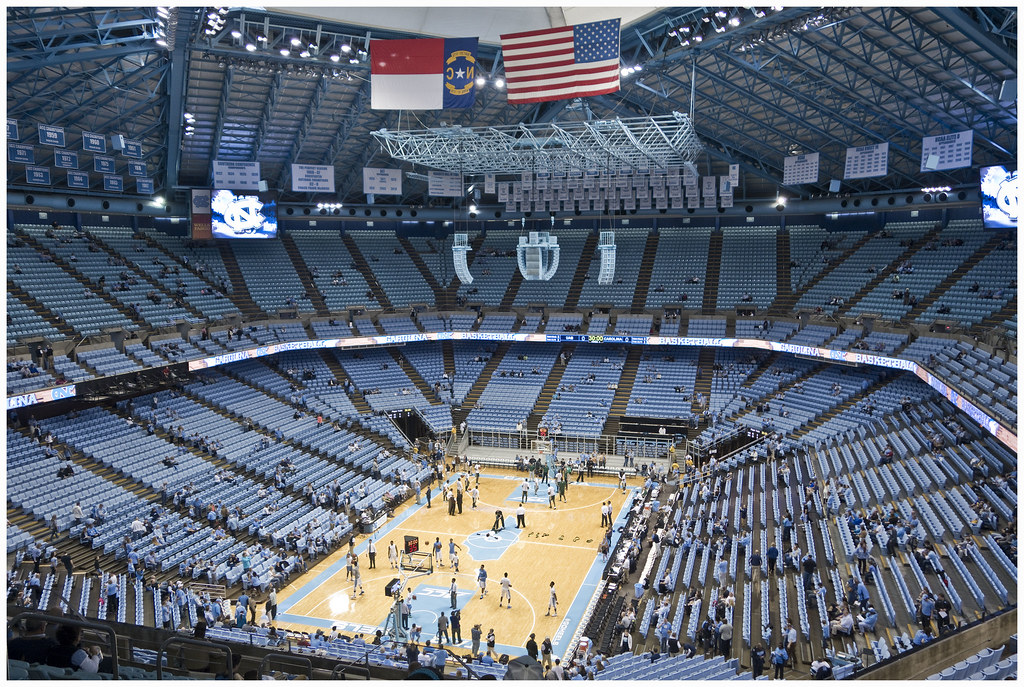
In contrast, the Dean Dome seats 21,750, and UNC fans complain that it doesn't have much atmosphere. It's considerably easier to get tickets -- as long as Duke is not the opponent. But tickets are going for over $1,000 from the school's website. UNC does put any tickets returned by the visiting team on sale at 5:00, and that's usually the only way to get a seat for anywhere near face value.
Getting There. It's 498 miles from Times Square to Cameron Indoor Stadium in Durham, and 507 miles to the Dean Smith Center in Chapel Hill. The schools are in that tricky range: A bit too close to fly, a bit too far to go any other way.
If you're going to drive, take the New Jersey Turnpike/Interstate 95 all the way from New Jersey to Petersburg, Virginia. At Exit 51, Interstate 85 splits off, and you can ride that all the way to Durham. Exit 174 will take you to U.S. Route 501 South.
On 501, Exit 107 takes you to Cameron Blvd. and the Duke campus. 501 merges with U.S. Route 15, and if you stay on "15-501" South to Manning Road (no exit number), you can turn right into the UNC campus. The 2 arenas are 10.8 road miles apart.
You'll be in New Jersey for about an hour and a half, Delaware for 20 minutes, Maryland for 2 hours, inside the Capital Beltway (Maryland, District of Columbia and Virginia) for half an hour if you're lucky (and don't make a rest stop anywhere near D.C.), Virginia for 3 hours, and North Carolina for about an hour and a half. Throw in traffic at each end, and in the DC area, and rest stops, preferably in Delaware and near Richmond, and it'll be close to 10 hours.
Greyhound doesn't go to Chapel Hill. It does go to Durham, 5 buses a day leaving from Port Authority, including 2 for which you won't have to change buses. (For the others, you would change in Richmond.) It's $118 round-trip. The station is at 515 W. Pettigrew Street.
Amtrak's
Carolinian leaves New York's Penn Station at 7:25 AM, and arrives at Durham at 5:50 PM, giving you just barely enough time to get to a hotel and then to the game the same night. So you might want to go a day earlier and spend the night. The next morning, the
Carolinian leaves Durham at 9:42 and arrives back in New York at 8:45 PM. Round-trip fare is $196. The station is at 601 W. Main Street, across from the Greyhound station.
Perhaps the best way to get from New York to the Raleigh area is by plane. If you fly United Airlines out of Newark, and you order your ticket online at this writing, you could get a nonstop round-trip flight to Raleigh-Durham International Airport for a shade over $200.
There is a reasonably-priced hotel called the Carolina Duke Inn, at 2517 Guess Road in Durham, off I-85. Cameron Stadium is 3 miles south (on foot, a little over 5 miles by car), and the Dean Smith Center is 13 miles southwest.
Once In the City. Both North Carolina and South Carolina were named for the King of England at the time of their initial settlements, King Charles I. Raleigh, the capital of North Carolina, was named for Sir Walter Raleigh, the English soldier who led the early English colonization of the Atlantic Coast (Virginia and the Carolinas).
North Carolina was both one of the Original 13 Colonies, and one of the 11 Confederate States. It was the 12th State to ratify the Constitution, on November 21, 1789; the 10th State to secede from the Union, on May 20, 1861; and the 4th former Confederate State to be readmitted, on July 4, 1868.
A reference to the Wright Brothers at Kitty Hawk,
not to Michael Jordan at Chapel Hill.
Durham was named for Bartlett S. Durham, who donated the land on which the city's 1st train station was to be built. Chapel Hill was named for the Chapel of the Cross, built on a hill in 1752, with its congregation moved to a new location in 1921. The Carolina Inn now stands on the site, and is considered a historic site in its own right.
Founded in 1792, Raleigh is home to about 430,000 people, making it the 2nd-largest city in the State, behind Charlotte. Durham has about 250,000 people; Chapel Hill, about 57,000; in each case, not counting the college students staying there.
The Raleigh-Durham area is about 70 percent white, 22 percent black, 5 percent Hispanic and 3 percent Asian. Durham County (including Durham), however, has about twice as many black people as Wake County (including Raleigh), and about 3 times as many as Orange County (including Chapel Hill).
The Raleigh-Durham area as a whole, known as the Triangle (or the "Research Triangle," to give it a tech-savvy nickname to suggest it's an East Coast version of the Silicon Valley) is home to a little over 2 million people. This ranks it 25th among NHL markets (ahead of only Nashville and Buffalo among U.S.-based teams), and would rank it 28th in the NBA, 29th in the NFL, and 30th and last in MLB, Don't expect it to ever get a team in the other markets, though.
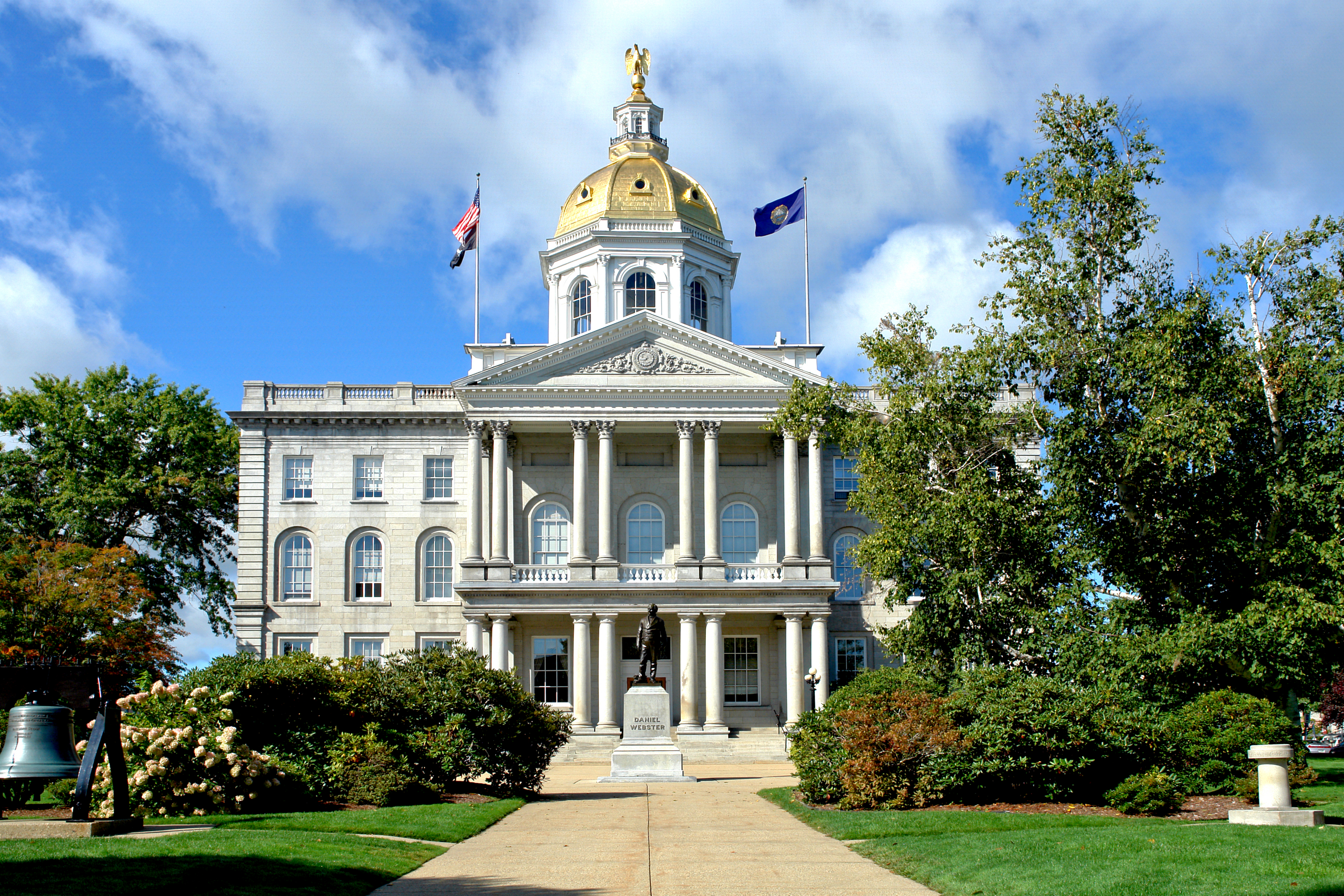
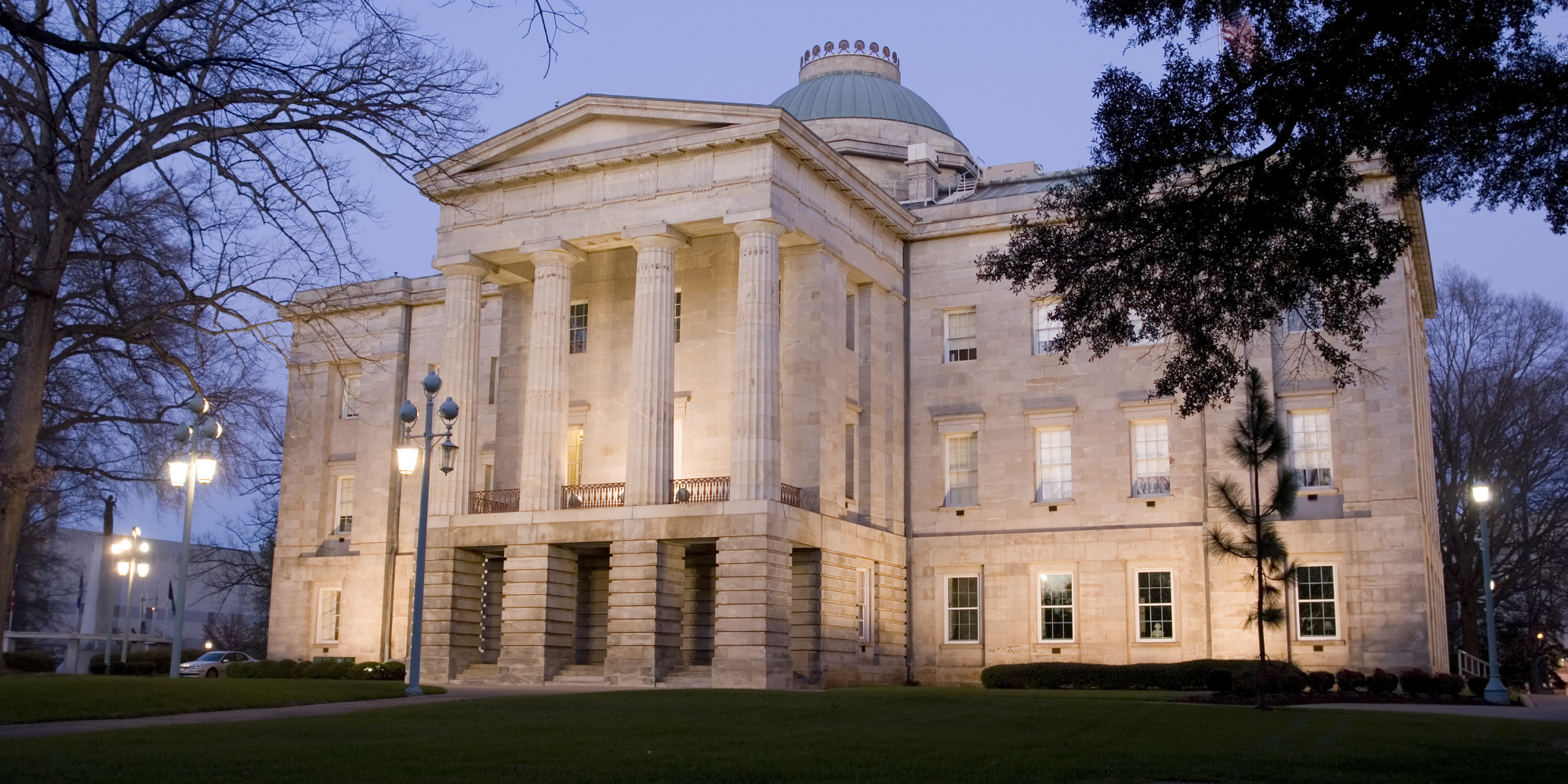
The State House, in Raleigh
Main Street is the divider for north-south addresses in Durham. The east-wide divider is Mangum Street. In Chapel Hill, the north-south divider is Franklin Street, and the east-west divider is Columbia Street.
Capital Area Transit runs buses around Raleigh. The fare is $2.25. GoTriangle serves the Triangle region: Raleigh, Durham and Chapel Hill. There is a light rail system being planned for the area, but it won't open before 2026. Interstate 540 is an incomplete beltway for the area.
The sales tax in North Carolina is 4.75 percent, but it rises to 6.75 percent in Raleigh. ZIP Codes for Raleigh and Chapel Hill start with the digits 275 and 276; and for Durham, 277. The Area Code for the area is 919, overlaid by 984. Progress Energy runs the local electricity.
In spite of Dean Smith's activism, and the apparent racial harmony on the Tar Heel and Blue Devil teams, the State of North Carolina is still Southern, and a former Confederate State, and has had its racial issues.
In 1870, 5 years after the war, the Ku Klux Klan used murder and intimidation to prevent recently freed slaves from exercising their right to vote, newly granted by the 15th Amendment to the Constitution. Governor William Holden (no relation to the later actor of the same name) assigned Colonel George Washington Kirk, who went from Union Army to Confederate Army and back to the Union, to handle things imposing martial law in Caswell and Alamance Counties, in the north-central part of the State, on the Virginia line. This became known as the Kirk-Holden War. The Wilmington Insurrection was carried out on November 10, 1898, white supremacists burning down the office of a newspaper, The Daily Record.
The Battle of Hayes Pond took place near Maxton on January 18, 1958, when KKK members tried to attack members of the Lumbee tribe of Native Americans, and got their asses kicked. On February 1, 1960, the Greensboro Sit-In began when black students at North Carolina A&T sat at the lunch counter at a Woolworth's, and refused to leave until they were served. The site of the store is now home to the International Civil Rights Center and Museum. On June 6, 1963, a group of black patrons was refused service in Lexington, and they fought back. One died, and it was one of the few times in the era when it wasn't the whites who started it.
UNC, chartered in 1789, is, of course, named for the State. In 1931, it was expanded into the Consolidated University of North Carolina system. Within the State, the main campus is usually just called "Chapel Hill," for the city. The North Carolina College for Women was brought into the system as UNC-Greensboro.
And North Carolina A&M was brought in, renamed North Carolina State University. Officially, it is still a part of the UNC system, but, unlike other other UNC campuses, it retains a separate identity, especially where sports is concerned.
UNC-Charlotte was added in 1965, and UNC-Asheville and UNC-Wilmington in 1969. In 1972, they added Appalachian State University (in Boone), East Carolina University in Greenville, Elizabeth City State University, Fayetteville State University, North Carolina Agricultural and Technical State University in Greensboro (NC A&T), North Carolina Central Univesrity in Durham, Pembroke State University (renamed UNC-Pembroke in 1996), UNC School of the Arts in Winston-Salem, Western Carolina University in Collowhee, Winston-Salem State University, and North Carolina School of Science and Mathematics in Durham. (NC A&T, NCCU and WSSU are historically black schools.)
UNC's arch-rival was founded at Trinity College in 1838 and moved to Durham in 1892. The school's board renamed it for James Buchanan Duke (1856-1925) in 1924, after his donations. He had been a textile and tobacco magnate, with plants in Durham. Duke University has just the 1 campus, although it is spread over a wide area of Durham.
Duke graduates in sports other than
basketball and football include:
* Baseball: Dick Groat, Quinton
McCracken, Scott Schoeneweis, Chris Capuano, Marcus Stroman, and Lawrence “Crash” Davis, a 2nd baseman for the Philadelphia Athletics in the 1940s, who grew up in North Carolina and played minor-league baseball there, and for whom Ron Shelton named the protagonist in his Durham-set baseball film Bull Durham.
* Soccer: John Kerr (the 1st American-trained player in England's 1st division, with Hampshire team Portsmouth in 1987), Jay Heaps, Jason
Kreis, Andrew Wenger (no relation to Arsene).
Also, sportswriter John
Feinstein '77, Tampa Bay Lightning owner Jeffrey Vinik '81, and equestrienne
Jessica Springsteen '14 – Bruce's daughter has done rather well in the sport,
getting as far as an alternate for the U.S. Olympic Team in 2012.
From outside sports,
notable Duke graduates include these political figures:
* Senators: Lee Overman
of North Carolina, Class of 1874; James Pearson of Kansas '42, Elizabeth Dole
'58, Bob Kreuger of Texas '59, Ted Kaufman of Delaware '60, Shelley Moore
Capito of West Virginia ’75, Rand Paul of Kentucky '88.
* Congressmen (a very
incomplete list): Henry Hyde of Illinois '47, Ron Paul of Texas '61 (M.D.), Jim
Courter of New Jersey '66 (law, was my Congressman from 1983 to 1991 and the
Republican nominee for Governor in 1989), Ben Quayle of Arizona '98 (Dan's
son).
* Cabinet officials:
Secretary of Labor Dole; Secretaries of Commerce Daniel Roper 1888 and Juanita
Kreps '44, Secretary of Veterans Affairs Eric Shinseki '76.
* Governors: Gregg
Cherry of North Carolina 1913, William Umstead of North Carolina '21, Claude
Kirk of Florida '48, Bob Wise of West Virginia '70, and Eric Greitens of
Missouri '96. (UPDATE: As of January 2019, add J.B. Pritzker of Illinois '87.)
Bill Campbell, a former Mayor of Atlanta, got a law degree from Duke in 1977.
No Duke undergraduate
has ever become President of the United States, but Richard Nixon got his law
degree from them in 1937, and his brother Ed Nixon got an undergraduate degree
there in 1952. Ricardo Lagos, a former President of Chile, got a Ph.D. there in
1966. Another politician with a Duke Law degree is Jim Courter, who served New
Jersey (including my district) in Congress, and was the 1989 Republican nominee
for Governor. Russell Kirk '41, through his book The Conservative Mind, was a
leading political philosopher in the 20th Century.
* Civil Rights: Benjamin
Chavis '80, William Barber '89.
* Business: William
Wrigley Jr. '85 (his family had sold the Chicago Cubs before then), Melinda
Gates '86, Dylan Lauren '96 (Ralph Lauren’s daughter and the founder of Dylans
Candy Bar).
* Literature: William
Styron and Mac Hyman '47, Peter Maas '49, Anne Tyler '61.
* Entertainment:
Bandleader Les Brown '36, screenwriter Randall Wallace '71, TV producer Rene
Echevarria and actor Jared Harris '84, actor Martin Kratt '89, actor Ken Jeong
'90, actress Annabeth Gish '92, songwriter Kara DioGuardi '93.
* Journalism: Clay
Felker '51, David Hartman '56, Charlie Rose '64, Judy Woodruff ’68, Sean
McManus '77 (president of CBS News and son of ABC sports legend Jim McKay),
John Harwood and John Siegenthaler Jr. '78, Dan Abrams '88, Michelle
Charlesworth '92, Mark Mazzetti '96, Melissa Harris-Perry '99.
Notable fictional Duke
graduates include Lieutenant Colonel Sarah MacKenzie, USMC (Catherine Bell on
JAG), Ben Barry (Matthew McConaughey in How to Lose a Guy in 10 Days), Sam
Seaborn (Rob Lowe on The West Wing), and Stacy Warner (Sela Ward on House).
Notable real-life UNC products, in sports other than
basketball and football:
* Baseball: Walt Weiss,
B.J. Surhoff, Paul Shuey, Brian Roberts, Kyle Seager, Daniel Bard, Matt Harvey,
Andrew Miller. And the real Dr. Archibald "Moonlight" Graham.
* Soccer, including
several of the players who've made the U.S. women's national team a 3-time
World Cup winner: Mia Hamm, Kristine Lilly, Eddie Pope, Eric Lichaj, Heather
O’Reilly, Yale Averbuch, Ashlyn Harris, Tobin Heath, Allie Long, Whitney Engen,
Meghan Klingenburg, Crystal Dunn.
* Track & Field: Jim
Beatty, and, dubiously, Marion Jones.
* Sportswriting and
Broadcasting: Furman Bisher '38, Woody Durham '63, Marty Brennaman '65, Peter
Gammons '67, Jim Lampley '71, Stuart Scott '87.
I could also have
included Raymond Floyd and Davis Love III, but golf is not a sport.
In other fields:
* Business: Caleb
Bradham 1890, pharmacist and inventor of Pepsi-Cola.
* Journalism: Vermont
Royster '35, Tom Wicker '48, Gene Roberts '54, Edwin Yoder '56, Jonathan
Yardley '61, Charles Kuralt '65, Monica Malpass '83, Brooke Baldwin '01.
* Literature: Thomas
Wolfe 1920, novelist Walker Percy '37, poet Lawrence Ferlinghetti '41,
journalist and novelist Armistead Maupin '66, historical Taylor Branch '68,
journalist and Boston talk-radio host Howie Carr '73. Historian Shelby Foote
attended in the late 1930s, but did not graduate.
* Entertainment: Actors
Whit Bissell '32, John Forsythe '48, Andy Griffith and George Grizzard '49,
Louise Fletcher '57, Sharon Lawrence '83, Dan Cortese and Billy Crudup '90;
bandleader Kay Kyser '28; songwriter Richard Adler '43; singer Oliver Swofford
'67 (he used only his first name); cartoonist Jeff MacNelly '69; TV producer
Michael Piller '70; comedian Lewis Black '70; disc jockey Rick Dees '72; film
director Peyton Reed '86; TV show host Kit Hoover '92.
Politics, representing
North Carolina unless otherwise stated:
* President: James K.
Polk, Class of 1818.
* Vice President:
William Rufus DeVane King, Class of 1803, the shortest-serving Vice President
ever, 25 days under Franklin Pierce in 1853, as he was already dying of
tuberculosis. He had served North Carolina in the House of Representatives and
Alabama in the Senate.
* Governors: John Branch
1801, Aaron V. Brown and Charles Manly 1814, Richard D. Spaight 1815, John M.
Morehead 1817, William D. Moseley 1818 of Florida (that State's 1st Governor), William A. Graham 1824, Henry T. Clark 1826, Tod Caldwell 1840, John
W. Ellis 1841, Zebulon Vance 1852, Elias Carr 1859, Charles Aycock and Locke
Craig 1880, Angus McLean 1892, John Ehringhaus 1902, William B. Umstead 1916,
Luther Hodges 1919, Dan Moore '27, Terry Sanford '39, Steve Copwer '60 of
Alaska, Gaston Caperton '63 of West Virginia, Mike Easley '72, and current
Governor Roy Cooper '79.
* Senators: King,
Branch, Graham, Sanford, Willie P. Mangum 1815, William H. Haywood 1819, Alfred
Nicholson 1827 of Tennessee, Thomas Clingman 1832, John Pool 1847, William R.
Webb of Tennessee 1867, Sam Ervin 1917, Paul Wellstone '65 of Minnesota.
* Cabinet Members: John
Y. Mason 1816, Attorney General under James K. Polk; and Jacob Thompson 1831,
Secretary of the Interior under James Buchanan.
North Carolina is known for its beaches on "The Outer Banks," or "OBX." This includes Kill Devil Hill, with the Wright Brothers National Memorial, on roughly the location where Orville Wright, with brother Wilbur Wright watching, took off in Flyer I on December 17, 1903, marking the 1st heavier-than-air human flight.
The Outer Banks are centered on Nags Head, about 193 miles east of the State House in Raleigh, 199 miles east of the PNC Arena, 219 miles east of the Dean Smith Center, and 220 miles east of Cameron Indoor Stadium.
Going In. Cameron Indoor Stadium opened in 1940, and is at 301 Whitford Drive, about 4 miles west of downtown Durham. Take the DRX bus from the Amtrak station. If you drive in, expect to pay about $12 to park.
It was known as Duke Indoor Stadium until 1972, when Eddie Cameron retired, after having been basketball coach at Duke from 1928 to 1942, football coach from 1942 to 1945, and athletic director from 1951 to 1972.
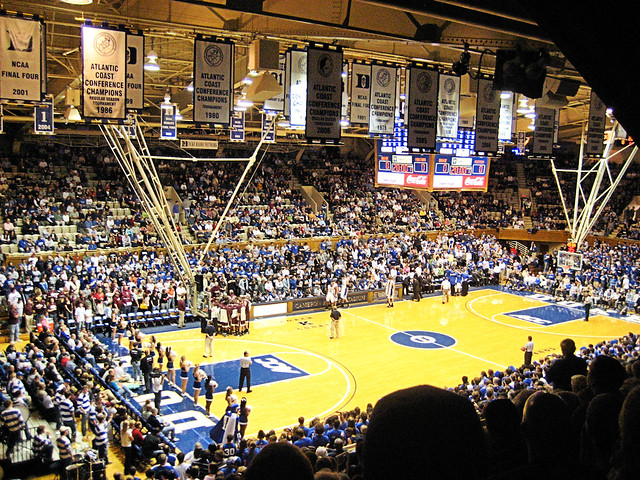
Its capacity of 9,314 seems small, but the fans are almost right on top of the players, combining with the home team's success to create the most intimidating home-court advantage in college basketball.
The 40,004-seat Brooks Field at Wallace Wade Stadium, opening in 1929, is next door. Wallace Wade coached football at Duke from 1931 to 1941, after building the great program at the University of Alabama, and the former Duke Stadium was renamed for him in 1967. The field itself was renamed in 2015, after a $13 million contribution from Steve Brooks, an insurance executive and a Duke graduate.
Wade Stadium hosted the only Rose Bowl away from Pasadena, in 1942, because of concerns over the Pacific Coast just 25 days after the bombing of Pearl Harbor. Duke lost it to Oregon State. Both its field and Cameron's court are laid out, more or less, north-to-south.
UPDATE: On
November 19, 2018,
Moneywise compiled a list of their
Worst
College Football Stadiums, the bottom 19 percent of college football, 25 out of 129. Wade Stadium came in 23rd, with objections that it feels like an oversized high school stadium.
At Carolina: The Dean E. Smith Student Activities Center, a.k.a. the Dean Dome, is at 300 Skipper Bowles Drive, about a mile and a half southeast of downtown Chapel Hill, about 12 miles southwest of downtown Durham, and about 28 miles northwest of downtown Raleigh. Bus 400 from downtown Durham. (Hargrove "Skipper" Bowles was a North Carolina politician and major UNC fundraiser, and the father of noted political figure Erskine Bowles.) If you drive in, expect to pay about $7.00 to park.
It opened in 1986, and Dean Smith, who'd coached the Tar Heels since 1961, told the University he did not want it named after him. He relented when they told him his name would be worth a great deal more in fundraising. He continued coaching them until retiring in 1997.
The court is laid out north-to-south. It seats 21,750, making it the 3rd-largest on-campus basketball arena, if you count the Carrier Dome in Syracuse, which also hosted football. The other one with more is the Thompson-Boling Arena at the University of Tennessee.
The 8,010-seat William Donald Carmichael Jr. Arena (smaller than Cameron Stadium), named for a former school official, where the Tar Heels played from 1965 to 1986 (and won the National Championship in 1982), is at 310 South Road.
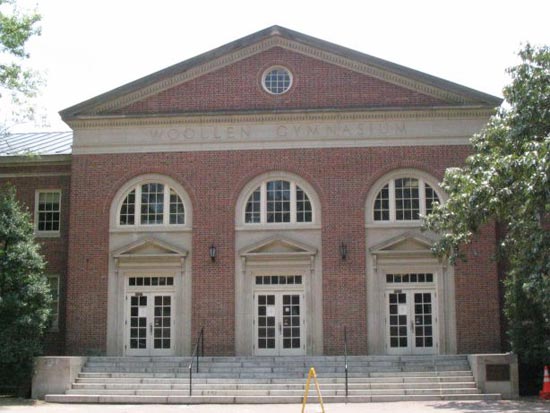
Woollen Gymnasium, where they played from 1937 to 1965 (and won the National Championship in 1957), is also at South Road. Current coach Roy Williams still holds his annual Summer basketball camp there.
Kenan Memorial Stadium, home to Tar Heel football since 1927, is at 104 Stadium Drive. The field is laid out mostly east-to-west, which can be a problem due to the sun. William R. Kenan Jr., a dairy farmer and a UNC graduate, made a donation to build it, and so it was named for him.
Kenan Stadium, Woollen Gym and Carmichael Arena are within a 5-minute walk of each other, and within a 20-minute walk of the Dean Dome.
The Dean Dome has hosted concerts by many legendary acts, including the Grateful Dead, Bruce Springsteen, R.E.M., Bon Jovi, Janet Jackson, Guns N' Roses, Boyz II Men and many others. In 2008, Senator Barack Obama held a campaign rally there, wearing a Carolina blue tie. He won North Carolina that time. When he ran for re-election in 2012, he had his convention in Charlotte, but didn't show up in Chapel Hill, and lost the State, although he won the nation as a whole.
Food. This is the South, tailgate party country, and North Carolina is among the places in this country particularly known for good barbecue. Tailgating is usually not done before college basketball games, and college basketball arenas are not particularly known for great food. You're probably better off eating before going in, and after coming out.
According to GoDuke.com, "A great variety of food items and Coca-Cola products are available from the concession stands located throughout Cameron Indoor Stadium operated by Blue Devil Concessions. Concession stands are located on the lower level in the North Lobby behind section 18 and on the upper level in the Hall of Honor and behind Sections 2, 3, 6, 7, 10, 11, and 15."
According to GoHeels.com, "Concession stands are located around the concourse and offer a wide variety of snacks, hot foods and beverages. Alcohol is neither sold nor permitted in the Smith Center." But they don't get more specific than that.
Team History Displays. Duke and UNC were both charter members of the Atlantic Coast Conference in 1953. Duke had some success before Mike Krzyzewski arrived in 1980. Vic Bubas coached them to the NCAA Final Four in 1963, '64 and '66, and the ACC title all 3 of those years and '65; and Bill Foster, who previously coached Rutgers, took them to the Final Four in 1978 and an ACC title in 1979.
But "Coach K" has taken them to another level. He's brought them ACC regular-season titles in 1986, '91, '92, '94, '97, '98, '99, 2000, '01, '04, '06 and '10; ACC Tournament titles in 1986, '88, '92, '99, 2000, '01, '02, '03, '05, '06, '09, '10 and '11; the Final Four in 1988, '89, '91, '92, '94, 2001, '04, '10 and '15; and the National Championship in 1991, 1992, 2001, 2010 and 2015. He has now won over 1,000 games as head coach at Army and Duke combined, and is approaching 1,000 wins at Duke alone.
Coach K and his players, after beating St. John's
at Madison Square Garden for his 1,000th win,
January 25, 2015
Duke has retired 13 numbers from its basketball team. Four of them came before Coach K: 10, guard Dick Groat '52 (better known as a baseball player); 25, forward Art Heyman '63 (Final Four, and a native of Oceanside, Long Island); 44, guard Jeff Mullins '64 ('63 Final Four, '64 Final, born in Queens but grew up in Kentucky); 43, center Mike Gminski '80 (1978 Final, a native of Monroe, Connecticut and later a star for the Ne Jersey Nets).
From the Coach K Era; 24, guard Johnny Dawkins '86 (Final, now head coach at Central Florida); 35, forward Danny Ferry '89 ('86 Final); 32, forward Christian Laettner '92 ('91 & '92 National Champs); 11, guard Bobby Hurley '93 ('91 & '92 National Champs, a native of Jersey City, New Jersey, now the head coach at Arizona State); 33, forward Grant Hill '94 ('91 & '92 National Champs); 31, forward Shane Battier '01 ('99 Final Four, '01 National Champs); 22, guard Jason "Jay" Williams '03 ('01 National Champs, a native of Plainfield, New Jersey and a graduate of St. Joseph's in Metuchen); 23, forward Shelden Williams '07 ('04 Final Four, no relation to Jay, played for the Knicks and the Nets); and 4, guard J.J. Redick '07 ('04 Final Four, and the only one of these still active in the NBA).
Oddly, none of these players has been elected to the Basketball Hall of Fame, although Krzyzewski, now the winningest coach in NCAA history (surpassing UNC's Dean Smith), has.
Duke has been far less successful in football. But they won the Southern Conference title in 133, '35, '36, '38, '39, '41, '43, '44, '45 and '52; the ACC title in 1953, '54, '55, '60, '61, '62 and '89; the ACC Coastal Division in 2013; the 1945 Sugar Bowl, the 1955 Orange Bowl, the 1961 Cotton Bowl, and, nodding to their New York connections, the 2015 Pinstripe Bowl at Yankee Stadium. Their football legends include 1930s quarterback Clarence "Ace" Parker (who also played Major League Baseball and lived to be 101), 1930s running back George McAfee, and 1960s quarterback Sonny Jurgensen, all in the Pro Football Hall of Fame; and 1960s Giants defensive tackle Al DeRogatis.
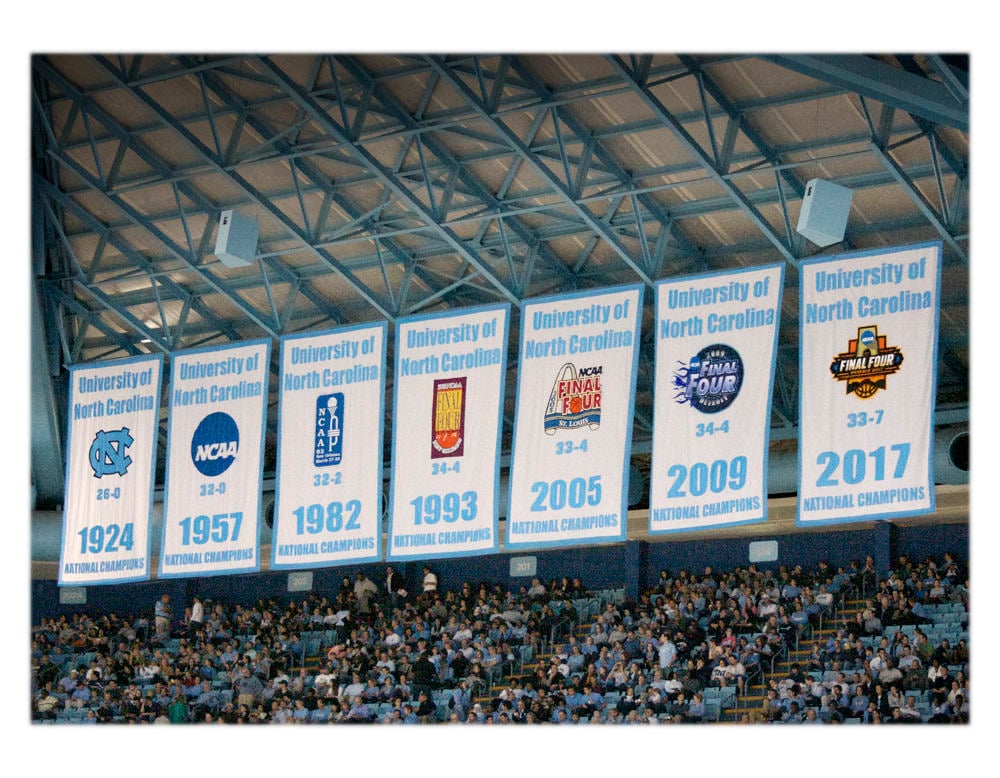
Carolina hangs National Championship banners in the rafters of the Dean Dome -- 6 of them: 1924, 1957, 1982, 1993, 2005 and 2009. The Tar Heels have reached 19 Final Fours, have won their conference's regular-season title 38 times, and have won its tournament 26 times (including last season's). They hang banners for these achievements as well.
UPDATE: After losing the 2016 National Championship Game to Villanova in crushing fashion, North Carolina beat Gonzaga in the 2017 Final. That's 6 titles to Duke's 5 in the NCAA Tournament era, 7-5 overall.
Carolina honors a whopping 51 players with banners in the rafters:
* 1924 National Champions: (no number), center Cartwright Carmichael; and (no number), forward Jack Cobb.
* 1940 ACC Tournament and 1941 ACC Regular Season Champions: 20, forward George Glamack.
* 1945 ACC Tournament Champions, 1946 ACC Regular Season Champions and NCAA Final: 8, guard Jim Jordan; and 13, forward John "Hook" Dillon.
* 1956 Regular Season Champions, 1957 ACC Regular Season and Tournament Champions and National Champions: 10, forward Lennie Rosenbluth; 35, forward Pete Brennan; and 40, guard Tommy Kearns.
* 1959, 1960 and 1961 ACC Regular Season Champions: 12, forward Lee Shaffer; 22, guard York Larese; and 35, forward Doug Moe. From 1961 alone, 11, guard Larry Brown.
* 1962 to 1965, but no titles: 32, forward Billy Cunningham.
* 1967 ACC Regular Season and Tournament Champions and NCAA Final Four, 1968 ACC Regular Season and Tournament Champions and NCAA Final, 1969 ACC Regular Season and Tournament Champions and NCAA Final Four: 22, guard Bob Lewis ('67 only); 44, guard Larry Miller ('67 and '68, but not '69); 33, guard Charlie Scott ('68 and '69, but not '67).
* 1971 ACC Regular Season Champions, 1972 ACC Regular Season and Tournament Champions and NCAA Final Four: 31, forward Bill Chamberlain; 44, forward Dennis Wuycik; 35, center Bob McAdoo ('72 only); and 34, forward Bobby Jones ('72 only).
* 1975 ACC Tournament Champions, 1976 ACC Regular Season Champions, 1977 ACC Regular Season and Tournament Champions and NCAA Final, 1978 ACC Regular Season Champions: 21, forward Mitch Kupchak ('75 and '76); 24, guard Walter Davis ('75, '76 and '77); 45, forward Tommy LaGarde ('75, '76 and '77); and 12, guard Phil Ford (all 4).
* 1979 ACC Regular Season and Tournament Champions, 1981 ACC Tournament Champions and NCAA Final: 31, forward Mike O'Koren ('79); 30, forward Al Wood.
* 1982 ACC Regular Season, Tournament and National Champions: 52, forward James Worthy; 41, forward Sam Perkins; and 23, guard Michael Jordan. Perkins and Jordan were also there for the 1983 and 1984 ACC Regular Season titles.
* 1983, 1984 and 1985 ACC Regular Season Champions: 42, center Brad Daugherty; 30, guard Kenny Smith.
* 1987 and 1988 ACC Regular Season Champions, 1989 ACC Tournament Champions: 34, forward J.R. Reid.
* 1991 ACC Regular Season and Tournament Champions and NCAA Final Four: 34, forward George Lynch.
* 1993 ACC Regular Season and National Champions, 1994 ACC Tournament Champions: 00, center Eric Montross; 21, guard Donald Williams.
* 1995 ACC Regular Season Champions and NCAA Final Four: 42, guard Jerry Stackhouse; and 30, forward Rasheed Wallace.
* 1997 and 1998 ACC Tournament Champions and NCAA Final Four: 15, guard Vince Carter; and 33, forward Antawn Jamison.
* 2000 NCAA Final Four, 2001 ACC Regular Season Champions: 00, center Brendan Haywood; and 40, guard Joseph Forte.
* 2005 ACC Regular Season and National Champions: 2, guard Raymond Felton; 42, forward Sean May; and 32, guard Rashad McCants.
* 2007 and 2008 ACC Regular Season and Conference Champions, 2008 NCAA Final Four, 2009 ACC Regular Season and National Champions: 50, forward Tyler Hansbrough; 5, guard Ty Lawson; and 22, guard Wayne Ellington.
* 2011 and 2012 ACC Regular Season Champions: 44, center Tyler Zeller; and 40, guard Harrison Barnes.
* 2016 ACC Regular Season and Tournament Champions, and NCAA Final: 5, guard Marcus Paige; and 11, forward Brice Johnson.
The 8 players whose numbers are retired are: Cobb, Glamack, Rosenbluth, Ford, Worthy, Jordan, Jamison and Hansbrough. Their banners are blue. The other 43 players are honored on white banners.
There are 9 Tar Heels in the Basketball Hall of Fame: Coaches Bernard Carnevale, Frank McGuire, Dean Smith and Roy Williams; and players Billy Cunningham, Bob McAdoo, Larry Brown (elected as a coach), James Worthy and Michael Jordan. Cunningham, Worthy and Jordan were named to the NBA's 50th Anniversary 50 Greatest Players in 1996. Charlie Scott was named to the ABA's All-Time Team for his performance with the Virginia Squires.
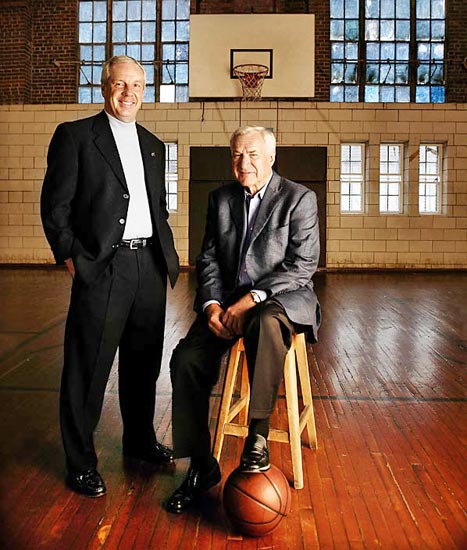
Roy Williams and the late Dean Smith,
inside Woollen Gymnasium
The Duke Basketball Museum and Sports Hall of Fame is adjacent to Cameron, at the Schwartz-Butters Athletic Center, at 306 Towerview Road. The Carolina Basketball Museum is on the 1st floor of the Ernie Williamson Athletic Center, adjacent to the Dean Dome, at 450 Skipper Bowles Drive. It is open from 10:00 AM to 4:00 PM on weekdays, and 9:00 AM to 1:00 PM on Saturdays.
As with Duke, UNC's football program doesn't come anywhere near its basketball success. They won the Southern Conference in 1895, 1922, 1946 and 1949, and the ACCin 1963, 1971, 1972, 1977 and 1980. They've won 14 bowl games, but none of them have been any of the traditional New Year's Day bowls: They lost the Sugar Bowl in 1947 and '49, and the Cotton Bowl in '50, and haven't been to one of those since.
They've honored 27 players in a ring-of-fame-type display at Kenan Stadium, although they haven't retired the numbers of any of them. The name that will stick out to New Yorkers is Lawrence Taylor, who wore Number 98 for Carolina from 1977 to 198. Other noteworthy Tar Heel grid greats include Number 44, 1940s running back Charlie "Choo Choo" Justice, who went on to star for the Washington Redskins; another 44, 1980s running back Kelvin Bryant, who won championships in both the USFL (for the Philadelphia Stars) and the NFL (for the Redskins); and 49, defensive end Julius Peppers.
A bust of Dean Smith is prominently displayed inside the arena, and a statue of Charlie Justice is outside the stadium.
Carolina currently leads the rivalry 135-110 in basketball, and 58-38-4 in football. (UPDATE: As of the conclusion of the 2019 football season, it's now 139-112 UNC in basketball, and 60-39-4 UNC in football.)
Stuff. Your best bets for team merchandise are the University Bookstores. Duke: 125 Science Drive, across from the famed University Chapel. UNC:
207 South Road, across from Kenan Stadium.
The best book about Duke basketball is Duke Basketball: A Pictorial History by Lewis Bowling, published in 2008. Two years later, Adam Lucas' book Carolina Basketball: A Century of Excellence was published.
In 2007, Will Blythe, a Carolina graduate who now writes for Harper's magazine, published To Hate Like This Is to Be Happy Forever: A Thoroughly Obsessive, Intermittently Uplifting, and Occasionally Unbiased Account of the Duke-North Carolina Basketball Rivalry. And in 2006, Alwyn Featherson took it 2 steps further by including 2 other nearby schools in Tobacco Road: Duke, Carolina, N.C. State, Wake Forest, and the History of the Most Intense Backyard Rivalries in Sports.
In 2005, Duke released the DVD
A Cut Above: 100 Seasons of Duke Basketball. In 2010, UNC released
North Carolina Basketball: Celebration of a Century.
During the Game. Fans of North Carolina's pro teams do not have a rough reputation. UNC fans usually don't, either, but the Duke rivalry amps everything up.
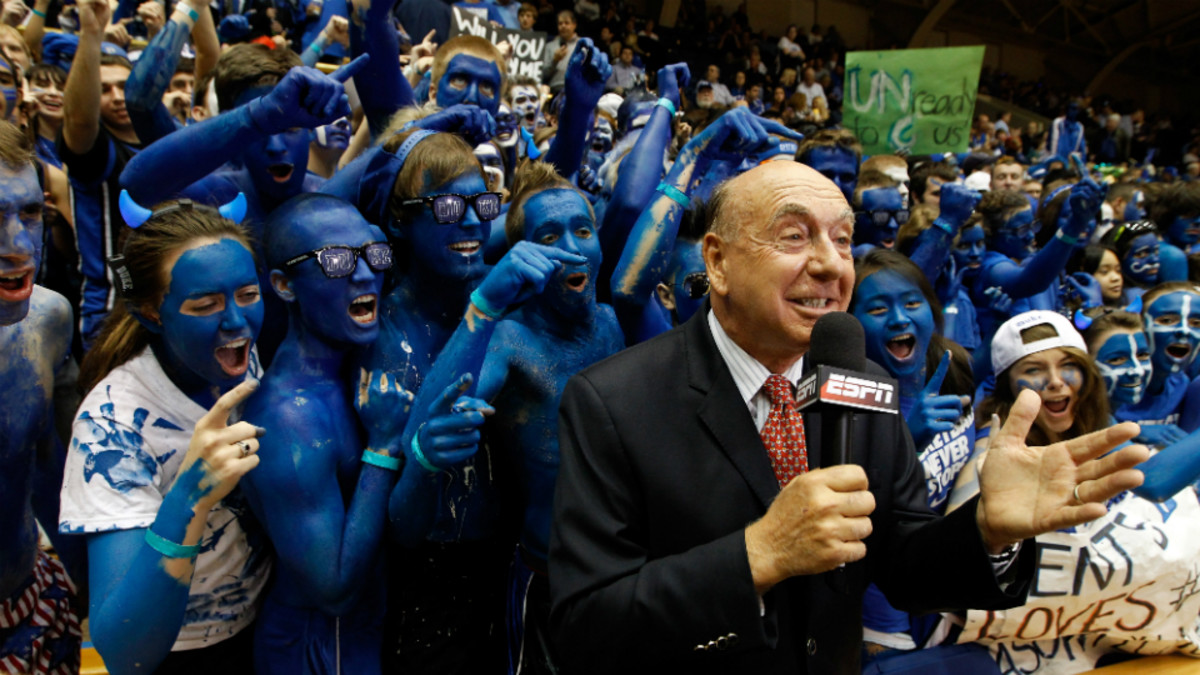
As for Duke fans... They are the closest thing that North American sports has to an English soccer-style hooligan firm, or a European-style "ultra" group.
They make camp outside the arena. Literally: They set up tents in a grassy area that got nicknamed "Krzyzewskiville." After waiting nearly 24 hours to get in, as one reporter put it, "It's no surprise that when they get inside, they become overly obnoxious and raucous."
Krzyzewskiville
Like the ultras, they are organized, and prepare for every game. They hand out lyric sheets to get non-members to chant along with them. It appears that they invented the "Air... ball!" chant in 1975.
A 2013-14 season cheat sheet
And they throw things. If a player is tall and thin, they'll throw cardboard boxes of noodles or spaghetti. If a player is fat, they'll throw Twinkies. Lorenzo Charles, whose dunk won the 1983 National Championship for North Carolina State, was later caught stealing a pizza, and the Crazies threw pizza boxes at him. Another N.C. State player, Chris Washburn, was caught stealing a stereo, and the Crazies threw records at him.
Despite this hooliganism, they are elitist. Duke is a private school: If the South had its own "Ivy League," it would include Duke. (Also William & Mary, Vanderbilt, Emory, Tulane and Rice.) Against UNC, they chant, "State school!" Against N.C. State, they chant, "Safety school!" They held up signs saying, "If you can't go to college, go to State!" If Duke falls behind against either team, they chant to the opposing fans, "It's all right, it's okay, you're gonna work for us one day!"
Dick Vitale with the Cameron Crazies.
Yes, they allow female students and,
despite Elton Brand's experience, black students.
A writer for
The Washington Post criticized this, so they made placards that said, "If you can't go to State, write for
The Washington Post!" This was well in the tradition of their response to Dean Smith's criticism of their chant of, "Hey, ref, you suck!" Upon the Heels' next visit, when a call didn't go their way, they chanted, "Hey, ref, we beg to differ!"
And while Smith was a beacon of the civil rights movement in the 1960s, Duke, despite having former Governor, future Senator, and UNC graduate Terry Sanford as their President from 1969 to 1985 (and he warned the Crazies about their foul language), is insensitive on racial matters as well. In 1999, Elton Brand, William Avery and Corey Maggette all famously shattered Coach K's then-perfect record of Duke players staying for all 4 years, leaving for the NBA Draft early, in Brand's case, after only 2 years. A woman sent him a racially-charged letter berating him for his decision. He publicly said that it was people like her that caused him to leave.
In spite of all of that, the Cameron Crazies are not known for violence. If you stay away from them, most likely, they'll stay away from you -- even if you're rooting for Carolina. If you're rooting for Duke, well, they're still not the best advertisement for the team.
Duke's teams are named for the Chasseurs Alpins, the French Alpine light infantry battalion during World War I, and were known as
les Diables Bleus -- the Blue Devils. Veterans of the unit toured America after we got into it in 1917, to raise money for their country, and their dress uniforms, with blue berets and blue capes, captured the American imagination.
When Duke began playing football in 1921 after having banned it for several years, they needed a name beyond "the Blue and White," and someone remembered
les Diables Bleus, and it was adopted in 1923 -- once the Methodist Church, which ran the school, was convinced it was military and not religious.
The Blue Devil. No beret, but he does wear a cape.
So what's a Tar Heel? Beyond being the name of UNC's teams, it describes any person from North Carolina. This differentiates it from a Dukie, because, although both schools have national student bodies, Duke has a far greater percentage of out-of-State students.
Tar, pitch and turpentine created from the vast pine forests were once major exports from the State. The phrase "tar heel" gained popularity during the American Civil War, because it was said that North Carolina's contributions to the Confederate Army "stuck to their ranks like they had tar on their heels."
But it goes back even further than that. During the War of the American Revolution, British General Charles Cornwallis had his troops ford a river, but it had been sabotaged by patriots dumping tar into it. Thus, his men, with their boots off to avoid soaking them, found their feet covered with tar. After that, anyone who waded through North Carolina rivers had "tar heels." But when, during the Civil War, 85 years later, Confederate General Robert E. Lee said, "God bless the Tar-heel boys," the earlier explanation was forgotten.
Back in the 1950s, St. John's University coach Frank McGuire was hired at UNC, and used what we would now call street cred to bring his fellow Irish Catholics (such as Tommy Kearns) and some Jewish players (such as Lennie Rosenbluth) down from New York City, in what was nicknamed, in a less enlightened time, "The Underground Railroad."
This resulted in the 1957 season, when UNC went undefeated and won the National Championship, beating a University of Kansas team led by Wilt Chamberlain in triple overtime in the Final at the Kansas City Municipal Auditorium. Ironically, McGuire's chief assistant and successor was a Kansas graduate, Dean Smith. (And McGuire left to coach the Philadelphia Warriors, whose star was Chamberlain.)
But that was then. From the 1980s onward, it is Duke that has the greater reputation for non-Carolina students. Indeed, the very name has a New York and New Jersey connection, as James B. Duke, though born and raised in Durham, lived in Manhattan. His mansion at 1 East 78th Street still stands, and he had an estate in Hillsborough, Somerset County, New Jersey, named Duke Farms. His daughter was the socialite and philanthropist Doris Duke. The Doris Duke Foundation opened Duke Farms and its gardens to the public in 2012.
So it's not surprising that New York and New Jersey high school students -- and not just basketball players such as the brothers Bobby and Danny Hurley of Jersey City -- have looked to Duke for an education. But, as Buddy Songy, a Baton Rouge radio talk-show host whose specialty is Louisiana State University football, once put it, "Two years at Duke, the University of New Jersey at Durham, does not make you a son of the South."
Or, as Jim Valvano, a Long Island native who played basketball at Rutgers before becoming North Carolina State's coach, put it, Duke fans didn't bother him, because, "They're all from Jersey, like me." Well, New Jersey's hockey team
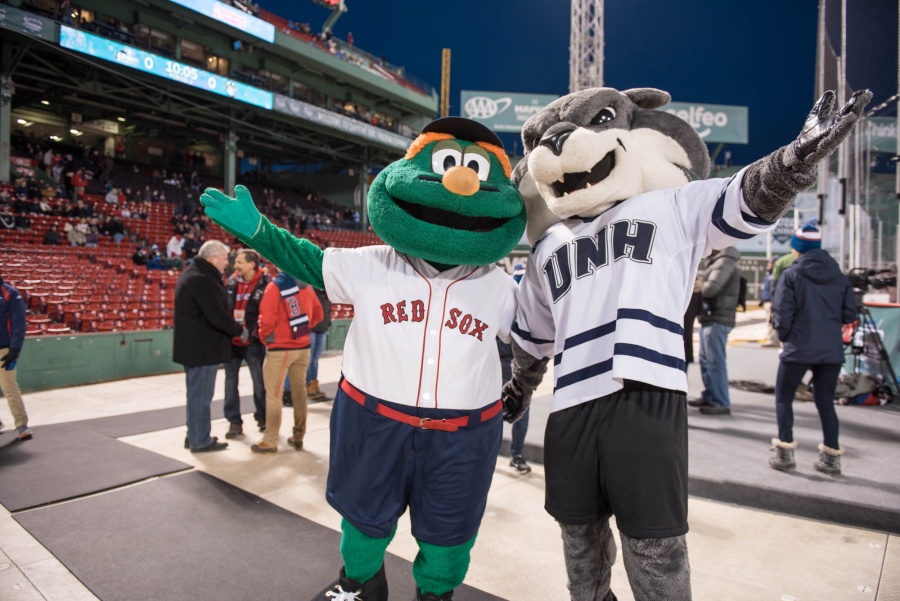
is called the Devils, but they didn't arrive until 1982, and they wear red.
Because the lower level of the Dean Dome is mostly season-ticket holders, and thus older fans, the place was said to have lost a lot of atmosphere from the previous building -- not unlike the new Yankee Stadium, the new TD Garden in Boston, and Arsenal's Emirates Stadium, all of which it preceded by several years. It has been called "a wine-and-cheese crowd," particularly by Duke fans.
This began to change in 1992, with an increase in student seating. In 2004, Connecticut came in ranked Number 1, and Carolina beat them, and their coach Jim Calhoun said, "I don't know what they are talking about, because there was no wine-and-cheese crowd here today." Two years later, Ohio State came in ranked Number 1, and also lost to Carolina, and coach Thad Matta said, "I think I've never been in a building that was as loud as that building was at times.
Tar Heel fans. Not better dressed, just better.
Both teams hold auditions for singing the National Anthem. Duke has 2 fight songs: "Blue and White" and "Fight! Blue Devils, Fight!" Its most-frequent cheer, at least among the printable ones, is the simple, "Let's go, Duke!" Carolina songs include "I'm a Tar Heel Born" and "Here Comes Carolina."
Aside from stickers of white footprints with black heels -- actually black, not African-American -- to suggest "Tar Heels," placed on stickers, Carolina has a mascot, Rameses the Ram. In 1922, UNC football player Jack Merritt was nicknamed "the Battering Ram," and Vic Huggins, the school's head cheerleader, suggested having a live ram mascot.
A live Rameses at Kenan Stadium.
No, that's not his tail hanging down.
In 1987, a 2nd Rameses, this time a student in a costume, debuted. In 2015, noting that the full ram costume was scaring some children, a 2nd costume was made, named Rameses Jr.. Not having the down-slanted eyebrows or "muscles," this mascot is the one allowed to approach children.
Rameses and Rameses Jr., enjoying that staple of
North Carolina fast food, Bojangles fried chicken
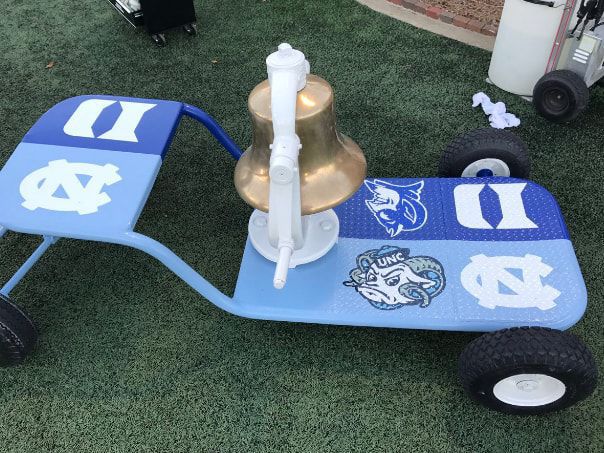
When the teams play each other in football, the winner receives a trophy, the Victory Bell.
This thing.
After the Game. Both campuses have police forces, and have never let things get out of hand, even in Duke vs. Carolina game days or nights. You will be safe, as long as you don't go out of your way to antagonize anyone.
The Duke athletic complex, which also includes a baseball field named for Philadelphia Athletics legend Jack Coombs, is surrounded by academic buildings on 2 sides, a golf course on another, and a cemetery on the other. You may have to go back to downtown Durham to get a postgame meal.
The same holds true for the Dean Dome: Although it's just off Route 15-501, there aren't many places to eat along that section of it. You'll have to go back to downtown Chapel Hill.
Downtown Sports Bar in Raleigh is the home of a local Giants fan club. It's at 410 Glenwood Avenue at Anwood Place. There are 2 places worth mentioning just off the N.C. State campus. Amadeo's Italian Restaurant is the home of a local Jets fan club. It's at 3905 Western Blvd. at Whitmore Drive. Fuhgeddaboudit Pizza, at 2504 Hillsborough Street and Horne Street, is said to be covered in various items of New York memorabilia.
If your visit to Raleigh-Durham-Chapel Hill is during the European soccer season, as we are now in, your best bets for a pub to watch your club are London Bridge Pub, at 110 E. Hargett Street in downtown Raleigh; or Bull McCabe's Irish Pub, at 427 W. Main Street across from the Amtrak and Greyhound stations in downtown Durham. I should note that the former is owned by Liverpool fans, so if you don't want to be surrounded by Scousers and wannabe Kopites, you may wish to look elsewhere; while the latter is the home of the local Arsenal supporters' club, so if you're not fond of Gooners, you may want to avoid that one.
Sidelights. Charlotte's sports history, at least at the major league level, isn't much, and Raleigh's is even less than that.
* PNC Arena. The home of the NHL's Carolina Hurricanes is at the PNC Arena, at 1400 Edwards Mill Road, at E. Stephen Stroud Way, about 5 miles west of downtown Raleigh. Stroud Way separates it from Carter-Finley Stadium, home field of the football team at North Carolina State University. The arena opened in 1999 as the Raleigh Entertainment & Sports Arena, and was named the RBC Center from 2002 to 2012. N.C. State also uses PNC Arena as its basketball home, succeeding the Reynolds Coliseum, where it won National Championships in 1974 and 1983.
If you're using public transportation, use Bus 100 from downtown Raleigh. That will get you to Blue Ridge Road at the State Fairgrounds, but then you'll have to make a left on Trinity Road to the stadium and the arena.
* Carter-Finley Stadium. After playing football at Riddick Stadium from 1907 to 1965 (demolished in 2005), North Carolina State moved into Carter Stadium in 1966. It was originally named for brothers Harry C. Carter and Wilbert J. "Nick" Carter, N.C. State graduates and major financial contributors. Albert E. Finley, another big contributor, had his name added in 1979. The playing surface is now named for yet another contributor: Wayne Day Family Field.

Currently seating 57,583, the N.C. State Wolfpack have won 3 Atlantic Coast Conference football titles there, in 1968, 1973 and 1979. This is in addition to the 8 titles they won in their various leagues at Riddick Stadium, for a total of 11: 1907, 1910, 1913, 1927, 1957, 1963, 1964 and 1965. Those last 3 conference titles provided the revenue for the building of a new stadium, to replace the obsolete Riddick. It features a display of 10 retired numbers, including current NFL quarterbacks Philip Rivers (17) and Russell Wilson (16), and former New York Jet Dennis Byrd (77 for them, 90 for the Jets).
It was also home to what's been called the worst team in the history of professional football: The Raleigh-Durham Skyhawks of the World League of American football. Their red, kelly green, black and white uniforms, and their jets in formation leaving vapor trails helmet logo, were weird enough. Their cheerleaders, tapping into the aviation theme and the Wright Brothers' first flight in the Outer Banks in 1903, were named the Kittyhawks. Charlotte Hornets owner George Shinn owned them, and Roman Gabriel, another N.C. State quarterback whose number has been retired (18), was their head coach.
But even with Shinn's money, Gabriel as head coach, and former pro quarterback Johnnie Walton and eventual Pro Football Hall-of-Famer Claude Humphrey as offensive and defensive coordinators, they went 0-10 in a weak league (the WLAF was nicknamed "The Laugh League") in the 1991 season. And, with no beer sold, they averaged just 12,066 fans per home game. (Even the Hurricanes can usually top that.) The team was moved to Columbus for the 1992 season and renamed the Ohio Glory.
Carter-Finley Stadium hosted a summer tour soccer game between Italy's Juventus and Mexico's C.D. Guadalajara (a.k.a. "Chivas") in 2011. It has also hosted concerts by Paul McCartney, Pink Floyd, U2 and, just this past summer, the Rolling Stones. 4600 Trinity Road at Youth Center Drive, separated from the PNC Arena by Stephen Stroud Way.
UPDATE: Carter-Finley has been chosen by the NHL for a 2023 Stadium Series game, with the Hurricanes playing a team yet to be determined.
One of the good things about football in the Tar Heel State: UNC, Duke and N.C. State all have real grass at their stadiums. None has ever used artificial turf.
Notable N.C. State graduates include:
* Sports, other
than football and basketball: Soccer stars Tab Ramos and Pablo Mastroeni,
1984 Olympic women’s marathon Gold Medalist Joan Benoit Samuelson, and 2008 and
2012 swimming Gold Medalist Cullen Jones. Notable graduates in other fields
include:
* Entertainment: John Tesh ’75, Internet comedy team Rhett and Link (Rhett McLaughlin 2000 and Link
Neal 2001, both with engineering degrees), actress Jill Wagner ‘01.
* Politics, from North
Carolina unless otherwise stated: Governor Jim Hunt ’59, Congressman J.D.
Hayworth ’80 of Arizona, Senator John Edwards ’74. Also, General Hugh Shelton ’63,
former Chairman of the Joint Chiefs of Staff.
According to an article in the September 2014 issue of The Atlantic, as you might guess, the Charlotte-based Carolina Panthers, just 168 miles from the State House, are the most popular NFL team not just in Charlotte and in the Raleigh-Durham area, but in the entire State of North Carolina. However, both Carolinas have significant pockets of support for the Washington Redskins, the Pittsburgh Steelers and the Dallas Cowboys, mainly due to the media saturation (and, in the Redskins' case, proximity is also a cause). In particular, these teams tend to cancel out Panther support in the ocean resort communities, on the Outer Banks of North Carolina and at Myrtle Beach and Hilton Head in South Carolina.
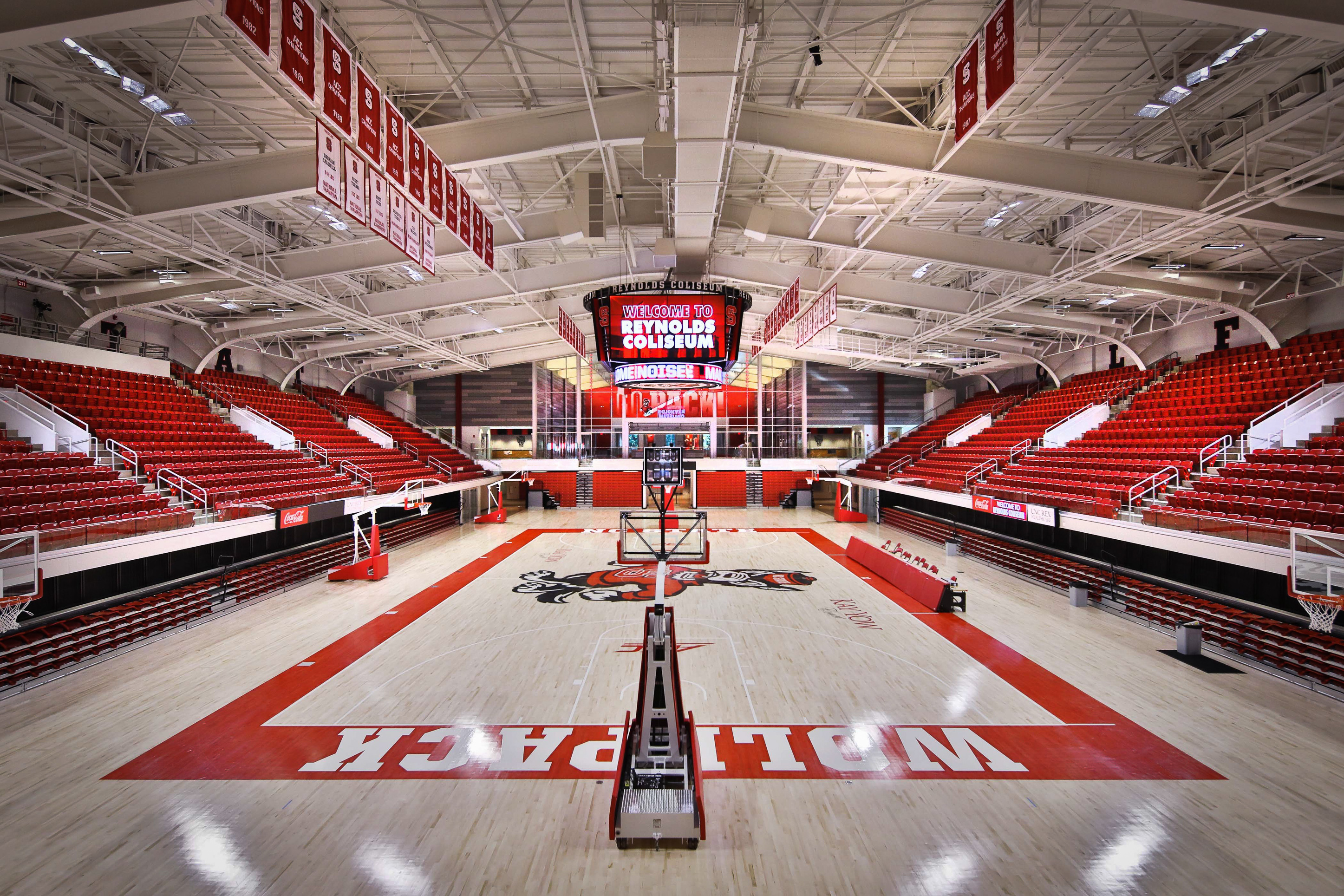
* Reynolds Coliseum. Home to N.C. State basketball from 1949 to 1999, the William Neal Reynolds Coliseum (named for the former chief executive of R.J. Reynolds Tobacco Company and brother of Richard Joshua Reynolds himself) hosted the Wolfpack teams that won the National Championship in 1974 and 1983, reached the Final Four in 1950, and won the ACC title in the regular season in 1950, '51, '53, '55, '56, '59, '73, '74, '85 and '89; and in the tournament in 1950, '51, '52, '54, '55, '56, '59, '65, '70, '73, '74, '83 and '87. (They haven't won either since moving into the new arena.)
The Coliseum was the home of the ACC Tournament from 1954 to 1966, and has hosted many NCAA Tournament games, and still hosts them for the women's tournament. It remains the home for N.C. State women's basketball and wrestling. The playing surface is named Kay Yow Court, after the women's basketball coach at N.C. State from 1975 until her death in 2009.
It is currently undergoing a renovation that is scheduled to be completed next August, providing more space for offices and a school Athletic Hall of Fame, but also reducing the seating capacity from 9,500 to 5,600. 2411 Dunn Avenue at Jeter Drive (not named for Derek Jeter), next door to the Talley Student Union, 2 miles west of downtown.
(UPDATE: Through the 2018 college football season, UNC leads N.C. State 66-36-6, and Duke leads N.C. State 41-36. In basketball, UNC leads N.C. State 155-78, and Duke leads N.C. State 145-101. In 2018, N.C. State's old arena was renamed James T. Valvano Arena at William Neal Reynolds Coliseum.)
The only Final Fours held in the Carolinas have been 1974 at the Greensboro Coliseum (N.C. State interrupting the UCLA dynasty in the Semifinal and beating Marquette in the Final) and 1994 at the 2nd Charlotte Coliseum (Arkansas beating Duke).
According to
a May 12, 2014 article in The New York Times, the Charlotte Hornets' reach doesn't get much beyond the Charlotte area. Then again, it doesn't help that the Hornets play 168 miles from downtown Raleigh. The most popular NBA team in the Raleigh-Durham area, as it has been since the dawn of the 21st Century (dovetailing nicely with the post-Michael Jordan fall of the Chicago Bulls), is the Los Angeles Lakers.
* Five County Stadium. Home to the Carolina Mudcats since 1991, the original owner wanted to get as close to downtown Raleigh as possible without infringing on the territory of any other team, including the Greensboro Hornets, which he also owned. Zebulon was as close as the Durham Bulls would let him get.
The Mudcats won Pennants in the Class AA Southern League in 1995 and 2003, but have not won one since moving to the Class A Carolina League in 2012. Ironically, where they were once higher in classification than the Bulls, they are now lower. 1501 State Highway 39 at Old U.S. 264, 26 miles east of the State House. Accessible by car only: No public transportation out there.
* Durham Athletic Park. Made famous by the 1988 film
Bull Durham, which jump-started the minor-league baseball craze of the late 20th Century, the Durham Bulls played at the site of "The DAP" from 1926 until 1994 (with a rebuild in 1939-40 after a fire), mostly in the Class A Carolina League. Having already won Pennants in 1924 and '25, they won them at The DAP in 1929, '30, '40, '41, '57, '65 and '67.
The film, which takes place in 1987, the year before it was released (a fact confirmed by the calendar in the manager's office), gives the impression that they weren't very good, and hadn't been for a long time, but got to 1st place by the 4th of July, and then faltered.
In real life, they went 67-75 that season, But they did have 6 players who went on to reach the major leagues: Kevin Brown, Kent Mercker, Mark Lemke, Derek Lilliquist, Gary Eave and Rusty Richards. Not bad for a Single-A team that was 8 games under .500. Then again, this was before their parent club, the Atlanta Braves, got good again in 1991, so they needed whatever help they could get. But Mercker and Lemke were a part of the Braves' quasi-dynasty.
The film made The DAP the most famous minor-league ballpark ever. But the park became a victim of the film's success: Soon, people came flocking to it, and its 5,000-seat capacity was now insufficient. A new ballpark was built, but the old one was left standing, and is still used for local baseball.
428 Morris Street. Unlike the Mudcats' home, The DAP can be reached by public transit from Raleigh. Take Bus 100 to the Regional Transit Center, then switch to Bus 700, and take that to the Durham Amtrak station. Then Bus 4 or a short walk.
* Durham Bulls Athletic Park. The DBAP (pronounced DEE-bap) has been home to the Bulls since 1995, and since 1998 they've been the Triple-A farm team of the Tampa Bay Rays. The Bulls have won International League Pennants there in 2002, '03, '09 and '13, making a total of 13 Pennants in various leagues at various levels.
Although it seats twice as many, 10,000, the Bulls tried to make it as much like the old DAP as possible, including the 305-foot right-field fence, nicknamed the Blue Monster, complete with the famous bull "HIT SIGN WIN STEAK" sign that was erected for the movie and kept. Even the overhanging roof, although up to public safety code, looks pretty much the same. 409 Blackwell Street at Willard Street, a 5-minute walk from the train station.
According to
an article in the April 24, 2014 edition of The New York Times, the Yankees are the most popular MLB team in the Triangle, averaging around 26 percent, with the Boston Red Sox at 20 and the Atlanta Braves at around 12. That's mainly due to the national media's exposure of the Yanks and Sox, since the Braves are easily the closest team, 265 miles away. The Washington Nationals are the next-closest, 278 miles, but are not as popular in the Triangle as either the Yanks or the Braves. It could also be due to the fact that UNC and Duke have a national reach with their student bodies.
The U.S. national soccer team has only played 1 game in the Triangle, a 1-1 draw with Jamaica in 2006, at Sahlen's Stadium, part of WakeMed Soccer Park in Cary, 201 Soccer Park Drive, about 8 miles west of the State House. Bus 300. The nearest Major League Soccer team is D.C. United, 283 miles, and that will remain the case after Atlanta United starts regular-season play next month: 406 miles.
UPDATE: Shortly after I wrote this, the Western New York Flash of the National Women's Soccer League moved to WakeMed Soccer Park, and became the North Carolina Courage. On March 27, 2018, the U.S. national soccer team defeated Paraguay 1-0 at Sahlen's Stadium. And in 2019, MLS granted an expansion franchise to Charlotte, to begin play at the Carolina Panthers' stadium in the 2022 season.
North Carolina A&T, in Greensboro, about 92 miles northeast of Charlotte and 76 miles west of Raleigh, has won "the National Championship of black college football" 5 times: 1951, 1968, 1990, 1999 and 2015. (UPDATE: They won a 6th in 2017.) Winston-Salem State University, in the city of the same name, 75 miles northeast of Charlotte and 104 miles west of Raleigh, has won it 4 times, all recently: 2011, 2012, 2013 and 2016. North Carolina Central, in Durham, has won it 3 times: 1954, 2005 and 2006.
Fayetteville State University, in the city of the same name, 136 miles east of Charlotte and 57 miles south of Raleigh, won it in 2002, although they compete in NCAA Division II. And Shaw University, in Raleigh, won it in 1947, and also now competes in Division II.
* Museums. The North Carolina Museum of History and the North Carolina Museum of Natural Sciences are next-door to each other, across Edenton Street from the State House. Durham has the Nasher Museum of Art, at 2001 Campus Drive. Chapel Hill has the Ackland Art Museum, at 101 S. Columbia Street.
The iconic Duke University Chapel is worth a look all by itself. It's at 401 Chapel Drive.
The domed Louis Round Wilson Library was UNC's main library from 1929 to 1984. The historian Shelby Foote went to UNC, and wrote in his diary that it looked like it was 11 stories tall. It now houses "special collections," as the 8-story Davis Library became the main one.
Wilson Library
The Beatles never performed together in the Raleigh-Durham area, although Paul McCartney and Ringo Starr have done so on solo tours. Elvis Presley only did so early in his career, all in Raleigh (never in Durham or Chapel Hill): At the Memorial Auditorium on May 19 and September 21, 1955; and a whopping 4 shows in 1 day at the Ambassador Theater on February 8, 1956. The Memorial Auditorium is now the Duke Energy Center for the Performing Arts, at 2 E. South Street, 7 blocks south of the State House. The Ambassador is at 115 Fayetteville Street, just south of the State House, but was demolished in 1989.
In addition to Raleigh -- and Charlotte, which I've covered in my guides for the Panthers and Hornets -- Elvis sang at the following North Carolina locations:
* In New Bern, at the Shrine Auditorium in New Bern on May 14 and September 13, 1955.
* In Asheville, at the City Auditorium on May 17 and September 16, 1955, and at the Asheville Civic Center on July 22, 23 and 24, 1975.
* In Thomasville, at the High School Auditorium on September 17, 1955.
* In Wilson, at Fleming Stadium on September 14, 1955, and 3 shows at the Charles L. Coon Auditorium on February 14, 1956.
* In Greensboro, 4 shows in 1 day at the National Theater on February 6, 1956, and at the Greensboro Coliseum on April 14, 1972; March 13, 1974; July 21, 1975; June 30, 1976; and April 21, 1977.
* In High Point, 4 shows in 1 day at the Convention Center on February 7, 1956.
* In Williams, at the High School Auditorium on February 15, 1956.
* In Winston-Salem, 3 shows in 1 day at the Carolina Theater on February 16, 1956.
* In Lexington, at the YMCA Gym on March 21, 1956.
* And in Fayetteville, at the Cumberland County Memorial Arena in Fayetteville on August 3, 4 and 5, 1976.
If you're paying attention, you saw that he did 4 shows in 1 day on February 6, 7, 8 and 10, 1956. That's 16 shows in a span of 5 days. He was 21. It was easier to do that than to do 2 in 1 day when he was packing on the pounds in his early 40s in 1975, '76 and '77.
Andrew Johnson was born in the State capital of Raleigh. His birthplace was a log cabin (which didn't help him as much as it helped his immediate predecessor, Abraham Lincoln) on the grounds of Casso's Inn, where his father worked, at Morgan Street and Fayetteville Street, across from the State House. It was moved to Mordecai Historic Park at 1 Mimosa Street, a mile north of downtown. Number 1 Bus.
He is 1 of 3 Presidents produced by the Carolinas. No one is precisely sure where Andrew Jackson was born -- not even whether it happened in North or South Carolina, only that it was in the Waxhaw region along the State Line. He was the 1st President born in a log cabin, but that cabin is long-gone. Andrew Jackson State Park, at 196 Andrew Jackson Park Road in Lancaster, South Carolina, is considered the likeliest place. It's about 33 miles south of Charlotte and not reachable by public transportation.
James K. Polk State Historical Site is in Pineville, which, like Charlotte, is in Mecklenburg County, North Carolina. It's about 12 miles south, at 12031 Lancaster Highway. It's easier to reach without a car: The Number 20 bus can get you to within half a mile.
All 3 Carolina-born Presidents have their main historical sites in Tennessee: Polk is buried on the State House grounds in Nashville; Jackson's home, The Hermitage, is in the Nashville suburbs; and Johnson's Museum is in Greeneville.
Polk graduated with honors from UNC in 1818, and the University later named the lower quad on its main campus Polk Place. Duke? The good news is, a future President graduated from its law school in 1937. The bad news is, it was Richard Nixon.
Dean Smith is laid to rest at Old Chapel Hill Cemetery, on South Road, almost directly across from Carmichael Arena where he first worked his magic.
PNC Plaza, at 301 Fayetteville Street in Raleigh, is 538 feet high, and is the tallest building in the Carolinas outside of Charlotte.
Bull Durham was filmed almost entirely in Durham and other North Carolina minor-league towns. Mitch's Tavern, site of the bar scenes near the beginning and the end of the film, is still in business, at 2426 Hillsborough Street in Raleigh. Other movies filmed in the area include
The Handmaid's Tale (which used Duke University for some location shots) and
Brainstorm (Natalie Wood's last film, which also did some filming at Duke).
A few TV shows have been filmed in North Carolina, most notably
Dawson's Creek in Wilmington, although it was set in fictional Capeside, Massachusetts.
One Tree Hill was set in the fictional town of Tree Hill, North Carolina.
But shows set in Raleigh are few and far between.
The Andy Griffith Show, set in fictional Mayberry and based on Griffith's real-life hometown of Mount Airy, mentioned Raleigh a few times, but was filmed in Southern California.
A statue of Griffith and Ron Howard as Sheriff Andy Taylor and his son Opie was dedicated by television network TV Land. It depicts them walking down the fishing trail, as seen in the show's famous opening. Unfortunately, the fishing poles the figures hold are frequently swiped. Pullen Park, near the carousel. 408 Ashe Avenue, a mile and a half west of downtown. The 100 bus gets you about halfway there. A copy of the statue stands outside the Andy Griffith Museum at 218 Rockford Street in Mount Airy, 139 miles to the northwest, near the Virginia State Line. Pilot Mountain (known on the show as Mount Pilot) is 16 miles southeast of Mount Airy.
*
The Raleigh-Durham Triangle isn't really big enough -- yet -- for a major league sports team. And the Carolinas are certainly no place for hockey. But, for better or for worse, the Hurricanes are there, and they have a Stanley Cup and are a perennial Playoff team.
But between Duke, UNC and N.C. State, the area is ground zero for college basketball in America. And Duke-UNC is the greatest college basketball rivalry of them all. If you can get in, A, congratulations; B, be careful; and, C, enjoy!