The Olympiastadion is 1 of 4 stadiums to have hosted an Olympic Games, a World Cup Final and a UEFA European Cup/Champions League Final. The others are the Olympiastadion in Munich, the old Wembley Stadium in London, and the Stade de France outside Paris.
Italy were loaded with legends: Gianluigi Buffon, Fabio Cannavaro, Andrea Pirlo, Francesco Totti, Luca Toni. This was a team so good, Daniele De Rossi and Alessandro Del Piero did not start and had to come on as substitutes, Alessandro Nesta and Filippo Inzaghi remained on the bench, and Paolo Maldini, still starting for AC Milan at age 38, was not even selected.
But France were equally laden with starpower, many of them holdovers from their 1998 triumph: Fabien Barthez, Lilian Thuram, David Trezeguet, Patrick Vieira, Thierry Henry, and Captain Zinedine Zidane. Others had developed since that win: Claude Makélélé, Florent Malouda, Sylvain Wiltord, Lasanna Diarra, Éric Abidal, Franck Ribéry.
The key was Zidane: The midfielder, who had starred for Girondins de Bordeaux in his homeland, Juventus in Turin, Italy, and Real Madrid in Spain, had put the team, indeed his entire country, on his back, and led them to victory in 1998.
The son of Kabyle immigrants from France's former colony of Algeria, he was a symbol of reconciliation, as both nations were still dealing with the nasty war that Algeria fought for its independence from 1954 to 1962 -- having ended only 36 years before.
Although light-skinned enough to appear white -- unlike several national side teammates, including Henry, Vieira, Thuram, Trezeguet, and his Real Madrid teammate Makélélé -- he had faced prejudicial gestures large and small, including the insinuation that he was not truly, or not wholly, French.
Although light-skinned enough to appear white -- unlike several national side teammates, including Henry, Vieira, Thuram, Trezeguet, and his Real Madrid teammate Makélélé -- he had faced prejudicial gestures large and small, including the insinuation that he was not truly, or not wholly, French.
Yet he went into that 2006 Final once again having led the team to glory. It was to be his last game: At age 34, he had announced his retirement as a player. Win or lose, it would be all over when the final whistle blew for this game.
In the 7th minute, Malouda, then playing his club football for Olympique Lyonnais, was knocked down in the box by Marco Materazzi of Internazionale Milano. If Materazzi were a hockey player, he wouldn't be a "pest": A good player who frequently plays rough; he'd be a "goon": A player whose sole purpose is to play rough, because he can't do anything else.
Horacio Elizondo, the Argentine selected to referee the game (because he was from neither team's continent), correctly awarded a penalty, and Zidane converted it. France led, 1-0.
The lead did not last long. In the 19th minute, Pirlo, the AC Milan legend, sent a hellacious corner kick into the box, and Materazzi, of all people, headed it past Barthez, the famously bald goalkeeper who was back with Olympique de Marseille after starring for them, Toulouse, AS Monaco and Manchester United.
In the 2nd half, Luca Toni, then of Florence-based Fiorentina, hit the crossbar with a shot, and then correctly had a headed goal disallowed as having been offside. Malouda was tackled in the box by Juventus' Gianluca Zambrotta, but was incorrectly not awarded another penalty. Arsenal legend Henry was stopped by Juventus goalie Buffon. Malouda skied a shot over the bar. Pirlo just missed with a free kick.
In extra time, Ribéry, then with Marseille and later to star for Bayern Munich, just missed. Buffon just barely knocked a Zidane header away.
And then, in the 110th minute, Materazzi pulled on Zidane's jersey, they exchanged words, and Zidane head-butted Materazzi right in the chest. In French soccer, this is known as a coup de boule -- literally, "stroke of ball" or "blow of ball," but also meaning "play of head." (The more familiar phrase coup d'état means "blow of state," and refers to the overthrow of a government.)
Elizondo did not see the incident. The 4th official, Luis Medina Cantalejo -- so respected that he not only officiated at 3 games of that World Cup, but was one of the few Spanish referees to officiate at La Liga games between arch-rivals Real Madrid and Barcelona, a rivalry so intense that foreign referees are nearly always assigned to oversee it -- told Elizondo through his headset that it had happened.
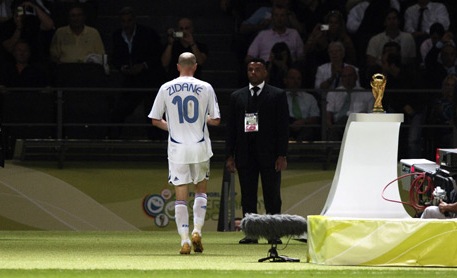
Elizondo properly showed Zidane a straight red card, making him the 4th player to be sent off in a World Cup Final, and the only player ever sent off in games of 2 separate World Cups. The scene of Zidane walking into the locker room, past the World Cup trophy but not even looking at it, is nearly as iconic as the coup de boule itself.
 Extra time ended with the game still 1-1, so it went to penalties. Italy kicked first. Pirlo scored his penalty. Sylvain Wiltord, then with Lyon and previously the man whose goal past Barthez secured the League and Cup "Double" for Arsenal in 2002, made his. 1-1.
Materazzi was next for Italy, and made his penalty. Next for France was Trezeguet, facing his Juventus teammate Buffon. In extra time of the Euro 2000 Final, he had beaten Buffon with a shot. Under the rules then in place, it was a "golden goal": Automatic victory. This time, he was not a hero: He clanged his shot off the crossbar. 2-1 Italy.
De Rossi made his penalty. Abidal made his. Del Piero made his. Willy Sagnol made his for France. Finally, Fabio Grosso clinched the win for Italy: 5-3, with France's last shot not taken, seeing as how it would have been meaningless. Italia: Campioni del Mondo.
Zidane, of course, was not available for the penalties.
Why did he do it? Three British newspapers -- The Times, The Sun, and the Daily Star, with varying degrees of reliability -- all hired lip-readers who were fluent in French and Italian to look at the tape, and to see what Materazzi had said to Zidane to provoke it. (Materazzi does not speak French, but Zidane played in Italy long enough to learn the language, and their exchange was entirely in Italian.)
The Times has a reputation for sterling journalism; The Sun and the Daily Star are considered lying right-wing propaganda rags. Yet the lip-readers hired by all 3 reported the exact same thing: They all said that Materazzi had called Zidane a "son of a terrorist whore."
It had been less than 5 years since the 9/11 attacks, and a year to the week after the 7/7 attacks on the London Underground (subway). Apparently, Materazzi was unaware that presuming that all Muslims are terrorists is not only bigoted, but stupid. To make matters worse, Zidane's mother was ill at the time.
Materazzi's version of events was a little different. He said he would never have insulted someone's mother, having lost his own when he was 15 years old. Without question, he had tugged on Zidane's shirt. The exchange of shirts is a postgame tradition that goes back decades, and Materazzi said that Zidane told him, "If you want my shirt, I will give it to you afterwards." Not an unreasonable request of a star of one of the finalists to one of the other finalist, and not an unreasonable response.
Materazzi said that his follow-up was, "I prefer the whore that is your sister." In other words, "Your sister puts out, and I'd like you to set me up with her." In other words, Materazzi admitted that he had gone too far.
But so had Zidane. There were about 10 minutes of play to go. Winning is the best revenge. A man as accomplished as Zidane -- 2 League titles in Italy and 1 in Spain, a Champions League win, a World Cup and a Euro title -- should have accepted this. Win the game, and you look like a champion, and the guy trying to provoke you looks like an idiot. Instead, the great Zizou looked like an easily provoked fool, and Materazzi an undeserved World Champion.
Elizondo did not see the incident. The 4th official, Luis Medina Cantalejo -- so respected that he not only officiated at 3 games of that World Cup, but was one of the few Spanish referees to officiate at La Liga games between arch-rivals Real Madrid and Barcelona, a rivalry so intense that foreign referees are nearly always assigned to oversee it -- told Elizondo through his headset that it had happened.
Elizondo properly showed Zidane a straight red card, making him the 4th player to be sent off in a World Cup Final, and the only player ever sent off in games of 2 separate World Cups. The scene of Zidane walking into the locker room, past the World Cup trophy but not even looking at it, is nearly as iconic as the coup de boule itself.
Materazzi was next for Italy, and made his penalty. Next for France was Trezeguet, facing his Juventus teammate Buffon. In extra time of the Euro 2000 Final, he had beaten Buffon with a shot. Under the rules then in place, it was a "golden goal": Automatic victory. This time, he was not a hero: He clanged his shot off the crossbar. 2-1 Italy.
De Rossi made his penalty. Abidal made his. Del Piero made his. Willy Sagnol made his for France. Finally, Fabio Grosso clinched the win for Italy: 5-3, with France's last shot not taken, seeing as how it would have been meaningless. Italia: Campioni del Mondo.
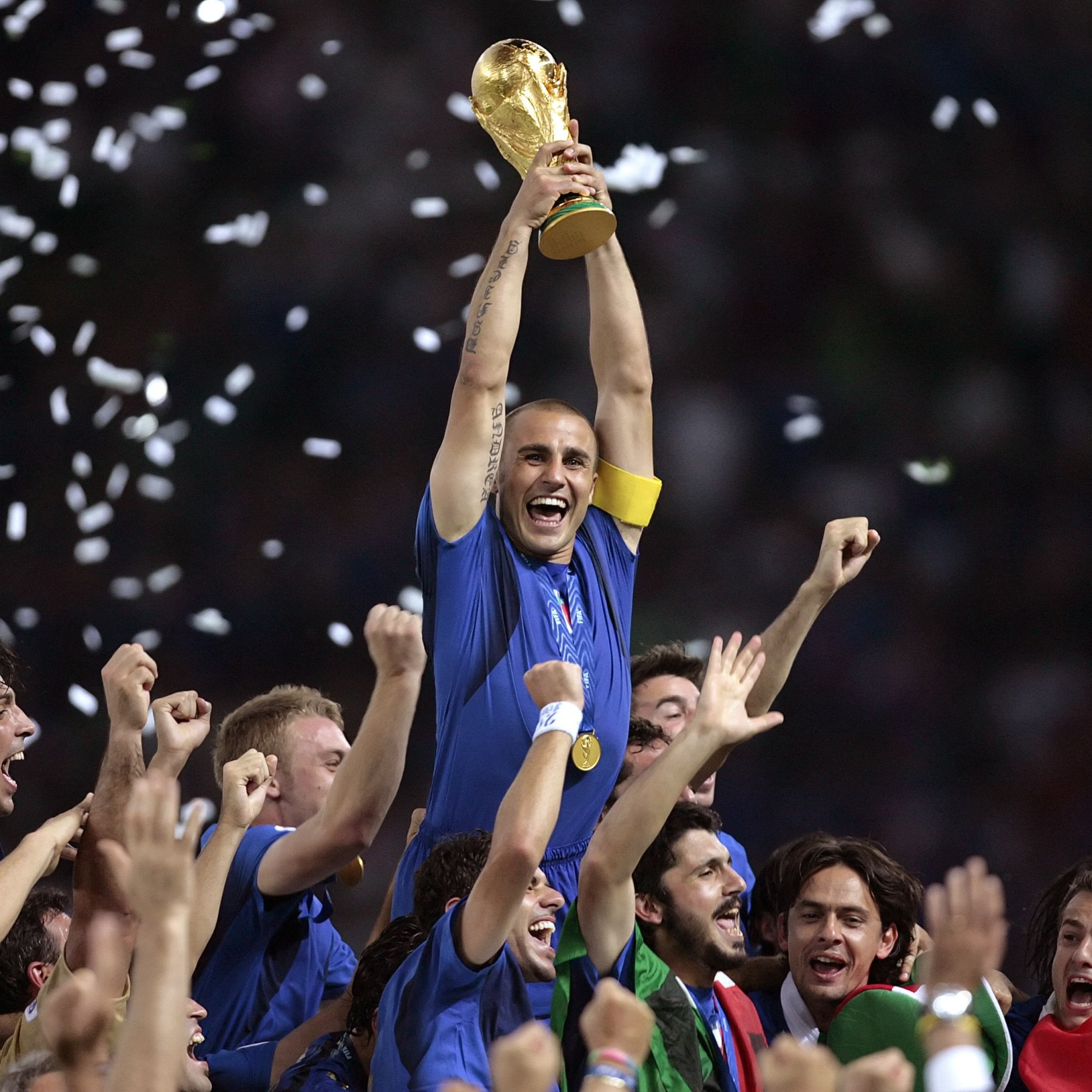
Fabio Cannavaro, as Captain, raising the Jules Rimet Trophy
Why did he do it? Three British newspapers -- The Times, The Sun, and the Daily Star, with varying degrees of reliability -- all hired lip-readers who were fluent in French and Italian to look at the tape, and to see what Materazzi had said to Zidane to provoke it. (Materazzi does not speak French, but Zidane played in Italy long enough to learn the language, and their exchange was entirely in Italian.)
The Times has a reputation for sterling journalism; The Sun and the Daily Star are considered lying right-wing propaganda rags. Yet the lip-readers hired by all 3 reported the exact same thing: They all said that Materazzi had called Zidane a "son of a terrorist whore."
It had been less than 5 years since the 9/11 attacks, and a year to the week after the 7/7 attacks on the London Underground (subway). Apparently, Materazzi was unaware that presuming that all Muslims are terrorists is not only bigoted, but stupid. To make matters worse, Zidane's mother was ill at the time.
Materazzi's version of events was a little different. He said he would never have insulted someone's mother, having lost his own when he was 15 years old. Without question, he had tugged on Zidane's shirt. The exchange of shirts is a postgame tradition that goes back decades, and Materazzi said that Zidane told him, "If you want my shirt, I will give it to you afterwards." Not an unreasonable request of a star of one of the finalists to one of the other finalist, and not an unreasonable response.
Materazzi said that his follow-up was, "I prefer the whore that is your sister." In other words, "Your sister puts out, and I'd like you to set me up with her." In other words, Materazzi admitted that he had gone too far.
But so had Zidane. There were about 10 minutes of play to go. Winning is the best revenge. A man as accomplished as Zidane -- 2 League titles in Italy and 1 in Spain, a Champions League win, a World Cup and a Euro title -- should have accepted this. Win the game, and you look like a champion, and the guy trying to provoke you looks like an idiot. Instead, the great Zizou looked like an easily provoked fool, and Materazzi an undeserved World Champion.
The play swept the world. Dozens of people posted their attempts at recreating it on the Internet. American TV shows parodied it. A song titled "Coup de Boule" hit Number 1 on the French music charts.
One moment can change not just a game, but a reputation, forever. Zidane stood to become the greatest hero in the history of French sport. Maybe he still is, anyway. But the first thing anyone thinks about when they hear his name is the coup de boule.