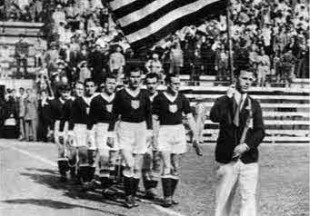
The Rose Bowl, Pasadena, California, July 17, 1994.
Attendance: 94,194.
July 17, 1994, 30 years ago: For the 1st time, the Final of soccer's World Cup is held on American soil.
There were 9 venues. From East to West:
* Foxboro Stadium, built in 1971, in the Boston suburb of Foxboro, Massachusetts, home of the NFL's New England Patriots. It had been the home of the North American Soccer League's Boston Minutemen and New England Tea Men, and would become the home of Major League Soccer's New England Revolution.
* Giants Stadium, 1976, in the New York suburb of East Rutherford, New Jersey, home of the NFL's New York Giants and New York Jets. It had been the home of the NASL's New York Cosmos, and would become the home of MLS' New York/New Jersey MetroStars, who became the New York Red Bulls.
* Robert F. Kennedy Memorial Stadium, known as District of Columbia Stadium from 1961 to 1969, in Washington, D.C., home of the NFL's Washington Redskins (now the Washington Commanders). It had been the home of the NASL's Washington Darts and Washington Diplomats, and would become the home of MLS' D.C. United.
* The Citrus Bowl, 1936, now named Camping World Stadium, in Orlando, Florida, the only venue not then the regular home of a professional or college football team. It was home of college football's annual Florida Citrus Bowl. It would later become the home of MLS' Orlando City Soccer Club.
* The Silverdome, 1975, in the Detroit suburb of Pontiac, Michigan, home of the NFL's Detroit Lions. It had been the home of the NASL's Detroit Express. Alone among these 9 metropolitan areas, Detroit has never had an MLS team.
* Soldier Field, 1924, in Chicago, home of the NFL's Chicago Bears. It had been the home of the NASL's Chicago Sting, and would become the home of MLS' Chicago Fire.
* The Cotton Bowl, 1930, in Dallas, home of the annual Cotton Bowl game, and the former home of the NFL's Dallas Cowboys. It had been the home of the NASL's Dallas Tornados, and would become the home of MLS' Dallas Burn, who became F.C. Dallas.
* The Rose Bowl, 1922, in the Los Angeles suburb of Pasadena, California, home of the football team at the University of California at Los Angeles (UCLA) and the annual Rose Bowl game. It had been the home of the NASL's Los Angeles Wolves and Los Angeles Aztecs, and would become the home of MLS' Los Angeles Galaxy.
* And Stanford Stadium, 1921, in the San Francisco suburb of Palo Alto, California, home of the football team at Stanford University.
Thus, the Silverdome, Soldier Field, the Rose Bowl and Stanford Stadium became the only stadiums to host both a Super Bowl and a World Cup match -- and the Rose Bowl would become the only one to host both a Super Bowl and a World Cup Final.
This tournament remains the World Cup with the highest per-game attendance: 68,991. And what an array of talent, not dampened in the slightest by England, which still thinks of itself as the country in world "football," failing to qualify for the 1st time since 1978:
* From finalists Brazil: Romário, Ronaldo, Cafu, Bebeto, Dunga, Leonardo, and Claudio Taffarel.
* From finalists Italy: Franco Baresi, Paolo Maldini, Gianfranco Zola, Mauro Tassotti, Roberto Donadoni, Antonio Conte, and Roberto and Dino Baggio (not related).
* From semifinalists Sweden: Henrik Larsson and Tomas Brolin.
* From semifinalists Bulgaria: Hristo Stoichkov.
* From quarterfinalists the Netherlands: Frank Rijkaard, Ronald Koeman, Dennis Bergkamp, Marc Overmars, Danny Blind, Edwin van der Sar, and the twins Frank and Ronald de Boer. (Marco van Basten had already had to retire due to injury.)
* From quarterfinalists Germany: Lothar Matthäus, Jürgen Klinsmann, Jürgen Kohler, Rudi Völler, Thomas Häßler, Andreas Brehme, Matthias Sammer and Oliver Kahn.
* From quarterfinalists Romania: Gheorghe Hagi and Gheorghe Popsecu.
* From quarterfinalists Spain: Pep Guardiola and Luis Enrique.
* From the Round of 16: From Argentina: Diego Maradona (who ended up getting suspended for drugs), Gabriel Batistuta and Claudio Caniggia. From Ireland: Roy Keane, Paul McGrath, Ray Houghton, John Aldridge, Steve Staunton, Ronnie Whelan, Tony Cascarino and Packie Bonner. From Nigeria: Jay-Jay Okocha.
* From teams that didn't make it to the knockout round: Roger Milla from Cameroon, and Carlos Valderrama and his hair from Colombia.
* And from our own team, which did make it past the Group Stage for the 1st time since 1930: Alexi Lalas, Eric Wynalda, Cobi Jones, Marcelo Balboa, Paul Caligiuri and Jersey Boys Tony Meola, John Harkes, Tab Ramos and Claudio Reyna.
* From teams that didn't make it to the knockout round: Roger Milla from Cameroon, and Carlos Valderrama and his hair from Colombia.
* And from our own team, which did make it past the Group Stage for the 1st time since 1930: Alexi Lalas, Eric Wynalda, Cobi Jones, Marcelo Balboa, Paul Caligiuri and Jersey Boys Tony Meola, John Harkes, Tab Ramos and Claudio Reyna.
True, we got knocked out by Brazil, on home soil, on the 4th of July no less, at the old Stanford Stadium in the San Francisco suburb of Palo Alto, California. And we wore horrid uniforms. But it was still a big boost for American soccer, just what the upcoming founding of Major League Soccer (MLS) needed going into 1996.

Certainly, we got the pageantry right. Having America play on the 4th of July worked out well, despite the loss. And the New York market got lucky, as 2 of the country's, and particularly the Tri-State Area's, biggest ethnic groups ended up having their ancestral homelands playing each other at the Meadowlands: The Republic of Ireland and Italy.

But, from the American perspective, the 2 worst things that could have happened did happen. Someone got killed. Not in the stadium, or in the streets; it wasn't a fight between hooligans. Not even in the country. After his own goal sent Colombia down to defeat against us, Andrés Escobar of Atlético Nacional went back home to Medellín, and was shot and killed. He was only 27 years old.

Yes, we actually wore these things.
Certainly, we got the pageantry right. Having America play on the 4th of July worked out well, despite the loss. And the New York market got lucky, as 2 of the country's, and particularly the Tri-State Area's, biggest ethnic groups ended up having their ancestral homelands playing each other at the Meadowlands: The Republic of Ireland and Italy.
Ireland vs. Italy, Giants Stadium, June 18, 1994.
Attendance: 75,338. Ireland pulled the upset, winning 1-0.
But, from the American perspective, the 2 worst things that could have happened did happen. Someone got killed. Not in the stadium, or in the streets; it wasn't a fight between hooligans. Not even in the country. After his own goal sent Colombia down to defeat against us, Andrés Escobar of Atlético Nacional went back home to Medellín, and was shot and killed. He was only 27 years old.
The other was that the Final ended scoreless. There were the 2 best teams in the world, Brazil and Italy, and, after a full 90 minutes, plus extra time making it 120 minutes, the final score was 0-0. Nil-nil. Nothing to nothing. Americans like scoring, and any American watching this Final, not knowing all that goes into a soccer game, would have found it boring as hell. It probably set American interest in the sport back several years.
Roberto Baggio blasted a penalty kick over the crossbar, and Brazil won the penalty phase, 3-2. And Americans not already into soccer shrugged their shoulders, and either went back to watching baseball or began preparing for a new NFL season.
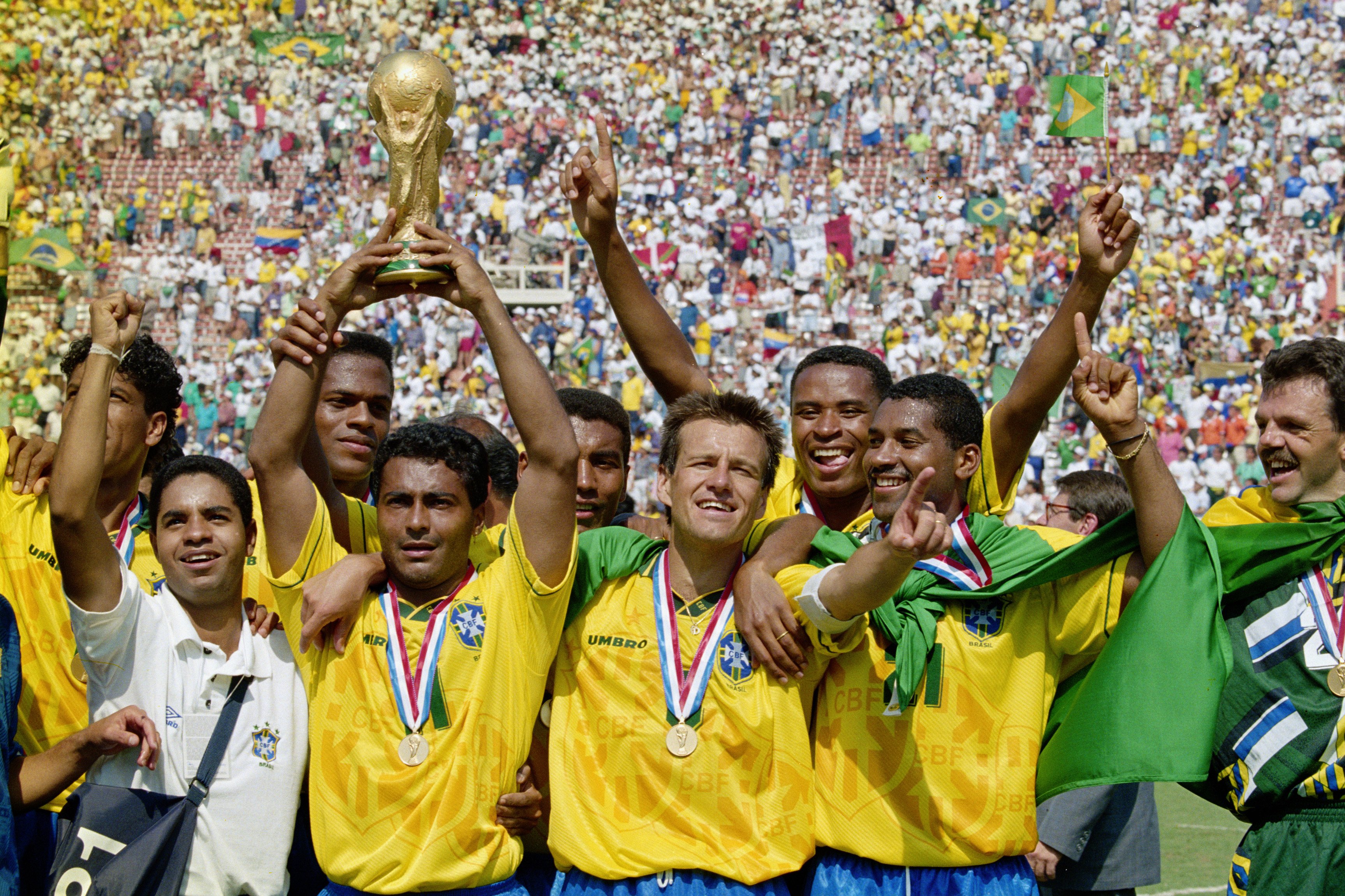
Romário (Number 11) lifts the Jules Rimet Trophy,
next to Dunga (8), the Captain
Foxboro Stadium was torn down in 2002, having been replaced by the next-door Gillette Stadium. Soldier Field was torn down in 2002, and replaced by a new stadium on the same site. Stanford Stadium was torn down in 2004, and replaced by a new stadium on the same site. Giants Stadium was torn down in 2010, having been replaced by the next-door MetLife Stadium. The Silverdome was torn down in 2017. RFK Stadium was torn down in 2023.
The 2026 World Cup was awarded jointly to all 3 North American nations: The United States, Canada (which has never hosted), and Mexico (which hosted in 1970 and 1986). Most of the host stadiums from 1994 are unlikely to host again in 2026, since they've been replaced. The Final was awarded to New York, and to MetLife Stadium. SoFi Stadium, outside Los Angeles, got a Quarterfinal; while the Semifinals went to Mercedes-Benz Stadium in Atlanta and AT&T Stadium outside Dallas.