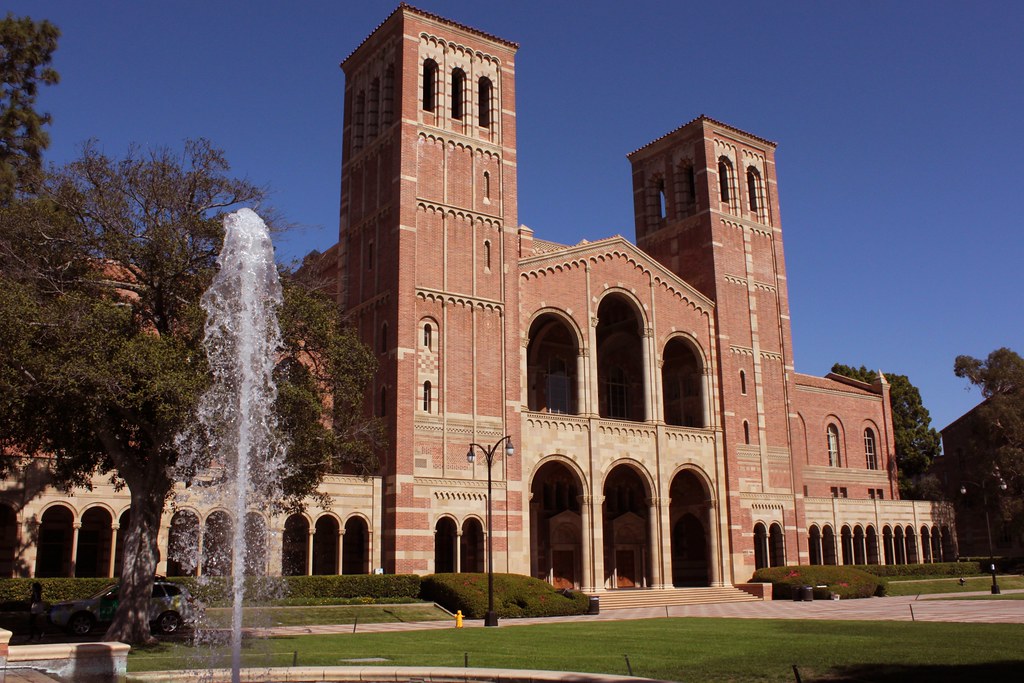
Royce Hall, once the most famous building
on the UCLA campus, now 2nd to Pauley Pavilion
With COVID restrictions scaled back, and mass vaccinations making large gatherings at things like sporting events no longer a death wish, I am ready to start my Trip Guides again.
On Saturday, August 28, UCLA, a school for whose football team I have not yet done one, will open their 2021 season at home to the University of Hawaii.
Before You Go. Unlike the Seattle and San Francisco Bay Areas, the Los Angeles area has very consistent weather. It's a nice place to visit. If you don't mind earthquakes. And mudslides. And wildfires. And smog. (Okay, the smog problem isn't as bad as it was in the Seventies. And New York had smog issues then, too.)
Check the weather forecast on the Los Angeles Times' website before you, so you'll know what to bring. Currently, projections for Saturday are in the mid-80s in daylight, and the high 60s at night. It is still, both scientifically and culturally, Summer, so stay hydrated.
Los Angeles is in the Pacific Time Zone, which is 3 hours behind New York. Adjust your timepieces accordingly.
Tickets. UCLA football tickets are expensive, rivaling the city's pro teams for prices. A sideline ticket close to the field will run you at least $113. Further back, $99. It looks like they're counting the Rose Bowl itself as a museum, and tacking on the admission fee for that. The end zone seats are sold out for the season.
Getting There. It's 2,779 miles from Times Square in New York to City Hall in downtown Los Angeles. In other words, if you're going, you're flying.
After all, even if you get someone to go with you, and you take turns, one drives while the other one sleeps, and you pack 2 days' worth of food, and you use the side of the Interstate as a toilet, and you don't get pulled over for speeding, you'll still need over 2 full days. Each way.
But, if you really, really want to drive... Take Interstate 80 West across New Jersey, Pennsylvania, Ohio, Indiana, Illinois, Iowa and Nebraska. Just before leaving Nebraska for Colorado, you'll get on Interstate 76, and shortly before reaching Denver you'll get on Interstate 70 West. You'll take that all the way to its end in Utah, where you'll take Interstate 15 South. You'll go through a short strip of Arizona before getting into Nevada (where you'll see the Strip, Las Vegas), before getting into California.
Assuming you're not going to a hotel first (and you really should), either in Los Angeles or near the stadium or Disneyland in Anaheim), you'll get off I-15 at Exit 109A, and get on Interstate 10 West, and almost immediately onto U.S. Route 101 North, the San Bernardino Freeway. Take that road's Exit 3 to State Route 110, the Pasadena Freeway, and Exit 24 will drop you off at Dodger Stadium.
Given an average speed of 60 miles an hour, you'll be in New Jersey for an hour and a half, Pennsylvania for 5:15, Ohio for 4 hours, Indiana for 2:30, Illinois for 2:45, Iowa for 5:15, Nebraska for 6 hours, Colorado for 7:15, Utah for 6 hours, Arizona for half an hour, Nevada for 2 hours, and California for 3 and a half hours hours; for a total of 46 hours and 30 minutes. Factor in rest stops, you'll need more like 3 full days. And, remember, that's just one way. And if you end up using Las Vegas as a rest stop, well, you might end up missing the series and end up, yourself, as what "stays in Vegas."
That's still faster than Greyhound and Amtrak. Greyhound will take about 65 hours, changing buses twice, and the price could be as little as $490 on advanced purchase. The station is at 1716 E. 7th Street, at Lawrence Street.
If you go by Amtrak, it's about 67 hours. You'd leave Penn Station on the Lake Shore Limited at 3:40 PM Eastern Time on Wednesday, arrive at Union Station in Chicago at 9:50 AM Central Time on Thursday, transfer to the Southwest Chief at 2:50 PM, and arrive and Union Station in Los Angeles at 8:00 AM Pacific Time on Saturday. It's $492 round-trip. Union Station is at Alameda & Arcadia Streets.
Flights could be more expensive, and you'll almost certainly have to change planes at least once, probably in Chicago or Dallas. But if you play your cards right, you can get a round-trip nonstop flight for a little under $600 -- just a little more than the train, and a hell of a lot faster. The LAX2US bus will take you, as its name suggests, from Los Angeles International Airport to Union Station, taking 45 minutes and costing $8.00; from there, bus and subway connections can be made to downtown.
Once In the City. Los Angeles was founded in 1781 by Spain as a Catholic mission, and means "The Angels" -- and so, that was the name of the Pacific Coast League team, and the subsequent American League team: The Los Angeles Angels. The city continues to grow by leaps and bounds, and is now just under 4 million people, making it the 2nd-largest city in North America, behind New York. (Unless you count Mexico, and thus Mexico City, as "North America" instead of "Central America.") The metro area has about 18.6 million people.
The Los Angeles skyline, including the new Wilshire Grand Tower,
against the San Gabriel Mountains and cloud cover
The population of the City of Los Angeles is about 47 percent Hispanic, 32 percent white, 11 percent Asian, and 10 percent black. For the County of Los Angeles, it's roughly the same: 47 percent Hispanic, 30 percent white, 14 percent Asian, 9 percent black.
Los Angeles has been plagued by racial strife since the beginning. People remember the Watts Riot of 1965 and the South Central Riot of 1992. But there was also the 1871 Los Angeles Anti-Chinese Riot, the 1907 Pacific Coast Race Riots, the 1929 Exeter Riot, the 1943 Zoot Suit Riot, the 1975 Chaffey High School Race Riot, the 2006 Fontana High School Riot, the 2006 California Prison Riots, and the 2008 Locke High School Riot.
The "centerpoint" of the city, where east-west and north-south addresses begin, is 1st Street and Main Street. Numbered streets are east-west.
The Los Angeles Times is the leading (most-circulated) newspaper in the Western United States, and has long been known for a great sports section. The legendary columnist Jim Murray has been dead for some time now, but if you watch ESPN's Around the Horn, you'll recognize the names of Bill Plaschke and J.A. Adande.
The sales tax in the State of California is 7.5 percent, and in the City of Los Angeles, it rises to 9 percent. ZIP Codes in Los Angeles start with the digits 900 and 901, and the suburbs 902 through 918. The original Area Code was 213, but it is now used only for Downtown, and 323 now overlays it. 310 and 818 are used for the Western suburbs, 562 for the Southern suburbs, and 661 and 747 for the Northern suburbs. Despite its extensive freeway network, Los Angeles does not have a "beltway." The Los Angeles Department of Power and Water (LADPW) runs the electricity and the water.
A single ride on an RTD (Rapid Transit District) bus or Metro subway is $1.75. A 1-day pass is $7.00, and a 7-day pass (which might be a better value even if you're only staying for the 3 games of the series) is $25. Yes, L.A. has a subway now, with Red, Blue, Green, Gold, Purple and Expo lines. (Expo? It goes from Los Angeles all the way to Montreal? No.)
Once On Campus. UCLA does not have its football stadium on campus, which makes things a little complicated.
The Southern Branch of the California State Normal School (which is now San Jose State University) was founded in 1882. In 1919, the University of California bought the campus, and made it their southern branch, and the school treats 1919 as its founding date. It remained a two-year college until 1923, becoming a full four-year school.
In 1927, it was renamed "The University of California at Los Angeles." In 1958, this name was officially given a slight tweak, to "The University of California, Los Angeles." Everybody just calls it "UCLA," anyway, as opposed to the University's main campus in Berkeley, which is called "Cal" for sports purposes and "Berkeley" for everything else. Nobody calls UCLA "Cal-Los Angeles."
The campus is in Westwood, about 12 miles west of City Hall. The best way to get there by public transportation is to get to Civic Center/Grand Park station, take the Red Line to Hollywood/Highland, walk 3 blocks south to Sunset Boulevard, and then take Bus 2 in.
UCLA is renowned for its law school and its medical school. Its Medical Center is one of the top hospitals on the West Coast, and is named for former President Ronald Reagan, who died there in 2004. So did Freddie Prinze Sr. in 1977, John Wayne in 1979, Marlon Brando and Rodney Dangerfield in 2004, Michael Jackson in 2009, Zsa Zsa Gabor and Carrie Fisher in 2016, and Adam West in 2017. Also in 2017, Beyoncé's twins were born there.
UCLA's alumni list is staggering. Just listing those from sports would take up much of this article. I'll get to the football stars in "Team History Displays," but here's some notables:
* Baseball: Jackie Robinson. Also, Todd Zeile, Eric Karros, Jeff Conine, Troy Glaus, Dave Roberts, Chase Utley, Gerrit Cole. And, uh, Trevor Bauer. Also, Red Sox owner John W. Henry.
* Basketball, where they've won more National Championships than any other school, the John Wooden streak of 10 National Championships in 13 seasons from 1964 to 1975 leading to the joke that "UCLA" stands for "U Can't Lose to Anybody": Don Barksdale (the 1st black All-American in basketball), Willie Naulls, Walt Hazzard, Gail Goodrich, Kareem Abdul-Jabbar (then using his birth name of Lew Alcindor), Sidney Wicke, Bill Walton, Jamaal Wilkes (then using his birth name of Keith Wilkes), Mitch Kupchak, Reggie Miller, Baron Davis, Ed O'Bannon, Kevin Love, Russell Westbrook, Jrue Holiday. Among women: Val Ackerman, Ann Meyers and Denise Curry. Jackie Robinson also played basketball at UCLA.
* Track and field, which might be a more successful sport for UCLA than even basketball: Rafer Johnson, Millard Hampton, Steve Lewis, Evelyn Ashford, Gail Devers, Jackie Joyner-Kersee, Andre Phillips, Kevin Young, Dawn Harper, Joanna Hayes, Monique Henderson. All of these were Olympic Gold Medalists. That doesn't include long jump world recordholder Mike Powell, and 1936 200-meter silver medalist Mack Robinson -- and his brother, Jackie Robinson, who also ran and long-jumped at UCLA.
* Tennis: Arthur Ashe. That should be enough. Jackie Robinson also played tennis at UCLA. So did Jimmy Connors and Brian Teacher.
* Gymnastics, all Olympic Gold Medalists: Tim Daggett, Mitch Gaylord, Peter Vidmar, Kerri Strug, Kyla Ross, Jordyn Wieber and Madison Kocian.
* Soccer: Sigi Schmid, Cobi Jones, Brad Friedel, Carlos Bocanegra, Benny Feilhaber, Abby Dahlkemper, Lauren Holiday and Sam Mewis.
From outside sports:
* Science: Glenn Seaborg, discoverer of several elements; Arthur Janov, inventor of "Primal Scream Therapy"; Carlos Castaneda, anthropologist; and Vinton Cerf, "The Father of the Internet."
* Prominent Lawyers: Several from the O.J. Simpson case alone, including lead prosecutor Marcia Clark, and defense team members Johnny Cochran and Robert Shapiro. (Robert Kardashian Sr. went to arch-rival USC.) Also, Vincent Bugliosi, Marvin Mitchelson, Judge Joe Brown and Michael Ovitz.
* Actors: Lloyd Bridges and his son Beau Bridges, James Coburn, Earl Holliman; Star Trek's Leonard Nimoy, George Takei, Walter Koenig and Armin Shimerman; Carol Burnett, Jayne Mansfield and her daughter Mariska Hargitay, Doug McClure, Tom Skerritt, Meredith MacRae, Rob Reiner, Michael Warren, Mark Harmon, Corbin Bernsen, Robert Englund (the original Freddy Krueger), Tim Robbins, Joanna Kerns, Elizabeth McGovern, Nicolas Cage, Simpsons voices Harry Shearer and Nancy Cartwright, Heather Locklear, Will Forte, Brad Garrett, Catherine Bell, Sean Astin, Ben Stiller, Jack Black, Shane Black, Daphne Zuniga, Taran Killam, James Franco, Danica McKellar, Gabrielle Union, Mayim Bialik, Jeremy Sisto, Jaleel White, Kal Penn, Mila Kunis, Milo Ventimiglia, Danielle Panabaker, Kelly Marie Tran.
Also, director Francis Ford Coppola, and Darren Star, creator-producer of Beverly Hills, 90210, Sex and the City, and Younger. TV chef Giada De Laurentiis counts as an "entertainer."
James Dean dropped out after 1 semester. Also dropping out, from UCLA Film School, were half of The Doors, lead singer Jim Morrison and organist Ray Manzarek.
* Music: In addition to the aforementioned Doors, Jan Berry of Jan & Dean, John Cage, Randy Newman, John Williams, La Monte Young, James Horner, Kim Gordon of Sonic Youth, Anthony Kiedis of Red Hot Chili Peppers, John Ondrasik a.k.a. Five for Fighting, and Sara Bareilles.
* Politics: United Nations delegate and Nobel Peace Prize winner Ralph Bunche; Attorney General William French Smith; John Ehrlichman and H.R. "Bob" Haldeman, advisors to President Richard Nixon and Watergate defendants; Governor Benjamin Cayetano of Hawaii (but not, as yet, a Governor of California); Senators Ted Stevens of Alaska and Kirsten Gillibrand of New York (but not, as yet, a Senator from California); Los Angeles Mayors Tom Bradley and Antonio Villaraigosa; Tony Blankley, chief of staff to former House Speaker Newt Gingrich and McLaughlin Group commentator; and columnist and Ben Shapiro.
* Journalism: Carol Lin, Ezra Klein and Laura Ling.
Going In. The official address of the Rose Bowl stadium is 1000 Rose Bowl Drive, in Pasadena. It is 9 1/2 miles northeast of downtown Los Angeles. By public transportation, take the Metro Gold Line from Union Station to Memorial Park, cross Memorial Park to Raymond Avenue and Holly Street, then take Bus 51s (lower-case S) to Seco Street & Arroyo Boulevard, then walk north up Arroyo to the stadium. If you drive in, parking is $25.
The stadium is approaching its Centennial. It opened on October 28, 1922, with a horseshoe shape that allowed it to seat over 65,000 people. The 1st event was a USC football game, but the University of California spoiled the party with a 12-0 win. The official dedication was for the Rose Bowl game on January 1, 1923, and USC redeemed themselves by beating Penn State 14-3.
The stadium was enclosed into a full bowl in 1928, and was capable of seating over 100,000 fans. Having peaked at 106,869 fans (for the 1973 Rose Bowl), the stadium's capacity is now officially listed as 92,542, as renovations have included wider seats.
The City of Pasadena owns the stadium. The field is aligned north-to-south, and has always been natural grass. In a 2017 article, Thrillist named the Rose Bowl the best college football stadium:
Yowza, what a sight to behold when the sun sets below the San Gabriel Mountains that surround the stadium, creating a perfect canyon for sports. Likewise, the eucalyptus and palm trees that stick out from the top of the stadium are quintessentially Cali. So are the 75-degree November tailgates on the golf course, where alumni grill right on the fairway as students throw footballs into sand traps.
Except for 1942, when fears of Japanese attack mere days after the bombing of Pearl Harbor led to the game being moved to Durham, North Carolina (Duke had been invited, and offered their stadium, and lost the game to Oregon State), the Rose Bowl game has been held there on or close to New Year's Day every year since 1923. Because the game began in 1902, ABC Sports football announcer Keith Jackson gave the game the nickname "The Granddaddy of Them All."
The 1st Rose Bowl was held in 1902, but it wasn't held again until 1916. It's been held every year since, and until 2001, the designated home team every year was the perceived top team on the West Coast. From 1947 to 2001, it was always a matchup of the Champions of the Big Ten Conference and the league known as the Pacific Coast Conference from 1915 to 1958, the Athletic Association of Western Universities (AAWU) from 1959 to 1963, the Pacific-8 (or Pac-8) from 1964 to 1977, the Pacific-10 (or Pac-10) from 1978 to 2011, and the Pacific-12 (or Pac-12) since 2012.
Starting with the 2002 game, the Bowl Championship Series and then the National Championship Playoff meant that it wouldn't necessarily be a Big Ten vs. Pac-12 matchup; and even when it was, it wasn't necessarily the Champions of each league. It's been something other than Big Ten vs. Pac-12 in 2002, 2003, 2005, 2006, 2011, 2015, 2018 and 2021.
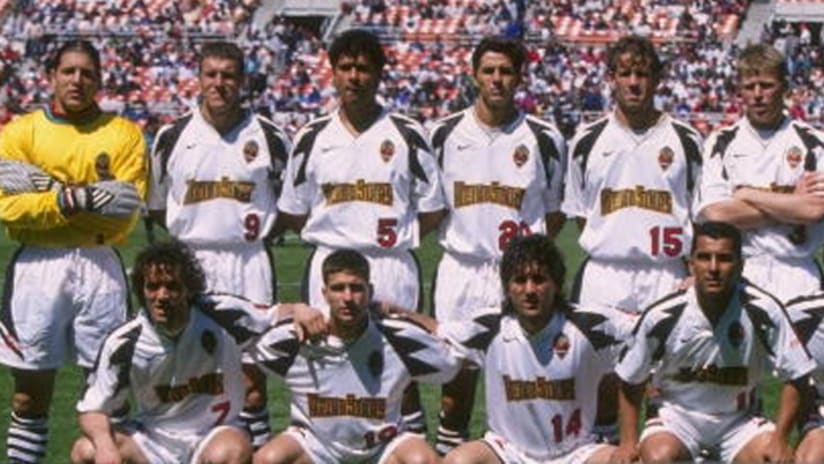
The stadium served as the home field for Caltech from 1923 to 1976, the North American Soccer League's Los Angeles Wolves in 1968 and its Los Angeles Aztecs in 1978 and 1979, Major League Soccer's Los Angeles Galaxy from 1996 to 2002, and UCLA football since 1982.
In 1983, the Rose Bowl hosted the Army-Navy Game, the only time it's been played west of the Mississippi River. It was done as a favor to military personnel on the West Coast, including the naval bases in San Diego and Oakland, and the Marines' Camp Pendleton in Oceanside. The referee was actor, gourmet chef, painter, art collector, and apparently accredited football referee Vincent Price. Navy won, 42-13.
The Rose Bowl has hosted 5 Super Bowls: XI, 1977, Oakland Raiders 32, Minnesota Vikings 14; XIV, 1980, Pittsburgh Steelers 31, Los Angeles Rams 19 (the 1st time a team ever played a Super Bowl in its own region, and they blew a 4th-quarter lead); XVII, 1983, Washington Redskins 27, Miami Dolphins 17; XXI, 1987, New York Giants 39, Denver Broncos 20; and XXVII, 1993, Dallas Cowboys 52, Buffalo Bills 17.
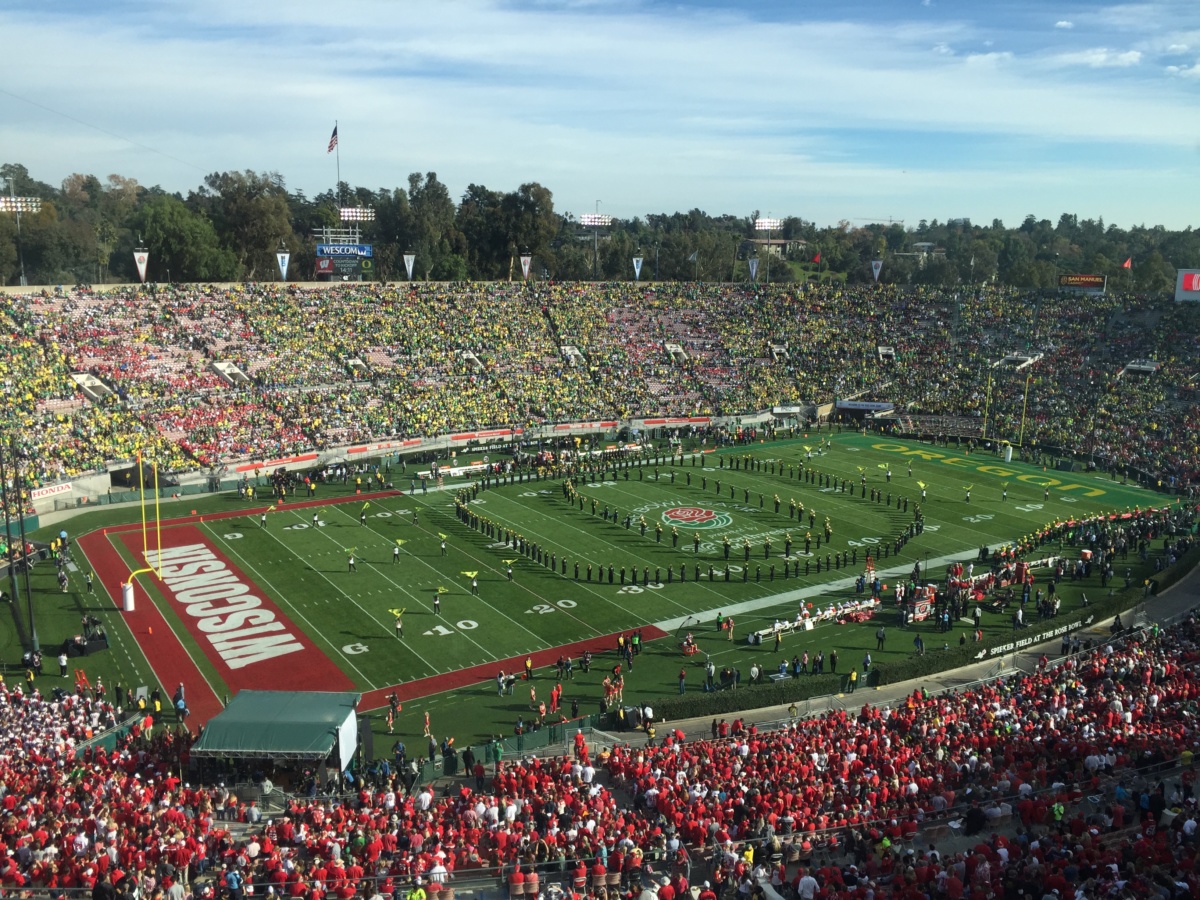
The 2020 Rose Bowl. Oregon beat Wisconsin, 28-27.
The NFL stopped hosting Super Bowls there not because the facilities were outdated (that's a matter of opinion), but because of a policy of hosting them in markets where there's an NFL team (which Los Angeles wasn't from 1995 to 2015). And with the opening of SoFi Stadium in 2019, the Rose Bowl will never host another.
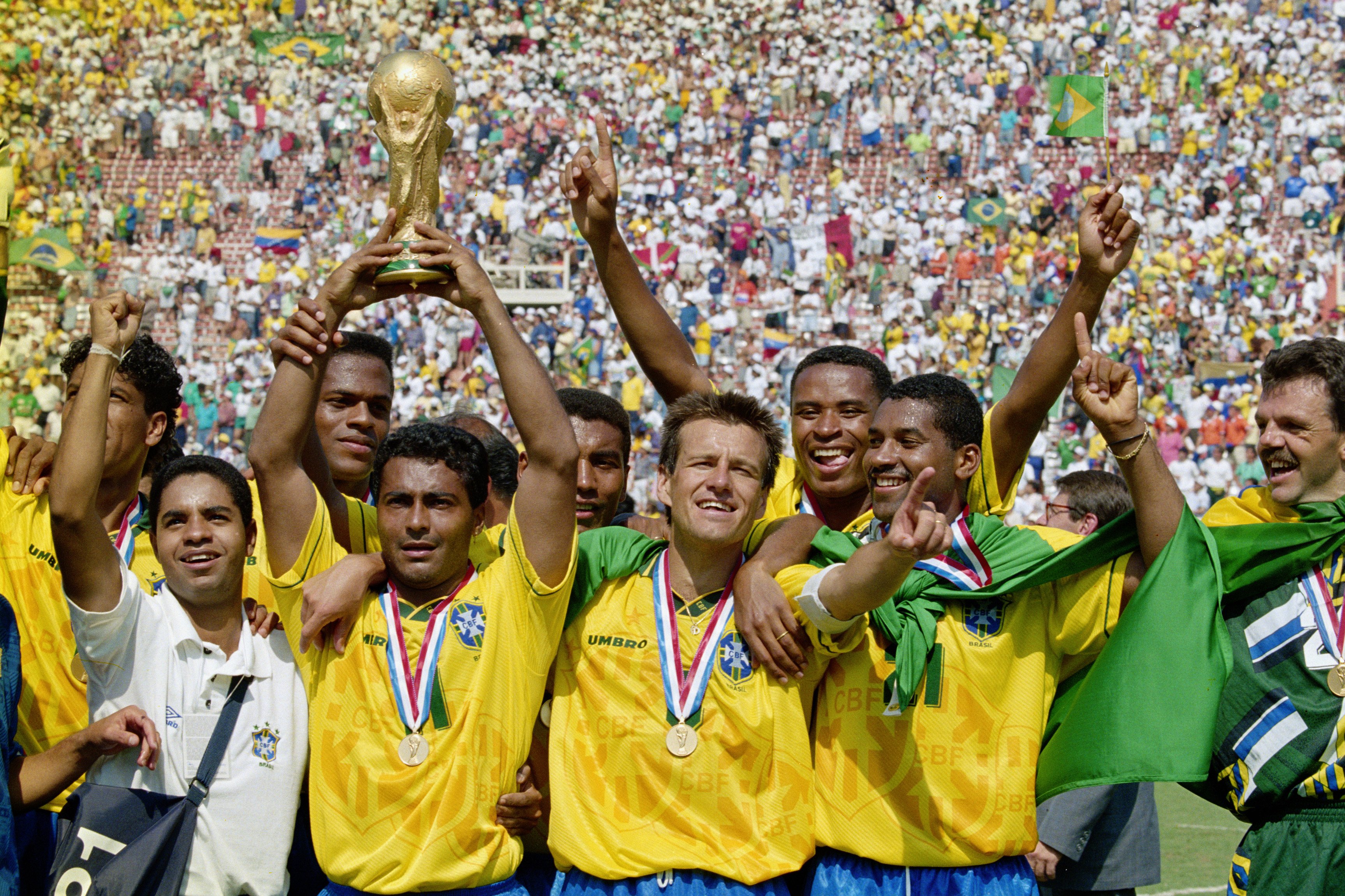
It hosted the Gold Medal Match of the 1984 Olympic soccer tournament, with France beating Brazil 2-0. It hosted 8 games of the 1994 World Cup, including the Final, which ended 0-0 before Brazil beat Italy on penalties. It hosted 4 games of the 1999 Women's World Cup, including the Final, which ended 0-0 before the U.S. beat China on penalties.
It's hosted 17 matches of the U.S. men's national team, including 2 in the 1994 World Cup; and 5 of the U.S. women's national team, including the 1999 World Cup Final. It hosted the 1998 MLS Cup Final (Chicago Fire 2, D.C. United 0), and the Final of the CONCACAF Gold Cup in 2002 (U.S. 2, Costa Rica 0) and 2011 (Mexico 4, U.S. 2).
Every year, formerly on Thanksgiving Day but now in early November, it hosts a high school football game, Pasadena High School vs. crosstown rival John Muir High School (Jackie Robinson's alma mater). It also hosts the Rose Bowl Flea Market, the largest flea market on the West Coast.
On June 6, 1982, it hosted a concert titled Peace Sunday, including Bob Dylan, Joan Baez, Stevie Wonder; Crosby, Stills & Nash, Stevie Nicks, Linda Ronstadt, Bette Midler and Tom Petty. On August 1 of that year, it hosted the Budwieser Superfest. Stevie played that show, too, as did, among others, Aretha Franklin and Luther Vandross.
Other notable concerts at the Rose Bowl include Janis Joplin in 1968, Journey in 1982, Metallica and Gun N' Roses in a 1992 show, Michael Jackson at the Super Bowl halftime show in 1993, Pink Floyd in 1994, Whitney Houston in 1994, The Rolling Stones in 1994 and 2019, The Eagles in 1995, Jennifer Lopez at the closing ceremony of the 1999 Women's World Cup, U2 and The Black Eyed Peas in a 2009 show, Beyoncé and Jay-Z in 2014, Eminem and Rihanna in 2014, One Direction in 2014, Taylor Swift in 2018, and BTS in 2019.
Food. There are concession stands all over the Bowl. They've got the usual stadium fare, and some real goodies: Bacon-wrapped hot dogs at Tunnels 3, 6, 16, 21 and 26; Bratwursts at 5, 21 and 28; Crepes at 7; Dippin Dots at 4 and 14; Italian Sausage at 11 and 14; Polish Sausage at 5, 21 and 28; Shaved Ice (Italian Ice) at 8, 16 and 24; Smoothies at 7 and 16; and Teriyaki Chicken Bowls at 2, 8, 16, 22 and 26.
Team History Displays. UCLA considers themselves to have won 17 Conference Championships: 1935, 1942, 1946, 1953, 1954, 1955, 1959, 1961, 1965, 1975, 1982, 1983, 1985, 1987, 1993, 1997 and 1998; and 2 Division Championships since the Pac-10 became the Pac-12: In 2011 and 2012, losing the Conference Championship Game both times.
They claim a National Championship for 1954, because the UPI Coaches' Poll declared them so. However, the AP Writers' Poll said that Ohio State was that season's National Champion. So it should have been settled in the 1955 Rose Bowl, right?
Yes, it should have -- and no, it wasn't. Both the Big 10 and the PCC then had a rule that a team couldn't go to the Rose Bowl 2 years in a row, and since UCLA had done so the year before, and Ohio State hadn't, the 2nd-place team went in UCLA's place. To make matters worse, that was USC. Now, USC was ranked Number 20 in the nation at the time, so they weren't a bad team. But Ohio State beat them, 20-7, and were recognized by most sources as National Champions.
UCLA has won 17 bowl games: The Rose Bowl in 1966, 1976, 1983, 1984, 1986, 1991; the Fiesta Bowl in 1985; the Cotton Bowl in 1989 and 1998; the Freedom Bowl in 1986; the Aloha Bowl in 1987; the Sun Bowl in 1991, 2005 and 2013; the Las Vegas Bowl in 2002; the EagleBank Bowl in 2009; and the Alamo Bowl in 2015.
There is no recognition for any of these honors at the Rose Bowl stadium, because UCLA doesn't own it.
In 1999, they named an All-Century UCLA Bruin Team:
* Offense: Quarterback Troy Aikman; running backs Skip Hicks, Kermit Johnson, Mel Farr, Freeman McNeal, Maurice Jones-Drew and Kenny Washington; receivers Tom Fears and J.J. Stokes; tight end Tim Wrightman; center Dave Dalby; guards Hardiman Cureton and Randy Cross; and tackles Jonathan Ogden and Kris Farris.
* Defense: Linemen Manu Tuiasosopo, Irv Eatman, Jack Ellena, Floyd Reese and Cliff Frazier; linebackers Jerry Robinson and Donn Moomaw; and defensive backs Kenny Easley, Don Rogers, Eric Turner and Bob Stiles.
* Special Teams: Kicker John Lee and punter Ben Wilson.
They've retired 10 numbers: 5 for early 1980s safety Easley; 8 for late 1980s quarterback Aikman; 13 for early 1940s back Washington; 16 for quarterback Gary Beban, the school's only winner of the Heisman Trophy, in 1967; 34 for 1950s defensive back Paul Cameron; 38 for 1940s end Burr Baldwin; 42 for late 1930s running back Jackie Robinson; 79 for 1990s tackle Ogden; 80 for early 1950s center Moomaw; and 84 for late 1970s linebacker Jerry Robinson (no relation to Jackie).
Jackie Robinson had the Number 42 retired for him by the Los Angeles Dodgers, even though he only played for them in Brooklyn, not in his "hometown" of Los Angeles; and it was later retired for all of Major League Baseball. And the University retired 42 for him across its entire athletic program in 2014: No matter what sport you play at UCLA, you can no longer wear 42.
However, while he was a really good football player, retiring 42 for him at UCLA is problematic, since he never wore the number there. There is a statue of him outside the Rose Bowl, showing him in a football uniform, but the number on his jersey is 55. And there is surviving film footage of him playing for UCLA, wearing 28. He played basketball at UCLA, wearing 18. And he played baseball at UCLA, but no known photo of him doing so shows his uniform number.
Aikman, Beban, Cross, Easley, Fears, Moomaw, Ogden, Jerry Robinson and Washington have been elected to the College Football Hall of Fame. So have 1940s guard Al Sparlis, 1950s guard Sam Boghosian, 1950s quarterback Billy Kilmer, 1970s safety John Sciarra, 1990s quarterback Cade McNown; and head coaches Red Sanders, Tommy Prothro and Terry Donahue. Despite his success at UCLA, and with the NFL's Philadelphia Eagles and St. Louis Rams, Dick Vermeil has not yet been elected to either the College or the Pro Football Hall of Fame.
Aikman, Easley, Fears and Ogden have been elected to both the College and the Pro Football Halls of Fame. Elected to the Pro Hall, but not the College Hall, have been 1940s quarterback Bob Waterfield and 1960s safety Jimmy Johnson (no relation to the later Dallas Cowboys coach).
It's also worth noting the retired numbers from UCLA's storied basketball program: 11, for Don Barksdale, 1946-47; 25, Gail Goodrich, 1962-65; 31, for both Reggie Miller, 1983-87, and Ed O'Bannon, 1991-95; 32, Bill Walton, 1971-74; 33, Kareem Abdul-Jabbar, 1966-69; 35, Sidney Wicks, 1968-71; 42, Walt Hazzard, 1961-64; 52, Jamaal Wilkes, 1971-74; and 54, Marques Johnson, 1973-77. Two women's players have had their numbers retired: 12, Denise Curry, 1977-81; and 15, Ann Meyers, 1974-78.
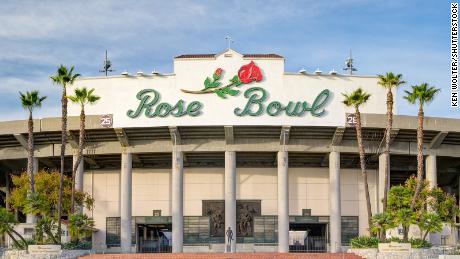
The Rose Bowl has a Court of Champions at its south end, under its famous marquee. It includes plaques with the scores and Most Valuable Players of every Rose Bowl game. These MVPs include:
* From UCLA: Bob Stiles in 1966, Sciarra in 1976, Don Rogers in 1983 and Rick Neuheisel in 1984.
* From Other schools now in the Pac-12: O.J. Simpson in 1968; Jim Plunkett of Stanford in 1971; Sam Cunningham of USC in 1973; Pat Haden of USC in 1975; Warren Moon of Washington in 1978; Charles White of USC in 1979 and 1980; Jack Del Rio of USC in 1985; Mark Brunell of Washington in 1991; Steve Emtman of Washington in 1992; Keyshawn Johnson of USC in 1996; Matt Leinart of USC in 2004; Mark Sanchez of USC in 2009; Marcus Mariota of Oregon in 2015; and Sam Darnold of USC in 2017.
* From Big Ten schools: Neil Snow of Michigan in 1902; Buddy Young of Illinois in 1947; Jim Grabowski of Illinois in 1964; Rex Kern of Ohio State in 1969; Ki-Jana Carter of Penn State in 1995; Brian Griese of Michigan in 1998; Ron Dayne of Wisconsin in 1999 and 2000; Terrelle Pryor of Ohio State in 2010; and Dwayne Haskins of Ohio State in 2019.
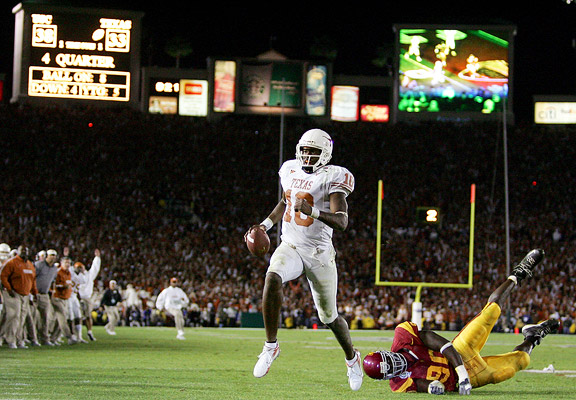
* From other teams: George Halas of the Great Lakes Naval Training Center in the World War I-affected 1918-19 season; Elmer Layden of Notre Dame's "Four Horsemen" in 1925; Johnny Mack Brown of Alabama in 1926; Charlie Trippi of Georgia in 1943; Vince Young of Texas in 2006; and Andy Dalton of Texas Christian in 2011.
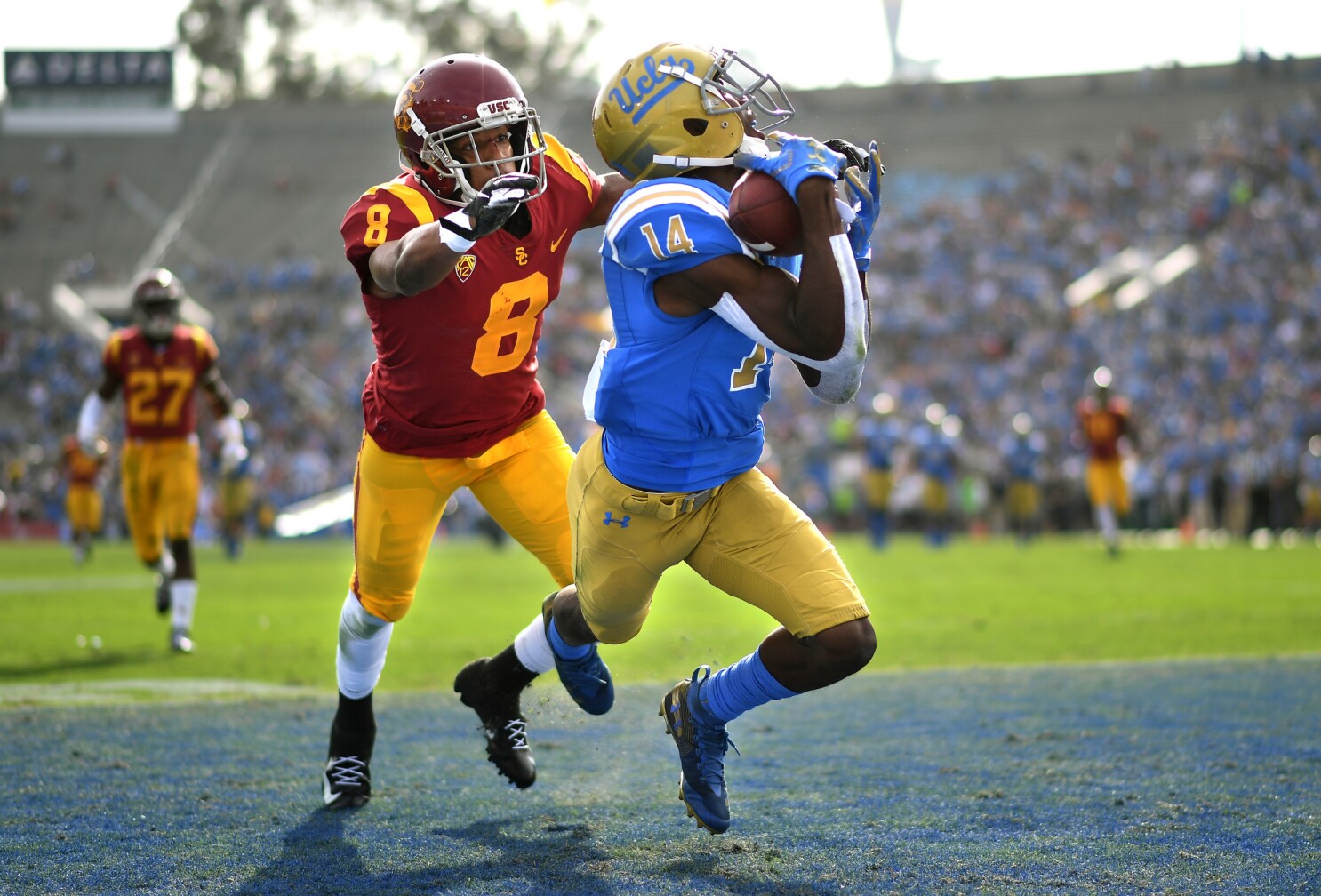
UCLA's great rival is the University of Southern California, a.k.a. Southern Cal, a.k.a. USC, 11 miles to the southeast. The annual winner between them across all sports receives the Crosstown Cup. In football, they have been playing each other since 1929, and it is a rare rivalry in which both teams wear their home uniforms: UCLA wears "True Blue," and USC wears "Cardinal Red."
USC leads the rivalry, 49-32-7. Since 1942, they have played for a Victory Bell, which formerly belonged to the locomotive of a Southern Pacific Railroad train. The 1st game for the Bell was UCLA's 1st win in the series. Nevertheless, USC leads that part of the rivalry, 44-32-4. Whichever team wins it paints it in their school's colors.
Stuff. Since the Rose Bowl stadium is owned by the City of Pasadena, not a college or a professional sports team, there are souvenir stands, but no big team store. The Tournament of Roses Shop is at the Tournament's headquarters, at 391 S. Orange Grove Blvd., nearly 2 miles south of the stadium.
If you're interested in UCLA souvenirs, you might be better off going to the UCLA Bookstore, at 308 Westwood Plaza, in the middle of campus.
In 2018, Spencer Stueve and Jonathan Franklin wrote The UCLA Football Encyclopedia. The year before, Stueve edited UCLA vs. USC: A Rivalry of Hate. In 2006, a DVD was produced, The Legends of UCLA.
During the Game. The UCLA campus is probably the safest place in Los Angeles. The Rose Bowl parking lot may be even safer. You do not have to worry about your car if you drive in.
The UCLA Bruin Marching Band, "The Solid Gold Sound," opens the pregame show with "The Bruin Fanfare" and a song written by the brothers George and Ira Gershwin, "Strike Up the Band." They play the National Anthem, and then form a script "Ucla" (only the U is capitalized, to match the script on the helmets), to the tune of "Bruin Warriors." They leave the field to the tune of "The Mighty Bruins."
At the end of every game, they play the Alma Mater, "Hail to the Hills of Westwood." If UCLA win, the band follows this with "Rover," a parody of "I'm Looking Over a Four-Leaf Clover."
Why "Bruins"? Because UCLA is a subsidiary of the University of California, who, in line with the State Flag, are the Golden Bears, and a bruin is a bear. The mascot is Joe Bruin, with a female equivalent, Josephine Bruin (or Josie Bruin).
After the Game. UCLA fans are not generally considered to be aggressive. You won't have any issues, with the possible exception of when they play USC.
The Rose Bowl is surrounded by a park and parking lots. You're better off heading back to Los Angeles proper to get a postgame meal.
West 4th & Jane is owned by a New Yorker and is an L.A.-area haven for Met fans. 1432 4th Street, Santa Monica. Bus R10. Rick's Tavern On Main is the home of the L.A. area's Yankees fan club. 2907 Main Street in Santa Monica, 2 blocks in from the beach. Bus 733 from downtown L.A. (While the 1970s sitcom Three's Company was set in Santa Monica, close to the beach, I cannot confirm that Rick's was the basis for the bar across from the apartment building, the Regal Beagle.)
O'Brien's Irish Pub at 2226 Wilshire Blvd. in Santa Monica is the home of the local fan club of the New York Giants football team. Bus R10. (Although it's also in Santa Monica, it's 3 miles in from the beach and Rick's.) On The Thirty is the home of L.A. area Jets fans. 14622 Ventura Blvd., Sherman Oaks. Metro Red Line to Universal/Studio City, then transfer to Bus 150.
If your visit to Los Angeles is during the European soccer season (which just ended, but will get back underway in mid-August), the best soccer bar in the L.A. area is The Fox and Hounds (that's plural), 11100 Ventura Blvd., Studio City. Metro Red Line to Universal/Studio City, then Bus 150 or 240 to Ventura & Arch.
Sidelights. On November 30, 2018, Thrillist published a list of "America's 25 Most Fun Cities." As you might guess, the country's 2nd biggest metropolitan area came in 2nd, behind the biggest, New York.
The Los Angeles metropolitan area, in spite of not having Major League Baseball until 1958, has a very rich sports history. And while L.A. is still a car-first city, it does have a bus system and even has a subway now, so you can get around. You'll need it if you visit L.A. during the 2028 Olympics, which it has been awarded.
* Tournament Park. Before the Rose Bowl stadium, the Rose Bowl game was held here, in 1902, 1916, 1917, 1918, 1919, 1920, 1921 and 1922, at a 43,000-seat stadium that no longer stands. The venue also hosted animal races, including chariot races. The reason the Rose Bowl stadium was constructed is that the venue was considered unsafe.
The site is now known as South Athletic Field, and is owned by the California Institute of Technology, a.k.a. Caltech, which, unlike UCLA and USC, actually is based in Pasadena. 1100 E. California Blvd. at S. Wilson Avenue.
The Tournament of Roses Parade was 1st held in 1890, and goes down Colorado Boulevard every New Year's Day, unless January 1 falls on a Sunday, in which case it's moved back to January 2 -- and that schedule holds even if the Rose Bowl game is scheduled for another day.
On The Jack Benny Program, first on radio and later on television, Jack played a fictional version of himself, an entertainer living in Los Angeles, known for his cheapness. (In real life, he was quite generous.) A common story was Jack going to buy a car, and the salesman would tell him that the car he was trying to sell had only one previous owner, "a little old lady from Pasadena, who only used it to drive to church on Sunday." Figuratively and literally, Jack wasn't buying it.
That led to the 1964 Dodge ad campaign, turning the story on its head: Kathryn Minner, then 72 years old, driving a souped-up car, saying, "Put a Dodge in your garage, honey!" This led to the record "The Little Old Lady (from Pasadena)\," by Jan & Dean (Jan Berry and Dean Torrence), invoking the nationally-famous route of the Parade:
And everybody's sayin' that there's nobody meaner
than the little old lady from Pasadena!
She drives real fast and she drives real hard!
She's the terror of Colorado Boulevard!
* Edwin W. Pauley Pavilion. Following their 1964 National Championship (they would win it again in 1965), UCLA coach John Wooden wanted a suitable arena for his ever-growing program. He got it in time for the 1965-66 season, and it has hosted 9 more National Championships, making for 11 banners (10 coached by Wooden).
The building was named for an oil magnate who was also a Regent of the University of California system, whose donation to its building went a long way toward making it possible. Edwin Pauley was a friend of, and appointee to several offices by, Presidents Franklin Roosevelt and Harry Truman, but the student protests of the 1960s led him to switch parties and support Ronald Reagan for Governor.
Speaking of politics, Pauley Pavilion was the site of the 2nd debate of the 1988 Presidential campaign, where CNN anchor Bernard Shaw asked the question that shattered the campaign of Governor Michael Dukakis – not that the Duke helped himself with his answer. Oddly, Dukakis chose to hold held his Election Eve rally there, despite being a Bostonian. (In contrast, Boston's JFK held his Convention in the Coliseum complex but his Election Eve rally at the Boston Garden.)
Metro Purple Line to Wilshire/Normandie station, switch to the 720 bus, then walk up Westwood Plaza to Strathmore Place. "Westwood" is the name of the neighborhood that UCLA is in, and Coach Wooden was known as "the Wizard of Westwood."
A few steps away is Drake Stadium, the track & field facility that was home to 1960 Olympic Decathlon champion Rafer Johnson and another UCLA track star you might've heard of, named Jackie Robinson. And also his brother Mack Robinson, 1936 Olympic Silver Medalist.
On the way up Westwood Plaza, you'll pass UCLA Medical Center, now named for someone who died there, Ronald Reagan. Wooden, John Wayne and Michael Jackson also died there. The UCLA campus also has a Dykstra Hall, but it wasn't named after Lenny Dykstra.
The PCL Angels were a farm team of the Chicago Cubs, and when chewing-gum magnate William Wrigley Jr. bought them both, he built the Angels' park to look like what was then known as Cubs Park, and then named this one, and then the Chicago one, Wrigley Field. So this ballpark was Wrigley Field first.
The Angels won 12 PCL Pennants, the last 5 at Wrigley: 1903, 1905, 1907, 1908, 1916, 1918, 1921, 1926, 1933, 1934, 1947 and 1956. Their rivals, the Hollywood Stars, shared it from 1926 to 1935. It hosted a U.S. soccer loss to England in 1959 and a draw vs. Mexico the next year.
Its capacity of 22,000 was too small for the Dodgers, and the AL Angels moved out after 1 season. Torn down in 1966, it lives on in ESPN Classic rebroadcasts of Home Run Derby, filmed there (because it was close to Hollywood) prior to the 1960 season. Mickey Mantle was a fixture, but the only other guy thought of as a Yankee to participate was Bob Cerv (then with the Kansas City A's). Yogi Berra wasn't invited, nor was Moose Skowron, nor Roger Maris (who had just been acquired by the Yankees and whose 61 in '61 season had yet to happen). And while Willie Mays, Duke Snider and Gil Hodges were on it, and all did briefly play for the Mets, the Mets hadn't gotten started yet, so no one on the show wore a Met uniform.
This Wrigley Field hosted 2 fights for the Heavyweight Championship of the World, both won by the defending Champions: Joe Louis knocking Jack Roper out in the 1st round on April 17, 1939; and Floyd Patterson defeating Roy Harris by decision on August 18, 1958.
42nd Place, Avalon Blvd., 41st & San Pedro Streets. Metro Red Line to 7th Street/Metro Center station, transfer to Number 70 bus. Be careful: This is South Central, so if you're overly nervous, you may want to skip this one.
* Gilmore Field. Home to the Hollywood Stars, this 13,000-seat park didn't last long, from 1939 to 1957. A football field, Gilmore Stadium, was adjacent. The Stars won 5 Pennants, the last 3 at Gilmore: 1929, 1930, 1949, 1952 and 1953. CBS Television City was built on the site. 7700 Beverly Blvd. at The Grove Drive. Metro Red Line to Vermont/Beverly station, then either the 14 or 37 bus.
* Los Angeles Memorial Coliseum. This is probably the most famous building in the State of California, unless you count San Francisco's Golden Gate Bridge or the HOLLYWOOD sign as "buildings." The University of Southern California (USC) has played football here since 1923. The University of California at Los Angeles (UCLA) played here from 1928 to 1981, when they inexplicably moved out of the Coliseum, and the city that forms their name, into the Rose Bowl, a stadium that could arguably be called USC's other home field.
The Coliseum was the centerpiece of the 1932 and 1984 Olympic Games. It was home to the NFL's Rams from 1946 to 1979 and the Raiders from 1982 to 1994, and to a number of teams in other leagues, including the AFL's Chargers in 1960 before they moved down the coast to San Diego.
The Dodgers played here from 1958 to 1961 while waiting for Dodger Stadium to be ready, but the shape of the field led to a 251-foot left-field fence, the shortest in modern baseball history. They got the biggest crowd ever for an official baseball game, 92,706, for Game 5 of the 1959 World Series; 93,103 for Roy Campanella's testimonial, an exhibition game against the Yankees on May 7, 1959; and the largest crowd for any baseball game played anywhere in the world, 115,300, for a preseason exhibition with the Red Sox on March 29, 2008, to celebrate their 50th Anniversary in L.A.
A crowd of 102,368 on November 10, 1957, for a rivalry game between the Rams and the San Francisco 49ers, stood as a regular-season NFL record until 2005. Ironically, the 1st Super Bowl, held here on January 15, 1967 (Green Bay Packers 35, Kansas City Chiefs 17) was only 2/3rds sold -- the only Super Bowl that did not sell out. Super Bowl VII (Miami Dolphins 14, Washington Redskins 7) was also played here.
It has hosted 20 matches of the U.S. soccer team -- only Robert F. Kennedy Stadium in Washington has hosted more. The U.S. has won 9 of those games, lost 7 and drawn 4. In 1967, as 2 separate leagues bid for U.S. soccer fans, it hosted the Los Angeles Wolves and the Los Angeles Toros. Those leagues merged to form the original North American Soccer League, but the Coliseum only hosted that league in 2 more seasons, for the Los Angeles Aztecs in 1977 and 1981.
Officially, the Coliseum now seats 93,607, and the Rams returned from 2016 to 2019. Oddly, since both they and the Raiders moved away after the 1994 season, the Raiders seem to be the most popular NFL team in Los Angeles County, but the much closer Chargers, 90 miles away, were the most popular team in Orange County. Now, the Chargers have also returned. More about that in a moment.
In 2018, wanting the money from selling naming rights, but not wanting to ruin the brand name that "The Los Angeles Memorial Coliseum" has become, or to insult the veterans of the City and the County of Los Angeles by taking the name off, the Coliseum Commission sold naming rights to the field, but not the stadium. It is now United Airlines Field at Los Angeles Memorial Coliseum.
* Banc of California Stadium and site of Los Angeles Memorial Sports Arena. Next-door to the Coliseum, the Sports Arena opened in 1959, and hosted the Democratic Convention the next year, although John F. Kennedy gave his acceptance speech at a packed Coliseum, debuting his theme of a "New Frontier."
The NBA's Lakers played here from 1960 to 1967, the NHL's Kings their first few home games in 1967 before the Forum was ready, the NBA's Clippers from 1984 to 1999, the ABA's Stars from 1968 to 1970, the WHA's Sharks from 1972 to 1974, the 1968 and 1972 NCAA Final Fours (both won by UCLA, the former over North Carolina and the latter over Florida State), USC basketball from 1959 to 2006, and UCLA basketball a few times before Pauley Pavilion opened in 1965 and again in 2011-12 due to Pauley's renovation.
Due to its closeness to Hollywood studios, the Sports Arena was often used for movies that need an arena to simulate a basketball or hockey game, a prizefight (including the Rocky films), a concert, or a political convention. Lots of rock concerts were held there, and Bruce Springsteen, on its stage, called the building "the joint that don't disappoint" and "the dump that jumps."
The Sports Arena jumps no more: It was torn down late last year, so that Banc of California Stadium, a soccer-specific stadium for the new Los Angeles FC, could be built on the site. It opened in 2018, and LAFC have begun playing an "El Trafico" derby with the Galaxy. Angel City FC of the National Women's Soccer League will begin play there in 2022.
3900 Block of S. Figueroa Street, just off the USC campus in Exposition Park. The California Science Center (including the space shuttle Endeavour), the Natural History Museum of Los Angeles County, and the California African American Museum are also there, and the Shrine Auditorium, former site of the Academy Awards, is but a few steps away. Number 40 or 42 bus from Union Station. Although the Coliseum and the Sports Arena are on the edge of South Central, you will probably be safe.
* Galen Center. In 2006, USC basketball finally had a home it owned, and at which it had first choice of scheduling -- ironic, considering their having first choice at the Coliseum infuriated the Rosenblooms of the Rams, the Hiltons of the Chargers, and Al Davis of the Raiders, and made the Spanoses of the Chargers decide not to use it until SoFi Stadium opened.
Seating 10,258, it is named for Louis and Helen Galen, bankers and longtime USC fans who donated $50 million, which turned out to be 1/3rd of the building's cost. The Jim Sterkel Court is named for a USC basketball player who died of cancer. On May 10, 2014, the vacant WBC Heavyweight Championship was awarded there when Bermane Stiverne knocked Chris Arreola out there.
3400 S. Figueroa Street, 5 blocks north of the Coliseum, and to the east of USC's main campus.
* The Forum. Home of the Lakers and the Kings from 1967 to 1999, built by their then-owner, Jack Kent Cooke, who went on to sell them and buy the NFL's Washington Redskins. From 1988 to 2003, it was named the Great Western Forum, after a bank. The Lakers appeared in 14 NBA Finals here, winning 6, with the Knicks clinching their last title over the Lakers here in 1973. The Kings appeared in just 1 Stanley Cup Finals here, in 1993, losing it to the Montreal Canadiens.
Now owned by the Madison Square Garden Corporation, thus run by James Dolan, which means it's going to be mismanaged. Elvis Presley sang here on November 14, 1970 and May 11, 1974. The Forum is not currently being used by any professional team, but was recently the stand-in for the Sunshine Center, the arena in the ABC sitcom Mr. Sunshine. 3900 W. Manchester Blvd.
* SoFi Stadium. This is the new stadium for the Rams and Chargers, on the site of the Hollywood Park horse racing track. Seating 70,240, it has a retractable roof, and is expandable to 100,000 for Super Bowls and NCAA Final Fours. It opened in time for the 2020 NFL season.
It has been awarded Super Bowl LVI, to be played on February 6, 2022; the College Football National Championship Game for the 2022-23 season; and the Opening and Closing Ceremonies for the 2028 Olympics, succeeding the Coliseum. It will not, however, host any games of the 2026 World Cup, because it wasn't finished at the time the joint North American (U.S.-Canadian-Mexican) bid was approved. (UPDATE: SoFi Stadium was selected as a venue for the 2026 World Cup, and it might host the Final.)
Hollywood Park Racetrack stood at the site from 1938 to 2013. Citation, the 1948 Triple Crown winner, won his last race there in 1951, becoming the 1st horse to win over $1 million. It hosted the Breeders' Cup in 1984, 1987 and 1997.
The NBA's Clippers plan to move for the 2024-25 season, to the Inglewood Basketball and Entertainment Center. (It will almost certainly sell the naming rights before then.) It will be located just south of SoFi Stadium, and seat 18,000. This will be the first time in the franchise's history -- in Buffalo, San Diego, or the Los Angeles area -- that the Clippers will control their own venue. (UPDATE: It has been named the Intuit Dome.)
3883 Prairie Avenue and Arbor Vitae Street, across Pincay Drive from the Forum. For both facilities, use Metro Silver Line to Harbor Transitway station, switch to Number 115 bus. (Be careful, this transfer is in South Central.)
Before the Rams, the Los Angeles Buccaneers were admitted to the NFL in 1926, but were a "traveling team," and never played a game in Los Angeles. They were made up of players from California colleges, but were based in Chicago. The Los Angeles Wildcats of the 1st American Football League were the same deal, a traveling team made up of West Coast athletes, naming them for George "Wildcat" Wilson of the University of Washington. Both teams folded the next year.
That same year, Abe Saperstein would found a basketball team in Chicago, but, like the Bucs and the Cats, make them a traveling team, and name them for a place that wasn't their real home: Since they were all-black, he named them the Harlem Globetrotters.
* Staples Center. This new downtown arena has been home to the Lakers, Clippers and Kings since 1999. The Lakers have won 5 Championships here, to go with the 6 they won at the Forum, and the 5 they won in Minneapolis. The Clippers, as yet, have won 2 Division Championships, but have never reached a Finals in any city since their founding in 1970 (as the Buffalo Braves, San Diego or L.A.). The Kings finally won a Stanley Cup in 2012, although, as a Devils fan, I'm trying to put that fixed Finals out of my mind. They've now won another, although, if you're a Ranger fan, you may want to do the same.
(UPDATE: Effective December 25, 2021, the Staples Center will be renamed the Crypto.com Arena. They might as well name it after a cryptocurrency: The arena is already expensive enough to make people go bankrupt.)
According to a recent New York Times article, there is not one place where the Clippers are more popular than the Lakers. Not in the City of Los Angeles, not in the County of Los Angeles, not in Orange County, not even in the Clippers' former home of San Diego (City or County). In fact, there are places in Southern California where the Chicago Bulls, as a holdover from the 1990s, have almost as many fans as the Clippers -- but not, despite all that LeBron James achieved, the Miami Heat or the Cleveland Cavaliers.
On 3 occasions, Vitali Klitschko fought for the WBC edition of the Heavyweight Championship of the World at the Staples Center. On June 21, 2003, he was knocked out by Lennox Lewis. But after Lewis vacated the title by retiring (there hasn't been an undisputed Heavyweight Champion of the World since), Klitschko was awarded the title by knocking Corrie Sanders out there on April 24, 2004. On September 26, 2009, he won a decision over Chris Arreola.
The Staples Center holds the Grammy Awards every other year (alternating with New York), and hosted the 2000 Democratic Convention, which nominated Al Gore. 1111 S. Figueroa Street, Los Angeles. The nearest Metro stop is Westlake/MacArthur Park, 8 blocks away.
(Yes, that MacArthur Park, the one where songwriter Jimmy Webb used to take the girlfriend who ended up leaving him and inspiring the song of the same title recorded by Richard Harris and later Donna Summer. Their relationship also inspired Webb to write "By the Time I Get to Phoenix" and "Where's the Playground Susie" by Glen Campbell, and "The Worst That Could Happen" by Johnny Maestro's later group, the Brooklyn Bridge. The worst that could happen there now, you don't want to know: Since the 1980s the park has been a magnet for gang violence, although this was significantly reduced in the 2000s.)
* Dodger Stadium. Home of the Los Angeles Dodgers since 1962, it has hosted 8 World Series (but none since 1988), and countless Cy Young Award wins and Rookies of the Year. It was also home to baseball's longest-serving broadcaster, who retired last year after 67 seasons in Brooklyn and Los Angeles. In his honor, the stadium's longtime address of 1000 Elysian Park Avenue was changed to 1000 Vin Scully Avenue.
It's about 2 miles north of downtown, in the Elysian Park neighborhood. Public transportation in L.A. is a lot better than it used to be, with the addition of the Metro -- and now, the Dodger Stadium Express bus.
The Beatles played their next-to-last concert at Dodger Stadium on August 28, 1966, before concluding their last tour up the coast at Candlestick Park the next night. It didn't host another concert until 1975, when Elton John sold it out on back-to-back nights (wearing a sequined Dodger jersey designed by Bob Mackie), and then not again until the Jacksons' 1984 Victory Tour. Pope John Paul II delivered a Mass there in 1987, and the Three Tenors held a concert there, telecast worldwide, on July 16, 1994, in conjunction with the World Cup. During a 2008 concert, Madonna brought on Britney Spears (they didn't kiss this time) and Justin Timberlake as guests.
* Angel Stadium of Anaheim. Home of the Angels since 1966, and of the Rams from 1980 until 1994, it was designed to look like a modernized version of the old Yankee Stadium, before that stadium's 1973-76 renovation. The football bleachers, erected in 1979, were demolished in 1997 and replaced with a SoCal-esque scene that gives the place some character. Unfortunately, the old "Big A" scoreboard that stood in left field from 1966 to 1979 was moved out to the parking lot, and now stands as a message board.
It was known as Anaheim Stadium from 1966 to 1997, and Edison International Field of Anaheim from 1998 to 2003. 2000 E. Gene Autry Way at State College Boulevard. Metrolink's Orange County Line and Amtrak share a train station just to the north of the stadium.
* Honda Center. Previously known as the Arrowhead Pond of Anaheim, it is across the railroad, the Orange Freeway and Katella Avenue from Angel Stadium. It has been home from the beginning of the franchise in 1993 to the NHL's Anaheim Ducks – formerly the Mighty Ducks of Anaheim, and I still tend to call them the Mighty Dorks and the Mighty Schmucks. It also hosted the NCAA's hockey version of the Final Four, the Frozen Four, in 1999. 2695 E. Katella Avenue. Anaheim Metrolink stop.
* Anaheim Convention Center. With the Angels having opened house in Orange County in 1966, prospective owners of teams in other sports began to consider the area. This complex opened in 1967, and includes a 7,500-seat arena.
That year, it became the home of a charter team in the American Basketball Association, the Anaheim Amigos, who couldn't even come close to filling the small capacity, averaging just 1,293 fans per home game. I've been to many a high school basketball game with more attendees than that. So the team moved up the freeway to the L.A. Sports Arena, and became the Los Angeles Stars. They were no more successful there, and moved to Salt Lake City, where, as the Utah Stars, they won the 1971 ABA title.
The ACC was home to the Anaheim Oranges of World Team Tennis in 1978, the California Surf of the indoor version of the old North American Soccer League in 1979-80, the wrestling matches of the 1984 Olympics, and the Big West Conference basketball tournaments (men's and women's) from 2001 to 2010. But if you don't count the ABA, then it's hosted exactly 1 major league sporting event ever, and then only as an emergency: On May 3, 1992, with the South Central riots still raging mere blocks from the Sports Arena, the Clippers moved Game 4 of their Playoff series with the Utah Jazz to the ACC, and won 115-107.
The Los Angeles Kings have never played at the Anaheim Convention Center. Nor have the Sacramento Kings. But the King of Rock and Roll, Elvis Presley, sang here on April 23 and 24, 1973 and November 30, 1976.
The ACC is now the largest exhibit facility on the West Coast. 800 W. Katella Avenue, across the street from Disneyland, about 2 miles west of Angel Stadium, and about 2 1/2 miles west of the Honda Center. Bus 50 goes down Katella between the venues.
* Titan Stadium. On the campus of California State University, Fullerton, this 10,000-seat facility is better known for soccer, having been used for NCAA Tournament games, U.S. Open Cup matches by the Los Angeles Galaxy, and 8 games by the U.S. national team -- which is undefeated there, winning 4 and drawing 4. 800 N. State College Blvd. Metrolink Blue Line from L.A. to Buena Park, then Number 24 bus. Or Number 57 bus from Angel Stadium.
* Dignity Health Sports Park. Formerly the Home Depot Center and the StubHub Center, this 30,500-seat stadium has been home to MLS' Los Angeles Galaxy since it opened in 2003, and Chivas USA from its formation in 2004 until it went out of business in 2014. From 2017 to 2019, it was the home field of the Los Angeles Chargers, until SoFi Stadium opened. The football team of San Diego State University will use it for the 2021 football season, while their new stadium is built on the site of Jack Murphy Stadium.
Aside from the regular-season title of the Western Conference in 2007, Chivas USA, a subsidiary of the legendary Guadalajara, Mexico-based Chivas, won nothing. But the Gals -- yes, they get that feminized nickname -- have won more MLS Cups than any other team, 5: 2002, 2005, 2011, 2012 and 2014, all but the 1st while playing here. They also won the CONCACAF Champions League, in 2000, and the U.S. Open Cup in 2001 and 2005.
It's hosted the MLS Cup Final in 2003, 2004, 2008, 2011, 2012 and 2014. It's hosted 12 games by the national team, most recently a win over Canada on February 5, 2016, winning 8, losing 2 and drawing 2. It hosted 6 games of the 2003 Women's World Cup, including the Final, in which Germany beat Sweden.
18400 Avalon Blvd. in Carson, adjacent to Cal State-Dominguez Hills. Public transport is difficult. You'd have to take 2 buses: First, the 910 or 950 Silver Line from downtown to the Harbor Gateway Transit Center, then the 246 San Pedro-Point Fermin line. That will get you to the corner of Avalon Blvd. and Victoria Street, the northwestern corner of the stadium's property.
* Veterans Memorial Stadium. This 11,600-seat stadium, opening in 1948, was the home field for the football program at California State University at Long Beach, a.k.a. Cal State-Long Beach, CSU-Long Beach or Long Beach State, from 1955 until the program was folded in 1991.
On April 28, 1957, it was the site of the 1st game for the U.S. soccer team against Mexico on home soil. Of the 10 previous meetings, starting at the 1934 World Cup, 1 (the 1st ) was in Italy, 1 was in a tournament in Cuba, and the rest were in Mexico City. It was a qualifier for the 1958 World Cup, and it didn't go so well: About 12,500 fans attended, most of them Mexicans coming over the border or Mexican-Americans choosing heritage over homeland, and Mexico won 7-2. Aside from that 1st match in 1934, the U.S. would not beat Mexico until 1980.
Like the old Veterans Stadium in Philadelphia, it is locally known as simply "The Vet." 5000 E. Lew Davis Street, about 19 miles southeast of downtown Los Angeles. Not easy to get to by public transportation: Bus 910 or 950 to Harbor/Century Transitway Station, then Metro Green Line to Lakewood Blvd., then Bus 266 to Lakewood & Michelson, then Bus 112 to Clark & Lew Davis.
* Murdock Stadium. As I mentioned, this 12,127-seat stadium on the campus of El Camino College was home to the NASL's Los Angeles Aztecs in 1975 and '76. It also hosted CONCACAF Gold Cup games, 2 in 1985 and 1 in 1989, and a game in the 1991 North American Nations Cup. The U.S. was the home team in all of them, winning 2, drawing 1 and losing 1. 16007 Crenshaw Blvd, in Torrance, 15 miles southwest of downtown Los Angeles. Bus 45 to Figueroa/Harbor Freeway Station, then Bus 2 to Redondo Beach Blvd, then a half-mile walk west.
* Gersten Pavilion. This 4,156-seat arena opened in 1981 as the home court for Loyola Marymount University, best known for their 1990 postseason run that included the death of Hank Gathers. For this reason, it is known as Hank's House. 1 LMU Drive. Bus 733 to Venice & Lincoln, then Bus 3 to Manchester & Loyola.
* Site of Naud Junction Pavilion. Naud Junction was the site of a warehouse built by Edouard Naud, including a signal tower at Alameda and Ord Streets. It lasted until 1940, when Union Station was built.
From 1905 to 1913, the site also included the Naud Junction Pavilion, also known as the Pacific Athletic Club. At this building, 4 fights for the Heavyweight Championship of the World were held, all successful defenses for Champion Tommy Burns: Against Marvin Hart, from whom he'd won the title the year before, on February 23, 1906; against Fireman Jim Flynn on October 2, 1906; against Light Heavyweight Champion Philadelphia Jack O'Brien on November 28, 1906; and against O'Brien again on May 8, 1907.
* Santa Anita Park. Opening on Christmas Day 1934, the West Coast's premier thoroughbred horse racing track annually hosts the Santa Anita Derby, one of the warmup races for the Triple Crown. It has also hosted the Breeders' Cup more times than any other track. How many times, Ed Rooney? "Nine times!": 1986, 1993, 2003, 2008, 2009, 2012, 2013, 2014 and 2016.
It's yet another location which, due to its proximity to Hollywood, has frequently served as a filming location for its usual subject: The Marx Brothers' A Day at the Races and the original version of A Star Is Born in 1937, and The Story of Seabiscuit in 1949. Seabiscuit had famously won his last race there, the 1940 Santa Anita Handicap. The ill-fated 2012 TV series Luck was also filmed there.
It also includes statues of several horses, including Seabiscuit, John Henry and Zenyatta; and jockeys such as Johnny Longden, Bill Shoemaker and Laffit Pincay Jr. 285 Huntington Drive in Arcadia, about 13 miles northeast of downtown Los Angeles. Metro Gold to Arcadia.
* Hollywood Bowl. This 17,376-seat outdoor amphitheater in the Hollywood Hills, with the HOLLYWOOD sign in the background, is one of the best-known concert venues in the world. Opening in 1922, it should be familiar to anyone who's seen the original 1937 version of A Star Is Born, Double Indemnity, Xanadu, and Monty Python Live at the Hollywood Bowl.
The Beatles played here on August 23, 1964, and again on August 29 & 30, 1965. Jazz icon Miles Davis played what turned out to be his last concert here on August 25, 1991. 2301 N. Highland Avenue. Metro Red Line to Hollywood/Highland Station, then walk almost a mile up Highland.
* Academy Award ceremony sites. The Oscars have been held at:** 1929, Hollywood Roosevelt Hotel (7000 Hollywood Blvd.).** 1930-43, alternated between the Ambassador Hotel, 3400 Wilshire Blvd.; and the Biltmore Hotel, 506 S. Grand Avenue, downtown.** 1944-46, Grauman's Chinese Theater (more about that in a moment).** 1947-48, Shrine Auditorium, 665. W. Jefferson Blvd., Los Angeles (Metro Silver Line to Figueroa/Washington, transfer to Number 81 bus). Elvis sang here on June 8, 1956.** 1949, Academy Award Theatre, at Academy headquarters on Melrose Avenue.** 1950-60, Pantages Theatre, 6233 Hollywood Blvd., Los Angeles.** 1961-68, Santa Monica Civic Auditorium, which also hosted the legendary televised rock concert The T.A.M.I. Show in 1964, 1855 Main Street, Santa Monica (Number 10 bus from Union Station).** 1969-2001, alternating between the Shrine Auditorium and the Dorothy Chandler Pavilion, 135 N. Grand Avenue, downtown;** 1988-2001, Shrine Auditorium again.** 2002-present, Dolby Theatre (formerly the Kodak Theatre, which also hosts American Idol), 6801 Hollywood Blvd (Metro Red Line to Hollywood/Highland).
All of these still stand, except the Ambassador, demolished in 2005. The site of a legendary nightclub, the Cocoanut Grove, and filming site of a lot of movies, the last movie filmed there was Bobby, in honor of the building's real-life most tragic event, the assassination of Robert F. Kennedy on June 5, 1968. (Directed by Emilio Estevez, one of its stars was his father Martin Sheen, who may be the only actor ever to play both Jack and Bobby Kennedy, although he didn't play either in this film.)
In addition to the above, Elvis sang at the Long Beach Municipal Auditorium on June 7, 1956; November 14 and 15, 1972; and April 25, 1976 (300 E. Ocean Blvd.); the Pan Pacific Auditorium on October 28 & 29, 1957 (7600 Beverly Blvd near CBS and the Gilmore stadiums, 1935-89); and the Swing Auditorium in San Bernardino on November 12 & 13, 1972, and May 10 & 13, 1974 (1949-81, demolished, 689 S. E Street, 58 miles east of downtown L.A.).
Oh yeah: He also sang at NBC's Burbank Studios, a complex which also includes, among other things, the studio where Johnny Carson from 1972 to 1992, and Jay Leno from then until 2014, hosted The Tonight Show. Elvis taped his "Comeback Special" there on June 24 and 25, 1968. 3000 W. Alameda Avenue. Metro Red Line to North Hollywood, then Bus 501 to Alameda & Olive.
The Los Angeles area is home to a few interesting museums, in addition to those mentioned at Exposition Park. The Getty Center is an art museum at 1200 Getty Center Drive, off I-405. The Autry National Center, 4700 Western Heritage Way, was founded by the Singing Cowboy and Angels founder-owner to celebrate and study the Western U.S. and Native Americans. (Metro Red Line, Hollywood/Western.) Also at Griffith Park, the Griffith Observatory, at 2800 E. Observatory Avenue, should be familiar from lots of movies (including Rebel Without a Cause) and TV shows.
The Hollywood section of town (not a separate city) has a few interesting sites, and the studio tours may be worth it, but do yourself a favor and skip the tours of stars' homes. You're probably not going to see any of the celebrities. You've got a better chance of seeing one back home on the streets of New York.
And you don't need to see the 44-foot-high HOLLYWOOD sign. You might remember the shot of it in the ESPN film The Bronx Is Burning, when the Yankees went out to L.A. to play the Dodgers in the 1977 World Series. Their shot of the sign was accurate: In 1977, it was falling apart, a genuine ruin. A year later, it was restored, but it's still no big deal up close. It was meant to be seen from afar.
Grauman's Chinese Theater, with its cemented signatures and footprints of stars, is the centerpiece of the Hollywood Walk of Fame at the legendary intersection of Hollywood Blvd. & Vine Street (6931 Hollywood Blvd., also at the Hollywood/Highland Metro stop).
Jackie Robinson grew up in Pasadena, at 121 Pepper Street. In a bit of foreshadowing, Pepper Street and Claremont Street are connected by an alley named Progress Lane. Pepper Street extends from Sunset Avenue, and at its foot is Brown Memorial AME Church, which the Robinsons attended. Gold Line from Union Station to Del Mar, then Bus 260 to Fair Oaks & Claremont. Be advised that this is still a private residence, not a museum dedicated to Jackie, and the people living there now will not want to be bothered.
Casey Stengel, the 1st manager of the Mets and the greatest manager of the Yankees, retired to Glendale, in Los Angeles County, and after his death on September 29, 1975, he was buried in Forest Lawn Memorial Park Cemetery. So was Don Drysdale, and early 1950s Brooklyn manager Chuck Dressen.
Also laid to rest there are Lou Gehrig's successor Babe Dahlgren, football star turned actor Johnny Mack Brown, 1930s boxing champion Jimmy McLarnin, Chicago Cubs owners William Wrigley Jr. and Philip K. Wrigley, Laverne and Maxene Andrews of the Andrews Sisters, James Arness, Humphrey Bogart and Lauren Bacall, Clara Bow, Lon Chaney Sr., Nat King Cole and Natalie Cole, Sam Cooke, Sammy Davis Sr. and Jr. and Sammy's widow Altovise, Walt Disney and other members of his family (he was not cryogenically frozen), W.C. Fields, Larry Fine (the other members of the Three Stooges are buried elsewhere in Los Angeles County), Errol Flynn, Clark Gable and Carole Lombard, Jean Harlow, Rex Harrison, Phil Hartman, Michael Jackson, Ted Knight, Harold Lloyd, Chico and Gummo Marx (but not Groucho or Harpo), Aimee Semple McPherson, Tom Mix, Lone Ranger star Clayton Moore, Mary Pickford, Will Rogers, David O. Selznick, Norma Shearer and Irving Thalberg, Red Skelton, Jimmy Stewart, Elizabeth Taylor and Spencer Tracy. 1712 S. Glendale Avenue. Bus 90, 91, 92 or 94 from downtown.
Roy Campanella is interred at Forest Lawn Memorial Park in the Hollywood Hills. So is another Hall-of-Famer associated with the Dodgers, Leo Durocher. So is John Roseboro, who succeeded Campy as Dodger catcher. So are John Wooden, Gene Autry, longtime Lakers owner Jerry Buss, Steve Allen, Lucille Ball, David Carradine, Bette Davis, Annette Funicello, Marvin Gaye, Andy Gibb, Batman creator Bob Kane, Buster Keaton, Jack LaLanne, Dorothy Lamour, Charles Laughton, Stan Laurel (but not Oliver Hardy), Liberace, Ed McMahon, Ozzie Nelson, Harriet Nelson, Ricky Nelson, Freddie Prinze, John Ritter, Telly Savalas, Lee Van Cleef, Dick Van Patten, Paul Walker and Jack Webb.
Despite his connections to L.A., Jackie Robinson is buried in Brooklyn, at Cypress Hills Cemetery, which is bisected by the Interborough Parkway, now named the Jackie Robinson Parkway. Gil Hodges is also buried in Brooklyn, at Holy Cross Cemetery. Pee Wee Reese is buried in his hometown of Louisville, Kentucky. Duke Snider lived in Fallbrook, California during his retirement, and is buried there, at Masonic Cemetery, about 100 miles southeast of Los Angeles. New York-born baseball legend Hank Greenberg, often called the 1st Jewish baseball star, is buried at Hillside Memorial Park & Mortuary, 6001 West Centinela Avenue. Bus 45 to Broadway & Slauson, then Bus 108 to Bristol Parkway & Green Valley Circle.
Among the sports-themed movies set and/or filmed in or around Los Angeles is the 1976 kids' baseball film The Bad News Bears, whose home field was Mason Park, 10500 Mason Avenue in Chatsworth, 29 miles northwest of downtown (Bus 92 to 1st & Olive, then Bus 164 to Victory & Woodman, then Bus 158 to Mason & Devonshire); and the basketball hustlers' film White Men Can't Jump, filmed at the courts at the Boardwalk in Venice Beach (Bus 733).
If you're interested in American history, especially recent history, Southern California is home to 2 Presidential Libraries. Richard Nixon's is not far from Anaheim, built adjacent to the house where he was born in 1913 at 18001 Yorba Linda Blvd. in Yorba Linda, Orange County. Metrolink Orange County Line from Union Station to Fullerton, then Number 26 bus to Yorba Linda.
Nixon's "Western White House" at San Clemente can be reached by I-5 or by Amtrak's Pacific Surfliner to San Juan Capistrano (the former Spanish mission where, as the song goes, the swallows return on the first day of spring), and then transferring to the Number 191 bus. However, the house, which Nixon called La Casa Pacifica, is privately owned (no longer by the Nixon family), and is not open to the public. So unless you're a major Tricky Dick fan, I'd suggest skipping it, as you'd only be able to stand outside it.
Ronald Reagan's Presidential Library is at 40 Presidential Drive in Simi Valley in Ventura County. (Reagan was born in Tampico, Illinois, about 130 miles west of Chicago.) Unfortunately, the Reagan Library is next to impossible to reach without a car.
Reagan's Western White House, Rancho del Cielo outside Santa Barbara, is owned by a private foundation that can be contacted for tours. The Reagans lived together at 668 St. Cloud Road, in the Bel Air section of L.A., until Ron's death in 2004. Nancy continued to live there until her death earlier this year. 668 St. Cloud Road, in Bel Air. Metro Red Line to Vermont & Sunset, then Bus 2 to Sunset & Bel Air, and then nearly a half-hour walk. It's been remarked that the ranch was
his home, whereas anyplace they lived in "Hollywood" was
her home.
The tallest building in Los Angeles, and the tallest building west of the Mississippi River, is the newly-completed Wilshere Grand Center, at 1,100 feet, at 900 Wilshere Blvd. at Figueroa. It surpassed the 1,018-foot Library Tower, a.k.a. the U.S. Bank Tower.
However, the two most famous tall buildings in Los Angeles are 444 S. Flower Street, at 5th Street, famous as the location for the law firm on L.A. Law; and City Hall, recognizable from LAPD badges, the early police series Dragnet, and as the stand-in for the Daily Planet building on the George Reeves Adventures of Superman series in the 1950s. 200 S. Spring Street at Main Street.
Did I forget anything important? Oh yeah, Southern California's original tourist destination, outside of the Hollywood studios. Most people I've talked to who have been to both Disneyland in Anaheim and Walt Disney World outside Orlando, Florida have said that the Florida one is a lot better. Anyway, the address is 1313 S. Harbor Blvd. in Anaheim, and if you're staying in Los Angeles, just drive down I-5. Public transportation is possible, but it's a mile and a half from the closest bus stop to Disneyland's gates.
*
UCLA football isn't as storied as USC football. But it's at least as storied as the Rams, and much more so than the Chargers. The UCLA campus and a UCLA football game -- regrettably, not in the same place -- are well worth checking out.