Showing posts with label game of the century. Show all posts

Sunday, January 4, 2026

January 4, 2006: USC vs. Texas, "The Game of the Century"

January 4, 2006, 20 years ago: The Rose Bowl game is held in the stadium of the same name, in the Los Angeles suburb of Pasadena, California.

Traditionally, the Rose Bowl features the Champions of the league currently known as the Pacific-12 (or Pac-12) Conference against those of the Big Ten Conference. But the drive to a Playoff to determine a true National Champion for college football has tweaked that: After 55 consecutive seasons, all on New Year's Day except for years in which January 1 fell on a Sunday, moving the game to January 2, with a Big 10 vs. PCC/AAWU/Pac-8/Pac-10 matchup, those leagues' newly-crowned titlists were not paired up in the Rose Bowl games of calendar years 2002, 2005, 2006, 2011, 2015, 2018 and 2021.

The shattering of the Pac-12 in 2023 ended the idea forever, especially with 4 of their teams joining the Big 10 -- although the Playoff system now in place made an Ohio State vs. Oregon Rose Bowl in the 2025 Quarterfinal possible. (Ohio State won.)

As I said, the 2006 game was one of them. True, the University of Southern California, winners of more titles in that league than any other team, winners of more Rose Bowls than any other team, and winners of more National Championships than any team in that league, had won the Pac-12 title again. And they had won the National Championship in each of the last 2 seasons, led by the last 2 Heisman Trophy winners, quarterback Matt Leinart and running back Reggie Bush. And they finished the regular season ranked Number 1 in every poll, including the Bowl Championship Series rankings.

But their opponents, the team that finished Number 2 in every poll, including the BCS, would not be the Big 10 Champions. That would be Pennsylvania State University, a.k.a. Penn State, who were ranked Number 3 in the BCS, and went on to win the Orange Bowl in Miami against Florida State University, the Atlantic Coast Conference Champions, on January 3.

No, the Number 2 team was the University of Texas. The most successful team in the since-concluded history of the Southwest Conference, they were now the Champions of the Big 12 Conference, formed in 1996 when half of the SWC teams were absorbed into the former Big Eight Conference. Texas was led by a spectacular quarterback, Vince Young, who could run and throw with equal aplomb.

Under head coach Pete Carroll, the USC Trojans had been Number 1, wire to wire, going 12-0. They had scored 70 at home to Arkansas, 66 at home to arch-rival and then-Number 11 UCLA, 63 away to Hawaii, 55 at home to Washington State, 51 away to Washington, 51 at home to Stanford, 50 at home to then-Number 16 Fresno State, 45 away to then-Number 24 Oregon, 42 at home to Arizona, 38 away to then-Number 14 Arizona State, 35 at home to the University of California, and 34 away to then-Number 9 Notre Dame. The Notre Dame game was a nationally-televised thriller, ending 34-31, and that was the only real close game the Trojans had all season.

Under head coach Mack Brown, the Texas Longhorns also came into the game 12-0, and were ranked Number 2 the entire season. The offense that Young led was every bit as impressive as USC's: They hung 66 on Kansas at home, 62 on Baylor University away, 60 on Louisiana-Lafayette at home, 52 on then-Number 10 Texas Tech at home, 51 on Rice at home, 51 on Missouri away, 47 on Oklahoma State away, 45 on Oklahoma on neutral ground in Dallas, 42 on then-Number 24 Colorado at home, and 40 on arch-rival Texas A&M away.

What's more, the Longhorns had a bigger win than USC did. On September 10, they traveled to Ohio State, then Number 4, and beat them 25-22. The Buckeyes were the only team that stayed within 10 points of Texas. In the Big 12 Championship Game in Houston, the 'Horns throttled Colorado, 70-3.

No question about it, if there was any team that could give USC a run for its money, it was Texas. USC had won 34 straight games. Texas had won 19 straight. Something had to give.

These were 2 of the titans of college football. USC had, to this point, won 35 Conference Championships. They also claimed 17 National Championships, but only 5 of these have been definitive under the current poll system, which has been in place since 1936: 1962, 1967, 1972, 2003 and 2004. (In 1978, the polls were split: UPI took USC, and the AP took Alabama.) Texas claimed 31 Conference Championships, and 8 National Championships, but only 1963 and 1969 were officially recognized by the NCAA.

This game was being hyped as "The Game of the Century," as had a few others in college football history. But this was the 21st Century, so there wasn't a previous game to live up to, unless you want to count Ohio State's dethroning of the University of Miami in the 2003 Fiesta Bowl.

A crowd of 93,988 crammed into the Rose Bowl stadium. An estimated 36 million more, making it the most-watched college football game ever, watched on ABC as Keith Jackson (who was calling his last game, and picked a great way to go out) and Pro Football Hall of Fame quarterback Dan Fouts, himself a Pac-8 veteran (University of Oregon), called the action. LeAnn Rimes sang the National Anthem.

Texas kicked off. USC couldn't do much on their opening possession. But they got the ball right back on a Texas fumble, and took a 7-0 lead to the end of the 1st quarter. Early in the 2nd quarter, Bush tried a lateral pass, but no one was there to receive it, and Texas recovered, leading to a field goal that made it 7-3.

A USC interception led to a Texas drive that ended in a lead-changing touchdown, although the extra point had been missed. Texas scored another touchdown, and USC added a field goal to make it 16-10 Texas at the half.

In the 3rd quarter, a USC drive ended with a LenDale White touchdown, and put the Trojans up 17-16. But Young led the 'Horns back, and scored himself, and Texas had a 23-17 lead. USC gambled on a 4th-and-1 from the Texas 12, and White scored again. That made it 24-23, and near the end of the 3rd quarter, Texas missed a field goal attempt.

Bush scored a touchdown early in the 4th quarter. The USC defense held Texas on their next possession, resulting in a field goal that made it 31-26 Trojans. USC scored again to make it 38-26 with 6 minutes and 42 seconds left, and it looked like they had done something no team had ever done: Win 3 straight NCAA Division I-A football championships.

Young refused to give up, leading a touchdown drive that made it 38-33 USC with 3:58 left. Now, it was the Longhorn defense's turn to be heroes, and they held USC to just 1 1st down. With 2:13 to go, USC faced 4th-and-2 at the Texas 45. Carroll decided to go for it. Leinart handed off to White, and he was held to 1 yard. (To the dismay of Seattle fans, this would not remain Carroll's greatest coaching blunder.) With 2:09 left, Texas needed to go 56 yards. (A field goal would only have made it 38-36.)

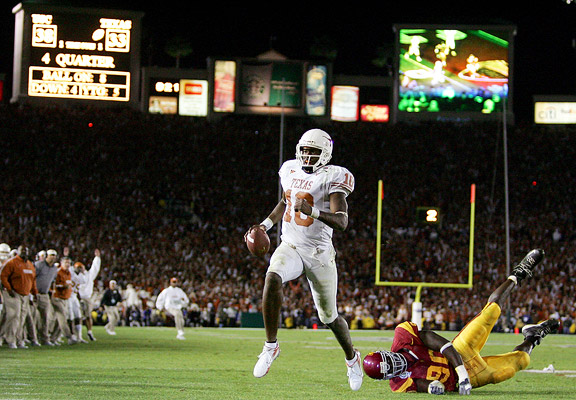
Young drove the Longhorns into Trojan territory. They got a big boost from a foolish face-mask penalty. They got to the 9-yard line, on 4th-and-5. A 1st down could have been gained without scoring a touchdown. The Longhorns went into their preferred formation, the shotgun. Young took the snap. His receivers were covered. He ran for the right sideline, got a key block from Justin Blalock, turned the corner, and dashed into the end zone with his 3rd rushing touchdown of the game. He got into the end zone again for the 2-point conversion. It was 41-38 Texas.

USC got the ball back with only 16 seconds left. It wasn't enough to for them to get into range for a tying field goal. Leinart only got them to the Texas 43. Had he time for 1 more play, a field goal from there would have been 60 yards.

But the clock had run out, and Texas were the undisputed National Champions for the 1st time in 36 years. The 2006 Rose Bowl, the 21st Century's 1st real Game of the Century, had lived up to the hype.

Soon, it would come out that USC had engaged in all kinds of recruiting violations. The NCAA vacated their last 2 wins of the 2004 season, all 12 in 2005, and both National Championships. They also revoked Bush's Heisman Trophy, the only time that has ever happened. The Trojans have since won the Pac-10 in 2006, '07 in '08, and the Pac-12 in 2017. But their mystique took a major hit. In 2024, USC became one of the Pac-12 teams that moved to the Big 10.

Texas won the Big 12 again in 2009. They advanced to the National Championship Game, but lost to Alabama. They won the Big 12 again in 2023, but lost the Sugar Bowl/Playoff Semifinal to the University of Washington. They had gotten into in roughly the same position as USC: Usually one of the better teams in the country, but not up to their previous standards. In 2024, Texas moved from the Big 12 to the Southeastern Conference.

Reggie Bush had a decent pro career, but Matt Leinart turned out to be an injury-plagued journeyman. Both went into network studio work. Vince Young saw his career damaged by poor management by his coaches and by his own struggles with mental illness. He now works for the University of Texas athletic department.

Of the coaches: Pete Carroll went on to win a Super Bowl with the Seattle Seahawks, joining Paul Brown, Jimmy Johnson and Barry Switzer as the only head coaches to win both a National Championship and a World Championship. But he will be forever remembered for his play-calling in the next year's Super Bowl, which cost the Seahawks back-to-back titles. Mack Brown, who had rebuilt the program at North Carolina before moving on to Texas, has gone back to North Carolina and done it again. He has now retired.

Wednesday, December 31, 2025

December 31, 1975: Hockey's "Game of the Century"

Left to right: Peter Mahovlich,
Vladislav Tretiak, Yvan Cournoyer

December 31, 1975, 50 years ago: A hockey game is played at the Montreal Forum. It not only ends up getting labeled "The Game of the Century," but it is often credited with "saving the sport."

Super Series '76 was scheduled, with 2 Soviet club teams taking on NHL teams. One was the reigning Soviet Champions, CSKA Moscow. Translated into English, "CSKA" (pronounced "CHESS-kah") became "Central Sports Club of the Army." It was a team sponsored by the country's Red Army, and that's what they were called in the American media: "The Red Army." The other was Krylya Sovetov, translated as "Soviet Wings." This suggests they were sponsored by the country's Air Force. Not quite: They were sponsored by the country's aircraft builders.

The Super Series began on December 28, 1975, at Madison Square Garden, and the Red Army pounded the New York Rangers, 7-3. This was understandable: Despite celebrating their 50th Season, the Broadway Blueshirts were in total disarray, having recently fired their head coach and general manager, Emile Francis; and traded away several key players, including goaltender Eddie Giacomin, defenseman Brad Park and center Jean Ratelle. On December 29, the Soviet Wings beat the Pittsburgh Penguins, 7-4. Also not a surprise: The Pens were not a good team at the time.

The next game got people's attention, though: On New Year's Eve, at the Montreal Forum, the Red Army took on the Montreal Canadiens, a team loaded with future Hall-of-Famers, and one of the favorites to win the Stanley Cup.

Les Habitantes got on the board first, as Steve Shutt scored 3:10 into the game. At 7:25, Yvon Lambert made it 2-0. Boris Mikhailov scored for the Soviets, 3:54 into the 2nd period. At 9:39, Canadien Captain Yvan Cournoyer scored, to make it 3-1. So, of the Habs' 1st 3 goals, 2 were scored by men with the French variation on the Russian name "Ivan," meaning "John."

At 16:21, Valery Kharlamov scored, to make it 3-2. At 4:04 into the 3rd period, Boris Aleksandrov scored to tie the game. It ended in a 3-3 tie, and the entire game only saw 8 penalties called. Montreal goalie Ken Dryden saved 10 of 13 shots, while the Soviets' Vladislav Tretiak saved 35 of 38. Each man was reprising a fine performance in the 1972 "Summit Series." It has been called one of the greatest games in the sport's history.

"We outshot them 38 to 13, and that was pretty indicative of the way the game went," the Canadiens' Doug Risebrough said. "Vladislav Tretiak stole the game. He was just great. But the final score didn’t matter. Whether we won, lost or tied the game, we knew we had something special."

On January 4, 1976, an NHL team finally got a win. The Buffalo Sabres, who had advanced to the previous season's Stanley Cup Finals, beat the Wings, 12-6 at the Buffalo Memorial Auditorium. But the Russians re-established their dominance: On January 7, the Wings went into the Chicago Stadium, and beat the Chicago Black Hawks, 4-2.

On January 8, the Red Army went into the Boston Garden and, playing a Boston Bruins team with Bobby Orr injured, Phil Esposito traded to the Rangers for Park and Ratelle, and Park and Ratelle not really settled in yet, dominated the Beantown Brats, 5-2. And on January 10, the Wings went out to Long Island, and beat the rising New York Islanders, 2-1.

There was one game left to play. On January 11, the Red Army went into The Spectrum in Philadelphia, to play the Philadelphia Flyers, 2-time defending Stanley Cup Champions. And the Flyers, in the process of standing up for America, undid a lot of the undoing of the damage.

They had a well-balanced team led by Captain Bobby Clarke and goaltender Bernie Parent. But they were also the most violent team hockey had ever seen, known as "The Broad Street Bullies." Philadelphia fans, enjoying their image as a city for tough people, loved it. 

In the 1st period, Ed Van Impe was sent to the penalty box for hooking. When his penalty ended, with the score still 0-0, he went right at Kharlamov, and elbowed him in the head. The referee, Lloyd Gilmour, did not call a penalty. Red Army coach Konstantin Loktev decided that his players were not going to be treated fairly, and, with the clock reading 11:21 of the 1st period (in other words, 9:39 to go), pulled his team off the ice. Bob Cole, calling the game for CBC (the Canadian Broadcasting Corporation), yelled, "They're going home! They're going home!"

With the threat of losing their share of the gate receipts, the Russians were talked back into going back onto the ice, and the Flyers beat them, 4-1. Tretiak said the Flyers won by playing "rude hockey." Loktev called them "a bunch of animals." They were both right. But the Flyers had won, and came away believing the Russians were skilled but soft. They were right, too.

The Flyers made it 3 straight trips to the Stanley Cup Finals, and printed up memorabilia reading, "HAT TRICK IN '76." But the Canadiens put a stop to that, sweeping them in 4 straight, for the 1st of 4 straight Stanley Cups. They credited the New Year's Eve tie with the Soviets for sparking them into that dynasty. Dryden, Cournoyer, Shutt, Guy Lafleur, Jacques Lemaire, Bob Gainey, Serge Savard, Guy Lapointe and Larry Robinson would all be elected to the Hockey Hall of Fame.

Tuesday, September 16, 2025

September 16, 1950: The Cleveland Browns Announce Their Presence

Marion Motley carrying the ball -- painted white,
to be more visible in a night game. This did not catch on.

September 16, 1950, 75 years ago: The National Football League features a season-opening game between their defending Champions and those of a newly-defunct rival league.

The game was played at the 105,000-seat Municipal Stadium in South Philadelphia. Usually playing their home games at Shibe Park in North Philadelphia, the Philadelphia Eagles had played home games at Municipal Stadium from 1936 to 1939, and select games thereafter.
Municipal Stadium, by this point named John F. Kennedy Stadium.
Just to the north was The Spectrum; to the north of that, Veterans Stadium.

This game was, as soccer fans would call it, a "Charity Shield" or "Super Cup" game: The 2-time defending NFL Champion Eagles vs. the Cleveland Browns, 4-time titlists in the All-America Football Conference. The Browns were 47-4-3 over the AAFC's 4-season history; the Eagles, 22-3-1 over the last 2 years, thanks to a 5-2 alignment that was the 1st defensive unit to have a memorable nickname: Before San Diego, Detroit and Los Angeles had lines that became known as the Fearsome Foursome, Philly had the Suicide Seven.

Some people then called it "The Game of the Century," and some now think of as an unofficial "first Super Bowl." Such a name is ironic, since it took the Eagles until 2018 to win an NFL Championship in the Super Bowl era, and, through the 2024 season, the Browns haven't even been to a Super Bowl yet.

Playing on a Saturday night -- making it, sort of, not just "the 1st Super Bowl" but "the 1st Monday Night Football game" -- in front of 71,237 fans, still the largest crowd ever to watch a professional football game in Pennsylvania (and nearly double the capacity of Shibe Park, which really limited the Eagles' attendance), the Browns put on a show.

Paul Brown, having mastered his craft at every level below the NFL -- at Massillon High School outside Cleveland, at Ohio State University where he won the 1942 National Championship, and with the Browns in the AAFC -- was the greatest offensive mind the game of football had yet seen. With Otto Graham as his quarterback, passing to Dante Lavelli, Mac Speedie and Dub Jones, and with the acceptance of black players like fullback Marion Motley and guard Bill Willis, he had won those 4 AAFC titles.
Paul Brown

(The Browns were named for Paul Brown. The story that Brown, or the original owner, Arthur B. McBride, wanted to name the team the Cleveland Brown Bombers in honor of Joe Louis, then the Heavyweight Champion of the World, is a myth. McBride had run a fan contest to determine the name, and the winner was "Cleveland Panthers," who played from 1919 to 1933, including in the 1st American Football League in 1926, but Paul Brown called them a failed team that he wanted no part of. So, over Brown's objection, McBride named them the Browns.)

And that Saturday night in South Philly, Brown let his team put on a show. The Eagles took an early lead on a field goal by Cliff Patton. But Graham threw freely, and the Browns scored the next 4 touchdowns: A 59-yard pass from Graham to Jones, a 26-yard pass from Graham to Lavelli, a 13-yard pass from Graham to Speedie (that was his real name: He was born Mac Curtis Speedie), and a 1-yard run by Graham.

It was 7-3 Browns at the end of the 1st quarter, 14-3 Browns at the half, 21-3 Browns after 3 quarters, and 28-3 Browns before Bill Mackrides threw a touchdown pass to Pete Pihos to get the Eagles into double figures. Late in the game, Rex Bumgardner ran for a touchdown, making the final score Browns 35, Eagles 10. To borrow a line from Bull Durham, a movie from another sport, the Browns had announced their presence with authority.

The Eagles actually had more 1st downs, 24-23; more rushing yards, 148-141; and fewer penalties, 3 for 45 yards to the Browns' 12 for 98 yards. And there were plenty of turnovers on both sides: 5 for Philadelphia, 4 for Cleveland.

But Graham completed 21 of 38 passes for 346 yards, a display that NFL fans, even with Sid Luckman of the Chicago Bears and Sammy Baugh of the Washington Redskins still active, simply weren't used to. It forced the Eagles into the air: Between them, Mackrides and Tommy Thompson attempted 32 passes, but only completed 11.
Until 1951, the Browns wore white helmets,
and Otto Graham wore Number 60. After that,
he switched to 14, and the Browns have worn
orange helmets ever since.

The performance stunned football fans all over the nation. Eagle coach Earle "Greasy" Neale was contemptuous of the aerial assault, calling the Browns "a basketball team." When the teams met again on December 3 at Cleveland Municipal Stadium, Brown told Graham not to throw a single pass, just to make a point, and he didn't. And the Browns didn't score a single offensive touchdown. They didn't need to: Warren Lahr intercepted a Thompson pass, and returned it 30 yards for a touchdown, while Lou Groza added 2 field goals, and the Browns won, 13-7. Brown had a great defense, too.

The Eagles never recovered, going 6-6, and didn't reach the NFL Championship Game again for 10 years. The Browns won the NFL title that year, and appeared in 7 title games in 8 years, winning 3: 1950, 1954 and 1955. Brown and 8 of his 1950 Browns would be elected to the Pro Football Hall of Fame: Graham, Motley, Groza, Lavelli, Speedie, Willis, end Len Ford and center Frank Gatski.

Paul Brown would be fired by new team owner Art Modell after the 1962 season. Cleveland fans treated this as the 1st time Modell aggrieved them, and it would be far from the last, or the worst. In 1968, Brown founded a team in the American Football League, the Cincinnati Bengals. He tried to remake the team in the old Browns' image, using the same colors and the same offense. They even had the same initials, although there had been a previous team with the Cincinnati Bengals name, which played in the 2nd (1936-37) and 3rd (1940-41) leagues with the AFL name.

Don McCafferty (1970 NFL Champion Colts) coached under him at Ohio State. Among his coaches with the Browns were Weeb Ewbank (1958 and '59 NFL Champion Baltimore Colts, 1968 World Champion New York Jets), Blanton Collier (his replacement as Brown coach, 1964 NFL Champions), Lou Saban (1964 and '65 AFL Champion Buffalo Bills) and Don Shula (1968 NFL Champion Colts, 1972 and '73 NFL Champion Miami Dolphins). Among his coaches with the Bengals were Bill Walsh and Sam Wyche (who, among their other achievements, opposed each other in Super Bowl XXIII in 1989).

Take it to the next level, and his "3rd generation" coaches include Red Miller (1977 AFC Champion Denver Broncos), Howard Schenllenberger (1983 NCAA Champion Miami), Dick MacPherson (undefeated season with Syracuse in 1987), George Seifert (1990 and '94 NFL Champion San Francisco 49ers), Paul Holmgren (1996 NFL Champion Green Bay Packers, 2005 AFC Champion Seattle Seahawks), Marty Schottenheimer (4 AFC Championship Games, although he lost them all), Tony Dungy (2006 NFL Champion Indianapolis Colts), Doug Pederson (2017 NFL Champion Philadelphia Eagles) and Andy Reid (2019, '22 and '23 NFL Champion Kansas City Chiefs).

Through Schottenheimer, his "coaching tree" also includes Bill Cowher (2005 NFL Champion Pittsburgh Steelers), Lovie Smith (2006 NFC Champion Chicago Bears), Mike Tomlin and Ken Whisehunt (who, among their other achievements, opposed each other in Super Bowl XLIII in 2009), Mike McCarthy (2010 NFL Champion Packers), Gary Kubiak (2015 NFL Champion Broncos) and Bruce Arians (2020 NFL Champion Tampa Bay Buccaneers). So Brown's NFL legacy spans that much: 1950 to 2023, including 24 of the 1st 59 Super Bowls, and 27 of the last 75 NFL Championships.

The Browns won the 1964 NFL Championship under Collier, reached the NFL Championship Game in 1968 and '69, and reached the AFC Championship Game in 1986, '87 and '89. After the 1995 season, Modell moved them, and they became the Baltimore Ravens. Cleveland was granted a replacement team, and the new Browns began in 1999. They have mostly struggled since. As have the Bengals, although they have won AFC Championships in 1981, 1988 and 2021.

Paul Brown died in 1991. When the Bengals moved into a new stadium for the 2000 season, it was named Paul Brown Stadium. It held that name until Paul's son, Mike Brown, often ridiculed as one of the NFL's cheapest owners (hence, their struggles), finally took his father's name off the stadium and sold the naming rights: In 2022, it became Paycor Stadium.

Speaking of stadiums: The Eagles moved to the University of Pennsylvania's Franklin Field in 1958, then returned to the South Philadelphia sports complex in Veterans Stadium in 1971, replacing that with Lincoln Financial Field in 2003. They won the NFL Championship in 1960, the NFC Championship in 1980 and 2004, and finally won a Super Bowl in the 2017 season.

In 1964, Philadelphia Municipal Stadium was renamed John F. Kennedy Stadium. On August 16, 1966, the Beatles played there. On July 13, 1985, it hosted the American end of Live Aid. But that show exposed to the world that it already falling apart. The Rolling Stones, who had packed the place on their 1981 Tattoo You tour, chose the considerably smaller Vet for Steel Wheels in 1989. It was demolished in 1992, and the new arena opened on the site in 1996.

Saturday, March 29, 2025

March 29, 1945: College Basketball's 1st "Game of the Century"

Cappy Lane, game timekeeper at the old Madison Square Garden,
flanked by Bob Kurland (left) and George Mikan

March 29, 1945, 80 years ago: College basketball has its 1st "Game of the Century." It's a benefit for the Red Cross at Madison Square Garden, between the 2 main claimants for the National Championship. NCAA Tournament Champion Oklahoma A&M (now Oklahoma State), coached by Henry Iba, defeats NIT Champion DePaul, coached by Ray Meyer, 52-44. Sadly, there appears to be no surviving footage.

It's also basketball's 1st real "battle of the big men," with Oklahoma State's 7-foot-even Bob Kurland getting the better of DePaul's 6-foot-10 George Mikan. Iba and Kurland would make it back-to-back NCAA titles in 1946.

But while "Foothills" Kurland would only play semipro ball, Mikan would dominate the early NBA, winning 6 league titles in 7 years with the Minneapolis Lakers, from 1948 to 1954.

Both men were among the earliest players elected to the Basketball Hall of Fame, Mikan with the 1st class of inductees in 1959, Kurland in 1961. Mikan lived until 2005, Kurland until 2013. Iba was elected to the Hall in 1969, Meyer in 1979 -- both men while still coaching at their respective schools. In fact, the year he was elected, Meyer finally got to the NCAA Final Four for the 1st time since 1941. He finally retired in 1984. Iba lived until 1993, Meyer until 2006.

March 29, 1945 was a big day in New York basketball for another reason, although it wouldn't be known for many years: New York Knicks Hall-of-Famer Walt Frazier was born.

Tuesday, April 16, 2024

April 16, 1954: The Tony Leswick Goal

April 16, 1954, 70 years ago: Only twice in the history of the Stanley Cup Finals has a Game 7 gone to overtime. They happened within 4 years of each other, and both were won by the Detroit Red Wings.

The Wings had won the Cup in 1950, when Pete Babando scored in double overtime of Game 7 of the Stanley Cup Finals. They won it again in 1952, becoming the 1st team ever to sweep the 2 rounds of the Playoffs in 8 straight. They still had enough talent to start a future Hall-of-Famer at every position: The Production Line of right wing Gordie Howe and left wing Ted Lindsay had a new center, with Alex Delvecchio replacing the retired Sid Abel; Jack Stewart had retired, but Red Kelly and Marcel Pronovost were on defense; and Terry Sawchuk had succeeded Harry Lumley in goal.

In the Finals, they would face the Montreal Canadiens. Les Habitantes (or the Habs, for short) had lost the Finals to the Toronto Maple Leafs in 1951 and the Wings in '52, but had won the Cup in '53, so they went in as the defending Champions.

Like the Wings, the Canadiens could start a Hall-of-Famer at every position. Right wing Maurice "the Rocket" Richard and center Elmer Lach were left over from the Punch Line of the 1940s, with the now-retired Hector "Toe" Blake on the left. There was also right wing Bernie "Boom-Boom" Geoffrion, left wing Bert Olmstead, and 3 future HOF defensemen: Émile "Butch" Bouchard, Doug Harvey and Tom Johnson. And, finishing their 1st full seasons in Montreal, center Jean Béliveau and goaltender Jacques Plante. However, it was Gerry McNeil, last season's Cup-winning goalie, who would be in the net for Montreal. Both of these teams were loaded.

The 1st 2 games, at the Olympia Stadium in Detroit, were split: The Red Wings won Game 1, 3-1; and the Canadiens won Game 2, by the same score. The action moved to the Montreal Forum, and the Wings won, 5-2 and 2-0. All they had to do was win Game 5 at home, but Ken Mosdell scored at 5:45 of overtime, and the Canadiens stayed alive, 1-0. Back in Montreal, the Habs held home ice, winning 4-1.

Game 7 was set for the Olympia on April 16. Hockey writers tend not to use the expression "Game of the Century" -- though they would do so for a later game at the Montreal Forum, the December 31, 1975 3-3 exhibition-game tie with the Soviet Union's Central Red Army team -- but, given the talent on the ice, and what happened in the game, it would have been justified.

Floyd Curry opened the scoring at 9:17 of the 1st period, giving the Canadiens the lead. At 1:17 of the 2nd, Kelly tied it. There was no scoring in the 3rd period, and the game went to overtime.

Boston Bruin fans won't like reading this, but Doug Harvey was doing the kind of things that Bobby Orr would do a generation later, becoming the 1st truly offensive defenseman. The difference was, Harvey was doing it in Canada, and on radio; while Orr did it in America, and on American television, and that's the main reason Orr is considered a contender for the title of the greatest player ever, along with Howe and Wayne Gretzky, and Harvey is not.
Orr won 8 Norris Trophies as the NHL's top defensemen, and 2 Stanley Cups. The Norris wasn't given out for the 1st time until 1954, and Kelly won it, but Harvey won 7 of the next 8, with Johnson winning the other; and won 6 Stanley Cups. Red Storey, an NHL referee at the height of Harvey's career, called him the smartest player in the game: "If he'd been a general, he'd have won every war." (Harvey was not related to the umpire of the same name who was elected to the Baseball Hall of Fame.)

So it was with some irony that Harvey "scored" the most famous "own goal" in hockey history: At 4:29 of the 1st overtime, Tony Leswick launched a slap shot, and it deflected off Harvey, and past McNeill. There was nothing that either Harvey or McNeil could do, and the Wings were 2-1 winners, and Stanley Cup Champions.

Leswick, 31, was 1 of 3 brothers to play in the NHL, and an uncle of later baseball star Lenny Dykstra. He was just 5-foot-6, but was so tough, he was known as "Tough Tony" and "Mighty Mouse." He played in 6 All-Star Games, was with the Wings when they won the 1952 Cup, and would be with them in 1955, when they won the Cup again. He later coached in the minor leagues, and lived until 2001.

In 1998, The Hockey News ranked Harvey 6th on their list of the 100 Greatest Hockey Players. Sadly, he had died in 1989. McNeill wasn't exactly blamed for letting the winning goal in, but Plante, who would rank 13th on The Hockey News' list, was ready, and, with stars like him, Richard, Harvey, Béliveau and Geoffrion, the Canadiens would win 5 straight Stanley Cups from 1956 to 1960. McNeill lived until 2004.

Tuesday, July 25, 2023

Johnny Lujack, 1925-2023

Western Pennsylvania has produced many great quarterbacks. In reverse chronological order, they include Terrelle Pryor, Rich Gannon, Jim Kelly, Jeff Hostetler, Joe Montana, Dan Marino, Chuck Fusina, Terry Hanratty, Joe Namath, Johnny Unitas, Willie Thrower, Babe Parilli and George Blanda.

The first was Johnny Lujack.

John Christopher Lujack was born on January 4, 1925, outside Pittsburgh in Connellsville, Pennsylvania. His brother Aloysius, or Al Lujack, starred in basketball, playing for Georgetown University and the NBA's Washington Capitols.

At Connellsville High School, Johnny Lujack lettered in football, baseball, basketball and track; and was also the senior class president and valedictorian. The school wanted him to go to the U.S. Military Academy, thinking it would keep him out of World War II, at least at first. But radio broadcasts and the influence of the Catholic Church made him a fan of the University of Notre Dame.

After 2 seasons in South Bend, he enlisted in the U.S. Navy, and Ensign Lujack hunted Nazi submarines. In 1946, he returned, and Army, having lost out on him twice (to Notre Dame and to the Navy), faced Notre Dame in "the Game of the Century" at Yankee Stadium. Both schools came in undefeated, Army ranked Number 1 and not having lost in 3 years, Notre Dame ranked Number 2 and the last team to beat Army. The game did not live up to its hype, and ended 0-0.

Lujack became only the 3rd person to win "monograms" (they didn't call them "varsity letters") in 4 different sports at Notre Dame, and led them to back-to-back National Championships in 1946 and 1947 (in the latter year, sharing with Michigan, whom they did not play that season).

In 1947, he was named Associated Press Athlete of the Year, and won the Heisman Trophy, beating out such contenders as Michigan running back Bob Chappuis, Southern Methodist running back Doak Walker (who won it the next year), Mississippi quarterback Charlie Conerly, Texas quarterback Bobby Layne, and University of Pennsylvania center and linebacker Chuck Bednarik.

He was the 1st Polish-American to win the Heisman. Only one has followed him: Vic Janowicz of Ohio State, in 1950.

In 1949, Lujack married Patricia Schierbrock of Davenport, Iowa, and they had 3 children: Mary, Jeff, and Carol.

He was drafted by the Chicago Bears, intended to replace the great Sid Luckman as their starting quarterback. In 1949, he led the NFL in passing yards and passing touchdowns. In the season finale, on December 11, the bears pounded their crosstown rivals, the Chicago Cardinals, 52-21. Lujack through 6 touchdown passes, and threw for 468 yards. That was an NFL record, although it stood for only 2 years: In 1951, Norm Van Brocklin of the Los Angeles Rams passed for 554 yards in a game, and that remains the record.

Very unusual for a 20th Century quarterback, Lujack actually led the NFL in rushing touchdowns in 1950, with 11. And, in those days, he also played in the defensive backfield. He made the Pro Bowl in 1950 and 1951.

And that was it. He only played 4 seasons in the NFL. He returned to Notre Dame, as an assistant coach to his former head coach, Frank Leahy. Together, they won a National Championship in 1953. Leahy then retired, and wanted Lujack to succeed him. But university president Theodore Hesburgh instead appointed Terry Brennan, one of Lujack's teammates at Notre Dame, who was then coaching the freshman team. It was a reasonable choice, and it was a good choice in 4 out of 5 seasons: He went 9-1, 8-2, 2-8, 7-3 and 6-4.

Lujack joined his father-in-law's Chevrolet dealership, and ran it until 1988. In 1958, CBS teamed him with Chris Schenkel on New York Giants broadcasts. But in 1962, Ford became a sponsor, and, since Lujack ran a Chevy dealership, he was fired. But this turned out to be good for NFL history: His replacement was former Giant player Pat Summerall, who became perhaps the greatest announcer in the sport's history, later teaming with John Madden to form the greatest football announcing team of all time.

Lujack wasn't done as a sportscaster, though: He teamed with Jim McKay, first on CBS, then on ABC. He was named to the College Football Hall of Fame and the National Polish-American Sports Hall of Fame. He wasn't named to the Pro Football Hall of Fame, but on the team's 100th Anniversary in 2019, he was named one of the 100 Greatest Bears of All Time.

Johnny Lujack died today, July 25, 2023, in hospice care near his home in Naples, Florida. He was 98 years, 6 months and 21 days old, making him, easily the longest-lived Heisman Trophy winner. (Jay Berwanger, the Trophy's 1st winner, in 1935, has been, so far, the next-longest: 88.)

With his death, the earliest living Heisman Trophy winner is Pete Dawkins of Army, in 1958.

Tuesday, November 9, 2021

November 9, 1946: Army vs. Notre Dame, "The Game of the Century"

November 9, 1946, 75 years ago: One of those college football games that gets the label "Game of the Century" is played at the original Yankee Stadium.

The football team at the United States Military Academy at West Point, New York -- 47 miles north of The Stadium, and they'd used both it and the nearby Polo Grounds as a home-away-from-home a few times -- was usually just called "Army." The teams, as were the students, were known as the Cadets. But, by this point, they were already being called "the Black Knights of the Hudson" in the press. In 1999, the Academy dropped "Cadets," and made "Black Knights" official.

Unlike most college football teams, Army didn't have a manpower drain due to World War II: Quite the opposite: They were training men for war. As a result, head coach Earl "Red" Blaik had the best backfield in the sport, and that included the NFL: Felix "Doc" Blanchard, Number 35; and Glenn Davis, Number 41. Due to their running style, Blanchard became known as "Mr. Inside" and Davis as "Mr. Outside."
In 1943, Army went 7-2-1. They were ranked Number 3 when they played the University of Notre Dame, ranked Number 1, at Yankee Stadium, and lost, 26-0. Army also lost their season finale, to Navy, at Municipal Stadium in Philadelphia (later renamed John F. Kennedy Stadium), 13-0.

But they went 9-0 in 1944, and were named National Champions. This included a 59-0 shellacking of then-Number 5 Notre Dame at Yankee Stadium, and a 23-7 win over Navy at Municipal Stadium in Baltimore. (Memorial Stadium was built on the site in 1954.)

In 1945, again, they went 9-0 and were named National Champions. This included another game at Yankee Stadium, against Notre Dame, then Number 2, and they won it 48-0. And they beat Navy, who had risen to Number 2, 32-13 at Philadelphia Municipal Stadium.

In 1946, they won their 1st 7 games. They beat Villanova at home, 35-0. They beat a rising Oklahoma team at home, 21-7. They beat Cornell at home, 46-21. They went to Ann Arbor and beat Number 4 Michigan, 20-13. They hosted Columbia and won, 48-14. The played Number 13 Duke at the Polo Grounds, and won 19-0. They hosted West Virginia and won, 19-0. They went into Yankee Stadium for the Notre Dame game with a 25-game winning streak.

Notre Dame, based in South Bend, Indiana and known as the Fighting Irish, were coached by Frank Leahy. They won the National Championship in 1943, led by quarterback Angelo Bertelli, who won the Heisman Trophy. In 1944, they went 8-2, losing to Navy and Army in back-to-back games. In 1945, they went 7-2-1. Their loss to Army was immediately preceded by a tie against Navy, and they also lost to the Great Lakes Naval Training Station team.

But in 1946, they were ready to make another run at the National Championship. They beat eventual Big Ten Champion Illinois in Champaign, 26-6. They beat the University of Pittsburgh at home, 33-0. They beat Purdue at home, 49-6. They went to Number 17 Iowa and beat them, 41-6. Then they went to Baltimore and beat Navy, 28-0. They were 5-0 and ranked Number 2 as they went into The Bronx to face Army.

When the teams took the field, there were 4 men who had, or would, win the Heisman Trophy: Blanchard won it in 1945, Davis would win it for 1946, Notre Dame quarterback Johnny Lujack would win it for 1947, and Notre Dame end Leon Hart -- due to the war, freshmen were temporarily made eligible -- would win it for 1949.
Johnny Lujack

There was already history between these teams, and not just in the 3 preceding seasons. In 1913, when Army was one of the top teams in the country and Notre Dame was almost unnoticed, Notre Dame became the 1st college football team to make headlines with the passing game, and upset Army at West Point.

In 1924, they played each other at the Polo Grounds, and Notre Dame won. Nationally-syndicated sportswriter Grantland Rice labeled Notre Dame's backfield "the Four Horsemen." In 1928, they played each other at Yankee Stadium, and Notre Dame coach Knute Rockne invoked the memory of George Gipp, a player who had starred for their 1920 National Championship team and then died, telling them to "win one for the Gipper." The Fighting Irish did just that.

Now, these two powerhouses were playing to set the winner up for the National Championship, in front of 74,121 fans. With the New York and Eastern press pushing Army, and the Chicago and Midwestern press pushing Notre Dame, it was billed as "The Game of the Century."

Sometimes, when a game gets that label, it lives up to the hype. This one did not. Notre Dame had 6 turnovers, 3 of them off Lujack by Arnold Tucker, who was also Army's quarterback, and finished 5th in the Heisman balloting, behind Davis, Charley Trippi of Georgia, Lujack and Blanchard. (Future Detroit Lions Hall of Fame quarterback Bobby Layne finished 8th.) Army had 4 turnovers.

Notre Dame fumbled on their 1st possession of the game, giving Army the ball on the Notre Dame 23-yard line. But the Cadets couldn't capitalize, and turned the ball over on downs. Notre Dame got to Army's 4-yard line in the 2nd quarter, but also turned it over on downs.

In the 3rd quarter, Lujack threw deep, but Tucker intercepted him. Tucker looked like he might return it all the way for a touchdown, but Lujack himself brought him down. A few plays later, Davis tried an option pass, but was intercepted.

And that was the game's last scoring threat. Blanchard and Davis were held to a total of 79 yards. Neither team attempted a field goal. Final score: Army 0, Notre Dame 0. Leahy called it "a terrific battle of defenses."

Army went to Philadelphia, and beat Penn at Franklin Field, and went back there 2 weeks later and beat Navy, to finish the season 9-0-1. Notre Dame hosted Northwestern and beat them, went to New Orleans and beat Tulane, and closed the season by beating Number 16 USC at home.

Neither team accepted an invitation to a postseason bowl game, which was usually the case for each of them. Number 3 Georgia beat Number 9 North Carolina in the Sugar Bowl. Number 5 Illinois beat Number 4 UCLA in the Rose Bowl, the 1st time that game would officially be between the Champions of the Big Nine and the Pacific Coast Conference, the leagues now known as the Big Ten and the Pacific Twelve (or Pac-12). Number 10 Rice beat Number 7 Tennessee in the Orange Bowl. And Number 16 Arkansas beat Number 8 Louisiana State in the Cotton Bowl.

So the question for the National Championship wasn't whether 9-0-1 Army or 8-0-1 Notre Dame was going to receive it, but which one of them. After the season, the Associated Press (AP) released a final poll, with Notre Dame at Number 1 and Army at Number 2. The American Football Coaches Association poll, which became the United Press International (UPI) poll in 1958, also chose Notre Dame. A few minor polls chose Army, and one chose 11-0 Georgia. But Notre Dame was the main pick.

Army eventually extended their unbeaten streak to 31 games, before October 25, 1947, losing to Columbia in a game known as "The Miracle of Morningside Heights." Two weeks after that, they lost to Notre Dame again.

Notre Dame repeated as National Champions, although they split the polls with Michigan. (Now considered big rivals, the teams did not play each other that season.) Only a tie with USC in the season finale spoiled things for the Fighting Irish in 1948, as they again split the polls with Michigan. They went undefeated again in 1949, and there was no split. It was 4 straight National Championships, and a 39-game unbeaten streak. Not until October 7, 1950 did they lose again, at home to Purdue.

That streak would be a record until 1957, when Oklahoma made it 47 straight. Just as would be the case with UCLA basketball and their record 88-game streak from 1971 to 1974, the last team to beat Oklahoma, and the next one, was Notre Dame.

The 1913 game at West Point was the 1st between Army and Notre Dame. They also played each other at West Point in 1914, 1915, 1916, 1917, 1919, 1920, 1921 and 1922. They played at Ebbets Field in 1923. They played at the Polo Grounds in 1925. They played at Yankee Stadium from 1925 to 1929, at Soldier Field in Chicago, Yankee Stadium again from 1931 to 1946. They played at South Bend in 1947, fulfilling their contract. But then they called the rivalry off, as they agreed that the hype had gotten out of control.

They resumed in 1957, at Philadelphia Municipal Stadium. They played at Notre Dame in 1958, 1966, 1970, 1974, 1980, 1985, 1998 and 2006. They played at Shea Stadium in 1965, the old Yankee Stadium in 1969, and West Point in 1973. They played at Giants Stadium in 1977, 1983 and 1995. They played at the new Yankee Stadium in 2010 -- with Notre Dame as the official home team despite Army's proximity -- and the Alamodome in San Antonio in 2016.

But Notre Dame leads the rivalry, 39-8-4. Army hasn't beaten Notre Dame since 1958, when Army had Heisman Trophy winner Pete Dawkins. That was Blaik's last season as Army head coach. He lived until 1989. Leahy stayed at Notre Dame through the 1953 season, one more National Championship, and lived until 1973.

The U.S. Army spun the U.S. Air Force off in 1947, and Doc Blanchard was part of his charter officer corps. He later coached Army's freshman football team. He flew 84 combat missions in the Vietnam War, and retired with the rank of Colonel. He served as Commandant of the New Mexico Military Institute, and died in 2009.

Unlike Blanchard, Davis did serve out his military commitment and then play pro football. Unfortunately, when he and Blanchard were filming the movie Spirit of West Point in early 1947 -- Blanchard's last football action -- Davis injured his knee, and arrived with the Los Angeles Rams as damaged goods. He reached the NFL Championship Game in 1950, losing to the Cleveland Browns; and got the Rams back into it in 1951, this time beating the Browns.

Although he made the Pro Bowl in 1950, the knee held him back. And the Rams were loaded in their backfield, with players like Paul "Tank" Younger, "Deacon" Dan Towler and V.T. "Vitamin" Smith. A reinjury of the knee cost Davis the entire 1952 season, and he was released afterward, never to play again. Although both he and Blanchard were elected to the College Football Hall of Fame during their lifetimes, neither became a pro legend. Davis became the organizer of charity events for the Los Angeles Times, and died in 2005.

Lujack played 4 seasons in the NFL, all with the Chicago Bears, succeeding Hall-of-Famer Sid Luckman as starting quarterback. He led the NFL in passing yards and passing touchdowns in 1949, and, despite being a quarterback, led it in rushing touchdowns in 1950. He made the Pro Bowl in 1950 (making him, for the only time in his career, a teammate of Glenn Davis) and 1951.

He returned to Notre Dame as an assistant coach in 1952 and '53, and then became a successful car dealer. As far as I know, Johnny Lujack, now 96 years old, is the last surviving player from this game. He is also the earliest living Heisman Trophy winner.

*

November 9, 1946 was a Saturday. There were other major college football games played that day:

* Number 3 Georgia beat Florida, 33-14 at Fairfield Stadium in Jacksonville, the precursor stadium to the Gator Bowl and the stadium now named TIAA Bank Field.

* Number 6 Michigan beat Michigan State, 55-7 at Michigan Stadium in Ann Arbor.

* Rutgers beat Lafayette, 41-2 at Rutgers Stadium in Piscataway, New Jersey.

* And Princeton lost to Virginia, 20-6 at Palmer Stadium in Princeton, New Jersey.

The baseball season was over. There were 4 games played in the brand-new Basketball Association of America, the league that would become the NBA:

* The Providence Steamrollers beat the Pittsburgh Ironmen, 76-66 at the Rhode Island Auditorium in Providence.

* The Detroit Falcons beat the Boston Celtics, 69-46 at the Olympia Stadium in Detroit.

* The Chicago Stags beat the Toronto Huskies, 62-54 at the Chicago Stadium.

* And the St. Louis Bombers beat the Washington Capitols, 70-69 at the St. Louis Arena.

And there were 2 games played in the NHL:

* The New York Rangers lost to the Toronto Maple Leafs, 4-2 at Maple Leaf Gardens.

* And the Montreal Canadiens beat the Boston Bruins, 5-2 at the Montreal Forum.

Also, Arsenal lost to Preston North End, 2-0 at Deepdale in Preston, Lancashire.

Friday, December 6, 2019

December 6, 1969: Texas vs. Arkansas, "The Game of the Century"

December 6, 1969, 50 years ago: One of college football's occasional "Games of the Century" is played.

NOTE: This was the same day as the disastrous Altamont concert outside San Francisco.

They seemed to be coming every year. 1966 saw Michigan State vs. Notre Dame, in the Big Ten region if not a Big Ten game in its own right. 1967 saw USC vs. UCLA, in the league now known as the Pac-12. Now, it was Texas vs. Arkansas, for the Championship of the Southwest Conference.

Darrell Royal had been a quarterback under Bud Wilkinson at the University of Oklahoma. He never played pro football, but went into coaching. His 1st head coaching job was with the Edmonton Eskimos of the Canadian Football League of 1953. He must have gotten tired of the cold, because he went to Mississippi State University in 1954, and the University of Washington in 1956.

In 1957, he was hired at the University of Texas, one of Oklahoma's main rivals. By 1963, he had made Texas National Champions. In 1967, he installed the wishbone offense, and made his team nearly unstoppable. They won or shared the SWC title in 1959, 1961, 1962, 1963 and 1968.
They roared through the 1969 season, hanging 69 points on Texas Christian (TCU), 56 each on Navy and Baylor, 49 each on Texas A&M and Texas Tech, and 45 on Southern Methodist (SMU). But they only played 1 ranked team all season, beating Number 8 Oklahoma, 27-17 at the Cotton Bowl in Dallas. After beating A&M away on Thanksgiving Day, they were 9-0, and ranked Number 1 in the nation. They went into the game with an 18-game winning streak, their last loss to Texas Tech early in the 1968 season.

Frank Broyles had also been a college quarterback, at Georgia Tech, but not a pro one. He got his 1st head coaching job in 1957, at the University of Missouri. After just 1 year, the University of Arkansas was impressed enough to hire him away.

At the time, the Southwest Conference had 9 teams, and Arkansas, in Fayetteville, was the only 1 of them not in the State of Texas. The others were: Texas, in Austin; Texas A&M, in College Station; Texas Tech, in Lubbock; Texas Christian University (TCU), in Fort Worth; Southern Methodist University (SMU), in Dallas; Baylor, in Waco; and 2 schools in Houston, Rice University and the University of Houston.

But Broyles' Razorbacks held their own, winning the SWC title in 1959, 1960, 1961, 1964, 1965 and 1968, and taking the National Championship in a split poll in 1964. (Alabama won the other poll.) Future Dallas Cowboys head coach Jimmy Johnson and owner Jerry Jones played on his '64 National Champions.
Arkansas also had a fabulous season in 1969. Its offense wasn't as high-powered, but they scored 55 points on the University of Tulsa, 52 on Wichita State, 39 on Oklahoma State, 35 on Texas A&M, 33 on Texas Tech, and 30 on Rice. After beating Texas Tech on Thanksgiving, they were 9-0, and ranked Number 2, behind only Texas. They went into the game with a 15-game winning streak, their last loss being to Texas the season before.

The 1969 season marked the 100th Anniversary of college football, with Rutgers having beaten Princeton in the first game in 1869. Beano Cook, then an executive with ABC Sports, suggested moving the Texas-Arkansas game, normally played in October, to the 1st weekend in December, a week after most other teams had finished playing. The teams agreed, because it meant the entire country would be focused on their game, not on another.

And moving the game turned out to be a lucky break. Because, on November 22, Ohio State, defending National Champions and ranked Number 1, were upset by their arch-rivals, Michigan, handing Michigan the Big 10 title. That moved Texas up to Number 1 and Arkansas up to Number 2, without either of them even playing. All each team had to do was win their respective game on Thanksgiving, which they did: The 'Horns beat A&M 49-12, and the Hogs beat Texas Tech 33-0.

And so, on Saturday, December 6, 47,500 people shoehorned themselves into Razorback Stadium in Fayetteville. That was about 5,000 above normal capacity at the time, and later expansions have made it now a 76,000-seat facility.
Razorback Stadium, 1969. The practice fields in the upper left corner
are where Marine One landed, depositing Nixon.

Among those 47,500 fans, his Marine One helicopter landing on an adjacent practice field a few minutes before the scheduled kickoff, was the nation's Number 1 football fan, a former offensive lineman at Whittier College outside Los Angeles, the President of the United States, Richard Nixon. He had said that week that he would give a plaque to the winning coach, declaring them the National Champions. Of course, this was before the New Year's Day bowl games could have messed that up. 

Also among the fans was the Rev. Billy Graham, who delivered a pregame prayer over the public address system. Graham had a degree from Wheaton College, in Wheaton, Illinois, hometown of football legend Red Grange, although Grange went to the University of Illinois.

Not among the fans was Bill Clinton, then 23 years old, himself a future President, and a future Governor of Arkansas. At some point during his political career, a rumor got out that he had watched the game for free from a tree. The rumor grew, until it involved him flashing Nixon, or holding up an antiwar sign in front of Nixon. But he was then a Rhodes scholar at Oxford University in England, left to listen to the game on the Armed Forces Radio Network.

One time, while he was Governor, a man asked him if it was true he had heckled Nixon that day. Clinton was forced to deny it, and, disappointed, the man said, "That's one of the reasons I voted for you!"

At the time, both schools had racially integrated student bodies, but all-white football team rosters, all-white bands, and all-white cheerleading corps. How many black fans were in the stands is unknown, but the number probably wasn't very large. In 2002, Terry Frei, who has written many books about football, published one about this game, fittingly titled Horns, Hogs, and Nixon Coming: Texas vs. Arkansas in Dixie's Last Stand, pointing out that, the last month of the 1960s, this was the last major all-white sporting event in America.

It was only 38 degrees at kickoff, and there was still some fog after an early morning rain when the game kicked off at 12:00 noon Central Time (1:00 PM Eastern Time). The game had to be held that early, because Razorback Stadium didn't yet have lights.

Broyles offered to move the game to War Memorial Stadium in Little Rock, which was a secondary home for the Razorbacks, did have lights, was a larger stadium, was in the central part of the State and thus closer to most people in Arkansas, and was closer to Austin, thus making it an easier roadtrip for the Texas fans. But ABC rejected this idea, dismissing that stadium's lights as not bright enough.

Arkansas, in red, kicked off, and benefited from Texas, wearing white, fumbling the ball away on their 2nd play from scrimmage. The Razorbacks converted that into a touchdown run by Bill Burnett. Their 7-0 lead held through halftime.

(If you get a chance to see this game, on a nostalgia network or online, you'll miss the 1st Arkansas touchdown: ABC only managed to save the last 3 quarters of their broadcast. The full game should be available on film.)

The Hogs started the 2nd half by driving through the Longhorn defense, resulting in a 29-yard touchdown pass from Bill Montgomery to Chuck Dicus. With 9:06 left in the 3rd quarter, it was Arkansas 14, Texas 0. And the Longhorns hadn't yet looked like scoring on the afternoon. This "Game of the Century" was not yet living up to the hype.

On the 1st play of the 4th quarter, Texas quarterback James Street made a 42-yard dash for a touchdown. Now, it was 14-6 Razorbacks. Royal, remembering the 1966 "Game of the Century" between Michigan State and Notre Dame that ended in a 10-10 tie, chose to go for a 2-point conversion. Street got over the goal line, to make it 14-8.

The Hogs were not fazed. On their next drive, Montgomery took them down to the Texas 7-yard line. But on 3rd and goal, his pass was intercepted in the end zone by Danny Lester. Had it merely been incomplete, a chip-shot field goal would have made it 17-8, a 2-score game, and probably cinched it for Arkansas.

Instead, it was still 14-8, and, with 4:47 left, Royal rolled the dice again, going for it on 4th and 3 from his own 43. Street threw to Randy Peschel, who caught it and took it deep, to the Arkansas 13. Two plays later, Jim Bertelsen scored a touchdown. The extra point by James "Happy" Feller gave the Longhorns a 15-14 lead. Now, with 3:58 left, the game was living up to the hype.

Arkansas refused to fold. They got to the Texas 40, and Campbell let a pass loose, but it was intercepted by Tom Campbell on the Texas 21 with under a minute to go. The Longhorns ran out the clock, and were 15-14 victors.

In the Longhorn locker room, ABC cameras captured Nixon's presentation of his National Championship plaque to Royal. But the bowl games were still left to play. Texas still had to beat Notre Dame in the Cotton Bowl in Dallas to truly be National Champions. They did, coming back from 10-0 down to win 21-17.
Nixon gives Royal the plaque. Number 24 is tailback Ted Koy.
Number 16 is quarterback James Street.

Arkansas went to the Sugar Bowl in New Orleans, and lost again, to Mississippi, 27-22. USC, undefeated at 9-0-1, beat Michigan in the Rose Bowl in the Los Angeles suburb of Pasadena, California. Undefeated and untied Penn State rose to Number 2 after Arkansas' loss to Texas, and won the Orange Bowl in Miami, 10-3 over Missouri, the Big 8 Champions and previously undefeated and untied.

Being undefeated, but with a tie, USC did not claim to be National Champions over Texas. Undefeated and untied Penn State did, and felt robbed when both the AP and UPI published final polls listing Texas at Number 1 and Penn State at Number 2.

Penn State have no case. They had their chance. The Cotton Bowl committee invited Penn State, hoping to set up a Number 1 vs. Number 2 matchup with the SWC Champion, regardless of whether it turned out to be Texas or Arkansas. But Joe Paterno figured it wouldn't be Number 1 vs. Number 2, because Ohio State were still Number 1, and turned them down.

Paterno later said, "I've wondered how President Nixon could know so little about Watergate in 1973, and so much about college football in 1969." Nixon died in 1994, before everyone found out that Joe Paterno was a lesser human being, and presided over more felonies, than Tricky Dick.

James Street was also a pitcher on the Longhorn baseball team, and pitched a perfect game. He was drafted by the Cleveland Indians, but got hurt, and never played in the major leagues, nor in professional football. He became a successful settlement planner. He died in 2013, having lived to see his son, Huston Street, become a star major league reliever.

Happy Feller kicked in the NFL for Philadelphia in 1971 and New Orleans in 1972 and '73. As of December 6, 2019, he is still alive.

In 1970, Julius Whittier became the 1st black football player at the University of Texas. In 1972, the Longhorns had 1 touchdown pass all season long. Whittier caught it, in their Thanksgiving win over Texas A&M. He became a lawyer, and died in 2018.

Darrell Brown had tried to be the 1st black player at Arkansas, and played for their freshman team in 1965, but broke his ankle, and was unable to play a varsity down. Like Whittier, he became a lawyer, and died in 2015.

Due to Brown's injury, Arkansas didn't integrate until 1974, after every other school in the SWC and the Southeastern Conference had already done so. Leotis Harris was a guard, and played for their 1977 team that nearly won the National Championship. He played 6 seasons for the Green Bay Packers, and is still alive.

"A lot of other coaches from other schools used to talk about that Coach Broyles wouldn't have a black player on his team," Harris said. He found otherwise: "He was a fair guy. Some people said some things about him, about the black-white thing, but he was just a great man."
Broyles and Royal both retired as head coach after the 1976 season. Royal remained the Longhorns' athletic director until 1980, and lived until 2012. Broyles remained the Razorbacks' athletic director until 2007, and lived until 2017.
And that plaque that Nixon gave Royal? Well, it turns out, Nixon only posed with Royal and the plaque. He didn't give it to Royal. He said he would take it back to Washington, and have "TEXAS LONGHORNS" engraved above the words "NATIONAL CHAMPIONS."
After that, it disappeared. No one knows where it is. The UT athletic department denies that it has possession. No player on the 1969 Longhorn team claims to have it, either. Nor does Royal's widow, Edith. Nor does the Nixon Presidential Library. Nor does the Lyndon B. Johnson Presidential Library, which was then being built across from Texas' Memorial Stadium. Nor does the White House. Nor does the National Archives. Nor does the Smithsonian Institution. Nor does the College Football Hall of Fame. Nor does the Texas Sports Hall of Fame.
Bill Little, the Texas football program's official historian, said on the game's 50th Anniversary in 2019, "No one's seen it in 50 years." Cotton Speyrer, a receiver on that Texas team, suggested, "Some Penn State fan had probably gotten the plaque and thrown it into Lake Erie." (Hayden Fox and Jack Geller, noted throwers of football-related things into lakes, couldn't be reached for comment.)
In 2019, to celebrate the 50th Anniversary of the game, a replica of the plaque was made, and put on display at the Longhorn Hall of Fame, in the north end zone of what's now named Darrell K. Royal Texas Memorial Stadium in Austin.

Saturday, November 18, 2017

November 18, 1967, USC vs. UCLA: "The Game of the Century"

O.J. Simpson's 4th quarter touchdown

November 18, 1967, 50 years ago: One of college football's occasional "Games of the Century" is played. And the schools involved were based just 10 miles apart, and even shared the same stadium at the time.

The University of California at Los Angeles (UCLA) was founded in 1919 as the southern branch of the University of California, with its main branch in Berkeley, outside San Francisco. It became a separate school in 1927.

Located west of downtown Los Angeles, in a neighborhood called Westwood, it is a State-sponsored school, and by 1967, it had already produced such legendary athletes as Jackie Robinson, Bob Waterfield and Rafer Johnson. At the time, it had a quarterback who was a favorite for the Heisman Trophy, Gary Beban; and the best player in college basketball, Lew Alcindor, who would later change his name to Kareem Abdul-Jabbar.

Since 1967, it's produced football quarterback Troy Aikman; basketball legends Bill Walton, Ann Meyers, Reggie Miller and Russell Westbrook; baseball players Chase Utley and Gerrit Cole; tennis legends Arthur Ashe and Jimmy Connors; track icons Jackie Joyner-Kersee and her sister-in-law Florence Griffith Joyner; and soccer stars Cobi Jones and Brad Friedel.

The University of Southern California (USC) was founded in 1880, and is a private school. Its campus effectively marks the border between downtown L.A. and the South Central ghetto.

Its football program then had the other favorite for the 1967 Heisman Trophy, running back Orenthal James "O.J. Simpson." It had already produced the 1965 Heisman winner, Mike Garrett; and also Red Badgro, Frank Gifford and Willie Wood. In the late 1920s, they had a player named Marion Morrison, but his misbehavior got him kicked off the team. He stayed in L.A., became an actor, and changed his name to John Wayne.

Since 1967, USC has produced Heisman winners Charles White, Marcus Allen, Carson Palmer, Matt Leinart and Reggie Bush, and other football stars like Ron Mix, Sam Cunningham, Lynn Swann, Anthony Munoz, Ronnie Lott, Willie McGinest, Junior Seau, Troy Polamalu, Bruce Matthews, Bruce's brother Clay Matthews Jr., and Clay's son Clay Matthews III.

Their highly successful baseball program had already produced Tom Seaver, and has since gone on to produce Bobby Valentine, Dave Kingman, Fred Lynn, Mark McGwire, Randy Johnson, Mark Prior, Barry Zito, and Bret and Aaron Boone.

In basketball, they had already produced Bill Sharman, and went on to produce Paul Westphal, Cheryl Miller, Lisa Leslie and Cynthia Cooper. They produced Olympic swimming Gold Medalist and actor Buster Crabbe, diving Gold Medalist Dr. Sammy Lee, swimming Gold Medalist Murray Rose, shot put Gold Medalist Parry O'Brien; and have since produced pole vault Gold Medalist Bob Seagren and swimming Gold Medalist John Naber.

The Los Angeles Memorial Coliseum opened in 1923, and USC had played football there ever since. UCLA began playing there in 1933. The Coliseum had hosted the Olympic Games in 1932, the NFL's Los Angeles Rams since 1946, and, 10 months earlier, the 1st Super Bowl. But, to Los Angelenos, it never hosted a bigger game than this one.

UCLA started the season by beating then-Number 9 Tennessee at home. They won away to Pittsburgh, Washington State and Penn State. They beat Cal at home, and Stanford away. Then came a blemish on their record: A 16-16 draw against Oregon State. 

USC started with home wins over Washington State and then-Number 5 Texas, beating Michigan State away, rising to Number 1. They continued, beating Stanford at home, beating then-Number 5 Notre Dame away, Washington away, Oregon at home, and Cal away.

But, 7 days after forging the tie with UCLA, Oregon State struck again, beating USC in Corvallis. That same day, UCLA rebounded with a 48-0 home win over Washington.

They rebounded with a 48-0 home win over Washington, and went into the the battle with USC ranked Number 1. USC was Number 4. A crowd of 90,772 filed into the Coliseum to watch UCLA in powder blue and USC in cardinal red face off in front of a national audience on ABC. The winner had the inside track to the Championship of the Athletic Association of Western Universities (the league now known as the Pacific-Twelve), the AAWU's berth in the Rose Bowl, and a shot at the National Championship.

It was billed as "The Game of the Century," despite that label having been used just a year earlier for Notre Dame vs. Michigan State. USC was favored by 3 points. Admission: $6.00 -- about $50 in today's money.

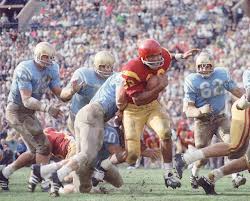
Each team scored a touchdown in the 1st quarter: First UCLA on a 12-yard run by Greg Jones, then USC when Pat Cashman intercepted a pass that Beban had intended for Jones, returning it 55 yards for a touchdown.

In the 2nd quarter, Zenon Andrusyshyn of UCLA missed a field goal attempt, and Simpson had a 12-yard touchdown run, dragging 2 UCLA tacklers into the end zone. At halftime, the Trojans led, 14-7.

Beban was not about to let down his effort in the game, and in the Heisman debate with O.J. In the 3rd quarter, he threw a 53-yard touchdown pass to George Farmer, tying the game. USC coach John McKay noticed that Andrusyshyn tended to make low kicks, so he sent 6-foot-8 linebacker Bill Hayhoe into the middle of the line, and he blocked 2 field goal attempts. The game remained 14-14 at the end of 3 quarters.

Early in the 4th quarter, Beban, battling a rib injury, threw a touchdown pass to Dave Nuttall. But, just as he had blocked those field goal attempts, now, Hayhoe blocked Andrusyshyn's extra point attempt. It was 20-14 UCLA, but that block would matter.
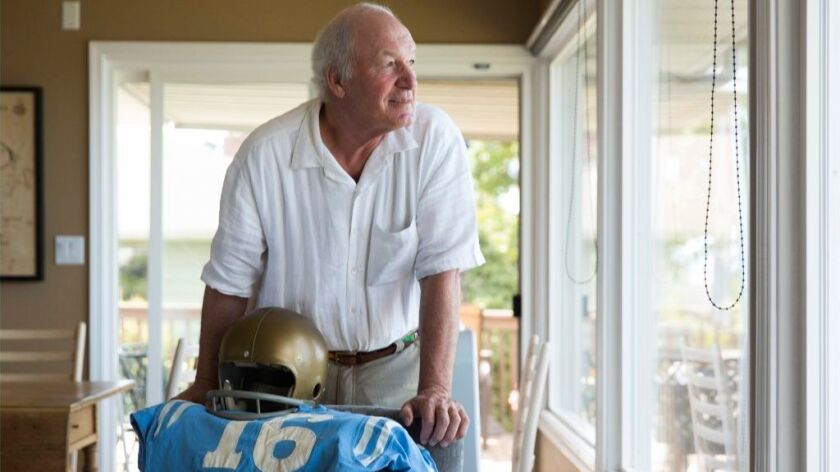
Gary Beban

With 10:38 left to play, and 3rd and 7 from the USC 36, USC quarterback Toby Page called an audible known as "23 blast." Simpson remembered thinking it was a terrible call. It wasn't: A key block from Dan Scott enabled O.J. to cut back to the middle, and run 64 yards for a touchdown. Rikki Aldridge kicked the extra point, and it was 21-20 USC.

Beban's injuries became too much for him, and he was unable to get the Bruins back across midfield. The 21-20 score held to the end, and USC had won. Any 1 of the 3 kicks that Hayhoe blocked would have made a difference, either giving UCLA a 23-21 win, or forging a 21-21 tie -- or forcing USC to decide, trailing 21-20 at the end, to decide whether to go for a 21-21 tie or a two-point conversion and a 22-21 win.

Chris Schenkel and former Oklahoma coach Bud Wilkinson called the game for ABC. Keith Jackson, then in only his 2nd season with ABC, narrated the taped highlights, and called it the greatest game he ever saw. So did Giles Pellerin, a USC graduate who saw every game the school played from 1925 until 1998, when he died while watching the USC-UCLA game, 797 games in a row.

Beban was unable to play the next week, and UCLA lost at home to Syracuse. They were not invited to a bowl game. Nevertheless, in one of the closest votes in the award's history, Beban was awarded the Heisman Trophy. UCLA ended the season 7-2-1, ranked Number 10.

USC had no more regular-season games. They went to the Rose Bowl, to face Indiana, then ranked Number 4, and won, 14-3, clinching the National Championship.

Simpson was a junior, so he returned for 1968, and seemed headed for another National Championship. They beat ranked opponents in Minnesota (away), Miami, Stanford (away), Cal and Oregon State. And, again, they beat UCLA, 28-16. And O.J. easily won the Heisman.

However, traditionally, when USC plays Notre Dame, it's in the middle of the season when it's the Fighting Irish's turn to host, to avoid the November cold of northern Indiana; and at the end of the season when it's the Trojans' turn, so it's in L.A. and warm. Notre Dame was ranked Number 9 at the time, and escaped with a 21-21 tie. It dropped them to Number 2, and sent them to the Rose Bowl to face Number 1 Ohio State. The Buckeyes' ended the Trojans' 12-game winning streak, 27-16, and won the National Championship.

O.J. went on to have a sensational pro career, at least on an individual basis, rushing for 11,236 yards, 2nd all-time at the time of his retirement. He set records, since broken, for rushing yards in a season (2,003 in 1973) and in a game (273 in a 1976 contest). He became one of the most popular athletes of his generation, and also gained praise as an actor. Team-wise, he was less successful: His Buffalo Bills played in only 1 Playoff game, smacking into the Pittsburgh Steel Curtain, although O.J. did score a touchdown in the game.

Beban -- like Simpson, a native of San Francisco -- had considerably worse luck than that. He was drafted by the Los Angeles Rams, so he didn't have to move, even playing in the Coliseum. But they already had All-Pro Roman Gabriel as their quarterback. And the Rams had already messed this situation up recently: They drafted the 1962 Heisman winner, Terry Baker, and he couldn't win the starting job from Gabriel, either.

So, before Beban signed a contract, the Rams traded his rights to the Washington Redskins, who already had future Hall-of-Famer Sonny Jurgensen. Sonny was 34, so trading for his replacement was a good idea. And the 'Skins had one of the greatest quarterbacks ever as their head coach, Otto Graham. But Sonny remained the starter, and Beban was released on the eve of the 1970 season. He was cut by the Denver Broncos before the 1971 season, and never played again.

Like Simpson, he was elected to the College Football Hall of Fame. But rather than being elected to the Pro Football Hall of Fame, his pro career consisted of 5 appearances, 1 incomplete pass, 5 rushes for 18 yards, and 1 trick play where he caught a pass for 12 yards.
A recent photo of Beban

Beban became a broadcaster for UCLA football, and a successful real estate executive. Chances are, even he would have been unable to sell the house where Nicole Brown Simpson and Ronald Goldman were murdered on June 12, 1994; or the house where O.J. Simpson was arrested for those crimes 5 days later. Perhaps, even before that, Gary Beban would not have been willing to trade lives with O.J. Simpson; certainly, he would not have wanted to do so afterward.