Showing posts with label john f. kennedy stadium. Show all posts

Wednesday, September 23, 2026

September 23, 1926: Tunney Defeats Dempsey

September 23, 1926, 100 years ago: Jack Dempsey, Heavyweight Champion of the World, defends his title against Gene Tunney at Sesquicentennial Stadium, the centerpiece of Philadelphia's World's Fair celebrating the 150th Anniversary of American independence. The huge horseshoe was packed with 120,557 fans, the largest crowd in boxing history to that point.
Dempsey hadn't fought in 3 years, and it showed. Once the most fearsome puncher ever, the Manassa Mauler couldn't handle the quickness of Tunney, who learned what he called "scientific pugilism" while serving in the U.S. Marine Corps in World War I.

It didn't help that this fight was outdoors, and it rained. By the 10th and final round, it was pouring, and Dempsey could do little to hurt Tunney.

For the 1st time ever, the Heavyweight Championship changed hands on a decision, rather than a knockout. Previously, decisions were considered unsatisfying, and judges were reluctant to take the title away from the Champion unless the challenger had knocked him out.

But this decision was an obvious one, and nobody objected at the time. Dempsey knew he had been fairly beaten: When his wife, actress Estelle Taylor, asked him what happened, he said, "Honey, I forgot to duck." A 15-year-old Illinois kid named Ronald Reagan read this in the newspaper, and, 55 years later, said it to his wife Nancy after he was shot.

Ironically, being dethroned made Dempsey more popular, as he had previously been called a "slacker" and a "draft dodger" for his avoidance of service in World War I. And Tunney, though the more skilled boxer, never developed the same kind of popularity as Dempsey.

Even after Tunney won by decision again a year later, in what became known as "The Long Count Fight," Dempsey's popularity grew, as some people thought he was robbed, not that they considered it Tunney's fault. Tunney, who retired as Champion rather than lose his title in the ring, was respected, but he was never truly loved.

In 1931, the 105,000-seat Sesquicentennial Stadium was renamed Municipal Stadium, and became famous as the neutral site of the Army-Navy Game. It hosted the 1952 fight where Rocky Marciano knocked out Jersey Joe Walcott to take the title.

In 1964, it was renamed John F. Kennedy Stadium. In 1966, it hosted the Beatles. In 1967, The Spectrum was built across the street; in 1971, Veterans Stadium to the north of the Spectrum, creating the South Philly sports complex. In 1985, it hosted the U.S. half of Live Aid. It was demolished in 1992, and the 76ers & Flyers arena now named the Xfinity Mobile Arena was built on the site.

September 23, 1926 was a Thursday. Jazz icon John Coltrane was born that day, and would later establish his home in Philadelphia, the city where Dempsey-Tunney I was held.

Sunday, May 31, 2026

May 31, 1976: The Bicentennial Cup

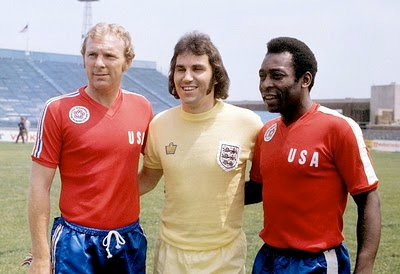
Left to right: Bobby Moore, Gerry Francis, Pelé

May 31, 1976, 50 years ago: The Bicentennial Cup concludes. Set up as one of the celebrations of the 200th Anniversary of American independence, it was not a good showcase for American soccer.

England and Italy were invited after they failed to qualify for Euro 76. Also invited was Brazil. The 4th team would be "Team America," made up of players in the North American Soccer League. That meant American players, who simply were not up to the task; and foreign players, who were mostly too old to play at a world class level anymore, such as Brazil's Pelé of the New York Cosmos and England's Bobby Moore of the San Antonio Thunder.

On May 23, Team America played Italy at Robert F. Kennedy Stadium in Washington. The crowd was decent: 33,445. The result was rather indecent: Italy won, 4-0. Fabio Capello scored in the 15th minute, and the U.S. was never really in it. A midfielder for Turin club Juventus, Capello would later win Serie A (Italian league) titles with A.C. Milan, A.S. Roma and Juventus; and La Liga titles with Real Madrid; total league titles, 9. He also led Milan to the UEFA Champions League title in 1994.

Also on May 23, Brazil beat England, 1-0 before 32,495 at the Los Angeles Memorial Coliseum. Carlos Roberto de Oliveira, a forward for Rio de Janeiro club Vasco da Gama, known as "Roberto Dinamite," won the game with a goal in the 89th minute.

On May 28, England beat Italy, 3-2 at Yankee Stadium; and Team America lost to Brazil, 2-0 at the new Kingdome in Seattle. Only 20,245 paid to get into the big gray toadstool in Seattle's Lower Downtown. For England vs. Italy in The Bronx, the attendance was 40,650. I would have expected more, given how many Italians live in and around New York City. But the vast majority of Italian-Americans are descended from people who left Italy before the country embraced soccer. For Italian New Yorkers of the 1970s, their sports were baseball, football and boxing.

At any rate, Francesco Graziani of the other Turin club, Torino F.C., scored 2 goals within 5 minutes early in the 1st half. But Mick Channon of Hampshire team Southampton scored 2 within 7 minutes early in the 2nd half, and Phil Thompson of Liverpool scored between those Channon goals.

On May 31, England beat Team America, 3-1 before 16,239 at John F. Kennedy Stadium, leaving over 87,000 empty seats at the big South Philadelphia horseshoe. Kevin Keegan of Liverpool scored twice within 6 minutes in the 1st half, and Trevor Francis of Birmingham City scored early in the 2nd half. Stuart Scullion, a Scottish winger playing for the Tampa Bay Rowdies, got a consolation goal for Team America in the 87th minute.

Later, 36,096 went into the Yale Bowl in New Haven, Connecticut, to see a copy of the 1970 World Cup Final: Brazil beat Italy, 4-1. Capello scored in the 2nd minute, but Gil (Gilberto Alves) of Rio club Fluminense, who had scored 2 against Team America, did it again against Italy.

Tuesday, September 16, 2025

September 16, 1950: The Cleveland Browns Announce Their Presence

Marion Motley carrying the ball -- painted white,
to be more visible in a night game. This did not catch on.

September 16, 1950, 75 years ago: The National Football League features a season-opening game between their defending Champions and those of a newly-defunct rival league.

The game was played at the 105,000-seat Municipal Stadium in South Philadelphia. Usually playing their home games at Shibe Park in North Philadelphia, the Philadelphia Eagles had played home games at Municipal Stadium from 1936 to 1939, and select games thereafter.
Municipal Stadium, by this point named John F. Kennedy Stadium.
Just to the north was The Spectrum; to the north of that, Veterans Stadium.

This game was, as soccer fans would call it, a "Charity Shield" or "Super Cup" game: The 2-time defending NFL Champion Eagles vs. the Cleveland Browns, 4-time titlists in the All-America Football Conference. The Browns were 47-4-3 over the AAFC's 4-season history; the Eagles, 22-3-1 over the last 2 years, thanks to a 5-2 alignment that was the 1st defensive unit to have a memorable nickname: Before San Diego, Detroit and Los Angeles had lines that became known as the Fearsome Foursome, Philly had the Suicide Seven.

Some people then called it "The Game of the Century," and some now think of as an unofficial "first Super Bowl." Such a name is ironic, since it took the Eagles until 2018 to win an NFL Championship in the Super Bowl era, and, through the 2024 season, the Browns haven't even been to a Super Bowl yet.

Playing on a Saturday night -- making it, sort of, not just "the 1st Super Bowl" but "the 1st Monday Night Football game" -- in front of 71,237 fans, still the largest crowd ever to watch a professional football game in Pennsylvania (and nearly double the capacity of Shibe Park, which really limited the Eagles' attendance), the Browns put on a show.

Paul Brown, having mastered his craft at every level below the NFL -- at Massillon High School outside Cleveland, at Ohio State University where he won the 1942 National Championship, and with the Browns in the AAFC -- was the greatest offensive mind the game of football had yet seen. With Otto Graham as his quarterback, passing to Dante Lavelli, Mac Speedie and Dub Jones, and with the acceptance of black players like fullback Marion Motley and guard Bill Willis, he had won those 4 AAFC titles.
Paul Brown

(The Browns were named for Paul Brown. The story that Brown, or the original owner, Arthur B. McBride, wanted to name the team the Cleveland Brown Bombers in honor of Joe Louis, then the Heavyweight Champion of the World, is a myth. McBride had run a fan contest to determine the name, and the winner was "Cleveland Panthers," who played from 1919 to 1933, including in the 1st American Football League in 1926, but Paul Brown called them a failed team that he wanted no part of. So, over Brown's objection, McBride named them the Browns.)

And that Saturday night in South Philly, Brown let his team put on a show. The Eagles took an early lead on a field goal by Cliff Patton. But Graham threw freely, and the Browns scored the next 4 touchdowns: A 59-yard pass from Graham to Jones, a 26-yard pass from Graham to Lavelli, a 13-yard pass from Graham to Speedie (that was his real name: He was born Mac Curtis Speedie), and a 1-yard run by Graham.

It was 7-3 Browns at the end of the 1st quarter, 14-3 Browns at the half, 21-3 Browns after 3 quarters, and 28-3 Browns before Bill Mackrides threw a touchdown pass to Pete Pihos to get the Eagles into double figures. Late in the game, Rex Bumgardner ran for a touchdown, making the final score Browns 35, Eagles 10. To borrow a line from Bull Durham, a movie from another sport, the Browns had announced their presence with authority.

The Eagles actually had more 1st downs, 24-23; more rushing yards, 148-141; and fewer penalties, 3 for 45 yards to the Browns' 12 for 98 yards. And there were plenty of turnovers on both sides: 5 for Philadelphia, 4 for Cleveland.

But Graham completed 21 of 38 passes for 346 yards, a display that NFL fans, even with Sid Luckman of the Chicago Bears and Sammy Baugh of the Washington Redskins still active, simply weren't used to. It forced the Eagles into the air: Between them, Mackrides and Tommy Thompson attempted 32 passes, but only completed 11.
Until 1951, the Browns wore white helmets,
and Otto Graham wore Number 60. After that,
he switched to 14, and the Browns have worn
orange helmets ever since.

The performance stunned football fans all over the nation. Eagle coach Earle "Greasy" Neale was contemptuous of the aerial assault, calling the Browns "a basketball team." When the teams met again on December 3 at Cleveland Municipal Stadium, Brown told Graham not to throw a single pass, just to make a point, and he didn't. And the Browns didn't score a single offensive touchdown. They didn't need to: Warren Lahr intercepted a Thompson pass, and returned it 30 yards for a touchdown, while Lou Groza added 2 field goals, and the Browns won, 13-7. Brown had a great defense, too.

The Eagles never recovered, going 6-6, and didn't reach the NFL Championship Game again for 10 years. The Browns won the NFL title that year, and appeared in 7 title games in 8 years, winning 3: 1950, 1954 and 1955. Brown and 8 of his 1950 Browns would be elected to the Pro Football Hall of Fame: Graham, Motley, Groza, Lavelli, Speedie, Willis, end Len Ford and center Frank Gatski.

Paul Brown would be fired by new team owner Art Modell after the 1962 season. Cleveland fans treated this as the 1st time Modell aggrieved them, and it would be far from the last, or the worst. In 1968, Brown founded a team in the American Football League, the Cincinnati Bengals. He tried to remake the team in the old Browns' image, using the same colors and the same offense. They even had the same initials, although there had been a previous team with the Cincinnati Bengals name, which played in the 2nd (1936-37) and 3rd (1940-41) leagues with the AFL name.

Don McCafferty (1970 NFL Champion Colts) coached under him at Ohio State. Among his coaches with the Browns were Weeb Ewbank (1958 and '59 NFL Champion Baltimore Colts, 1968 World Champion New York Jets), Blanton Collier (his replacement as Brown coach, 1964 NFL Champions), Lou Saban (1964 and '65 AFL Champion Buffalo Bills) and Don Shula (1968 NFL Champion Colts, 1972 and '73 NFL Champion Miami Dolphins). Among his coaches with the Bengals were Bill Walsh and Sam Wyche (who, among their other achievements, opposed each other in Super Bowl XXIII in 1989).

Take it to the next level, and his "3rd generation" coaches include Red Miller (1977 AFC Champion Denver Broncos), Howard Schenllenberger (1983 NCAA Champion Miami), Dick MacPherson (undefeated season with Syracuse in 1987), George Seifert (1990 and '94 NFL Champion San Francisco 49ers), Paul Holmgren (1996 NFL Champion Green Bay Packers, 2005 AFC Champion Seattle Seahawks), Marty Schottenheimer (4 AFC Championship Games, although he lost them all), Tony Dungy (2006 NFL Champion Indianapolis Colts), Doug Pederson (2017 NFL Champion Philadelphia Eagles) and Andy Reid (2019, '22 and '23 NFL Champion Kansas City Chiefs).

Through Schottenheimer, his "coaching tree" also includes Bill Cowher (2005 NFL Champion Pittsburgh Steelers), Lovie Smith (2006 NFC Champion Chicago Bears), Mike Tomlin and Ken Whisehunt (who, among their other achievements, opposed each other in Super Bowl XLIII in 2009), Mike McCarthy (2010 NFL Champion Packers), Gary Kubiak (2015 NFL Champion Broncos) and Bruce Arians (2020 NFL Champion Tampa Bay Buccaneers). So Brown's NFL legacy spans that much: 1950 to 2023, including 24 of the 1st 59 Super Bowls, and 27 of the last 75 NFL Championships.

The Browns won the 1964 NFL Championship under Collier, reached the NFL Championship Game in 1968 and '69, and reached the AFC Championship Game in 1986, '87 and '89. After the 1995 season, Modell moved them, and they became the Baltimore Ravens. Cleveland was granted a replacement team, and the new Browns began in 1999. They have mostly struggled since. As have the Bengals, although they have won AFC Championships in 1981, 1988 and 2021.

Paul Brown died in 1991. When the Bengals moved into a new stadium for the 2000 season, it was named Paul Brown Stadium. It held that name until Paul's son, Mike Brown, often ridiculed as one of the NFL's cheapest owners (hence, their struggles), finally took his father's name off the stadium and sold the naming rights: In 2022, it became Paycor Stadium.

Speaking of stadiums: The Eagles moved to the University of Pennsylvania's Franklin Field in 1958, then returned to the South Philadelphia sports complex in Veterans Stadium in 1971, replacing that with Lincoln Financial Field in 2003. They won the NFL Championship in 1960, the NFC Championship in 1980 and 2004, and finally won a Super Bowl in the 2017 season.

In 1964, Philadelphia Municipal Stadium was renamed John F. Kennedy Stadium. On August 16, 1966, the Beatles played there. On July 13, 1985, it hosted the American end of Live Aid. But that show exposed to the world that it already falling apart. The Rolling Stones, who had packed the place on their 1981 Tattoo You tour, chose the considerably smaller Vet for Steel Wheels in 1989. It was demolished in 1992, and the new arena opened on the site in 1996.

Sunday, July 13, 2025

July 13, 1985: Live Aid

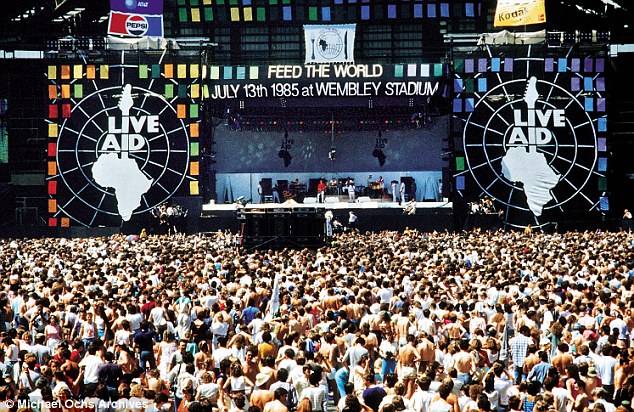
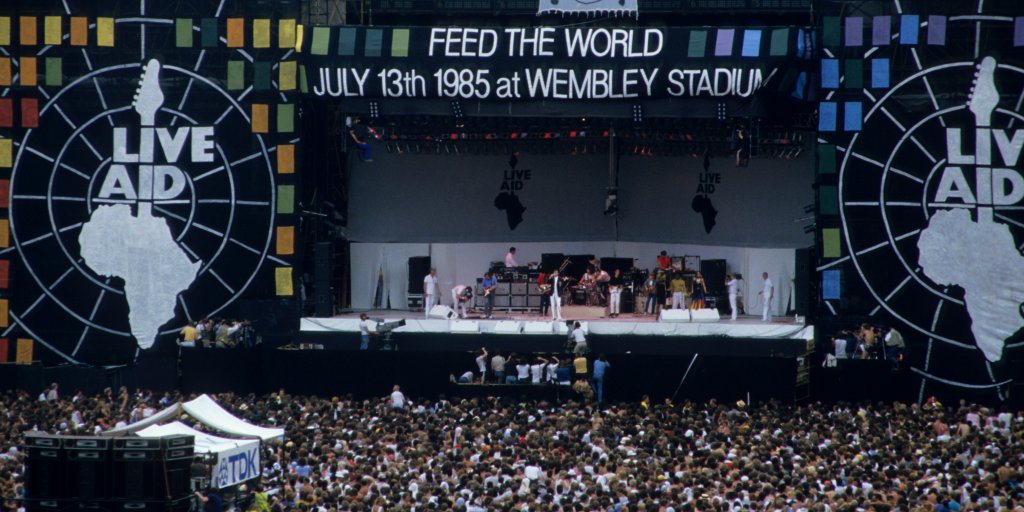
July 13, 1985, 40 years ago: The Live Aid concerts are held: One at the old Wembley Stadium in West London, the other at John F. Kennedy Stadium in South Philadelphia. 

The show was organized by Bob Geldof, leader of The Boomtown Rats; and James "Midge" Ure, lead singer of Ultravox. Geldof, Irish, and Ure, Scottish, had written "Do They Know It's Christmas?" for African famine relief, in time for the 1984 Christmas season, and got pretty much everybody who was currently anybody in music in the British Isles to sing on it.

With its success, an American version was inevitable. Producer Quincy Jones called Michael Jackson, at the time the biggest show business figure in the world. Jackson and Lionel Richie wrote "We Are the World," and Jones gathered several American musical luminaries to record it in Los Angeles. It was also a runaway success.

With both songs having raised a lot of money, a benefit concert was inevitable. It ended up being 2 shows, one in each country. It was a combination of current stars and established legends -- an "All-Star Game" and an "Old-Timers Day" in one. Or, in more recent parlance, an Avengers of rock and roll.

And it wasn't that easy. Geldof called Elton John, and said you gotta do it, because David Bowie and Queen had already agreed -- when they hadn't. While Elton was thinking it over, Geldof called Bowie, and told him that Elton and Queen had already agreed. Eventually, Geldof got everybody he wanted.

*

At 12:00 Noon London time, 7:00 AM U.S. East Coast time, the British leg began at the original Wembley, England's national stadium since its opening in 1923. Holding 100,000 in its normal configuration, the huge stage limited it to 72,000 seats, all sold. Tickets were £5, plus a £20 donation to charity. With Britain's rate of inflation, that's about £97. With today's exchange rate, that's about $131.
The Coldstream Guards gave a royal salute, and played the National Anthem, "God Save the Queen." Queen Elizabeth II was not in attendance -- she was already 58 years old, and tolerated rock and roll more than actually enjoying it -- but her son and heir, Prince Charles, and his wife, Princess Diana, were there.

The Anthem done, the 1st band to play was Status Quo. They were followed by The Style Council, Geldof's Boomtown Rants, Adam Ant, Ure's Ultravox, Spandau Ballet, Elvis Costello (singing only one song, The Beatles' "All You Need Is Love"), Nik Kershaw, Sade (who may have the sexiest voice in all of humanity), Sting from The Police and Phil Collins from Genesis together, Howard Jones, Bryan Ferry, Paul Young, U2, Dire Straits, Queen, David Bowie, The Who reunited for the 1st time since their 1982 "farewell tour," and Elton John.

Queen came on at 6:41 PM, and have been widely regarded as the highlight of the Wembley part of the show. They played "Bohemian Rhapsody," "Radio Ga Ga" (the song that inspired Stefani Germanotta, born the next year, to rename herself Lady Gaga), "Hammer to Fall," "Crazy Little Thing Called Love," "We Will Rock You," and "We Are the Champions."
Freddie Mercury and Brian May of Queen

At 9:48, Queen's lead singer Freddie Mercury and lead guitarist Brian May came back out, and played, "Is This the World We Created?" At 9:51, former Beatle Paul McCartney came out, and, with Bowie, Geldof, Alison Moyet and Who guitarist Pete Townshend backing him, sang "Let It Be." At 9:57, the show closed with everybody coming back out, and, over 5 months before the next December 25, sang, "Do They Know It's Christmas?"
Left to right: Bob Geldof, Bono, Paul McCartney and Freddie Mercury


*

Built in 1926, as Sesquicentennial Stadium, for a world's fair celebrating the 150th Anniversary of American independence, and known from that fair until 1964 as Municipal Stadium, John F. Kennedy Stadium was a 105,000-seat horseshoe in South Philadelphia, with The Spectrum and then Veterans Stadium built adjacent. Best known as the site of the annual Army-Navy football game, it was, by this point, rarely used, since it was aging and not well-cared-for.

So, why there? The producer for the American leg was Bill Graham, already legendary for the concerts he promoted in San Francisco, and operator of the concert halls Fillmore West there and Fillmore East in New York. He got well-known TV producer Tony Verna to handle the U.S. broadcast. Verna was a Philadelphia native, and Verna was on good terms with Mayor Wilson Goode, who offered the use of JFK Stadium.

Why not New York? The biggest stadium in the Tri-State Area was Giants Stadium, and, this being before the building of the Meadowlands Spur of New Jersey Transit's rail operations, getting there by any means other than car was a miserable experience. (Given the inevitable traffic backups, getting there by car wasn't much better.) And since both Yankee Stadium and Shea Stadium were owned by New York City, they would have needed Mayor Ed Koch's permission to do the show at either one, and Koch wasn't interested.

Tickets were $35, or about $104 in today's money -- hardly an unreasonable price, given how many stars took the stage at JFK Stadium. The crowd was listed as 89,484. They started earlier, their time, than London did: 8:51 AM.
The 1st act was Bernard Watson. Who? His real name was David Weinstein, he was 18 years old, he was from Miami Beach, he had just graduated from high school, and he had no professional musical experience. He slept outside the stadium for a week, hoping to get a ticket, and ran into Graham, and talked him into letting him open. He sang Bob Dylan's "All I Really Want to Do," and a song he wrote, "Interview." (About the only information I have on him is that he's still alive.)

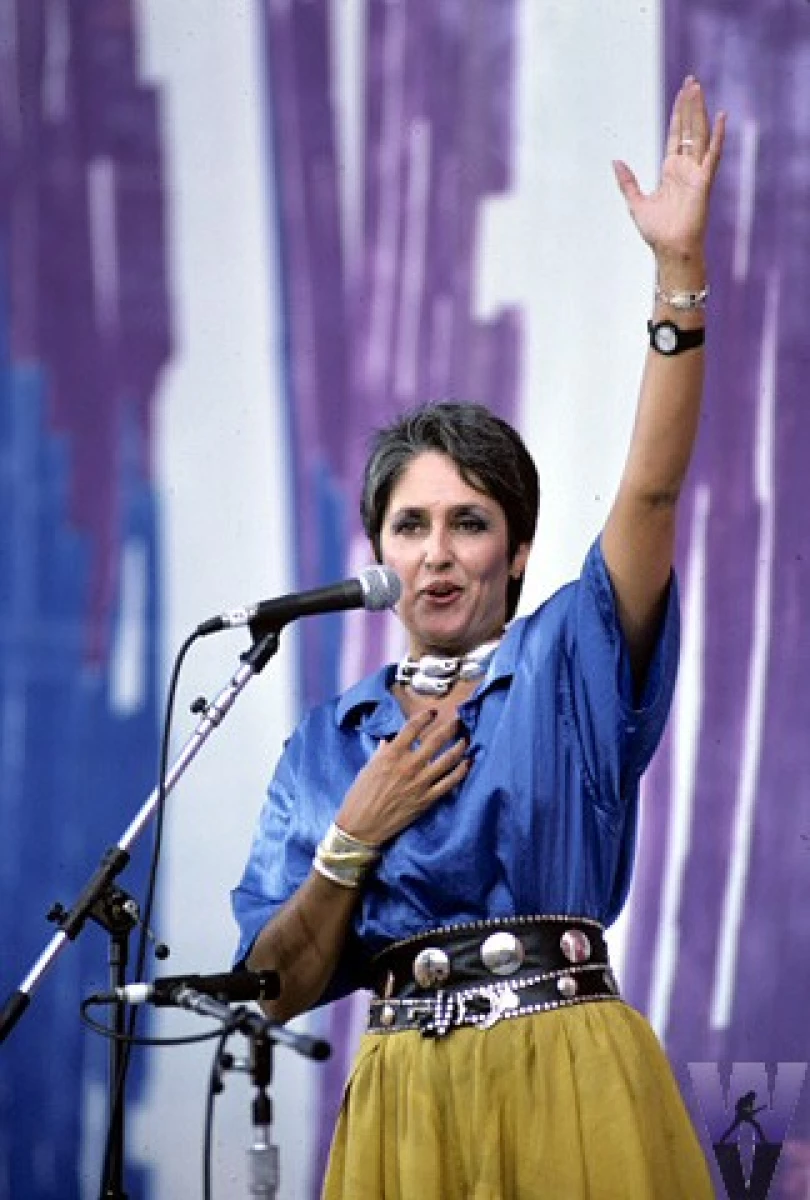
At 9:01 AM, Joan Baez, a veteran of the Greenwich Village folk scene, the Newport Folk Festival, and Woodstock took the stage. She told a generation too young to have gone to those shows, "This is your Woodstock, and it's long overdue." She sang "Amazing Grace" and "We Are the World."
She was followed by Philly natives The Hooters, then Motown legends the Four Tops. Trinidadian soul singer Billy Ocean was next, and then, a different style from any of those, the British inventors of heavy metal, Black Sabbath, with Ozzy Osbourne singing lead with them for the 1st time since 1979.

If that wasn't enough of a mix of styles, Sabbath were followed by the biggest group in rap at the time, Run-D.M.C. And they were followed by... Rick Springfield. And then REO Speedwagon. David Crosby, Stephen Stills and Graham Nash were the 2nd act from Woodstock, after Baez, to perform. And their soft-rock was followed by another British metal icon, Judas Priest. Then Bryan Adams. Then the Beach Boys, complete with Brian Wilson.

George Thorogood and the Destroyers came up from Delaware, with bluesmasters Bo Diddley and Albert Collins sitting in. Simple Minds came over from Scotland. The Pretenders were next. At the time, their leader, Chrissie Hynde, was married to Simple Minds' leader, Jim Kerr. Then, Woodstock veterans Santana. Motown songwriting couple Nick Ashford & Valerie Simpson, by now singing their own songs, performed with Philly native Teddy Pendergrass, by then in a wheelchair following a car crash.

Madonna was next, with Thompson Twins and Nile Rodgers backing her. Then, Tom Petty and the Heartbreakers, Kenny Loggins, The Cars. Neil Young, who has often performed with Crosby, Stills and Nash, performed without them. Next up was The Power Station: Lead singer Robert Palmer; Duran Duran guitarist Andy Taylor and bassist John Taylor; and Chic drummer Tony Thompson. Then, Eric Clapton.

One man played at Wembley, got over to Heathrow Airport, flew across the Atlantic Ocean on the Concorde, got from JFK Airport in New York by helicopter to JFK Stadium in Philadelphia, and played there, too: Phil Collins. He had played from 3:18 to 3:48 in London, and from 8:00 to 8:35 in Philadelphia -- with the 5-hour time difference, it was about a 10-hour gap.

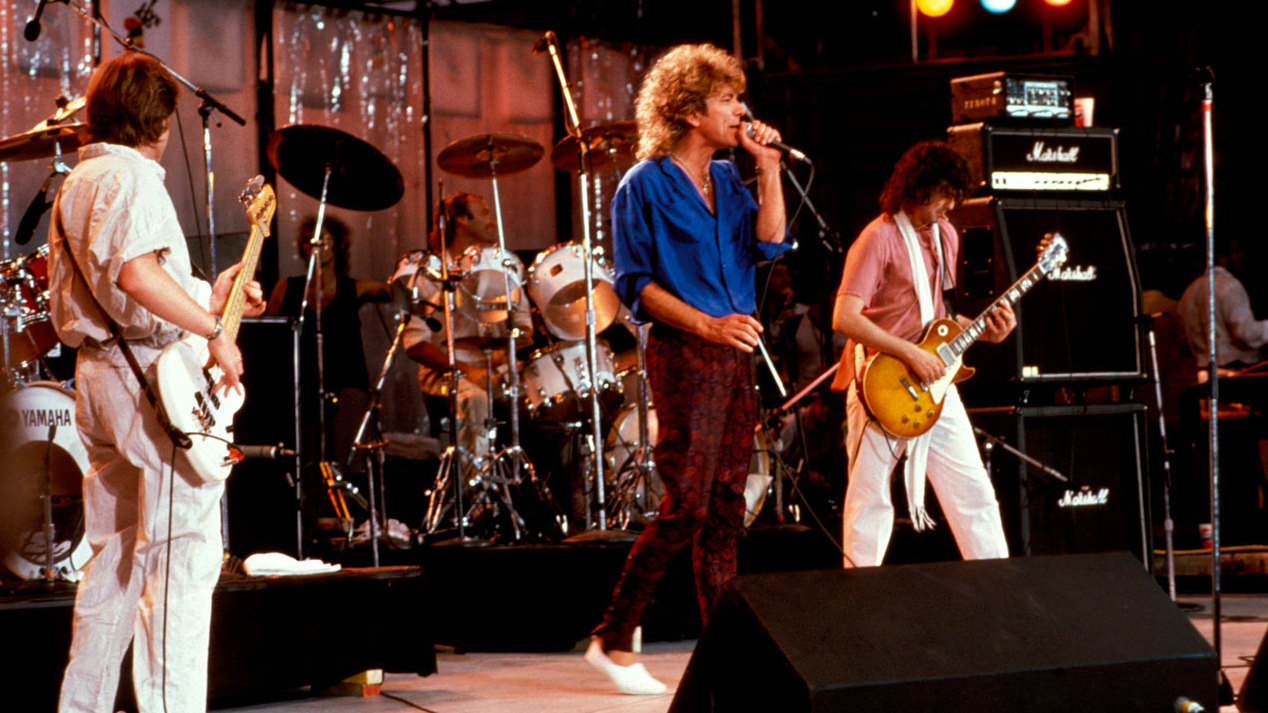
And that may not have been the most notable thing he did that day. He played drums for Led Zeppelin. Singer Robert Plant, guitarist Jimmy Page and bassist John Paul Jones hadn't played together since drummer John Bonham died in 1980. But, with Collins sitting in, they played "Rock and Roll," "Whole Lotta Love" and "Stairway to Heaven."
Then, as night began to fall over the Delaware Valley, Crosby, Stills, Nash & Young did sing together. So did Duran Duran. Then things got serious: On came Philly native Patti LaBelle. Then Philly natives Daryl Hall & John Oates, with former Temptations singers Eddie Kendricks and David Ruffin.
Tina & Mick

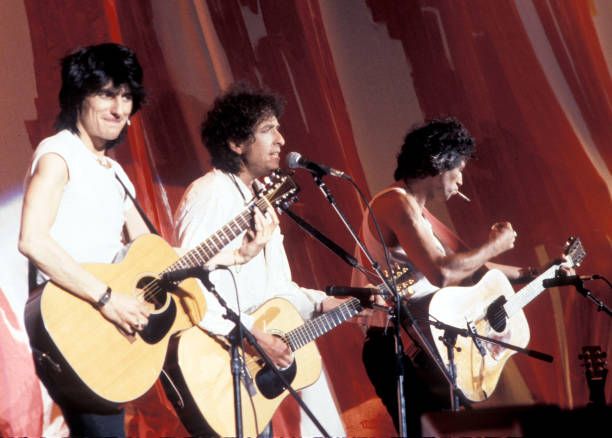
At 10:15, Mick Jagger of the Rolling Stones and Tina Turner took the stage, and sang 5 songs together. At 10:39, backed by Stones guitarists Keith Richards and Ron Wood, Bob Dylan, who did not play at Woodstock, came on, and sang "Ballad of Hollis Brown," "When the Ship Comes In," and "Blowin' in the Wind." The finale, at 10:55, was everybody coming onstage to sing "We Are the World."
Between the 2 shows, it was estimated that 1.9 billion people watched at least part of the broadcast, about 40 percent of the world's population at the time. Money raised? According to Geldof, about £150 million, or about $107 million given what was then the exchange rate, or about $319 million in 2025 money.

This was the greatest thing ever to happen at Wembley, or any other sports stadium. England's victory in the 1966 World Cup Final is a distant 2nd.

The old Wembley was not well-cared-for, and a replacement became necessary. It was closed in 2000, demolished, and the new Wembley Stadium opened on the site in 2007.

Mick and the Stones had planned to return to JFK Stadium for their Steel Wheels tour in 1989, but it was ruled unsafe for occupancy, so they headed 2 blocks north to The Vet. The last show at JFK Stadium was The Grateful Dead in 1991. The following year, it was demolished. In 1996, the new arena for the NBA's Philadelphia 76ers and the NHL's Philadelphia Flyers opened on the site. As one bank has bought out another, arena naming rights and all, it has gone through several names. On September 1, 2025, it will officially be renamed the Xfinity Mobile Arena.

In 1986, Spin magazine published an exposé on Live Aid's actions in Ethiopia. They claimed that Geldof deliberately ignored warnings from Doctors Without Borders, who had complained directly to Geldof even before Live Aid, about the role of the Ethiopian government under Derg leader Mengistu Haile Mariam in causing the famine; and that, by working with Mengistu directly, much of the relief funds intended for victims were in fact siphoned off to purchase arms from the Soviet Union, thereby making the situation even worse.

Geldof reportedly responded by saying, "I'll shake hands with the Devil on my left and on my right to get to the people we are meant to help."
 

Monday, July 13, 2015

July 13, 1985: Live Aid

July 13, 1985, 30 years ago: The Live Aid concerts are held: One at the old Wembley Stadium in West London, the other at John F. Kennedy Stadium in South Philadelphia. 

The show was organized by Bob Geldof, leader of The Boomtown Rats; and James "Midge" Ure, lead singer of Ultravox. Geldof, Irish, and Ure, Scottish, had written "Do They Know It's Christmas?" for African famine relief, in time for the 1984 Christmas season, and got pretty much everybody who was currently anybody in music in the British Isles to sing on it.

With its success, an American version was inevitable. Producer Quincy Jones called Michael Jackson, at the time the biggest show business figure in the world. Jackson and Lionel Richie wrote "We Are the World," and Jones gathered several American musical luminaries to record it in Los Angeles. It was also a runaway success.

With both songs having raised a lot of money, a benefit concert was inevitable. It ended up being 2 shows, one in each country. It was a combination of current stars and established legends -- an "All-Star Game" and an "Old-Timers Day" in one. Or, in more recent parlance, an Avengers of rock and roll.

And it wasn't that easy. Geldof called Elton John, and said you gotta do it, because David Bowie and Queen had already agreed -- when they hadn't. While Elton was thinking it over, Geldof called Bowie, and told him that Elton and Queen had already agreed. Eventually, Geldof got everybody he wanted.

*

At 12:00 noon London time, 7:00 AM U.S. East Coast time, the British leg began at the original Wembley, England's national stadium since its opening in 1923. Holding 100,000 in its normal configuration, the huge stage limited it to 72,000 seats, all sold. Tickets were £5, plus a £20 donation to charity. With Britain's rate of inflation, that's about £75. With today's exchange rate, that's about $105.
The Coldstream Guards gave a royal salute, and played the National Anthem, "God Save the Queen." Queen Elizabeth II was not in attendance -- she was already 58 years old, and tolerated rock and roll more than actually enjoying it -- but her son and heir, Prince Charles, and his wife, Princess Diana, were there.

The Anthem done, the 1st band to play was Status Quo. They were followed by The Style Council, Geldof's Boomtown Rants, Adam Ant, Ure's Ultravox, Spandau Ballet, Elvis Costello (singing only one song, The Beatles' "All You Need Is Love"), Nik Kershaw, Sade (who may have the sexiest voice in all of humanity), Sting from The Police and Phil Collins from Genesis together, Howard Jones, Bryan Ferry, Paul Young, U2, Dire Straits, Queen, David Bowie, The Who reunited for the 1st time since their 1982 "farewell tour," and Elton John.

Queen came on at 6:41 PM, and have been widely regarded as the highlight of the Wembley part of the show. They played "Bohemian Rhapsody," "Radio Ga Ga" (the song that inspired Stefani Germanotta, born the next year, to rename herself Lady Gaga), "Hammer to Fall," "Crazy Little Thing Called Love," "We Will Rock You," and "We Are the Champions."
Freddie Mercury and Brian May of Queen

At 9:48, Queen's lead singer Freddie Mercury and lead guitarist Brian May came back out, and played, "Is This the World We Created?" At 9:51, former Beatle Paul McCartney came out, and, with Bowie, Geldof, Alison Moyet and Who guitarist Pete Townshend backing him, sang "Let It Be." At 9:57, the show closed with everybody coming back out, and, over 5 months before the next December 25, sang, "Do They Know It's Christmas?"
Left to right: Bob Geldof, Bono, Paul McCartney and Freddie Mercury

*

Built in 1926, as Sesquicentennial Stadium, for a world's fair celebrating the 150th Anniversary of American independence, and known from that fair until 1964 as Municipal Stadium, John F. Kennedy Stadium was a 105,000-seat horseshoe in South Philadelphia, with The Spectrum and then Veterans Stadium built adjacent. Best known as the site of the annual Army-Navy football game, it was, by this point, rarely used, since it was aging and not well-cared-for.

So, why there? The producer for the American leg was Bill Graham, already legendary for the concerts he promoted in San Francisco, and operator of the concert halls Fillmore West there and Fillmore East in New York. He got well-known TV producer Tony Verna to handle the U.S. broadcast. Verna was a Philadelphia native, and Verna was on good terms with Mayor Wilson Goode, who offered the use of JFK Stadium.

Why not New York? The biggest stadium in the Tri-State Area was Giants Stadium, and, this being before the building of the Meadowlands Spur of New Jersey Transit's rail operations, getting there by any means other than car was a miserable experience. (Given the inevitable traffic backups, getting there by car wasn't much better.) And since both Yankee Stadium and Shea Stadium were owned by New York City, they would have needed Mayor Ed Koch's permission to do the show at either one, and Koch wasn't interested.

Tickets were $35, or about $77 in today's money -- hardly an unreasonable price, given how many stars took the stage at JFK Stadium. The crowd was listed as 89,484. They started earlier, their time, than London did: 8:51 AM.
The 1st act was Bernard Watson. Who? His real name was David Weinstein, he was 18 years old, he was from Miami Beach, he had just graduated from high school, and he had no professional musical experience. He slept outside the stadium for a week, hoping to get a ticket, and ran into Graham, and talked him into letting him open. He sang Bob Dylan's "All I Really Want to Do," and a song he wrote, "Interview." (About the only information I have on him is that he's still alive.)

At 9:01 AM, Joan Baez, a veteran of the Greenwich Village folk scene, the Newport Folk Festival, and Woodstock took the stage. She told a generation too young to have gone to those shows, "This is your Woodstock, and it's long overdue." She sang "Amazing Grace" and "We Are the World."
She was followed by Philly natives The Hooters, then Motown legends the Four Tops. Trinidadian soul singer Billy Ocean was next, and then, a different style from any of those, the British inventors of heavy metal, Black Sabbath, with Ozzy Osbourne singing lead with them for the 1st time since 1979.

If that wasn't enough of a mix of styles, Sabbath were followed by the biggest group in rap at the time, Run-D.M.C. And they were followed by... Rick Springfield. And then REO Speedwagon. David Crosby, Stephen Stills and Graham Nash were the 2nd act from Woodstock, after Baez, to perform. And their soft-rock was followed by another British metal icon, Judas Priest. Then Bryan Adams. Then the Beach Boys, complete with Brian Wilson.

George Thorogood and the Destroyers came up from Delaware, with bluesmasters Bo Diddley and Albert Collins sitting in. Simple Minds came over from Scotland. The Pretenders were next. At the time, their leader, Chrissie Hynde, was married to Simple Minds' leader, Jim Kerr. Then, Woodstock veterans Santana. Motown songwriting couple Nick Ashford & Valerie Simpson, by now singing their own songs, performed with Philly native Teddy Pendergrass, by then in a wheelchair following a car crash.

Madonna was next, with Thompson Twins and Nile Rodgers backing her. Then, Tom Petty and the Heartbreakers, Kenny Loggins, The Cars. Neil Young, who has often performed with Crosby, Stills and Nash, performed without them. Next up was The Power Station: Lead singer Robert Palmer; Duran Duran guitarist Andy Taylor and bassist John Taylor; and Chic drummer Tony Thompson. Then, Eric Clapton.

One man played at Wembley, got over to Heathrow Airport, flew across the Atlantic Ocean on the Concorde, got from JFK Airport in New York by helicopter to JFK Stadium in Philadelphia, and played there, too: Phil Collins. He had played from 3:18 to 3:48 in London, and from 8:00 to 8:35 in Philadelphia -- with the 5-hour time difference, it was about a 10-hour gap.

And that may not have been the most notable thing he did that day. He played drums for Led Zeppelin. Singer Robert Plant, guitarist Jimmy Page and bassist John Paul Jones hadn't played together since drummer John Bonham died in 1980. But, with Collins sitting in, they played "Rock and Roll," "Whole Lotta Love" and "Stairway to Heaven."
Then, as night began to fall over the Delaware Valley, Crosby, Stills, Nash & Young did sing together. So did Duran Duran. Then things got serious: On came Philly native Patti LaBelle. Then Philly natives Daryl Hall & John Oates, with former Temptations singers Eddie Kendricks and David Ruffin.
Tina & Mick

At 10:15, Mick Jagger of the Rolling Stones and Tina Turner took the stage, and sang 5 songs together. At 10:39, backed by Stones guitarists Keith Richards and Ron Wood, Bob Dylan, who did not play at Woodstock, came on, and sang "Ballad of Hollis Brown," "When the Ship Comes In," and "Blowin' in the Wind." The finale, at 10:55, was everybody coming onstage to sing "We Are the World."
Between the 2 shows, it was estimated that 1.9 billion people watched at least part of the broadcast, about 40 percent of the world's population at the time. Money raised? According to Geldof, about £150 million, or about $107 million given what was then the exchange rate, or about $235 million in 2015 money.

This was the greatest thing ever to happen at Wembley, or any other sports stadium. England's victory in the 1966 World Cup Final is a distant 2nd.

The old Wembley was not well-cared-for, and a replacement became necessary. It was closed in 2000, demolished, and the new Wembley Stadium opened on the site in 2007.

Mick and the Stones had planned to return to JFK Stadium for their Steel Wheels tour in 1989, but it was ruled unsafe for occupancy, so they headed 2 blocks north to The Vet. The last show at JFK Stadium was The Grateful Dead in 1991. The following year, it was demolished. In 1996, the new arena for the NBA's Philadelphia 76ers and the NHL's Philadelphia Flyers opened on the site. As one bank has bought out another, arena naming rights and all, it has gone through several names, and is currently the Wells Fargo Center.