Showing posts with label otto graham. Show all posts

Friday, December 26, 2025

December 26, 1955: Otto Graham Goes Out a Winner

December 26, 1955, 70 years ago: The NFL Championship Game is played at the Los Angeles Memorial Coliseum. It was moved up a day, because, that year, December 25 fell on a Sunday, and the NFL refused to play on Christmas Day until 1971.

The Cleveland Browns were playing in a league championship game for the 10th straight year: The 1st 4 in the All-America Football Conference (1946-49), winning all 4 of those; and the last 6 in the NFL, having beaten the Los Angeles Rams in 1950, lost to the Rams in 1951, lost to the Detroit Lions in 1952 and 1953, and beaten the Lions in 1954. Now, they were playing the Rams again.

Quarterback Otto Graham had been there for all of those games. Under head coach Paul Brown, an offensive genius, he had been, in terms of results, the most successful quarterback in pro football history. (Sure, Tom Brady later got teams into 10 championship games under the Super Bowl name, all within the NFL. But Graham did 10 in a row, and matched Brady with 7 wins. And Graham never had to cheat.)

Graham had retired after the 1954 Championship Game, but Brown talked him into returning for 1 more season. He led the Browns to a 9-2-1 record. They opened with a loss to the Washington Redskins, but shrugged it off to beat the San Francisco 49ers away, the Philadelphia Eagles at home, the Redskins away, the Green Bay Packers at home, the Chicago Cardinals away, and the New York Giants at home.

In addition to Graham, the Browns still had receiver Dante Lavelli, center Frank Gatski, tackle and placekicker Lou Groza, and defensive end Len Ford, who would all be elected to the Pro Football Hall of Fame. So would Brown. So would linebacker Chuck Noll, albeit as the later head coach of the Pittsburgh Steelers.

The Browns lost to the Eagles in Philadelphia, then beat the Steelers at home. They could only manage a tie with the Giants in New York, then won away to Pittsburgh, and closed by beating the Cardinals at home.

The Rams were coached by Sid Gillman, whose innovations in the passing game had begun to rival those of Paul Brown. They had finished 8-3-1, with 2 of their losses inflicted by the Chicago Bears. They still finished ahead of the Bears, who went 8-4.

The Rams still had several of the players who beat the Browns in the 1951 title game, including quarterback Norm Van Brocklin and his top 2 receivers, Tom Fears and Elroy "Crazy Legs" Hirsch, all of whom would be elected to the Pro Football Hall of Fame. So would Gillman, and linebacker Les Richter. Running back Paul "Tank" Younger and defensive tackle Gene "Big Daddy" Lipscomb have not yet been elected to the Hall, but should be.

And, this being an odd-numbered year, the Western Division winners would have the home-field advantage. And the Coliseum was the only stadium in the NFL that seated more than the Browns' Cleveland Municipal Stadium, so 87,695 fans came out, supporting the blue and gold, rather than the orange and white.

Groza kicked a 43-yard field goal to give the Browns a 3-0 lead at the end of the 1st quarter. The 2nd quarter featured several big plays, including Don Paul intercepting Van Brocklin, and returning it 65 yards for a touchdown, to make it 10-0 Browns; Van Brocklin throwing a 67-yard touchdown pass to Volney "Skeet" Quinlan, closing the Rams to within 10-7; and Graham throwing a 50-yard touchdown pass to Lavelli, giving the Browns a 17-7 halftime lead.

Graham himself ran the ball in for 2 touchdowns in the 3rd quarter, and the Browns led, 31-7. In the 4th quarter, Graham's last touchdown pass was 35 yards to Ray Renfro. Ron Waller scored from 4 yards out to give the Rams a consolation score, and the Browns won, 38-14.

It was the 7th league championship, the 3rd in the NFL, for Graham and Paul Brown. It would be the last. Graham retired again, and, this time, stuck with it. Brown led the Browns until 1962, before being fired by new owner Art Modell. He later founded the Cincinnati Bengals.

Gillman would further develop his passing ideas, and led the San Diego Chargers to the 1963 AFL Championship. Bill Walsh, who served as an assistant on the Bengals under Brown, and also under on the Oakland Raiders under Al Davis, who had been an assistant on the Chargers under Gillman, would coach the San Francisco 49ers to 3 Super Bowl wins.

Under the new regime, the Browns won the Championship in 1964 -- and haven't reached a world championship game since. The Rams would fare little better, not reaching another until Super Bowl XIV in the 1979 season, and losing. They moved to St. Louis in 1995, won Super Bowl XXXIV in the 1999 season, lost Super Bowl XXXVI in the 2001 season, moved back to Los Angeles in 2016, and have lost Super Bowl LIII in the 2018 season and won Super Bowl LVI in the 2021 season.

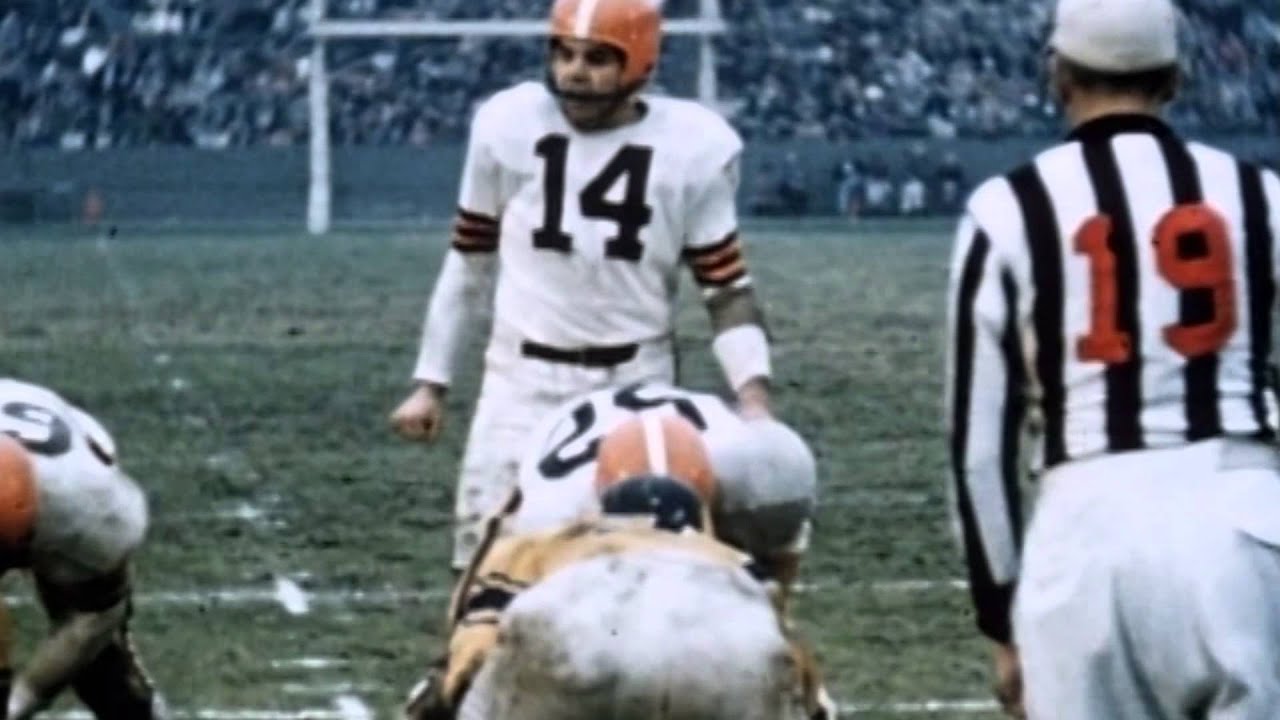
Graham started his professional career wearing Number 60, from 1946 to 1951. From 1952 onward, he wore Number 14. The Browns retired that number, and also named him to their Ring of Honor. He was elected to the Pro Football Hall of Fame in its 3rd class, in 1965.

He later served as head coach and general manager of the Washington Redskins, and as head coach and athletic director at the U.S. Coast Guard Academy. In 1999, he was ranked 7th on The Sporting News' list of the 100 Greatest Football Players, trailing only Joe Montana and Johnny Unitas among quarterbacks. He died in 2003.

In 2010, the NFL Network ranked Graham 16th on its list of the 100 Greatest Players, among quarterbacks trailing only Montana, Unitas, Peyton Manning and the even earlier Sammy Baugh, but not yet Tom Brady. He was named to the NFL's 50th Anniversary Team in 1969, its 75th Anniversary Team in 1994, and its 100th Anniversary Team in 2019. Also in 2019, a statue of Graham was dedicated outside Huntington Bank Field in Cleveland.

Tuesday, September 16, 2025

September 16, 1950: The Cleveland Browns Announce Their Presence

Marion Motley carrying the ball -- painted white,
to be more visible in a night game. This did not catch on.

September 16, 1950, 75 years ago: The National Football League features a season-opening game between their defending Champions and those of a newly-defunct rival league.

The game was played at the 105,000-seat Municipal Stadium in South Philadelphia. Usually playing their home games at Shibe Park in North Philadelphia, the Philadelphia Eagles had played home games at Municipal Stadium from 1936 to 1939, and select games thereafter.
Municipal Stadium, by this point named John F. Kennedy Stadium.
Just to the north was The Spectrum; to the north of that, Veterans Stadium.

This game was, as soccer fans would call it, a "Charity Shield" or "Super Cup" game: The 2-time defending NFL Champion Eagles vs. the Cleveland Browns, 4-time titlists in the All-America Football Conference. The Browns were 47-4-3 over the AAFC's 4-season history; the Eagles, 22-3-1 over the last 2 years, thanks to a 5-2 alignment that was the 1st defensive unit to have a memorable nickname: Before San Diego, Detroit and Los Angeles had lines that became known as the Fearsome Foursome, Philly had the Suicide Seven.

Some people then called it "The Game of the Century," and some now think of as an unofficial "first Super Bowl." Such a name is ironic, since it took the Eagles until 2018 to win an NFL Championship in the Super Bowl era, and, through the 2024 season, the Browns haven't even been to a Super Bowl yet.

Playing on a Saturday night -- making it, sort of, not just "the 1st Super Bowl" but "the 1st Monday Night Football game" -- in front of 71,237 fans, still the largest crowd ever to watch a professional football game in Pennsylvania (and nearly double the capacity of Shibe Park, which really limited the Eagles' attendance), the Browns put on a show.

Paul Brown, having mastered his craft at every level below the NFL -- at Massillon High School outside Cleveland, at Ohio State University where he won the 1942 National Championship, and with the Browns in the AAFC -- was the greatest offensive mind the game of football had yet seen. With Otto Graham as his quarterback, passing to Dante Lavelli, Mac Speedie and Dub Jones, and with the acceptance of black players like fullback Marion Motley and guard Bill Willis, he had won those 4 AAFC titles.
Paul Brown

(The Browns were named for Paul Brown. The story that Brown, or the original owner, Arthur B. McBride, wanted to name the team the Cleveland Brown Bombers in honor of Joe Louis, then the Heavyweight Champion of the World, is a myth. McBride had run a fan contest to determine the name, and the winner was "Cleveland Panthers," who played from 1919 to 1933, including in the 1st American Football League in 1926, but Paul Brown called them a failed team that he wanted no part of. So, over Brown's objection, McBride named them the Browns.)

And that Saturday night in South Philly, Brown let his team put on a show. The Eagles took an early lead on a field goal by Cliff Patton. But Graham threw freely, and the Browns scored the next 4 touchdowns: A 59-yard pass from Graham to Jones, a 26-yard pass from Graham to Lavelli, a 13-yard pass from Graham to Speedie (that was his real name: He was born Mac Curtis Speedie), and a 1-yard run by Graham.

It was 7-3 Browns at the end of the 1st quarter, 14-3 Browns at the half, 21-3 Browns after 3 quarters, and 28-3 Browns before Bill Mackrides threw a touchdown pass to Pete Pihos to get the Eagles into double figures. Late in the game, Rex Bumgardner ran for a touchdown, making the final score Browns 35, Eagles 10. To borrow a line from Bull Durham, a movie from another sport, the Browns had announced their presence with authority.

The Eagles actually had more 1st downs, 24-23; more rushing yards, 148-141; and fewer penalties, 3 for 45 yards to the Browns' 12 for 98 yards. And there were plenty of turnovers on both sides: 5 for Philadelphia, 4 for Cleveland.

But Graham completed 21 of 38 passes for 346 yards, a display that NFL fans, even with Sid Luckman of the Chicago Bears and Sammy Baugh of the Washington Redskins still active, simply weren't used to. It forced the Eagles into the air: Between them, Mackrides and Tommy Thompson attempted 32 passes, but only completed 11.
Until 1951, the Browns wore white helmets,
and Otto Graham wore Number 60. After that,
he switched to 14, and the Browns have worn
orange helmets ever since.

The performance stunned football fans all over the nation. Eagle coach Earle "Greasy" Neale was contemptuous of the aerial assault, calling the Browns "a basketball team." When the teams met again on December 3 at Cleveland Municipal Stadium, Brown told Graham not to throw a single pass, just to make a point, and he didn't. And the Browns didn't score a single offensive touchdown. They didn't need to: Warren Lahr intercepted a Thompson pass, and returned it 30 yards for a touchdown, while Lou Groza added 2 field goals, and the Browns won, 13-7. Brown had a great defense, too.

The Eagles never recovered, going 6-6, and didn't reach the NFL Championship Game again for 10 years. The Browns won the NFL title that year, and appeared in 7 title games in 8 years, winning 3: 1950, 1954 and 1955. Brown and 8 of his 1950 Browns would be elected to the Pro Football Hall of Fame: Graham, Motley, Groza, Lavelli, Speedie, Willis, end Len Ford and center Frank Gatski.

Paul Brown would be fired by new team owner Art Modell after the 1962 season. Cleveland fans treated this as the 1st time Modell aggrieved them, and it would be far from the last, or the worst. In 1968, Brown founded a team in the American Football League, the Cincinnati Bengals. He tried to remake the team in the old Browns' image, using the same colors and the same offense. They even had the same initials, although there had been a previous team with the Cincinnati Bengals name, which played in the 2nd (1936-37) and 3rd (1940-41) leagues with the AFL name.

Don McCafferty (1970 NFL Champion Colts) coached under him at Ohio State. Among his coaches with the Browns were Weeb Ewbank (1958 and '59 NFL Champion Baltimore Colts, 1968 World Champion New York Jets), Blanton Collier (his replacement as Brown coach, 1964 NFL Champions), Lou Saban (1964 and '65 AFL Champion Buffalo Bills) and Don Shula (1968 NFL Champion Colts, 1972 and '73 NFL Champion Miami Dolphins). Among his coaches with the Bengals were Bill Walsh and Sam Wyche (who, among their other achievements, opposed each other in Super Bowl XXIII in 1989).

Take it to the next level, and his "3rd generation" coaches include Red Miller (1977 AFC Champion Denver Broncos), Howard Schenllenberger (1983 NCAA Champion Miami), Dick MacPherson (undefeated season with Syracuse in 1987), George Seifert (1990 and '94 NFL Champion San Francisco 49ers), Paul Holmgren (1996 NFL Champion Green Bay Packers, 2005 AFC Champion Seattle Seahawks), Marty Schottenheimer (4 AFC Championship Games, although he lost them all), Tony Dungy (2006 NFL Champion Indianapolis Colts), Doug Pederson (2017 NFL Champion Philadelphia Eagles) and Andy Reid (2019, '22 and '23 NFL Champion Kansas City Chiefs).

Through Schottenheimer, his "coaching tree" also includes Bill Cowher (2005 NFL Champion Pittsburgh Steelers), Lovie Smith (2006 NFC Champion Chicago Bears), Mike Tomlin and Ken Whisehunt (who, among their other achievements, opposed each other in Super Bowl XLIII in 2009), Mike McCarthy (2010 NFL Champion Packers), Gary Kubiak (2015 NFL Champion Broncos) and Bruce Arians (2020 NFL Champion Tampa Bay Buccaneers). So Brown's NFL legacy spans that much: 1950 to 2023, including 24 of the 1st 59 Super Bowls, and 27 of the last 75 NFL Championships.

The Browns won the 1964 NFL Championship under Collier, reached the NFL Championship Game in 1968 and '69, and reached the AFC Championship Game in 1986, '87 and '89. After the 1995 season, Modell moved them, and they became the Baltimore Ravens. Cleveland was granted a replacement team, and the new Browns began in 1999. They have mostly struggled since. As have the Bengals, although they have won AFC Championships in 1981, 1988 and 2021.

Paul Brown died in 1991. When the Bengals moved into a new stadium for the 2000 season, it was named Paul Brown Stadium. It held that name until Paul's son, Mike Brown, often ridiculed as one of the NFL's cheapest owners (hence, their struggles), finally took his father's name off the stadium and sold the naming rights: In 2022, it became Paycor Stadium.

Speaking of stadiums: The Eagles moved to the University of Pennsylvania's Franklin Field in 1958, then returned to the South Philadelphia sports complex in Veterans Stadium in 1971, replacing that with Lincoln Financial Field in 2003. They won the NFL Championship in 1960, the NFC Championship in 1980 and 2004, and finally won a Super Bowl in the 2017 season.

In 1964, Philadelphia Municipal Stadium was renamed John F. Kennedy Stadium. On August 16, 1966, the Beatles played there. On July 13, 1985, it hosted the American end of Live Aid. But that show exposed to the world that it already falling apart. The Rolling Stones, who had packed the place on their 1981 Tattoo You tour, chose the considerably smaller Vet for Steel Wheels in 1989. It was demolished in 1992, and the new arena opened on the site in 1996.

Sunday, May 6, 2018

Cleveland's 10 Greatest Athletes

The last 2 athletes to lead a Cleveland team
to a World Championship: Jim Brown and LeBron James.

This weekend, the Yankees are playing the Cleveland Indians.

Cleveland's 10 Greatest Athletes

Honorable Mention to Cleveland Indians in the Baseball Hall of Fame, who did not otherwise make the Top 10: Elmer Flick, Addie Joss, Stan Coveleski, Joe Sewell, Earl Averill, Lou Boudreau, Bob Lemon, Larry Doby, Satchel Paige, Early Wynn, Gaylord Perry, Dennis Eckersley, Bert Blyleven, Roberto Alomar and Jim Thome.

Sewell, Doby, Paige, Wynn, Perry, Eckersley, Blyleven, Alomar and Thome might have made the Top 10 if they'd spent their entire careers in Cleveland. So might Shoeless Joe Jackson, who is not in the Baseball Hall of Fame -- for a reason that also prevented him from having an "entire career."

Honorable Mention to Bob Waterfield, who quarterbacked the Cleveland Rams to the 1945 NFL Championship, before the team moved to Los Angeles and he became a Hall-of-Famer there.

Honorable Mention to Cleveland Browns in the Pro Football Hall of Fame, who did not otherwise make the Top 10: Lou Groza, Dante Lavelli, Bill Willis, Frank Gatski, Len Ford, Mike McCormack, Bobby Mitchell, Gene Hickerson, Paul Warfield, Leroy Kelly and Joe DeLamielleure. Mitchell and Warfield might be on this list had they played their entire careers in Cleveland.

Honorable Mention to Cleveland Cavaliers in the Basketball Hall of Fame, who did not otherwise make the Top 10. Actually, for the moment, there's only 4 Cavs in the Hall, and, between them, they played just 8 seasons in Cleveland: Lenny Wilkens (1972-74), Nate Thurmond (1975-77), Walt Frazier (1977-80) and Shaquille O'Neal (2009-10). No question those were some great players, but, despite Lenny later coaching the Cavs, none of them is remembered for their time with them.

Honorable Mention to Brad Daugherty, center, Cleveland Cavaliers, 1986-94. Probably the best player in Cavs history until LeBron came along, he made 5 All-Star Games, and had his Number 43 retired. He'd be much higher on this list if a back injury hadn't ended his career at age 28.

Now, the Top 10:

10. Ozzie Newsome, tight end, Cleveland Browns, 1978-90. Ozzie made 3 Pro Bowls, catching 662 passes for 7,980 yards and 47 touchdowns. These were fantastic numbers for a receiver in the era. He was a tight end, for which these numbers were unheard-of.

He is a member of the College and Pro Football Halls of Fame, the NFL's 1980s All-Decade Team, and the Browns' Ring of Honor. Strangely, The Sporting News did not put him on their list of the 100 Greatest Football Players in 1999. But, in 2010, the NFL Network listed him 73rd on their list of the 100 Greatest Players.

He was in the Browns' front office when they moved to become the Baltimore Ravens after the 1995 season, receiving a ring for their win in Super Bowl XXXV. In 2002, he was named their general manager, the 1st black man to hold that office with any NFL team, and built the squad that won Super Bowl XLVII.

9. Napoleon Lajoie, 2nd base, Cleveland Blues/Naps, 1902-14. That's pronounced LAH-zhoh-way. He was known as Nap for short, the Frenchman for his ancestry, and Larry (I can't find the source of that nickname).

In 1901, the American League's 1st season, playing for the Philadelphia Athletics, Nap became its 1st batting champion, and set a League record for batting average. For a long time, it was listed as .422. It was eventually checked, and revealed to be .426, the highest batting average for a single season in the 20th Century. He was also the AL's 1st leader in home runs and RBIs, thus winning him the Triple Crown.

Since he had jumped Leagues, having previously played for the Philadelphia Phillies, legal issues prevented him from playing in the State of Pennsylvania for any team but the Phillies. So the A's had to trade him in 1902, and he went to the Cleveland Blues. He proved so popular there that, in 1905, not only was he named player-manager, but they were renamed for him: The Cleveland Naps. (In 1915, after he left, they were renamed the Indians.)

He won 3 AL batting titles. He batted .339 lifetime, and collected 3,252 hits. He wasn't as good as a manager, never coming closer to a Pennant than a near-miss in 1908. He was among the earliest inductees to the Baseball Hall of Fame, attending its opening ceremony in 1939, along with Tris Speaker, who may have succeeded him as the Indians' greatest player. He was also one of the most admired players of his time, but fans and opponents alike.

He was elected to the Baseball Hall of Fame in 1937, in its 2nd round of elections, the 1st player at 2nd base chosen. He played before there were All-Star Games, and also before there were uniform numbers, so, of course, there's no number to retire for him. Nevertheless, Nap Lajoie is still on the short list for the title of greatest 2nd baseman who ever lived.

8. Cy Young, pitcher, Cleveland Spiders 1890-98, and Cleveland Naps (forerunners of the Indians) 1909-11. He might be Number 1, certainly no lower than Number 2, on this list if he'd spent his entire career in Cleveland.

(If you're wondering about the name of the team that represented Cleveland in the National League from 1887 to 1899, it came from an observer saying that their fielders stopped so many grounders, they must have had 8 legs, like spiders.)

Of his all-time record of 511 wins, he won 241 games for the Spiders, and another 29 for the Indians, for a Cleveland total of 270. He pitched 3 no-hitters, the 1st for the Spiders, eventually becoming the 1st pitcher to throw no-hitters in both Leagues.

He was elected to the Baseball Hall of Fame in 1937, in its 2nd round of elections, with the only pitchers preceding him in the previous year's election being Walter Johnson and Christy Mathewson. In 1999, 88 years after his last game, and 44 years after his death, The Sporting News ranked him 14th on their list of the 100 Greatest Baseball Players, again trailing only Johnson and Mathewson among pitchers. That same year, he was named to the Major League Baseball All-Century Team, even though he was already 33 years old when the 20th Century began.

Supposedly, a few years before he died, someone walked up to him and said, "Didn't you used to play baseball?" Cy Young answered, "Mister, I won more games than you'll ever see."

7. Marion Motley, running back, Cleveland Browns, 1946-53. In 1946, just as the Los Angeles Rams were reintegrating the NFL with Kenny Washington and Woody Strode, the Cleveland Browns were making the All-America Football Conference integrated from its start, with running back Motley and guard Bill Willis. So pro football is sometimes said to have had "four Jackie Robinsons."

He helped the Browns win all 4 AAFC titles and the 1950 NFL Championship. He led the AAFC in rushing in 1948 and the NFL in 1950. He was named to the Pro Football Hall of Fame, and the NFL's 1940s All-Decade and 75th Anniversary Teams. The Browns have not retired his Number 76, but they have named him to their Ring of Honor, and the University of Nevada has retired the Number 41 that he wore there.

Motley became, after Bronko Nagurski, the model of the big bruising fullback, to be followed by men like Jim Brown and Jerome Bettis. He was also described by Blanton Collier, then an assistant to Paul Brown and later his successor as head coach, as someone who "had no equal as a blocker" and "a great, great linebacker."

When The Sporting News named their 100 Greatest Football Players in 1999, they listed Motley 32nd. Jim Brown was listed 1st. In 2010, the NFL Network listed Motley 74th on their list of the 100 Greatest Players. Brown was listed 2nd. But no less a player than Motley's quarterback, Otto Graham, said, "There is no comparison between Jim Brown and Marion Motley. Motley was the greatest all-around fullback."

In his 1970 book The Thinking Man's Guide to Pro Football, Sports Illustrated writer Paul Zimmerman called him the best player in the history of the sport. When "Dr. Z" updated that book in 1984, 14 years later, following a refresher on a lot of old football film, he refused to change that ranking.

6. Jim Thorpe, running back and defensive back, Canton Bulldogs, 1915-20 and 1926; and the NFL version of the Cleveland Indians, 1921. He'd be higher on this list if he'd spent his entire career in Northern Ohio, or if we had more film on which to see how good he was.

The 1st great pro football player, and the 1st player elected to the Pro Football Hall of Fame, he was also the 1912 Olympic decathlon and pentathlon champion. And he was a good baseball player, an outfielder in the major leagues from 1913 to 1919. In 1950, the Associated Press chose him as the greatest athlete of the 1st half of the 20th Century.

How good a football player was he, by today's standards? Hard to tell, although the college award for the best defensive back is named the Jim Thorpe Award. In 1999, The Sporting News ranked him 88th on its list of the 100 Greatest Football Players.

In 2010, 57 years after his death and 82 years after he last played so much as a down in the pro game, the NFL Network ranked him 37th on the list of the 100 Greatest Players. I don't know what happened in the ensuing 11 years to make him jump 57 places in spite of new players making the list. Maybe some old film was discovered, providing previously lost insight.

5. Tris Speaker, center field, Cleveland Indians, 1916-26. Like Edwin "Duke" Snider, Richie "Whitey" Ashburn and Edward "Whitey" Ford, his prematurely light hair got him a nickname, "The Grey Eagle." (Always written that way, never as "Gray.") In the 1910s and 1920s, he was right up there with Ty Cobb as the best all-around player in baseball.

He was an incredible hitter, with a .345 lifetime batting average, and 3,514 career hits, a total still surpassed only by Cobb, Pete Rose, Hank Aaron and Stan Musial. He holds the career record for doubles with 792. He was also the best-fielding outfielder of his time, and he still holds the career record for assists by an outfielder with 449.

He helped the Boston Red Sox win the World Series in 1912 and 1915, was traded to the Indians, became their player-manager, and won the Series with them in 1920. He was elected to the Baseball Hall of Fame with its 2nd class in 1937 (along with Nap Lajoie and Cy Young), and ranked 27th on The Sporting News' 1999 list of the 100 Greatest Baseball Players.

Despite allegations that he was a member of the Ku Klux Klan, in 1947 Speaker came out of retirement, at the request of Indians owner Bill Veeck, to assist the American League's 1st black player, Larry Doby, in learning how to play center field, which he hadn't played before. Speaker assisted the other black players that Veeck brought in as well, and won another World Series ring as one of their coaches in 1948. Although he is in the Indians' team Hall of Fame (and the Red Sox' as well), the uniform number he wore as a coach, 43, is not retired.

4. LeBron James, forward, Cleveland Cavaliers, 2003-10 and 2014-present. Where to begin? He was the 1st high school basketball player to appear on the cover of Sports Illustrated, and he's the only athlete to be named their Sportsperson of the Year twice. (In 2012 and 2016. He was preceded by Tiger Woods, but golfers are not athletes.) Being on the cover so often does not seem to have jinxed him.

The Akron native went straight from high school to the NBA, to his hometown Cavaliers, and became, except for Michael Jordan, the most-hyped player in NBA history. He was named Rookie of the Year in 2004. As of the 2017-18 season, he had been named to 15 All-Star Games, including 3 times being named the game's MVP. He led the league in scoring in 2008, and in the next 5 seasons, he was named to the All-Defensive First Team. He is a 4-time regular-season MVP.

But it's the postseason where the greatest of the great stamp their legends. In 2007, he got the Cavs to their 1st NBA Finals, but they got swept. After repeated Spring humiliations, and practically begging team owner Dan Gilbert to get better players around him, he played out his contract and, in a live ESPN special, said, "I'm taking my talents to South Beach." The people of Northern Ohio saw this as a massive betrayal, but let the record show that he did respect his contract, rather than forcing a move.

He went to the Miami Heat, played 4 seasons for them, and reached the Finals all 4 years, winning the title in 2012 and 2013. His contract completed there, he made peace with Gilbert, and returned to the Cavs. In his 1st 3 seasons back, he took them to the Finals all 3 times -- meaning he's now been to 7 straight Finals. In 2016, he finally got them their 1st title. For all 3 of his titles, he was named the winner of the Bill Russell Award as Finals MVP. He also led the U.S. team to the Olympic Gold Medal in 2008 in Beijing and in 2012 in London. He is 33 years old, and could have many more big years.

We are now hearing that he and Cavs management are feuding again, and people are already guessing where he will end up. Give it up, Knicks fans: He didn't want you last time, and he doesn't want you this time. He's had enough with chaotic management.

The Number 23 he wore with the Cavs in honor of Jordan, and the Number 6 he wore with the Heat in honor of Russell, will almost certainly be retired. He will almost certainly be elected to the Basketball Hall of Fame. He will almost certainly be one of the first people selected in 2021 if the NBA names a 75th Anniversary 75 Greatest Players. (I say, "Almost certainly," because, as Pete Rose and the steroid users have shown us, there is no longer any such thing as a sure thing.

3. Bob Feller, pitcher, Cleveland Indians, 1936-56. In their 1981 book The 100 Greatest Baseball Players of All Time, Lawrence Ritter and Donald Honig (one of them, anyway, but it's hard to tell which) wrote, "Bob Feller remains baseball's only prodigy." He debuted for the Indians while still in high school. To give you an idea: Joe DiMaggio also debuted in 1936, but he was 4 years older; Ted Williams was also born in 1918, but debuted 3 years later.

He set an American League record, striking out 17 batters in a game -- when 17 was also his age. In 1938, still not quite 19, he raised that record to 18. In 1940, he pitched a no-hitter, still the only one ever pitched on a season's Opening Day. he won the pitching Triple Crown that season, including 27 wins, a total only 1 American League pitcher has topped since (Denny McLain's 31 in 1968).

At the close of the 1941 season, just before turning 23, he was 107-54. For the sake of comparison: Warren Spahn, also decorated for heroism in World War II, wouldn't win his 1st major league game until he got back -- at age 25.

Feller missed the entire seasons of 1942, 1943 and 1944, and most of 1945 -- at the ages of 23, 24, 25 and 26 -- serving in the U.S. Navy. He said he didn't care what statistics or achievements he lost due to his wartime service, because The War was more important. He also had some words of wisdom for people who compare sports and war: "Anybody who says sports is war has never been in a war."

In 1946, his 1st full season back, he pitched a no-hitter against the Yankees, and struck out 348 batters. This was long believed to be a major league record, but a later check revealed that Rube Waddell, had 349 strikeouts in 1904, not 343 as previously believed. It was still the highest total between 1904 and 1965. In 1948, he finally won an AL Pennant and a World Series with the Indians. In 1951, he pitched a 3rd no-hitter, tying what was then the record.

He was an 8-time All-Star. There was no Cy Young Award in his era, but if there was, he probably would have won it 5 and possibly 7 times. As it is, he finished in the top 3 in the AL MVP voting 3 times. He won another Pennant in 1954, but all those early innings finally wore him down, and he retired after the 1956 season.

His final record was 266-162, with 2,581 strikeouts. Had he been exempted from service, and not gotten hurt in the meantime, he might have won over 350 games, and seriously challenged the career record for strikeouts at the time, Walter Johnson's 3,508.

He was elected to the Baseball Hall of Fame in his 1st year of eligibility. In 1999, The Sporting News ranked him 36th on their 100 Greatest Baseball Players. The Indians retired his Number 19, and he lived long enough to see a statue of himself dedicated outside their current ballpark, what's now named Progressive Field. There is a Bob Feller Museum in his hometown of Van Meter, Iowa, whose architect was his son Stephen Feller.

2. Otto Graham, quarterback, Cleveland Browns, 1946-55. He played 10 professional seasons, all with the Browns, the 1st 4 in the All-America Football Conference, the last 6 in the NFL -- and brought them to their league's championship game in all 10 seasons.

He led the Browns to all 4 AAFC titles: 1946, 1947, 1948 and 1949. He led the Browns to the NFL Championship in 1950, 1954 and 1955. He was an 8-time Pro Bowler (3 in the AAFC, 5 in the NFL), and a 5-time league MVP (twice in the AAFC, 3 times in the NFL).

Although he wore Number 60 at the beginning of his career, he switched to Number 14, and that's the number the Browns retired for him. He was named to the College and Pro Football Halls of Fame, the NFL's 1950s All-Decade Team, and the NFL's 50th and 75th Anniversary Teams. He was voted 7th on The Sporting News' list of the 100 Greatest Football Players in 1999. When the NFL Network did the 100 Greatest Players in 2010, it put Graham 16th.

When you talk about the greatest quarterbacks of all time, you can mention Sammy Baugh, Johnny Unitas, Bart Starr, Joe Montana and Peyton Manning -- but you'd better also include Otto Graham, pro football's ultimate winner. And he is not known to have ever cheated, unlike Tom Brady.

1. Jim Brown, running back, Cleveland Browns, 1957-65. He was voted Number 1 on The Sporting News' list of the 100 Greatest Football Players in 1999, ahead of Jerry Rice at Number 2. When the NFL Network did the 100 Greatest Players in 2010, it put Rice at 1 and Brown at 2. Here's why many think Brown is still Number 1:

He did all of the following despite playing just 12 games in a regular season from 1957 to 1960, and 14 from 1961 to 1965, as opposed to the 16 games a season has been since 1978. He played 9 seasons, and was named to the Pro Bowl every season.

He won the 1957 NFL Rookie of the Year award and 3 NFL MVP awards. He was the NFL's record holder for rushing yards in a game from 1957 (his rookie season) until 1976, for rushing yards in a season from 1958 (breaking Steve Van Buren's 1949 record by 381 yards) until 1973, and for rushing yards in a career from 1963 until 1984.

He was the 1st man to rush for over 9,000, 10,000, 11,000 and 12,000 career yards, and the 1st man to score 100 touchdowns, both overall and rushing. His 5.2 yards per carry remain an NFL record. He also caught 262 passes, at a time when that was a decent career total, and a record for a running back. He helped the Cleveland Browns reach the Playoffs 4 times, winning the 1964 NFL Championship.

Like Sandy Koufax, he retired at the peak of his game. Unlike Koufax, it was not because of injury. Rather, he decided that he wasn't going to leave the set of the film The Dirty Dozen and fly all the way across the ocean -- and who wants to exchange London for Cleveland? -- just because the owner of his team gave him an order.

At age 29, he decided he could make more money acting than playing football, which, at the time, was easily true. Or, as he later put it, he'd rather make love to Raquel Welch (his co-star in the 1969 "revisionist Western" film 100 Rifles) than take orders from Art Modell -- and that's an easy choice, even if you don't know what they both looked like.

After he and Modell made peace, the Browns retired his Number 32. He was named to the NFL's 1960s All-Decade Team, its 50th and 75th Anniversary Teams, and the College and Pro Football Halls of Fame. Although 9 players (currently led by Emmitt Smith, with 18,355) now have more rushing yards than his 12,312, he is still the standard by which big fullbacks are measured.

Sunday, December 3, 2017

Top 10 Athletes From Illinois

December 3, 1818: Illinois is admitted to the Union as the 21st State. Next year will be the State's Bicentennial.

Top 10 Athletes From Illinois

Remember: Some of these will be from the northern, Chicago-leaning half of the State; but some will be from the southern, St. Louis-leaning half. Chicago, by itself, makes Illinois one of the most athletically potent States, up there with New York, Pennsylvania, Ohio, Florida, Texas and California.

Honorable Mention to Baseball Hall-of-Famers from the State who didn't otherwise make the Top 10: Al Spalding of Byron (we'll never know for sure how the legendary 1870s pitcher and later executive would have done under modern rules), Charles Comiskey of Chicago's St. Ignatius Prep (he was a great player before becoming a rotten team owner), Joe McGinnity of Decatur, Ray Schalk of the St. Louis suburb of Litchfield, "Sunny" Jim Bottomley and Charles "Red" Ruffing of Nokomis, Freddie Lindstrom of Chicago's Loyola Academy, Lou Boudreau of Harvey, Albert "Red" Schoendienst of the St. Louis suburb of Germantown, Robin Roberts of Springfield, and Kirby Puckett of Chicago's Calumet High School.

Jim Thome of the Peoria suburb of Bartonville will almost certainly join them in the election whose results will be announced next month. Rickey Henderson was born in Chicago, but lived in Oakland from age 7 onward, and so was included in the corresponding post I did for California. So was Robin Yount, born in Danville, Illinois, but raised in Los Angeles.

Honorable Mention to Bob Turley of the St. Louis suburb of Troy, who won the World Series Most Valuable Player award in 1958, the year he also became the 1st Yankee to win the Cy Young Award. "Bullet Bob" was also a member of the Yankees' 1961 and 1962 World Champions.

Honorable Mention to Ben Zobrist of Eureka, who was named World Series MVP in 2016, helping the Chicago Cubs finally win the World Series again.

Honorable Mention to Yankee World Series Winners from the State: Ruffing, Turley, Bill "Moose" Skowron of Chicago's Weber High School, Joe Girardi of East Peoria (won 3 World Series as a player and another as manager, let's give credit where it's due), Homer Bush of East St. Louis, and Jerry Hairston Jr. of the Chicago suburb of Naperville.

Honorable Mention to Pro Football Hall-of-Famers from the State who didn't otherwise make the Top 10: John "Paddy" Driscoll of Evanston, George Trafton of the Chicago suburb of Oak Park, Tony Canadeo of Chicago's Steinmetz High School, George Connor of Chicago's De La Salle Institute, Kellen Winslow Sr. of East St. Louis, and Kevin Greene of Granite City.

Honorable Mention to Knute Rockne and George Halas, both of Chicago, who were very good football players in their time, the 1910s; but are now far better remembered as coaches who helped to define the sport in the 1920s.

Rockne died in a plane crash in 1931, while his Notre Dame team was the defending National Champion. Halas, for all intents and purposes the founder of the NFL, continued to shape the game into the 1960s, and still owned the Chicago Bears at his death in 1983.

Honorable Mention to Clint Frank of Evanston and Johnny Lattner of Chicago's Fenwick High School, who won the Heisman Trophy, in 1937 at Yale and in 1953 at Notre Dame, respectively.

A Very Honorable Mention to Frederick Douglass "Fritz" Pollard of Chicago's Lane Technical High School. In his day, there weren't many black students, let alone athletes, at Ivy League schools, but he played as a 2-way back at Brown University in Providence, Rhode Island, helping them reach the 1916 Rose Bowl.

In 1920, he joined the Akron Pros of the brand-new American Professional Football Association, which became the National Football League in 1922. He led the Pros to the 1st NFL Championship. In 1921, he was named the Pros' head coach. Whether the NFL was then a "major league" is debatable, but, if it was, then Fritz Pollard was the 1st black head coach in North American major league sports -- 26 years before Jackie Robinson suited up for the Brooklyn Dodgers, 45 years before Bill Russell in the NBA, 54 years before Frank Robinson in baseball, and 68 years before Art Shell became the 1st black head coach in the modern NFL. He was also the head coach of the Hammond Pros, outside Chicago in Indiana, in 1925.

He would continue to play in the NFL until 1926, after which none of the black players in the League were signed to contracts for 1927. Pro football would then be all-white until 1946. He went into various businesses including newspapers and music production, but was almost forgotten. In 1976, NFL Films did an interview with him as part of their investigation into the League's beginnings.

He died in 1986, having lived long enough to be elected to the College Football Hall of Fame (the 2nd black player so honored, after Duke Slater of Iowa), but not the Pro Football Hall of Fame. He was finally elected in 2005.

Honorable Mention to Basketball Hall-of-Famers from the State who didn't otherwise make the Top 10: Pat Page of Chicago, John Schommer of Chicago, Bob Gruenig of Chicago's Crane Tech, Andy Phillip of the St. Louis suburb of Granite City, Harry Gallatin of the St. Louis suburb of Roxana, Jerry Sloan of McLeansboro, and Dan Issel of the Chicago suburb of Batavia.

Honorable Mention to Cappie Pondexter of Chicago's John Marshall High School, one of the greatest players in WNBA history, who now plays for her hometown Chicago Sky. I also include her because she played here in Central Jersey, at Rutgers.

Honorable Mention to Chris Chelios of the Chicago suburb of Evergreen Park, the State's greatest hockey player. Although the 11-time All-Star didn't win the Stanley Cup with his hometown Blackhawks, making the Finals in 1992, he did win it with the 1986 Montreal Canadiens and the 2002 and 2008 Detroit Red Wings -- the 16-year gap being the longest in Cup history.

He won the Norris Trophy as the NHL's best defenseman 3 times, and was still playing in the League at age 48, making him 2nd only to Gordie Howe among the oldest NHL players ever. He won the World Cup of Hockey with the U.S. in 1996, and Captained the U.S. team at the 2004 World Cup, and at the Winter Olympics in Nagano in 1998, in Salt Lake City in 2002 (Silver Medal), and Turin in 2006. Although the 'Hawks have not retired his Number 7 (nor did the Habs or Wings retire the Number 24 he wore with them), he is in the Hockey Hall of Fame.

Honorable Mention to Brett Hull of Chicago. Although he was born in Belleville, Ontario, Canada, as was his father, Hall-of-Famer Bobby Hull, a.k.a. "the Golden Jet," "the Golden Brett" grew up in Chicago while Bobby played for the 'Hawks, went to college and played college hockey for the University of Minnesota-Duluth, and exercised his right to play for the U.S. team. Canada has never forgiven him.

An 11-time All-Star right wing, he spent the bulk of his career on teams that are rivals to his father's, the St. Louis Blues and the Detroit Red Wings. He won the 1991 Hart Trophy as NHL MVP, and scored 741 goals -- trailing only Wayne Gretzky and Howe (but not his father) at the time of his retirement, and only Jaromir Jagr has surpassed him since. (Jagr has also now surpassed Chelios as the NHl's 2nd-oldest player ever.) He won the Stanley Cup with the 1999 Dallas Stars (scoring a controversial clincher in Game 6 of the Finals), and the 2002 and 2008 Wings.

He and Bobby are the only father and son in the Hockey Hall of Fame, the only such pair to each have 1,000 career points, the only such pair to both have their uniform numbers retired (the Blues retired 16 for him), and the only such pair to both have statues outside their arenas (Bobby in Chicago, Brett in St. Louis). When their teams played each other in the 2017 NHL Winter Classic, the Hulls served as opposing honorary captains.

In an ad for the NHL in Sports Illustrated, he was used as a stand-in for any player known as "The Scorer": "You love the Scorer. You hate the Scorer. You watch the Scorer." Another player used was Adam Oates -- together in St. Louis, the nickname "Hull and Oates" was a natural -- as "The Playmaker." They also used Adam Graves as "The Grinder," Patrick Roy as "The Stopper," and Gretzky as "The Superstar."

Honorable Mention to Jack Root of Chicago, an immigrant from what's now the Czech Republic (born Janos Ruthaly), who is considered the 1st official Light Heavyweight Champion of the World, in 1903.

Honorable Mention to Billy Papke of Spring Valley. "The Illinois Thunderbolt" was briefly Middleweight Champion of the World in 1908.

Honorable Mention to Barney Ross of Chicago, a hero in many ways, in and out of the ring. Although born (as Dov-Ber David Rosofsky) in Manhattan, his father's career as a rabbi led to a move to the West Side of Chicago. He was Lightweight Champion of the World from 1933 to 1935, and was Welterweight Champion of the World from then until 1938. The Ring magazine named him Fighter of the Year for 1935. He might have been the toughest boxer of a very tough era.

He enlisted in the U.S. Marine Corps during World War II, and won the Silver Star for his heroism at the Battle of Guadalcanal. But the morphine he got to ease the pain of his combat wounds led to a heroin addiction. Long before there was a Betty Ford Center, Barney Ross was one of the earliest people to become famous for beating a drug problem.

The 1957 film Monkey On My Back, based on his memoir, starred Cameron Mitchell. Sylvester Stallone would name his character in the Expendables movies Barney Ross in tribute to a fighter who, while Jewish instead of Italian, was every bit as known for his refusal to give up as Stallone's fictional Rocky Balboa.

Honorable Mention to Ken Norton of the St. Louis suburb of Jacksonville. He learned to box when, like Ross, he served in the Marines, in his case during the early Vietnam years. "The Black Hercules" is best known for his 3 fights with Muhammad Ali, beating him by decision and breaking his jaw in 1973, losing a rematch a few months later, and then, in their only fight for the title, and the main event of the only professional fight card in the renovated version of the original Yankee Stadium (1976-2008), losing a controversial decision. In fact, all 3 decisions with Ali were split.

When Ali lost to Leon Spinks, in what was only Spinks' 9th professional fight, the World Boxing Council refused to recognize Spinks as the Heavyweight Champion of the World. Since they considered Norton to be the man who'd otherwise come the closest to beating Ali (by this point, Joe Frazier was a nonfactor), they recognized Norton as Champion on March 18, 1978. That ended on June 9, when Norton, again with controversy, lost a split decision to Larry Holmes. But, ever since, with a few brief exceptions (Mike Tyson twice and Lennox Lewis once), the heavyweight title has been split.

His son, Ken Norton Jr., was an All-Pro football player. Like Vai Sikahema, he would develop a habit of punching the padding on the goalpost like a heavy bag when he scored a touchdown.

Root, Papke, Ross and Norton have all been elected to the International Boxing Hall of Fame.

Honorable Mention to Johnny Loftus of Chicago. He won the 1916 Kentucky Derby aboard the horse George Smith. He became the 1st jockey to win the Kentucky Derby, the Preakness Stakes and the Belmont Stakes all in the same year, 1919 -- the feat that would become known as the Triple Crown. His horse was Sir Barton.

He also rode Man o' War in his 1st 9 races, winning 8, but losing to the horse named Upset in the Sanford Memorial Stakes at Saratoga Race Course. (The term "upset" to describe an unexpected victory was already in place, but this race cemented it in people's minds.) He was denied a renewal of his license to race for 1920, and retired to become a trainer. He was elected to the National Museum of Racing and Hall of Fame.

Honorable Mention to Oliver McCall of Chicago. "The Atomic Bull" was briefly WBC Heavyweight Champion, from September 24, 1994 (knocking Lennox Lewis out) to September 2, 1995 (losing a decision to Frank Bruno). Among the other fighters he beat were an aging Larry Holmes, Bruce Seldon and Henry Akinwande.

Now, the Top 10:

10. Johnny Weissmuller of Chicago's Lane Technical High School. The swimmer won 3 Gold Medals at the 1924 Olympics in Paris, and 2 more at the 1928 Olympics in Amsterdam. But that's not how he's best known: From 1932 to 1948, he starred in 12 films as Tarzan.

Weissmuller pioneered the iconic "Tarzan yell" that has been parodied many times, including in the 1960s by Bill Scott as the voice of cartoon hero George of the Jungle; and in the 1970s by Carol Burnett on The Carol Burnett Show and Judy Graubart as Jennifer of the Jungle on PBS' The Electric Company.

But, due to his thick Austrian accent (not unlike later film action hero Arnold Schwarzenegger), he couldn't be an erudite son of an English lord, as Edgar Rice Burroughs imagined the character. Instead, he spoke broken English, as in, "Me do this, me do that," tainting Tarzan's image forever. But he never said, "Me Tarzan, you Jane" to his love interest, Maureen O'Sullivan's Jane Porter.

9. Jimmy Connors of East St. Louis. So much fuss was made over Connors that it's surprising that he didn't win a lot more. He won 3/4 of the Grand Slam in 1974, but never won the French Open, which, due to its clay surface, is an outlier. He won the Australian Open in 1974; Wimbledon in 1974 and 1982; and the U.S. Open in 1974, 1976, 1978, 1982 and 1983, and probably got more attention for getting to the Semifinals in 1991 at age 39 than for anything else he ever did.

He is a member of the International Tennis Hall of Fame. He also seemed to have inspired Pete Rose's late-career hairstyle.

8. George Mikan of Joliet. In 1996, as part of an ESPN discussion on the greatest NBA teams of all time, Bob Ryan of The Boston Globe said you couldn't include Mikan's Minneapolis Lakers team, because they played a different game: The institution of the 24-second shot clock in 1954 ended their dynasty. His description: "George Mikan? A good backup center. Best player of his time. Deserved every accolade he ever got. But today? He's Greg Kite with a hook shot."

So here's what he did in his time: He was named College Basketball Player of the Year for Chicago's DePaul University in 1944 and 1945, leading them to the 1945 NIT title, at a time when that meant more than the NCAA title. The 6-foot-10 Mikan and the 7-foot-even Bob "Foothills" Kurland, who led Oklahoma A&M (now Oklahoma State) to the 1945 and 1946 NCAA titles, were the 1st great big men in the sport.

What's that, you say? You've never heard of Kurland? That's because he didn't turn pro, instead working for Phillips Petroleum and playing for the "amateur" team they sponsored, the Phillips 66ers. Mikan turned pro, winning National Basketball league titles with the 1947 Chicago American Gears and the 1948 Lakers. The Lakers then went into the nascent NBA, and he led them to the title in 1949, 1950, 1952, 1953 and 1954. That's 7 league titles in 8 seasons.

He was NBL Most Valuable Player in 1948, a 5-time scoring champion (twice in the NBL, 3 times in the NBA), and played in the NBA's 1st 4 All-Star Games (1951-54). He was bigger than the league: A game against the Knicks had the marquee at the old Madison Square Garden not mention the Lakers, just him: "GEO MIKAN v/s KNICKS."

DePaul retired his Number 99. Oddly, the Lakers never have, even though 99 is a number rarely seen in the NBA. (They do have a banner honoring their Minneapolis-era Hall-of-Famers.) He was named the greatest basketball player of the half-century by the Associated Press, and was named to the NBA's 25th Anniversary Team and its 50th Anniversary 50 Greatest Players. He lived long enough to receive all of these honors.

7. Ray Nitschke of the Chicago suburb of Elmwood Park. He starred as a linebacker at the University of Illinois, so you'd think the Chicago Bears would have gone for him. They didn't. Big mistake: Instead, their arch-rivals, the Green Bay Packers, did. He was a 6-time All-Pro, and helped them win 5 NFL Championships: 1961, 1962, 1965, 1966 and 1967, including the 1st 2 Super Bowls.

The Packers retired his Number 66. He was named to the Pro Football Hall of Fame, the Green Bay Packers Hall of Fame, the NFL's 1960 All-Decade Team, the NFL's 75th Anniversary Team, The Sporting News' 100 Greatest Football Players in 1999 (18th), and the NFL Network's 100 Greatest Players in 2010 (47th).

6. Isiah Thomas of Chicago and St. Joseph High School of neighboring Westchester. His messy personal life and his disastrous runs as an NBA coach and executive are not factors here. This is based solely on what he did as a player.

The guard won a National Championship under Bobby Knight at Indiana in 1981, being named the Tournament's Most Outstanding Player. A 12-time All-Star in his 13 seasons with the Detroit Pistons, he led them to the NBA Championship in 1989 and 1990, winning the Bill Russell Award as Finals MVP in 1990. (Also from Illinois and winning that award: Dwyane Wade of Chicago and the 2006 Miami Heat, and Andre Iguodala of Springfield and the 2015 Golden State Warriors.)

The Pistons retired his Number 11, and he was named to the Basketball Hall of Fame and the NBA's 50th Anniversary 50 Greatest Players.

5. Dick Butkus of Chicago Vocational High School. He was a victim of timing: Although he was with Illinois, enabling him to help them win the 1963 Big Ten title, he not only arrived with the Chicago Bears just as they were ending a strong era, but his playing career included the era in which the NFL, including the Bears in 1971, was switching to artificial turf, which wrecked his knees. As a result, he never played in so much as a Playoff game, and played his last game when he was only 31 years old.

Which makes his legendary reputation all the more remarkable. He was named Big Ten Most Valuable Player in 1963, as both a center and a linebacker -- an offensive lineman and a defensive player. That alone is astounding. He played 9 seasons in the NFL, and was named to the Pro Bowl in 8 of them. He was named NFL Defensive Player of the Year in 1969 and 1970, despite the Bears going just 1-13 and 6-8 in those seasons.

He was named to the College and Pro Football Halls of Fame, the NFL's 1960s and 1970s All-Decade Teams (he and Larry Wilson were the only men named to both), and the NFL's 75th Anniversary Team. Illinois retired his Number 50, and the Bears retired his Number 51.

The NCAA created the Butkus Award to honor the best linebacker of the season. In 1999, The Sporting News named him Number 9 on its list of the 100 Greatest Football Players, 2nd only to Lawrence Taylor among defensive players. On the CBS special honoring those players, NFL Today analyst and former coach Jerry Glanville, who specialized on defense, called him the greatest football player he ever saw. Not the greatest defender, the greatest player.

In 2008, ESPN ranked Butkus 19th on their list of the Top 25 College Football Players of All Time. In 2010, the NFL Network ranked him Number 10 on its list of the 100 Greatest Players, again trailing only Taylor on defense.

He remains, even more than L.T., Mean Joe Greene and Ray Lewis, the last word in mean, hard-hitting defensive football players, the definitive Chicago "Monster of the Midway." Sylvester Stallone named one of his dogs Butkus, and even cast the dog as Rocky Balboa's dog in Rocky, keeping the name "Butkus."

All of which made it all the more fun when Dick Butkus became an actor, including starring alongside fellow defensive behemoth Bubba Smith in Miller Lite beer commercials. Deacon Jones, another contender for the titles of greatest and meanest defensive player ever, and who also did some Miller Lite commercials, said, "Dick was an animal. I called him a maniac. A stone maniac. He was a well-conditioned animal, and every time he hit you, he tried to put you in the cemetery, not the hospital."

4. Otto Graham of the Chicago suburb of Waukegan. He starred in baseball, football and basketball at Northwestern University, and played pro basketball. But it's as one of the greatest quarterbacks ever that he is remembered. He was named Big Ten Player of the Year in 1943, although, at the time, Northwestern football wasn't yet the epochal disaster it became in the late 1970s.

He played 10 professional seasons, all with the Cleveland Browns, the 1st 4 in the All-America Football Conference, the last 6 in the NFL -- and brought them to their league's championship game in all 10 seasons.

He led the Browns to all 4 AAFC titles: 1946, 1947, 1948 and 1949. He led the Browns to the NFL Championship in 1950, 1954 and 1955. He was an 8-time Pro Bowler (3 in the AAFC, 5 in the NFL), and a 5-time league MVP (twice in the AAFC, 3 times in the NFL).

Although he wore Number 60 at the beginning of his career, he switched to Number 14, and that's the number the Browns retired for him. He was named to the College and Pro Football Halls of Fame, the NFL's 1950s All-Decade Team, and the NFL's 50th and 75th Anniversary Teams. In 1999, The Sporting News named him 7th on its list of the 100 Greatest Football Players. In 2010, the NFL Network ranked him 16th on its list of the 100 Greatest Players.

When you talk about the greatest quarterbacks of all time, you can mention Sammy Baugh, Johnny Unitas, Bart Starr, Joe Montana and Peyton Manning -- but you'd better also include Otto Graham, pro football's ultimate winner. And he is not known to have ever cheated, unlike Tom Brady.

3. Harold "Red" Grange of the Chicago suburb of Wheaton. The 2-way back led the University of Illinois to the National Championship in 1923, then dedicated their Memorial Stadium the next year with a 6-touchdown performance against Michigan.

The following year, he became the 1st real star of professional football, following Halas' path from the Illini to the Chicago Bears, drawing crowds that, essentially, saved the NFL from going under after only 6 seasons -- making him easily the most influential athlete on this list, and maybe the single most important player in NFL history.

"The Galloping Ghost" got his knee injured in a tackle by the aforementioned George Trafton in a 1927 game (he had left the Bears, for whom Trafton played, but would return to them), but, like many great athletes who lost their speed, raised their game on defense. He helped the Bears win the 1st 2 NFL Championship Games, in 1932 and 1933, in a backfield with Bronko Nagurski. Just as Nagurski was the prototype for the big bruising fullback, so was Grange the one for the speedy halfback.

He was a charter inductee into both the College and the Pro Football Hall of Fame. He was named to the NFL's 1920s All-Decade Team. Football used uniform numbers earlier than baseball and basketball (although hockey preceded them), and so the Number 77 that Grange wore with both the Fighting Illini and the Bears became sports' 1st iconic uniform number, and both retired it. In 1969, he was the only unanimous choice on the 100th Anniversary All-America Team. He lived long enough to receive all of these honors.

After his death in 1991, he was ranked 80th on The Sporting News' 100 Greatest Football Players in 1999, named the greatest player in college football history by ESPN in 2008, had a statue of him dedicated outside Illinois' Memorial Stadium in 2009, was named to the NFL's 100 Greatest Players by the NFL Network in 2010 (ranked 48th, actually gaining 32 places in the intervening 11 years), and was named the Big Ten Conference's greatest sports icon by the Big Ten Network in 2011. Keep in mind, most of those honoring him had never seen him play, as he played his last NFL game in 1934, and there is precious little surviving footage of him.

In spite of all of those achievements, my top 2 athletes from Illinois are women:

2. Bonnie Blair of Champaign. The speed skater is the most decorated female athlete in Winter Olympic history, winning 5 Gold Medals: 1 in 1988 in Calgary, 2 in 1992 in Albertville, France, and 2 in 1994 in Lillehammer, Norway.

In 1994, she and fellow speed skater Johan Olav Koss of Norway were co-awarded Sportsperson of the Year by Sports Illustrated. Other Illinoisians to win the award have been Mike Myers of the Chicago suburb of Crystal Lake, as one of the 2004 Boston Red Sox; Dwyane Wade of Chicago and Richards High School of neighboring Oak Lawn, in 2006; and Mike Krzyzewski of Chicago's Archbishop Weber High School, sharing it in 2011 with fellow coaching legend Pat Summitt.

In 1992, Blair was awarded the James E. Sullivan Memorial Award for amateur athlete of the year. Other Illinoisians to win it have been the Rev. Bob Richards of Champaign in 1951, Gold Medalist in the pole vault at the 1952 and 1956 Olympics; John Kinsella of the Chicago suburb of Hinsdale in 1970, a Gold Medalist in swimming at the 1972 Olympics; distance runner Rick Wohlhuter of the Chicago suburb of St. Charles in 1974; John Naber of the Chicago suburb of Evanston in 1977, winner of 4 Gold Medals in swimming at the 1976 Olympics; Evan Lysaceck of Naperville in 2010, winner of the Gold Medal in men's figure skating at the 2010 Winter Olympics; Lauren Carlini of the Chicago suburb of Geneva, a volleyball star; and the 1986 honoree, who is my choice for Number 1:

1. Jackie Joyner-Kersee of East St. Louis. She was born on March 3, 1962, the day after Wilt Chamberlain scored 100 points in a single NBA game. That isn't what inspired her to play basketball, although she was a fine player at UCLA.

In 1975, at age 13, she saw a documentary about Babe Didrikson Zaharias, the greatest female athlete of the 1st half of the 20th Century, whose specialty was track & field. That inspired the eventual JJK to become the greatest female athlete of the 2nd half of the 20th Century.

She won the Silver Medal in the heptathlon -- the 7-contest event that is the feminine equivalent of the 10-contest decathlon -- at the 1984 Olympics in Los Angeles. She won the Gold Medal in it at the 1988 Olympics in Seoul. She still holds the world record for points in the event. She also won the long jump. In 1992, at Barcelona, she won the heptathlon again, and the Bronze Medal in the long jump. She won the Bronze in the long jump again in Atlanta in 1996. That's 6 medals in 2 events over 4 Olympics.
Maybe they should have made her wear the medals
in the races and jumps, just to make it
a little more fair to the other competitors.

In 1984-85, she was awarded the Honda-Broderick Cup as the best female collegiate athlete of the schoolyear. Other Illinoisians to win it have been Stanford volleyball player Ogonna Nnamani of Normal in 2004-05, and Tennessee basketball player Candace Parker of Naperville in 2007-08.

Her brother is Olympic triple jump Gold Medalist Al Joyner, who was married to another Gold Medalist, Florence Griffith Joyner. Jackie married her coach, Bob Kersee. One of the stops on the East St. Louis portion of St. Louis' MetroLink light rail service is named for her.

Sports Illustrated named her the greatest female athlete of all time, and she was named to the IAAF (International Association of Athletics Federations) Hall of Fame for her contributions to track & field. She is now on the board of directors for USA Track & Field, which covers the sport in America.
Thursday, January 22, 2015

Top 10 Quarterbacks of All Time

The Super Bowl is coming up. What is the purpose of a quarterback? To lead his team to victory -- ultimately, in the Super Bowl.

That's how great quarterbacks are measured. Dan Marino: Great passer, but never won a Super Bowl. Earl Morrall, Doug Williams, Jeff Hostetler, Mark Rypien, Trent Dilfer, Brad Johnson? Not sensational quarterbacks, but all won a Super Bowl, and so all are ahead of Marino.

Period.

Top 10 Quarterbacks of All Time

You'll notice that Russell Wilson of the Super Bowl-bound Seattle Seahawks is not on this list. Check back in 10 years. Same for Ben Roethlisberger, Drew Brees, Aaron Rodgers and Joe Flacco.

You'll notice that Tom Brady of the Super Bowl-bound New England Patriots is not on this list. You know why.

And you'll notice that neither of the Manning brothers is on this list. Eli's not here because, although I once called him the greatest quarterback in New York history in a previous post on this blog, and still think so, I don't think he's ahead of any of these guys.

Peyton's not here because, for all his talent, and for all his records, he is the most disappointing quarterback of all time. Yes, he's won a title. So has Alex Rodriguez. Now, I'm not saying Peyton cheats -- although I think shilling for Papa John is a greater slap in the face of the people watching him than A-Rod using steroids -- but I am saying that I get the feeling that, if Brady and the Patriots hadn't cheated, Peyton still might have only the 1 ring.

10. Bob Griese. No, he wasn't a great passer. But think of it this way: 15 quarterbacks have led their team to back-to-back NFL Championships. One of those led his team to an undefeated season, from kickoff of Week 1 to the final gun of the title game. And that was Bob Griese of the 1972-73 Miami Dolphins.

True, you can have a lucky year. But he led his team to 2 straight titles, 3 straight Super Bowl appearances, and they dominated the AFC East in the 1970s. Someone directed that offense. That someone was Bob Griese.

If you don't like his son Brian, for whatever reason, don't hold it against Bob.

9. Roger Staubach. I hate the Dallas Cowboys, as does everyone with taste. But he was "Captain Comeback." I take him ahead of Troy Aikman because Aikman had better weapons. Aikman had Emmitt Smith his whole career, while Staubach only had a great running back, Tony Dorsett, towrd the end. Aikman had Michael Irvin and Jay Novacek to pass to his entire career, while Staubach's options were Drew Pearson and... Golden Richards?

8. Sid Luckman. The 1st quarterback to master the T formation in the NFL, he led the Chicago Bears to 4 titles in the 1940s -- and it might have been more if he didn't miss 2 seasons in World War II.

7. Sammy Baugh. Along with Luckman, the 1st modern quarterback. Also the only quarterback to lead his team to an NFL championship, under any name, as a rookie.

6. Otto Graham. The only quarterback to get his team into his league's championship game 10 straight seasons. That's all 4 that were played in the All-America Football Conference, leading the Cleveland Browns to win all 4: 1946, 1947, 1948 and 1949. Then 6 in the NFL, winning in 1950, 1954 and 1955, losing in 1951, 1952 and 1953.

5. Bart Starr. The only quarterback to win 5 NFL Championships, taking the Green Bay Packers all the way in 1961, 1962, 1965 1966 and 1967, including the 1st 2 Super Bowls, in which he was the MVP. Brett Favre may hold a lot of records, but he wasn't better than Starr. He might make the Top 20, but not the Top 10.

4. Terry Bradshaw. Maybe I'm a little biased, because, along with Staubach, he was the defining quarterback of my childhood. You could add Fran Tarkenton to that, but he went 0-3 in Super Bowls. You could also add Joe Namath, but after fulfilling his guarantee in Super Bowl III, he never won another Playoff game -- and only appeared in 1 more.

TB won 4 Super Bowls, and was the MVP in 2 of them. He told his teammates, "You might not win with me, but you can't win without me." Like Broadway Joe, Luziana Terry backed it up. In Super Bowl XIII, Cowboy linebacker Thomas "Hollywood" Henderson said the Cowboys would win 31-0 and that, "Terry Bradshaw is so dumb, he couldn't spell 'cat' if you spotted him on the C and the A." Well, he got the Cowboy score right: The Steelers won 35-31. Bradshaw said, "Ask Hollywood how dumb I am now." He proved that, while his brain might not work as well as yours and mine does outside of a football milieu, within it, he was pretty goldurn smart.

3. John Elway. Before Favre, he won more games than any quarterback. And while it took him 4 tries, he did eventually win a Super Bowl. And then another, going out as on top as any athlete ever has, winning the World Championship and the MVP in the title game that turned out to be his last game.

2. Johnny Unitas. He replaced Baugh (or maybe Graham) as the defining figure among quarterbacks, and he may still be. When I was a kid, the answer to, "Who is the greatest quarterback who ever lived?" was, inevitably, "Johnny U."

He made the Baltimore Colts "America's Team" before the Dallas Cowboys ever played a down, made the NFL must-see-TV, and made the quarterback the greatest glamour position in American sports. And he was always grounded about it: He knew he was great, but he never went out of his way to tell people he was.

I never saw Unitas play during his career -- he played his 1st NFL game in Dwight D. Eisenhower's 1st term as President and his last in Richard Nixon's 2nd term -- but I've seen plenty of film of him. There is no doubt in my mind that he would excel just as much in today's game, especially with the liberalization of rules concerning passing and receiving, and with the bigger linemen of today to protect him from the bigger and faster defenders of today. And, despite those iconic black high-top shoes, he could even run a little.

1. Joe Montana. This was a tough call. Maybe I picked Montana simply because, unlike Unitas, who was already in the Hall of Fame before I ever heard of him, I got to see Montana all the way through.
Despite winning 4 Super Bowls with the San Francisco 49ers, and being awarded the MVP in 3 of them, I think the difference between Johnny U and Joe Cool is just a hair. And I mean one of Johnny's little short crew-cut hairs, not one of Joe's long blond hairs.