Showing posts with label isiah thomas. Show all posts

Tuesday, March 30, 2021

March 30, 1981: President Ronald Reagan Is Shot

March 30, 1981, 40 years ago: President Ronald Reagan is shot in an assassination attempt. It happens as he's walking to his car outside the Washington Hilton.

It was 2:27 PM. A few minutes later, the news reached my mother and me, at the library in East Brunswick, New Jersey. I don't remember why I was there, instead of in school: It was a Monday, not during Spring Break (Easter wasn't until April 19 that year), and I was in the 6th grade, at a school that let out at 2:35. Maybe it was a half-day, due to parent-teacher conferences, or something like that.

No President had been assassinated since John F. Kennedy on November 22, 1963. My mother was in her senior year of high school; my father, in his senior year of college. Both were sent home early. There were 2 assassination attempts against Gerald Ford in September 1975, but neither came close to succeeding. So this was the first close call that I could remember, and it remains the only one.

Reagan was at the Hilton to give a speech at a luncheon of labor union executives. In his previous career, Reagan was not merely an actor, but served a term as President of an actors' union, the Screen Actors Guild. But he had turned on his fellow actors, and named names of those he suspected of Communist ties, and was never trusted by actors again. By 1965 -- at 54, hardly an age at which actors were, then as now, considered to be done -- his acting career was over.

He went into politics, and was elected Governor of California in 1966 and 1970. Supporters of his made a halfhearted effort to get the Republican Party to nominate him for President in 1968. In 1976, he nearly derailed the nomination of the incumbent President, Gerald Ford, who then lost to Jimmy Carter. In 1980, Reagan gave it one more try, and beat Carter.

Reagan was not friendly toward labor unions once he left SAG. This became obvious later in the year: Having survived the shooting, he exercised his authority as President to fire the striking members of PATCO, the union of air-traffic controllers. American organized labor has never recovered from the Reagan Years.

But that was yet to come. There was no reason to believe Reagan was shot due to his stance on labor. Secret Service Agents immediately pounced on the shooter: John W. Hinckley Jr., a mentally ill man who never should have had access to a gun. A court would find him not guilty by reason of insanity, and he remained incarcerated at a hospital for the criminally insane until 2016. He is 65 years old. With some irony, he shares his birthday, May 29, with John F. Kennedy.

Hinckley, not particularly caring that anyone other than Reagan might be hit, also shot White House Press Secretary James Brady. He was paralyzed, and an early report said that he had died. He was confined to a wheelchair, and became an advocate for gun control. He lived until 2014.

Secret Service Agent Timothy McCarthy was wounded. He remains the only Secret Service Agent ever to, as the common saying goes, "take a bullet for the President." In spite of this, he was the least seriously wounded man in the attempt. He later became his Illinois hometown's chief of police, and is still alive, age 71.

Also still alive is Thomas Delahanty, a D.C. police officer. He was there as part of Reagan's security detail because his usual duty had been interrupted: He was part of a police dog unit, and his dog was sick. The shooting happened so fast that he couldn't do much about it, and he's always regretted that. He was released from the hospital a day before Reagan was. He returned to the Pittsburgh area from whence he came, and is now 85.

Reagan was taken to George Washington University Hospital, a few blocks away. He was able to walk in, and said to the staff, "Please tell me you're all Republicans." But he was closer to death than anyone realized: The bullet had just missed his heart, and he ended up losing a lot of blood.

In the recovery room, the first people he saw were some of his staff members: White House Chief of Staff James Baker, Baker's deputy Michael Deaver, and White House Press Secretary Lyn Nofziger. Reagan looked at them, and said, "Who's minding the store?" When his wife Nancy was let in, Reagan quoted Jack Dempsey's line after losing the Heavyweight Championship of the World to Gene Tunney in 1926, when Reagan was in high school: "Honey, I forgot to duck."

He was released on April 11. He made a full recovery, although speculation on what the experience did to him, and to Nancy, psychologically has run rampant. He was re-elected in 1984, and served out his 2nd term.

In 1994, he announced that he had Alzheimer's disease. This had been suspected by the public as early as his re-election campaign. Even before that, in spite of his wit and sense of humor, Reagan was often thought of as not particularly intelligent. Certainly, he was intellectually lazy, and believed many things that were untrue, even ridiculous. He died in 2004.

March 30, 1981 was scheduled as the day of the Final of the NCAA men's basketball tournament, to be held at The Spectrum in Philadelphia. Had Reagan died -- or, perhaps, if his life were still in danger as tipoff approached -- the game might have been postponed. Instead, with the knowledge that he was in recovery, the game went forward, with a moment of silence held after player introductions.

Indiana University beat the University of North Carolina, 63-50. Bobby Knight's Hoosiers included Hall-of-Famer Isiah Thomas. Dean Smith's Tar Heels included Hall-of-Famer James Worthy. (Michael Jordan was in his senior year at Emsley A. Laney High School in Wilmington, North Carolina, but had committed to play at UNC. Laney was a prominent businessman in Wilmington.)

Tuesday, July 21, 2020

Top 10 Worst Managers/Head Coaches in New York Sports History

Once again, I'm going to limit "history" to 1920 on forward, since we have a much more detailed record of what they've done, and it's also the beginning of baseball's Lively Ball Era, the founding year of the NFL (with the Giants having been founded in 1925), and the 1st full decade of the NHL (with the Rangers having been founded in 1926).

This exempts the worst manager in Yankee history, statistically speaking, Harry Wolverton, who managed them for just 1 season, 1912, and went 50-102. Say this for George Steinbrenner: Of all the guys he hired and fired as manager, he didn't allow any of them to stay long enough to do serious damage.

It also exempts, though hardly absolves, Hal Chase, whose fixing of games as Yankee 1st baseman in 1910 led manager George Stallings to tell the owners, "Either he goes, or I go." Since Chase was easily the team's best and most popular player, Stallings was treated like an NBA coach who'd run afoul of the local prima donna player, and sent packing. And Prince Hal was named manager, for the end of 1910 and all of 1911.

Some great players, such as Rogers Hornsby and Lou Boudreau, were a lot better as managers when they had themselves as players. Chase the manager didn't do very well with Chase the player, and was fired, for Wolverton. It would be 1917 before new ownership hired Miller Huggins as the first successful Yankee manager.

Note that these are not necessarily managers (in baseball) or head coaches (in the other sports) who put up losing seasons, but the list also includes those who had presumably good teams that blew it late in the regular season or in the postseason.

Note also that, since they won with the Yankees, Torre and Casey Stengel are excused for their awful performances managing National League teams in New York (both with the Mets, Casey also with the Dodgers).

I'm also limiting this to the 4 major league sports, which means college coaches, the leaders of the WNBA's Liberty and pro soccer's Cosmos, Arrows and MetroStars/Red Bulls are off the hook. (Terry Shea, Craig Littlepage, Mike Jarvis, Pat Coyle, and Juan Carlos Osorio, you can all thank me later.) And expansion-team coaches (such as Casey with the Mets, and those of the early Titans/Jets, Nets, Islanders and Devils) get a free pass, because of the odds being stacked against them.

I could find no Devils coach who lasted long enough to have more than one significant postseason failure without also winning a Stanley Cup, unless you want to count Lou Lamoriello himself, who was a really good coach at Providence College but not at the NHL level.

Although I have said on a number of occasions that Rex Ryan failed as Jet coach, he got them to 2 AFC Championship Games.  And, theoretically, he could turn it around.

Furthermore, let's exempt the 9 current coaches:

* Luis Rojas of the Mets, Joe Judge of the Giants and Lindy Ruff of the Devils are all newly hired, so we have nothing to go on. (Ruff is the only one of these who's ever been a top man anywhere before, and he got the Buffalo Sabres to the 1999 Stanley Cup Finals -- but that was 21 years ago.)

* Mike Miller of the Knicks and Jacque Vaughn of the Nets are still, officially, interim head coaches. "Caretaker managers," as they would say in English soccer. Vaughn might still be head coach of the Nets whenever the 2020-21 NBA season begins, but the Knicks are already publicly looking for a replacement for Miller.

* Adam Gase of the Jets is about to enter his 2nd season, and, given what he had to work with in his 1st season, 7-9 was not bad at all.

* David Quinn of the Rangers and Barry Trotz of the Islanders are each in their 2nd season with their current team, and they had them playing well before the Coronavirus shutdown hit. Both will be in the expanded NHL Playoffs about to begin.

* Aaron Boone of the Yankees has had 2 seasons, and has made the Playoffs both times. He could be doing better, but he's certainly \not doing badly.

So here's the Top 10 -- or the Bottom 10, if you prefer:

10. Allie Sherman, Giants, 1961-68. 57-51-4, .528. Doesn't look like such a bad record, does it? Well, in 1961, he inherited a team that had already been to 3 of the last 5 NFL Championship Games, and had won the title in 1956.

He got them back to the title game in each of his first 3 seasons. He lost the 1961 title game to the Green Bay Packers, 37-0 in the snow at Lambeau Field. He lost the 1962 title game to the Packers, 16-7 on a frozen field at Yankee Stadium. The Packers were 13-1 that season. He lost the 1963 title game to the Chicago Bears, 14-10 on a frozen surface at Wrigley Field, with quarterback Y.A. Tittle injured during the game. Can't fault him for any of those losses.
Then everybody seemed to get old at once in 1964, including Tittle and Frank Gifford playing their final seasons. From 1964 onward, he was 24-43-3 for a .364 percentage, and in 1968, the fans at Yankee Stadium sang, "Goodbye, Allie" to the tune of "Good Night, Ladies," a precursor to "Joe Must Go," "Ray Must Go," and "Fi-re Ko-tite! (Clap, clap, clap-clap-clap!)" Still, Allie did get them to those title games, and he faced a better team each time.

Allie was a rare lefthanded quarterback, getting the Philadelphia Eagles to a 2nd place finish in 1944, but he was relegated to backup duty in 1947, and it was Tommy Thompson who, starting that year, got them to 3 straight title games, winning in '48 and '49, neither of which Allie was involved in, because he'd been cut after '47.

Allie's replacement was Alex Webster. He had been a very good player, once the G-Men's all-time leading rusher. But, as coach, he didn't have a whole lot to work with, and ended up going 29-40-1 from 1969 to 1973.

The truth is, no Giant coach has lasted particularly long with a bad record. Bill Arnsparger, hailed as a genius for building the Miami Dolphins' "No-Name Defense" that reached 3 Super Bowls and won 2, replaced Webster as Giant coach from 1974 to 1976, and had the worst record in team history, 7-28. But he had even less to work with by that point, and also had the chaotic stadium situation to deal with.

Ray Handley went 8-8 his 1st season, and 6-10 the next, but he was only there for 2 seasons, not long enough to truly do some damage, so he doesn't get on this list. Nor does the other "Must Go" guy, Joe Walton of the 1983-89 Jets: He got them to the Playoffs twice, despite being in the same division at the same time as the Don Shula & Dan Marino Miami Dolphins and a pretty good New England Patriots team coached by Raymond Berry. It was the rise of Marv Levy's Buffalo Bills that really doomed Walton.

More recent Giant coaches? Ben McAdoo went 13-15 in 2016 and '17, and Pat Shurmur went 9-23 in 2018 and '19. But they were dealing with an aging team and a front office that wasn't really with it. I can't put either of them on this list. And even Jet coaches like Eric "Mangenius" Mangini and Rex Ryan weren't bad enough to make this list. Disappointing, certainly. Bad, no.

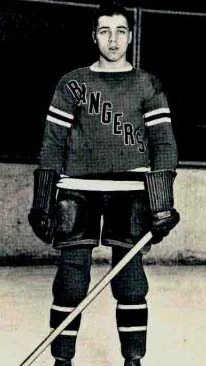
9. Phil Watson, Rangers, 1955-59. 119-124-52, .492.  Through the 2020 season, he remains the only man to coach the Rangers at least 4 full seasons with an overall losing record. He did, however, win 2 Stanley Cups as a player, with the 1940 Rangers and the 1944 Montreal Canadiens.
Watson as a Ranger player

8. John Hynes, Devils, 2015-19. He had a good goalie in Cory Schneider, a Hart Trophy winner in Taylor Hall, a legend in Patrik Elias, and decent players like Travis Zajac, Adam Henrique, Andy Greene, Kyle Palmieri, Jordin Tootoo, Eric Gelinas, Michael Cammalleri, Miles Wood, Sami Vatanen, Brian Boyle...

And he made the Playoffs once in 4 seasons, and left the Devils worse off than when he arrived, going 150-159-45 -- and, since you should really count those 45 overtime and/or shootout losses as losses, that's actually 150-203, for a percentage of .425. Pathetic.
After all the work put in by Lou Lamoriello, Hynes effectively made the Devils a Mickey Mouse operation again.

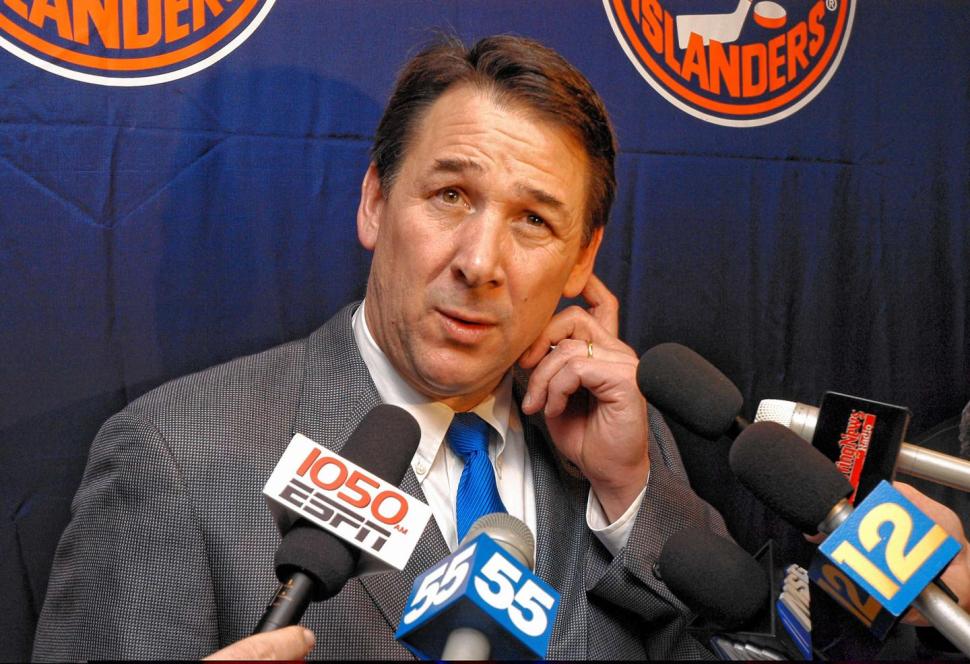
. Mike Milbury, Islanders, 2 terms between 1995 and 1999. 57-112-24, .358. Perhaps his biggest problem was that, at the time, the Atlantic Division had very strong teams in New Jersey, Philadelphia, Pittsburgh, Washington, and, sometimes, Madison Square Garden.

Or, perhaps, his biggest problem was Islander ownership not having money to spend on good players. Or, perhaps, his biggest problem was that his general manager was an idiot. Who was his general manager? Mike Milbury.
He was, however, a decent player with the Boston Bruins, reaching the 1977 and '78 Stanley Cup Finals.

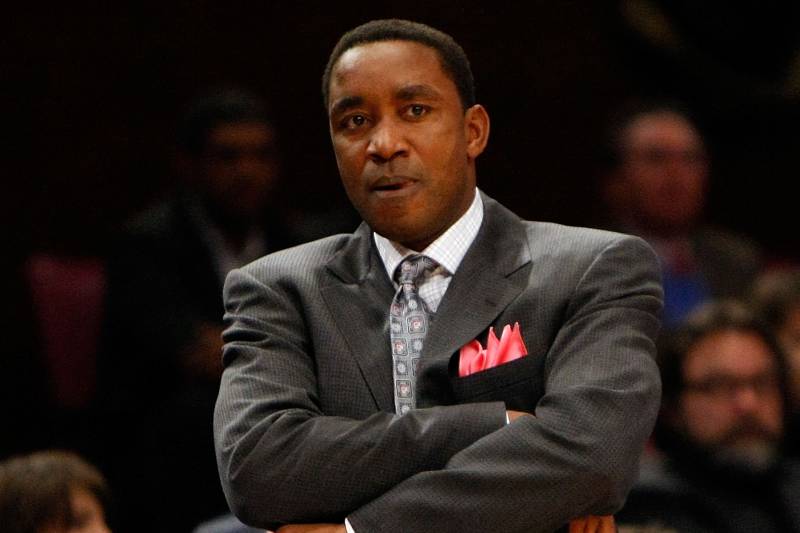
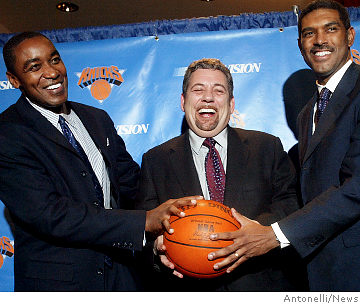
6. Isiah Thomas, Knicks, 2006-08. 56-108, .341. Only 2 seasons, so I can't rank him higher. (Or would that be "lower"?) And, let's face it, like Milbury, he had an idiot for a general manager. Of course, like Milbury, his general manager was himself. But, although he was a true all-time great as a player with the Detroit Pistons, as Knick boss, he was an embarrassment, on the basketball court, in civil court, and in the court of public opinion.
It got so bad that Isaiah Thomas, no relation and with a different spelling, got booed at The Garden when he played there for the Sacramento Kings. Like former Islander and Toronto Maple Leaf goalie Felix Potvin, who always heard the "Potvin sucks!" chant from Ranger fans, he must have wondered, "What did I do? I've never done anything to these people!"

The true problem was that, as long as Charles Dolan had a job, James Dolan had a job; as long as James had a job, Isiah the GM had a job; and as long as Isiah the GM had a job, Isiah the coach had a job. Finally, James -- with prodding from Charles, perhaps? -- fired Isiah from both roles.

5. Eddie Donovan, Knicks, 1961-65. 84-194, .302. He was just 43 years old when he left the head coach's post, and never coached another game in the NBA. However, let the record show that, at the time, the NBA's Eastern Division was dominated by Red Auerbach's Boston Celtics and Wilt Chamberlain's Philadelphia Warriors.
Let it also show that Donovan became the team's general manager and, with head coach Red Holzman, built the 1970 and 1973 NBA Champions. So while he's on the list of the Top 10 Worst Coaches, he is also one of the Top 10 Best Executives.

4. Bill Fitch, Nets, 1989-92. 83-163, .337. He won 944 games in NBA regular-season play, which is 8th all-time. He got the Cleveland Cavaliers to their 1st-ever Eastern Conference Finals in 1976, won a World Championship with the Boston Celtics in 1981, and got the Houston Rockets to the Finals in 1986, and if the Celtics didn't have one of the best teams ever that season he might've won another title.

But he also lost 1,106 regular-season games, more than any coach before him, and the last 2 NBA teams who thought he could be trusted were the Nets and the Los Angeles Clippers, the 2 "little brother teams." Only in his last season with the Nets did he get close to .500, 40-42. (Lenny Wilkens now has more losses, but Lenny also once had the most wins, and, like Don Nelson who has surpassed him in that regard, is well over .500.)
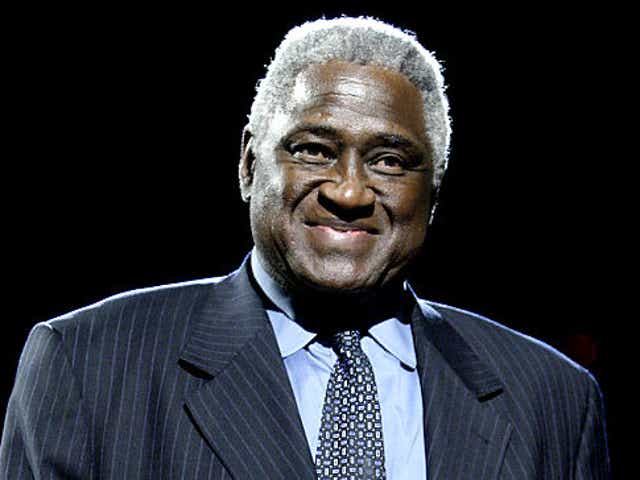
3. Willis Reed, Knicks 1977-79 and Nets 1987-89. 82-124, .398. He was a truly great player for the Knicks, but great players often don't make good coaches. Aside from Stephon Marbury, he may be the only man ever to so badly cock up both area NBA franchises.
2. Charlie Dressen, Dodgers, 1951-53. 298-166, .642. A baseball season was 154 games back then, and in each of his 3 seasons, Dressen got the Dodgers to at least a 157th game. And he won 64 percent of his regular-season games. So how could he be so high on this list? Observe:

* 1951: The Dodgers led the National League by 13 games on August 11. They blew it, and faced their arch-rivals, the New York Giants, in a best 2-out-of-3 playoff. We all know how that ended: Bobby Thomson hits one out off Ralph Branca, and "The Giants win the Pennant!"

Dressen had Branca and Carl Erskine in his bullpen. Erskine had a great curve, but Dressen brought in Branca, who had only a fastball, to face Thomson, who couldn't hit anything but a fastball, and who had already homered off Branca in the first game of the playoff. Branca didn't lose that Pennant, Dressen did.

* 1952: The Dodgers won the Pennant, but lost the World Series to the Yankees in 7 games. True, the Dodgers were without their best pitcher, Don Newcombe, who was serving in the Korean War -- but so was the Yankees' best pitcher, Whitey Ford. And Dressen trusted Billy Loes twice, with disastrous results.

* 1953: The Dodgers won 104 games, tying a franchise record that still stands, and ran away with the Pennant.  Again, they lost to the World Series to the Yankees. Dressen still didn't have Newcombe, and the Yankees had Ford back (but then, Ford was serving in '51 and Newcombe hadn't yet been drafted), and Dressen trusted Johnny Podres 2 years too soon in Game 5, where he got rocked, and trusted Erskine too little in Game 6, and pulled him too early and the Yanks clinched.
After the '53 season, Dressen's wife told him to demand a 3-year contract from Dodger owner Walter O'Malley. O'Malley's policy was to give his managers only 1-year contracts, figuring it would motivate them more. Mr. and especially Mrs. Dressen wanted the security. O'Malley wanted the control and the fear factor. He fired Dressen, not for his mismanaging, but for his impudence. O'Malley hired Walter Alston, and 2 years later, the Dodgers finally won it all. (In fact, it was on October 4, 1955, 55 years ago today.)

Still, as my Grandma, an old Dodger fan from Queens would say, "Oh, that Dressen! He was so
stupid!" I tried to tell her Bobby Valentine, who managed the Mets from 1996 to 2002, was dumber. She wouldn't buy it. She was right: Bobby V made his share of mistakes, but never got the chance to make as many big ones as Dressen. (However, if I were making this list for Boston, Bobby V would be on the list, even if he did manage there for only 1 season.)

1. Rich Kotite, Jets, 1995-96. Here we go, the one we cannot top. Or "bottom," as the case may be. Born in Brooklyn, grew up on Staten Island, went to that Borough's Wagner College, played tight end for the Giants from 1967 to 1972, not at all a bad player.  But he did play for 2 guys on this list, Sherman and Webster. And he was an assistant coach under Joe "Must Go" Walton. Were these bad omens?

In 1991 and '92, he got the Philadelphia Eagles into the Playoffs. In 1993, 8-8 wasn't enough to get in. In 1994, he got the Eagles off to a 7-2 start. Then, trailing the Dallas Cowboys by 17 points in the 4th quarter on a soggy afternoon, James Joseph scored a touchdown to pull the Eagles within 24-13. Kotite decided to go for the two-point conversion. Huh? Going for 1 would've gotten them within 10, just a touchdown and a field goal from a tie; going for 2 would've gotten them within 9, but the touchdown they still needed could've been the time to go for 2. The Eagles didn't get it, and lost.

During the post-game press conference, Kotite went the Milli Vanilli route, and blamed it on the rain: "I must have read my chart wrong. It must have gotten wet." You mean you knew it was raining, and didn't have a protective sheet over the chart to keep it dry? How about this: Don't rely on the chart, dumbass! Down by 15, maybe you go for 2; down by 11, no way!

The Eagles lost all their remaining games, finished 7-9, missed the Playoffs, and Kotite was fired. Crap like this is what makes people in Philly go up to cops and say, "Officer, I want to report a crime: The Eagles are killing me!"

On January 4, 1995, a date which lives in infamy, Jets owner Leon Hess announced that he had hired Kotite to be the team's head coach and, effectively, also its GM. Why Kotite? Well, he was a local guy, and a blue-collar guy who could appeal to local fans. But Hess knew that Kotite had led the Eagles to a couple of Playoff berths. Words that Hess should have guessed would outlive him: "I'm 80 years old. I want results now!"

He got results, all right. In 1995, the Jets went 3-13. One of those losses was the 1st win in franchise history for the expansion Carolina Panthers. (While the Panthers did reach the NFC Championship Game the next season, that 1st year, they were only 4-12.)

Miami dropped 52 points on them; Oakland, 47. They got held to 7 points by New England, 3 points by Atlanta, and in their last 2 games of the season, they got held to 6 points by Houston and shut out at home by New Orleans. They only drew 28,885 for that game. Don't tell me that it was Christmas Eve, and the day after the Giants' "Snowball Bowl": NFL fans will sit through anything. Not once all season did the Jets get a home attendance over 69,000.

In 1996, the Jets had the worst season in the history of Tri-State Area football, 1-15. The only win came in Week 9, October 27, 31-21 away to Arizona. They didn't give up more than 36 points in any game, but gave up at least 31 points in 10 games. They got held to 6 points by the Giants and Denver, and 7 by Indianapolis.

On the one hand, it wasn't as bad as it looked: They only lost to Philadelphia by 1, Buffalo and Miami by 3 each, Jacksonville and New England by 4 each, Indianapolis by 5, and the Giants by 7. On the other hand, that means they had a legitimate chance to go 8-8, and couldn't get the job done.

Two days before the team's '96 finale, GM Kotite fired coach Kotite. The last 2 home games before this, the Jets drew 21,731 and 29,176; knowing that it was his last game, they came out 49,933 strong for the finale.

Owner Hess then hired Bill Parcells, and got much better results, although Hess died before Parcells could get the ultimate result for the Jets, like he did twice for the Giants.

Kotite was just 54 years old when he left Weeb Ewbank Hall, but has never again even been hired as an assistant coach. Anywhere. Not the pros, not college, not even in high school.  However, at age 77, he has been a contributor to various NFL Network broadcasts.

In 2004, in a book titled The Great Philadelphia Sports Debate, co-authors Glen Macnow and Angelo Cataldi, both hosts on Philly's sports-talk radio station WIP, took the question of who was the worst coach in Philadelphia sports history. Macnow said it was Doug Moe, who'd been a good coach with the Denver Nuggets, but was a disaster in his half-season with the 76ers. After Macnow's 2 pages detailing this choice, Cataldi said, "No, the worst coach in Philadelphia sports history was Rich Kotite," and then provided an explanation that any prosecutor would love to have thought of for his closing argument.

Think about this: The worst team in the history of Philadelphia sports was the Quakers, who played one season in the NHL, 1930-31, and finished 4-36-4, for a "winning" percentage of .136 that makes the decades of ineptitude of the Phillies (pre-Charlie Manuel), A's and Eagles look brilliant by comparison. The worst single-season team in that city was the 1972-73 76ers, 9-73, .110.

In his last 39 games as an NFL head coach, with 2 different sets of players, Rich Kotite was 4-35. That's a percentage of .103. In neither case, of the '94 Eagles or the '95 and '96 Jets, could he use the excuse of leading an expansion team, or not having a lot of money to spend. (Eagles owner Jeff Lurie was a Hollywood studio head, Hess was an oilman, both were billionaires, and, besides, the NFL has a salary cap, which means you can't spend like the Yankees or Manchester City.)

Nor were his Eagles and his Jets beset by long-term injuries to multiple key players. Nor was there trouble in the locker rooms: The Jets may have had Keyshawn Johnson in '96, but he wasn't causing trouble at the time. And blaming the media or the fans doesn't change the fact that Kotite put himself in position to get ripped by the media and booed by the fans.

There is no viable excuse to explain it: Rich Kotite is the worst head coach in the sports histories of both Philadelphia and New York.

Top 10 Worst Executives in New York Sports History

All of these disasters are pretty much in my lifetime, 1969 onward.

10. George Steinbrenner, Yankees, 1980-90. Okay, officially, George wasn't the GM. But, let's face it, he was the man making the personnel decisions, no matter how much he blamed his bad transactions on "my baseball people."

When he had Gabe Paul from 1973 to '77, Al Rosen in '78 and '79, Gene Michael stepping in after his suspension in 1990, Bob Watson in '96 and '97, and Brian Cashman from 1998 to 2010, George was a great owner, which is why he's only Number 10 on this list. But he was a horrible "GM," and that's why he makes this list at all.

9. "The Secaucus Seven," Nets, 1978-98. Led by Joe Taub and Alan Cohen, these guys got little to work with, and they made less out of it. Having to pay $8 million just to get into the NBA following the collapse of the ABA, and to pay off the Knicks for "territorial indemnification," the Nets had to sell off their best player, Long Island native Julius "Dr. J" Erving, and a year later trade their next-best player, Bronx native Nate "Tiny" Archibald.

In other words, just to remain in the Tri-State Area, the Nets had to dump 2 of the men who would be named in 1996 to the NBA's 50th Anniversary 50 Greatest Players.

So how many times did the Nets make the Playoffs in those 20 seasons that the S7 owned them? 10. Which isn't actually all that bad. But how many Playoff series did they win? One. That was in 1984, against the defending World Champion Philadelphia 76ers -- with Erving -- before falling in 6 in the next round against the Milwaukee Bucks. How many Playoff games did they win? 9, with 5 of those coming, as I said, in '84.

It's not so much how often they made the Playoffs, it's how bad they were when they didn't. And the bad draft picks... Dennis Hopson, Ed O'Bannon, Yinka Dare... Maybe the Nets weren't as big a joke as the other "little brother" team in the NBA, the Los Angeles Clippers... but even when they were a good team, 1982-86 and 1992-94, they didn't exactly sell out the Meadowlands. Partly because the established, glamorous Knicks were also good at the same time.

The general managers over that time included part-owner Roy Boe, 1973-74 (he was also an owner of the Islanders), Dave DeBusschere, 1974-75; Boe again, 1975-78, including the decisions to trade Erving and Archibald; Charles Theokas, 1978-81; Bob MacKinnon, 1981-83; Lewis Schaffel, 1983-86; MacKinnon again, 1986-87; Harry Weltman, 1987-90; Willis Reed, 1990-96; and John Calipari, 1996-99. So there were some guys who really knew their basketball, but, given the Nets' situation, were in over their heads as GMs.

The S7 sold the Nets in 1998, and in 2001 new ownership made the trade for Jason Kidd and the team made 2 NBA Finals, reaching the Playoffs 6 straight seasons, before Bruce Ratner bought the team and put their breakup and move to Brooklyn into motion.

Despite a 20-year record of ineptitude, I can't rank the S7 any higher, for 2 reasons: There were 7 of them, not any 1 that was more responsible than any other; and the Nets have always been the 2nd basketball team in a 2-team town. Sometimes 3rd, when you consider St. John's.

In fact, counting all the area's major league teams, they're the 9th team in a 9-team town. And, frankly, counting the Liberty and the Red Bulls may not be doing the Nets any favors, either. We'll see if the current management team, led by owner Joseph Tsai and GM Sean Marks, can turn them around in Brooklyn, but don't hold your breath.

8. Mike Milbury, Islanders, 1995-2006. He was one of the players who typified the Boston Bruins' late 1970s-early 1980s "Lunch Pail Athletic Club": Not especially talented, but hard-working, the kind of guy you needed to win. As head coach of the Bruins, he got them to the 1990 Stanley Cup Finals, but got swept by the Edmonton Oilers, whose GM and former head coach was Glen Sather. (See #5 below.)

In 1995, the Islanders named him head coach and GM. He was asked by a reporter how he expected to compete with the Devils, who had just won the Cup, and the Rangers, who had won it the year before. He had the right attitude: "You know, fuck the Rangers and fuck the Devils! I'm running the New York Islanders!" From Flushing to Montauk, you could hear Isles fans saying, "Hell yeah!"

But even when they were winning 4 straight Stanley Cups, the Islanders have never been a team with deep pockets. The moves Milbury made were terrible, pretty much demolishing a team that had come within 3 games of the Finals just 2 years earlier. He removed himself as head coach, reinstalled himself, and removed himself again. He never hired a good head coach, and from his 1995 hiring until 2015, 20 seasons, the team made the Playoffs 6 times, winning 11 games and exactly zero series.
So the way he messed things up on the Jericho Turnpike well outlasted his tenure. When he was hired, they were a viable franchise that may have had an interesting future. When he was finally canned after 11 years, they were a team in trouble, and remain so.

Milbury's heart was in the right place, and no one could question his courage. If he only had a brain. He is not solely to blame for the club's post-1993 decline, but, competitively, it still doesn't look good for the team's long-term future.

7. Wilbur "Weeb" Ewbank, Jets, 1968-74. Bear with me: In order to make you truly understand what Weeb did to the Jets, I have to make this one long. A truly great football coach, he was the only man to be head coach of both an NFL Champion (1958 and '59 Baltimore Colts, both times over the New York Giants) and an AFL Champion (1968-69 New York Jets, over his former team, the Colts). But look at what he did with the team as GM after owner Leon Hess fired Sonny Werblin.

Imagine that it is August 1969, and you are the General Manager of the New York Jets. Your team has not only won the World Championship of American football in its last game that counted, but it did so in a fashion that stunned and excited the entire nation. You've just won an exhibition game (strangely, played at the Yale Bowl in New Haven, Connecticut) in which you decisively defeated the Giants, the City's NFL aggregation. So now you are definitively the best team in your sport, both in New York and in the world.

The Knicks have glamorous stars like Walt Frazier and Bill Bradley and the courageous Willis Reed, but they haven't yet won their 1st title, and even after 2 titles they won't be as big as a popular football team would be.

The Mets are in their 1st Pennant race, but haven't yet gotten their "Miracle" fully onto the City's radar. And even when they do, their marquee player, Tom Seaver, as great as he is and will be, is a private man: He can handle the spotlight, but he does not relish it, and isn't the most bankable guy around.

You have Joe Namath, a glamour guy at the glamour position (quarterback), in the glamour city, in what's becoming the glamour sport, and he loves the spotlight, eats it up. You've just proven that the Giants stink. So do the Yankees, whose big star Mickey Mantle just retired. The Nets are in the ABA, out on Long Island, so they're an afterthought. The Rangers are a bunch of Canadians, not exactly popular in an America that elected Richard Nixon. The Islanders and Devils don't exist yet. No college team in the area is doing big things.

Maybe you don't own the New York Tri-State Area, but you're co-owning with the Mets and the Knicks, and that's pretty good. You've got it made.

And your franchise loses in the 1st round of the next season's Playoffs... and then doesn't reach the Playoffs again for 12 years! And doesn't win another Playoff game until a year after that!
Weeb couldn't keep the Super Bowl team together. He resigned as head coach prior to the 1973 season, by which point an oft-injured Namath was the only one from 1/12/69 still contributing. Weeb remained as GM, and hired his son-in-law, Charlie Wimmer, as head coach. Charlie didn't do too well. Overall, Weeb makes my list of New York's Top 10 Best Coaches, but also my list of New York's Top 10 Worst Executives.

The Jets could have become the team in New York football, instead of becoming a joke franchise, which they still are, at least for the moment. Considering the kind of opportunity Ewbank had in 1969, it is almost a crime that, by 1986, Sports Illustrated could put Lawrence Taylor and Mark Gastineau on their cover, with the words, "In the Big Apple, the Jets are always the second banana."

Weeb never should've been named GM. Jerry Izenberg, the legendary columnist of the Newark Star-Ledger, calls the Jets' inability to win a Super Bowl, or even to reach one, these last 41 seasons "The Curse of Sonny Werblin." That doesn't make much sense, since they did win the next Super Bowl after firing him. Maybe "The Curse of Weeb Ewbank" is better.

6. Mike Burke, Yankees, 1966-73. A genuine hero of America's effort in World War II. A great businessman. A man who loved sports. And, along with Mayor John Lindsay, the man who saved the original Yankee Stadium for an additional 2 generations. We should thank him for those things.

But while he loved baseball, he didn't know how to run a sports team. Granted, the Topping-Webb regime left CBS, and their handpicked team president Burke, a pig in a poke, basically a brand name and nothing else. But he didn't do much with it: When the team finally won the whole thing in 1977, only 4 players were left from before George Steinbrenner owned the team: Roy White, Thurman Munson, Sparky Lyle and Graig Nettles. I think when George came in, and then bought Burke out, it was a great relief to Burke.
Burke, handing the team over to Steinbrenner, January 3, 1973

5. Glen Sather, Rangers, 2000-present. A Ranger defenseman from 1971 to 1974, he became one of the great coaches and GMs in hockey history when he coached the Edmonton Oilers to 4 Stanley Cups and was GM for 5. But what has he done in 20 years in New York?
It took the Rangers 12 years under his leadership to reach the Conference Finals, and 2 more to reach the Stanley Cup Finals. They have not gotten that far again.

His head coaches have been abysmal: John Muckler (who succeeded him in Edmonton and won the 1990 Cup, but awful at the Garden), Ron Low (aptly-named), Bryan Trottier (real smart, hiring one of the greatest Islanders with no head coaching experience to run the Rangers), himself (not so easy when you don't have Gretzky, Messier, Kurri, Anderson, Coffey, Lowe and Fuhr all in their primes), Tom Renney, John Tortorella, Alain Vigneault, and now David Quinn.

And when the Rangers finally did reach the Conference Finals in 2012, they ended up losing to the Devils, a humiliation that well and truly pus the 1994 Cup win deep into the past, every bit as much as the Isles' 1980-83 Cups irrevocably are. Reaching the Stanley Cup Finals in 2014 didn't help, as they got embarrassed by the Los Angeles Kings.

Sather still holds the titles of Senior Advisor and Alternate Governor (the NHL calls their teams' operational owners "Governors"), while Jeff Gorton (not auto racer Jeff Gordon) is the official general manager.

Of course, Sather hasn't done as much damage to the Rangers as Milbury did to the Islanders in a shorter span of time. The Rangers were never in danger of getting moved out of the Tri-State Area. Besides, somebody had to make the mistake of hiring Sather, and then keeping him for this long.

4. Omar Minaya, Mets, 1995-2002, 2005-10, and 2017-present. Previously a scout under GM Steve Phillips, he left to become MLB's 1st Hispanic GM, with the Montreal Expos. With that team getting moved to become the Washington Nationals, the Mets brought him back as their GM.

He was going to lead the Latin Revolution in Flushing Meadow. He brought in Pedro Martinez, Carlos Beltran, Jose Reyes, Carlos Delgado, Johan Santana and Francisco Rodriguez. And David Wright. (How'd that Gringo get in there?)

2005: No Playoffs, but that's okay, because they're still working their way up. No shame in that.

2006: One run from a Pennant, but a 9th-inning homer by the opposition, and Beltran leaves the bat on his shoulder. Okay, that's not good, but there's still plenty of reason for optimism.

2007: Up by 7 with 17 to go, and they don't even make the Playoffs. Now that is a disgrace.

2008: Up by 3 1/2 with 17 to go, and they don't even make the Playoffs. In this case, half a disgrace does not lessen the disgrace, it compounds it. They couldn't even win the last game at Shea Stadium. They couldn't let their beloved home "die with dignity."

2009: The 1st season at Citi Field is, competitively, an unmitigated disaster.

2010: Another sub-.500 season.

All the while, the Yankees remain the Number 1 team in town, winning a 27th World Championship. The Mets are still looking for a 3rd. The Yankees have won 40 Pennants; the Mets won a 5th after firing Minaya, but are still looking for a 6th.

Can't blame it on the manager, because the Mets failed under Willie Randolph and failed harder under Jerry Manuel. Nope, don't blame the waiter, blame the chef.
People said the Mets should spend more money, like the Yankees do. But the guys Minaya did spend money on didn't pan out. And then, of course, came the reckoning of Fred and Jeff Wilpon's dealings with Bernie Madoff, and so, under new GM Sandy Alderson, the Mets haven't been able to spend big.

Frankly, the Wilpons should have dumped Minaya after 2008. After all, '05 was a rebuilding year, '06 was pretty successful by Met standards, and '07 could be written off as a fluke -- a mind-numbing, nasty fluke, but a fluke nonetheless. But 2008 should have been the alarm bell. The Mets should've broken up with Minaya then.

Finally, in 2010, the Wilpons told him, "This relationship isn't working, and I think we should start seeing other executives." No, Omar, it's not them, it's you. The Latin Revolution left Met fans feeling so tortured, it should have been called the Spanish Inquisition.

For a while, he worked in the front office of the San Diego Padres. They didn't come close to a Pennant while he was there. He returned to the Mets after the 2017 season, as a "special assistant to the general manager." It seems that Fred Wilpon just can't quit Omar.

UPDATE: In 2023, Hal Steinbrenner hired Minaya as a front-office consultant. It appears to have been key to the Yankees obtaining Juan Soto in a trade. That trade may yet redeem Minaya, and force an update of this list.

3. Isiah Thomas, Knicks, 2003-08. It was bad enough that Isiah made some bad moves as GM. It was worse that he trusted some guys who couldn't coach, including himself.  It led to the infamous T-shirts: "Don't hate the players, hate the coach." And if that had been the extent of it, that would have been bad enough, although perhaps not bad enough to make the top (or should that be "bottom"?) half of this list.

But through his private life becoming public, he dragged the Knicks through the tabloid muck. Once the team of Clyde Frazier, cool and stylish, a team the ladies could love as much as the guys, the Knicks had become a festering sewer, both competitively and morally.

Of course, Thomas didn't do as much damage to the Rangers as the Secaucus Seven did to the Nets. And the damage he did, while severe in terms of public relations and competitiveness, both on the court and in the boardroom, didn't put the Knicks in danger of moving or going out of business. Besides, somebody had to make the mistake of hiring Thomas, and then keeping him for that long.

2. M. Donald Grant, Mets, 1962-78. He was a friend of Mets founder Joan Payson, and she hired him to be the team's 1st chairman of the board. After the 1969 season, the Mets owned New York every bit as much as the Jets did. After the 1973 season, when they'd won another Pennant, they were so far ahead of the Yankees it wasn't funny -- though you can be sure Met fans were cackling with glee.

Surely, with their (relatively) new ballpark and exciting young players in a nice neighborhood, they had the advantage over the Yankees, with their old ballpark and failing players in a disastrous neighborhood, not to mention their crazy new owner.

The Mets, or rather Grant, frittered away so much of that goodwill, to the point where a few Met fans -- not many, but a few, including Brooklynite college student and aspiring filmmaker Spike Lee -- switched to the Yankees after they returned to the top, a rise coinciding with the Mets' collapse.
A blog called Mike's Mets -- not connected to me in any way -- pretty much sums Grant's mindset up:

Grant, a stockbroker, was Mrs. Payson's close personal advisor when she became the original owner of the Mets. He probably had very little influence in player movement for the first several years, and in the days before free agency, no one could say that the Mets were particularly cheap. But... Grant did not believe that a ballplayer deserved to be making as much money as a stockbroker or real estate magnate, and probably didn't think they belonged at the same parties or meetings, either.

Grant's meddling, no doubt, played a part in driving Mets' GM Bing Devine, who was doing a nice job of trying to build a winner, back to St. Louis. It was probably after Mets' GM Johnny Murphy passed away in 1970 that Grant's influence began to increase. Whitey Herzog was Mets' player development director and heir to the GM job, but Grant passed him by because he knew he wouldn't stand for any interference from someone who in Whitey's words "knew nothing about baseball".

The next two Mets' GM's, Bob Scheffing and Joe McDonald, probably had their hands tied by Grant, his frugality, and his belief that ballplayers should be quiet, sign their contracts, and just play ball. When a player became outspoken about salary issues, such as Tom Seaver and Dave Kingman did, it was only a matter of time before they would be sent away. When Gil Hodges died just before the 1972 season began, Grant again chose to bypass the outspoken Herzog, driving him out of the organization, in favor of Yogi Berra.

Probably the best example of how out of touch M. Donald Grant was with the average fan was when he tried to explain the Tom Seaver negotiations and subsequent trade in terms of bluffing and playing tricks in a hand of bridge. How many Mets fans have any idea how to even play bridge?

Things got worse when Mrs. Payson got sick, and died late in 1975. Her daughter, Lorinda de Roulet, inherited the team, and she knew that she knew nothing about baseball, so she trusted Grant even more.

Observe the breakup of the "Miracle" team: The autocratic Grant traded away Tommie Agee after the 1972 season, Tug McGraw after 1974, Rusty Staub (who would later return) and Cleon Jones after 1975, Jerry Grote after 1976, and Seaver and Kingman on June 15, 1977, a date which lives in Met infamy. Aside from the Dodgers and Giants getting moved out of town, this is the most hated transaction in the history of New York sports -- even if Steve Henderson had a few hits in him and Doug Flynn was a very good fielder.

Lorinda finally fired the old buzzard in 1978. By that point, attendance at Shea Stadium was so sparse it was being called Grant's Tomb: It had gone from a City record 2.7 million in 1970 to under 800,000 by 1979 -- or, per game, 33,000 to 9,740. Contrast that with the Yankees: 1972, 966,000 (12,000); 1980, 2.6 million (32,000).  Not until 1980, when Lorinda sold the team to Fred Wilpon and Nelson Doubleday, did things begin to turn around at Shea.

Grant died on November 29, 1998, 16 days after the death of Weeb Ewbank, and 12 days after the death of the Knicks' title-winning head coach, Red Holzman. Weeb and Red got a lot of praise in the New York media. Grant's death was barely even noticed. Serves him right.

1. James Dolan, Knicks and Rangers, 1994 to the present. His father Charles Dolan hired him to run Cablevision. Which, until Charles sold Cablevision in 2016 but kept ownership of all of the following, owned ITT. Which owns Viacom. Which owns Paramount Communications. Which owns Gulf + Western. Which owns the Madison Square Garden Corporation. Which owns the Garden complex, the Knicks, the Rangers, the MSG Network, and the Garden's boxing, concert and other special-events promotion companies. (From the team's founding in 1997 until selling them to Nets owner Joseph Tsai in 2019, the Dolan conglomerate also owned the WNBA's New York Liberty.)

"Guitar Jimmy" has done great things. He has promoted the Concert For New York City after 9/11, the Big Apple to Big Easy Concert after Hurricane Katrina, and the 12-12-12 Concert to raise money for relief of Hurricane Sandy. He is one of the most charity-sustaining people in America. He is, by most accounts, a decent person. (I have heard suggestions of "Me Too" incidents, but these have not been seriously pursued.) I have no reason to dislike him. Especially since I am neither a Knicks nor a Rangers fan.

But this is the guy who hired Glen Sather to run the Broadway Blueshirts, and also the guy who hired Isiah Thomas to run the Knickerbockers. Through those 2 guys, whom he showed unbelievable loyalty, to the point where both New York Daily News columnist Mike Lupica and I, independent of each other, have wondered what kind of pictures Isiah has of Dolan, he has managed to futz up one of the NBA's charter franchises and one of the NHL's so-called "Original Six" teams, the 3rd- and 4th-greatest franchises in the Tri-State Area in terms of historic success (behind the Yankees and football Giants), for over a decade.

Think about it: Starting with 2000-01, the first full season in which Dolan has, effectively, been the big boss of both teams, the Knicks have won 1 Playoff series, and only 9 Playoff games, despite spending more money (even with the league's salary cap) than any team in basketball history.

The Rangers have done a bit better, but even that took a few years to really get rolling. Over that stretch, they have won 10 Playoff series, but only 3 times have they gotten to the Conference Finals, and only once to the Stanley Cup Finals, despite spending more money (both without and then with the league's salary cap) than any team in hockey history.

Think about that: 2 teams, same building, 20 years, 11 Playoff series won. That roughly translates to 1 Playoff series win every 2 years, for each team, in what's promoted as "The World's Most Famous Arena." From 1998 to 2011, there was a 14-season stretch without either the Knicks or the Rangers making the Playoffs.

Messing up one franchise for a decade is bad enough. Jimmy Dolan has messed 2 up for 2 decades. He's not a cheap dirty bastard, like Walter O'Malley or Donald Grant. He's not a sleazeball, like Isiah Thomas, or an "ogre" as George Steinbrenner was often called  And he isn't a legend whose sport has passed him by, like Glen Sather.

On the other hand, he isn't a good man thrown into an awful situation, like Mike Burke. He's a (possibly) good man who made an awful situation -- indeed, 2 of them. Like Weeb Ewbank (as GM, anyway) and Mike Milbury, he is a guy in over his head. But it's Knick and Ranger fans who feel like they're drowning.

Friday, April 13, 2018

Detroit's 10 Greatest Athletes

Steve Yzerman and Gordie Howe

Tonight, the Yankees begin a series in Detroit against the Tigers.

Detroit's 10 Greatest Athletes

Honorable Mention to Tigers in the Baseball Hall of Fame, who didn't otherwise make the Top 10: Hugh Jennings, Sam Crawford, Harry Heilmann, Heinie Manush, Goose Goslin, Mickey Cochrane, Charlie Gehringer, Hal Newhouser, George Kell, Jim Bunning, Alan Trammell, Jack Morris and Ivan Rodriguez.

Miguel Cabrera will probably join them, and Lou Whitaker should be allowed to. If Cochrane had spent his entire career in Detroit, he'd be in the Top 10.

Honorable Mention to Lions in the Pro Football Hall of Fame, who didn't otherwise make the Top 10: Dutch Clark, Alex Wojciechowicz, Doak Walker, Lou Creekmur, Jack Christiansen, Dick Stanfel, Yale Lary, Joe Schmidt, John Henry Johnson, Dick LeBeau, Dick "Night Train" Lane, Lem Barney and Charlie Sanders.

Night Train Lane would be in the Top 10 if he'd spent his entire career in Detroit. These men should be joined by Alex Karras, Wayne Walker, Chris Spielman and Lomas Brown.

In 1999, The Sporting News listed their 100 Greatest Football Players, and Lane came in 19th, Schmidt 65th, Chrstiansen 86th and Barney 97th. But by 2010, the NFL Network completely left Christiansen and Barney off their list of the 100 Greatest Players, while listing Lane 30th and Schmidt 84th.

Honorable Mention to Pistons in the Basketball Hall of Fame, who didn't otherwise make the Top 10: Dick McGuire, Bailey Howell, Dave DeBusschere, Dave Bing, Bob Lanier, Joe Dumars, Adrian Dantley, Dennis Rodman and Grant Hill. They might be joined someday by Bill Laimbeer, Ben Wallace, Rasheed Wallace, Chauncey Billups and Richard Hamilton.

Honorable Mention to Red Wings in the Hockey Hall of Fame, who didn't otherwise make the Top 10: Marty Barry, Herbie Lewis, Brian Kilrea, Syd Howe, Bill Quackenbush, Jack Stewart, Sid Abel, Harry Lumley, Ted Lindsay, Red Kelly, Alex Delvecchio, Marcel Pronovost, Bill Gadsby, Norm Ullman, Marcel Dionne, Dino Ciccarelli, Viachelsav Fetisov, Mark Howe, Sergei Fedorov, Larry Murphy, Brendan Shanahan, Igor Larionov, Chris Chelios, Dominik Hasek and Brett Hull.

Mark Howe, of course, is Gordie's son. Syd Howe, however, is not related to them. Several of these guys would be in the Top 10 if they'd spent their entire careers with the Wings.

Now, the Top 10:

10. Bobby Layne, quarterback, Detroit Lions, 1950-58. His stats don't look so hot in comparison to quarterbacks of the post-merger era, but he was the original master of the 2-minute drill. He made 6 Pro Bowls, and led the Lions to the NFL Championship in 1952, 1953 and 1957 (although he was injured for the '57 Championship Game, with Tobin Rote filling in.)

The Lions retired his Number 22, and he was named to the Pro Football Hall of Fame and the NFL's 1950s All-Decade Team. In 1999, The Sporting News listed him 52nd on their list of the 100 Greatest Football Players. But by 2010, the NFL Network completely left him off their list of the 100 Greatest Players, the biggest dropoff of any quarterback.

9. Isiah Thomas, guard, Detroit Pistons, 1981-94. His messy personal life and his disastrous runs as an NBA coach and executive are not factors here. This is based solely on what he did as a player.

A 12-time All-Star in his 13 seasons with the Pistons, he led them to the NBA Championship in 1989 and 1990, winning the Bill Russell Award as Finals MVP in 1990. The Pistons retired his Number 11, and he was named to the Basketball Hall of Fame and the NBA's 50th Anniversary 50 Greatest Players.

8. Hank Greenberg, 1st base and left field, Detroit Tigers, 1930-46. He won AL MVP awards in 1935 and 1940 – the former at 1st base, the latter in left field, becoming the 1st player to win MVPs at 2 different positions. (Only one has done it since, Robin Yount.)

In 1934, he hit 63 doubles (2nd-highest total in MLB history), and helped the Tigers win their 1st Pennant in 25 years, despite missing a key game down the stretch because it fell on Yom Kippur, the holiest day in the Jewish calendar. (This was a year before Sandy Koufax was born, and 31 years before Koufax would do the same on the day of Game 1 of the World Series.)

In 1935, he won the AL MVP and led them to their 1st World Championship, although he was injured during the World Series. In 1937, he had a whopping 183 RBIs, 1 off Gehrig's AL record. In 1938, he hit 58 home runs, and for a while it looked like he might break Babe Ruth's record of 60. In 1940, he won the MVP and led the Tigers to another Pennant.

Then he became the 1st baseball All-Star to enlist in the armed forces, in anticipation of World War II. Discharged in the middle of the 1945 season, he rejoined the Tigers, and hit a grand slam on the last day of the regular season to win the Pennant, and the Tigers won the World Series as well.

A bad back led him to retire after 1946, but the Pittsburgh Pirates talked him out of it by offering him baseball's 1st $100,000-a-year contract. The original "Hammerin' Hank" walked away after the 1947 season, with a .313 batting average, a 158 OPS+, and 1,628 hits and 331 home runs, despite having played only enough games to add up to 10 full seasons

He was elected to the Hall of Fame, and the Tigers retired his Number 5 and dedicated a statue to him outside Comerica Park. The Sporting News ranked him 37th on their list of the 100 Greatest Baseball Players.

7. Terry Sawchuk, goaltender, Detroit Red Wings, 1950-64. Well, more accurately, 1950-55, 1957-64, and 1968-69. Until Patrick Roy and then Martin Brodeur came along, Sawchuk was on the short list for the title of greatest goalie in hockey history, along with Jacques Plante.

An 11-time All-Star, he won the Calder Memorial Trophy as Rookie of the Year in 1951; and the Vezina Trophy as best goalie in 1952, 1953, 1955 and 1965. He helped the Wings win 3 Stanley Cups, and the Toronto Maple Leafs win 1 more. For a long time after he retired, his 447 wins and 103 shutouts were all-time records.

He was elected to the Hockey Hall of Fame, and the Wings retired his Number 1. In 1998, The Hockey News ranked him 9th, the highest-ranking goalie, on their list of the 100 Greatest Hockey Players. In 2010, THN ranked him the greatest goalie ever. In 2017, he was named to the NHL's 100th Anniversary 100 Greatest Players.

6. Nicklas Lidström, defenseman, Detroit Red Wings, 1991-2012. It wasn't easy to succeed Steve Yzerman as the Wings' Captain, but no one was better suited to it. A 12-time All-Star, he won 7 Norris Trophies as the NHL's best defenseman, including in 2001, when he became the 1st player born or trained in Europe to win it; and in 2011, when he became the oldest man to win the award, 41.

No European-born player has played in as many games as Lidstrom, 1,564. That number also marks the most games played for only 1 NHL team. He played in a record 900 winning regular-season games. His 263 postseason games are the most with a single team. And his +61 is the highest postseason plus/minus rating.

He won the Stanley Cup in 1997, 1998, 2002 (the 1st European winner of the Conn Smythe Trophy as Playoff MVP) and 2008 (the 1st European Captain of a Cup winner). The Wings retired his Number 5, and he was named to the Hockey Hall of Fame and the NHL's 100th Anniversary 100 Greatest Players.

5. Al Kaline, right field, Detroit Tigers, 1955-74. An 18-time All-Star, in 1955 he became the youngest player ever to win a major league batting title. He collected 3,007 career hits, including 399 home runs, and won 10 Gold Gloves. He led the Tigers to win the 1968 World Series. His Number 6 was the 1st number retired by the team, and they dedicated a statue to him at Comerica Park. He was named to the Baseball Hall of Fame and The Sporting News' 100 Greatest Baseball Players, coming in 76th.

He remains the most popular athlete in Detroit history, ahead of Ty Cobb, Doak Walker, Barry Sanders, Isiah Thomas, Gordie Howe and Steve Yzerman.

4. Barry Sanders, running back, Detroit Lions, 1989-98. He played 10 seasons with the Lions, and made the Pro Bowl in all of them. He was NFL Offensive Rookie of the Year in 1989, and MVP in 1991 and 1997. He rushed for 15,269 yards and 99 touchdowns, and added 352 receptions for 2,921 yards and 10 touchdowns.

And then, in 1999, just 1,457 yards short of Walter Payton's all-time record, and about to turn 31 so he was in his prime and could've broken the record that year, he retired. Maybe it was the right decision: We've seen so many players suffer from arthritis due to the constant pounding their bodies took, and from dementia from blows to the head, including the aforementioned Sayers.

The Lions retired his Number 20 (a joint ceremony with Lem Barney and Barry's fellow Heisman Trophy winner, Billy Sims of arch-rival Oklahoma). He was named to the Pro Football Hall of Fame -- making him the shortest player in Canton -- and the NFL's 1990s All-Decade Team. In 1999, The Sporting News listed him 12th on their list of the 100 Greatest Football Players. In 2010, the NFL Network ranked him 17th on their list of the 100 Greatest Players.

3. Steve Yzerman, center, Detroit Red Wings, 1983-2006. In 1986, he was named the Wings' Captain. He was just 21, and, at the time, the youngest Captain in NHL history. But he had already broken a record, which he still holds, of youngest All-Star ever: 18 in 1984. It was the 1st of 10 All-Star appearances. His 19 years and 1,303 games as an NHL team Captain are unlikely ever to be surpassed.

But he arrived in the middle of the "Dead Things" era, and it took years to clean up the damage left by the Bruce Norris regime. Finally, Mike Ilitch came in, and built one of the great teams in NHL history around him. They finally reached the Stanley Cup Finals in 1995, and won the Cup in 1997. Gordie Howe then said of Stevie Y, "I'm just so dang happy for the kid, it's unbelievable." The "kid" was 32, but, to Gordie Howe, pretty much everybody was a kid.

Yzerman would also lead the Wings to Cups in 1998 (winning the Conn Smythe Trophy as Playoff MVP) and 2002. He finished with 692 goals and 1,755 points, got his Number 19 retired, and was named to the Hockey Hall of Fame and the NHL's 100th Anniversary 100 Greatest Players.

2. Ty Cobb, center field, Detroit Tigers, 1905-26. This isn't about how nice a guy he was. This is about him being the best baseball player in the world pretty much continuously through the entire Presidencies of William Howard Taft and Woodrow Wilson. That's 12 full seasons.

The Georgia Peach won 12 American League batting titles, 4 RBI titles, and the home run title in 1909, making him the AL's 1st Triple Crown winner. He led the Tigers to Pennants in 1907, 1908 and 1909. Under the old system, he was named AL MVP in 1911.

He was once recognized as having held the records for stolen bases in a season (96) and a career (892), although checks of 19th Century totals have thrown those marks into question. He once held the record for most runs scored in a career, 2,245. He once held the record for most hits in a career, 4,191, although that was later revised to 4,189. He still holds the record for highest career batting average, the revision bringing it from the old familiar .367 to .366.

Since he played before the era of uniform numbers, the Tigers dedicated a plaque in his memory, and placed it on the outer wall of Tiger Stadium. They have since added his name, but no number, to the retired number wall at Comerica Park, and dedicated a statue to him as well. (Footage of him at Yankee Stadium for Old-Timers' Day 1947 shows him wearing a Tiger uniform with the Number 25 on it. There is no known explanation for the number.)

When the 1st election for the Baseball Hall of Fame was held in 1936, Cobb got the most votes, which, in a manner of speaking, makes him the 1st person elected to the Hall of Fame -- in any sport. In 1999, The Sporting News listed him 3rd on their 100 Greatest Baseball Players, behind only Babe Ruth and Willie Mays. That same year, he was named to the Major League Baseball All-Century Team.

1. Gordie Howe, right wing, Detroit Red Wings, 1946-71. Say what you want about Wayne Gretzky, but Gordie Howe is the greatest hockey player of all time. He remains Mr. Hockey. Put it this way: At age 38, in 1999, Gretzky had to retire due to a bad back; at the same age, in 1966, Howe was still putting the Wings on his back, to the Stanley Cup Finals, and was still 1 of the top 5 players in the game.

He played in 22 All-Star Games for the Wings -- plus 2 more for the Houston Aeros and 1 more for the Hartford Whalers. He won 6 Hart Memorial Trophies as NHL MVP, and 6 Art Ross Trophies as leading scorer. He led the Wings into 10 Stanley Cup Finals, winning in 1950, 1952, 1954 and 1955. Nobody played more regular season games, 1,767. His 801 career goals (786 with the Wings) have been surpassed in NHL history only by Gretzky.

The Wings retired his Number 9, and dedicated a statue to him. He was named to the Hockey Hall of Fame, The Hockey News' 100 Greatest Players (3rd), and the NHL's 100th Anniversary 100 Greatest Players. He lived long enough to learn that the new bridge over the Detroit River, connecting Detroit with Windsor, Ontario, would be named the Gordie Howe International Bridge.

Sunday, December 3, 2017

Top 10 Athletes From Illinois

December 3, 1818: Illinois is admitted to the Union as the 21st State. Next year will be the State's Bicentennial.

Top 10 Athletes From Illinois

Remember: Some of these will be from the northern, Chicago-leaning half of the State; but some will be from the southern, St. Louis-leaning half. Chicago, by itself, makes Illinois one of the most athletically potent States, up there with New York, Pennsylvania, Ohio, Florida, Texas and California.

Honorable Mention to Baseball Hall-of-Famers from the State who didn't otherwise make the Top 10: Al Spalding of Byron (we'll never know for sure how the legendary 1870s pitcher and later executive would have done under modern rules), Charles Comiskey of Chicago's St. Ignatius Prep (he was a great player before becoming a rotten team owner), Joe McGinnity of Decatur, Ray Schalk of the St. Louis suburb of Litchfield, "Sunny" Jim Bottomley and Charles "Red" Ruffing of Nokomis, Freddie Lindstrom of Chicago's Loyola Academy, Lou Boudreau of Harvey, Albert "Red" Schoendienst of the St. Louis suburb of Germantown, Robin Roberts of Springfield, and Kirby Puckett of Chicago's Calumet High School.

Jim Thome of the Peoria suburb of Bartonville will almost certainly join them in the election whose results will be announced next month. Rickey Henderson was born in Chicago, but lived in Oakland from age 7 onward, and so was included in the corresponding post I did for California. So was Robin Yount, born in Danville, Illinois, but raised in Los Angeles.

Honorable Mention to Bob Turley of the St. Louis suburb of Troy, who won the World Series Most Valuable Player award in 1958, the year he also became the 1st Yankee to win the Cy Young Award. "Bullet Bob" was also a member of the Yankees' 1961 and 1962 World Champions.

Honorable Mention to Ben Zobrist of Eureka, who was named World Series MVP in 2016, helping the Chicago Cubs finally win the World Series again.

Honorable Mention to Yankee World Series Winners from the State: Ruffing, Turley, Bill "Moose" Skowron of Chicago's Weber High School, Joe Girardi of East Peoria (won 3 World Series as a player and another as manager, let's give credit where it's due), Homer Bush of East St. Louis, and Jerry Hairston Jr. of the Chicago suburb of Naperville.

Honorable Mention to Pro Football Hall-of-Famers from the State who didn't otherwise make the Top 10: John "Paddy" Driscoll of Evanston, George Trafton of the Chicago suburb of Oak Park, Tony Canadeo of Chicago's Steinmetz High School, George Connor of Chicago's De La Salle Institute, Kellen Winslow Sr. of East St. Louis, and Kevin Greene of Granite City.

Honorable Mention to Knute Rockne and George Halas, both of Chicago, who were very good football players in their time, the 1910s; but are now far better remembered as coaches who helped to define the sport in the 1920s.

Rockne died in a plane crash in 1931, while his Notre Dame team was the defending National Champion. Halas, for all intents and purposes the founder of the NFL, continued to shape the game into the 1960s, and still owned the Chicago Bears at his death in 1983.

Honorable Mention to Clint Frank of Evanston and Johnny Lattner of Chicago's Fenwick High School, who won the Heisman Trophy, in 1937 at Yale and in 1953 at Notre Dame, respectively.

A Very Honorable Mention to Frederick Douglass "Fritz" Pollard of Chicago's Lane Technical High School. In his day, there weren't many black students, let alone athletes, at Ivy League schools, but he played as a 2-way back at Brown University in Providence, Rhode Island, helping them reach the 1916 Rose Bowl.

In 1920, he joined the Akron Pros of the brand-new American Professional Football Association, which became the National Football League in 1922. He led the Pros to the 1st NFL Championship. In 1921, he was named the Pros' head coach. Whether the NFL was then a "major league" is debatable, but, if it was, then Fritz Pollard was the 1st black head coach in North American major league sports -- 26 years before Jackie Robinson suited up for the Brooklyn Dodgers, 45 years before Bill Russell in the NBA, 54 years before Frank Robinson in baseball, and 68 years before Art Shell became the 1st black head coach in the modern NFL. He was also the head coach of the Hammond Pros, outside Chicago in Indiana, in 1925.

He would continue to play in the NFL until 1926, after which none of the black players in the League were signed to contracts for 1927. Pro football would then be all-white until 1946. He went into various businesses including newspapers and music production, but was almost forgotten. In 1976, NFL Films did an interview with him as part of their investigation into the League's beginnings.

He died in 1986, having lived long enough to be elected to the College Football Hall of Fame (the 2nd black player so honored, after Duke Slater of Iowa), but not the Pro Football Hall of Fame. He was finally elected in 2005.

Honorable Mention to Basketball Hall-of-Famers from the State who didn't otherwise make the Top 10: Pat Page of Chicago, John Schommer of Chicago, Bob Gruenig of Chicago's Crane Tech, Andy Phillip of the St. Louis suburb of Granite City, Harry Gallatin of the St. Louis suburb of Roxana, Jerry Sloan of McLeansboro, and Dan Issel of the Chicago suburb of Batavia.

Honorable Mention to Cappie Pondexter of Chicago's John Marshall High School, one of the greatest players in WNBA history, who now plays for her hometown Chicago Sky. I also include her because she played here in Central Jersey, at Rutgers.

Honorable Mention to Chris Chelios of the Chicago suburb of Evergreen Park, the State's greatest hockey player. Although the 11-time All-Star didn't win the Stanley Cup with his hometown Blackhawks, making the Finals in 1992, he did win it with the 1986 Montreal Canadiens and the 2002 and 2008 Detroit Red Wings -- the 16-year gap being the longest in Cup history.

He won the Norris Trophy as the NHL's best defenseman 3 times, and was still playing in the League at age 48, making him 2nd only to Gordie Howe among the oldest NHL players ever. He won the World Cup of Hockey with the U.S. in 1996, and Captained the U.S. team at the 2004 World Cup, and at the Winter Olympics in Nagano in 1998, in Salt Lake City in 2002 (Silver Medal), and Turin in 2006. Although the 'Hawks have not retired his Number 7 (nor did the Habs or Wings retire the Number 24 he wore with them), he is in the Hockey Hall of Fame.

Honorable Mention to Brett Hull of Chicago. Although he was born in Belleville, Ontario, Canada, as was his father, Hall-of-Famer Bobby Hull, a.k.a. "the Golden Jet," "the Golden Brett" grew up in Chicago while Bobby played for the 'Hawks, went to college and played college hockey for the University of Minnesota-Duluth, and exercised his right to play for the U.S. team. Canada has never forgiven him.

An 11-time All-Star right wing, he spent the bulk of his career on teams that are rivals to his father's, the St. Louis Blues and the Detroit Red Wings. He won the 1991 Hart Trophy as NHL MVP, and scored 741 goals -- trailing only Wayne Gretzky and Howe (but not his father) at the time of his retirement, and only Jaromir Jagr has surpassed him since. (Jagr has also now surpassed Chelios as the NHl's 2nd-oldest player ever.) He won the Stanley Cup with the 1999 Dallas Stars (scoring a controversial clincher in Game 6 of the Finals), and the 2002 and 2008 Wings.

He and Bobby are the only father and son in the Hockey Hall of Fame, the only such pair to each have 1,000 career points, the only such pair to both have their uniform numbers retired (the Blues retired 16 for him), and the only such pair to both have statues outside their arenas (Bobby in Chicago, Brett in St. Louis). When their teams played each other in the 2017 NHL Winter Classic, the Hulls served as opposing honorary captains.

In an ad for the NHL in Sports Illustrated, he was used as a stand-in for any player known as "The Scorer": "You love the Scorer. You hate the Scorer. You watch the Scorer." Another player used was Adam Oates -- together in St. Louis, the nickname "Hull and Oates" was a natural -- as "The Playmaker." They also used Adam Graves as "The Grinder," Patrick Roy as "The Stopper," and Gretzky as "The Superstar."

Honorable Mention to Jack Root of Chicago, an immigrant from what's now the Czech Republic (born Janos Ruthaly), who is considered the 1st official Light Heavyweight Champion of the World, in 1903.

Honorable Mention to Billy Papke of Spring Valley. "The Illinois Thunderbolt" was briefly Middleweight Champion of the World in 1908.

Honorable Mention to Barney Ross of Chicago, a hero in many ways, in and out of the ring. Although born (as Dov-Ber David Rosofsky) in Manhattan, his father's career as a rabbi led to a move to the West Side of Chicago. He was Lightweight Champion of the World from 1933 to 1935, and was Welterweight Champion of the World from then until 1938. The Ring magazine named him Fighter of the Year for 1935. He might have been the toughest boxer of a very tough era.

He enlisted in the U.S. Marine Corps during World War II, and won the Silver Star for his heroism at the Battle of Guadalcanal. But the morphine he got to ease the pain of his combat wounds led to a heroin addiction. Long before there was a Betty Ford Center, Barney Ross was one of the earliest people to become famous for beating a drug problem.

The 1957 film Monkey On My Back, based on his memoir, starred Cameron Mitchell. Sylvester Stallone would name his character in the Expendables movies Barney Ross in tribute to a fighter who, while Jewish instead of Italian, was every bit as known for his refusal to give up as Stallone's fictional Rocky Balboa.

Honorable Mention to Ken Norton of the St. Louis suburb of Jacksonville. He learned to box when, like Ross, he served in the Marines, in his case during the early Vietnam years. "The Black Hercules" is best known for his 3 fights with Muhammad Ali, beating him by decision and breaking his jaw in 1973, losing a rematch a few months later, and then, in their only fight for the title, and the main event of the only professional fight card in the renovated version of the original Yankee Stadium (1976-2008), losing a controversial decision. In fact, all 3 decisions with Ali were split.

When Ali lost to Leon Spinks, in what was only Spinks' 9th professional fight, the World Boxing Council refused to recognize Spinks as the Heavyweight Champion of the World. Since they considered Norton to be the man who'd otherwise come the closest to beating Ali (by this point, Joe Frazier was a nonfactor), they recognized Norton as Champion on March 18, 1978. That ended on June 9, when Norton, again with controversy, lost a split decision to Larry Holmes. But, ever since, with a few brief exceptions (Mike Tyson twice and Lennox Lewis once), the heavyweight title has been split.

His son, Ken Norton Jr., was an All-Pro football player. Like Vai Sikahema, he would develop a habit of punching the padding on the goalpost like a heavy bag when he scored a touchdown.

Root, Papke, Ross and Norton have all been elected to the International Boxing Hall of Fame.

Honorable Mention to Johnny Loftus of Chicago. He won the 1916 Kentucky Derby aboard the horse George Smith. He became the 1st jockey to win the Kentucky Derby, the Preakness Stakes and the Belmont Stakes all in the same year, 1919 -- the feat that would become known as the Triple Crown. His horse was Sir Barton.

He also rode Man o' War in his 1st 9 races, winning 8, but losing to the horse named Upset in the Sanford Memorial Stakes at Saratoga Race Course. (The term "upset" to describe an unexpected victory was already in place, but this race cemented it in people's minds.) He was denied a renewal of his license to race for 1920, and retired to become a trainer. He was elected to the National Museum of Racing and Hall of Fame.

Honorable Mention to Oliver McCall of Chicago. "The Atomic Bull" was briefly WBC Heavyweight Champion, from September 24, 1994 (knocking Lennox Lewis out) to September 2, 1995 (losing a decision to Frank Bruno). Among the other fighters he beat were an aging Larry Holmes, Bruce Seldon and Henry Akinwande.

Now, the Top 10:

10. Johnny Weissmuller of Chicago's Lane Technical High School. The swimmer won 3 Gold Medals at the 1924 Olympics in Paris, and 2 more at the 1928 Olympics in Amsterdam. But that's not how he's best known: From 1932 to 1948, he starred in 12 films as Tarzan.

Weissmuller pioneered the iconic "Tarzan yell" that has been parodied many times, including in the 1960s by Bill Scott as the voice of cartoon hero George of the Jungle; and in the 1970s by Carol Burnett on The Carol Burnett Show and Judy Graubart as Jennifer of the Jungle on PBS' The Electric Company.

But, due to his thick Austrian accent (not unlike later film action hero Arnold Schwarzenegger), he couldn't be an erudite son of an English lord, as Edgar Rice Burroughs imagined the character. Instead, he spoke broken English, as in, "Me do this, me do that," tainting Tarzan's image forever. But he never said, "Me Tarzan, you Jane" to his love interest, Maureen O'Sullivan's Jane Porter.

9. Jimmy Connors of East St. Louis. So much fuss was made over Connors that it's surprising that he didn't win a lot more. He won 3/4 of the Grand Slam in 1974, but never won the French Open, which, due to its clay surface, is an outlier. He won the Australian Open in 1974; Wimbledon in 1974 and 1982; and the U.S. Open in 1974, 1976, 1978, 1982 and 1983, and probably got more attention for getting to the Semifinals in 1991 at age 39 than for anything else he ever did.

He is a member of the International Tennis Hall of Fame. He also seemed to have inspired Pete Rose's late-career hairstyle.

8. George Mikan of Joliet. In 1996, as part of an ESPN discussion on the greatest NBA teams of all time, Bob Ryan of The Boston Globe said you couldn't include Mikan's Minneapolis Lakers team, because they played a different game: The institution of the 24-second shot clock in 1954 ended their dynasty. His description: "George Mikan? A good backup center. Best player of his time. Deserved every accolade he ever got. But today? He's Greg Kite with a hook shot."

So here's what he did in his time: He was named College Basketball Player of the Year for Chicago's DePaul University in 1944 and 1945, leading them to the 1945 NIT title, at a time when that meant more than the NCAA title. The 6-foot-10 Mikan and the 7-foot-even Bob "Foothills" Kurland, who led Oklahoma A&M (now Oklahoma State) to the 1945 and 1946 NCAA titles, were the 1st great big men in the sport.

What's that, you say? You've never heard of Kurland? That's because he didn't turn pro, instead working for Phillips Petroleum and playing for the "amateur" team they sponsored, the Phillips 66ers. Mikan turned pro, winning National Basketball league titles with the 1947 Chicago American Gears and the 1948 Lakers. The Lakers then went into the nascent NBA, and he led them to the title in 1949, 1950, 1952, 1953 and 1954. That's 7 league titles in 8 seasons.

He was NBL Most Valuable Player in 1948, a 5-time scoring champion (twice in the NBL, 3 times in the NBA), and played in the NBA's 1st 4 All-Star Games (1951-54). He was bigger than the league: A game against the Knicks had the marquee at the old Madison Square Garden not mention the Lakers, just him: "GEO MIKAN v/s KNICKS."

DePaul retired his Number 99. Oddly, the Lakers never have, even though 99 is a number rarely seen in the NBA. (They do have a banner honoring their Minneapolis-era Hall-of-Famers.) He was named the greatest basketball player of the half-century by the Associated Press, and was named to the NBA's 25th Anniversary Team and its 50th Anniversary 50 Greatest Players. He lived long enough to receive all of these honors.

7. Ray Nitschke of the Chicago suburb of Elmwood Park. He starred as a linebacker at the University of Illinois, so you'd think the Chicago Bears would have gone for him. They didn't. Big mistake: Instead, their arch-rivals, the Green Bay Packers, did. He was a 6-time All-Pro, and helped them win 5 NFL Championships: 1961, 1962, 1965, 1966 and 1967, including the 1st 2 Super Bowls.

The Packers retired his Number 66. He was named to the Pro Football Hall of Fame, the Green Bay Packers Hall of Fame, the NFL's 1960 All-Decade Team, the NFL's 75th Anniversary Team, The Sporting News' 100 Greatest Football Players in 1999 (18th), and the NFL Network's 100 Greatest Players in 2010 (47th).

6. Isiah Thomas of Chicago and St. Joseph High School of neighboring Westchester. His messy personal life and his disastrous runs as an NBA coach and executive are not factors here. This is based solely on what he did as a player.

The guard won a National Championship under Bobby Knight at Indiana in 1981, being named the Tournament's Most Outstanding Player. A 12-time All-Star in his 13 seasons with the Detroit Pistons, he led them to the NBA Championship in 1989 and 1990, winning the Bill Russell Award as Finals MVP in 1990. (Also from Illinois and winning that award: Dwyane Wade of Chicago and the 2006 Miami Heat, and Andre Iguodala of Springfield and the 2015 Golden State Warriors.)

The Pistons retired his Number 11, and he was named to the Basketball Hall of Fame and the NBA's 50th Anniversary 50 Greatest Players.

5. Dick Butkus of Chicago Vocational High School. He was a victim of timing: Although he was with Illinois, enabling him to help them win the 1963 Big Ten title, he not only arrived with the Chicago Bears just as they were ending a strong era, but his playing career included the era in which the NFL, including the Bears in 1971, was switching to artificial turf, which wrecked his knees. As a result, he never played in so much as a Playoff game, and played his last game when he was only 31 years old.

Which makes his legendary reputation all the more remarkable. He was named Big Ten Most Valuable Player in 1963, as both a center and a linebacker -- an offensive lineman and a defensive player. That alone is astounding. He played 9 seasons in the NFL, and was named to the Pro Bowl in 8 of them. He was named NFL Defensive Player of the Year in 1969 and 1970, despite the Bears going just 1-13 and 6-8 in those seasons.

He was named to the College and Pro Football Halls of Fame, the NFL's 1960s and 1970s All-Decade Teams (he and Larry Wilson were the only men named to both), and the NFL's 75th Anniversary Team. Illinois retired his Number 50, and the Bears retired his Number 51.

The NCAA created the Butkus Award to honor the best linebacker of the season. In 1999, The Sporting News named him Number 9 on its list of the 100 Greatest Football Players, 2nd only to Lawrence Taylor among defensive players. On the CBS special honoring those players, NFL Today analyst and former coach Jerry Glanville, who specialized on defense, called him the greatest football player he ever saw. Not the greatest defender, the greatest player.

In 2008, ESPN ranked Butkus 19th on their list of the Top 25 College Football Players of All Time. In 2010, the NFL Network ranked him Number 10 on its list of the 100 Greatest Players, again trailing only Taylor on defense.

He remains, even more than L.T., Mean Joe Greene and Ray Lewis, the last word in mean, hard-hitting defensive football players, the definitive Chicago "Monster of the Midway." Sylvester Stallone named one of his dogs Butkus, and even cast the dog as Rocky Balboa's dog in Rocky, keeping the name "Butkus."

All of which made it all the more fun when Dick Butkus became an actor, including starring alongside fellow defensive behemoth Bubba Smith in Miller Lite beer commercials. Deacon Jones, another contender for the titles of greatest and meanest defensive player ever, and who also did some Miller Lite commercials, said, "Dick was an animal. I called him a maniac. A stone maniac. He was a well-conditioned animal, and every time he hit you, he tried to put you in the cemetery, not the hospital."

4. Otto Graham of the Chicago suburb of Waukegan. He starred in baseball, football and basketball at Northwestern University, and played pro basketball. But it's as one of the greatest quarterbacks ever that he is remembered. He was named Big Ten Player of the Year in 1943, although, at the time, Northwestern football wasn't yet the epochal disaster it became in the late 1970s.

He played 10 professional seasons, all with the Cleveland Browns, the 1st 4 in the All-America Football Conference, the last 6 in the NFL -- and brought them to their league's championship game in all 10 seasons.

He led the Browns to all 4 AAFC titles: 1946, 1947, 1948 and 1949. He led the Browns to the NFL Championship in 1950, 1954 and 1955. He was an 8-time Pro Bowler (3 in the AAFC, 5 in the NFL), and a 5-time league MVP (twice in the AAFC, 3 times in the NFL).

Although he wore Number 60 at the beginning of his career, he switched to Number 14, and that's the number the Browns retired for him. He was named to the College and Pro Football Halls of Fame, the NFL's 1950s All-Decade Team, and the NFL's 50th and 75th Anniversary Teams. In 1999, The Sporting News named him 7th on its list of the 100 Greatest Football Players. In 2010, the NFL Network ranked him 16th on its list of the 100 Greatest Players.

When you talk about the greatest quarterbacks of all time, you can mention Sammy Baugh, Johnny Unitas, Bart Starr, Joe Montana and Peyton Manning -- but you'd better also include Otto Graham, pro football's ultimate winner. And he is not known to have ever cheated, unlike Tom Brady.

3. Harold "Red" Grange of the Chicago suburb of Wheaton. The 2-way back led the University of Illinois to the National Championship in 1923, then dedicated their Memorial Stadium the next year with a 6-touchdown performance against Michigan.

The following year, he became the 1st real star of professional football, following Halas' path from the Illini to the Chicago Bears, drawing crowds that, essentially, saved the NFL from going under after only 6 seasons -- making him easily the most influential athlete on this list, and maybe the single most important player in NFL history.

"The Galloping Ghost" got his knee injured in a tackle by the aforementioned George Trafton in a 1927 game (he had left the Bears, for whom Trafton played, but would return to them), but, like many great athletes who lost their speed, raised their game on defense. He helped the Bears win the 1st 2 NFL Championship Games, in 1932 and 1933, in a backfield with Bronko Nagurski. Just as Nagurski was the prototype for the big bruising fullback, so was Grange the one for the speedy halfback.

He was a charter inductee into both the College and the Pro Football Hall of Fame. He was named to the NFL's 1920s All-Decade Team. Football used uniform numbers earlier than baseball and basketball (although hockey preceded them), and so the Number 77 that Grange wore with both the Fighting Illini and the Bears became sports' 1st iconic uniform number, and both retired it. In 1969, he was the only unanimous choice on the 100th Anniversary All-America Team. He lived long enough to receive all of these honors.

After his death in 1991, he was ranked 80th on The Sporting News' 100 Greatest Football Players in 1999, named the greatest player in college football history by ESPN in 2008, had a statue of him dedicated outside Illinois' Memorial Stadium in 2009, was named to the NFL's 100 Greatest Players by the NFL Network in 2010 (ranked 48th, actually gaining 32 places in the intervening 11 years), and was named the Big Ten Conference's greatest sports icon by the Big Ten Network in 2011. Keep in mind, most of those honoring him had never seen him play, as he played his last NFL game in 1934, and there is precious little surviving footage of him.

In spite of all of those achievements, my top 2 athletes from Illinois are women:

2. Bonnie Blair of Champaign. The speed skater is the most decorated female athlete in Winter Olympic history, winning 5 Gold Medals: 1 in 1988 in Calgary, 2 in 1992 in Albertville, France, and 2 in 1994 in Lillehammer, Norway.

In 1994, she and fellow speed skater Johan Olav Koss of Norway were co-awarded Sportsperson of the Year by Sports Illustrated. Other Illinoisians to win the award have been Mike Myers of the Chicago suburb of Crystal Lake, as one of the 2004 Boston Red Sox; Dwyane Wade of Chicago and Richards High School of neighboring Oak Lawn, in 2006; and Mike Krzyzewski of Chicago's Archbishop Weber High School, sharing it in 2011 with fellow coaching legend Pat Summitt.

In 1992, Blair was awarded the James E. Sullivan Memorial Award for amateur athlete of the year. Other Illinoisians to win it have been the Rev. Bob Richards of Champaign in 1951, Gold Medalist in the pole vault at the 1952 and 1956 Olympics; John Kinsella of the Chicago suburb of Hinsdale in 1970, a Gold Medalist in swimming at the 1972 Olympics; distance runner Rick Wohlhuter of the Chicago suburb of St. Charles in 1974; John Naber of the Chicago suburb of Evanston in 1977, winner of 4 Gold Medals in swimming at the 1976 Olympics; Evan Lysaceck of Naperville in 2010, winner of the Gold Medal in men's figure skating at the 2010 Winter Olympics; Lauren Carlini of the Chicago suburb of Geneva, a volleyball star; and the 1986 honoree, who is my choice for Number 1:

1. Jackie Joyner-Kersee of East St. Louis. She was born on March 3, 1962, the day after Wilt Chamberlain scored 100 points in a single NBA game. That isn't what inspired her to play basketball, although she was a fine player at UCLA.

In 1975, at age 13, she saw a documentary about Babe Didrikson Zaharias, the greatest female athlete of the 1st half of the 20th Century, whose specialty was track & field. That inspired the eventual JJK to become the greatest female athlete of the 2nd half of the 20th Century.

She won the Silver Medal in the heptathlon -- the 7-contest event that is the feminine equivalent of the 10-contest decathlon -- at the 1984 Olympics in Los Angeles. She won the Gold Medal in it at the 1988 Olympics in Seoul. She still holds the world record for points in the event. She also won the long jump. In 1992, at Barcelona, she won the heptathlon again, and the Bronze Medal in the long jump. She won the Bronze in the long jump again in Atlanta in 1996. That's 6 medals in 2 events over 4 Olympics.
Maybe they should have made her wear the medals
in the races and jumps, just to make it
a little more fair to the other competitors.

In 1984-85, she was awarded the Honda-Broderick Cup as the best female collegiate athlete of the schoolyear. Other Illinoisians to win it have been Stanford volleyball player Ogonna Nnamani of Normal in 2004-05, and Tennessee basketball player Candace Parker of Naperville in 2007-08.

Her brother is Olympic triple jump Gold Medalist Al Joyner, who was married to another Gold Medalist, Florence Griffith Joyner. Jackie married her coach, Bob Kersee. One of the stops on the East St. Louis portion of St. Louis' MetroLink light rail service is named for her.

Sports Illustrated named her the greatest female athlete of all time, and she was named to the IAAF (International Association of Athletics Federations) Hall of Fame for her contributions to track & field. She is now on the board of directors for USA Track & Field, which covers the sport in America.