Showing posts with label mike burke. Show all posts

Tuesday, January 3, 2023

January 3, 1973: George Steinbrenner Buys the New York Yankees

January 3, 1973, 50 years ago: CBS, the Columbia Broadcasting System, which had bought the New York Yankees for $11.2 million a little over 8 years before, sells the franchise to a consortium led by George M. Steinbrenner III, the 42-year-old native of the Cleveland area who was president of the American Shipbuilding Company.

CBS had far more resources than most tycoons, even one from an industry like shipbuilding -- which wasn't exactly booming in the early 1970s. Yet for all their attempts to "buy a championship," CBS couldn't do it. They didn't even come close.

With the previous regime having gutted the farm system, and the players of the Mickey Mantle generation all seeming to get hurt or old (or both) at once, the Yankees' best finish from 1965 to 1972 was a second-place finish in the American League Eastern Division in 1970, winning 93 games -- a good solid total, but the Baltimore Orioles ran away with the Division, winning 108.

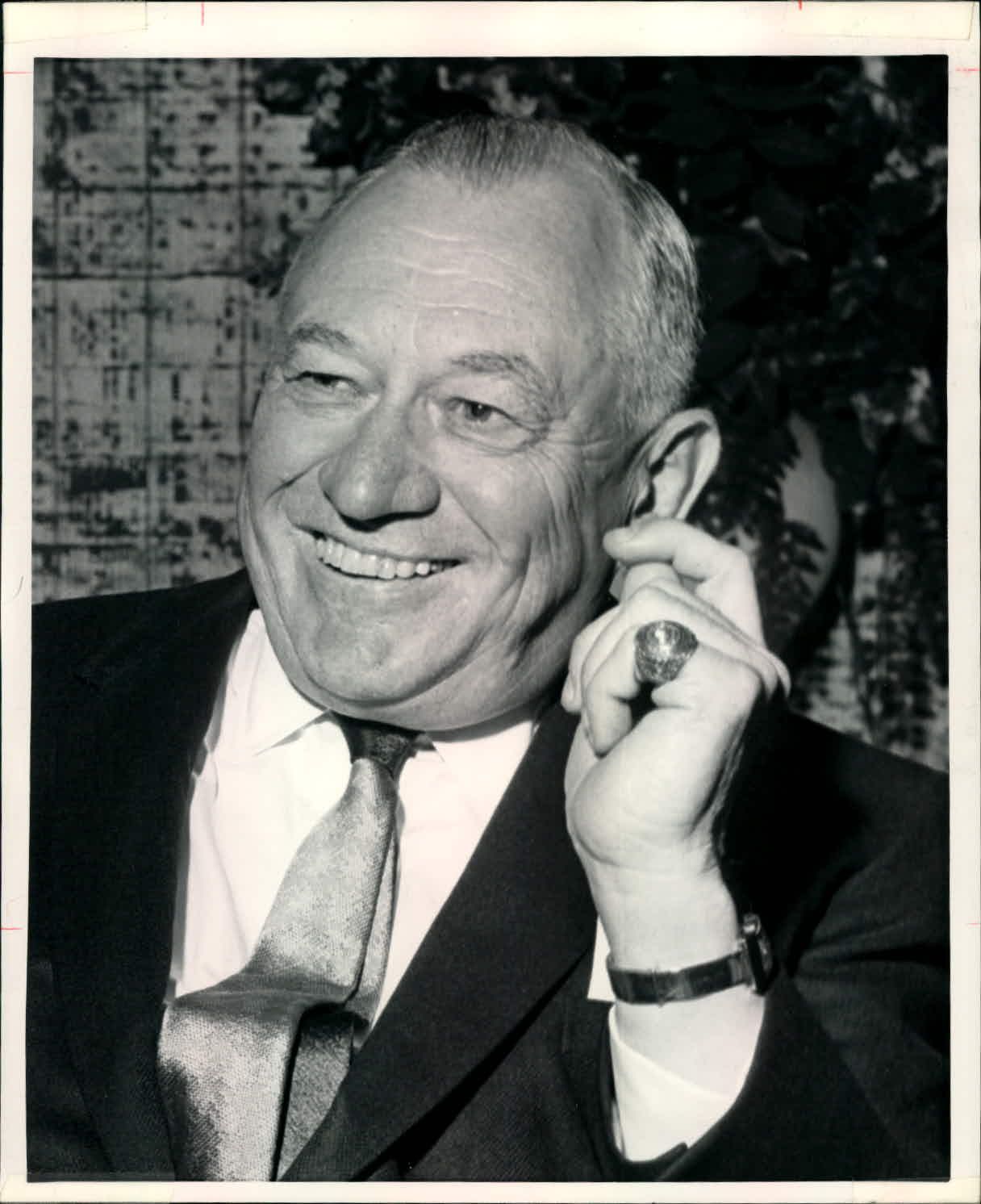
CBS entrusted the running of the Yankees to Mike Burke, a genuine hero of World War II through his service in the Office of Strategic Services (OSS, forerunner of the CIA), and later a successful businessman. But while he loved sports and knew business, he couldn't combine the two.

The Yankees fell behind the crosstown New York Mets both competitively and culturally: Even before the Mets' 1969 "Miracle" World Series, they had become more popular, suggesting that a big chunk of Yankee fandom was people who were Yankee Fans only because the Yankees were winning.

Burke was a good man, but a poor steward of the Pinstripes. It was beginning to look like his best connection to the Yankees was an incidental one, in that Gary Cooper, who played Lou Gehrig in The Pride of the Yankees, played the character based on Burke in Cloak and Dagger. 

But his deal with Mayor John Lindsay, cut in the wake of the New York Giants football team's decision to leave the City and go to New Jersey, saved the original Yankee Stadium for another 2 generations. So, for all of their respective mistakes, Yankee fans should thank Burke (1916-87) and Lindsay (1921-2000, Mayor 1966-73) for that.

The purchase price was $8.8 million, meaning that, with inflation factored in, CBS probably sold the Yankees at a loss of half the money.

Steinbrenner's group included some interesting names. Nelson Bunker Hunt was a son of oil billionaire and right-wing activist H.L. Hunt; and a brother of Lamar Hunt, who founded the American Football League and the Kansas City Chiefs, and co-founded the Chicago Bulls and Major League Soccer. In 1980, Nelson and brother William attempted to corner the silver market, but that led to a panic on commodity exchanges, and that helped cause the recession of the early 1980s. George knew Hunt through their common love of thoroughbred racing, as both owned racehorses.

Lester Crown, one of the co-founders of the Bulls with Lamar Hunt (who probably met George through Nelson), is the son of the founder of General Dynamics, and was a major banking executive. He has been a great donor to medical causes including a new headquarters for Cook County Hospital
in his hometown of Chicago. (That hospital was built on the site of West Side Park, the Cubs' home before Wrigley Field, and was the basis for the TV show ER.)

John McMullen was a naval engineer, whom George knew from the shipbuilding operation. He served in the Navy during World War II, and the Naval Academy named its hockey rink after him. He sold his stake in the Yankees, saying, "Nothing is so limited as being one of George's limited partners." He then bought another baseball team, the Houston Astros, and a hockey team, the Colorado Rockies. In 1982, he moved the Rockies to the Meadowlands, and they became the New Jersey Devils. His son Peter is now a minority owner of the Devils.

Robert Nederlander is a Broadway producer, and his friendship with George fed George's love of theater, which certainly came into play as Yankee owner on a few occasions.

And then there was John Zachary DeLorean. As an executive with General Motors, he developed 3 of Pontiac's signature cars: The GTO, the Firebird, and the Grand Prix. On the other hand, he also developed 2 of Chevrolet's lesser vehicles, the Vega and the Nova. He founded DeLorean Motor Company and developed the DMC-12, the gull-winged sports car that was customized as the time machine in the Back to the Future movies.


He was arrested for drug trafficking in 1982, but was acquitted, his attorney proving entrapment. However, his legal expenses and the failure of DMC proved his financial undoing.

McMullen and DeLorean both died in 2005, Hunt in 2006. As of January 3, 2023, Crown and Nederlander are still alive, ages 97 and 89, respectively.


When George's consortium bought the Yankees on January 3, 1973, he commanded a press conference, and said that he was bringing in Gabe Paul, the longtime president of the Cleveland Indians, as general manager. George, a native of the Cleveland suburbs, had tried to buy the Indians the year before. He had also owned the Cleveland Pipers of the short-lived American Basketball League in 1961 and '62.


George announced his commitment to building a winner for the Yankee Fans, and for the City of New York. For all that happened afterward, and for all the occasionally screwy ways in which he tried to build a winner could be criticized, his love of the fans and the City could never be seriously doubted.


But he also said this at that presser: "I won't be active in the day-to-day operations of the club at all.  I can't spread myself so thin. I've got enough headaches with my shipping company."


That turned out to be wrong. Very wrong.


Under George, the Yankees rose, winning 5 AL East titles, 3 Pennants and 2 World Championships from 1976 to 1981; fell, rose again but not quite reaching the Playoffs, then fell again as George fell into scandal and was suspended from operating the team; then, with general manager Gene Michael rebuilding the team, rose again, winning 7 AL East titles, 6 Pennants and 4 World Championships from 1996 to 2003. The team won 1 more Pennant and World Series in 2009, before George's death on July 13, 2010, his 38th season owning the team, a team record.

Tuesday, July 21, 2020

Top 10 Worst Executives in New York Sports History

All of these disasters are pretty much in my lifetime, 1969 onward.

10. George Steinbrenner, Yankees, 1980-90. Okay, officially, George wasn't the GM. But, let's face it, he was the man making the personnel decisions, no matter how much he blamed his bad transactions on "my baseball people."

When he had Gabe Paul from 1973 to '77, Al Rosen in '78 and '79, Gene Michael stepping in after his suspension in 1990, Bob Watson in '96 and '97, and Brian Cashman from 1998 to 2010, George was a great owner, which is why he's only Number 10 on this list. But he was a horrible "GM," and that's why he makes this list at all.

9. "The Secaucus Seven," Nets, 1978-98. Led by Joe Taub and Alan Cohen, these guys got little to work with, and they made less out of it. Having to pay $8 million just to get into the NBA following the collapse of the ABA, and to pay off the Knicks for "territorial indemnification," the Nets had to sell off their best player, Long Island native Julius "Dr. J" Erving, and a year later trade their next-best player, Bronx native Nate "Tiny" Archibald.

In other words, just to remain in the Tri-State Area, the Nets had to dump 2 of the men who would be named in 1996 to the NBA's 50th Anniversary 50 Greatest Players.

So how many times did the Nets make the Playoffs in those 20 seasons that the S7 owned them? 10. Which isn't actually all that bad. But how many Playoff series did they win? One. That was in 1984, against the defending World Champion Philadelphia 76ers -- with Erving -- before falling in 6 in the next round against the Milwaukee Bucks. How many Playoff games did they win? 9, with 5 of those coming, as I said, in '84.

It's not so much how often they made the Playoffs, it's how bad they were when they didn't. And the bad draft picks... Dennis Hopson, Ed O'Bannon, Yinka Dare... Maybe the Nets weren't as big a joke as the other "little brother" team in the NBA, the Los Angeles Clippers... but even when they were a good team, 1982-86 and 1992-94, they didn't exactly sell out the Meadowlands. Partly because the established, glamorous Knicks were also good at the same time.

The general managers over that time included part-owner Roy Boe, 1973-74 (he was also an owner of the Islanders), Dave DeBusschere, 1974-75; Boe again, 1975-78, including the decisions to trade Erving and Archibald; Charles Theokas, 1978-81; Bob MacKinnon, 1981-83; Lewis Schaffel, 1983-86; MacKinnon again, 1986-87; Harry Weltman, 1987-90; Willis Reed, 1990-96; and John Calipari, 1996-99. So there were some guys who really knew their basketball, but, given the Nets' situation, were in over their heads as GMs.

The S7 sold the Nets in 1998, and in 2001 new ownership made the trade for Jason Kidd and the team made 2 NBA Finals, reaching the Playoffs 6 straight seasons, before Bruce Ratner bought the team and put their breakup and move to Brooklyn into motion.

Despite a 20-year record of ineptitude, I can't rank the S7 any higher, for 2 reasons: There were 7 of them, not any 1 that was more responsible than any other; and the Nets have always been the 2nd basketball team in a 2-team town. Sometimes 3rd, when you consider St. John's.

In fact, counting all the area's major league teams, they're the 9th team in a 9-team town. And, frankly, counting the Liberty and the Red Bulls may not be doing the Nets any favors, either. We'll see if the current management team, led by owner Joseph Tsai and GM Sean Marks, can turn them around in Brooklyn, but don't hold your breath.

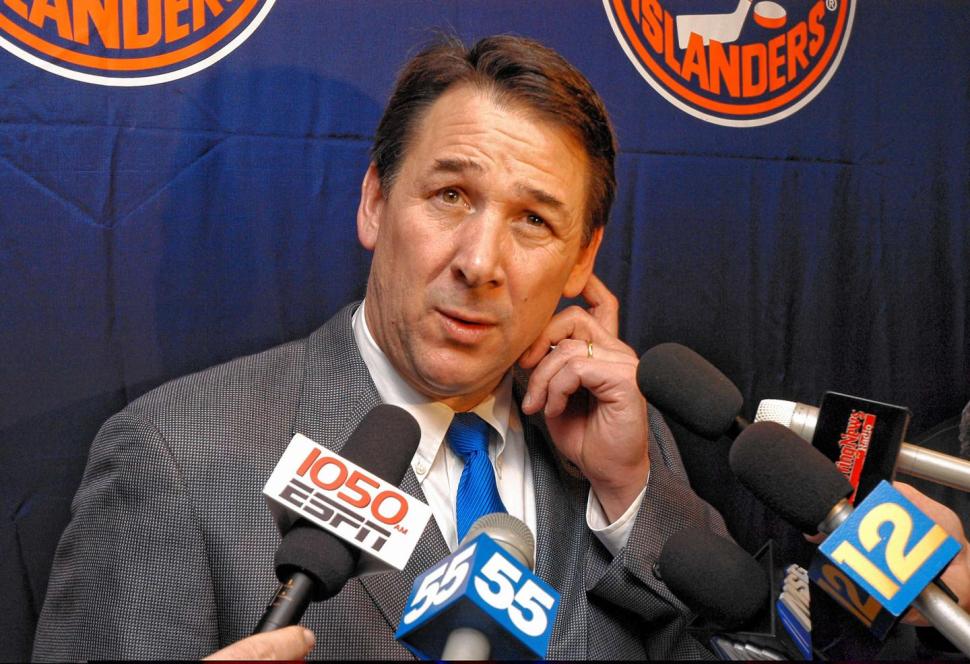
8. Mike Milbury, Islanders, 1995-2006. He was one of the players who typified the Boston Bruins' late 1970s-early 1980s "Lunch Pail Athletic Club": Not especially talented, but hard-working, the kind of guy you needed to win. As head coach of the Bruins, he got them to the 1990 Stanley Cup Finals, but got swept by the Edmonton Oilers, whose GM and former head coach was Glen Sather. (See #5 below.)

In 1995, the Islanders named him head coach and GM. He was asked by a reporter how he expected to compete with the Devils, who had just won the Cup, and the Rangers, who had won it the year before. He had the right attitude: "You know, fuck the Rangers and fuck the Devils! I'm running the New York Islanders!" From Flushing to Montauk, you could hear Isles fans saying, "Hell yeah!"

But even when they were winning 4 straight Stanley Cups, the Islanders have never been a team with deep pockets. The moves Milbury made were terrible, pretty much demolishing a team that had come within 3 games of the Finals just 2 years earlier. He removed himself as head coach, reinstalled himself, and removed himself again. He never hired a good head coach, and from his 1995 hiring until 2015, 20 seasons, the team made the Playoffs 6 times, winning 11 games and exactly zero series.
So the way he messed things up on the Jericho Turnpike well outlasted his tenure. When he was hired, they were a viable franchise that may have had an interesting future. When he was finally canned after 11 years, they were a team in trouble, and remain so.

Milbury's heart was in the right place, and no one could question his courage. If he only had a brain. He is not solely to blame for the club's post-1993 decline, but, competitively, it still doesn't look good for the team's long-term future.

7. Wilbur "Weeb" Ewbank, Jets, 1968-74. Bear with me: In order to make you truly understand what Weeb did to the Jets, I have to make this one long. A truly great football coach, he was the only man to be head coach of both an NFL Champion (1958 and '59 Baltimore Colts, both times over the New York Giants) and an AFL Champion (1968-69 New York Jets, over his former team, the Colts). But look at what he did with the team as GM after owner Leon Hess fired Sonny Werblin.

Imagine that it is August 1969, and you are the General Manager of the New York Jets. Your team has not only won the World Championship of American football in its last game that counted, but it did so in a fashion that stunned and excited the entire nation. You've just won an exhibition game (strangely, played at the Yale Bowl in New Haven, Connecticut) in which you decisively defeated the Giants, the City's NFL aggregation. So now you are definitively the best team in your sport, both in New York and in the world.

The Knicks have glamorous stars like Walt Frazier and Bill Bradley and the courageous Willis Reed, but they haven't yet won their 1st title, and even after 2 titles they won't be as big as a popular football team would be.

The Mets are in their 1st Pennant race, but haven't yet gotten their "Miracle" fully onto the City's radar. And even when they do, their marquee player, Tom Seaver, as great as he is and will be, is a private man: He can handle the spotlight, but he does not relish it, and isn't the most bankable guy around.

You have Joe Namath, a glamour guy at the glamour position (quarterback), in the glamour city, in what's becoming the glamour sport, and he loves the spotlight, eats it up. You've just proven that the Giants stink. So do the Yankees, whose big star Mickey Mantle just retired. The Nets are in the ABA, out on Long Island, so they're an afterthought. The Rangers are a bunch of Canadians, not exactly popular in an America that elected Richard Nixon. The Islanders and Devils don't exist yet. No college team in the area is doing big things.

Maybe you don't own the New York Tri-State Area, but you're co-owning with the Mets and the Knicks, and that's pretty good. You've got it made.

And your franchise loses in the 1st round of the next season's Playoffs... and then doesn't reach the Playoffs again for 12 years! And doesn't win another Playoff game until a year after that!
Weeb couldn't keep the Super Bowl team together. He resigned as head coach prior to the 1973 season, by which point an oft-injured Namath was the only one from 1/12/69 still contributing. Weeb remained as GM, and hired his son-in-law, Charlie Wimmer, as head coach. Charlie didn't do too well. Overall, Weeb makes my list of New York's Top 10 Best Coaches, but also my list of New York's Top 10 Worst Executives.

The Jets could have become the team in New York football, instead of becoming a joke franchise, which they still are, at least for the moment. Considering the kind of opportunity Ewbank had in 1969, it is almost a crime that, by 1986, Sports Illustrated could put Lawrence Taylor and Mark Gastineau on their cover, with the words, "In the Big Apple, the Jets are always the second banana."

Weeb never should've been named GM. Jerry Izenberg, the legendary columnist of the Newark Star-Ledger, calls the Jets' inability to win a Super Bowl, or even to reach one, these last 41 seasons "The Curse of Sonny Werblin." That doesn't make much sense, since they did win the next Super Bowl after firing him. Maybe "The Curse of Weeb Ewbank" is better.

6. Mike Burke, Yankees, 1966-73. A genuine hero of America's effort in World War II. A great businessman. A man who loved sports. And, along with Mayor John Lindsay, the man who saved the original Yankee Stadium for an additional 2 generations. We should thank him for those things.

But while he loved baseball, he didn't know how to run a sports team. Granted, the Topping-Webb regime left CBS, and their handpicked team president Burke, a pig in a poke, basically a brand name and nothing else. But he didn't do much with it: When the team finally won the whole thing in 1977, only 4 players were left from before George Steinbrenner owned the team: Roy White, Thurman Munson, Sparky Lyle and Graig Nettles. I think when George came in, and then bought Burke out, it was a great relief to Burke.
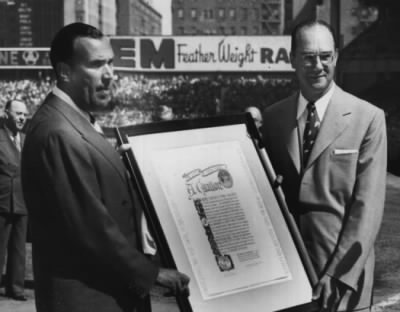
Burke, handing the team over to Steinbrenner, January 3, 1973

5. Glen Sather, Rangers, 2000-present. A Ranger defenseman from 1971 to 1974, he became one of the great coaches and GMs in hockey history when he coached the Edmonton Oilers to 4 Stanley Cups and was GM for 5. But what has he done in 20 years in New York?
It took the Rangers 12 years under his leadership to reach the Conference Finals, and 2 more to reach the Stanley Cup Finals. They have not gotten that far again.

His head coaches have been abysmal: John Muckler (who succeeded him in Edmonton and won the 1990 Cup, but awful at the Garden), Ron Low (aptly-named), Bryan Trottier (real smart, hiring one of the greatest Islanders with no head coaching experience to run the Rangers), himself (not so easy when you don't have Gretzky, Messier, Kurri, Anderson, Coffey, Lowe and Fuhr all in their primes), Tom Renney, John Tortorella, Alain Vigneault, and now David Quinn.

And when the Rangers finally did reach the Conference Finals in 2012, they ended up losing to the Devils, a humiliation that well and truly pus the 1994 Cup win deep into the past, every bit as much as the Isles' 1980-83 Cups irrevocably are. Reaching the Stanley Cup Finals in 2014 didn't help, as they got embarrassed by the Los Angeles Kings.

Sather still holds the titles of Senior Advisor and Alternate Governor (the NHL calls their teams' operational owners "Governors"), while Jeff Gorton (not auto racer Jeff Gordon) is the official general manager.

Of course, Sather hasn't done as much damage to the Rangers as Milbury did to the Islanders in a shorter span of time. The Rangers were never in danger of getting moved out of the Tri-State Area. Besides, somebody had to make the mistake of hiring Sather, and then keeping him for this long.

4. Omar Minaya, Mets, 1995-2002, 2005-10, and 2017-present. Previously a scout under GM Steve Phillips, he left to become MLB's 1st Hispanic GM, with the Montreal Expos. With that team getting moved to become the Washington Nationals, the Mets brought him back as their GM.

He was going to lead the Latin Revolution in Flushing Meadow. He brought in Pedro Martinez, Carlos Beltran, Jose Reyes, Carlos Delgado, Johan Santana and Francisco Rodriguez. And David Wright. (How'd that Gringo get in there?)

2005: No Playoffs, but that's okay, because they're still working their way up. No shame in that.

2006: One run from a Pennant, but a 9th-inning homer by the opposition, and Beltran leaves the bat on his shoulder. Okay, that's not good, but there's still plenty of reason for optimism.

2007: Up by 7 with 17 to go, and they don't even make the Playoffs. Now that is a disgrace.

2008: Up by 3 1/2 with 17 to go, and they don't even make the Playoffs. In this case, half a disgrace does not lessen the disgrace, it compounds it. They couldn't even win the last game at Shea Stadium. They couldn't let their beloved home "die with dignity."

2009: The 1st season at Citi Field is, competitively, an unmitigated disaster.

2010: Another sub-.500 season.

All the while, the Yankees remain the Number 1 team in town, winning a 27th World Championship. The Mets are still looking for a 3rd. The Yankees have won 40 Pennants; the Mets won a 5th after firing Minaya, but are still looking for a 6th.

Can't blame it on the manager, because the Mets failed under Willie Randolph and failed harder under Jerry Manuel. Nope, don't blame the waiter, blame the chef.
People said the Mets should spend more money, like the Yankees do. But the guys Minaya did spend money on didn't pan out. And then, of course, came the reckoning of Fred and Jeff Wilpon's dealings with Bernie Madoff, and so, under new GM Sandy Alderson, the Mets haven't been able to spend big.

Frankly, the Wilpons should have dumped Minaya after 2008. After all, '05 was a rebuilding year, '06 was pretty successful by Met standards, and '07 could be written off as a fluke -- a mind-numbing, nasty fluke, but a fluke nonetheless. But 2008 should have been the alarm bell. The Mets should've broken up with Minaya then.

Finally, in 2010, the Wilpons told him, "This relationship isn't working, and I think we should start seeing other executives." No, Omar, it's not them, it's you. The Latin Revolution left Met fans feeling so tortured, it should have been called the Spanish Inquisition.

For a while, he worked in the front office of the San Diego Padres. They didn't come close to a Pennant while he was there. He returned to the Mets after the 2017 season, as a "special assistant to the general manager." It seems that Fred Wilpon just can't quit Omar.

UPDATE: In 2023, Hal Steinbrenner hired Minaya as a front-office consultant. It appears to have been key to the Yankees obtaining Juan Soto in a trade. That trade may yet redeem Minaya, and force an update of this list.

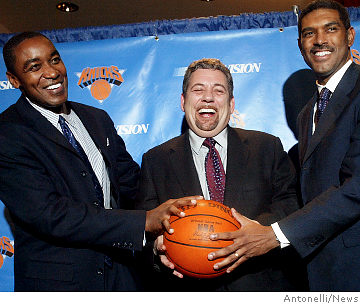
3. Isiah Thomas, Knicks, 2003-08. It was bad enough that Isiah made some bad moves as GM. It was worse that he trusted some guys who couldn't coach, including himself.  It led to the infamous T-shirts: "Don't hate the players, hate the coach." And if that had been the extent of it, that would have been bad enough, although perhaps not bad enough to make the top (or should that be "bottom"?) half of this list.

But through his private life becoming public, he dragged the Knicks through the tabloid muck. Once the team of Clyde Frazier, cool and stylish, a team the ladies could love as much as the guys, the Knicks had become a festering sewer, both competitively and morally.

Of course, Thomas didn't do as much damage to the Rangers as the Secaucus Seven did to the Nets. And the damage he did, while severe in terms of public relations and competitiveness, both on the court and in the boardroom, didn't put the Knicks in danger of moving or going out of business. Besides, somebody had to make the mistake of hiring Thomas, and then keeping him for that long.

2. M. Donald Grant, Mets, 1962-78. He was a friend of Mets founder Joan Payson, and she hired him to be the team's 1st chairman of the board. After the 1969 season, the Mets owned New York every bit as much as the Jets did. After the 1973 season, when they'd won another Pennant, they were so far ahead of the Yankees it wasn't funny -- though you can be sure Met fans were cackling with glee.

Surely, with their (relatively) new ballpark and exciting young players in a nice neighborhood, they had the advantage over the Yankees, with their old ballpark and failing players in a disastrous neighborhood, not to mention their crazy new owner.

The Mets, or rather Grant, frittered away so much of that goodwill, to the point where a few Met fans -- not many, but a few, including Brooklynite college student and aspiring filmmaker Spike Lee -- switched to the Yankees after they returned to the top, a rise coinciding with the Mets' collapse.
A blog called Mike's Mets -- not connected to me in any way -- pretty much sums Grant's mindset up:

Grant, a stockbroker, was Mrs. Payson's close personal advisor when she became the original owner of the Mets. He probably had very little influence in player movement for the first several years, and in the days before free agency, no one could say that the Mets were particularly cheap. But... Grant did not believe that a ballplayer deserved to be making as much money as a stockbroker or real estate magnate, and probably didn't think they belonged at the same parties or meetings, either.

Grant's meddling, no doubt, played a part in driving Mets' GM Bing Devine, who was doing a nice job of trying to build a winner, back to St. Louis. It was probably after Mets' GM Johnny Murphy passed away in 1970 that Grant's influence began to increase. Whitey Herzog was Mets' player development director and heir to the GM job, but Grant passed him by because he knew he wouldn't stand for any interference from someone who in Whitey's words "knew nothing about baseball".

The next two Mets' GM's, Bob Scheffing and Joe McDonald, probably had their hands tied by Grant, his frugality, and his belief that ballplayers should be quiet, sign their contracts, and just play ball. When a player became outspoken about salary issues, such as Tom Seaver and Dave Kingman did, it was only a matter of time before they would be sent away. When Gil Hodges died just before the 1972 season began, Grant again chose to bypass the outspoken Herzog, driving him out of the organization, in favor of Yogi Berra.

Probably the best example of how out of touch M. Donald Grant was with the average fan was when he tried to explain the Tom Seaver negotiations and subsequent trade in terms of bluffing and playing tricks in a hand of bridge. How many Mets fans have any idea how to even play bridge?

Things got worse when Mrs. Payson got sick, and died late in 1975. Her daughter, Lorinda de Roulet, inherited the team, and she knew that she knew nothing about baseball, so she trusted Grant even more.

Observe the breakup of the "Miracle" team: The autocratic Grant traded away Tommie Agee after the 1972 season, Tug McGraw after 1974, Rusty Staub (who would later return) and Cleon Jones after 1975, Jerry Grote after 1976, and Seaver and Kingman on June 15, 1977, a date which lives in Met infamy. Aside from the Dodgers and Giants getting moved out of town, this is the most hated transaction in the history of New York sports -- even if Steve Henderson had a few hits in him and Doug Flynn was a very good fielder.

Lorinda finally fired the old buzzard in 1978. By that point, attendance at Shea Stadium was so sparse it was being called Grant's Tomb: It had gone from a City record 2.7 million in 1970 to under 800,000 by 1979 -- or, per game, 33,000 to 9,740. Contrast that with the Yankees: 1972, 966,000 (12,000); 1980, 2.6 million (32,000).  Not until 1980, when Lorinda sold the team to Fred Wilpon and Nelson Doubleday, did things begin to turn around at Shea.

Grant died on November 29, 1998, 16 days after the death of Weeb Ewbank, and 12 days after the death of the Knicks' title-winning head coach, Red Holzman. Weeb and Red got a lot of praise in the New York media. Grant's death was barely even noticed. Serves him right.

1. James Dolan, Knicks and Rangers, 1994 to the present. His father Charles Dolan hired him to run Cablevision. Which, until Charles sold Cablevision in 2016 but kept ownership of all of the following, owned ITT. Which owns Viacom. Which owns Paramount Communications. Which owns Gulf + Western. Which owns the Madison Square Garden Corporation. Which owns the Garden complex, the Knicks, the Rangers, the MSG Network, and the Garden's boxing, concert and other special-events promotion companies. (From the team's founding in 1997 until selling them to Nets owner Joseph Tsai in 2019, the Dolan conglomerate also owned the WNBA's New York Liberty.)

"Guitar Jimmy" has done great things. He has promoted the Concert For New York City after 9/11, the Big Apple to Big Easy Concert after Hurricane Katrina, and the 12-12-12 Concert to raise money for relief of Hurricane Sandy. He is one of the most charity-sustaining people in America. He is, by most accounts, a decent person. (I have heard suggestions of "Me Too" incidents, but these have not been seriously pursued.) I have no reason to dislike him. Especially since I am neither a Knicks nor a Rangers fan.

But this is the guy who hired Glen Sather to run the Broadway Blueshirts, and also the guy who hired Isiah Thomas to run the Knickerbockers. Through those 2 guys, whom he showed unbelievable loyalty, to the point where both New York Daily News columnist Mike Lupica and I, independent of each other, have wondered what kind of pictures Isiah has of Dolan, he has managed to futz up one of the NBA's charter franchises and one of the NHL's so-called "Original Six" teams, the 3rd- and 4th-greatest franchises in the Tri-State Area in terms of historic success (behind the Yankees and football Giants), for over a decade.

Think about it: Starting with 2000-01, the first full season in which Dolan has, effectively, been the big boss of both teams, the Knicks have won 1 Playoff series, and only 9 Playoff games, despite spending more money (even with the league's salary cap) than any team in basketball history.

The Rangers have done a bit better, but even that took a few years to really get rolling. Over that stretch, they have won 10 Playoff series, but only 3 times have they gotten to the Conference Finals, and only once to the Stanley Cup Finals, despite spending more money (both without and then with the league's salary cap) than any team in hockey history.

Think about that: 2 teams, same building, 20 years, 11 Playoff series won. That roughly translates to 1 Playoff series win every 2 years, for each team, in what's promoted as "The World's Most Famous Arena." From 1998 to 2011, there was a 14-season stretch without either the Knicks or the Rangers making the Playoffs.

Messing up one franchise for a decade is bad enough. Jimmy Dolan has messed 2 up for 2 decades. He's not a cheap dirty bastard, like Walter O'Malley or Donald Grant. He's not a sleazeball, like Isiah Thomas, or an "ogre" as George Steinbrenner was often called  And he isn't a legend whose sport has passed him by, like Glen Sather.

On the other hand, he isn't a good man thrown into an awful situation, like Mike Burke. He's a (possibly) good man who made an awful situation -- indeed, 2 of them. Like Weeb Ewbank (as GM, anyway) and Mike Milbury, he is a guy in over his head. But it's Knick and Ranger fans who feel like they're drowning.

Monday, July 20, 2020

Top 10 Worst Team Owners in New York Sports History

As I said in my post about the 10 best, picking the 10 best is harder than picking the 10 worst. Once again, I'm going to limit it to the last 100 years, 1920 to 2020.

10. Stephen W. McKeever, Dodgers, 1925-38. (That's as controlling owner. As at least part-owner, 1912-38.) Steve McKeever was not a bad guy. But after the deaths of Charlie Ebbets and his brother Ed McKeever within days of each other in 1925, he was the owner of a team that never had any money.
There were times during the Great Depression that the Dodgers could have gone out of business. The team was terribly. And Ebbets Field, built in 1913, was already in a state of disrepair, because McKeever couldn't afford to maintain it. The Brooklyn Trust Company controlled Charlie Ebbets' estate, and hired Walter O'Malley to oversee their one-quarter ownership of the Dodgers.

Steve McKeever died in 1938, and that led to the other owners hiring Larry MacPhail away from the Cincinnati Reds, and that ended the Dodgers' danger of becoming the 1st MLB team to go bankrupt in the 20th Century. That ended up never happening, although the Seattle Pilots came pretty close in 1969 and '70, before being sold and becoming the Milwaukee Brewers.

Steve McKeever was a tragic figure, so I can only place him at Number 10. Most of it wasn't his fault.

9. Leon Hess, Jets, 1968-99. (That's as controlling owner. As at least part-owner, 1963-99.) Also not a bad guy. He was a good businessman, in his case the energy business. And he was very generous with charity. He was liked, and he was respected. Jet fans usually did not blame him for the team's failures. But they should have, because he didn't get it done. Hess is not on this list for reasons of personality or scandal. It's strictly business.

When he became majority owner of the Jets, business was booming, thanks to the partner he'd bought out, David "Sonny" Werblin; the head coach that Werblin had hired, Wilbur "Weeb" Ewbank; and the quarterback that Werblin had drafted, Joseph "Broadway Joe" Namath. The Jets won Super Bowl III on January 12, 1969.

For the rest of Hess' life, he owned the Jets, and they reached only 2 AFC Championship Games. (Had he died 4 months sooner, it would have been only 1.) In 24 years after firing Ewbank, he hired 8 head coaches (not counting interim ones), and none got him back to the Super Bowl. Walt Michaels came within 1 game in the 1982-83 season. Bill Parcells came within a half in the 1998-99 season. But that was it.
The worst one was Rich Kotite. A Staten Island native, who'd been a decent tight end for the Giants, and had coached the Philadelphia Eagles into the Playoffs, he seemed like a good fit. On January 4, 1995, Hess told the media, "I'm 80 years old. I want results now!" Here's the results he got: 3-13 in 1995, and 1-15 in 1996.

Kotite quit before he could be fired, and Hess begged Parcells to leave the New England Patriots and come home to New Jersey. It came close to working. And then Hess died. And then Vinny Testaverde got hurt in the next season's opening game, and was out for the season, and the chance to win one for Hess was gone.

8. Mike Burke, Yankees, 1966-73, and Knicks 1973-81. (More accurately, in terms of seasons, he was the Yankees' "owner" 1967-72.) Another guy who isn't on this list for reasons of personality, or for the amount of effort he put into trying to win.
Edmund Michael Burke was a genuine hero of America's effort in World War II. A great businessman. A man who loved sports. And, along with Mayor John Lindsay, the man who saved the original Yankee Stadium for an additional 2 generations. We should thank him for those things.

But while he loved baseball, he didn't know how to run a sports team. Granted, the Topping-Webb regime left CBS, and their handpicked team president Burke, a pig in a poke, basically a brand name and nothing else.

But he didn't do much with it: When the team finally won the whole thing in 1977, only 4 players were left from before George Steinbrenner owned the team: Roy White, Thurman Munson, Sparky Lyle and Graig Nettles. I think when George came in, and then bought Burke out, it was a great relief to Burke.

Upon leaving the Yankees, he was named President of the Madison Square Garden Corporation. But that did him no favors on this list, either. Once again, his timing was terrible: The Knicks had just won 2 titles and reached another Final in 4 seasons, but the key players were getting old. He proved unable to replace them. Finally, in 1981, he sold out, and retired to a farm he'd bought outside Galway, in his ancestors' homeland of Ireland, living there until his death in 1987.

7. "The Secaucus Seven," Nets, 1978-98. Led by Joe Taub and Alan Cohen, these guys got little to work with, and they made less out of it. Having to pay $8 million -- and, as the late sportswriting legend Bert Randolph Sugar would have said, these were Jerry Ford dollars, not Donald Trump dollars -- just to get into the NBA following the collapse of the ABA and to pay off the Knicks for "territorial indemnification" -- the Nets had to sell off their best player, Long Island native Julius "Dr. J" Erving, and a year later trade their next-best player, Bronx native Nate "Tiny" Archibald.

In other words, just to remain in the Tri-State Area, the Nets had to dump 2 of the men who would be named in 1996 to the NBA's 50th Anniversary 50 Greatest Players. (Even as we approach the NBA's 75th Anniversary, Doc is probably still one of the game's top 20.)

So how many times did the Nets make the Playoffs in those 20 seasons that the S7 owned them? 10. Which isn't actually all that bad. But how many Playoff series did they win? One. That was in 1984, against the defending World Champion Philadelphia 76ers -- with Erving -- before falling in 6 in the next round against the Milwaukee Bucks. How many Playoff games did they win? 9, with 5 of those coming, as I said, in '84.

It's not so much how often they made the Playoffs, it's how bad they were when they didn't. And the bad draft picks... Dennis Hopson, Ed O'Bannon, Yinka Dare... Maybe the Nets weren't as big a joke as the other "little brother" team in the NBA, the Los Angeles Clippers... but even when they were a good team, 1982-86 and 1992-94, they didn't exactly sell out the Meadowlands. Partly because the established, glamorous Knicks were also good at the same time.

The S7 sold the Nets in 1998, and in 2001 new ownership made the trade for Jason Kidd and the team made 2 NBA Finals, reaching the Playoffs 6 straight seasons, before Bruce Ratner bought the team and put their breakup and move to Brooklyn into motion.

Despite a 20-year record of ineptitude, I can't rank the S7 any higher, for 2 reasons: There were 7 of them, not any 1 that was more responsible than any other; and the Nets have always been the 2nd basketball team in a 2-team town. Sometimes 3rd, when you consider St. John's.

In fact, counting all the area's major league teams, they're the 9th team in a 9-team town. And, frankly, counting the Liberty and the Red Bulls may not be doing the Nets any favors, either. The owners since have done them no favors, either.

6. Fred Wilpon, Mets, 2002-present. (That's as controlling owner. As at least part-owner, 1980-present.) When Freddy and Nelson Doubleday were co-owners, the Mets reached the Playoffs 4 times, winning the 1986 World Series and the 2000 NL Pennant. Since Doubleday sold out in 2002, and Fred became sole owner and gave his son Jeff Wilpon effective control of the team, it's been 3 Playoff berths, 1 Pennant, and 2 shocking regular-season collapses.
Okay, things happen. Teams have injury crises. Teams simply get beat by better ones. Teams have runs of bad luck. All of these have happened to the Mets since the Wilpons started running things on their own. And while many Met fans were sad to see Shea Stadium go, Citi Field is a much better ballpark, and that was Fred Wilpon's idea.

But the Wilpons trusted Bernie Madoff with their money, and that crippled the Mets financially for the 1st few Citi Field years. And they hired field managers and general managers who didn't know what they were doing. Omar Minaya and his "Los Mets" didn't work: It left Met fans feeling so tortured, it might as well have been called the "Spanish Inquisition."

Willie Randolph got the Mets to within 1 run of a Pennant in 2006. Given what happened in 2007 and '08, with mostly the same players, that may have been the biggest "miracle" in Met history. Jerry Manuel was not the answer. Ask Met fans if they won the 2015 Pennant and the 2016 Wild Card berth because Terry Collins was the manager, and they'll say no, they won those in spite of Collins.

Mickey Callaway was not the answer. Jeff Wilpon hired Carlos Beltran to manage, and he had to have been aware that there was already an investigation into Beltran's activities with the Houston Astros. So now, Luis Rojas is the manager.
Firing Minaya as GM led to the hiring of Sandy Alderson, but his health became an issue, hamstringing the Mets further. Brodie Van Wagenen has been a fool, trying to dictate to his managers how to run things every bit as much as Brian Cashman seemed to do in The Bronx to Joe Girardi and now to Aaron Boone.

It now appears that the Wilpons may finally be about to sell the Mets to Steven A. Cohen, a billionaire hedge fund manager with a company history of bigotry, misogyny and crooked dealings. When the other option was... Alex Rodriguez and Jennifer Lopez.

That's the Mets for ya. As their former manager Jeff Torborg once said about ways to catch the knuckleball, there are two theories about how to run the Mets, and, unfortunately, neither of them work. As was proven when they were owned by...

5. Lorinda de Roulet, Mets, 1975-80. Joan Payson knew her baseball, and that's a big reason why she was a member of the board of directors of the baseball New York Giants. She was the only board member to vote against the move to San Francisco in 1957, and that's a big reason why she was offered the chance to buy into the National League as the 1st owner of a new team for New York, the Mets.

Mrs. Payson owned the Mets from their laughable 1962 beginnings to their 1969 World Championship and their 1973 Pennant. Then, in 1975, she died. Her daughter, Lorinda de Roulet, inherited the team.

She knew that she knew nothing about baseball, so she trusted the team's president, M. Donald Grant. He was cheap. Not because the Mets weren't making money. And even if they weren't, it wasn't his money: Mrs. de Roulet was a de Roulet by marriage, and both a Payson and a Whitney by blood. She was richer than George Steinbrenner. She could afford to spend whatever she wanted.

But she trusted Grant, and he thought baseball players were beneath him. He had what Marvin Miller, director of the players' union, called "a plantation mentality." When he pulled a dirty trick that led to Tom Seaver, "The Franchise," demanding a trade in mid-1977, hardly any of the '73 Pennant winners were left. After the season, he got rid of Bud Harrelson, the last remaining player from the '69 titlists.

Mrs. de Roulet finally fired the old buzzard in 1978. By that point, attendance at Shea Stadium was so sparse, it was being called Grant's Tomb: It had gone from a City record 2.7 million fans in the 1970 season to under 800,000 by 1979 -- or, per game, from 33,000 to 9,740. The Mets were bad, and not even interesting. They had bottomed out every bit as much as the Yankees had in 1966, and without the history to back it up.

Not until 1980 did things begin to turn around at Shea. That was the year when Lorinda sold the team to Fred Wilpon and Nelson Doubleday. They hired Frank Cashen, who helped build the Baltimore Orioles team that dominated the American League from 1966 to 1971, as general manager. His drafts and trades built the Mets into a contender by 1984, and a World Champion in 1986.

In 2003, the last remaining original Met broadcaster, Bob Murphy, retired. Among the former Met personalities invited back to Shea Stadium for a pregame ceremony was Mrs. de Roulet. Along with Mayor Mike Bloomberg, she was one of only two people booed that night. I had a close enough seat that I could see the look on her face, and she seemed puzzled as to why people were booing her, 23 years after she sold the team.
New Yorkers have long memories: If they could still hate Walter O'Malley 46 years after the Dodgers were taken away from him, hating her after 23 years was a piece of cake.

Lorinda de Roulet is still alive, age 88, but hasn't been involved in professional sports since selling the Mets, 40 years ago.

This may come as a shock to Met fans of a certain age, but there have been 4 team owners in New York sports that were worse than Lorinda de Roulet and Fred Wilpon.

4. Bruce Ratner, Nets, 2004-10. How to screw up a good thing. The New Jersey Nets had reached the NBA Finals in 2002 and 2003, and the Knicks were terrible. For the 1st time, really, the Nets had the chance to be the Tri-State Area's most popular basketball team. They were already its most successful, at least recently, despite the Knicks' 1994 and '99 trips to the Finals.

Enter Ratner. Emphasis on the "Rat." A real estate developer, he could have led the move to build a new arena for the Nets and Devils, so they could leave the Meadowlands in style. Instead of joining the Devils in the building of the Prudential Center, he wanted to build an arena in the Atlantic Yards section of Brooklyn, and move the Nets there. New Jersey basketball fans finally had a great team, and, instead of helping, the new owner stabbed them in the back, right through the heart.
For reasons I won't get into, the Barclays Center project dragged on. And on. And on. Even the Montreal Expos were not a lame-duck franchise as long as the New Jersey Nets were. Finally, in 2010, Ratner had had enough: He sold the Nets to Russian oligarch Mikhail Prokhorov, so that he could concentrate on finishing the Barclays Center project. He did, and it opened in 2012.

Nets games have not become a big happening in Brooklyn. Really, the people of the Borough couldn't care less. As bad as the Knicks have been in the 21st Century, they are still more popular in Brooklyn than the Nets are. And Prokhorov, who promised big things for the franchise, also failed as an owner, and has sold out.

In the 6 seasons that Ratner owned the Nets, they went from Atlantic Division Champions in 2004, and Division Champions again in 2006, to 12-70 in 2010. And he killed their fan base, and failed to build a new one where he was moving them to. He packed as much ugliness into 6 years as Fred Wilpon has in 18 years.

3. Walter O'Malley, Dodgers, 1950-57. (That's as controlling owner. As at least part-owner, 1942-57. Counting Los Angeles, 1942-79.) Did he have anything to do with the Dodgers' success in the 7 seasons between his buying out of Branch Rickey and his move of the team? Not much. The biggest move was in hiring Walter Alston as manager in 1954 -- and even that may have been more of him being convinced by general manager Emil "Buzzie" Bavasi.
Let's get it out of the way right now: If you think the move of the Brooklyn Dodgers to Los Angeles was a bad thing, the person most responsible for it was Walter O'Malley.

Robert Moses, who controlled construction of pretty much anything in the State of New York at the time, refused to condemn the land that O'Malley wanted for a new stadium, which would have been built in Atlantic Yards, where the Barclays Center was eventually built. Moses offered O'Malley a stadium he wanted to build in Flushing Meadow, but O'Malley didn't want to own the Queens Dodgers, so he turned it down, and started looking elsewhere. This was the stadium that would eventually become Shea Stadium.

O'Malley has been called a "visionary." But his "vision" only seemed to succeed when it could benefit him, not the fans of the Brooklyn Dodgers. If he was such a visionary, then he should have found a way around Moses. He could have gone to Mayor Robert Wagner. If Wagner refused to help, O'Malley could have gone to Governor Averell Harriman.

If he refused to help, O'Malley had other options. The City of New York was electing a Mayor in 1957. How the hell Wagner got elected to a 2nd term after losing the Dodgers and the Giants, I don't know. Get-out-the-vote efforts by the City's Democratic machine, I guess. O'Malley could have financed a candidate to beat Wagner.

Failing that, the State of New York was electing a Governor in 1958. O'Malley could have helped Nelson Rockefeller beat Harriman, which did happen. Rocky would have had no qualms about overruling Moses on the stadium, because he went on to overrule him on other things, and finally removed him from power in 1968.

But O'Malley, who had already forced Branch Rickey, Red Barber and Jackie Robinson away from the Dodgers, chose not to find a way around Moses. He moved the Dodgers to Los Angeles after the 1957 season.

It wasn't because Los Angeles was potentially a great market for baseball. If he thought he could make more money staying in Brooklyn, he would have. If he thought he could make more money in San Diego, or Hawaii, or Japan, or Antarctica, or on the Moon, that's where the Dodgers would be playing today. Walter O'Malley was about Walter O'Malley, and that meant that he was about money.

2. Horace Stoneham, Giants (baseball), 1936-57. (Counting San Francisco, 1936-76.) It was no contest. And not just because he owned the team for 22 seasons and won just 1 World Championship. That's not that bad. They did win 4 Pennants. Throw in what happened after he left New York, and that's 5 Pennants, for an average of 1 every 8 seasons. I know, it doesn't work that way. But it makes him look somewhat competent.

He wasn't. He inherited the team from his father Charles (who owned the team from 1919 until his death in 1936), and saw them win Pennants in 1936 and 1937. But the rise of 2 teams built by Branch Rickey -- first the St. Louis Cardinals and then the Brooklyn Dodgers -- saw what had been the most successful sports team in North America become the 3rd-biggest baseball team in New York City.
He never spent much to rebuild the team, or to maintain the ballpark. As the neighborhoods -- Harlem to the south, Washington Heights to the West -- deteriorated, so, too, did the Polo Grounds. When he made the decision to move, he was asked about the young fans he was abandoning. He said, "I feel bad for the kids, but I haven't seen too many of their fathers lately."

The fathers didn't want to risk their cars and sit in a rickety old stadium. It was 46 years old at the time of the move, but already in worse shape than either Ebbets Field, or Shea Stadium, or the original Yankee Stadium ever got.

The Giants then had the Minneapolis Millers of the American Association as their top farm team. There were going to move to Minneapolis for the 1958 season. It would have been the cheapest option. Then, O'Malley told him of the plan to move the Dodgers to Los Angeles, and said, Why don't you move the Giants to San Francisco? It would keep the rivalry going.

Although the move to the City By the Bay paid off financially and competitively at first, things dropped off, and by 1976, Stoneham nearly moved them again, to Toronto, before finding a buyer.

The thing is, it didn't have to be this way. Moses had offered O'Malley the Flushing Meadow stadium. Had he offered it to Stoneham, the Giants probably would have moved into a new stadium there by Opening Day 1960, and might be playing in Citi Field today.

And, all that time, New Yorkers would have still gotten to see Willie Mays, and also Willie McCovey, Orlando Cepeda, Gaylord Perry, Bobby and Barry Bonds, Jack Clark, the unrelated Will Clark, Madison Bumgarner, Buster Posey, and, with no hard feelings, Jeff Kent.

There would never have been a Mets, so they wouldn't have had Tom Seaver or Mike Piazza. But they still might have had a "miracle" title in 1969 (the Giants finished 2nd in the NL West, and would instead have been in the NL East, and might've beat the Chicago Cubs out, and then all bets would have been off). There wouldn't have been a title in 1986, but there could have been Pennants in 1989, 2002, 2010, 2012 and 2014 -- and the Giants did win their Division in 2000, before losing to the Mets, so, in addition to 1962, there could have been at least 1 other Subway Series between the Giants and the Yankees.

All Stoneham had to do was ask Moses for help. The plan was there, waiting for a team to take it. But Stoneham was the biggest fool who ever owned a New York sports team.

But not the worst owner.

1. Charles Dolan, Knicks and Rangers, 1994-present. As the owner of Cablevision, Dolan bought the Madison Square Garden Corporation. He sold Cablevision in 2016, but kept control of the Garden Corporation. It should have been the other way around.
He became controlling owner of the teams just after both had made the Finals in their respective sports, the Rangers winning, the Knicks coming within 1 game of doing so. 26 years. 2 teams. 2 berths in the Finals. 2 Finals games won. That's it.

Yes, more of the blame can be laid at his son James, the actual operator of the Knicks and the Rangers. But when Mike McCaskey ran the Chicago Bears into the ground, his father Ed "took the keys away." And when it became obvious that William Clay Ford Jr. was never going to turn the Detroit Lions around, his mother, Martha Firestone Ford -- making Bill Ford a great-grandson of both auto titan Henry Ford and tire mogul Henry Firestone -- removed him from power.

Charles Dolan continues to let James Dolan run the Knicks and the Rangers. Charles is 93 years old, making him the oldest team owner in New York sports history. As far as I know, he is not in ill health. Even if he were, James is 65, and could run the teams for a long time to come.
Telling Knicks and Rangers fans, "It can't get any worse" will be no comfort to them. They've seen it get very bad. They know that things can get worse, even than they are now.

James Dolan recently tested positive for COVID-19. He recovered. It would be wrong for Knick or Ranger fans to wish death on him. But I'm sure there were a few who were happy to know he suffered.

Friday, January 3, 2014

Top 5 Reasons You Can't Blame CBS for the 1965-75 Yankee Dark Age

Mike Burke and George Steinbrenner, January 3, 1973

Today is January 3. It is the anniversary of George Steinbrenner and his group buying the Yankees from CBS.

The Columbia Broadcasting System bought the Yankees from co-owners Del Webb and Dan Topping on August 13, 1964, for $11.2 million. That works out to about $84.2 million in 2013 money.

On January 3, 1973, the Steinbrenner-led group bought the team from CBS for $10 million. That works out to about $55.8 million in 2013 money.

So CBS didn't just sell the Yankees at a loss, it was, with inflation factored in, a 51 percent loss. This, on the greatest franchise in the history of North American sports.

The CBS years are the Yankees' "Dark Ages" -- with the pre-Ruth years, 1903 to 1919, effectively being prehistory.

The CBS era was a time when the players got old and/or hurt, the farm system dried up, the ballpark fell into disrepair, the neighborhood even more so, and, worst of all, the Mets not only surpassed the Yankees in popularity but won the 1969 World Series and another Pennant in 1973.

It got so bad that, in order to renovate Yankee Stadium and make it a modern ballpark, the Yankees had to spend 2 years sharing Shea Stadium with the Mets. Not a fate worse than contraction, but bad enough.

From 1921 to 1964, here are the Yankees' finishes, out of 8 (1921-60) or 10 (1961-64): 1st, 1st, 1st, a close 2nd, 7th, 1st, 1st, 1st, 2nd, 3rd, 2nd, 1st, 2nd, 2nd, a close 2nd, 1st, 1st, 1st, 1st, a close 3rd, 1st, 1st, 1st, 3rd, 4th, 3rd, 1st, a close 3rd, 1st, 1st, 1st, 1st, 1st, 2nd despite winning 103 games, 1st, 1st, 1st, 1st, 3rd, 1st, 1st, 1st, 1st and 1st.

From 1965 to 1975, out of 10 (1965-68) or 6 (1969-75): 6th, 10th, 9th, 5th, 5th, a distant 2nd, 4th, 4th, 4th, a close 2nd, 3rd.

From 1976 to 1981, out of 6 (1976) or 7 (1977-81): 1st, 1st, 1st, 4th, 1st, 1st.

So you can see the difference. They fell apart under CBS, then began to recover under Steinbrenner.

The Yankees weren't just ranging between bad and merely mediocre under CBS, they weren't even all that interesting. From 1946 (the 1st post-World War II season) to 1964, the Yankees averaged 22,120 fans per home game, about as good as it got for any team in those days.

From 1965 to 1975, the Dark Age, it was 14,470 -- they'd lost about 1 out of every 3 fans. They lost a lot to the Mets, some because the Mets got good, and some because of safety in Queens compared to the fear of crime in The Bronx. Some fans simply stopped caring, and some, clearly, were front-runners, only rooting for the Yankees because they won, and were doing so no longer.

From 1976, the reopening of The Stadium and the return to glory, through 1995, the year before the Torre/Jeter/Rivera Era began -- and this includes the successful Reggie Years as well as the far less successful Donnie Baseball Years that followed -- the Yankees averaged 27,369 fans, better than ever to that point. (Since 1996, it's been 43,265.)

In 1970, the Yankees finished 2nd, winning 93 games -- but that was still 15 games behind the eventual World Champion Baltimore Orioles. In 1972, the Yankees were in the race until September; in 1973, until August; but fell apart both times. In 1974, they were in the race all the way to the end, but fell short. In 1975, again, they fell apart in September and ended up 3rd.

It would not be until 1976, with the pitching shored up and with Mickey Rivers and Willie Randolph installed to add speed and defense, that the Yankees got back into the postseason, and, along with the revamped Stadium, brought the fans back: Averaging 16,101 fans in '75, they averaged 25,314 in '76, not bad considering the state of the economy at the time, especially in the nearly-bankrupt New York City.

Meanwhile, as I said, the Mets surpassed them both on the field and at the box office. The Jets also won a title. The Knicks won 2, and had 3 other close calls. The Nets were born, and went on to win 2 titles in the ABA. The Rangers reached the Stanley Cup Finals and were regular contenders. The Islanders were born, and reached contender status as the end of that era. So the Yankees were not only no longer the best team in town, in any sport, they were 7th in getting, and deserving, attention, ahead of only the woeful football Giants.

So for a decade, the years of Lyndon Johnson, Richard Nixon and Gerald Ford in the White House; the years of John Lindsay as Mayor, essentially; the years of psychedelia and soul power... the Yankees weren't just no longer the team to beat in baseball, they were damn near irrelevant.

Naturally, CBS, and the figurehead it hired to be president of the Yankees, Mike Burke, have gone down in history as fools, for ruining the greatest baseball team of them all.

Burke, a genuine American hero for what he did in World War II, and a man who genuinely loved sports, didn't seem to know much about running a team. And, also true, CBS didn't give him a lot of help, even though they were breaking ground with their TV programming: These were the years when they debuted All In the Family, M*A*S*H, The Sonny & Cher Comedy Hour, and modernized crime dramas like Kojak, Cannon and Barnaby Jones.

With such success, and (then as now) no salary cap in baseball, CBS could have afforded to give Burke a blank check to trade for better players and pay them what they were worth. Instead, in 1972, the last CBS season, the average salary was $23,652. The top salary on the team was the $62,500 paid to Felipe Alou. This was not unusual for the era, in the last years before free agency, but this was the Yankees, and this was CBS.

Clearly, Burke and CBS did not make the most of what they had.

But, just as clearly, they got a bum rap from history, because "what they had" was a name and a legacy, and little else. They bought a pig in a poke.

Top 5 Reasons You Can't Blame CBS for the 1965-75 Yankee Dark Age

5. Age and Injuries. In 1965, Tony Kubek hurt his back, and retired at the end of the season. Jim Bouton threw out his elbow, and went from winning 21 games in '63 and 18 in '64 to going 4-15 in '65. Roger Maris had a broken hand -- and the team didn't tell him just how bad it was, so he kept playing and made it worse. Bobby Richardson was also hurt, and had to be talked into playing one more year in '66.

Whitey Ford's shoulder was cutting his career short. And, of course, Mickey Mantle's injuries were compounded, by new ones, by his not taking care of himself in his off-hours, and by his dogged determination to play no matter what, even when he could have used some time off.
The infamous "End of an Era" cover, June 21, 1965,
sometimes erroneously called the "End of a Dynasty" cover.
Mickey is 33, but looks physically and mentally exhausted.

By the dawn of the '67 season, Mickey, Whitey, Elston Howard and Tom Tresh were the only ones left from the starting lineup that won the '62 Series. Whitey retired early that season, Howard was traded away late that season, and by Opening Day 1968, the only players left from the 1964 World Series were Mickey, Tresh and Joe Pepitone.

To ease the strain on Mickey's legs, they switched him to 1st base and moved Pepitone out to center field. It was a mistake: Mickey wasn't a bad 1st baseman, but Pepi was a really good one, and not so good in center.

Mickey said, years later, "I see Horace Clarke at 2nd, Gene Michael at short, Bobby Cox at 3rd, and I say, 'Where did everybody go?'" In 1967, Jerry Izenberg, the great sports columnist for Newark's Star-Ledger, invoked the musical Fiddler On the Roof, saying of the Yankees, "I don't recall growing older. When did they?"

It didn't quite happen all at once; it just seemed that way. And the farm system was dry: There was no one to replace them. I'll get back to that point later.

4. The Amateur Draft. For 40 years, the Yankees could figure out what high school or college player they wanted to sign, go to him, flash some cash, mention the Yankees' legacy and titles, and say, "Whattaya say?" and the kid would sign, unless he was completely committed to his "hometown club."

When the draft was instituted, to be first held in June 1965, it was designed as a way to counteract the Yankees' influence. Now, just as they already had in the other sports, the best amateur players (at least, theoretically) would go to the teams with the worst records. That this happened exactly as the Yankees fell apart is not a coincidence, but it is very interesting.

Equally interesting is that the Draft didn't help the Yankees much:

* Their first pick in 1965 was Bill Burbach: He would pitch just 37 games in the major leagues.

* 1966: Jim Lyttle, who ended up playing longer in Japan than he did in the American major leagues. Richie Hebner and Carlos May went later in that 1st Round.

* 1967: Ron Blomberg, a 1st baseman whose lefty swing seemed tailor-made for The Stadium, but was prevented by injuries from reaching his full potential. Taken later in that 1st Round: Jon Matlack, John Mayberry, Ted Simmons, Bobby Grich. So even though the Yankees had the 1st pick in the entire draft, and Boomer was hardly a bum, they could have done much better.

* Thurman Munson was their first pick in 1968, and he certainly turned out to be a great choice.

* In 1969, they chose Charlie Spikes, a decent player, but best known now as one of 4 players the Yankees sent to the Cleveland Indians to get Graig Nettles. Available later in that round: Don Gullett, Roger Metzger and Gorman Thomas.

* 1970: Dave Cheadle, who never pitched for them, got traded to the Atlanta Braves for Pat Dobson in 1973, and ended up pitching 2 innings in the majors. It wasn't much of a draft: The best players taken in the 1st Round after Cheadle were John D'Acquisto and Dan Ford, and the best ones taken before him were Mike Ivie and Darrell Porter.

* 1971: Terry Whitfield, who didn't play much for the Yankees, although he became a good player for the San Francisco Giants later on. This was a nother bad draft: The best players taken before Whitfield were Jim Rice and Frank Tanana, while the best first-rounders after him were Rick Rhoden and Craig Reynolds.

So while teams like the Baltimore Orioles, the Cincinnati Reds, the Oakland Athletics and the Los Angeles Dodgers were able to build strong teams for the 1970s in part because of good drafting, the Draft did little to help the Yankees.

It's also worth noting that, with all their free agent signings in the Steinbrenner Era, the Yankees had no 1st Round pick in 1979, '80, '81, '82, '83, '86, '87, '88 and '89. Of all the 1st Round picks the Yankees have ever made, only 1 is now in Monument Park: Munson. Derek Jeter, taken in 1992, will be the 2nd.

3. Home Field Disadvantage. Hank Aaron has said many times that, although the Milwaukee Braves beat the Yankees in the 1957 World Series, winning Game 7 at Yankee Stadium, he felt intimidated -- not by the team, but by The Stadium.

By 1965, that day was done. Teams were excited to come to Yankee Stadium, because they could beat the now-weakened Yankees at the place where Babe Ruth, Lou Gehrig and Joe DiMaggio once played.

But it was worse than that: When the Mets opened Shea Stadium in 1964, it gave them something the Yankees just didn't have anymore: A state-of-the-art stadium that wasn't in a bad neighborhood. It also gave the Mets something no New York sports team had ever had: A building with lots of parking. Having just 750 parking spaces meant that Ebbets Field was doomed even if Walter O'Malley had gotten the dome he imagined for what became the site of the Barclays Center; Shea had 12,000 spaces.

So the crowds at Yankee Stadium dwindled, and likely would have even if the Yankees had remained a good team in the latter half of the Sixties and the first half of the Seventies. It got to be like the complaints we now see about the new Yankee Stadium: Too many businessmen bringing clients to the home of the Yankees to try to impress them, and not enough "real fans."

But as the Mets made their Pennant run in 1969, that made Shea the place to be, the place to take a client -- or a date. Can you imagine if Tom Seaver were not just as good as he was, but as exciting and as glamorous as Joe Namath of the Jets? Or Walt Frazier of the Knicks?

With the "Yankee Mystique" firmly in the past at that point, and no intimidating New York crowds, a home game gave the Yankees little help.

2. The Mets Were Smart. For once. It wasn't just that they figured out how to win, and that they built Shea. It was how they marketed themselves.

Even in the early Sixties, when the Yankees were still winning Pennants, they weren't reaching out to minority fans. Yes, they had Elston Howard, who was black. Yes, they had Luis Arroyo, a briefly great relief pitcher, who was Puerto Rican. Yes, they had Hector Lopez, who was black and Hispanic (in his case, Cuban).

But general manager George Weiss had long resisted integrating the team at all, thinking that black fans would buy tickets, and that the Yankees' fan base consisted of businessmen from Westchester and Connecticut and blue-collar white ethnic guys from Jersey (at the time, a conceit but a reasonable one), and that they wouldn't want to see "colored" and "Spanish" players.

But the Mets were, in spirit if not in a business sense, the heirs of the Brooklyn Dodgers of Jackie Robinson, Roy Campanella and Don Newcombe; and also of the New York Giants of Willie Mays and Monte Irvin. Since they weren't going to win anyway (at least, not at first), they could afford to sign black and Hispanic players, and go after whatever dollars that minority fans had and were willing to spend.

When the Mets won the Series in 1969, here were their black players: Starting left fielder Cleon Jones, starting center fielder Tommie Agee, platoon 1st baseman and Series MVP Donn Clendenon, and platoon 3rd baseman Ed Charles. Only 4 guys, but very prominent on the team.

The Yankees, at the same time, had the following black players: Pitcher Al Downing, starting left fielder Roy White, starting 2nd baseman Horace Clarke, starting center fielder Ron Woods, starting 3rd baseman Jerry Kenney, outfielder Bill Robinson, outfielder Dick Simpson, and infielder Nate Oliver. That's 8, so that's twice as many. But aside from Downing and White, none of them were especially good (though Robinson would become a very good player... after the Yankees traded him away). Clarke, in particular, because he arrived in '65 when it all fell apart, got seriously booed at The Stadium, which he certainly didn't deserve.

So the Mets seemed like better marketers, because they had a team that seemed more diverse, and they had a new stadium, and they could call upon memories of the Dodgers and Giants, bringing their fans together, so it seemed like Yankee Fans were outnumbered 2-1.

This fed into the media: The newspaper and TV coverage of the Mets, even before they got good, was positive; they were "lovable losers" before the Chicago Cubs were, and they got better press while losing than the Yankees got while winning.
Reporters who had once covered the Dodgers and Giants were thrilled when the Mets started winning and the Yankees continued losing. If you watch reruns of The Odd Couple, you'll notice Oscar Madison (played by Jack Klugman) frequently wearing a Mets cap, even though he was already approaching middle age by the time the Mets arrived in 1962. He never wore a Yankee cap.

(The 3rd season DVD of the show even has Klugman wearing a Met cap on the cover. The 4th & 5th season openings show him coming out of a graffiti-stained pre-renovation Yankee Stadium, but that could just as easily have been from covering a Giants football game.)
Oh, Oscar, Oscar, Oscar!

So, as the media has always tended to do, it went with the story it liked, regardless of how true it was: The Mets represent everything that is good about New York City and its baseball today (the late 1960s and early 1970s), while the Yankees are a past we'd like to forget, and a present we'd like to ignore even more so.

You don't believe me? The Mets didn't just get a ticker-tape parade on October 20, 1969 for winning the World Series, they got one on April 12, 1962, the day before their 1st home game, just for existing. The baseball Giants and the Dodgers had also gotten parades (although, in the Dodgers' case, it was in downtown Brooklyn instead of up Broadway in Lower Manhattan).

The Yankees, at that point, had gotten just one parade, after winning the 1947 World Series, and so few people came to see it that they didn't get another -- until 1977, by which point the Mets had almost singlehandedly revived the tradition of ticker-tape parades up Broadway's "Canyon of Heroes."

The Mets were the cool team. Even the New York-based superhero Spider-Man was shown, in comic books and on the PBS kids' show The Electric Company, as a Met fan. (To be fair, his secret identity, Peter Parker, was said to be from the Mets' home Borough of Queens.)

The Yankees? That was the team of your father, or your big brother, or the dumb kid down the block who still thought it was cool to limp and talk in an Oklahoma drawl like Mickey Mantle. All the cool kids were chanting, "Let's go Mets!" And this contrast made the Yankees' struggles look even worse than they actually were.
Too bad his Spider-Sense couldn't warn him about
M. Donald Grant trading Tom Seaver right after
this episode of The Electric Company aired on PBS in 1977.

1. Dan Topping and Del Webb. At some point in 1960, the co-owners -- a metal-ore heir playboy and a Mob-connected real estate developer, respectively -- decided they wanted out, and began their preparations for unloading the team.

After the season, they fired manager Casey Stengel, and handled that abominably. (The fact that they installed Ralph Houk, and that Houk turned out to be a very successful choice in his 1st go-round as Yankee manager, doesn't make it a lot better.) Shortly thereafter, general manager George Weiss read the writing on the wall, and resigned one step ahead of the pitchforks and torches.
A rare photo of George Weiss smiling.

And Weiss, who'd gotten his start running a minor league club in New Haven and then running the Yankee farm system before becoming GM, knew what the state of the farm system was. Since becoming GM after Larry MacPhail was bought out in 1947, he'd been continually trading prospects, sometimes multiple prospects, to struggling teams in exchange for a single player (or sometimes more than one) who had previously shown his class and could help the Yankees win the current season's Pennant.

Frequently, this worked: Johnny Mize, Johnny Hopp, Johnny Sain, Jim Konstanty, Bobby Shantz, Enos Slaughter, Bob Cerv, Pedro Ramos. They weren't all Johnnys, and some helped win more than 1 Pennant.

But Weiss knew what the farm system had as the Sixties dawned, and knew the same old policy couldn't work forever. He told a sportswriter, "I give it 5 years." The 1st 4, the Yankees still won the Pennant, although there were signs in year 4, 1964, that it might be the end of the line. The 5th year was 1965, and Weiss was proven right. At that point, the Yankee farm system consisted of a lot of players who would never pan out, and a few who would: Mel Stottlemyre, Bobby Murcer, Roy White. That was about it.

What did Topping and Webb care about what happened after Stengel and Weiss? They weren't going to be the owners anymore. Maybe that's why they accepted CBS' offer in 1964, rather than waiting for a better one the next year: So they could skip town with the loot, and leave Burke and CBS holding the bag.
Dan Topping and Del Webb, 1952

In other words, it didn't matter who ended up buying the Yankees from Topping and Webb. Even if Donald Trump, then 18, had been able to buy the team, he still wouldn't have been able to spend enough to keep them on top. He, or a Steinbrenner ready to buy the team, might have been able to get them back on top sooner than 1976. But there still would have been some rough times in the late 1960s, because there was precious little to build on. That wasn't CBS' fault: They played the hand they were dealt very badly, but the hand itself was a lousy one.

It's worth noting that, by the time the Yankees began moving their stuff out of Shea and back into the renovated Yankee Stadium in the Autumn of 1975, Topping, Webb, Stengel and Weiss were all dead. (Weiss, August 13, 1972; Topping, May 18, 1974; Webb, July 4, 1974; Stengel, September 29, 1975.) It's also worth noting that, while they oversaw the Yankees through 15 Pennants -- more than any owners in the history of baseball (Walter O'Malley of the Dodgers is the leading sole owner, with 13) -- neither Topping nor Webb has been elected to the Baseball Hall of Fame.

Stengel has. So has Weiss. So has MacPhail, whom Topping and Webb forced out after his drunken tirade at the victory party following the 1947 World Series. a.k.a. the Battle of the Biltmore. To be fair, that was the right decision -- and MacPhail is in the Hall for what he did before coming to the Yankees.

Nor have Topping and Webb received Plaques in Monument Park, either in the old Yankee Stadium or the new one. Neither has Weiss, who, to be fair, was a cheap bastard and a nasty racist. But Stengel has.

Topping and Webb have been all but forgotten. Is that fair? In a way, yes, since they were little more than check-signers as winning baseball was built by Weiss, guided by Stengel, and played by men like DiMaggio, Rizzuto, Berra, Ford, Mantle, Howard and Maris.

But they should be remembered, because, while they brought the Yankees into the modern era in 1946 and '47 (in some cases, pushed into it by MacPhail), they also sowed the seeds of the Yankees' downfall.

It was a downfall more damaging than the one Steinbrenner would bring about after 1981, and both make what's happened under George's sons, Lonn Trost, Randy Levine and Brian Cashman look pretty good by comparison.

VERDICT: Not Guilty. CBS handled what they got poorly, but they did not cause the fall of the Yankee empire after 1964.

Tuesday, February 26, 2013

Top 10 Worst Executives in New York Sports History

As with my Top 10 Worst Coaches, I'm going to limit "History" to 1920 onward, with "The Golden Age of Sports" effectively beginning the modern age of sports. So this exempts, if not absolves, Andrew Freedman, the nutcase who owned the Giants at the turn of the 20th Century; and Frank Farrell and Big Bill Devery, the ex-police commissioner and current bootlegger (or was it the other way around? Didn't matter, whichever had been Commish was pretty damn corrupt) who owned the New York Highlanders/Yankees from their 1903 founding until 1915.

Actually, all of these disasters are pretty much in my lifetime, 1969 onward. I didn't even think to include Horace Stoneham, who owned the baseball Giants from 1936 to 1976, and moved them to San Francisco in 1957, talked into it by Walter O'Malley of the Dodgers who needed another California team, after Stoneham was already deciding to move to Minneapolis, where the Giants' top farm team was.

It would have been so simple to save the Giants: Robert Moses, practically the dictator of New York City already, had the plan for the building in Flushing Meadow that would become known as Shea Stadium. If Stoneham had just asked for it, the Giants might be playing at Citi Field today, and, as there would have been in 1962, and could have been a few other times (they would've been in the NL East, not having to face the Dodgers and Reds in the NL West), there could, in the fall of 2010, be a Subway Series between the New York Yankees and the New York Giants. Willie Mays was beloved in New York.

Think of what New York fans could have done with Willie McCovey, Orlando Cepeda, Juan Marichal, Jack Sanford, the Alou Brothers, Gaylord Perry, Bobby and Barry Bonds -- Barry might've gotten the love he needed to not try steroids.

But all Stoneham could see was his crumbling Polo Grounds in a disintegrating upper Harlem and Washington Heights, with the Yankees and Dodgers both making money hand over glove, and he thought he couldn't compete. If he had just held on for another year...

But he didn't, so I'm putting him at Number 11 on this list. But the rest are all guys who did foolish or rotten things that I'm old enough to remember, and seriously mucked up some great teams.

10. George Steinbrenner, Yankees, 1980-90. Okay, officially, George wasn't the GM. But, let's face it, he was the man making the personnel decisions, no matter how much he blamed his bad transactions on "my baseball people."

When he had Gabe Paul from 1973 to '77, Al Rosen in '78 and '79, Gene Michael stepping in after his suspension in 1990, Bob Watson in '96 and '97 and Brian Cashman from 1998 to 2010, George was a great owner, which is why he's only Number 10 on this list. But he was a horrible "GM," and that's why he makes this list at all.

9. "The Secaucus Seven," Nets, 1978-98. Led by Joe Taub and Alan Cohen, these guys got little to work with, and they made less out of it. Having to pay $8 million -- and, as the late sportswriting legend Bert Randolph Sugar would have said, these were Jerry Ford dollars, not Barack Obama dollars -- just to get into the NBA following the collapse of the ABA and to pay off the Knicks for "territorial indemnification" -- the Nets had to sell off their best player, Long Island native Julius "Dr. J" Erving, and a year later trade their next-best player, Bronx native Nate "Tiny" Archibald.

In other words, just to remain in the Tri-State Area, the Nets had to dump 2 of the men who would be named in 1996 to the NBA's 50th Anniversary 50 Greatest Players. (Even 14 seasons later, Doc is probably still one of the game's top 20.)

So how many times did the Nets make the Playoffs in those 20 seasons that the S7 owned them? 10. Which isn't actually all that bad. But how many Playoff series did they win? One. That was in 1984, against the defending World Champion Philadelphia 76ers -- with Erving -- before falling in 6 in the next round against the Milwaukee Bucks. How many Playoff games did they win? 9, with 5 of those coming, as I said, in '84.

It's not so much how often they made the Playoffs, it's how bad they were when they didn't. And the bad draft picks... Dennis Hopson, Ed O'Bannon, Yinka Dare... Maybe the Nets weren't as big a joke as the other "little brother" team in the NBA, the Los Angeles Clippers... but even when they were a good team, 1982-86 and 1992-94, they didn't exactly sell out the Meadowlands. Partly because the established, glamorous Knicks were also good at the same time.

The S7 sold the Nets in 1998, and in 2001 new ownership made the trade for Jason Kidd and the team made 2 NBA Finals, reaching the Playoffs 6 straight seasons, before Bruce Ratner bought the team and put their breakup and move to Brooklyn into motion.

Despite a 20-year record of ineptitude, I can't rank the S7 any higher, for 2 reasons: There were 7 of them, not any 1 that was more responsible than any other; and the Nets have always been the 2nd basketball team in a 2-team town. Sometimes 3rd, when you consider St. John's.

In fact, counting all the area's major league teams, they're the 9th team in a 9-team town. And, frankly, counting the Liberty and the Red Bulls may not be doing the Nets any favors, either.  We'll see if Mikhail Prokhorov, Jay-Z and the new management team can turn them around in Brooklyn, but don't hold your breath.

8. Mike Milbury, Islanders, 1995-2006. He was one of the players who typified the Boston Bruins' late 1970s-early 1980s "Lunch Pail Athletic Club": Not especially talented, but hard-working, the kind of guy you needed to win. As head coach of the Bruins, he got them to the 1990 Stanley Cup Finals, but got swept by the Edmonton Oilers, whose GM and former head coach was Glen Sather. (See #5 below.)

In 1995, the Islanders named him head coach and GM. He was asked by a reporter how he expected to compete with the Devils, who had just won the Cup, and the Rangers, who had won it the year before. He had the right attitude: "You know, fuck the Rangers and fuck the Devils! I'm running the New York Islanders!" From Flushing to Montauk, you could hear Isles fans saying, "Hell yeah!"

But even when they were winning 4 straight Stanley Cups, the Islanders have never been a team with deep pockets. The moves Milbury made were terrible, pretty much demolishing a team that had come within 3 games of the Finals just 2 years earlier. He removed himself as head coach, reinstalled himself, and removed himself again. He never hired a good head coach, and in the 18 seasons since Milbury was hired, the team has made the Playoffs 4 times, winning 6 games and exactly zero series.

So the way he messed things up on the Jericho Turnpike has already well outlasted his tenure. When he was hired, they were a viable franchise that may have had an interesting future. When he was finally canned after 11 years, they were a team in trouble, and remain so.

The planned move to the Barclays Center in Brooklyn after the Nassau Coliseum's lease runs out in 2015 will help, as the team will still be on Long Island -- geologically, if not culturally.  The team is no longer in danger of moving off the physical island or out of the Tri-State Area.

Milbury's heart was in the right place, and no one could question his courage, but if he only had a brain. He is not solely to blame for the club's post-1993 decline, but, competitively, it still doesn't look good for the team's long-term future.  Ironically, the move of the Nets to Brooklyn may end up doing more to help the Islanders.

7. Wilbur "Weeb" Ewbank, Jets, 1968-73. Bear with me: In order to make you truly understand what Weeb did to the Jets, I have to make this one long. A truly great football coach, he was the only man to be head coach of both an NFL Champion (1958 and '59 Baltimore Colts, both times over the New York Giants) and an AFL Champion (1968-69 New York Jets, over his former team, the Colts). But look at what he did with the team as GM after owner Leon Hess fired Sonny Werblin.

Imagine that it is August 1969, and you are the General Manager of the New York Jets. Your team has not only won the World Championship of American football in its last game that counted, but done so in a fashion that stunned and excited the nation. You've just won an exhibition game (strangely, played at the Yale Bowl in New Haven, Connecticut) in which you decisively defeated the Giants, the City's NFL aggregation. So now you are definitively the best team, both in New York and in the world.

The Knicks have glamorous stars like Walt Frazier and Bill Bradley and the courageous Willis Reed, but they haven't yet won their 1st title, and even after 2 titles they won't be as big as a popular football team. The Mets are in their 1st Pennant race, but haven't yet gotten their "Miracle" fully onto the City's radar. And even when they do, their marquee player, Tom Seaver, as great as he is and will be, is a private man who can handle the spotlight, but does not relish it.

You have Joe Namath, a glamour guy at the glamour position (quarterback), in the glamour city, in what's becoming the glamour sport, and he loves the spotlight, eats it up. You've just proven that the Giants stink. So do the Yankees, whose big star Mickey Mantle just retired. The Nets are in the ABA, out on Long Island, so they're an afterthought. The Rangers are a bunch of Canadians, not exactly popular in an America that elected Richard Nixon. The Islanders and Devils don't exist yet. No college team in the area is doing big things.

Maybe you don't own the New York Tri-State Area, but you're co-owning with the Mets and the Knicks, and that's pretty good. You've got it made.

And your franchise loses in the 1st round of the next season's Playoffs... and then doesn't reach the Playoffs again for 12 years! And doesn't win another Playoff game until a year after that!

Weeb couldn't keep the Super Bowl team together. He resigned as coach prior to the 1973 season, by which point an oft-injured Namath was the only one from 1/12/69 still contributing. Weeb hired his son-in-law, Charlie Wimmer. Charlie didn't do too well.

Weeb hired Lou Holtz, who had done a great job reviving North Carolina State. And would go on to revive the programs at Arkansas, Minnesota, Notre Dame and South Carolina. Of course, the reason he was able to do so well in college is that, like a lot of college coaches (hello, Steve Spurrier), he couldn't handle the pro game. (The veer offense? With Namath's knees? Hello, anybody home? Think, McFly!) He was fired before finishing his 1st season in Flushing Meadow and Hempstead. The Jets didn't have a decent GM after Werblin until Hess handed Bill Parcells the keys to the kingdom in 1997.

The Jets could have become the team in New York football, instead of becoming a joke franchise, which, despite the work of Woody Johnson, Mike Tannenbaum and Rex Ryan, they still are, at least for the moment. Considering the kind of opportunity Ewbank had in 1969, it is almost a crime that, by 1986, Sports Illustrated could put Lawrence Taylor and Mark Gastineau on their cover, with the words, "In the Big Apple, the Jets are always the second banana."

Weeb never should've been named GM. Jerry Izenberg, the legendary columnist of the Newark Star-Ledger, calls the Jets' inability to win a Super Bowl, or even to reach one, these last 41 seasons "The Curse of Sonny Werblin." Doesn't make much sense, since they did win the next Super Bowl after firing him. Maybe "The Curse of Weeb Ewbank" is better.

6. Mike Burke, Yankees, 1965-73. A genuine hero of America's effort in World War II. A great businessman. A man who loved sports. And, along with Mayor John Lindsay, the man who saved the original Yankee Stadium for an additional 2 generations. We should thank him for those things.

But while he loved baseball, he didn't know how to run a sports team. Granted, the Topping-Webb regime left CBS, and their handpicked team president Burke, a pig in a poke, basically a brand name and nothing else. But he didn't do much with it: When the team finally won the whole thing in 1977, only 4 players were left from before George Steinbrenner owned the team: Roy White, Thurman Munson, Sparky Lyle and Graig Nettles. I think when George came in, and then bought Burke out, it was a great relief to Burke.

5. Glen Sather, Rangers, 2000-present. He was one of the great coaches and GMs in hockey history when he coached the Edmonton Oilers to 4 Stanley Cups and was GM for 5. But what has he done in 13 years in New York?

It took the Rangers 12 years under his leadership to reach the Conference Finals, and his head coaches have been abysmal: John Muckler (who succeeded him in Edmonton and won the 1990 Cup, but awful at the Garden), Ron Low (aptly-named), Bryan Trottier (real smart, hiring one of the greatest Islanders with no head coaching experience to run the Rangers), himself (not so easy when you don't have Gretzky, Messier, Kurri, Anderson, Coffey, Lowe and Fuhr all in their primes), Tom Renney and now John Tortorella (won the Cup with the 2004 Tampa Bay Lightning but doesn't have Andreychuk and Lecavalier here).

And when the Rangers finally did reach the Conference Finals last year, they ended up losing to the Devils, a humiliation that well and truly puts the 1994 Cup win deep into the past, every bit as much as the Isles' 1980-83 Cups irrevocably are.

Of course, Sather hasn't done as much damage to the Rangers as Milbury did to the Islanders in roughly the same span of time. The Rangers were never in danger of getting moved out of the Tri-State Area. Besides, somebody had to make the mistake of hiring Sather, and then keeping him for this long.

4. Omar Minaya, Mets, 2005-10. He was going to lead the Latin Revolution. He brought in Pedro Martinez, Carlos Beltran, Jose Reyes, Carlos Delgado, Johan Santana and Francisco Rodriguez. And David Wright. (How'd that Gringo get in there?)

2005: No Playoffs, but that's okay, because they're still working their way up. No shame in that.

2006: One run from a Pennant, but a 9th-inning homer by the opposition, and Beltran leaves the bat on his shoulder. Okay, that's not good, but there's still plenty of reason for optimism.

2007: Up by 7 with 17 to go, and they don't even make the Playoffs. Now that is a disgrace.

2008: Up by 3 1/2 with 17 to go, and they don't even make the Playoffs. In this case, half a disgrace does not lessen the disgrace, it compounds it. They couldn't even win the last game at Shea. They couldn't let their beloved home "die with dignity."

2009: The 1st season at Citi Field is, competitively, an unmitigated disaster.

2010: Another sub-.500 season.

All the while, the Yankees remain the Number 1 team in town, winning a 27th World Championship. The Mets are still looking for a 3rd. The Yankees have won 40 Pennants; the Mets are still stuck on 4.

Can't blame it on the manager, because the Mets failed under Willie Randolph and failed harder under Jerry Manuel. Nope, don't blame the waiter, blame the chef. People said the Mets should spend more money, like the Yankees, but the guys Minaya did spend money on didn't pan out.  And then, of course, came the reckoning of Fred and Jeff Wilpon's dealings with Bernie Madoff, and so, under new GM Sandy Alderson, the Mets haven't been able to spend big.

Frankly, the Wilpons should have dumped Minaya after 2008. After all, '05 was a rebuilding year, '06 was pretty successful by Met standards, and '07 could be written off as a fluke -- a mind-numbing, nasty fluke, but a fluke nonetheless. But 2008 should have been the alarm bell. The Mets should've broken up with Minaya then. Finally, in 2010, the Wilpons told him, "This relationship isn't working, and I think we should start seeing other executives." No, Omar, it's not them, it's you.

3. Isiah Thomas, Knicks, 2003-08. It was bad enough that Isiah made some bad moves as GM. It was worse that he trusted some guys who couldn't coach, including himself.  It led to the infamous T-shirts: "Don't hate the players, hate the coach." And if that had been the extent of it, that would have been bad enough, although perhaps not bad enough to make this list.

But through his private life becoming public, he dragged the Knicks through the tabloid muck. Once the team of Clyde Frazier, cool and stylish, a team the ladies could love as much as the guys, the Knicks had become a festering sewer, both competitively and morally.

Of course, Thomas didn't do as much damage to the Rangers as the Secaucus Seven did to the Nets. And the damage he did, while severe in terms of public relations and competitiveness, both on the court and in the boardroom, didn't put the Knicks in danger of moving or going out of business. Besides, somebody had to make the mistake of hiring Thomas, and then keeping him for that long.

2. M. Donald Grant, Mets, 1962-78. He was a friend of Mets founder Joan Payson, and she hired him to be the team's 1st chairman of the board. After the 1969 season, the Mets owned New York every bit as much as the Jets did. After the 1973 season, when they'd won another Pennant, they were so far ahead of the Yankees it wasn't funny -- though you can be sure Met fans were cackling with glee.

Surely, with their (relatively) new ballpark and exciting young players in a nice neighborhood, they had the advantage over the Yankees, with their old ballpark and failing players in a disastrous neighborhood, not to mention their crazy new owner.

The Mets, or rather Grant, frittered away so much of that goodwill, to the point where a few Met fans -- not many, but a few, including college student and aspiring filmmaker Spike Lee -- switched to the Yankees after they returned to the top, a rise coinciding with the Mets' collapse.

A blog called "Mike's Mets" -- not connected to me in any way -- pretty much sums Grant's mindset up:

Grant, a stockbroker, was Mrs. Payson's close personal advisor when she became the original owner of the Mets. He probably had very little influence in player movement for the first several years, and in the days before free agency, no one could say that the Mets were particularly cheap. But... Grant did not believe that a ballplayer deserved to be making as much money as a stockbroker or real estate magnate, and probably didn't think they belonged at the same parties or meetings, either.

Grant's meddling, no doubt, played a part in driving Mets' GM Bing Devine, who was doing a nice job of trying to build a winner, back to St. Louis. It was probably after Mets' GM Johnny Murphy passed away in 1970 that Grant's influence began to increase. Whitey Herzog was Mets' player development director and heir to the GM job, but Grant passed him by because he knew he wouldn't stand for any interference from someone who in Whitey's words "knew nothing about baseball".

The next two Mets' GM's, Bob Scheffing and Joe McDonald, probably had their hands tied by Grant, his frugality, and his belief that ballplayers should be quiet, sign their contracts, and just play ball. When a player became outspoken about salary issues, such as Tom Seaver and Dave Kingman did, it was only a matter of time before they would be sent away. When Gil Hodges died just before the 1972 season began, Grant again chose to bypass the outspoken Herzog, driving him out of the organization, in favor of Yogi Berra.

Probably the best example of how out of touch M. Donald Grant was with the average fan was when he tried to explain the Tom Seaver negotiations and subsequent trade in terms of bluffing and playing tricks in a hand of bridge. How many Mets fans have any idea how to even play bridge?

Things got worse when Mrs. Payson got sick, and died late in 1975. Her daughter, Lorinda de Roulet, inherited the team, and she knew that she knew nothing about baseball, so she trusted Grant even more.

Observe the breakup of the "Miracle" team: The autocratic Grant traded away Tommie Agee after the 1972 season, Tug McGraw after 1974, Rusty Staub (who would later return) and Cleon Jones after 1975, Jerry Grote after 1976, and Seaver and Kingman on June 15, 1977, a date which lives in Met infamy. Aside from the Dodgers and Giants getting moved out of town, this is the most hated transaction in the history of New York sports -- even if Steve Henderson had a few hits in him and Doug Flynn was a very good fielder.

Lorinda finally fired the old buzzard in 1978. By that point, attendance at Shea Stadium was so sparse it was being called Grant's Tomb: It had gone from a City record 2.7 million in 1970 to under 800,000 by 1979 -- or, per game, 33,000 to 9,740. Contrast that with the Yankees: 1972, 966,000 (12,000); 1980, 2.6 million (32,000).  Not until 1980, when Lorinda sold the team to Fred Wilpon and Nelson Doubleday, did things begin to turn around at Shea.

Grant died on November 29, 1998, 16 days after the death of Weeb Ewbank, and 12 days after the death of the Knicks' title-winning head coach, Red Holzman. Weeb and Red got a lot of praise in the New York media. Grant's death was barely even noticed. Serves him right.

1. James Dolan, Knicks and Rangers, 1999 to the present. His father Charles Dolan hired him to run Cablevision. Which owns ITT. Which owns Viacom. Which owns Paramount Communications. Which owns Gulf + Western. Which owns the Madison Square Garden Corporation. Which owns the Garden complex, the Knicks, the Rangers, the WNBA's New York Liberty, the MSG Network, and the Garden's boxing, concert and other special-events promotion companies.

"Guitar Jimmy" has done great things. He has promoted the Concert For New York City after 9/11, the Big Apple to Big Easy Concert after Hurricane Katrina, and, just this past fall, the 12-12-12 Concert to raise money for relief of Hurricane Sandy. He is one of the most charity-sustaining people in America. He is, by most accounts, a decent person. I have no reason to dislike him. Especially since I am neither a Knicks nor a Rangers fan.

But this is the guy who hired Glen Sather to run the Broadway Blueshirts, and also the guy who hired Isiah Thomas to run the Knickerbockers. Through those 2 guys, whom he showed unbelievable loyalty, to the point where both New York Daily News columnist Mike Lupica and I, independent of each other, have wondered what kind of pictures Isiah has of Dolan, he has managed to futz up one of the NBA's charter franchises and one of the NHL's so-called "Original Six" teams, the 3rd- and 4th-greatest franchises in the Tri-State Area (behind the Yankees and football Giants), for over a decade.

Think about it: Starting with 2000-01, the first full season in which Dolan has, effectively, been the big boss of both teams, the Knicks have won no Playoff series, and only 3 Playoff games, despite spending more money (even with the league's salary cap) than any team in basketball history; while the Rangers have won 2 Playoff series but only once have progressed beyond the NHL's final 8 (last year, and then getting beat by the Devils), despite spending more money (both without and then with the league's salary cap) than any team in hockey history.

Think about that: 2 teams, same building, 13 years, 27 Playoff games won. That roughly translates to 1 Playoff win per year for each team, in what's promoted as "The World's Most Famous Arena." (And when you consider 10 of those 27 were last season's Rangers, it looks a lot worse.) Last year was the 1st time they both made the Playoffs since 1997. That's right: There was a 15-year stretch without both the Knicks and the Rangers still playing at the end of April, to say nothing of May, or even June, as in 1994, when a few John Starks bricks prevented a double title at the Garden.

Messing up one franchise for a decade is bad enough. Jimmy Dolan has messed up 2. He's not a dirty bastard, like Walter O'Malley or Donald Grant. He's not a sleazeball, like Isiah Thomas, or an "ogre" as George Steinbrenner was often called  And he isn't a legend whose sport has passed him by, like Glen Sather.

On the other hand, he isn't a good man thrown into an awful situation, like Mike Burke.  He's a good man who made an awful situation -- indeed, 2 of them. Like Weeb Ewbank (as GM, anyway) and Mike Milbury, he is a guy in over his head. But it's Knick and Ranger fans who feel like they're drowning.