Showing posts with label lorinda de roulet. Show all posts

Monday, July 20, 2020

Top 10 Worst Team Owners in New York Sports History

As I said in my post about the 10 best, picking the 10 best is harder than picking the 10 worst. Once again, I'm going to limit it to the last 100 years, 1920 to 2020.

10. Stephen W. McKeever, Dodgers, 1925-38. (That's as controlling owner. As at least part-owner, 1912-38.) Steve McKeever was not a bad guy. But after the deaths of Charlie Ebbets and his brother Ed McKeever within days of each other in 1925, he was the owner of a team that never had any money.
There were times during the Great Depression that the Dodgers could have gone out of business. The team was terribly. And Ebbets Field, built in 1913, was already in a state of disrepair, because McKeever couldn't afford to maintain it. The Brooklyn Trust Company controlled Charlie Ebbets' estate, and hired Walter O'Malley to oversee their one-quarter ownership of the Dodgers.

Steve McKeever died in 1938, and that led to the other owners hiring Larry MacPhail away from the Cincinnati Reds, and that ended the Dodgers' danger of becoming the 1st MLB team to go bankrupt in the 20th Century. That ended up never happening, although the Seattle Pilots came pretty close in 1969 and '70, before being sold and becoming the Milwaukee Brewers.

Steve McKeever was a tragic figure, so I can only place him at Number 10. Most of it wasn't his fault.

9. Leon Hess, Jets, 1968-99. (That's as controlling owner. As at least part-owner, 1963-99.) Also not a bad guy. He was a good businessman, in his case the energy business. And he was very generous with charity. He was liked, and he was respected. Jet fans usually did not blame him for the team's failures. But they should have, because he didn't get it done. Hess is not on this list for reasons of personality or scandal. It's strictly business.

When he became majority owner of the Jets, business was booming, thanks to the partner he'd bought out, David "Sonny" Werblin; the head coach that Werblin had hired, Wilbur "Weeb" Ewbank; and the quarterback that Werblin had drafted, Joseph "Broadway Joe" Namath. The Jets won Super Bowl III on January 12, 1969.

For the rest of Hess' life, he owned the Jets, and they reached only 2 AFC Championship Games. (Had he died 4 months sooner, it would have been only 1.) In 24 years after firing Ewbank, he hired 8 head coaches (not counting interim ones), and none got him back to the Super Bowl. Walt Michaels came within 1 game in the 1982-83 season. Bill Parcells came within a half in the 1998-99 season. But that was it.
The worst one was Rich Kotite. A Staten Island native, who'd been a decent tight end for the Giants, and had coached the Philadelphia Eagles into the Playoffs, he seemed like a good fit. On January 4, 1995, Hess told the media, "I'm 80 years old. I want results now!" Here's the results he got: 3-13 in 1995, and 1-15 in 1996.

Kotite quit before he could be fired, and Hess begged Parcells to leave the New England Patriots and come home to New Jersey. It came close to working. And then Hess died. And then Vinny Testaverde got hurt in the next season's opening game, and was out for the season, and the chance to win one for Hess was gone.

8. Mike Burke, Yankees, 1966-73, and Knicks 1973-81. (More accurately, in terms of seasons, he was the Yankees' "owner" 1967-72.) Another guy who isn't on this list for reasons of personality, or for the amount of effort he put into trying to win.
Edmund Michael Burke was a genuine hero of America's effort in World War II. A great businessman. A man who loved sports. And, along with Mayor John Lindsay, the man who saved the original Yankee Stadium for an additional 2 generations. We should thank him for those things.

But while he loved baseball, he didn't know how to run a sports team. Granted, the Topping-Webb regime left CBS, and their handpicked team president Burke, a pig in a poke, basically a brand name and nothing else.

But he didn't do much with it: When the team finally won the whole thing in 1977, only 4 players were left from before George Steinbrenner owned the team: Roy White, Thurman Munson, Sparky Lyle and Graig Nettles. I think when George came in, and then bought Burke out, it was a great relief to Burke.

Upon leaving the Yankees, he was named President of the Madison Square Garden Corporation. But that did him no favors on this list, either. Once again, his timing was terrible: The Knicks had just won 2 titles and reached another Final in 4 seasons, but the key players were getting old. He proved unable to replace them. Finally, in 1981, he sold out, and retired to a farm he'd bought outside Galway, in his ancestors' homeland of Ireland, living there until his death in 1987.

7. "The Secaucus Seven," Nets, 1978-98. Led by Joe Taub and Alan Cohen, these guys got little to work with, and they made less out of it. Having to pay $8 million -- and, as the late sportswriting legend Bert Randolph Sugar would have said, these were Jerry Ford dollars, not Donald Trump dollars -- just to get into the NBA following the collapse of the ABA and to pay off the Knicks for "territorial indemnification" -- the Nets had to sell off their best player, Long Island native Julius "Dr. J" Erving, and a year later trade their next-best player, Bronx native Nate "Tiny" Archibald.

In other words, just to remain in the Tri-State Area, the Nets had to dump 2 of the men who would be named in 1996 to the NBA's 50th Anniversary 50 Greatest Players. (Even as we approach the NBA's 75th Anniversary, Doc is probably still one of the game's top 20.)

So how many times did the Nets make the Playoffs in those 20 seasons that the S7 owned them? 10. Which isn't actually all that bad. But how many Playoff series did they win? One. That was in 1984, against the defending World Champion Philadelphia 76ers -- with Erving -- before falling in 6 in the next round against the Milwaukee Bucks. How many Playoff games did they win? 9, with 5 of those coming, as I said, in '84.

It's not so much how often they made the Playoffs, it's how bad they were when they didn't. And the bad draft picks... Dennis Hopson, Ed O'Bannon, Yinka Dare... Maybe the Nets weren't as big a joke as the other "little brother" team in the NBA, the Los Angeles Clippers... but even when they were a good team, 1982-86 and 1992-94, they didn't exactly sell out the Meadowlands. Partly because the established, glamorous Knicks were also good at the same time.

The S7 sold the Nets in 1998, and in 2001 new ownership made the trade for Jason Kidd and the team made 2 NBA Finals, reaching the Playoffs 6 straight seasons, before Bruce Ratner bought the team and put their breakup and move to Brooklyn into motion.

Despite a 20-year record of ineptitude, I can't rank the S7 any higher, for 2 reasons: There were 7 of them, not any 1 that was more responsible than any other; and the Nets have always been the 2nd basketball team in a 2-team town. Sometimes 3rd, when you consider St. John's.

In fact, counting all the area's major league teams, they're the 9th team in a 9-team town. And, frankly, counting the Liberty and the Red Bulls may not be doing the Nets any favors, either. The owners since have done them no favors, either.

6. Fred Wilpon, Mets, 2002-present. (That's as controlling owner. As at least part-owner, 1980-present.) When Freddy and Nelson Doubleday were co-owners, the Mets reached the Playoffs 4 times, winning the 1986 World Series and the 2000 NL Pennant. Since Doubleday sold out in 2002, and Fred became sole owner and gave his son Jeff Wilpon effective control of the team, it's been 3 Playoff berths, 1 Pennant, and 2 shocking regular-season collapses.
Okay, things happen. Teams have injury crises. Teams simply get beat by better ones. Teams have runs of bad luck. All of these have happened to the Mets since the Wilpons started running things on their own. And while many Met fans were sad to see Shea Stadium go, Citi Field is a much better ballpark, and that was Fred Wilpon's idea.

But the Wilpons trusted Bernie Madoff with their money, and that crippled the Mets financially for the 1st few Citi Field years. And they hired field managers and general managers who didn't know what they were doing. Omar Minaya and his "Los Mets" didn't work: It left Met fans feeling so tortured, it might as well have been called the "Spanish Inquisition."

Willie Randolph got the Mets to within 1 run of a Pennant in 2006. Given what happened in 2007 and '08, with mostly the same players, that may have been the biggest "miracle" in Met history. Jerry Manuel was not the answer. Ask Met fans if they won the 2015 Pennant and the 2016 Wild Card berth because Terry Collins was the manager, and they'll say no, they won those in spite of Collins.

Mickey Callaway was not the answer. Jeff Wilpon hired Carlos Beltran to manage, and he had to have been aware that there was already an investigation into Beltran's activities with the Houston Astros. So now, Luis Rojas is the manager.
Firing Minaya as GM led to the hiring of Sandy Alderson, but his health became an issue, hamstringing the Mets further. Brodie Van Wagenen has been a fool, trying to dictate to his managers how to run things every bit as much as Brian Cashman seemed to do in The Bronx to Joe Girardi and now to Aaron Boone.

It now appears that the Wilpons may finally be about to sell the Mets to Steven A. Cohen, a billionaire hedge fund manager with a company history of bigotry, misogyny and crooked dealings. When the other option was... Alex Rodriguez and Jennifer Lopez.

That's the Mets for ya. As their former manager Jeff Torborg once said about ways to catch the knuckleball, there are two theories about how to run the Mets, and, unfortunately, neither of them work. As was proven when they were owned by...

5. Lorinda de Roulet, Mets, 1975-80. Joan Payson knew her baseball, and that's a big reason why she was a member of the board of directors of the baseball New York Giants. She was the only board member to vote against the move to San Francisco in 1957, and that's a big reason why she was offered the chance to buy into the National League as the 1st owner of a new team for New York, the Mets.

Mrs. Payson owned the Mets from their laughable 1962 beginnings to their 1969 World Championship and their 1973 Pennant. Then, in 1975, she died. Her daughter, Lorinda de Roulet, inherited the team.

She knew that she knew nothing about baseball, so she trusted the team's president, M. Donald Grant. He was cheap. Not because the Mets weren't making money. And even if they weren't, it wasn't his money: Mrs. de Roulet was a de Roulet by marriage, and both a Payson and a Whitney by blood. She was richer than George Steinbrenner. She could afford to spend whatever she wanted.

But she trusted Grant, and he thought baseball players were beneath him. He had what Marvin Miller, director of the players' union, called "a plantation mentality." When he pulled a dirty trick that led to Tom Seaver, "The Franchise," demanding a trade in mid-1977, hardly any of the '73 Pennant winners were left. After the season, he got rid of Bud Harrelson, the last remaining player from the '69 titlists.

Mrs. de Roulet finally fired the old buzzard in 1978. By that point, attendance at Shea Stadium was so sparse, it was being called Grant's Tomb: It had gone from a City record 2.7 million fans in the 1970 season to under 800,000 by 1979 -- or, per game, from 33,000 to 9,740. The Mets were bad, and not even interesting. They had bottomed out every bit as much as the Yankees had in 1966, and without the history to back it up.

Not until 1980 did things begin to turn around at Shea. That was the year when Lorinda sold the team to Fred Wilpon and Nelson Doubleday. They hired Frank Cashen, who helped build the Baltimore Orioles team that dominated the American League from 1966 to 1971, as general manager. His drafts and trades built the Mets into a contender by 1984, and a World Champion in 1986.

In 2003, the last remaining original Met broadcaster, Bob Murphy, retired. Among the former Met personalities invited back to Shea Stadium for a pregame ceremony was Mrs. de Roulet. Along with Mayor Mike Bloomberg, she was one of only two people booed that night. I had a close enough seat that I could see the look on her face, and she seemed puzzled as to why people were booing her, 23 years after she sold the team.
New Yorkers have long memories: If they could still hate Walter O'Malley 46 years after the Dodgers were taken away from him, hating her after 23 years was a piece of cake.

Lorinda de Roulet is still alive, age 88, but hasn't been involved in professional sports since selling the Mets, 40 years ago.

This may come as a shock to Met fans of a certain age, but there have been 4 team owners in New York sports that were worse than Lorinda de Roulet and Fred Wilpon.

4. Bruce Ratner, Nets, 2004-10. How to screw up a good thing. The New Jersey Nets had reached the NBA Finals in 2002 and 2003, and the Knicks were terrible. For the 1st time, really, the Nets had the chance to be the Tri-State Area's most popular basketball team. They were already its most successful, at least recently, despite the Knicks' 1994 and '99 trips to the Finals.

Enter Ratner. Emphasis on the "Rat." A real estate developer, he could have led the move to build a new arena for the Nets and Devils, so they could leave the Meadowlands in style. Instead of joining the Devils in the building of the Prudential Center, he wanted to build an arena in the Atlantic Yards section of Brooklyn, and move the Nets there. New Jersey basketball fans finally had a great team, and, instead of helping, the new owner stabbed them in the back, right through the heart.
For reasons I won't get into, the Barclays Center project dragged on. And on. And on. Even the Montreal Expos were not a lame-duck franchise as long as the New Jersey Nets were. Finally, in 2010, Ratner had had enough: He sold the Nets to Russian oligarch Mikhail Prokhorov, so that he could concentrate on finishing the Barclays Center project. He did, and it opened in 2012.

Nets games have not become a big happening in Brooklyn. Really, the people of the Borough couldn't care less. As bad as the Knicks have been in the 21st Century, they are still more popular in Brooklyn than the Nets are. And Prokhorov, who promised big things for the franchise, also failed as an owner, and has sold out.

In the 6 seasons that Ratner owned the Nets, they went from Atlantic Division Champions in 2004, and Division Champions again in 2006, to 12-70 in 2010. And he killed their fan base, and failed to build a new one where he was moving them to. He packed as much ugliness into 6 years as Fred Wilpon has in 18 years.

3. Walter O'Malley, Dodgers, 1950-57. (That's as controlling owner. As at least part-owner, 1942-57. Counting Los Angeles, 1942-79.) Did he have anything to do with the Dodgers' success in the 7 seasons between his buying out of Branch Rickey and his move of the team? Not much. The biggest move was in hiring Walter Alston as manager in 1954 -- and even that may have been more of him being convinced by general manager Emil "Buzzie" Bavasi.
Let's get it out of the way right now: If you think the move of the Brooklyn Dodgers to Los Angeles was a bad thing, the person most responsible for it was Walter O'Malley.

Robert Moses, who controlled construction of pretty much anything in the State of New York at the time, refused to condemn the land that O'Malley wanted for a new stadium, which would have been built in Atlantic Yards, where the Barclays Center was eventually built. Moses offered O'Malley a stadium he wanted to build in Flushing Meadow, but O'Malley didn't want to own the Queens Dodgers, so he turned it down, and started looking elsewhere. This was the stadium that would eventually become Shea Stadium.

O'Malley has been called a "visionary." But his "vision" only seemed to succeed when it could benefit him, not the fans of the Brooklyn Dodgers. If he was such a visionary, then he should have found a way around Moses. He could have gone to Mayor Robert Wagner. If Wagner refused to help, O'Malley could have gone to Governor Averell Harriman.

If he refused to help, O'Malley had other options. The City of New York was electing a Mayor in 1957. How the hell Wagner got elected to a 2nd term after losing the Dodgers and the Giants, I don't know. Get-out-the-vote efforts by the City's Democratic machine, I guess. O'Malley could have financed a candidate to beat Wagner.

Failing that, the State of New York was electing a Governor in 1958. O'Malley could have helped Nelson Rockefeller beat Harriman, which did happen. Rocky would have had no qualms about overruling Moses on the stadium, because he went on to overrule him on other things, and finally removed him from power in 1968.

But O'Malley, who had already forced Branch Rickey, Red Barber and Jackie Robinson away from the Dodgers, chose not to find a way around Moses. He moved the Dodgers to Los Angeles after the 1957 season.

It wasn't because Los Angeles was potentially a great market for baseball. If he thought he could make more money staying in Brooklyn, he would have. If he thought he could make more money in San Diego, or Hawaii, or Japan, or Antarctica, or on the Moon, that's where the Dodgers would be playing today. Walter O'Malley was about Walter O'Malley, and that meant that he was about money.

2. Horace Stoneham, Giants (baseball), 1936-57. (Counting San Francisco, 1936-76.) It was no contest. And not just because he owned the team for 22 seasons and won just 1 World Championship. That's not that bad. They did win 4 Pennants. Throw in what happened after he left New York, and that's 5 Pennants, for an average of 1 every 8 seasons. I know, it doesn't work that way. But it makes him look somewhat competent.

He wasn't. He inherited the team from his father Charles (who owned the team from 1919 until his death in 1936), and saw them win Pennants in 1936 and 1937. But the rise of 2 teams built by Branch Rickey -- first the St. Louis Cardinals and then the Brooklyn Dodgers -- saw what had been the most successful sports team in North America become the 3rd-biggest baseball team in New York City.
He never spent much to rebuild the team, or to maintain the ballpark. As the neighborhoods -- Harlem to the south, Washington Heights to the West -- deteriorated, so, too, did the Polo Grounds. When he made the decision to move, he was asked about the young fans he was abandoning. He said, "I feel bad for the kids, but I haven't seen too many of their fathers lately."

The fathers didn't want to risk their cars and sit in a rickety old stadium. It was 46 years old at the time of the move, but already in worse shape than either Ebbets Field, or Shea Stadium, or the original Yankee Stadium ever got.

The Giants then had the Minneapolis Millers of the American Association as their top farm team. There were going to move to Minneapolis for the 1958 season. It would have been the cheapest option. Then, O'Malley told him of the plan to move the Dodgers to Los Angeles, and said, Why don't you move the Giants to San Francisco? It would keep the rivalry going.

Although the move to the City By the Bay paid off financially and competitively at first, things dropped off, and by 1976, Stoneham nearly moved them again, to Toronto, before finding a buyer.

The thing is, it didn't have to be this way. Moses had offered O'Malley the Flushing Meadow stadium. Had he offered it to Stoneham, the Giants probably would have moved into a new stadium there by Opening Day 1960, and might be playing in Citi Field today.

And, all that time, New Yorkers would have still gotten to see Willie Mays, and also Willie McCovey, Orlando Cepeda, Gaylord Perry, Bobby and Barry Bonds, Jack Clark, the unrelated Will Clark, Madison Bumgarner, Buster Posey, and, with no hard feelings, Jeff Kent.

There would never have been a Mets, so they wouldn't have had Tom Seaver or Mike Piazza. But they still might have had a "miracle" title in 1969 (the Giants finished 2nd in the NL West, and would instead have been in the NL East, and might've beat the Chicago Cubs out, and then all bets would have been off). There wouldn't have been a title in 1986, but there could have been Pennants in 1989, 2002, 2010, 2012 and 2014 -- and the Giants did win their Division in 2000, before losing to the Mets, so, in addition to 1962, there could have been at least 1 other Subway Series between the Giants and the Yankees.

All Stoneham had to do was ask Moses for help. The plan was there, waiting for a team to take it. But Stoneham was the biggest fool who ever owned a New York sports team.

But not the worst owner.

1. Charles Dolan, Knicks and Rangers, 1994-present. As the owner of Cablevision, Dolan bought the Madison Square Garden Corporation. He sold Cablevision in 2016, but kept control of the Garden Corporation. It should have been the other way around.
He became controlling owner of the teams just after both had made the Finals in their respective sports, the Rangers winning, the Knicks coming within 1 game of doing so. 26 years. 2 teams. 2 berths in the Finals. 2 Finals games won. That's it.

Yes, more of the blame can be laid at his son James, the actual operator of the Knicks and the Rangers. But when Mike McCaskey ran the Chicago Bears into the ground, his father Ed "took the keys away." And when it became obvious that William Clay Ford Jr. was never going to turn the Detroit Lions around, his mother, Martha Firestone Ford -- making Bill Ford a great-grandson of both auto titan Henry Ford and tire mogul Henry Firestone -- removed him from power.

Charles Dolan continues to let James Dolan run the Knicks and the Rangers. Charles is 93 years old, making him the oldest team owner in New York sports history. As far as I know, he is not in ill health. Even if he were, James is 65, and could run the teams for a long time to come.
Telling Knicks and Rangers fans, "It can't get any worse" will be no comfort to them. They've seen it get very bad. They know that things can get worse, even than they are now.

James Dolan recently tested positive for COVID-19. He recovered. It would be wrong for Knick or Ranger fans to wish death on him. But I'm sure there were a few who were happy to know he suffered.

Thursday, June 15, 2017

June 15, 1977: The Wildest Week in New York Baseball History, Part I

It was 40 years ago that we had the wildest week in New York baseball history.

And neither the Yankees nor the Mets came out of it looking good.

On Sunday, the anniversary of the Yankee event in question, I'll post about it. Today is the anniversary of the Met event in question.

June 15, 1977, 40 years ago: The Yankees trade Mike Fischlin, Randy Niemann and a player to be named later (who, after the season, turns out to be Dave Bergman) to the Houston Astros for Cliff Johnson.

This is easily the best trade made by a New York baseball team on the day, as Johnson becomes Thurman Munson's backup catcher and a key righthanded bat off the bench for the Yankee teams that win the 1977 and '78 World Series. But it is not the trade that anyone ends up talking about that week.

In June 1977, the Mets were, for the moment, still the most popular team in New York City, riding their rather incomplete successes of the 1969 World Series win and the 1973 National League Pennant (but losing the World Series). They remained the most popular team despite not really following up, and despite the Yankees having won the 1976 American League Pennant.

M. Donald Grant was a friend of Joan Payson, the founding owner of the Mets. She hired him to be the team's 1st chairman of the board. After the 1969 season, the Mets owned New York, even more than the Jets did. After the 1973 season, when they'd won another Pennant, they were so far ahead of the Yankees it wasn't funny -- though you can be sure Met fans were cackling with glee.

Surely, with their new ballpark and exciting young players in a nice neighborhood, they had the advantage over the Yankees, with their old ballpark and failing players in a disastrous neighborhood, not to mention their crazy new owner.

The Mets, or rather Grant, frittered away so much of that goodwill, to the point where a few Met fans -- not many, but a few, including a Brooklyn-born-and-raised college student and aspiring filmmaker, Shelton "Spike" Lee -- switched to the Yankees after they returned to the top, a rise coinciding with the Mets' collapse.

Grant was the son of Mike Grant, a member of the Hockey Hall of Fame, winning the Stanley Cup with the Montreal Victorias in 1895, 1896, 1897 and 1898; and the Winnipeg Victorias (not the same team) in 1899 and 1900. This was when hockey was all-amateur.

But after trying his hand at amateur hockey in Montreal, "Don" Grant came to New York in the 1920s, becoming a stockbrocker. He made a lot of money in the bull market of the Roaring Twenties, and was not wiped out in the Crash of 1929. He became Mrs. Payson's personal advisor when she found out they shared a passion for horse racing.

She became a member of the board of directors of the New York Giants baseball team, and he stood in as her proxy vote on the board. On her order, he cast the only dissenting vote when the board voted to move to San Francisco after the 1957 season. Together, they worked with prominent New York attorney William A. Shea to get a new team for New York, and that's how the Mets were born: If Bill Shea is the Mets' "father" and Joan Payson its "mother," then Don Grant is... their creepy uncle.

(Yeah, I know: As someone who calls himself "Uncle Mike," I should be careful. But those of you who remember Grant, tell me he wasn't creepy.)

In 1970, shortly after the World Series win, Johnny Murphy, the former Yankee reliever who was the Mets' general manager, died. Their player development director expected to be promoted into the job, but Grant wouldn't do it, because he knew the guy wouldn't let him tell him what to do.

When manager Gil Hodges died in 1972, Grant passed the guy over for that job as well, giving it to coach Yogi Berra -- who, to be fair, had won a Pennant as manager of the Yankees in 1964, and would do so for the Mets in 1973.

The passed-over guy had enough: He went to the Kansas City Royals, and built a winner there, before crossing Missouri and doing the same thing with the St. Louis Cardinals, causing problems first for the Yankees in the 1970s and then for the Mets in the 1980s. He was Dorrel Norman Elvert "Whitey" Herzog.

Grant hired Bob Scheffing to be the GM, and he did as he was told -- including trading away Nolan Ryan in 1971, allowing Ryan to become one of the best pitchers of his generation. On Grant's orders, Scheffing traded away Tommie Agee after the 1972 season, and Tug McGraw after 1974. In 1975, Grant fired Scheffing, and replaced him with Joe McDonald, who traded away Cleon Jones and Rusty Staub after that season.

Then Mrs. Payson died. Her daughter, Lorinda de Roulet, inherited the team, and she knew that she knew nothing about baseball, so she trusted Grant even more than her mother did. After the 1976 season, in which the Mets finished 15 games out of 1st place, but were nonetheless 86-76 for a very respectable 3rd, Grant/McDonald traded away Jerry Grote. Hardly anybody from the '73, let alone '69, Pennant winners was left.

But there was still Tom Seaver, the greatest player the Met franchise had ever known. (And he still is). Along with Steve Carlton of the Philadelphia Phillies and Don Sutton of the Los Angeles Dodgers, he was still 1 of the 3 best pitchers in the NL; along with Ryan of the California Angels, Jim Palmer of the Baltimore Orioles,and Jim "Catfish" Hunter of the Yankees, 1 of the top 6 in the majors. But he was also expensive: Going into the 1977 season, he was in the middle of a 3-year contract worth $675,000.

Think about that for a moment: Tom Seaver, "Tom Terrific," "The Franchise," was making $225,000 a year. Factoring inflation in, that's about $900,000 today. For comparison's sake, the man usually regarded as the best pitcher in baseball today, Clayton Kershaw, is making $35.5 million this season -- about $8.8 million in 1977 dollars.

Granted -- no pun intended -- most MLB team owners were cheap back then. Some, notoriously so, like Walter O'Malley of the Dodgers, Charlie Finley of the Oakland Athletics, and Calvin Griffith of the Minnesota Twins. Some were forced into it by low revenue streams, like a succession of owners of the Chicago White Sox and the Cleveland Indians. A few were willing to spend, like George Steinbrenner of the Yankees, Ruly Carpenter of the Phillies, Gene Autry of the Angels and Ray Kroc of the San Diego Padres.

And then there was August Anheuser Busch Jr., owner of the brewery that sold Budweiser, and owner of the St. Louis Cardinals. Gussie Busch went to both extremes. If you did what you were told, kept your mouth shut, and showed loyalty, Gussie treated you very well, and paid you well -- as shown by a cover on Sports Illustrated magazine at the start of the 1968 World Series, showing that the Cards were the highest-paid team in baseball.

But if you asked for anything more than what he was offering, Gussie wanted nothing to do with you, and traded you. In 1971, he had offered Carlton $50,000, a pretty good salary for a pitcher at the time. Carlton wanted $60,000. Not $200,000, not $100,000, not even $65,000. $60,000. Just $10,000 more than Busch was offering. He had the stats to deserve it. Busch had all that beer money, and should have been too big of a man to quibble over ten thousand bucks. He traded Carlton to the Phillies, and it took the Cards 10 years to recover.

M. Donald Grant -- he really hated it when people referred to him that way -- was cheap. Not because the Mets weren't making money. And even if they weren't, it wasn't his money: Mrs. de Roulet was a de Roulet by marriage, and both a Payson and a Whitney by blood. She was richer than George Steinbrenner. She could afford to spend whatever she wanted.

But she trusted Grant, and he thought baseball players were beneath him. He had what Marvin Miller, director of the players' union, called "a plantation mentality." When Seaver, who lived in Stamford, Connecticut during the season (and his native Fresno, California in the off-season), joined the nearby Greenwich Country Club, Grant was furious: "Who do you think you are, joining the Greenwich Country Club?"

Seaver eventually told the New York Daily News that, during the negotiations over the contract that was paying him $225,000 a year, Grant asked Seaver, "What are you, some sort of Communist?"

Tom Seaver was not a Communist. He was a veteran of the U.S. Marine Corps, having served during, if not in, the Vietnam War. I looked it up: M. Donald Grant never served in the military, neither in his native Canada nor in his adopted America. (Being born in 1904, he was 14 when World War I ended, and 35 when Canada entered World War II, so he was not going to be drafted.)
Seaver and Grant in happier times, 1972.
They are probably not discussing that year's Presidential election
between Richard Nixon and George McGovern.

As might have been said on Match Game 77 at that time: "Dumb Donald is so dumb!" "How dumb is he?" Well, actually, M. Donald Grant wasn't so much dumb as he was out of touch. How out of touch was he? I once saw a Met-themed blog whose author wrote that Grant tried to explain what he was doing with Seaver in terms of "bluffing and playing tricks in a hand of bridge."

How many average baseball fans know how to play the card game bridge, a.k.a. contract bridge? I consider myself a fairly smart person. I can play poker and gin rummy. I've never even seen bridge being played. It's usually considered a rich person's game. Well, M. Donald Grant was a rich person.

His son, Michael Donald Grant III, who goes by Michael Grant, said, "He was a formal kind of guy, but he wasn't an aristocrat or a blue blood. It annoyed him that he was given the image of a stuffed shirt."

Well, tough shit, M. Donald. Regardless of your father's success at amateur hockey, you had no more business running a professional sports team than you would have a trucking company.

Seaver thought that, even at $225,000 a year, he was underpaid. He knew that, across town, Catfish was making $640,000; as the 1st free agent of the modern era, his salary was well-publicized. Also well-publicized was the $230,000 that the Cleveland Indians were paying free agent pitcher Wayne Garland, whose career would be cut short by that season's injury.

Seaver may not have known that Carlton was making less than he was, $160,000. Or that Palmer was making more than he was: $250,000. Or that Sutton was also making $250,000. (O'Malley often reluctantly paid stars big, but average players very little.)

Noting 2 other pitchers whose names will shortly come up: He may not have known that Luis Tiant of the Boston Red Sox was making $185,000, or that Ryan's California Angels teammate Frank Tanana was making $225,000.

But he did know that his teammate, Jerry Koosman, who had, in 1976, become the 2nd Met, after Seaver, to win 20 games in a season was making $150,000. And he knew that Ryan was making $200,000.

And how did he know this? Because their wives, Nancy Seaver and Ruth Ryan, remained close friends after Nolan was traded. Women talk.

Let me say this again: Seaver was making $225,000, Ryan $200,000. Tom Seaver was making more money than Nolan Ryan. Baseball-Reference.com, the most authoritative historical baseball source there is, confirms this. If anybody said that Ryan was making more money, and that Seaver was thus jealous of Ryan over this, that anybody was a liar. He was also making more than Luis Tiant, and exactly as much as Frank Tanana.

Again: Anybody saying that those 3 guys were making more money than Seaver was flat-out lying. And anybody saying that Seaver was saying that those 3 guys were making more was flat-out lying.

Still, Seaver thought he was underpaid. Given that he was the Mets' biggest drawing card, he was right: In the 8 home games that he started, the Mets got an average per-game attendance of 23,257; the 17 home games he didn't start, they averaged 11,913, about half as much.

Seaver wanted to remain a Met for the rest of his career, but wanted more money and over a longer period of time, guaranteed. He decided to go over Grant's head, and asked Mrs. de Roulet for a contract extension. She agreed to it. No problem, right?

Wrong: Grant acted as though he was the true owner of the Mets, and took this as a grave personal insult. (Well, maybe it was, but he deserved it.) Apparently, he was okay for him to call a wartime U.S. Marine veteran who was the greatest player his team had ever had "a Communist," but it wasn't okay for said player to go over his head to his boss.

He probably also didn't like that his boss was a woman. After all, unlike Mrs. Payson, Mrs. de Roulet was not an old friend. He probably thought of her as "the kid."

Grant went to Dick Young, longtime baseball columnist for the Daily News. Once a liberal crusader who stood up for Jackie Robinson, Young was now 59 years old. Years of hard drinking had lined his face and turned his hair stark white. He had become embittered and conservative, as he saw what he called "my America" fading away.
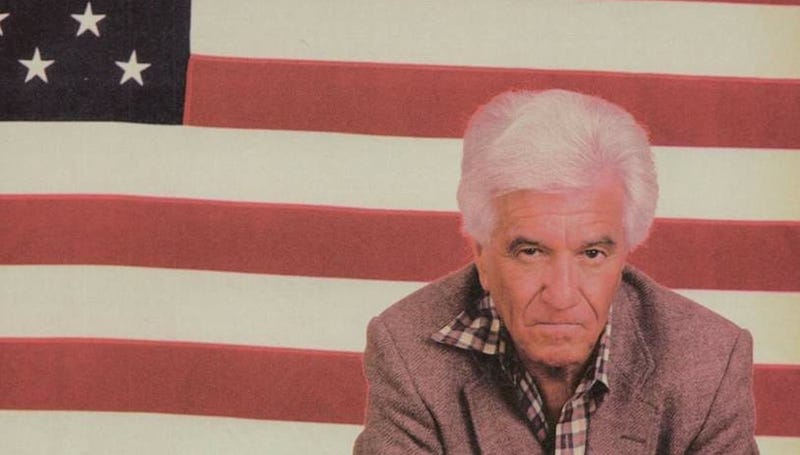
Dick Young, circa 1977.
No longer Young. But very much a dick.

Aside from possibly Whitey Ford, Seaver was the best pitcher he would ever see for a New York team, but he was now tight with Grant. Grant asked him to write a column smearing Seaver. Young didn't need much convincing. He probably traded it for a drink. He was probably happy to do it.

Young's anger at Seaver may have dated to the 1969 postseason, in which Seaver made public statements like, "If the Mets can win the World Series, we can get out of Vietnam," and, "I think it's perfectly ridiculous what we're doing about the Vietnam situation. It's absurd!" Seaver would later say, "I wasn't opposed to all wars. I wasn't a confirmed pacifist. But I did feel that this particular war was wrong."

Here is a summary of the most infamous sports column in the history of New York newspapers, from the Daily News of June 15, 1977 -- at the time, June 15 was the trading deadline in MLB:


In a way, Tom Seaver is like Walter O’Malley. Both are very good at what they do. Both are very deceptive in what they say. Both are very greedy.
Greed is greed, whether it is manifested by an owner or a ballplayer...
Tom Seaver is after more money. He wants to break his contract with the Mets. “Renegotiate” is the pretty word he used for it in this time of pretty words.
So, Tom Seaver said, over and over, that the Mets were not competitive in the free agent field. He said the front office was not spending money the way it should. He made it appear that he wanted the money to be spent on others, but really he wanted it to be spent on him. He talked ideals, but actually he was talking hard cash.
Like O’Malley, Tom Seaver couldn’t say that out loud. How would it sound for Tom Terrific, All-American boy, to disavow a contract he had signed in good faith?...
“Tom, we can’t do that,” said Grant. “I have a board of directors to account for. Were you happy when you signed your contract?”
“Yes, I was, but things have changed.”
“You asked for more money than had ever been paid to any pitcher, and you got it.”
“That’s not so anymore,” said Seaver.
“Who gets more?”
“Tiant, Ryan, Tanana.”
“I don’t know about that,” said Grant, “but it was you who opted for a three year contract. If we renegotiate for you, we would have every player on the team in the office. Please see the light of day. I beg you to reconsider and be the Tom Seaver happy to play with the Mets.”
“You want me to be happy at your terms.”
“Yes, and you want to be happy only on your terms, and that’s a standoff. I have told you 10 times we don’t want to trade you. Of the cities you prefer, we have our best offer from Cincinnati. If that can crystallize, we’ll make it.”
Tom Seaver’s base pay is $225,000, and he could do $250,000 with a good year. Luis Tiant does not make $225,000. Frank Tanana, by threatening to play out his option, received a $1 million signing bonus from Gene Autry, but his base salary of $200,000 is below Seaver’s. Nolan Ryan is getting more now than Seaver, and that galls Tom because Nancy Seaver and Ruth Ryan are very friendly and Tom Seaver long has treated Nolan Ryan like a little brother.
It comes down to this: Tom Seaver is jealous of those who had the guts to play out their option or used the threat of playing it out as leverage for a big raise — while he was snug behind a three-year contract of his choosing. He talks of being treated like a man. A man lives up to his contract...
*
Young had lied through his dentures about what Seaver said, and his reasons for wanting to renegotiate. That was bad enough. But he had also brought Seaver's wife into the lies -- and Ryan's wife, too.

Young wrote about what "a man" does. A man may disagree with another man, but a man does not bring the other man's family into it. That is a line that a man does not cross. Ever.

You got a problem with someone? Fine. But leave the family out of it. By playing Major League Baseball, Tom Seaver had made himself a public figure. Nancy Seaver was not a public figure until Dick Young made her one, and for what? Selling a few newspapers, and doing his pal M. Donald Grant a big fat favor.

"That Young column was the straw that broke the back," Seaver told the Daily News in 2007, on the 30th Anniversary. "Bringing your family into it, with no truth whatsoever to what he wrote. I could not abide by that. I had to go."

I know what it is like to work for a man who doesn't respect you, and lies to you, and treats you like garbage. Seaver knew what I later found out: Sometimes, you get to a point where no other circumstance matters, and you can no longer work for your boss. The well had been poisoned -- by Grant and Young, not by Seaver.

According to the Young column, Grant had told Seaver that the Cincinnati Reds had made the best trade offer for him. Seaver took Grant at his word one last time, and accepted a trade to Cincinnati.
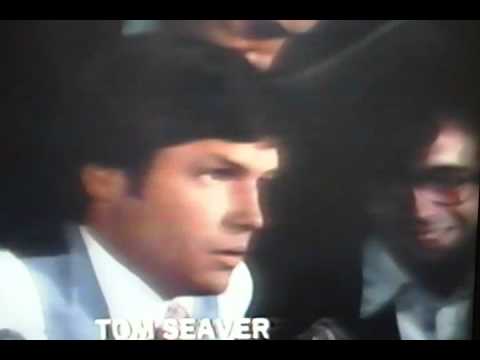
"Come on, George... " said George Thomas Seaver,
trying to maintain control of his emotions at the press conference,
calling himself by his rarely-used first name,

As the Daily News' front page put it, "His wish is M. Don Granted."

In exchange for the legend, 32 years old but still one of the game's top pitchers, the Mets got:

* Steve Henderson, 24, who made his major league debut for the Mets the next day, and became a decent hitter and a good left fielder, finishing 2nd in the NL Rookie of the Year voting, behind Andre Dawson of the Montreal Expos.

* Doug Flynn, 26, stuck behind Joe Morgan in Cincinnati, but became one of the best-fielding 2nd basemen in baseball in Flushing Meadow, winning a Gold Glove in 1980, although never making an All-Star Team and never becoming much of a hitter.

* Pat Zachry, 25, a pitcher who had finished in a 1st place tie in the vote for the previous year's NL Rookie of the Year, with pitcher Butch Metzger of the San Diego Padres -- but, stricken by injury, would himself be traded to the Mets in 1978, ending his career with them that season. Zachry would be an All-Star in 1978, going 10-6 for a bad Met team.

* And Dan Norman, 22, a right fielder who made his major league debut that September, and never amounted to much; essentially, a throw-in, to make it look like the Mets had actually gotten 4 serviceable major leaguers for Seaver.

And yet, by Opening Day 1981, Henderson and Norman would be gone; by Opening Day 1982, so would Flynn; by Opening Day 1983, so would Zachry. By the time Seaver pitched his last major league game, Henderson was the only 1 of the 4 still playing in the majors.

True, the Mets didn't exactly get nothing for Seaver. That would happen when, after the new regime brought him back in 1983, a clerical mistake caused them to lose him as a free-agent compensation pick to the Chicago White Sox after the season. They got some value for him in 1977.

They still didn't get as much value for Seaver as Seaver gave the Reds from June 18, 1977 to August 15, 1982 (a season cut short by injury), including 2 more All-Star seasons in 1978 and 1981, pitching the only no-hitter of his career in 1978, leading the NL in shutouts and getting them to its Championship Series in 1979, leading it in wins and winning percentage in 1981, nearly winning a 4th Cy Young Award that year, and, also that year, notching his 3,000th career strikeout, against the St. Louis Cardinals, the victim being future Met legend Keith Hernandez.

Aside from the Dodgers and Giants getting moved out of town, this is the most hated transaction in the history of New York sports.

And it wasn't the only Met trade of the night: They also sent Dave Kingman, the surly slugger who would go on to hit 442 home runs but, strikeout-prone, would have a lifetime batting average of .236, to the Padres.
What did they get from San Diego for "Kong"? Paul Siebert, a nothing pitcher who would throw his last major league pitch for the Mets in 1978, only 25. And a once-greatly-heralded prospect, now a 27-year-old banged-up utility player who could no longer hit, and would play his last major league game just 2 years later. He would, however, later write his name into Met history. His name was Bobby Valentine.

The Padres didn't keep Kingman long, soon trading him to the Angels, who then waived him, and he was picked up for the stretch run by the Yankees, making him the 1st man to play for 4 major league teams in 1 season in the 20th Century, and the 1st man to play for the Mets and the Yankees in the same season. He was not, however, included on the Yankees' ALCS or World Series roster.

Interestingly, when the Mets got Kingman back in 1981, from the Chicago Cubs, where he'd thrived, the player they sent to get him was Steve Henderson.

With Watergate and its "Saturday Night Massacre" -- which happened mere hours after Seaver was the losing pitcher when the Mets lost Game 6 of the 1973 World Series -- still fresh in the memory, and the Yankees having made a trade in 1974 that was known as "the Friday Night Massacre," these 2 Met trades became known as "the Midnight Massacre."

The effect on attendance was staggering. The following Saturday, June 18, was Banner Day, and the Mets drew 52,784, nearly a sellout. On August 21, not just a Sunday but also Seaver's 1st game back with the Reds, the Mets drew 46,265. Minus those 2 games, their average attendance from June 16 to September 23, 1977 (their last home date of the season) was 13,243 -- only a little more than they were getting without Seaver before the trade, and 10,000 per game less than they got when he pitched.
The face is Tom's. The ballpark is Shea.
But the uniform never looked right on him.

In hindsight, it had to be done. Either Seaver or Grant had to go, and Grant had the power, so he wasn't going anywhere.

And, let's be honest about this: Having Seaver, even if the Mets had those other 4 players as well, would have made no difference: The Mets were nowhere near Playoff contention from 1977 to 1982, when he was in Cincinnati, and his pitching wouldn't have won enough games to get them into contention.

There is even a theory that suggests that losing Seaver may have been for the best, since the Mets would have been a little better, and wouldn't have accumulated the draft picks that helped build The Dynasty That Never Was, including the 1986 World Championship. In other words, had Tom Seaver stayed, the Mets would not have won the World Series since 1969 -- not once in my entire lifetime -- and we would now be talking about the Curse of Amos Otis, instead of the Curse of Kevin Mitchell.

But from a public relations standpoint, the deal was a nightmare. It made the Mets organization look petty, bush-league, like profits were more important than Playoffs, and obedience more important than performance. It made them look, as Wayne Gretzky would say of the New Jersey Devils in 1983, like "a Mickey Mouse organization."

The world of baseball had changed, to the point where players now had the freedom to get paid based on performance, and to play where they wanted; and M. Donald Grant was saying, essentially, "No, the world has not changed, not on my watch!"

Throw in the fact that the Yankees were titleholders in the American League, had a renovated Yankee Stadium that was better than Shea, had the defending AL Most Valuable Player in Thurman Munson, had the game's best relief pitcher in Sparky Lyle, and had recently acquired the game's most charismatic slugger in Reggie Jackson, and any pretensions the Mets had to being the most popular, and the most respected, baseball team in New York were gone. Until 1984, anyway.

For Met fans, this was, to borrow Don McLean's phrase about the 1959 plane crash that killed Buddy Holly, "The Day the Music Died." They treated it as if their childhood was over. They reacted to it the way their parents (or big brothers) did when the Dodgers (or Giants) left in 1957. They cried over this as if Seaver had died. As if Seaver had been assassinated by M. Donald Grant, and their youth had died with him.

Babe Ruth left the Yankees in 1935. Joe DiMaggio retired in 1951. Mickey Mantle retired in 1969. Reggie Jackson was not re-signed in 1981. Mariano Rivera retired in 2013, and Derek Jeter retired in 2014. On none of those occasions did Yankee Fans react like a child who had been told his dog was "taken to a farm upstate."

There were 2 times when Yankee Fans did react like that. The 1st was for Lou Gehrig in 1939. Except he actually was going to die. The 2nd was for Thurman Munson in 1979. And he actually
did die.

Great players leave. Great players come to take their places. It was time for Met fans to grow up.

*

In February 1978, 8 months after the trade, Grant was asked when the Mets would be contenders. He said, "We are contenders right now."

Was he full of shit? Or just delusional?

Lorinda de Roulet finally fired the old buzzard in 1978. By that point, attendance at Shea Stadium was so sparse, it was being called Grant's Tomb: It had gone from a City record 2.7 million fans in the 1970 season to under 800,000 by 1979 -- or, per game, from 33,000 to 9,740. Contrast that with the Yankees: In 1972, they bottomed out at 966,000 (12,000 per game), their lowest since World War II; by 1980, they had risen to 2.6 million (32,000).

Not until 1980 did things begin to turn around at Shea. That was the year when Lorinda sold the team to Fred Wilpon and Nelson Doubleday. They hired Frank Cashen, who helped build the Baltimore Orioles team that dominated the American League from 1966 to 1971, as general manager. His drafts and trades built the Mets into a contender by 1984, and a World Champion in 1986.

Tom Seaver was not killed by M. Donald Grant on June 15, 1977. His life and career continued to flourish. He even came back to the Mets for 1983, though only for 1983.

He won his 300th game in New York City on August 4, 1985 -- pitching for the White Sox against the Yankees at Yankee Stadium. I was there: It was Phil Rizzuto Day, and there were 54,000 fans on hand, half of them Yankee Fans there to honor the Scooter, half of them Met fans there to see Tom Terrific notch the milestone.

He retired after the 1986 season -- in which he was with the Boston Red Sox, and might have pitched against the Mets in the World Series, had he not been injured. The Mets retired his Number 41 in 1988. He was elected to the Baseball Hall of Fame in 1992. He had already assisted ABC on its baseball broadcasts while still active, including during the 1977 World Series that the Yankees won. He later broadcast for the Yankees from 1989 to 1993, playfully bantering with Rizzuto; and for the Mets from 1999 to 2005.

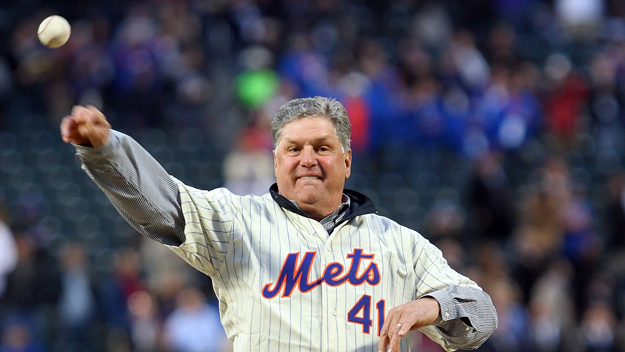
In 2008, he threw out the ceremonial last pitch at Shea Stadium. The next year, he threw out the first pitch at Citi Field. He is now 72 years old, still married to Nancy, they have 2 daughters, and they are still close friends with Nolan and Ruth Ryan. They still have a home in Connecticut, and they own a vineyard in Northern California's Napa Valley, producing fine wine. There is a rumor going around that the Mets will honor him with a statue in 2019, as part of the celebrations of the 50th Anniversary of the 1969 "Miracle."
M. Donald Grant died on November 29, 1998, at the age of 94, not having been involved in professional sports for the last 18 years of his life. He died 16 days after the death of the Jets' title-winning head coach, Wilbur "Weeb" Ewbank, and 12 days after the death of the Knicks' title-winning head coach, William "Red" Holzman. Weeb and Red got a lot of praise in the New York media at the time. Grant's death was barely even noticed. Serves him right.

Moral of the story? Never trust a businessman named Donald in New York City -- especially in Queens. Incidentally, that boss I mentioned? He was from New York City, albeit Staten Island rather than Queens, but his name was Donald.

Lorinda de Roulet is still alive, age 85, but hasn't been involved in professional sports since selling the Mets, 37 years ago.

Tom Seaver made his 1st start for Cincinnati on June 18, 1977. That would also turn out to be an epic day in the saga of New York baseball -- but because of what happened with the Yankees, and it would be even uglier than the way Seaver was forced out of the Mets.