Showing posts with label leon hess. Show all posts

Saturday, January 4, 2025

January 4, 1995 & 2000: The Jets Get Rich Kotite, Then Don't Get Bill Belichick

January 4 is simply not a good day for Jet fans.

January 4, 1995, 30 years ago: Rich Kotite, in spite of having cost the Philadelphia Eagles a Playoff spot by losing the last 7 games of the previous season, was hired as head coach of the New York Jets.

Kotite was a local guy, from Staten Island, and was a decent tight end for the New York Giants in the early 1970s. But he was already known as a bafflingly dumb coach.

Jets owner Leon Hess had his reason for hiring him: "I'm 80 years old. I want results now!" The assembled media laughed.

Hess got results, all right: 3-13 in 1995, 1-15 in 1996. To put it another way: From November 13, 1994 to December 22, 1996, as an NFL head coach, Rich Kotite was 4-35, for a "winning" percentage of .114. That is slightly better than the worst 39-game stretch any NFL team has ever had: The 2007-09 Detroit Lions were 3-36, .077; slightly better than the worst season in NBA history: The 1972-73 Philadelphia 76ers were 9-73, or .110; worse than the worst season in NHL history: The 1974-75 Washington Capitals were 8-67-5, or .131; and worse than the worst season in MLB history: The 1899 Cleveland Spiders were 20-134, or .149.

Two days before the 1996 regular-season finale, with Jet fans from Morristown to Montauk, from Bear Mountain to Cape May, wanting him fired or worse, Kotite resigned. The long metropolitan nightmare was over. For now. Kotite has never been employed, in any capacity, by another NFL team.

Hess begged Bill Parcells to come back to the Meadowlands, and the rebuild began. Parcells, head coach of the New York Giants from 1981 to 1990, and of the New England Patriots from 1993 to 1996, went 9-7 in 1997.
In 1998, he went 12-4, setting a new team record for wins in a season, and achieving the Jets' 1st Division title since the 1970 NFL merger. (They had won the AFL East in 1968 and '69.) They beat the Jacksonville Jaguars in the Divisional Playoff, and led the Denver Broncos at halftime of the AFC Championship Game, in Denver no less, before losing.

Then Hess died, close to the results he wanted. But Jet fans had hope. In the opening game of the 1999 season. quarterback Vinny Testaverde tore his Achilles tendon, and was out for the season. Somehow, Parcells squeezed an 8-8 season out of what was left. But he was 58 and tired, and resigned as head coach, vowing never to hold that job again (he later made a liar of himself), and stayed on as general manager.

Bill Belichick had worked with Parcells, as an assistant coach on the Giants from 1979 to 1982; an assistant to him on the Giants from 1983 to 1990, building the defense that won Super Bowls XXI and XXV; an assistant to him on the Patriots in 1996, winning the AFC Championship but losing Super Bowl XXXI; and an assistant to him on the Jets from 1997 to 1999. Parcells arranged for the team to select Belichick as his successor.

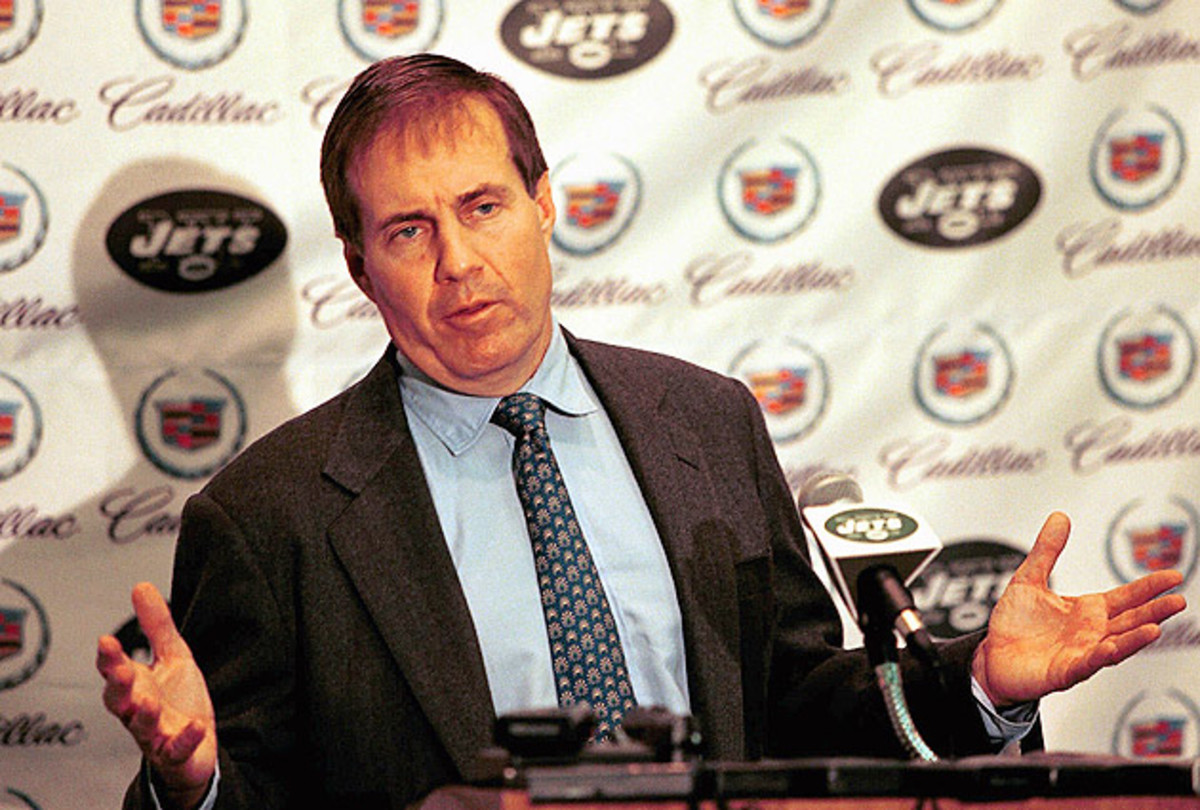
January 4, 2000, 25 years ago: One day after the arrangement is made, the press conference that was supposed to announce it ended with a napkin to owner Woody Johnson, on which Belichick had written, "I RESIGN AS HC OF THE NYJ." Not so abbreviated: Belichick spoke for half an hour, justifying his decision.

Just 16 days later, he was hired as head coach of the Patriots, the Jets' arch-rivals. (No, the Miami Dolphins are not the Jets' arch-rivals. Nor are the Raiders, regardless of what city they're in at any moment.) The Jets, to whom he was still under contract, demanded compensation. The NFL awarded the Jets the Pats' 1st round pick in the next NFL Draft, a pick they ended up trading, anyway.

Linebackers coach Al Groh was hired in Belichick's place. He went 9-7, just missing the Playoffs. Considering all that had happened to the Jets recently, this wasn't bad at all. Then he left as well, taking the head coaching job at his alma mater, the University of Virginia.


In the 1st 22 seasons after Belichick quit on the Jets, 2000 to 2021, the Patriots made the Playoffs 20 times, the Jets 6; the Pats won 31 postseason games, the Jets 6; the Pats reached 13 AFC Championship Games, the Jets 2; the Pats won the AFC Championship and reached the Super Bowl 9 times, the Jets none; and the Pats won 6 Super Bowls, the Jets none.

And there is this very telling stat: The Jets had 6 head coaches in that span, the Patriots 1.
Pictured: One smug, self-satisfied son of a bitch.

The Jets keeping Belichick would almost certainly have meant no dynasty for the Patriots. So, Belichick did the right thing, right?


Not by Jet fans, he didn't. It would have been bad enough had he left them for anyone else, but the Patriots? New England? 


Before 2000, Yankee Fans hated the Boston Red Sox, while Met fans mocked them over the 1986 World Series; Knick fans hated the Boston Celtics, and so did Net fans, to a lesser degree; Ranger fans hated the Boston Bruins, and so did Islander and Devils fans, to a lesser degree.


But Jet fans' hatred for the Patriots was minor, compared to what they felt for the Dolphins and Raiders. As Massachusetts native chef Emeril Lagasse would say, this abandonment kicked it up a notch! And that was before the Pats started winning -- dubiously, as we would later find out.


But can we really blame Belichick for this? 
Parcells looked like he was working miracles with the Jets, but he didn't get the team to the Super Bowl in his 3 years with them. And that was a good tenure by Jet standards.

The season after Super Bowl III, 1969, Weeb Ewbank got the Jets to the AFL East title again, the last AFL East title before the merger, and the Jets moving into the new AFC East. After that, though, he never had another winning season.

Lou Holtz, already a success at North Carolina State with an ACC title and 2 bowl game wins, was hired for the 1976 season, and he went 3-10 before being fired before the season's last game. To know what Holtz did later at Arkansas, Minnesota, Notre Dame and South Carolina -- 9 Top 10 ranking finishes, including a National Championship; 10 bowl wins, including 2 Oranges, 2 Cottons and a Fiesta -- you might be shocked to know how badly he did with the Jets.

Charley Winner, Walt Michaels, Joe Walton and Bruce Coslet had all been good NFL assistant coaches, but all failed as Jet boss. Maybe that's a little unfair for Michaels: He took a really good Jet defense and a good-but-not great offense to the 1982 AFC Championship Game. In other words, he was as successful as any other post-Weeb Jet coach has been.

The aforementioned Rich Kotite had gotten the Eagles into the Playoffs, and was 36-21 over his 1st 3 1/2 seasons at Veterans Stadium. But I've already told you the rest: He seemed like a good hire at the start of 1995, but by the end of 1996, he had cemented himself as perhaps the worst NFL coach ever. So, 6 seemingly good hires turned sour for the Jets, and, having been around the team, and being a keen student of football history, Belichick surely knew the story.

And that doesn't even count Pete Carroll, who won National Championships at USC and a Super Bowl with the Seattle Seahawks after leaving the Jets, but who had never had a head coaching job before the Jets gave him one.

Also, Belichick's only head coaching job until 2000 had been with the Cleveland Browns from 1991 to 1995, and he got them into the Playoffs just once, in 1994. After that, in just 1 year, he went from 11-5 to 5-11. Maybe he needed Parcells. (Or maybe he needed to cheat.)

There's an old saying: You don't want to be the guy who follows the legend; you want to be the guy who follows that guy. Both Parcells and Belichick first worked for the Giants as assistants to Ray Perkins, who had played for Paul "Bear" Bryant at the University of Alabama. When Bryant retired after the 1982 season, Perkins was hired to replace him. It didn't work out, because everyone demanded that he become Bear II. And he never would.

(Perkins had been a receiver on Alabama's National Champions of 1964 and '65, and was with the Baltimore Colts when they lost Super Bowl III to the Jets, and when they beat the Dallas Cowboys in Super Bowl V. After 'Bama, he was head coach of the Tampa Bay Buccaneers for 4 years and Arkansas State for 1; served as Parcells' offensive coordinator on the Pats; and then served on the Oakland and Cleveland staffs. He died in 2020, having coached at a high school in Mississippi since 2014.)


If Belichick had stayed with the Jets, he would have been Parcells' man, but he would also have been expected to work miracles like Parcells had, both in East Rutherford and in Foxborough. And the pressure on him would have been tremendous, especially after his 1st season: In 2000, the Giants got back to the Super Bowl, although they lost it to the Baltimore Ravens.


Which leads to the New York media. 
Belichick is a grouch. Parcells can be pretty grouchy, too, but he also knew how to get the New York media on his side. The Boston media can be every bit as nasty, but Belichick toyed with them because the winning came first.

If the winning didn't come quickly in New York, how long would it have taken Steve Serby of the Post, Rich Cimini of the Daily News, Mike & the Mad Dog and their WFAN listeners, etc. to turn on him? Not long. Why would he have wanted to put with that? For the money that Woody Johnson would have given him? Bob Kraft was willing to give him more money and more control. As with NFL team owners, there's nothing an NFL head coach values more than control, and not having Parcells look over his shoulder may have helped.


But even if things had gone the Jets' way with Belichick in charge, they would have stopped. Because he would have been caught cheating. Spygate. Deflategate. Six players testing positive for performance-enhancing drugs. Spygate II. And that's just what we know about. Every single game the Patriots won under Belichick is suspect. Guilty until proven innocent.
Would Belichick still have done all this stuff -- or allowed others working for him to do some of this stuff -- if he'd stayed with the Jets? Would Parcells have put up with it (presuming he was still there the 1st time Belichick got caught, instead of going off to Dallas to coach the Cowboys)? I don't think so. Belichick wants to win in the worst way; Parcells wants to win in the best way. 

Maybe he wouldn't have done well with the Jets if he'd cheated. Certainly, not if he hadn't. Maybe we saw the real Belichick in Cleveland: A 36-44 coach. Or in Foxborough after Tom Brady left: A 29-38 coach. After all, his quarterback in East Rutherford would have been Chad Pennington. He was good, but not as good as a cheating-aided Tom Brady.


Let's face it: What good was taking the job for 24 hours, and then leaving it in a public way? He should have listened to the offer, said, "Give me 24 hours to think about it," and then made his decision, "No." If he had done that, it wouldn't have made a difference in either team's record since 2000, but at least his knife wouldn't have any back blood on it.

Instead, Belichick came into the Jets' house, ate their food, drank their liquor, watched their TV, slept in their guest room, and made a mess... and then walked out as soon as he got a better offer.


And he's never said he's sorry. But we wouldn't want him to lie to us, would we? Any apology he would give now would be as fraudulent as his 6 titles.

On January 11, 2024, Belichick left the Patriots' job -- officially, by mutual consent. He was 71 years old at the time, old by the standard of NFL head coaches, but, perhaps, not too old for a desperate team. But no NFL team would hire him for the 2024 season. Not counting the Patriots, 6 teams had head coaching vacancies at that point. And 3 others fired coaches during the season. That's 9 teams that could have hired him. None did. Perhaps none of them believed all that "greatest coach of all time" stuff. Or, perhaps they all believed he was too old.

On December 11, 2024, he was finally hired as a head coach -- by the University of North Carolina.

Wednesday, October 16, 2024

October 16, 1994: The Dumbest Football Coach Who Ever Lived

October 16, 1994, 30 years ago: The Dallas Cowboys lead the Philadelphia Eagles, 24-7, at Texas Stadium in the Dallas suburb of Irving, Texas. The Eagles score a touchdown in the 4th quarter to make it 24-13, and head coach Rich Kotite tells his team to attempt a 2-point conversion. It fails, and the 24-13 score holds until the end of the game.
Why go for 2 there? At that point, there was little difference between trailing by 10 and by 9: You still needed a touchdown and a field goal to make the difference. But failing at the 2-pointer meant trailing by 11, so you needed 2 touchdowns. Obviously, the right thing to do was to kick the extra point, and make it 24-14.
After the game, Kotite told the media, "The rain made the ink run and blurred the chart, so I couldn't see what was written on it to know what to do."
He shouldn't have needed a chart to tell him what to do! But it was worse than that: He knew it was going to rain, and didn't have a plastic sheet to protect his ink and paper. I guess Yankee Fans are lucky that the dugout protected Joe Girardi's infamous binder from the rain.
Richard Edward Kotite was born on October 13, 1942 is born in Brooklyn, and grew up on Staten Island. A tight end, he played for Wagner College on Staten Island, and was a decent player for the Giants from 1967 to 1972. Among his coaching jobs were with the New York Jets, as receivers coach in 1983 and '84, and as offensive coordinator from 1985 to 1989. He got the same job with the Philadelphia Eagles in 1990, and was promoted to head coach in 1991. In 1991 and '92, he got the Eagles into the Playoffs. In 1993, 8-8 wasn't enough to get in.
In 1994, he got the Eagles off to a 4-1 start. Then came his what-the-hell moment against the Cowboys. The Eagles would get to 7-2, leading the NFC Eastern Division. Then they lost their last 7 games, including to the Giants and the Cincinnati Bengals by 3 points each, the Arizona Cardinals by 6, and the Atlanta Falcons by 7.
The Eagles finished 7-9, missing the Playoffs, and Kotite was fired. Crap like this is what makes people in Philly go up to cops and say, "Officer, I want to report a crime: The Eagles are killing me!"
On January 4, 1995, a date which lives in infamy, Jets owner Leon Hess announced that he had hired Kotite to be the team's head coach and, effectively, also its general manager. Why Kotite? Well, he was a local guy, and a blue-collar guy who could appeal to local fans. But that shouldn't have mattered. What should have mattered was that Kotite had led the Eagles to a couple of Playoff berths.
Words that Hess should have guessed would outlive him: "I'm 80 years old. I want results now!"
He got results, all right. In 1995, the Jets went 3-13. One of those losses was the 1st regular-season win in franchise history for the expansion Carolina Panthers. (While the Panthers did reach the NFC Championship Game the next season, that 1st year, they were only 4-12.)
In 1996, the Jets had the worst season in the history of New York Tri-State Area football, 1-15. The only win came in Week 9, October 27, 31-21 away to Arizona. Two days before the team's '96 finale, GM Kotite fired Coach Kotite.

Between them, Coach Kotite and GM Kotite went 3-13 and 1-15 in his 2 seasons with the Jets. In other words, from November 7, 1994 to December 22, 1996, he went 4-35 as a head coach. That's a .103 percentage, worse than the worst single seasons in the histories of MLB (the 1899 Cleveland Spiders went 20-134, or .134), the NBA (the 1972-73 Philadelphia 76ers went 9-73, or .110) and the NHL (the 1974-75 Washington Capitals went 8-67-5, or .131).

Owner Hess then hired Bill Parcells, and got much better results, although Hess died before Parcells could get the ultimate result for the Jets, like he did twice for the Giants.
Kotite was just 54 years old when he left Weeb Ewbank Hall, but has never again even been hired as an assistant coach. Anywhere. Not the pros, not college, not even in high school. Even the XFL -- both the laughingstock 2001 version and the new edition that started in 2020 -- haven't touched him. That's how radioactive Rich Kotite has been. However, he has been a contributor to various NFL Network broadcasts. At 80, it's unlikely he'll ever be hired by another pro team, in any capacity.

This game could be cited as part of "The Curse of Billy Penn": From 1983, when the Philadelphia 76ers won the NBA Championship, until 2008, when the Phillies won their next World Series, no Philadelphia professional sports team won a World Championship. The suggestion was that the construction of One Liberty Place in 1987, making it taller than the statue of William Penn atop City Hall, caused Penn's spirit to put a curse on the city's teams. The Eagles didn't win a Super Bowl until 2018.

Monday, July 20, 2020

Top 10 Worst Team Owners in New York Sports History

As I said in my post about the 10 best, picking the 10 best is harder than picking the 10 worst. Once again, I'm going to limit it to the last 100 years, 1920 to 2020.

10. Stephen W. McKeever, Dodgers, 1925-38. (That's as controlling owner. As at least part-owner, 1912-38.) Steve McKeever was not a bad guy. But after the deaths of Charlie Ebbets and his brother Ed McKeever within days of each other in 1925, he was the owner of a team that never had any money.
There were times during the Great Depression that the Dodgers could have gone out of business. The team was terribly. And Ebbets Field, built in 1913, was already in a state of disrepair, because McKeever couldn't afford to maintain it. The Brooklyn Trust Company controlled Charlie Ebbets' estate, and hired Walter O'Malley to oversee their one-quarter ownership of the Dodgers.

Steve McKeever died in 1938, and that led to the other owners hiring Larry MacPhail away from the Cincinnati Reds, and that ended the Dodgers' danger of becoming the 1st MLB team to go bankrupt in the 20th Century. That ended up never happening, although the Seattle Pilots came pretty close in 1969 and '70, before being sold and becoming the Milwaukee Brewers.

Steve McKeever was a tragic figure, so I can only place him at Number 10. Most of it wasn't his fault.

9. Leon Hess, Jets, 1968-99. (That's as controlling owner. As at least part-owner, 1963-99.) Also not a bad guy. He was a good businessman, in his case the energy business. And he was very generous with charity. He was liked, and he was respected. Jet fans usually did not blame him for the team's failures. But they should have, because he didn't get it done. Hess is not on this list for reasons of personality or scandal. It's strictly business.

When he became majority owner of the Jets, business was booming, thanks to the partner he'd bought out, David "Sonny" Werblin; the head coach that Werblin had hired, Wilbur "Weeb" Ewbank; and the quarterback that Werblin had drafted, Joseph "Broadway Joe" Namath. The Jets won Super Bowl III on January 12, 1969.

For the rest of Hess' life, he owned the Jets, and they reached only 2 AFC Championship Games. (Had he died 4 months sooner, it would have been only 1.) In 24 years after firing Ewbank, he hired 8 head coaches (not counting interim ones), and none got him back to the Super Bowl. Walt Michaels came within 1 game in the 1982-83 season. Bill Parcells came within a half in the 1998-99 season. But that was it.
The worst one was Rich Kotite. A Staten Island native, who'd been a decent tight end for the Giants, and had coached the Philadelphia Eagles into the Playoffs, he seemed like a good fit. On January 4, 1995, Hess told the media, "I'm 80 years old. I want results now!" Here's the results he got: 3-13 in 1995, and 1-15 in 1996.

Kotite quit before he could be fired, and Hess begged Parcells to leave the New England Patriots and come home to New Jersey. It came close to working. And then Hess died. And then Vinny Testaverde got hurt in the next season's opening game, and was out for the season, and the chance to win one for Hess was gone.

8. Mike Burke, Yankees, 1966-73, and Knicks 1973-81. (More accurately, in terms of seasons, he was the Yankees' "owner" 1967-72.) Another guy who isn't on this list for reasons of personality, or for the amount of effort he put into trying to win.
Edmund Michael Burke was a genuine hero of America's effort in World War II. A great businessman. A man who loved sports. And, along with Mayor John Lindsay, the man who saved the original Yankee Stadium for an additional 2 generations. We should thank him for those things.

But while he loved baseball, he didn't know how to run a sports team. Granted, the Topping-Webb regime left CBS, and their handpicked team president Burke, a pig in a poke, basically a brand name and nothing else.

But he didn't do much with it: When the team finally won the whole thing in 1977, only 4 players were left from before George Steinbrenner owned the team: Roy White, Thurman Munson, Sparky Lyle and Graig Nettles. I think when George came in, and then bought Burke out, it was a great relief to Burke.

Upon leaving the Yankees, he was named President of the Madison Square Garden Corporation. But that did him no favors on this list, either. Once again, his timing was terrible: The Knicks had just won 2 titles and reached another Final in 4 seasons, but the key players were getting old. He proved unable to replace them. Finally, in 1981, he sold out, and retired to a farm he'd bought outside Galway, in his ancestors' homeland of Ireland, living there until his death in 1987.

7. "The Secaucus Seven," Nets, 1978-98. Led by Joe Taub and Alan Cohen, these guys got little to work with, and they made less out of it. Having to pay $8 million -- and, as the late sportswriting legend Bert Randolph Sugar would have said, these were Jerry Ford dollars, not Donald Trump dollars -- just to get into the NBA following the collapse of the ABA and to pay off the Knicks for "territorial indemnification" -- the Nets had to sell off their best player, Long Island native Julius "Dr. J" Erving, and a year later trade their next-best player, Bronx native Nate "Tiny" Archibald.

In other words, just to remain in the Tri-State Area, the Nets had to dump 2 of the men who would be named in 1996 to the NBA's 50th Anniversary 50 Greatest Players. (Even as we approach the NBA's 75th Anniversary, Doc is probably still one of the game's top 20.)

So how many times did the Nets make the Playoffs in those 20 seasons that the S7 owned them? 10. Which isn't actually all that bad. But how many Playoff series did they win? One. That was in 1984, against the defending World Champion Philadelphia 76ers -- with Erving -- before falling in 6 in the next round against the Milwaukee Bucks. How many Playoff games did they win? 9, with 5 of those coming, as I said, in '84.

It's not so much how often they made the Playoffs, it's how bad they were when they didn't. And the bad draft picks... Dennis Hopson, Ed O'Bannon, Yinka Dare... Maybe the Nets weren't as big a joke as the other "little brother" team in the NBA, the Los Angeles Clippers... but even when they were a good team, 1982-86 and 1992-94, they didn't exactly sell out the Meadowlands. Partly because the established, glamorous Knicks were also good at the same time.

The S7 sold the Nets in 1998, and in 2001 new ownership made the trade for Jason Kidd and the team made 2 NBA Finals, reaching the Playoffs 6 straight seasons, before Bruce Ratner bought the team and put their breakup and move to Brooklyn into motion.

Despite a 20-year record of ineptitude, I can't rank the S7 any higher, for 2 reasons: There were 7 of them, not any 1 that was more responsible than any other; and the Nets have always been the 2nd basketball team in a 2-team town. Sometimes 3rd, when you consider St. John's.

In fact, counting all the area's major league teams, they're the 9th team in a 9-team town. And, frankly, counting the Liberty and the Red Bulls may not be doing the Nets any favors, either. The owners since have done them no favors, either.

6. Fred Wilpon, Mets, 2002-present. (That's as controlling owner. As at least part-owner, 1980-present.) When Freddy and Nelson Doubleday were co-owners, the Mets reached the Playoffs 4 times, winning the 1986 World Series and the 2000 NL Pennant. Since Doubleday sold out in 2002, and Fred became sole owner and gave his son Jeff Wilpon effective control of the team, it's been 3 Playoff berths, 1 Pennant, and 2 shocking regular-season collapses.
Okay, things happen. Teams have injury crises. Teams simply get beat by better ones. Teams have runs of bad luck. All of these have happened to the Mets since the Wilpons started running things on their own. And while many Met fans were sad to see Shea Stadium go, Citi Field is a much better ballpark, and that was Fred Wilpon's idea.

But the Wilpons trusted Bernie Madoff with their money, and that crippled the Mets financially for the 1st few Citi Field years. And they hired field managers and general managers who didn't know what they were doing. Omar Minaya and his "Los Mets" didn't work: It left Met fans feeling so tortured, it might as well have been called the "Spanish Inquisition."

Willie Randolph got the Mets to within 1 run of a Pennant in 2006. Given what happened in 2007 and '08, with mostly the same players, that may have been the biggest "miracle" in Met history. Jerry Manuel was not the answer. Ask Met fans if they won the 2015 Pennant and the 2016 Wild Card berth because Terry Collins was the manager, and they'll say no, they won those in spite of Collins.

Mickey Callaway was not the answer. Jeff Wilpon hired Carlos Beltran to manage, and he had to have been aware that there was already an investigation into Beltran's activities with the Houston Astros. So now, Luis Rojas is the manager.
Firing Minaya as GM led to the hiring of Sandy Alderson, but his health became an issue, hamstringing the Mets further. Brodie Van Wagenen has been a fool, trying to dictate to his managers how to run things every bit as much as Brian Cashman seemed to do in The Bronx to Joe Girardi and now to Aaron Boone.

It now appears that the Wilpons may finally be about to sell the Mets to Steven A. Cohen, a billionaire hedge fund manager with a company history of bigotry, misogyny and crooked dealings. When the other option was... Alex Rodriguez and Jennifer Lopez.

That's the Mets for ya. As their former manager Jeff Torborg once said about ways to catch the knuckleball, there are two theories about how to run the Mets, and, unfortunately, neither of them work. As was proven when they were owned by...

5. Lorinda de Roulet, Mets, 1975-80. Joan Payson knew her baseball, and that's a big reason why she was a member of the board of directors of the baseball New York Giants. She was the only board member to vote against the move to San Francisco in 1957, and that's a big reason why she was offered the chance to buy into the National League as the 1st owner of a new team for New York, the Mets.

Mrs. Payson owned the Mets from their laughable 1962 beginnings to their 1969 World Championship and their 1973 Pennant. Then, in 1975, she died. Her daughter, Lorinda de Roulet, inherited the team.

She knew that she knew nothing about baseball, so she trusted the team's president, M. Donald Grant. He was cheap. Not because the Mets weren't making money. And even if they weren't, it wasn't his money: Mrs. de Roulet was a de Roulet by marriage, and both a Payson and a Whitney by blood. She was richer than George Steinbrenner. She could afford to spend whatever she wanted.

But she trusted Grant, and he thought baseball players were beneath him. He had what Marvin Miller, director of the players' union, called "a plantation mentality." When he pulled a dirty trick that led to Tom Seaver, "The Franchise," demanding a trade in mid-1977, hardly any of the '73 Pennant winners were left. After the season, he got rid of Bud Harrelson, the last remaining player from the '69 titlists.

Mrs. de Roulet finally fired the old buzzard in 1978. By that point, attendance at Shea Stadium was so sparse, it was being called Grant's Tomb: It had gone from a City record 2.7 million fans in the 1970 season to under 800,000 by 1979 -- or, per game, from 33,000 to 9,740. The Mets were bad, and not even interesting. They had bottomed out every bit as much as the Yankees had in 1966, and without the history to back it up.

Not until 1980 did things begin to turn around at Shea. That was the year when Lorinda sold the team to Fred Wilpon and Nelson Doubleday. They hired Frank Cashen, who helped build the Baltimore Orioles team that dominated the American League from 1966 to 1971, as general manager. His drafts and trades built the Mets into a contender by 1984, and a World Champion in 1986.

In 2003, the last remaining original Met broadcaster, Bob Murphy, retired. Among the former Met personalities invited back to Shea Stadium for a pregame ceremony was Mrs. de Roulet. Along with Mayor Mike Bloomberg, she was one of only two people booed that night. I had a close enough seat that I could see the look on her face, and she seemed puzzled as to why people were booing her, 23 years after she sold the team.
New Yorkers have long memories: If they could still hate Walter O'Malley 46 years after the Dodgers were taken away from him, hating her after 23 years was a piece of cake.

Lorinda de Roulet is still alive, age 88, but hasn't been involved in professional sports since selling the Mets, 40 years ago.

This may come as a shock to Met fans of a certain age, but there have been 4 team owners in New York sports that were worse than Lorinda de Roulet and Fred Wilpon.

4. Bruce Ratner, Nets, 2004-10. How to screw up a good thing. The New Jersey Nets had reached the NBA Finals in 2002 and 2003, and the Knicks were terrible. For the 1st time, really, the Nets had the chance to be the Tri-State Area's most popular basketball team. They were already its most successful, at least recently, despite the Knicks' 1994 and '99 trips to the Finals.

Enter Ratner. Emphasis on the "Rat." A real estate developer, he could have led the move to build a new arena for the Nets and Devils, so they could leave the Meadowlands in style. Instead of joining the Devils in the building of the Prudential Center, he wanted to build an arena in the Atlantic Yards section of Brooklyn, and move the Nets there. New Jersey basketball fans finally had a great team, and, instead of helping, the new owner stabbed them in the back, right through the heart.
For reasons I won't get into, the Barclays Center project dragged on. And on. And on. Even the Montreal Expos were not a lame-duck franchise as long as the New Jersey Nets were. Finally, in 2010, Ratner had had enough: He sold the Nets to Russian oligarch Mikhail Prokhorov, so that he could concentrate on finishing the Barclays Center project. He did, and it opened in 2012.

Nets games have not become a big happening in Brooklyn. Really, the people of the Borough couldn't care less. As bad as the Knicks have been in the 21st Century, they are still more popular in Brooklyn than the Nets are. And Prokhorov, who promised big things for the franchise, also failed as an owner, and has sold out.

In the 6 seasons that Ratner owned the Nets, they went from Atlantic Division Champions in 2004, and Division Champions again in 2006, to 12-70 in 2010. And he killed their fan base, and failed to build a new one where he was moving them to. He packed as much ugliness into 6 years as Fred Wilpon has in 18 years.

3. Walter O'Malley, Dodgers, 1950-57. (That's as controlling owner. As at least part-owner, 1942-57. Counting Los Angeles, 1942-79.) Did he have anything to do with the Dodgers' success in the 7 seasons between his buying out of Branch Rickey and his move of the team? Not much. The biggest move was in hiring Walter Alston as manager in 1954 -- and even that may have been more of him being convinced by general manager Emil "Buzzie" Bavasi.
Let's get it out of the way right now: If you think the move of the Brooklyn Dodgers to Los Angeles was a bad thing, the person most responsible for it was Walter O'Malley.

Robert Moses, who controlled construction of pretty much anything in the State of New York at the time, refused to condemn the land that O'Malley wanted for a new stadium, which would have been built in Atlantic Yards, where the Barclays Center was eventually built. Moses offered O'Malley a stadium he wanted to build in Flushing Meadow, but O'Malley didn't want to own the Queens Dodgers, so he turned it down, and started looking elsewhere. This was the stadium that would eventually become Shea Stadium.

O'Malley has been called a "visionary." But his "vision" only seemed to succeed when it could benefit him, not the fans of the Brooklyn Dodgers. If he was such a visionary, then he should have found a way around Moses. He could have gone to Mayor Robert Wagner. If Wagner refused to help, O'Malley could have gone to Governor Averell Harriman.

If he refused to help, O'Malley had other options. The City of New York was electing a Mayor in 1957. How the hell Wagner got elected to a 2nd term after losing the Dodgers and the Giants, I don't know. Get-out-the-vote efforts by the City's Democratic machine, I guess. O'Malley could have financed a candidate to beat Wagner.

Failing that, the State of New York was electing a Governor in 1958. O'Malley could have helped Nelson Rockefeller beat Harriman, which did happen. Rocky would have had no qualms about overruling Moses on the stadium, because he went on to overrule him on other things, and finally removed him from power in 1968.

But O'Malley, who had already forced Branch Rickey, Red Barber and Jackie Robinson away from the Dodgers, chose not to find a way around Moses. He moved the Dodgers to Los Angeles after the 1957 season.

It wasn't because Los Angeles was potentially a great market for baseball. If he thought he could make more money staying in Brooklyn, he would have. If he thought he could make more money in San Diego, or Hawaii, or Japan, or Antarctica, or on the Moon, that's where the Dodgers would be playing today. Walter O'Malley was about Walter O'Malley, and that meant that he was about money.

2. Horace Stoneham, Giants (baseball), 1936-57. (Counting San Francisco, 1936-76.) It was no contest. And not just because he owned the team for 22 seasons and won just 1 World Championship. That's not that bad. They did win 4 Pennants. Throw in what happened after he left New York, and that's 5 Pennants, for an average of 1 every 8 seasons. I know, it doesn't work that way. But it makes him look somewhat competent.

He wasn't. He inherited the team from his father Charles (who owned the team from 1919 until his death in 1936), and saw them win Pennants in 1936 and 1937. But the rise of 2 teams built by Branch Rickey -- first the St. Louis Cardinals and then the Brooklyn Dodgers -- saw what had been the most successful sports team in North America become the 3rd-biggest baseball team in New York City.
He never spent much to rebuild the team, or to maintain the ballpark. As the neighborhoods -- Harlem to the south, Washington Heights to the West -- deteriorated, so, too, did the Polo Grounds. When he made the decision to move, he was asked about the young fans he was abandoning. He said, "I feel bad for the kids, but I haven't seen too many of their fathers lately."

The fathers didn't want to risk their cars and sit in a rickety old stadium. It was 46 years old at the time of the move, but already in worse shape than either Ebbets Field, or Shea Stadium, or the original Yankee Stadium ever got.

The Giants then had the Minneapolis Millers of the American Association as their top farm team. There were going to move to Minneapolis for the 1958 season. It would have been the cheapest option. Then, O'Malley told him of the plan to move the Dodgers to Los Angeles, and said, Why don't you move the Giants to San Francisco? It would keep the rivalry going.

Although the move to the City By the Bay paid off financially and competitively at first, things dropped off, and by 1976, Stoneham nearly moved them again, to Toronto, before finding a buyer.

The thing is, it didn't have to be this way. Moses had offered O'Malley the Flushing Meadow stadium. Had he offered it to Stoneham, the Giants probably would have moved into a new stadium there by Opening Day 1960, and might be playing in Citi Field today.

And, all that time, New Yorkers would have still gotten to see Willie Mays, and also Willie McCovey, Orlando Cepeda, Gaylord Perry, Bobby and Barry Bonds, Jack Clark, the unrelated Will Clark, Madison Bumgarner, Buster Posey, and, with no hard feelings, Jeff Kent.

There would never have been a Mets, so they wouldn't have had Tom Seaver or Mike Piazza. But they still might have had a "miracle" title in 1969 (the Giants finished 2nd in the NL West, and would instead have been in the NL East, and might've beat the Chicago Cubs out, and then all bets would have been off). There wouldn't have been a title in 1986, but there could have been Pennants in 1989, 2002, 2010, 2012 and 2014 -- and the Giants did win their Division in 2000, before losing to the Mets, so, in addition to 1962, there could have been at least 1 other Subway Series between the Giants and the Yankees.

All Stoneham had to do was ask Moses for help. The plan was there, waiting for a team to take it. But Stoneham was the biggest fool who ever owned a New York sports team.

But not the worst owner.

1. Charles Dolan, Knicks and Rangers, 1994-present. As the owner of Cablevision, Dolan bought the Madison Square Garden Corporation. He sold Cablevision in 2016, but kept control of the Garden Corporation. It should have been the other way around.
He became controlling owner of the teams just after both had made the Finals in their respective sports, the Rangers winning, the Knicks coming within 1 game of doing so. 26 years. 2 teams. 2 berths in the Finals. 2 Finals games won. That's it.

Yes, more of the blame can be laid at his son James, the actual operator of the Knicks and the Rangers. But when Mike McCaskey ran the Chicago Bears into the ground, his father Ed "took the keys away." And when it became obvious that William Clay Ford Jr. was never going to turn the Detroit Lions around, his mother, Martha Firestone Ford -- making Bill Ford a great-grandson of both auto titan Henry Ford and tire mogul Henry Firestone -- removed him from power.

Charles Dolan continues to let James Dolan run the Knicks and the Rangers. Charles is 93 years old, making him the oldest team owner in New York sports history. As far as I know, he is not in ill health. Even if he were, James is 65, and could run the teams for a long time to come.
Telling Knicks and Rangers fans, "It can't get any worse" will be no comfort to them. They've seen it get very bad. They know that things can get worse, even than they are now.

James Dolan recently tested positive for COVID-19. He recovered. It would be wrong for Knick or Ranger fans to wish death on him. But I'm sure there were a few who were happy to know he suffered.