Showing posts with label bill parcells. Show all posts

Saturday, January 4, 2025

January 4, 1995 & 2000: The Jets Get Rich Kotite, Then Don't Get Bill Belichick

January 4 is simply not a good day for Jet fans.

January 4, 1995, 30 years ago: Rich Kotite, in spite of having cost the Philadelphia Eagles a Playoff spot by losing the last 7 games of the previous season, was hired as head coach of the New York Jets.

Kotite was a local guy, from Staten Island, and was a decent tight end for the New York Giants in the early 1970s. But he was already known as a bafflingly dumb coach.

Jets owner Leon Hess had his reason for hiring him: "I'm 80 years old. I want results now!" The assembled media laughed.

Hess got results, all right: 3-13 in 1995, 1-15 in 1996. To put it another way: From November 13, 1994 to December 22, 1996, as an NFL head coach, Rich Kotite was 4-35, for a "winning" percentage of .114. That is slightly better than the worst 39-game stretch any NFL team has ever had: The 2007-09 Detroit Lions were 3-36, .077; slightly better than the worst season in NBA history: The 1972-73 Philadelphia 76ers were 9-73, or .110; worse than the worst season in NHL history: The 1974-75 Washington Capitals were 8-67-5, or .131; and worse than the worst season in MLB history: The 1899 Cleveland Spiders were 20-134, or .149.

Two days before the 1996 regular-season finale, with Jet fans from Morristown to Montauk, from Bear Mountain to Cape May, wanting him fired or worse, Kotite resigned. The long metropolitan nightmare was over. For now. Kotite has never been employed, in any capacity, by another NFL team.

Hess begged Bill Parcells to come back to the Meadowlands, and the rebuild began. Parcells, head coach of the New York Giants from 1981 to 1990, and of the New England Patriots from 1993 to 1996, went 9-7 in 1997.
In 1998, he went 12-4, setting a new team record for wins in a season, and achieving the Jets' 1st Division title since the 1970 NFL merger. (They had won the AFL East in 1968 and '69.) They beat the Jacksonville Jaguars in the Divisional Playoff, and led the Denver Broncos at halftime of the AFC Championship Game, in Denver no less, before losing.

Then Hess died, close to the results he wanted. But Jet fans had hope. In the opening game of the 1999 season. quarterback Vinny Testaverde tore his Achilles tendon, and was out for the season. Somehow, Parcells squeezed an 8-8 season out of what was left. But he was 58 and tired, and resigned as head coach, vowing never to hold that job again (he later made a liar of himself), and stayed on as general manager.

Bill Belichick had worked with Parcells, as an assistant coach on the Giants from 1979 to 1982; an assistant to him on the Giants from 1983 to 1990, building the defense that won Super Bowls XXI and XXV; an assistant to him on the Patriots in 1996, winning the AFC Championship but losing Super Bowl XXXI; and an assistant to him on the Jets from 1997 to 1999. Parcells arranged for the team to select Belichick as his successor.

January 4, 2000, 25 years ago: One day after the arrangement is made, the press conference that was supposed to announce it ended with a napkin to owner Woody Johnson, on which Belichick had written, "I RESIGN AS HC OF THE NYJ." Not so abbreviated: Belichick spoke for half an hour, justifying his decision.

Just 16 days later, he was hired as head coach of the Patriots, the Jets' arch-rivals. (No, the Miami Dolphins are not the Jets' arch-rivals. Nor are the Raiders, regardless of what city they're in at any moment.) The Jets, to whom he was still under contract, demanded compensation. The NFL awarded the Jets the Pats' 1st round pick in the next NFL Draft, a pick they ended up trading, anyway.

Linebackers coach Al Groh was hired in Belichick's place. He went 9-7, just missing the Playoffs. Considering all that had happened to the Jets recently, this wasn't bad at all. Then he left as well, taking the head coaching job at his alma mater, the University of Virginia.


In the 1st 22 seasons after Belichick quit on the Jets, 2000 to 2021, the Patriots made the Playoffs 20 times, the Jets 6; the Pats won 31 postseason games, the Jets 6; the Pats reached 13 AFC Championship Games, the Jets 2; the Pats won the AFC Championship and reached the Super Bowl 9 times, the Jets none; and the Pats won 6 Super Bowls, the Jets none.

And there is this very telling stat: The Jets had 6 head coaches in that span, the Patriots 1.
Pictured: One smug, self-satisfied son of a bitch.

The Jets keeping Belichick would almost certainly have meant no dynasty for the Patriots. So, Belichick did the right thing, right?


Not by Jet fans, he didn't. It would have been bad enough had he left them for anyone else, but the Patriots? New England? 


Before 2000, Yankee Fans hated the Boston Red Sox, while Met fans mocked them over the 1986 World Series; Knick fans hated the Boston Celtics, and so did Net fans, to a lesser degree; Ranger fans hated the Boston Bruins, and so did Islander and Devils fans, to a lesser degree.


But Jet fans' hatred for the Patriots was minor, compared to what they felt for the Dolphins and Raiders. As Massachusetts native chef Emeril Lagasse would say, this abandonment kicked it up a notch! And that was before the Pats started winning -- dubiously, as we would later find out.


But can we really blame Belichick for this? 
Parcells looked like he was working miracles with the Jets, but he didn't get the team to the Super Bowl in his 3 years with them. And that was a good tenure by Jet standards.

The season after Super Bowl III, 1969, Weeb Ewbank got the Jets to the AFL East title again, the last AFL East title before the merger, and the Jets moving into the new AFC East. After that, though, he never had another winning season.

Lou Holtz, already a success at North Carolina State with an ACC title and 2 bowl game wins, was hired for the 1976 season, and he went 3-10 before being fired before the season's last game. To know what Holtz did later at Arkansas, Minnesota, Notre Dame and South Carolina -- 9 Top 10 ranking finishes, including a National Championship; 10 bowl wins, including 2 Oranges, 2 Cottons and a Fiesta -- you might be shocked to know how badly he did with the Jets.

Charley Winner, Walt Michaels, Joe Walton and Bruce Coslet had all been good NFL assistant coaches, but all failed as Jet boss. Maybe that's a little unfair for Michaels: He took a really good Jet defense and a good-but-not great offense to the 1982 AFC Championship Game. In other words, he was as successful as any other post-Weeb Jet coach has been.

The aforementioned Rich Kotite had gotten the Eagles into the Playoffs, and was 36-21 over his 1st 3 1/2 seasons at Veterans Stadium. But I've already told you the rest: He seemed like a good hire at the start of 1995, but by the end of 1996, he had cemented himself as perhaps the worst NFL coach ever. So, 6 seemingly good hires turned sour for the Jets, and, having been around the team, and being a keen student of football history, Belichick surely knew the story.

And that doesn't even count Pete Carroll, who won National Championships at USC and a Super Bowl with the Seattle Seahawks after leaving the Jets, but who had never had a head coaching job before the Jets gave him one.

Also, Belichick's only head coaching job until 2000 had been with the Cleveland Browns from 1991 to 1995, and he got them into the Playoffs just once, in 1994. After that, in just 1 year, he went from 11-5 to 5-11. Maybe he needed Parcells. (Or maybe he needed to cheat.)

There's an old saying: You don't want to be the guy who follows the legend; you want to be the guy who follows that guy. Both Parcells and Belichick first worked for the Giants as assistants to Ray Perkins, who had played for Paul "Bear" Bryant at the University of Alabama. When Bryant retired after the 1982 season, Perkins was hired to replace him. It didn't work out, because everyone demanded that he become Bear II. And he never would.

(Perkins had been a receiver on Alabama's National Champions of 1964 and '65, and was with the Baltimore Colts when they lost Super Bowl III to the Jets, and when they beat the Dallas Cowboys in Super Bowl V. After 'Bama, he was head coach of the Tampa Bay Buccaneers for 4 years and Arkansas State for 1; served as Parcells' offensive coordinator on the Pats; and then served on the Oakland and Cleveland staffs. He died in 2020, having coached at a high school in Mississippi since 2014.)


If Belichick had stayed with the Jets, he would have been Parcells' man, but he would also have been expected to work miracles like Parcells had, both in East Rutherford and in Foxborough. And the pressure on him would have been tremendous, especially after his 1st season: In 2000, the Giants got back to the Super Bowl, although they lost it to the Baltimore Ravens.


Which leads to the New York media. 
Belichick is a grouch. Parcells can be pretty grouchy, too, but he also knew how to get the New York media on his side. The Boston media can be every bit as nasty, but Belichick toyed with them because the winning came first.

If the winning didn't come quickly in New York, how long would it have taken Steve Serby of the Post, Rich Cimini of the Daily News, Mike & the Mad Dog and their WFAN listeners, etc. to turn on him? Not long. Why would he have wanted to put with that? For the money that Woody Johnson would have given him? Bob Kraft was willing to give him more money and more control. As with NFL team owners, there's nothing an NFL head coach values more than control, and not having Parcells look over his shoulder may have helped.


But even if things had gone the Jets' way with Belichick in charge, they would have stopped. Because he would have been caught cheating. Spygate. Deflategate. Six players testing positive for performance-enhancing drugs. Spygate II. And that's just what we know about. Every single game the Patriots won under Belichick is suspect. Guilty until proven innocent.
Would Belichick still have done all this stuff -- or allowed others working for him to do some of this stuff -- if he'd stayed with the Jets? Would Parcells have put up with it (presuming he was still there the 1st time Belichick got caught, instead of going off to Dallas to coach the Cowboys)? I don't think so. Belichick wants to win in the worst way; Parcells wants to win in the best way. 

Maybe he wouldn't have done well with the Jets if he'd cheated. Certainly, not if he hadn't. Maybe we saw the real Belichick in Cleveland: A 36-44 coach. Or in Foxborough after Tom Brady left: A 29-38 coach. After all, his quarterback in East Rutherford would have been Chad Pennington. He was good, but not as good as a cheating-aided Tom Brady.


Let's face it: What good was taking the job for 24 hours, and then leaving it in a public way? He should have listened to the offer, said, "Give me 24 hours to think about it," and then made his decision, "No." If he had done that, it wouldn't have made a difference in either team's record since 2000, but at least his knife wouldn't have any back blood on it.

Instead, Belichick came into the Jets' house, ate their food, drank their liquor, watched their TV, slept in their guest room, and made a mess... and then walked out as soon as he got a better offer.


And he's never said he's sorry. But we wouldn't want him to lie to us, would we? Any apology he would give now would be as fraudulent as his 6 titles.

On January 11, 2024, Belichick left the Patriots' job -- officially, by mutual consent. He was 71 years old at the time, old by the standard of NFL head coaches, but, perhaps, not too old for a desperate team. But no NFL team would hire him for the 2024 season. Not counting the Patriots, 6 teams had head coaching vacancies at that point. And 3 others fired coaches during the season. That's 9 teams that could have hired him. None did. Perhaps none of them believed all that "greatest coach of all time" stuff. Or, perhaps they all believed he was too old.

On December 11, 2024, he was finally hired as a head coach -- by the University of North Carolina.

Friday, January 12, 2024

Top 10 NFL Coaches

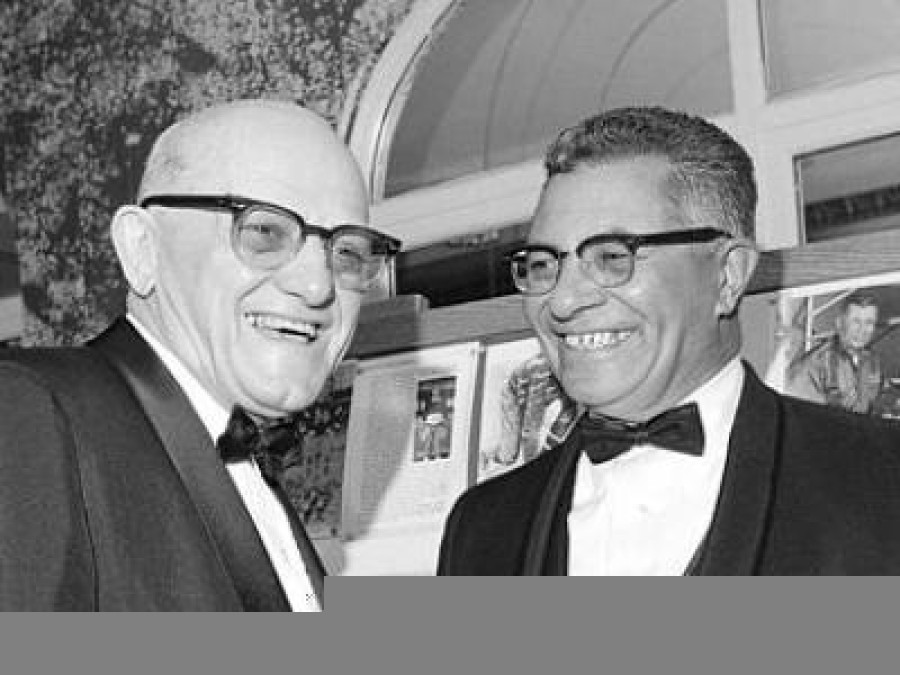
Left: The most important coach in NFL history.
Right: The greatest coach in NFL history.

Don't tell me that Bill Belichick, who was fired as head coach of the New England Patriots yesterday, is "the greatest coach in NFL history." He is not. Bill Belichick is a damn cheat. And without his biggest co-conspirator in cheating, Tom Brady, we saw the real Belichick, in Cleveland, 1991-95: 36-44. And in New England after Brady, 2020-23: 29-38.

And so, to everybody calling him the greatest coach in NFL history, I quote a great football coach, though not in American football, who never had to cheat, Brian Clough: "You lads are a bloody disgrace!

Top 10 Greatest NFL Coaches

10. Tom Landry. Dallas Cowboys, 1960-88. His greatest contribution may have come as defensive coordinator for the New York Giants, as he invented the 4-3 defense. As a head coach, he won 13 Division titles, reached 12 NFL or NFC Championship Games, and reached 5 Super Bowls, winning 2. Built not one but two great offenses, and not one but two great defenses. Won a Super Bowl against Shula's Dolphins.

I'd rank him higher, but the Cowboys did get a lot of breaks.

9. Weeb Ewbank. Baltimore Colts, 1954-62. New York Jets, 1963-73. A few coaches have won back-to-back NFL Championships, and he's one. But he's the only one to win titles in both the NFL and the AFL, and beat Shula's Dolphins in Super Bowl III.

8. Joe Gibbs. Washington Redskins, 1981-92, 2004-07. With Daniel Snyder as the team's owner the 2nd time around, he couldn't do much. With Jack Kent Cooke as the owner the 1st time around, he took the team to 4 Super Bowls in 9 seasons. Even more remarkable, and this is something no other coach in NFL history can claim, he won 3 Super Bowls, each with a different quarterback. Won a Super Bowl against Shula's Dolphins and an NFC Championship Game against Landry's Cowboys, and split 2 NFC Championship Games against Walsh's 49ers.

7. Bill Parcells. New York Giants, 1983-90. New England Patriots, 1993-96. New York Jets, 1997-99. Dallas Cowboys, 2003-06. Coaching in New York magnified his personality, and made him seem better than he was. But he turned 3 different franchises from horrible losers into winners.

He led the Giants to 2 Super Bowl wins, he got the Patriots into a Super Bowl and saved them from being moved -- at least out of Massachusetts to Connecticut, and possibly out of New England entirely -- and, in what has got to be his greatest achievement, he got the Jets to within a half of a Super Bowl. (Okay, Walt Michael and Rex Ryan also did that, and Ewbank took them all the way. Still.)

6. Don Shula. Baltimore Colts, 1963-69. Miami Dolphins, 1970-95. He won more games than any other NFL coaches, both if you count only the regular season and if you also count the postseason. He built 4 strong defenses: With the Detroit Lions as an assistant coach, in Baltimore, and in Miami in the early 1970s and again in the early 1980s.

He won 15 Division titles, and reached 7 NFL championship games, including 6 Super Bowls. His record in those games was 2-5, and they included a game he never should have lost, Super Bowl III, to Ewbank's Jets. Also lost one each to Landry's Cowboys, Gibbs' Redskins and Walsh's 49ers. But they also included Super Bowls VII and VIII, and VII finished the only undefeated NFL season since the NFL began having playoffs in 1932.

5. George Halas. Chicago Bears, 1920-29, 1933-42, 1946-55, 1958-67. Most NFL Championships, 8. Okay, he was owner for 8 and general manager for 8, but head coach for "only 6." But he never had to cheat. His 324 wins were the record until Shula. Also, unlike the guy at Number 1, an innovator, as he created the modern passing game.

Of course, his greatest innovations were not on the sideline, but in the boardroom, and not just because he founded the damn league.

4. Bill Walsh. San Francisco 49ers, 1979-88. Took a 2-14 team, and made them Super Bowl winners in 2 years. Built maybe the greatest offense in football history. Won 3 Super Bowls and had the team in place that would win 2 more.

Won a Super Bowl against Shula's Dolphins, an NFC Championship Game against Landry's Cowboys, and a Divisional Playoff against Parcells' Giants. Split 2 NFC Championship Games against Gibbs' Redskins.

3. Chuck Noll. Pittsburgh Steelers, 1969-91. Took the worst team in the NFL -- not just at the time, but historically -- and, in 4 seasons, built them into a team that would reach the Playoffs 8 straight years, winning 7 Division titles, reaching 4 Super Bowls, and winning them all, 2 of them against Landry's Cowboys. His offense was as good as any the NFL has ever seen. His defense was even better than that. Split 2 Playoff meetings with Shula's Dolphins.

2. Paul Brown. Cleveland Browns, 1946-62. Cincinnati Bengals, 1968-90. Also, Ohio State, 1941-43. The 1st man ever to coach both an NCAA and an NFL Champion. Won the title in the All-American Football Conference in all 4 seasons of its existence. Won 3 NFL titles. Reached his league's title game 10 straight seasons.

The greatest offensive genius the sport has ever known. Worth noting that Ewbank, Shula, Noll and Walsh either played for him or were on his coaching staff.

1. Vince Lombardi. Green Bay Packers, 1959-67. Washington Redskins, 1969. In 1958, the Packers were 1-10-1. 1st year: Got them over .500. 2nd year; Division title. 3rd year: NFL Champions. 4th year: NFL Champions. 5th year: Missed Playoffs. 6th year: Missed Playoffs. 7th year: NFL Champions. 8th year: NFL and World Champions. 9th year; NFL and World Champions. To win those 8th and 9th year NFL Championships, had to beat Landry's Cowboys.

Took a year off, a year in which the Redskins were 5-9. 1st year: Got them over .500. Developed cancer and died before his 2nd year with Washington. In what would have been his 4th year, George Allen, a former Halas assistant, got them into the Super Bowl, and came closer than anyone expected to beating Shula's Dolphins.

Top that, Belichick, and do it without cheating. You can't. No one ever has.

Tuesday, April 12, 2022

Yankees Are Bang-Average

Cliché Alert: You can never have too much pitching. And pitching was a big concern for the Yankees going into the 2022 season.

So far, 4 games in, the pitching has not been the problem. By some margin, the bigger problem has been situational hitting.

Last night, the Yankees began a 4-game home series against the Toronto Blue Jays. Jameson Taillon started for the Pinstripes, and had the team's longest and best start yet: 5 innings, allowing 2 runs on 5 hits, no walks and 6 strikeouts. 

But he also allowed a 2-run home run to George Springer. Michael King pitched pretty well for nearly 3 innings, but allowed an additional run in the 7th.

The Yankees got only 4 hits, all singles by players who hadn't been hitting: 2 by Joey Gallo, and 1 each by Gleyber Torres and Aaron Hicks. And only 1 of those hits, a single by Gallo, came in the 1st 6 innings, as Alek Manoah pitched brilliantly for those pesky Blue Jays.

The Yankees went into the bottom of the 9th with a chance. Gallo led off with what should have been a double, but with his lack of speed was only a single. Still, there was hope. 

That hope was extinguished when Torres grounded into an easy 6-4-3 double play. It got infuriating when Hicks singled. Had Torres done so as well... but "Cashman's Jeter" didn't. And Kyle Higashioka struck out to end it.

Blue Jays 3, Yankees 0. WP: Manoa (1-0). SV: Jordan Romano (3). LP: Taillon (0-1).

Bill Parcells, a great New York coach in another sport, taught us, "You are what your record says you are." The Yankees are 2-2, and it says that they are a bang-average team: Capable of winning when they bang, but they don't do it in enough games, leaving them average.

Yogi Berra taught us, "It ain't over 'til it's over." And it's very early in the season. Then again, Yogi also taught us, "It gets late early out there."

The series continues tonight -- weather permitting. (It's raining as I type this.) Nestor Cortes starts for the Yanks, Yusei Kikuchi for the Jays. Maybe tonight, we'll actually get some, you know, runs.

Tuesday, July 21, 2020

Top 10 Best Managers/Head Coaches In New York Sports History

Eligibility: Has to be with a major league team. If I go to colleges, that means I have to go out to the suburbs and consider Rutgers, Princeton and Army... and they really don't feel like "New York teams."

So, sorry to Clair Bee of Long Island University, Nat Holman of City College, Howard Cann of NYU, and St. John's bee-ball bosses Joe Lapchick, Frank McGuire and Lou Carnesecca. And I won't even consider a manager/head coach unless he won at least one World Championship in his sport.

Honorable Mention to those New York Tri-State Area head coaches who didn't make this list despite winning World Championships: Miller Huggins, Yankees, 1923, '27 and '28; Bucky Harris, Yankees, 1947; Ralph Houk, Yankees, 1961 and '62; Davey Johnson, Mets, 1986; Earl Potteiger, football Giants, 1927; Steve Owen, football Giants, 1934 and '38; Jim Lee Howell, football Giants, 1956; Frank Boucher, Rangers, 1940; Mike Keenan, Rangers, 1994; Jacques Lemaire, Devils, 1995; Larry Robinson, Devils, 2000; Pat Burns, Devils, 2003; and Joe Girardi, Yankees, 2009.

Dishonorable Mention to Leo Durocher, Dodgers 1938-48 and Giants 1948-56. True, he led 2 different New York baseball franchises to Pennants -- something only Yogi Berra has also done -- and helped the restore the Dodgers from a joke franchise into a powerhouse.

But that was much more due to the maneuverings of executives Larry MacPhail and Branch Rickey. And we know that Durocher cheated to get the Giants the '51 Pennant. To say nothing of how he turned coat from Dodgers to Giants. That was simply not done. Besides, there was only room for one libertine New York baseball manager on this list.

Mention both Honorable and Dishonorable to Billy Martin, Yankees 1975-88 (on and off). He was an alcoholic, a womanizer, a free-spender, an umpire-baiter, a lunatic and a paranoiac -- in other words, things that Leo the Lip also was. But Billy the Brat had less to work with. True, he had Reggie Jackson -- against his will -- but he never had a Willie Mays.

And he still led the Yankees to the 1976 Pennant and the 1977 World Championship. With one more good starter, who knows, he might've gotten the Yankees at least the Division Title in 1985. The relationship between Billy and Yankee owner George Steinbrenner has been likened to that between Elizabeth Taylor and Richard Burton: They couldn't live with each other, but neither could they live without each other.

Who knows what Billy could have done if George had simply let him manage... aside from George stepping in in August 1977 and telling him, "Billy, bat Reggie 4th, or you're fired." That, as Lisa Swan of Subway Squawkers pointed out in a comment the first time I posted this list (when I had Billy ranked 10th), was one time that George knew a lot better than Billy.

10. Gil Hodges, Mets 1968-71. The great 1st baseman of the 1950s Dodgers only managed 4 seasons in New York, and only once in his career (including his earlier managing job with the Washington Senators) did he ever win more than 83 games in a season. But that was in 1969. A "miracle"? Not with Gil Hodges around. It shouldn't shock anyone that the even-tempered Hodges outmanaged the hotheaded Earl Weaver of the Baltimore Orioles in the 1969 World Series.
Gil died of a heart attack, on the eve of his 48th birthday and the 1972 season. I wonder how Met history might have been changed had he simply still been alive on June 15, 1977 (he would've been just 53), and had been able to protect Tom Seaver from M. Donald Grant.

Maybe it wouldn't have made a difference, because, once Mrs. Payson was no longer around to protect anyone, Grant probably would've fired Gil anyway. Face it, if he could trade Seaver, he could pretty much do whatever he wanted. It was only the sale of the team by Mrs. Payson's dimwitted daughter that stopped him.

That Hodges is not yet in the Baseball Hall of Fame can be explained by the fact that Hall voters do not combine achievements as a player and as a manager: You can be elected as one or the other, but not both.  But the Mets retired his Number 14, and elected him to their team Hall of Fame.

9. Joe McCarthy, Yankees 1931-46. They called him "a push-button manager," and the fact that he inherited Babe Ruth, Lou Gehrig, Bill Dickey, Red Ruffing and Lefty Gomez prevents him from rising higher on this list. Then again, the man known as Marse Joe always knew which buttons to push.

The Yankees won the Pennant under his leadership in 1932, '36, '37, '38, '39, '41, '42 and '43, winning the World Series in all by '42. Seven World Series: No manager has ever won more. In postseason play, his teams were a whopping 29-10, including sweeps in '32, '38 and '39.
Oddly, even though he was managing in the major leagues as late as 1950, he never wore a number on his uniform. But he is in the Baseball Hall of Fame, and the Yankees have honored him with a Plaque in Monument Park.

8. Tom Coughlin, Giants 2004-15.  His regular season record was 102-90, and 8-3 in postseason play. In the 2007 and 2011 seasons, each time, just when it looked like the players were about to revolt and lead to his firing, he settled everybody down, righted the ship, and led Big Blue to win the Super Bowl. That alone would get him into the Top 10. The fact that both of those wins are against the cheating bastards from Foxboro makes it all the sweeter.
Face it, when a team comes into the Super Bowl undefeated, and is going for a perfect season, it takes a damn good coach to prevent it. George Allen couldn't do it in 1973, but Tom Coughlin did it in 2008.

That Super Bowl XLVI win, on February 5, 2012, remains the last World Championship for any major league team in the New York Tri-State Area. Since then, the Mets have won a Pennant, the Rangers have reached a Stanley Cup Final, and the Red Bulls have won 3 Supporters' Shields for best regular-season record in Major League Soccer and reached a U.S. Open Cup Final. But that's it. Coughlin shouldn't still be the last Big Apple (and environs) field boss to have won a title.

7. Joe Torre, Yankees 1996-2007. Another "push-button manager"? Unlike pre-1969 managers, Joe had to go through not just 1 round of postseason play, but 2; and unlike 1969-93 managers, he had to go through not just 2 rounds, but 3. He won 17 postseason series, a total matched only by Tony LaRussa. (Bobby Cox? 12.) He was 17-8 in postseason series and 76-47 in postseason games. He won 6 Pennants and 4 World Championships. And he raised the Yankee legacy higher than anyone had before.
Sure, some of his moves (particularly with pitchers) seemed baffling, especially later on in his career. But "Clueless Joe," the name the Daily News gave to him on its back page after he was hired? As Joe McCarthy would have said, "My God, man, you were never that!"

He is now in the Baseball Hall of Fame, and the Yankees retired his Number 6 and given him a Plaque in Monument Park.

6. Lester Patrick, Rangers 1926-39. The Silver Fox had already been a great player, as had his brother Frank Patrick, and both would be elected to the Hockey Hall of Fame as players rather than "builders" (the HHOF's name for coaches and executives). But both men -- sometimes together, sometimes not -- made their biggest marks in suits rather than in sweaters.

Lester was the Rangers' head coach for their 1st 2 Stanley Cups (1928 and '33), and their general manager for their 1st 3 (add 1940). His greatest achievement came in Game 2 of the 1928 Stanley Cup Finals against the Montreal Maroons, when, at age 44, he had to substitute for his injured goalie Lorne Chabot. He volunteered, having played the position only once in his life, and not having played at all in 12 years (he had been a defenseman). Lots of players have since played to that age and beyond, including some goalies, but, at the time, it was unusual.

Putting on a Number 16 jersey (the NHL mandated uniform numbers starting with the 1926-27 season), he told his players, "Boys, don't let an old man down." With their help, he allowed just 1 goal as the Rangers beat the Maroons in overtime and went on to win their first Cup. It made him the oldest player ever to play in the Finals, a record that still stands. (In 2008, Chris Chelios was with the Detroit Red Wings at age 46, but did not appear in the Finals.)
Don't get too excited: This photo has been colorized.

He stepped aside for his former best player, Frank Boucher, and watched as Boucher led them to the '40 Cup. Put it this way: The Rangers didn't win a Cup without either Patrick or Boucher being involved until the franchise was 68 years old.

But as glorious as Patrick's career was, he wasn't the best hockey coach in Tri-State Area history. That would be...

5. Al Arbour, Islanders 1973-94. Like Lester Patrick, Al Arbour had been a pretty good defenseman, winning Stanley Cups with 3 different teams: The 1954 Detroit Red Wings, the 1961 Chicago Blackhaws, and the 1962, '63 and '64 Toronto Maple Leafs. He came close to winning with a 4th, reaching the Finals with the 1968, '69 and '70 St. Louis Blues.

As a head coach, he took the Islanders, then a 2nd-year expansion team, got them to the Stanley Cup Semifinals in only their 3rd season (beating the Rangers in the process), and built a force that dominated the division then named for Lester Patrick from 1978 to 1984, eventually reaching 5 straight Cup Finals and winning 4 straight Cups -- in each case, still a unique achievement for an American hockey team.
From April 1980 to May 1984, he won 19 straight postseason series -- a record for any coach, and for any team, in any sport, anywhere in North America. It's hard to believe that the Islanders, who have been so mediocre for so long, could have been that dominant, but they were: The Nassau Coliseum was nicknamed "Fort Neverlose."

Arbour stepped aside after the 1986 season, but came back 2 years later, and in 1993 got them back to the Conference Finals. Put it this way: Under Arbour as head coach, the Isles won 31 postseason series; with all others, they've won 3 -- and 2 of those came in 2016 and '18.

Having coached 1,499 NHL games, on November 3, 2007, at the request of Islanders coach Ted Nolan, Arbour was signed to a one-day contract to coach his 1,500th. At age 75, he became the oldest man ever to coach an NHL game. The Islanders beat the Pittsburgh Penguins 3–2, giving Arbour his 740th win. The banner honoring him with the number 739 on it, standing in for a retired number, was brought down from the Coliseum rafters, and was replaced with one with the number 1500. More even than Denis Potvin, Al Arbour was the New York Islanders. He is in the Hockey Hall of Fame.

4. Bill Parcells, Giants 1983-90, Jets 1997-99. He didn't just win games, he saved the reputations of franchises. That's plural. Both the Giants and the Jets were jokes when he stepped in. In between, so were the New England Patriots.

He got the Giants to win Super Bowls XXI and XXV, stepped aside for health reasons, took the Patriots' job (which, at the time, was not a job for a man with a heart condition -- but he hasn't had heart trouble since), got them into Super Bowl XXXI (but didn't win), and then saved the Jets from the 4-28 Rich Kotite disaster, getting them to the 1998 AFC Championship Game -- and they were leading John Elway and the Denver Broncos at the half at Mile High Stadium. The Broncos' talent won out, but the Big Tuna had brought Gang Green back from the abyss, as he had with Big Blue.
Parcells has the image of being what the average New York Tri-State Area football fan likes to think he is: Smart as a whip, but still in touch with his blue-collar roots (regardless of whether the jersey he wears over that blue collar is Giant blue or Jet green -- or even Rutgers scarlet), knowing just how much crap to take, and knowing what to do when you reach your limit thereof; finding the balance between having good humor and being a tough bastard.

Of course, with the way Parcells has left teams, and where he's gone afterward, and how he's teased teams he's ended up not joining, he seems to be missing one quality that New Yorkers and New Jerseyans tend to hold in very high esteem: Loyalty. And, whenever The One Great Scorer calls him to that great stadium in the sky, Parcells will have to answer for foisting Bill Belichick on America. But he is finally, rightfully, in the Pro Football Hall of Fame.

3. Leonard "Red" Holzman, Knicks, 1967-82. Boston Celtics fans will say that their own Red Auerbach was the coach who invented modern pro basketball; but then, Auerbach was also the general manager who got the players, not just the coach who led them. Not having that amount of control, Red became the model for all NBA coaches who followed him.

With him, they won 2 out of 3 NBA Finals, beating Wilt Chamberlain, Jerry West, Elgin Baylor and the Los Angeles Lakers in 1970 and '73, losing to the Lakers in '72. With all other head coaches combined, they are 0-5 in NBA Finals.
Keep in mind, the Knicks were the last of the "old" New York teams to win a World Championship; even the Mets and Jets, less than 10 years old at the time, had beaten them to it. That's what made 1970 so special. In '73, on the way to the Finals, they became the 1st team ever to beat the Celtics in a Playoff series Game 7 at the Boston Garden.

A very good player in the 1940s and '50s, who understood teamwork like few coaches ever has, he taught it to his players, leading with respect rather than fear like a Vince Lombardi would. He made a work ethic something to embrace, rather than something to consider drudgery. And still, his teams added sizzle to their steak. The 1970 Knicks, along with the 1955 Dodgers and the 1969 Mets, are probably one of the 3 most beloved single-year sports teams in the City's history.

Red is the only man in the Basketball Hall of Fame based on having coached a professional team in the New York Tri-State Area, and a banner with the number 613 on it, signifying his regular-season wins as Knick head coach, hangs in Madison Square Garden, standing in for a retired uniform number.

2. John McGraw, baseball Giants 1902-32. I know I said I was going to limit this to 1920 onward, but he excelled in baseball management on both sides of that demarcation line. More even than Connie Mack, the Little Napoleon was the defining baseball manager of the 1st 1/3rd of the 20th Century.
A star 3rd baseman in the 1890s, he took his win-at-any-costs attitude to the Polo Grounds, and turned the baseball Giants from perhaps the worst team in the majors at that point to the best in just 2 years.

He won Pennants in 1904, '05, '11, '12, '13, '17, '21, '22, '23 and '24. He remains the only National League manager to win 4 straight, and one of only 2 to win 3 straight, which he did twice. He won the World Series in 1905, 1921 and 1922.

In 1937, he and Mack became the 1st 2 managers elected to the Baseball Hall of Fame. Anyone who remembers him as an active manager would be close to 100 years old, but he deserves to have his achievements remembered.  Although they haven't been in New York in over 60 years, the San Francisco Giants honor McGraw, and his favorite player, star pitcher Christy Mathewson, with "NY" signs with their retired numbers, as both served the club in the era before numbers were worn.

1. Casey Stengel, Dodgers 1934-36, Yankees 1949-60, Mets 1962-65. A former player of McGraw's, the Ol' Perfesser didn't do too well managing in Brooklyn. Nor in his next job, with the Boston Braves. He missed a few games after he was hit by a cab, and a Boston sportswriter named the driver as the man who did the most for Boston sports in 1943.

Casey had a young Warren Spahn at the time, and had Spahn at the end of each man's career with the 1965 Mets. Spahn said, "I'm the only man who played for Casey both before and after he was a genius." And no matter what kind of genius he was, he could do nothing with the early Metropolitans, except promote them and make them lovable losers: "Come and see my Amazin' Mets! I been in this game 100 years, but they've shown me ways to lose I never knew existed before!"

But while he brought fans to the Mets, he brought championships to the fans the Yankees already had. They were in a transition when he arrived in 1949, with the stars that McCarthy managed starting to age -- and some of them, such as Joe DiMaggio, Tommy Henrich and Phil Rizzuto, didn't exactly like him or his managing style.

But he got his own guys in: Yogi Berra, Whitey Ford, the aforementioned Billy Martin, and, of course, Mickey Mantle. Remembering McGraw's platoon style, lefty hitters against righty pitchers and vice versa, he had guys who were starting half the time and pissed off at him the other half, so they were always trying to prove him wrong by playing great when they did play -- thus proving both sides right.

He managed 12 seasons, won 10 Pennants to tie McGraw's record (and break Mack's American League record), and won 7 World Series to tie McCarthy's record. He won the World Series in 1949, 1950, 1951, 1952 and 1953, making the Yankees the only MLB team to win 5 straight. He won the Pennant in 1955, the Series in 1956, the Pennant in 1957, the Series in 1958, and the Pennant in 1960 before being fired, allegedly due to his age (70, although others have managed that long, and well, including Torre.)

As Newark Star-Ledger columnist Jim Ogle said, "Well, 'the clown' did pretty well. He won 10 Pennants in 12 years, and he made the Yankee legend and mystique grow volumes." More than at any other time in their history, under Huggins, under McCarthy, under Houk, under Martin, even under Torre, these were "the lordly Yankees."

Both the Yankees and the Mets have retired his Number 37. The Yankees gave him a Plaque in Monument Park, and the Mets gave him the equivalent honor by electing him to their team Hall of Fame. The road around Shea Stadium, and now the one around Citi Field, were named Casey Stengel Plaza. And the MTA rail yard between the ballpark and Flushing Meadow-Corona Park is named for him.

Was Casey Stengel the greatest baseball manager ever? The greatest game boss in New York sports history? It is my opinion that he is both of those things. The facts to support this opinion? There is a large body of work full of them. As the man himself would say, "You can look it up."

Saturday, January 4, 2020

Top 5 Reasons You Can't Blame Bill Belichick for Leaving the New York Jets

January 4 is simply not a good day for Jet fans. 

January 4, 1995, 25 years ago: Rich Kotite, in spite of having cost the Philadelphia Eagles a Playoff spot by losing the last 7 games of the previous season, is hired as head coach of the New York Jets.

Kotite was a local guy, from Staten Island, and was a decent tight end for the New York Giants in the early 1970s. But he was already known as a bafflingly dumb coach.

Jets owner Leon Hess had his reason for hiring him: "I'm 80 years old. I want results now!" The assembled media laughed. 
Hess got results, all right: 3-13 in 1995, 1-15 in 1996.

To put it another way: From November 13, 1994 to December 22, 1996, as an NFL head coach, Rich Kotite was 4-35, for a "winning" percentage of .114. That is:

* Slightly better than the worst 39-game stretch any NFL team has ever had: The 2007-09 Detroit Lions were 3-36, .077.

* Slightly better than the worst season in NBA history: The 1972-73 Philadelphia 76ers were 9-73, or .110.

* Worse than the worst season in NHL history: The 1974-75 Washington Capitals were 8-67-5, or .131. And...

* Worse than the worst season in MLB history: The 1899 Cleveland Spiders were 20-134, or .149.

Two days before the 1996 regular-season finale, with Jet fans from Morristown to Montauk, from Bear Mountain to Cape May, wanting him fired or worse, Kotite resigned. The long metropolitan nightmare was over. For now. Kotite has never been employed, in any capacity, by another NFL team.

Hess begged Bill Parcells to come back to the Meadowlands, and the rebuild began. Parcells, head coach of the New York Giants from 1981 to 1990, and of the New England Patriots from 1993 to 1996, went 9-7 in 1997.
In 1998, he went 12-4, setting a new team record for wins in a season, and achieving the Jets' 1st division title since the 1970 NFL merger. (They had won the AFL East in 1968 and '69.) They beat the Jacksonville Jaguars in the Divisional Playoff, and led the Denver Broncos at halftime of the AFC Championship Game, in Denver no less, before losing.

Then Hess died, close to the results he wanted. But Jet fans had hope. In the opening game of the 1999 season. quarterback Vinny Testaverde tore his Achilles tendon, and was out for the season. Somehow, Parcells squeezed an 8-8 season out of what was left. But he was 58 and tired, and resigned as head coach, vowing never to hold that job again (he later made a liar of himself), and stayed on as general manager.

Bill Belichick had worked with Parcells, as an assistant coach on the Giants from 1979 to 1982; an assistant to him on the Giants from 1983 to 1990, building the defense that won Super Bowls XXI and XXV; an assistant to him on the Patriots in 1996, winning the AFC Championship but losing Super Bowl XXXI; and an assistant to him on the Jets from 1997 to 1999. Parcells arranged for the team to select Belichick as his successor.
*
January 4, 2000, 20 years ago: One day after the arrangement is made, the press conference that was supposed to announce it ends with a napkin to owner Woody Johnson, on which Belichick had written, "I RESIGN AS HC OF THE NYJ." Not so abbreviated: He speaks for half an hour, justifying his decision.

Just 16 days later, he is hired as head coach of the Patriots, the Jets' arch-rivals. (No, the Miami Dolphins are not the Jets' arch-rivals. Nor are the Raiders, regardless of what city they're in at any moment.) The Jets, to whom he was still under contract, demanded compensation. The NFL awarded the Jets the Pats' 1st round pick in the next NFL Draft, which they ended up trading, anyway.

Linebackers coach Al Groh was hired in Belichick's place. He went 9-7, just missing the Playoffs. Considering all that had happened to the Jets recently, this wasn't bad at all. Then he left as well, taking the head coaching job at his alma mater, the University of Virginia.


In the last 20 seasons, 2000 to 2019 (not counting the results of this season's postseason):


* Regular-season games won: Patriots 237, Jets 148.


* Record against each other, including Playoffs: Patriots 31, Jets 11.


* Playoff seasons: Patriots 17, Jets 6.


* AFC East Championships: Patriots 17, Jets 1 (2002).


* Postseason games won: Patriots 31, Jets 6.


* AFC Championship Game appearances: Patriots 13, Jets 2.


* AFC Championships: Patriots 9, Jets 0.


* Super Bowls won: Patriots 6, Jets 0.


* Head Coaches: Patriots 1 (Bill Belichick), Jets 6 (Al Groh, Herman Edwards, Eric Mangini, Rex Ryan, Todd Bowles and Adam Gase).


To put this in perspective: The Patriots have been in 68 percent of the AFC Championship Games played since 9/11. Since the formation of the AFC in 1970, the Patriots have won it -- how many times, Ed Rooney? -- 9 times, the Pittsburgh Steelers 8, the Denver Broncos 8, the Miami Dolphins 5, the Raiders 5, and everybody else 14.


The Patriots have won as many Super Bowls as any other team, tying the Steelers with 6, and you have to go back to 1961 to find a team that's won more NFL Championships, and, even then, the Green Bay Packers have won those 7 in 59 years, compared to the Patriots winning their 6 in 18 and the Steelers their 6 in 45.
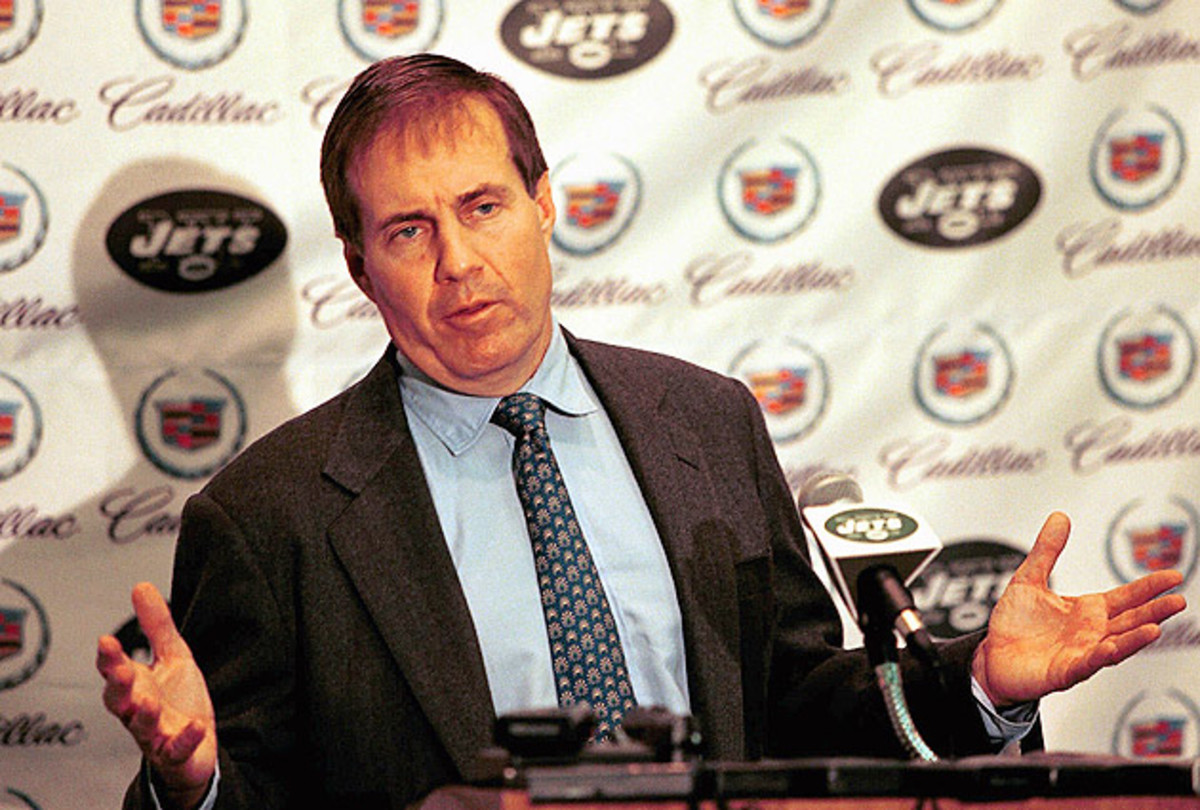
Pictured: One smug, self-satisfied, cheating son of a bitch.

The Jets keeping Belichick would almost certainly have meant no dynasty for the Patriots. So, Belichick did the right thing, right?


Not by Jet fans, he didn't. It would have been bad enough had he left them for anyone else, but the Patriots? New England? 


Before 20 years ago, Yankee Fans hated the Boston Red Sox, while Met fans mocked them over the 1986 World Series; Knick fans hated the Boston Celtics, and so did Net fans, to a lesser degree; Ranger fans hated the Boston Bruins, and so did Islander and Devils fans, to a lesser degree.


But Jet fans' hatred for the Patriots was minor, compared to what they felt for the Dolphins and Raiders. As Massachusetts native chef Emeril Lagasse would say, this abandonment kicked it up a notch! And that was before the Pats started winning -- dubiously, as we would later find out.


But can we really blame Belichick for this?


Top 5 Reasons You Can't Blame Bill Belichick for Leaving the New York Jets


5. Past Failures. Parcells looked like he was working miracles with the Jets, but he didn't get the team to the Super Bowl in his 3 years with them. And that was a good tenure by Jet standards.

The season after Super Bowl III, 1969, Weeb Ewbank got the Jets to the AFL East title again, the last AFL East title before the merger, and the Jets moving into the new AFC East. After that, though, he never had another winning season.

Lou Holtz, already a success at North Carolina State, was hired for the 1976 season, and he went 3-10 before being fired before the season's last game. To know what Holtz did later at Arkansas, Minnesota, Notre Dame and South Carolina, you might be shocked to know how badly he did with the Jets.

Charley Winner, Walt Michaels, Joe Walton and Bruce Coslet had all been good NFL assistant coaches, but all failed as Jet boss. Maybe that's a little unfair for Michaels: He took a really good Jet defense and a good-but-not great offense to the 1982 AFC Championship Game. In other words, he was as successful as any other post-Weeb Jet coach has been.

The aforementioned Rich Kotite had gotten the Philadelphia Eagles into the Playoffs, and was 36-21 over his 1st 3 1/2 seasons at Veterans Stadium. But I've already told you the rest: He seemed like a good hire at the start of 1995, but by the end of 1996, he had cemented himself as perhaps the worst NFL coach ever. So, 6 seemingly good hires turned sour for the Jets, and, having been around the team, and being a keen student of football history, Belichick surely knew the story.

And that doesn't even count Pete Carroll, who won National Championships at USC and a Super Bowl with the Seattle Seahawks after leaving the Jets, but who had never had a head coaching job before the Jets gave him one.

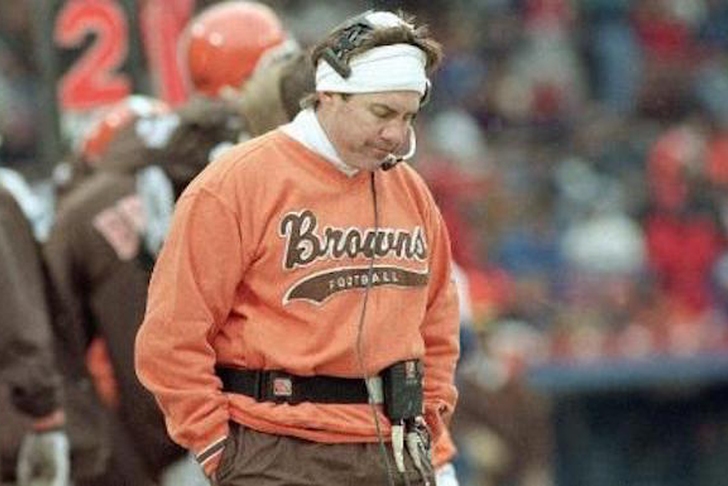
4. Bill Parcells. Belichick's only head coaching job until 2000 had been with the Cleveland Browns from 1991 to 1995, and he got them into the Playoffs just once, in 1994. After that, in just 1 year, he went from 11-5 to 5-11. Maybe he needed Parcells. (Or maybe he needed to cheat.)
This was after Walter Payton and Jim McMahon
made wearing headbands on a sideline cool,
but before Belichick discovered hoodies. 

There's an old saying: You don't want to be the guy who follows the legend; you want to be the guy who follows that guy. Both Parcells and Belichick first worked for the Giants as assistants to Ray Perkins, who had played for Paul "Bear" Bryant at the University of Alabama. When Bryant retired after the 1982 season, Perkins was hired to replace him. It didn't work out, because everyone expected him to be Bear II. And he never would be.


(Perkins had been a receiver on Alabama's National Champions of 1964 and '65 over the Dallas Cowboys. After 'Bama, he was head coach of the Tampa Bay Buccaneers for 4 years and Arkansas State for 1; served as Parcells' offensive coordinator on the Pats; and then served on the Oakland and Cleveland staffs. Now 78, he has coached at a high school in Mississippi since 2014.)


If Belichick had stayed with the Jets, he would have been Parcells' man, but he would also have been expected to work miracles like Parcells had, both in East Rutherford and in Foxborough. And the pressure on him would have been tremendous, especially after his 1st season: In 2000, the Giants got back to the Super Bowl, although they lost it to the Baltimore Ravens.


Which leads to... 


3. The New York Media. Belichick is a grouch. Parcells can be pretty grouchy, too, but he also knew how to get the New York media on his side. The Boston media can be every bit as nasty, but Belichick toys with them because the winning came first.


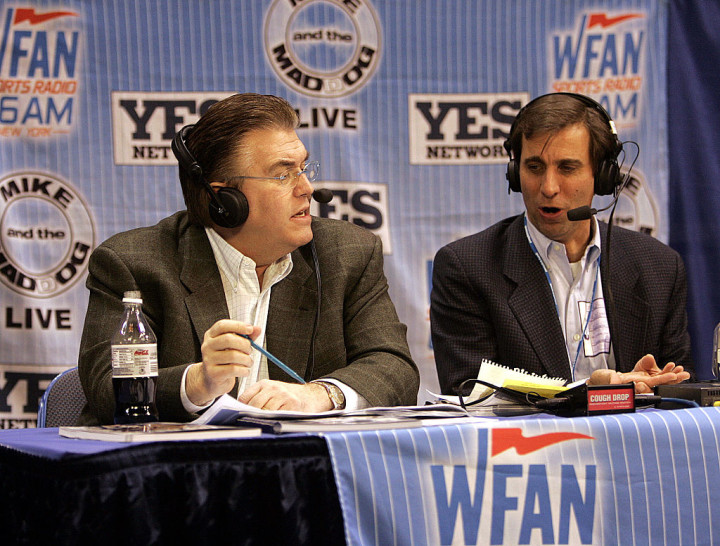
If the winning didn't come quickly in New York, how long would it have taken Steve Serby of the Post, Rich Cimini of the Daily News, Mike & the Mad Dog and their WFAN listeners, etc. to turn on him? Not long. Why would he have wanted to put up with that? For the money that Woody Johnson would have given him? Bob Kraft was willing to give him more money and more control. Not having Parcells look over his shoulder may have helped.

Mike Francesa: "So, Dog, what did you think of the Jets yesterday?"
Chris Russo: "Ah ha ha ha ha ha ha ha ha!"

2. Same Old Jets. The franchise is cursed. Joe Namath has always sworn that there was no deal with the Devil, that he didn't trade half a century or more of Jet glory for that 1 win in Super Bowl III in 1969. And "The Curse of Sonny Werblin" doesn't wash, because Sonny was forced out before that season. "The Curse of Broadway Joe"? Certainly, Joe himself would never have placed a curse on the Jets.

So what's the curse? Maybe it doesn't matter. Things happen to this team. Bad officiating. Bad weather. Untimely injuries. Coaches leaving for whatever reason. Coaches turning out to be flops (Eric Mangini proving he was no "Mangenius," Rex Ryan proving he couldn't run an offense any better than his father Buddy could).
The expression is "Same Old Jets." Think of it this way: If the Jets had played that Playoff game against the Raiders in a snowy, windy Giants Stadium, and the same play had happened, you know which one, would "The Tuck Rule" have saved them, or would the play have been ruled in Duh Raiduhs' favor? What do you think?

But even if things had gone the Jets' way with Belichick in charge, they would have stopped. Because he would have been caught...

1. Cheating. Spygate. Deflategate. Six players testing positive for performance-enhancing drugs. Now, Spygate II. And that's just what we know. Every single game the Patriots have won under Belichick, all 268 of them going into tomorrow's Playoff game against the Tennessee Titans, are now suspect. Guilty until proven innocent.
Would Belichick still have done all this stuff -- or allowed others working for him to do some of this stuff -- if he'd stayed with the Jets? Would Parcells have put up with it (presuming he was still there the 1st time Belichick got caught, instead of going off to Dallas to coach the Cowboys)?

I don't think so. Belichick wants to win in the worst way; Parcells wants to win in the best way. To use a Star Wars analogy: It's like Parcells is Obi-Wan Kenobi, while Belichick is Anakin Skywalker, turned to Darth Vader, with (so far) no redemption arc. (Does that make Pats owner Robert Kraft Palpatine? Who is Luke Skywalker in this scenario? Or do we have to wait another 30 years for a Rey?)


Maybe he wouldn't have done well with the Jets if he'd cheated. Certainly, not if he hadn't. Maybe we saw the real Belichick in Cleveland, a 36-44 coach. After all, his quarterback in East Rutherford would have been Chad Pennington. He was good, but not as good as a cheating-aided Tom Brady.


You've seen the case for the prosecution: Belichick screwed the Jets over, went to the Patriots, and has spent 20 years screwing the entire League over.


You've seen the case for the defense: Staying would likely have done neither the man nor the team much good.


It's time to decide.


VERDICT: Guilty. Let's face it, what good was taking the job for 24 hours, and then leaving it in a public way? He should have listened to the offer, said, "Give me 24 hours to think about it," and then made his decision, "No." If he had done that, it wouldn't have made a difference in either team's record over the last 20 years, but at least his knife wouldn't have any back blood on it.


Instead, Belichick came into the Jets' house, ate their food, drank their liquor, watched their TV, slept in their guest room, and made a mess... and then walked out as soon as he got a better offer.


And he's never said he's sorry. But we wouldn't want him to lie to us, would we? Any apology he would give now would be as fraudulent as his 6 titles.


UPDATE: A few minutes after I posted this, I found out that the Patriots had lost, at home, to the Titans, their season over.

Good. Take that, you smug, self-satisfied, cheating son of a bitch!

Sunday, December 10, 2017

Faux Flashback: How to Go to a Giants or Jets Game at Giants Stadium


I have become disillusioned by football, as a result of the frustrations over the poor performances of the football teams at East Brunswick High School and Rutgers University, the fecklessness of NFL Commissioner Roger Goodell, the cheating of the New England Patriots, and seeing what the game of football has done to men, including to their brains.

Has it really been all that long since football seemed free of such problems? Return with us now, to those thrilling days of yesteryear... Say, the end of the 20th Century, when the Jets were contenders, and the Giants were, at the least, a team with historical significance, both recent and distant, but not yet the team that humiliated the Cheatriots in 2 Super Bowls. Come with me to Giants Stadium (with updates in italics)...

Before You Go. In New York and North Jersey, anything is possible as far as the weather goes, but there are some usuals. It can get really hot early in the season, really cold from November on out, and the biggest thing wrong with Giants Stadium, the wind, wasn't fixed for MetLifeStadium, even with $1.6 billion at their disposal. So be aware of the possibility of any kind of weather. Check the newspaper or local TV websites for the forecast before you decide what to wear.

It's the Eastern Time Zone, so you don't have to worry about fiddling with your timepieces if you actually are a Giants fan, or a Jets fan, or a fan of any of the teams in the East visiting them this season. If you're living in the Central Time Zone, turn your clocks ahead 1 hour; the Mountain Time Zone, 2 hours; and the Pacific Time Zone, 3 hours.


Tickets. The games are usually sold out well in advance, with all 80,242 seats sold (if not actually occupied during the game). This is in spite of the fact of the familiar joke that the only reason anyone goes to Jet games is that they can't get tickets to Giant games. Tickets in the lower 2 levels usually go for $75, and for $50 in the upper deck.

That's based on memory, from a 1996 visit. I could be wrong.

Getting There. For reasons that will soon become clear, I'm advising you to get to New York/New Jersey by a means other than driving: Plane, train, bus. Then get a hotel nearby (there are several near both Newark Airport and the Sports Complex), and then either get a rental car or take public transportation (especially the latter if you're actually staying in New York City).

Despite the fact that the Meadowlands Sports Complex is just 8 miles from Times Square, if you're in the City, getting to there by public transportation has never been easy. The only way to do it was to get to the Port Authority Bus Terminal at 41st Street & 8th Avenue (A, C or E train to 42nd Street), and then take the New Jersey Transit 320 bus in. This is still possible, and, theoretically, you can get from bus station to stadium gate in 20 minutes.

But, as I said, the traffic will be bad, so make sure you leave Port Authority no later than an hour before kickoff (12:00 or 3:00 for most Sunday games). Round-trip fare is $4.50.

Today, it's $9.00. At least now, you have the option of taking the train, New Jersey Transit from New York's Penn Station to Secaucus Junction, and then transferring to the Meadowlands Rail Spur. That's $11.

If you're driving, here's how to get to the Meadowlands Sports Complex by car: 

* From New York City itself: Take the Lincoln Tunnel, which will empty out onto New Jersey Route 3, which will take you directly to the stadium. With regular traffic, it should take you 20 minutes from entering the tunnel to getting off Route 3. This will not be regular traffic, and you should avoid this at all costs. Better to take New Jersey Transit, as I'll explain in "Going In."


* From New England: Take Interstate 95 South, including the Cross Bronx Expressway and the George Washington Bridge, to the New Jersey Turnpike and Exit 16W.

* From other points North: Take the New York State Thruway, Interstate 87 South, to Exit 15, to State Route 17, which will keep its numeric designation as it crosses the New York-New Jersey State Line. Take State Route 120 East to the stadium.

* From Central Jersey: Take the Turnpike North to Exit 16W.

* From the Jersey Shore: Take the Garden State Parkway North to Exit 129, then the Turnpike North to Exit 16W -- making sure you take the Western Spur, not the Eastern Spur, which leads to the Lincoln Tunnel.

* From Philadelphia (Eagles): Take the Ben Franklin Bridge to U.S. Route 30 East to State Route 38 East, to State Route 73 South, to the Turnpike, to Exit 16W.

* From other points South, including Washington, D.C. (Redskins) and Miami (Dolphins): Take Interstate 95 North into Delaware, then take the Delaware Memorial Bridge to the New Jersey Turnpike, to Exit 16W.

* From points West, including Buffalo (Bills): Take any route that gets you to Interstate 80 East, to U.S. Route 46 East, to State Route 3 East, to the Sports Complex. Or, take any route that gets you to Interstate 78 East, to the Turnpike, to Exit 16W.

Be advised that traffic around the stadium is going to be hellacious, even though (unless you're foolish enough to drive to a New York hotel) you'll never actually be entering New York City. So, whatever driving time I gave you, allow yourself at least half an hour to get from Exit 16W to your parking space.

Once In the City. East Rutherford is a Borough of 9,164 people in Bergen County, New Jersey. Its most famous native is basketball announcer Dick Vitale. If not for the Meadowlands complex, which opened in 1976 with Giants Stadium and the Meadowlands Racetrack, added the arena now named the IZOD Center in 1981, and replaced the Stadium with MetLife in 2010, it might very well be best known for producing Dickie V, bay-bee! It's not like, aside from the Complex, there's anything noticeable about the town.


The sales tax in New Jersey is 7 percent. ZIP Codes in North Jersey tend to begin with the digits 07, including 071 for Newark and environs, 072 for Elizabeth, 073 for Jersey City, and 075 for Paterson. Central and South Jersey got ZIP Codes starting with the digits 08, including 084 for Atlantic City, 086 and 086 for Trenton, and 089 for New Brunswick and environs.

New Jersey's original Area Code was 201. 609 was split off in 1958, 908 in 1991, 732 in 1997, and 856 in 1999. Now, they serve as follows: 201, with 551 overlaid in 2001, serves only Bergen and Hudson Counties (including the Meadowlands, and thus MetLife Stadium, and Harrison, and thus Red Bull Arena); 609 serves Mercer County (including the capital of Trenton and Princeton University) and the Southern Shore region (including Atlantic City); 732, with 848 overlaid, much of Central Jersey (including Rutgers University) and the Northern Shore region; 856, the Delaware River region that serves as suburbs of Philadelphia; 908, the Counties of Union, northern Somerset, Morris and Warren; and 973, with 862 overlaid, the Counties of Essex (including Newark, and thus the Prudential Center) and Passaic.

Because they used to play at Shea Stadium, and their headquarters -- office and practice facility -- is at Weeb Ewbank Hall on the campus of Hofstra University in Hempstead, across the street from the Nassau Coliseum -- the Jets are the more popular team in Queens and Long Island. The Giants are more popular in the rest of the Tri-State Area. I guess Sports Illustrated had it right in 1986, when the Giants were on their way to their 1st Super Bowl win and the Jets were also Playoff-bound.
For those of you not old enough to remember the 1980s,
those really are professional football players of the time,
not the leaders of a gangsta rap group and a hair metal band.

Going In. Despite the fact that the Meadowlands Sports Complex is just 8 miles from Times Square, if you're in the City, getting to there by public transportation has never been easy. It used to be that the only way to do it was to get to the Port Authority Bus Terminal at 41st Street & 8th Avenue (A, C or E train to 42nd Street), and then take the New Jersey Transit 320 bus in. This is still possible, and, theoretically, you can get from bus station to stadium gate in 20 minutes.

But, as I said, the traffic will be bad, so make sure you leave Port Authority no later than an hour before kickoff (12:00 or 3:00 for most Sunday games). Round-trip fare is $9.00. The official address of the Stadium is 50 Route 120. Parking is $25. Tailgating is allowed in the Stadium parking lots.
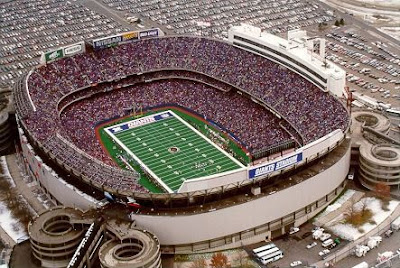
Giants Stadium -- set up for a Jets game.

Seating capacity is 76,891. The field is artificial turf, and runs (more or less) north-to-south. And while summer clothes may be fine for September or even early October, the wind can be nasty, so if you're going in November or later, bring a winter coat, a hat, gloves, maybe even earmuffs.

A temporary grass field was laid down in 1994, for the World Cup, because FIFA, the governing body for world soccer, has ruled that all World Cup matches must be played on real grass. It wasn't until 2000 that a permanent grass field was put down. It turned out to not be all that permanent -- and not because the stadium was doomed, either. The field couldn't hold up to all the events at the stadium, and so it was replaced by a new FieldTurf carpet after only 3 years.
The Giants have played there since 1976, the Jets since 1984. It was also home to the New Jersey Generals of the USFL from 1983 to 1985, and the New York/New Jersey Knights of the World League of American Football in 1991 and 1992.

College football made its home there with Rutgers playing half their home games there from 1976 to 1992 (due to Rutgers Stadium only holding 23,000 at the time), all their home games there in 1993 (due to Rutgers Stadium being demolished and rebuilt as a modern 41,000-seat stadium), and the occasional game there since. It also hosted the Garden State Bowl from 1978 to 1981, and the Kickoff Classic from 1983 to 2002.

In soccer, it was home to the New York Cosmos of the North American Soccer League from 1977 to 1984, and it hosted the NASL championship game, the Soccer Bowl, in 1978 and 1979. It hosted 7 games of the 1994 World Cup, including a famous game between Italy and Ireland (a natural matchup for the New York Tri-State Area) and the Semifinal between Italy and Bulgaria. The new league, Major League Soccer, debuted the New York/New Jersey MetroStars there in 1996.

In its last few years, Giants Stadium hosted both the Giants, the Jets and the Red Bulls until their league's respective 2009 seasons, games of the 1999 Women's World Cup, and the Finals of the 2005 and 2009 CONCACAF Gold Cups, the continental tournament for national teams in North America, Central America, and the Caribbean. It also hosted the New York/New Jersey Hitmen of the ill-advised, ill-fated XFL, a 1 "home game" for the hurricane-displaced New Orleans Saints in 2005.

Despite a rainstorm, Pope John Paul II delivered a Mass there in 1995. Among the concerts held there have been numerous Bruce Springsteen shows, including the 1986 A Conspiracy of Hope Benefit Concert for Amnesty International, which also featured Joan Baez, Jackson Browne, Sting and U2; U2's 1987 stand; and hard-rock festivals Ozzfest and Monsters of Rock. The Three Tenors -- Luciano Pavarotti, Placido Domingo and José Carreras -- sang at Giants Stadium on July 20, 1996.

Food. It's ordinary and expensive. Eat before and after the game. As I said, tailgating is permitted.

Team History Displays. As the only stadium in the NFL that has, as they would say in soccer, "groundsharing," it is difficult to have team history displays at Giants Stadium. The Jets hang banners with their retired numbers on the sideline, but the Giants, the older team and the more successful team, do not. And neither team, thus far, hangs representations of their World Championships (the Jets only the 1, the Giants 6.)

With the opening of MetLife Stadium, and the electronically-aided switching between home teams, signs can be turned out around the lip of the upper deck, showing the Giants' and Jets' Rings of Honor.

Stuff. There are souvenir stands around the stadium, but no big team store.

That would change after the move. On the first floor of the outer edge of MetLife Stadium, along the west sideline, is The Flagship Store, as big as most Sports Authority or Modell's outlets, that sells both Giant and Jet gear. Which includes Giants' and Jets' hard hats, which so many fans in the urban Northeast and Midwest like to wear, imagining themselves to be as tough as construction workers. Ha ha.

During the Game. 
Although New Yorkers and New Jerseyans can be intense, a visiting fan will probably be safe attending a game at MetLife Stadium. Giant fans may verbally harass people wearing Eagles or Cowboys gear, but if you don't provoke them, it won't get any worse than that. As for Jet fans, they'll probably leave you alone. But, again, don't provoke them, and you should be all right.

Both teams hold auditions for National Anthem singers, rather than having a regular do it. Neither team has a mascot. Neither team has ever had cheerleaders. The teams really don't need them. These are, after all, New Yorkers, New Jerseyans, and Connecticutians... uh, Connecticutites... uh, people from Connecticut.

The Giants still don't have cheerleaders. The Jets Flight Crew was established in 2007.


As I said, it was Giant fans in 1956 that invented the "Dee-FENSE!" chant. Jet fans, however, are content to chant, "J! E! T! S! Jets! Jets! Jets!" Giant fans may wonder if that's the best that Jet fans can do, but Jet fans can say, "At least we've proven we can spell." Of course, Giant fans could come back with "'Jets' is a four-letter word."

The man who leads the J-E-T-S chants from Section 134 (an end zone) of Giants Stadium is New York fireman Edwin "Fireman Ed" Anzalone. 
A native of College Point, Queens, not far from the Jets' former home of Shea Stadium, he wears a fireman's hat decorated with Jets gear, and a jersey, Number 42, in honor of former Jet running back Bruce Harper. Oddly, while continuing to work with the FDNY, he actually lives in East Rutherford.
He stopped going "in character" for a while -- apparently, it was Mark Sanchez's "Butt Fumble," on Thanksgiving Night 2012 against the arch-rival Patriots, that made him give up -- but he came back.

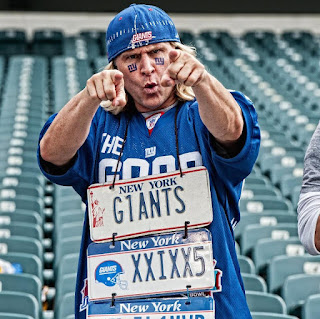
As for the Giants, I previously thought that they don't have any fans who are any more noticeable than the others. But this isn't true: Joe Ruback, a.k.a. License Plate Guy, has attended every Giants home game since Giants Stadium opened in 1976, and has attended every away game since 2003, too. He first came to a Giants game with his original plate, one of the old orange New York plates with blue lettering, reading "G1ANTS."

He now has a collection that he rotates, including a vanity plate with a Giants helmet (available from New York's DMV even though the Giants play in New Jersey), reading "XXIXX5" for their 1st 2 Super Bowl wins. (I guess someone already had "XXI XXV.") Like Fireman Ed, he's no dope: He's trusted enough to be the athletic director at a school in Yonkers, and runs a design company. 
That's got to be heavy. Certainly, heavier than Ed's helmet.

After the Game. Traffic may be even worse after the game than before. After all, those 77,000 people have tried all day to get into the parking lot, some to tailgate, some just to see the game. Afterward, they all want to get out as soon as possible. (Well, maybe not all. Some fans like to do a postgame tailgate, too.) Be advised: It may take a while to get out.

Route 3 is probably your best bet for a postgame meal, as there are plenty of chain restaurants. It's a typically tacky and commercial Jersey highway. Manny's Cocktail Lounge, a.k.a. "Manny's of Moonachie" (that's pronounced Moo-NAH-key), made famous as a watering hole by fans of the 1980s Giants, is at 110 Moonachie Avenue.


It has long since gone out of business, replaced by a Cuban-themed restaurant and banquet hall, La Havana 59. 

Sidelights. This is where I discuss other sports-related sites in the metropolitan area in question, and then move on to tourist attractions that have no (or little) connection to sports. Since most people reading this will be from the Tri-State Area, I'll skip it.


*

The New York Giants and the New York Jets no longer play in New York City, or even in New York State, but still represent the Big Apple after all these years. To be fair, the Meadowlands Sports Complex is only slightly farther from Midtown Manhattan than Shea Stadium was, and not that much further than Yankee Stadium. So they're still a good match for The City.

If you follow these instructions carefully, you'll be able to get in, through and out of a Giants or Jets game safely. Not without stress, to be sure, and I can't guarantee a win (I'm Uncle Mike, not Broadway Joe), but safely.