I just got a look at the NFL Playoff game between the Cincinnati Bengals and the Houston Texans. At this writing, it's the 3rd quarter, and the Texans lead, 17-10.
This was the 44th season for the Bengals, and only the 10th time they've made the Playoffs. This was the 10th season for the Texans, and the 1st time they've made it, having also won their first AFC South Division Championship. The last time a Houston team made the NFL Playoffs was the 1993 Houston Oilers, now the Tennessee Titans, 18 seasons ago.
The Bengals are coached by Marvin Lewis, who never played in the NFL. The Texans are coached by Gary Kubiak, best known as John Elway's backup on the Denver Bronco teams that won 3 AFC titles but no Super Bowls.
Like a lot of athletes who were good enough to make it to the major league level of their sport, but not good enough to excel at it, they put their love and knowledge of the game to work in coaching. Kubiak became a respecting quarterbacking coach and offensive coordinator before getting the Texans head job.
Lewis, undrafted out of Idaho State, returned to his alma mater as an assistant coach, and worked his way into the pros, becoming the defensive coordinator that built the Baltimore Ravens defense that led them to the 2000 NFL Championship and Super Bowl XXXV -- holding the Giants to 7 points, and those on a kickoff return, making them the only team with no "offensive points" in a Super Bowl. (Of course, by definition, all points are scored by the offense, even if you pick up a fumble or intercept a pass, at that moment, even if you're a 300-pound defensive end, your side becomes the offense.)
While it's not the lowest point total ever in a Super Bowl -- in SB VI, in 1972, the Dallas Cowboys held the Miami Dolphins to a field goal -- it is the lowest point total in an NFL championship game, under any name, since the Cleveland Browns shut out the Baltimore Colts in 1964.
*
What about the other teams in the NFL Playoffs?
Giants: Tom Coughlin won Super Bowl XLII, and got the Jacksonville Jaguars to the AFC Championship Game in only the franchise's 2nd season. But while he set Syracuse University's pass-reception record on a team that had Larry Csonka and Floyd Little in its backfield, he went undrafted by the NFL. He coached at Syracuse, and made his name as Boston College's quarterbacks coach, turning a 5-foot-9-and-3/4 kid named Doug Flutie into a Heisman Trophy winner. He coached with Philadelphia and Green Bay before joining Bill Parcells' Giant staff, then became BC's head man before coaching the Jags and the Giants.
New England Patriots: Bill Belichick has won 3 Super Bowls -- perhaps by cheating -- but as a player, went right from college to working for a pro coach, Ted Marchibroda of the Baltimore Colts, and began his coaching rise that way, including coaching on Parcells' staff, along with Coughlin and some other names that became head coaches. I don't know what Coughlin learned from watching Belichick, but Belichick's been a head man in 4 Super Bowls, all of them close, and Coughlin's Giants are the only one to beat him.
Pittsburgh Steelers: Mike Tomlin, like Coughlin, set receiving records at his school, William & Mary, but went undrafted. He coached under Tony Dungy and Jon Gruden with the Tampa Bay Buccaneers, and when Bill Cowher left the Steelers they hired Tomlin, who has now led them to 2 AFC titles and a Super Bowl win.
New Orleans Saints: Sean Payton was one of the 1987 strikebreakers, playing 3 games for Chicago's "Spare Bears." Like Fox, he was on Jim Fassel's staff for the 2000 NFC Champion Giants, and led the Saints to their first Super Bowl appearance and win.
Green Bay Packers: Mike McCarthy went to Baker University, an NAIA school in Kansas -- there's the NCAA Football Bowl Subdivision (formerly known as Division I-A), there's the NCAA Football Championship Subdivision (formerly Division I-AA), there's NCAA Division II, there's NCAA Division III... and then there's the NAIA. But McCarthy made his way to the nearby Kansas City Chiefs, where he was on a staff that got them to the 1993-94 AFC Championship Game, the closest the franchise has gotten to the Super Bowl since 1969-70. Maybe some of the Chiefs' veteran quarterback, Joe Montana, rubbed off on him. He became a well-regarded quarterbacks coach and then offensive coordinator before getting the Pack head job, and in the past 2 seasons has led them to a Super Bowl win and a 15-1 season which makes them the favorites to do it again.
Denver Broncos: Jon Fox played at San Diego State, where he was a teammate of Herman "You play to win the game!" Edwards, but went undrafted. Prior to his current job, his jobs including defensive coordinator for the Giants under Jim Fassel and the head job with the Carolina Panthers, whom he led to the 2003 NFC Championship before losing Super Bowl XXXVIII to Belichick's Pats.
Atlanta Falcons: Mike Smith was the defensive MVP at East Tennessee State University, but 1 year in Canada was the limit of his pro playing experience. Like Marvin Lewis, he was on Brian Billick's Ravens staff before being hired in Atlanta. He has taken a franchise that was a horror show after the Michael Vick fiasco and turned it into a very respectable unit again.
San Francisco 49ers: Jim Harbaugh is almost an exception to what I'm suggesting is a rule. The son of Jack Harbaugh, an assistant coach to Bo Schembechler at the University of Michigan, he became Michigan's quarterback, got the Bears into the Playoffs a couple of times, and got the Indianapolis Colts to the 1995 AFC Championship Game. He was a member of the Oakland Raiders staff that won the 2002 AFC Championship, then was named head coach at the University of San Diego and Stanford University before being named Niners head man earlier this year. He seems to have singlehandedly turned Alex Smith from one of the biggest first-pick-in-the-draft busts ever into a Playoff quarterback.
Baltimore Ravens: Jim's older brother John Harbaugh never played in the NFL, having been a defensive back at Miami University of Ohio. The brothers' father, Jack Harbaugh, was an assistant to University of Michigan coach Bo Schembechler, who had played at Miami and recommended John to the school. He spent 10 years on Andy Reid's Philadelphia Eagles staff before getting the Ravens job.
Detroit Lions: Jim Schwartz played at Georgetown University, the Washington, D.C.-based school far better known for its basketball team. He was a Titans assistant under Jeff Fisher and helped them win the 1999 AFC Title and make more Playoff appearances in the 2000s. After the Lions bottomed out with their 2008 0-16 season, he was brought in, and has made them a Playoff team in just 3 years. Considering that this is his first head job, and what he had to work with at the start, this may be the most amazing NFL coaching job in a long time.
*
"Okay, Mike," I can hear you say, "this theory of yours makes sense for the moment. But is it historically true?"
Let's see. First, let's start counting from 1933 onward. Why? Two reasons: First, it was the 1st season in which there was an official NFL Championship Game; second, we're now getting out of the era of player-coaches, men who were playing and coaching at the same time.
1933 Chicago Bears: George Halas. Good player, not a great one. In the Pro Football Hall of Fame as a coach and owner, much more than as a player.
1934 New York Giants: Steve Owen. Good player, not a great one. In the Hall of Fame as a coach, not a player.
1935 Detroit Lions: George "Potsy" Clark. I can't find much information about his playing career, which suggests he was, at best, ordinary.
1936 Green Bay Packers: Earl "Curly" Lambeau. Good player, not a great one. In the Hall of Fame as a coach, not a player.
1937 Washington Redskins: Ray Flaherty. An exceptional player, helping the Giants win the 1927 NFL Championship (in the pre-title game era). His Number 1 is, by some sources, the 1st uniform number to be retired by any team in any sport. In the Hall as a player.
1938 Giants: Owen.
1939 Packers: Lambeau.
1940 Bears: Halas.
1941 Bears: Halas.
1942 Redskins: Flaherty.
1943 Bears: Heartley "Hunk" Anderson, a former Notre Dame star, and Luke Johnsos (not "Johnson") were co-head coaches while Halas was a Navy officer during World War II. Although Anderson was a very good collegiate player, neither had starred in the NFL.
1944 Packers: Lambeau.
1945 Cleveland Rams: Adam Walsh. Not to be confused with the boy of the same name, whose kidnapping and murder inspired his father John Walsh to start the TV show
America's Most Wanted, this Adam Walsh was one of the linemen known as the "Seven Mules," blocking for the "Four Horsemen," that helped Notre Dame win the 1924 National Championship. But he never played in the pros -- although by the standards of the time he would have been considered an excellent prospect. Despite winning the title, the Rams did not draw well in Cleveland, and became the only team in North American major league sports history to win a "world championship" and then move for the next season, to Los Angeles.
1946 Bears: Halas.
1947 Chicago Cardinals: Jimmy Conzelman was one of the NFL's 1st stars, and was player-coach of the 1928 NFL Champions, the Providence Steam Roller. (Officially, the name had no S on the end -- why, I don't know. But most people just called them the Steam Rollers, anyway, and some surviving artifacts of the team such as banners and game programs have the S on the end. The franchise went bust in 1933 due to the Depression.) Conzelman is in the Hall of Fame, mainly as a player.
1948 Philadelphia Eagles: Earle "Greasy" Neale was a very good baseball player, the starting right fielder for the 1919 Cincinnati Reds. He played both Major League Baseball and pro football with Jim Thorpe (albeit in the pre-NFL era). As a football player, he wasn't as good as he was at baseball.
1949 Eagles: Neale.
1950 Cleveland Browns: Paul Brown was one of the greatest minds the game of football has ever produced, but he never played in the pros.
1951 Los Angeles Rams: Joe Stydahar played on Halas' 1940 "Monsters of the Midway" and is legitimately in the Hall as a player.
1952 Detroit Lions: Raymond "Buddy" Parker played on the Lions' 1935 title team, but wasn't a great player.
1953 Lions: Parker.
1954 Browns: Brown.
1955 Browns: Brown.
1956 Giants: Jim Lee Howell played 10 years for the Giants and was a member of their 1938 title team, but was not particularly noteworthy as a player. As a head coach, he's remembered less for leading the Giants to this title than for his assistants: Offensive coordinator Vince Lombardi and defensive coordinator Tom Landry.
1957 Lions: George Wilson played for Halas' 1940 Bears, like Stydahar; unlike Stydahar, he was an unremarkable player. But he did lead the Lions to what, for the moment, remains their last title, after Parker quit in a huff in the preceding off-season. Wilson was also the first head coach of the Dolphins. He should not be confused with George "Wildcat" Wilson who in the 1920s starred at the University of Washington and then played under Conzelman on the 1928 Champion Steam Roller. Oddly, I know a pair of brothers named George and Merle Wilson -- but Merle is the Dolphin fan, while that George likes the Redskins.
1958 Baltimore Colts: Wilbur "Weeb" Ewbank is the only man to be head coach of both an NFL Champion and an AFL Champion, the 1968-69 Jets. But he never played pro ball.
1959 Colts: Ewbank.
1960 Philadelphia Eagles: Lawrence "Buck" Shaw was a teammate of Hunk Anderson on Knute Rockne's 1920 Notre Dame team that won the National Championship, but he never played pro ball.
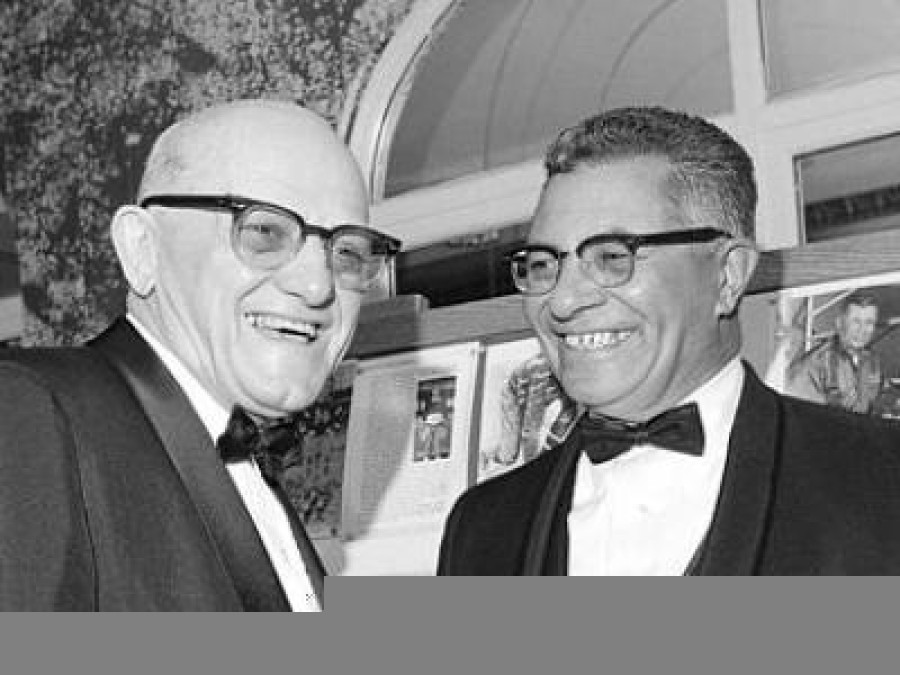
1961 Packers: Vince Lombardi was a member of the "Seven Blocks of Granite" team that made Fordham University a formidable side in the late 1930s, but he never played in the pros.
1962 Packers: Lombardi.
1963 Bears: Halas.
1964 Browns: Blanton Collier is the most recent man to lead a Northern Ohio-based team to a World Championship, but he never played pro ball.
1965 Packers: Lombardi.
1966 Packers: Lombardi.
1967 Packers: Lombardi.
1968 New York Jets: Ewbank.
1969 Kansas City Chiefs: Hank Stram was an exceptional all-around athlete in high school, but World War II interrupted his college days and he went right into coaching in peacetime.
1970 Baltimore Colts: Don McCafferty played only 1 season of pro ball.
1971 Dallas Cowboys: Tom Landry was a very good player, a 2-way star for the University of Texas in the late 1940s, with Bobby Layne of the 1950s Lions as his quarterback. When the NFL went 2-platoon in the early '50s, he was the first player to make his mark as purely a defensive back. He became one of the great defensive minds in the game's history, building the unit that became the 1st one to lead fans to chant "De-FENSE!" as the Giants won the 1956 NFL Championship. He became the Cowboys' first head coach in 1960 and was their only one until 1988. He's in the Hall as a coach, but could have been elected as a player.
1972 Miami Dolphins: Don Shula was a good defensive back for the Colts, but not a great one.
1973 Dolphins: Shula.
1974 Pittsburgh Steelers: Chuck Noll was a very good 2-way lineman for Paul Brown's Cleveland Browns, but not a great one.
1975 Steelers: Noll.
1976 Oakland Raiders: John Madden was drafted by the Philadelphia Eagles in 1959, but wrecked his knee in training camp and never played a pro down. But that worked out wonderfully for him because Eagle quarterback Norm Van Brocklin was studying game film in the locker room and called him over, and taught Madden how to analyze game film. Madden couldn't play on the Eagles' 1960 NFL Champions, but he became an assistant in the AFL with the San Diego Chargers and then the Raiders, and was one of the few coaches in the era before the 16-game schedule to win 100 regular-season games in 10 years.
1977 Cowboys: Landry.
1978 Steelers: Noll.
1979 Steelers: Noll.
1980 Oakland Raiders: Tom Flores was the 1st-ever starting quarterback for the Raiders, but was an ordinary player, unlike later Raider signal-callers Daryle Lamonica, George Blanda, Ken Stabler, Jim Plunkett, Jay Schroeder and Rich Gannon.
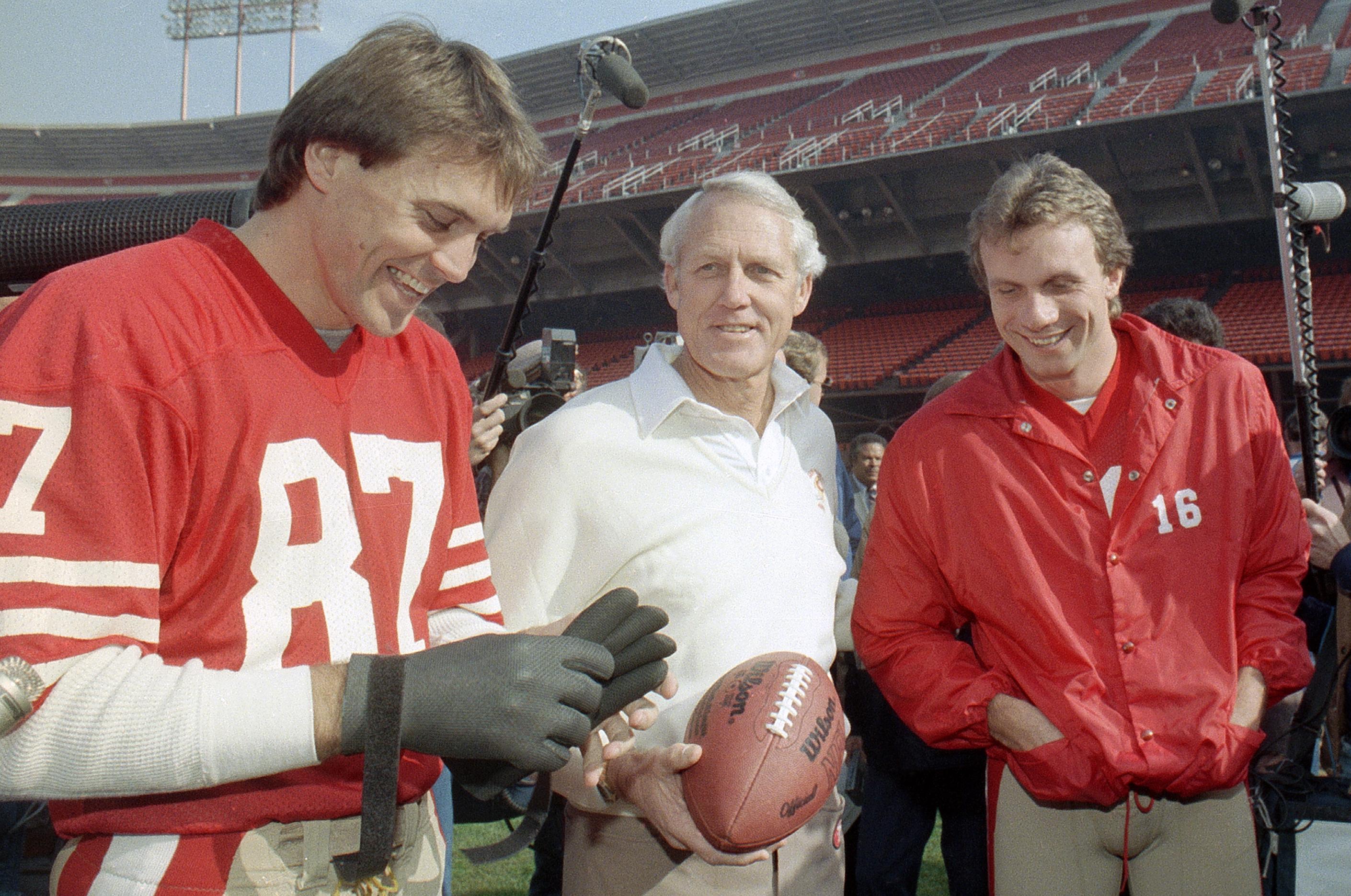
1981 San Francisco 49ers: Although Bill Walsh he played football and boxed at San Jose State University, and served as a worthy assistant to Paul Brown with the original Cincinnati Bengals, he never played a down in the pros.
1982 Washington Redskins: Joe Gibbs went right into coaching after graduating from San Diego State, and never played a down in the pros.
1983 Los Angeles Raiders: Flores.
1984 49ers: Walsh.
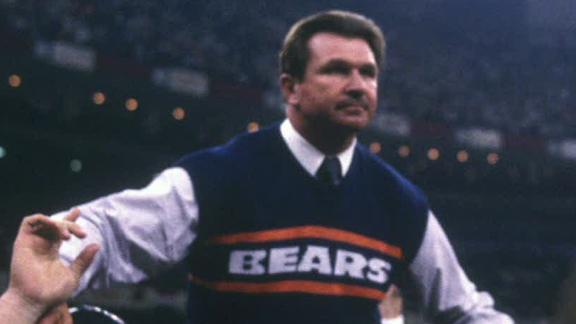
1985 Chicago Bears: Mike Ditka is in the Hall as a player, and justifiably so, as he was the 1st offensive end to be a modern tight end, and helped Halas win his last title with the 1963 Bears and Landry his 1st with the 1971 Cowboys.
1986 Giants: Bill Parcells was drafted by the Detroit Lions but cut before the season started, and never played in the NFL.
1987 Redskins: Gibbs.
1988 49ers: Walsh.
1989 49ers: George Seifert never played in the pros.
1990 Giants: Parcells.
1991 Redskins: Gibbs.
1992 Cowboys: Jimmy Johnson played for the University of Arkansas' 1964 team that won a split National Championship, but never played in the pros. He made his name coaching at Oklahoma State and the University of Miami (the one in Florida, not the one in Ohio). His college teammate, Jerry Jones, bought the Cowboys, fired Landry, and hired Johnson, enabling him to become the 1st man to be head coach of both a college National Champion and a Super Bowl winner. But Jones drove Johnson nuts (not a long drive), Johnson quit, and Jones hired legendary University of Oklahoma coach Barry Switzer, who preceded them both as an Arkansas player, and then became the 2nd such coach.
1993 Cowboys: Johnson.
1994 49ers: Seifert.
1995 Cowboys: Barry Switzer played at Arkansas, but went right into the U.S. Army and then into coaching after his discharge.
1996 Packers: Mike Holmgren has been called the best high school quarterback the City of San Francisco has ever produced -- hard to imagine, considering how fat he was by the time he became an NFL head coach -- and was a backup on the 1967 University of Southern California team that won a National Championship, thanks to another San Franciscan, O.J. Simpson. Holmgren was drafted by the St. Louis Cardinals, but washed out with both them and the Jets before the season began, and never played in the pros.
1997 Denver Broncos: Mike Shanahan was a quarterback at Eastern Illinois University, but a freak injury in practice ruptured a kidney, nearly killing him and ending his chances at a pro career. He was 2-0 in Super Bowls with the Broncos, the 2nd win coming at the expense of the Atlanta Falcons, coached by Dan Reeves -- who had a good pro career with Landry's Cowboys, first as a running back (SB VI) and then as an assistant coach (SB XII -- same with Ditka), but was 0-3 in Super Bowls as Bronco head man.
1998 Broncos: Shanahan.
1999 St. Louis Rams: Dick Vermeil was a backup quarterback at San Jose State, and never had a chance to play pro ball. But he's been named a Coach of the Year in high school, junior college, Division I-A (leading UCLA to win a Pacific Eight title and a Rose Bowl) and the NFL, getting the Eagles to their first Championship Game appearance in 20 years (losing Super Bowl XV) and getting the Rams to their first World Championship in 49 years (winning Super Bowl XXXIV).
2000 Baltimore Ravens: Brian Billick was drafted by the 49ers but was cut by them and the Cowboys and never played pro ball.
2001 New England Patriots: Belichick, as I said, never played pro ball.
2002 Tampa Bay Buccaneers: Jon Gruden was a backup quarterback at Ohio's University of Dayton and never had much of a chance to play in the NFL.
2003 Patriots: Belichick.
2004 Patriots: Belichick.
2005 Steelers: Bill Cowher ends a 20-year run of Super Bowl-winning coaches who never played so much as a single down in the NFL. A linebacker, he wasn't a great player, but he did help the Browns' "Kardiac Kids" dethrone their arch-rivals, the Steelers, as AFC Central Division Champions in 1980.
2006 Indianapolis Colts: Tony Dungy was a defensive back who didn't play long in the NFL, but did get a ring with the 1978 Steelers. He then became a boy-wonder coach, serving under Noll on the Steelers, Marty Schottenheimer on the Chiefs and Dennis Green on the Minnesota Vikings before getting the Bucs' job. Fired right before they could take the last step, he was quickly hired by the Colts, and led them to their 1st title since moving from Baltimore.
2007 Giants: Coughlin, as I said, never played pro ball.
2008 Steelers: Tomlin, as I said, never played pro ball.
2009 Saints: Payton, as I said, was a strikebreaker, but otherwise never played pro ball.
2010 Packers: McCarthy, as I said, never played pro ball.
2011 To Be Determined.
*
So, counting multiple winners multiple times, counting the 1943 Anderson/Johnsos entry as one player, and counting coaches who didn't play pro ball at all as "mediocre players":
Great players: 7
Good players: 20
Mediocre players: 50
Being charitable, the only "great players" to have become title-winning NFL coaches in the last 60 years are Tom Landry and his former player and assistant Mike Ditka. Being more specific, the only Hall of Fame player to have become a title-winning NFL coach in the last 60 years is Ditka.
Consider some of the Hall of Fame players who have become NFL head coaches from 1951 onward: Sammy Baugh, Tom Fears, Norm Van Brocklin, Otto Graham, Joe Schmidt, Bart Starr, Mike Singletary.
But since Stydahar coached the '51 Rams to the title, the only other HOF players to be head coaches of teams that even got into the NFL Championship Game (1952-65) or the Super Bowl (1966 season through 2010) is Forrest Gregg, who played on Lombardi's 5 Packer titles and Landry's 1st Cowboy title. (So did Herb Adderley, who's never been an NFL head coach. He and Gregg are the only NFL players to have played on 6 title-winning teams.)
I'm not the only person to think about this idea. It's long been suggested that great players, when they become coaches, get frustrated with players under them who aren't as good as they were, and even more so with players who are good but don't put up the kind of effort the coach once did.
I'll look at the other major sports in subsequent entries.
Oh, and it's a final from Reliant Stadium in Houston: Texans 31, Bengals 10. This is the 1st time since December 29, 1991 -- 19 years and 9 days -- since a Houston team has won an NFL Playoff game. That time? At the Astrodome, the Oilers won 17-10 over... the Jets.