Showing posts with label weeb ewbank. Show all posts

Friday, January 12, 2024

Top 10 NFL Coaches

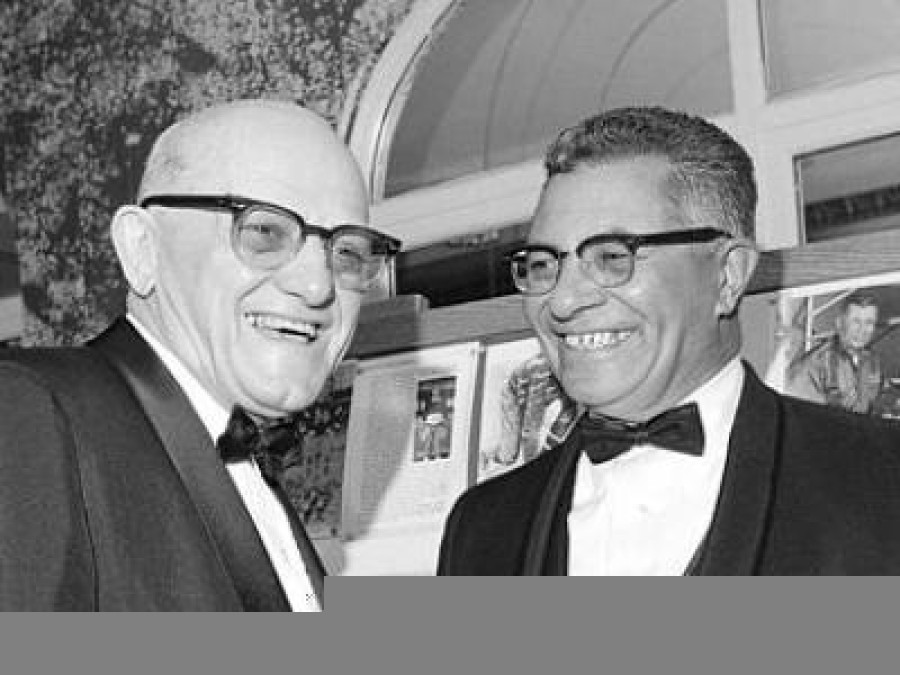
Left: The most important coach in NFL history.
Right: The greatest coach in NFL history.

Don't tell me that Bill Belichick, who was fired as head coach of the New England Patriots yesterday, is "the greatest coach in NFL history." He is not. Bill Belichick is a damn cheat. And without his biggest co-conspirator in cheating, Tom Brady, we saw the real Belichick, in Cleveland, 1991-95: 36-44. And in New England after Brady, 2020-23: 29-38.

And so, to everybody calling him the greatest coach in NFL history, I quote a great football coach, though not in American football, who never had to cheat, Brian Clough: "You lads are a bloody disgrace!

Top 10 Greatest NFL Coaches

10. Tom Landry. Dallas Cowboys, 1960-88. His greatest contribution may have come as defensive coordinator for the New York Giants, as he invented the 4-3 defense. As a head coach, he won 13 Division titles, reached 12 NFL or NFC Championship Games, and reached 5 Super Bowls, winning 2. Built not one but two great offenses, and not one but two great defenses. Won a Super Bowl against Shula's Dolphins.

I'd rank him higher, but the Cowboys did get a lot of breaks.

9. Weeb Ewbank. Baltimore Colts, 1954-62. New York Jets, 1963-73. A few coaches have won back-to-back NFL Championships, and he's one. But he's the only one to win titles in both the NFL and the AFL, and beat Shula's Dolphins in Super Bowl III.

8. Joe Gibbs. Washington Redskins, 1981-92, 2004-07. With Daniel Snyder as the team's owner the 2nd time around, he couldn't do much. With Jack Kent Cooke as the owner the 1st time around, he took the team to 4 Super Bowls in 9 seasons. Even more remarkable, and this is something no other coach in NFL history can claim, he won 3 Super Bowls, each with a different quarterback. Won a Super Bowl against Shula's Dolphins and an NFC Championship Game against Landry's Cowboys, and split 2 NFC Championship Games against Walsh's 49ers.

7. Bill Parcells. New York Giants, 1983-90. New England Patriots, 1993-96. New York Jets, 1997-99. Dallas Cowboys, 2003-06. Coaching in New York magnified his personality, and made him seem better than he was. But he turned 3 different franchises from horrible losers into winners.

He led the Giants to 2 Super Bowl wins, he got the Patriots into a Super Bowl and saved them from being moved -- at least out of Massachusetts to Connecticut, and possibly out of New England entirely -- and, in what has got to be his greatest achievement, he got the Jets to within a half of a Super Bowl. (Okay, Walt Michael and Rex Ryan also did that, and Ewbank took them all the way. Still.)

6. Don Shula. Baltimore Colts, 1963-69. Miami Dolphins, 1970-95. He won more games than any other NFL coaches, both if you count only the regular season and if you also count the postseason. He built 4 strong defenses: With the Detroit Lions as an assistant coach, in Baltimore, and in Miami in the early 1970s and again in the early 1980s.

He won 15 Division titles, and reached 7 NFL championship games, including 6 Super Bowls. His record in those games was 2-5, and they included a game he never should have lost, Super Bowl III, to Ewbank's Jets. Also lost one each to Landry's Cowboys, Gibbs' Redskins and Walsh's 49ers. But they also included Super Bowls VII and VIII, and VII finished the only undefeated NFL season since the NFL began having playoffs in 1932.

5. George Halas. Chicago Bears, 1920-29, 1933-42, 1946-55, 1958-67. Most NFL Championships, 8. Okay, he was owner for 8 and general manager for 8, but head coach for "only 6." But he never had to cheat. His 324 wins were the record until Shula. Also, unlike the guy at Number 1, an innovator, as he created the modern passing game.

Of course, his greatest innovations were not on the sideline, but in the boardroom, and not just because he founded the damn league.

4. Bill Walsh. San Francisco 49ers, 1979-88. Took a 2-14 team, and made them Super Bowl winners in 2 years. Built maybe the greatest offense in football history. Won 3 Super Bowls and had the team in place that would win 2 more.

Won a Super Bowl against Shula's Dolphins, an NFC Championship Game against Landry's Cowboys, and a Divisional Playoff against Parcells' Giants. Split 2 NFC Championship Games against Gibbs' Redskins.

3. Chuck Noll. Pittsburgh Steelers, 1969-91. Took the worst team in the NFL -- not just at the time, but historically -- and, in 4 seasons, built them into a team that would reach the Playoffs 8 straight years, winning 7 Division titles, reaching 4 Super Bowls, and winning them all, 2 of them against Landry's Cowboys. His offense was as good as any the NFL has ever seen. His defense was even better than that. Split 2 Playoff meetings with Shula's Dolphins.

2. Paul Brown. Cleveland Browns, 1946-62. Cincinnati Bengals, 1968-90. Also, Ohio State, 1941-43. The 1st man ever to coach both an NCAA and an NFL Champion. Won the title in the All-American Football Conference in all 4 seasons of its existence. Won 3 NFL titles. Reached his league's title game 10 straight seasons.

The greatest offensive genius the sport has ever known. Worth noting that Ewbank, Shula, Noll and Walsh either played for him or were on his coaching staff.

1. Vince Lombardi. Green Bay Packers, 1959-67. Washington Redskins, 1969. In 1958, the Packers were 1-10-1. 1st year: Got them over .500. 2nd year; Division title. 3rd year: NFL Champions. 4th year: NFL Champions. 5th year: Missed Playoffs. 6th year: Missed Playoffs. 7th year: NFL Champions. 8th year: NFL and World Champions. 9th year; NFL and World Champions. To win those 8th and 9th year NFL Championships, had to beat Landry's Cowboys.

Took a year off, a year in which the Redskins were 5-9. 1st year: Got them over .500. Developed cancer and died before his 2nd year with Washington. In what would have been his 4th year, George Allen, a former Halas assistant, got them into the Super Bowl, and came closer than anyone expected to beating Shula's Dolphins.

Top that, Belichick, and do it without cheating. You can't. No one ever has.

Saturday, December 16, 2023

December 16, 1973: O.J. 2,000 & Weeb's Farewell

December 16, 1973, 50 years ago: O.J. Simpson sets the NFL's single-season rushing yards record, becoming the 1st player to rush for 2,000 yards in a season.

In 1934, Beattie Feathers of the Chicago Bears became the 1st NFL player to rush for 1,000 yards in a season. His 1,004 yards stood as the record until 1947, when Steve Van Buren of the Philadelphia Eagles raised it to 1,008. In 1949, Van Buren broke his own record, with 1,146.

Jim Brown played 9 seasons in the NFL, 1957 to 1965, all with the Cleveland Browns, and led the League in rushing yards in 8 of them. Jim Taylor of the Green Bay Packers led in 1962. In 1958, Brown broke Van Buren's record by plenty, with 1,527. In 1963, with the schedule having been increased from 12 to 14 games, he raised the record to 1,863. In 2 years, he had increased the record by 33 percent; within 8 years, by 62 percent.

Simpson arrived in professional football in 1969, with the Buffalo Bills, having won the Heisman Trophy the year before and led USC to the National Championship the year before that. But his 1st 3 seasons were a bit of a struggle. In 1972, he rushed for 1,251 yards, leading the NFL, and the most by any player in 7 years, since Brown in his last season.

The Bills began the 1973 season in a new stadium, in the Buffalo suburb of Orchard Park, New York. It was then named Rich Stadium, and is now named Highmark Stadium. Simpson started off as well as anyone could have hoped for, rushing for 250 yards.

This broke the single-game record of 247, then held by Willie Ellison of the Los Angeles Rams in a 1971 game. In 1976, Simpson would raise that record to 273, but it was broken a year later when Walter Payton rushed for 275. Today, the record is 296, set by Adrian Peterson of the Minnesota Vikings in 2007.

Simpson ran for 103 yards in Week 2, 123 in Week 3, 171 in Week 4, and 166 in Week 5. But in Week 6, he was held to 55 yards by the defending Champion Miami Dolphins and their "No-Name Defense." In Week 7, against a Kansas City Chiefs defense that had once been great but was now aging, Simpson ran for 157. That gave him 1,025 for the season, at the halfway mark. Brown's record of 1,863 and even 2,000 now seemed within reach.

Then Simpson went into a slump. He only got 79 yards in Week 8 and 99 in Week 9. He bounced back in Week 10, getting 120. In Week 11, he got 124. In Week 12, he got 137. That got him 1,584. And in Week 15, he got 219. That gave him 1,803. So, in the season's final game, he needed 61 for a new record, and 197 for 2,000.

Fortunately for Simpson and the Bills, they were playing the New York Jets. Unfortunately, it would be at Shea Stadium, in cold air, with snow falling, on a frozen field. But the Bills were used to that kind of weather back home, so it didn't bother them much -- even if Simpson himself was a San Francisco native who'd made his name at USC, in the steady warm weather of Los Angeles, on the pristine grass field at the Los Angeles Memorial Coliseum.

The result was not really in doubt. The game was 7-7 at the end of the 1st quarter, by which point Simpson had already surpassed Brown's single-season record, needing just 8 carries to do it. The Bills pulled ahead to 21-7 by the half, including a touchdown run by Simpson.

The Bills led 28-7 after 3 quarters, and the final was 34-14. In case you're a Jet fan who is wondering: For the Jets, who finished 4-10, Joe Namath completed 13 out of 30 passes, for 206 yards, 2 touchdowns and no interceptions. But he also got sacked 3 times.

With 5 minutes left, Bills quarterback Joe Ferguson handed off to Simpson, and he ran up the middle, gaining 7 yards. It gave him 200 yards even for the day, and 2,003 yards for the season. The Bills carried him off the field, and a crowd of 47,740, mostly Jet fans, gave him a standing ovation.

This turned out to be the last game as an NFL head coach for the Jets' Wilbur "Weeb" Ewbank. He had led the Baltimore Colts to the NFL Championship in 1958 and '59. It had been only 5 seasons since he and Namath had led the Jets to win the Super Bowl, but it now seemed very far away.
The Bills also became the 1st NFL team to rush for over 3,000 yards in a season. At a postgame press conference, Simpson -- because of his initials, sometimes called "Orange Juice" or just "Juice" -- introduced each member of the offensive line, who called themselves "The Electric Company," because, "We make the Juice flow."

Let the record show that they were: Left tackle Dave Foley, left guard Reggie McKenzie, center Mike Montler, right guard Joe DeLamielleure, and right tackle Donnie Green. DeLamielleure would eventually join Simpson in the Pro Football Hall of Fame. (Montler died in 2018, Green in 2019. Foley, McKenzie and DeLamielleure are still alive.)

The following season, their 1st season with the "charging" buffalo on their helmets instead of the standing one they'd had since their 1960 inception, the Bills made the Playoffs. Although he caught a touchdown pass in the AFC Divisional Playoff, the Bills lost to the Pittsburgh Steelers, in what turned out to be the only Playoff game Simpson ever appeared in.

In a way, Simpson was unlucky: For all his personal success, as a player, an actor, and a commercial pitchman, he arrived in Buffalo just as the Dolphins were becoming the team that would dominate the AFC Eastern Division, which they remained until the mid-1980s, by which point Simpson was in the Hall of Fame, a sideline analyst for NFL games on NBC, and still doing commercials, especially for Hertz Rent-a-Car, sometimes with golf legend Arnold Palmer.

And he was popular. Still good-looking. Charming. For a lot of people, including myself, O.J. Simpson had been a hero for all or most of their lives.

And if he, rather than his ex-wife Nicole Brown Simpson and her friend Ronald Goldman, had died on June 12, 1994, it would have been a shock, but not the greater shock that we all got. Though it's likely that the awful things he had already done by that point would have come out eventually.

The film The Dark Knight featured Aaron Eckhardt as fictional District Attorney Harvey Dent, who said, "You either die a hero, or you live long enough to see yourself become the villain." And he went on to prove it.

The film The Sandlot featured Art LaFleur as the ghost of Babe Ruth, saying, "Heroes get remembered, but legends never die."

O.J. Simpson was a hero. He is a legend. But it's worth remembering that not all legends are heroic ones, or have happy endings.

The O.J. 2000 Game remains considerably more memorable than the one in which the record O.J. set was broken, by Eric Dickerson of the Los Angeles Rams. How much more memorable? This much: I had to look up not only the date, but the year that it happened. And I was just short of my 15th birthday at the time, so I remember it having happened, though I wasn't watching as it happened.

It was December 9, 1984: The Rams beat the Houston Oilers, 27-16 at Anaheim Stadium (now Angel Stadium), and, with 215 yards, Dickerson surpassed Simpson, finishing the game with 2,007. There was 1 more week to play, and in the season finale, he ran for 98, finishing the year with 2,105.

This remains the NFL record. In 1985, Herschel Walker ran for 2,411 yards for the New Jersey Generals of the United States Football League. But, just as Dickerson needed a 15th game to surpass Simpson (O.J. still holds the record for most rushing yards in the 1st 14 games of a season), Walker played an 18-game season. What's more, the USFL was not highly regarded. Dickerson himself said, "The difference is, I did it in the majors, and he did it in the minors." The next year, Walker came to the NFL, with the Dallas Cowboys. His peak total in the NFL was 1,514 yards, in 1988.

There have now been 8 2,000-yard rushing seasons in NFL history. Since Simpson and Dickerson: Barry Sanders had 2,053 for the 1997 Detroit Lions, Terrell Davis had 2,008 for the 1998 Denver Broncos, Jamal Lewis had 2,006 for the 2003 Baltimore Ravens, Chris Johnson had 2,006 for the 2009 Tennessee Titans, Adrian Peterson had 2,097 for the 2012 Vikings, and Derrick Henry had 2,027 for the 2020 Titans.

Oddly, while Lewis and Peterson would both eventually break (and Peterson still holds) the record for most rushing yards in a game, neither did it in the season in which they rushed for over 2,000 yards. Simpson did (in 1973) -- and didn't (in 1976, when he raised the single-game record).

For comparison's sake: Jim Brown's highest single-game total was 237; Walter Payton, the 1st man to rush for more yards in a game than Simpson (275), and eventually the NFL's all-time rushing leader, topped out at 1,852 yards in a season; and Emmitt Smith, who surpassed Payton and remains the all-time rushing leader, topped out at 237 for a game and 1,773 for a season.

Tuesday, July 21, 2020

Top 10 Worst Executives in New York Sports History

All of these disasters are pretty much in my lifetime, 1969 onward.

10. George Steinbrenner, Yankees, 1980-90. Okay, officially, George wasn't the GM. But, let's face it, he was the man making the personnel decisions, no matter how much he blamed his bad transactions on "my baseball people."

When he had Gabe Paul from 1973 to '77, Al Rosen in '78 and '79, Gene Michael stepping in after his suspension in 1990, Bob Watson in '96 and '97, and Brian Cashman from 1998 to 2010, George was a great owner, which is why he's only Number 10 on this list. But he was a horrible "GM," and that's why he makes this list at all.

9. "The Secaucus Seven," Nets, 1978-98. Led by Joe Taub and Alan Cohen, these guys got little to work with, and they made less out of it. Having to pay $8 million just to get into the NBA following the collapse of the ABA, and to pay off the Knicks for "territorial indemnification," the Nets had to sell off their best player, Long Island native Julius "Dr. J" Erving, and a year later trade their next-best player, Bronx native Nate "Tiny" Archibald.

In other words, just to remain in the Tri-State Area, the Nets had to dump 2 of the men who would be named in 1996 to the NBA's 50th Anniversary 50 Greatest Players.

So how many times did the Nets make the Playoffs in those 20 seasons that the S7 owned them? 10. Which isn't actually all that bad. But how many Playoff series did they win? One. That was in 1984, against the defending World Champion Philadelphia 76ers -- with Erving -- before falling in 6 in the next round against the Milwaukee Bucks. How many Playoff games did they win? 9, with 5 of those coming, as I said, in '84.

It's not so much how often they made the Playoffs, it's how bad they were when they didn't. And the bad draft picks... Dennis Hopson, Ed O'Bannon, Yinka Dare... Maybe the Nets weren't as big a joke as the other "little brother" team in the NBA, the Los Angeles Clippers... but even when they were a good team, 1982-86 and 1992-94, they didn't exactly sell out the Meadowlands. Partly because the established, glamorous Knicks were also good at the same time.

The general managers over that time included part-owner Roy Boe, 1973-74 (he was also an owner of the Islanders), Dave DeBusschere, 1974-75; Boe again, 1975-78, including the decisions to trade Erving and Archibald; Charles Theokas, 1978-81; Bob MacKinnon, 1981-83; Lewis Schaffel, 1983-86; MacKinnon again, 1986-87; Harry Weltman, 1987-90; Willis Reed, 1990-96; and John Calipari, 1996-99. So there were some guys who really knew their basketball, but, given the Nets' situation, were in over their heads as GMs.

The S7 sold the Nets in 1998, and in 2001 new ownership made the trade for Jason Kidd and the team made 2 NBA Finals, reaching the Playoffs 6 straight seasons, before Bruce Ratner bought the team and put their breakup and move to Brooklyn into motion.

Despite a 20-year record of ineptitude, I can't rank the S7 any higher, for 2 reasons: There were 7 of them, not any 1 that was more responsible than any other; and the Nets have always been the 2nd basketball team in a 2-team town. Sometimes 3rd, when you consider St. John's.

In fact, counting all the area's major league teams, they're the 9th team in a 9-team town. And, frankly, counting the Liberty and the Red Bulls may not be doing the Nets any favors, either. We'll see if the current management team, led by owner Joseph Tsai and GM Sean Marks, can turn them around in Brooklyn, but don't hold your breath.

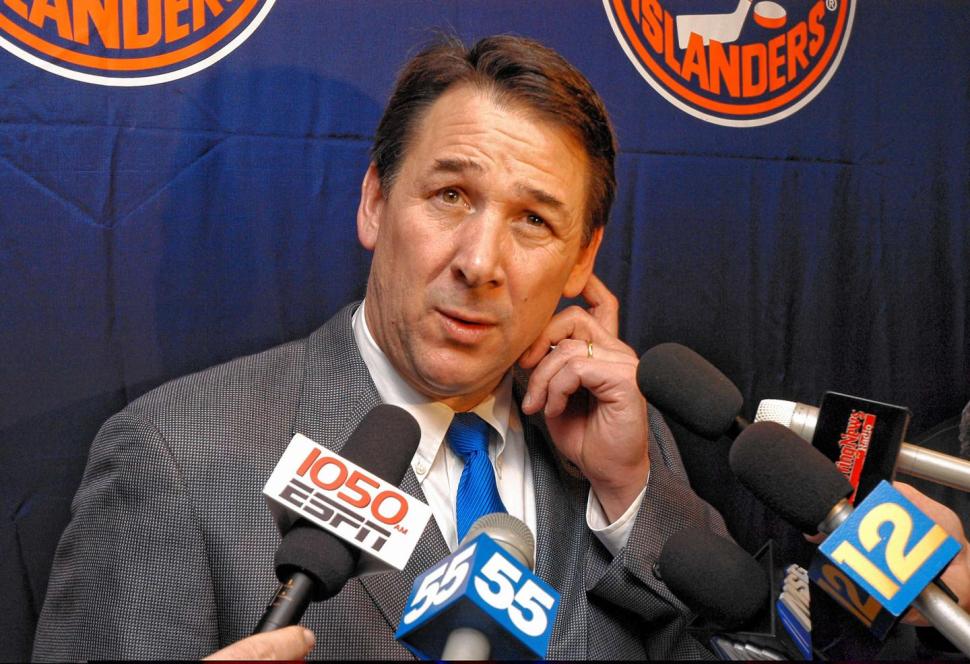
8. Mike Milbury, Islanders, 1995-2006. He was one of the players who typified the Boston Bruins' late 1970s-early 1980s "Lunch Pail Athletic Club": Not especially talented, but hard-working, the kind of guy you needed to win. As head coach of the Bruins, he got them to the 1990 Stanley Cup Finals, but got swept by the Edmonton Oilers, whose GM and former head coach was Glen Sather. (See #5 below.)

In 1995, the Islanders named him head coach and GM. He was asked by a reporter how he expected to compete with the Devils, who had just won the Cup, and the Rangers, who had won it the year before. He had the right attitude: "You know, fuck the Rangers and fuck the Devils! I'm running the New York Islanders!" From Flushing to Montauk, you could hear Isles fans saying, "Hell yeah!"

But even when they were winning 4 straight Stanley Cups, the Islanders have never been a team with deep pockets. The moves Milbury made were terrible, pretty much demolishing a team that had come within 3 games of the Finals just 2 years earlier. He removed himself as head coach, reinstalled himself, and removed himself again. He never hired a good head coach, and from his 1995 hiring until 2015, 20 seasons, the team made the Playoffs 6 times, winning 11 games and exactly zero series.
So the way he messed things up on the Jericho Turnpike well outlasted his tenure. When he was hired, they were a viable franchise that may have had an interesting future. When he was finally canned after 11 years, they were a team in trouble, and remain so.

Milbury's heart was in the right place, and no one could question his courage. If he only had a brain. He is not solely to blame for the club's post-1993 decline, but, competitively, it still doesn't look good for the team's long-term future.

7. Wilbur "Weeb" Ewbank, Jets, 1968-74. Bear with me: In order to make you truly understand what Weeb did to the Jets, I have to make this one long. A truly great football coach, he was the only man to be head coach of both an NFL Champion (1958 and '59 Baltimore Colts, both times over the New York Giants) and an AFL Champion (1968-69 New York Jets, over his former team, the Colts). But look at what he did with the team as GM after owner Leon Hess fired Sonny Werblin.

Imagine that it is August 1969, and you are the General Manager of the New York Jets. Your team has not only won the World Championship of American football in its last game that counted, but it did so in a fashion that stunned and excited the entire nation. You've just won an exhibition game (strangely, played at the Yale Bowl in New Haven, Connecticut) in which you decisively defeated the Giants, the City's NFL aggregation. So now you are definitively the best team in your sport, both in New York and in the world.

The Knicks have glamorous stars like Walt Frazier and Bill Bradley and the courageous Willis Reed, but they haven't yet won their 1st title, and even after 2 titles they won't be as big as a popular football team would be.

The Mets are in their 1st Pennant race, but haven't yet gotten their "Miracle" fully onto the City's radar. And even when they do, their marquee player, Tom Seaver, as great as he is and will be, is a private man: He can handle the spotlight, but he does not relish it, and isn't the most bankable guy around.

You have Joe Namath, a glamour guy at the glamour position (quarterback), in the glamour city, in what's becoming the glamour sport, and he loves the spotlight, eats it up. You've just proven that the Giants stink. So do the Yankees, whose big star Mickey Mantle just retired. The Nets are in the ABA, out on Long Island, so they're an afterthought. The Rangers are a bunch of Canadians, not exactly popular in an America that elected Richard Nixon. The Islanders and Devils don't exist yet. No college team in the area is doing big things.

Maybe you don't own the New York Tri-State Area, but you're co-owning with the Mets and the Knicks, and that's pretty good. You've got it made.

And your franchise loses in the 1st round of the next season's Playoffs... and then doesn't reach the Playoffs again for 12 years! And doesn't win another Playoff game until a year after that!
Weeb couldn't keep the Super Bowl team together. He resigned as head coach prior to the 1973 season, by which point an oft-injured Namath was the only one from 1/12/69 still contributing. Weeb remained as GM, and hired his son-in-law, Charlie Wimmer, as head coach. Charlie didn't do too well. Overall, Weeb makes my list of New York's Top 10 Best Coaches, but also my list of New York's Top 10 Worst Executives.

The Jets could have become the team in New York football, instead of becoming a joke franchise, which they still are, at least for the moment. Considering the kind of opportunity Ewbank had in 1969, it is almost a crime that, by 1986, Sports Illustrated could put Lawrence Taylor and Mark Gastineau on their cover, with the words, "In the Big Apple, the Jets are always the second banana."

Weeb never should've been named GM. Jerry Izenberg, the legendary columnist of the Newark Star-Ledger, calls the Jets' inability to win a Super Bowl, or even to reach one, these last 41 seasons "The Curse of Sonny Werblin." That doesn't make much sense, since they did win the next Super Bowl after firing him. Maybe "The Curse of Weeb Ewbank" is better.

6. Mike Burke, Yankees, 1966-73. A genuine hero of America's effort in World War II. A great businessman. A man who loved sports. And, along with Mayor John Lindsay, the man who saved the original Yankee Stadium for an additional 2 generations. We should thank him for those things.

But while he loved baseball, he didn't know how to run a sports team. Granted, the Topping-Webb regime left CBS, and their handpicked team president Burke, a pig in a poke, basically a brand name and nothing else. But he didn't do much with it: When the team finally won the whole thing in 1977, only 4 players were left from before George Steinbrenner owned the team: Roy White, Thurman Munson, Sparky Lyle and Graig Nettles. I think when George came in, and then bought Burke out, it was a great relief to Burke.
Burke, handing the team over to Steinbrenner, January 3, 1973

5. Glen Sather, Rangers, 2000-present. A Ranger defenseman from 1971 to 1974, he became one of the great coaches and GMs in hockey history when he coached the Edmonton Oilers to 4 Stanley Cups and was GM for 5. But what has he done in 20 years in New York?
It took the Rangers 12 years under his leadership to reach the Conference Finals, and 2 more to reach the Stanley Cup Finals. They have not gotten that far again.

His head coaches have been abysmal: John Muckler (who succeeded him in Edmonton and won the 1990 Cup, but awful at the Garden), Ron Low (aptly-named), Bryan Trottier (real smart, hiring one of the greatest Islanders with no head coaching experience to run the Rangers), himself (not so easy when you don't have Gretzky, Messier, Kurri, Anderson, Coffey, Lowe and Fuhr all in their primes), Tom Renney, John Tortorella, Alain Vigneault, and now David Quinn.

And when the Rangers finally did reach the Conference Finals in 2012, they ended up losing to the Devils, a humiliation that well and truly pus the 1994 Cup win deep into the past, every bit as much as the Isles' 1980-83 Cups irrevocably are. Reaching the Stanley Cup Finals in 2014 didn't help, as they got embarrassed by the Los Angeles Kings.

Sather still holds the titles of Senior Advisor and Alternate Governor (the NHL calls their teams' operational owners "Governors"), while Jeff Gorton (not auto racer Jeff Gordon) is the official general manager.

Of course, Sather hasn't done as much damage to the Rangers as Milbury did to the Islanders in a shorter span of time. The Rangers were never in danger of getting moved out of the Tri-State Area. Besides, somebody had to make the mistake of hiring Sather, and then keeping him for this long.

4. Omar Minaya, Mets, 1995-2002, 2005-10, and 2017-present. Previously a scout under GM Steve Phillips, he left to become MLB's 1st Hispanic GM, with the Montreal Expos. With that team getting moved to become the Washington Nationals, the Mets brought him back as their GM.

He was going to lead the Latin Revolution in Flushing Meadow. He brought in Pedro Martinez, Carlos Beltran, Jose Reyes, Carlos Delgado, Johan Santana and Francisco Rodriguez. And David Wright. (How'd that Gringo get in there?)

2005: No Playoffs, but that's okay, because they're still working their way up. No shame in that.

2006: One run from a Pennant, but a 9th-inning homer by the opposition, and Beltran leaves the bat on his shoulder. Okay, that's not good, but there's still plenty of reason for optimism.

2007: Up by 7 with 17 to go, and they don't even make the Playoffs. Now that is a disgrace.

2008: Up by 3 1/2 with 17 to go, and they don't even make the Playoffs. In this case, half a disgrace does not lessen the disgrace, it compounds it. They couldn't even win the last game at Shea Stadium. They couldn't let their beloved home "die with dignity."

2009: The 1st season at Citi Field is, competitively, an unmitigated disaster.

2010: Another sub-.500 season.

All the while, the Yankees remain the Number 1 team in town, winning a 27th World Championship. The Mets are still looking for a 3rd. The Yankees have won 40 Pennants; the Mets won a 5th after firing Minaya, but are still looking for a 6th.

Can't blame it on the manager, because the Mets failed under Willie Randolph and failed harder under Jerry Manuel. Nope, don't blame the waiter, blame the chef.
People said the Mets should spend more money, like the Yankees do. But the guys Minaya did spend money on didn't pan out. And then, of course, came the reckoning of Fred and Jeff Wilpon's dealings with Bernie Madoff, and so, under new GM Sandy Alderson, the Mets haven't been able to spend big.

Frankly, the Wilpons should have dumped Minaya after 2008. After all, '05 was a rebuilding year, '06 was pretty successful by Met standards, and '07 could be written off as a fluke -- a mind-numbing, nasty fluke, but a fluke nonetheless. But 2008 should have been the alarm bell. The Mets should've broken up with Minaya then.

Finally, in 2010, the Wilpons told him, "This relationship isn't working, and I think we should start seeing other executives." No, Omar, it's not them, it's you. The Latin Revolution left Met fans feeling so tortured, it should have been called the Spanish Inquisition.

For a while, he worked in the front office of the San Diego Padres. They didn't come close to a Pennant while he was there. He returned to the Mets after the 2017 season, as a "special assistant to the general manager." It seems that Fred Wilpon just can't quit Omar.

UPDATE: In 2023, Hal Steinbrenner hired Minaya as a front-office consultant. It appears to have been key to the Yankees obtaining Juan Soto in a trade. That trade may yet redeem Minaya, and force an update of this list.

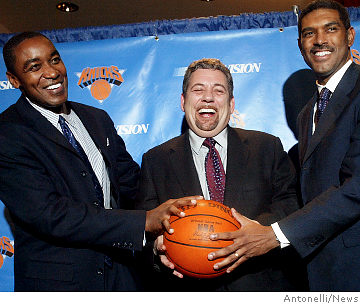
3. Isiah Thomas, Knicks, 2003-08. It was bad enough that Isiah made some bad moves as GM. It was worse that he trusted some guys who couldn't coach, including himself.  It led to the infamous T-shirts: "Don't hate the players, hate the coach." And if that had been the extent of it, that would have been bad enough, although perhaps not bad enough to make the top (or should that be "bottom"?) half of this list.

But through his private life becoming public, he dragged the Knicks through the tabloid muck. Once the team of Clyde Frazier, cool and stylish, a team the ladies could love as much as the guys, the Knicks had become a festering sewer, both competitively and morally.

Of course, Thomas didn't do as much damage to the Rangers as the Secaucus Seven did to the Nets. And the damage he did, while severe in terms of public relations and competitiveness, both on the court and in the boardroom, didn't put the Knicks in danger of moving or going out of business. Besides, somebody had to make the mistake of hiring Thomas, and then keeping him for that long.

2. M. Donald Grant, Mets, 1962-78. He was a friend of Mets founder Joan Payson, and she hired him to be the team's 1st chairman of the board. After the 1969 season, the Mets owned New York every bit as much as the Jets did. After the 1973 season, when they'd won another Pennant, they were so far ahead of the Yankees it wasn't funny -- though you can be sure Met fans were cackling with glee.

Surely, with their (relatively) new ballpark and exciting young players in a nice neighborhood, they had the advantage over the Yankees, with their old ballpark and failing players in a disastrous neighborhood, not to mention their crazy new owner.

The Mets, or rather Grant, frittered away so much of that goodwill, to the point where a few Met fans -- not many, but a few, including Brooklynite college student and aspiring filmmaker Spike Lee -- switched to the Yankees after they returned to the top, a rise coinciding with the Mets' collapse.
A blog called Mike's Mets -- not connected to me in any way -- pretty much sums Grant's mindset up:

Grant, a stockbroker, was Mrs. Payson's close personal advisor when she became the original owner of the Mets. He probably had very little influence in player movement for the first several years, and in the days before free agency, no one could say that the Mets were particularly cheap. But... Grant did not believe that a ballplayer deserved to be making as much money as a stockbroker or real estate magnate, and probably didn't think they belonged at the same parties or meetings, either.

Grant's meddling, no doubt, played a part in driving Mets' GM Bing Devine, who was doing a nice job of trying to build a winner, back to St. Louis. It was probably after Mets' GM Johnny Murphy passed away in 1970 that Grant's influence began to increase. Whitey Herzog was Mets' player development director and heir to the GM job, but Grant passed him by because he knew he wouldn't stand for any interference from someone who in Whitey's words "knew nothing about baseball".

The next two Mets' GM's, Bob Scheffing and Joe McDonald, probably had their hands tied by Grant, his frugality, and his belief that ballplayers should be quiet, sign their contracts, and just play ball. When a player became outspoken about salary issues, such as Tom Seaver and Dave Kingman did, it was only a matter of time before they would be sent away. When Gil Hodges died just before the 1972 season began, Grant again chose to bypass the outspoken Herzog, driving him out of the organization, in favor of Yogi Berra.

Probably the best example of how out of touch M. Donald Grant was with the average fan was when he tried to explain the Tom Seaver negotiations and subsequent trade in terms of bluffing and playing tricks in a hand of bridge. How many Mets fans have any idea how to even play bridge?

Things got worse when Mrs. Payson got sick, and died late in 1975. Her daughter, Lorinda de Roulet, inherited the team, and she knew that she knew nothing about baseball, so she trusted Grant even more.

Observe the breakup of the "Miracle" team: The autocratic Grant traded away Tommie Agee after the 1972 season, Tug McGraw after 1974, Rusty Staub (who would later return) and Cleon Jones after 1975, Jerry Grote after 1976, and Seaver and Kingman on June 15, 1977, a date which lives in Met infamy. Aside from the Dodgers and Giants getting moved out of town, this is the most hated transaction in the history of New York sports -- even if Steve Henderson had a few hits in him and Doug Flynn was a very good fielder.

Lorinda finally fired the old buzzard in 1978. By that point, attendance at Shea Stadium was so sparse it was being called Grant's Tomb: It had gone from a City record 2.7 million in 1970 to under 800,000 by 1979 -- or, per game, 33,000 to 9,740. Contrast that with the Yankees: 1972, 966,000 (12,000); 1980, 2.6 million (32,000).  Not until 1980, when Lorinda sold the team to Fred Wilpon and Nelson Doubleday, did things begin to turn around at Shea.

Grant died on November 29, 1998, 16 days after the death of Weeb Ewbank, and 12 days after the death of the Knicks' title-winning head coach, Red Holzman. Weeb and Red got a lot of praise in the New York media. Grant's death was barely even noticed. Serves him right.

1. James Dolan, Knicks and Rangers, 1994 to the present. His father Charles Dolan hired him to run Cablevision. Which, until Charles sold Cablevision in 2016 but kept ownership of all of the following, owned ITT. Which owns Viacom. Which owns Paramount Communications. Which owns Gulf + Western. Which owns the Madison Square Garden Corporation. Which owns the Garden complex, the Knicks, the Rangers, the MSG Network, and the Garden's boxing, concert and other special-events promotion companies. (From the team's founding in 1997 until selling them to Nets owner Joseph Tsai in 2019, the Dolan conglomerate also owned the WNBA's New York Liberty.)

"Guitar Jimmy" has done great things. He has promoted the Concert For New York City after 9/11, the Big Apple to Big Easy Concert after Hurricane Katrina, and the 12-12-12 Concert to raise money for relief of Hurricane Sandy. He is one of the most charity-sustaining people in America. He is, by most accounts, a decent person. (I have heard suggestions of "Me Too" incidents, but these have not been seriously pursued.) I have no reason to dislike him. Especially since I am neither a Knicks nor a Rangers fan.

But this is the guy who hired Glen Sather to run the Broadway Blueshirts, and also the guy who hired Isiah Thomas to run the Knickerbockers. Through those 2 guys, whom he showed unbelievable loyalty, to the point where both New York Daily News columnist Mike Lupica and I, independent of each other, have wondered what kind of pictures Isiah has of Dolan, he has managed to futz up one of the NBA's charter franchises and one of the NHL's so-called "Original Six" teams, the 3rd- and 4th-greatest franchises in the Tri-State Area in terms of historic success (behind the Yankees and football Giants), for over a decade.

Think about it: Starting with 2000-01, the first full season in which Dolan has, effectively, been the big boss of both teams, the Knicks have won 1 Playoff series, and only 9 Playoff games, despite spending more money (even with the league's salary cap) than any team in basketball history.

The Rangers have done a bit better, but even that took a few years to really get rolling. Over that stretch, they have won 10 Playoff series, but only 3 times have they gotten to the Conference Finals, and only once to the Stanley Cup Finals, despite spending more money (both without and then with the league's salary cap) than any team in hockey history.

Think about that: 2 teams, same building, 20 years, 11 Playoff series won. That roughly translates to 1 Playoff series win every 2 years, for each team, in what's promoted as "The World's Most Famous Arena." From 1998 to 2011, there was a 14-season stretch without either the Knicks or the Rangers making the Playoffs.

Messing up one franchise for a decade is bad enough. Jimmy Dolan has messed 2 up for 2 decades. He's not a cheap dirty bastard, like Walter O'Malley or Donald Grant. He's not a sleazeball, like Isiah Thomas, or an "ogre" as George Steinbrenner was often called  And he isn't a legend whose sport has passed him by, like Glen Sather.

On the other hand, he isn't a good man thrown into an awful situation, like Mike Burke. He's a (possibly) good man who made an awful situation -- indeed, 2 of them. Like Weeb Ewbank (as GM, anyway) and Mike Milbury, he is a guy in over his head. But it's Knick and Ranger fans who feel like they're drowning.

Saturday, January 12, 2019

January 12, 1969: The Jets Are Number 1

January 12, 1969, 50 years ago: Super Bowl III is played at the Orange Bowl in Miami, to decide professional football's World Championship.

When the National Football League and the American Football League began the process of merging in 1966, the NFL was considered to be of far higher quality. Sure enough, the 1st 2 installments of the "AFL-NFL World Championship Game" were easily won by the NFL Champions, the Green Bay Packers -- the game retroactively called "Super Bowl I" 35-10 over the AFL Champion Kansas City Chiefs, and Super Bowl II 33-14 over the Oakland Raiders. The 3rd one was officially renamed the Super Bowl, although the Roman numerals didn't start until Super Bowl V.

*

The NFL Champions for Super Bowl III were the Baltimore Colts. They were coached by Don Shula, who had made his name as the defensive coordinator for the Detroit Lions. Despite losing Johnny Unitas, possibly the greatest quarterback the game had yet seen, to a torn muscle in his throwing arm in the last preseason exhibition game, the Colts steamrolled through the NFL, going 13-1 behind backup quarterback Earl Morrall, with such stars as running back Tom Matte, receiver Jimmy Orr, tight end John Mackey, defensive end Bubba Smith, and linebacker and Mike Curtis.

They hung 44 points on the Atlanta Falcons on at home, 42 on the 49ers in San Francisco, and 41 on the Steelers in Pittsburgh. Their only loss of the regular season was 30-20 to the Cleveland Browns at Memorial Stadium in Baltimore.

They beat the Minnesota Vikings in the Divisional Playoff. Then, in the NFL Championship Game -- in Cleveland because the NFL then alternated hosting duties between the Division Champions -- they avenged their defeat, beating the Browns 34-0 at Cleveland Municipal Stadium. They looked unstoppable -- even without Johnny U.

*

The AFL Champions were the New York Jets. They were coached by Wilbur "Weeb" Ewbank, who had been an assistant to Paul Brown on the early 1950s Cleveland Browns, and then coached the Colts to their 1958 and 1959 NFL Championships, with Unitas as their quarterback. By this point, Unitas was just about the only one left, so his familiarity with the Colts wouldn't have helped.

The Jets had a marquee quarterback, too, the long-haired, white-shoed, big-mouthed Joe Namath. They had a running attack with Emerson Boozer and Matt Snell, receivers Don Maynard and George Sauer, and a defense with ends Verlon Biggs and Gerry Philbin, linebacker Larry Grantham, and defensive backs Bill Baird and Johnny Sample.

The Jets went 11-3. Their losses were to the Denver Broncos at home at Shea Stadium, the Bills in Buffalo, and the Raiders at the Oakland Coliseum, in the game whose NBC coverage screwup got it nicknamed the Heidi Bowl. But they won the AFL Eastern Division, and on December 29, 1968, they hosted the AFL West winners, the Raiders, and won a thriller, 27-23. It was Shea's 1st title, 10 months before the baseball team that called it home.

Still, most football observers thought that the Colts were by far the better team. Mainly because the NFL was by far the better league. By the morning of the game, the Colts were 18-point favorites.

To put that in perspective: Only one other Super Bowl has had a higher point spread, and that one, just barely: Super Bowl XXIX in 1995, the San Francisco 49ers were 18 1/2-point favorites over the San Diego Chargers. (The Niners covered.) No other Super Bowl has had a spread of more than 14 points.

*

January 9, 1969: There's a banquet at the Miami Touchdown Club. Namath was one of the speakers. As he took the podium, someone in the audience yelled out, "Hey, Namath! We're gonna kick your butts!"

Broadway Joe was tired of hearing that, and yelled back, "Let me tell you something: We've got a good team. We're gonna win the game. I guarantee it!"

In an interview for NFL Films years later, Ewbank said, "I could have shot him." The comment hit the papers the next day, and Ewbank asked Namath what he was thinking. Namath said, "Coach, you think we're going to win, don't you?" Ewbank had to admit that he did.

I wonder if Namath understood the meaning of the term "guarantee." The paid attendance at the game was 75,389. The price of a ticket was $20 -- $141 in today's money, which would be a decent price by that standard of today's regular-season NFL games. 75,389 times 20 is $1,507,780. So, if the Jets lost, Namath would have owed the paying customers a million and a half. His famous bonus for signing with the Jets in 1965 was $427,000, less than 1/3rd of that gate.

But that guarantee did 2 things: It boosted the Jets' confidence, and it got into the Colts heads. It allowed the Colts to think, hey, maybe we can lose this game after all. Maybe that's all the Colts needed to actually lose it.

Years later, Namath said, "I just honest to God felt good about our team, and got tired of being told how we were going to lose the game."

At the time, Namath also said, "There are 4 or 5 quarterbacks in the AFL that are better than Morrall," he wasn't kidding. There was himself, Len Dawson of Kansas City, Daryle Lamonica of Oakland, John Hadl of San Diego, and Jack Kemp of Buffalo.

In contrast, That season, with Unitas injured, how many of the NFL's 16 starting quarterbacks were as good as Namath was that year? Possibly Bart Starr of Green Bay, and maybe Sonny Jurgensen of Washington, and maybe John Brodie of San Francisco, and maybe Fran Tarkenton, then with the Giants. But not Morrall, not Joe Kapp of Minnesota, not Roman Gabriel of Los Angeles, or anybody else.

And Ewbank's coaching staff included defensive coaches Walt Michaels and Buddy Ryan. Those names should be familiar to any New York Tri-State Area football fan of the last 40 years. Michaels coached the Jets to the 1982 AFC Championship Game, the 1st time they'd gotten that far since Super Bowl III.

Ryan became the defensive coordinator for the Chicago Bears, designing the "46 Defense" that won Super Bowl XX, then coached the Philadelphia Eagles into the Playoffs. His son Rex Ryan became the only Jets coach to date to get them to 2 AFC Championship Games, although he lost them both.

Joe Falls, the legendary columnist for the Detroit Free Press, said this of Namath: "he'd better grow that mustache again and that goatee and those sideburns because they're going to rearrange his face in Miami on Jan. 12."

Namath would end up being sacked a grand total of one time in that game.

*

January 12, 1969. Lyndon Johnson was 8 days away from handing the Presidency over to Richard Nixon. Nelson Rockefeller was Governor of the State of New York, and John Lindsay was Mayor of the City of New York.

The Number 1 song in America was Marvin Gaye's version of "I Heard It Through the Grapevine." Elvis Presley was recording From Elvis In Memphis. The Beatles were recording Let It Be. Bob Dylan was about to record Nashville Skyline. The Jackson 5 were about to debut. Frank Sinatra had just recorded "My Way."

Star Trek had just aired the episode "Let That Be Your Last Battlefield," with Frank Gorshin playing an interstellar cop who is black on one side of his body and white on the other -- actual black and actual white, not "Negro" and "Caucasian" -- chasing a dissident who's also half-black and half-white, but the reverse, and seeking sanctuary on the starship Enterprise. It had been 9 months since the assassination of Dr. Martin Luther King Jr.

Inflation has been such that what $1.00 would buy then, $6.19 would buy now. A stamp was 6 cents. The Subway fare in New York was 20 cents. The average price of a gallon of gas was 34 cents, a cup of coffee 42 cents, a McDonald's meal 79 cents (49 cents of that being the newly-introduced Big Mac), a movie ticket $1.20, a new car around $2,300, a new house $27,600. The preceding Friday, the Dow Jones Industrial Average closed at 925.53.

The game, as with that episode of Star Trek, was broadcast on NBC. There was a key difference: William Shatner, Leonard Nimoy, Gorshin, et al. stuck to the script in their drama; Namath, in his, knew that the conventional wisdom was no script, and could be discarded. At any rate, less than half of American households had color television sets on which to watch this game.

At the Orange Bowl in Miami, Florida, the temperature at kickoff was 66 degrees, with a mostly overcast sky, and a wind of 12 miles per hour -- noticeable, but not enough to wreak havoc with either team's passing game.

Apollo 8 astronauts Frank Borman, Jim Lovell and William Anders, 18 days after returning to Earth from the Moon, led the crowd in the Pledge of Allegiance. Lloyd Geisler, the first trumpeter of the Washington National Symphony Orchestra, played "The Star-Spangled Banner."

The coin toss ceremony was actually a fraud: The toss had already been conducted by referee Tom Bell, with the Jets winning, and electing to receive. It was staged, with Unitas, Lenny Lyles and Preston Pearson representing the Colts; and Namath and Johnny Sample representing the Jets.

Curt Gowdy, NBC's lead football announcer, handled the play-by-play. The color commentators were Al DeRogatis and Kyle Rote -- perhaps a little unfair toward the Jets and the AFL, as both men were not only former NFL players, but former Giants.

Nevertheless, with his evenhanded broadcasts on the Peacock Network, Gowdy may have been the best friend the AFL ever had. And, of all the events in various sports in a career that lasted from 1943 to 1988, he called this the most memorable game he ever called.

*

At 3:05 PM, Lou Michaels of the Colts kicked off, and Earl Christy of the Jets returned it. The Jets could not get into Baltimore territory, and punted. The Colts drove to the Jets' 19-yard line, but Morrall's 2 passes fell incomplete and his run went for no gain. Michaels came on to attempt a 27-yard field goal --the goalposts were on the goal line, until the 1974 season, when they were moved 10 yards deeper to the end line -- but missed.

Again, Namath could not get the Colts across midfield, and the Jets had to punt. But they held the Colts to 3 and out. On the next possession, Namath threw a pass to George Sauer, completed, but Sauer fumbled, and the ball was recovered by Ron Porter. The Colts were on the Jet 13.

The 1st quarter ended, with the game still scoreless, but the Colts knocking on the door. They got to the Jet 6 with 14:35 left in the half.

But that would be the closest the Colts came to taking a lead in this game. Morrall looked for Tom Mitchell, but his pass was intercepted on the 6 by Randy Beverly.

And that's when the Jets took over. Four straight runs by Matt Snell gained 26 yards. Namath completed 4 of 5 passes, got the Jets to the Colt 4, and Snell ran to the left and into the end zone. Touchdown. Jim Turner kicked the extra point. Jets 7, Colts 0, 9:34 left in the half.

The football world was stunned. But most people thought that this was a fluke, and that it would wake the Colts up, and they would still win the game relatively easily.

They thought wrong. The Colts drove to the Jet 42, but the Jets held them to 4 yards. Michaels attempted another field goal, this time from 46 yards, and missed. Still 7-0 Jets. Namath was able to get the Jets into Colt territory, but not to score, and Turner missed a 41-yard attempt. Still 7-0 Jets.

With 3:40 left in the half, Matte ran for 58 yards. This would turn out to be the longest rushing gain of the contest. It was 2nd and 9 on the Jet 15, and Morrall handed off to Matte. A former Ohio State quarterback who had filled in at quarterback for the Colts in 1965 when both Unitas and Gary Cuozzo had been injured, Matte ran to his right, and threw backwards to Morrall -- a legal play, one which has often been incorrectly described as a flea-flicker.

(A flea-flicker is when a quarterback underhands the ball to a player, then gets open, and the player underhands the ball back to him, so he can pass.)

Morrall looked to pass. Jimmy Orr was wide open. But the Sun had broken through the clouds, and Morrall didn't see Orr. Instead, he saw Willie Richardson, and his pass was intercepted at the 2 by Jim Hudson. Just like that, a great chance for the Colts was gone.

There was some irony in this. The 1965 Orange Bowl game had been played at that same stadium, with Namath making his last collegiate appearance, for the University of Alabama. They lost, to the University of Texas. Texas' quarterback that day was Hudson.

The Jets couldn't get a 1st down, and punted. Morrall threw 2 passes, and couldn't get anywhere, and the half ended. New York Jets 7, Baltimore Colts 0. Football fans from coast to coast, from border to border, were buzzing as the halftime show was played by the legendary marching band of Florida A&M University, a historically black school.

*

The Jets kicked off for the 2nd half. On the 1st play from scrimmage, Matte ran for 8 yards... and fumbled. The Jets recovered on the Colt 25, and Turner went on to kick a 32-yard field goal. Jets 10, Colts 0. There were still 25 minutes and 41 seconds to play. Still plenty of time for Baltimore to get back into it, and win it -- in theory.

The Jets again held the Colts to a 3-and-out. Namath drove the Jets to the Colt 23. Turner kicked a 30-yard field goal. Jets 13, Colts 0.

At this point, Shula rolled the dice. He needed 2 touchdowns in 19 minutes and 24 seconds. He decided a Johnny Unitas who hadn't played a down for the entire regular season gave him a better chance than an Earl Morrall at full strength. Shula would later say he should have brought Unitas on after halftime.

It's become part of the legend that the Jets got scared when they saw the already-legendary Unitas come in. This is unlikely: 13 points means 2 touchdowns, they knew he wasn't at full strength, and they knew that the rest of the Colts were still in disarray.

Unitas would end up with more passing yards in 19 minutes (119) than Morrall had in 41 minutes (71). But his 1st drive led to no 1st downs, and the Colts had to punt. When the 3rd quarter ended, it was still 13-0 Jets, and the Jets were threatening to score again. They got to the Colt 2, and Ewbank called for a field goal. No reason to get cocky and go for the touchdown: If successful, the field goal attempt would make it a 3-score lead with less than 14 minutes to play; otherwise, it's a 2-score lead with an eternity for a passing master like Unitas.

The Jets kicked off, and with 13:10 left, Johnny U went to work. He got to the Jet 25, and, unlike Morrall, saw Jimmy Orr open. Except Randy Beverly saw Orr open, too, and ran in and intercepted the pass.

With 11:06 left, Namath could afford to eat the clock. He got the Jets to the Colt 35, setting up a 42-yard field goal attempt by Turner, but he missed.

Now, there was just 6:34 to play. Could Unitas possibly lead the Colts to 2 touchdowns and a field goal in that time? He threw 3 incomplete passes, but on 4th and 10 from his own 20, he found Orr to keep the game alive. He got into Jet territory, throwing to Orr, then to Mackey, then to Richardson, getting to the Jet 1. He handed off to Jerry Hill. Touchdown. Michaels kicked the extra point.

Jets 16, Colts 7. The Colts recovered the onside kick. There were 3 minutes and 14 seconds left. Unitas got the Colts to the Jet 24. 1st down: Pass to Richardson, gains 5 yards. 2nd and 5 on the Jet 19: Pass to Richardson, incomplete. 3rd and 5: Pass to Orr, incomplete. 4th and 5 on the 19. 2:44 left.

A field goal would make it 16-10, and the Colts would need a touchdown. They had all their timeouts, plus the 2-minute warning, and had already recovered an onside kick a moment ago. But Shula decided to go for it. Unitas looked for Orr, and threw, but Orr couldn't catch it. It was, for all intents and purposes, over.

The Jets ate as much of the clock as they could, and there were 15 seconds left when Curley Johnson punted to the Colt 34. Unitas threw 2 passes to Richardson. The 1st was incomplete. The 2nd was caught, and he ran 15 yards, but the clock ran out.

Final score: New York Jets 16, Baltimore Colts 7. The Jets were World Champions. The AFL had proven itself, on the biggest stage, to be not only the NFL's equal, but, for the moment, its superior.

It had gotten dark over the course of the game. And in that darkness, under the Orange Bowl's floodlights, Namath stuck his index finger over his head and waved it to the fans. As far as I can tell, this was the 1st time anybody had done that in order to say, "We're Number 1!"
"I just know that when I was running off that field after the game," Namath says now, "I swear I saw those AFL people up there in the stands, and they were so happy. And it was just the finality of it. It seemed like a struggle, such a struggle for we as individuals and teams in the AFL."

He was right: Al Davis, owner of the Raiders and the man more responsible for the merger than anyone else, was sitting with his new head coach, John Madden. Madden has spoken many times about how wonderful that game made the AFL guys feel.

Len Dawson, the Hall of Fame quarterback who would lead another upset by the AFL's Kansas City Chiefs over the NFL's Minnesota Vikings the next year in Super Bowl IV, was also there, and he now says he stood up and said, "How does that lousy American Football League look now?" Today, he says, "I just had to stick it in, because I had been holding it in all day."

William Wallace (not the legendary Scottish hero) in The New York Times: "Because of what Joe Namath accomplished in the Super Bowl yesterday, pro football will never quite be the same again."

Bill Mazer, opening the football section of his book The Answer Book of Sports, published later in the year: "For those of you who are younger readers, something should be made clear: Football was not invented by Joe Namath on January 12, 1969 at the Orange Bowl in Miami."

But Namath was elevated to sports idolhood. Along with the Mets' Tom Seaver 9 months later, and the Knicks' Walt "Clyde" Frazier 8 months after that, he became part of New York's holy trinity of sports icons for a generation, as Mickey Mantle and Frank Gifford had been in the generation before, and Reggie Jackson and Lawrence Taylor, and then Derek Jeter and Eli Manning, would later become.

Despite not having thrown a single touchdown pass, Namath was named the game's Most Valuable Player. He joined Ed Danowski (1934 and 1938 Giants) and Charlie Conerly (1956 Giants) as New York quarterbacks to win World Championships. He has since been joined by Phil Simms (1986 Giants), Jeff Hostetler (1990 Giants) and Eli Manning (2007 and 2011 Giants).

Simms was 13 years old, and watching Super Bowl III on television at his parents' house in Louisville, Kentucky. Now an analyst for CBS Sports, the 2nd man to be MVP of a New York Super Bowl win was asked to use his skills in that job to watch the 1st, Namath, and the rest of the game in its entirety again, for the article that Newsday did for the 50th Anniversary.

He had previously believed the win to be a fluke, based on the Colts' mistakes. He believes that no longer: "The Jets whupped them," he said. "I'm really shocked... They beat 'em up."

His comment at the half: "If you and I were watching this game, right now, live, we'd be going, 'Man, Baltimore really looks like the better team.'"

His comment at the end: "The Jets ripped their butt here in the second half. I don't remember it this way. It's amazing."

Bubba Smith, the All-Pro defensive end of the Colts, later an actor, eventually suggested that the game was fixed. Tom Matte disagreed: "It was a team failure as far as I'm concerned. We came up on the short end of the stick, and those guys came out smelling like roses... They won the game, so you have to have a lot of respect for them."
This is what a New York Jets Super Bowl ring looks like.

Shula: "It's just a bad memory. So I had to learn to live with it, and I couldn't do anything about it until we did something about it."

The Colts did do something about it. So did Shula. Just not together.

*

Despite becoming the most celebrated player in the history of New York football, Namath only appeared in 1 more Playoff game, the next season, against the Kansas City Chiefs, and lost it. He would play 7 more seasons for the Jets, battling injuries to his knees, and play out the 1977 season with the Los Angeles Rams, and retire.

Since the merger was completed in 1970, the Jets have been to the AFC Championship Game 4 times: In the seasons of 1982, 1998, 2009 and 2010, and lost them all. Their moments of glory have been fleeting, and it has been half a century since they reached, let alone won, a Super Bowl.

The Colts would fire Shula after the 1969 season, hire Don McCafferty, and gain a measure of redemption by winning Super Bowl V on January 17, 1971, beating the Dallas Cowboys 16-13 on a last-play field goal by Jim O'Brien. Ironically, in that game, Unitas started, but had to leave at the half with an injury, trailing 13-6, and it was Morrall who led them to victory.

The Colts got old in a hurry after that, and were a very different team when they won 3 straight AFC Eastern Division titles in 1975, 1976 and 1977. They did not reach the Super Bowl. They got broken up, and in 1984, were moved to Indianapolis. They have usually been good in Indianapolis, but their path to Playoff glory has frequently been blocked by the New England Patriots. The Colts have won Super Bowl XLI and lost Super Bowl XLIV. This weekend, they are 2 games away from reaching Super Bowl LIII.

In 1996, Baltimore got a new team, the Ravens. Wearing a replica of his blue Number 19 Colt jersey, Unitas presented the game ball to the officials as the captains of the purple-shirted Ravens and the white-shirted Oakland Raiders looked on. The Ravens won Super Bowls XXXV and XLVII, and reached the Playoffs this season, before losing in the Wild Card round to the Los Angeles Chargers.

Johnny Unitas died in 2002, of a heart attack at age 59. A statue of him now stands outside the Ravens' M&T Bank Stadium at Camden Yards. Earl Morrall died in 2014, of natural causes at 79. An autopsy showed that he had chronic traumatic encephalopathy (CTE), the brain damage that so many football players have sustained. Don Shula just turned 89, and, at least officially, remains a part of the Dolphins' front office.

Tom Bell had refereed the 1959 NCAA Final Four, making him the only man to officiate at both a Final Four and a Super Bowl. He also refereed Super Bowl VII, when Shula's Dolphins, with Morrall as backup, beat the Washington Redskins 14-7 at the Los Angeles Memorial Coliseum, to complete a perfect 17-0 season. Bell retired after refereeing the 1976 AFC Championship Game (the Oakland Raiders beat the Pittsburgh Steelers), and died of leukemia in 1986, at age 63. Broadcaster Curt Gowdy also died of leukemia, in 2006, at 86.

Of the 1968 World Champion New York Jets, the following have died: Assistant coach Clive Rush in 1980, of a heart attack, only 49 years old; tight end Verlon Biggs in 1994, assistant coach Joe Spencer in 1996, head coach Weeb Ewbank in 1998, team owner Leon Hess in 1999, offensive tackle Sam Walton in 2002, cornerback Johnny Sample in 2005, defensive tackle John Elliott in 2010, receiver George Sauer and safety Jim Hudson in 2013; assistant coach Buddy Ryan, offensive tackle Winston Hill, and punter John "Curley" Johnson in 2016; backup quarterback Babe Parilli and linebacker Larry Grantham in 2017, and receiver Bill Rademacher in 2018.

Still alive are assistant coach Walt Michaels, 89, and these 31 players, at these ages:

83: Receiver Don Maynard.
80: Guard Bob Talamini and defensive tackle Paul "Rocky" Rochester.
79: Running back Mark Smolinski and safety Bill Baird.
78: Receiver Robert "Bake" Turner and cornerback Cornell Gordon.
77: Running back Matt Snell, kicker Jim Turner (who, between them, scored all 16 Jet points), guard Dave Herman and defensive end Gerry Philbin.
76: Center John Schmitt and linebacker Ralph Baker.
75: Quarterback Joe Namath, running back Emerson Boozer, tight end Pete Lammons, linebacker Al Atkinson, cornerback Earl Christy and safety Mike D'Amato.
74: Center Paul Crane, guard Jeff Richardson, linebacker Carl McAdams, and cornerbacks Randy Beverly and John Dockery.
73: Guard Randy Rasmussen, defensive tackle Steve Thompson, defensive end Karl Henke and linebacker Michael Stromberg.
72: Running back Lee White, linebacker John Neidert and safety Jim Richards.

UPDATE: Walt Michaels died later in 2019. Paul Rochester and Bill Mathis died in 2020. This leaves 29 survivors.
Super Bowl III was not a miracle. It was not nearly as important to the AFL as its legendeers would have you believe: The merger was going forward, no matter what.

But it was still a huge moment. And, as they say, "Cometh the hour, cometh the man." The hour was 3:05 PM on January 12, 1969. The man was Joe Namath.
Tuesday, February 26, 2013

Top 10 Worst Executives in New York Sports History

As with my Top 10 Worst Coaches, I'm going to limit "History" to 1920 onward, with "The Golden Age of Sports" effectively beginning the modern age of sports. So this exempts, if not absolves, Andrew Freedman, the nutcase who owned the Giants at the turn of the 20th Century; and Frank Farrell and Big Bill Devery, the ex-police commissioner and current bootlegger (or was it the other way around? Didn't matter, whichever had been Commish was pretty damn corrupt) who owned the New York Highlanders/Yankees from their 1903 founding until 1915.

Actually, all of these disasters are pretty much in my lifetime, 1969 onward. I didn't even think to include Horace Stoneham, who owned the baseball Giants from 1936 to 1976, and moved them to San Francisco in 1957, talked into it by Walter O'Malley of the Dodgers who needed another California team, after Stoneham was already deciding to move to Minneapolis, where the Giants' top farm team was.

It would have been so simple to save the Giants: Robert Moses, practically the dictator of New York City already, had the plan for the building in Flushing Meadow that would become known as Shea Stadium. If Stoneham had just asked for it, the Giants might be playing at Citi Field today, and, as there would have been in 1962, and could have been a few other times (they would've been in the NL East, not having to face the Dodgers and Reds in the NL West), there could, in the fall of 2010, be a Subway Series between the New York Yankees and the New York Giants. Willie Mays was beloved in New York.

Think of what New York fans could have done with Willie McCovey, Orlando Cepeda, Juan Marichal, Jack Sanford, the Alou Brothers, Gaylord Perry, Bobby and Barry Bonds -- Barry might've gotten the love he needed to not try steroids.

But all Stoneham could see was his crumbling Polo Grounds in a disintegrating upper Harlem and Washington Heights, with the Yankees and Dodgers both making money hand over glove, and he thought he couldn't compete. If he had just held on for another year...

But he didn't, so I'm putting him at Number 11 on this list. But the rest are all guys who did foolish or rotten things that I'm old enough to remember, and seriously mucked up some great teams.

10. George Steinbrenner, Yankees, 1980-90. Okay, officially, George wasn't the GM. But, let's face it, he was the man making the personnel decisions, no matter how much he blamed his bad transactions on "my baseball people."

When he had Gabe Paul from 1973 to '77, Al Rosen in '78 and '79, Gene Michael stepping in after his suspension in 1990, Bob Watson in '96 and '97 and Brian Cashman from 1998 to 2010, George was a great owner, which is why he's only Number 10 on this list. But he was a horrible "GM," and that's why he makes this list at all.

9. "The Secaucus Seven," Nets, 1978-98. Led by Joe Taub and Alan Cohen, these guys got little to work with, and they made less out of it. Having to pay $8 million -- and, as the late sportswriting legend Bert Randolph Sugar would have said, these were Jerry Ford dollars, not Barack Obama dollars -- just to get into the NBA following the collapse of the ABA and to pay off the Knicks for "territorial indemnification" -- the Nets had to sell off their best player, Long Island native Julius "Dr. J" Erving, and a year later trade their next-best player, Bronx native Nate "Tiny" Archibald.

In other words, just to remain in the Tri-State Area, the Nets had to dump 2 of the men who would be named in 1996 to the NBA's 50th Anniversary 50 Greatest Players. (Even 14 seasons later, Doc is probably still one of the game's top 20.)

So how many times did the Nets make the Playoffs in those 20 seasons that the S7 owned them? 10. Which isn't actually all that bad. But how many Playoff series did they win? One. That was in 1984, against the defending World Champion Philadelphia 76ers -- with Erving -- before falling in 6 in the next round against the Milwaukee Bucks. How many Playoff games did they win? 9, with 5 of those coming, as I said, in '84.

It's not so much how often they made the Playoffs, it's how bad they were when they didn't. And the bad draft picks... Dennis Hopson, Ed O'Bannon, Yinka Dare... Maybe the Nets weren't as big a joke as the other "little brother" team in the NBA, the Los Angeles Clippers... but even when they were a good team, 1982-86 and 1992-94, they didn't exactly sell out the Meadowlands. Partly because the established, glamorous Knicks were also good at the same time.

The S7 sold the Nets in 1998, and in 2001 new ownership made the trade for Jason Kidd and the team made 2 NBA Finals, reaching the Playoffs 6 straight seasons, before Bruce Ratner bought the team and put their breakup and move to Brooklyn into motion.

Despite a 20-year record of ineptitude, I can't rank the S7 any higher, for 2 reasons: There were 7 of them, not any 1 that was more responsible than any other; and the Nets have always been the 2nd basketball team in a 2-team town. Sometimes 3rd, when you consider St. John's.

In fact, counting all the area's major league teams, they're the 9th team in a 9-team town. And, frankly, counting the Liberty and the Red Bulls may not be doing the Nets any favors, either.  We'll see if Mikhail Prokhorov, Jay-Z and the new management team can turn them around in Brooklyn, but don't hold your breath.

8. Mike Milbury, Islanders, 1995-2006. He was one of the players who typified the Boston Bruins' late 1970s-early 1980s "Lunch Pail Athletic Club": Not especially talented, but hard-working, the kind of guy you needed to win. As head coach of the Bruins, he got them to the 1990 Stanley Cup Finals, but got swept by the Edmonton Oilers, whose GM and former head coach was Glen Sather. (See #5 below.)

In 1995, the Islanders named him head coach and GM. He was asked by a reporter how he expected to compete with the Devils, who had just won the Cup, and the Rangers, who had won it the year before. He had the right attitude: "You know, fuck the Rangers and fuck the Devils! I'm running the New York Islanders!" From Flushing to Montauk, you could hear Isles fans saying, "Hell yeah!"

But even when they were winning 4 straight Stanley Cups, the Islanders have never been a team with deep pockets. The moves Milbury made were terrible, pretty much demolishing a team that had come within 3 games of the Finals just 2 years earlier. He removed himself as head coach, reinstalled himself, and removed himself again. He never hired a good head coach, and in the 18 seasons since Milbury was hired, the team has made the Playoffs 4 times, winning 6 games and exactly zero series.

So the way he messed things up on the Jericho Turnpike has already well outlasted his tenure. When he was hired, they were a viable franchise that may have had an interesting future. When he was finally canned after 11 years, they were a team in trouble, and remain so.

The planned move to the Barclays Center in Brooklyn after the Nassau Coliseum's lease runs out in 2015 will help, as the team will still be on Long Island -- geologically, if not culturally.  The team is no longer in danger of moving off the physical island or out of the Tri-State Area.

Milbury's heart was in the right place, and no one could question his courage, but if he only had a brain. He is not solely to blame for the club's post-1993 decline, but, competitively, it still doesn't look good for the team's long-term future.  Ironically, the move of the Nets to Brooklyn may end up doing more to help the Islanders.

7. Wilbur "Weeb" Ewbank, Jets, 1968-73. Bear with me: In order to make you truly understand what Weeb did to the Jets, I have to make this one long. A truly great football coach, he was the only man to be head coach of both an NFL Champion (1958 and '59 Baltimore Colts, both times over the New York Giants) and an AFL Champion (1968-69 New York Jets, over his former team, the Colts). But look at what he did with the team as GM after owner Leon Hess fired Sonny Werblin.

Imagine that it is August 1969, and you are the General Manager of the New York Jets. Your team has not only won the World Championship of American football in its last game that counted, but done so in a fashion that stunned and excited the nation. You've just won an exhibition game (strangely, played at the Yale Bowl in New Haven, Connecticut) in which you decisively defeated the Giants, the City's NFL aggregation. So now you are definitively the best team, both in New York and in the world.

The Knicks have glamorous stars like Walt Frazier and Bill Bradley and the courageous Willis Reed, but they haven't yet won their 1st title, and even after 2 titles they won't be as big as a popular football team. The Mets are in their 1st Pennant race, but haven't yet gotten their "Miracle" fully onto the City's radar. And even when they do, their marquee player, Tom Seaver, as great as he is and will be, is a private man who can handle the spotlight, but does not relish it.

You have Joe Namath, a glamour guy at the glamour position (quarterback), in the glamour city, in what's becoming the glamour sport, and he loves the spotlight, eats it up. You've just proven that the Giants stink. So do the Yankees, whose big star Mickey Mantle just retired. The Nets are in the ABA, out on Long Island, so they're an afterthought. The Rangers are a bunch of Canadians, not exactly popular in an America that elected Richard Nixon. The Islanders and Devils don't exist yet. No college team in the area is doing big things.

Maybe you don't own the New York Tri-State Area, but you're co-owning with the Mets and the Knicks, and that's pretty good. You've got it made.

And your franchise loses in the 1st round of the next season's Playoffs... and then doesn't reach the Playoffs again for 12 years! And doesn't win another Playoff game until a year after that!

Weeb couldn't keep the Super Bowl team together. He resigned as coach prior to the 1973 season, by which point an oft-injured Namath was the only one from 1/12/69 still contributing. Weeb hired his son-in-law, Charlie Wimmer. Charlie didn't do too well.

Weeb hired Lou Holtz, who had done a great job reviving North Carolina State. And would go on to revive the programs at Arkansas, Minnesota, Notre Dame and South Carolina. Of course, the reason he was able to do so well in college is that, like a lot of college coaches (hello, Steve Spurrier), he couldn't handle the pro game. (The veer offense? With Namath's knees? Hello, anybody home? Think, McFly!) He was fired before finishing his 1st season in Flushing Meadow and Hempstead. The Jets didn't have a decent GM after Werblin until Hess handed Bill Parcells the keys to the kingdom in 1997.

The Jets could have become the team in New York football, instead of becoming a joke franchise, which, despite the work of Woody Johnson, Mike Tannenbaum and Rex Ryan, they still are, at least for the moment. Considering the kind of opportunity Ewbank had in 1969, it is almost a crime that, by 1986, Sports Illustrated could put Lawrence Taylor and Mark Gastineau on their cover, with the words, "In the Big Apple, the Jets are always the second banana."

Weeb never should've been named GM. Jerry Izenberg, the legendary columnist of the Newark Star-Ledger, calls the Jets' inability to win a Super Bowl, or even to reach one, these last 41 seasons "The Curse of Sonny Werblin." Doesn't make much sense, since they did win the next Super Bowl after firing him. Maybe "The Curse of Weeb Ewbank" is better.

6. Mike Burke, Yankees, 1965-73. A genuine hero of America's effort in World War II. A great businessman. A man who loved sports. And, along with Mayor John Lindsay, the man who saved the original Yankee Stadium for an additional 2 generations. We should thank him for those things.

But while he loved baseball, he didn't know how to run a sports team. Granted, the Topping-Webb regime left CBS, and their handpicked team president Burke, a pig in a poke, basically a brand name and nothing else. But he didn't do much with it: When the team finally won the whole thing in 1977, only 4 players were left from before George Steinbrenner owned the team: Roy White, Thurman Munson, Sparky Lyle and Graig Nettles. I think when George came in, and then bought Burke out, it was a great relief to Burke.

5. Glen Sather, Rangers, 2000-present. He was one of the great coaches and GMs in hockey history when he coached the Edmonton Oilers to 4 Stanley Cups and was GM for 5. But what has he done in 13 years in New York?

It took the Rangers 12 years under his leadership to reach the Conference Finals, and his head coaches have been abysmal: John Muckler (who succeeded him in Edmonton and won the 1990 Cup, but awful at the Garden), Ron Low (aptly-named), Bryan Trottier (real smart, hiring one of the greatest Islanders with no head coaching experience to run the Rangers), himself (not so easy when you don't have Gretzky, Messier, Kurri, Anderson, Coffey, Lowe and Fuhr all in their primes), Tom Renney and now John Tortorella (won the Cup with the 2004 Tampa Bay Lightning but doesn't have Andreychuk and Lecavalier here).

And when the Rangers finally did reach the Conference Finals last year, they ended up losing to the Devils, a humiliation that well and truly puts the 1994 Cup win deep into the past, every bit as much as the Isles' 1980-83 Cups irrevocably are.

Of course, Sather hasn't done as much damage to the Rangers as Milbury did to the Islanders in roughly the same span of time. The Rangers were never in danger of getting moved out of the Tri-State Area. Besides, somebody had to make the mistake of hiring Sather, and then keeping him for this long.

4. Omar Minaya, Mets, 2005-10. He was going to lead the Latin Revolution. He brought in Pedro Martinez, Carlos Beltran, Jose Reyes, Carlos Delgado, Johan Santana and Francisco Rodriguez. And David Wright. (How'd that Gringo get in there?)

2005: No Playoffs, but that's okay, because they're still working their way up. No shame in that.

2006: One run from a Pennant, but a 9th-inning homer by the opposition, and Beltran leaves the bat on his shoulder. Okay, that's not good, but there's still plenty of reason for optimism.

2007: Up by 7 with 17 to go, and they don't even make the Playoffs. Now that is a disgrace.

2008: Up by 3 1/2 with 17 to go, and they don't even make the Playoffs. In this case, half a disgrace does not lessen the disgrace, it compounds it. They couldn't even win the last game at Shea. They couldn't let their beloved home "die with dignity."

2009: The 1st season at Citi Field is, competitively, an unmitigated disaster.

2010: Another sub-.500 season.

All the while, the Yankees remain the Number 1 team in town, winning a 27th World Championship. The Mets are still looking for a 3rd. The Yankees have won 40 Pennants; the Mets are still stuck on 4.

Can't blame it on the manager, because the Mets failed under Willie Randolph and failed harder under Jerry Manuel. Nope, don't blame the waiter, blame the chef. People said the Mets should spend more money, like the Yankees, but the guys Minaya did spend money on didn't pan out.  And then, of course, came the reckoning of Fred and Jeff Wilpon's dealings with Bernie Madoff, and so, under new GM Sandy Alderson, the Mets haven't been able to spend big.

Frankly, the Wilpons should have dumped Minaya after 2008. After all, '05 was a rebuilding year, '06 was pretty successful by Met standards, and '07 could be written off as a fluke -- a mind-numbing, nasty fluke, but a fluke nonetheless. But 2008 should have been the alarm bell. The Mets should've broken up with Minaya then. Finally, in 2010, the Wilpons told him, "This relationship isn't working, and I think we should start seeing other executives." No, Omar, it's not them, it's you.

3. Isiah Thomas, Knicks, 2003-08. It was bad enough that Isiah made some bad moves as GM. It was worse that he trusted some guys who couldn't coach, including himself.  It led to the infamous T-shirts: "Don't hate the players, hate the coach." And if that had been the extent of it, that would have been bad enough, although perhaps not bad enough to make this list.

But through his private life becoming public, he dragged the Knicks through the tabloid muck. Once the team of Clyde Frazier, cool and stylish, a team the ladies could love as much as the guys, the Knicks had become a festering sewer, both competitively and morally.

Of course, Thomas didn't do as much damage to the Rangers as the Secaucus Seven did to the Nets. And the damage he did, while severe in terms of public relations and competitiveness, both on the court and in the boardroom, didn't put the Knicks in danger of moving or going out of business. Besides, somebody had to make the mistake of hiring Thomas, and then keeping him for that long.

2. M. Donald Grant, Mets, 1962-78. He was a friend of Mets founder Joan Payson, and she hired him to be the team's 1st chairman of the board. After the 1969 season, the Mets owned New York every bit as much as the Jets did. After the 1973 season, when they'd won another Pennant, they were so far ahead of the Yankees it wasn't funny -- though you can be sure Met fans were cackling with glee.

Surely, with their (relatively) new ballpark and exciting young players in a nice neighborhood, they had the advantage over the Yankees, with their old ballpark and failing players in a disastrous neighborhood, not to mention their crazy new owner.

The Mets, or rather Grant, frittered away so much of that goodwill, to the point where a few Met fans -- not many, but a few, including college student and aspiring filmmaker Spike Lee -- switched to the Yankees after they returned to the top, a rise coinciding with the Mets' collapse.

A blog called "Mike's Mets" -- not connected to me in any way -- pretty much sums Grant's mindset up:

Grant, a stockbroker, was Mrs. Payson's close personal advisor when she became the original owner of the Mets. He probably had very little influence in player movement for the first several years, and in the days before free agency, no one could say that the Mets were particularly cheap. But... Grant did not believe that a ballplayer deserved to be making as much money as a stockbroker or real estate magnate, and probably didn't think they belonged at the same parties or meetings, either.

Grant's meddling, no doubt, played a part in driving Mets' GM Bing Devine, who was doing a nice job of trying to build a winner, back to St. Louis. It was probably after Mets' GM Johnny Murphy passed away in 1970 that Grant's influence began to increase. Whitey Herzog was Mets' player development director and heir to the GM job, but Grant passed him by because he knew he wouldn't stand for any interference from someone who in Whitey's words "knew nothing about baseball".

The next two Mets' GM's, Bob Scheffing and Joe McDonald, probably had their hands tied by Grant, his frugality, and his belief that ballplayers should be quiet, sign their contracts, and just play ball. When a player became outspoken about salary issues, such as Tom Seaver and Dave Kingman did, it was only a matter of time before they would be sent away. When Gil Hodges died just before the 1972 season began, Grant again chose to bypass the outspoken Herzog, driving him out of the organization, in favor of Yogi Berra.

Probably the best example of how out of touch M. Donald Grant was with the average fan was when he tried to explain the Tom Seaver negotiations and subsequent trade in terms of bluffing and playing tricks in a hand of bridge. How many Mets fans have any idea how to even play bridge?

Things got worse when Mrs. Payson got sick, and died late in 1975. Her daughter, Lorinda de Roulet, inherited the team, and she knew that she knew nothing about baseball, so she trusted Grant even more.

Observe the breakup of the "Miracle" team: The autocratic Grant traded away Tommie Agee after the 1972 season, Tug McGraw after 1974, Rusty Staub (who would later return) and Cleon Jones after 1975, Jerry Grote after 1976, and Seaver and Kingman on June 15, 1977, a date which lives in Met infamy. Aside from the Dodgers and Giants getting moved out of town, this is the most hated transaction in the history of New York sports -- even if Steve Henderson had a few hits in him and Doug Flynn was a very good fielder.

Lorinda finally fired the old buzzard in 1978. By that point, attendance at Shea Stadium was so sparse it was being called Grant's Tomb: It had gone from a City record 2.7 million in 1970 to under 800,000 by 1979 -- or, per game, 33,000 to 9,740. Contrast that with the Yankees: 1972, 966,000 (12,000); 1980, 2.6 million (32,000).  Not until 1980, when Lorinda sold the team to Fred Wilpon and Nelson Doubleday, did things begin to turn around at Shea.

Grant died on November 29, 1998, 16 days after the death of Weeb Ewbank, and 12 days after the death of the Knicks' title-winning head coach, Red Holzman. Weeb and Red got a lot of praise in the New York media. Grant's death was barely even noticed. Serves him right.

1. James Dolan, Knicks and Rangers, 1999 to the present. His father Charles Dolan hired him to run Cablevision. Which owns ITT. Which owns Viacom. Which owns Paramount Communications. Which owns Gulf + Western. Which owns the Madison Square Garden Corporation. Which owns the Garden complex, the Knicks, the Rangers, the WNBA's New York Liberty, the MSG Network, and the Garden's boxing, concert and other special-events promotion companies.

"Guitar Jimmy" has done great things. He has promoted the Concert For New York City after 9/11, the Big Apple to Big Easy Concert after Hurricane Katrina, and, just this past fall, the 12-12-12 Concert to raise money for relief of Hurricane Sandy. He is one of the most charity-sustaining people in America. He is, by most accounts, a decent person. I have no reason to dislike him. Especially since I am neither a Knicks nor a Rangers fan.

But this is the guy who hired Glen Sather to run the Broadway Blueshirts, and also the guy who hired Isiah Thomas to run the Knickerbockers. Through those 2 guys, whom he showed unbelievable loyalty, to the point where both New York Daily News columnist Mike Lupica and I, independent of each other, have wondered what kind of pictures Isiah has of Dolan, he has managed to futz up one of the NBA's charter franchises and one of the NHL's so-called "Original Six" teams, the 3rd- and 4th-greatest franchises in the Tri-State Area (behind the Yankees and football Giants), for over a decade.

Think about it: Starting with 2000-01, the first full season in which Dolan has, effectively, been the big boss of both teams, the Knicks have won no Playoff series, and only 3 Playoff games, despite spending more money (even with the league's salary cap) than any team in basketball history; while the Rangers have won 2 Playoff series but only once have progressed beyond the NHL's final 8 (last year, and then getting beat by the Devils), despite spending more money (both without and then with the league's salary cap) than any team in hockey history.

Think about that: 2 teams, same building, 13 years, 27 Playoff games won. That roughly translates to 1 Playoff win per year for each team, in what's promoted as "The World's Most Famous Arena." (And when you consider 10 of those 27 were last season's Rangers, it looks a lot worse.) Last year was the 1st time they both made the Playoffs since 1997. That's right: There was a 15-year stretch without both the Knicks and the Rangers still playing at the end of April, to say nothing of May, or even June, as in 1994, when a few John Starks bricks prevented a double title at the Garden.

Messing up one franchise for a decade is bad enough. Jimmy Dolan has messed up 2. He's not a dirty bastard, like Walter O'Malley or Donald Grant. He's not a sleazeball, like Isiah Thomas, or an "ogre" as George Steinbrenner was often called  And he isn't a legend whose sport has passed him by, like Glen Sather.

On the other hand, he isn't a good man thrown into an awful situation, like Mike Burke.  He's a good man who made an awful situation -- indeed, 2 of them. Like Weeb Ewbank (as GM, anyway) and Mike Milbury, he is a guy in over his head. But it's Knick and Ranger fans who feel like they're drowning.