Showing posts with label dwight clark. Show all posts

Monday, January 10, 2022

January 10, 1982: Dwight Clark Makes The Catch

January 10, 1982, 40 years ago: It is a hinge moment in the National Football League, the end of one era, and the beginning of another.

From 1966 to 1981, 16 seasons, under head coach Tom Landry, the Dallas Cowboys had made the Playoffs 15 times (missing only in 1974), won their Division 12 times, won 18 postseason games, reached 11 NFL or NFC Championship Games, reached 5 Super Bowls, and won 2 of them. They had produced Hall-of-Famers, great comebacks on offense, and a united known as "the Doomsday Defense."

They had won Super Bowl VI in 1972, and Super Bowl XII in 1978, and also lost Super Bowls V, X and XIII. Following their Super Bowl XII win, they began advertising themselves as "America's Team." There was some reason for that: They had gained a nationwide following. Part of this was due to CBS, which had the NFC's TV contract at the time, putting them on TV nearly every week, to the point where people who hated the Cowboys said that "CBS" stood for "Cowboys Broadcasting System."

Ask fans of the New York Giants, the Philadelphia Eagles and the Washington Redskins who their arch-rivals were, and they wouldn't say any of the other nearby teams. It was the team that, geographically speaking, didn't belong in the NFC East, but was. They would all have said, "The Dallas Cowboys," possibly with a qualifier starting with the letter F or the letter G.

And the retirement of Hall of Fame quarterback Roger Staubach, following the 1979 season, didn't slow them down much. In 1980 and 1981, with Danny White having replaced him, and still having Hall-of-Famers like running back Tony Dorsett and linebacker Randy White, they again reached the NFC Championship Game in those seasons. For 1980, they lost to the Philadelphia Eagles. For 1981, they would play the San Francisco 49ers.

The 49ers began play in 1946, in the All-America Football Conference. In 1950, they entered the NFL. For most of their early history, they were usually good, but never anything special. They won the AAFC Western Division title in 1949, but lost the league's Championship Game to the Cleveland Browns. They tied for the Western Division title in 1957, but lost a Playoff to the Detroit Lions. They won the NFC Western Division in 1970, '71 and '72, but lost to the Cowboys all 3 times, the 1st 2 in the NFC Championship Game.

And then they collapsed. In 1978, they finished just 2-14. In 1979, team owner Edward J. DeBartolo Jr. hired Stanford coach Bill Walsh as head coach and general manager. Walsh had been an assistant coach for the Cincinnati Bengals, and thus a student of team owner Paul Brown, who, as head coach of the Browns in the 1940s and '50s, revolutionized football offense.

(Eddie DeBartolo developed shopping malls, including the Brunswick Square Mall in my hometown of East Brunswick, New Jersey, along with his father, Edward Sr., who owned the NHL's Pittsburgh Penguins. The family is from Youngstown, Ohio, slightly closer to Pittsburgh than to Cleveland.)

Walsh began rebuilding the team. In 1979, they finished 2-14 again. Then Walsh drafted Notre Dame quarterback Joe Montana. (Both Edward DeBartolos were also Notre Dame graduates.) The improvement was noticeable, as they went 6-10 in 1980.

But nobody imagined the jump that would occur in 1981. After a 1-2 start -- losing to the Lions in Detroit, beating the Chicago Bears at home, and losing to the Falcons in Atlanta -- the Niners nearly ran the table, to finish 13-3. Their only loss was 15-12 at home to the Browns. They avenged their loss to the Falcons, clobbered the Cowboys 45-14 at Candlestick Park, and beat their arch-rivals, the Los Angeles Rams, twice.

They won the NFC West for the 1st time in 9 years. In the Division Playoff, they beat the New York Giants, 38-24 at Candlestick. Now, they were set to play the Cowboys for a trip to Super Bowl XVI. If the Cowboys were to win, it would be their 6th World Championship Game. For the 49ers, it would be their 1st.

*

This is what the world was like on January 10, 1982:

There was an NFL team in Baltimore, but it was the Colts, not the Ravens. There was one in Houston, but it was the Oilers, not the Texans. The Cardinals were still in St. Louis. The Rams were the only team in Los Angeles. The Raiders were about to leave Oakland for L.A., and the idea that the Chargers would ever leave San Diego was ridiculous.

The 49ers had never won a Super Bowl. This was also true for the Rams, the Cardinals, the Chicago Bears, the New York Giants, the Denver Broncos, the New England Patriots, the Tampa Bay Buccaneers, the Seattle Seahawks, the New Orleans Saints and the Philadelphia Eagles. (The Bears, the Giants, the Cardinals and the Eagles, at least, had won NFL Championships in the pre-Super Bowl years.)

The 49ers had never even been to a Super Bowl. This was also true for the Bears, the Patriots, the Chargers, the Buccaneers, the Seahawks, the Saints, the Cincinnati Bengals, the Buffalo Bills, the Atlanta Falcons and the Houston Oilers/Tennessee Titans franchise. And the Carolina Panthers, the Jacksonville Jaguars, the Houston Texans, and, sort of, the Ravens didn't even exist.

All of those facts are no longer true.

Only 4 teams played their 2021 seasons in the same stadiums in which they played their 1981 seasons: The Bills, the Saints, the Green Bay Packers and the Kansas City Chiefs. Madison Square Garden is the only 1981-82 season arena remaining in both the NBA and the NHL. And only 6 Major League Baseball teams are still using the same stadiums they used in 1982: The Boston Red Sox, the Chicago Cubs, the Oakland Athletics, the Kansas City Royals, and both Los Angeles-area teams.

Chicago Bears founder and NFL co-founder George Halas was still running his team. Also still alive were fellow NFL pioneers Red Grange, Bronko Nagurski, Fritz Pollard and Clarke Hinkle. So was Jim Crowley, the last surviving member of "The Four Horsemen of Notre Dame."

Most of the defining players of my childhood were still active, although Mean Joe Greene was about to retire, and Roger Staubach, Larry Csonka and O.J. Simpson had all done so after the 1979 season.


Lawrence Taylor, Marcus Allen, Herschel Walker, John Elway, Dan Marino, Bo Jackson, Jerry Rice, Steve Young and Bruce Smith were in college. Troy Aikman and Deion Sanders were in high school. Emmitt Smith and Brett Favre were 12 years old, Kurt Warner was 10, Terrell Davis was 9, Ray Lewis was 6, Peyton Manning was 5, Tom Brady was 4, Drew Breese was about to turn 3, Eli Manning was 1, Troy Polamalu was 9 months old, and Ben Roethlisberger, Aaron Rodgers and Colin Kaepernick weren’t born yet.


The current coach of the New York Giants (as of this writing, he may be fired by the time you read this), Joe Judge, had just been born. Jets coach Robert Saleh was about to turn 3. Tom Thibodeau of the Knicks was an assistant coach at Salem State University outside Boston. Lindy Ruff of the Devils was playing for the Buffalo Sabres. Buck Showalter of the Mets was playing for the Yankees' farm team, the Nashville Sounds. Gerard Gallant of the Rangers was playing for the Sherbrooke Castors of the Quebec Major Junior Hockey League. Barry Trots of the Islanders was playing for the Regina Pats to the Western Hockey League.


Aaron Boone of the Yankees was 8 years old. Steve Nash of the Nets was 7. Ronny Deila of NYCFC was 6. Gerhard Struber of the Red Bulls was about to turn 5. And Liberty coach Walt Hopkins wasn't born yet.


The defending World Champions were the Oakland Raiders in football, the Philadelphia Phillies in baseball, the Boston Celtics in basketball and the New York Islanders in hockey. The Heavyweight Champion of the World was Larry Holmes.


The Olympic Games have since been held in America 3 times; twice each in Canada, Korea and Japan; and once each in Bosnia, France, Spain, Norway, Australia, Greece, Italy, China, Britain, Russia and Brazil. The World Cup has since been held in America, Mexico, Italy, France, Japan, Korea, Germany, South Africa, Brazil and Russia.


There were 26 Amendments to the Constitution of the United States. (There are now 27.) The idea that people of the same gender could get married and have all the benefits of marriage was considered ridiculous. But then, so was the idea that corporations were "people" and entitled to all the rights thereof. No person then on the Supreme Court is still on it now, and Sandra Day O'Connor is the only Justice on it then who is still alive.


The President of the United States was Ronald Reagan. George H.W. Bush was his Vice President. Jimmy Carter, Gerald Ford, Richard Nixon, their wives, and the widows of Lyndon Johnson, John F. Kennedy and Harry Truman were still alive.


Bill Clinton was running to regain the office of Governor of Arkansas. George W. Bush was running an energy business into the ground in Texas. Barack Obama was at Columbia University in New York. Donald Trump was beginning to make a name for himself in real estate -- and not a good one. Joe Biden was in his 2nd term as a U.S. Senator from Delaware. And Kamala Harris was at Howard University in Washington.


The Governor of California was Jerry Brown, and the Mayor of San Francisco was Dianne Feinstein. The Governor of the State of New York was Hugh Carey, the Mayor of the City of New York was Ed Koch, and the Governor of New Jersey was Brendan Byrne, but Tom Kean was a few days away from being inaugurated as his replacement.


The current holders of those offices? Gavin Newsom was in high school. London Breed was 7 years old. Kathy Hochul was attending law school at the Catholic University of American is Washington. Eric Adams was attending the John Jay College of Criminal Justice, part of the City University of New York (CUNY) system. And Phil Murphy was at the University of Pennsylvania's Wharton School of Business in Philadelphia.


There were still survivors of the Spanish-American War, the Boer War, the Russo-Japanese War, the Potemkin Mutiny, and the crew of the RMS Titanic. The Office of the United Nations High Commissioner for Refugees was awarded the Nobel Peace Prize.


The Pope was John Paul II. The current Pope, Francis, then Father Jorge Mario Bergoglio, was rector of the Philosophical and Theological Faculty of San Miguel in his native Argentina. The Prime Minister of Canada was Pierre Trudeau, father of the current holder of the office, Justin Trudeau; and of Britain, Margaret Thatcher. The head of state for both nations was Queen Elizabeth II -- that hasn't changed. There have since been 6 Presidents of the United States, 6 Prime Ministers of Britain, and 3 Popes.

Birmingham-based Aston Villa were the defending Champions of England's Football League, and went on to win that year's European Cup. They would succeed Liverpool FC as holders of that trophy, and Liverpool would succeed them as League Champions. Tottenham Hotspur of North London were the holders of the FA Cup, and would repeat as such.


Major novels of 1982 included The Color Purple by Alice Walker, Battlefield Earth by Scientology salesman L. Ron Hubbard, North and South by John Jakes, Mistral's Daughter by Judith Krantz, The Parsifal Mosiac by Robert Ludlum, Space by James Michener, Master of the Game by Sidney Sheldon, The BFG by Roald Dahl, War Horse by Michael Morpurgo, Shoeless Joe by W.P. Kinsella (on which the film Field of Dreams would be based), Fevre Dream by George R.R. Martin (that's how the future Game of Thrones author spelled it), and Pet Sematary and The Running Man by Stephen King.


Bruce Feirstein wrote Real Men Don't Eat Quiche, John Naisbitt Megatrends, and Tom Peters In Search of Excellence. And 17-year-old J.K. Rowling took the entrance exam for Oxford University, but failed.


Not many major films were released in the Winter of 1982. Holdovers from the 1981 Christmas season included Absence of Malice, Sharky's Machine, Chariots of Fire, Taps, and Neighbors, which turned out to be John Belushi's last film.


Gene Roddenberry was working on Star Trek II: The Wrath of Khan, George Lucas on Star Wars:  Episode VI: Return of the Jedi, and Steven Spielberg on E.T.: The Extra-Terrestrial. Roger Moore was playing James Bond, Peter Davison was playing The Doctor, and Christopher Reeve was playing Superman. But the last live-action Batman was still Adam West, and the last live-action Spider-Man was still Nicholas Hammond.


Fame and Late Night with David Letterman had just debuted on television. Soon to close their runs were Late Night with Tom Snyder, In Search of... , The Lawrence Welk Show, WKRP in Cincinnati, The Incredible Hulk with Lou Ferrigno, Mork & Mindy, and the greatest cop show of all time, the ABC sitcom Barney Miller.


Robert and Kris Kardashian were still married to each other. Kourtney and Kim had been born, but not yet Khloe and Rob. The following week would be the last week of the old Match Game with Gene Rayburn. The panelists were Skip Stephenson, Brett Somers, Charles Nelson Reilly, Melinda O. Fee, McLean Stevenson and Betty White.


The Number 1 song in America was "Physical" by Olivia Newton-John. Ozzy Osbourne played in Des Moines, Iowa, and had what he thought was a rubber bat thrown at him onstage. He bit its head off. As it turned out, it was a real bat, still alive. A month later, he was arrested in San Antonio, for pissing on The Alamo. Pat Benatar married her guitarist Neil Giraldo. They're still together.


Inflation was such that what $1.00 bought then, $2.80 would buy now. A U.S. postage stamp cost 20 cents, and a New York Subway ride 75 cents. The average price of a gallon of gas was $1.31, a cup of coffee $1.10, a McDonald's meal (Big Mac, fries, shake) was $2.40, a movie ticket $2.94, a new car $9,903, and a new house $81,200. The Dow Jones Industrial Average closed the preceding Friday at 866.53.


The tallest building in the world was the Sears Tower in Chicago. There were mobile phones, but they were still big enough to be called "bricks." The leading home video game system was the Atari VCS. (It was renamed the Atari 2600 later in the year, when the Atari 5200 SuperSystem came out.) There were Apple II computers, and the Commodore 64 was introduced the week before. But the Internet as we know it did not exist. There were heart transplants, liver transplants and lung transplants, and artificial kidneys, but no artificial hearts.


At the beginning of 1982, Air Florida Flight 90 crashed upon takeoff from Washington National Airport, the closest airport to the White House, just 5 months after President Reagan had fired the air traffic controllers. This crash killed 78 people. Did the public hold this against Reagan? No. In fact, in 1998, a Republican-controlled Congress voted to rename the airport in question after him.


AT&T settled the lawsuit filed against it by the federal government, and "Ma Bell" agreed to divest itself of its "Baby Bells." The first computer virus was discovered. And in Great Britain, temperatures were their lowest in the 20th Century, and unemployment reached its highest level since World War II. The Conservative Party government of Prime Minister Margaret Thatcher could not be blamed for the former, but it could be blamed for the latter.


Victor Buono, and Hans Conried, and Paul Lynde died. Kate Middleton, and Dontrelle Willis, and Dwyane Wade were born.


That's what the world was like on January 10, 1982, when the San Francisco 49ers and the Dallas Cowboys played at Candlestick Park in San Francisco, for the NFC Championship and a trip to Super Bowl XVI.


*


But first, at 1:00 PM Eastern Time, the Cincinnati Bengals hosted the San Diego Chargers at Riverfront Stadium in Cincinnati, for the AFC Championship.


Eight days earlier, the Chargers had beaten the Miami Dolphins at the Orange Bowl, in an overtime thriller that was dangerously hot and humid. The weather conditions for this game couldn't have been more different. It was 9 degrees below zero Fahrenheit, and the wind chill factor dropped it to 59 below. It was the coldest game in NFL history, even colder than the 1967 NFL Championship Game in Green Bay, known as the Ice Bowl.


This one became known as the Freezer Bowl. And Cincinnati isn't even known for being especially cold, unlike its cross-State rival Cleveland. Nevertheless, 46,302 people showed up for this game.


For going from the dry heat of San Diego to the humidity of Miami to the frigidity of Cincinnati, the Chargers should have gotten hazard pay. They committed 4 turnovers, the Bengals jumped out to a 10-0 lead in the 1st quarter, and the game was never really in doubt. The Bengals won, 27-7, and were AFC Champions for the 1st time.


The NFC Championship Game kicked off at 2:00 Pacific Time, 5:00 Eastern Time. Candlestick Park was infamous for its winds, and baseball games there, especially at night, could be cold -- although not as cold as Cincinnati was on this day, or Green Bay has been for many Packers games. In fact, it was 52 degrees and sunny, with hardly any wind. I've often said that San Francisco is the only city with baseball weather in football season and football weather in baseball season.


The Cowboys' 1st drive came to nothing. Montana made the most of this, and took the Niners downfield, resulting in an 8-yard touchdown pass to Freddie Solomon. The Cowboys came back with a field goal by Rafael Septién. The 49ers fumbled on their next possession, leading to Danny White throwing a 26-yard touchdown pass to Tony Hill. After 1 quarter, it was 10-7 Dallas.


In the 2nd quarter, Everson Walls of the Cowboys intercepted Montana in the end zone. Timing is everything, I suppose: This is not the play from the game for which we remember Walls. But the 49ers forced the Cowboys to punt, and Montana threw a 20-yard touchdown pass to Dwight Clark. Now, it was 14-10 San Francisco. And this is not the play from the game for which we remember Montana and Clark, either.


For years, fans complained that the Cowboys got favorable calls from the officials. Ronnie Lott, a rookie who went on to become perhaps the greatest defensive back of all time, intercepted a pass, but this was wiped out by a pass interference call. So, instead of 49er ball, it was a 35-yard Cowboy gain. And Tony Dorsett scored on a 5-yard run to make it 17-14 Dallas.


Late in the half, the 49ers recovered a fumbled punt in Dallas territory, but on a later play, Clark was called for an illegal block, and Montana then fumbled the ball away. Early in the 3rd quarter, Montana had another turnover, as he was intercepted by Randy White. But Danny White was then intercepted by Bobby Leopold, and this time, the Montana got the job done, driving the Niners until Johnny Davis ran 2 yards for a touchdown. It was 21-17 San Francisco.


Septién kicked a field goal early in the 4th quarter to make it 21-20. And Walls recovered a fumble, and Danny White threw a 21-yard touchdown pass to Doug Cosbie, and it was 27-21 Dallas. Walls intercepted Montana again, but the Cowboys couldn't convert, and had to punt. The 49ers got the ball back at their own 11, with 4:54 left in regulation.


What followed was one of the epic drives in NFL history. It included 30 yards of rushing by Elliott, and Solomon rushing for 15 and catching 2 passes for 18. With 58 seconds left, the Niners were at 3rd-and-goal on the Cowboy 6.


Walsh pulled a play out of the old Paul Brown playbook. He called it "Change Left Slot - Sprint Right Option." He had his offense practice it many times. But it had never been done with Clark as the 1st choice.


Montana took the snap. He rolled to his right. But Solomon was covered. He saw Clark in the end zone, and threw. Clark was covered by Walls, but jumped.


If he hadn't caught it... The Cowboys would have won the game, and might have won Super Bowl XVI. Instead of losing the next season's NFC Championship Game, this new generation of Cowboys would have had the confidence to win that, and Super Bowl XVII, too. They were 12-4 in 1983, but lost to the Rams in the 1st Round. Maybe they would have won that, too, although it's hard to imagine them turning around the 38-9 loss the Redskins had to the Raiders. So they could have extended the Cowboy legacy with 3 more Super Bowls and 2 more wins.


And the 49ers? Walsh would have remained head coach, and Carmen Policy was soon brought in as general manager. They would have won eventually, but they wouldn't have won as much as they did. They might have been a one-and-done, instead of a dynasty of 4-for-4, and 2 other NFC Championship Games, in 10 seasons.


Instead, Clark did make what became known as The Catch. "I don't know what got me up there," Clark said. "It must have been God, or something." He got it: Touchdown, 49ers. Ray Wersching kicked the extra point, and it was 28-27 49ers.


But there were still 51 seconds to play, and the Cowboys only needed a field goal. And the Niners needed a key tackle by rookie cornerback Eric Wright on Drew Pearson to prevent a touchdown. On the next play, Lawrence Pillers sacked Danny White, forcing a fumble, which was recovered by Jim Stucky. Game over.


The photo above, by Walter Iooss Jr., became the cover of Sports Illustrated. It made Clark a legend, even if he wasn't as good as receiver as Solomon, or his later teammates Jerry Rice, Russ Francis or John Taylor. He died in 2018, from the effects of Lou Gehrig's disease.


The 49ers went on to win Super Bowl XVI, beating the Bengals, 26-21 at the Silverdome in the Detroit suburb of Pontiac, Michigan. After a losing season in 1982, they reached the NFC Championship Game in 1983, losing to the Redskins. In 1984, they went 15-1 in the regular season, and won Super Bowl XIX, beating the Miami Dolphins.


Having drafted Rice, they reached the Playoffs in 1985, 1986 and 1987. They won Super Bowl XXIII, winning a rematch with the Bengals; and Super Bowl XXIV, beating the Denver Broncos. Montana became the greatest quarterback of all time, and Rice the greatest receiver. DeBartolo, Walsh, Montana, Rice, Lott, Fred Dean and Charles Haley have been elected to the Pro Football Hall of Fame. Policy, Roger Craig, Randy Cross and Guy McIntyre should probably also be elected.


In the 1990 NFC Championship Game, the 49er dynasty game to an end, as they lost to the New York Giants, who went on to win Super Bowl XXV. Everson Walls, burned by The Catch, was a key figure on that Giants defense, so he gained a measure of redemption.


While this was going on, the Cowboys were falling apart, sold, and rebuilt. In 1992, '93 and '94, the Cowboys played the 49ers in the NFC Championship Game. The Cowboys won for '92 and '93, winning Super Bowls XXVII and XXVIII.


The 49ers won in 1994, with Steve Young having taken over at quarterback for Montana, and led them to win Super Bowl XXIX. They did so with former Chicago Bears Super Bowl MVP Richard Dent, and longtime New Orleans Saints linebacker Rickey Jackson, who won his 1st title. Both of them probably secured their Hall of Fame elections with this win. The 49ers also had Deion Sanders that season, but he signed with the Cowboys the next season, and they won Super Bowl XXX, without having to go through the 49ers in the Playoffs. Both teams remained Playoff-capable for the rest of the 1990s.

Thursday, June 7, 2018

Dwight Clark, 1957-2018

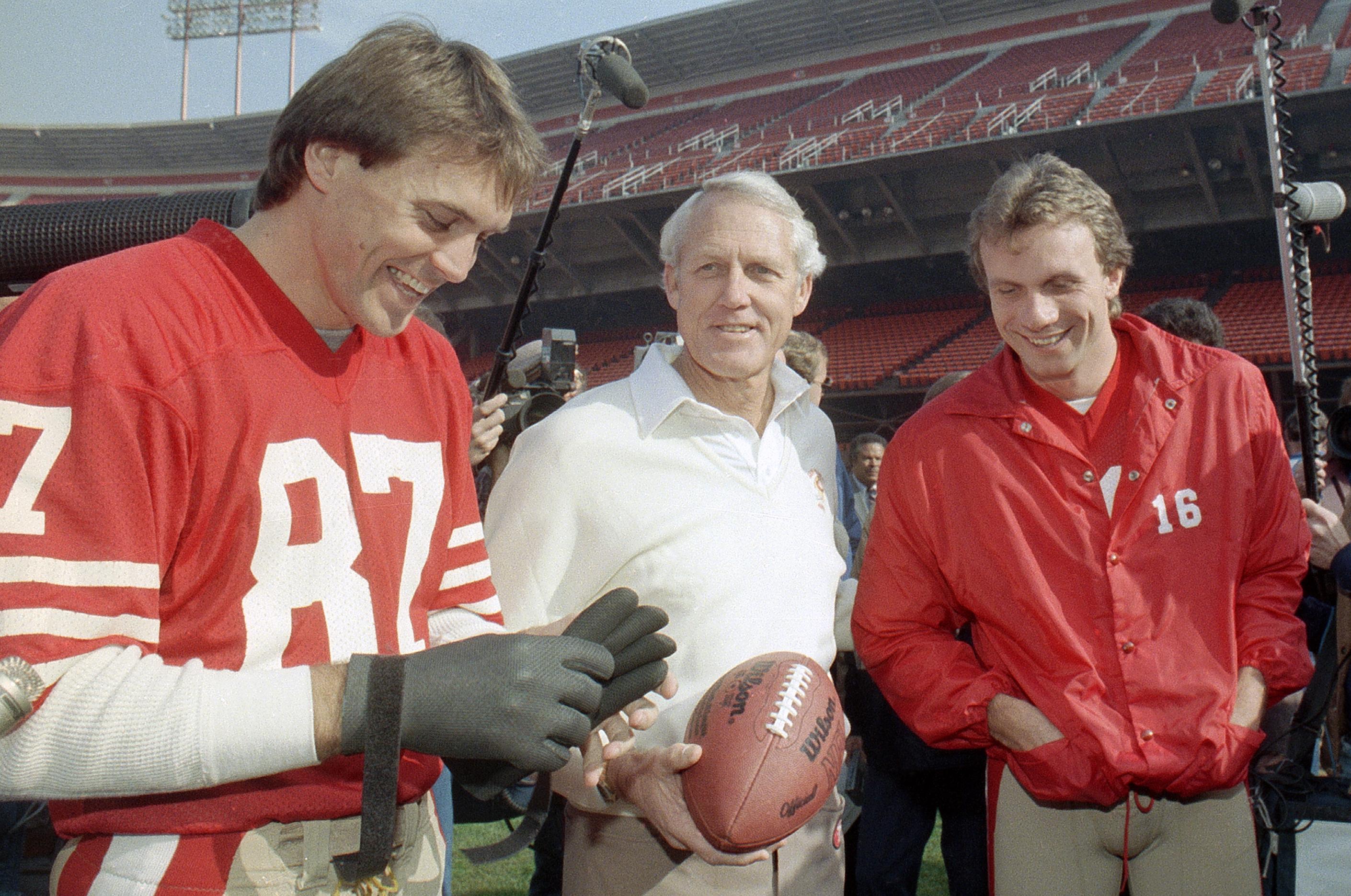
Dwight Clark, Bill Walsh and Joe Montana at Candlestick Park, 1982.
Walsh and Montana made Clark famous.
Clark made Walsh and Montana Super Bowl-bound.

A person should not have his or her life limited to the perception of one moment in it. But sometimes, one moment can make us remember your life forever.

Dwight Edward Clark was born on January 8, 1957 in Kinston, North Carolina, and grew up across the State in Charlotte. He was a quarterback in high school, but Clemson University tried to convert him into a defensive back. He was unhappy, and they moved him to wide receiver.

In 1978, with Steve Fuller as quarterback, he helped them go 11-1, beat Ohio State in the Gator Bowl (where his teammate Charlie Bauman was punched by Ohio State coach Woody Hayes, leading to his firing), and were ranked 6th in the final poll.

Clark caught only 33 passes in college, 11 in his senior year. But Bill Walsh, head coach of the San Francisco 49ers, saw something in him, and drafted him in the 10th round. (Today, the NFL Draft only has 7 rounds.)

The 49ers were terrible, going just 2-14 in Clark's 1st season, as they had the season before. But it was also Walsh's 1st season, and he was building one of the greatest teams of all time. Included in this was another rookie, Notre Dame quarterback Joe Montana.

The 49ers improved to 6-10 in 1980, but no one except Walsh saw the 1981 season coming. After dropping 2 of their 1st 3 -- losing away to Detroit by 7, beating Chicago at home, and losing away to Atlanta by 17 -- the Niners went on a tear, winning 12 of their last 13, the only loss by 3 at home to Cleveland, a pretty good team at the time, and taking their 1st NFC Western Division title in 9 years.

Included in that run was a 17-10 win over the Giants at Candlestick Park. They hosted the Giants again in the Divisional Playoff, and beat them 38-24. This set up their 3rd appearance in an NFC Championship Game. The 1st 2 had been in 1970 and 1971, both against the Dallas Cowboys, and they lost both. They had made the Playoffs again in 1972, and again lost to the Cowboys.

(The 49ers had also lost the 1949 All-America Football Conference Championship Game to the Cleveland Browns, and a 1-game Playoff for the 1957 NFL Western Division title to the Detroit Lions. Until 1981-82, those had been their only trips to the Playoffs, in any league.)

Now, they welcomed the Cowboys again to windswept Candlestick. The Niners had home-field advantage. The Cowboys had experience, with most of them having played in the previous season's NFC Championship Game, a loss to the Philadelphia Eagles; and some having played in Super Bowls XII (a win over the Denver Broncos) and XIII (a loss to the Pittsburgh Steelers).

The game was a seesaw affair. The 49ers led 7-0, then the Cowboys led 10-7 at the end of the 1st quarter, then the 49ers led 14-10, then the Cowboys led 17-14 at the half, then the 49ers led 21-17 at the end of the 3rd quarter. This included a touchdown pass from Montana to Clark.

The Cowboys kicked a field goal at the start of the 4th quarter, to make it 21-20 San Francisco, then added a touchdown to make it 27-21 Dallas. With 4:54 left in the game, the 49ers got the ball at their own 11-yard line. They had given up 6 turnovers, including 3 interceptions by Montana. This would have been cited as the reason they had lost -- if they had lost.

Montana went to work. Lenville Elliott dropped a pass, then ran for 6 yards. Montana threw a 6-yard pass to Freddie Solomon. First down. Elliott ran for 11 yards, for a 1st down, then another 7, then let another Montana pass slip through his hands. He was seemingly setting himself up to be the scapegoat, and he might have remained so, had the Cowboys not been caught offside on the next play, giving the 49ers a 1st down.

Montana threw a 5-yard pass to Earl Cooper, the unintentional symbol of the team, as he wore Number 49. This brought the game to the 2-minute warning. Montana called a reverse, and handed off to Solomon, who ran for 14 yards and a 1st down. Montana threw to Clark for 10 yards, 1st down. Then he threw to Solomon for 13 yards and a 1st down at the Dallas 12. They called their 1st timeout. Montana looked to Solomon in the end zone, but it went incomplete. Elliott ran for 6 yards, bringing the ball to the Dallas 6.

San Francisco called its 2nd timeout, with 58 seconds on the clock. It was 3rd and 3. If the next play failed, there was still time to call timeout -- or to use the stoppage of the clock if it were an incomplete pass -- and get a 1st down and then a winning touchdown, but a field goal wouldn't be enough. It had to be a touchdown.

Walsh told Montana to run "Sprint Right Option," a play he adapted from one he learned as an assistant coach to Paul Brown on the Cincinnati Bengals, which Brown had run successfully with quarterback Otto Graham on the 1950s Browns. Earlier in the game, the play had resulted in a touchdown pass from Montana to Solomon. Walsh figured that would work again.

Maybe it would have, if Solomon hadn't slipped while running his route. There are so many things the loss could have been blamed on, if the 49ers had lost and blown their best chance to date of winning a title. To make matters worse, the Cowboys broke through the 49ers' offensive line. Ed "Too Tall" Jones, Larry Bethea and D.D. Lewis of the "Doomsday Defense" all came toward Montana.

It would later be said of Montana, "He sees the whole field." He knew he had the mobility to get out of this, and the awareness of where his receivers (now including his running backs) were so that he could get the ball to them. I like to compare him to another blond legend of a game called "football," the legendary Dutch forward for Arsenal, Dennis Bergkamp.

Clark's job on the play was to block, but with Solomon having slipped, there was no one to block for. Instead, he got into the end zone. Everson Walls saw this, and covered him. Montana thought he could get the ball to Clark. He executed a perfect pump-fake, and Jones, at 6-foot-9, was not too tall for this play: In this case, his height was a disadvantage, as he jumped to block and possibly intercept a pass that never came, and couldn't get back down in time to get back into position to chase Montana.

Montana jumped and threw. It looked like the ball would go over the end zone. But Clark, who later denied that it was a throwaway, that it was a backup plan for such a play that they had practiced, jumped and caught it in the corner. Touchdown.

"I don't know how I got up there," he said after the game. "Maybe it was God, or something."

Walter Iooss Jr. of Sports Illustrated, already considered perhaps the greatest photographer in sports history, got the picture that ended up on the cover and in everyone's memory. It's an iconic image, even though, due to his arm and his facemask, you can't see his face.
Ray Wersching kicked the all-important extra point, and it was San Francisco 28, Dallas 27. There were still 51 seconds left. But the Cowboys could only run 2 plays from scrimmage, and Lawrence Pillers caused a fumble while sacking Danny White well short of game-winning field-goal range. Jim Stuckey recovered it, and the 49ers were headed to their 1st NFL championship game of any name.

Candlestick Park stood for 54 years, hosting the baseball Giants for 40 seasons, the 49ers for 43 seasons, and the Beatles' last official concert in 1966. Unless you want to count holding firm during the 1989 World Series earthquake and saving 60,000 lives, and hosting the Bay Area's coming-together a week later, this was the much-maligned stadium's greatest moment. As Clark said, "It was dump, but it was our dump, so we could talk about about it, but we didn't want anybody else to talk bad about it."

As with Willie Mays in the 1954 World Series, when the baseball Giants were still in New York, before moving to San Francisco, Clark's grab became known as simply "The Catch."

The 49ers advanced to Super Bowl XVI, at the Pontiac Silverdome in the Detroit suburbs. By a weird twist, the opponent was Walsh's former employer, the Cincinnati Bengals, still owned but no longer coached by Paul Brown, who taught him "Sprint Right Option." Forrest Gregg, who won 5 NFL Championships with the Green Bay Packers and a 6th with the Cowboys, coached them. The 49ers won, 26-21. Clark was not much of a factor, not catching a single pass. But he had won a ring.

He had also earned his 1st Pro Bowl bid, and earned his 2nd the next season, leading the NFL in receptions. The 49ers returned to the NFC Championship Game in the 1983 season, but lost to the Washington Redskins. But they went 15-1 in 1984, and won Super Bowl XIX. In that game, Clark caught 6 passes for 77 yards, as the 49ers beat the Miami Dolphins 38-19.

Clark retired after the 1987 season, having been replaced as a receiving target by both Jerry Rice and John Taylor. He finished his career with 506 receptions for 6,750 yards and 48 touchdowns. Not enough, perhaps, to get into the Pro Football Hall of Fame, but enough for the 49ers to retire his Number 87, their 1st honoree from their 1980s teams that won 4 Super Bowls before adding another in the 1994 season.

"The Catch" was a hinge moment in NFL history. Before it, the Cowboys had been one of the League's dominant teams, reaching 11 NFL or NFC Championship Games in 16 years, including 5 Super Bowls, winning 2; while the 49ers had made the Playoffs only 5 times in the previous 35 years. Over the next 14 seasons, the 49ers would go 5-0 in Super Bowls, while the Cowboys would struggle for several years. The rivalry would be renewed in the 1990s, as they faced each other in 3 straight NFC title games, the Cowboys winning in 1992 and '93 and the 49ers in '94.

Everson Walls, meanwhile, spent several years trying to live down his ineffectiveness in preventing "The Catch." But in the 1990 season, he helped the Giants reach Super Bowl XXV, and win it, finally getting a ring.
*

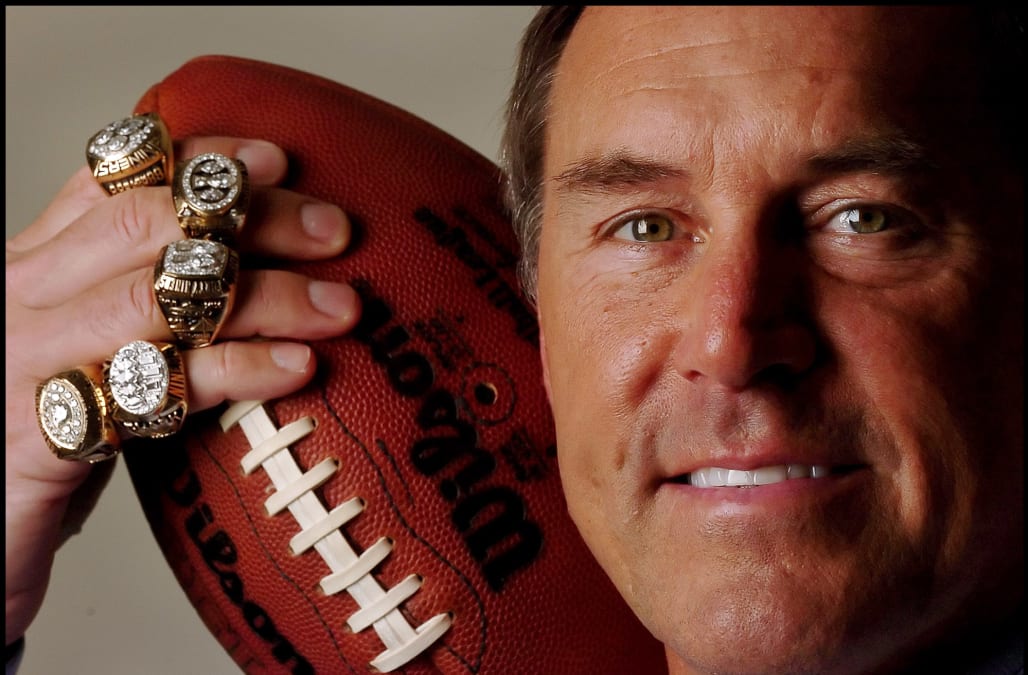
After retiring as a player, Clark was hired in the 49ers' front office. He was awarded rings from their victories in Super Bowls XXIII, XXIV and XXIX. In 1999, when the Browns began their restoration, former 49ers executive Carmen Policy was running them, and hired Clark to be general manager. Things didn't go well there, and Clark resigned after 3 seasons, becoming a postgame analyst on SportsNet Bay Area's 49ers coverage.
He married and divorced Ashley Stone, having daughter Casey and sons Riley and Mac. Casey married Peter Harrold, who played for the Los Angeles Kings and the New Jersey Devils.

In 2011, Clark married Kelly Radzikowski, and lived in Santa Cruz, which is considerably closer to the 49ers' new home, Levi's Stadium in Santa Clara, than it is to the site of Candlestick or to downtown San Francisco. Clark may have anticipated having a longtime job as a 49ers studio analyst, and thus living somewhere convenient to work.

If so, he was tragically mistaken. On March 19, 2017, he annouced that he had been diagnosed with amyotrophic lateral sclerosis, known by its initials ALS, but best known for the earlier sports legend who suffered from it: Lou Gehrig's disease. It's awful: It kills neurons that control voluntary muscles, resulting in the muscles stiffening, twitching and shrinking. Eventually, victims lose the ability to speak, swallow, and finally breathe.

Gehrig died just 2 years after being diagnosed. Physicist Stephen Hawking died earlier this year, over 50 years after being diagnosed, and after 30 years of being almost completely immobile. So its "progress" varies.

Other sports figures known to have had it: Football layers Kevin Turner, Orlando Thomas, and Canadian star Tony Proudfoot; Yankee Hall of Fame pitcher Jim "Catfish" Hunter, 1949-51 Heavyweight Champion Ezzard Charles, and soccer legends Don Revie and Jimmy "Jinky" Johnstone.

From outside sports: Chinese dictator Mao Zedong, Vice President Henry Wallace, Blues singer Huddy "Lead Belly" Ledbetter, actor and singer Dennis Day, songwriter Bob Haymes, jazz musician Charles Mingus, actor David Niven, General Maxwell Taylor, former Senator Jacob Javits of New York, former Governor Sidney P. Osborn of Arizona, former Governor Paul Cellucci of Massachusetts, playwright Sam Shepard, Toto bassist Mike Porcaro, British comedian Ronnie Corbett, actor Lane Smith, soap opera star Michael Zaslow, and professor Morrie Schwartz, immortalized by his former student, Detroit sports columnist Mitch Albom, in his book Tuesdays with Morrie.

More to the point, 3 players from the 49ers' 1964 team developed ALS: Running back Gary Lewis, dead in 1986 at 44; linebacker Matt Hazeltine, dead a month after Lewis, at 53; and quarterback Bob Waters, dead in 1989 at 50. Some people speculated that something to do with Candlestick caused it, but that now appears to have been a dead end. After all, until Clark, no other 49er had been diagnosed.

But enough players now have that a link has been suggested between ALS and the the brain condition chronic traumatic encephalopathy (CTE), which can only be definitively diagnosed after death. Players who've developed ALS have usually had repeated concussions, which has also been a cause of CTE.

Clark had 3 concussions while playing. "I've been asked if playing football caused this," he said. "I don't know for sure. But I certainly suspect it did. And I encourage the National Football League Players Association and the NFL to continue working together in their efforts to make the game of football safer, especially as it related to head trauma.

Dwight and Kelly Clark moved to rural Whitfish, Montana, where he died on June 4, 2018, at the age of 61.

Some of us only knew Dwight Clark for a moment. But because of that moment, we will remember him forever.

UPDATE: Clark was buried at Candy Bar Ranch in Kalispell, Montana.