Showing posts with label arkansas razorbacks. Show all posts

Wednesday, March 4, 2026

Lou Holtz, 1937-2026

Lou Holtz has died. I will be (by my standards) brief, because I didn't like him:

Louis Leo Holtz was born on January 6, 1937 in Follansbee, West Virginia, not far from Wheeling, or from Pittsburgh. He grew up in nearby East Liverpool, Ohio, and attended nearby Kent State University, where he played linebacker. He was an assistant coach at Iowa, William & Mary, Connecticut, South Carolina, and on Woody Hayes' staff when Ohio State won the National Championship in 1968.

His 1st head coaching job was at William & Mary, from 1969 to 1971. He went just 13-20 with them, but he did get them into the 1970 Tangerine Bowl. This game, which became the Citrus Bowl, was then for what would now be Football Championship Subdivision (FCS) teams, or (before that) Division I-AA. In 1972, he was named head coach at North Carolina State. He coached them for 4 seasons, winning the Atlantic Coast Conference title in 1973, and getting them into a bowl game every year, including winning the 1972 Peach Bowl and the 1973 Liberty Bowl.

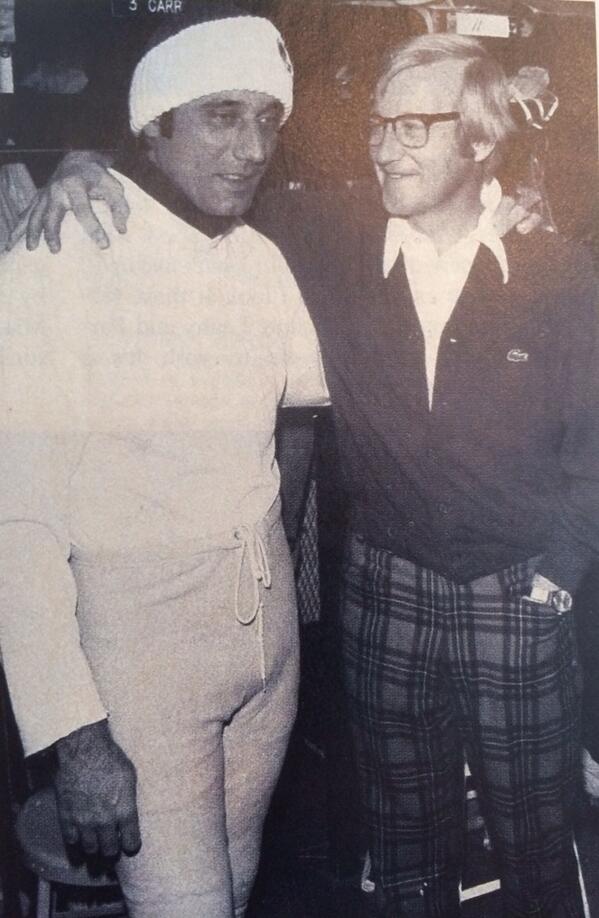
In 1976, he got his 1st NFL job. It turned out to be his last. It was with the New York Jets, and Holtz tried to install the veer offense, a run-oriented offense. And the quarterback was Joe Namath. This was not the 1969 Namath with the cannon arm and the swagger, it was the 1976 Namath with 7 added years of pounding and two bad knees. He couldn't run it.
I think we should all be glad
this picture is not in color.
It was the 1970s, after all.

He wasn't the first college football coach to bomb out in the NFL, and he wouldn't be the last: The Jets went 3-10, with 2 of the wins being by 5 and 7 points. On December 9, with one game to go, and one step ahead of the law, Holtz quit, saying, "God did not put Lou Holtz on this earth to coach in the pros."

Frank Broyles retired as head coach at the University of Arkansas. Since he was still their athletic director, he chose his successor, and he chose Holtz. In that 1st season, 1977, he took them to 11-1 and victory over Oklahoma in the Orange Bowl. Their only loss was 13-9 to Texas, costing them the Southwest Conference title. In 1979, they won the SWC title, but lost the Sugar Bowl to Alabama. They won the Hall of Fame Bowl in 1980, and the Bluebonnet Bowl in 1982.
In 1984, he left Arkansas to become head coach at Minnesota. In just 2 years, he got a program that had been doormats for a generation to victory in the 1985 Independence Bowl. It was the program's only bowl game win between the 1961 and 2002 seasons.

That got him hired by Notre Dame in 1986. In his 2nd season, he got them to the Cotton Bowl, but they lost. Like George Gipp, Frank Leahy, Ara Parseghian and Dan Devine, Lou Holtz led Notre Dame to the National Championship in just his 3rd season, going 12-0, including their Number 1 vs. Number 2 "Catholics vs. Convicts" game against the University of Miami, the defending National Champions. They capped it by beating West Virginia in the 1989 Fiesta Bowl.

They nearly did it again in 1989, losing only to revenge-minded Miami on Thanksgiving weekend. Their win in the Orange Bowl cost Colorado the National Championship, throwing it to Miami. Colorado avenged this loss in the next season's Orange Bowl, winning the National Championship.

Notre Dame won the Sugar Bowl in the 1991 season, and the Cotton Bowl in each of the next 2 seasons. But losses to Stanford in 1992 and Boston College in 1993 -- just 1 week after a Number 1 vs. Number 2 "Game of the Century" with Florida State -- cost them the National Championship both times.

His next 3 seasons were not as successful, and he retired after the 1996 season. The Minnesota Vikings offered him their head job, but he turned it down, and took a studio analyst job with CBS. In 1999, he took the job at South Carolina, going 0-11, before going 8-4 and 9-3, and winning back-to-back Outback bowls. He retired after going 8-4 in 2004, and went back to ESPN before retiring after the 2015 season.

His college coaching record was 249-132-7, including a 10-8-1 record in bowl games, for a winning percentage of .651. He won an ACC title, a SWC title, and the 1988 National Championship. He was beloved among college football fans, as both a coach and a broadcaster.

He was also a horrible person, supporting horrible people. In 1990, he supported the successful re-election campaign of race-baiting homophobic Senator Jesse Helms of North Carolina. In 2016, he spoke at the Republican Convention, endorsed Donald Trump, and criticized Colin Kaepernick for his kneeling in opposition to police brutality.

In the 2020 campaign, he again spoke at the Republican Convention, again endorsed Trump, made multiple appearances on Sean Hannity's Fox News Channel show, supported Amy Coney Barrett's nomination for the Supreme Court, and said -- remember, he had been the head coach at the University of Notre Dame, a towering symbol of American Catholicism -- that Joe Biden was "a Catholic in name only." This statement was so foul that Notre Dame released a statement distancing itself from it.

Trump gave Holtz the Presidential Medal of Freedom, something he absolutely would not have done if Holtz had supported Democrats. Holtz was also elected to the Upper Ohio Valley Hall of Fame, the Arkansas Sports Hall of Fame, and the Indiana Sports Hall of Fame. Notre Dame does not have an intra-university Hall of Fame.
Lou Holtz died today, at age 89, in Orlando, Florida. He was predeceased by his wife, Beth Barcus, and was survived by 4 children, including 3 Notre Dame graduates.

One of those is Louis Leo Holtz Jr., a.k.a. Skip Holtz, who has been an assistant to Bobby Bowden at Florida State, offensive coordinator to his father at both Notre Dame and South Carolina, and head coach at Connecticut, East Carolina, South Florida and Louisiana Tech. For the last 4 seasons, he was the head coach of the UFL's Birmingham Stallions.

With the death of Lou Holtz, the earliest living former head coach of the Jets is now Bruce Coslet (1990-93); and the earliest living former Notre Dame head coach is Holtz's successor, Bob Davie (1997-2001).

I will close with a joke I heard while Holtz was still in South Bend. A man walks into a bar, and announces that he's the world's biggest Notre Dame fan. Nobody believes him. He tells the bar, "I've got a tattoo of Paul Hornung on one side of my ass, and Joe Montana on the other!" Both had been quarterbacks at Notre Dame. The bartender says, "Prove it!" So the guy drops his pants and moons the bartender. Talk about a "South Bend." The bartender says, "I don't see Hornung, and I don't see Montana, but that's definitely Lou Holtz in the middle!"

Wednesday, January 1, 2025

January 1, 1955: Georgia Tech Complete the New Year's Day Circuit

Bobby Dodd

January 1, 1955, 70 years ago: The Cotton Bowl Classic is held at the Cotton Bowl stadium in Dallas. The University of Arkansas, Champions of the Southwest Conference, take on the Georgia Institute of Technology, the 2nd-place team in the Southeastern Conference. (Georgia Tech left the SEC and became an independent in 1964, and joined the Atlantic Coast Conference in 1983. Arkansas joined the SEC in 1992.)

The Arkansas Razorbacks, coached by Bowden Wyatt, came into the game 8-2, and ranked Number 10 in the country. The Georgia Tech Yellow Jackets, coached by Bobby Dodd, were 7-3 and unranked, but were coming off a big win over arch-rival Georgia.

The game was scoreless until right before halftime, when Arkansas quarterback George Walker completed an 80-yard drive by scoring himself, but he missed the extra point. Georgia Tech dominated the 2nd half, holding the Razorbacks to only 8 yards rushing, and scoring touchdowns with Paul Rotenberry in the 3rd quarter and Wade Mitchell in the 4th. The Yellow Jackets won, 14-6.

By winning this game, Georgia Tech became the 1st school to win all 4 of the major New Year's Day bowl games. They had previously won the Rose Bowl in Pasadena, California in 1929; the Orange Bowl in Miami in 1940; and the Sugar Bowl in New Orleans in 1944.

Entering the 2024-25 bowl games, there have since been 8 other schools to turn the trick: Alabama, completing the circuit with the 1962 Sugar Bowl; Georgia, with the 1967 Cotton Bowl; Notre Dame, with the 1975 Orange Bowl; Penn State, with the 1995 Rose Bowl; Ohio State, with the 1999 Sugar Bowl; Miami, with the 2002 Rose Bowl; Oklahoma, with the 2003 Rose Bowl; and Texas, with the 2005 Rose Bowl.

Prior to the start of major conference realignment in the 1990s, winning all 4 was really hard, because, from 1947 onward, the Rose Bowl had been between the Champions of the leagues now known as the Big Ten and the Pacific-Twelve.

Also, until 1975, the Big Ten and the league then known as the Pac-Eight had a rule that the Rose Bowl was the only bowl they would send a team to. And Notre Dame did not accept any bowl bids between their 1925 Rose Bowl win and their 1970 Cotton Bowl loss. Notre Dame have overcome this, but Ohio State are the only team that was in the Big Ten prior to Penn State's arrival in 1993 to overcome their league's issue.

Michigan, the Big Ten's other previous major power, have never played in the Cotton Bowl, although they've won the other 3. A few other schools have won 3 of the 4, including Tennessee, Arkansas, Missouri, Oregon and Washington.

Once the Bowl Championship Series kicked in for the 1998 season, conference tie-ins were no longer written in stone, making cross-league bowls more common. You'll notice that Penn State, Miami, Oklahoma and Texas did it after the Big Ten Champion could have gone to a de facto National Championship Game in a year when it wasn't the Rose Bowl. Prior to the 1946 season's lock-in for the Big Ten, Penn State had played in the 1923 Rose Bowl, but lost to USC; while Miami, Oklahoma and Texas had never previously played in it.

The Fiesta Bowl, in the Phoenix suburbs, in Tempe from 1971 to 2006 and in Glendale ever since, became a New Year's Day bowl game in 1982. Notre Dame first won it on January 2, 1989, making them the 1st team to have won all 5. Penn State won it for the 1st time in 1982, so they completed all 5 in 1995. Ohio State won it in 1984, so they completed all 5 in 1999. Texas won it in 2009, and Oklahoma in 2011, completing all 5. So that's 5 schools that have won all 5 major New Year's Day bowl games.

Oklahoma (in 1976) and Penn State (in 1977 and 1980) had won the Fiesta Bowl before it was a New Year's Day game. Alabama, Georgia and Georgia Tech have never won it: Alabama have lost their only appearance, in 1991, while the 2 Georgia schools have never even been in it.

Since 1913, Georgia Tech have played their home games at Grant Field. In 1988, it was officially renamed Bobby Dodd Stadium at Historic Grant Field. In 2024, the Grant name was removed, and the naming rights sold: It is now Bobby Dodd Stadium at Hyundai Field.

Having been a star player at Tennessee, Dodd is one of the few men to have been elected to the College Football Hall of Fame as both a player and a coach.

*

January 1, 1955 was a Saturday. In the other New Year's Day bowl games:

* Number 1 Ohio State beat Number 17 University of Southern California, 20-7 in the Rose Bowl, in the stadium of the same name in the Los Angeles suburb of Pasadena, California. Ohio State had won the Big Ten. USC had finished 2nd in the Pacific Coast Conference, the forerunner of the Pac-12, but, like the Big Ten, the PCC had a rule that no team could represent it in the Rose Bowl in back-to-back years, so their intra-city arch-rivals, the University of California at Los Angeles, ranked Number 2 in the country, were out, and USC took their place. As a result, the polls ended up split on the National Championship, between Ohio State and UCLA.

* Number 5 Navy beat Number 6 Mississippi, 21-0 in the Sugar Bowl, at Tulane Stadium in New Orleans. "Ole Miss" had won the SEC title, beating Georgia Tech.

* Number 14 Duke beat Nebraska, 34-7 in the Orange Bowl, at Burdine Stadium in Miami. (The stadium was renamed the Orange Bowl in 1959.) Duke were the Champions of the ACC. Oklahoma had won the title in the league then known as the Big Seven Conference (Oklahoma State would soon join, to make it the Big Eight), but the league had a rule that no team could represent it in the Orange Bowl in back-to-back years, so 2nd-place Nebraska did, with poor results.

* Texas Western University beat Florida State, 47-20 in the Sun Bowl, at Kidd Field in El Paso, Texas -- TWU's home field. They were renamed the University of Texas at El Paso in 1967. Kidd Field still stands, but was replaced as their home field, and as the home of the Sun Bowl game, by the adjacent Sun Bowl stadium in 1963. Burt Reynolds was on FSU's roster, but was injured and didn't play in the Sun Bowl. His football career over, he turned to acting. His roommate was Lee Corso, who would later become a college coach and ESPN's top college football analyst.


Friday, December 6, 2019

December 6, 1969: Texas vs. Arkansas, "The Game of the Century"

December 6, 1969, 50 years ago: One of college football's occasional "Games of the Century" is played.

NOTE: This was the same day as the disastrous Altamont concert outside San Francisco.

They seemed to be coming every year. 1966 saw Michigan State vs. Notre Dame, in the Big Ten region if not a Big Ten game in its own right. 1967 saw USC vs. UCLA, in the league now known as the Pac-12. Now, it was Texas vs. Arkansas, for the Championship of the Southwest Conference.

Darrell Royal had been a quarterback under Bud Wilkinson at the University of Oklahoma. He never played pro football, but went into coaching. His 1st head coaching job was with the Edmonton Eskimos of the Canadian Football League of 1953. He must have gotten tired of the cold, because he went to Mississippi State University in 1954, and the University of Washington in 1956.

In 1957, he was hired at the University of Texas, one of Oklahoma's main rivals. By 1963, he had made Texas National Champions. In 1967, he installed the wishbone offense, and made his team nearly unstoppable. They won or shared the SWC title in 1959, 1961, 1962, 1963 and 1968.
They roared through the 1969 season, hanging 69 points on Texas Christian (TCU), 56 each on Navy and Baylor, 49 each on Texas A&M and Texas Tech, and 45 on Southern Methodist (SMU). But they only played 1 ranked team all season, beating Number 8 Oklahoma, 27-17 at the Cotton Bowl in Dallas. After beating A&M away on Thanksgiving Day, they were 9-0, and ranked Number 1 in the nation. They went into the game with an 18-game winning streak, their last loss to Texas Tech early in the 1968 season.

Frank Broyles had also been a college quarterback, at Georgia Tech, but not a pro one. He got his 1st head coaching job in 1957, at the University of Missouri. After just 1 year, the University of Arkansas was impressed enough to hire him away.

At the time, the Southwest Conference had 9 teams, and Arkansas, in Fayetteville, was the only 1 of them not in the State of Texas. The others were: Texas, in Austin; Texas A&M, in College Station; Texas Tech, in Lubbock; Texas Christian University (TCU), in Fort Worth; Southern Methodist University (SMU), in Dallas; Baylor, in Waco; and 2 schools in Houston, Rice University and the University of Houston.

But Broyles' Razorbacks held their own, winning the SWC title in 1959, 1960, 1961, 1964, 1965 and 1968, and taking the National Championship in a split poll in 1964. (Alabama won the other poll.) Future Dallas Cowboys head coach Jimmy Johnson and owner Jerry Jones played on his '64 National Champions.
Arkansas also had a fabulous season in 1969. Its offense wasn't as high-powered, but they scored 55 points on the University of Tulsa, 52 on Wichita State, 39 on Oklahoma State, 35 on Texas A&M, 33 on Texas Tech, and 30 on Rice. After beating Texas Tech on Thanksgiving, they were 9-0, and ranked Number 2, behind only Texas. They went into the game with a 15-game winning streak, their last loss being to Texas the season before.

The 1969 season marked the 100th Anniversary of college football, with Rutgers having beaten Princeton in the first game in 1869. Beano Cook, then an executive with ABC Sports, suggested moving the Texas-Arkansas game, normally played in October, to the 1st weekend in December, a week after most other teams had finished playing. The teams agreed, because it meant the entire country would be focused on their game, not on another.

And moving the game turned out to be a lucky break. Because, on November 22, Ohio State, defending National Champions and ranked Number 1, were upset by their arch-rivals, Michigan, handing Michigan the Big 10 title. That moved Texas up to Number 1 and Arkansas up to Number 2, without either of them even playing. All each team had to do was win their respective game on Thanksgiving, which they did: The 'Horns beat A&M 49-12, and the Hogs beat Texas Tech 33-0.

And so, on Saturday, December 6, 47,500 people shoehorned themselves into Razorback Stadium in Fayetteville. That was about 5,000 above normal capacity at the time, and later expansions have made it now a 76,000-seat facility.
Razorback Stadium, 1969. The practice fields in the upper left corner
are where Marine One landed, depositing Nixon.

Among those 47,500 fans, his Marine One helicopter landing on an adjacent practice field a few minutes before the scheduled kickoff, was the nation's Number 1 football fan, a former offensive lineman at Whittier College outside Los Angeles, the President of the United States, Richard Nixon. He had said that week that he would give a plaque to the winning coach, declaring them the National Champions. Of course, this was before the New Year's Day bowl games could have messed that up. 

Also among the fans was the Rev. Billy Graham, who delivered a pregame prayer over the public address system. Graham had a degree from Wheaton College, in Wheaton, Illinois, hometown of football legend Red Grange, although Grange went to the University of Illinois.

Not among the fans was Bill Clinton, then 23 years old, himself a future President, and a future Governor of Arkansas. At some point during his political career, a rumor got out that he had watched the game for free from a tree. The rumor grew, until it involved him flashing Nixon, or holding up an antiwar sign in front of Nixon. But he was then a Rhodes scholar at Oxford University in England, left to listen to the game on the Armed Forces Radio Network.

One time, while he was Governor, a man asked him if it was true he had heckled Nixon that day. Clinton was forced to deny it, and, disappointed, the man said, "That's one of the reasons I voted for you!"

At the time, both schools had racially integrated student bodies, but all-white football team rosters, all-white bands, and all-white cheerleading corps. How many black fans were in the stands is unknown, but the number probably wasn't very large. In 2002, Terry Frei, who has written many books about football, published one about this game, fittingly titled Horns, Hogs, and Nixon Coming: Texas vs. Arkansas in Dixie's Last Stand, pointing out that, the last month of the 1960s, this was the last major all-white sporting event in America.

It was only 38 degrees at kickoff, and there was still some fog after an early morning rain when the game kicked off at 12:00 noon Central Time (1:00 PM Eastern Time). The game had to be held that early, because Razorback Stadium didn't yet have lights.

Broyles offered to move the game to War Memorial Stadium in Little Rock, which was a secondary home for the Razorbacks, did have lights, was a larger stadium, was in the central part of the State and thus closer to most people in Arkansas, and was closer to Austin, thus making it an easier roadtrip for the Texas fans. But ABC rejected this idea, dismissing that stadium's lights as not bright enough.

Arkansas, in red, kicked off, and benefited from Texas, wearing white, fumbling the ball away on their 2nd play from scrimmage. The Razorbacks converted that into a touchdown run by Bill Burnett. Their 7-0 lead held through halftime.

(If you get a chance to see this game, on a nostalgia network or online, you'll miss the 1st Arkansas touchdown: ABC only managed to save the last 3 quarters of their broadcast. The full game should be available on film.)

The Hogs started the 2nd half by driving through the Longhorn defense, resulting in a 29-yard touchdown pass from Bill Montgomery to Chuck Dicus. With 9:06 left in the 3rd quarter, it was Arkansas 14, Texas 0. And the Longhorns hadn't yet looked like scoring on the afternoon. This "Game of the Century" was not yet living up to the hype.

On the 1st play of the 4th quarter, Texas quarterback James Street made a 42-yard dash for a touchdown. Now, it was 14-6 Razorbacks. Royal, remembering the 1966 "Game of the Century" between Michigan State and Notre Dame that ended in a 10-10 tie, chose to go for a 2-point conversion. Street got over the goal line, to make it 14-8.

The Hogs were not fazed. On their next drive, Montgomery took them down to the Texas 7-yard line. But on 3rd and goal, his pass was intercepted in the end zone by Danny Lester. Had it merely been incomplete, a chip-shot field goal would have made it 17-8, a 2-score game, and probably cinched it for Arkansas.

Instead, it was still 14-8, and, with 4:47 left, Royal rolled the dice again, going for it on 4th and 3 from his own 43. Street threw to Randy Peschel, who caught it and took it deep, to the Arkansas 13. Two plays later, Jim Bertelsen scored a touchdown. The extra point by James "Happy" Feller gave the Longhorns a 15-14 lead. Now, with 3:58 left, the game was living up to the hype.

Arkansas refused to fold. They got to the Texas 40, and Campbell let a pass loose, but it was intercepted by Tom Campbell on the Texas 21 with under a minute to go. The Longhorns ran out the clock, and were 15-14 victors.

In the Longhorn locker room, ABC cameras captured Nixon's presentation of his National Championship plaque to Royal. But the bowl games were still left to play. Texas still had to beat Notre Dame in the Cotton Bowl in Dallas to truly be National Champions. They did, coming back from 10-0 down to win 21-17.
Nixon gives Royal the plaque. Number 24 is tailback Ted Koy.
Number 16 is quarterback James Street.

Arkansas went to the Sugar Bowl in New Orleans, and lost again, to Mississippi, 27-22. USC, undefeated at 9-0-1, beat Michigan in the Rose Bowl in the Los Angeles suburb of Pasadena, California. Undefeated and untied Penn State rose to Number 2 after Arkansas' loss to Texas, and won the Orange Bowl in Miami, 10-3 over Missouri, the Big 8 Champions and previously undefeated and untied.

Being undefeated, but with a tie, USC did not claim to be National Champions over Texas. Undefeated and untied Penn State did, and felt robbed when both the AP and UPI published final polls listing Texas at Number 1 and Penn State at Number 2.

Penn State have no case. They had their chance. The Cotton Bowl committee invited Penn State, hoping to set up a Number 1 vs. Number 2 matchup with the SWC Champion, regardless of whether it turned out to be Texas or Arkansas. But Joe Paterno figured it wouldn't be Number 1 vs. Number 2, because Ohio State were still Number 1, and turned them down.

Paterno later said, "I've wondered how President Nixon could know so little about Watergate in 1973, and so much about college football in 1969." Nixon died in 1994, before everyone found out that Joe Paterno was a lesser human being, and presided over more felonies, than Tricky Dick.

James Street was also a pitcher on the Longhorn baseball team, and pitched a perfect game. He was drafted by the Cleveland Indians, but got hurt, and never played in the major leagues, nor in professional football. He became a successful settlement planner. He died in 2013, having lived to see his son, Huston Street, become a star major league reliever.

Happy Feller kicked in the NFL for Philadelphia in 1971 and New Orleans in 1972 and '73. As of December 6, 2019, he is still alive.

In 1970, Julius Whittier became the 1st black football player at the University of Texas. In 1972, the Longhorns had 1 touchdown pass all season long. Whittier caught it, in their Thanksgiving win over Texas A&M. He became a lawyer, and died in 2018.

Darrell Brown had tried to be the 1st black player at Arkansas, and played for their freshman team in 1965, but broke his ankle, and was unable to play a varsity down. Like Whittier, he became a lawyer, and died in 2015.

Due to Brown's injury, Arkansas didn't integrate until 1974, after every other school in the SWC and the Southeastern Conference had already done so. Leotis Harris was a guard, and played for their 1977 team that nearly won the National Championship. He played 6 seasons for the Green Bay Packers, and is still alive.

"A lot of other coaches from other schools used to talk about that Coach Broyles wouldn't have a black player on his team," Harris said. He found otherwise: "He was a fair guy. Some people said some things about him, about the black-white thing, but he was just a great man."
Broyles and Royal both retired as head coach after the 1976 season. Royal remained the Longhorns' athletic director until 1980, and lived until 2012. Broyles remained the Razorbacks' athletic director until 2007, and lived until 2017.
And that plaque that Nixon gave Royal? Well, it turns out, Nixon only posed with Royal and the plaque. He didn't give it to Royal. He said he would take it back to Washington, and have "TEXAS LONGHORNS" engraved above the words "NATIONAL CHAMPIONS."
After that, it disappeared. No one knows where it is. The UT athletic department denies that it has possession. No player on the 1969 Longhorn team claims to have it, either. Nor does Royal's widow, Edith. Nor does the Nixon Presidential Library. Nor does the Lyndon B. Johnson Presidential Library, which was then being built across from Texas' Memorial Stadium. Nor does the White House. Nor does the National Archives. Nor does the Smithsonian Institution. Nor does the College Football Hall of Fame. Nor does the Texas Sports Hall of Fame.
Bill Little, the Texas football program's official historian, said on the game's 50th Anniversary in 2019, "No one's seen it in 50 years." Cotton Speyrer, a receiver on that Texas team, suggested, "Some Penn State fan had probably gotten the plaque and thrown it into Lake Erie." (Hayden Fox and Jack Geller, noted throwers of football-related things into lakes, couldn't be reached for comment.)
In 2019, to celebrate the 50th Anniversary of the game, a replica of the plaque was made, and put on display at the Longhorn Hall of Fame, in the north end zone of what's now named Darrell K. Royal Texas Memorial Stadium in Austin.

Tuesday, October 17, 2017

How to Go to an Arkansas Football Game

Old Main, on the Fayetteville campus

40 States down, 10 to go. This Saturday, the University of Arkansas plays football against Auburn, one of the powers of the Southeastern Conference.

It's still strange to see Arkansas in the SEC, even 26 years after leaving the Southwest Conference (SWC), essentially leading to its demise. But in the SEC, they are.

Before You Go. Being in the South, Arkansas can get quite hot. But this will be late October, so daytime temperatures on Saturday are projected to be in the mid-70s, and nighttime temperatures in the low 50s. You should bring a jacket.

Despite being a former Confederate State, you will not need to bring a passport or change your money to go to Arkansas. However, it is in the Central Time Zone, an hour behind New York, so you will have to adjust your timepieces.

Tickets. Despite not being a championship contender in recent years, the Razorbacks usually top 70,000 fans at home games. So tickets may be difficult to get. Sideline seats are $85 in the lower level, and $65 in the upper level.

Getting There. It is 1,328 miles from Midtown Manhattan to Fayetteville, Arkansas. Knowing this, your first instinct is going to be to fly.

Arkansas is one of the few States whose capital doesn't have a major football-playing college in it. (There is a University of Arkansas at Little Rock, but they're not Division I-A.) As a result, flying to Northwest Arkansas Regional Airport to attend a Razorbacks game could be difficult.

United Airlines offers one daily nonstop flight there from Newark, leaving at 8:15 AM (Eastern) and arriving at 10:28 AM (Central, 11:28 Eastern). But there are no nonstops on the way back, and the total fare is going to be over $1,500. Flying to Little Rock instead (into the airport now named Bill and Hillary Clinton National Airport), and renting a car to go the rest of the way, won't help, as it's 189 miles away.

So what are the other options? Amtrak does not go to Fayetteville. Greyhound does, and it will cost $358, but it could drop to $302 with advanced-purchase. The station is at 3075 W. Wedington Drive, about 2 miles northwest of the campus.

Oh... kay. So what about driving? As I said, over 1,300 miles. I would definitely recommend bringing a friend and sharing the driving. You'll need to get on the New Jersey Turnpike, and take Interstate 78 West across New Jersey, and at Harrisburg get on the Pennsylvania Turnpike, which at this point will be both I-70 and I-76. When the two Interstates split outside Pittsburgh, stay on I-70 west. You'll cross the northern tip of West Virginia, and go all the way across Ohio (through Columbus), Indiana (through Indianapolis) and Illinois.

When you cross into Missouri, you'll be in St. Louis, going over the new Stan Musial Veterans Memorial Bridge. Switch to Interstate 44 West, and take that across southern Missouri until reaching Exit 11A, onto Interstate 49 South. Exit 66 will get you to the campus.

If you do it right, you should spend about an hour and 15 minutes in New Jersey, 5 hours in Pennsylvania, 15 minutes in West Virginia, 3 hours and 45 minutes in Ohio, 2 hours and 30 minutes in Indiana, 2 hours and 30 minutes in Illinois, 5 hours and 15 minutes in Missouri, and 45 minutes in Arkansas. That's going to be a little over 21 hours. Counting rest stops, preferably 5 of them, and accounting for traffic at both ends, it should be about 28 hours.

Once In the City. Arkansas was the 25th State admitted to the Union, on June 15, 1836; the 9th State to secede from the Union, on May 6, 1861; and the 2nd former Confederate State to be readmitted to the Union, on June 2, 1868.
Founded in 1828, Fayetteville was named for the founders' hometown, which was Fayetteville, Tennessee, which was named for Fayetteville, North Carolina, which was named for the Marquis de Lafayette, the French nobleman who helped America win its Revolutionary War.

Arkansas' most famous citizen, former President Bill Clinton, once explained that the reason the State is so poor is that the major transcontinental rail lines bypassed it. Neither the one going westward from St. Louis to San Francisco nor the one going westward across the south to Los Angeles, through Dallas, went through it. Thus, there were no towns established around such stops, and thus there were no such towns to grow into revenue-generating cities.

The image of Arkansas as a racist bastion, due to the 1957 Little Rock school integration crisis (on top of the 1919 Elaine Massacre where over 200 black people were murdered), didn't help. Nor did the corporate-owned media's portrayal of Clinton as a horny, corrupt country bumpkin who was in over his head upon his arrival in the White House. He wasn't corrupt, he was no bumpkin, and if he was ever in over his head, he swam out of it.

The Fayetteville area, in the northwestern part of the State, is home to about 84,000 people (not counting University students in residence), and the area is home to about 500,000. Arkansas as a whole is home to about 3 million people.
The State House in Little Rock

ZIP Codes in Arkansas start with the digits 716 to 729, and for Fayetteville 727. The Area Codes are 501 for Little Rock and Hot Springs, 479 for Fayetteville, and 870 for the southwestern part that includes Texarkana and Bill Clinton's hometown of Hope. The State sales tax is 6.5 percent. Neither Little Rock nor Fayetteville has a "beltway."
The State's largest newspaper, the Arkansas Democrat-Gazette, recently took over the local paper, the Northwest Arkansas Times, and made it the Northwest Arkansas Democrat-Gazette. College Avenue divides street addresses into East and West, and Center Street into North and South. The University of Arkansas was founded there in 1871, and their Razorback Transit bus system is free, and provides access around town, mostly to the campus.

In addition to the main campus in Fayetteville, there's also a campus in Little Rock (including the Medical School), one in Monticello, one in Pine Bluff and one in Fort Smith. UAPB is NCAA Division I, but in the Football Championship Subdivision, what used to be known as Division I-AA. UALR doesn't play football, but is Division I in all other sports. UAM and UAFS are in Division II.

Among UA's alumni are Dillard's Departent Stores founder William T. Dillard; Alltel founder Joe T. Ford; pacemaker inventor Dr. Walter Keller; novelists Charles Portis and E. Lynn Harris; CNN anchor T.J. Holmes; actor Laurence Luckinbill; Governors Jeff Davis (not that Jefferson Davis), Xenophon Pindall, George Donaghey, Junius Futrell, Charles H. Brough, John Martineau, Joseph T. Robinson, Tom Terral, Francis Cherry, Sid McMath, Bob Riley, Joe Purcell, Dale Bumpers, David Pryor, Jim Guy Tucker, Asa Hutchinson and Mike Beebe, plus Governor Edwin Mechem of New Mexico; Senators Robinson, Davis, Bumpers, Pryor and his son Mark Pryor, J. William Fulbright, Tim Hutchinson and John Boozman; and a President of Panama, Ricardo Martinelli.

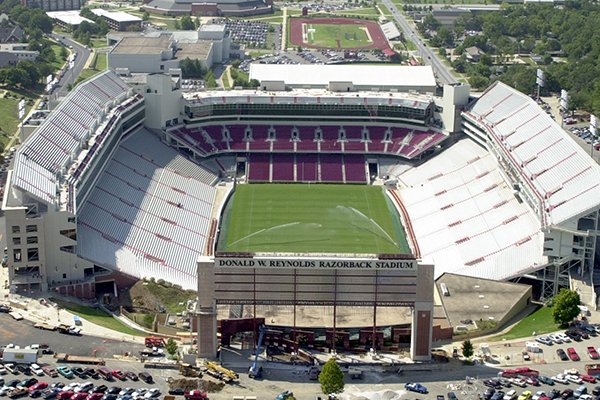
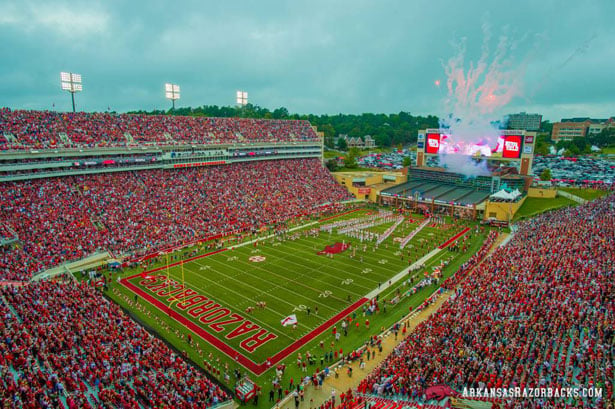
Going In. Razorback Stadium opened in 1938, at 350 N. Razorback Road, about a mile northest of downtown. If you drive in, parking is $20.

Originally seating 13,500, it was expanded to 21,000 in 1950, 30,000 in 1957, 42,000 in 1969, 52,000 in 1985, and its present 76,000 in 2001. That last expansion was funded by the Donald W. Reynolds Foundation, founded by an Arkansas media chief, and the stadium was renamed Donald W. Reynolds Razorback Stadium.
The field is laid out north to south, and has been artificial turf since 2009. It was named Frank Broyles Field for the former football coach and athletic director upon his 2007 retirement as AD. The scoreboard includes not a "big screen," but, in keeping with the Razorback theme, a "Pig Screen."

(UPDATE: Arkansas returned to natural grass for the 2019 season.)

The Athletic Center, including team offices and training centers, was also named for Broyles, and in the north end zone. It was recently demolished to make way for an replacement facility under a bleacher section that will expand capacity to over 80,000.
Food. It's the South. You're gonna get food that's long on taste and low on health benefits. You can get your organic Whole Foods and nonfat latte from Starbucks when you get back to New York.

They seem to like macaroni & cheese in Arkansas, because they put it on both a "Mac Attack Burger" (definitely not to be confused with a McDonald's Big Mac) and a quarter-pound hot dog. They also serve Big Red Pork Tenderloin Sandwiches, Petit Jean Grilled Ham & Cheese Sandwiches, and Buffalo Chicken Nachos. In other words, if you're rooting for the visiting team, if they can't beat you, they'll kill you by ruining your diet.

Team History Displays. Long a mainstay of the Southwest Conference, Arkansas won it 13 times: In 1936, 1946, 1954, 1959, 1960, 1961, 1964, 1965, 1968, 1975, 1979, 1988 and 1989. They've found the Southeastern Conference rough going, winning the Western Division in 1995, 2002 and 2006, but losing the SEC Championship Game each time.

They won the National Championship in 1964, with a team that included future Dallas Cowboys owner Jerry Jones (guard, Number 61) and future Cowboys coach Jimmy Johnson (defensive tackle, Number 60). This included beating Nebraska 10-7 in the 1965 Cotton Bowl in Dallas.

They won the Cotton Bowl again in 1976, 2000 and 2012. They also won the 1947 Dixie Bowl, the 1960 Gator Bowl, the 1969 Sugar Bowl, the 1978 Orange Bowl, the 1980 Hall of Fame Classic, the 1982 Bluebonnet Bowl, the 1985 Holiday Bowl, the 2003 Independence Bowl, the 2009 Liberty Bowl, the 2014 Texas Bowl, and the 2015 Liberty Bowl. However, there is no open display for any of these honors in the fan-viewable areas of the stadium.

Razorback football legends the following members of the College Football Hall of Fame, with their senior years included: End Wear Schoonover (1929), running back Clyde Scott (1948), linebacker Wayne Harris (1960), receiver Lance Alworth (1961), running back Billy Joe Moody (1962), offensive tackle Loyd Phillips (1966), receiver Chuck Dicus (1970), defensive end Billy Ray Smith Jr. (1982); and head coaches Hugo Bezdek (1908-12), Francis Schmidt (1922-28), Bowden Wyatt (1953-54, elected for what he did elsewhere), Frank Broyles (1958-76) and Lou Holtz (1977-83). Alworth is also in the Pro Football Hall of Fame.

Other prominent Arkansas football players include end Jim Lee Howell (1936, was an NFL Champion with the Giants as a player in 1938 and as head coach in 1956), end Jim Benton (1937), offensive tackle Pat Summerall (1951, won an NFL Championship with the Giants, better known as a broadcaster), defensive tackle Dave Hanner (1951), quarterback Joe Ferguson (1972), linebacker Dennis Winston (1976, won 2 Super Bowls with the Pittsburgh Steelers), guard R.C. Thielemann (1976, went from Arkansas to the Washington Redskins, so remained a "Hog," won a Super Bowl), defensive tackle Dan Hampton (1978, won a Super Bowl with the Chicago Bears, Pro Football Hall of Fame), guard Fred Childress (1988), safety Steve Atwater (1988, won 2 Super Bowls with the Denver Broncos), offensive tackle Brandon Burlsworth (1998), running back Darren McFadden (2007).

Former college head coaches Red Hickey, Barry Switzer, Fred Akers, Ken Hatfield, Jimmy Johnson and Butch Davis are also Razorbacks.

The Razorbacks have retired 2 numbers: 12, for Clyde Scott; and 77, for Brandon Burlsworth. Scott, born in 1924, was a member of the 1949 NFL Champion Philadelphia Eagles, and is still alive. Burlsworth, born in 1976, is not, killed in a car crash in 1999, after being drafted by the Indianapolis Colts, but before he could play for them.

Arkansas is also known for a great track & field program, which has produced Olympic Gold Medalists Mike Conley Sr. (1992), Veronica Campbell (2004 and 2008 for Jamaica), Omar McLeod (2016 for Jamaica) and Taylor Ellis-Watson (2016). The school also produced swimming Gold Medalist Neil Brooks (1980, for Australia).

Other prominent Razorback athletes included baseball players Tim Lollar, Kevin McReynolds, Tom Pagnozzi, Cliff Lee, Eric Hinske, Dallas Keuchel and Andrew Benintendi; basketball players Gordon Carpenter and Robert Pitts (Gold Medal, 1948 Olympics), Sidney Moncrief (the Milwaukee Bucks retired his number), Joe Kleine and Alvin Robertson (Gold Medal, 1984 Olympics), Corliss Williamson (led them to the 1994 National Championship) and Joe Johnson (current Brooklyn Nets star); and, if you want to really stretch the meaning of "athlete," beyond the amount you normally would for a golfer, there's John Daly.

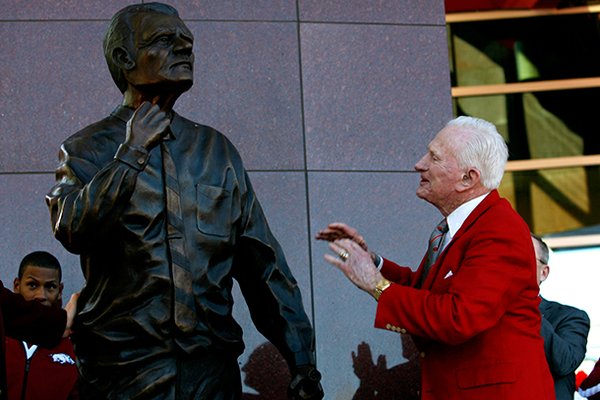
Outside the north end zone, where the Athletic Center named for him was, and will be again after the renovations, a statue was dedicated to Frank Broyles. He lived long enough to see it.
The Razorbacks' greatest rival was the University of Texas, culminating in a game at Razorback Stadium on December 6, 1969, with the Longhorns coming in ranked Number 1 and the Razorbacks Number 2, and the winner getting the SWC title, a berth in the Cotton Bowl, and a shot at the National Championship.

It was billed as one of those periodic "Game of the Century" matches, and was attended by President Richard Nixon. (Legend has it that Arkansas native and future President Bill Clinton attended, but he was at Oxford University at the time.) Arkansas led 14-0, but Texas won it 15-14, ruining the Hogs' hopes. In his book Horns, Hogs, and Nixon Coming: Texas vs. Arkansas in Dixie's Last Stand, Terry Frei of the Denver Post called it "Arkansas' Greek tragedy." They ended up losing the Sugar Bowl to neighboring Mississippi, too.

Texas leads the rivalry 56-22, but the annual game stopped after Arkansas left the SWC for the Southeastern Conference in 1991 (rendering the SWC a Texas-only league, and probably leading to its doom 5 years later), they haven't played each other since Arkansas won the 2014 Texas Bowl, and they won't play each other again until 2021.

Arkansas' move to the SEC led to rivalries with schools from neighboring States, including the University of Missouri (a.k.a. "Mizzou," also a new SEC team, they lead Arkansas 5-3), the University of Tennessee (they lead 13-5, although Arkansas has won the last 2), the University of Mississippi (a.k.a. "Ole Miss," Arkansas leads them 35-27-1), and Louisiana State University (a.k.a. LSU. who lead Arkansas 38-22-2).

UPDATE: Through the 2020 season, Arkansas now leads Ole Miss 36-28-1, but trails Missouri 9-3, trails LSU 42-22-2, and still trails Tennessee 13-5.

A trophy in the shape of the adjoining States of Arkansas and Louisiana, called the Golden Boot, goes to the winner of the Arkansas-LSU game, usually played on Thanksgiving weekend since 1992.
Stuff. There is no big team store at the stadium, just souvenir stands. You'll have to go to the University  Bookstore, at 616 Garland Avenue, at Douglas Street, about a 5-minute walk northeast of the stadium.

The most comprehensive history of Razorback football I could find on Amazon.com only goes up to 1995: Orville Henry's The Razorbacks: A Story of Arkansas Football. Terri Frei of the Denver Post wrote Horns, Hogs, and Nixon Coming: Texas vs. Arkansas in Dixie's Last Stand, about the 1969 Texas-Arkansas Game. 

There's not much on video, either, just the period specific 22 Straight: Arkansas Football 1963-1965 and Arkansas SEC Classics (which covers 1992 to 2008).

During the Game. In 2013, Arkansas visited Rutgers, and thousands of their fans came in their cardinal red clothes, and were very polite, and didn't make a fuss about going 1,300 miles just to lose to Rutgers. If you return the favor, I don't think you'll have a problem with rough treatment.

In 1909, the team, then known as the Arkansas Cardinals for the school color went 7-0, and outscored the opposition 186-18. Coach Hugo Bedzek said his team "played like a wild band of razorback hogs." The name was changed to the Razorbacks for 1910, and by the 1920s, the traditional cheer, the Calling of the Hogs, was in place: "Woooooooo... Pig! Sooie!" It usually starts in the student section, the upper deck of the southeast corner.
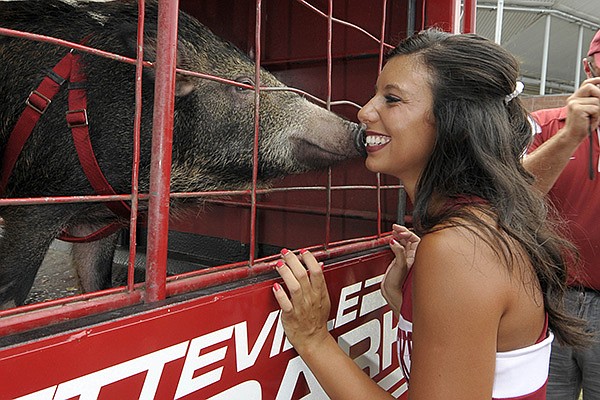
Tusk IV and a Razorback cheerleader. At Arkansas,
if you call a man a "pig," he might say, "Thank you, sir."

The fight song is "Arkansas, Fight!" There are 2 mascots: A live Tusk IV, a Russian boar and the great-grandson of Tusk I, who debuted in 1994; and Big Red, a student in a costume, used since 1973. There's also a female Hog, naturally named Sue E. (UPDATE: Tusk IV died in 2020, and has been replaced by a Tusk V.)
Big Red appears to be cheating on Sue E.
by hamming it up with these cheerleaders.

After the Game. Your safety won't be an issue. Getting a postgame meal might be. Despite my joke earlier, there is a Starbucks about half a mile east of the stadium, at 111 Ozark Avenue. There's also a Chick-fil-A at 435 Garland Avenue; and a Quizno's, in Brough Commons Dining Hall, at 1021 W. Dickson Street. But you're probably better off heading downtown.

If you visit Arkansas during the European soccer season, as we are now in, you're probably out of luck: The best-known "football pub" in the State is back in Little Rock, Dugan's Pub, at 401 E. 3rd Street.

Sidelights. Just to the southeast of Razorback Stadium at 285 Stadium Drive is the 10,000-seat home of Arkansas basketball from 1954 to 1993. Originally known as the Arkansas Fieldhouse, it was renamed Barnhill Arena in 1973, for the late John Barnhill, football coach 1946 to 1949 and athletic director 1946 to 1971.
Head coach Nolan Richardson ran his "Forty Minutes of Hell" offense, and the arena was nicknamed "Barnhell." He was successful enough to get a new arena built, named for a member of the Walton family of nearby Bentonville and Walmart infamy: The 19,368-seat Bud Walton Arena. 1270 Leroy Pond Drive, about half a mile south of Razorback Stadium and Barnhill Arena.

In their 1st season in it, 1993-94, the Razorbacks won the National Championship. In their 2nd season, they got back to the Final.
They won their conference's regular-season title 24 times (including 1992 and 1994 since moving to the SEC) and its tournament 7 times (including 2000 in the SEC). They've reached the Final Four in 1941, 1945, 1978, 1990, 1994 and 1995.

Aside from the University, there isn't much to see in Fayetteville. Headquarters House, at 118 E. Dickson Street, was a headquarters for both sides in the Civil War, as the city changed hands.

Back in Little Rock, 189 miles to the southeast, is War Memorial Stadium, a 54,128-seat stadium built in 1948, which the Razorbacks have used as a secondary home, usually once a season. (They opened this season there, beating Florida A&M.) It is also home to the football team of Arkansas Baptist College, and minor-league soccer's Little Rock Rangers. 1 Stadium Drive, about 2 1/2 miles west of downtown.
Hot Springs, 185 miles southeast of Fayetteville and 55 miles southwest of Little Rock, where Bill Clinton spent his teenage years, was a resort well known for having actual hot springs, and also for illegal gambling. It is said that Spring Training was invented there when, coming off a Pennant-winning season, Chicago White Stockings (forerunners of the Cubs) manager and 1st baseman Adrian "Cap" Anson took his team there before the 1886 season to "boil the beer out of them." It remained a popular Spring Training site into the 1920s, before railroads and air-conditioning made Florida, and later Arizona, practical.

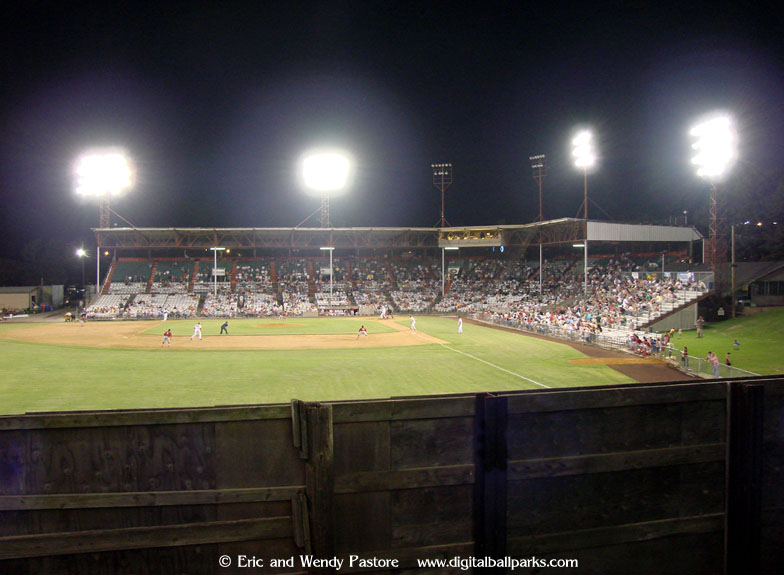
There are 2 minor-league baseball teams in Arkansas. The Arkansas Travelers, currently a farm team of the Seattle Mariners, play at the 7,200-seat Dickey-Stephens Park in North Little Rock. 400 W. Broadway Street, just across the Arkansas River from downtown Little Rock.
Dickey-Stephens Park, with the Arkansas River
and downtown Little Rock in the background

DSP replaced the Travelers' previous home, 1932 to 2006, the 6,000-seat Traveler Field, renamed Ray Winder Field in 1966. 4936 W. Markham Street, just south of War Memorial Stadium.
The Travelers, named for the old folk song "The Arkansas Traveler," have won 9 Pennants: In 1937, 1960, 1971, 1977, 1979, 1980, 1989, 2001 and 2008.
Despite their name, the Travelers compete in the Class AA Texas League, as does the State's other team, the Northwest Arkansas Naturals. They are a farm team of the Kansas City Royals, have won 4 Division titles, including the 2010 Texas League Pennant, and play in Arvest Ballpark. 3000 Gene George Blvd. in Springdale, about 8 miles north of the UA campus.
Dickey-Stephens Park is named for 2 sets of brothers, local businessmen Jackson and Witt Stehens, and ex-big league catchers Bill and George Dickey. Bill Dickey, of course, was the 1st great Yankee catcher, starting from 1929 until 1943, and winning 8 Pennants and 7 World Series. He was Lou Gehrig's best friend on the team, played himself in the movie The Pride of the Yankees, and, while the Captaincy was officially vacant from 1939 to 1976, he was the effective captain from 1939 until 1939.

He managed the team in 1946, and was a coach from 1949 to 1960, teaching Yogi Berra how to be a proper catcher. The Yankees retired Number 8 for him and Berra in 1972, and dedicated Plaques in Monument Park for them in 1988. He died in 1993, and is buried at Roselawn Memorial Park in Little Rock. 2801 Asher Avenue, about 3 miles southwest of downtown.

From the UA campus in Fayetteville, it is far to any major-league city: 216 miles west to Oklahoma City, 232 miles north to Kansas City, 318 miles southeast to Memphis, 331 miles southwest to Dallas, and 358 miles northeast to St. Louis.

In baseball, most of Arkansas shows the effects of the old St. Louis Cardinals' radio network, plus Card superstar Dizzy Dean being from Arkansas. Both Little Rock and Fayetteville give about 25 percent of their baseball fandom to the Cards, with the Yankees and Red Sox both around 10 percent. Except for the southenrmost tier of the State, which tilts toward the New Orleans, Saints, Arkansans tend to root for the Dallas Cowboys in the NFL.

In basketball, the easternmost part of the State, bordering Tennessee, supports the nearby Memphis Grizzlies; and the western area, bordering Oklahoma, favors the Oklahoma City Thunder. But Little Rock and Fayetteville are too isolated from Memphis or OKC for those teams to register. Fans there mostly root for the most successful teams: The Los Angeles Lakers, the Golden State Warriors, and whatever team LeBron James is playing for now. Hockey is barely on the radar, but the St. Louis Blues are preferred over the Nashville Predators and the Dallas Stars.

The University of Arkansas also has a campus in Pine Bluff, and won the National Championship of historically black colleges and universities (HBCUs) in 2012. The Golden Lions play at the 16,000-seat Golden Lion Stadium, 1960 Oliver Road. The school is 43 miles southeast of Little Rock, 229 miles southeast of Fayetteville, and 142 miles southwest of Memphis.
The Beatles never played in Arkansas. Elvis Presley did, especially early in his career, because his hometown of Memphis, Tennessee is right across the Mississippi River from West Memphis, Arkansas.

He played at the Texarkana Municipal Auditorium on November 24, 1954, April 22 and May 27, 1955; the Catholic Club in Helena on December 2, 1954, January 13, March 8 and December 14, 1955; the P and G Auditorium in West Memphis on December 8, 1954; the City Auditorium in Camden on February 21, 1955;  the Robinson Auditorium in Little Rock: On February 20 and August 3, 1955, and May 16, 1956; City Hall in Hope on February 22, 1955; the Armory and Porky's Rooftop in Newport on March 2, 1955; the Arkansas Municipal Auditorium in Texarkana on March 3, September 2 and November 17, 1955; the Fair Park Coliseum in Hope on June 7, 1955; the Sevier County Fair in De Queen on June 16, 1955; the Silver Moon Club in Newport on July 21 and October 24, 1955; the Camden Municipal Auditorium on August 4 and November 16, 1955; River Stadium in Batesville on August 6, 1955; Memorial Stadium in El Dorado on October 17, 1955; the B&I Club in Swifton on December 9, 1955; and the Community Center in Jonesboro on January 4, 1956.

And at high schools in 1955 in Leachville on January 20, August on February 2, Aubrey on February 3, Pine Bluff on February 23, Parkin on March 21, Marianna on March 24, Dermott on March 25, El Dorado on March 30, Nettleron on April 4, Bono on September 6, Watson Chapel on September 27, Forrest City on November 14, and Swifton on December 9.

In his later years, he played the T.H. Barton Coliseum in Little Rock (2600 Howard Street) on April 17, 1972, and the Pine Bluff Convention Center (1 Convention Center Plaza) on September 7 and 8, 1976. Both buildings are still standing.

Bill Clinton is the only President with a significant connection to Arkansas. The William J. Clinton Presidential Center is at 1200 President Clinton Avenue, just east of downtown. Between the Library and downtown is the Historic Arkansas Museum, at 200 E. 3rd Street.

The Clinton Birthplace Foundation is at his childhood home, at 117 S. Hervey Street in Hope, 113 miles southwest of Little Rock, 232 miles south of Fayetteville, and 209 miles northeast of Dallas. This was the home of his maternal grandparents.

But it was not his birthplace: He was born on August 19, 1946 at Julia Chester Hospital, which was demolished in 1991, just before he began his run for President. (This happened to Gerald Ford as well: The house where he was born was torn down 4 years before he became President.) Ironically, a funeral home was built on the site. Brazzel-Oakcrest Funeral Home, 1001 S. Main Street. He later lived nearby at 321 E. 13th Street; in Hot Springs at 1011 Park Avenue; and at the Governor's Mansion in Little Rock, at 1800 Center Street.

The tallest building in Arkansas is the 547-foot Simmons Tower, at 425 W. Capitol Avenue in downtown Little Rock.
There have been 2 notable TV shows set in Arkansas. Evening Shade, running on CBS from 1990 to 1994, was a sitcom with Burt Reynolds playing a local football hero coming home to coach his old high school's team. Although taped in Los Angeles, several Arkansas scenes were used in the opening sequence, including McClard's Bar-be-que in Hot Springs National Park. And what started as 17, becoming 18, and finally 19 Kids and Counting starred the Duggar Family, who lived in Tontitown, outside Springdale. It ran from 2008 to 2015, until scandal sank it.

Thelma & Louise started in Little Rock, as did Brubaker, Robert Redford's 1980 prison film. So did Walk the Line, the film biography of Dyess native Johnny Cash.

*

Arkansas is an odd place in many ways, but they do love their college football. The Razorbacks are an institution, and if you hear the call of the Hogs, find a time to answer it, and go.