Showing posts with label torino fc. Show all posts

Friday, May 29, 2026

May 29, 1966: Estadio Azteca Opens

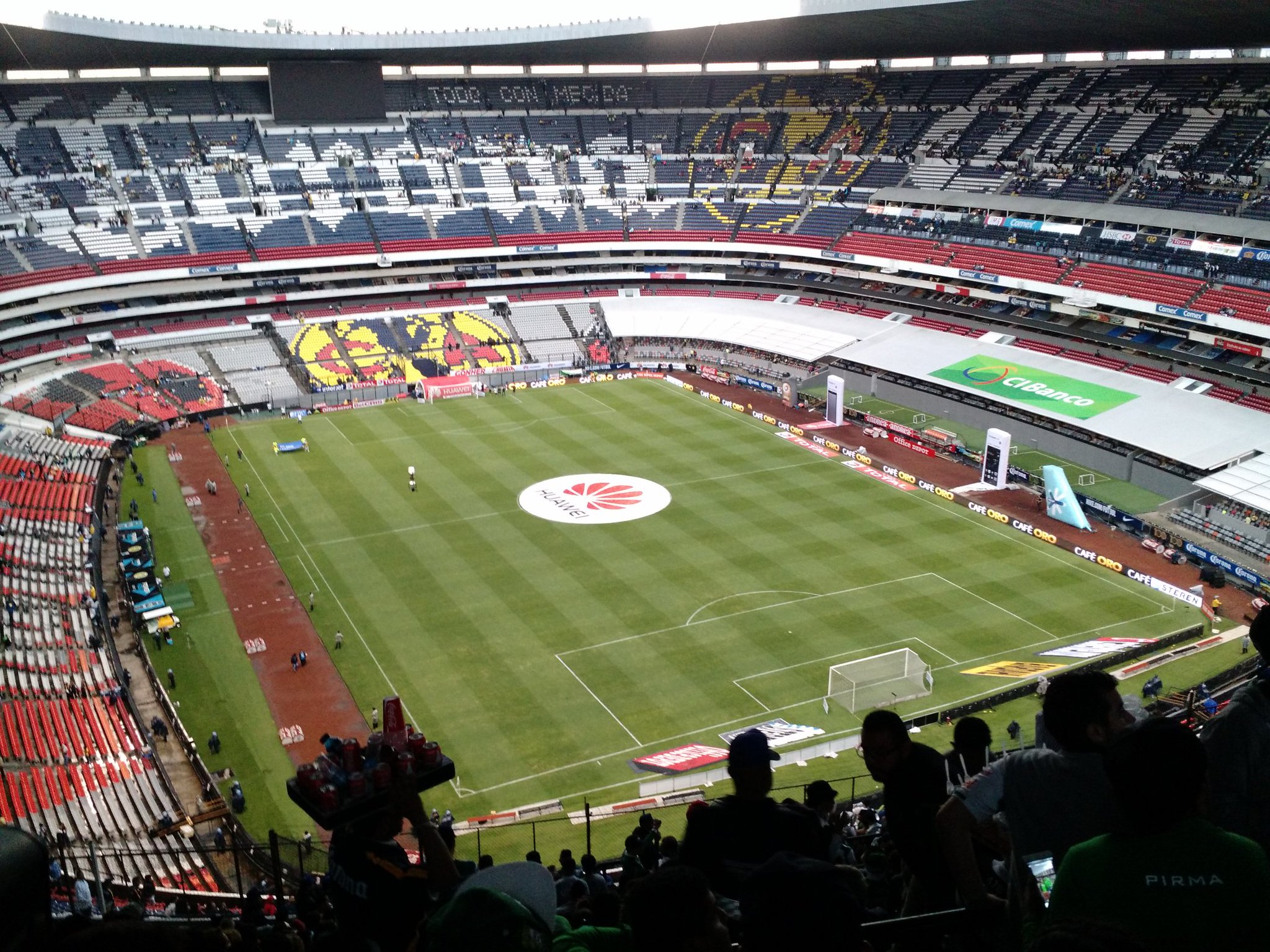
May 29, 1966, 60 years ago: Estadio Azteca opens in Mexico City, about 9 miles south of downtown. Club América takes a 2-0 lead over Italian team Torino F.C., but Torino plays back to a 2-2 draw. President Gustavo Díaz Ordaz of Mexico made the ceremonial first kick, and FIFA President Sir Stanley Rous attended.

The Azteca is the most famous building not just in Mexico, but in all of Central America. Named for the ancient empire that ruled Mexico, it remains the home of the national team and of Club de Fútbol América S.A. de C.V., or simply Club América, the most-loved -- and, like the New York Yankees, the most-hated -- sports team in the country. 

It is older than every Major League Soccer stadium except Providence Park in Portland; every NFL stadium except Lambeau Field in Green Bay; every MLB stadium except Fenway Park in Boston, Wrigley Field in Chicago, and the 2 Los Angeles area ballparks, Dodger Stadium and Angel Stadium; every NBA arena; and every NHL arena.

From a peak of 119,853 fans at a 1968 game, renovations have reduced the soccer seating capacity to an official 87,523, which still makes it larger than all but a few stadiums in the world, including most of those in the U.S. The field is a hybrid of natural grass and artificial fibers, and runs north-to-south.
Known as "El Coloso de Santa Úrsula," the Colossus of Saint Ursula (for the neighborhood it's in), along with the Maracanã in Brazil, it is 1 of 2 stadiums to have hosted 2 World Cup Finals: 1970, in which Brazil beat Italy; and 1986, in which Argentina beat West Germany.

It also hosted the 1970 Semifinal between Italy and Germany that became known as "The Game of the Century"; and the 1986 Quarterfinal between Argentina and England in which Diego Maradona scored what became known as "The Goal of the Century," only 4 minutes after his handball goal that he called "The Hand of God," the most famous cheat in the history of sports on planet Earth.

In addtion to Club América, the Azteca has been the home field for Club Necaxa, who played there from 1966 to 1970, and again from 1982 to 2003 before going to the city of Aguascalientes; Atlante, who played there off and on from 1966 to 2007, before returning permanently to their home base in Cancún; Club de Fútbol Universidad Nacional A.C., a.k.a. Pumas de la UNAM, Pumas or UNAM from 1967 to 1969; Atlético Español from 1970 until they went out of business in 1982; and Cruz Azul (Blue Cross) from 1971 to 1996.

It's also hosted soccer for the 1968 Olympics, the 1975 Pan American Games, the 1993 and 2003 CONCACAF Gold Cups, the 1999 Confederations Cup, and the 2011 Under-17 World Cup. It will host 5 matches of the 2026 World Cup, including 2 Mexico matches, and matches in the Rounds of 32 and 16. (Estadio Olímpico Universitario was the main stadium for the 1968 Olympics, and preceded the Azteca as the national team's stadium.)

It's hosted our football 10 times. The 1st was on August 15, 1994, in a preseason game in which the Houston Oilers beat the Dallas Cowboys 6-0, in front of the largest crowd in NFL history, 112,376. It's hosted 6 regular-season games, with a 1 each planned for the seasons of 2026, 2027 and 2028.

On February 20, 1993, the stadium's all-time attendance record was set, as 132,247 people saw Mexico's greatest-ever boxer, Julio César Chávez, knock Greg Haugen out to retain the Light Welterweight Championship of the World. The stadium has also hosted concerts, including by Paul McCartney, Michael Jackson and U2; and religious convocations, including the funeral of Chesperito, a legendary Mexican comedian who was a Club América fan.

Mexico City's combination of desert and mountains -- its elevation is higher than that of Denver, "the Mile High City" -- makes for a climate difficult for visiting teams, especially from outside Mexico. It took the U.S. national team 12 tries, until 2012, to get their 1st win over Mexico at the Azteca, and that was in a friendly: As of May 29, 2022, they're still looking for their 1st competitive win there.

Saturday, May 4, 2024

May 4, 1949: The Superga Air Disaster

May 4, 1949, 75 years ago: A plane crash wipes out what might have been the best soccer team in the world at the time.

Torino Football Club, based in the Northern Italian city that the English language calls Turin, had dominated Serie A, Italy's football league. They had won Serie A in 1928, and Italy's version of the FA Cup, the Coppa Italia, in 1936.

Ferrucio Novo, who had played for Torino as a defender, had gotten rich in the leather industry -- possibly appropriate, given the team's symbol, also the city's symbol, a bull. (And the team was known as Il Toro, The Bull.) In 1939, he became the team's president and its manager. In modern sports, this might seem like a bad idea. But in Italy, during World War II, at the end of Benito Mussolini's fascist dictatorship, it worked like a charm.

In 1942, it all came together. Upon the recommendation of forward Felice Borel, they adopted what Italy called la sistema (The System), known in English football by its shape as the W-M formation: Goalkeeper, 3 fullbacks, 2 halfbacks, 2 midfielders, 3 forwards.

They finished 2nd in Serie A that season, and then won it in 1943, 1946, 1947, 1948 and 1949, becoming known as Il Grande Torino. They also won the Coppa Italia in 1943, becoming the 1st Italian team to, as they say in England, "do The Double."

This was the usual lineup:

1 Goalkeeper, Valerio Bacigalupo
2 Right Fullback, Mario Rigamonti
3 Left Fullback, Virgilo Maroso
4 Right Halfback, Aldo Ballarin
5 Centre Fullback, Eusebio Castigliano
6 Left Halfback, Danilo Martelli
7 Outside Right, Ezio Loik
8 Inside Right, Guglielmo Gabetto
9 Centre Forward, Romeo Menti
10 Inside Left, Valentino Mazzola
11 Inside Forward, Franco Ossola

In a land beset by conservative Catholicism, terrorized by organized crime, benighted by poverty, and devastated by a war on which it had chosen the wrong side, this team lifted people up, and provided them with thrills they enjoyed, even if far from Turin, even when it sent their local side down to defeat.

On May 3, 1949, the Torino team were in Lisbon, Portugal, playing Sport Lisboa e Benfica at the Stadio do Luz (Stadium of Light). Benfica were already known as Portugal's greatest sports team, and the game was a testimonial in honor of their Captain, midfielder Francisco Ferreira. He had already led Benfica to 3 titles in the Portuguese league, and 4 Portuguese Cups. He had also previously won a league title with F.C. Porto.

Novo had seen him play for Portugal against an Italy team with some of his Torino players. Although Italy won the game 4-1, Novo was very impressed with Ferreira, and arranged the special match. He did not make the trip, though, as he was ill with the flu. So his assistant, Ernő Egri Erbstein, a Hungarian Jew who had played in Italy and later escaped from the Nazis, took charge for the game. Benfica won, 4-3. Matches like this would help inspire the European Cup, which began in the 1955-56 season, and is now known as the UEFA Champions League.

The next day, May 4, the Torino team boarded their Avio Linee Italiane Fiat G.212CP for the flight home. It took off at 9:40 AM local time (Portugal is in the same time zone as Britain, an hour behind most of Europe, including Italy), and landed in Barcelona, Spain to refuel at 1:00 PM. At the Barcelona airport, the Torino players met with those of AC Milan, who were on their way to play a friendly against Real Madrid.

At 2:50, the plane took off again, flying over the French Riviera and the French and Italian Alps. But at 4:55, the pilot got a message that the weather in Turin was bad: Clouds almost touching the ground, and strong southwest wind gusts.

At 4:59, the control tower heard the pilot say he was 9 miles away, approaching the airport from the west (even though he had been flying east from Lisbon and Barcelona), and would use the Basilica of Superga, just past the eastern city limits of Turin, as his sign to turn toward the airport. At 5:03, he made his turn to the left. But he was too low -- a recent theory is that his altimeter had malfunctioned and locked, leading him to think he was higher than he was -- and the plane crashed into the back of the Basilica.

All 31 people on board the plane died, including the entire usual starting lineup. There were 7 other players on board who died, including Dino Ballarin, backup goalkeeper and brother of Aldo Ballarin. Assistant manager Egri Erbstein also died.
A memorial to the victims at the Basilica

There were still 4 games left in Serie A play. An agreement was reached that Torino would be declared league champions, and that all teams would play their youth teams in the remaining games. Torino won all 4 remaining games, and won the league by 5 points over Internazionale Milano (a.k.a. "Inter").

On May 26, a benefit match for the families of the victims was played at the Stadio Comunale in Turin. A group of 11 players donated from other clubs wore the maroon of Torino against visiting Argentine champions River Plate, including Alfredo Di Stéfano, already considered the best player in South America, who would later star for Real Madrid. The match ended 2-2.

The crash changed the course of Italian soccer history. Gabetto was 33 years old, Mazzola 30, Loik and Mento 29, Castigliano 28, Ossola and Aldo Ballarin 27, Rigamonti 26, Baciagalupo 25, Maroso and Dino Ballarin 23, Martelli just short of turning 22. Some of these men could have continued Torino's domination of Serie A, and been major forces for Italy in the World Cups of 1950, 1954, maybe even 1958. It was as devastating to their country as the Munich Air Disaster of 1958, killing 8 Manchester United players, was to England.
Translation: Superga, 4th of May 1949.
Raise your head great people,
You cannot forget the scream of faith.
Turn your gaze to the future
certain to be worthy of the glorious past. 

With Torino having supplied the bulk of the Italian national team, it was decided that Novo should rebuild that as well, and he managed them into the 1950 World Cup. (Italy had won the World Cup in 1934 and 1938, but the 1942 and 1946 editions were canceled due to the effects of World War II.) He took no chances: He had them travel to Brazil by ship, not plane. The long sea voyage may have taken a lot out of them: They beat Paraguay, but lost to Sweden, and did not advance to the knockout round. He remained in charge of Torino until 1953, and died in 1974.

For the 1949-50 season, the other teams in Serie A were each asked to donate a player to Torino. Essentially, it was what we in North American sports would call an expansion draft. But the team never really recovered. They didn't win another notable trophy until the 1968 Coppa Italia. Since then, they have won the Coppa again in 1971 and 1993, and Serie A in 1976. But, ever since, crosstown Juventus F.C. have dominated not just the city, but, often, the country.

The legacy of Valentino Mazzola, Captain of club and country, continued. His son, Sandro Mazzola, starred for the next Italian team to be known as "Grande," the Inter team of the 1960s.