Showing posts with label milan. Show all posts

Saturday, September 19, 2026

September 19, 1926: The San Siro Opens

September 19, 1926, 100 years ago: Nuovo Stadio Calcistico San Siro -- San Siro New Football Stadium -- opens in the San Siro section of Milan, Italy, about 3 miles west of the center of town. Unlike most sports stadiums in Europe at the time, it was designed specifically for soccer -- known in Italy as "calcio," not a variation of "football" -- without a running track.

The 1st match is a Milan Derby -- or Derby della Madonnina, as Milan is known as "The Madonna's City" -- and Internazionale Milano defeats Associazione Calcio Milan, 6-3. A full house of 35,000 attends.

A.C. Milan, known as simply Milan for short, and as the Rossoneri for their shirts of red and black stripes, have played their home games there ever since. Inter Milan, or just Inter, known as the Nerazzurri for their shirts of black and blue stripes, began playing home games there in 1947.

Expansions were undertaken in 1935 and 1955. In 1987, a renovation began to prepare the stadium for the 1990 World Cup. A minor renovation was undertaken in 2015-16. Current capacity is 75,817, making it the largest stadium in Italy, as well as the most famous.
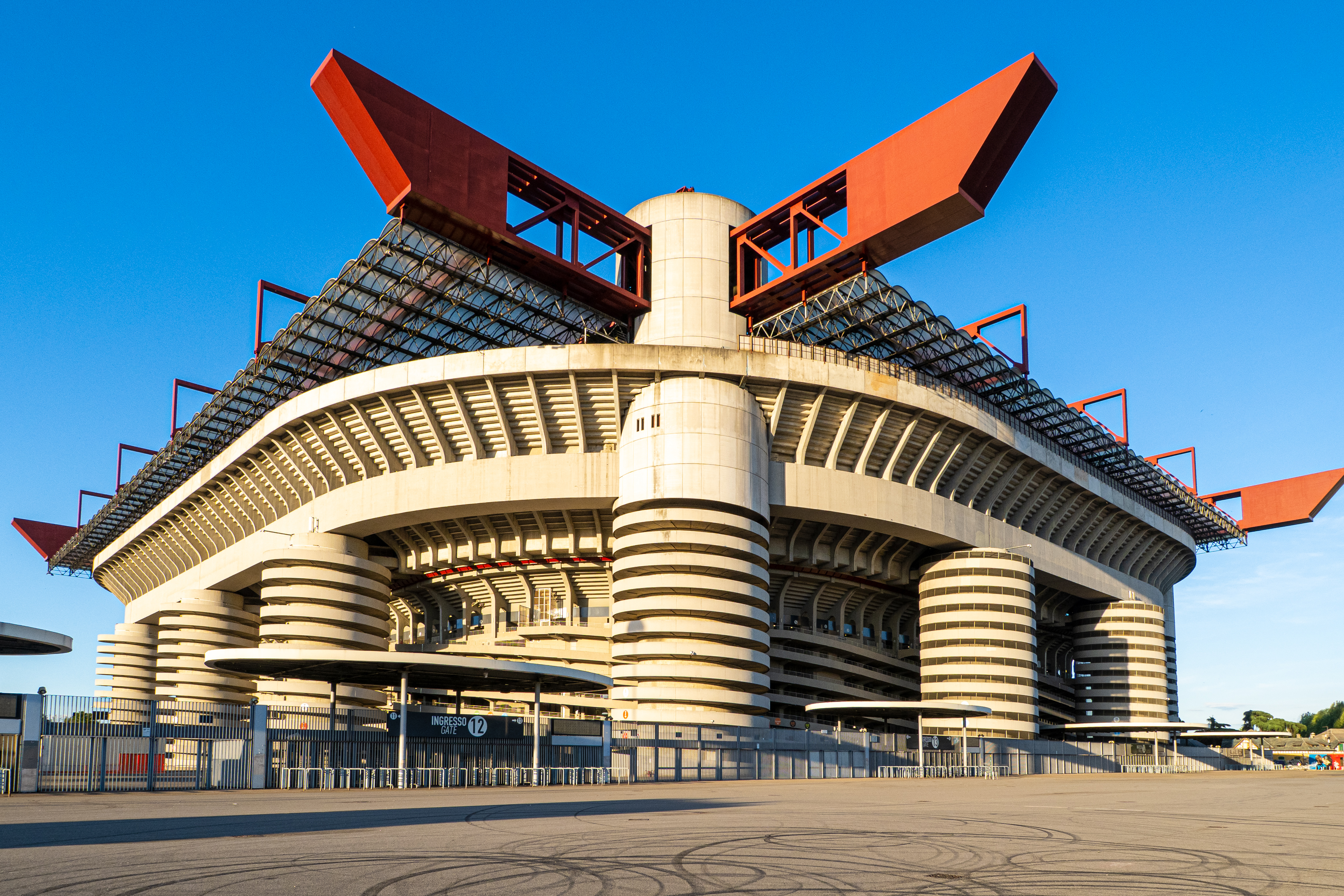
The stadium hosted 3 games of the 1934 World Cup, which Italy won, as they did in France in 1938, in large part due to Giuseppe Meazza, the Milan-born Inter striker. He died in 1979. The following year, the stadium was officially renamed Stadio Giuseppe Meazza. But it is still called "The San Siro" around the world, and it has surpassed the Duomo as Milan's most famous building.

Since moving in, both Milan teams have been remarkably successful. AC Milan have won 19 league titles, 16 of them in Italy's Serie A since moving in: 1951, 1955, 1957, 1959, 1962, 1968, 1979, 1988, 1992, 1993, 1994, 1996, 1999, 2004, 2011 and 2022. They have won the Coppa Italia 5 times: 1967, 1972, 1973, 1977 and 2003 -- although they've never won "The Double," the league and the cup in the same season. They've won the European Cup/UEFA Champions League 7 times, 2nd only to Real Madrid: 1963, 1969, 1989, 1990, 1994, 2003 and 2007.

Inter have won 21 titles, 2nd among Italian teams behind Juventus. They've won 16 since moving into the San Siro: 1953, 1954, 1963, 1965, 1966, 1971, 1980, 1989, 2006, 2007, 2008, 2009, 2010, 2021, 2024 and 2026. They've won the Coppa Italia 10 times, 9 since moving in: 1978, 1982, 2005, 2006, 2010, 2011, 2022, 2023 and 2026. This means they've won 2 Doubles, in 2006 and 2010. And they've won the European Cup/Champions League 3 times: Back-to-back titles in 1964 and 1965, and in 2010, making them the 1st, and still the only, Italian team to win a "European Treble."

The 1960s was the golden age of Italian soccer, with both Milan teams practicing "catenaccio," meaning "padlock," a supreme defensive strategy. Between them, Milan and "Il Grande Inter" won 4 European Cups, and Inter lost 1 other Final, in 7 seasons.

Milan's fans sit in the Curva Sud, the south end; Inter's in the Curva Nord, the north end. Unlike such other Italian rivalries as Roma-Lazio and Juventus-Torino, this rivalry tends to be mostly talk, and violence is rare.
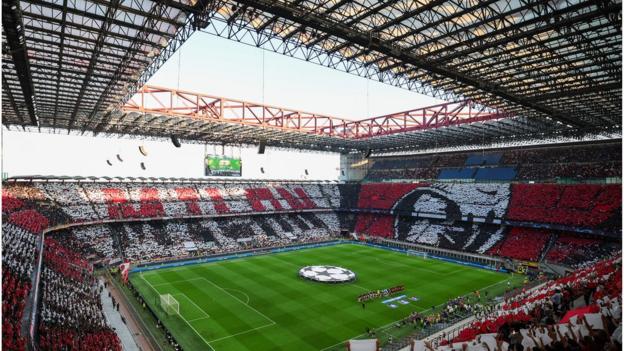
The San Siro hosted 3 games of UEFA Euro 1980, 6 games of the 1990 World Cup, and 4 Finals of the European Cup: 1965, 1970, 2001 and 2016. It was the main stadium for the 2026 Winter Olympics, which were divided between Milan and 1956 hosts Cortina d'Ampezzo.

By a coincidence that I, as a fan of theirs, have enjoyed, North London team Arsenal F.C. became the 1st British team to beat each of the hosts at the San Siro, both in Champions League play: Inter in 2003, and AC Milan in 2008.

In 2019, a plan to build a new 70,000-seat stadium next door, to be used by both teams, was put forward, intended to be ready for the 2022-23 season. It didn't happen. In 2023, AC Milan announced plans for a separate stadium, next to their club headquarters in the city's southern suburbs. This would have left the new San Siro to be home to Inter only. This plan also fell through.

In 2025, the two clubs announced an agreement on a new stadium, adjacent to the current one. Construction is set to begin in late 2027.

Monday, April 28, 2025

April 28-30, 1945: The Ends of the Dictators

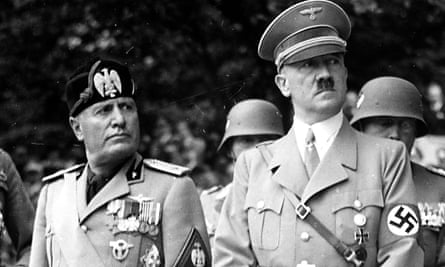
April 28, 1945, 80 years ago: Benito Mussolini, the fascist dictator of Italy from 1922 to 1943, is captured by Communist partisans and executed. He was 61 years old, and few wept for him.

Mussolini was originally a journalist who entered politics as a Socialist. He served in the Italian Army in World War I, and was wounded in 1917. His experience shifted him from left to right. On October 28, 1922, thinking the postwar Italian national government weak, he led the Fascists in a March On Rome. The government fell rather than oppose him with the Army, and King Victor Emmanuel III appointed Mussolini to be the country's youngest Prime Minister ever to that point. He became known as Il Duce (The Leader).

After removing all political opposition through his secret police, and outlawing labor strikes, Mussolini and his followers consolidated power through a series of laws that transformed the nation into a one-party dictatorship. In 1924, he ordered the assassination of Giacomo Matteotti, the Leader of the country's Socialist Party. In 1929, he signed the Lateran Treaty with the Holy See, to establish Vatican City.

His supporters, including in America, liked to say, "He made the trains run on time." In fact, they ran no better under him than under the previous government. They also liked to say he put an end to the Mafia. This also wasn't true. It would be more accurate to say that he made a deal with the Mafia, a non-aggression pact: Leave my officials -- including policemen, prosecutors and judges -- alone, let them do as they please, or, rather, as I please; and I'll do the same for you.

He also wanted to build a new Roman Empire. He established a protectorate over nearby Albania, and in 1935 invaded Ethiopia, annexing it into Italian East Africa (comprised of the current nations of Somalia and Eritrea). From 1936 to 1939, he and Adolf Hitler, the dictatorial Chancellor of Nazi Germany, aided fellow fascist Francisco Franco in his takeover of Spain.

(This included Hitler sending his air force, the Luftwaffe, to bomb opposing cities; and Mussolini sending troops, which became known as Franco's Italian Army. In the 1970s, this name would be adapted by Italian-American fans of the Pittsburgh Steelers, who formed a fan club for the half-Italian, half-black running back Franco Harris. Not to be outdone, a group of black fans honored defensive tackle Joe Greene with "Mean Joe Greene's Ethiopian Brigade." Given what Mussolini's men did in Spain and Ethiopia, both names should already have been considered cringeworthy.)

With the onset of World War II, Mussolini brought Italy into the Axis with Nazi Germany and Imperial Japan. But the reputation of Italy having a weak army -- which both Mussolini and Giuseppe Garibaldi had taken advantage of in the preceding 80 years -- still held, as British and American troops kicked them out of North Africa, and then invaded Sicily, and finally the Italian mainland.

On July 25, 1943, his own Grand Council of Fascism passed a vote of no confidence in him, and the King who had appointed him dismissed him as Prime Minister after 21 years, and ordered his arrest. The King then agreed to an armistice with the Allies.

German paratroopers broke Mussolini out of prison, resulting in a civil war. The Allies did not intervene, since their focus had moved to Western Europe. This time, Mussolini did not have enough troops to even oppose the regular Italian Army.

On April 25, 1945, Mussolini took his mistress, Clara Petacci -- leaving his wife and 6 children behind -- along with 13 others, including Clara's brother, who was posing as a Spanish consul, and fled. They set out for adjoining and neutral Switzerland, intending to board a plane and escape to also-neutral Spain, under Franco's protection.

But on April 27, they were stopped by Communist partisans near Lake Como, just 20 miles from the Swiss border. On April 28, instead of being turned over to the United Nations, as per Allied agreement in the event that he should be captured, they were executed in a village named Giulini de Mezzegra, on the orders of a partisan named Walter Audisio.

The witnesses' accounts of his last words differed. One said that he was defiant to the end, telling them, "Aim at my heart!" One said that he was a coward, yelling, "No! No!" The other said that Mussolini said nothing at all as the rifles were raised.

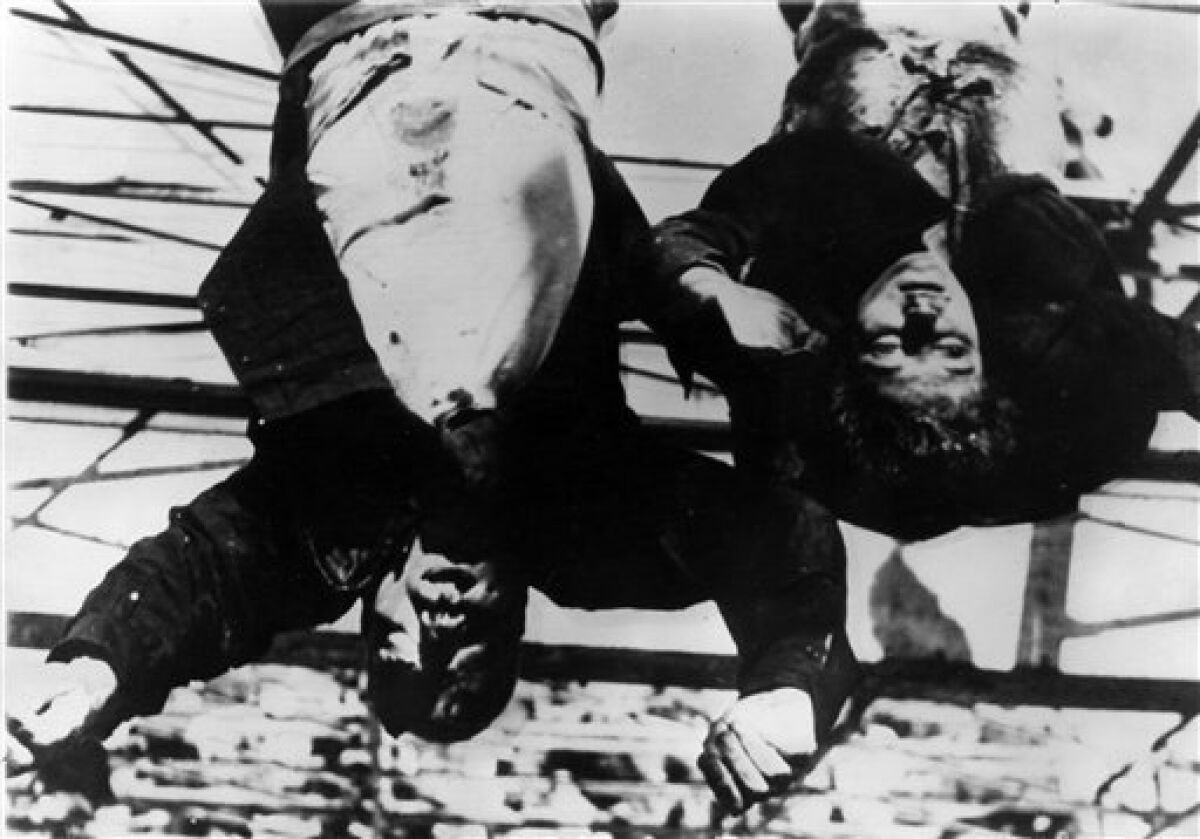
On April 29, the bodies of the executed were loaded in a van and moved to Milan, the largest city in northern Italy. They were dumped on the ground in the Piazzale Loreto, where people kicked them and spat on them. Finally, the bodies of Mussolini and the Petaccis were hung, upside-down, from the roof of an Esso gas station, and people threw stones at them.
Initially, Mussolini was buried in an unmarked grave. In 1946, his body was dug up and stolen by Fascist supporters. Four months later, it was recovered by the authorities, who then kept it hidden. In 1957, his remains were allowed to be interred in the Mussolini family crypt in his hometown of Predappio. His tomb has become a place of pilgrimage for neo-fascists, and the anniversary of his death is marked by neo-fascist rallies.

His granddaughter, Alessandra Mussolini, is a member of the European Parliament, and has been one of the leaders of far-right politics in Italy since the early 21st Century. Her son, Romano Mussolini, plays for SS Lazio, the Rome-based team known for a Fascist fan base. He says he has no interest in politics.

*

On April 30, upon hearing a report of what happened to Mussolini, and knowing that the Soviet Union's Red Army had Berlin surrounded, and that his own escape was unlikely, Hitler decided that he was not going to face the same fate. The Nazi dictator killed himself.
The famous, occasionally-imitated, Time cover

His wife, Eva Braun, had also committed suicide, with a cyanide pill. She was 33. The Nazi regime came to an end with the rump government's surrender 8 days later.

He knew the Red Army was closing in from the east. He knew the other Allies, America and Britain, were closing in from the west.

On April 22, he ordered General Felix Steiner to attack the Soviet troops attempting to encircle Berlin. Steiner could not raise enough troops to do so. Pretty much the only available fighters in Germany who weren't already in the Army were old men and children.

Steiner was no hero. He was arrested for war crimes, but after 3 years, he was released due to an inability to get enough evidence against him. He lived until 1966, still trying to rehabilitate the image of the German army, and in particular the SS.

In his Bunker, Hitler was told of Steiner's inability to raise troops, and he lost his composure. He now knew that defeat in World War II is inevitable. This event was dramatized in the 2004 German film Der Untergang, known as Downfall in the English-speaking world. Hitler was played by Austrian actor Bruno Ganz, and, since the scene was filmed in German, a language most non-Germans don’t understand, it became the basis for the "Hitler Rants Parodies" video series, with fake subtitles put on to match whatever joke the author wants to tell.

Hitler knew Berlin was surrounded. He had hoped to hold out until May 5, the anniversary of the death of Napoleon Bonaparte, his role model, who had come closer to conquering Russia than he had, actually reaching Moscow, but finding it burned and useless to him before returning.

But the reports that Hitler was getting suggested that the Soviets would get there sooner. And when he found out how his former Axis partner, Mussolini, had been treated after his capture, and especially after his execution, by Communists in his country, Hitler was determined to not fall into the hands of any of the Allied nations, especially the Soviets.

As the saying goes, the one service Hitler ever performed for humanity was to kill Hitler. But the regime he began on January 30, 1933, 12 years earlier -- including the war he started on September 3, 1939 -- had led to the deaths of 75 million people, military and civilian combined, including over 400,000 Americans.

The true depths of his depravity had already begun to reach the civilized world before word of his death had, as American, British and Soviet troops found the concentration camps where the Holocaust was carried out. In these camps, 11 million people died, some from murder, some from disease. And 6 million of those people who died, and many others who survived, were put there for no crime other than being Jewish.

So the death of Hitler could not be a wholly joyous occasion, because it was a reminder of all that he did, and all that he could have done had he won.

If you ever wonder which is worse, Fascism or Communism, consider this: The Soviets had the atomic bomb for 40 years, and never used it; the Chinese have had it for nearly 60 years, and have never used it; but if the Nazis had ever gotten it, there is no doubt that Hitler would have ordered its use.

His propaganda minister, Joseph Goebbels, and his wife, Magda, remained in the Bunker. On May 1, they fed their children poison, and then took their own lives. On May 2, Generals Hans Krebs and Wilhelm Burgdorf, both among those that Hitler asked to remain in the Bunker in the Downfall scene, committed suicide. The same day, Nazi Party Secretary Martin Bormann, who had fled the Bunker, realized capture by the Soviets was inevitable, and committed suicide. SS leader Heinrich Himmler escaped until he was captured by British troops, and committed suicide in their custody on May 23.

Most of the remaining Nazi high command was captured alive. They were tried in Nuremburg, site of some of the Party's infamous rallies, and convicted. These included Joachim von Ribbentrop, the Foreign Minister; Julius Streicher, the Nazis' top propaganda publisher; Hans Frank, Governor-General of occupied Poland; and the other 2 military leaders that Hitler had asked to stay in the Downfall scene, General Alfred Jodl, Chief of the Armed Forces, who had signed the surrender papers on V-E Day, and Field Marshal Wilhelm Keitel.

Not among the condemned, but scheduled to be so, was Reichsmarschall Hermann Göring, the highest-ranking Nazi official to have survived V-E Day. He had made an appeal, asking to be shot as a soldier instead of hanged as a common criminal, but the court refused. So he committed suicide with a potassium cyanide capsule the night before he was to be hanged.

Two more Fascist dictators, because they were neutral in The War, hung on: António Salazar had a stroke, and was removed from power in Portugal in 1968, dying in 1970, and democracy was restored in 1974; and Francisco Franco died in 1975, and, with the support of King Juan Carlos I, Spain went back to democracy.

Monday, December 16, 2024

December 16, 1899: Soccer Comes to Italy

Herbert Kilpin

December 16, 1899, 125 years ago: The Milan Foot-Ball and Cricket Club is founded in Milan, Lombardy. Its founder is an expatriate Englishman, Herbert Kilpin. It is the 1st professional soccer team in Italy.

Kilpin, a 29-year-old native of Nottingham, had played for Notts Olympic, and went to Italy to work for a textile merchant linked with his employer in Nottingham. There, he joined Internazionale FC Torino. (Both teams were defunct by 1916.) He founded the Milan club, giving it the English Cross of St. George as its crest, and shirts of red and black stripes, giving it the nickname Il Rossoneri, the Red and Black. He said, "We will be a team of devils. Our colours will be red like fire and black like the fear we will invoke in our opponents." 

He led the team to Italian titles in 1901, 1907 and 1909, and married an Italian woman, before dying from the effects of alcoholism in 1916, only 46 years old. In 1908, a dispute led to some players leaving the team, and forming a new one, Internazionale Milano, or "Inter." They chose black and blue stripes, making them Il Nerazzurri, the Black and Blue. The existing team became Associazione Calcio Milan, or "A.C. Milan," or just "Milan."

Since 1926, A.C. Milan have played their home games at a stadium in the San Siro neighborhood, and it is called "The San Siro." Inter have played there since 1947. Ironically, its official name is Estadio Giuseppe Meazza, after an Inter player who helped Italy win the 1934 and 1938 World Cups. Although it is the most famous sports venue in the country, both teams have expressed interest in replacing it, with plans being suggested that they would collaborate, or build separate stadiums.
The San Siro, prior to an AC Milan match
in the UEFA Champions League

Through the 2021-22 season, A.C. Milan have won Italy's national league, Serie A, 19 times, including in said 2021-22 season; the Coppa Italia, Italy's version of the FA Cup, 5 times, most recently in 2003;  and the European Cup/UEFA Champions League 7 times, more than any team except Real Madrid: In 1963, 1969, 1989, 1990, 1994, 2003 and 2007.

Inter have also won Serie A 19 times, and the Coppa Italia 8, including in 2021-22. Unlike A.C. Milan, they have won the League and Cup "Double," in 2006 and 2010. They have won the European Cup/Champions League 3 times, in 1964, 1965 and 2010 -- meaning that, in 2010, they won the only "European Treble" in Italian history. (UPDATE: In 2023, Inter won a 9th Coppa Italia; in 2024, a 20th Serie A title.)
Inter's badge

Both teams trail the 30 Serie A titles won by Turin-based Juventus Football Club, and their 14 Coppi Italia, althtough both have exceeded Juve's 2 Champions League titles, of 1985 and 1996. (UPDATE: Juve won a 15th Coppa Italia in 2024.)

Calendar year 1899 was a great year for soccer, as, in addition to A.C. Milan, several other legendary clubs were founded:

* January 8: SK Rapid Wien, in Vienna, Austria.
* March 8: Frankfurter Fußball-Club Victoria von 1899, the predecessor of Eintracht Frankfurt, in Frankfurt, Germany.
* May 3: Ferencvárosi Torna Club, commonly known as Ferencváros, in Budapest, Hungary.
* May 13: Esporte Clube Vitória, in Salvador, Brazil.
* May 14: Club Nacional de Football, in Montevideo, Uruguay.
* May 27: Rangers Football Club, in Glasgow, Scotland.
* August 31: Olympique de Marseille in Marseille, France.
* November 29: FC Barcelona in Barcelona, Spain.

December 16, 1899 was also the day that British actor and playwright Noël Coward was born.