Showing posts with label adolf hitler. Show all posts

Monday, August 3, 2026

August 3, 1936: Jesse Owens Beats Aryan Supremacy

August 3, 1936, 90 years ago: Nazi Germany's myth of racial supremacy is shattered by a black American.

The International Olympic Committee had awarded the 1936 Olympic Games to Germany in 1931, when it was still governed by the Weimar Republic. The Winter Games went to Garmisch-Partenkirchen, in Bavaria, on the nation's southern border, with Austria. The Summer Games went to the national capital, Berlin.

But in 1933, the National Socialist German Workers' Party -- Nationalsozialistische Deutsche Arbeiterpar, or "Nazi" Party -- came to power, and Adolf Hitler became Chancellor. Within another year, he had total control, and instituted the party's ideology, fascism: Nationalism, militarism, bigotry, and letting big business do whatever it wanted.

He also instituted his ideal of an "Aryan" "master race": White, blond hair, blue eyes, tall, physically strong. He, himself, was white, but not the other things.

And he falsely blamed Communists and Jews for Germany's defeat in World War I. Well before most people know what a "holocaust" was (originally, the word was used to mean a large fire), he was cutting Jewish people out of German society.

Like most dictators, he was not especially interested in sports. But, like many of them, someone talked him into using sports as propaganda for his ideals. And so, the 1936 Olympics, especially the Summer Games in Berlin, would be a spectacle celebrating "Aryan supremacy."

But a story which may be apocryphal (I hope it's true) shows that even his power was not absolute. In the Olympic Stadium (Olympiastadion) he had constructed for the Games, the restrooms had signs saying, "Dogs and Jews are not allowed." A representative of the International Olympic Committee told him to take it down.

Hitler: "When you come into a man's house, you don't tell him what he can and cannot put up!"

IOC official: "Excuse me, Mr. Chancellor, but when that five-ringed flag goes up over the stadium, it is no longer Germany. It is Olympia. And we are the masters there."

The signs came down.

*

James Cleveland Owens was born on September 12, 1913 in Oakville, Alabama. One thing Southern white people and Southern black people have in common is frequently addressing boys by their initials, so Owens was usually called "J.C."

When he was 9, the family moved north, as part of the "Great Migration" of African-Americans seeking to leave the segregated South in search of less prejudice and better jobs in the Northeast, the Midwest, and the West Coast. The fact that they moved to Cleveland, both his and his father's middle name (Henry Cleveland Owens), appears to have been a coincidence.

Upon arrival in school in Cleveland, the boy was asked his name. He said, "J.C. Owens." The teacher misheard this, and said, "Your name is Jesse?" Not wanting to contradict her, he said it was. And so he was Jesse Owens from then on.

He became Ohio's biggest high school track star. On May 25, 1935 -- the day after the 1st night game in Major League Baseball -- he competed for Ohio State University at the Big Ten Championships at Ferry Field, the former football facility at the University of Michigan in Ann Arbor.

He ran the 100-yard dash in 9.4 seconds, tying the world record. He set world records in the long jump (26 feet, 8 1/4 inches, a world record that would last for 25 years), the 220-yard sprint (20.3 seconds), and the 220-yard low hurdles (22.6 seconds). These 4 records were all set within a span of 45 minutes.

So when the U.S. Olympic Team set sail -- flying across the Atlantic Ocean was still too risky at that point -- for Germany in July 1936, Owens was considered one of the favorites in the 100 meters, the 200 meters, and the long jump. (Most of the world was now racing using the metric system, although the United States, as yet, was not.)

*

The Games began on August 1, and were the 1st sporting event ever televised, though only a few people in Germany had sets on which to watch it. The Nazis instituted many of the things we now associate with the Opening Ceremony of the Olympics, including the torch relay from Olympia, Greece into the stadium and the lighting of the cauldron; and the release of doves as a symbol of peace, although they used pigeons instead. When a cannon was fired as a salute, it literally scared the shit out of the pigeons, and many of the athletes got pooped on.

Established from the beginning in 1896 was the host country's head of state speaking before the crowd, and declaring the Games open. Hitler did this, in German, rather than French, the official language of the Olympics (he hated the French as much as he hated anyone else), or in English, by this point the semi-official language of the world. (As far as historians have been able to determine, German was the only language he spoke fluently.)

It's not always the head of state that does it. Sometimes, someone else is designated. In 1932, in Los Angeles, President Herbert Hoover sent Vice President Charles Curtis. In 1960, in Squaw Valley for the Winter Games, President Dwight D. Eisenhower sent Vice President Richard Nixon to his native California to do it. In 1980, President Jimmy Carter sent Vice President Walter Mondale. President Ronald Reagan did it himself in his adopted home State in Los Angeles in 1984, President Bill Clinton did it in Atlanta in 1996, and President George W. Bush did it in Salt Lake City in 2002.

When Britain has hosted: King Edward VII did it in 1908, King George VI did it in 1948, and Queen Elizabeth II did it in 2012, despite being 86 years old. When Australia hosted in 1956 and 2000, and when Canada did it in 1976 for the Summer Games, and 1988 and 2010 for the Winter Games, it was the Queen's representative, the Governor-General, who did it, even though the Queen was in attendance in Montreal in 1976, as her daughter, Princess Anne, was competing in the equestrian events.

The Parade of Nations had also been established from the beginning, and many of the countries' delegations followed the tradition of dipping their flag before the host nation's head of state. The American delegation refused to do this with the Stars & Stripes, and it had nothing to do with said head of state being a Fascist maniac. They were criticized for this, but stood their ground.

On August 2, Owens ran in the qualifying heats for the 100 meters. In the 1st, he tied the Olympic and world record. In the 2nd, he broke it. On August 3, the final was held, and Owens won it with a time of 10.3 seconds. Finishing 2nd was another black American, Ralph Metcalfe, who would later serve the South Side of Chicago in Congress from 1971 until his death in 1978.

Owens was now an Olympic Gold Medalist, and, by winning the Olympic 100-meter dash, he became recognized unofficially as "the fastest man in the world."

On August 4, Owens won the long jump, with 26 feet, 5 inches. Finishing 2nd was Luz Long of Germany, who did fit the Aryan profile. Owens was missing the tape and fouling, and, in a great display of sportsmanship, Long advised Owens to jump a bit short of the tape, just to be sure. It worked, and he had a 2nd Gold Medal.

On August 5, he won the 200 meters in 20.7 seconds. Finishing 2nd was a runner from UCLA, Matthew MacKenzie "Mack" Robinson. He had a younger brother, who went on to star in track, and other sports, at UCLA: Jack Roosevelt "Jackie" Robinson. So Owens now had 3 Gold Medals, fulfilling his goal.

On the 1st day, Hitler shook hands with the German victors only, and then left the stadium. International Olympic Committee president Henri de Baillet-Latour told him that he had to greet every medalist or none at all. Hitler opted for none at all, and skipped all further medal presentations.

His refusal to congratulate Owens had nothing to do with hating black people, or hating Americans. Nor was it personal. Owens was not "snubbed by Hitler." Owens responded to these claims at the time:

Hitler had a certain time to come to the stadium and a certain time to leave. It happened he had to leave before the victory ceremony after the 100 meters race began at 5:45 PM. But before he left, I was on my way to a broadcast, and passed near his box. He waved at me, and I waved back. I think it was bad taste to criticize the "man of the hour" in another country.

The final of the 4x100-meter sprint relay was to be held on August 9. The intended American competitors were Frank Wykoff (Des Moines, Iowa and of Dutch descent, having already taken Gold Medals in the event in 1928 and 1932), Foy Draper (from Texas and of English descent, and would be listed as missing in action in World War II), and 2 Jewish runners, Marty Glickman from New York and Sam Stoller from Cincinnati. (Glickman went on to become the 1st great New York sportscaster.)

But the President of the U.S. Olympic Committee was Avery Brundage, a racist and an anti-Semite, who was just fine with the Nazis. He decided that, since Hitler's boys had already been beaten by black men, it would be worse if they were beaten by Jews. So he benched Glickman and Stoller, and told Owens and Metcalfe that they would run in those men's places. Owens objected. Coach Dean Cromwell told him, "You'll do as you're told." With no recourse but to drop out, which would have been much worse, he ran the anchor leg, and the U.S. team won.

Owens had his 4th Gold Medal -- possibly the most unwelcome medal in Olympic history. This feat -- winning the Gold Medals of the 100 meters, the 200 meters, the 4x100-meter relay, and the long jump -- has only been done once since, by Carl Lewis in Los Angeles in 1984.

From a distance, Owens was hailed as a hero upon his return to America. Up close, he was still treated like any other black person in the 1930s. He found it difficult to make a living -- "You can't eat four gold medals," he said -- and took part in demeaning stunts to raise money. During World War II, the U.S. Office of Civilian Defense appointed Owens as director of a national fitness program for African Americans, but he lost this job when peace came. Like his contemporary, Joe Louis, the Heavyweight Champion of the World, he fell into trouble over his taxes. Unlike Louis, he eventually got out of it.
He became what he called "a professional good example." He became an American representative at the Olympics, and was particularly honored the next time a free and democratic Germany hosted, in Munich in 1972. He even did an American Express "Do you know me?" commercial. He died on March 31, 1980, of cancer, at age 66. He is buried at Oak Woods Cemetery in Chicago.

The Olympiastadion still stands, having undergone some renovations. It is the home of the biggest soccer team in the German capital, Hertha Berlin. It hosted 3 games in the 1974 World Cup, and 6 games in the 2006 World Cup, including the Final and a Quarterfinal. It hosted the 2015 UEFA Champions League Final, and the Final of Euro 2024. Having seated over 100,000 upon its opening, renovations and wider seats have brought capacity down to 74,475, but it is still the largest stadium in any German-speaking country.
In fact, the Olympiastadion in Berlin is 1 of 4 stadiums to have hosted an Olympic Games, a World Cup Final and a UEFA European Cup/Champions League Final. The others are the Olympiastadion in Munich, the old Wembley Stadium in London, and the Stade de France outside Paris.

Monday, April 28, 2025

April 28-30, 1945: The Ends of the Dictators

April 28, 1945, 80 years ago: Benito Mussolini, the fascist dictator of Italy from 1922 to 1943, is captured by Communist partisans and executed. He was 61 years old, and few wept for him.

Mussolini was originally a journalist who entered politics as a Socialist. He served in the Italian Army in World War I, and was wounded in 1917. His experience shifted him from left to right. On October 28, 1922, thinking the postwar Italian national government weak, he led the Fascists in a March On Rome. The government fell rather than oppose him with the Army, and King Victor Emmanuel III appointed Mussolini to be the country's youngest Prime Minister ever to that point. He became known as Il Duce (The Leader).

After removing all political opposition through his secret police, and outlawing labor strikes, Mussolini and his followers consolidated power through a series of laws that transformed the nation into a one-party dictatorship. In 1924, he ordered the assassination of Giacomo Matteotti, the Leader of the country's Socialist Party. In 1929, he signed the Lateran Treaty with the Holy See, to establish Vatican City.

His supporters, including in America, liked to say, "He made the trains run on time." In fact, they ran no better under him than under the previous government. They also liked to say he put an end to the Mafia. This also wasn't true. It would be more accurate to say that he made a deal with the Mafia, a non-aggression pact: Leave my officials -- including policemen, prosecutors and judges -- alone, let them do as they please, or, rather, as I please; and I'll do the same for you.

He also wanted to build a new Roman Empire. He established a protectorate over nearby Albania, and in 1935 invaded Ethiopia, annexing it into Italian East Africa (comprised of the current nations of Somalia and Eritrea). From 1936 to 1939, he and Adolf Hitler, the dictatorial Chancellor of Nazi Germany, aided fellow fascist Francisco Franco in his takeover of Spain.

(This included Hitler sending his air force, the Luftwaffe, to bomb opposing cities; and Mussolini sending troops, which became known as Franco's Italian Army. In the 1970s, this name would be adapted by Italian-American fans of the Pittsburgh Steelers, who formed a fan club for the half-Italian, half-black running back Franco Harris. Not to be outdone, a group of black fans honored defensive tackle Joe Greene with "Mean Joe Greene's Ethiopian Brigade." Given what Mussolini's men did in Spain and Ethiopia, both names should already have been considered cringeworthy.)

With the onset of World War II, Mussolini brought Italy into the Axis with Nazi Germany and Imperial Japan. But the reputation of Italy having a weak army -- which both Mussolini and Giuseppe Garibaldi had taken advantage of in the preceding 80 years -- still held, as British and American troops kicked them out of North Africa, and then invaded Sicily, and finally the Italian mainland.

On July 25, 1943, his own Grand Council of Fascism passed a vote of no confidence in him, and the King who had appointed him dismissed him as Prime Minister after 21 years, and ordered his arrest. The King then agreed to an armistice with the Allies.

German paratroopers broke Mussolini out of prison, resulting in a civil war. The Allies did not intervene, since their focus had moved to Western Europe. This time, Mussolini did not have enough troops to even oppose the regular Italian Army.

On April 25, 1945, Mussolini took his mistress, Clara Petacci -- leaving his wife and 6 children behind -- along with 13 others, including Clara's brother, who was posing as a Spanish consul, and fled. They set out for adjoining and neutral Switzerland, intending to board a plane and escape to also-neutral Spain, under Franco's protection.

But on April 27, they were stopped by Communist partisans near Lake Como, just 20 miles from the Swiss border. On April 28, instead of being turned over to the United Nations, as per Allied agreement in the event that he should be captured, they were executed in a village named Giulini de Mezzegra, on the orders of a partisan named Walter Audisio.

The witnesses' accounts of his last words differed. One said that he was defiant to the end, telling them, "Aim at my heart!" One said that he was a coward, yelling, "No! No!" The other said that Mussolini said nothing at all as the rifles were raised.

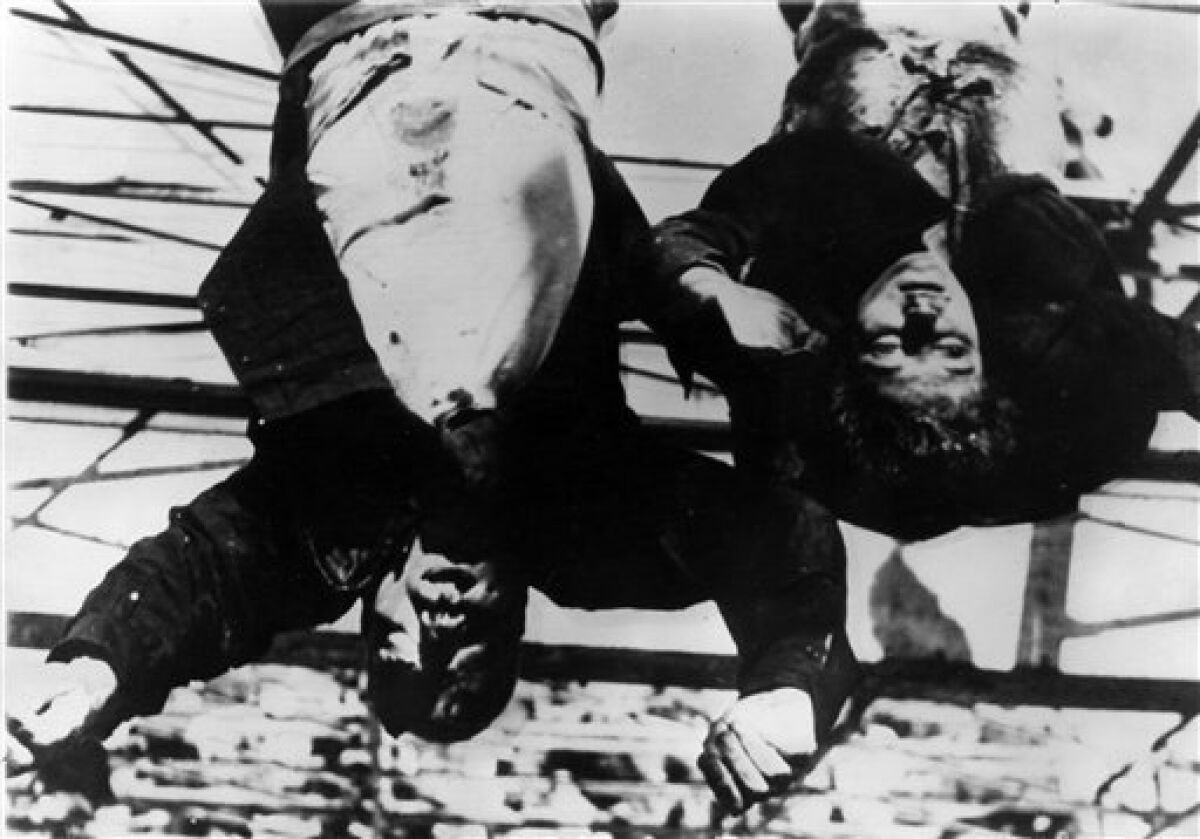
On April 29, the bodies of the executed were loaded in a van and moved to Milan, the largest city in northern Italy. They were dumped on the ground in the Piazzale Loreto, where people kicked them and spat on them. Finally, the bodies of Mussolini and the Petaccis were hung, upside-down, from the roof of an Esso gas station, and people threw stones at them.
Initially, Mussolini was buried in an unmarked grave. In 1946, his body was dug up and stolen by Fascist supporters. Four months later, it was recovered by the authorities, who then kept it hidden. In 1957, his remains were allowed to be interred in the Mussolini family crypt in his hometown of Predappio. His tomb has become a place of pilgrimage for neo-fascists, and the anniversary of his death is marked by neo-fascist rallies.

His granddaughter, Alessandra Mussolini, is a member of the European Parliament, and has been one of the leaders of far-right politics in Italy since the early 21st Century. Her son, Romano Mussolini, plays for SS Lazio, the Rome-based team known for a Fascist fan base. He says he has no interest in politics.

*

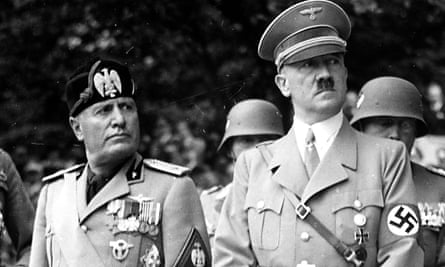
On April 30, upon hearing a report of what happened to Mussolini, and knowing that the Soviet Union's Red Army had Berlin surrounded, and that his own escape was unlikely, Hitler decided that he was not going to face the same fate. The Nazi dictator killed himself.
The famous, occasionally-imitated, Time cover

His wife, Eva Braun, had also committed suicide, with a cyanide pill. She was 33. The Nazi regime came to an end with the rump government's surrender 8 days later.

He knew the Red Army was closing in from the east. He knew the other Allies, America and Britain, were closing in from the west.

On April 22, he ordered General Felix Steiner to attack the Soviet troops attempting to encircle Berlin. Steiner could not raise enough troops to do so. Pretty much the only available fighters in Germany who weren't already in the Army were old men and children.

Steiner was no hero. He was arrested for war crimes, but after 3 years, he was released due to an inability to get enough evidence against him. He lived until 1966, still trying to rehabilitate the image of the German army, and in particular the SS.

In his Bunker, Hitler was told of Steiner's inability to raise troops, and he lost his composure. He now knew that defeat in World War II is inevitable. This event was dramatized in the 2004 German film Der Untergang, known as Downfall in the English-speaking world. Hitler was played by Austrian actor Bruno Ganz, and, since the scene was filmed in German, a language most non-Germans don’t understand, it became the basis for the "Hitler Rants Parodies" video series, with fake subtitles put on to match whatever joke the author wants to tell.

Hitler knew Berlin was surrounded. He had hoped to hold out until May 5, the anniversary of the death of Napoleon Bonaparte, his role model, who had come closer to conquering Russia than he had, actually reaching Moscow, but finding it burned and useless to him before returning.

But the reports that Hitler was getting suggested that the Soviets would get there sooner. And when he found out how his former Axis partner, Mussolini, had been treated after his capture, and especially after his execution, by Communists in his country, Hitler was determined to not fall into the hands of any of the Allied nations, especially the Soviets.

As the saying goes, the one service Hitler ever performed for humanity was to kill Hitler. But the regime he began on January 30, 1933, 12 years earlier -- including the war he started on September 3, 1939 -- had led to the deaths of 75 million people, military and civilian combined, including over 400,000 Americans.

The true depths of his depravity had already begun to reach the civilized world before word of his death had, as American, British and Soviet troops found the concentration camps where the Holocaust was carried out. In these camps, 11 million people died, some from murder, some from disease. And 6 million of those people who died, and many others who survived, were put there for no crime other than being Jewish.

So the death of Hitler could not be a wholly joyous occasion, because it was a reminder of all that he did, and all that he could have done had he won.

If you ever wonder which is worse, Fascism or Communism, consider this: The Soviets had the atomic bomb for 40 years, and never used it; the Chinese have had it for nearly 60 years, and have never used it; but if the Nazis had ever gotten it, there is no doubt that Hitler would have ordered its use.

His propaganda minister, Joseph Goebbels, and his wife, Magda, remained in the Bunker. On May 1, they fed their children poison, and then took their own lives. On May 2, Generals Hans Krebs and Wilhelm Burgdorf, both among those that Hitler asked to remain in the Bunker in the Downfall scene, committed suicide. The same day, Nazi Party Secretary Martin Bormann, who had fled the Bunker, realized capture by the Soviets was inevitable, and committed suicide. SS leader Heinrich Himmler escaped until he was captured by British troops, and committed suicide in their custody on May 23.

Most of the remaining Nazi high command was captured alive. They were tried in Nuremburg, site of some of the Party's infamous rallies, and convicted. These included Joachim von Ribbentrop, the Foreign Minister; Julius Streicher, the Nazis' top propaganda publisher; Hans Frank, Governor-General of occupied Poland; and the other 2 military leaders that Hitler had asked to stay in the Downfall scene, General Alfred Jodl, Chief of the Armed Forces, who had signed the surrender papers on V-E Day, and Field Marshal Wilhelm Keitel.

Not among the condemned, but scheduled to be so, was Reichsmarschall Hermann Göring, the highest-ranking Nazi official to have survived V-E Day. He had made an appeal, asking to be shot as a soldier instead of hanged as a common criminal, but the court refused. So he committed suicide with a potassium cyanide capsule the night before he was to be hanged.

Two more Fascist dictators, because they were neutral in The War, hung on: António Salazar had a stroke, and was removed from power in Portugal in 1968, dying in 1970, and democracy was restored in 1974; and Francisco Franco died in 1975, and, with the support of King Juan Carlos I, Spain went back to democracy.

Monday, November 4, 2024

Is Trump "Hitler"?

Every politician gets compared, by people who don't like him or her, to Adolf Hitler, Chancellor of Nazi Germany from 1933 to 1945.

Donald Trump, more than most. Even his own current Vice Presidential nominee, J.D. Vance, once called him "America's Hitler."

But that's not fair. Only Hitler was really Hitler, right?

Well:

* Hitler appealed to bigotry, both racial and religious. So has Trump.

* Hitler treated his country as miserable, with the need to make it great again. So has Trump.

* Hitler finished first in an election, even though he didn’t get a majority of the popular vote. So did Trump.

* Hitler wanted things in popular culture that he didn’t like, as we would say today, "canceled." So does Trump.

* Hitler called people in the media that criticized him "the enemy" and said they were lying, when he knew damn well that they were telling the truth. So does Trump.

* Hitler valued personal loyalty, loyalty to him, above all. So has Trump.

* Hitler took the greatest offense at people who were once loyal to him turning coat. So has Trump.

* Hitler let big business do whatever they wanted, so long as they were loyal to him. So has Trump.

* Hitler established concentration camps for people he deemed inferior and/or criminals. So did Trump. In Hitler's case, they weren't only limited to along his country's border. In Trump's case, they weren't slave labor camps, and didn't become death camps -- at least not intentionally.

* Hitler thought he knew more than his generals did. He didn't. The same is true of Trump.

* Hitler wasn't much of a sports fan, but he understood how sports success could be used for propaganda purposes. The same is true for Trump: He used to go to Yankee games, but he went there for business networking. Now, he can't show his face in the new Yankee Stadium, because he'd get the hell booed out of him.

* Hitler had a thing for much-younger blondes. So does Trump.

* Hitler lied. About everything. So does Trump.

* Hitler usually wore boots to make himself look taller. Trump wears lifts on his shoes.

* Hitler was addicted to cocaine and methamphetamines. Trump is believed to be addicted to both cocaine and Adderall.

* According to his surviving medal records, among the reasons Hitler took drugs was to cure flatulence. Trump has been accused of severe flatulence while sitting in court.

* Hitler was at his happiest when he was cheered by adoring crowds during his lie-filled, bigotry-filled speeches. So is Trump.

* Hitler was impersonated and mocked, in his own time, by Charlie Chaplin, who, though a genius, was a sex fiend who liked 'em young. Trump has been impersonated and mocked, in his own time, by Alec Baldwin, who doesn’t even have genius status.

* Hitler survived an assassination attempt. So has Trump -- or so he would like us to believe.

* Hitler has been featured in three episodes of the Internet series Epic Rap Battles of History. So has Trump. (A fourth has now happened.)

* And when his reign came to an end, Hitler's country needed serious rebuilding. The same was true of Trump.

There is, of course, a huge difference: When Hitler's reign came to an end, he was dead. When Trump's reign came to an end, he was still alive, and began to build a new regime, with a chance of achieving it.

One more big difference: Hitler refused to be captured by the Russians in the end, while Trump allowed himself to be captured by the Russians in the beginning.

*

So: Is Trump "Hitler"? No. Is he bad enough? Yes.

So you can't sit this one out. You have to vote. And you can't vote third-party, just because you think the Democrats are "corporatist" or you believe the bald-faced lie that it is Israel that is committing "genocide" in Gaza, when it is Hamas whose own stated reason for existence is genocide.

You're not going to get your perfect candidate for President. You have either Kamala Harris or Donald Trump. Harris would be a great candidate against anybody. Trump is absolutely unacceptable against anybody.

You can't say, "I disagree with her on this one issue, therefore I can't vote for her."

That kind of thinking prevented Hubert Humphrey from winning in 1968, and we got Richard Nixon.

It prevented Jimmy Carter from winning in 1980, and we got Ronald Reagan.

It prevented Al Gore from winning in 2000, and we got George W. Bush.

It prevented Hillary Clinton from winning in 2016, and we got Donald Trump.

Every time that kind of thinking takes hold, the people thinking it end up getting the President who is the least like the one they really wanted.

This time, there is no other option: A vote for anyone other than Harris, including a vote for no one at all, is a vote for Trump, which is a vote for absolute Fascism.

Harris is not perfect. But she is a good person, with good ideas. Benjamin Netanyahu is evil. So is Hamas. They cancel each other out. Throw the issue out. It does not matter in this election, not one damned bit. The only issue that matters is preventing Fascism. Which means stopping Trump.

I cannot make it any clearer than that. Vote for Harris this time, and you can vote for whoever you want next time -- because there will be a next time. If Trump wins this time, there won't be a next time for a long time to come, if at all.

Donald Trump tells people, "You've been through tough times. It's not your fault. See those people over there? It's their fault! Vote for me, and I will punish them for you!"

Four years ago, Joe Biden told people, "You've been through tough times. So have I. I understand. Together, we can make the times better."

Now, Kamala Harris can tell people, "Joe was right. Together, we made the times better. But we have more to do. Together, we can do it!"
It will be a tough fight. As the lady says, "And when we fight, we win!"

Thursday, October 17, 2024

October 17, 1944: The Near-Destruction of Warsaw

October 17, 1944, 80 years ago: Having successfully put down an uprising in the Polish capital of Warsaw for the 2nd year in a row, Gestapo chief Heinrich Himmler gives an order: "The city must completely disappear from the surface of the earth and serve only as a transport station for the Wehrmacht. No stone can remain standing. Every building must be razed to its foundation."

Himmler's boss, Adolf Hitler, had been considering this since 1939: He wanted to tear the city down, and replace it with a modern city in the German style. He specifically said to get rid of historical monuments and the Polish national archives. Hitler didn't just want genocide, he wanted to completely wipe Poland from public memory.

By January 1945, 85 percent of the buildings that had stood in Warsaw before the initial German invasion of September 1, 1939 had been destroyed. In 2005, an estimate was made that the value of the damage was, in current U.S. dollars, $54.6 billion.

With Poland a client state after World War II -- the Eastern European version of the West's NATO was founded in 1955 as "The Warsaw Pact" -- the Soviet Union funded the rebuilding of the city, but in the Communist style. As a result, it is not considered an architectural marvel. No, if you want to see a classical Polish city, the only one left is 
Kraków, which was always the country's home of culture.

The 778-foot, 42-story Palace of Culture and Science was erected in 1955, a copy of the Moscow State University Building. It has nicknames of both genders: Since the State University Building is one of Moscow's "Seven Sisters," the Palace is called "The Eighth Sister"; but it's also known as "Stalin's Dick." (Also, "Stalin's Syringe.")

You've heard of Polish jokes? Here is an actual Polish joke, from Poland: Where is the best view of the city of Warsaw? From the Palace of Culture and Science. Why? Because, from there, you can't see the Palace of Culture and Science.

Much like Colonial Williamsburg in America, Warsaw's "Old Town" was reconstructed. The project was the world's first attempt to resurrect an entire historic city core, and was included on the UNESCO World Heritage list in 1980. 
Today, Warsaw is a thriving national capital, a metropolis of 1.8 million people, the 8th-largest in the European Union behind Berlin, Madrid, Rome, Bucharest, Paris, Vienna and Hamburg.  

Saturday, July 20, 2024

July 20, 1944: The Plot to Kill Hitler

July 20, 1944, 80 years ago: Operation Valkyrie is carried out. The intention is to kill Chancellor Adolf Hitler of Nazi Germany. It is not successful.

A previous attempt to kill him was made on November 8, 1939, in Munich, as Hitler was celebrating the anniversary of the Beer Hall Putsch, the Nazi Party's failed attempt to take over the government of the German state of Bavaria in 1923. Hitler left earlier than expected, so he was not among the 8 people killed by a bomb planted by Georg Elser.

Elser was quickly found and imprisoned. With some irony, not only was he not executed immediately, but he outlived many of the 1944 plotters -- and almost outlived Hitler anyway, only being executed at the Dachau concentration camp on April 9, 1945.

By July 1944, on the Western Front, the Allies had made their D-Day invasion, and were rolling through France. On the Eastern Front, the Soviets had pushed Nazi troops out of their country. For the first time, it was clear that Germany was losing the war.

Generals begged Hitler for trains, to move troops and equipment to the fronts. Hitler said, "No, I need the trains to kill the Jews." In other words, to transport them to the concentration camps. So the generals knew that the thing that would most help them in the war was not coming.

So a plot was hatched to remove Hitler from power. And since he had been granted absolute power by the Reichstag years earlier, the only way to do that was to kill him. The hope was that the successor government would then be able to make peace with the Allies, and that Germany would be able to keep what it still had by that point.

The plotters had an inside man. Colonel Claus von Stauffenberg was an aide to the senior staff of the Germany Army, the Wehrmacht. Hitler had scheduled a meeting of the senior staff for his retreat, the Wolfsschanze (Wolf's Lair) in Rastenburg, East Prussia, for July 20.

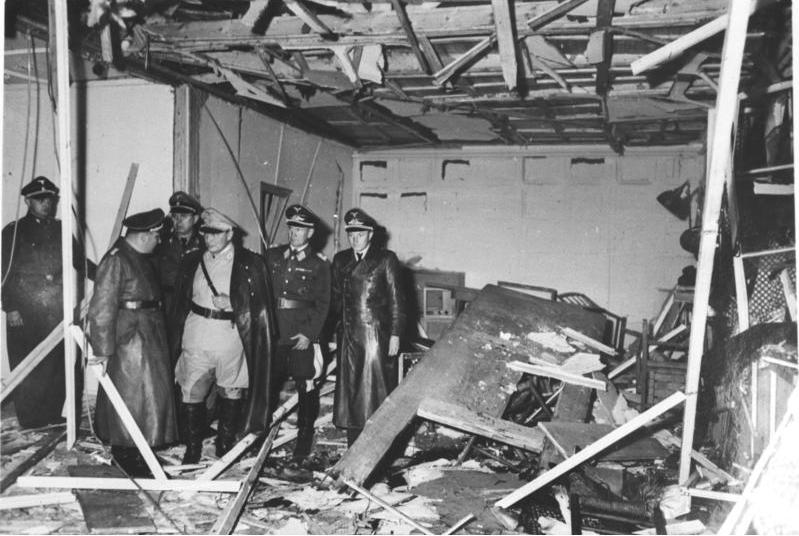
Stauffenberg walked into the briefing room carrying a briefcase containing two small bombs. But he only had time to arm one of the bombs. He left the briefcase under the conference table, as close to Hitler as he could get it. Then, as part of the plan, someone walked in and told Stauffenberg that there was a phone call for him. He excused himself, and left the room.

At 12:42 PM, Stauffenberg looked back, and saw the explosion and the smoke. He presumed that Hitler was dead. He got into a staff car, driven by his aide Werner von Haeften, and left the Wolfsschanze complex for the nearby airfield. By 1:00, he was airborne, with a plane whose flight was arranged by another conspirator.

At 4:00, Stauffenberg's plane landed at Berlin's Templehof airport, and he called the Bendlerblock, the Nazis' version of the Pentagon, telling them that Hitler was dead. This was his biggest mistake: It immediately made him something he had not been before the call: A suspect.

Had he waited for confirmation -- or, as it turned out, for denial -- he might not have become a suspect. Becoming one was bad for him, because Hitler was alive. When Stauffenberg left the briefing room, Colonel Heinz Brandt moved the briefcase. As a result, while the explosion did kill 4 people and injure almost everyone else in the room, Hitler was shielded by a leg of the solid oak conference table. Shrapnel ripped through his pants, giving him minor wounds to his legs. And, like almost everyone else in the room, Hitler suffered a perforated eardrum. But that was the extent of his injuries.

The Gestapo ended up arresting more than 7,000 people, executing 5,000 of them, including Stauffenberg, shot by a firing squad the next day. Field Marshal Erwin Rommel was a part of the plot, but, as Germany's greatest living military hero, he was given the option of suicide, and the use of a cover story that he had died in battle, which would protect his name and his family from dishonor.

The Allies continued closing in, and Hitler lasted another 9 months before taking the easy way out. The Soviets attempted to destroy the Wolfsschanze, but it was so solidly reinforced that conventional explosives couldn't do the job. The remains are now a historic site, and the redrawing of national borders after the war means that they're now located in Kętrzyn, Poland.

Monday, May 8, 2023

Top 10 Myths About World War II

May 8, 1945: Nazi Germany surrenders, ending the European Theater of World War II. It becomes known as V-E Day: Victory in Europe. V-J Day, Victory over Japan, came on August 14.

Top 10 Myths About World War II

1. It Began On September 1, 1939. That's the date on which Nazi Germany invaded Poland, beginning what became known as "the European Theater" of the war. But "the Pacific Theater" had begun earlier. Japan had been attacking China since 1931, when they invaded and annexed the province of Manchuria.

2. It never would have happened without Hitler. Adolf Hitler became Chancellor of Germany on January 30, 1933. He wanted revenge on Britain, France, Russia, and their client states Poland and Czechoslovakia. And he wanted revenge on the Jews, whom he blamed for a "stab in the back" that caused Germany to lose World War I.
He wasn't the only one who thought so. Had he never become Chancellor, there were others willing to step into the breach of chaos Germany was in during the early 1930s. Another such figure might not have been as eager to go to war. But it would have happened. And such a figure might have been a more competent commander-in-chief, allowing Germany to hold out longer, and maybe even to negotiate a peace that would have allowed it to continue as a fascist nation.

3. The French were cowards who surrendered too early. They were overwhelmed by the Nazis, unaware that their defenses, such as the Maginot Line, would be terribly ineffective. What were they supposed to do? Surrendering allowed them to stay alive as a country.

And they had a Resistance, and it kept fighting for 4 years, until the Allies came in and turned the tide. That sounds like "surrender" was a half-truth.
French Resistance flag, with the Cross of Lorraine

4. FDR knew Pearl Harbor was going to be attacked, and let it happen. This charge has been leveled at Franklin Delano Roosevelt, the greatest President ever produced by the Democratic Party, by Republicans who don't want to give a Democrat credit for winning the war.
They want the credit for winning the war to go to Republicans like Generals Dwight D. Eisenhower (who was elected President in 1952 and 1956, solely on the basis of his wartime command, as he'd never held elective or even civilian appointive office) and Douglas MacArthur (whom the hard right really wanted in the elections of 1948 and 1952).

The argument is that FDR couldn't convince Congress to declare war on Nazi Germany, because so many of them were either big-city Democrats, with large Irish constituencies that didn't want to go to war on behalf of Great Britain, and Italian constituencies that didn't want to go to war against Italy; or Midwesterners, of both parties, in America's largest ethnic group, which, then as now, was German, and didn't want to go to war against Germany.
Therefore, the only way to get America into a war against Germany was to get it into a war with Germany's ally, Imperial Japan. So, in their theory, FDR provoked Japan by instituting an embargo on exports to them, including oil; freezing Japanese assets in U.S. banks; and supplying Japan's enemy, China, through Britain.

Every surviving document that discussed the possibility of Japanese retaliation for these measures suggests a direct countermeasure, such as economic sanctions; or an attack on a considerably closer U.S. military base, such as one in the Philippines. Which did happen: On December 7 and 8, 1941, one or the other, Japan attacked pretty much every base America had in the Pacific Ocean, and some British targets, too. As he said in his address to Congress on December 8, asking for a Declaration of War:

Yesterday, the Japanese Government also launched an attack against Malaya. Last night, Japanese forces attacked Hong Kong. Last night, Japanese forces attacked Guam. Last night, Japanese forces attacked the Philippine Islands. Last night, the Japanese attacked Wake Island. And, this morning, the Japanese attacked Midway Island.

Malaya (Malaysia) and Hong Kong were then under British control. Congress granted the Declaration of War. America was at war with Japan. But it still was not at war with Germany. Three days later, on December 11, to aid its ally, Germany declared war on America. Only then did Congress declare war on Germany.

But the surviving documents that suggest that the Japanese would attack a U.S. military base directly mentioned the Philippines -- not the Hawaiian Islands, still a U.S. Territory. (Hawaii gained Statehood in 1959.) The idea that the Japanese were even capable of an attack on Hawaii appears not to have been considered by the U.S. Department of War. It was a complete surprise. It wasn't just that FDR didn't know: Nobody on our side knew.

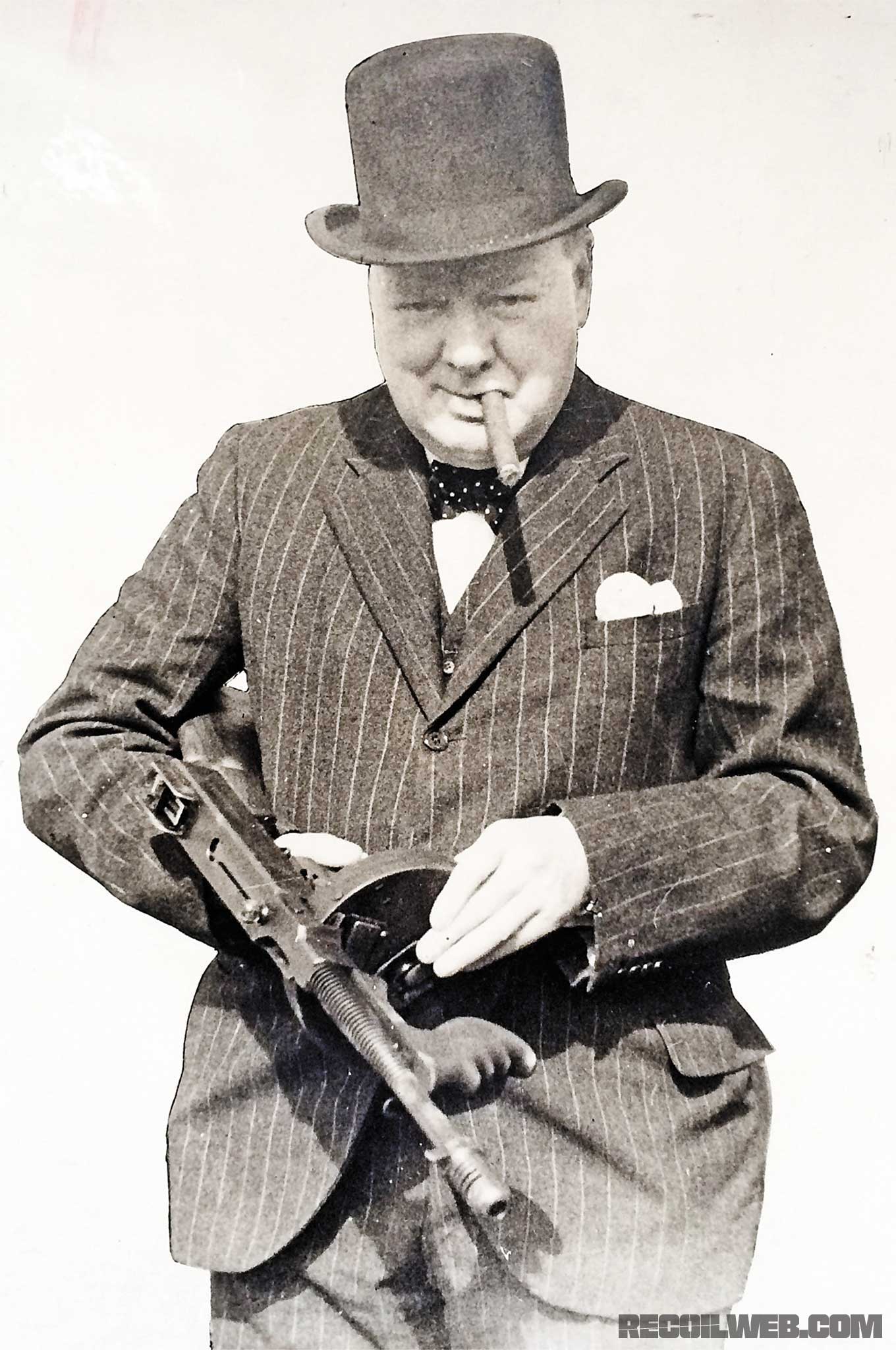
5. Churchill was an incorruptible good guy. Using the term "corrupt" suggests that the subject was willing to be bribed with something -- money, power, or something else -- to achieve his goals. In that regard, calling Winston Churchill "corrupt" is ridiculous. He was always filthy rich, and could not be bought.
"You've got to ask yourself one question: 'Do I feel lucky?'
Well, do you, you old sod?"

But... "Good guy"? He hated Nazis, which was a plus, especially when few others were willing to oppose them publicly. He hated Communists, which was a plus. But he was also an Englishman of the Victorian era: He was first elected to Parliament in 1900, the last full year of Queen Victoria's life. He was a big believer in the British Empire, and no fan of the natives of its colonies.

In 1919, as Secretary of State for Air, he agreed to the Royal Air Force's request to use mustard gas in Iraq: "I am strongly in favour of using poisoned gases against uncivilised tribes." The Versailles Conference was going on at the time, and Churchill said, "The democratic principles of Europe are by no means suited to the development of Asiatic and African people."

This was while the Irish War of Independence was going on. As in opposition to Margaret Thatcher and the paramilitary terrorists she supported in the early 1980s, there were hunger strikers in Ireland then, too. Of them, Churchill said, "Hunger strikers will be allowed to die in jail, the more the merrier. Some of them have died already, and a damn bad job they were not all allowed to die." And this was a man who had spent part of his childhood in Ireland: His father, Lord Randolph Churchill, served as the island's Lord Lieutenant, and his brother, Jack, was born there.

Winston also wanted to maintain control of the Indian subcontinent, saying in 1942, "I have not become the King's First Minister in order to preside over the liquidation of the British Empire." That same year, he wrote, "Eventually, the Moslems will become master, because they are warriors, while the Hindus are windbags. Yes, windbags! Oh, of course, when it comes to fine speeches, skilfully balanced resolutions and legalistic castles in the air, the Hindus are real experts! They're in their element! When it comes to business, when something must be decided on quickly, implemented, executed -- here the Hindus say 'pass.' Here they immediately reveal their internal flabbiness."

It got worse. Of Hindus, Churchill once said, "They are a beastly people with a beastly religion." Famine struck the Bengal province, including present-day Bangladesh, in 1943, and over 3 million people starved to death, more than in the Irish potato famine of 100 years earlier. Churchill didn't lift a finger to send them food. For this reason, Indians, especially Bengalis, accuse Churchill of genocide, the very thing he was trying to stop the Nazis from committing.

In 1931, he said this of Mohandas Gandhi, who became world-famous with his Salt March the previous year: "It is alarming and nauseating to see Mr. Gandhi, a seditious Middle Temple lawyer, now posing as a fakir... striding half-naked up the steps of the Vice-regal Palace."

Not that Gandhi was a saint. His activities with, and feelings toward, women were unacceptable to present-day sensibilities. And on July 23, 1939, he wrote this letter to Hitler. I have not changed a word, or corrected a misspelling (as with "deliberately"):

Dear friend,

Friends have been urging me to write to you for the sake of humanity. But I have resisted their request, because of the feeling that any letter from me would be an impertinence. Something tells me that I must not calculate and that I must make my appeal for whatever it may be worth.

It is quite clear that you are today the one person in the world who can prevent a war which may reduce humanity to the savage state. Must you pay the price for an object however worthy it may appear to you to be? Will you listen to the appeal of one who has seliberately shunned the method of war not without considerable success? Any way I anticipate your forgiveness, if I have erred in writing to you.

That's right: Gandhi called Hitler "friend." At best, this was incredibly naive. Forty days later, Hitler invaded Poland.

6. The Western Democracies won it. If it wasn't for the 27 million deaths, military and civilian combined, of citizens of the Soviet Union, the Nazis wouldn't have lost nearly as many men as they did.

In the years to come, America and Britain didn't want to admit anything good about the Communist nations, so they came to believe that they won the war, without Soviet help. The British like to take it a step further: They like to claim that they stood alone for 2 years until America came in, and that America has hogged the glory ever since.

It gets taken even further than that. When England play Germany in soccer, England fans sing this, to the tune of "She'll Be Comin' 'Round the Mountain":

There were ten German bombers in the air. (In the air!)
There were ten German bombers
Ten German bombers
Ten German bombers in the air. (In the air!)

And the RAF of England shot one down. (Shot one down!)
And the RAF of England
RAF of England
RAF of England shot one down. (Shot one down!)

There were nine German bombers in the air...

And so on, until there's no German bombers in the air, 'cause "the RAF of England shot them down." This overlooks the fact that, during the Battle of Britain in 1940 and '41, before America got into The War, in addition to Englishmen, the Royal Air Force had Welshmen, Scotsmen, Irishmen, Canadians, Australians, New Zealanders, Indians, Africans, expatriate Americans, and exiles from all over the Nazi-controlled lands of Europe, but especially France and Poland. The French and the Polish actually exceeded those from elsewhere in the British Empire. If it had only been Englishmen in the RAF, those German bombers would have won. And the English footie fans can't even bring themselves to admit that.

7. If Hitler had only (pick your move that he could have made), he would have won the war. Unless you mean "If he hadn't invaded the Soviet Union," or "If he hadn't declared war on America." If he had never opposed the 2 strongest nations on Earth other than his own, he might have lasted long enough to get a stalemate with the 3rd of the 3 strongest other than his own, Britain, and the Third Reich might have lasted a lot longer. It wouldn't have been "The Thousand-Year Reich" that he proclaimed, but it would have lasted longer than the 12 years that it did.

But once he invaded the Soviet Union on June 22, 1941, he was doomed. Even if America hadn't gotten into the "European Theater" of the war, it would have been a matter of time before the Soviets got to Berlin. And then, Britain and France would have been faced with a Red Europe, as Stalin would have been more than happy to add the formerly Nazi-controlled countries, including France, to his Union of Soviet Socialist Republics.
8. Roosevelt "sold out to Stalin" at Yalta. The last meeting between FDR, Stalin and Churchill was at Yalta, in the Crimea, on the Black Sea -- part of the territory of Ukraine that Vladimir Putin annexed to Russia -- from February 4 to 11, 1945. 
Ever since, conservatives have claimed that FDR "betrayed" Eastern Europe by leaving it to Stalin. Well, what was FDR supposed to do? Send American troops into Poland, Czechoslovakia, Hungary, et al.? In other words, provoke Stalin?

The war was not over. Germany was still fighting, even if the end, there, was in sight. Japan was still fighting, with no end in sight. The Battles of Iwo Jima and Okinawa were yet to come. FDR needed the Soviet Union in that fight. He also knew that the United Nations would be stronger after the war if the Soviets were in it. Roosevelt agreed to some concessions at Yalta, for the same reason he cut his social programs short, telling a reporter, "Dr. New Deal had to give way to Dr. Win the War."

My father, of Polish descent, was a Kennedy Democrat, but he never forgave Roosevelt, the President when he was born, for how he handled the Polish situation at Yalta. But David Reynolds, a professor of history at Cambridge University, has written:

The so-called "Yalta myths" have been a great part of Republican mythology ever since the 1940s. They were a way of attacking Roosevelt and the Democratic party and it’s been brought up at various times since. The assumption behind it is that Roosevelt "sold out" Poland and Eastern Europe to the Soviet Union. It’s hard really to square that with the realities of 1945. The Red Army is in control of most of Poland by the time they meet at Yalta. So unless you embarked, say, on a war to evict the Red Army from Poland, there really is nothing you can do about that.

In other words, Poland and Eastern Europe were not Roosevelt's to "sell." Stalin already had them.

If FDR "sold out to Stalin at Yalta," then so did Churchill. Because of Stalin's promises, Churchill believed that he would keep his word regarding Poland and remarked, "Poor Neville Chamberlain believed he could trust Hitler. He was wrong. But I don't think I am wrong about Stalin." He was.

9. Dropping the atomic bombs on Japan was not necessary to end the war. The closer the U.S. got to the Japanese home islands, the harder the Japanese army fought. With victory at Okinawa on June 22, 1945, the U.S. got as close to the home islands as could be gotten without building new, closer islands. But that battle took 12 weeks. There were 12,500 Americans killed.

Compare that total with the 4,500 killed in 8 years in Iraq. Those 12,500 were more men, in 12 weeks, than America lost in Vietnam in any single year except 1968. The Japanese lost 110,000 men, and even more civilians on the island may have been killed.

President Harry S Truman, who didn't even know about the atomic bomb project until his 2nd day in office -- that's right: FDR did not tell his own Vice President about it -- was given these figures. He asked for figures of how many soldiers would die in an invasion of the Japanese home islands, and how long it would take. He was told over 1 million Japanese, half as many Americans, and it would take at least 6 months of fighting to get Japan to surrender. Given that "X-Day," the day the invasion was set to begin, would have been November 1, 1945, that meant that the "Pacific Theater" of the war would still have been in progress by May 1, 1946.

Truman asked when the atomic bomb would be ready. He was told that the 1st test would be on July 16, and that, if successful, more would be ready to go at a moment's notice. He knew that, if the invasion happened, and the predictions for it came true (and he believed that they would), and then it came out that America had the bombs that would have ended the war before the invasion, and Truman didn't use them, the American people would blow their stacks. He knew it would destroy his reputation as a strong leader who cared about the country. He cared more about that than he did about the Democratic Party losing the 1946 Congressional elections or the 1948 Presidential election.
He gave the order to proceed. Hiroshima was bombed on August 6. On August 9, Nagasaki was bombed, and the Soviet Union invaded Manchuria. The Japanese knew it was only going to get worse, much worse, and surrendered on August 14, which became known as V-J Day.

10. Black men serving in the war made the desegregation of baseball possible. The line was, "If we can stop bullets, why not balls?" In 1945, Albert "Happy" Chandler, a former Governor of Kentucky and U.S. Senator, was appointed Commissioner of Baseball. (He said he took the job because he loved baseball, and because it paid better than serving in the Senate.) He cited black men serving in the war as a reason to allow them in the professional ranks of baseball.

But there was a reason Chandler was appointed to the post: It was vacant. It was vacant because the 1st and only man, to that point, to hold it, Kenesaw Mountain Landis, had died in 1944. And he was a racist. While he publicly denied that there was any reason why black men couldn't play in the major leagues, there was no way he was ever going to allow it. And he loved being Commissioner, so he was never going to resign, even though he was 78 years old when he died.
And he looked old when he was
considerably younger than that.

Branch Rickey, president of the Brooklyn Dodgers, signed Jackie Robinson to a contract on October 23, 1945. Had Landis still been alive and on the job on that date, there is no way in hell that he would have allowed that contract to stand. Not even if a black American soldier had shot Hitler, or if a black American pilot had dropped the bomb on Hiroshima, or even if a black man had, by whatever means, saved Landis' own life.
Lieutenant Jack R. Robinson, U.S. Army.
Don't bother looking for a picture of Kenesaw Mountain Landis
in a military uniform: He never served, and so it doesn't exist.

If Landis were still alive in 1945, then, today, Jackie Robinson would be remembered, if at all, as a good running back for UCLA in 1940. And God only knows when a black man would have played in Major League Baseball. But it wouldn't have been while Landis was still alive.

Of course, Rickey was a lawyer. And a brilliant man. He could have sued, and argued the case very well. But Landis had been a federal Judge, meaning he was also a lawyer. He could have tied the case up for years.

If Landis had still been alive and Commissioner in 1954, when the U.S. Supreme Court decided Brown v. Board of Education, he still would have held firm, until the Supreme Court got the case of Brooklyn National League Baseball Club, Inc. v. Kenesaw Mountain Landis, and Chief Justice Earl Warren would have done what he did in Brown v. Board, and gotten a unanimous ruling in favor of the plaintiff, granting great joy to black Americans, and giving the elderly Landis a terrible public humiliation.

But it still would have been, at the minimum, the Summer of 1954, before that ruling was issued. Which means the debuts of Robinson, Roy Campanella, Don Newcombe, Larry Doby, Satchel Paige, Monte Irvin, Willie Mays, Ernie Banks and Hank Aaron all would have been delayed -- and, given the ages of some of them, possibly prevented entirely.