Showing posts with label fascism. Show all posts

Wednesday, August 19, 2026

August 19, 1936: The Assassination of Federico García Lorca

August 19, 1936, 90 years ago: Federico García Lorca, the Spanish poet, playwright and theater director, is assassinated near Alfacar, Granada, in the southern region of Spain, known as Andalusia. He was 38 years old.

Born on on June 5, 1898 in Fuente Vaqueros, outside Granada, García Lorca gained fame as a member of "The Generation of '27," a group of Spanish poets that tapped into the European literary movements of symbolism, futurism and surrealism. In 1928, he published Romancero Gitano (which was translated into English with what would now be considered a slur, Gypsy Ballads). He published the plays Blood Wedding in 1932, Yerma in 1934, and The House of Bernarda Alba in 1936.

But success did not fulfill him. He was gay, and suffered from depression after the end of a relationship with a sculptor. The coming of the Spanish Civil War in 1936 weighed heavily on him. He was a Socialist, like the prevailing government, the Second Republic that first won election in 1931. But the Nationalists, fascists, led by Generalissimo Francisco Franco, were unfavorable to socialism due to its criticism of religion, and, with its strong Catholic base, unfavorable to homosexuals.

His hometown of Granada had gone without a Mayor for several months, because all possible candidates feared for their lives. García Lorca's brother-in-law, Manuel Fernández-Montesinos, agreed to accept the position, but he was assassinated within a week. On the same day he was shot, August 18, García Lorca was arrested.

The circumstances of his death are in dispute, partly because his remains have never been found. In his book The Assassination of García Lorca, author Ian Gibson wrote that he was shot -- with 3 others: Joaquín Arcollas Cabezas, Francisco Galadí Melgar and Dióscoro Galindo González -- by Nationalist militia at the Fuente Grande (the Great Spring), on the road between Viznar and Alfacar.

Police reports released by radio station Cadena SER in April 2015, concluded that he was executed by fascist forces. A Franco-era report, dated July 9, 1965, describes the writer as a "socialist" and "freemason belonging to the Alhambra lodge," who engaged in "homosexual and abnormal practices."

Most biographers seem to agree that his death had political overtones. But Leslie Stainton, who wrote the 1999 biography Lorca: A Dream of Life, suggested that he was killed specifically because he was gay -- a murder, and a hate crime, but not an assassination.

He has been honored with statues in his hometown of Granada, and the national capital of Madrid; with a garden on the River Seine in Paris; in a hotel room where he once stayed in Buenos Aires, Argentina, kept as a museum; and on the Rainbow Honor Walk, in the gay-friendly Castro District of San Francisco.

He once said, "I will always be on the side of those who have nothing, and who are not even allowed to enjoy the nothing they have in peace." Sounds like my kind of guy. 

Monday, April 28, 2025

April 28-30, 1945: The Ends of the Dictators

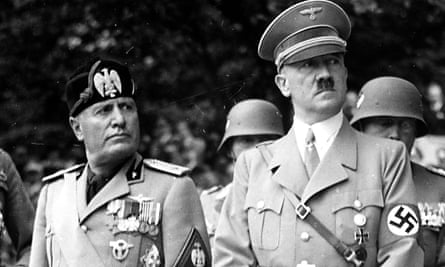
April 28, 1945, 80 years ago: Benito Mussolini, the fascist dictator of Italy from 1922 to 1943, is captured by Communist partisans and executed. He was 61 years old, and few wept for him.

Mussolini was originally a journalist who entered politics as a Socialist. He served in the Italian Army in World War I, and was wounded in 1917. His experience shifted him from left to right. On October 28, 1922, thinking the postwar Italian national government weak, he led the Fascists in a March On Rome. The government fell rather than oppose him with the Army, and King Victor Emmanuel III appointed Mussolini to be the country's youngest Prime Minister ever to that point. He became known as Il Duce (The Leader).

After removing all political opposition through his secret police, and outlawing labor strikes, Mussolini and his followers consolidated power through a series of laws that transformed the nation into a one-party dictatorship. In 1924, he ordered the assassination of Giacomo Matteotti, the Leader of the country's Socialist Party. In 1929, he signed the Lateran Treaty with the Holy See, to establish Vatican City.

His supporters, including in America, liked to say, "He made the trains run on time." In fact, they ran no better under him than under the previous government. They also liked to say he put an end to the Mafia. This also wasn't true. It would be more accurate to say that he made a deal with the Mafia, a non-aggression pact: Leave my officials -- including policemen, prosecutors and judges -- alone, let them do as they please, or, rather, as I please; and I'll do the same for you.

He also wanted to build a new Roman Empire. He established a protectorate over nearby Albania, and in 1935 invaded Ethiopia, annexing it into Italian East Africa (comprised of the current nations of Somalia and Eritrea). From 1936 to 1939, he and Adolf Hitler, the dictatorial Chancellor of Nazi Germany, aided fellow fascist Francisco Franco in his takeover of Spain.

(This included Hitler sending his air force, the Luftwaffe, to bomb opposing cities; and Mussolini sending troops, which became known as Franco's Italian Army. In the 1970s, this name would be adapted by Italian-American fans of the Pittsburgh Steelers, who formed a fan club for the half-Italian, half-black running back Franco Harris. Not to be outdone, a group of black fans honored defensive tackle Joe Greene with "Mean Joe Greene's Ethiopian Brigade." Given what Mussolini's men did in Spain and Ethiopia, both names should already have been considered cringeworthy.)

With the onset of World War II, Mussolini brought Italy into the Axis with Nazi Germany and Imperial Japan. But the reputation of Italy having a weak army -- which both Mussolini and Giuseppe Garibaldi had taken advantage of in the preceding 80 years -- still held, as British and American troops kicked them out of North Africa, and then invaded Sicily, and finally the Italian mainland.

On July 25, 1943, his own Grand Council of Fascism passed a vote of no confidence in him, and the King who had appointed him dismissed him as Prime Minister after 21 years, and ordered his arrest. The King then agreed to an armistice with the Allies.

German paratroopers broke Mussolini out of prison, resulting in a civil war. The Allies did not intervene, since their focus had moved to Western Europe. This time, Mussolini did not have enough troops to even oppose the regular Italian Army.

On April 25, 1945, Mussolini took his mistress, Clara Petacci -- leaving his wife and 6 children behind -- along with 13 others, including Clara's brother, who was posing as a Spanish consul, and fled. They set out for adjoining and neutral Switzerland, intending to board a plane and escape to also-neutral Spain, under Franco's protection.

But on April 27, they were stopped by Communist partisans near Lake Como, just 20 miles from the Swiss border. On April 28, instead of being turned over to the United Nations, as per Allied agreement in the event that he should be captured, they were executed in a village named Giulini de Mezzegra, on the orders of a partisan named Walter Audisio.

The witnesses' accounts of his last words differed. One said that he was defiant to the end, telling them, "Aim at my heart!" One said that he was a coward, yelling, "No! No!" The other said that Mussolini said nothing at all as the rifles were raised.

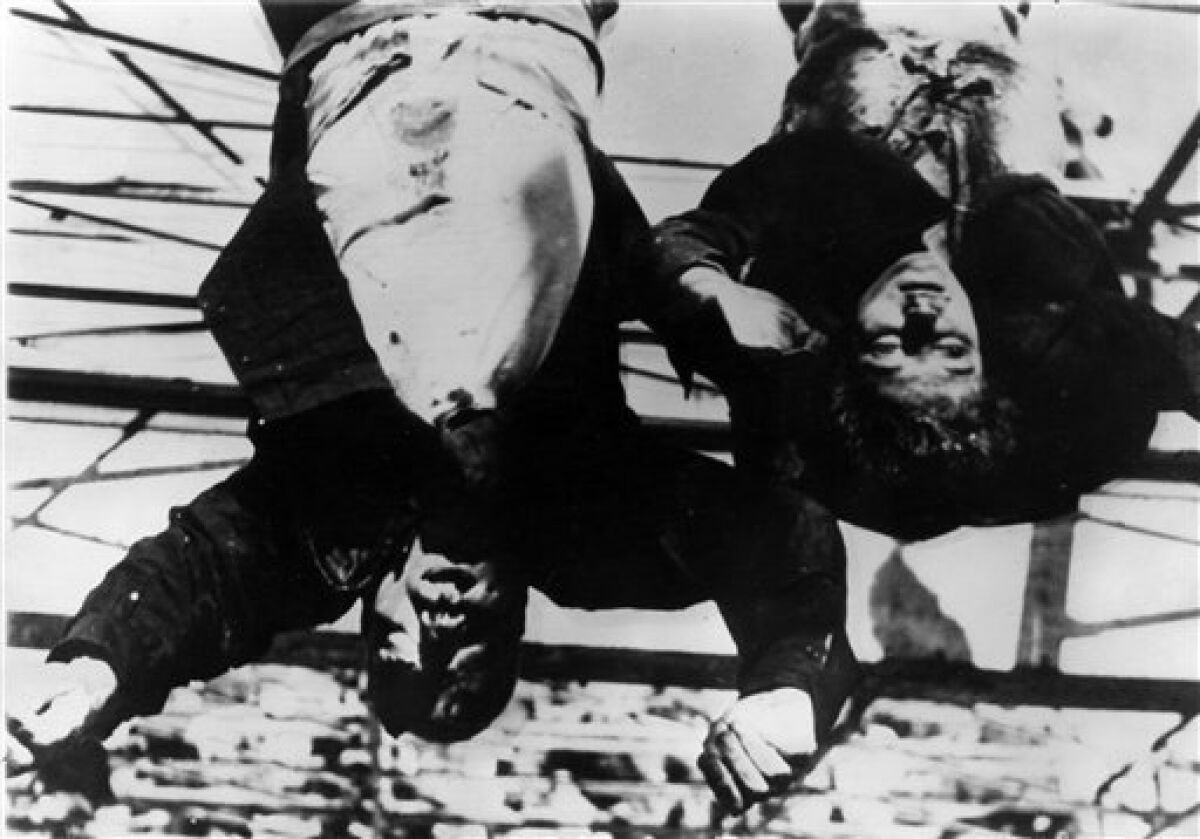
On April 29, the bodies of the executed were loaded in a van and moved to Milan, the largest city in northern Italy. They were dumped on the ground in the Piazzale Loreto, where people kicked them and spat on them. Finally, the bodies of Mussolini and the Petaccis were hung, upside-down, from the roof of an Esso gas station, and people threw stones at them.
Initially, Mussolini was buried in an unmarked grave. In 1946, his body was dug up and stolen by Fascist supporters. Four months later, it was recovered by the authorities, who then kept it hidden. In 1957, his remains were allowed to be interred in the Mussolini family crypt in his hometown of Predappio. His tomb has become a place of pilgrimage for neo-fascists, and the anniversary of his death is marked by neo-fascist rallies.

His granddaughter, Alessandra Mussolini, is a member of the European Parliament, and has been one of the leaders of far-right politics in Italy since the early 21st Century. Her son, Romano Mussolini, plays for SS Lazio, the Rome-based team known for a Fascist fan base. He says he has no interest in politics.

*

On April 30, upon hearing a report of what happened to Mussolini, and knowing that the Soviet Union's Red Army had Berlin surrounded, and that his own escape was unlikely, Hitler decided that he was not going to face the same fate. The Nazi dictator killed himself.
The famous, occasionally-imitated, Time cover

His wife, Eva Braun, had also committed suicide, with a cyanide pill. She was 33. The Nazi regime came to an end with the rump government's surrender 8 days later.

He knew the Red Army was closing in from the east. He knew the other Allies, America and Britain, were closing in from the west.

On April 22, he ordered General Felix Steiner to attack the Soviet troops attempting to encircle Berlin. Steiner could not raise enough troops to do so. Pretty much the only available fighters in Germany who weren't already in the Army were old men and children.

Steiner was no hero. He was arrested for war crimes, but after 3 years, he was released due to an inability to get enough evidence against him. He lived until 1966, still trying to rehabilitate the image of the German army, and in particular the SS.

In his Bunker, Hitler was told of Steiner's inability to raise troops, and he lost his composure. He now knew that defeat in World War II is inevitable. This event was dramatized in the 2004 German film Der Untergang, known as Downfall in the English-speaking world. Hitler was played by Austrian actor Bruno Ganz, and, since the scene was filmed in German, a language most non-Germans don’t understand, it became the basis for the "Hitler Rants Parodies" video series, with fake subtitles put on to match whatever joke the author wants to tell.

Hitler knew Berlin was surrounded. He had hoped to hold out until May 5, the anniversary of the death of Napoleon Bonaparte, his role model, who had come closer to conquering Russia than he had, actually reaching Moscow, but finding it burned and useless to him before returning.

But the reports that Hitler was getting suggested that the Soviets would get there sooner. And when he found out how his former Axis partner, Mussolini, had been treated after his capture, and especially after his execution, by Communists in his country, Hitler was determined to not fall into the hands of any of the Allied nations, especially the Soviets.

As the saying goes, the one service Hitler ever performed for humanity was to kill Hitler. But the regime he began on January 30, 1933, 12 years earlier -- including the war he started on September 3, 1939 -- had led to the deaths of 75 million people, military and civilian combined, including over 400,000 Americans.

The true depths of his depravity had already begun to reach the civilized world before word of his death had, as American, British and Soviet troops found the concentration camps where the Holocaust was carried out. In these camps, 11 million people died, some from murder, some from disease. And 6 million of those people who died, and many others who survived, were put there for no crime other than being Jewish.

So the death of Hitler could not be a wholly joyous occasion, because it was a reminder of all that he did, and all that he could have done had he won.

If you ever wonder which is worse, Fascism or Communism, consider this: The Soviets had the atomic bomb for 40 years, and never used it; the Chinese have had it for nearly 60 years, and have never used it; but if the Nazis had ever gotten it, there is no doubt that Hitler would have ordered its use.

His propaganda minister, Joseph Goebbels, and his wife, Magda, remained in the Bunker. On May 1, they fed their children poison, and then took their own lives. On May 2, Generals Hans Krebs and Wilhelm Burgdorf, both among those that Hitler asked to remain in the Bunker in the Downfall scene, committed suicide. The same day, Nazi Party Secretary Martin Bormann, who had fled the Bunker, realized capture by the Soviets was inevitable, and committed suicide. SS leader Heinrich Himmler escaped until he was captured by British troops, and committed suicide in their custody on May 23.

Most of the remaining Nazi high command was captured alive. They were tried in Nuremburg, site of some of the Party's infamous rallies, and convicted. These included Joachim von Ribbentrop, the Foreign Minister; Julius Streicher, the Nazis' top propaganda publisher; Hans Frank, Governor-General of occupied Poland; and the other 2 military leaders that Hitler had asked to stay in the Downfall scene, General Alfred Jodl, Chief of the Armed Forces, who had signed the surrender papers on V-E Day, and Field Marshal Wilhelm Keitel.

Not among the condemned, but scheduled to be so, was Reichsmarschall Hermann Göring, the highest-ranking Nazi official to have survived V-E Day. He had made an appeal, asking to be shot as a soldier instead of hanged as a common criminal, but the court refused. So he committed suicide with a potassium cyanide capsule the night before he was to be hanged.

Two more Fascist dictators, because they were neutral in The War, hung on: António Salazar had a stroke, and was removed from power in Portugal in 1968, dying in 1970, and democracy was restored in 1974; and Francisco Franco died in 1975, and, with the support of King Juan Carlos I, Spain went back to democracy.

Thursday, November 21, 2024

November 21, 1934: The "Business Plot" Is Exposed

Smedley Butler 

November 21, 1934: The New York Post and the Philadelphia Record break the story of what came to be known as "The Business Plot," a rich men's plan to launch a military coup and take over the American government.

The story is broken by Paul Comly French, a reporter who had once been the private secretary of Smedley Butler, a retired Major General (2 stars) in the U.S. Marine Corps.

Smedley Darlington Butler was born on July 30, 1881, in the Philadelphia suburb of West Chester, Chester County, Pennsylvania. His father, Thomas Stalker Butler, was a Republican Congressman. His maternal grandfather, Smedley Darlington, had previously held the same seat in Congress. Three earlier Darlingtons had served in Congress. Smedley's aunt, Isabel Darlington, was the 1st woman to practice law in Chester County.

He enlisted in the Marines, and served with distinction in the Spanish-American War, the Philippine Campaign and the Boxer Rebellion. His participation in the so-called "Banana Wars" in Central America caused him to look at war and its conduct differently.

He received his 1st Congressional Medal of Honor for his service in the American occupation of Veracruz, Mexico in 1914. He offered to return it, saying he had done nothing to earn it. He was ordered to keep it. He received a 2nd Medal of Honor for his role in repelling an ambush during the American occupation of Haiti in 1915.

He received his General's stars during World War I, and was appointed commanding officer of the Marine barracks at Quantico, Virginia, now the "home base" of the Corps (and of the FBI). In 1924, President Calvin Coolidge gave him leave from active duty so that he could become Director of Public Safety for Philadelphia.

He said, "Cleaning up Philadelphia was worse than any battle I was ever in." He brought crime down significantly, but his tactics were a bit heavy-handed. Still, there were many people who liked that, and they remembered it, thinking that Butler was their kind of man. He held the job for 2 years, returned to the Corps, and retired from the service in 1931.

He ran for the U.S. Senate in Pennsylvania in 1932, but, with the tide turning against Prohibition, which he supported, he lost the Republican Primary. He opposed the Bonus Army in a public statement that year, and there were many people who liked that.

That year, Governor Franklin D. Roosevelt of New York, a Democrat, was elected President of the United States. His "New Deal" lifted millions out of poverty, increasing taxes on rich people in order to do it. America's wealthiest men were furious, and some were not willing to wait until November 3, 1936, the next election, to do something about it.

In November 1934, Butler testified before a special committee of the U.S. House of Representatives. He told them that he was visited by Gerald P. MacGuire, a prominent Connecticut businessman. MacGuire had visited Germany and Italy, and saw how veterans' groups had aided the Fascist movements there, movements that had stopped Communist uprisings. He told Butler that he viewed FDR and his advisors, the so-called "Brain Trust," as Communists, and said they had to be stopped.

He told Butler that a group of businessmen had $50 million to spend, and a private army of 500,000 ex-soldiers, many of them members of the American Legion, ready to march on Washington, to remove Roosevelt from power, and establish a Fascist dictatorship. MacGuire told Butler that the group wanted him to be the dictator.

Butler said that he later met with Robert Sterling Clark, an heir to the Singer sewing machine fortune. Clark told him about some of the other men backing the plan:

* Irénée du Pont, head of the DuPont Corporation, which had recently bought the Remington Arms company, which would produce the weapons and the ammunition for the coup.

* Thomas W. Lamont, running J.P. Morgan & Company on behalf of J.P. Morgan Jr., son of the company's founder, and an adviser to every President since Woodrow Wilson, including FDR, thus giving the group an "inside man." 

* Grayson Murphy, a director of Goodyear Tire, Anaconda Copper, and Bethlehem Steel, all companies capable of supplying the coup effort with necessary materiel.

* And the last 2 Democratic Party nominees for President before FDR: John W. Davis, a former Congressman from West Virginia and U.S. Ambassador to Britain, who was always more conservative than the mainstream of the Party; and Alfred E. Smith, who was also FDR's predecessor as Governor of New York, had lost very badly to Herbert Hoover in 1928, saw FDR beat Hoover even worse in 1932, and was intensely jealous of FDR's early success and popularity as President.

About all of this, Butler told French, whom he trusted due to his service. French did some digging, and found evidence that the plot was real, not just MacGuire and Clark blowing off steam at a President they hated. Armed with this knowledge, Butler met with MacGuire again, and said, "If you get 500,000 soldiers advocating anything smelling of Fascism, I am going to get 500,000 more, and lick the hell out of you, and we will have a real war right at home." And then he went to Congress, and spilled the beans.

French broke the story in the New York Post and the Philadelphia Record on November 21. On November 22, The New York Times wrote about it, calling it a "gigantic hoax." All the parties alleged to be involved publicly said there was no truth in the story, calling it a joke and a fantasy. Roosevelt's reaction to it is not known to have been recorded.

If the coup ever got beyond the talking stage, it was doomed without a leader -- or, more likely, a figurehead. It has been alleged that Hugh S. Johnson, a retired Army Brigadier General who had been running the National Recovery Administration for FDR, and had been named Man of the Year for 1933 by Time magazine, had also turned the plotters down.

In 1935, Butler published a book titled War Is a Racket, comparing what Dwight D. Eisenhower would later call "the military-industrial complex" to organized crime. He wrote, "I spent most of my time as a high class muscle man for Big Business... a gangster for capitalism" who "might have given Al Capone a few hints." That book, all by itself, showed that the big business boys were looking to the wrong man for their goal.
Plaque honoring Butler, Philadelphia City Hall:
"He enforced the law impartially,
he defended it courageously, he proved incorruptible."

MacGuire died of pneumonia shortly before Butler published his book. Grayson Murphy died in 1937, Smedley Butler in 1940, Hugh Johnson in 1942, Al Smith in 1944, Thomas Lamont in 1948, John W. Davis in 1955, Robert S. Clark in 1956, Paul French in 1960, and Irénée du Pont in 1963.

In 2018 and 2022, Thomas Lamont's great-grandson, Edward Miner Lamont Jr., a.k.a. Ned Lamont, was elected Governor of Connecticut -- as a liberal Democrat. He has conducted the office very differently from what his ancestor would have hoped.

This month, Donald Trump won -- or, perhaps, "won" -- the Presidential election, needing only business lords like Rupert Murdoch and Elon Musk to re-shape public opinion for him. He won't need a respected General to be a figurehead for him. After all, he still believes what he said in 2015: "I know more than the generals do."

Wednesday, November 6, 2024

The Message

At 4:22 this afternoon, Kamala Harris gave her concession speech, at Howard University, her Alma Mater, where she had hoped to give a victory speech.

She spoke for 12 minutes, praising America and its system, thanking her supporters and telling them she loved them, and telling them to not give up the fight for making this a better country.

Do I feel better for having heard that? No. To continue that fight, we need a plan. Right now, to paraphrase her opponent's line, we don't even have a concept of a plan.

*

This is not the United States of America. This is Bully Bro Nation. Where white bros can bully women and "weak" men, and always get away with it. And it is the America that I -- male, white and straight, but disabled, and with Polish and Jewish heritage -- grew up in, and hoped would become better. For a while, I thought it had. That turned out to be the real "blue mirage."

*

So, after an emotionally devastating election, what message to I have for the people who, like me, supported Kamala Harris?

In 2016, the message was easy: "Don't flee to Canada. Stay and fight. Together, we will get through this." This would seem to be a good message again. But, this time, we can't be sure of that. Trump says he'll be a dictator on Day One. No dictator ever gave up power on Day Two. He's said he will terminate the Constitution of the United States, which, he has said, has been "unfair" to him. And he has the Supreme Court on his side now, along with the Senate, and probably (the returns are not all in yet) also the House of Representatives.

Can we survive four years of Dictator Trump and the Heritage Foundation's Project 2025? Or, if, for whatever reason, Trump can't complete the term, four years of a combination of Dictator Trump and Dictator Vance, carrying Project 2025 out? I honestly don't know.

I tried. I warned as many people as I could. Not enough listened to me. I'm sorry. I know that makes me sound like McMurphy in One Flew Over the Cuckoo's Nest, and he was no hero, and he came to the kind of end that I can imagine Trump's new government carrying out. But it's all I can say. 

*

What's the message to the people who voted for Trump? It's simple:

You got what you wanted. You own it all now. Whatever happens over the next four years, it is all on you.

You have bet your lives, and everybody else's, on Trump having a successful second term. Even though his first term was, by any rational measure, a complete disaster. The day he left office the first time, the country's economy was in tatters, it was causing the inflation you blamed on Joe Biden, over 1 million people died from COVID when he could have saved the vast majority of those had he taken it seriously, the crime problem had gotten worse, and he hadn't come close to solving the border problem you care so damned much about.

You decided that his first term, his various failures, his various crimes including impeachable offenses, his various bigotries, and the other evidence of his low character don't matter. You also decided that, whatever virtues Harris has, don't matter. Whether that's because you love Trump, or because Harris is a woman, or because Harris is black, or a combination thereof, I don't know: Your reason matters less than your result. Whatever I might think of such an attitude, it is your right.

But, know this: You are betting your lives, as well as ours, on Trump having a successful term. Even though you know that he is now 78 years old, older than Biden was when he was elected, and morbidly obese. And even though that you also know that, if, for whatever reason, he can't complete this term, the Presidency will fall to J.D. Vance. I'll bet you any money you like that not one of you was undecided, heard that Vance was the choice, and chose Trump on that basis.

But it's all on him now, and it's all on you. Whatever happens over the next four years, it's because you chose this guy.

If it works out in your favor, you are well within your rights to gloat.

If it doesn't -- if Trump crashes the economy a second time, if crime gets worse, if the immigration problem is not fixed, if there is a foreign-policy disaster, if there is another pandemic -- I am well within my rights to tell you that I told you so.

Whatever happens, as was said in the first Joker film, you get what you fucking deserve.

Tuesday, July 23, 2024

July 23, 1974: The Restoration of Greek Democracy

Konstantinos G. Karamanlis

July 23, 1974, 50 years ago: After 7 years of a right-wing military dictatorship, democracy is restored to the birthplace of the concept, Greece.

On April 21, 1967, a group of colonels in the Greek Army overthrew the caretaker government, a month before scheduled elections which Georgios Papandreou's Centre Union party was favored to win. King Constantine II and his family fled to England, and the monarchy was never restored.
King Constantine II, 2019

The military dictatorship was led by Georgios Papadopoulos, and was characterized by policies such as anti-communism, restrictions on civil liberties, and the imprisonment, torture and exile of political opponents. In other words, the kind of things the Greek people had fought so hard against in World War II, only a generation before. The coup is believed to have been heavily influenced by America's CIA, in a bid to ward off Communist influence, spilling over from neighboring Albania and Bulgaria.

As internal dissatisfaction grew in the early 1970s, and especially after an abortive coup by the Navy in early 1973, Papadopoulos attempted to legitimize the regime by beginning a gradual "democratization." On June 1, 1973, he formally abolished the monarchy, and declared Greece a republic, with himself as President. He was confirmed in office via a controversial referendum. He furthermore sought the support of the old political establishment, but secured only the cooperation of Spiro Markezinis, who became Prime Minister.

Concurrently, many restrictions were lifted, and the Army's role significantly reduced. An interim Constitution created a presidential republic, which vested sweeping, almost dictatorial, powers in the hands of the President. The decision to return to at least nominal civilian rule, and the restriction of the Army's role, was resented by many of the regime's supporters, whose dissatisfaction with Papadopoulos would become evident a few months later.

On November 14, 1973, students at the Athens Polytechnic University went on strike, and started protesting against the junta. An assembly formed spontaneously, and decided to occupy the Polytechnic. On the 15th, thousands of people from Athens poured in to support the students. On the 16th, the demonstrators proclaimed that the students were aiming to bring down the junta. During the afternoon, demonstrations and attacks against neighboring ministries took place. Central roads closed, fires erupted, and Molotov cocktails were thrown.

In the early hours of November 17, the transitional government sent a tank crashing through the gates of the Polytechnic. Soon after that, Prime Minister Markezinis asked President Papadopoulos to reimpose martial law.

An official investigation undertaken after the fall of the junta declared that no students of the Athens Polytechnic were killed during the incident. However, 24 civilians were killed outside the campus, including a 5-year-old boy caught in crossfire.

It was the end of the line for Papadopoulos: On November 25, he was overthrown by a hardliner, Dimitrios Ioannidis. This began a string of events that would culminate in the fall of the regime, sparked by Ioannidis' ill-advised invasion, on July 15, 1974, of the island nation of Cyprus, which inflamed tensions with neighboring Turkey, which invaded on July 20.

Ioannidis could not survive such a humiliation, and was pushed out by "The Coup of the Generals" on July 23. They invited Konstantinos Karamanlis, who had served as Prime Minister 3 times between 1955 and 1963, to return from exile, and end the military rule.

Papadopoulos was sentenced to death, but this was commuted to life imprisonment. He died in prison in 1999, at the age of 80. Ioannidis was sentenced to life, and died in prison in 2010, at 87. Karamanlis served as Prime Minister until the election of 1980, making him President, holding the office until his resignation in 1985. Despite being 81 years old, he was elected again in 1990, and retired again in 1995. He died in 1998, at 91. His nephew, Konstantinos A. "Kostas" Karamanlis, served as Prime Minister from 2004 to 2009.

King Constantine II, as his opponents reminded him, was not ethnically Greek. He was German and Danish. He was a grandson of Kaiser Wilhelm II of Germany, and a great-grandson of both Queen Victoria of Britain and King Christian IX of Denmark -- which made him a 3rd cousin of Queen Elizabeth II, who allowed him and his family to settle in London after the 1967 coup.

He married another 3rd cousin, Princess Anne-Marie of Denmark. They were permitted to return to Greece in 2013, although there was no chance of the monarchy ever being legally restored. The King died in 2023. The former Queen is still alive. The current head of the royal family, the House of Glücksburg, is Crown Prince Pavlos, 57, who runs an investment firm in New York, and would be King Paul II in the incredibly unlikely event that the monarchy was restored.
He is a 4th cousin of King Charles III of Britain, at whose Coronation the photo above was taken; and a 1st cousin of King Felipe VI of Spain (who had been his roommate at Georgetown University in Washington, D.C.) and King Frederik X of Denmark.

Monday, July 15, 2024

Never Acceptable

Two things must be made absolutely clear:

1. It's a good thing Trump wasn't killed. Not because it would have been a "national tragedy," but because it would have made him a martyr to one of the most despicable causes in American history.

He must be alive to face both the voters on November 5, and justice thereafter. No one is above the law, and those 6 Justices on the Extreme Court know it. He will be held accountable for at least some of what he has done.

2. Rationally, there's a 99 percent chance that this was real. People looking for "clues" to show that the assassination attempt was staged -- and there are many, some making little sense, some making some sense -- to make him look like a tough guy, a badass, superhuman, whatever, as opposed to "elderly," "unfit" Joe Biden, end up looking like Beatles fans in 1969, scouring album pictures and song lyrics for clues to back up the rumor that Paul McCartney had died.

But if we're being completely rational, then we can't completely dismiss the possibility that this was staged. After all, this is Donald Trump we're talking about. A man who believes that image, appearances, "optics," especially displays of strength, are everything. Staging an unsuccessful assassination attempt, and not caring that others might actually be hurt or get killed, is almost certainly not be what he did do. But only his most blinkered fans cannot accept that it is exactly the sort of thing that he would do.

Regardless, Donald Trump is still unfit for the Presidency, and you can pick any one of a dozen reasons why. If you want America to remain free, and to be better than it is now, President Joe Biden is the only choice.

And can we really be shocked? This guy has encouraged violence, from his announcement of candidacy to the January 6, 2021 insurrection, and still does it. He is a genuine Fascist. It has been said that "He who lives by the sword shall die by the sword." It has been said, "As ye sow, so shall ye reap." Trump has created a climate where political violence has become "okay." When it should never be okay, or even "okay." (I want to make that absolutely clear.)

And now, with minimal injury, he has been shot:

* Not by anybody with (as far as is publicly known, as of this writing) liberal connections, but by a 20-year-old male registered as a member of the Republican Party, the Party he leads.

* Not by an immigrant, regardless of religion, but by someone born and raised in America. Tall, blond, blue-eyed.

* And by an AR-15, a weapon of war that reasonable people consider to be absolutely unacceptable outside of an actual war, a gun that Trump has promised to do nothing about.

Justified? Of course not. President Biden is right: Political violence is never acceptable. And I want Trump alive, to face the voters, and to face the juries. I want him defeated, disgraced, and imprisoned. Once he is in prison, it will no longer matter to me how long he lives, but I want him alive at least that long.

Not because I'm a Democrat. Not even because I'm an American.

But because I'm a human being.

Political violence is never acceptable. Likewise, Donald Trump is never acceptable.

And let's not kid ourselves: Trump did not "take a bullet for America." Trump took a bullet for the only thing he has ever given a damn about: Himself.

It has also become clear to me that this period, the Age of Trump, which began in 2015 with the announcement of his candidacy, and will hopefully end in 2025 with his imprisonment, will not easily lend itself to nostalgia. Because even the people who supported Trump will, by the time the nostalgia wave would kick in, probably in the late 2030s, have to ask themselves, "What did we really get out of 'the good old days'? How good could they really have been?"

Hopefully, people will come to realize they had been fooled, and accept that he was bad for the country.

But who's kidding who? There are people alive today who voted for Richard Nixon, and wouldn't go back and change their vote if they could.

And Nixon wasn't nearly the danger to American freedom that Trump is, has been, and yet could be.

And that danger is both very real and still being staged.

Some people still don't get that. Well, to paraphrase the tagline from the Republican Convention of 60 years ago, as a new one gets underway:

I would remind you, my fellow Americans, that extremism in the defense of liberty is no defense of liberty. And I would remind you also that supporting Donald Trump, in the pursuit of anything, is no virtue.

Saturday, June 8, 2024

June 8, 1949: George Orwell Publishes "Nineteen Eighty-Four"

June 8, 1949, 75 years ago: Nineteen Eighty-Four is published by Secker & Warburg in London. It is the last novel written by Eric Blair to be published in his lifetime. It has become synonymous with his pen name: George Orwell.

The year was not chosen at random: It was simply the year in which the book was written, 1948, with the last 2 digits reversed, suggesting a "near future" to which the reader might be able to relate, even if Orwell himself might not live to see it. (He was born in 1903, but it was a foregone conclusion: He had been suffering from tuberculosis as early as 1938, when he was a journalist covering the Spanish Civil War. He died on January 21, 1950.)

In the novel, Britain, now known as Airstrip One, as well as America and the entire Western Hemisphere, and also the original Oceania, meaning Australia, New Zealand and the Pacific Islands, are part of a totalitarian superstate, named Oceania. This superstate is apparently led by Big Brother, who is pushed by the Party, the political organization that actually runs Oceania. Orwell leaves it vague as to whether Big Brother is a man who actually exists, or ever did, or is merely a convenient symbol.

The government tells the people, "Big Brother is watching you." As a result, they don't want to disappoint him by doing anything against the Party, and therefore against the nation. "Who controls the present controls the past" is a Party plank, and so there is a Ministry of Truth, which rewrites history to suit the Party's needs.

"Oceania had always been at war with with Eastasia," which includes Japan, China, and the Himalayas. "Oceania had always been at war with Eurasia," which includes what had been the Soviet Union and the rest of continental Europe. Both statements of perpetual war had been true, and neither, and could flip, depending on what the Party thought it needed at the time. "Even the names of countries, and their shapes on the map, had been different. Airstrip One, for instance, had not been so called in those days: it had been called England, or Britain, though London, he felt fairly certain, had always been called London."

"He" is the novel's protagonist, a Ministry of Truth worker named Winston Smith. Through his work of changing the truth, he has seen the truth, and begins to rebel. One thing leads to another, and his contact in a resistance group turns out to be a mole placed by the Party, and Winston is captured and tortured, and his loyalty is restored. The last line of the novel is, "He loved Big Brother."

In real life, the year 1984 turned out to be very little like the world of the novel Nineteen Eighty-Four, although a movie based on the book, starring William Hurt as Winston, was released that year. And yet, in the years to come, Britain, and, to a lesser extent, America, would become loaded with closed-circuit TV cameras used by law-enforcement agencies. This growth of government watching led to a British TV "reality show," exported to America, titled Big Brother.

In short, just as "Machiavellian" has come to represent the kind of tactics that Niccolò di Bernardo dei Machiavelli was mocking in his book The Prince, "Orwellian" has come to mean the kind of governmental approach -- in total, or even in part, as with CCTV cameras -- that Orwell himself, a democratic socialist -- opposed.

In 1982, Alan Moore's graphic novel V for Vendetta premiered, showing a fascist, surveillance-obsessed Britain of 1997, led by a Big Brother-type figure, who was basically insecure and needed the love of the people. A film version was released in 2006, set in 2038, and it took a lot of liberties with the original story, including making the Chancellor a much meaner figure. He was played by William Hurt, who had come full circle from playing Winston Smith 22 years earlier.

But an insecure leader, who is not the man his supporters believe him to be, who tells you what the truth is, and calls the actual truth lies, and punishes those who act against his government? We have already had Donald Trump in the Presidency. We do not need that again. We don't need 2025 to be like Nineteen Eighty-Four.

Tuesday, June 4, 2024

June 4, 1944: The Liberation of Rome

June 4, 1944, 80 years ago: Allied troops liberate Rome, the capital of Italy, one of the nations of the Axis.

In 1922, Benito Mussolini took advantage of Italy's post-World War I chaos, and had his Fascists make their "March On Rome." For 21 years, "Il Duce" (The Leader) ruled the land of Garibaldi, Leonardo and Vivaldi with a fist more iron than ever imagined by Caligula, Commodus or Diocletian. George Seldes, an American journalist who covered his entire career (and lived to be 104), wrote a book about him titled Sawdust Caesar.

The reputation of Italy having a weak army -- which both Mussolini and Giuseppe Garibaldi had taken advantage of in the preceding 80 years -- still held, as British and American troops kicked them out of North Africa, and then invaded Sicily, and finally the Italian mainland. On July 25, 1943, his own Grand Council of Fascism passed a vote of no confidence in him, and King Victor Emmanuel III, who had appointed him Prime Minister, dismissed him and ordered his arrest.

The Allies rolled into Rome on June 4, 1944, and, to borrow a phrase that would haunt later American leaders, were welcomed as liberators. Among them was an Army stenographer from The Bronx, Staff Sergeant George Goldberg -- my grandfather.

Within a year, Mussolini was dead, and so was Adolf Hitler.

Thursday, April 25, 2024

April 25, 1974: Portugal's Carnation Revolution

April 25, 1974, 50 years ago: A military coup overthrows the Fascist government of Portugal, ending it after 41 years. Because of the flowers that the soldiers wore in their lapels, it became known as the Carnation Revolution.

Portugal's First Republic was overthrown in a coup on May 28, 1926, leading to the Ditadura Nacional (National Dictatorship). It was replaced on April 11, 1933 by the Estado Novo (New State). Historians would falsely label this combined era as the Second Portuguese Republic.

From its founding in 1933 until 1968, the Estado Novo was run by António de Oliveira Salazar. It was Fascist: Corporatist, nationalist, and bigoted, heavily oppressing Portugal's overseas colonies, especially in Africa: Mozambique, Angola, and Cape Verde. Like most Fascist regimes, including the one that began in Italy in 1922 and the one that would begin in neighboring Spain in 1939, it was tied in with the Catholic Church, itself conservative and autocratic.
António Salazar

Like Spain, Portugal remained neutral during World War II, and postwar American Administrations, Democratic and Republican alike, looked the other way at their abuses, domestic and foreign, since they were part of the worldwide bulwark against Communism. Portugal was a founding member of NATO in 1949, although Spain was kept out until 1982, due to not wanting to antagonize the Soviets, with their memories of the Spanish Civil War that was lost in 1939. Both Portugal and Spain joined the United Nations in 1955.

From 1950 until 1970, Portugal saw its Gross Domestic Product per capita increase at an annual average rate of 5.7 percent. Despite this remarkable economic growth, by the fall of the Estado Novo in 1974, Portugal still had the lowest per capita income and the lowest literacy rate in Western Europe. They were in so deep of a hole that this remained true following the fall, and continues to the present day.

After the Second Vatican Council (1962-66), a large number of Catholics became active in the democratic opposition. The outbreak of the colonial wars in Angola, Guinea and Mozambique – in March 1961, January 1963 and September 1964 respectively – exacerbated the divisions within the Catholic sector along progressive and traditionalist lines.

On August 3, 1968, Salazar fell in his bath and hit his head. At first, he seemed fine. But on August 19, he felt sick, and was admitted to a hospital. On September 16, he went into a coma. Américo Tomás, who, as the President of Portugal, had ceremonial duties but otherwise had little power, presumed that Salazar would never recover, and dismissed him on September 25, replacing him with Marcelo Caetano.

But Salazar did emerge from his coma, and was even lucid. He was not told that he had been removed from power. He was allowed to continue to believe that he ruled the nation, until he died on July 27, 1970, at the age of 81.
Caetano continued to pave the way towards economic integration with Europe and a higher level of economic liberalization in the country, achieving the signing of an important free-trade agreement with the European Economic Community (a.k.a. the EEC or the "Common Market") in 1972.
In February 1974, Caetano decided to remove General António de Spínola from the command of Portuguese forces in Guinea, in the face of Spínola's increasing disagreement with the promotion of military officers and the direction of Portuguese colonial policy. This occurred shortly after the publication of Spínola's book, Portugal and the Future, which expressed his political and military views of the Portuguese Colonial War.
Several military officers who opposed the war formed the Movimento das Forças Armadas (MFA, or Armed Forces Movement) to overthrow the government in a military coup. The movement was aided by other Portuguese army officers who supported Spínola and democratic civil and military reform.
Thousands of Portuguese took to the streets, mingling with, and supporting, the military insurgents. A central gathering point was the Lisbon flower market, then richly stocked with carnations (which were in season). Some of the insurgents put carnations in their gun barrels, an image broadcast on television worldwide, which gave the revolution its name. Caetano was permitted to flee to Portuguese-speaking Brazil.
Portugal's 1st free election, ever, was held on the 1st anniversary of the Revolution, April 25, 1975 to write a new constitution replacing the Constitution of 1933, which prevailed during the Estado Novo era. Another election was held in 1976 and the first constitutional government, led by centre-left socialist Mário Soares, took office. He served as Prime Minister until 1978, and again from 1983 to 1985, and later as the President of Portugal from 1986 to 1996.
Mário Soares
Portugal became free, and remains free to this day. But freedom from Fascism for them meant independence for its colonies. And that proved to be troublesome, even disastrous:
* Guinea-Bisseau: Portugal recognized its independence on September 10, 1974. At first, things went well. But in 1980, as in many other countries, the economy went sour, and there was a coup. Multi-party elections were not held again until 1994. A civil war was fought in 1998-99, and there were coups again in 2003 and 2004, a Presidential assassination in 2009, another coup in 2012. Things stabilized after that, although there was a failed attempt at another coup in 2022.
* Mozambique: Portugal recognized its independence on June 25, 1975. After just 2 years of independence, a civil war broke out, and lasted until 1992. Finally, in 1994, they had their 1st multi-party elections, and the country became free, and remains so.
* Cape Verde: Portugal recognized the independence of this archipelago off the West Coast of Africa on July 5, 1975. This is easily the most successful of the ex-colonies, having remained democratic since independence. In 2013, they officially changed their name to the Portuguese-language Cabo Verde. In 2020, they were voted Africa's most democratic nation by the V-Dem Institute, which tracks emerging democracies.
* São Tomé and Príncipe: Portugal recognized its independence on July 12, 1975. Like Cabo Verde, it has been comparatively stable and free.
* Angola: Portugal recognized its independence on November 11, 1975. But it went Communist, and descended into a civil war that lasted until 2002, well after the collapse of the Soviet Union, to the point where the only outside aid it was getting was from Cuba. The People's Movement for the Liberation of Angola (Movimento Popular de Libertação de Angola, or MPLA) has ruled the country from the beginning, and José Eduardo dos Santos ruled as President from 1979 to 2017. He retired for health reasons, and was succeeded by João Lourenço, who has reformed things somewhat. Nevertheless, Angola remains a one-party dictatorship.
Marcelo Caetano lived until 1980, António de Spínola until 1996, and Mário Soares until 2017.