Showing posts with label joker. Show all posts

Monday, January 12, 2026

January 12, 1966: "Batman" Premieres On TV

Burt Ward (left) as Robin, and Adam West as Batman
January 12, 1966, 60 years ago: Batman premieres on ABC. The villain in the 1st 2-part episode is the Riddler, played by noted impressionist Frank Gorshin, and the episodes are titled "Hi Diddle Riddle" and, the next night, "Smack in the Middle." Most of the halves of the 2-part episodes had rhyming titles.

Batman had appeared in live-action before, in a 1943 film serial, titled simply Batman, starring Lewis Wilson, and Douglas Croft as Robin; and a 1949 serial, Batman and Robin, starring Robert Lowery and Johnny Duncan. But this was Batman's, and Robin's, 1st TV appearance.
The show ran for 120 episodes, 3 seasons, over the next 2 years, and became the only successful live-action TV series featuring a superhero between The Adventures of Superman's last airing in 1958 and The New Original Wonder Woman's premiere in 1975.
The standard format:
* The 1st part of a 2-part episode would air on a Wednesday night. William Dozier, the series' creator and executive producer, would narrate.
* The opening shot would usually be of Manhattan in New York City, standing in for Gotham City, the fictional home of the Batman character since his debut in Detective Comics #27 in 1939. Location shots later in the show make it look like there are beaches and mountains nearby, suggesting that Gotham looks more like Los Angeles, where the show really was filmed.
But while most versions of Gotham -- in comic books, on TV and in films -- have it looking like a crime-ridden mess, practically a lost cause, Batman '66 (what some fans of the character like to call the show, to differentiate it from other versions of the Bat-Story) makes Gotham look like a nice place, because Batman and his sidekick, Robin the Boy Wonder, have done such a great job in cleaning it up.
Likewise, unlike most versions, where Police Commissioner James Gordon willingly works with Batman, but the rest of the city doesn't quite trust him, and fears him, and some people believe he's an urban legend created to scare criminals, on this show, Batman and Robin are well-known celebrities, and beloved. Not just by Gothamites: Their fame and admiration extends around the world.
But that idyllic urban opening shot is always interrupted by Dozier saying something like, "But, wait! What's this?" And we see the villain and his (or her) henchmen (and/or henchwomen) striking, usually a robbery. This is, after all, the 1960s: Network censors wouldn't take kindly to murders right off the bat, especially for a show based on a comic book aimed at children. The villain and his crew get away with this crime -- for the moment.
* The scene then shifts to Police Headquarters, where Commissioner Gordon and the Chief of Police, Miles O'Hara, realize who is behind the crime, often because the villain is arrogant enough to leave behind a clue admitting it, and realize that this is someone who has them in over their heads.
Gordon was played by Neil Hamilton, and this is one of the few times that he is depicted without a mustache. O'Hara was created specifically for the series, and was played by Stafford Repp, usually with an exaggerated Irish accent, as so many policemen who started when he would have were of Irish descent.
So Gordon says there's only one man who can help them now. He walks over to a red telephone, and uses it to call Batman.
* Dozier says, "Meanwhile, at stately Wayne Manor... " The Manor is owned by a man nearly always referred to as "millionaire Bruce Wayne." In most versions since, Bruce is referred to as a billionaire and one of the richest men in the world. 
The TV version never explains how his family got its money, only that they were one of Gotham's founding families. This is also true in the comics, which suggested armaments, during the American Civil War, and then even more so during the World Wars. This has suggested that Bruce's father, Thomas Wayne, became a doctor and a charity runner out of liberal guilt.
In the very first episode, and only once thereafter, does Bruce (Adam West) mention that his parents, Thomas and Martha Wayne, were murdered by criminals. On no episode is the killer identified, as he was in the comics: Joe Chill, as a result of a robbery gone wrong -- or, depending on which writer is telling the story, it was a hit, hired by a gangster named Lew Moxon, who had a grudge against Dr. Wayne. Only in the 1989 Batman film is the murder committed by Jack Napier, the man who went on to become the Joker.
West was 37 years old when the pilot episode first aired, and, clearly, he's already a veteran crimefighter. Bruce has never been married, so, under the laws of the time, he couldn't adopt a child, but he could be the legal guardian for one. So it is with Dick Grayson -- played by Burt Ward, 20 at the time -- who gets his driver's license in the 2nd season, suggesting that he then turned 16.
In the comics, Dick was a gymnast, who with his parents performed as The Flying Graysons in a circus. The circus was sabotaged by a gangster, and Dick's parents were killed. Batman taught him to deal with his anger by fighting crime with his brain as well as with his fists, and the gangster was brought to justice.
Robin's origin was never touched upon on the show, but Bruce, both in costume and out, is constantly pushing Dick's education, both at his private school and in the Batcave beneath Wayne Manor. He wants Dick to be as smart as he is, and, at times, he seems so, but still has a lot to learn.
* When Gordon calls, Bruce will be doing something in line with the Wayne Foundation, or teaching Dick something, usually in the company of Dick's aunt, Harriet Cooper (Madge Blake), who does not know their secret. The longtime Wayne family butler, Alfred Pennyworth (Alan Napier -- and his last name is never mentioned on the show), does know, and he walks into the room, and whispers in Bruce's ear, telling him that Gordon is calling.
* Bruce and Dick walk into Bruce's private study. Bruce picks up his extension of the red phone, a.k.a. the Batphone, and says, "Yes, Commissioner?" Gordon explains the problem. Bruce tells him they'll be right over. Bruce pulls on the head of a bust of William Shakespeare, and a bookcase moves back, to reveal two poles, similar to those of a firehouse. Bruce tells Dick, "To the Batpoles!" They slide down, still in their civilian clothes, and then the opening credits start.
* We come back from the 1st set of commercials, and Bruce and Dick reach the bottom of the poles, in their costumes. They run to the Batmobile, and the episode's title is shown. As they pull out of the cave, they reach a road, where a sign says, "Gotham City 14 miles." The credits show: "Special Guest Villain" (or "Special Guest Villainess"), the actor's name, and his (or her) character. If there's a 2nd villain, it's "Extra Special Guest Villain.") As they go down the highway, and then pull up in front of Police Headquarters, the episode's writer(s), producer(s) and director are named.
* Gordon and O'Hara brief Batman and Robin, a.k.a. the Caped Crusaders, a.k.a. the Dynamic Duo, on what they already know. Batman, often with help from Robin, makes a guess as to the villain's next move. They turn out to be right, but the villain gets away.
* Back at the Batcave, the Duo, often with Alfred's help, use their resources, including a Batcomputer, to make another deduction about the villain's moves. They figure it out.
* They get to the villain's hideout, and there's a fight! And with every impact of a fist or other object on the villain or a henchman, graphics appear on the screen: "POW!" "ZAP!" "BAM!" "SOCK!" "KAPOW!" "ZING!" and the ever-popular "OOOOFF!" Naturally, this is the Batman, the world's greatest hand-to-hand com-BAT-ant, and he's going to win the fight.
* But no! The Bat and the Boy Wonder lose the fight! And they end up trapped in some gizmo tied in with the theme of the villain's crimes! Much like in a James Bond film, the villain explains his plan, because it doesn't matter if Batman and Robin hear it, because they're not going to be alive to do anything about it! And then, the villain and his henchmen leave the Dynamic Duo to their fate!
* Dozier narrates again! Points out how they're trapped! Words on the screen! Always ending with an exclamation point! Can they get out of it? Dozier closes with, "Tune in tomorrow! Same Bat-Time, Same Bat-Channel!"
* And then the closing credits roll, showing a cartoon Bat-Signal over a cartoon city. Except, on the show, the Bat-Signal was rarely used: Nearly every time that Gordon wanted to contact Batman, it was in daylight, and so he used the Batphone.
* Then the viewer had to wait until Thursday night. The episode begins with a recap of the one before. Then the opening credits. Then, upon coming back from the commercials, Batman figures out an impossible way of getting out of the impossible situation. (While Bruce wanted Dick to learn all about science, the science of the show often didn't make sense.)
* They get back to the Batcave to talk to Alfred, or to GCPD HQ to talk to Gordon and O'Hara, to strategize.
* Finally, there is another knock-down-drag-out fight, and, this time, Batman and Robin win. Then, Gordon and/or O'Hara burst in, leading uniformed cops, and Batman tells them to take the bad boys away. Usually, Batman drops a line about how crime does not pay -- sometimes even acknowledging the villain's worthiness as an opponent, and saying something like, "If only he used his mind for good."
* The episode usually concludes either in Wayne Manor, with Aunt Harriet talking about how wonderful Batman and Robin are, not knowing that they're right there with her in the room; or in Gordon's office, with Batman summing things up and leaving, and Gordon wondering what the city would ever do without them, and sometimes wondering who they really are. And then, the closing credits.
In spite of all the fighting, it's basically just ordinary stuff. There's no lethal force, or even nearly-lethal stuff. If your experience with Batman is in any version from 1989 onward, and you've never seen this version, you may feel let down. Indeed, in the entire series, only 3 criminals ever die, all lackeys.
The most common villains were the more familiar ones from the comics: The Joker (Cesar Romero, who refused to shave his famous mustache, and so, instead of making it green like the Joker's hair, they put the same white makeup used for his face on it, but it can still clearly be seen), the Penguin (Burgess Meredith), the Riddler (Frank Gorshin, with John Astin substituting on an occasion when Gorshin wanted more money), and Catwoman. 
In the comics, Catwoman tends to play both sides of the law, and even becomes Batman's main love interest. But on this show, while she'd love to get into Batman's tights, she's all evil. In the 1st season, she was played by Julie Newmar.
The 1st season was so successful, a movie was made, with those 4 main villains teaming up in an attempt to extort the whole world for big bucks. But Newmar was filming another movie, and was unavailable. So Lee Meriwether played Catwoman this one time. For the 2nd season, Newmar returned. 
For the 3rd season, the character was played by Eartha Kitt, a black actress, whose stage name even suggested a cat, and she not only played up the feline puns used by Newmar and Meriwether, but added her own distinctive purring sound. Of course, since this made Batman and Catwoman an interracial relationship, and this was 1968, the hints of them getting together were dropped.
Also scaled back due to the censors: The Joker's tendency to be a homicidal maniac. Romero's version was little more than a master criminal with clown makeup and, usually, joke themes to his gadgets and crimes. The comics' Joker would have considered him little more than an amateur, and maybe even an insult.
A character created for the comics a few years earlier, Mr. Zero, was renamed Mr. Freeze for the show, and the name change was applied to the comics. Like the Joker, Mr. Freeze's persona had been accidentally created by Batman in the comics. Unlike in the comics, this was never mentioned for the Joker, but it was for Mr. Freeze, and his 3 storylines -- 1st season, played by George Sanders; 2nd, by noted Swedish director Otto Preminger; 3rd, by Eli Wallach -- tended to be a bit darker.
Indeed, one of the darkest episodes, and one of the least "campy" (an adjective all too often correctly applied to this show), was Sanders' appearance, where he appeared to have frozen Batman and Robin to death. They couldn't get out of it themselves, and were very carefully thawed out by doctors.
The Mad Hatter was also adapted from the comics, played here by David Wayne. But the Scarecrow, one of the earlier Batman villains who has been adapted a few times recently, starting with Christopher Nolan's Dark Knight Trilogy, does not appear.
There was a plan to feature Two-Face. Famed science-fiction writer Harlan Ellison even contributed a script for an episode. And Clint Eastwood, just becoming a big star with his "Man With No Name" Western movies, was approached to play him. But the makeup department couldn't make a mask that made former District Attorney Harvey Dent's acid-scarred left profile not look too scary for kids. (Ellison's story was later adapted for a comic book, and an animated film based on it.) Nor did Clayface appear, and the special effects for his appearance would have stretched the show's already stretched budget.
So, with Two-Face and Clayface not viable options, a new character was created: False Face, a master of disguise who could appear to be anybody, including a Bat-ally, and was listed in the opening credits of both parts, and the closing credits of the 1st part, as simply "?" The closing credits of the 2nd part revealed the actor's name: Malachi Throne.
In fact, many villains were created just for the series, including Victor Buono as King Tut (a history professor who had come to think of himself as the ancient Egyptian Pharoah, now destined to rule the modern world), Vincent Price as Egghead (with his egg-shaped bald head and his egg-asperating puns), Roddy McDowall as the Bookworm (his episode was dark, as it began by having him appear to have masterminded Gordon's assassination), Milton Berle as flower-themed gangster Louie the Lilac, Van Johnson as the singing criminal the Minstrel (one of the less campy episodes), Art Carney as the Archer (this variation on Robin Hood didn't steal from the rich and give to the poor, he just stole and kept it); and, in the series' most-watched episode, Liberace as twins: Chandell, a renowned concert pianist, and his brother Harry, who used his brother's image (figuratively and literally) to commit crimes.
The show was successful enough that Dozier was approached about a 2nd superhero show. So he created a new version of the Green Hornet, starring Van Williams as newspaper publisher Britt Reid and a not-yet-famous Bruce Lee as his Chinese valet Kato. (Kato was Japanese in the 1930s radio show; and, because Japan was seen an enemy nation by then, Korean in the early 1940s film serials.)
The kick to The Green Hornet was that he was a good guy pretending to be a bad guy, so he could muscle in on the gangsters' territory, and then defeat them, and lead the police to them. The downside is that the public had to believe that the Hornet and his sidekick (the public never seemed to know his name, and no superhero "codename" was ever created for Kato) were master criminals, and so Reid had to keep up the illusion, by having his Daily Sentinel play this image up.
Aside from Kato, the only people who knew Reid's dual identity were his secretary, Lenore Case (Wende Wagner), and the District Attorney, Frank Scanlon (Walter Brooke). On the radio show, Reid's contact in law enforcement was the Police Commissioner, possibly inspiring Batman's Jim Gordon. To avoid confusion, Scanlon became a D.A. for the TV show.
The Green Hornet was considerably more serious than Batman: Williams said he wouldn't have done the show if it was silly. But the ratings never reached the heights. A crossover episode was done, explaining that Bruce Wayne and Britt Reid had been rivals since they were kids. The Hornet's city was never mentioned in his show's script, but in the Batman 2-parter, "A Piece of the Action" and "Batman's Satisfaction," airing on March 1 & 2, 1967, it's clear that Reid and Kato are "in town," meaning they don't live in Gotham. (The 2011 film The Green Hornet definitively places them in Los Angeles.) 
They compete with each other as Bruce & Dick and Britt & Kato, but also as Batman & Robin and the Green Hornet & Kato, fighting each other as well as a villain, Colonel Gumm (Roger C. Carmel, better known as Star Trek's Harry Mudd). 
They even get into a Bam! Smack! Pow! fight, in which Kato says to the Hornet, "It's a good thing those guys are on our side, even if they don't know it!" And Robin says to Batman, "It's a good thing those guys aren't in town every week!"
Lee, already a true martial arts master, told the writers and producers that he didn't mind losing a fight to Batman, since it was his show; but he refused to lose a fight to a sidekick like Robin. So the fight was rewritten as a draw, and the Hornet and Kato were the only "criminals" who ever truly got away from the Caped Crusaders.
The crossover didn't work, ratings-wise, and the show didn't get a 2nd season. Although there would be comic books featuring him thereafter, the Green Hornet didn't appear in live-action again until the horrible Seth Rogen film of 2011, and hasn't since.
After Batman's 2nd season, Madge Blake fell ill, and did not appear in most 3rd season episodes. So a new character was introduced: Yvonne Craig as Gordon's daughter, Barbara, a librarian, who, inspired by Batman, becomes Batgirl. In her 1st appearance, Alfred accidentally learns her identity, but she convinces him to tell no one -- and he doesn't even tell Batman. (In the comics, Batman and Robin know -- and she and Dick even date for a while).
Familiar Batman stories that began after 1968 are, of course, not touched upon in this show. Ra's al-Ghul and his daughter Talia, Professor Hugo Strange, Killer Croc, the Ventriloquist and his doll Scarface, Hush, Bane, and the Court of Owls do not appear.
Dick doesn't leave Batman and become the grownup hero Nightwing. There are no new Robins: No Jason Todd, no Tim Drake, no Stephanie Brown, no Damian Wayne, no Carrie Kelley. Batgirl is the only female counterpart: There's no Batwoman, no Huntress, no Lady Shiva, no Gotham Girl. And Batgirl is never shot and paralyzed by the Joker, forcing her to become the behind-the-scenes figure Oracle.
And George Reeves, who starred in The Adventures of Superman, had been dead since 1959, so there was no chance of a "World's Finest" crossover. Stanley Ralph Ross, a writer for Batman '66, created the Wonder Woman series that began with a pilot in 1975 and became a series the next year, starring Lynda Carter. And Christopher Reeve starred in the 1st of 4 Superman movies in 1978. But there was never a crossover between any two of Reeve, Carter and West.
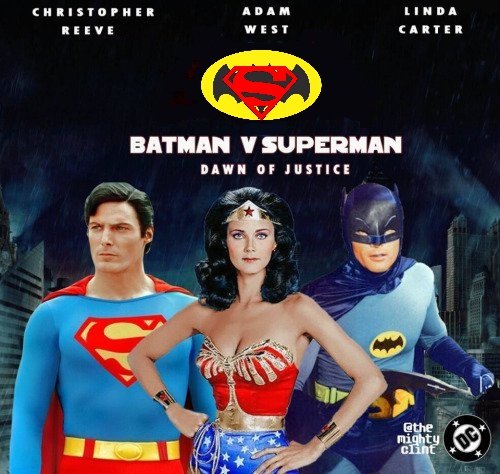
No, we never got this. Nor did we ever get
Reeve, Carter, and Michael Keaton from the 1989 Batman film,
which could have added John Wesley Shipp from the 1990-91 Flash series.
Indeed, there was never an indication on either The Adventures of Superman, Batman ('66), or The New Original Wonder Woman that any other superheroes existed. On the Superman and Wonder Woman shows, there was no indication that there were even any non-powered costumed crimefighters. On Batman '66 (as it's sometimes known), the only other such characters were the Green Hornet and Kato. So, there were no superhero crossovers. No team-ups. No Justice League. No Earth-One or Earth-Two.
And we are all the poorer for it, old chum.

As of January 12, 2026, Burt Ward is the last survivor of the main cast. Adam West died in 2017. Of the supporting players: Madge Blake died in 1969, Stafford Repp in 1974, Neil Hamilton in 1984, Alan Napier in 1988, William Dozier in 1991, and Yvonne Craig in 2015.

Of the regular rotation of villains: George Sanders (Mr. Freeze in Season 1) died in 1972, Victor Buono (King Tut) in 1982, Otto Preminger (Mr. Freeze early in Season 2) in 1986, Vincent Price (Egghead) in 1993, Cesar Romero (the Joker) in 1994, David Wayne (the Mad Hatter) in 1995, Burgess Meredith (the Penguin) in 1997, Frank Gorshin (the Riddler in Seasons 1 & 3) in 2005, Eartha Kitt (Catwoman in Season 3) in 2008, and Eli Wallach (Mr. Freeze later in Season 2) in 2014.

There are 3 "Special Guest Villains" still alive: John Astin (the Riddler in Season 2); Joan Collins (the Siren), and Julie Newmar (Catwoman in Seasons 1 & 2 before giving way to Eartha Kitt). You could make it 4, counting Lee Meriwether (Catwoman in the movie made from the show).

Sunday, August 3, 2025

Top 10 DC Comics Villains

Left to right: Dr. Sivana, Captain Cold, Gorilla Grodd,
Talia and Ra's al Ghul, The Penguin, The Joker, Mirror Master,
Lex Luthor, the Trickster, Mr. Element, Catwoman,
Mr. Mxyzptlk, The Scarecrow, The Riddler, Abra Kadabra.

Dishonorable Mention: Darkseid, the Anti-Monitor, Mongul, Ares and Brainiac. As evil as they are, Darkseid, the Anti-Monitor and Mongul know nothing but the desire for conquest. Ares, the Greek god of war and arguably the most significant villain to Wonder Woman, is every bit as "locked into" his role. And Brainiac is an artificial intelligence. Though he thinks on his own, he's still basically running a program. They're actually pretty boring as villains go.

Somewhat Honorable Mention: Selina Kyle, Catwoman, sometimes nemesis and sometimes love interest of Bruce Wayne, the Batman. If you only know her from the 1966-68 Batman TV show, where she was played by Julie Newmar and later Eartha Kitt -- and, in the 1966 film version, by Lee Meriwether -- where she was only a villain, despite her flirting with Batman, then you should give her another look.

She isn't so much a villain as an "anti-hero." She has played both sides. Like Britt Reid, the Green Hornet, she has played the villain to other villains to undermine them from the inside. And, many times, she has proven to be a valuable asset to Batman.

Now, the Top 10:

10. Pamela Isley, Poison Ivy, enemy of Batman. A scientist who, having been empowered by an elemental force, can control plants, became an ecoterrorist. She's the opposite of the corporate polluters she hates: She wants to save the Earth, but doesn't care who has to die to achieve this. Her goal is worthy, but her methods are unacceptable.

9. Albert Desmond, who was first Mr. Element, then Dr. Alchemy, enemy of The Flash. Desmond debuted as a chemist who, in a split personality, developed the identity of Mr. Element, developing an "elemental gun" that could change an object's chemical composition. (The so-called Silver Age of Comics, 1956 to 1973, liked to talk about science, but wasn't very good at observing the laws of physics.)

While in prison, he learned of the existence of the Philosopher's Stone, which could do what his gun could, and more efficiently. Upon his release, he found the Stone, stole it, and created the new persona of Dr. Alchemy.

As various versions of The Flash have sometimes been able to do with the villains in the "Flash Rogues Gallery," Barry Allen got Desmond to go straight. But he had an "astral twin": Alvin Desmond, named nearly the same, born at the exact same time, and also with what would now be called disassociative identity disorder, but also with a psychic link to Albert. He took on the Dr. Alchemy identity, and, without Albert's original personality to morally ground him, became a more dangerous foe.

In a story titled "The Good, the Bad, and the Unexpected," Albert (in this case, "The Unexpected") was unfairly accused of Alvin's crimes. So he resumed his Mr. Element identity, and helped The Flash take the 2nd Dr. Alchemy down.

8. David Hyde, Black Manta, arch-enemy of Aquaman. His origin has been tinkered with a few times. The current version has him as the younger half of father & son crooks, and he blames Aquaman for saving him but not his father from a disaster.

But he is always portrayed as a ruthless underwater mercenary, with a black insect-headed costume (even though the manta ray is a very different-looking creature), particularly focused on Aquaman. In some versions, as Aquaman failed to save Black Manta's father, Black Manta killed Arthur Curry Jr., son of Aquaman and Mera.

In the Super Friends cartoon of the 1970s, he was simply "Manta," and his armor was orange, but he was no less evil, and no less difficult for Aquaman and the other Super Friends (Superman, Wonder Woman, Batman and Robin, and the Wonder Twins) to defeat.

7. Harvey Dent, Two-Face, enemy of Batman. Once Gotham City's crusading District Attorney, and an ally of Police Commissioner Jim Gordon, and of the hero in both his businessman Bruce Wayne and crimefighter Batman personae -- he didn't know they were the same man -- half of his face was scarred by acid.

As a result, he developed the persona of Two-Face, who believed there was no such thing as justice, only chance. He had a two-headed silver dollar, and he took a knife and scarred one side of the coin. (In some versions of his origin, the coin was scarred by the same acid that ruined his face.) If the scarred side came up when he flipped it, he would commit a crime; but if the clean side came up, he wouldn't.

The 2nd Robin, Jason Todd -- who did not yet know that Dent had killed his father, gangster Willis Todd, but Batman did know -- asked how he could prepare for an opponent that unpredictable. Batman explained that Dent was actually their most predictable opponent, because his crimes were always based around the number 2, or duality in some form. Typical of this: He robbed the box office at the ballpark when the Gotham Goliaths played the Minnesota Twins, with 2 outs in the bottom half of the 2nd inning of the 2nd game of a doubleheader. Batman once set a trap for him by having a casino pay out a jackpot of $22 million -- money donated by Bruce Wayne, of course.

To make matters worse, there was a second Two-Face. Within the comics' universe, a TV-movie was made about the case, and the actor playing Dent, Paul Sloane, got mistakenly hit with real acid instead of water, and took up Two-Face's persona. The only way Batman could tell them apart was that Dent was righthanded, and Sloane was lefthanded. Sloane's damage was less severe, and he was cured in both face and mind. Dent has occasionally been cured, but has always had the Two-Face personality take over again.

Why do I put Two-Face on this list? Why not The Penguin? Because he's just a gangster with a theme. The film Batman Returns and the TV shows Gotham and The Penguin (the latter, a spinoff of the 2022 film The Batman) have tried to make him more interesting, but they didn't work for me.

Why not The Riddler? He's a bit more interesting, because he's more of an intellectual challenge for Batman -- although I did notice that, in the 1966-68 TV series, Robin (Dick Grayson) solved more of the riddles than Batman did. But he's not as unhinged, and thus as dangerous, as Two-Face, let alone the Joker.

Why not Bane, the man who "broke the Bat"? Certainly, he's more of a threat, but he's rather boring. Even in The Dark Knight Rises, when he was tied to Ra's al Ghul and his League of Shadows (which he previously was not in the comics), he wasn't that interesting.

6. Thaal Sinestro, arch-enemy of the Green Lantern Corps. Willpower is the green on the Lantern spectrum, and fear is the yellow on it. Once the leader of the Corps, and mentor of Earth's main Lantern, Hal Jordan, he believed that, in order to truly face all enemies, the Corps had to fully understand fear. The Guardians of the Universe, who ran the Corps, refused to accept this, and expelled him. So he became a Yellow Lantern, but it corrupted him. And, in most versions, the Green Lantern power ring is ineffective against the color yellow.

(On Earth-2, their Green Lantern, Alan Scott, got his power from plant life, and thus his ring couldn't be used against anything plant-related, including wood, leading to him occasionally getting hit with wooden objects.)

Turning against the Corps, with all his knowledge of them, made Sinestro not only a particularly effective counterpoint to the Corps, it made him, in effect, their "Anakin Skywalker," even though the character was created in 1961, 16 years before the debut of Star Wars, and 19 years before Anakin's betrayal and conversion to Darth Vader was known. On top of that, Sinestro is usually shown with pointed ears, which speaks more to the Vulcans and Romulans of Star Trek than Star Wars, even though he is frequently highly illogical.

5. Slade Wilson, Deathstroke, arch-enemy of, collectively, the Teen Titans. He's an anti-Captain America: First he was in the U.S. Army, then he received a "super-soldier serum," giving him vastly heightened strength, speed and reflexes. He became a mercenary, and is considered the top assassin in the DC Universe. The Marvel anti-hero Deadpool is considered a ripoff of Deathstroke, to the point where his real name is Wade Wilson.

Deathstroke has fought Batman and Green Arrow, and in the Arrowverse, where Green Arrow was the stand-in for Batman, he and Deathstroke fought each other. In the comics, Deathstroke's vendetta against the Titans began when he swore revenge for the death of his eldest son Grant, a villain who used the name Ravager. His other 2 children, Jericho and Rose, would go on to join the Titans to oppose him, with Rose even taking on the Ravager identity.

4. Ra's al-Ghul, enemy of Batman. This character was created in 1971, and was thus unavailable for the Adam West TV series. Centuries old, and revived from many deaths thanks to a Lazarus Pit, Ra's al-Ghul (Arabic for "The Demon's Head") runs the League of Assassins (known in The Dark Knight 
Trilogy as the League of Shadows), which has found every succeeding world civilization to be corrupt, and has tried to bring it down, becoming responsible for the Sack of Rome in AD 410, the fall of Camelot in 537, the Norman Conquest in 1066, the Black Death in 1340s Europe, the fall of Constantinople in 1453, the Reign of Terror in France in the 1790s, and World War I and the Bolshevik Revolution in the 1910s.

Ra's (usually pronounced "Rahz," but, to match the language, it should be "Raysh"), like Deathstroke and Captain America, has more-than-human strength and reflexes, if not on a truly superhuman level, and is one of the world's deadliest physical combatants, having had the time to master multiple martial arts and hand weapons.

He considers Batman's hometown of Gotham City to be the most corrupt place on Earth (there is some reason to think so), and has specifically targeted it for destruction, seeing Batman, whose secret identity of Bruce Wayne he figured out, as a not merely a worthy opponent, calling him "Detective," but as a possible successor to lead the League of Assassins, through marriage to his daughter, Talia.

Talia, nearly as much of a physical marvel as her father, is fine with this, as she is in love with Bruce. Bruce, whose feelings for her conflict with those of his other main love interest, Catwoman, can't resist her, and she kept the birth of their son, Damian Wayne, secret from him for years. Damian was raised to be his grandfather's successor and a great assassin, flying in the face of Batman's no-kill rule. But when Talia introduced Damian to Bruce, Bruce took him in, set him straight (mostly), and made him the latest in a series of Robins.

In the Arrowverse, given their refusal to use Batman, Ra's al-Ghul became the arch-nemesis of Green Arrow.

3. Lex Luthor, arch-enemy of Superman. Superman is unusual among superheroes in that, while he does have opponents who wear costumes and develop themes based on their powers and/or personalities, his Number 1 opponent is a mortal man without powers.

From 1940 to 1985, Luthor was usually portrayed as a stereotypical "mad scientist," who wanted to control the world, not such much out of greed or a lust for power, but because he thought he could run it better. And Superman stood in his way.

Eventually, he was given a backstory to explain his specific hatred of Superman: They had grown up together in Smallville, and were friends. One day, the teenage Luthor made a mistake in his lab, and Superboy, as Clark Kent's costumed identity was then known, blew out the fire, but the fumes caused Luthor's hair to fall out, and he blamed Superboy, not his own mistake, for this. And so, his schemes to stop him were personal, unlike his schemes to "take over the world." (This would be copied in Marvel, with Victor Von Doom/Dr. Doom blaming former friend Reed Richards/Mr. Fantastic for his facial scarring, rather than his own mistake.)

After Crisis On Infinite Earths in 1985, there was a complete reboot of DC Comics. Now, Luthor was several years older than Superman, and a contemporary and rival of Daily Planet publisher Perry White. And, like the Marvel superhero Iron Man, he seemed a variation on science wizard Howard Hughes.

This version of him hated Superman not just because he was now getting the headlines in the Planet that Luthor himself used to get, but because Luthor believed that the best of humanity -- himself, and people like him -- should be the best of Earth, not some super-powered alien "interloper."

Wanting to "save humanity" is just Lex's excuse for why he wants to eliminate Superman. If Lex's goal was to save humanity, he wouldn't kill people to achieve his sub-goals, be they building a new machine to help humanity, or synthesizing a helpful new drug, or building a factory to employ thousands of people. If he wanted to do those things, he'd just do them. And if he had to kill people to achieve them, being supposedly one of the smartest people alive -- he confesses that Batman is the only man he considers to be smarter than himself -- he'd find a way around killing to achieve them.

In All-Star Superman, Superman points out that, once Lex became as rich as he is, he could have "saved humanity," whatever those words meant to him, any time he wanted to. And he hasn't even tried. Some of the other brilliant scientists in the DC canon have tried, with limited success, particularly on a local scale (Bruce Wayne, a.k.a. Batman, in Gotham City; Oliver Queen, a.k.a. Green Arrow, in Star City, and so on). Luthor simply uses his genius and his resources for his own benefit.

2. Jack Napier, the Joker, arch-enemy of Batman. Whereas even Luthor would do the right thing if he thought he could benefit from it, the Joker only does things to make himself laugh. And, despite recent adaptations of Luthor as shown in the TV series Superman & Lois and in the 2025 Superman film, the Joker is even more sadistic, determined to prove that, as happened to him, all it takes is one truly bad day to drive a good man insane.

The fact that he was -- depending on the telling; as he put it, "If I have to choose my story, I prefer multiple choice!" -- already a small-time crook, either by choice or forced into it, and was disfigured and shocked into adopting his Joker persona as a result of a confrontation with Batman, makes it all the more poignant: Inadvertently, Batman created his arch-enemy, and he knows it. (The 2019 and 2024 Joker films go against this idea.)

The 1989 Batman film took this to the next level, showing that Napier was not only a gangster and a rotten guy long before he became the Joker, he was also the man who killed Thomas and Martha Wayne in front of a child Bruce. As Batman told him at the film's climax: "I made you? You made me first." This is the only version of the story where the Waynes' killer becomes the Joker: In most versions, it's Joe Chill, who is depicted as either a small-time hood who gets scared, and thus his mugging of the Waynes goes horribly wrong; or a Mob hitman, carrying out the vendetta of a boss that Dr. Wayne offended.

Two oddities, both from movies. In the Tim Burton movies, had the Penguin's plan succeeded, his death toll of over 100,000 would have been greater than any plan yet seen from any live-action version of the Joker. And in the film version of Watchmen, a hero-turned-antihero named the Comedian ends up killing more people, including more innocent people, than any version of the Joker.

So who could be worse than all of these, including Luthor and the Joker? In my opinion, this guy:

1. Eobard Thawne, Professor Zoom, the Reverse-Flash, arch-enemy of Barry Allen, the 2nd Flash. In the 25th Century, Thawne started out admiring the 20th Century hero, The Flash. He wanted to be like Barry Allen. So he found a way to give himself super-speed. Then, just as he's about to debut as his era's speedster hero, Allen comes from the past and saves the people Thawne was supposed to save. Though Barry didn't yet know Thawne existed, Thawne took his action as a deeply personal affront, and began to hate The Flash, and would occasionally go back to the 20th Century to make his life miserable.

He was responsible for the death of Barry's wife, Iris West, although she later returned from the dead. Not satisfied with this, Flash canon was rewritten so that Thawne became Barry's "Joe Chill," but with a twist: He went back further in time, killing Barry's mother Nora, and getting Barry's father Henry blamed for the murder, making Barry "lose" both parents as a boy. But instead of becoming embittered and a villain, Barry still sought justice and became a hero, and still stopped Thawne every time.

In 2011, deciding they needed another reboot, the suits at DC allowed the Flashpoint story: Barry went back in time and saved his mother, but it messed up the entire world. As Barry said in the 2023 Flash film, "I broke the universe!" In the comics version, adapted to an animated film, Thawne decided to lecture him over this:
Yes, Thawne. You are the villain. Barry was not a villain, just a well-intentioned fool.

Tell me, Thawne, when have you ever tried to save a life, instead of end one, or make one miserable? (The Arrowverse's series The Flash and Legends of Tomorrow tried to redeem him this way, but it rang hollow.)

Lex Luthor was an abused kid who lost his hair. The Joker and Two-Face were disfigured and lost everything. Mr. Element/Dr. Alchemy was already mentally ill. Black Manta lost his father, although he blamed the wrong person. Ra's al-Ghul and Poison Ivy want to save the world, though they try it with psychotic methods. Even Sinestro had a point, that no one was willing to listen to, and felt rejected by his own people.

What's your excuse for being a villainous son of a bitch, Thawne? A man who didn't even know you existed at that point, and thus wasn't trying to hurt you, hurt your feelings. He hurt your pride. That's it.

In a way, Thawne, you're even worse than Darkseid, Mongul and Brainiac. Trying to conquer is all they know. You should have been smarter than that. But you weren't. In your origin, you're the worst DC villain of them all. You are the villain.

Wednesday, November 6, 2024

The Message

At 4:22 this afternoon, Kamala Harris gave her concession speech, at Howard University, her Alma Mater, where she had hoped to give a victory speech.

She spoke for 12 minutes, praising America and its system, thanking her supporters and telling them she loved them, and telling them to not give up the fight for making this a better country.

Do I feel better for having heard that? No. To continue that fight, we need a plan. Right now, to paraphrase her opponent's line, we don't even have a concept of a plan.

*

This is not the United States of America. This is Bully Bro Nation. Where white bros can bully women and "weak" men, and always get away with it. And it is the America that I -- male, white and straight, but disabled, and with Polish and Jewish heritage -- grew up in, and hoped would become better. For a while, I thought it had. That turned out to be the real "blue mirage."

*

So, after an emotionally devastating election, what message to I have for the people who, like me, supported Kamala Harris?

In 2016, the message was easy: "Don't flee to Canada. Stay and fight. Together, we will get through this." This would seem to be a good message again. But, this time, we can't be sure of that. Trump says he'll be a dictator on Day One. No dictator ever gave up power on Day Two. He's said he will terminate the Constitution of the United States, which, he has said, has been "unfair" to him. And he has the Supreme Court on his side now, along with the Senate, and probably (the returns are not all in yet) also the House of Representatives.

Can we survive four years of Dictator Trump and the Heritage Foundation's Project 2025? Or, if, for whatever reason, Trump can't complete the term, four years of a combination of Dictator Trump and Dictator Vance, carrying Project 2025 out? I honestly don't know.

I tried. I warned as many people as I could. Not enough listened to me. I'm sorry. I know that makes me sound like McMurphy in One Flew Over the Cuckoo's Nest, and he was no hero, and he came to the kind of end that I can imagine Trump's new government carrying out. But it's all I can say. 

*

What's the message to the people who voted for Trump? It's simple:

You got what you wanted. You own it all now. Whatever happens over the next four years, it is all on you.

You have bet your lives, and everybody else's, on Trump having a successful second term. Even though his first term was, by any rational measure, a complete disaster. The day he left office the first time, the country's economy was in tatters, it was causing the inflation you blamed on Joe Biden, over 1 million people died from COVID when he could have saved the vast majority of those had he taken it seriously, the crime problem had gotten worse, and he hadn't come close to solving the border problem you care so damned much about.

You decided that his first term, his various failures, his various crimes including impeachable offenses, his various bigotries, and the other evidence of his low character don't matter. You also decided that, whatever virtues Harris has, don't matter. Whether that's because you love Trump, or because Harris is a woman, or because Harris is black, or a combination thereof, I don't know: Your reason matters less than your result. Whatever I might think of such an attitude, it is your right.

But, know this: You are betting your lives, as well as ours, on Trump having a successful term. Even though you know that he is now 78 years old, older than Biden was when he was elected, and morbidly obese. And even though that you also know that, if, for whatever reason, he can't complete this term, the Presidency will fall to J.D. Vance. I'll bet you any money you like that not one of you was undecided, heard that Vance was the choice, and chose Trump on that basis.

But it's all on him now, and it's all on you. Whatever happens over the next four years, it's because you chose this guy.

If it works out in your favor, you are well within your rights to gloat.

If it doesn't -- if Trump crashes the economy a second time, if crime gets worse, if the immigration problem is not fixed, if there is a foreign-policy disaster, if there is another pandemic -- I am well within my rights to tell you that I told you so.

Whatever happens, as was said in the first Joker film, you get what you fucking deserve.