Showing posts with label harvard crimson. Show all posts

Thursday, November 13, 2025

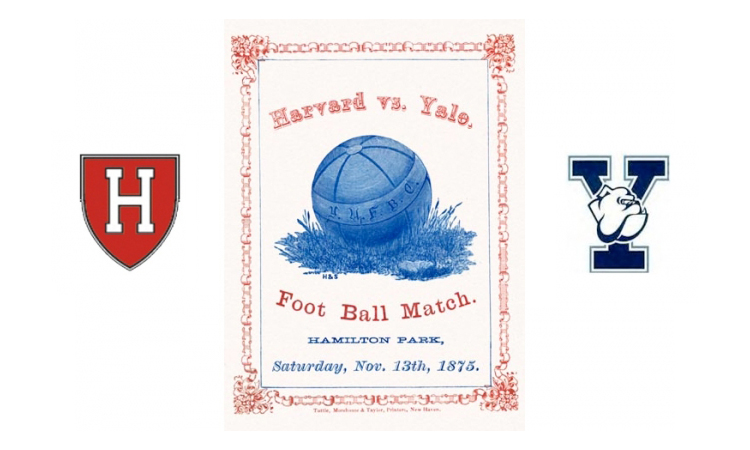
November 13, 1875: The 1st Harvard-Yale Game

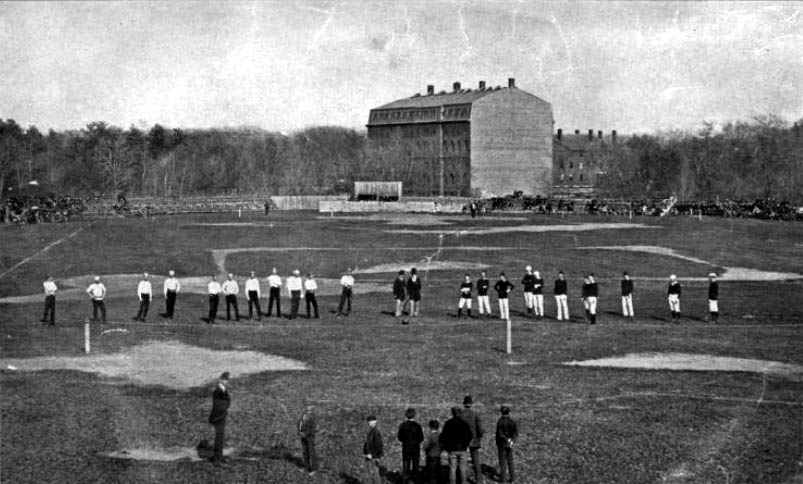
November 13, 1875, 150 years ago: Harvard University and Yale University, America's oldest and 3rd-oldest colleges, and both pioneers of college football, play each other in the sport for the 1st time. The game is played at Hamilton Park, a horse-racing track in New Haven, Connecticut, and, with on touchdown, under the scoring system of the time, Harvard won, 4-0.

This was still early in the history of football, college or otherwise. Only 1 other game was played that day: Princeton (then still known as the College of New Jersey) beat Columbia, 6-2 at University Field in Princeton, New Jersey.

The first American intercollegiate sporting event took place on August 3, 1852, after Yale invited Harvard to a race of crews. Harvard won "The Boat Race" on that 1st occasion. The first intercollegiate contests in ice hockey, soccer, and 5-on-5 basketball featured teams from Harvard and Yale.

Many now century-old, or older, aspects of American football were introduced by Harvard or Yale students or athletes. Yale introduced cheerleading at athletic events in 1890, and tailgate parties in 1905. Harvard introduced spring practice to collegiate football March 14, 1889.

Yalies sang "Hold the Fort" during the 1892 Harvard game, considered the first public performance of a collegiate "fight song." It predated "Boola Boola," in 1900, and what became their official fight song, "Bull Dog," written by Cole Porter when he was a senior at Yale in 1913.

In 1883, Harvard and Yale played each other at the Polo Grounds in New York, with Yale winning, 23-2. From 1891 to 1894, they played each other at Hampden Park in Springfield, Massachusetts. There was fan violence at the 1894 game, won by Yale, 12-4, leading to the schools taking the next 2 seasons off. They resumed in 1897, and have alternated between Boston and New Haven ever since.

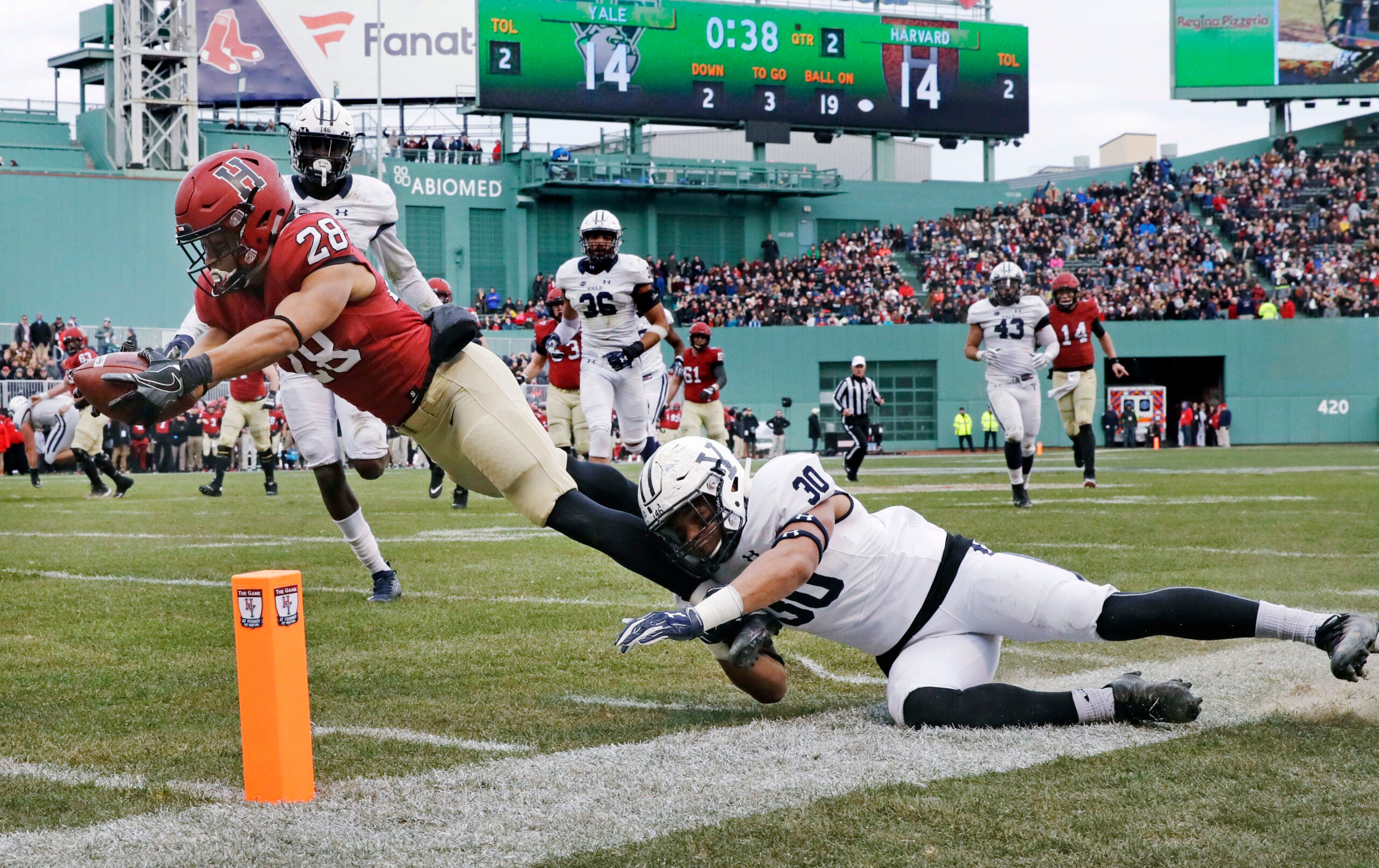
They took 1917 and 1918 off due to World War I; 1943, 1944 and 1945 due to World War II; and 2020, due to COVID. But, since WWII, they have played at Harvard Stadium (built in 1903) in even-numbered years, and the Yale Bowl (built in 1914) in odd-numbered years. An exception was made in 2018, when Harvard, having the choice of home field, talked Yale into playing at Fenway Park in Boston. Harvard won that one, 45-27, making it the highest-scoring contest in the history of "The Game."
November 17, 2018

Both teams went into the 1900 game undefeated, and Yale won, 28-0. The 1908 game saw both teams undefeated as well, and Harvard won, 4-0. In 1914, Harvard spoiled the opening of the Yale Bowl, winning 36-0.
The Yale Bowl, with the field marked for "The Game"

Before the opening kickoff of the 1923 game, Yale coach Dwight Jones told his undefeated Bulldogs, "Gentlemen, you are about to play Harvard. You will never do anything else so important for the rest of your lives."

They certainly wouldn't have done so under worse conditions: According to the era's greatest sportswriter, Grantland Rice, the field at Harvard Stadium was "a gridiron of seventeen lakes, five quagmires and a water hazard." Perhaps it was fitting that the key play, a return of a fumble 67 yards for a touchdown, was made by a man named Raymond Pond, known as Ducky. Yale won, 13-0. Pond later served as Yale's head coach, from 1934 to 1940.

In 1947, the only way for a Harvard football player to win his varsity letter was to play in the Yale game. Legend has it that, knowing this, Robert F. Kennedy played in the Harvard-Yale game on a broken leg. In 1955, his brother, Ted Kennedy, caught a touchdown pass against Yale.

What the Kennedy legend doesn't say is that Bobby really played on "only" a sprained ankle, and that Yale won both of these games: 31-21 in '47, and 21-7 in '55. (Ted was good enough to receive interest from the Green Bay Packers, but his father told him to go to law school instead.)
Harvard Stadium

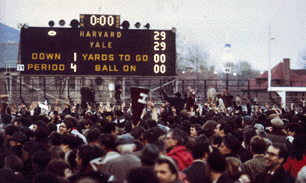
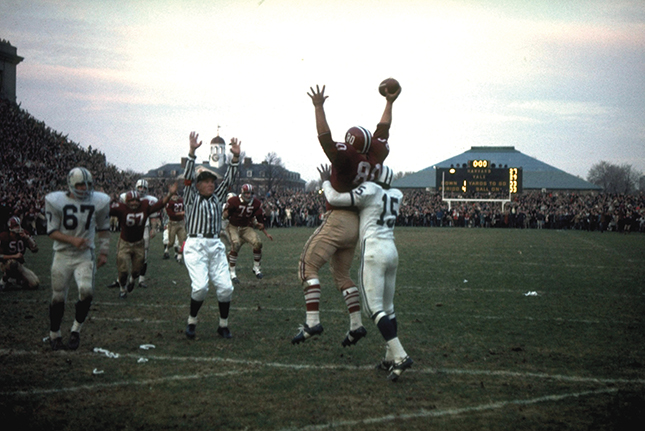
Both teams were undefeated going into the 1968 game at Harvard Stadium, making it the 1st Ivy League title decider between them since the League's official founding in 1954. Yale led 29-13 with 42 seconds to go, but Harvard scored 2 touchdowns and 2 2-point conversions to tie the game, and split the honors. The Harvard Crimson newspaper had the headline: "HARVARD BEATS YALE, 29-29."
November 23, 1968

In 1982, students at the Massachusetts Institute of Technology, Harvard's Cambridge neighbors, pulled one of the great college football pranks, pushing a balloon with the letters "MIT" on it through the turf at Harvard Stadium. (Harvard won, 45-7.) Not to be outdone, a little over a year later, during the 1984 Rose Bowl, students at California Institute of Technology in Pasadena hacked into the Rose Bowl scoreboard, so that what should have read "UCLA 38" and "ILLINOIS 9" read "CALTECH 38" and "MIT 9." (UCLA ended up winning, 45-9.)
November 20, 1982

Going into the 2025 game, Yale leads the all-time series, with 71 wins to Harvard's 61, while there have been 8 ties.

Wednesday, May 15, 2024

May 15, 1874: Harvard and McGill Invent American Football

 
May 15, 1874, 150 years ago: American football is invented.

What's that? You thought that happened on November 6, 1869, between Rutgers and Princeton? Well, that was the 1st football game played in America. But that was essentially a soccer game, 25-a-side. In 1870, these 2 schools in New Jersey were joined by Columbia University, of New York City.

In 1872 came another New Jersey school, the Hoboken-based Stevens Institute of Technology; and Yale University, of New Haven, Connecticut. In 1873 came Harvard University, of Cambridge, Massachusetts, across the Charles River from Boston; and the 1st game in the South, between Washington & Lee University and the Virginia Military Institute (VMI), which are practically next-door to each other in Lexington, Virginia.

So what happened on May 15, 1874?

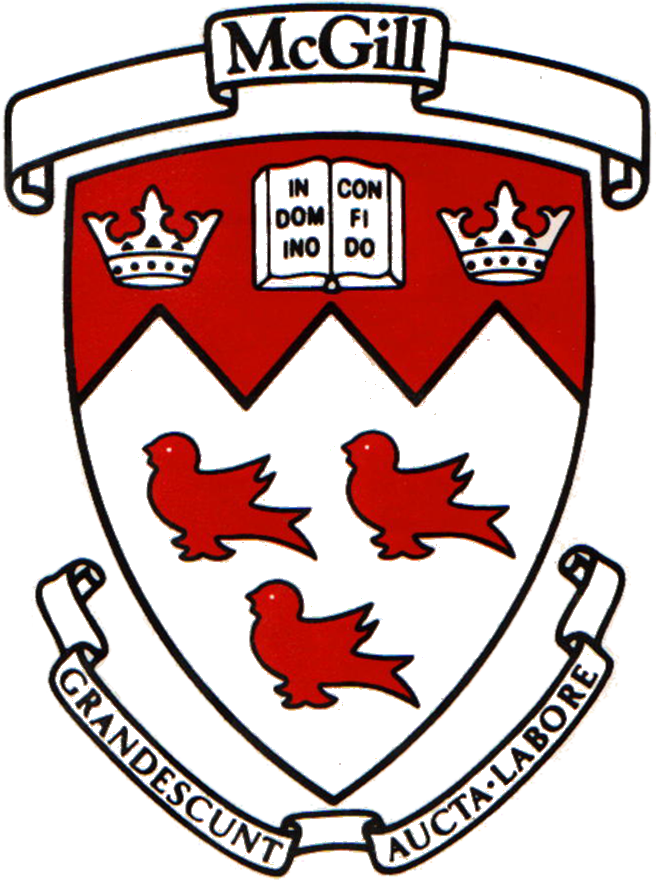
Essentially, McGill University, in Montreal, Quebec, is Canada's answer to Harvard, right down to the use of Crimson red as the school color. Both Harvard's men and McGill's men believed themselves to be sporting gentlemen, in the tradition of the Victorian Era that was pretty much at its peak in the 1870s.

As citizens of the British Empire, McGill's men believed themselves to be honest, brave, and examples for the youth of the world to follow. The University's motto is Grandescunt Aucta Labore, Latin for "By work, all things increase and grow."

As citizens of the United States of America, Harvard's men believed the same things of themselves, with the added touch of being the inheritors of the American Revolution. The University's motto is simply Veritas, Latin for "Truth."

Having heard that Harvard had one the best football teams in America, McGill started its football program in 1874, and challenged Harvard to a game of "football." It would be the 1st-ever "football" game between American and Canadian teams. Wishing to maintain their appearance as honorable sportsmen, Harvard happily accepted.

But when the McGill men got to Harvard's Jarvis Field on May 14, they discovered that the game Harvard thought they'd been invited to play was soccer -- which got shortened to "assoc." and eventually to "soccer." The McGill men expected that they would be playing rugby (which has frequently been called "rugger").

Being "sportsmen" and "gentlemen," the team captains met to discuss the discrepancy with civility. There may have been tea involved, or perhaps a stronger beverage.

They came up with a compromise: They would play a game under Harvard's "Boston game" rules, and another game under the "code" of "rugby union," the version of football most familiar to Canada at the time. (Indeed, the predecessor to the CFL, the Canadian Football League, was the CRU, the Canadian Rugby Union.)

At least, that's the story I'd been led to believe. But, as Richard Hershberger, a historian who specializes in the post-Civil War period, points out, an article in The Boston Globe of May 11 suggests that the teams already knew ahead of time about the discrepancy, and that the compromise was worked out, by either mail or telegram. (The telephone was invented 2 years later, also in Boston. Note that, just as baseball was often spelled as 2 words at the time, or hyphenated, "base ball" or "base-ball," so, too, is "foot-ball" hyphenated here.)
On May 14, Harvard won the soccer game 3-0. The following day, they met for the rugby match, which ended 0-0. As Hershberger puts it:

This is the most important game in the history of American sport. I write this with no exaggeration. This is the game that converted Harvard to the rugby rules. Harvard then went forth and explained to the other schools that Harvard is Harvard and you other schools are not, so that is that. Next year, rugby will be adopted as for intercollegiate matches. From there they will immediately begin fiddling with the rules, and by 1880 will have distinctive features of American football. Most schools in 1874 favored a kicking game. Were it not for today's game, college football would be soccer, or something very close to it.

The Harvard men liked the rugby version, including the "try." Later in the year, their officials met with officials from the other football-playing schools, and the rules were combined with those of the soccer generally considered "football" in America, and carrying the ball was officially allowed, and the "try" became the "touchdown."
So if you want to know why America plays the gridiron game instead of the sport that most of the rest of the world calls "football" or some variant, blame Harvard and McGill.


Like St. John's University in New York City's Queens, McGill used to call their team the Redmen. Despite the Indigenous heritage of Canada, it had nothing to do with the people then usually called "Indians": University founder James McGill, like many Scotsmen, had red hair. The name was used from 1927 to 2020, when it was changed to Redbirds.
"Redbirds" was chosen as a match for the name for their women's teams, the Martlets. Their women's sports department was founded in 1976, and their women's teams were named for the birds shown on the McGill family crest.

Friday, October 29, 2021

October 29, 1921: The Impossible Formula

October 29, 1921, 100 years ago: The Harvard University football team loses to Centre College of Danville, Kentucky, 6-0 at Harvard Stadium in Boston, ending a 25-game winning streak. This is considered one of the biggest upsets in college football, as the "Praying Colonels" (no, I'm not making that mascot name up), from a school of just 300 students at the time, were the 1st team from outside the old Northeast (Jim Thorpe's Pennsylvania-based Carlisle counts) to beat one of the old "Big Three" of Harvard, Yale and Princeton.
All over Danville, graffiti appeared with the score: "C6H0." This could be read as a scientific formula: Six parts carbon, zero parts hydrogen. Since that can't be done, it become known as "The Impossible Formula."
Today, Harvard, like all the Ivy League teams, is in the FCS, the Football Championship Subdivision, what used to be known as Division I-AA. Since the official founding of the Ivy League as a sports conference in 1955, Harvard has won its football championship 15 times, most recently in 2015.
Centre would prove that their 1921 win over Harvard was no fluke. They finished their regular season undefeated, 10-0, having also beaten Clemson, Virginia Tech, Kentucky, Auburn, Tulane and Arizona. They were invited to play Texas A&M in the Dixie Classic, a precursor game to the Cotton Bowl. A&M won, 22-14, in a game that became known for the origin story of their "12th Man" tradition. Their biggest star of 1921, Bo McMillin, was a rough Texan who was one of the 1st good NFL quarterbacks, and would coach Indiana to its 1st football title in the Big Ten in 1945.
They had also beaten Kentucky and Virginia Tech the year before. In 1922, they beat Clemson away, Mississippi, Virginia Tech away, Louisville, Kentucky away and South Carolina. However, they lost a rematch away to Harvard on October 21, 24-10. They also lost to Auburn at Rickwood Field, the Birmingham ballpark.
In 1923, they went 7-1-1, their conquests including Clemson, Kentucky, and Auburn at Rickwood again. They tied Georgia, and their only loss was the Penn at the original Franklin Field in Philadelphia. On 4 consecutive Saturdays in 1924, the Colonels defeated Kentucky, Tennessee, Alabama, and Georgia. 
Today, however, Centre are in Division III, but have won their league 15 times, including 6 times from 1980 to 1990. Their last title was in 2014. Their current enrollment: 1,430, to Harvard's 27,000.
Nor would Harvard's loss be a fluke: A week later, they went down to Princeton, and lost again.
In 1950, the Associated Press named C6H0 the greatest upset of the 1st half of the 20th Century, in any sport. In 2005, The New York Times called it "arguably the upset of the century in college football." (They did not use capital letters.) In 2006, ESPN named it the 3rd-biggest upset in college football history.
In anticipation of the game's 75th Anniversary, in 1996, Centre challenged Harvard to a rematch. Harvard declined. Harvard went 4-6 that season. I can't find a record of how Centre did that year, but they won their league the year before. Who knows, maybe history could have repeated itself.
This year? Harvard won its 1st 5 games before losing to Princeton last week. They host Dartmouth tomorrow. Centre take a 5-2 record into tomorrow's game, home to Rhodes College of Memphis.
*
October 29, 1859: Charles Hercules Ebbets is born in Manhattan. In 1883, he got a job with a new baseball team, then known as the Brooklyn Grays. By 1890, he had become the majority owner. In 1912, knowing that Washington Park was insufficient for a major league team in the wake of new stadiums like Shibe Park and Forbes Field, he began building a new ballpark for his team, by then known as the Dodgers. He was told that since it was his idea, it should be called Ebbets Field. And so the Dodgers played at Ebbets Field from 1913 until 1957.

Under his guidance, the team, under various names, won Pennants in 1889 (in the American Association, thereafter in the National League), 1890, 1899, 1900, 1916 and 1920. He invented Ladies Day, with women admitted at half-price, in 1899. His experience as a bookkeeper led him to the concept that the best schedule for baseball was for the 8 NL teams to play each other 22 times a season: 22 times 7 = 154, so he created the 154-game schedule that was in place from 1904 to 1960 (and until 1961 in the NL).

In 1906, he installed a visiting team clubhouse, complete with showers, at Washington Park, eliminating the need for teams to change at their hotels and arrive in open vehicles (horse-drawn carriages, and by this point early taxis) in their uniforms, where home fans could throw things at them. He invented the rain check in 1911. As early as 1922, he suggested that players wear uniform numbers -- although his suggestion was on the cap or the sleeve, not on the back as would happen starting in 1929. He also served in the New York State Assembly and on the New York City Council, as a Democrat.

Unfortunately, his messy personal life would have consequences for baseball, and, indirectly, the entire world. He had lived with his eventual 2nd wife for 12 years before his divorce from his 1st wife became final. And, unlike later team owners Branch Rickey and Walter O'Malley, he was not a lawyer who would have known a way around this: To guarantee his alimony payments, he deposited his shares of the Dodgers with the Mechanics Bank, which was later bought by the Brooklyn Trust Company.

He died in 1925, with the team in dire financial straits. To make matters worse, it rained at his funeral, and one of his co-owners, Ed McKeever, caught a cold, which developed into the flu, and, in those pre-antibotic days, he outlived Ebbets by only 11 days.

That left Ebbets' widow Grace, his son-in-law Joseph Gilleaudeau, and Brooklyn Trust as half-owners of the Dodgers, and Ed's brother Steve McKeever as owner of the other half. When Steve died in 1938, his half-share passed to his daughter Elizabeth "Dearie" Mulvey and her husband James. But the team was still, financially, in bad shape.

So Brooklyn Trust appointed Cincinnati Reds general manager Larry MacPhail as team president. He straightened things out, until leaving to re-enter the U.S. Army in World War II. He was replaced by Rickey. In 1944, Rickey and John L. Smith bought out Mrs. Ebbets and Gilleaudeau. Rickey and Smith were now each 1/4 owners.

O'Malley was the lawyer who handled the Dodgers for Brooklyn Trust, and eventually bought the bank's shares. In 1950, he bought Rickey and Smith out, and the Mulveys pretty much did what he wanted, including approving the move of the team to Los Angeles after the 1957 season, before O'Malley bought them out in 1975.

The move not only betrayed Ebbets' vision and the Dodger fans in the New York Tri-State Area, but made Los Angeles a "major league city" in a way that even the NFL's Rams hadn't, elevating it to the status of the loftiest city in the American West.

O'Malley died in 1979. His son Peter owned the team until selling to Rupert Murdoch in 1998. Frank McCourt bought them in 2004, but, learning nothing from the example of Charlie Ebbets, had to sell them in 2012 to pay off his divorce settlement. For $2 billion, basketball legend Earvin "Magic" Johnson became their owner, and remains so today.

*

October 29, 1881, 140 years ago: John Riegel DeWitt is born in Phillipsburg, Warren County, New Jersey, and grows up nearby in Riegelsville, Pennsylvania, which an ancestor of his had founded. A guard and kicker at Princeton University at the dawn of the 20th Century, he is a member of the College Football Hall of Fame.

In 1920 Walter Camp named "The Princeton Strong Boy" to his all-time All-America team. A 1919 article for a Princeton magazine called him the school's best player ever. A 2009 article by Football Foundation, choosing retroactive Heisman Trophies for 1935 and earlier, chose him for 1903.

John DeWitt was also a track & field star, specializing in throwing events, and won the Silver Medal in the hammer throw at the 1904 Olympics in St. Louis. He became a prominent businessman in New York, commuted into The City from a home in Connecticut, and died unexpectedly of a heart attack on his commute in 1930, only 48 years old.
October 29, 1889: The National League Champion New York Giants win their 2nd consecutive World Championship by taking this year's best-of-11 matchup in 9 games.

After spotting the American Association Champion Brooklyn Bridegrooms (the once-and-future Dodgers were so named because 3 of their players had gotten married in the 1887-88 off-season) 2 runs in the 1st‚ the Giants rally to win 3-2 behind Hank O'Day's pitching -- the same Hank O'Day who would be the umpire who ruled against them in the Fred Merkle Game 19 years later. Slattery scores the winning run in the 7th inning‚ coming in from second as catcher Doc Bushing misses a two-out 3rd strike.

The next season, the 'Grooms would join the NL, and win the Pennant. They would win 2 more Pennants before the Giants won another, in 1899 and 1900. But over the next 40 years, the Superbas/Robins/Dodgers would win just 2 Pennants, while the Giants would win 13. And the Yankees, not even formed yet, would win 11. Ah, but over the last 17 years of New York's 3-team availability, it would be a different story: The Yankees would win 12 Pennants, the Dodgers 7, the Giants only 2.

The last survivor of the 1889 Giants was 3rd baseman Art Whitney, who lived on until 1943.

October 29, 1891, 130 years ago: Fania Borach is born in Manhattan. Like her fellow Lower East Siders the Marx Brothers, she was a child of a Jewish immigrant from Alsace, France. By 1910, under the name Fanny Brice, she was starring on Broadway in the Ziegfeld Follies. In 1912, she created the character of Baby Snooks, a mischievous little girl. 

In 1944, she began the CBS radio program The Baby Snooks Show, even though she was already 52 years old. The show helped give comedy legend Danny Thomas his start. In 1949, she was filmed in character, clowning with the Chicago White Sox at their Spring Training complex. She died on May 29, 1951, of a cerebral hemorrhage at age 59, and the show was canceled.

In 1921, she had a hit song, "Second Hand Rose." In 1964, Barbra Streisand began appearing on Broadway as Brice in the musical Funny Girl, and the song became more identified with Streisand than it ever was with Brice. The musical was filmed in 1968, and a sequel, Funny Lady, was filmed in 1975. Today, if anybody knows Fanny, they know her through Barbra Joan.

*

October 29, 1901, 120 years ago: Leon Czolgosz is executed in the electric chair at Auburn Prison (now Auburn Correctional Facility) in Auburn, in the Finger Lakes Region of Central New York. The assassin of President William McKinley was 28, and had outlived his victim by 45 days.

His last words were, "I killed the President because he was the enemy of the good people, the good working people. I am not sorry for my crime. I am sorry I could not see my father."

October 29, 1911, 110 years ago: Bernard Joy (no middle name) is born in Fulham, West London. On May 9, 1936, the centreback played for England in a 3-2 loss to Belgium. To this day, he is the last amateur to play for the England senior team. Later that year, he was the Captain of the Great Britain soccer team at the 1936 Olympics in Berlin. They did not win a medal.

He was soon signed by Arsenal, and helped them win the League in 1938. But World War II came right in the middle of his prime: He served in the Royal Air Force, and he never won another trophy. He retired in 1947, just before Arsenal began another title-winning season.

He became a sportswriter, writing for The Star, The Evening Standard and the Sunday Express, covering soccer and tennis. In 1952, he wrote Forward, Arsenal! It was the 1st comprehensive history of the team, but it contained many inaccuracies (presumably unintentional), including some which wouldn't be cleared up until the gentlemen at Untold Arsenal did some legwork over half a century later. Joy wrote several more soccer books, and lived until 1984.

*
October 29, 1920: The Yankees sign Red Sox manager Ed Barrow as business manager – the job that will, in a few years, begin to be called "general manager" – completing the front office team that will build the game's most successful record. Hugh Duffy, the Boston Braves star who batted a record .438 in 1894, replaces Barrow at Fenway Park.

Barrow had managed the Red Sox to the 1918 World Series, and, regarding the hitting and pitching talents of Babe Ruth, said, "I'd be a fool to turn the best lefthanded pitcher in the game into an outfielder."

The choice had already been made for him, but he would help the Yankees win 14 Pennants and 10 World Series in his 26 seasons as Yankee GM. Shortly before his death in 1953, he was elected to the Hall of Fame. At the Yankees' next home opener, a plaque was dedicated in his memory and hung on the outfield wall near the Monuments, and would later be moved to Monument Park.

He is buried in Kensico Cemetery in Valhalla, Westchester County, New York, along with several other baseball-connected personalities: The Yankee owner who hired him, Jacob Ruppert; a Yankee slugger he signed, Lou Gehrig; the Boston owner and Broadway promoter who previously hired him, Harry Frazee; the Governor of New York who sometimes threw out the first ball at big Yankee games, Herbert Lehman; the opera singer who often sang the National Anthem at Yankee games, Robert Merrill; and the Brooklyn-born comedian who remained a Dodger fan after they moved West to his own new home of Hollywood, and was a member of the first ownership group of the Seattle Mariners, Danny Kaye.

Also on this day, William Juzda (no middle name) is born in Winnipeg. A defenseman, Bill Juzda briefly played for the New York Rangers before going into World War II, and later made 2 NHL All-Star Games and helped the Toronto Maple Leafs win the 1949 and 1951 Stanley Cups. He was named to the Manitoba Sports and Manitoba Hockey Halls of Fame, and played in old-timers' games into his 70s. He lived until 2008.

October 29, 1929: Black Tuesday. The stock market completes the crash that began the preceding Thursday. The Roaring Twenties are over. The Dirty Thirties, and the Great Depression, have begun.
The incumbent Republican President, Herbert Hoover, gets blamed for it, when it was his Republican predecessors, Warren Harding and Calvin Coolidge, who set the table for it. Hoover shouldn't be blamed for the Depression. And he shouldn't be blamed for doing nothing: He tried a few things.

What he should be blamed for is giving up. Some of the things he tried worked a little, but not enough, and he abandoned his efforts. And in 1932, he lost in a landslide, to the Democratic Governor of New York, Franklin Delano Roosevelt.

At the height of the stock boom in early September 1929, America's unemployment rate was 3.2 percent. By the end of 1930, it was 8.7. 1931, 15.9. At the 1932 election, 23.6. At the depth, on March 4, 1933, when FDR was inaugurated and the banking crisis was critical, the rate was 24.9 percent. Fully 1 out of 4 Americans who wanted to work couldn't get work. Some people have suggested the rate was considerably higher than that, as much as 31 percent, or nearly 1 in 3.

The Great Depression left scars on people that never went away. My grandmother grew up in Queens in that era, and knew how important it was to save money. She grew up in the Depression, so, due to her pinching pennies as an adult, my mother also "grew up in the Depression." And because of that, I "grew up in the Depression." Am I saying that I'm cheap? Yes, I am cheap, but not by choice.

The people who grew up in the Depression are now dead or very old. We cannot allow their memories to fade. Remember our forgotten men and women.
I was going to do a "Scores On This Historic Day" for the date, but it was after the MLB season ended, before the NHL season started, before the NBA was founded, and in the middle of the week of the NFL season. So there's no games to report.
*

October 29, 1931, 90 years ago: For the 1st time under the current format, as voted by the Baseball Writers' Association of America, the Most Valuable Player awards are given. In the American League, the choice is an easy one, and is unanimous: Robert "Lefty" Grove of the Philadelphia Athletics, who had, statistically speaking, maybe the best season any pitcher has ever had, going 31-4 with a 2.08 ERA, and helping the A's win their 3rd straight Pennant. They did lose the World Series, so I can't call it "the best season any pitcher has ever had."

The 1st official NL MVP is Frankie Frisch, 2nd baseman for the Pennant-winning Cardinals. The Fordham Flash batted .311 and led the NL in stolen bases, before leading them to victory over the A's in the World Series, avenging the previous season's defeat. He will become player-manager in 1934, and lead "the Gashouse Gang" to another World Championship, his 4th as a player, also including 1921 and 1922 with the Giants. He and Grove, who'd won the Series with the A's in 1929 and 1930, will both become easy choices for the Hall of Fame.

October 29, 1939: The Babe Siebert Memorial Game is played at the Montreal Forum. It raised $15,000 for his family -- about $281,000 in today's money.

Charles Albert Siebert was a left wing who won Stanley Cups with the 1926 Montreal Maroons and the 1933 New York Rangers. With Nels Stewart and Hooley Smith, he formed one of the first named
 forward lines in hockey, the S-Line. In 1934, playing for the Boston Bruins, he played in the 1st All-Star benefit game for an NHL player, Ace Bailey of the Toronto Maple Leafs, whose career was ended by a vicious check by Bruin defenseman Eddie Shore.
But Siebert and Shore couldn't get along, and, in 1936, the Bruins traded him to the Montreal Canadiens. He was immediately named Captain, and won the 1937 Hart Trophy as NHL MVP. The following fall, he played in another All-Star benefit game, this time for Canadiens superstar Howie Morenz, who had died in March from complications from leg surgery.

In 1939, 35 years old and plagued with injuries, he retired.  He was immediately offered the Canadiens' head coaching position, and accepted. But he never got the chance to coach a game. On August 25, 1939, while vacationing with his family and swimming with his daughters Judy and Joan, then just 11 and 10 years old, at a family cottage on the shore of Lake Huron, he drowned attempting to retrieve an inflatable tire they were playing with.

The league organized an all-star benefit game to aid Siebert's widow (who was paralyzed and had mounting medical bills) and daughters. The Canadiens faced an all-star team composed of the best players from the remaining teams. The All-Stars won, 5-2. Though only about 6,000 fans showed up, the organizers met their target of $15,000.

*

October 29, 1941
, 80 years ago: Harvey Hendrick shoots and kills himself at his farm in Covington, Tennessee. He was only 43. A star football player at Vanderbilt University, he was a rookie 1st baseman and outfielder on the Yankees' 1st World Championship team in 1923, and, after Lou Gehrig, was the 2nd man to have played on that team to die. His baseball career ended in 1934, with a .308 lifetime batting average (though as mainly a reserve player), and I guess his farm wasn't working out well.
Judging by the reaction when active Yankee Cory Lidle was killed in a plane crash just after the 2006 regular season, I can imagine that, today, if a former Yankee player committed suicide, the story would soak the news (in blood) for days.

But Hendrick has been just about forgotten. The Yankees did not wear black armbands or any kind of memorial patch during the 1942 season -- just the red, white & blue "HEALTH" shield that all teams wore in that 1st full year of World War II for the U.S. And there is no mention of him in Monument Park, or anywhere else in Yankee Stadium.
Also on this day, Charles Andrew Russell is born in Detroit, and grows up in the St. Louis suburb of Ladue, Missouri. A star linebacker at the University of Missouri, Andy Russell was a rookie with the Pittsburgh Steelers in 1963, then missed 2 years in the U.S. Army during the Vietnam War.
He was with the Steelers when they bottomed out in the late 1960s, but was still there when they rose to the top. A 7-time Pro Bowler, he and center Ray Mansfield were the senior Steelers when they finally won Super Bowl IX on January 12, 1975. Each was still with them for Super Bowl X, and each lasted 1 more year before retiring. Russell is still alive, and a member of the Missouri Sports Hall of Fame and the Pittsburgh Steelers All-Time Team and Hall of Honor.
Also on this day, Ernest William Accorsi Jr. is born in Hershey, Pennsylvania. The man from the Chocolate City (sorry, George Clinton) has had a long and sweet career. After reporting on sports for The Charlotte News, The Baltimore Sun and The Philadelphia Inquirer, he served in the athletic departments at Philadelphia's St. Joseph's University (when Dr. Jack Ramsay was the head basketball coach) and Pennsylvania State University (in the early tenure of head football coach Joe Paterno).
In 1970, he was named public relations director of the Baltimore Colts. In his 1st season there, they won Super Bowl V. He later served as their last general manager, resigning rather than make the move to Indianapolis in 1984. He was named GM of the Cleveland Browns, building a team that made 3 AFC Championship Games, but lost all 3.
In 1994, he was named assistant GM of the New York Giants. In 1998, he became full general manager, staying until 2006, building the teams that lost Super Bowl XXXV and won Super Bowl XLII (with many of his players still being there to win Super Bowl XLVI). He has since served as a consultant in the front offices of the Carolina Panthers, the Chicago Bears, the Giants again, the Arizona Cardinals, and, currently, the Detroit Lions.
Also on this day, the Kaunas Massacre takes place in Lithuania. The Nazis' SS shot and killed 9,200 Jews. It was the largest single-day execution in Nazi history.
October 29, 1942: Robert Norman Ross is born in Daytona Beach, Florida. He enlisted in the U.S. Air Force at age 18, serving among the mountains in Alaska, which would later inspire his painting. He also decided that, having had to be mean as a First Sergeant, once he was discharged, he would never scream again. The persona of Bob Ross was born.

From 1983 to 1994, his program The Joy of Painting appeared on PBS. Like Julia Child, Fred (Mr.) Rogers, Bob Vila and Carl Sagan, he used his appearances on that network to show himself as a kindly person who not only knew his stuff, but wanted you to know it, too, and explained it in ways that would be understood, but never insulting your intelligence.

His show stopped only because he developed lymphoma, and died in 1995. His legacy goes on, with his portrayal by "Nice Peter" Shukoff against "Epic Lloyd" Ahlquist as Pablo Picasso on a 2013 episode
 Epic Rap Battles of History, and Target Stores having released the board game "Bob Ross: The Art of Chill." It should sell well: After all, as the man himself said, "I don't believe in mistakes."
October 29, 1946, 75 years ago: Frank Watts Baker is born in Meridian, Mississippi. A shortstop, he played 146 games for the Yankees and the Baltimore Orioles from 1970 to 1974, batting .191. He is still alive.
*

October 29, 1951
, 70 years ago: New York City gives a ticker-tape parade to servicemen from all United Nations wounded in the Korean War.
October 29, 1953: Denis Charles Potvin is born in Hull, Quebec, across the Ottawa river from the Canadian capital of Ottawa, Ontario. One of the greatest defensemen in hockey history, he was the Captain of the New York Islanders' 4 straight Stanley Cups of 1980 to 1983.

Arguably the team's greatest player ever, and certainly its most important, his Number 5 has been retired, and he was the first Isles player elected to the Hockey Hall of Fame. His brother Jean Potvin also played for the Isles for a time, and his cousin Marc Potvin also played in the NHL.

However, his name is best remembered for an incident in the Ranger-Islander rivalry. On February 25, 1979, the teams played at Madison Square Garden, and Potvin checked Ranger All-Star Ulf Nilsson into the boards, breaking Nilsson's ankle.

In spite of the fact that no penalty was called, and the fact that Nilsson himself has always maintained that it was a clean hit, and that fact that then-Ranger coach Fred Shero also said it was a clean hit, the moron Ranger fans have spent almost 40 years chanting, "Potvin sucks!" – against all opponents, not just the Islanders. This led to some confusion, years later, when Felix Potvin (no relation) would tend goal for various teams, including the Islanders for a time.

In retaliation, Islander fans have done a "Rangers suck!" chant for every home game, regardless of opponent, and New Jersey Devils fans do the same. Ranger fans also had a chant of "Beat your wife, Potvin, beat your wife!" Denis Potvin, who has never been charged with beating his wife, usually beat the Rangers instead.

Part of Ranger mythology is that Potvin's hit knocked Nilsson out for the season, and that's why they lost the Stanley Cup Finals to the Montreal Canadiens. In fact, Nilsson returned in time for those Finals, in which the Rangers won Game 1 at the Montreal Forum, but then dropped the next 4, including all 3 at the Garden.
October 29, 1959: The Greensboro Coliseum opens in Greensboro, North Carolina, as a memorial to the city's fallen from World Wars I and II and the Korean War. The opening event is Holiday On Ice.
The complex includes an arena, an amphitheater, an aquatic center, a banquet hall, a convention center, a museum, a theater, and an indoor pavilion. The arena, which is what people usually mean when they say "the Greensboro Coliseum," opened with 7,100 seats, was expanded to 15,000 in 1972, and had a 3rd tier added in 1993 to push capacity to 23,000.
It has hosted 27 of the last 54 Atlantic Coast Conference men's basketball tournaments, and 21 of the last 22 ACC women's tournaments. In 1974, it hosted the NCAA Final Four, featuring David Thompson and North Carolina State ending UCLA's dynasty in the Semifinal before beating Marquette in the Final. On March 23, 1976, Rutgers University had the greatest moment in its sports history at the Coliseum, defeating Virginia Military Institute (VMI) 91-75, to advance to the NCAA Final Four with an undefeated record. (Indiana beat them in the Semifinal.)
Since 2009, it has been home court for the University of North Carolina at Greensboro. From 1959 to 1989, it hosted some home games for Wake Forest University for which the Winston-Salem Memorial Coliseum would have been too small, prior to the building of the on-campus Joel Coliseum. The Carolina Cougars of the American Basketball Association played there from 1969 to 1974. In minor-league basketball, it has hosted the Greensboro City Gators (1991-92) and the Greensboro Swarm (since 2016).
When the Hartford Whalers moved to become the Carolina Hurricanes in 1997, they played 2 seasons at the Greensboro Coliseum, until their new arena is Raleigh was ready. Since the locals knew this was a temporary setup, the 'Canes' attendance was even worse in Greensboro. In minor-league hockey, the Coliseum hosted the Greensboro Generals (1959-77, and again 1999-2004), and the Greensboro Monarchs (1989-97). In arena football, it hosted the Greensboro Prowlers (2000-03), the Greensboro Revolution (2006-07) and the Carolina Cobras (debuting this year).

Elvis Presley sang at the Greensboro Coliseum on April 14, 1972, and again on April 21, 1977, on what turned out to be his final tour.

Also on this day, Jesse Lee Barfield is born in Joliet, Illinois, outside Chicago. Possessor of one of the best right field arms ever, he also hit 241 home runs in the major leagues. He was an All-Star in 1986, leading the American League in home runs, and a Gold Glove winner in 1986 and 1987.

But his luck was bad in terms of postseason play. He was a member of the Toronto Blue Jays' 1st AL Eastern Division Champions in 1985, but was traded to the Yankees for Al Leiter in 1989, missing the Jays' 1989 and '91 Division titles and their 1992 and '93 World Championships.

And his arrival with the Yankees coincided with their collapse from a near-miss run from 1985 to 1988, when they really could have used someone like him -- especially in the 2nd half of 1987, when Dave Winfield, also with one of the great outfield arms of the era, got hurt. Had Barfield played on the Yankees when he was with the Jays, and vice versa, he could have gone from All-Star to true baseball legend.

Injuries led him to retire at age 34, with 241 home runs. He is now a Blue Jays broadcaster. His sons Josh and Jeremy also played pro baseball, with Josh playing a season for the Baltimore Orioles and 3 for the Cleveland Indians.

Also on this day, Michael Alfred Gartner is born in Ottawa. Mike Gartner was a right wing who starred for several hockey teams, including the Washington Capitals, who retired his Number 11. But he never appeared in the Stanley Cup Finals, being traded by the Rangers at the trading deadline in 1994, in a trade that helped them win the Cup, to the Toronto Maple Leafs, who made it to the Western Conference Finals before losing.

Among players who have never won a Cup, he is 2nd to Phil Housley in games played, and 2nd to Marcel Dionne in goals, with 708. He is a member of the Hockey and Ontario Sports Halls of Fame. In 2017, he was named to the NHL's 100th Anniversary 100 Greatest Players. He and former Caps teammate Wes Jarvis run a string of ice rinks in the Toronto area.
Also on this day, Finola Hughes (no middle name) is born in London. She started out as a dancer, then became a soap opera legend by playing Anna Devane on General Hospital. She's been a character in productions of  both Marvel Comics (as Emma Frost of the X-Men in Generation X) and DC Comics (the voices of Superman's mother Lara Lor-Van in Superman: The Animated Series, and supervillain Lady Shiva in Beware the Batman).
Not being a soap opera fan, I first saw her on Jack's Place, a 1992-93 ABC drama starring Hal Linden, which was essentially The Love Boat in a restaurant that also served as a ja club, where she played the head waitress. She became part of the long line of British brunettes to capture my fancy.
*

October 29, 1961
, 60 years ago: Joel Stuart Otto is born in Elk River, Minnesota. The center won a Stanley Cup with the Calgary Flames in 1989. He scored 195 goals in a career that lasted from 1985 to 1998. He has returned to Calgary, as an assistant coach for the minor-league Calgary Hitmen.

October 29, 1964: Ground is broken for the current Madison Square Garden, on top of Penn Station at 32nd Street & 7th Avenue.
October 29, 1966: Detective Comics #359 is published, with a date of January 1967. The title of the story is "The Million Dollar Debut of Batgirl!" Batgirl is Barbara Gordon, a librarian, and the daughter of Jim Gordon, the Police Commissioner of Gotham City. In the following TV season, she is written into the Batman TV series on ABC, played by Yvonne Craig. In comics, October 29 is retconned in as her birthday.
On TV, Batman's butler, Alfred Pennyworth, discovers her dual identity, but keeps it a secret even from Batman and Robin -- and he keeps theirs, Bruce Wayne and Dick Grayson, respectively, from her. In the comics, though, Bruce and Dick find out, and eventually her father does as well. (Whether the Commissioner knows the identities of Batman and the various Robins has been debated, but not established in canon.)
In the 1988 graphic novel Batman: The Killing Joke, an uncostumed Barbara was shot and paralyzed by the Joker. Though confined to a wheelchair, she adopted a new nom de guerre, Oracle, and became a computer hacker and information broker for crimefighters. In the 2011 "New 52" reboot, the paralysis was retconned as not having happened, and she was once again Batgirl.
In the 1997 film Batman and Robin, Batgirl was rewritten as Barbara Wilson, Alfred's niece, played by Alicia Silverstone. In the 2002 Fox TV series Birds of Prey, Dina Meyer played Barbara Gordon, as Oracle, with flashbacks showing her in the Batgirl costume. In 2019, a young Barbara was played by Jeté Laurence on the Fox TV series Gotham. This year, Hispanic actress Leslie Grace was cast in a DC Extended Universe Batgirl film.
While she has been apparently referenced on The CW's Arrow, and is played by Savannah Welch on the DC Universe network's Titans (having been paralyzed, yet been awarded her late father's job as Police Commissioner), she has not yet been shown  in "The Arrowverse." Instead, since 2019, they have focused on the separate character of Batwoman, Bruce Wayne's gay Jewish cousin Kate Kane, played by Ruby Rose on the show's 1st season. After Rose was fired, she was replaced by a new character created for the show, Ryan Wilder (Javicia Leslie), who is gay and black, but grew up poor and with no connection to the Wayne or Kane families.
October 29, 1969: The 1st-ever computer-to-computer link is established on ARPANET, thus making this a possible birthdate for the Internet.
*

October 29, 1971
, 50 years ago: Winona Laura Horowitz is born in Winona, Minnesota. Her hippie parents named her for her birthplace. Sometimes, that works, as with Italian-born Florence Nightingale. Sometimes it doesn't, as with David and Victoria Beckham's son Brooklyn.
She renamed herself Winona Ryder, after 1960s rocker Mitch Ryder. She is best known for playing Veronica Sawyer in Heathers. You don't like that? "Lick it up, baby, lick it up!" She recently played Evelyn Finkel, eventually Evelyn Bengelsdorf, in the HBO miniseries based on Philip Roth's alternate-history story The Plot Against America.

What does she have to do with sports? As far as I know, nothing, although the climactic bomb in Heathers was in the high school gym.
Also on this day, Matthew Lawrence Hayden is born in Kingaroy, Queensland, Australia. A longtime star for the Queensland state cricket team, he was a member of the Australia teams that won the 2003 and 2007 Cricket World Cups. He was named in a poll as the best opener in the national team's history. He now works for the Queensland state tourist board.

Also on this day, Duane Allman is killed in a motorcycle accident in his native Georgia. He was only 24 years old, and, in spite of his hard-living image, was not under the influence of alcohol or any other drug. A truck had to make a sudden stop, and he couldn't avoid it.

He had already made himself a legend, recording "Whipping Post" (with his brother Gregg singing lead and playing keyboards) for The Allman Brothers Band, and doing a dueling guitar solo with Eric Clapton on "Layla" by Derek & the Dominoes. In 2003, Rolling Stone magazine named him 2nd on their list of the 100 Greatest Guitarists of All Time, behind Jimi Hendrix.

A little more than a year after Duane's crash, just 3 blocks away from the site, Allman Brothers bass guitarist Berry Oakley was killed in a motorcycle crash, slamming into a stopped bus. They are buried next to each other in Macon.
October 29, 1973: Robert Emmanuel Pirès is born in Reims, France, the son of a Portuguese father and a Spanish mother. A midfielder, "Super Rob" was a member of France's World Cup winners in 1998, and the Arsenal champions of 1998 (League and FA Cup "Double"), 2002 (another Double) and 2004 (undefeated League season). He is now on the Arsenal coaching staff.

Also on this day, Vonetta Jeffery (no middle name) is born in Birmingham, Alabama. Under her married name of Vonetta Flowers, she and Jill Bakken won Gold Medals in the two-woman bobsled at the 2002 Winter Olympics in Salt Lake City. Bakken was the driver, Flowers the brakewoman. This made the former University of Alabama at Birmingham (UAB) sprinter the 1st black person, of any country, of either gender, to win a Gold Medal in the Winter Olympics.

Also on this day, and this has nothing to do with sports, Match Game 73 aired this exchange on CBS:

Gene Rayburn, host, reading a card with a clue: "Bertha was so fat!"

Bert Convy, host of other game shows, and one of the panelists, interrupts: "How fat was she, Gene?"

Gene: "I'll tell you how fat Bertha was: They had to use (blank) to get her through the revolving door. That's how fat Bertha was."

Richard Voelsing, contestant: "Grease."

Bert: "I'm in the family. I said, 'Lard.'" Ironically, given how fat she apparently was. The show's judges counted it as a match.

Brett Somers, actress and Match Game regular: "I didn't say, 'Lard," I didn't say, 'Grease,' I said, 'Pushers!'"

Jack Carter, comedian: "You should see what pushers are selling nowadays! Well, I know Bertha's sister. She's so fat, she needs a bookmark to find her chins! She used, 'Suction!'"

Fannie Flagg, actress and writer, previously known for her work on Candid Camera, making her 1st appearance on the show before becoming a regular panelist: "This man and I are thinking alike: I said, 'Axle grease.'" It was counted as a match. Only, due to her dyslexia, she unleashed the 1st of her many Match Game misspellings: "Axil grease." Spelling didn't count on that show, much to the relief of Fannie and, later on, Hungarian-born actress Eva Gabor, who said on a 1977 installment, "Darling, I speak 4 languages, but I can't spell in any of them!"

Richard Dawson, actor, and later host of the game show Family Feud: "'Grease!'"

Ann Elder, comedy-show writer, who had been on Laugh-In with Dawson a couple of years earlier: "Well, I wrote a word that was near and dear to my heart as I tried to think of an answer. I wrote, 'Pressure.'" So, 3 matches.

A little later, Gene read, rolling his eyes, "The Vanderwinkles' guest bathtub is soooo huge... " And Convy took the hint and went along with it, asking, "How huge is it, Gene?" And Gene said, "They put up a sign saying, 'No (blank)ing!'" The answer was, "No swimming."

Johnny Carson released a record album, Here's Johnny.... Magic Moments From The Tonight Show, in 1974, and there's a "How hot was it?" line on it. I can find no reference to when that show was broadcast. It could have been before October 29, 1973, but I can't prove it. So this Match Game
episode is the earliest example I have yet found of the old "How (adjective) is/was (pronoun)?" bit on TV.

But on a 1975 Match Game episode, somebody yelled out a response from the audience, and Brett asked, "What is he, Ed McMahon?" This suggests that McMahon, Carson's announcer and sidekick, was the 1st to do the routine -- or, at least, that Brett thought he was.

In October 1974, DC Comics released Action Comics #442, a story titled "The Midnight Murder Show!" Their analogue to Johnny Carson was Johnny Nevada, since the capital of Nevada is Carson City. Like Carson, Nevada had a habit of going on vacation and needing a guest host. This time, it was Steve Lombard, quarterback-turned-sportscaster, who said, "It was so hot in Metropolis today!" The audience yelled, "How hot was it?" Steve said, "It was so hot, I saw the Flash chasing the Mirror Master, and they were both walking!" So, at least by then, the routine was familiar enough with the general public that even kids who bought comic books, who might be in school when Match Game aired and in bed when The Tonight Show did, would know it.

I have no way of knowing about the contestants on that Match Game installment, but Convy died in 1991, Rayburn in 1999, Somers in 2007 (shortly before fellow regular panelist Charles Nelson Reilly did), Dawson in 2012, Carter in 2015, and Flagg and Elder are still alive.

*

October 29, 1981, 40 years ago: Bill Giles‚ the Philadelphia Phillies' vice president for the past 11 years‚ heads a group of investors which purchases the club for just over $30 million‚ the highest price paid to date for an MLB club.

Giles is the son of longtime National League President Warren Giles. He turned over day-to-day operation of the club to David Montgomery in 1997, and since 2000 has been NL President himself, although this is a powerless, purely ceremonial role, pretty much limited to awarding the trophy named for his father to the NL's Pennant winner.

Also on this day, Amanda Ray Beard is born in Newport Beach, California. The swimmer won Gold Medals at the 1996 and 2004 Olympics.

Also on this day, Jonathan Brown (no middle name) is born in Warrnambool, Victoria, Australia. Now retired from Australian Rules Football, he was the Captain of the Brisbane Lions. He was a 3-time league player of the year, and won 3 league titles with the Lions.
October 29, 1994: Had the 1994 baseball season been allowed to reach a conclusion, this would have been the day Game 6 of the World Series was played, at the National League Champions' home park.

But there was a baseball championship on this day, and it was in a Game 6, of the Japan Series. The Tokyo-based Yomiuri Giants beat the Tokorozawa-based Seibu Lions, 3-1 at Seibu Lions Stadium, now the MetLife Dome. Henry Cotto, an outfielder who had reached the Playoffs with the 1984 Chicago Cubs, played for the Yankees from 1985 to 1987, and was an original 1993 Florida Marlin, hits a home run in what turns out to be his last professional game.

Despite being named for the old New York Giants, and having their colors of black and orange, Yomiuri are the Yankees of Japan: This was their 18th win in the Japan Series, and they now have 22, most recently in 2012. They have won 37 Central League Pennants, most recently in 2019.

But this is the only season in which they could legitimately have claimed to be "the World Champions of Baseball." They do not claim this, but they could. It's not like the Pacific Coast League Champion Albuquerque Dukes, or the Governor's Cup-winning Richmond Braves could.

October 29, 1996
, 25 years ago: The NBA announces its 50th Anniversary 50 Greatest Players:

* 18 Guards, in alphabetical order: Nate "Tiny" Archibald, Dave Bing, Bob Cousy, Clyde "the Glide" Drexler, Walt "Clyde" Frazier, George "Iceman" Gervin, Hal Greer, Earvin "Magic" Johnson, Sam Jones, Michael "Air" Jordan, "Pistol" Pete Maravich, Earl "the Pearl" Monroe, Oscar "the Big O" Robertson, Bill Sharman, John Stockton, Isiah Thomas, Jerry "Mr. Clutch" West and Lenny Wilkens.

* 16 Forwards: "Pitchin'" Paul Arizin, "Sir" Charles Barkley, Rick Barry, Elgin Baylor, Larry Bird, Billy Cunningham, Dave DeBusschere, Julius "Dr. J" Erving, John "Hondo" Havlicek, Elvin "Big E" Hayes, Jerry Lucas, Karl "the Mailman" Malone, Kevin McHale, Bob Pettit, Scottie Pippen, Dolph Schayes, and "Big Game" James Worthy.

* 15 Centers: Kareem Abdul-Jabbar, Wilt "the Stilt" Chamberlain, Dave Cowens, Patrick Ewing, George Mikan, Moses Malone, Hakeem "the Dream" Olajuwon, Shaquille O'Neal, Robert Parish, Willis Reed, David "the Admiral" Robinson, Bill Russell, Nate Thurmond, Wes Unseld and "the Roaring Redhead" Bill Walton.

Only Maravich was already dead, in 1988. He has been followed into the Great Gym In the Sky by Chamberlain in 1999, DeBusschere in 2003, Mikan in 2005, Arizin in 2006, Sharman in 2013, Moses Malone and Schayes in 2015, Thurmond in 2016, Greer in 2018, Havlicek in 2019 and Wes Unseld in 2020. So, 38 of the 50 are still alive. Shaq, in 2011, was the last one still active.
In 2021, the NBA named a 75th Anniversary 75 Greatest Players. All of the 50 Greatest were included, plus 2 who were eligible then but denied: Bob McAdoo and Dominique Wilkins. 

*

October 29, 2003: LeBron James, the most-hyped high school basketball player ever, makes his professional debut, 2 months before his 19th birthday. At the ARCO (now Sleep Train) Arena in Sacramento, he plays 42 minutes, scores 25 points, and doesn't make a difference, as his hometown Cleveland Cavaliers lose to the Sacramento Kings, 106-92.

October 29, 2008: After a 2-day delay for rain, Game 5 of the World Series is resumed at Citizens Bank Park. It begins in the bottom of the 6th, with the game tied 2-2. Geoff Jenkins doubles, is bunted to 3rd by Jimmy Rollins, and is driven in by a Jayson Werth single. Rocco Baldelli ties the game with a home run in the 7th. Later in the inning, Utley takes a grounder, fakes a throw to 1st, then throws Jason Bartlett out at home for the 3rd out in a play later described as having saved the Series for the Phillies.

In the bottom of the 7th, Pat Burrell leads off with a double. Eric Bruntlett, pinch-running for Burrell, scores on a single by Pedro Feliz to put the Phillies up by a run again, 4–3.

In the top of the 9th, Brad Lidge gives up a single and a stolen base, but faces Eric Hinske with the chance to give the city its 1st World Series win since 1980, and its 1st World Championship in any sport since the 1983 76ers. Harry Kalas, the Hall of Fame voice of the Phils, had the call:

One strike away, nothing-and-two to Hinske. Fans on their feet. Brad Lidge stretches. The 0–2 pitch! Swing and a miss! Struck him out! The Philadelphia Phillies are 2008 World Champions of baseball!

Brad Lidge does it again, and stays perfect for the 2008 season, 48-for-48 in save opportunities! And let the city celebrate! Don't let the 48-hour wait diminish the euphoria of this moment and celebration! Twenty-five years in this city that a team has enjoyed a World Championship, and the fans are ready to celebrate. What a night! Phils winning, 4–3, Brad Lidge gets the job done once again!

Harry would die early the next season. He deserved that title.

Also on this day, the Oklahoma City Thunder, who for the previous 41 years had been the Seattle SuperSonics, make their debut. Kevin Durant is not yet the superstar he would become, and scores only 12 points. Richard Jefferson, Charlie Villanueva and Michael Redd each score 20 points, and the Milwaukee Bucks beat the Thunder, 98-87 at the Ford Center (now the Chesapeake Energy Arena).

Also on this day, a North London Derby is played at the Emirates Stadium, home of Arsenal. Their arch-rivals, Tottenham Hotspur, take an early 1-0 lead. David Bentley, a member of Arsenal's 2003-04 "Invincibles" who never quite panned out, scores against them for Tottenham. But Arsenal come back, and, on goals by Mikael Silvestre, William Gallas, Emmanuel Adebayor and Robin van Persie (the first 2 considerably more surprising as scorers than the second 2), lead 4-2 in the 88th minute. Darren Bent, always a problem for Arsenal, scored the other goal for "Spurs," but Arsenal are in command.

And they blow it. Jermaine Jenas scores in the 89th, and, with more stoppage time given than necessary, Aaron Lennon scores in the 94th. It's a 4-4 draw.

Within 12 hours, before the last chorus of "Four-two, and you fucked it up!" can stop ringing around North London, Tottenham release a DVD of this match. That's right, they released a video of a draw. True, Arsenal celebrated a draw at White Hart Lane in 2004, but that draw gave them the 1 point they needed to clinch the League title away to their arch-rivals. What did "Spurs" get out of this draw? Not bragging rights: They still hadn't won a League game against Arsenal in 9 years. (That streak would end in 2010.)

Because they're both young black Englishmen who play on the right wing, Lennon (from Leeds in West Yorkshire) and Arsenal's Theo Walcott (from the Stanmore section of Northwest London) often got compared to each other. Tottenham fans call Walcott "a shit Aaron Lennon." No, Aaron Lennon is a shit Aaron Lennon. (That refers only to his performance. He is regarded by all as a man of fine character.)

October 29, 2009Game 2 of the World Series. The Yankees' finest season in 6 years is in trouble after losing Game 1, the 1st Series game played at the new Yankee Stadium. While the Phillies -- wearing "HK" memorial patches for Kalas -- are the defending champs, that shouldn't matter: The Yankees have to step it up. Especially considering that the starting pitcher for the Phillies is, perhaps, the most despised pitcher in the history of Yankee opponents, Pedro Martinez.

With a pregame ceremony that includes native New Yorkers Jay-Z and Alicia Keys singing their current duet hit "Empire State of Mind," the Yankees do, indeed, step it up. Mark Teixeira takes Pedro over the wall in the 4th inning, and Hideki Matsui does the same in the 6th, reminding him that the Yankees are his "daddy." A.J. Burnett allowed a run in the 2nd inning, but cruises after that. With tomorrow being a travel day, using Mariano Rivera for 2 innings is no problem, and he shuts the Phils down. Yankees 3, Phils 1. The Series goes to Philadelphia tied.

*

October 29, 2011, 10 years ago: A rare October snowstorm hits the New York Tri-State Area. Eric LeGrand, paralyzed from the neck down during a Rutgers football game the year before, returns to High Point Solutions Stadium in Piscataway, New Jersey, and, in his wheelchair, leads the Rutgers team onto the field. The photo of him doing so while large snowflakes fell around him was voted "Sports Moment of the Year" by Sports Illustrated readers on the magazine's website.

Unfortunately, as is so often the case for Rutgers when something nice happens, they actually had to play a game. The opponent was West Virginia, then ranked Number 24 in the country. Rutgers lost, 41-31.

Also on this day, Arsenal cross London to play away to Chelsea, whose Stamford Bridge has been a difficult place to play for nearly 2 decades. But 3 goals from van Persie, and goals from Walcott and the much-maligned left back Andre Santos, give Arsenal a stunning 5-3 win. It was the 3rd straight win for the Gunners in a streak that would eventually reach 8.

October 29, 2012: Hurricane Sandy hits the New York Tri-State Area, causing devastation all over the Jersey Shore, Staten Island, Brooklyn, Queens and Long Island, and causing flooding in Lower Manhattan. In some places, power was out for a week. It was a Monday, and power wasn't restored to my residence until the following Monday.

In terms of damage, it was the 2nd-worst hurricane in American history, behind Katrina, which nearly destroyed New Orleans in 2005. In terms of lives lost, there are 286 that were blamed either directly or indirectly on the "superstorm."

In sports terms, the main effect around here was that the Nets' 1st game as a Brooklyn team, scheduled for November 1 against the Knicks at the Barclays Center, was postponed, and was instead played on November 3, the regularly-scheduled 2nd game against the Toronto Raptors. The Nets won, 107-100. The New York City Marathon was also canceled, for what remains the only time in its history.

Today, some parts of the Shore, Queens and Long Island have still not recovered, due to Republican members of Congress not authorizing funds for States that vote Democratic, as New York and New Jersey tend to do.

Even Republican officials like Mayor Mike Bloomberg of New York (until he left office at the end of 2013) and Governor Chris Christie of New Jersey (until he left office near early in 2018) were unable to sway those lawmakers, some of whom come from Republican-voting States since devastated by hurricanes: North Carolina, South Carolina, Florida, Alabama, Mississippi, Louisiana and Texas.

Late in 2017, Hurricane Harvey hit Houston, and Texas lawmakers demanded relief from the federal government. But when Hurricane Maria hit Puerto Rico -- which, though not a State, is part of the United States of America, and its people citizens thereof -- they did nothing.

Donald Trump ignored his duty as President, and refused to help. The death toll? It depends on who you ask. The federal government said it was 66. Funeral directors on the island have gotten together, and said that they have processed the remains of over 3,000 people -- about as many as were killed on September 11, 2001.

Donald Trump loves Russian dictators so much, he even covers up the effects of disasters like one. Look up how casualties were reported in World War II, the 1982 Luzhniki Stadium disaster, and the 1986 Chernobyl nuclear plant meltdown.

Previous Presidents have handled hurricanes fairly well: Franklin Roosevelt got aid to the Northeast after the Hurricane of 1938 (they began to be named for women in 1955, and for men in 1975), Richard Nixon to the Gulf Coast after Hurricane Camille in 1969 and the Northeast after Hurricane Agnes in 1972, Jimmy Carter to Florida and the Northeast after Hurricane David in 1979, George H.W. Bush to the Carolinas after Hurricane Hugo in 1989 and Florida after Hurricane Andrew in 1992, and, of course, President Barack Obama after Hurricane Sandy in 2012.

In contrast, George W. Bush screwed up after Hurricane Katrina wrecked New Orleans in 2005, and Trump, rather than screwing up (making mistakes), willfully ignored the suffering after Hurricane Maria. What does he care? The people of Puerto Rico legally could not vote for him even if they liked him. They sure don't now.

*

October 29, 2014: For only the 2nd time since Bud Selig -- now, thankfully, overseeing his final game as Commissioner -- declared in 2003 that the League that wins the All-Star Game would have home-field advantage for the World Series, a Series goes to a Game 7. That means that the Kansas City Royals will host it at Kauffman Stadium.

And the 1st time was in 2011, and the St. Louis Cardinals won Games 6 and 7 to beat the Texas Rangers. And the last time the road team has won a Game 7 in the World Series was the 1979 Pittsburgh Pirates, 35 years earlier. And that means that, despite most of the San Francisco Giants having at least 1 ring (2012) and many of them 2 rings (2010 and 2012), and the Royals are in their 1st World Series in 29 years, the Giants have no chance, right?

Wrong. The teams trade blocks of 2 runs in the 2nd inning, and in the top of the 4th, Pablo Sandoval reaches on an infield single, and advances to 3rd on a single by Hunter Pence. Michael Morse singles him home to give the Giants the lead.

Giants manager Bruce Bochy gambles, sending Madison Bumgarner out to pitch the 5th on 2 days' rest. "MadBum" gave up a hit, but, in a display that wouldn't have seemed so courageous as recently as the 1970s, didn't allow another baserunner until the 9th, retiring 14 batters in a row.

With 1 out to go, Alex Gordon hits a liner that rolls to the wall, and he gets to 3rd. Salvador Perez had already gotten the game-winning hit in the AL Wild Card game. But Bumgarner induces a foul popup that is caught by Sandoval, completing the longest save in World Series history: 5 full innings.

The Giants win, 3-2, and take their 3rd World Championship in the last 5 years -- their 8th World Series win, counting their New York period. The Royals would have to wait at least 1 more year. Gordon would have to wait 1 more World Series game to become a baseball legend.

Also on this day, the Charlotte Hornets name is officially revived. The original Hornets, who played from 1988 to 2002, moved to New Orleans, but were enticed to give the name up in 2013, and take the name of a former minor-league baseball team, the New Orleans Pelicans. The Charlotte Bobcats, created as an expansion team in 2004, are officially allowed to take the Charlotte Hornets name.

Like the Oklahoma City Thunder, the new Hornets play their 1st game at home against the Milwaukee Bucks. Unlike the Thunder, the Hornets win, 108-106 at Time Warner Cable Arena (now the Spectrum Center). Kemba Walker leads all scorers with 26 points.
And Arsenal lost to Huddersfield Town, 3-1 at Highbury in North London.

Sunday, November 17, 2019

How to Go to the Harvard-Yale Game

Next Saturday begins College Football Rivalry Week, and it includes the original rivalry: Harvard vs. Yale. Or, as they call it, The Game.

Not "The Big Game." "The Game."

*

Before You Go. While New Haven weather is practically identical to New York City weather, Boston weather is a little different, being a little bit further north. Mark Twain, who lived the last few years of his life in nearby Hartford, said, "If you don’t like the weather in New England, wait a minute."

You should check the websites of the Boston Globe and the Boston Herald -- or the New Haven Register -- before you leave. For the moment, they're predicting mid-40s by day and the high 30s by night for Saturday, with a chance of rain.

Wind is sometimes an issue inside Fenway Park, and it might be one if this game were being played in Harvard Stadium, which is just inland from the Charles River. But it shouldn't be one if it's played in the Yale Bowl in New Haven.

The Berkeley Building, a.k.a. the Old John Hancock Building, has a spire that lights up, and is a weather beacon, complete with poem:

Steady blue, clear view.
Flashing blue, clouds due.
Steady red, rain ahead.
Flashing red, snow instead.

If it flashes red during the baseball season, that doesn't mean snow. It means the game has been called off. Or, as one wag added to the poem:

But if it's baseball time and Boston
and the weather is to blame
if you see the light is flashing red
that means there'll be no game.

If the game is at Harvard, leave any New York sports team gear you may have at home. Boston is the easternmost city in Major League Baseball (and in the other North American sports leagues, too, and will remain so even if Quebec City returns to the NHL), but it is still in the Eastern Time Zone, so adjusting your watch and your smartphone clock is not necessary. And, of course, despite the silliness of the concept of "Red Sox Nation," you do not need a passport to cross the New Haven City Line, or to change your money.

Tickets. This is "The Game," so tickets are in short supply. But, when available, all seats at Harvard home games are $25. For Yale, all tickets are $20. This is the Ivy League, which has not been "major college football" for a long time.

Getting There. It's 81 miles by road from Times Square to the New Haven Green, and 214 miles to Boston's Downtown Crossing. Getting to either city is fairly easy. However, I do not recommend driving in or around Boston, including Cambridge, especially if you have Yankee paraphernalia on your car (bumper sticker, license-plate holder, decals, etc.). Chances are, it won't get vandalized... but you never know.

To Yale, it's fairly easy: Just take Interstate 95 North into Connecticut, to Exit 48 in New Haven. That should take about 2 hours. From the Green, take Chapel Street 2 miles west, and the Yale Bowl will be on your left.

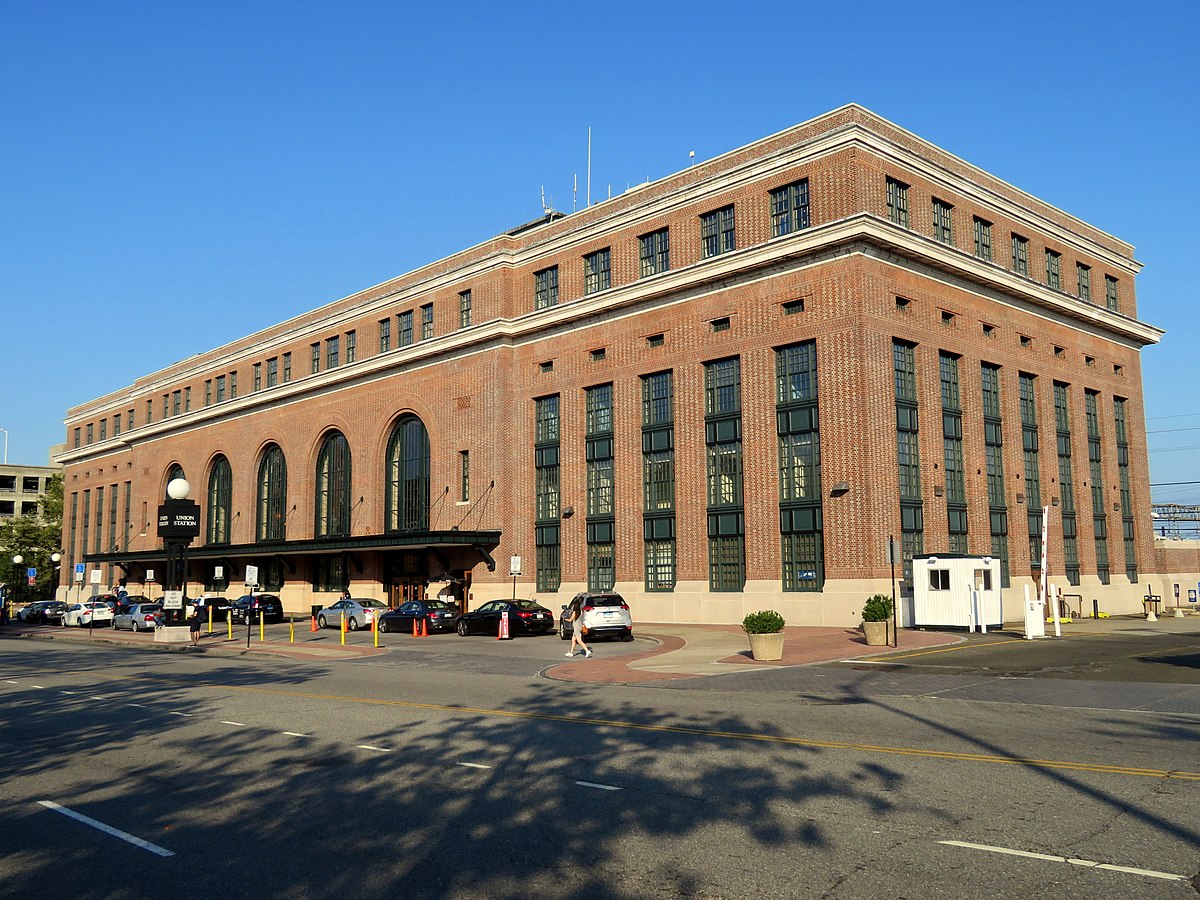
Union Station, a mile south of the Green at 50 Union Avenue, serves Amtrak, Metro-North and Greyhound. Amtrak out of Penn Station is a lot more expensive than Metro-North, and doesn't save that much time, so take Metro-North's New Haven Line out of Grand Central Terminal. It takes 2 hours and 23 minutes, and is $47 round-trip. Greyhound from Port Authority to New Haven is $46 round-trip, but it can drop to $28 with advanced purchase.

To Harvard: When you get to New Haven, take Interstate 91 North toward Hartford. When you reach Hartford, take Exit 29 to Interstate 84, which you will take into Massachusetts and all the way to its end, where it merges with Interstate 90, the Massachusetts Turnpike. (And the locals call it "the Mass Pike" – never "the Turnpike" like we do in New Jersey.)

Theoretically, you could take I-95 all the way to Boston as well, but that will take you through downtown Providence, Rhode Island, up to the Boston suburbs. I like Providence as a city, but that route is longer by both miles and time than the route described above.

Although you will see Fenway Park, or at least its light towers, from the Mass Pike a couple of minutes before you reach the exit for the park, you'll take Exit 22 for "Prudential Center" – not to be confused with the Newark arena that is home to the New Jersey Devils. This is a skyscraper with a major area mall on its 1st 2 levels. You will end up on Huntington Avenue, and make a right on Belvidere Street, then a left on Boylston Street, and then a right on Ipswich Street, which will take you to Fenway's parking deck.

If all goes well, and you make one rest stop (preferably around Hartford, roughly the halfway point), and you don't get seriously delayed by traffic within the city limits of either New York or Boston (either of which is very possible), you should be able to make the trip in under 5 hours.

But, please, do yourself a favor and get a hotel outside the city. It's not just that hotels in Boston proper are expensive, unless you want to try one of the thousands of bed-and-breakfasts with their communal bathrooms. It's also that Boston drivers are said to come in 2 classes, depending on how big their car is: Homicidal and suicidal.

So my recommendation is that, whenever a Yankee series in Boston approaches on the schedule, whatever your plans are for going, bag them, and make your game ticket and lodging plans for the next series.

For any lodging in Cambridge rather than in Boston proper, take Exit 18 off the Mass Pike and follow the signs for Cambridge, across the Charles River to the north. For lodging in Newton, Exit 15, 16 or 17. For lodging south of the city -- in, for example, Quincy -- take Exit 15 off the Mass Pike, for I-95/495 South (Boston's "beltway," in which case, it might be more convenient to take I-95 all the way up), to Exits 12 to 15; or, if going further, where it flows into Interstate 93, Exits 1 through 12.

Boston, like Philadelphia, Baltimore and Washington, is too close to fly from New York, and once you factor in fooling around with everything you gotta do at each airport, it doesn't really save you much time compared to driving, the bus or the train. It certainly won't save you any money.

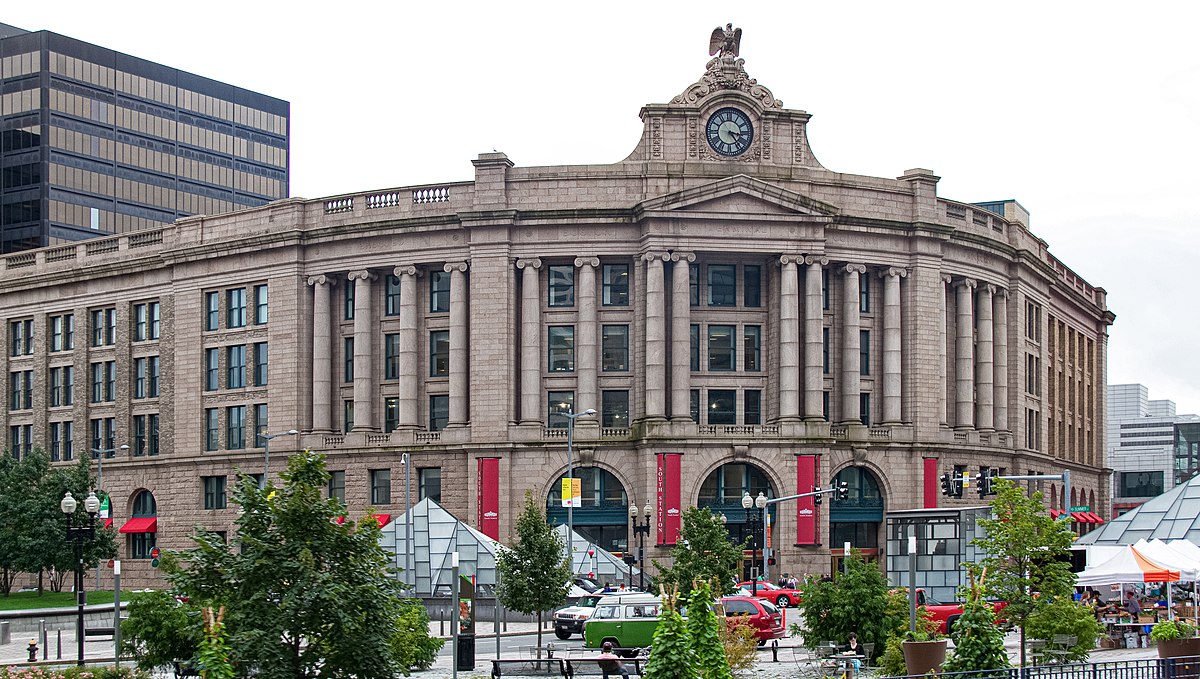
The train is a very good option. Boston's South Station is at 700 Atlantic Avenue, corner of Summer Street, at Dewey Square. (Named for Admiral George Dewey, naval hero of the Spanish-American War, not New York Governor and 1944 & '48 Presidential candidate Thomas E. Dewey, and not for former Red Sox right fielder Dwight "Dewey" Evans, either.) It'll be $154 round-trip from New York’s Penn Station to South Station, and it will take roughly 4½ hours. The Acela Express (the new name for the Metroliner, a more expensive option) will take about 3½ hours.
That pointy thing in front of it is a subway entrance.

South Station also has a bus terminal attached, and it may be the best bus station in the country – even better than New York's Port Authority. If you take Greyhound, you'll leave from Port Authority's Gate 84, and it will take about 4½ hours, most likely making one stop, at Hartford's Union Station complex, or in the Boston suburbs of Framingham, Worcester or Newton. New York to Boston and back is tremendously cheaper on the bus than on the train, usually around $114 round-trip, and it could drop to as little as $62 with advanced purchase), and is probably Greyhound's best run. On the way back, you’ll board at South Station's Gate 3.

Once In the City: Cambridge. Although their athletic facilities are on the south, Boston bank of the Charles River, Harvard University is on the north bank, in Cambridge. It was named for the University of Cambridge in England, as the founders of Harvard were Puritans, some of whom had gone to that school, founded in 1209. That city was named for a bridge over the River Cam.

One of those Cambridge graduates was John Harvard, a minister known in his time (1607-1638) as "a godly gentleman and a lover of learning." Unfortunately, he was only 31 when he died of tuberculosis. Upon his death, he left money for The New College, founded in 1636 as the 1st college in America. So he's not quite the founder of what was subsequently renamed Harvard University. He's more the benefactor, as Colonel Henry Rutgers would be of Queens College in New Jersey, 189 years later.

Radcliffe College, a women's school, was founded in Cambridge in 1889. It was integrated into Harvard in 1977, making America's oldest college co-ed at last.

The city grew around the University, with Harvard Square being the centerpoint, for town activity, though not for street addresses. It is formed by the intersection of Massachusetts Avenue, Brattle Street and John F. Kennedy Street (formerly Harvard Street).

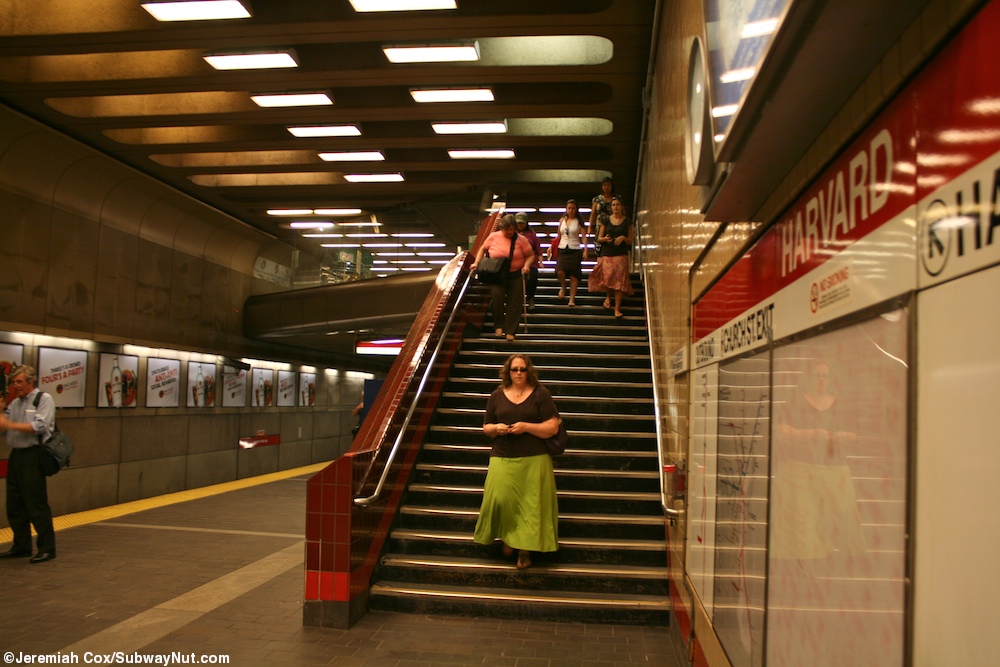
Since 1912, the Square has been served by the Harvard station on the Boston subway, now part of the MBTA Red Line, and I suspect the color was chosen to match Harvard's color, crimson, which is also the name of the school newspaper (The Harvard Crimson) and the name of its sports teams. Harvard Square is also a major bus service hub.
Harvard Station

Also is Cambridge is the Kendall station on the Red Line, mentioned in the song "M.T.A.": "Charlie handed in his dime at the Kendall Square Station... " Today, a ride costs $2.75 with cash, the same as New York's subway, and if you're there for the entire series, it may be cheaper to get a 7-day pass for $21.25. The MBTA 1-day pass is $12, so the 7-day pass is a better option.

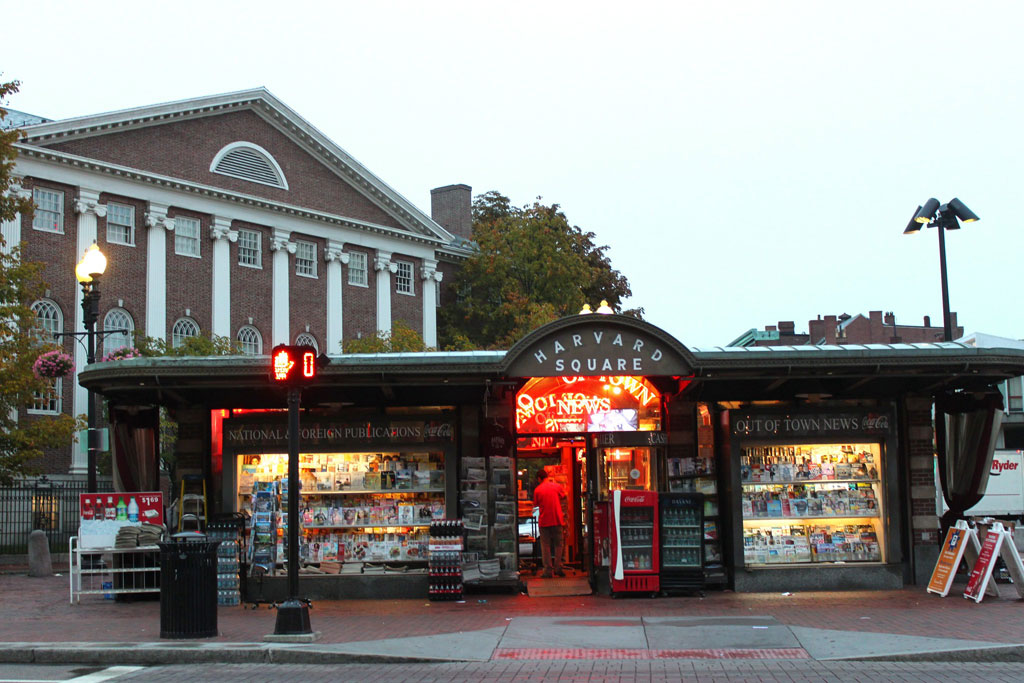
But the Harvard Square Kiosk, in place since 1928, and home to the newspaper and magazine store known as Out of Town News since 1955, is no more. Out of Town News closed this past October 31, and the Kiosk is being renovated, expected to reopen sometime next year.
Harvard Square, including the Kiosk, with Dudley House behind it

Harvard Yard is bounded by Broadway on the north, Quincy Street on the east, Massachusetts Avenue on the south and Peabody Street on the west. There are signs stating that motorized vehicles are banned. So the phrase designed to show off the Boston accent is pointless: Legally, you cannot "Pahk yuh cah in Hahvahd Yahd."

In the Yard, in front of University Hall, is a statue of John Harvard, dedicated in 1884. His left shoe is shiny, because people rub it for good luck. In 1934, some Harvard students kidnapped Handsome Dan, the Yale Bulldog mascot, and let him loose at the statue. Sacrilege? No: They'd smeared the shoes with hamburger grease, and got a photograph of "Yale licking Harvard's boots." The dog was not otherwise harmed, and was soon returned.
Cambridge is also the location of the Massachusetts Institute of Technology (MIT). The city is home to 120,000 people, but it's as much "town" as "gown," and the "town" is very blue-collar, home to Thomas "Tip" O'Neill, Speaker of the U.S. House of Representatives from 1977 to 1986; and actors Matt Damon and Ben and Casey Affleck.

The Area Code is 617, with 857 overlaid; and the ZIP Codes run from 02138 to 02142. The sales tax in Massachusetts is 6.25 percent, less than New Jersey's 7 percent and New York City's 8.875 percent. The Boston area's electric companies have been unified under a company called Eversource Energy. Cambridge was 91 percent white as recently as 1970, but is now 63 percent white, 16 percent Asian, 13 percent black and 8 percent Hispanic.

As America's oldest college, a list of Harvard's (and Radcliffe's) notable graduates would be either extensive or short-changing. Let me thus list the biggest of the big names:

* Presidents: John Adams (Class of) 1755, John Quincy Adams 1767, Rutherford B. Hayes 1845 (Law School), Theodore Roosevelt 1880, Franklin D. Roosevelt 1904, John F. Kennedy '40, George W. Bush '73 (Business School), Barack Obama '91 (Law School).

Also, Vice President Al Gore '69; President Syngman Rhee 1909 of South Korea, and President Ellen Johnson Sirleaf '71 of Liberia; and Prime Ministers Pierre Trudeau '45 of Canada, and Benazir Bhutto '73 of Pakistan.

First Lady Michelle Obama got her law degree at Harvard in '88. First Daughter Caroline Kennedy graduated in '80, and Malia Obama is on schedule to graduate in 2021. Masako Owada '85 is now Empress Masako of Japan,

* Cabinet members: Many, including Secretaries of State Edward Everett 1814, Richard Olney 1858, Dean Acheson 1918 (Law) and Mike Pompeo '94; Secretaries of Defense Robert Todd Lincoln 1864, Henry Stimson 1889, Caspar Weinberger '38, Robert McNamara '39, James Schlesinger '50; Secretaries of the Treasury Donald Regan '40 and Robert Rubin '60; Attorneys General Robert F. Kennedy 1948, Janet Reno '63, Loretta Lynch '81; Secretaries of Labor Willard Wirtz '37, Elizabeth Dole '65 (also a Senator) and Elaine Chao '79; Secretaries of Housing & Urban Development Robert C. Weaver '34, Henry Cisneros '73 and Julian Castro 2000; and Secretary of Commerce Wilbur Ross '61.

Castro's twin brother Joaquin Castro, currently a Congressman from Texas and a candidate for President, also graduated in 2000.

* U.S. Supreme Court: 23 Justices, including Oliver Wendell Holmes Jr. 1861, Louis Brandeis 1877, Felix Frankfurter 1906, Harry Blackmun '29, William J. Brennan '31, Lewis Powell '32, William Rehnquist '50, Antonin Scalia '60, Anthony Kennedy and David Souter '61, and current Justices Stephen Breyer '64. Neil Gorsuch '67 and Elena Kagan '86. This means that, from 1990 to 2005, 4 of the 9 Justices, nearly a majority, were Harvard graduates, either undergraduate or Law School. In addition, Watergate Special Prosecutor Archibald Cox '34.

* Governors: Among others, Samuel Adams 1740 of Massachusetts, John Hancock 1754 of Massachusetts, Leverett Saltonstall 1914 of Massachusetts, Christian Herter 1915 of Massachusetts, John Davis Lodge '25 of Connecticut, Alfred E. Driscoll '28 of New Jersey, John Chafee '50 of Rhode Island, Michael Dukakis '60 of Massachusetts, Jay Rockefeller '61 of West Virginia, Bob Graham '62 of Florida, Pete du Pont '63 of Delaware, William Weld '66 of Massachusetts, Jim Doyle '72 of Wisconsin, Mitt Romney '75 of Massachusetts, Ned Lamont '76 of Connecticut, Deval Patrick '78 of Massachusetts, Phil Murphy '79 of New Jersey, Mark Warner '80 of Virginia, Bruce Rauner '81 of Illinois, Jim McGreevey '82 of New Jersey, Tim Kaine '83 of Virginia, Eliot Spitzer '84 of New York, and Jennifer Granholm '87 of Michigan.

Saltonstall, Chafee, Rockefeller, Graham, Warner and Kaine were also U.S. Senators.

* U.S. Senators: Among others, not including those previously mentioned: Rufus King 1777 of Massachusetts, Charles Sumner 1830 of Massachusetts, Henry Cabot Lodge 1871 of Massachusetts, Robert Taft 1913 of Ohio (Law), Sam Ervin of North Carolina '22, Henry Cabot Lodge Jr. '24 of Massachusetts (grandson of the earlier Senator), Claude Pepper '24 of Florida, William Proxmire '40 of Wisconsin, Robert Taft Jr. '42 of Ohio (Law), Thomas Eagleton of Missouri '53, Ted Kennedy '56 of Massachusetts, Paul Sarbanes '60 of Maryland, Pat Toomey '61 of Pennsylvania, John Heinz '63 of Pennsylvania, Harrison Schmitt '64 of New Mexico (also astronaut who walked on the Moon), Richard Blumenthal '67 of Connecticut, Chuck Schumer '71 of New York, Al Franken '73 of Minnesota, Jack Reed '73 of Rhode Island, Paul Tsongas '74 of Massachusetts, Mike Crapo '77 of Idaho, Bill Frist '78 of Tennessee, Russ Feingold '79 of Wisconsin, Bob Torricelli '80 of New Jersey, David Vitter '83 of Louisiana, Martha McSally '90 of Arizona, Ben Sasse '94 of Nebraska, Ted Cruz '95 of Texas, and Tom Cotton '98 of Arkansas.

* Others: Declaration of Independence signer Robert Treat Paine 1749, civil rights icon W.E.B. Du Bois 1890, State Department official and accused spy Alger Hiss '29, conservative activist Phyllis Schlafly '45, Federal Reserve Chairman Paul Volcker '51, Pentagon Papers leaker Daniel Ellsberg '52, Mayor Kevin White '57 of Boston, Presidential speechwriter Richard Goodwin '58 and his wife historian Doris Kearns Goodwin '68, consumer advocate and 2000 3rd party Presidential candidate Ralph Nader '58, Mayor Michael Bloomberg '66 of New York, Presidential advisor David Gergen '67, physician and 3rd party Presidential candidate Jill Stein '73, conservative economic guru Grover Norquist '78, and Mayor Eric Johnson '98 of Dallas.

* Science: Psychologist William James 1869, sex researcher Alfred Kinsey 1919, physicist J. Robert Oppenheimer '25, astronomer Neil de Grasse Tyson '80. Alas, also "Unabomber" Theodore Kaczynski '62.

* Business: Banker David Rockefeller '36, Levi Strauss CEO and former Oakland Athletics owner Walter Haas '39, Viacom CEO Sumner Redstone '44, New York Daily News owner Mortimer Zuckerman '62, Microsoft CEO and Los Angeles Clippers owner Steve Ballmer '77, Enron fraudster Jeffrey Skilling '79, JPMorgan Chase CEO Jamie Dimon '82.

* Journalism: Ben Bradlee '44, George Plimpton '48, Lou Dobbs '67, Thomas Oliphant '67, James Fallows '70, Frank Rich '71, Michael Kinsley '72, E.J. Dionne '73, Evan Thomas '73, William Kristol '73, Walter Isaacson '74, Jill Abramson '76, Jim Cramer '77, Jonathan Alter '79, Nicholas Kristof '81, Andrew Sullivan '86, Soledad O'Brien '87, Suzanne Malveaux '87, Joy-Ann Reid '90. If you count sports journalism: James Brown '73, Pablo S. Torre 2007.

* Literature: Ralph Waldo Emerson 1821, Oliver Wendell Holmes 1836 (grandfather of the Justice), Henry David Thoreau 1837, James Russell Lowell 1838, Horatio Alger 1852, Ernest Thayer 1885 (wrote "Casey At the Bat"), George Santayana 1886, Gertrude Stein 1897, Helen Keller 1904, Robert Benchley 1912, E.E. Cummings 1915, John Dos Passos 1916, Thomas Wolfe '22, William S. Burroughs '36, Norman Mailer '43, Richard Wilbur '47, Edward Gorey '50, Robert Bly '50, Donald Hall '51, Ursula K. Le Guin '51, John Updike '54, Susan Sontag '57, Erich Segal '58, Peter Benchley '61 (Robert's grandson), Margaret Atwood '62, Michael Crichton '64, Scott Turow '78, Elizabeth Wurtzel '89.

* Actors: Jack Lemmon '47, Fred Gwynne '51, Wallace Shawn '65, Stockard Channing '65, John Lithgow '67, Tommy Lee Jones '69 (also a football player and roommate of Al Gore), Fred Grandy '70, Courtney B. Vance '82, Amy Brenneman '87, Donal Logue '89, Mira Sorvino '90, Nestor Carbonell '90, Matt Damon '92, Rashida Jones '97, Elisabeth Shue 2000, Natalie Portman '03, Jonathan Taylor Thomas '04, Scottie Thompson '05.

* Comedians: Andy Borowitz '80, Conan O'Brien '85, Greg Giraldo '88, Mo Rocca '91.

* Directors: Terrence Malick '66, James Toback '66, Edward Zwick '74, Jeff Zucker '86, Darren Aronofsky '91.

* Music: Composer-conductor Leonard Bernstein '39, musical satirist Tom Lehrer '47, Talking Heads keyboardist Jerry Harrison '71, cellist Yo-Yo Ma '76, Rage Against the Machine leader Tom Morello '86, jazz saxophonist Joshua Redman '91, Weezer frontman Rivers Cuomo '06.

* Architecture: Charles Bulfinch 1781, Philip Johnson '30, I.M. Pei '46.

You were wondering when I was going to get around to sports? Non-football athletes from Harvard include: Early tennis star Richard Sears 1883, baseball player and war hero Eddie Grant 1905, figure skater Dick Button '52, soccer goalie Shep Messing '73, rowing Olympic Gold Medalist Esther Lofgren '09, basketball player Jeremy Lin '10. Also, hockey general managers Robert Ridder '40 and Brian Burke '81, and Baseball Commissioner Rob Manfred '83. If you count golf as a sport (I don't), Bobby Jones '24.

Once In the City: New Haven. Settled in 1638, and named as a "haven" for Puritans fleeing England, "the Elm City" is now home to about 130,000 people, making it about the same size as Cambridge.
The city and the school are both centered on the New Haven Green, bordered by Elm Street on the north, Church Street on the east, Chapel Street on the south and College Street on the west. The Green is 77 miles northeast of Midtown Manhattan, and 137 miles southwest of Downtown Crossing in Boston. This makes the city a convenient "neutral zone" for fans of New York teams and Boston teams alike.
New Haven faced some serious "white flight" after the 1960s: With a white population of 70 percent in 1970, it's now about 35 percent black, 32 percent white, 28 percent Hispanic and 5 percent Asian. The Area Code is 203, with 475 overlaid; and the ZIP Codes run from 06501 to 06540. The sales tax in Connecticut is 6.35 percent. Oddly, New Haven's electricity is run by Pennsylvania Power and Light -- Pennsylvania and Connecticut don't even border each other.

Connecticut Transit runs New Haven's buses, and when you board, you can press a button to get an All-Day Pass for just $3.50. New Haven's Union Station is served by Amtrak, Metro-North, the Hartford Line (connecting to Springfield, Massachusetts), the Shore Line East (connecting as far east as Old Saybrook), Greyhound, Megabus and Connecticut Transit buses.
Union Station

The Collegiate School was founded in 1701 in Branford, Connecticut -- and the school's current people won't want to admit this, but it was by Harvard-educated ministers. It moved around a bit until it was set in New Haven in 1716, and stayed there.

As with John Harvard of Cambridge University (and Henry Rutgers of Columbia), it was a man from another school who became its benefactor and namesake, Boston businessman and Harvard graduate Elihu Yale (1649-1721). An official in the East India Company, "Eli" Yale made his contribution, and the school was named for him in 1718. The students and graduates have since been called "Men of Old Eli," and the teams were called the Elis before "Bulldogs" was adopted.
He has no statue on campus, and no shiny shoe.

Harvard's motto is simply Veritas, Latin for "Truth." Yale's is Lux et Veritas, "Light and Truth." One-upmanship? They've been trying to one-up each other for 300 years. They have more in common than they'd like to admit, but they like to think they're opposites, with Yale even using blue as a color rather than red. Yale's school newspaper is The Yale Daily News, or "The Daily Yalie."

As with Harvard, any list of notable Yale alumni would be exhaustive, and includes some who also got degrees at Harvard, but here goes:

* Presidents: William Howard Taft 1878, Gerald Ford '41 (Law), George H.W. Bush '48, George W. Bush '68, Bill Clinton '73 (Law).

* Vice Presidents: In addition to Ford and the elder Bush, John C. Calhoun 1804, Dick Cheney '63.

* Supreme Court: 18 Justices, including Chief Justice Taft, Potter Stewart '37, Byron White '46, and current Justices Clarence Thomas '74, Samuel Alito '75, Sonia Sotomayor '79 and Brett Kavanaugh '90.

* Cabinet members: Secretaries of State Henry Stimson 1888, Dean Acheson 1915, Cyrus Vance '39, John Kerry '66 and Hillary Clinton '73 (Law); Secretary of Defense Les Aspin '60; Secretaries of the Treasury Robert Rubin '64 and Steve Mnuchin '85; Attorneys General Alphonso Taft 1833 (founder of the family's political dynasty) and Edwin Meese '53; and Secretary of Commerce Wilbur Ross '59. Kerry and Clinton were also U.S. Senators.

Also, abolitionist and later Ambassador Cassius Clay 1832 (namesake of the man who became Muhammad Ali), "Chicago Eight" defendant David Dellinger '36 (he titled his memoir From Yale to Jail), original Peace Corps Director and Kennedy in-law Sargent Shriver '38, notable Deputy Attorney General Burke Marshall '43, New York County District Attorney Cyrus Vance Jr. '78, "hippie lawyer" William Kunstler '41, and notorious Bush Administration official Lewis "Scooter" Libby '72.

* Governors: In addition to those previously mentioned, William Livingston 1741 of New Jersey (1st Governor), Samuel Tilden 1837 of New York, Averell Harriman 1913 of New York, William Scranton '39 of Pennsylvania, John Chafee '47, of Rhode Island, Lowell Weicker '53 of Connecticut, Robert Taft '53 of Ohio (son of Robert Jr. and great-grandson of William Howard), Pete Wilson '56 of California, Jerry Brown '64 of California (Law), George Pataki '67 of New York, Mark Dayton '69 of Minnesota, Jack Dalrymple '70 of North Dakota. Howard Dean '71 of Vermont, Gary Locke '72 of Washington. Chafee, Weicker and Wilson were also U.S. Senators. Also Mayor John Lindsay '44 of New York.

* U.S. Senators: Among them, in addition to those already mentioned, Robert Taft 1910 of Ohio, Prescott Bush 1917 of Connecticut (George H.W.'s father), Stuart Symington '23 of Missouri, Robert Taft Jr. '39 of Ohio, William Proxmire '48 of Wisconsin, Arlen Specter '56 of Pennsylvania (Law), John Heinz '60 of Pennsylvania, Gary Hart '61 of Colorado, Joe Lieberman '64 of Connecticut, Richard Blumenthal '73 of Connecticut (Law), Sherrod Brown '74 of Ohio, Sheldon Whitehouse '78, of Rhode Island, Amy Klobuchar '82 of Minnesota, Cory Booker '97 of New Jersey (Law).

* Members of Congress: Among them, Gerry Studds '59 of Massachusetts, the 1st openly gay Congressman; Eleanor Holmes Norton '63, longtime nonvoting delegate from the District of Columbia; and Sheila Jackson Lee '72 of Texas.

* Political commentators: William F. Buckley '50 and his son Christopher Buckley '75, Alan Dershowitz '62, David Gergen '63, Marvin Olasky '71, Fareed Zakaria '86.

Also, Revolutionary patriot spy Nathan Hale 1773; the founder of Cleveland, Ohio, Moses Cleaveland 1777; and New York building czar Robert Moses 1909.

* Journalism: Ogden Mills Reid 1904 and his son Whitelaw Reid '34, Gordon McLendon '42, Tom Wolfe '57, John Lahr '63, Margaret Warner '71, Jane Mayer '77, Stone Phillips '77, Naomi Wolf '84, Adam Liptak '84, David Leonhart '94.

* Business: Publisher Henry Holt 1862, aircraft pioneers William Boeing 1903 and Juan Trippe '21, newspaper publishers Joseph Medill Patterson 1901 (founder of the New York Daily News) and his cousin "Colonel" Robert McCormick 1903 (of the Chicago Tribune), Time magazine founders Henry Luce 1920 and Britton Hadden 1920, venture capital inventor and New York Herald Tribune
publisher John Hay "Jock" Whitney '26, automaker Henry Ford II '40, Federal Express founder Frederick W Smith '66.

* Science: Cotton gin inventor Eli Whitney 1792, painter and telegraph inventor Samuel Morse 1810, child psychologist Benjamin Spock '25, computer pioneer Grace Hopper '30, and neurosurgeons Harvey Williams Cushing 1891 and Ben Carson '73.

* Social Science: Reinhold Niebuhr 1914, Brendan Gill '36, Camille Paglia '72, Henry Louis Gates Jr. '73.

* Architecture: Eero Saarinen '34, Robert Stern '65, and Maya Lin '81.

* Art: Painters Mark Rothko '24, Chuck Close '64; cartoonist Garry Trudeau '70.

* Acting: Vincent Price '33, James Whitmore '42, Anne Meacham '47, Paul Newman '54, Sam Waterston '61, Henry Winkler '70, Ben Stein '70, Michael Gross '73, Sigourney Weaver '74, Harry Hamlin '74, Meryl Streep '75, Robert Picardo '75, Angela Bassett '80, Tony Shalhoub '80, Bronson Pinchot '81, David Hyde Pierce '81, David Alan Grier '81, Frances McDormand '82, Victoria Clark '82, John Turturro '83, Jodie Foster '85, Chris Noth '85, Enrico Colantoni '85, Jennifer Beals '87, Paul Giamatti '89 (son of former Yale President and Baseball Commissioner Bart Giamatti), David Duchovny '89, Ron Livingston '89, Phil LaMarr '89, Edward Norton '91, Bellamy Young '91, Jennifer Connelly '92, Liev Schreiber '92, Noah Emmerich '92, Sara Gilbert '97, Josh Saviano '98, Kellie Martin '01, Claire Danes '02, Jordana Brewster '03 (granddaughter of former Yale President Kingman Brewster), Allison Williams '10, Lupita Nyong'o '12, Winston Duke '13.

Also, directors George Roy Hill '43, Michael Cimino '61, James Burrows '62, Oliver Stone '68, Lloyd Kaufman '68, Thomas F. Lennon '73, Alex Gibney '74, Todd Solondz '81 and Jessica Yu '87; producer Dick Ebersol '70; film critic Gene Siskel '67; and chef Ming Tsai '86.

* Comedy: Dick Cavett '58, Lewis Black '77, John Hodgman '92.

* Literature: Noah Webster 1778, James Fenimore Cooper 1805, John Knowles '49, Harold Bloom '56, Larry Kramer '57.

* Music: Composers Charles Ives 1898, Cole Porter 1913, Mich Leigh '51, Maury Yeston '67, Michael Gore '73, Robert Lopez '97; jazz singer Rudy Vallee '72, Fugees singer Pras Michel '94, Pentatonix singer Kevin Olusola '11.

* Athletes, other than football: Yankee 1936 World Series pitcher Johnny Broaca, Met 1986 World Series pitcher Ron Darling, curse-breaking Red Sox and Cubs general manager Theo Epstein, former Knick coach Jeff Van Gundy, former Nets player Chris Dudley, Olympic Gold Medal-winning swimmer Don Schollander, Olympic Gold Medal-winning marathoner Frank Shorter, Olympic Gold Medal-winning figure skater Sarah Hughes; and the 1st notable openly transgender athlete, tennis player Richard Raskind, a.k.a. Renee Richards, who, yes, had to field some "mixed singles" lines.

Going In. Harvard Stadium is the oldest continuously-used college football stadium, having opened on November 14, 1903. Alas, they did not win their opener, losing 11-0 to Dartmouth. It's 116 years old. That makes it 9 years older than Fenway Park in Boston; 10 years older than the oldest stadium in major college football, Georgia Tech's Grant Field in Atlanta; and 11 years older than both the Yale Bowl and Wrigley Field in Chicago. In spite of that age, it is in very good shape. I suppose having America's wealthiest alumni base helps.
The address is 79 N. Harvard Street,about 4 miles west of Downtown Crossing, in the Allston neighborhood of Boston. If you drive in, parking is $20. The University recommends parking by Gate 8, 14, 16 or 20 if you want to tailgate.

Public transportation is a little tricky. You could take the Red Line to Central, in Cambridge, and transfer to Bus 70. Or, you could take the Red Line to Harvard, and walk across the Harvard Bridge over the river, and get there in about 15 minutes. Or, you could take the Green Line B Train to Harvard Avenue, and transfer to Bus 66.

Previously, Harvard played at Jarvis Field, where the Littauer Center of Public Administration now stands. 1805 Cambridge Street, across from the northwestern corner of Harvard Yard, across from Cambridge Common.
Jarvis Field, 1890

When it opened, Harvard Stadium seated 42,000. In 1906, as part of a study on game safety demanded by President Theodore Roosevelt, himself a Harvard graduate, Yale coach Walter Camp recommended widening the field. But with its new stadium, Harvard said they couldn't. In those days, what Harvard wanted, it usually got. So other measures were taken, including hashmarks and the legalization of the forward pass.

By 1929, Harvard Stadium was a bowl seating 57,166. But by 1952, a stadium that big was hardly ever needed, except against Yale. So the north stand was torn down, leaving the stadium in the horseshoe shape it retains today, with a capacity of 30,323.

The field runs southwest-to-northeast. From 1872 to 2005, Harvard played home games on real grass. Since 2006, they have used FieldTurf. That was also the year they finally installed permanent lights.
The Boston Patriots used Harvard Stadium in 1970, their 1st year in the NFL after the merger with the AFL, and their last year before moving out to the suburb of Foxborough and changing their name to the New England Patriots. The Boston Breakers of the USFL didn't use it (they used Nickerson Field at Boston University), but the team of the same name in the National Women's Soccer League used it from 2009 to 2014, before folding.

Olympic Trials for track and field were held there in the 1920s. The stadium hosted 6 soccer games of the 1984 Olympics, even though the Games were held all the way across the country in Los Angeles. It's held concerts, including what turned out to be Janis Joplin's last on August 12, 1970, and Bob Marley in 1979. The Boston Bruins are working with the University and the NHL to have the 2024 Winter Classic played there, to celebrate their 100th Anniversary.

A short walk down Soldiers Field Road, at 65 N. Harvard Street, is Jordan Field, the 4,000-seat home of the Harvard men's and women's soccer teams. It was also the home of the Boston Breakers -- not a descendant of the USFL team, but the local XI in the National Women's Soccer League. The Breakers previously (2009-11) played at Harvard Stadium. They announced they were folding in 2018.

The Yale Bowl opened on November 21, 1914, and Harvard spoiled the party, winning 36-0. (They were 7-0-2, while Yale finished 7-2. A week before, Yale had spoiled the opening of Princeton's Palmer Stadium, 19-14.) It was the 1st football stadium to be named a "bowl," because of its shape.
The address is 81 Central Avenue, 2 miles west of the Green. Bus 255 leaves from Chapel & Temple Streets, at the southeast corner of the Green, and drops you off at Derby & Yale Avenues, southeast of the stadium, 13 minutes later. If you drive in, parking is $20, the same as at Harvard. Not only is tailgating encouraged, but, supposedly, it was Yale football fans who invented the tailgate party in the first place.
The bowl held 70,896 fans, but it has rarely been filled from the 1970s onward. A badly-needed renovation in 1994 reduced capacity to 64,246. Another renovation in 2006 dropped it to the current 61,446, still more than is necessary for any opponent except Harvard. The playing surface, known as Class of 1954 Field, runs northwest-to-southeast. From 1872 to 2018, Yale played all their home games on God's own grass. This year, they switched to FieldTurf.
The Yale Bowl hosted the 1st-ever game between the New York Giants and Jets, a preseason exhibition on August 17, 1969 -- the Saturday of Woodstock. The Giants and their fans had talked about how, in spite of the Jets' recent Super Bowl win, they weren't the best team in New York, let alone the world. The Jets proved them very wrong, 37-14.

When the original Yankee Stadium was closed for renovations in October 1973, the Giants were out of luck: They had announced their intention to move to the Meadowlands of New Jersey for 1976, but Mayor John Lindsay wouldn't let them use City-owned Shea Stadium in the interim. So, for their last 5 1973 home games, and for all 7 in 1974, the Giants headed up I-95 and used the Yale Bowl, winning just 1 of 12 games (over the St. Louis Cardinals in 1973). New Mayor Abe Beame let them use Shea in 1975.

The Yale Bowl was also the home of the Connecticut Bicentennials of the old North American Soccer League in the 1976 and '77 seasons. It's hosted 4 international matches: Brazil 4-1 Italy on May 31, 1976; Italy 0-0 Portugal on June 6, 1993; USA 0-2 Brazil on June 6, 1993; and USA 1-1 Greece on May 28, 1994. Despite also being a good hockey school, Yale has never hosted an outdoor hockey game at the Yale Bowl.


Nobody’s gone to Yale for the football since Walter Camp was coaching there, but it makes the Yale Bowl no less impressive. It’s historic, the sight lines are surprisingly good, and the campus is spectacular. Plus, it was a pioneer in how big-time football stadiums would be constructed in the years to to come.

To the south, across Derby Avenue, is Yale Field. Baseball has been played at the site since 1885, and in the current 6,200-seat stadium since 1928. It also hosted the New Haven Ravens of the Class AA Eastern League from 1994 to 2003, and the New Haven County Cutters of the Can-Am League from 2004 to 2007.
Food. Honestly, in both Cambridge and New Haven, you're better off eating before and after the game. Harvard does not have a stadium concession map on their website, only mentioning that "Several concessions stands which offer a variety of food and drink options are available." Yale's website doesn't even say that much, although there are concessions stands.

Team History Displays. There is no display in the fan-viewable areas of either stadium for titles, which is probably just as well, given how long ago their big achievements were. Nor does either school retire numbers.

Harvard has won 12 National Championships, but all of them were retroactively awarded before the 1st Associated Press poll in 1936: 1874, 1875, 1890, 1898, 1899, 1901, 1908, 1910, 1912, 1913, 1919 and 1920.

The term "Ivy League" had been in use since 1934, but it wasn't until 1956 that a formal league -- encompassing Harvard, Yale, Princeton, Penn, Columbia, Dartmouth, Brown and Cornell -- began awarding sports championships. Harvard has won or shared it 17 times: 1961, 1966, 1968, 1974, 1975, 1982, 1983, 1987, 1997, 2001, 2004, 2007, 2008, 2011, 2013, 2014 and 2015. (Dartmouth is going to win it this season.)

There are 18 Harvard players, and 3 coaches, in the College Football Hall of Fame, and all but 1 of those played before World War II:

* From the 1890s: Center William H. Lewis, tackle Marshall Newell, fullbacks Charley Brewer and Bill Reid. Lewis (1868-1949), playing from 1888 to 1893 while he was at Harvard Law School (the NCAA didn't have a rule against that at the time, because there was no NCAA at the time), had previously played across Massachusetts at Amherst College, where he became the 1st black American football player. He later served as an Assistant Attorney General under President Taft.
* From the 1900s: Quarterback Charles Daly, end Dave Campbell and tackle Hamilton Fish III.

* From the 1910s: Coach Percy Haughton, guard Bob Fisher, halfback Percy Wendell, end Huntington Hardwick, guard Stan Pennock, and fullbacks Eddie Mahan and Eddie Casey.

* From the 1920s: Halfback George Owen.

* From the 1930s: Coach Dick Harlow, center Ben Ticknor, quarterback Barry Wood.

* From the 1940s: Harlow, guard Endicott Peabody.

* From the 1950s: Coach Lloyd Jordan.

* Since the 1950s: Receiver and punter Pat McNinally, 1972-74, later to play on the Cincinnati Bengals' 1981 AFC Champions.

In addition to McInally, Harvard players in the NFL include guard Earl Evans of the 1925 NFL Champion Chicago Cardinals, cornerback John Dockery of the Super Bowl III-winning Jets, guard Joe Pellegrini of the nearly AFC Champion 1982 Jets, and Matt Birk of the Super Bowl XLVII-winning Baltimore Ravens. There are 8 current Harvardians in the NFL: Quarterback Ryan Fitzpatrick of the Miami Dolphins; running back Kyle Juszczyk of the San Francisco 49ers, centers Tyler Ott of the Seattle Seahawks, Nick Easton of the Minnesota Vikings and Adam Redmond of the Dallas Cowboys; defensive tackle Desmond Bryant of the Cleveland Browns, and tight ends Cameron Brate of the Tampa Bay Buccaneers and Anthony Firkser of the Jets.

Harvard also invented American football. What's that, you say? Rutgers and Princeton played the 1st game in 1869? Officially, yes. But that was a soccer game, albeit 25-a-side. Harvard turned it into football as we know it.

In 1874, the football team at McGill University in Montreal challenged Harvard to a "football" game. Seeing themselves as sporting gentlemen, the Harvard team accepted. But when the McGill men got to Cambridge, they realized there was a misunderstanding. They thought they were going to be playing what's now called rugby union, while the Harvard men thought they were going to be playing association football, or soccer.

Seeing themselves as sporting gentlemen, the captains of each side agreed to play a game under each side's rules. On May 14, 1874, under "Boston rules," Harvard won, 3-0. The next day, under "McGill rules," they played to a 0-0 tie.

The Harvard men decided they liked the McGill rules, even though they hadn't won. Later in the year, they went to Montreal to play McGill under home rules again, and won. And they got the captains of the other football-playing schools in America together, and all agreed to play by the new rules, and American football was born.

Yale, of course, was one of those schools. Yale has won more National Championships than any other college football team, 27 -- but, like Harvard, all of theirs were retroactively awarded before the 1st Associated Press poll in 1936: 1872, 1874, 1876, 1877, 1879, 1880, 1881, 1882, 1883, 1884, 1886, 1887, 1888, 1891, 1892, 1893, 1894, 1895, 1897, 1900, 1901, 1902, 1905, 1906, 1907, 1909 and 1927. Indeed, from 1879 to 1884, 6 seasons, Yale went 37-0-5. And from 1891 to 1895, 5 seasons, they went 65-1-2.

Yale has won or shared 15 Ivy League titles: 1956, 1960, 1967, 1968, 1969, 1974, 1976, 1977, 1979, 1980, 1981, 1989, 1999, 2006 and 2017. In 1960, they shared the Lambert Trophy, given to "the best college football team in the East," with the Naval Academy.

Yale has had 28 figures in the College Football Hall of Fame. As with Harvard, only 1 has played for them since World War II:

* From the 1880s: Coach Walter Camp, end Amos Alonzo Stagg (later one of the great coaches, but not at Yale), guard Walter "Pudge" Heffelfinger (who became the 1st man openly paid to play football, in 1892), and halfback Lee McClung.
Pudge Heffelfinger

* From the 1890s: Camp, end Frank Hinkey, halfback Sam Thorne and guard Gordon Brown.

* From the 1900s: Tackle James Hogan, end Tom Shevlin, fullback Ted Coy and end John Kilpatrick (who later ran Madison Square Garden, and is thus in the Hockey Hall of Fame). Howard Jones, later to be the founder of the USC football dynasty, coached Yale in the 1909 and 1913 seasons.

* From the 1910s: Coach Thomas "Tad" Jones, quarterback Art Howe (not related to the later Mets manager), end Doug Bomeisler and center Hank Ketcham (not related to the later Dennis the Menace cartoonist).

* From the 1920s: Coach Tad Jones, halfback Mal Stevens, tackle Century Milstead, fullback Bill Mallory (not related to the later Indiana coach, who was once an assistant at Yale) and guard Herbert Sturhahn.

* From the 1930s: Halfback Albie Booth, end Larry Kelley and halfback Clint Frank. Kelley won the Heisman Trophy in 1936, Frank in 1937.

* Since the 1930s: 1965-96 head coach Carmen Cozza and early 1970s running back Dick Jauron (later head coach of the Chicago Bears).

Not in the College Hall, but with notable pro careers are: Tackle Century Milstead, of the 1927 NFL Champion Giants; tackle John Prchlik, of the 1952 and '53 NFL Champion Detroit Lions; center Mike Pyle, of the 1963 NFL Champion Bears; running back Chuck Mercein, of the Super Bowl II-winning Green Bay Packers, having played for the Giants before that and the Jets afterward; running back Calvin Hill, of the Super Bowl VI-winning Dallas Cowboys, and father of Basketball Hall-of-Famer Grant Hill; tight end John Spagnola, of the 1980 NFC Champion Philadelphia Eagles; and safety Gary Fencik, of the Super Bowl XX-winning Bears. There is 1 current NFL player who went to Yale, Atlanta Falcons linebacker Foyesade Oluokun.

Probably the most famous Yale football player of all was Brian Dowling, a quarterback from Cleveland, who led Yale to a share of the 1968 Ivy League title. (More about that shortly.) That year, the Yale Daily News published a comic strip titled Bull Tales, whose lead character was "B.D.," a parody of Dowling.

In 1970, the strip's writer, Garry Trudeau, got to nationally syndicate the strip, which he renamed for another character, Doonesbury. Over the years, B.D. was shown as the quarterback and later the head coach for fictional Walden College, a backup quarterback for the Los Angeles Rams, a California Highway Patrol officer (a "CHiP"), and a soldier who loses a leg in Iraq. The character remains in the strip today, still more conservative than most of the main characters.

The real Dowling played for the Patriots from 1970 to 1973, the World Football League version of the Charlotte Hornets in 1974 and '75, and the Packes in 1977, before becoming a stockbroker and a venture capitalist, which you would tend to expect from a Yalie.
1968 Yale players Bruce Weinstein,
Calvin Hill, Kyle Gee and Brian Dowling

Walter Camp -- halfback 1876-1881, head coach 1888-1892, and writer about the game from then until his death in 1925 -- is known as "The Father of American Football." He invented the center snap, the seven-linemen-and-four-back system, the four-down system, and the current scoring system including the invention of the safety. He also named the 1st All-America Team, starting a tradition that continues to this day.
As for the rivalry: They first played each other on November 13, 1875, at Hamilton Park in New Haven. Harvard scored 4 goals and 2 "tries," which rugby still uses, but American football would later call a "touchdown," since a "try" was generally scored by touching the ball down inside the end zone. Under today's scoring system, this would have given Harvard a 26-0 victory.

Yale learned quickly, and won 10 games and tied 2 more before Harvard beat them again, in 1890. Through 1907, it was Yale 21, Harvard 4, with 3 ties. And they were rough: After same nasty injuries in Yale's 12-4 win in 1894, the series was suspended for 2 years.

Then, in 1908, new Harvard coach Percy Haughton allegedly strangled a live bulldog and threw its dead body on the locker room floor, in front of his players, to show them how much they should hate Yale. It worked, as Harvard won, 4-0. The legend is probably an exaggeration: A 2011 Los Angeles Times story suggested it was a papier-mache bulldog.
Image result for Percy Haughton
Harvard went on to dominate the rivalry, going 8-1 from 1912 to 1922. (Both teams suspended their programs for 1917 and '18, due to World War I.)

In both 1883 and 1887, the game was played on Thanksgiving Day, and high school football on that day, in retreat in so many places (including, to my regret, New Jersey), remains a big deal in New England.

From 1889 to 1894, it was played on neutral ground at Hampden Park in Springfield, Massachusetts. It's been played at Major League Baseball parks: In 1878 and 1880 at South End Grounds, home of the Boston Beaneaters (the team now known as the Atlanta Braves); those Thanksgiving games of 1883 and 1887, both on neutral ground at the original Polo Grounds in New York; and in 2018 at Fenway Park, as a Harvard home game.

John F. Kennedy was not good enough to make any sports team at Harvard. His brother, Robert F. Kennedy, was too small to start on the Harvard football team, but in the 1947 season opener, he scored a touchdown in a 52-0 win over Western Maryland (now McDaniel College, an NCAA Division III school). In the next-to-last game, he broke his leg in a win over Brown. Since the only way you could win your varsity letter at the time was to play in the Yale game, Bobby Kennedy played in the Harvard-Yale game with a broken leg. And in the 1955 game, the youngest brother, Ted Kennedy, scored a touchdown for Harvard against Yale.
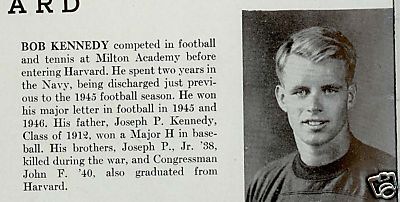
What the Kennedy myth-makers don't tell you is that Bobby had "only" a sprained ankle; that Yale won both the 1947 game (31-21) and the 1955 game (21-7); and that, earlier in the 1955 game, before his touchdown, Ted dropped a pass in the end zone. However, Ted was considered good enough at the position we now call tight end that the Green Bay Packers were interested in him. Old Joe Kennedy said no, Ted was going to go to law school, which he did -- not at Harvard, but at the University of Virginia. The Game was pushed back a week in 1963, after JFK was assassinated. 
Ted Kennedy, Number 88. Bobby wore Number 86.

The most famous game in the series came on November 23, 1968, when both teams walked into Harvard Stadium undefeated. (They hadn't both been undefeated going into The Game since 1909, and haven't since.) The winner would win the Ivy League title.

This game was played against the backdrop of a bad year, with the Vietnam War raging, Bobby Kennedy and Martin Luther King assassinated, the riot at the Democratic Convention, Richard Nixon being elected President 18 days earlier, the civil rights demonstration at the Olympics the previous month, and demonstrations of all kinds on both schools' campuses.

And both teams were far bigger than they are now. This was before the New England/Hartford Whalers were founded, and before UConn basketball (men's or women's) meant much, so Yale football was the biggest sports team in Connecticut. And with the Patriots still in the AFL, and Boston College in something of a down period, Harvard was the biggest football team in Massachusetts -- briefly surpassing the ethnicity-and-religion-aided fandom of faraway Notre Dame. The Crimson were nicknamed the Boston Stranglers, after the city's recent serial killer (allegedly, Albert DeSalvo).

Yale jumped out to a 22-0 lead, and led 29-13 going into the last minute. But with 42 seconds left, Harvard scored a touchdown and a 2-point conversion to make it 29-21. They recovered the onside kick, and on the last play of regulation, quarterback Frank Champi threw a touchdown pass to Vic Gatto.

Fans stormed the field, but had to be cleared off. It was 29-27 Yale, but the game wasn't over. Harvard went for 2 again, and Champi threw to Pete Varney to end the game in a tie. (Varney went on to play pro ball -- not football, but baseball, as a catcher, for 4 seasons with the Chicago White Sox and 1 with the Atlanta Braves.)
Image result for Pete Varney Harvard
Varney's 2-pointer

The writers of The Harvard Crimson were moved to print what has become the most famous headline in the history of college newspapers.
MIT doesn't have a football team, but they've made their presence felt in this game. In 1982, they managed to release a balloon with "MIT" written all over it at midfield. Harvard won 45-7. In 1990, MIT launched a fireworks-shooting rocket from midfield. Yale won 34-19.
(Not to be outdone, MIT's West Coast archrivals, the California Institute of Technology in Pasadena, hacked the scoreboard at the 1984 Rose Bowl, replacing "UCLA" and "Illinois" so that it looked like CALTECH 45, MIT 9. And a lot more people saw that prank, as live national TV beats ESPN highlights.)

In 2004, 80 years after the "Yale licks Harvard's boots" prank, Yale thought they had finally gotten even, by rearranging Harvard's "card trick." But the message turned out to be a lie, as Harvard won, 35-3.
Along with Army-Navy, The Game is the biggest game among football teams not in the 5 major conferences (the Big 10, the Big 12, the Pac-12, the SEC and the ACC). In 2014, ESPN hosted College GameDay from Harvard Stadium. Harvard has dominated in recent years, winning 10 of the last 12. But Yale still leads overall, winning 67 games to Harvard's 60, with 8 ties. This Saturday's game will be the 136th edition.

(UPDATE: Through the 2024 season, Yale leads 71-61-8.)

Stuff. Forget the souvenir stands at the stadiums. If you want souvenirs, you're better off going to the school bookstores, the Harvard Coop (co-op, but pronounced like "chicken coop") off Harvard Square at 1400 Massachusetts Avenue, and the Yale Bookstore at 77 Broadway. Both are now affiliated with Barnes & Noble, as college bookstores now tend to be.

As George Will (an Ivy Leaguer, due to his master's and Ph.D. from Princeton) put it, New England is "the literary capital of America." But while the Red Sox, as he put it, "get written about to death," and there are some good books written about the other Boston teams, neither Harvard football nor Yale football seems to have been much of a literary subject.

In 2018, Dick Friedman published The Coach Who Strangled the Bulldog: How Harvard's Percy Haughton Beat Yale and Reinvented Football. In 1999, the man then coaching Yale released the memoir True Blue: The Carm Cozza Story. In 2014, Rich Marazzi published A Bowl Full of Memories: 100 Years of Football at the Yale Bowl. Later this year, his book Yale Football Through the Years will be published.

In 2008, Stephen Fritzer published A View of The Game: Yale-Harvard Football Moments. (You can tell he's a Yale man, because Yale is listed first.) There are 2 good books about the 1968 game. For the 40th Anniversary, Kevin Rafferty published Harvard Beats Yale 29-29, and made a documentary film about it as well, interviewing most of the surviving players, including Tommy Lee Jones. And for the 50th Anniversary, George Howe Colt published The Game: Harvard, Yale, and America in 1968.

During the Game. This is the Ivy League. Boston, Cambridge and New Haven may be tough cities, but no one is going to take a swing at you if you root for the visiting team.

Eighty minutes before kickoff of a Yale home game, the entire team gathers under the Walter Camp Memorial to start "The Bulldog Walk." Led by the captain and the head coach, the players lock arms while following the Yale Precision Marching Band on the 1,000-foot march into the Bowl. Fans, students, parents and alumni line both sides of the path to cheer them on.
The night before the game, the Glee Clubs of each schools have a joint concert. Among the songs they sing is "Ten Thousand Men of Harvard." New players are required to memorize it in both English and Latin. Here's the English chorus:

Ten Thousand Men of Harvard want victory today 
For they know that ov'r old Eli fair Harvard holds sway. 
So then we'll conquer all old Eli's men, 
And when the game ends we'll sing again: 
Ten thousand men of Harvard gained vict'ry today.

Yale's official fight song is "Bull Dog" by alumnus Cole Porter:

Bulldog!  Bulldog! Bow, wow, wow, Eli Yale
Bulldog!  Bulldog! Bow, wow, wow, Our team can never fail
When the sons of Eli break through the line
That is the sign we hail
Bulldog!  Bulldog! Bow, wow, wow
Eli Yale!
"Down the Field" is played after every score and every win, mocking the Harvard version of the Boston accent:

March, march on down the field
Fighting for Eli
Break through that crimson line
Their strength to defy
We’ll give a long cheer for Eli’s men
We’re here to win again
Hahvahd’s team may fight to the end
But YALE!  WILL!  WIN!

But the best-known Yale song defies Ivy erudition. It is titled "Boola Boola":

Boola boola, boola boola
When we rough house poor old Hahvahd
They will holler, “Boola boo”
Oh Yale, Eli Yale!  Oh Yale, Eli Yale!

Oh Yale, Eli Yale!  Oh Yale, Eli Yale! 

How do you make a mascot out of a color? In Harvard's case, crimson red? They have a guy in a foam suit, looking like a Pilgrim, allegedly John Harvard.
Image result for harvard university mascot john harvard the pilgrim
He doesn't look capable of carving a Thanksgiving turkey,
let alone taming Yale's Bulldog.

In 1889, Yale adopted a live bulldog mascot, Handsome Dan. That dog stayed with them through the 1897, when he was retired. There wouldn't be a Handsome Dan II until 1933, but they've had a succession of them since.

But unfortunate circumstances have abounded. As I said earlier, Handsome Dan II was dognapped in 1934, and made to "lick Harvard's boots." Handsome Dan III was retired in 1938, due to a fear of crowds. In 1952, the same thing was done, for the same reason, with Handsome Dan VIII. Handsome Dan IV was hit by a car and paralyzed in 1940.

Handsome Dan VI died in 1949, only 2 years old. Why? Depends on who you ask. Some said he was literally scared to death by a fireworks display during The Game. Some said he died of shame, because Yale lost to both Harvard and Princeton that year.

Handsome Dan VII was retired in 1952, due to a bad temper. In 1996, Handsome Dan XIV died of a heart attack in midseason, and Handsome Dan XIII, the longest-serving mascot, came out of retirement to finish the season, his 13th. In 2005, Handsome Dan XVI was dognapped by Harvard, but there was no replay of the boot-licking. 

In 1956, Handsome Dan IX became the 1st college mascot to appear on the cover of Sports Illustrated -- not a surprise, given that the magazine's founder, Time, Inc. boss Henry Luce, was a Yale grad. In 1975, a bulldog named Bingo became the 1st female Yale mascot, Handsome Dan XII. (Turnabout is fair play: Lassie has always been played by a male collie.) The current version, Handsome Dan XVIII, is in his 4th season. There is also a man-in-a-suit mascot, also named Handsome Dan.
HD18 at the 2018 game at Fenway Park

Yale legend has it that the reason the University of Georgia's mascot is a bulldog is that they were founded by missionaries from Yale. 

After the Game. Harvard and Yale hate each other's teams, but it's a respectful rivalry. No one is going to overturn cars or set fire to anything if they lose. You, and your car if you drove in, are going to be safe. Just don't talk trash about any of the Boston-area teams, as Harvard is (more or less) in Boston, and lots of Yalies are from New England.

There's not much to eat around either stadium. With Harvard, you're better off going back to Harvard Square or anywhere in Boston proper. If you've been to Princeton, Cambridge will seem familiar to you, with lots of cutesy shops and eateries, including some that seem to be off little streets too quaint to be called "alleys." One of the better-known Cambridge eateries is Grendel's Den, at 89 Winthrop Street, across from Winthrop Square. I've eaten there, and while you go for the atmosphere, the food and service are good, if not great.

Just as the Riviera Café off Sheridan Square in the West Village and Professor Thom's on 2nd Avenue in the East Village were Sox-friendly bars in New York (both are now out of business), there are places in Boston that welcome Yankee Fans. 

Boston Globe profile during the 2009 World Series mentioned Champions, at the Marriott Copley Place hotel at 110 Huntington Avenue (Green Line to Copley). But it has since closed. Still open, and mentioned in the article, are: The Boston Sports Grille, at 132 Canal Street, across from North Station and the Garden (Green Line to North Station); and, right across from Fenway itself, Game On! at 82 Lansdowne Street (Green Line to Kenmore).

The local Giants fan club meets at The Greatest Bar, 262 Friend Street off Canal, a block from the Garden. M.J. O'Connor's, at 27 Columbus Avenue next to the Boston Park Plaza Hotel, is the local home of Jets fans. (Green Line to Arlington.) The Kinsale, at 2 Government Center, is also said to be a Jet haven.

Likewise, the Yale Bowl is bordered on the north side by a residential area and on the other 3 sides by school athletic facilities. New Haven is known as an Italian city, and for its pizzerias. Supposedly, Louis Lassen, owner of Louis' Lunch, invented the hamburger in 1900. As with the classic Philadelphia cheesesteak 30 years later, he took beef scraps and put it on the kind of roll that he had available. The restaurant is still in business: Its current location is at 263 Crown Street, a block south and then west of the Green.

If your visit to Boston is during the European soccer season, as we are now in, there are 2 great area bars at which you could watch your favorite club. The Phoenix Landing in Cambridge is the original Boston-area footie pub, and is still the best. Red Line to Central. The Banshee Pub in Dorchester (which, unlike Cambridge, actually is in the City of Boston) is much more working-class, but if you think you're "hard enough," "come and have a go." (No, I'm not suggesting that anyone will try to fight you: As long as you show respect, you will have that respect returned.) Red Line to JFK/UMass.

New Haven's big "footie pub" is Christy's Irish Pub, at 261 Orange Street, a block east and then north of the Green. The other big one in New Haven, Anna Liffey's, at 17 Whitney Avenue, has gone out of business.

Sidelights. Boston is probably America's best sports city, per-capita. Which doesn't make it an easy place to be a fan of a non-New England team. On February 3, 2017, Thrillist made a list ranking the 30 NFL cities (New York and Los Angeles each having 2 teams), and Boston came in 8th, in the top 1/3rd. But the "Sidelights" section for them is long, so if you want to read it you might as well go to my 2019 Trip Guide for the Red Sox.

As for New Haven: I've already told you about Yale Field. From 1972 to 1982, the city had a team in adjoining West Haven, in the Class AA Eastern League. As the West Haven Yankees, they won Pennants in 1972, 1976, 1979 and 1980. As the West Haven A's, an Oakland farm team, they won another Pennant in 1982.

They played at Quigley Stadium, which stood from 1947 to 1987, and has been replaced by a high school football stadium. 362 Front Avenue. Bus 261 or 265, and then you'd have to walk a block west on the Boston Post Road (U.S. Route 1) before turning left on Front Avenue for about a 5-minute walk.

For the 1983 season, they moved to Albany, became a Yankee farm team again in 1985, as the Albany-Colonie Yankees, moved to southeastern Connecticut as the Norwich Navigators in 1995, became a San Francisco Giants farm team in 2003, became the Connecticut Defenders in 2006, and moved to Richmond, Virginia for 2010.

With that team, the New Haven Ravens/New Haven County Crosscutters, and the Bridgeport Bluefish out of business, currently, Connecticut's only professional baseball team is the Hartford Yard Goats, playing at Dunkin Donuts Park, at 1214 Main Street, separated from downtown Hartford by the elevated Interstate 84. It's an even 100 miles southwest of Boston's Downtown Crossing, and 39 miles northeast of the New Haven Green.
Image result for Dunkin Donuts Park Hartford
From 1972 to 2007, the 11,000-seat New Haven Coliseum stood at 275 S. Orange Street, at the corner of George Street. It was home to a series of minor-league hockey teams, most notably the New Haven Nighthawks. They were a farm team of both the Rangers and the Islanders (at different times), and won division titles in 1979 and '80, and reached the final of the AHL Championship, the Calder Cup, in 1974, 1978, 1979 and 1989, but lost all 4.
Image result for New Haven Coliseum
The construction of The Arena at Harbor Yard in Bridgeport and the Mohegan Sun Arena in Uncasville, both designed after Camden Yards in Baltimore rewrote the rules of sports venue construction, made the Coliseum obsolete. Its teams moved out, and it was demolished. Housing has been planned for the site, but is tied up in legal wrangles, so, for the moment, it remains a parking lot.

Before the Coliseum, there was the New Haven Arena. Built in 1927 and seating 4,000 people, it, too, hosted minor-league hockey: The Eagles from 1936 to 1952, and the Blades from then until 1972, when the Coliseum opened.

It also hosted concerts, but its best-remembered concert was cut short. On December 9, 1967, The Doors were supposed to play, but before the show, lead singer Jim Morrison was caught back stage making out with a groupie (not Patricia Kennealy, as Oliver Stone's movie suggested), and was maced by a policeman. The misunderstanding and his eyes were cleared up, but he wouldn't let it go, stopped a song in mid-performance, told the crowd what happened, and became the 1st rock-and-roller ever to be arrested in mid-concert.
Image result for New Haven Arena
The Arena was demolished in 1974. The FBI built its local office on the site -- a touch of irony, given its connection with a "crime." 600 State Street, northeast of the Green.

*

Harvard vs. Yale may no longer be "The Game" to anyone but its own people (players, support staff, other students, coaches, alumni, etc.). But it is one of the most historic rivalries in North American sport.