Showing posts with label george young. Show all posts

Tuesday, July 21, 2020

Top 10 Best Executives in New York Sports History

Ed Barrow watches as Babe Ruth signs a contract for Jacob Ruppert

I did it for team owners, here's an update for executives. For the most part, my selections for the best and worst of these aren't also team owners -- more about the men who made the personnel decision, the trades, the free-agent signings, the draft picks -- but there are notable exceptions. Again, I'll limit it to 1920 to the present.

Honorable Mention to Charles "Chub" Feeney, Giants, 1946-57. (Counting San Francisco, 1946-70.) A grandson of former owner Charles Stoneham, and a nephew of the next owner, Horace Stoneham, he was hired as general manager, and built the Giants' 1951 National League Pennant winners and 1954 World Champions.

But he was also the main force behind their attempt to move the team to Minneapolis (where their top farm team was located) for the 1958 season, and then scuttled that move when Brooklyn Dodger owner Walter O'Malley suggested to Horace Stoneham that both teams move to California instead, the Dodgers to Los Angeles and the Giants to San Francisco.

Honorable Mention to Lester Patrick, Rangers, 1926-46. One of the best players of the 1900s and 1910s, he was the Rangers' 1st GM and 1st head coach (1926-39), leading them to the 1928 and 1933 Stanley Cups, before stepping aside and letting his former best player, Frank Boucher, coach them to the 1940 Cup. A charter member of the Hockey Hall of Fame.

Honorable Mention to Eddie Donovan, Knicks, 1965-72. A bad head coach (1961-65), but a great general manager, who built the 1970 and 1973 NBA Champions, although that may have been more to do with the coaching of Red Holzman. Still, Eddie hired Red, which counts for a lot.

Honorable Mention to Gabe Paul, Yankees, 1973-77. When George Steinbrenner bought the Yankees, they were far and away New York's 2nd team behind the Mets. He had Paul as a part-owner and his personnel man. The team was completely overhauled. For 1974, Paul traded for Lou Piniella, Chris Chambliss and Dick Tidrow. For 1975, Paul signed free agent Catfish Hunter.

For 1976, Paul traded for Willie Randolph, Mickey Rivers and Ed Figueroa. For 1977, Paul traded for Bucky Dent. Granted, bringing in manager Billy Martin and slugger Reggie Jackson were both ideas of George Steinbrenner (and George should, at least, get Honorable Mention status for those 2 moves alone), but Paul built the team.

All those years, both before and after this, he ran the Cleveland Indians, but never won anything. He never had an owner with enough money to build a champion, and, as a result, Paul often had to sell off or trade away players in salary dumps just to keep the Indians afloat. With George, Gabe finally had a man willing to spend whatever it took. And they found out what it took. It was worth every penny. If Gabe hadn't had enough of George after the 1977 victory, and had stayed, I might rank him higher.

Honorable Mention to Al Rosen, Yankees, 1978-79. He succeeded Gabe, and brought in Goose Gossage, vital spare parts Gary Thomasson and Jay Johnstone, and, after Billy had to go, his old Indians teammate Bob Lemon as manager.

Honorable Mention to Bob Watson, Yankees, 1996-97. He finished Gene Michael's job in 1996.

Honorable Mention to Brian Cashman, Yankees, 1998-present. I have ripped him mercilessly, saying that he's never won anything on his own, that he only won from 1998 to 2009 because he had George Steinbrenner's money and Gene Michael's players. There is some fairness to that, but it's far from completely fair.

Still, since the retirement of Derek Jeter in 2014, he has had more resources than any GM in baseball, and has just 1 Division title and 2 ALCS berths to show for it. His decisions have helped 3 different teams win 4 Pennants: The Chicago Cubs and the Cleveland Indians in 2016, and the Houston Astros in 2017 and 2019.

It is time for him to win a Pennant for the team he actually works for. With all the resources at the Yankees' disposal, 1 Pennant in 17 years, 1 World Championship in 20 years, is unacceptable.

Now, the Top 10:

Honorable Mention to Jerry Reese, Giants, 2002-17. Director of Player Personnel starting in '02, and general manager in '07, he did from then until 2012 what all the employees that the New York Jets have ever had, combined, have not been able to do: Build a team that won 2 Super Bowls.
But while the job he did was impressive -- not since the 1997-98 Broncos has any other team won 2 Super Bowls without cheating -- it wasn't nearly as important to the franchise as that done by the man who starts my Top 10:

10. George Young, Giants, 1979-97. After the disastrous play known as "the Miracle of the Meadowlands" against the Philadelphia Eagles on November 19, 1978, Giants owner Wellington Mara decided that enough was enough. The team his father Tim founded was at the bottom of the barrel. They hadn't won an NFL Championship since 1956 (Super Bowl -X, if you prefer) or made the Playoffs since 1963 (the NFL Championship Game loss to the Chicago Bears, Super Bowl -III), and he wanted a new GM and a new head coach.

Young had built the Baltimore Colts into the team that won Super Bowl V, and was now the GM of a perennial Playoff team, the Miami Dolphins, so he was the right GM. He hired Ray Perkins, who got the Giants into the Playoffs in 1981. When Perkins left to succeed his mentor Bear Bryant at the University of Alabama, Young hired Perkins' assistant, Bill Parcells, and that was the right coach, winning Super Bowls XXI and XXV. The Giants made the Playoffs 8 times while Young was GM, and nobody laughs at them anymore.
Honorable Mention to Parcells, who as both head coach and GM brought the Jets back from the disgrace and ineptitude of the Rich Kotite years. He's not on the main list because he didn't stick around long enough to finish the job for Gang Green the way he and Young did with Big Blue.

Honorable Mention to David "Sonny" Werblin, GM of the Jets who built their Super Bowl III Champions. If he'd been allowed to stick around longer, he might be on this list. As it is, he went on to run the New Jersey Sports & Exposition Authority and helped Governor Brendan Byrne build the Meadowlands Sports Complex, then crossed back over the Hudson River to be President of the Madison Square Garden Corporation, helping the Rangers regain their respectability in the late Seventies and put the Knicks back on solid footing in the Eighties.

If you think about it, he helped out the Giants, Jets, Knicks, Rangers, Nets and Devils -- six teams! However, unless you count the one the Jets won shortly after he was fired, none of the teams won a title while he was involved with them.

9. Jacob Ruppert, Yankees, 1915-39. More specifically, 1915-20, before hiring Ed Barrow away from the Boston Red Sox, where he'd been field manager, to be his general manager. Barrow ranks considerably higher on this list, and he did have the help of Ruppert's vast personal fortune.

But it was "the Colonel" who insisted that the Yankees move from being New York's 3rd team to America's 1st team. The moves he made brought in manager Miller Huggins, pitchers Bob Shawkey and Carl Mays, and, of course, Babe Ruth.
And he built Yankee Stadium. While "This Imposing Edifice," as his Monument Park Plaque called the original, is now gone, Ruppert's legacy lives. So why did it take until last fall for the greatest empire builder in the history of North American sport to be elected to the Baseball Hall of Fame?

Ruppert is buried in Kensico Cemetery in Valhalla, New York. In that same cemetery are interred Billy Martin, Yankee National Anthem singer Robert Merrill, and Harry Frazee, the Red Sox owner from whom Ruppert made the purchases that made the Yankees. It is virtually next-door to Gate of Heaven Cemetery in Valhalla, final resting place of the Babe, Billy Martin, and a different kind of "Yankee Doodle Dandy," although also a Yankee Fan, James Cagney.

8. George Weiss, Yankees, 1947-60, and Mets, 1961-66. He was the personnel man in the Yankees' most glorious period, the Casey Stengel years. It was Weiss who talked owners Dan Topping and Del Webb into hiring Stengel for the 1949 season, and the Yankees of the Fabulous Fifties were off and running.

Weiss was every bit the cheap, mean old bastard that his predecessor Ed Barrow was, but he was also the guy who brought in Mickey Mantle, Whitey Ford, Roger Maris, and a bunch of veterans who seemed good bets to help the Yankees win the Pennant in a particular year, some of whom stuck around to win more than one, including Johnny Mize, Johnny Sain, Jim Konstanty, Bobby Schantz, Enos Slaughter. (Some of them may have been Stengel's idea, but Weiss saw the wisdom in the Ol' Perfesser's wishes.)
After the 1960 season, Topping and Webb fired Stengel. Weiss predicted that he would be next, and "got out of Dodge," so that it looked like his decision. He also predicted that within 5 years, the Yankee Dynasty would be over. He was right, and he knew why: Topping and Webb had begun looking for a buyer. They figured, we're not going to own the team in 5 years, so what do we care how good the team is? So the beautiful farm system that Weiss had built as Barrow's assistant dried up.

Still, Weiss is in the Hall of Fame -- but not, for some reason, in Monument Park. That reason may be racism: Although he finally let Elston Howard be the team's 1st black player in 1955, it could have been Vic Power anywhere up to 3 years earlier. The way Weiss treated Power was abominable.

When the Mets' organization was being built, he was hired, and rejoined Stengel. Nothing he did with the Mets brings him any higher on this list, though. That is not the case with the next man, who should be in the Hall of Fame, and I could say that even if he had never joined the Mets' organization:

7. Frank Cashen, Mets, 1980-91. He had been the GM that built the Baltimore Orioles into the 1966 and 1970 World Champions. In 1980, upon buying the Mets from Lorinda de Roulet, daughter of team founder Joan Payson, Fred Wilpon and Nelson Doubleday hired Cashen as GM.

His job was more dire than that of Yankee GMs Gabe Paul in 1973 and Gene Michael in 1990. In fact, it may have been the most dire rebuilding job in New York sports since Larry MacPhail saved the Dodgers from possible bankruptcy and folding in 1938.

Think about it: The Mets weren't just no longer New York's 1st baseball team, they were barely its 2nd. Since the Mets' 1973 Pennant, the Yankees had won 3 Pennants and 2 World Series; the Rangers had been to the Stanley Cup Finals; the Islanders were on their way to the first of 4 straight Cups; the Nets had won 2 ABA titles; and, while they weren't very good at the moment, the Giants and Jets already had in place the rebuilding efforts that would make them Playoff contenders throughout the Eighties. Only the Knicks were in remotely as bad a shape. (The Devils hadn't arrived yet.) The Mets had been so decimated by the moves of team chairman M. Donald Grant (fired in 1978) that Shea Stadium was averaging 12,000 fans a night and got the nickname "Grant's Tomb."

Cashen's 1st draft pick was Darryl Strawberry. He drafted Dwight Gooden. He got perennial All-Stars (already) Keith Hernandez and Gary Carter, in each case for next to nothing. He traded for Ron Darling and Howard Johnson. And he hired the right manager for them, Davey Johnson.

(Although that may not be all that accurate: Davey may have looked too far the other way on Darryl's and Doc's substance abuse, and he has never won another Pennant with any of the 4 teams he has since managed, including botching the Washington Nationals' chances last fall.)

Cashen built a team that finished 1st or 2nd every season from 1984 to 1990, and won the 1986 World Series. The reason he isn't higher on this list is that the team won only the 1 Series, and that team did tarnish themselves in some ways. But for Cashen to have taken the Mets to where they were at the dawn of the 1980s -- Met fans, surrounded by Yankee Fans' gloating, probably felt as much like hostages as those in Iran at the moment -- to where they were in October 1986 was mind-boggling. The Mets weren't just on top of New York, they were on top of the world.
As late as 1991, Cashen's last season (he resigned after a 5th-place finish), they were still, beyond question, a better organization than the Yankees. That they have never been that again is not his fault, but neither did he do much to avoid it, and that's why he's not higher on this list.

6. Larry MacPhail, Dodgers 1938-41, Yankees 1945-47. He had already restored the Cincinnati Reds, putting up Major League Baseball's first stadium lights, negotiating a lucrative radio contract (although it helped that the Reds owner who hired him, Powel Crosley, was a radio manufacturer), and making the deals that built the team that won the 1939 Pennant and the 1940 World Series.

Desperate to keep from going out of business, the financially troubled Dodgers brought him in, and the Roaring Redhead did much the same thing: He put up lights at Ebbets Field (the Polo Grounds got lights in 1940), broke the "gentlemen's agreement" against the New York teams broadcasting on radio, brought his Cincinnati broadcaster Red Barber in, renovated Ebbets Field to make it clean and family-friendly, and made the transactions that built the 1941 Pennant winners.
But MacPhail had a serious drinking problem, and the other owners forced him out after the '41 Series. Still, the success of the Dodgers, from 1942 to 1988, under Branch Rickey, Walter O'Malley and Peter O'Malley, would not have been possible without MacPhail.

In 1945, he joined with metal-industry heir Dan Topping and real estate tycoon Del Webb to buy the Yankees from Colonel Ruppert's heirs, and they modernized the team, putting lights up at Yankee Stadium in 1946 and getting the team on local television.

After winning the 1947 World Series, MacPhail got drunk and nasty at the victory party, and shortly thereafter was bought out by Topping and Webb. He never worked in baseball again, and rarely gets credit for the rebuilding that turned the Yankees into a team that won 13 Pennants in 16 seasons from 1947 to 1964.

But his legacy lives on: Aside from the Frank McCourt divorce saga (which was a mess but not an existential crisis for the club), the Dodgers have never again been in financial difficulty, not in Brooklyn, not in Los Angeles. They remain one of the model franchises in the game.

MacPhail's son Bill became President of CBS Sports, his other son Lee became GM of the Orioles and Yankees and President of the American League (and they are the only father-son combination in the Hall of Fame); Lee's son Andy became GM of the Twins and president of the Cubs and Orioles; and Lee's grandson Leland Stanford MacPhail IV works with his uncle Andy in the Oriole front office.

5. Lou Lamoriello, Devils, 1987-2015. It took the former Providence College head coach just 1 season to get the Meadowlands Marauders (now the Mulberry Street Marauders) into the Conference Finals. Starting in 1990, he got them into the Playoffs every season but 1 (1996) until 2010. Starting in 1988, they reached the Conference Finals 7 times, the Cup Finals 5 times and won the Cup 3 times.
He hired Jacques Lemaire as head coach, then Larry Robinson, the Pat Burns, and each of them won a Stanley Cup (in 1995, 2000 and 2003, respectively). He drafted Martin Brodeur, Scott Niedermayer and Patrik Elias. And he engineered the move that got the St. Louis Blues to compensate for signing Brendan Shanahan away with Scott Stevens, the most consequential transaction in New York Tri-State Area hockey history. (More than the Rangers' acquisition of Mark Messier: I don't care how big you think that 1994 title was, 3 beats 1.)

But he also short-circuited the team's chances to win more by some truly baffling trades -- Claude Lemieux for Steve Thomas? John MacLean for Doug Bodger? -- and letting star players go to save money. Letting Scott Gomez get away was, I suppose, understandable... but to the Rangers? To The Scum?!?

And it is neither secret nor coincidence that, after he let defensemen Scott Niedermayer and Brian Rafalski go after the 2006 season, the next 2 Cups were won by Niedermayer's Anaheim Ducks and Rafalski's Detroit Red Wings. Sure, I understand, the Ducks were a good team and Nieder wanted to play with his brother Rob; and the Wings were great and Raffy's from the Detroit area.

But how exactly have the Devils done since they left? Okay, they got to the Finals in 2012. But they fell apart thereafter. They have hardly been any good since then. He did so much, but he stayed too long.

4. Gene Michael, Yankees, 1990-2017. The stereotypical "Good field, no hit" player in the late Sixties and early Seventies, "Stick" went on to serve the Yankees as minor league manager, major league coach, major league manager (twice), chief scout and general manager.

When Steinbrenner was suspended in 1990, Michael was given the keys to the kingdom, and had a hell of a mess to clean up: A number of George's trades, in the manner of the 1950s Yankees where 3 prospects would be traded for 1 guy who could help them win in a given year, hadn't panned out. And the Mets were, far and away, the Tri-State Area's most popular team.

Mariano Rivera and Bernie Williams had just come into the system. Michael's guidance led to the drafting of Derek Jeter, Andy Pettitte and Jorge Posada. He engineered the trades for Paul O'Neill and David Cone, and the signings of Wade Boggs and Jimmy Key.
Back from suspension, George removed him from the GM post in 1995, although he was still a key man in the operations, and as "superscout" his suggestions remained part of the backbone of the building of the 1996-2003 dynasty.

George's children did not give him his Monument Park Plaque while he was still alive. They still haven't. They should have, because if it wasn't for Stick, George's Monument would be a joke.

3. Bill Torrey, Islanders, 1972-92. John Brush of the baseball Giants. Jacob Ruppert, Gabe Paul and Gene Michael of the Yankees. George Young of the football Giants. Bill Parcells of both the Giants and the Jets. Sonny Werblin of the Jets, Knicks and Rangers. Lou Lamoriello of the Devils. These men took awful, even disgraceful, franchises, and brought (or restored) them to glory. And Larry MacPhail may have saved the Dodgers completely.

But building a team from scratch, making them a Playoff contender within 3 years, and a World Champion within 8 years? Without Steinbrenner-type money? Impossible.

No, it's not. Torrey and Isles coach Al Arbour did it. By 1978, the team of Denis Potvin, Bryan Trottier, Mike Bossy and Billy Smith was almost ready to go all the way. By 1980, they'd added Butch Goring and Clark Gillies, and 4 straight Stanley Cups followed. Torrey is in the Hockey Hall of Fame, and is honored with a banner with his signature bowtie on it in the rafters of the Nassau Coliseum.
2. Branch Rickey, Dodgers, 1942-50. MacPhail's successor as Dodger President & GM was already a baseball legend. As GM of the St. Louis Cardinals, he established the concept of the minor-league farm system. (He didn't totally invent it, but most teams had relationships with maybe one minor-league club: The Boston Red Sox with the Providence Grays, and the Philadelphia Athletics with the pre-1954 Baltimore Orioles.) That way of doing business helped the Cards win 9 Pennants and 6 World Series from 1926 to 1946.

This made Rickey a hot property when the Dodgers fired MacPhail, and Rickey built the team that won 8 Pennants (and just missed 2 others) and a World Series from 1947 to 1959. (By the Maury Wills season of 1962, nobody from the "Boys of Summer" was still contributing, and the L.A. Dodgers were Buzzie Bavasi's team all the way.) And if that had been the extent of Rickey's building, that would be enough to get him on this list, and maybe into the Hall of Fame.

But Rickey realized, from standpoints both moral and competitive, that it was time to bring nonwhite players into what was then nicknamed "Organized Baseball." He signed Jackie Robinson. He followed that with Roy Campanella, Don Newcombe and Joe Black. (Jim Gilliam and Sandy Amoros came after Rickey left.)

Along with the already-present Pee Wee Reese and Gil Hodges, and Rickey acquisitions Duke Snider, Carl Furillo, Preacher Roe, Billy Cox, Carl Erskine and Clem Labine, these were what Roger Kahn, Dodger beat writer for the New York Herald Tribune in 1952 and '53, called "The Boys of Summer" in his 1972 book of the same title that romanticized the Dodgers for generations of fans that would never see them play. (Like me.)
After the 1950 season, part-owner Walter O'Malley, who hated Rickey's guts (and Rickey was no fan of the unscrupluous O'Malley, either), bought out his share and the shares of the other stockholders. Rickey moved on to the Pittsburgh Pirates, and although he was gone by the time his plans bore fruit, the team he built did win the 1960 World Series.

He is in the Hall of Fame, and, despite the claims of historian Robert W. Creamer that Babe Ruth and Casey Stengel (both of whom were the subject of Creamer biographies) were the two most interesting men ever involved with the game, I think a better case can be made for Wesley Branch Rickey and the man with whom he changed the game, and America, forever, Jack Roosevelt Robinson.

Honorable Mention to Emil "Buzzie" Bavasi, who took over as O'Malley's GM after Rickey was bought out, and continued to build the Dodgers up into a team that won 8 Pennants and 4 World Series from 1952 to 1966.

1. Ed Barrow, Yankees, 1921-46. He arrived in time to build the Yankees' 1st American League Pennant winner. By the time he quit, not happy with Dan Topping, Del Webb and Larry MacPhail, who had bought the team from Ruppert's heirs, he had built a team that won 14 Pennants and 10 World Series. He had brought Hall of Fame pitchers Waite Hoyt and Herb Pennock to the team, and also Hall of Fame center fielder Earle Combs, and his greatest signing, Hall of Fame 1st baseman Lou Gehrig. And that was just from 1921 to 1925.

In 1930, he brought in 2 more Hall of Fame pitchers, Charles "Red" Ruffing (who went from a lousy pitcher with the Red Sox to brilliance with the Yankees) and Vernon "Lefty" Gomez. He ran the scouting department that found the Hall of Fame Yankees at the position of shortstop, Phil Rizzuto, and catcher, Yogi Berra.

And, in 1934, when a bad ankle caused many big-league clubs to shy away from the Pacific Coast League superstar, Barrow took a chance on Joe DiMaggio. It paid off. Top that. Barrow is in the Hall of Fame, and in Monument Park.

Sunday, February 2, 2020

Pro Football Hall-of-Famers By Team, 2020 Edition

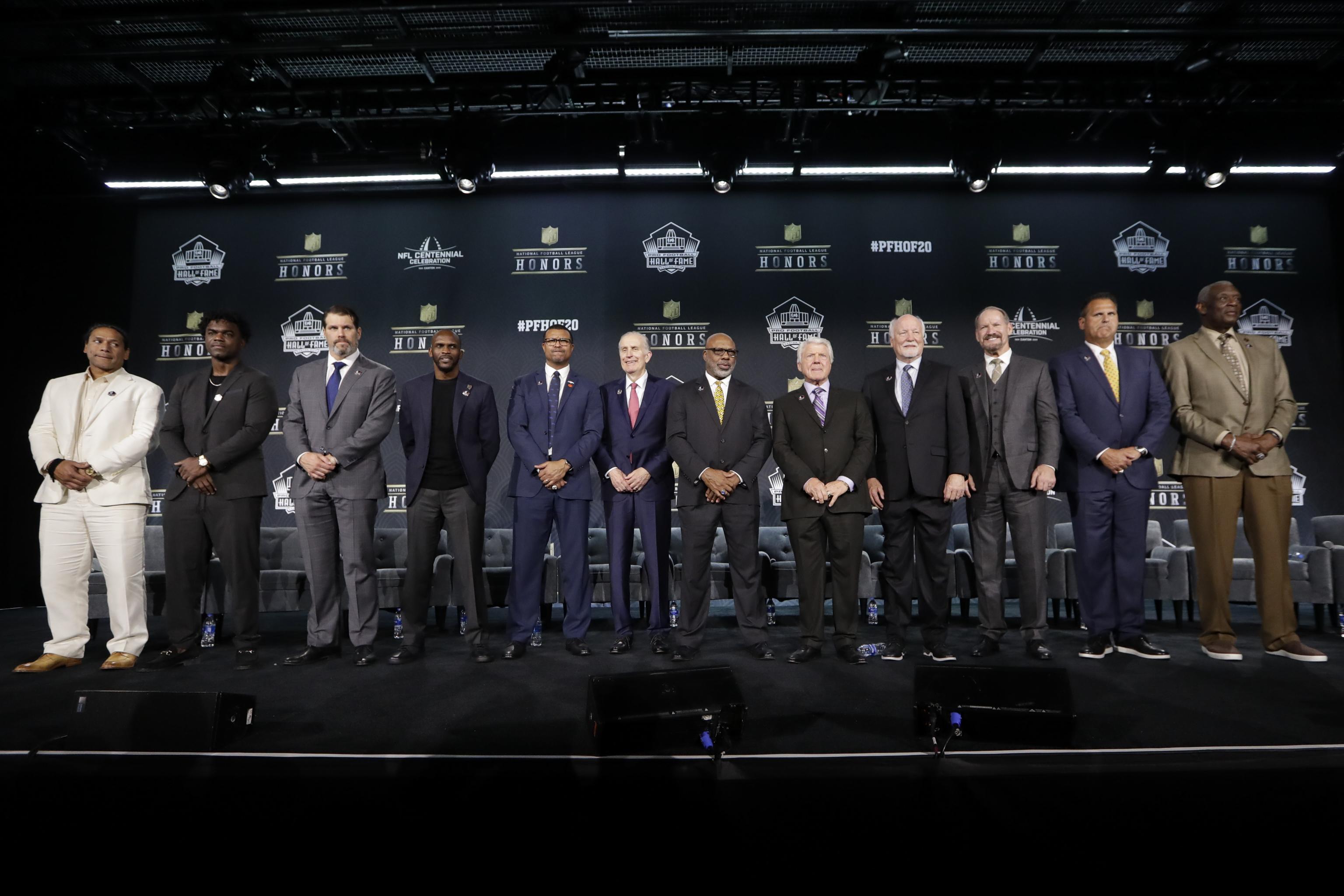
Congratulations to the newly-elected members of the Pro Football Hall of Fame. New members are annually announced on the day before the Super Bowl, and that was done again yesterday. In addition, as part of the celebrations of the NFL's 100th season, a "Centennial Class" was elected, which included several people who should have gotten in years earlier.

Here are the record 20 new electees, listed here in chronological order:

* Duke Slater, two-way tackle, one of the NFL's early black stars, 1922 Milwaukee Badgers, 1922-25 Rock Island Independents, 1926-31 Chicago Cardinals.


* Ed Sprinkle, two-way end, 1944-55 Chicago Bears, including their 1946 NFL Championship.

* Mac Speedie, two-way end, 1946-52 Cleveland Browns, including their 1946, '47, '48 and '49 AAFC Championships, and their 1950 NFL Championship.

* Bobby Dillon, defensive back, 1952-59 Green Bay Packers.

* Alex Karras, defensive tackle, 1958-70 Detroit Lions.

* Steve Sabol, who joins his father and co-founder of NFL Films, Ed Sabol.

* Winston Hill, offensive tackle, 1963-76 New York Jets, including their win in Super Bowl III.

* Cliff Harris, safety, 1970-79 Dallas Cowboys, including their wins in Super Bowls VI and XII.

* Harold Carmichael, receiver, 1971-83 Philadelphia Eagles, including their loss in Super Bowl XV; 1984 Dallas Cowboys.

* Donnie Shell, safety, 1974-87 Pittsburgh Steelers, including their wins in Super Bowls IX, X, XIII and XIV.

* George Young, general manager, 1979-97 New York Giants, including their wins in Super Bowls XXI and XXV.

* Jim Covert, offensive tackle, 1983-90 Chicago Bears, including their win in Super Bowl XX.

* Paul Tagliabue, NFL Commissioner 1989-2006.

* Jimmy Johnson, head coach, 1989-93 Dallas Cowboys, including their wins in Super Bowls XXVII and XXVIII; 1996-99 Miami Dolphins.

* Steve Atwater, safety, 1989-98 Denver Broncos, including their wins in Super Bowls XXXII and XXXIII; 1999 New York Jets.

* Bill Cowher, head coach, 1992-2006 Pittsburgh Steelers, including their win in Super Bowl XL.

* Isaac Bruce, receiver, 1994 Los Angeles Rams, 1995-2007 St. Louis Rams, including their win in Super Bowl XXXIV; 2008-09 San Francisco 49ers.

* Edgerrin James, running back, 1999-2005 Indianapolis Colts, 2006-08 Arizona Cardinals, including their loss in Super Bowl XLIII; 2009 Seattle Seahawks.

* Steve Hutchinson, guard, 2001-05 Seattle Seahawks, including their loss in Super Bowl XL; 2006-11 Minnesota Vikings, 2012 Tennessee Titans.

* Troy Polamalu, safety, 2003-14 Pittsburgh Steelers, including their wins in Super Bowls XL and XLIII.

Dillon died last year, Hill in 2016, Sprinkle in 2014, Karras and Sabol in 2012, Young in 2001, Speedie in 1993, Slater in 1966. The rest are still alive.

*

Inductees are listed here with a team if they played, or coached, or were an executive, with them for at least 4 seasons.

I have divided moved teams accordingly (i.e., Johnny Unitas never took a snap for the Indianapolis Colts). "Sure future Hall-of-Famers" are not included, because, as we have seen in baseball, there is no such thing anymore. 

Tenure as a player, or a coach, or an executive is only counted if they were elected as such. In other words, Raymond Berry coached the Patriots into a Super Bowl, and Forrest Gregg did so with the Bengals, but they were elected as a Colts player and a Packers player, respectively, so those are the teams with which they're included.

Ties in the rankings are broken by more players, as opposed to other categories; and then by time in the league. So a team with 4 players is ahead of one with 3 players and 1 coach, and a team with 3 players in 50 years is ahead of one with 3 players in 80 years.

Figures are listed here as follows: Players in chronological order of their Hall of Fame service with the team (even if they had other functions with that team), then coaches, then executives, then broadcasters.

1. Chicago Bears, 31: George Halas (founder, owner, general manager, head coach, player), John "Paddy" Driscoll, George Trafton, Ed Healey, William "Link" Lyman, Red Grange, Bill Hewitt, Bronko Nagurski, George Musso, Dan Fortmann, Joe Stydahar, Sid Luckman, George McAfee, Clyde "Bulldog" Turner, Ed Sprinkle, George Connor, George Blanda, Bill George, Doug Atkins, Stan Jones, Mike Ditka (player & coach), Dick Butkus, Gale Sayers, Walter Payton, Alan Page, Jim Covert, Richard Dent, Dan Hampton, Mike Singletary, Brian Urlahcer, Jim Finks (executive).

The election of Covert now gives them 5 from their 1985-86 "Super Bowl Shuffle" team, as opposed to 4 from their 1963 NFL Champions, and 7 from their 1940s "Monsters of the Midway" team -- 8 if you count Nagurski's 1943 comeback.

Willie Galimore and Gary Fencik should be in. Thomas Jones is now eligible, and while he didn't spend 4 seasons with any team, his 3 years with the Bears were his most productive period, so I'd list him with them if he got in, and with over 10,000 career rushing yards, he should be in.

2. Green Bay Packers, 28: Earl "Curly" Lambeau (founder, owner, executive, head coach, player), Cal Hubbard, John "Johnny Blood" McNally, Mike Michalske, Arnie Herber, Clarke Hinkle, Don Hutson, Tony Canadeo, Bobby Dillon, Jim Ringo, Bart Starr, Forrest Gregg, Paul Hornung, Jim Taylor, Jerry Kramer, Ray Nitschke, Henry Jordan, Willie Davis, Willie Wood, Herb Adderley, Dave Robinson, James Lofton, Jan Stenerud, Reggie White, Brett Favre, Vince Lombardi (coach & executive), Ron Wolf (executive), Ray Scott (broadcaster, later the main voice on CBS' NFL telecasts).

Nearly half of the Packer figures enshrined in Canton, 13, are from the Lombardi Era, including Lombardi himself. This doesn't count Emlen Tunnell, who played the last 3 seasons of his career with the Packers and retired after the 1st title of the Lombardi Era, 1961.

Now eligible from the Mike Holmgren era, and they would join White and Favre, are Holmgren himself, LeRoy Butler, Adam Timmerman and Gilbert Brown. Eugene Robinson could be considered, but he was only a Packer for 2 seasons, although both ended in Super Bowls, but only 1 won. Sean Jones played 3 seasons for the Packers, and would qualify as a Raider and an Oiler if he got in. Donald Driver is the only figure from the Mike McCarthy era yet eligible and worthy of consideration.

3. Pittsburgh Steelers, 27: Walt Kiesling (also coach), John "Johnny Blood" McNally, Bill Dudley, Ernie Stautner, Jack Butler, John Henry Johnson, Bobby Layne, Joe Greene, Terry Bradshaw, Franco Harris, Mike Webster, Jack Lambert, Jack Ham, Lynn Swann, John Stallworth, Mel Blount, Donnie Shell, Rod Woodson, Dermontti Dawson, Jerome Bettis, Troy Polamalu, Art Rooney (founder-owner), Dan Rooney (owner), Bert Bell (coach, later NFL Commissioner), Chuck Noll (coach), Bill Cowher (coach), Myron Cope (broadcaster). 

While the Steelers were rarely competitive for their 1st 40 seasons, they did have a few players who were Hall-worthy, but note that 14 of the 27, more than half, were involved with the club during their 1972-79 "Steel Curtain" dynasty. Hines Ward is now eligible, and while that touchdown he scored on a kickoff return for the Gotham Rogues as the field collapsed behind him in The Dark Knight Rises does nothing to help his candidacy, if he does get in, you know that highlight will be played over and over again.


4. New York Giants, 22: Steve Owen (elected as a coach, also a pretty good player for Giants), Ray Flaherty, Benny Friedman, Red Badgro, Mel Hein, Ken Strong, Alphonse "Tuffy" Leemans, Emlen Tunnell, Arnie Weinmeister, Frank Gifford, Roosevelt Brown, Sam Huff, Andy Robustelli, Y.A. Tittle, Fran Tarkenton, Harry Carson, Lawrence Taylor, Michael Strahan, Tim Mara (founder & owner), Wellington Mara (owner), Bill Parcells (coach), George Young (executive).

Gifford has also been elected as a broadcaster. So has Pat Summerall, but as a CBS & Fox broadcaster, not as a Giants player or broadcaster, so he can't be included here. Tom Landry was the 1st great defensive back to be only a defensive back, after the early 1950s shift to two-platoon football, and was the defensive coordinator on the Giants' 1956-63 contenders. But was elected to the Hall based on his service as a head coach, and he only served as such for the Cowboys, and thus can't be counted here.

There are 6 from the 1956 NFL Champions, but only 3 from Parcells' Super Bowl-winning teams, 5 if you count Parcells himself and the newly-elected Young. Phil Simms has not yet been elected, and you can also make a case for Mark Bavaro (tight ends are in short supply in the Hall), George Martin and Leonard Marshall. I wonder if anyone will be willing to vote for Tiki Barber, who is now eligible.

5. Washington Redskins, 22: Cliff Battles, Turk Edwards (also coach), Wayne Millner, Sammy Baugh, Bobby Mitchell, Sonny Jurgensen, Charley Taylor, Sam Huff, Paul Krause, Chris Hanburger, Ken Houston, John Riggins, Art Monk, Russ Grimm, Darrell Green, Bruce Smith (last 4 years of his career as a Redskin), Champ Bailey, George Preston Marshall (founder & owner), Ray Flaherty (elected as a Giants player but coached 'Skins to 2 NFL titles so I'm counting him as one of theirs), George Allen (coach), Joe Gibbs (coach), Bobby Beathard (executive).

Jurgensen and Huff have also been broadcasters for the team. Grimm is the only one of the "Hogs" yet elected, but Jeff Bostic and Joe Jacoby should also be elected. A case can be made for an earlier Redskin lineman, Len Hauss.

None of the men who have thus far quarterbacked the Redskins into a Super Bowl is in: Not Billy Kilmer, not Joe Theismann, not Doug Williams, not Mark Rypien -- and good cases can be made for all but Rypien, who just didn't play long enough. If Jan Stenerud got elected as a kicker (who didn't also play another position, as did Lou Groza and George Blanda), then why not Mark Moseley?

6. Dallas Cowboys, 20: Bob Lilly, Mel Renfro, Bob Hayes, Rayfield Wright, Mike Ditka, Roger Staubach, Cliff Harris, Randy White, Tony Dorsett, Troy Aikman, Emmitt Smith, Michael Irvin, Deion Sanders, Larry Allen, Charles Haley, Tom Landry (coach), Jimmy Johnson (coach), Bill Parcells (coach), Tex Schramm (executive), Jerry Jones (owner).

Parcells did coach them for 4 seasons, so that counts. Ditka is so identified with the Bears (with whom he practically invented the position of tight end and won an NFL Championship in 1963) that people forget he was a Cowboy, and won a Super Bowl each as a player and as one of Landry's assistant coaches -- as did Dan Reeves, although if he ever got elected it would be as a head coach, and therefore not as a Cowboy.

Don Meredith was elected as a broadcaster, but was never a broadcaster specifically for the Cowboys. A case can be made that he deserves election as a player. Drew Pearson, Charlie Waters and Herschel Walker also have their advocates.

Oakland Raiders, 19: Jim Otto, Fred Biletnikoff, George Blanda, Ken Stabler, Gene Upshaw, Willie Brown, Art Shell, Dave Casper, Ray Guy, Ted Hendricks, Mike Haynes, Howie Long, Marcus Allen, Jerry Rice, Warren Sapp, Tim Brown, John Madden (coach), Al Davis (owner-coach), Ron Wolf (scout).

Madden has also been elected as a broadcaster. Rice and Sapp were both there for 4 seasons, so they count. Now that Guy is in, who's the most obvious Raider not in? I'd say Jack Tatum, if anybody's got the guts to elect a great cornerback who needlessly paralyzed a man in a preseason game. Also worthy of consideration are Ben Davidson and Lester Hayes.


Note that I'm making an exception to my one-city-only rule for the California-era Raiders, treating them as a continuous Oakland franchise, since they did return, even though their Los Angeles edition became a cultural icon (and not for good reasons). Counted separately, the Oakland Raiders have 16, and the Los Angeles Raiders have 3 (Haynes, Long, Allen). I have now relegated this team to former team status, and the Las Vegas Raiders' Hall-of-Famers will drop to zero for many years to come.


7. Kansas City Chiefs, 18: Bobby Bell, Len Dawson, Willie Lanier, Buck Buchanan, Emmitt Thomas, Johnny Robinson, Curley Culp, Jan Stenerud, Derrick Thomas, Marcus Allen, Willie Roaf, Will Shields, Tony Gonzalez, Hank Stram (coach), Mary Levy (coach), Lamar Hunt (founder-owner), Bobby Beathard (executive), Charlie Jones (broadcaster, did Dallas Texans/K.C. Chiefs games before becoming the main voice for NBC's AFL and then AFC broadcasts).

Dawson has also been elected as a broadcaster. 

8. Cleveland Browns, 17: Otto Graham, Marion Motley, Lou Groza, Dante Lavelli, Bill Willis, Mac Speedie, Frank Gatski, Len Ford, Mike McCormack, Jim Brown, Bobby Mitchell, Gene Hickerson, Leroy Kelly, Paul Warfield, Joe DeLamiellure and Ozzie Newsome, Paul Brown (coach-executive).

It says something about this franchise that there have been no players who have played so much as a down for them since 1990 that can be called a Browns' HOFer -- and only DeLamielleure and Newsome have played for them since 1977. Tom Cousineau hasn't made it, and neither has Clay Matthews Jr. (father of the current star Packer linebacker and brother of Oliers/Titans HOFer Bruce Matthews -- Clay Sr. played for the 49ers in the 1950s, but wasn't HOF quality).

And yet, look at just what they produced in the 1940s and '50s. And that doesn't include players they let get away, like Doug Atkins, Henry Jordan, Willie Davis, Len Dawson, and (while they did both play long enough for the Browns to be counted with them) Mitchell and Warfield.

Maybe that's the real reason Art Modell isn't in the Hall: It's not that he moved the original Browns, and screwed the people of Northern Ohio, it's that he was a bad owner. (Though, to be fair, his firing of Paul Brown and installation of Blanton Collier in 1962 did bring the 1964 NFL Championship, Cleveland's last title in any sport until the 2016 Cavaliers.)

9. San Francisco 49ers, 17: Bob St. Clair, Y.A. Tittle, Joe "the Jet" Perry, Leo Nomellini, Hugh McElhenny, John Henry Johnson, Dave Wilcox, Jimmy Johnson, Joe Montana, Fred Dean, Ronnie Lott, Jerry Rice, Steve Young, Charles Haley, Terrell Owens, Bill Walsh (coach), Eddie DeBartolo (owner).

Tittle, Perry, McElhenny and John Henry Johnson are the only entire backfield that all played together to all be elected to the Hall, and they were known as the $100,000 Backfield. The Jimmy Johnson listed above was a black cornerback in the 1960s and '70s, and should not be confused with the white coach for the Cowboys -- although this Jimmy Johnson, unlike the coach, was actually born in Dallas.

Rickey Jackson only played 2 seasons for the Niners, but he did win his only ring with them. Deion Sanders played only 1 season for them, but got the same Super Bowl XXIX ring that Jackson did. So, due to insufficient longevity, I can't cont either of them as 49ers HOFers.

From their 1980s champions, Dwight Clark, Roger Craig, Randy Cross, Guy McIntyre, Harris Barton and Ken Norton Jr. have not been elected, but all are worth consideration, and Craig absolutely should be in.

10. Los Angeles Rams, 15: Bob Waterfield, Tom Fears, Elroy "Crazy Legs" Hirsch, Norm Van Brocklin, Les Richter, Deacon Jones, Merlin Olsen, Tom Mack, Jackie Slater, Jack Youngblood, Eric Dickerson, Kevin Greene, George Allen (coach), Dan Reeves (owner, not to be confused with the Denver/Atlanta coach), Dick Enberg (broadcaster).

Joe Stydahar coached the Rams to their only NFL Championship in Los Angeles, 1951, but he was elected as a player, not a coach, and so che an't be counted as a Rams' Hall-of-Famer. Counting their St. Louis years, the Rams franchise has 19. Now that Greene is in, Henry Ellard is the most deserving former L.A. Ram not yet in the Hall, but he's a borderline case at best.

11. Detroit Lions, 15: Dutch Clark (also coach), Jack Christiansen, Bobby Layne, Doak Walker, Yale Lary, Alex Wojciechowicz, Lou Creekmur, Dick Stanfel, Dick "Night Train" Lane, Joe Schmidt (also coach), Alex Karras, Lem Barney, Dick LeBeau, Charlie Sanders and Barry Sanders (no relation to each other).

Although he played for their 1935 NFL Champions and coached them to the 1952 and '53 titles, Buddy Parker is not in the Hall. It took until this year, a little over 7 years after he died, for Karras to be elected. If Paul Hornung, a man whose morals were a lot looser than Karras', could be forgiven for his gambling charge that led to his suspension for the 1963 season and get elected, why not Karras, who was suspended at the same time for the same offense? Even though he's in now, the question still hangs there.
It says something about this franchise that there has been only 1 player (Barry Sanders) who has played so much as a down for them since 1977 that can be called a Lions' HOFer, although cases can be made for Herman Moore, Lomas Brown and Chris Spielman.

12. Minnesota Vikings, 15: Fran Tarkenton, Carl Eller, Alan Page, Paul Krause, Ron Yary, Mick Tinglehoff, Chris Doleman, Gary Zimmerman, Randall McDaniel, Cris Carter, John Randle, Randy Moss, Steve Hutchinson, Bud Grant (coach), Jim Finks (executive). Warren Moon was only there for 3 seasons. 

13. Philadelphia Eagles, 14: Steve Van Buren, Alex Wojciechowicz, Pete Pihos, Chuck Bednarik, Sonny Jurgensen, Tommy McDonald, Norm Van Brocklin, Bob Brown, Jim Ringo, Harold Carmichael, Reggie White, Brian Dawkins, Greasy Neale (coach), Bert Bell (founder-owner-coach, later NFL Commissioner).

Van Brocklin only played 3 seasons for the Eagles, but he was the quarterback on their last NFL Championship team before the Super Bowl era, 1960, and then he retired, despite being only 34 years old, so I'm bending the rule to count him. On the other hand, Claude Humphrey played 3 seasons for them, 1 being their 1st trip to the Super Bowl, but unlike Van Brocklin is not an Eagles icon, so I can only include him with the Falcons. This means that Carmichael is the 1st Eagle Hall-of-Famer from the Dick Vermeil era. Vermeil himself is not in, and should be.

Art Monk, James Lofton and Richard Dent briefly played for the team, and cases could be made for Stan Walters, Jerry Sisemore, Bill Bergey, Randall Cunningham, Clyde Simmons, Seth Joyner and Donovan McNabb. Ron Jaworski, however, only stands to be elected as a media personality, not a player. That is how Irv Cross was elected: While he made 2 Pro Bowls as an Eagle cornerback, he is not in the Hall as a player.


14. Miami Dolphins, 12: Larry Csonka, Nick Buoniconti, Bob Griese, Jim Langer, Larry Little, Paul Warfield, Dan Marino, Dwight Stephenson, Jason Taylor, Don Shula (coach), Jimmy Johnson (coach), Bobby Beathard (executive).

Johnson didn't win as Dolphins' head coach, but he was there for 4 seasons, so he counts there. In spite of everything that happened in his career, Ricky Williams rushed for over 10,000 yards. He is now eligible, but I doubt he'll ever get in. If he does, he would qualify only as a Dolphin, not as a Saint.

15. Buffalo Bills, 12: Billy Shaw, O.J. Simpson (had to list him), Joe DeLamiellure, James Lofton, Jim Kelly, Bruce Smith, Thurman Thomas, Andre Reed, Marv Levy (coach), Ralph Wilson (owner), Bill Polian (executive) and Van Miller (broadcaster).

Shaw played his entire career in the AFL, making him the only man in the Pro Football Hall of Fame who never played a down in the NFL. (Remember, it's not the National Football League Hall of Fame, it's the Pro Football Hall of Fame.) So much fuss was made over the special-teams skills of Steve Tasker that I'm surprised that he's not in.


Houston Oilers, 11: George Blanda, Elvin Bethea, Curley Culp, Robert Brazile, Earl Campbell, Dave Casper, Ken Houston, Charlie Joiner, Warren Moon, Mike Munchak, Bruce Matthews. Since Matthews counts as both an Oiler and a Titan, if we combine the Houston years and the Tennessee years, their total rises to 12.


Chicago Cardinals, 10: Jimmy Conzelman, Paddy Driscoll, Guy Chamberlin, Duke Slater, Ernie Nevers, Walt Kiesling, Charley Trippi, Ollie Matson, Dick "Night Train" Lane, Charles Bidwill (owner). Conzelman, Driscoll and Kiesling were also head coaches for the Cards. Counting all their cities, despite having been around for nearly a century, the Cards have only 14 Hall-of-Famers.

Baltimore Colts, 10: Art Donovan, Raymond Berry, Gino Marchetti, Johnny Unitas, Lenny Moore, Jim Parker, John Mackey, Ted Hendricks, Weeb Ewbank (coach), Don Shula (coach). Counting their Indianapolis years, the Colts have 14.

San Diego Chargers, 10: Ron Mix, Lance Alworth, Fred Dean, Dan Fouts, Charlie Joiner, Kellen Winslow, Junior Seau, LaDainian Tomlinson, Sid Gillman (coach), Bobby Beathard (executive).

16. New England Patriots, 10: Nick Buoniconti, John Hannah, Mike Haynes, Andre Tippett, Curtis Martin, Ty Law, Junior Seau, Randy Moss, Bill Parcells (coach) and Don Criqui (broadcaster). This counts players from their AFL days, when they were officially named the Boston Patriots.

Cases could also be made for Jim Nance, Jim Hunt, Steve Nelson, Julius Adams, Irving Fryar, Drew Bledsoe and Tedy Bruschi, all eligible.

17. Denver Broncos, 9: Willie Brown, Floyd Little, John Elway, Steve Atwater, Shannon Sharpe, Gary Zimmerman, Terrell Davis, Champ Bailey, Pat Bowlen (owner). 3-time AFC Champion coach Dan Reeves has not been elected, but should be. So should Randy Gradishar and Mark Schlereth, although, because of how many feathers he ruffled, I don't think you'll ever see Bill Romanowski get in. Peyton Manning becomes eligible in 2021.

18. New York Jets, 9: Don Maynard, Winston Hill, Joe Namath, John Riggins, Curtis Martin, Kevin Mawae, Weeb Ewbank (coach), Bill Parcells (coach-executive), Ron Wolf (executive).

Of the 9, 4 are from the Super Bowl III team. Although the Big Tuna only coached the Jets for 3 seasons, he was an executive with them for 4 seasons, and thus meets my qualification for a Jet HOFer. Wesley Walker, Joe Klecko and Marty Lyons should be considered, although nobody seems to be willing to vote for Mark Gastineau. Vinny Testaverde is eligible, but not yet in. (He would also qualify as a Buccaneer.)

19. Seattle Seahawks, 6: Steve Largent, Kenny Easley, Cortez Kennedy, Walter Jones, Kevin Mawae, Steve Hutchinson. Rickey Watters is eligible, and while he only played 3 seasons each with the 49ers and Eagles, he played 4 with the 'Hawks, so if he goes in, he would qualify only for them.

Canton Bulldogs, 6: Jim Thorpe, Guy Chamberlin, Joe Guyon, Pete Henry, William "Link" Lyman, Earl "Greasy" Neale.

20. Indianapolis Colts, 6: Eric Dickerson, Marshall Faulk, Marvin Harrison, Edgerrin James, Tony Dungy (coach), Bill Polian (executive). Reggie Wayne is now eligible. Peyton Manning becomes eligible in 2021.

St. Louis Rams, 5: Orlando Pace, Kurt Warner, Marshall Faulk, Isaac Bruce, Aeneas Williams. Dick Vermeil and Torry Holt are eligible. Note that the St. Louis edition of the Rams is now italicized as a former team. Unlike the Raiders, it doesn't really make sense to fold the St. Louis era in with Los Angeles.

21. Baltimore Ravens, 5: Jonathan Ogden, Ray Lewis, Rod Woodson, Ed Reed, Ozzie Newsome (executive). Newsome was elected as a Cleveland Browns player, but has been a masterful executive for the franchise since the move, so I'm bending the rules to include him as a Brown and a Raven. Jamal Lewis is eligible, but isn't yet in.

22. Atlanta Falcons, 5: Deion Sanders, Claude Humphrey, Morten Andersen, Tony Gonzalez, Bobby Beathard (executive). I wonder if anyone will vote for Michael Vick when he becomes eligible in 2022. Andre Rison, another controversial figure, is already eligible, and, while he played for 7 different teams (plus 1 in the CFL), on this list, he would qualify only for the Falcons.)

23. Tampa Bay Buccaneers, 5: Lee Roy Selmon, Warren Sapp, Derrick Brooks, Tony Dungy (coach), Ron Wolf (executive). John Lynch is now eligible, and should be in, and would also qualify as a Bronco. Warrick Dunn is now eligible, and should be in, and would also qualify as a Falcon.

24. New Orleans Saints, 4: Rickey Jackson, Willie Roaf, Morten Andersen, Jim Finks (executive). Mike Ditka was Saints coach for 3 seasons and Tom Fears for 4, but neither was elected as a coach, so they can't be included here anyway. Same for Hank Stram, who was elected as a coach, but only coached the Saints for 2 seasons.

St. Louis Cardinals, 4: Larry Wilson, Dan Dierdorf, Jackie Smith, Roger Wehrli. Dierdorf has also been elected as a broadcaster, although not specifically with the Cardinals. Ottis Anderson should be elected as a Cardinal, although he achieved his greatest moment as a Giant.

Duluth Eskimos, 3: Walt Kiesling, John "Johnny Blood" McNally, Ernie Nevers.

25. Cincinnati Bengals, 3: Charlie Joiner, Anthony Munoz, Paul Brown (founder-owner-coach). Reggie Williams and Corey Dillon should be in, but Boomer Esiason is a borderline case. Chad "Ochocinco" Johnson hasn't played in an NFL game since 2011, but played in the Canadian Football League as recently as 2015, so I don't know what the ruling is on when his eligibility begins. Whenever it does, he's both a borderline Hall of Fame case and a borderline mental case.

26. Tennessee Titans, 2: Bruce Matthews, Kevin Mawae. Matthews only played 3 years as a "Tennessee Titan," but counting 2 years as a "Tennessee Oiler," he qualifies for the Titans. Eddie George is eligible, and should be in.

27. Arizona Cardinals, 2: Aeneas Williams, Kurt Warner. Emmitt Smith wasn't with them long enough. Nor was Edgerrin James.

Frankford Yellow Jackets, 2: Guy Chamberlin, William "Link" Lyman. The 1926 NFL Champions should also have Russell "Bull" Behman and Henry "Two-Bits" Homan -- the former a big guy by the standards of the time, and the latter a little guy who was the NFL's answer to Wee Willie Keeler -- in the Hall.  But both died in the early 1950s, so neither was able to speak on his own behalf since the 1962 founding of NFL Films. Although the Eagles replaced the Jackets as Philadelphia's NFL team, the two teams are not the same franchise.

Providence Steam Roller, 2: Jimmy Conzelman (player & coach), Frederick "Fritz" Pollard.

Brooklyn Dodgers (NFL 1930-1948), 2: Clarence “Ace” Parker, Frank "Bruiser" Kinard.

28. Carolina Panthers, 1: Bill Polian (executive). Mike McCormack was an executive with them, but that's as close any other Panthers figure comes. Reggie White, who played for them in 2000 and died in 2004, is their only former player thus far inducted. Perhaps the late Sam Mills might end up being their 1st elected HOF player, or maybe Steve Smith. Kevin Greene only played 3 seasons for them, so he doesn't count. Cam Newton, of course, is still active.

29. Las Vegas Raiders, none. Sorry, Mark Davis, but you dropped your team (nearly) to the bottom of this list when you screwed Oakland over, like your daddy did before you.

30. Los Angeles Chargers, none. Sorry, Dean Spanos, but you dropped your team (nearly) to the bottom of this list when you screwed San Diego over.


31. Houston Texans, none. Not surprising, as they are the newest franchise -- if not, as you saw above, "the newest team." It's not yet clear who their 1st HOFer would be, although the recently-retired Andre Johnson made 7 Pro Bowls, and the still-active J.J. Watt has made 5. Ed Reed.

32. Jacksonville Jaguars, none: Not surprising, as they've only been around since 1995, and, while they've made 3 AFC Championship Games, they have yet to reach a Super Bowl. I had previously listed Tony Boselli. While he is in the College Football Hall of Fame, he has not yet been elected to the Pro Football Hall. He is still the likeliest to become their 1st HOFer. Fred Taylor is also a possibility.

Rock Island Independents, 1: Duke Slater.

Tuesday, February 26, 2013

Top 10 Best Executives in New York Sports History


This list is less about the team owners and more about the men who made the personnel decisions -- the trades, the free-agent signings, the draft picks.

Honorable Mention to John T. Brush, the owner who restored the baseball New York Giants to glory from 1902 to his death in 1912, and built the last and most familiar version of the Polo Grounds. And to Charles "Chub" Feeney, the general manager who built the Giants' 1951 National League Pennant winners and 1954 World Champions -- but was also the main force behind their attempt to move the team to Minneapolis (where their top farm team was located) for the 1958 season, and then scuttled that move when Brooklyn Dodger owner Walter O'Malley suggested to Giant owner Horace Stoneham (Chub's uncle) that both teams move to California instead, the Dodgers to Los Angeles and the Giants to San Francisco.

Honorable Mention also to Lester Patrick. One of the best players of the 1900s and 1910s, he was the Rangers' first GM (1926-46) and first head coach (1926-39), leading them to the 1928 and 1933 Stanley Cups, before stepping aside and letting his former best player, Frank Boucher, coach them to the 1940 Cup. A charter member of the Hockey Hall of Fame.

Honorable Mention to Eddie Donovan. Bad coach with the Knicks, but great general manager, who built the 1970 and 1973 NBA Champions, although that may have been more to do with the coaching of Red Holzman. Still, Eddie hired Red, which counts for a lot.

Honorable Mention to Gabe Paul. When George Steinbrenner bought the Yankees in 1973, they were far and away New York's 2nd team behind the Mets. He had Gabe Paul as part-owner and personnel man. The team was completely overhauled. For 1974, Paul traded for Lou Piniella, Chris Chambliss and Dick Tidrow. For 1975, Paul signed free agent Catfish Hunter.

For 1976, Paul traded for Willie Randolph, Mickey Rivers and Ed Figueroa. For 1977, Paul traded for Bucky Dent. Granted, bringing in manager Billy Martin and slugger Reggie Jackson were both ideas of George Steinbrenner (and George should, at least, get Honorable Mention status for those 2 moves alone), but Paul built the team.

All those years, both before and after this, he ran the Cleveland Indians, but never won anything. He never had an owner with enough money to build a champion, and, as a result, Paul often had to sell off or trade away players in salary dumps just to keep the Indians afloat. With George, Gabe finally had a man willing to spend whatever it took. And they found out what it took. It was worth every penny. If Gabe hadn't had enough of George after the 1977 victory, and had stayed, I might rank him higher.

And Honorable Mention to Al Rosen, who succeeded Gabe, and brought in Goose Gossage, vital spare parts Gary Thomasson and Jay Johnstone, and, after Billy had to go, his old Indians teammate Bob Lemon as manager. To Bob Watson, the GM who finished Gene Michael's job in 1996. And to Brian Cashman, who took over from 1998 and has continued to build the Yankee Mystique. But I can't put any of the 3 of them on this list.

10. Jerry Reese, Giants, 2004-present. Director of Player Personnel starting in '04, and general manager since '07, he has done in those few years what all the employees that the New York Jets have ever had, combined, have not been able to do: Build a team that won 2 Super Bowls. And yet, lots of people don't even know his name.  He has quietly rebuilt the Giants into a class organization.

But while the job he's done has been impressive -- not since the 1997-98 Broncos has any other team won 2 Super Bowls without cheating -- it wasn't nearly as important to the franchise as that done by...

9. George Young, Giants, 1979-97. After the disastrous play known as "the Miracle of the Meadowlands" against the Philadelphia Eagles on November 19, 1978, Giants owner Wellington Mara had enough. The team his father Tim founded (and Honorable Mention to him, and to Wellington) was at the bottom of the barrel. They hadn't won an NFL Championship since 1956 (Super Bowl -X, if you prefer) or made the Playoffs since 1963 (the NFL Championship Game loss to the Chicago Bears, Super Bowl -III), and he wanted a new GM and a new head coach.

Young had built the Baltimore Colts into the team that won Super Bowl V and was now the GM of the perennial Playoff team the Miami Dolphins, so he was the right GM. He hired Ray Perkins, who got the Giants into the Playoffs in 1981. When Perkins left to succeed his mentor Bear Bryant at the University of Alabama, Young hired Perkins' assistant, Bill Parcells, and that was the right coach, winning Super Bowls XXI and XXV. The Giants made the Playoffs 8 times while Young was GM, and nobody laughs at them anymore.

Honorable Mention to Parcells, who as both head coach and GM brought the Jets back from the disgrace and ineptitude of the Rich Kotite years. He's not on the main list because he didn't stick around long enough to finish the job for Gang Green the way he and Young did with Big Blue.

Honorable Mention to David "Sonny" Werblin, GM of the Jets who built their Super Bowl III Champions. If he'd been allowed to stick around longer, he might be on this list. As it is, he went on to run the New Jersey Sports & Exposition Authority and helped Governor Brendan Byrne build the Meadowlands Sports Complex, then crossed back over the Hudson River to be President of the Madison Square Garden Corporation, helping the Rangers regain their respectability in the late Seventies and put the Knicks back on solid footing in the Eighties.

If you think about it, he helped out the Giants, Jets, Knicks, Rangers, Nets and Devils -- six teams! However, unless you count the one the Jets won shortly after he was fired, none of the teams won a title while he was involved with them.

8. Jacob Ruppert, Yankees, 1915-39. More specifically, 1915-20, before hiring Ed Barrow away from the Boston Red Sox, where he'd been field manager, to be his general manager. Barrow ranks considerably higher on this list, and he did have the help of Ruppert's vast personal fortune.

But it was "the Colonel" who insisted that the Yankees move from being New York's 3rd team to America's 1st team. The moves he made brought in manager Miller Huggins, pitchers Bob Shawkey and Carl Mays, and, of course, Babe Ruth.  And he built Yankee Stadium. While "This Imposing Edifice," as his Monument Park Plaque called the original, is now gone, Ruppert's legacy lives. So why did it take until last fall for the greatest empire builder in the history of North American sport to be elected to the Baseball Hall of Fame?

Ruppert is buried in Kensico Cemetery in Valhalla, New York. In that same cemetery are interred Billy Martin, Yankee National Anthem singer Robert Merrill, and Harry Frazee, the Red Sox owner from whom Ruppert made the purchases that made the Yankees. It is virtually next-door to Gate of Heaven Cemetery in Valhalla, final resting place of the Babe, Billy Martin, and a different kind of "Yankee Doodle Dandy," although also a Yankee Fan, James Cagney.

7. George Weiss, Yankees, 1947-60. He was the personnel man in the Yankees' most glorious period, the Casey Stengel years. It was Weiss who talked owners Dan Topping and Del Webb into hiring Stengel for the 1949 season, and the Yankees of the Fabulous Fifties were off and running.

Weiss was every bit the cheap, mean old bastard that his predecessor Ed Barrow was, but he was the guy who brought in Mickey Mantle, Whitey Ford, Roger Maris, and a bunch of veterans who seemed good bets to help the Yankees win the Pennant in a particular year, some of whom stuck around to win more than one: Johnny Mize, Johnny Sain, Jim Konstanty, Bobby Schantz, Enos Slaughter. (Some of them may have been Stengel's idea, but Weiss saw the wisdom in the Ol' Perfesser's wishes.)

After the 1960 season, Topping and Webb fired both Stengel and Weiss. Weiss predicted that within 5 years, the Yankee Dynasty would be over. He was right, and he knew why: Topping and Webb had begun looking for a buyer. They figured, we're not going to own the team in 5 years, so what do we care how good the team is? So the beautiful farm system that Weiss had built as Barrow's assistant dried up. Still, Weiss is in the Hall of Fame -- but not, for some reason, in Monument Park.

6. Frank Cashen, Mets, 1980-91. He had been the GM that built the Baltimore Orioles into the 1966 and 1970 World Champions. In 1980, upon buying the Mets from Lorinda de Roulet, daughter of team founder Joan Payson, Fred Wilpon and Nelson Doubleday hired Cashen as GM. His job was more dire than that of Yankee GMs Gabe Paul in 1973 and Gene Michael in 1990. In fact, it may have been the most dire rebuilding job in New York sports since Larry MacPhail saved the Dodgers in 1938.

Think about it: The Mets weren't just no longer New York's 1st baseball team, they were barely its 2nd. Since the Mets' 1973 Pennant, the Yankees had won 3 Pennants and 2 World Series; the Rangers had been to the Stanley Cup Finals; the Islanders were on their way to the first of 4 straight Cups; the Nets had won 2 ABA titles; and, while they weren't very good at the moment, the Giants and Jets already had in place the rebuilding efforts that would make them Playoff contenders throughout the Eighties. Only the Knicks were in remotely as bad a shape. (The Devils hadn't arrived yet.) The Mets had been so decimated by the moves of team chairman M. Donald Grant (fired in 1978) that Shea Stadium was averaging 12,000 fans a night and got the nickname "Grant's Tomb."

Cashen's first draft pick was Darryl Strawberry. He drafted Dwight Gooden. He got perennial All-Stars (already) Keith Hernandez and Gary Carter, in each case for next to nothing. He traded for Ron Darling and Howard Johnson. And he hired the right manager for them, Davey Johnson. (Although that may not be all that accurate: Davey may have looked too far the other way on Darryl's and Doc's substance abuse, and he has never won another Pennant with any of the 4 teams he has since managed, including botching the Washington Nationals' chances last fall.)

Cashen built a team that finished 1st or 2nd every season from 1984 to 1990, and won the 1986 World Series. The reason he isn't higher on this list is that the team won only the 1 Series, and that team did tarnish themselves in some ways. But for Cashen to have taken the Mets to where they were at the dawn of the 1980s -- Met fans, surrounded by Yankee Fans' gloating, probably felt as much like hostages as those in Iran at the moment -- to where they were in October 1986 was mind-boggling. The Mets weren't just on top of New York, they were on top of the world.

As late as 1991, Cashen's last season (he resigned after a 5th-place finish), they were still, beyond question, a better organization than the Yankees. That they have never been that again is not his fault, but neither did he do much to avoid it, and that's why he's not higher on this list.

5. Larry MacPhail, Dodgers 1938-41, Yankees 1945-47. He had already restored the Cincinnati Reds, putting up Major League Baseball's first stadium lights, negotiating a lucrative radio contract (although it helped that the Reds owner who hired him, Powel Crosley, was a radio manufacturer), and making the deals that built the team that won the 1939 Pennant and the 1940 World Series.

Desperate to keep from going out of business, the financially troubled Dodgers brought him in, and the Roaring Redhead did much the same thing: He put up lights at Ebbets Field (the Polo Grounds got lights in 1940), broke the "gentlemen's agreement" against the New York teams broadcasting on radio, brought his Cincinnati broadcaster Red Barber in, renovated Ebbets Field to make it clean and family-friendly, and made the transactions that built the 1941 Pennant winners.

But MacPhail had a serious drinking problem, and the other owners forced him out after the '41 Series. In 1945, he joined with metal-industry heir Dan Topping and real estate tycoon Del Webb to buy the Yankees from Colonel Ruppert's heirs, and they modernized the team, putting lights up at Yankee Stadium in 1946 and getting the team on local television.

After winning the 1947 World Series, MacPhail got drunk and nasty at the victory party, and shortly thereafter was bought out by Topping and Webb. He never worked in baseball again, and rarely gets credit for the rebuilding that turned the Yankees into a team that won 13 Pennants in 16 seasons from 1947 to 1964.

But his legacy lives on: Aside from the Frank McCourt divorce saga (which was a mess but not an existential crisis for the club), the Dodgers have never again been in financial difficulty, not in Brooklyn, not in Los Angeles. They remain one of the model franchises in the game.

MacPhail's son Bill became President of CBS Sports, his other son Lee became GM of the Orioles and Yankees and President of the American League (and they are the only father-son combination in the Hall of Fame); Lee's son Andy became GM of the Twins and president of the Cubs and Orioles; and Lee's grandson Leland Stanford MacPhail IV works with his uncle Andy in the Oriole front office.

4. Gene Michael, Yankees, 1990-95. The stereotypical "Good field, no hit" player in the late Sixties and early Seventies, "Stick" went on to serve the Yankees as minor league manager, major league coach, major league manager (twice), chief scout and general manager.

When Steinbrenner was suspended in 1990, Michael was given the keys to the kingdom, and had a hell of a mess to clean up: A number of George's trades, in the manner of the Fifties Yankees where 3 prospects would be traded for one guy who could help them win in a given year, hadn't panned out. And the Mets were, far and away, the Tri-State Area's most popular team.

Mariano Rivera and Bernie Williams had just come into the system. Michael's guidance led to the drafting of Derek Jeter, Andy Pettitte and Jorge Posada. He engineered the trades for Paul O'Neill and David Cone, and the signings of Wade Boggs and Jimmy Key. Back from suspension, George removed him from the GM post, although he was still a key man in the operations, and as "superscout" his suggestions remained part of the backbone of the building of the 1996-2003 dynasty.

I hope George's sons give him his Monument Park Plaque while he's still alive, because if it wasn't for Stick, George's Monument would be a joke.

3. Bill Torrey, Islanders, 1972-92. John Brush of the baseball Giants. Jacob Ruppert, Gabe Paul and Gene Michael of the Yankees. George Young of the football Giants. Bill Parcells of both the Giants and the Jets. Sonny Werblin of the Jets, Knicks and Rangers. Lou Lamoriello of the Devils. These men took awful, even disgraceful, franchises, and brought (or restored) them to glory. And Larry MacPhail may have saved the Dodgers completely. But building a team from scratch, making them a Playoff contender within 3 years, and a World Champion within 8 years? Without Steinbrenner-type money? Impossible.

No, it's not. Torrey and Isles coach Al Arbour did it. By 1978, the team of Denis Potvin, Bryan Trottier, Mike Bossy and Billy Smith was almost ready to go all the way. By 1980, they'd added Butch Goring and Clark Gillies, and 4 straight Stanley Cups followed. Torrey is in the Hockey Hall of Fame, and is honored with a banner with his signature bowtie on it in the rafters of the Nassau Coliseum.

Why can't I give any more than an Honorable Mention to Lamoriello, the Devils' GM since 1987? After all, he's built a team that's made the Playoffs every season but one since 1991, has reached the Conference Finals 6 times, the Cup Finals 4 times and won the Cup 3 times.

But he's also short-circuited the Meadowlands Marauders' (now the Mulberry Street Marauders') chances to win more by some truly baffling trades -- Claude Lemieux for Steve Thomas? John MacLean for Doug Bodger? -- and letting star players go to save money. Letting Scott Gomez get away was, I suppose, understandable... but to the Rangers? To The Scum?!?

And it is neither secret nor coincidence that, after he let defensemen Scott Niedermayer and Brian Rafalski go after the 2006 season, the next 2 Cups were won by Niedermayer's Anaheim Ducks and Rafalski's Detroit Red Wings. Sure, I understand, the Ducks were a good team and Nieder wanted to play with his brother Rob; and the Wings were great and Raffy's from the Detroit area.

But how exactly have the Devils done since they left? Okay, they got to the Finals last year.  But Lou Lam, El Baldo, is not getting on this list even if the Devils win a 4th Cup. Maybe they would never have won 4 straight as the Isles did under Torrey, but they might've won a 4th, a 5th, even a 6th by now (which would place them 2nd behind the Wings among U.S.-based teams) if he'd just opened his wallet a little more.

2. Branch Rickey, Dodgers, 1942-50. MacPhail's successor as Dodger President & GM was already a baseball legend. As GM of the St. Louis Cardinals, he established the concept of the minor-league farm system. (He didn't totally invent it, but most teams had relationships with maybe one minor-league club: The Boston Red Sox with the Providence Grays, and the Philadelphia Athletics with the pre-1954 Baltimore Orioles.) That way of doing business helped the Cards win 9 Pennants and 6 World Series from 1926 to 1946.

This made Rickey a hot property when the Dodgers fired MacPhail, and Rickey built the team that won 8 Pennants (and just missed 2 others) and a World Series from 1947 to 1959. (By the Maury Wills season of 1962, nobody from the "Boys of Summer" was still contributing, and the L.A. Dodgers were Buzzie Bavasi's team all the way.) And if that had been the extent of Rickey's building, that would be enough to get him on this list, and maybe into the Hall of Fame (which he is in).

But Rickey realized, from standpoints both moral and competitive, that it was time to bring nonwhite players into what was then nicknamed "Organized Baseball." He signed Jackie Robinson. He followed that with Roy Campanella, Don Newcombe and Joe Black. (Jim Gilliam and Sandy Amoros came after Rickey left.)

Along with the already-present Pee Wee Reese and Gil Hodges, and Rickey acquisitions Duke Snider, Carl Furillo, Preacher Roe, Billy Cox, Carl Erskine and Clem Labine, these were what Roger Kahn, Dodger beat writer for the New York Herald Tribune in 1952 and '53, called "The Boys of Summer" in his 1972 book of the same title that romanticized the Dodgers for generations of fans that would never see them play. (Like me.)

After the 1950 season, part-owner Walter O'Malley, who hated Rickey's guts (and Rickey was no fan of the unscrupluous O'Malley, either), bought out his share and the shares of the other stockholders. Rickey moved on to the Pittsburgh Pirates, and although he was gone by the time his plans bore fruit, the team he built did win the 1960 World Series.

He is in the Hall of Fame, and, despite the claims of historian Robert W. Creamer that Babe Ruth and Casey Stengel (both of whom were the subject of Creamer biographies) were the two most interesting men ever involved with the game, I think a better case can be made for Wesley Branch Rickey and the man with whom he changed the game, and America, forever, Jack Roosevelt Robinson.

Honorable Mention to Emil "Buzzie" Bavasi, who took over as O'Malley's GM after Rickey was bought out, and continued to build the Dodgers up into a team that won 8 Pennants and 4 World Series from 1952 to 1966.

1. Ed Barrow, Yankees, 1921-46. Arrived in time to build the Yankees' first American League Pennant winner. By the time he quit, not happy with Dan Topping, Del Webb and Larry MacPhail, who had bought the team from Ruppert's heirs, he had built a team that won 14 Pennants and 10 World Series. He had brought Hall of Fame pitchers Waite Hoyt and Herb Pennock to the team, and also Hall of Fame center fielder Earle Combs, and his greatest signing, Hall of Fame 1st baseman Lou Gehrig. And that was just from 1921 to 1925.

In 1930, he brought in 2 more Hall of Fame pitchers, Charles "Red" Ruffing (who went from a lousy pitcher with the Red Sox to brilliance with the Yankees) and Vernon "Lefty" Gomez. He ran the scouting department that found the Hall of Fame Yankees at the position of shortstop, Phil Rizzuto, and catcher, Yogi Berra.

And, in 1934, when a bad ankle caused many big-league clubs to shy away from the Pacific Coast League superstar, Barrow took a chance on Joe DiMaggio. It paid off. Top that. Barrow is in the Hall of Fame, and in Monument Park.