I only saw the 1st 2 of Reggie's home runs. I was about to turn 8, and my parents figured the game was in the bag, and that I didn't need to stay up past 11 to see the last out, especially on a school night. (It was a Tuesday -- don't bet me. And you know what? The game ended at 10:53, so I didn't
have to stay up past 11!) So I missed Reggie's mammoth 3rd blast. I've seen the clip a few times since. (Ya think, DiNozzo?)
As he jokingly predicted, a candy bar was named after him. I loved the Reggie Bar. Oddly enough, it was peanuts and caramel, surrounded by chocolate -- pretty much the same combination as the Baby Ruth bar, which, as we now know, was named after the Bambino, the 1st man to hit 3 homers in a World Series game.
That feat has since been matched by Albert Pujols (not much of a surprise) and Pablo Sandoval (a very big surprise).
Because of what he was able to do, and where, and when, Reginald Martinez Jackson remains my favorite athlete of all time. Yeah, he's flawed -- so are we all, and so what?
I still don't have children. I have 8-year-old twin nieces. They're now old enough to be shown the clips. They know who Reggie is, and Mickey Mantle, and Joe DiMaggio, and Lou Gehrig, and especially Babe Ruth.
They know Reggie is My Guy, that he's is still around, and that he's not only a Yankee Legend, but one of the special Yankees. One of them heard me refer to a player as an "icon," and asked, "What's an icon?"
Reggie Jackson is an icon. He'll be one long after he's gone. And now, I've been able to pass my favorite player of all time down to a new generation of Yankee Fans.
There are 20 members of the 1977 World Champion New York Yankees still alive, 38 years later: Reggie Jackson, Ron Guidry, Willie Randolph, Roy White, Graig Nettles, Chris Chambliss, Lou Piniella, Mickey Rivers, Bucky Dent, Ed Figueroa, Sparky Lyle, Dick Tidrow, Cliff Johnson, Fred Stanley, Don Gullett, Mike Torrez, Fran Healy, Ken Clay, Dell Alston & George Zeber. Coaches Bobby Cox and Cloyd Boyer (older brother of Clete and Ken) are also still alive.
Thurman Munson, Catfish Hunter, Paul Blair, manager Billy Martin, and coaches Elston Howard, Dick Howser, Art Fowler, and now Yogi Berra have died.
*
October 18, 1889: For the 1st time, a postseason series is played between 2 champions of baseball leagues that are both from New York.
The best-6-of-11 series between the Brooklyn Bridegrooms of the American Association (3 players on the team previously known as the Grays, and later as the Dodgers, had gotten married during the previous offseason) and the New York Giants of the National League (formerly the Gothams, manager Jim Mutrie had described them as “my big boys, my giants”) opens at the Polo Grounds in Manhattan.
The Bridegrooms win, 12-10 in 8 innings. Oyster Burns is 4-for-5 with 3 RBIs‚ including the game-winning double in the bottom of the last inning.
October 18, 1904: Abbott Joseph Liebling is born in Manhattan. Working for The New Yorker from 1935 until his death in 1963, he wrote superbly on many subjects, particularly boxing and horse racing. In 1995, the Boxing Writers Association of America created the A.J. Liebling Award for writing about the sport.
October 18, 1913: In Cincinnati, the Giants and White Sox begin a 5-month worldwide barnstorming trip that will include stops in Australia, Asia, Europe, and the Middle East. The teams recruit top players from both leagues, including the Giants' Christy Mathewson, the White Sox' Buck Weaver, Tris Speaker of the Boston Red Sox and Sam Crawford of the Detroit Tigers. But Jim Thorpe, then playing for the Giants, is the main attraction during the global tour, due to his fame from the 1912 Olympics.
October 18, 1919: Joseph Philippe Pierre Yves Elliott Trudeau is born in Montreal. Prime Minister of Canada for all but 9 months between April 1968 and February 1984, the man usually listed as "Pierre Elliott Trudeau" threw out the ceremonial first balls before the 1st Montreal Expos home game at Jarry Park in 1969, the 1st Toronto Blue Jays game at Exhibition Stadium in 1977, and the 1st game the Expos played at their new home, the Olympic Stadium, also in 1977.
As a sports participant, he was a brown belt in judo, and loved to ski in Quebec's Laurentian Mountains. He died in 2000, and his son Justin Trudeau now serves in Canada's House of Commons, and holds his father's old post as Leader of the Liberal Party.
Tomorrow, there will be a federal election, and if the Liberals win, Justin will become Prime Minister, making the Trudeaus the 1st father & son pair to do so. Hopefully, the Conservative incumbent, Stephen Harper, won't ride the Blue Jays' current success to victory.
*
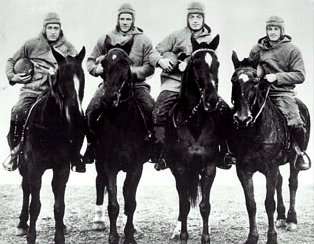
October 18, 1924: At the Polo Grounds in New York, the South Bend, Indiana-based University of Notre Dame beats Army -- the U.S. Military Academy at West Point, New York -- 13-7, led by their 4-man backfield: Quarterback Harry Stuhldreher, left halfback Jim Crowley, right halfback Don Miller and fullback Elmer Layden. Layden scored a touchdown in the 2nd quarter, Crowley in the 3rd.
The great syndicated sports columnist Grantland Rice, based out of the New York Herald Tribune, heard Notre Dame's publicity director, George Strickler, cite the biblical Four Horsemen of the Apocalypse, and wrote this opening paragraph, the most famous piece of sportswriting ever:
Outlined against a blue-gray October sky, the Four Horsemen rode again. In dramatic lore their names are Death, Destruction, Pestilence, and Famine. But those are aliases. Their real names are: Stuhldreher, Crowley, Miller and Layden. They formed the crest of the South Bend cyclone before which another fighting Army team was swept over the precipice at the Polo Grounds this afternoon as 55,000 spectators peered down upon the bewildering panorama spread out upon the green plain below.
They don't write 'em like that anymore: Not only was the 1920s, as Rice himself later billed it, the Golden Age of Sports, it was the golden age of sportswriting, with Rice joined by such men as Ring Lardner, Paul Gallico, Jimmy Cannon and Damon Runyon.
Over the Horsemen's 3 seasons -- freshmen were not eligible to play varsity football at the time -- Notre Dame won 27 games and lost only 2, both away to Nebraska, plus a tie in an earlier game with Army. They won the 1924 National Championship, defeating Ernie Nevers' Stanford squad in the 1925 Rose Bowl, with Layden returning 2 interceptions for touchdowns. (Notre Dame would then refuse all bowl invitations until 1970 -- having been shamed into it because they refused to take on Texas for the National Championship in the previous year's Cotton Bowl.)
None of them was over 6 feet tall, and none weighed more than 162 pounds. But this was typical of football players of the Roaring Twenties. And no one today can question their toughness: In their 30 games together, they played in primitive protective equipment, played offense and defense, excelling on both sides, and played all 60 minutes with no substitutions. The line that protected them was nicknamed the "Seven Mules," to emphasize their crucial but less glamorous function.
They didn't do much in the pros. Stuhldreher served as head coach at Villanova and Wisconsin, worked for U.S. Steel and wrote a couple of books about football. He died in 1965, only 63 years old. Layden went on to be the head coach at Duquesne and later Notre Dame, and was Commissioner of the NFL during the difficulties of the World War II era. He then went into business in Chicago, and died in 1973, age 70. Miller coached at Georgia Tech and then practiced law. He was appointed a U.S. Attorney for the Cleveland area by President Franklin D. Roosevelt, and died in 1979, age 77.
Crowley became head coach at Michigan State and Fordham, where he coached a team that challenged for the National Championship in 1937 and '38, with a line known as the Seven Blocks of Granite, including 2 future Pro Football Hall-of-Famers. Alex Wojciechowicz starred for the Philadelphia Eagles and the Detroit Lions. The other never played a down of pro ball, and is in the Hall as a coach: Vince Lombardi. (Longtime Giants owner Wellington Mara didn't play, but was also a student at Fordham at this time.) He later became chairman of the Pennsylvania State Athletic Commission, and was the last survivor of the Four Horsemen, living until 1986, at the age of 83.
*
On the same day that Rice wrote his famous prose, Harold "Red" Grange led the defending National Champions, the University of Illinois, onto the field at brand-new Memorial Stadium in Champaign for its dedication game against the University of Michigan. Grange returned the opening kickoff 95 yards for a touchdown. He ran 67 yards for a touchdown. He ran 56 yards for a touchdown. He ran 44 yards for a touchdown. All this was accomplished in the 1st 12 minutes of the ballgame. He later passed for another touchdown, and returned a kick for another. He accounted for 6 touchdowns in Illinois' 39-14 victory.
Having made legends out of the Four Horsemen, Grantland Rice took pen in hand (or, more likely, tapped out on his typewriter), and wrote this about Grange:
A streak of fire, a breath of flame
Eluding all who reach and clutch;
A gray ghost thrown into the game
That rival hands may never touch;
A rubber bounding, blasting soul
Whose destination is the goal
Red Grange of Illinois!
Although Rice had called Grange "a gray ghost" (and he certainly appears as such in the few surviving film clips of him playing, all black and white, of course), Warren Brown, writing for the Chicago American, gave him the nickname "the Galloping Ghost."
Grange's 77 became the 1st celebrated uniform number in American sports -- especially since Major League Baseball wouldn't have uniform numbers until 1929, and the National Hockey League until 1926. When asked how he got the famous double-digit, he said, "The guy in front of me got 76, and the guy behind me got 78." It wasn't a choice, and it's not like Wheaton had uniform numbers at the time. (In case you're wondering about the Four Horsemen, I looked it up: Layden wore 5, Miller 16, Crowley 18 and Stuhldreher 32.)
Late in the 1925 season, Illinois went to Philadelphia, and stunned the University of Pennsylvania 24-2 at Franklin Field. Grange ran for 237 yards and 2 touchdowns on a mud-soaked field. In his last collegiate game, the next week, Illinois beat Ohio State 14-9.
Grange would star for the Chicago Bears, and his 1925 game against the Giants drew 75,000 people to the Polo Grounds, the gate receipts saving the franchise. He played until 1934, became a broadcaster, was honored in the 1st class of inductees to the Pro Football Hall of Fame in 1963, and lived until 1991, at age 87.
In 1999, he was ranked number 80 on The Sporting News' end-of-century list of the 100 Greatest Football Players. In 2008, Grange was also ranked #1 on ESPN's Top 25 Players In College Football History list. In 2011, the Big Ten Network named Grange the league's greatest icon -- 86 years after he played his last game for Illinois. Today, 91 years after his greatest game, and 81 years after he played his last game of any kind, he remains a legend, a touchstone, one of the founding fathers of professional football.
*
October 18, 1925, 90 years ago: Tony Lazzeri, 2nd baseman for the Salt Lake Bees of the Pacific Coast League, hits his 60th home run of the season, in a 12-10 victory over the Sacramento Solons in the final regular-season game of the year. It is an inside-the-park drive in the 7th off Frank Shellenback. The 21-year-old Lazzeri also had 222 RBIs, which may still be a North American professional record.
However, given that the weather in California allowed for a longer season – though as a mountain city, Salt Lake probably had some problems with snow at both ends – the PCL season was 200 games long. Lazzeri’s record was accomplished in 197 appearances. He would soon be signed by the Yankees and go on to a Hall of Fame career.
On this same day, Cincinnati Reds pitcher Marv Goodwin is injured in a plane crash in Houston. He dies from his injuries 3 days later. The 34-year-old righthander from outside Charlottesville, Virginia appeared in 4 games for Cincinnati, 3 as a starter, 2 of them complete games, and posted an 0-2 record. He appears to have been the 1st big-league athlete to die in a plane crash.
October 18, 1926: Charles Edward Anderson Berry is born in St. Louis. What does Chuck Berry, one of the founding fathers of rock and roll, have to do with sports? Not much, although John Fogerty borrowed the title of a Berry song, "Brown Eyed Handsome Man," for his baseball song "Centerfield."
October 18, 1928: Keith Jackson is born in Roopville, Georgia -- right around the time of, as he would later put it, "the possum-huntin' moon." Whoa, Nelly, he's the greatest college football broadcaster of all time. My goodness. His homespun Southern sayings endeared him to 2 generations of fans. "You can't be pussyfootin' around like a ballerina out there, you've got to run it north-and-south." (Translation: Don't give us any fancy offensive tricks, just run the ball up the middle.)
Oddly, he went to a Northern college, Washington State University -- on the G.I. Bill after serving in the Marines in the Korean War. But this enabled him to be objective when calling so many Southeastern Conference football games. He also nicknamed the oldest bowl game, the Rose Bowl, "the Granddaddy of Them All," and Michigan Stadium, which has had a crowd of over 115,000 for a football game, "The Big House."
He also tended drag out the M in "Mmmmichigan," and the L and the last A in "Allllabamaaaaaaaa," and refer to the University of Iowa's teams, the Hawkeyes, as the "Huckeyes." When a big play got canceled by a penalty, he would say, "Hold the phone!" When there were flags from every official on a play, he'd say, "There's a ton o' laundry on the field." The line of his that every impressionist copies, aside from "Whoa, Nelly," is "Fumblllllllle!"
On Thanksgiving Day 1993, he announced Georgia vs. Georgia Tech with former Miami Dolphin quarterback Bob Griese, saying, "This is the day when the waistline takes a whoopin', and ancient rivalries are replayed." The game was 16-10 in Georgia's favor going into the 4th quarter, but then things got out of control, as Georgia ran up the score, and Tech didn't like that, and a big fight broke out, before it was a 43-10 final. Not for the 1st time, and not for the last, Keith said of a rivalry, "These two teams just... don't... like each other."
He just wasn't as good with pro football. He did Monday Night Football in its 1st season, 1970, including the 1st game, a Jets loss away to the Cleveland Browns, then went back to the college game. He was ABC's lead broadcaster for the USFL, 1983 to 1985, but, again, it just wasn't the same. He also did ABC baseball broadcasts for a few years, including Chris Chambliss' home run that won the 1976 Pennant for the Yankees, the 1978 Playoff with the Red Sox (the Bucky Dent Game), and -- on his own 49th birthday -- Reggie's 3 homers.
His last game was the 2006 Rose Bowl thriller between Southern California and Texas. He turns 87 today, and is alive and well, but has said he's not going to write a book about his experiences until he loses his golf swing. Too bad, I want to read that book.
*
October 18, 1933: As it turns out, October 18 is a good birthday for a future football coach. Alvis Forrest Gregg (he dropped the first name) is born in Birthright, Texas -- no, I'm not making that town name up. Green Bay Packer coach Vince Lombardi called this Hall-of-Famer “the finest player I ever coached.”
An offensive tackle, Forrest Gregg and 2 of his teammates, guard Fred "Fuzzy" Thurston and cornerback Herb Adderley are the only men ever to play on 6 NFL Championship teams. All 3 won in 1961, ’62, ’65, ’66 and ’67 with the Packers. Thurston also won with the 1958 Baltimore Colts, Gregg and Adderley both did so with the 1971 Dallas Cowboys. This includes Super Bowls I, II and VI.
Gregg went on to coach for Tom Landry in Dallas, took the head job with the Cleveland Browns, and got the Cincinnati Bengals into Super Bowl XVI, their first trip to the season finale. After his alma mater, Southern Methodist University in Dallas, got “the death penalty” from the NCAA, having their program suspended for a year due to recruiting violations while already on probation, he was named head coach, held the program back another year so it could rebuild, and got them back onto a footing where they’ve been able to consistently compete as what college basketball would call a “mid-major.” Lombardi and Landry would be proud.
He now lives in Colorado Springs, but has developed Parkinson's disease, possibly as a result of all his football contact.
October 18, 1937: Boyd Hamilton Dowler is born in in Rock Springs, Wyoming. Another of Lombardi's 1960s Packers, he was a wide receiver and punter, a member of all 5 title teams and an All-Pro in 1965 and 1967. But he's probably best remembered for getting hurt early in Super Bowl I, enabling Max McGee to step in, and catch the 1st pass and score the 1st touchdown in Super Bowl history.
Dowler would, however, be key in winning the next season's NFL Championship Game, the Ice Bowl, scoring 2 touchdowns against the Cowboys. In 11 seasons, he caught 474 passes for 7,270 yards, pretty good totals for the era. He is now a scout for the Atlanta Falcons.
October 18, 1938: Robert Frank Knoop is born in Sioux City, Iowa. Bobby Knoop -- and that Dutch name is pronounced "Kuh-NOPP," not "NOOP" -- was a 2nd baseman for the Los Angeles/California Angels from 1964 to 1969, and then played for the Chicago White Sox and the Kansas City Royals. He won 3 straight Gold Gloves, and was an All-Star in 1966.
He later coached, mostly for the Angels, and was on their staff for their 1st 4 postseason appearances: The 1979, '82 and '86 American League Championship Series, and the 1995 AL Western Division Playoff defeat to the Seattle Mariners. In 1994, he was interim manager, splitting 2 games. He is still listed as an Angels coach, in much the way that Jimmie Reese once was, the way Johnny Pesky was for the Boston Red Sox and Red Schoendienst still is for the St. Louis Cardinals.
October 18, 1939: Michael Keller Ditka Jr. is born in Carnegie, Pennsylvania. A star at the University of Pittsburgh, he practically invented the position of tight end with the Chicago Bears, helping them win the 1963 NFL Championship. He went on to the Dallas Cowboys and helped them win Super Bowl VI. He then served as an assistant to Landry, alongside Gregg, and another eventual Super Bowl-reaching head coach, former Cowboys running back Dan Reeves. Together, they won Super Bowl XII.
"Iron Mike" was the last head coach hired for the Chicago Bears by team founder-owner George Halas. He got them into the Playoffs 7 times, including winning Super Bowl XX. In other words, the Bears haven’t won a World Championship without Ditka having some part in it in 68 years. He was the 1st tight end elected to the Hall of Fame. After a long estrangement, the Bears finally retired his Number 89 last December. He has spent most of his time since losing the Bears job as a studio analyst for NBC Sports.
When the Bears won the Super Bowl in 1986, the space shuttle Challenger blew up 2 days later, and their White House reception with President Ronald Reagan was canceled. In 2011, 25 years later, President and Chicago resident Barack Obama invited the team to the White House to make it up to them. Despite Ditka and several of the players being very conservative -- Ditka was even approached to run against Obama for the U.S. Senate in 2004, but thought a loss would hurt the restaurant chain he owned, and chose not to. He gave Obama the traditional gift, a team jersey with the President's name on the back. Sometimes, the number on the jersey is 1, sometimes it's the President's number (in Obama's case, 44); this time, it was the year of the title, 85.
Unfortunately for Ditka, and anyone else born the same day, this was also the day that Lee Harvey Oswald was born, in New Orleans. Another guy with a connection to Dallas – in fact, he was living in Irving in 1963, 8 years before Texas Stadium opened and the Cowboys moved there.
Some people will never be convinced that he is the one and only person behind the assassination of President John F. Kennedy – and I’m one of them. But there is no doubt that, later that day, he killed a Dallas police officer, Patrolman J.D. Tippit. And there were other reasons to conclude that Oswald was scum. When Jack Ruby killed him 2 days later, it meant that the chances of us ever hearing the full story were probably gone forever; but other than that, it was no great loss.
*
October 18, 1946: Yet another football coach with an October 18 birthday: Frank Mitchell Beamer is born in Mount Airy, North Carolina. He turned the football program at his alma mater, Virginia Polytechnic Institute, a.k.a. Virginia Tech, from a laughingstock into training stock for the NFL.
He is now in his 26th season there, having won 225 games, including 9 bowls and 9 1st-place finishes in either his league (first the Big East, now the Atlantic Coast Conference) or his division (since the ACC split). Counting his time as the head man at Murray State, he has 275 wins, and is the winningest and longest-tenured active coach in Division I-A -- excuse me, in the Football Bowl Subdivision (FBS).
His son Shane, a member (along with the now-infamous Michael Vick) of his 1999 team that reached the BCS National Championship Game, is now one of his assistants, and could well end up as his successor.
October 18, 1949: George Andrew Hendrick Jr. is born in Los Angeles. The 4-time All-Star hit 267 home runs, and was a member of 2 World Championship teams, the 1972 Oakland Athletics and the 1982 St. Louis Cardinals. Now the 1st base coach for the Tampa Bay Rays, he says he will only autograph Cardinals memorabilia.
October 18, 1950: Connie Mack’s sons, Connie Jr., Earle and Roy, take legal action that removes their father from the operating ownership and manager's job with the Philadelphia Athletics after 50 years. Counting his time running the Pittsburgh Pirates before that, he managed a big-league record 54 years.
But he is about to turn 88 years old, and is clearly senile (having spent the last few years calling out the names of players he had long since traded away), and had managed just 1 winning season in the last 17. It was long since time for him to step aside, but, as owner, he never would, until his sons forced his hand.
To do so, they had to swallow their differences: Earle and Roy were the products of the old man's 1st marriage, Connie Jr. from his 2nd. His 2nd wife was still alive, and she basically controlled Connie Jr., and hated Earle and Roy. Earle and Roy didn't much like each other, but sided with each other against their half-brother and stepmother. Until now: They felt they didn't dare ruin their father's 50th Anniversary season, but now they had to admit the obvious: He had to be removed from full control of the ballclub.
"The Grand Old Man of Baseball" retains his title as president of the club, but it is purely ceremonial now. Before his death, Shibe Park will be renamed Connie Mack Stadium; but the A's will also be sold by "the House of Mack" in 1954, and moved to Kansas City.
Connie died in 1956, aged 93. Longtime A's player and coach Jimmy Dykes succeeded him as manager, and the results wee little better, which was one of the reasons for the move.
None of the Mack sons was ever involved with sports again. Connie Jr.'s son Connie III served Florida in both houses of Congress, and his son Connie IV tried to do the same, serving in the House but losing for the Senate in 2012.
*
October 18, 1951: Michael John Antonovich is born in Calumet, Minnesota. A star hockey player at the University of Minnesota, Mike was a member of the original 1982-83 New Jersey Devils, but his best years were in the 1970s in the WHA, with the Minnesota Fighting Saints (no, I’m not making that name up, they played in St. Paul and they did do a lot of fighting) and the New England Whalers.
Now a scout with the St. Louis Blues, he shares his exact date of birth with Mork & Mindy star Pam Dawber (born in Detroit) and novelist Terry McMillan (also in Michigan, in Port Huron). Status of Terry's groove, and whether she needs to get it back, is uncertain. But, since Pam is married to former UCLA quarterback and NCIS star Mark Harmon, I'm guessing her groove is in good shape.
October 18, 1952: Jeron Kennis Royster is born in Sacramento. A speedy infielder, Jerry played in the 1974 World Series for the Dodgers, and spent 1987 with the Yankees, but played the majority of his career on some mediocre Atlanta Braves teams in between.
He managed the Milwaukee Brewers briefly in 2002, and recently managed the Lotte Giants of Busan, Korea – the first non-Korean manager in Korea’s top baseball league. He is now the 3rd base coach for the Red Sox.
Also on this day, Allen Stevens Ripley is born in the Boston suburb of Norwood, Massachusetts. He was a rookie pitcher with the ill-fated 1978 Red Sox, and was done in the major leagues by 1982, with a record of 23-27. While pitching for the San Francisco Giants in 1980, his catcher, Bob Brenly, nicknamed him Speed Limit, because his fastball seemed to top out at 55 miles per hour. Ripley died last year.
October 18, 1954: Texas Instruments announces it has begun production of the first transistor radio. Baseball fans everywhere rejoice, for now they can listen to ballgames almost anywhere, from the office to the beach.
Well, they’ll have to wait until Summer 1955 to listen to them on the beach. Maybe April 1955, if they live in California and can get Pacific Coast League broadcasts.
Also on this day, Mort Walker and Dik Browne debut the comic strip Hi & Lois. Separately, Walker created Beetle Bailey (Lois Flagston was Beetle's sister), and Browne created Hagar the Horrible.
October 18, 1955, 60 years ago: Ralph Kiner, formerly a great slugger for the Pittsburgh Pirates, calls it quits due to a back injury. He is about to turn 33 years old. He hit just 18 home runs for the Cleveland Indians this past season.
Years later, as a broadcaster for the Mets, a player (whose name I've long since forgotten, even though I was watching this game on WOR-Channel 9) hit his 1st major league home run, and Kiner said, "You always remember your first." Kiner's 1st was on April 18, 1946, at Sportsman's Park in St. Louis, off Howie Pollet of the Cardinals, who beat the Pirates that day anyway, and went on to win the World Series that season.
His broadcast partner Tim McCarver, who won 2 Series as a catcher for the Cardinals (1964 and '67) and one more with the Phillies (1980, his last season), said he didn't remember his 1st major league home run, saying, "You'd think I would, because I didn't hit very many." It came on July 13, 1961, also at Sportsman's Park (by then, the 1st ballpark to get the name of Busch Stadium), off Tony Cloninger of the Milwaukee Braves, who beat the Cardinals that day anyway.
Kiner: "I don’t remember my last home run, because, at the time, I didn't think it would be my last! It was on September 10, 1955, at Fenway Park in Boston, off Ellis Kinder, and the Indians beat the Red Sox.
That last home run was Number 369 – and he did that in only 10 seasons, a career shortened at the beginning by service in World War II and at the end by his injury. If he'd been able to play 20, you can double that 369, and you've got 718. I know it doesn't work that way, but, theoretically, he could have surpassed Babe Ruth before Hank Aaron did.
Ralph died last year. He was 91, and it was a remarkable baseball life.
October 18, 1956: Martina Šubertová (no middle name) is born in Prague, in the nation then known as Czechoslovakia. Her stepfather, Miroslav Navrátil, became her 1st tennis coach, and her name was changed to Martina Navrátilová.
Sorry, Roger Federer, but Martina remains the greatest tennis player who ever lived, of any gender, of any era, of any nationality. From 1978 to 1990, she won 9 Wimbledons, 4 U.S. Opens, 3 Australian Opens and 2 French Opens. She just missed the Grand Slam in 1983, winning all but the French. That's 18 majors.
October 18, 1958: Thomas Hearns (no middle name) is born in Memphis, although, like Alabama-born Joe Louis, he grew up and trained as a boxer in Detroit. Known as “The Hit Man” and "The Motor City Cobra," he was one of the most devastating punchers the ring has ever known, holding various titles ranging from welterweight to light heavyweight from 1980 to 1992.
Also on this day, Kjell Samuelsson (no middle name) is born in Tingsryd, Sweden -- and that's pronounced like "shell." A defenseman, he played for the New York Rangers and Philadelphia Flyers and didn’t gain a reputation as a thug – an amazing achievement. More importantly, he was a member of the Pittsburgh Penguins when they won the 1992 Stanley Cup.
October 18, 1959: Christopher Michael Russo is born in Syosset, Long Island, New York. No word on whether the future sports-talk host known as "Mad Dog" said to the people in the delivery room, "Aaaaaaaaaaaaaaaand goodaftanoon evwybody! Howayoutoday?"
*
October 18, 1960: Yankee co-owners Dan Topping and Del Webb officially relieve Casey Stengel as manager. He gives the press a prepared statement where he announces his resignation. Then he says, "I guess this means they fired me.” And “I’ll never make the mistake of being 70 again.” But Casey, and Mets fans, would have the last laugh.
Also on this day, Erin Marie Moran is born in Burbank, California. Not an athlete, but as Joanie Cunningham on Happy Days, she played a cheerleader at Milwaukee’s Jefferson High School. There are about 40 Jefferson High Schools in the U.S., but Milwaukee doesn't have one in real life: The school used for exterior shots was the city's Washington High School.
She's had money troubles lately, and she and her husband were recently evicted -- by her mother-in-law. Maybe she should use that experience and get a role as a nasty mother-in-law on a sitcom.
October 18, 1966: The expansion Chicago Bulls play their 1st home game. They overcome 32 points from Rick Barry with 26 by Jerry Sloan and 22 by Guy Rodgers, and beat the San Francisco Warriors 119-116 at the International Amphitheatre.
The Bulls will play only their 1st season in the stockyards arena, which became infamous 2 years later as the site of the 1968 Democratic Convention, and play at the Chicago Stadium on the West Side from 1967 until 1994, subsequently moving across the street to the United Center.
October 18, 1967: The American League approves Charlie Finley’s move of the Athletics to Oakland‚ California. Kansas City is promised an expansion team for 1969, as is Seattle.
When Senator Stuart Symington of Missouri and Mayor Ilus Davis of Kansas City threaten legal action against the move‚ possibly including the revocation of baseball’s exemption from antitrust laws, AL President Joe Cronin reopens talks‚ and the expansion deadline is moved to 1969.
Nevertheless, Symington is glad that his home State is rid of Finley, saying, "Oakland is the luckiest city since Hiroshima."
October 18, 1968: Bob Beamon sets a world record of 8.90 meters in the long jump at the Olympic Games in Mexico City. The crowd is stunned. But, as an American, not familiar with the metric system, Beamon doesn’t know what 8.90 meters means. The old world record was 27 feet, 7¼ inches. Beamon’s jump is 29 feet, 2½ inches. He has broken both the 28-foot and 29-foot barriers.
The record stands for 23 years. Beamon was a native of South Jamaica, Queens, New York, the same neighborhood that produced Governor Mario Cuomo, rapper 50 Cent, and my Grandma.
After that Gold Medal, he was drafted by one of the NBA's brand-new expansion teams, the Phoenix Suns. He didn't sign, staying at Long Island's Adelphi University and getting his degree. He now operates a museum in Florida.
Speaking of the Suns: On this date, they play the 1st game ever played by a major league team calling Arizona home. They win it, too, getting 27 points from Gail Goodrich, and defeating last year's expansion team, the Seattle SuperSonics, 116-107 at the Arizona Veterans Memorial Coliseum.
October 18, 1969: Having been college basketball's player of the year all 3 years he played for UCLA -- freshmen wouldn't be made eligible until 1972 -- Lew Alcindor plays his 1st professional basketball game. He scores 29 points to lead the Milwaukee Bucks to a 119-110 win over the Detroit Pistons at the Milwaukee Arena.
In 1970-71, just his 2nd season, their 3rd, Big Lew led the Bucks to the title, and got the great Oscar Robertson his one and only ring. After another season, he announced his conversion to Islam and his name change. He has been Kareem Abdul-Jabbar ever since. Only 2 people were still allowed to call him Lew: His father, Ferdinand Lewis Alcindor Sr., and his college coach, John Wooden, who, until the day he died, called Kareem "Lewis."
Also on this day, Nelson David Vivas is born in Granadero Baigorra, Argentina. A right back, he began his career with Buenos Aires club Quilmes in 1991, and ended it with them in 2005. In between, he played for both of the Buenos Aires giants, Boca Juniors and River Plate. He played for Argentina in the 1998 World Cup.
From 1998 to 2001, he played for North London's Arsenal -- with no luck. They won the League and Cup "Double" the season before he got there and the season after he left. While he was there, they reached the 2000 UEFA Cup Final and the 2001 FA Cup Final, but lost both. He has since gone into management, including with former club Quilmes.
*
October 18, 1970: Sachio Kinugasa takes his place in the starting lineup of the Hiroshima Carp‚ playing 3rd base. Over the next 17 years he will play in 2‚215 consecutive games -- longer than Lou Gehrig, although Major League Baseball doesn't count it as a record. And, of course, Cal Ripken will surpass this total, too.
Also on this day, Douglas Anthony Mirabelli born in Kingman, Arizona. He is best known as Tim Wakefield’s personal catcher on the 2004 and 2007 World Champion * Boston Red Sox. He is now head coach of a high school team and a realtor, both in Traverse City, Michigan.
October 18, 1973: The Mets win Game 5 of the World Series, 2-0 over the Oakland Athletics at Shea Stadium, behind the 3-hit pitching of Jerry Koosman and Tug McGraw. Cleon Jones doubles in a run in the 2nd, and Don Hahn's triple scores the other run.
The Series now moves out to Oakland, and the Mets need to win only 1 of the last 2 games to win their 2nd World Series. It would take them another 13 years to get that 4th World Series game won.
October 18, 1974: Robert William Savage is born in Wrexham, Wales. Appropriately enough, that city's name pronounced like "Wrecks 'em." "Savage," indeed: Robbie was one of the dirtiest soccer players of his time.
A midfielder, he played in England for 15 years, and he won just 1 trophy, the 2000 League Cup with Leicester City. In 2008, the Daily Mail named him the dirtiest player in Premier League history to that point (1992 to 2008), due to his diving and his rough play. He received more yellow cards than any player before him, although he has been surpassed. (It should surprise no one that his 1st pro club was the dirtiest club in Britain, Manchester United, although he never played in a League game for them.)
He has since become a pundit on BBC's Radio 5 Live, and he continues to be a polarizing figure: Those who like him defend him to the hilt, and those who don't like him absolutely despise him.
October 18, 1975, 40 years ago: Jose Alexander Cora is born in Caguas, Puerto Rico. The starting shortstop of the 2007 World Champion * Boston Red Sox, Alex Cora also played for the Mets, and is now an analyst for ESPN. His brother Joey Cora is a former big-leaguer and now an MLB Network analyst.
October 18, 1976: Game 2 of the World Series. The Cincinnati Reds score 3 runs off Catfish Hunter in the 2nd inning, and that decides it. Jack Billingham pitches well, and the Reds beat the Yankees 4-3.
This was the 1st Series game to start at night on a weekend. Commissioner Bowie Kuhn did it so the game would have better ratings on NBC. It was cold, and he decided to prove to people that cold Cincinnati weather in mid-October didn't bother him by not wearing an overcoat. I hope the bastard froze his ass off.
October 18, 1977: On the same night that Reggie goes boom, boom, boom, the Nets play their 1st game as a New Jersey team. Well, not really: They started out as the New Jersey Americans in the ABA in 1967-68, before moving to Long Island and becoming the New York Nets. And this game is on the road, at Cobo Hall in Detroit. But, officially, they play their 1st game as the New Jersey Nets.
It doesn't go so well: The Detroit Pistons beat them, 110-93. As they did the season before, their 1st in the NBA, the Nets will struggle for the 4 seasons in which they call the Rutgers Athletic Center home. (Anybody would, playing their home games in that ridiculous gym.) Once they move into the Meadowlands Arena in 1981, things will improve a bit.
*
October 18, 1981: Gregory Robert Warren is born in Mount Olive, North Carolina. A center and the long snapper for the Pittsburgh Steelers, he has appeared in 3 Super Bowls, winning 2 (XL and XLIII).
October 18, 1982: Mark Sampson (no middle name) is born in Creigiau, Wales. A defender, he wasn't much of a soccer player. But this year, he guided the England team to the Semifinals of the Women's World Cup.
October 18, 1983: Willie Edward Jones dies in Cincinnati at age 58. I can't find a cause. Nicknamed Puddin' Head, he was the 3rd baseman on the 1950 National League Champion Philadelphia Phillies, a.k.a. the Whiz Kids. He batted .258 for his career, and hit 190 home runs. He was a 2-time All-Star, and closed his career with another Pennant, with the 1961 Cincinnati Reds.
October 18, 1984: Lindsey Caroline Kildow is born in St. Paul, Minnesota. We know her as Lindsey Vonn. She won the women's downhill at the 2010 Winter Olympics in Vancouver.
After divorcing a fellow Olympic skier, she says she'll never get married again. She recently broke up with Tiger Woods. But even if she had married him, she'd still have been, by far, the most successful athlete in the family. Even if you do consider golf a "sport," 1 Gold Medal tops 4 Green Jackets.
October 18, 1985, 30 years ago: Yoenis Céspedes Milanés is born in Campechuela, Cuba. The left fielder defected in 2011, appeared in the AL Division Series for the Oakland Athletics in 2012 and '13.
When the Mets picked him up at the 2015 trading deadline, they had a small chance at winning the National League Eastern Division, and a better shot at the NL Wild Card. Now, with him, they are 2 wins away from the Pennant. Truly, by the strictest definition of the phrase, he is the most valuable player in the NL, even though he was only in the NL for the last 2 months of the regular season.
October 18, 1986: Maybe the Mets' World Series win this year isn't "inevitable" after all. The Boston Red Sox win Game 1, 1-0 at Shea, when Tim Teufel botches Rich Gedman's routine grounder in the 7th inning‚ allowing Jim Rice to score the game's only run. Bruce Hurst and Calvin Schiraldi combine on a 4-hitter for the Red Sox.
October 18, 1988: Mark McGwire's home run off Jay Howell in the bottom of the 9th gives Oakland a 2-1 win in Game 3 of the World Series. This is the first time, and it remains the only time, that 2 games of a single World Series end with walkoff homers. However, this will be the only game in the Series that the A’s will win.
*
October 18, 1992: The Toronto Blue Jays even the World Series with a 5-4 win over the Braves in Game 2 in Atlanta. Pinch-hitter Ed Sprague's 2-run home run in the top of the 9th proves to be the margin of victory‚ marking just the 2nd time in Series history that a 9th-inning homer turns a losing margin into a winning one. The other was Kirk Gibson's homer in Game 1 of the 1988 Series.
This is also the 1st time a non-U.S. team wins a World Series game. But, due to this international distinction, there is a mishap: The Canadian flag is inadvertently flown upside-down by a United States Marine Corps color guard during the pregame ceremonies. Although the international incident annoys many Canadians, most Toronto fans resist the call to fly the American Stripes and Stars in a similar fashion during Game 3 at the Skydome, but opt instead to wave Canada's L'Unifolié with the message, "This end up", affixed to the top.
October 18, 1997: For the 1st time, a World Series game is played in the State of Florida. The Marlins take Game 1‚ 7-4 over the Cleveland Indians at Joe Robbie Stadium‚ behind rookie Cuban pitcher Livan Hernandez. Moises Alou's 3-run homer in the 4th inning is the big blow for the Marlins‚ who are outhit by the Indians‚ 11-7.
October 18, 1998: The Yankees strike early‚ scoring 3 runs in each of the 1st 2 innings. They go on to cruise to a 9-3 win in Game 2 behind Orlando Hernandez, brother of Livan and nicknamed “El Duque” (the Duke). Bernie Williams and Jorge Posada connect for homers.
October 18, 1999: Yankees 6, Red Sox 1, in Game 5 of the ALCS. For only the 2nd time, the Yankees clinch a Pennant at Fenway Park – the first was on September 25, 1960, back when Pennants could still be clinched in the regular season. El Duque wins the clincher and is named series MVP. Derek Jeter and Jorge Posada homer for the Yanks.
*
October 18, 2003: The 100th Anniversary World Series gets underway at Yankee Stadium. I had a feeling that, physically and emotionally drained after their intense ALCS against the Red Sox, there was no way the Yankees would win Game 1.
Sure enough: Bernie Williams hits a home run, but Brad Penny, Dontrelle Willis and Ugeth Urbina otherwise shut them down, and the Florida Marlins beat them, 3-2.
October 18, 2004: The Red Sox outlast the Yankees‚ 5-4‚ in 14 innings to force a Game 6 of their ALCS. David Ortiz again is the hero (cough-with a sidekick named “Steroids”-cough)‚ driving home the winning run with a bloop single. Ortiz also homers‚ as does Bernie Williams for the Yanks.
Also on this day, Jeff Kent hits a home run in the bottom of the 9th, breaking up a scoreless duel and giving the Houston Astros a 3-0 win over the St. Louis Cardinals. The Astros now lead the Cards 3 games to 2, and are 1 win away from their 1st Pennant in their 43-season history.
They will have to wait 1 more season.
October 18, 2005, 10 years ago: Longtime Bay Area sportscaster Bill King dies. He was the voice of the A's, the Raiders and the Warriors. Like former A's reliever Rollie Fingers, he was noted for having a handlebar mustache. He was 78.
Also on this day, the Montreal Canadiens pay tribute to the departed Expos by raising a commemorative banner to the rafters of Montreal's Bell Centre. Displaced mascot Youppi, working in his 1st game for the NHL team, and former players Gary Carter and Andre Dawson are on hand to assist in the hoisting the of blue and orange banner that features their retired numbers, 8 and 10, respectively, as well as the numbers for Tim Raines (30) and Rusty Staub (10).
October 18, 2006: The Mets edge the Cardinals, 4-2 at Shea, to even the NLCS at 3 games apiece. Jose Reyes gets 3 hits for the Mets, including a homer, and John Maine gets the win.
The Mets go into Game 7, 1 win away from the National League Pennant and a trip to their 5th World Series. They’re still looking for that win.
October 18, 2008: Scoring in each of the last 3 innings, the Red Sox erase a 7-run deficit in the 7th to beat the Rays, 8-7, in Game 5 of the ALCS.
The Philadelphia A's, who rallied after trailing 8-0 to beat the Cubs, 10-8, in Game 4 of the 1929 World Series, are the only team to have made a bigger comeback in the postseason.
October 18, 2012: The Tigers win their 2nd Pennant in 7 years when they beat the Yankees, 8-1, at Comerica Park to complete a 4-game sweep. Delmon Young is named series MVP.
The last time the Bronx Bombers failed to win a game in a postseason series was in 1980, after the Royals beat them 3 straight in the best 3-of-5 ALCS.
Did I say "Bombers"? Derek Jeter broke his ankle in Game 1 and missed the rest of the series, and, really, was never the same again. Even so, in this series, as in the ALDS against the Baltimore Orioles, the Yankees just weren't hitting: Curtis Granderson went 0-for-11, Brett Gardner 0-for-8, Eric Chavez 0-for-8, Robinson Cano 1-for-18, Alex Rodriguez 1-for-9 (2009 was already beginning to look like a long time ago), Russell Martin 2-for-14, Mark Teixeira 3-for-15, Raul Ibanez 3-for-13, Nick Swisher 3-for-12. The Yankees scored 4 runs in the bottom of the 9th to send Game 1 to extra innings. Other than that, in 38 innings in this series, they scored 2 runs, and had an on-base percentage of .224. Pathetic.
The Yankees have not appeared in a Division Series game since. And haven't won a Pennant, much less a World Series, in 6 years.
Why does Brian Cashman still have a job?
Also on this day, Slater Martin dies in Houston at age 86. A point guard, "Dugie" Martin was a 7-time NBA All-Star, and won NBA Championships with the Minneapolis Lakers in 1950, '52, '53 and '54, and with the St. Louis Hawks in 1958. He also coached the Hawks and the ABA's Houston Mavericks. The University of Texas retired his Number 15, and he wore 22 with the Lakers, before it was worn by Elgin Baylor, for whom it would be retired. He is in the Basketball Hall of Fame.
October 18, 2013: Oail Andrew "Bum" Phillips dies on his Texas ranch at age 90. He coached the Houston Oilers into the 1978 and '79 AFC Championship Games, bringing pro football to its most popular point in South Texas. (The Oilers had won the AFL title in 1960 and '61, but weren't as popular as they'd become in the late Seventies. The Texans haven't gotten that popular yet, either.) As Bum himself said, "The Dallas Cowboys may be America's team, but the Houston Oilers are Texas' team."
He also coached the New Orleans Saints. His son Wade Phillips has been head coach of the Denver Broncos, the Buffalo Bills and the Cowboys, and is now back with the Broncos as defensive coordinator.
Also on this day, Allan Stanley dies in Bobcaygeon, Ontario at age 87. The defenseman played for the Rangers in the 1950s. Needless to say, he won the Stanley Cup after he left. Indeed, he won it 4 times with the Toronto Maple Leafs, in 1962, '63, '64 and '67, scoring the goal that wrapped up the '67 Cup. He was a 3-time All-Star, and was elected to the Hockey Hall of Fame.
The best-6-of-11 series between the Brooklyn Bridegrooms of the American Association (3 players on the team previously known as the Grays, and later as the Dodgers, had gotten married during the previous offseason) and the New York Giants of the National League (formerly the Gothams, manager Jim Mutrie had described them as “my big boys, my giants”) opens at the Polo Grounds in Manhattan.
The Bridegrooms win, 12-10 in 8 innings. Oyster Burns is 4-for-5 with 3 RBIs‚ including the game-winning double in the bottom of the last inning.
October 18, 1904: Abbott Joseph Liebling is born in Manhattan. Working for The New Yorker from 1935 until his death in 1963, he wrote superbly on many subjects, particularly boxing and horse racing. In 1995, the Boxing Writers Association of America created the A.J. Liebling Award for writing about the sport.
October 18, 1913: In Cincinnati, the Giants and White Sox begin a 5-month worldwide barnstorming trip that will include stops in Australia, Asia, Europe, and the Middle East. The teams recruit top players from both leagues, including the Giants' Christy Mathewson, the White Sox' Buck Weaver, Tris Speaker of the Boston Red Sox and Sam Crawford of the Detroit Tigers. But Jim Thorpe, then playing for the Giants, is the main attraction during the global tour, due to his fame from the 1912 Olympics.
October 18, 1919: Joseph Philippe Pierre Yves Elliott Trudeau is born in Montreal. Prime Minister of Canada for all but 9 months between April 1968 and February 1984, the man usually listed as "Pierre Elliott Trudeau" threw out the ceremonial first balls before the 1st Montreal Expos home game at Jarry Park in 1969, the 1st Toronto Blue Jays game at Exhibition Stadium in 1977, and the 1st game the Expos played at their new home, the Olympic Stadium, also in 1977.
As a sports participant, he was a brown belt in judo, and loved to ski in Quebec's Laurentian Mountains. He died in 2000, and his son Justin Trudeau now serves in Canada's House of Commons, and holds his father's old post as Leader of the Liberal Party.
Tomorrow, there will be a federal election, and if the Liberals win, Justin will become Prime Minister, making the Trudeaus the 1st father & son pair to do so. Hopefully, the Conservative incumbent, Stephen Harper, won't ride the Blue Jays' current success to victory.
*
October 18, 1924: At the Polo Grounds in New York, the South Bend, Indiana-based University of Notre Dame beats Army -- the U.S. Military Academy at West Point, New York -- 13-7, led by their 4-man backfield: Quarterback Harry Stuhldreher, left halfback Jim Crowley, right halfback Don Miller and fullback Elmer Layden. Layden scored a touchdown in the 2nd quarter, Crowley in the 3rd.
The great syndicated sports columnist Grantland Rice, based out of the New York Herald Tribune, heard Notre Dame's publicity director, George Strickler, cite the biblical Four Horsemen of the Apocalypse, and wrote this opening paragraph, the most famous piece of sportswriting ever:
Outlined against a blue-gray October sky, the Four Horsemen rode again. In dramatic lore their names are Death, Destruction, Pestilence, and Famine. But those are aliases. Their real names are: Stuhldreher, Crowley, Miller and Layden. They formed the crest of the South Bend cyclone before which another fighting Army team was swept over the precipice at the Polo Grounds this afternoon as 55,000 spectators peered down upon the bewildering panorama spread out upon the green plain below.
They don't write 'em like that anymore: Not only was the 1920s, as Rice himself later billed it, the Golden Age of Sports, it was the golden age of sportswriting, with Rice joined by such men as Ring Lardner, Paul Gallico, Jimmy Cannon and Damon Runyon.
Over the Horsemen's 3 seasons -- freshmen were not eligible to play varsity football at the time -- Notre Dame won 27 games and lost only 2, both away to Nebraska, plus a tie in an earlier game with Army. They won the 1924 National Championship, defeating Ernie Nevers' Stanford squad in the 1925 Rose Bowl, with Layden returning 2 interceptions for touchdowns. (Notre Dame would then refuse all bowl invitations until 1970 -- having been shamed into it because they refused to take on Texas for the National Championship in the previous year's Cotton Bowl.)
None of them was over 6 feet tall, and none weighed more than 162 pounds. But this was typical of football players of the Roaring Twenties. And no one today can question their toughness: In their 30 games together, they played in primitive protective equipment, played offense and defense, excelling on both sides, and played all 60 minutes with no substitutions. The line that protected them was nicknamed the "Seven Mules," to emphasize their crucial but less glamorous function.
They didn't do much in the pros. Stuhldreher served as head coach at Villanova and Wisconsin, worked for U.S. Steel and wrote a couple of books about football. He died in 1965, only 63 years old. Layden went on to be the head coach at Duquesne and later Notre Dame, and was Commissioner of the NFL during the difficulties of the World War II era. He then went into business in Chicago, and died in 1973, age 70. Miller coached at Georgia Tech and then practiced law. He was appointed a U.S. Attorney for the Cleveland area by President Franklin D. Roosevelt, and died in 1979, age 77.
Crowley became head coach at Michigan State and Fordham, where he coached a team that challenged for the National Championship in 1937 and '38, with a line known as the Seven Blocks of Granite, including 2 future Pro Football Hall-of-Famers. Alex Wojciechowicz starred for the Philadelphia Eagles and the Detroit Lions. The other never played a down of pro ball, and is in the Hall as a coach: Vince Lombardi. (Longtime Giants owner Wellington Mara didn't play, but was also a student at Fordham at this time.) He later became chairman of the Pennsylvania State Athletic Commission, and was the last survivor of the Four Horsemen, living until 1986, at the age of 83.
*
On the same day that Rice wrote his famous prose, Harold "Red" Grange led the defending National Champions, the University of Illinois, onto the field at brand-new Memorial Stadium in Champaign for its dedication game against the University of Michigan. Grange returned the opening kickoff 95 yards for a touchdown. He ran 67 yards for a touchdown. He ran 56 yards for a touchdown. He ran 44 yards for a touchdown. All this was accomplished in the 1st 12 minutes of the ballgame. He later passed for another touchdown, and returned a kick for another. He accounted for 6 touchdowns in Illinois' 39-14 victory.
Having made legends out of the Four Horsemen, Grantland Rice took pen in hand (or, more likely, tapped out on his typewriter), and wrote this about Grange:
A streak of fire, a breath of flame
Eluding all who reach and clutch;
A gray ghost thrown into the game
That rival hands may never touch;
A rubber bounding, blasting soul
Whose destination is the goal
Red Grange of Illinois!
Although Rice had called Grange "a gray ghost" (and he certainly appears as such in the few surviving film clips of him playing, all black and white, of course), Warren Brown, writing for the Chicago American, gave him the nickname "the Galloping Ghost."
Grange's 77 became the 1st celebrated uniform number in American sports -- especially since Major League Baseball wouldn't have uniform numbers until 1929, and the National Hockey League until 1926. When asked how he got the famous double-digit, he said, "The guy in front of me got 76, and the guy behind me got 78." It wasn't a choice, and it's not like Wheaton had uniform numbers at the time. (In case you're wondering about the Four Horsemen, I looked it up: Layden wore 5, Miller 16, Crowley 18 and Stuhldreher 32.)
Late in the 1925 season, Illinois went to Philadelphia, and stunned the University of Pennsylvania 24-2 at Franklin Field. Grange ran for 237 yards and 2 touchdowns on a mud-soaked field. In his last collegiate game, the next week, Illinois beat Ohio State 14-9.
Grange would star for the Chicago Bears, and his 1925 game against the Giants drew 75,000 people to the Polo Grounds, the gate receipts saving the franchise. He played until 1934, became a broadcaster, was honored in the 1st class of inductees to the Pro Football Hall of Fame in 1963, and lived until 1991, at age 87.
In 1999, he was ranked number 80 on The Sporting News' end-of-century list of the 100 Greatest Football Players. In 2008, Grange was also ranked #1 on ESPN's Top 25 Players In College Football History list. In 2011, the Big Ten Network named Grange the league's greatest icon -- 86 years after he played his last game for Illinois. Today, 91 years after his greatest game, and 81 years after he played his last game of any kind, he remains a legend, a touchstone, one of the founding fathers of professional football.
*
October 18, 1925, 90 years ago: Tony Lazzeri, 2nd baseman for the Salt Lake Bees of the Pacific Coast League, hits his 60th home run of the season, in a 12-10 victory over the Sacramento Solons in the final regular-season game of the year. It is an inside-the-park drive in the 7th off Frank Shellenback. The 21-year-old Lazzeri also had 222 RBIs, which may still be a North American professional record.
However, given that the weather in California allowed for a longer season – though as a mountain city, Salt Lake probably had some problems with snow at both ends – the PCL season was 200 games long. Lazzeri’s record was accomplished in 197 appearances. He would soon be signed by the Yankees and go on to a Hall of Fame career.
On this same day, Cincinnati Reds pitcher Marv Goodwin is injured in a plane crash in Houston. He dies from his injuries 3 days later. The 34-year-old righthander from outside Charlottesville, Virginia appeared in 4 games for Cincinnati, 3 as a starter, 2 of them complete games, and posted an 0-2 record. He appears to have been the 1st big-league athlete to die in a plane crash.
October 18, 1926: Charles Edward Anderson Berry is born in St. Louis. What does Chuck Berry, one of the founding fathers of rock and roll, have to do with sports? Not much, although John Fogerty borrowed the title of a Berry song, "Brown Eyed Handsome Man," for his baseball song "Centerfield."
October 18, 1928: Keith Jackson is born in Roopville, Georgia -- right around the time of, as he would later put it, "the possum-huntin' moon." Whoa, Nelly, he's the greatest college football broadcaster of all time. My goodness. His homespun Southern sayings endeared him to 2 generations of fans. "You can't be pussyfootin' around like a ballerina out there, you've got to run it north-and-south." (Translation: Don't give us any fancy offensive tricks, just run the ball up the middle.)
Oddly, he went to a Northern college, Washington State University -- on the G.I. Bill after serving in the Marines in the Korean War. But this enabled him to be objective when calling so many Southeastern Conference football games. He also nicknamed the oldest bowl game, the Rose Bowl, "the Granddaddy of Them All," and Michigan Stadium, which has had a crowd of over 115,000 for a football game, "The Big House."
He also tended drag out the M in "Mmmmichigan," and the L and the last A in "Allllabamaaaaaaaa," and refer to the University of Iowa's teams, the Hawkeyes, as the "Huckeyes." When a big play got canceled by a penalty, he would say, "Hold the phone!" When there were flags from every official on a play, he'd say, "There's a ton o' laundry on the field." The line of his that every impressionist copies, aside from "Whoa, Nelly," is "Fumblllllllle!"
On Thanksgiving Day 1993, he announced Georgia vs. Georgia Tech with former Miami Dolphin quarterback Bob Griese, saying, "This is the day when the waistline takes a whoopin', and ancient rivalries are replayed." The game was 16-10 in Georgia's favor going into the 4th quarter, but then things got out of control, as Georgia ran up the score, and Tech didn't like that, and a big fight broke out, before it was a 43-10 final. Not for the 1st time, and not for the last, Keith said of a rivalry, "These two teams just... don't... like each other."
He just wasn't as good with pro football. He did Monday Night Football in its 1st season, 1970, including the 1st game, a Jets loss away to the Cleveland Browns, then went back to the college game. He was ABC's lead broadcaster for the USFL, 1983 to 1985, but, again, it just wasn't the same. He also did ABC baseball broadcasts for a few years, including Chris Chambliss' home run that won the 1976 Pennant for the Yankees, the 1978 Playoff with the Red Sox (the Bucky Dent Game), and -- on his own 49th birthday -- Reggie's 3 homers.
His last game was the 2006 Rose Bowl thriller between Southern California and Texas. He turns 87 today, and is alive and well, but has said he's not going to write a book about his experiences until he loses his golf swing. Too bad, I want to read that book.
*
October 18, 1933: As it turns out, October 18 is a good birthday for a future football coach. Alvis Forrest Gregg (he dropped the first name) is born in Birthright, Texas -- no, I'm not making that town name up. Green Bay Packer coach Vince Lombardi called this Hall-of-Famer “the finest player I ever coached.”
An offensive tackle, Forrest Gregg and 2 of his teammates, guard Fred "Fuzzy" Thurston and cornerback Herb Adderley are the only men ever to play on 6 NFL Championship teams. All 3 won in 1961, ’62, ’65, ’66 and ’67 with the Packers. Thurston also won with the 1958 Baltimore Colts, Gregg and Adderley both did so with the 1971 Dallas Cowboys. This includes Super Bowls I, II and VI.
Gregg went on to coach for Tom Landry in Dallas, took the head job with the Cleveland Browns, and got the Cincinnati Bengals into Super Bowl XVI, their first trip to the season finale. After his alma mater, Southern Methodist University in Dallas, got “the death penalty” from the NCAA, having their program suspended for a year due to recruiting violations while already on probation, he was named head coach, held the program back another year so it could rebuild, and got them back onto a footing where they’ve been able to consistently compete as what college basketball would call a “mid-major.” Lombardi and Landry would be proud.
He now lives in Colorado Springs, but has developed Parkinson's disease, possibly as a result of all his football contact.
October 18, 1937: Boyd Hamilton Dowler is born in in Rock Springs, Wyoming. Another of Lombardi's 1960s Packers, he was a wide receiver and punter, a member of all 5 title teams and an All-Pro in 1965 and 1967. But he's probably best remembered for getting hurt early in Super Bowl I, enabling Max McGee to step in, and catch the 1st pass and score the 1st touchdown in Super Bowl history.
Dowler would, however, be key in winning the next season's NFL Championship Game, the Ice Bowl, scoring 2 touchdowns against the Cowboys. In 11 seasons, he caught 474 passes for 7,270 yards, pretty good totals for the era. He is now a scout for the Atlanta Falcons.
October 18, 1938: Robert Frank Knoop is born in Sioux City, Iowa. Bobby Knoop -- and that Dutch name is pronounced "Kuh-NOPP," not "NOOP" -- was a 2nd baseman for the Los Angeles/California Angels from 1964 to 1969, and then played for the Chicago White Sox and the Kansas City Royals. He won 3 straight Gold Gloves, and was an All-Star in 1966.
He later coached, mostly for the Angels, and was on their staff for their 1st 4 postseason appearances: The 1979, '82 and '86 American League Championship Series, and the 1995 AL Western Division Playoff defeat to the Seattle Mariners. In 1994, he was interim manager, splitting 2 games. He is still listed as an Angels coach, in much the way that Jimmie Reese once was, the way Johnny Pesky was for the Boston Red Sox and Red Schoendienst still is for the St. Louis Cardinals.
October 18, 1939: Michael Keller Ditka Jr. is born in Carnegie, Pennsylvania. A star at the University of Pittsburgh, he practically invented the position of tight end with the Chicago Bears, helping them win the 1963 NFL Championship. He went on to the Dallas Cowboys and helped them win Super Bowl VI. He then served as an assistant to Landry, alongside Gregg, and another eventual Super Bowl-reaching head coach, former Cowboys running back Dan Reeves. Together, they won Super Bowl XII.
"Iron Mike" was the last head coach hired for the Chicago Bears by team founder-owner George Halas. He got them into the Playoffs 7 times, including winning Super Bowl XX. In other words, the Bears haven’t won a World Championship without Ditka having some part in it in 68 years. He was the 1st tight end elected to the Hall of Fame. After a long estrangement, the Bears finally retired his Number 89 last December. He has spent most of his time since losing the Bears job as a studio analyst for NBC Sports.
When the Bears won the Super Bowl in 1986, the space shuttle Challenger blew up 2 days later, and their White House reception with President Ronald Reagan was canceled. In 2011, 25 years later, President and Chicago resident Barack Obama invited the team to the White House to make it up to them. Despite Ditka and several of the players being very conservative -- Ditka was even approached to run against Obama for the U.S. Senate in 2004, but thought a loss would hurt the restaurant chain he owned, and chose not to. He gave Obama the traditional gift, a team jersey with the President's name on the back. Sometimes, the number on the jersey is 1, sometimes it's the President's number (in Obama's case, 44); this time, it was the year of the title, 85.
Unfortunately for Ditka, and anyone else born the same day, this was also the day that Lee Harvey Oswald was born, in New Orleans. Another guy with a connection to Dallas – in fact, he was living in Irving in 1963, 8 years before Texas Stadium opened and the Cowboys moved there.
Some people will never be convinced that he is the one and only person behind the assassination of President John F. Kennedy – and I’m one of them. But there is no doubt that, later that day, he killed a Dallas police officer, Patrolman J.D. Tippit. And there were other reasons to conclude that Oswald was scum. When Jack Ruby killed him 2 days later, it meant that the chances of us ever hearing the full story were probably gone forever; but other than that, it was no great loss.
*
October 18, 1946: Yet another football coach with an October 18 birthday: Frank Mitchell Beamer is born in Mount Airy, North Carolina. He turned the football program at his alma mater, Virginia Polytechnic Institute, a.k.a. Virginia Tech, from a laughingstock into training stock for the NFL.
He is now in his 26th season there, having won 225 games, including 9 bowls and 9 1st-place finishes in either his league (first the Big East, now the Atlantic Coast Conference) or his division (since the ACC split). Counting his time as the head man at Murray State, he has 275 wins, and is the winningest and longest-tenured active coach in Division I-A -- excuse me, in the Football Bowl Subdivision (FBS).
His son Shane, a member (along with the now-infamous Michael Vick) of his 1999 team that reached the BCS National Championship Game, is now one of his assistants, and could well end up as his successor.
October 18, 1949: George Andrew Hendrick Jr. is born in Los Angeles. The 4-time All-Star hit 267 home runs, and was a member of 2 World Championship teams, the 1972 Oakland Athletics and the 1982 St. Louis Cardinals. Now the 1st base coach for the Tampa Bay Rays, he says he will only autograph Cardinals memorabilia.
October 18, 1950: Connie Mack’s sons, Connie Jr., Earle and Roy, take legal action that removes their father from the operating ownership and manager's job with the Philadelphia Athletics after 50 years. Counting his time running the Pittsburgh Pirates before that, he managed a big-league record 54 years.
But he is about to turn 88 years old, and is clearly senile (having spent the last few years calling out the names of players he had long since traded away), and had managed just 1 winning season in the last 17. It was long since time for him to step aside, but, as owner, he never would, until his sons forced his hand.
To do so, they had to swallow their differences: Earle and Roy were the products of the old man's 1st marriage, Connie Jr. from his 2nd. His 2nd wife was still alive, and she basically controlled Connie Jr., and hated Earle and Roy. Earle and Roy didn't much like each other, but sided with each other against their half-brother and stepmother. Until now: They felt they didn't dare ruin their father's 50th Anniversary season, but now they had to admit the obvious: He had to be removed from full control of the ballclub.
"The Grand Old Man of Baseball" retains his title as president of the club, but it is purely ceremonial now. Before his death, Shibe Park will be renamed Connie Mack Stadium; but the A's will also be sold by "the House of Mack" in 1954, and moved to Kansas City.
Connie died in 1956, aged 93. Longtime A's player and coach Jimmy Dykes succeeded him as manager, and the results wee little better, which was one of the reasons for the move.
None of the Mack sons was ever involved with sports again. Connie Jr.'s son Connie III served Florida in both houses of Congress, and his son Connie IV tried to do the same, serving in the House but losing for the Senate in 2012.
*
October 18, 1951: Michael John Antonovich is born in Calumet, Minnesota. A star hockey player at the University of Minnesota, Mike was a member of the original 1982-83 New Jersey Devils, but his best years were in the 1970s in the WHA, with the Minnesota Fighting Saints (no, I’m not making that name up, they played in St. Paul and they did do a lot of fighting) and the New England Whalers.
Now a scout with the St. Louis Blues, he shares his exact date of birth with Mork & Mindy star Pam Dawber (born in Detroit) and novelist Terry McMillan (also in Michigan, in Port Huron). Status of Terry's groove, and whether she needs to get it back, is uncertain. But, since Pam is married to former UCLA quarterback and NCIS star Mark Harmon, I'm guessing her groove is in good shape.
October 18, 1952: Jeron Kennis Royster is born in Sacramento. A speedy infielder, Jerry played in the 1974 World Series for the Dodgers, and spent 1987 with the Yankees, but played the majority of his career on some mediocre Atlanta Braves teams in between.
He managed the Milwaukee Brewers briefly in 2002, and recently managed the Lotte Giants of Busan, Korea – the first non-Korean manager in Korea’s top baseball league. He is now the 3rd base coach for the Red Sox.
Also on this day, Allen Stevens Ripley is born in the Boston suburb of Norwood, Massachusetts. He was a rookie pitcher with the ill-fated 1978 Red Sox, and was done in the major leagues by 1982, with a record of 23-27. While pitching for the San Francisco Giants in 1980, his catcher, Bob Brenly, nicknamed him Speed Limit, because his fastball seemed to top out at 55 miles per hour. Ripley died last year.
October 18, 1954: Texas Instruments announces it has begun production of the first transistor radio. Baseball fans everywhere rejoice, for now they can listen to ballgames almost anywhere, from the office to the beach.
Well, they’ll have to wait until Summer 1955 to listen to them on the beach. Maybe April 1955, if they live in California and can get Pacific Coast League broadcasts.
Also on this day, Mort Walker and Dik Browne debut the comic strip Hi & Lois. Separately, Walker created Beetle Bailey (Lois Flagston was Beetle's sister), and Browne created Hagar the Horrible.
October 18, 1955, 60 years ago: Ralph Kiner, formerly a great slugger for the Pittsburgh Pirates, calls it quits due to a back injury. He is about to turn 33 years old. He hit just 18 home runs for the Cleveland Indians this past season.
Years later, as a broadcaster for the Mets, a player (whose name I've long since forgotten, even though I was watching this game on WOR-Channel 9) hit his 1st major league home run, and Kiner said, "You always remember your first." Kiner's 1st was on April 18, 1946, at Sportsman's Park in St. Louis, off Howie Pollet of the Cardinals, who beat the Pirates that day anyway, and went on to win the World Series that season.
His broadcast partner Tim McCarver, who won 2 Series as a catcher for the Cardinals (1964 and '67) and one more with the Phillies (1980, his last season), said he didn't remember his 1st major league home run, saying, "You'd think I would, because I didn't hit very many." It came on July 13, 1961, also at Sportsman's Park (by then, the 1st ballpark to get the name of Busch Stadium), off Tony Cloninger of the Milwaukee Braves, who beat the Cardinals that day anyway.
Kiner: "I don’t remember my last home run, because, at the time, I didn't think it would be my last! It was on September 10, 1955, at Fenway Park in Boston, off Ellis Kinder, and the Indians beat the Red Sox.
That last home run was Number 369 – and he did that in only 10 seasons, a career shortened at the beginning by service in World War II and at the end by his injury. If he'd been able to play 20, you can double that 369, and you've got 718. I know it doesn't work that way, but, theoretically, he could have surpassed Babe Ruth before Hank Aaron did.
Ralph died last year. He was 91, and it was a remarkable baseball life.
October 18, 1956: Martina Šubertová (no middle name) is born in Prague, in the nation then known as Czechoslovakia. Her stepfather, Miroslav Navrátil, became her 1st tennis coach, and her name was changed to Martina Navrátilová.
Sorry, Roger Federer, but Martina remains the greatest tennis player who ever lived, of any gender, of any era, of any nationality. From 1978 to 1990, she won 9 Wimbledons, 4 U.S. Opens, 3 Australian Opens and 2 French Opens. She just missed the Grand Slam in 1983, winning all but the French. That's 18 majors.
October 18, 1958: Thomas Hearns (no middle name) is born in Memphis, although, like Alabama-born Joe Louis, he grew up and trained as a boxer in Detroit. Known as “The Hit Man” and "The Motor City Cobra," he was one of the most devastating punchers the ring has ever known, holding various titles ranging from welterweight to light heavyweight from 1980 to 1992.
Also on this day, Kjell Samuelsson (no middle name) is born in Tingsryd, Sweden -- and that's pronounced like "shell." A defenseman, he played for the New York Rangers and Philadelphia Flyers and didn’t gain a reputation as a thug – an amazing achievement. More importantly, he was a member of the Pittsburgh Penguins when they won the 1992 Stanley Cup.
October 18, 1959: Christopher Michael Russo is born in Syosset, Long Island, New York. No word on whether the future sports-talk host known as "Mad Dog" said to the people in the delivery room, "Aaaaaaaaaaaaaaaand goodaftanoon evwybody! Howayoutoday?"
*
October 18, 1960: Yankee co-owners Dan Topping and Del Webb officially relieve Casey Stengel as manager. He gives the press a prepared statement where he announces his resignation. Then he says, "I guess this means they fired me.” And “I’ll never make the mistake of being 70 again.” But Casey, and Mets fans, would have the last laugh.
Also on this day, Erin Marie Moran is born in Burbank, California. Not an athlete, but as Joanie Cunningham on Happy Days, she played a cheerleader at Milwaukee’s Jefferson High School. There are about 40 Jefferson High Schools in the U.S., but Milwaukee doesn't have one in real life: The school used for exterior shots was the city's Washington High School.
She's had money troubles lately, and she and her husband were recently evicted -- by her mother-in-law. Maybe she should use that experience and get a role as a nasty mother-in-law on a sitcom.
October 18, 1966: The expansion Chicago Bulls play their 1st home game. They overcome 32 points from Rick Barry with 26 by Jerry Sloan and 22 by Guy Rodgers, and beat the San Francisco Warriors 119-116 at the International Amphitheatre.
The Bulls will play only their 1st season in the stockyards arena, which became infamous 2 years later as the site of the 1968 Democratic Convention, and play at the Chicago Stadium on the West Side from 1967 until 1994, subsequently moving across the street to the United Center.
October 18, 1967: The American League approves Charlie Finley’s move of the Athletics to Oakland‚ California. Kansas City is promised an expansion team for 1969, as is Seattle.
When Senator Stuart Symington of Missouri and Mayor Ilus Davis of Kansas City threaten legal action against the move‚ possibly including the revocation of baseball’s exemption from antitrust laws, AL President Joe Cronin reopens talks‚ and the expansion deadline is moved to 1969.
Nevertheless, Symington is glad that his home State is rid of Finley, saying, "Oakland is the luckiest city since Hiroshima."
October 18, 1968: Bob Beamon sets a world record of 8.90 meters in the long jump at the Olympic Games in Mexico City. The crowd is stunned. But, as an American, not familiar with the metric system, Beamon doesn’t know what 8.90 meters means. The old world record was 27 feet, 7¼ inches. Beamon’s jump is 29 feet, 2½ inches. He has broken both the 28-foot and 29-foot barriers.
The record stands for 23 years. Beamon was a native of South Jamaica, Queens, New York, the same neighborhood that produced Governor Mario Cuomo, rapper 50 Cent, and my Grandma.
After that Gold Medal, he was drafted by one of the NBA's brand-new expansion teams, the Phoenix Suns. He didn't sign, staying at Long Island's Adelphi University and getting his degree. He now operates a museum in Florida.
Speaking of the Suns: On this date, they play the 1st game ever played by a major league team calling Arizona home. They win it, too, getting 27 points from Gail Goodrich, and defeating last year's expansion team, the Seattle SuperSonics, 116-107 at the Arizona Veterans Memorial Coliseum.
October 18, 1969: Having been college basketball's player of the year all 3 years he played for UCLA -- freshmen wouldn't be made eligible until 1972 -- Lew Alcindor plays his 1st professional basketball game. He scores 29 points to lead the Milwaukee Bucks to a 119-110 win over the Detroit Pistons at the Milwaukee Arena.
In 1970-71, just his 2nd season, their 3rd, Big Lew led the Bucks to the title, and got the great Oscar Robertson his one and only ring. After another season, he announced his conversion to Islam and his name change. He has been Kareem Abdul-Jabbar ever since. Only 2 people were still allowed to call him Lew: His father, Ferdinand Lewis Alcindor Sr., and his college coach, John Wooden, who, until the day he died, called Kareem "Lewis."
Also on this day, Nelson David Vivas is born in Granadero Baigorra, Argentina. A right back, he began his career with Buenos Aires club Quilmes in 1991, and ended it with them in 2005. In between, he played for both of the Buenos Aires giants, Boca Juniors and River Plate. He played for Argentina in the 1998 World Cup.
From 1998 to 2001, he played for North London's Arsenal -- with no luck. They won the League and Cup "Double" the season before he got there and the season after he left. While he was there, they reached the 2000 UEFA Cup Final and the 2001 FA Cup Final, but lost both. He has since gone into management, including with former club Quilmes.
*
October 18, 1970: Sachio Kinugasa takes his place in the starting lineup of the Hiroshima Carp‚ playing 3rd base. Over the next 17 years he will play in 2‚215 consecutive games -- longer than Lou Gehrig, although Major League Baseball doesn't count it as a record. And, of course, Cal Ripken will surpass this total, too.
Also on this day, Douglas Anthony Mirabelli born in Kingman, Arizona. He is best known as Tim Wakefield’s personal catcher on the 2004 and 2007 World Champion * Boston Red Sox. He is now head coach of a high school team and a realtor, both in Traverse City, Michigan.
October 18, 1973: The Mets win Game 5 of the World Series, 2-0 over the Oakland Athletics at Shea Stadium, behind the 3-hit pitching of Jerry Koosman and Tug McGraw. Cleon Jones doubles in a run in the 2nd, and Don Hahn's triple scores the other run.
The Series now moves out to Oakland, and the Mets need to win only 1 of the last 2 games to win their 2nd World Series. It would take them another 13 years to get that 4th World Series game won.
October 18, 1974: Robert William Savage is born in Wrexham, Wales. Appropriately enough, that city's name pronounced like "Wrecks 'em." "Savage," indeed: Robbie was one of the dirtiest soccer players of his time.
A midfielder, he played in England for 15 years, and he won just 1 trophy, the 2000 League Cup with Leicester City. In 2008, the Daily Mail named him the dirtiest player in Premier League history to that point (1992 to 2008), due to his diving and his rough play. He received more yellow cards than any player before him, although he has been surpassed. (It should surprise no one that his 1st pro club was the dirtiest club in Britain, Manchester United, although he never played in a League game for them.)
He has since become a pundit on BBC's Radio 5 Live, and he continues to be a polarizing figure: Those who like him defend him to the hilt, and those who don't like him absolutely despise him.
October 18, 1975, 40 years ago: Jose Alexander Cora is born in Caguas, Puerto Rico. The starting shortstop of the 2007 World Champion * Boston Red Sox, Alex Cora also played for the Mets, and is now an analyst for ESPN. His brother Joey Cora is a former big-leaguer and now an MLB Network analyst.
October 18, 1976: Game 2 of the World Series. The Cincinnati Reds score 3 runs off Catfish Hunter in the 2nd inning, and that decides it. Jack Billingham pitches well, and the Reds beat the Yankees 4-3.
This was the 1st Series game to start at night on a weekend. Commissioner Bowie Kuhn did it so the game would have better ratings on NBC. It was cold, and he decided to prove to people that cold Cincinnati weather in mid-October didn't bother him by not wearing an overcoat. I hope the bastard froze his ass off.
October 18, 1977: On the same night that Reggie goes boom, boom, boom, the Nets play their 1st game as a New Jersey team. Well, not really: They started out as the New Jersey Americans in the ABA in 1967-68, before moving to Long Island and becoming the New York Nets. And this game is on the road, at Cobo Hall in Detroit. But, officially, they play their 1st game as the New Jersey Nets.
It doesn't go so well: The Detroit Pistons beat them, 110-93. As they did the season before, their 1st in the NBA, the Nets will struggle for the 4 seasons in which they call the Rutgers Athletic Center home. (Anybody would, playing their home games in that ridiculous gym.) Once they move into the Meadowlands Arena in 1981, things will improve a bit.
*
October 18, 1981: Gregory Robert Warren is born in Mount Olive, North Carolina. A center and the long snapper for the Pittsburgh Steelers, he has appeared in 3 Super Bowls, winning 2 (XL and XLIII).
October 18, 1982: Mark Sampson (no middle name) is born in Creigiau, Wales. A defender, he wasn't much of a soccer player. But this year, he guided the England team to the Semifinals of the Women's World Cup.
October 18, 1983: Willie Edward Jones dies in Cincinnati at age 58. I can't find a cause. Nicknamed Puddin' Head, he was the 3rd baseman on the 1950 National League Champion Philadelphia Phillies, a.k.a. the Whiz Kids. He batted .258 for his career, and hit 190 home runs. He was a 2-time All-Star, and closed his career with another Pennant, with the 1961 Cincinnati Reds.
October 18, 1984: Lindsey Caroline Kildow is born in St. Paul, Minnesota. We know her as Lindsey Vonn. She won the women's downhill at the 2010 Winter Olympics in Vancouver.
After divorcing a fellow Olympic skier, she says she'll never get married again. She recently broke up with Tiger Woods. But even if she had married him, she'd still have been, by far, the most successful athlete in the family. Even if you do consider golf a "sport," 1 Gold Medal tops 4 Green Jackets.
October 18, 1985, 30 years ago: Yoenis Céspedes Milanés is born in Campechuela, Cuba. The left fielder defected in 2011, appeared in the AL Division Series for the Oakland Athletics in 2012 and '13.
When the Mets picked him up at the 2015 trading deadline, they had a small chance at winning the National League Eastern Division, and a better shot at the NL Wild Card. Now, with him, they are 2 wins away from the Pennant. Truly, by the strictest definition of the phrase, he is the most valuable player in the NL, even though he was only in the NL for the last 2 months of the regular season.
October 18, 1986: Maybe the Mets' World Series win this year isn't "inevitable" after all. The Boston Red Sox win Game 1, 1-0 at Shea, when Tim Teufel botches Rich Gedman's routine grounder in the 7th inning‚ allowing Jim Rice to score the game's only run. Bruce Hurst and Calvin Schiraldi combine on a 4-hitter for the Red Sox.
October 18, 1988: Mark McGwire's home run off Jay Howell in the bottom of the 9th gives Oakland a 2-1 win in Game 3 of the World Series. This is the first time, and it remains the only time, that 2 games of a single World Series end with walkoff homers. However, this will be the only game in the Series that the A’s will win.
*
October 18, 1992: The Toronto Blue Jays even the World Series with a 5-4 win over the Braves in Game 2 in Atlanta. Pinch-hitter Ed Sprague's 2-run home run in the top of the 9th proves to be the margin of victory‚ marking just the 2nd time in Series history that a 9th-inning homer turns a losing margin into a winning one. The other was Kirk Gibson's homer in Game 1 of the 1988 Series.
This is also the 1st time a non-U.S. team wins a World Series game. But, due to this international distinction, there is a mishap: The Canadian flag is inadvertently flown upside-down by a United States Marine Corps color guard during the pregame ceremonies. Although the international incident annoys many Canadians, most Toronto fans resist the call to fly the American Stripes and Stars in a similar fashion during Game 3 at the Skydome, but opt instead to wave Canada's L'Unifolié with the message, "This end up", affixed to the top.
October 18, 1997: For the 1st time, a World Series game is played in the State of Florida. The Marlins take Game 1‚ 7-4 over the Cleveland Indians at Joe Robbie Stadium‚ behind rookie Cuban pitcher Livan Hernandez. Moises Alou's 3-run homer in the 4th inning is the big blow for the Marlins‚ who are outhit by the Indians‚ 11-7.
October 18, 1998: The Yankees strike early‚ scoring 3 runs in each of the 1st 2 innings. They go on to cruise to a 9-3 win in Game 2 behind Orlando Hernandez, brother of Livan and nicknamed “El Duque” (the Duke). Bernie Williams and Jorge Posada connect for homers.
October 18, 1999: Yankees 6, Red Sox 1, in Game 5 of the ALCS. For only the 2nd time, the Yankees clinch a Pennant at Fenway Park – the first was on September 25, 1960, back when Pennants could still be clinched in the regular season. El Duque wins the clincher and is named series MVP. Derek Jeter and Jorge Posada homer for the Yanks.
*
October 18, 2003: The 100th Anniversary World Series gets underway at Yankee Stadium. I had a feeling that, physically and emotionally drained after their intense ALCS against the Red Sox, there was no way the Yankees would win Game 1.
Sure enough: Bernie Williams hits a home run, but Brad Penny, Dontrelle Willis and Ugeth Urbina otherwise shut them down, and the Florida Marlins beat them, 3-2.
October 18, 2004: The Red Sox outlast the Yankees‚ 5-4‚ in 14 innings to force a Game 6 of their ALCS. David Ortiz again is the hero (cough-with a sidekick named “Steroids”-cough)‚ driving home the winning run with a bloop single. Ortiz also homers‚ as does Bernie Williams for the Yanks.
Also on this day, Jeff Kent hits a home run in the bottom of the 9th, breaking up a scoreless duel and giving the Houston Astros a 3-0 win over the St. Louis Cardinals. The Astros now lead the Cards 3 games to 2, and are 1 win away from their 1st Pennant in their 43-season history.
They will have to wait 1 more season.
October 18, 2005, 10 years ago: Longtime Bay Area sportscaster Bill King dies. He was the voice of the A's, the Raiders and the Warriors. Like former A's reliever Rollie Fingers, he was noted for having a handlebar mustache. He was 78.
Also on this day, the Montreal Canadiens pay tribute to the departed Expos by raising a commemorative banner to the rafters of Montreal's Bell Centre. Displaced mascot Youppi, working in his 1st game for the NHL team, and former players Gary Carter and Andre Dawson are on hand to assist in the hoisting the of blue and orange banner that features their retired numbers, 8 and 10, respectively, as well as the numbers for Tim Raines (30) and Rusty Staub (10).
October 18, 2006: The Mets edge the Cardinals, 4-2 at Shea, to even the NLCS at 3 games apiece. Jose Reyes gets 3 hits for the Mets, including a homer, and John Maine gets the win.
The Mets go into Game 7, 1 win away from the National League Pennant and a trip to their 5th World Series. They’re still looking for that win.
October 18, 2008: Scoring in each of the last 3 innings, the Red Sox erase a 7-run deficit in the 7th to beat the Rays, 8-7, in Game 5 of the ALCS.
The Philadelphia A's, who rallied after trailing 8-0 to beat the Cubs, 10-8, in Game 4 of the 1929 World Series, are the only team to have made a bigger comeback in the postseason.
October 18, 2012: The Tigers win their 2nd Pennant in 7 years when they beat the Yankees, 8-1, at Comerica Park to complete a 4-game sweep. Delmon Young is named series MVP.
The last time the Bronx Bombers failed to win a game in a postseason series was in 1980, after the Royals beat them 3 straight in the best 3-of-5 ALCS.
Did I say "Bombers"? Derek Jeter broke his ankle in Game 1 and missed the rest of the series, and, really, was never the same again. Even so, in this series, as in the ALDS against the Baltimore Orioles, the Yankees just weren't hitting: Curtis Granderson went 0-for-11, Brett Gardner 0-for-8, Eric Chavez 0-for-8, Robinson Cano 1-for-18, Alex Rodriguez 1-for-9 (2009 was already beginning to look like a long time ago), Russell Martin 2-for-14, Mark Teixeira 3-for-15, Raul Ibanez 3-for-13, Nick Swisher 3-for-12. The Yankees scored 4 runs in the bottom of the 9th to send Game 1 to extra innings. Other than that, in 38 innings in this series, they scored 2 runs, and had an on-base percentage of .224. Pathetic.
The Yankees have not appeared in a Division Series game since. And haven't won a Pennant, much less a World Series, in 6 years.
Why does Brian Cashman still have a job?
Also on this day, Slater Martin dies in Houston at age 86. A point guard, "Dugie" Martin was a 7-time NBA All-Star, and won NBA Championships with the Minneapolis Lakers in 1950, '52, '53 and '54, and with the St. Louis Hawks in 1958. He also coached the Hawks and the ABA's Houston Mavericks. The University of Texas retired his Number 15, and he wore 22 with the Lakers, before it was worn by Elgin Baylor, for whom it would be retired. He is in the Basketball Hall of Fame.
October 18, 2013: Oail Andrew "Bum" Phillips dies on his Texas ranch at age 90. He coached the Houston Oilers into the 1978 and '79 AFC Championship Games, bringing pro football to its most popular point in South Texas. (The Oilers had won the AFL title in 1960 and '61, but weren't as popular as they'd become in the late Seventies. The Texans haven't gotten that popular yet, either.) As Bum himself said, "The Dallas Cowboys may be America's team, but the Houston Oilers are Texas' team."
He also coached the New Orleans Saints. His son Wade Phillips has been head coach of the Denver Broncos, the Buffalo Bills and the Cowboys, and is now back with the Broncos as defensive coordinator.
Also on this day, Allan Stanley dies in Bobcaygeon, Ontario at age 87. The defenseman played for the Rangers in the 1950s. Needless to say, he won the Stanley Cup after he left. Indeed, he won it 4 times with the Toronto Maple Leafs, in 1962, '63, '64 and '67, scoring the goal that wrapped up the '67 Cup. He was a 3-time All-Star, and was elected to the Hockey Hall of Fame.