Showing posts with label derby. Show all posts

Friday, February 9, 2018

Arsenal vs. Tottenham: The Defining Moments, Part II: 1920-1970

April 23, 1921: Tottenham win their 2nd major trophy, the FA Cup, defeating Wolverhampton Wanderers (a.k.a. Wolves) 1-0 in the Final at Stamford Bridge, home ground of West London club Chelsea. Local hero Jimmy Dimmock scored the only goal.

This would turn out to be the only major trophy Tottenham would win in a half-century span, from 1901 to 1951. "Big club"?

September 23, 1922: The clubs play an early-season match at White Hart Lane, and it was one of the most disgraceful displays in Arsenal history -- worthy of 1970s Leeds United, or more recent Manchester United and Barcelona squads. Indeed, this game would seem to confirm everything that Spurs fans believe about Arsenal.

Spurs' outside right (roughly the equivalent of a right winger in the modern era) Frederick "Fanny" Walden -- at 5-foot-2, the shortest player ever for the England national team -- left the game with an injury 20 minutes in. As substitutes weren't allowed until 1966, this left Spurs with 10 men for 70 minutes. There is no contemporary record stating that his injury was caused, willfully or otherwise, by an Arsenal player. But since Tottenham fans, even then, weren't exactly long on logic, they got angry.

A few minutes later, the intent to injure was undeniably underway. Arsenal's Arthur Hutchins fouled Spurs' Alex Lindsay. For the 5 minutes that it took to tend to his injury on the touchline (we would say "sideline"), Spurs were down to 9 men. At that, the Spurs crowd was justifiably angry. Bert Smith (no relation to later Tottenham star Bobby) got fouled, and they got angrier. Bert Bliss got hurt right before the half, and played the 2nd half limping.

Reg Boreham broke the deadlock 5 minutes into the 2nd half. But, despite being 1-0 up on a team with, essentially, 9 1/2 men, the Gunners continued to play rough. Dimmock got hacked down by Frank Bradshaw. This was the era before yellow and red cards were used to discipline players, but the referee, listed in the game account only as "Mr. C. Austin," only had a few words with Bradshaw, rather than sending him off and (more or less) evening things out.

With 10 minutes left, Boreham scored again, and Arsenal led 2-0. But Lindsay pulled one back, making it 2-1. At first, it appeared to have been ruled offside. But then Austin motioned that he was allowing it, and Arsenal goalkeeper Stephen Dunn, ignoring the fact that time had almost run out and an equalizer (equaliser) was incredibly unlikely, actually grabbed him and shook him. Today, that would be an automatic straight red card, likely a lengthy suspension, and villain status for all time. Austin let him stay on the pitch.

Then Bert Smith, according to the later report, "used filthy language" in yelling at Arsenal's Alex Graham (no relation to later star and manager George), and Graham decked him. The Spurs fans began throwing things at the Arsenal players, and the police came onto the pitch to settle things down.

The Football Association actually appointed a commission to investigate this game. And, as was often the case in those days when neighbors (neighbours) played each other, the return fixture was not weeks or months later, but just 1 week later!

September 30, 1922: The teams met again at Highbury, and 55,000 came out, the biggest Arsenal home crowd of the season. They did not leave happy. The FA appointed the strictest referee of that era, a Mr. W.E. Russell, to oversee the proceedings, and nothing untoward happened. Peter McWilliam, improvising following the previous weekend's injuries, put together a Spurs side that beat Arsenal 2-0. At the final whistle, the opposing captains shook hands, and things were calm.

When the FA concluded their inquiry on October 5, Smith, Graham and Dunn were all suspended. While the North London rivals have had viciousness between their fans on a number of occasions since, the September 23, 1922 match remains by far the most violent encounter between the sets of players.

October 25, 1924: Jimmy Brain makes his first-team debut for Arsenal, and scores the only goal in a 1-0 derby win over Spurs at Highbury. He would go on to become the 1st player to score 100 goals for Arsenal.

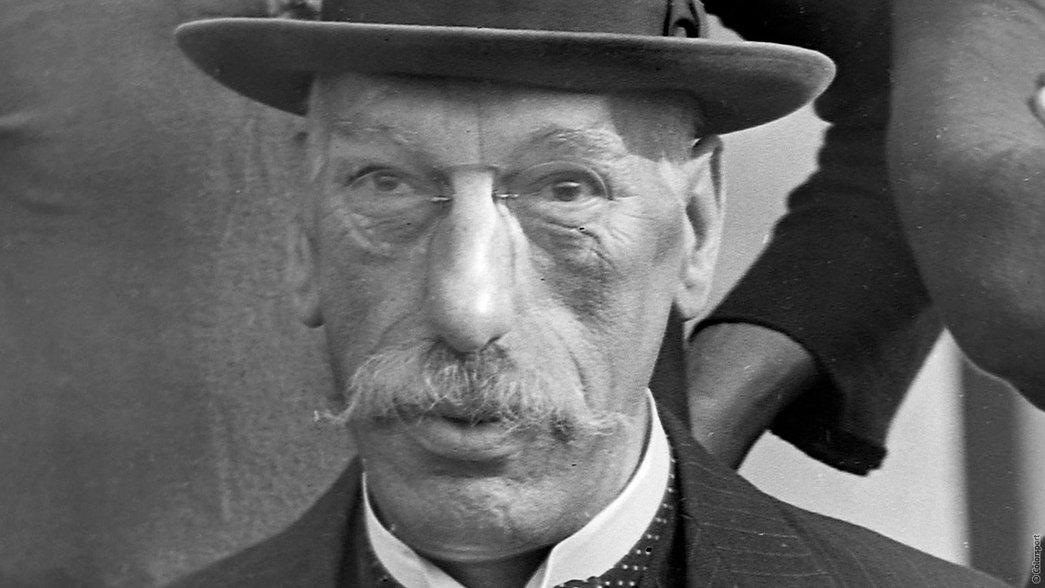
August 29, 1925: After some lean years under the management of Leslie Knighton, including nearly getting relegated at the end of the preceding season, Arsenal play their 1st match under Herbert Chapman, a former Tottenham player (but not a very good one), who had built Yorkshire's Huddersfield Town into the 1st team that ever won 3 straight Football League titles.
Herbert Chapman

Chapman starts 7 of the previous season's usual starters, 3 players who hadn't seen much playing time the season before, and his big new signing, Sunderland star Charlie Buchan (who, before becoming a star for those Black Cats, had briefly played for Arsenal). The game, against Tottenham at White Hart Lane, doesn't go so well for Arsenal, as Spurs win, 1-0, in front of a huge crowd of 53,183 fans. But Chapman must have liked what he saw from the previous year's 7 plus Buchan, and he began to tinker with the side a little more.

He also instituted what became known, due to its shape, as the W-M formation. Usually, teams had lined up with two fullbacks, three midfielders, and five forwards: A "2-3-5" formation. By moving a central midfielder back, creating the position of centreback, Chapman could move his left back and right back out, thus providing better coverage on defense (or "defence," as they'd say in England). By moving two forwards back, Chapman created a two-tired attack.

The W-M was a 3-2-2-3, and this, coupled with a change in the offside rule (though the W-M's creation had little to do with adapting to it), allowed Chapman to play certain players to their strengths, scoring more goals and allowing fewer.
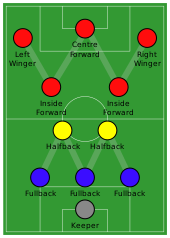
The W-M Formation

This formation would be copied all over Europe due to the success that Arsenal would have in the 1930s, and would be the preferred formation in England until the 1953 demolition of the national side by Ferenc Puskas-led Hungary at Wembley, which led to the more modern 4-4-2 and 4-3-3 formations. (Today, Arsenal manager Arsene Wenger's preferred formation of 4-2-3-1 owes a little bit to the W-M.)

A team that had mostly the same players as the year before, plus one "marquee signing," went from nearly relegated in 1925 to 2nd place in 1926 -- the best finish in Arsenal's history to that point, and the closest any London or quasi-London team (including Tottenham) had yet come to winning Division One. "The Gunners" (nicknamed for their cannon badge, a nod to the old Royal Arsenal days) were on their way.

May 5, 1928: Both North London teams travel to Liverpool for the last game of the season. Tottenham lose 2-0 to Liverpool FC at Anfield, completing a disastrous run where they won only 3 of their last 15 League games, 2 of their last 12, 1 of their last 8, and none of their last 4.

Meanwhile, Arsenal draw 3-3 with Everton at Goodison Park. This not only allows Everton, led by the premier forward of the era, William "Dixie" Dean, to win the League title, but it completes a nosedive -- later American fans would call it a "tanking" -- Tottenham thus finish 21st, and are relegated, when 1 more point by them, or 1 fewer point by either Burnley or Portsmouth, would have saved them.

Arsenal had purposely lost to Burnley and Portsmouth earlier, in order to get Tottenham relegated. Or so the story goes. In fact, it's ridiculous. By a weird twist of the schedule, both of Arsenal's matches against Burnley were way too early in the season to know whether Tottenham were in relegation danger: August 31 and September 5, and Arsenal actually won both of those games. One of the Portsmouth games was on October 8, and Arsenal won that, too.

Arsenal did lose 2-0 at home to Portsmouth on March 28, but there were 10 games to go, and Tottenham were 9th at the time -- ahead of Arsenal. The win put Portsmouth in 15th, ahead of Arsenal in 16th, so it really didn't make sense for Arsenal to throw the game. Arsenal ended up 10th, as they lost only 2 more games the rest of the way -- 1 of them to Tottenham. Fine job of trying to get them relegated, huh?

Once again, Tottenham's version of history is, as the English say, bollocks.

April 26, 1930: After losing their 1st appearance in the FA Cup Final in 1927, to Cardiff City (still the only team outside England to win it, and Scotland's Queen's Park is the only other non-English team to even appear in the Final), The Arsenal were back in it, and against Chapman's former side, Huddersfield Town, now managed by their former star inside forward Clem Stephenson. As a result, the two sides walked out onto the field (or the "pitch," as they'd say in England) at London's Wembley Stadium together. This became a tradition, and now it's done for every game, all over the world.

Alex James scores for Arsenal in the 1st half, and Jack Lambert (no relation to the legendary Pittsburgh Steelers linebacker of the same name) adds a late insurance goal, and Arsenal win, 2-0, to win their 1st major trophy. They had won a few minor trophies, but the Cup was the big one.

April 11, 1931: Arsenal travel to Grimsby Town and win, 1-0, at Grimsby's Blundell Park, to clinch the League title for the 1st time. Indeed, they were the 1st London club ever to do it. Tottenham Hotspur had never done it -- and even if they had, at this point, Tottenham was still in Middlesex, not in London.

With stars like James, Tom Parker, Cliff Bastin, David Jack, Bob John, Joe Hulme, Eddie Hapgood, and later Ted Drake and Wilf Copping, Arsenal would go on to win the League again in 1933, '34, '35 and '38, and also take the FA Cup in 1936, while reaching the Final but losing it in 1932. Meanwhile, Tottenham would be relegated during the decade. Despite Chapman's death in 1934, The Arsenal kept winning under new manager George Allison, and became the best team in Britain, and maybe the best team in Europe.

(We can't say for sure: There would be no European Cup until the 1955-56 season, but, in late 1934, an England side with 7 Arsenal players, plus a 19-year-old but already quite wizardly Stoke star Stanley Matthews, beat Italy, which had recently won the World Cup, in a rough match played in drenching rain at Highbury. So, at that point, it was reasonable to assume that, if the top team in Italy was Juventus, which contributed more players to the nominal World Champions -- England then thought the World Cup beneath itself, and did not compete in it until 1950 -- than any other team, then Arsenal were better, and were thus "the best team in the world.")

May 5, 1931: Arsenal and Tottenham play each other in the Final of the London FA Charity Cup, at Stamford Bridge. It's the Great Depression, and only 10,160 fans are listed as having paid the expense to see a meaningless exhibition.

If it was so meaningless, why do I mention it? Because it's the first time, and it remains the only time, that Arsenal and Tottenham have ever played each other in the final of any tournament. That, at the very least, has to be worth mentioning. Arsenal win it, 2-1.

September 10, 1931: Jimmy Brain becomes the 1st major Arsenal player to cross the divide, as the Gunners sell him to Spurs, for £2,500. He appears, however, to not have had this held against him by Arsenal fans. He had scored 139 goals for Arsenal (a club record until surpassed by Bastin), but would score only 10 for Spurs.

January 6, 1934: In this pre-antibiotic age, Chapman dies of pneumonia, just short of his 56th birthday, and after leading Arsenal to the 1930 FA Cup and the League title in 1931 and 1933. But caretaker manager Joe Shaw takes them to another title in 1934. George Allison, a longtime associate of Chapman's, took over as manager, and led Arsenal to League titles in 1935 and 1938, and the FA Cup in 1936.

October 20, 1934: Ted Drake, who had nearly signed for Tottenham as a teenager, but was now in his 1st full season with Arsenal, scores 3 goals in a 5-1 win over Tottenham at White Hart Lane. He is the 1st Arsenal player ever to score a hat trick in a competitive match against Spurs. There has been only one other since, and he also did it at The Lane.
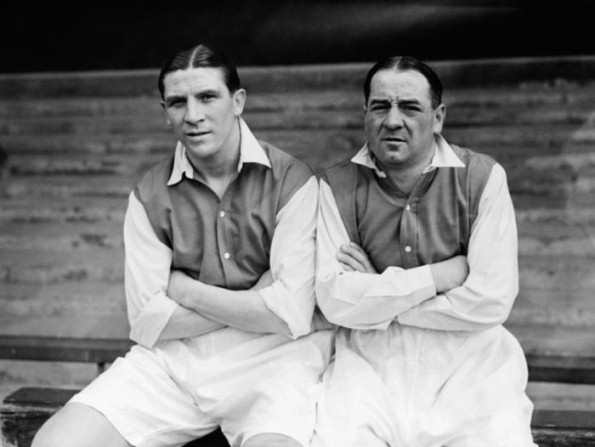
Ted Drake, left, and Alex James,
in the iconic red shirts with white sleeves
that Chapman had introduced in 1933

Drake was just getting warmed up: A year later, he would tie a league record for most goals in a Division One match, tallying 7 against Aston Villa. No player has matched or beaten that since.

In 1955, Drake would become the 1st man to win the League as both a non-managing player and a non-playing manager, taking Chelsea to the title. It was the only title in their 1st 99 seasons, and the only manager ever to take Chelsea to the League title without Roman Abrmovich's ill-gotten Russian energy billions is an Arsenal man.

September 1, 1939: Nazi Germany invades Poland, World War II begins, and, with the 1939-40 season barely begun, the FA shut league competition down for the duration. Since the war ended on August 14, 1945, too late to start up a new Football League season (but not too late to start up a full 1945-46 season for the FA Cup), the League did not resume until the next season, 1946-47.
Highbury, sometime between the 1936 opening of the East Stand
and the 1988 reconstruction of the south end, the Clock End

January 8, 1949: For the 1st time, a North London Derby is held in the FA Cup. In a 3rd Round match at Highbury, Arsenal, defending League Champions under manager Tom Whittaker, win, 3-0.

September 13, 1949: Arsenal purchase Freddie Cox from Tottenham for £312,000 -- for the time, a gigantic sum.

April 28, 1951: Tottenham beat Sheffield Wednesday (so named because the cricket club they were founded as played their matches on that day of the week), 1-0 at White Hart Lane, and win their 1st League title. It took them 43 years. Well, 32 seasons, if you don't count the ones that weren't played due to the World Wars.

It's not that Arsenal were in decline: Under Whittaker, who'd been the team physiotherapist in the Chapman and Allison years, they'd won the League in 1948, won the FA Cup in '50, would reach the Final again while just missing the League title in '52, and would win the League again in '53.

They were led by Captain Joe Mercer (who would later lead Manchester City to the 1968 title), the aforementioned Freddie Cox, Reg Lewis (who scored both goals in the 1950 Final), and the Compton brothers, Les and Denis, who were also esteemed cricketers.

But, in this particular season, Tottenham were better. The team, managed by Arthur Rowe and known for their style of play as "the Push and Run Spurs," included 2 future managing legends: Bill Nicholson and Alf Ramsey. Other stars included Ronnie Burgess and Ted Ditchburn.

September 29, 1951: The largest crowd in the history of North London Derbies to this point, 72,164, crams into Highbury to see a 1-1 draw.

Soon, however, both clubs would go into a down period. Between 1953 and 1971, Arsenal would only finish as high as 3rd once, in 1959. Tottenham would be even worse off in the later Fifties: As age and decline beset Nicholson, Ramsey and the rest, Rowe's health became poor, and he had to retire in favor of Jimmy Anderson. Spurs were nearly relegated in 1956, then jumped back to 2nd in '57, but Anderson got sick as well, and Nicholson became manager. This is when Tottenham's greatest period began.

June 15, 1952: The last 2 Football League Champions meet in a friendly -- at Yankee Stadium in New York. It is no contest, as 1951 Champions Tottenham clobber 1952 Champions Manchester United 7-1.
United, left, and Spurs players line up before the game


October 20, 1956: Arsenal defeat Tottenham 3-1 at Highbury. This was to be their last match with Tom Whittaker as manager. He died 4 days later. He and Herbert Chapman remain the only Arsenal managers to die in office.

April 17, 1961: Tottenham win the League for the 2nd time, as the failed Bay of Pigs invasion gets underway in Cuba. Again, the clincher is at home at White Hart Lane, and again the opponent is Sheffield Wednesday. Spurs win, 2-1.
White Hart Lane, circa 1961

Arsenal are 11th in the table, and not a factor for either the League title, the FA Cup, or the League Cup, which is run for the 1st time this season (although Arsenal won't enter it until 1965-66).

May 6, 1961: Tottenham defeat Leicester City, 2-0 at Wembley, and win the FA Cup for the 1st time in 40 years. Even more, winning the League and the FA Cup gives Spurs "The Double" -- an achievement only done twice before: By Preston North End in the 1st League season of 1888-89 (an unbeaten League season that got them nicknamed the Invincibles), and by Aston Villa of Birmingham in 1897.

By "doing The Double," Spurs were now the toast of not just London, but all of England. And while Arsenal fans sing "You won the League in black and white," there is surviving film of the Cup Final in color (or "colour," as they'd say in England).
Bill Nicholson, with the League trophy and the FA Cup

August 26, 1961: Tottenham beat Arsenal 4-3 at The Lane, and left winger (in position, I don't know about his politics) Terry Dyson becomes the 1st Spurs player to score 3 goals in a competitive game against Arsenal. He remains the only one.

September 13, 1961: Tottenham become the 1st London team to play in the European Cup. Actually, no, they don't, as they are not in London, they are in Middlesex. They do, however, become the 1st team from the South of England to play in it. In a match played in Zabrze, Poland, Tottenham lose 4-2 to Gornik Zabrze.

The tournament had begun with the 1955-56 season, when Chelsea were coming off their 1st League title, but they were ordered by the FA to decline an invitation to participate. Manchester United ignored the FA's demands, and had competed in the Cup in the 1957-58 season, making them the 1st English team to play in it. They got to the Quarterfinals, against Red Star in Belgrade, Yugoslavia (now Serbia). But a plane crash after a refueling stop in Munich, Germany killed 22 people, including 8 United players, and injured 2 others badly enough to end their careers.

This not only hurt United's trophy chances for a few years (though they still reached the '58 FA Cup Final), it is often considered the reason England did not win the World Cup in 1958 and 1962. (The fact that Garrincha, Didi, Nilton Santos and a young man known as Pelé were starring for Brazil seems to be overlooked by the English.) It would take until 1967 for a British club to win it (Celtic, of Glasgow, Scotland) and 1968 for an English one (a rebuilt United).

September 20, 1961: Tottenham become the 1st London-area team to host a European Cup match. They make Gornik pay dearly for the defeat in Poland, winning 8-1, with Welsh winger Cliff Jones scoring 3 goals and forward Bobby Smith 2.

April 5, 1962: After losing the 1st leg of the European Cup Semifinal in Lisbon, Portugal to defending Champions Benfica, 3-1, Tottenham play the home leg, and 64,448 fans shoe-horn themselves into White Hart Lane. Smith scores, and Danny Blanchflower, the Northern Irish defender who was their Captain, converts a penalty, to give Spurs a 2-1 win. But Spurs lose 4-3 on aggregate.
Danny Blanchflower

To this day, there are Spurs fans who insist that Benfica cheated in those matches. In one of his last interviews, the late Spurs defender Dave Mackay agreed. Yeah, Benfica cheated by having more experience, and having the great Mozambicquan star Eusébio in their ranks. Such people also say that Spurs would have defeated Real Madrid in the Final -- a Madrid side that featured Ferenc Puskás
and Alfredo di Stéfano. They figure they would have beaten Madrid in the Final because Benfica did.

Poor old Spurs, everybody cheats but them. As they say in England, "Go home, you're drunk."

October 6, 1962: Tottenham take a 3-0 lead over Arsenal at White Hart Lane. Mackay scores in the 4th minute, forward John White in the 16th, and Jones in the 26th. David Court scores for Arsenal right after that, and again in the 33rd, but Jones tallies again right before the half, to make it 4-2. Some observers thought Spurs could have had as many as 6 goals.

Johnny MacLeod gets the Gunners to within 4-3 early in the 2nd half, and in the 75th minute, Geoff Strong finds an equaliser. Tottenham 4-4 Arsenal. As the later song would have gone, "Three-nil, and they fucked it up!"

That was what supporting Arsenal was like in the early 1960s: Lots of games they would win 4-3 or 5-4, lose 4-3 or 5-4, draw 3-3 or 4-4. Their attack, with wingers Court and MacLeod, and forwards Strong, George Eastham and Joe Baker, was fantastic. But their defense was not equal to the task.

And what supporting Spurs was like at that time? In 1962-63, they scored 111 goals in League play, an average of 2.64 per game, but finished 2nd to Liverpool side Everton.

May 15, 1963: Tottenham -- as their fans never stop reminding us -- become the 1st British team to win any European trophy. Having again won the FA Cup in 1962, they were eligible to enter the European Cup Winners' Cup (a tournament that was canceled after the 1998-99 season). They win the Final over Atletico Madrid (not to be confused with Real Madrid), 5-1 at De Kuip, the home stadium of the Dutch giants Feyenoord in Rotterdam. This is easily their greatest moment in Rotterdam -- more troubling ones were to come.

Jimmy Greaves, their hotshot forward (obtained midway through the 1961-62 season, so he wasn't on the Double side), scores twice. So does the aforementioned Terry Dyson. So does the aforementioned John White.

Just a little over a year later, White would be killed by being struck by lightning. He was only 27. Greaves would go on to one of the greatest playing careers any Englishman has ever had, but his life would be dogged by alcoholism. Like later Arsenal legends Kenny Sansom, Tony Adams and Paul Merson, but unlike (thus far) later Spurs legend Paul Gascoigne, he would famously dry out and become a spokesman for a clean lifestyle.

Tottenham fans were sure that their 1960s Spurs would surpass the achievements of the 1930s Gunners, but, for whatever reasons -- dodgy European referees, White's death, Greavsie's drinking, you name it -- it just didn't happen. In 9 seasons, 1930 to 1938, Arsenal won 5 League titles and 2 FA Cups; in 7 seasons, 1961 to 1967, Spurs won 3 FA Cups and a Cup Winners' Cup, but only 1 League title.

October 15, 1963: A year and change after the 4-4 draw at The Lane, a crowd of 67,857 plows into Highbury to see a derby, and if they came to see goals, they are not disappointed. Greaves scores in only the 3rd minute, and Bobby Smith in the 20th. Mackay also scores for Spurs, who lead 4-2 with 5 minutes to play.

Eastham scores 2 for Arsenal, including a penalty. Then, with 5 minutes left, Baker scores. And, in stoppage time, a supposedly injured but carrying-on Strong scores off a corner to forge yet another 4-4 draw that electrifies Islington.

Smith complains that Spurs goalkeeper Bill Brown had been interfered with, and that the equaliser should be waved off. The referee is having none of it. That ref is Dennis Howell, who would later be elected to Parliament and serve as Britain's Minister of Sport. Clearly, Prime Minister Harold Wilson (serving 1964 to 1970 and again 1974 to 1976) was not a Tottenham fan.

April 1, 1965: The London Government Act 1963 takes effect, creating "Greater London." It includes the entire historic County of London, most of Middlesex, and parts of Essex, Kent, Surrey and Hertfordshire. The parts of Kent it brought into London do not include Arsenal's spiritual homes of Woolwich and Plumstead, because those had been brought into London in 1889. The parts of Middlesex it brings into London do include Tottenham. The rest of Middlesex ias broken up, put into Surrey, Hertfordshire and Berkshire.

So, now, finally, Tottenham fans could truthfully say their team was in London. Nearly 94 years after Arsenal had officially arrived in the city, and nearly 82 years after Arsenal had arrived in Norton London.

And, for the moment, there was little doubt that Spurs were the best team in London. Yes, West Ham had won the FA Cup in 1964 and the Cup Winners' Cup in 1965, and Chelsea had improved significantly, and Arsenal had a lot of history. But Tottenham were, beyond much question, tops within the London area, and, indeed, in the South of England. Liverpool, Everton, Manchester United and Leeds United could, in the mid-to-late 1960s, call themselves "the Pride of the North," but Tottenham were the Pride of the South. (Both Spurs and Arsenal have put the words "the Pride of the South" into songs, each rhyming that with how they hate the other team's fans, "'cause they are all mouth.")

Although, oddly, Spurs fans would continue to call themselves "the Pride of North London." Mainly as a swipe to their arch-rivals, 4 miles down the Seven Sisters Road. After all, as was said at the time, "Arsenal haven't won a trophy since before the Coronation." It was true: The last Arsenal trophy was the League title won on May 1, 1953, and Queen Elizabeth II was crowned a month later on June 2.

Indeed, with several years of stagnation, compared with the trophies of Spurs and the Hammers, and the glamour that was coming to Chelsea, Fulham (thanks to forward Johnny Haynes) and Queens Park Rangers (a.k.a. QPR), Arsenal were not only not one of the more popular clubs in London, but were becoming just about irrelevant.

That would change in the summer of 1966, when they dismissed Billy Wright (one of the best European players of the 1950s but a failure as a manager) and hired Bertie Mee -- their physiotherapist.

He would install Dave Sexton as assistant manager, and Sexton straightened out their attack. He left after that first season, 1966-67, for Chelsea, and would lead them to their 1st FA Cup in 1970, and their 1st European Trophy, the 1971 Cup Winners' Cup. He came close to leading QPR to pipping Liverpool for the League title in 1976, and in 1979 would manage Man United into the FA Cup Final, where they would lose to... ah, but we're getting ahead of ourselves.

Mee replaced Sexton with Don Howe, an Arsenal fullback who had been Captain in 1966 when he broke his leg in a game against Blackpool, ending his playing career. What Sexton did for the offense (or "offence" or "attack"), Howe did for the defense (or "defence"). Over the next 20 years, he would be one of the most important figures at Arsenal.

July 30, 1966: England win the World Cup, beating West Germany 4-2. The England manager was former Spurs player Alf Ramsey, who had also managed Ipswich Town to the 1962 League title.

Both Tottenham and Arsenal had only 1 player in the squad. For Tottenham, it was Greaves, who was injured in the last Group Stage game and didn't play in the knockout stage, although he insisted he was ready to play in the Final. That was still better than the lone Gunner, Eastham, who didn't take the pitch at all. Martin Peters of West Ham started the Final, and would later play for Tottenham. Alan Ball of Blackpool started the Final, and would later play for Arsenal.

Ball had kind of a weird career. He helped Everton win the League title in 1970, but joined 3 teams that had won the FA Cup the season before -- Everton in 1966, Arsenal in 1971, and Southampton in 1976 -- but never won it himself, losing the Final in 1968 and 1972.

September 16, 1967: Despite Tottenham coming in as the holders of the FA Cup, completing a string of 5 major trophies in 7 years, and Arsenal still having a long way to go on their way back up, Arsenal defeat Tottenham 4-0 at Highbury.

November 20, 1968: For the 1st time, Arsenal and Tottenham play each other in the League Cup. In the 1st leg of the Semifinal, a match played at Highbury, Arsenal win, 1-0.

December 4, 1968: In the White Hart Lane leg of the League Cup Semifinal, Arsenal manage a 1-1 draw, taking the tie 2-1 on aggregate, and advancing to the Final.

March 15, 1969: Arsenal lose that Final, at Wembley Stadium, to Swindon Town -- a Division Three team in Wiltshire, in England's West Country. Thanks to a previous event tearing up the field and a rainstorm on the preceding Thursday, the field was a horrible mess, and some Arsenal players hoped the match would be postponed. Some wanted it postponed for another reason, having the flu -- shades of the "Lasagne Incident" that would happen in 2006. To make matters worse, the match went to extra time, the last thing the tired players needed.

Arsenal had lost the League Cup Final the year before, to Don Revie's Leeds United. Losing a Wembley Final 1-0 to Leeds, which was already a very good team (and would go on to win the League in 1969), was understandable. But 3-1 to Swindon? The headlines blare, including "THE SHAME OF LONDON." And, again, the line went up: "Arsenal haven't won a trophy since the Coronation."

Years later, Howe related a story: Someone told him that the club should take down the team photos of the champions of the 1930s, and the Joe Mercer teams of 1948-53, because they were too intimidating to the current players, a reminder of what they hadn't done. Howe said, "No, we have to replace these photos, with photos of the current players with a cup in their hands, so they can be a pain in the backside to the next group that comes up."

That was Howe's goal, and, as he said, "So that's what we did."

April 28, 1970: Arsenal end the trophy drought at 17 years. (And you think 9 years is hard?) They beat Anderlecht, of Brussels, Belgium, 3-0 at Highbury, to win 4-3 on aggregate and take the Inter-Cities Fairs Cup.
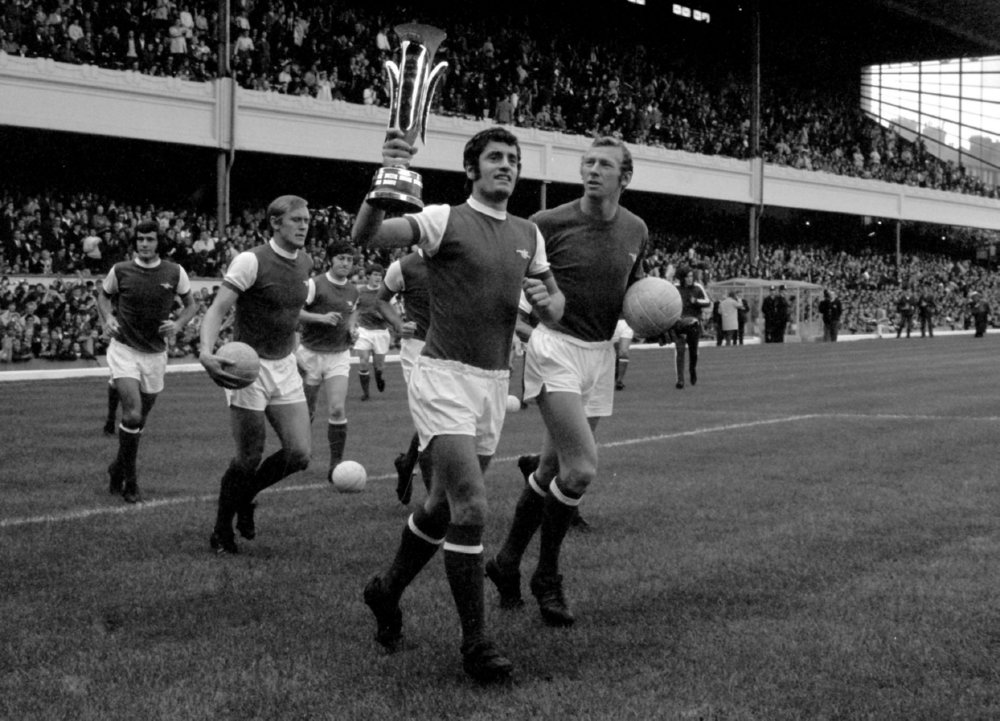
Arsenal Captain Frank McLintock, with the Fairs Cup,
and goalkeeper Bob Wilson

Two years later, the tournament would be renamed the UEFA Cup, and Tottenham would win it. To this day, their fans claim, "We are the 1st English team to win the UEFA Cup" -- even though, in 2010, the tournament became known as the UEFA Europa League.

But that's another Tottenham fans' lie: Arsenal had won it in 1970, so Spurs weren't even the 1st North London team to win it. Leeds had won it in 1968 and '71, and Newcastle had won it in '69 -- and that remains the Geordies' last major trophy (unless you want to count the now-defunct Intertoto Cup, which they won in 2006).

But despite winning the Fairs Cup, Arsenal finished 12th in the League. And they had lost the League Cup Final in back-to-back years. And oh how the Spurs fans (and everyone else in England) laughed at Arsenal.

In the 1970-71 season, the laughter would stop, as you'll see in Part III.

Arsenal vs. Tottenham: The Defining Moments, Part I: 1882-1919

Tomorrow is the North London Derby. (And that's pronounced "DAR-bee," not "DURR-bee.") Arsenal play Tottenham Hotspur.

In English soccer -- and until England can beat America in a competitive match, I'll call the sport anything I damn well please -- a team (they haven't really been "club" for over a century) has to prove itself by getting promoted to higher levels. If they finish high in a division, they get promoted to a higher one; if they finish low, they get relegated to a lower one.

This is a system of reward for trying to win, and punishment for failure, that North American sports does not have. It would be logistically difficult to rearrange things every year anyway, given the vast space of our country. The longest possible roadtrip in English "football" is Carlisle in Cumbria, in the North, near the Scottish border, to Plymouth Argyle in Devon, in the South-West, 389 miles. Of the other 13 teams in the American League, only Boston and Baltimore are closer to the Yankees than that. And a 389-mile roadtrip in the NFL or college football would be considered a piece of cake by fans of those sports.

The top division of England's Football League was called Division One from the League's founding in 1888 until 1992, and has been called the Premier League (or "The Premiership") ever since. Arsenal, of North London, have been in that top division every season since 1919, the longest uninterrupted stretch in League history.

Tottenham Hotspur, also currently in North London, have been in Division Two, now called "The Championship," a few times since then.

(And don't get me started on why the second division is called The Championship, the third is League One and the fourth is League Two. It's supposed to make sense to the English, not to the Americans.)

English football rivalries are nastier than most North American sports rivalries. Occasionally, you'll hear of trouble between fans of the Yankees and Red Sox, the Dodgers and Giants, and a few rivalries in the NFL, college football, college basketball and the NHL.

But when rivals in soccer play each other, half the city's police force has to be in and around the stadium to try to stop trouble. This is deep hatred, the kind that makes Duke basketball fans look like sissies and Oakland Raiders fans look civil (and well-dressed).

Arsenal fans hate Tottenham. Tottenham fans hate Arsenal more. Tottenham fans hate Arsenal because of Arsenal's success, much of it at the expense of Tottenham. Arsenal fans hate Tottenham because their fans are assholes.

Here then, is the 1st part of a historical sketch of the rivalry known as the North London Derby.

*

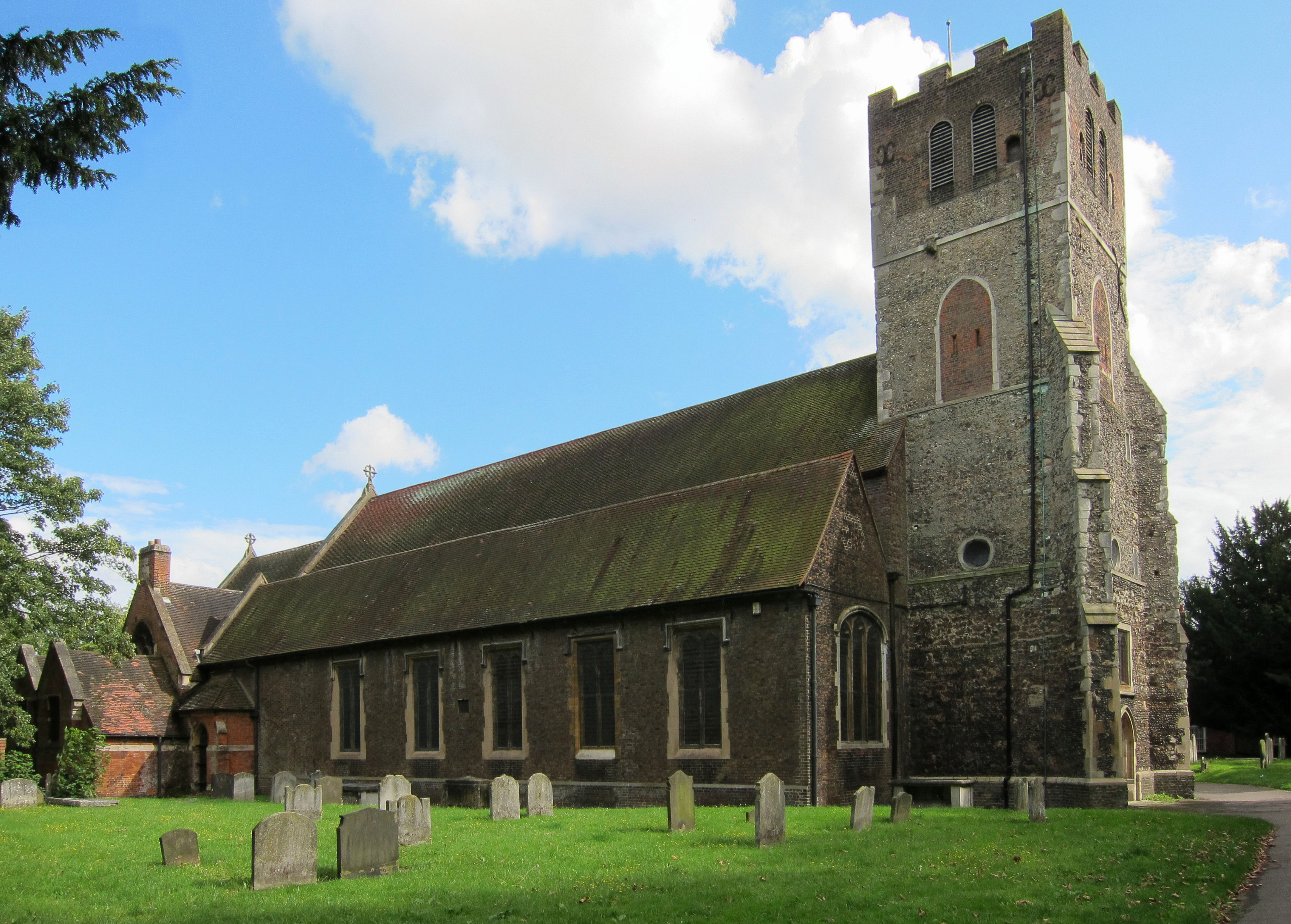
September 5, 1882: Grammar-school boys from a Bible class at All Hallows Church, an Anglican church in the Tottenham section of England's historic county of Middlesex -- not within the city limits of London, although it would later be given the postal code of N17 -- form what we would call a soccer team, under the leadership of a teacher named E.L. Sprylions. They named themselves the Hotspur Football Club, after the nearby Hotspur Cricket Club.
All Hallows Church, Tottenham

There was already another nearby team called Hotspur F.C., and still another named London Hotspur F.C. Neither of these lasted very long, but they were there at the time. So, in 1884, the All Hallows club changed their name to Tottenham Hotspur F.C. This was a successful attempt by the club to avoid confusion. Later attempts to avoid confusion amongst themselves have been less successful.

They have been nicknamed "Spurs" for short ever since. Sometimes it's "the Spurs," just like their rivals are frequently "The Arsenal" (although it's never written as Capital T, Capital S), as in their reworking of "When the Saints Go Marching In" as "When the Spurs Go Marching In."

The name "Hotspur" comes from Sir Henry Percy, an English nobleman who fought in the Anglo-Scottish Wars, first under King Richard II, then under King Henry IV. He was known as Harry Hotspur for his fine horsemanship. He later turned on Henry IV, as told in William Shakespeare's plays about the latter, and was killed at the Battle of Shrewsbury on July 21, 1403. He was just 39 years old. (Though with lifespans being what they were back then, especially for warriors, that was like being 60 today.)

So not only are Tottenham Hotspur named after a loser, they're named after a traitor.

Yeah, I know: If it wasn't for "traitors," there would have been no American Revolution. In all fairness, the Percy family did have some legitimate grievances against King Henry. And there are plenty of teams named after historical losers: Trojans, Vandals, Cavaliers, Rebels, and all the variations on Native Americans (Indians, Chiefs, Redskins, Warriors, Blackhawks, Seminoles, etc.). Not to mention that Portsmouth F.C. are nicknamed "Pompey," although this has nothing to do with the defeated rival of Julius Caesar.

December 11, 1886: The team that would be known as Arsenal play their 1st game, on the Isle of Dogs, against Eastern Wanderers. Whether, on this day, the club is playing under the name of Dial Square or under the name of Royal Arsenal is not clear. But the proto-Arsenal win the match, 6-0. It was played at a ground recently vacated by Millwall (then named Millwall Rovers), and was thus available for Dial Square/Royal Arsenal to be the "home team."

The club was founded by workers at the Royal Arsenal in Woolwich, then in the county of Kent, but now part of London (SE18). Dial Square was the section of the Royal Arsenal where most of the players worked. So, like London neighbors West Ham United (Thames Ironworks), and a pair of American football clubs that are arch-rivals, the Chicago Bears (Staley Starch Company) and the Green Bay Packers (Indian Packing Company), Arsenal got their start as what Americans called a company team, and what Englishmen call a works team or a works side.
The Royal Arsenal, Woolwich

The founders were Scottish engineer David Danskin (not connected to the Danskin clothing company), North-Easterner (County Durham) Jack Humble, and Nottingham natives Fred Beardsley and Morris Bates. The latter two had played for Nottingham Forest, and upon the founding of the Royal Arsenal club, they wrote to Forest and asked if they could spare any old uniforms. Forest could, and did, and even sent a ball through the mail. Since Forest's uniform, or "kit," is red, Arsenal's first-choice kit has also been red ever since.

(Forest also contributed founding kits to Liverpool F.C., resulting in their always having worn red at home as well. Tottenham, when they have had the choice, have worn white. When the North London teams play each other, the contrast of colors allows each to wear their usual home color.)

December 25, 1886: Records suggest that, on this Christmas Day, a meeting was held at the Royal Oak pub near the Royal Arsenal, and that the name of the club was officially changed to Royal Arsenal Football Club.

November 19, 1887: The 1st game between Royal Arsenal and Tottenham Hotspur is played, at Spurs' home ground, then in the Tottenham Marshes. Spurs are leading 2-1 after 75 minutes, when the game is called -- "abandoned," in English footyspeak -- due to darkness.

The newspaper accounts of the game make no mention of there being trouble between the supporters -- or even that there were spectators at all.

September 21, 1889: A friendly -- what Americans would call an exhibition game, but can any game between these teams really be called "friendly?" -- is played between the teams at the Manor Ground in Plumstead, Kent (now Southeast London), Arsenal's home ground at the time. Royal Arsenal win, 10-1.

James Meggs scores 4 goals for the "Woolwich Reds," and Hope Robertson scores 3. However, being tallied in a friendly, these goals are not generally counted in the history of the rivalry.

February 24, 1892: Having turned professional the year before -- legal, but "just not done" by "gentlemen" in those days -- Royal Arsenal decide that they are tired of all the teams in the Football League (founded in 1888) being in Birmingham or further north, and attempt to form the Southern League, so that teams in London and elsewhere in England's South will be able to play regular games against regular opponents, and still save on travel costs.

RAFC sent letters to the other Southern teams, and on this day, representatives of 34 clubs meet at the Anderton Hotel in central London. (It had no connection to the family that would later produce Spurs player Darren "Sicknote" Anderton.)

This league fell apart before it could ever be organized. This was the infancy of the automobile age, and trains and horse-drawn carriages were still the dominant means of land transport, and expensive. Several clubs dropped out quickly, including one that survives today, Reading F.C. of Berkshire.

Before that falling-apart, Tottenham applied to join. The 21 members who had not immediately dropped out voted on Tottenham's admittance, and they got one vote -- their own. That's it? How could that be? Is it possible that nobody liked Tottenham, even back then?

For Royal Arsenal, soon to rename themselves Woolwich Arsenal, the failure to establish a Southern League ended up not mattering, as they got an even better offer: They were invited to join the Football League, in its Division Two (there were only 2 divisions at the time), for the 1893-94 season.

This is why Arsenal's club records for that season onward are a lot more complete, and thus a lot more reliable, than they are for the founding period of 1886-93.

It ended up not mattering for Tottenham, either, as, in 1895, a Southern League was finally formed, and they were elected as charter members. In 1900, Spurs won that League -- in effect, making themselves champions of England's third division.

By the standards of today, that would be no big deal: The last 5 champions of the 3rd division, currently known as Football League One, have been Yorkshire club Doncaster Rovers, Birmingham-area team Wolverhampton Wanderers, West Country team Bristol City, Manchester area club Wigan Athletic, and Yorkshire club Sheffield United. "Wolves" have been victims of recent financial mismanagement. But, of those, only they and Sheff U are even remotely considered a "big club."

But by the standards of that time, it was a notable achievement -- and something bigger than Woolwich Arsenal had achieved by that point.

November 9, 1896: For the 1st time, a full competitive match is played between the teams, at the Manor Ground. Arsenal win, 2-1.

December 25, 1897: Yes, until the early 1970s, England's Football Association (the FA) allowed games to be played on Christmas Day. Spurs get their 1st full-match competitive win over Arsenal, 3-2 at Northumberland Park, a home game for Spurs.

September 4, 1899: Tottenham play their 1st game at White Hart Lane, named for one of its border roads, itself named after a pub called The White Hart. (A hart is a male deer.) They beat Notts County, of Nottingham, 4-1. (County should not be confused with their neighbors, Nottingham Forest.) This stadium was in Tottenham. Which, at the time, was still in Middlesex -- not in London.
A photo alleged to be of the 1st game at White Hart Lane

April 27, 1901: After playing Sheffield United to a 2-2 draw in the FA Cup Final in front of 110,820 fans at the Crystal Palace stadium in South London (since demolished and replaced with a much smaller stadium, and with no connection to the current nearby club named Crystal Palace), Tottenham win a replay at Burnden Park in Bolton (now part of "Greater Manchester"), 3-1, in front of 20,470. This makes Spurs the 1st Southern club to win the FA Cup.

To this day, Spurs fans call their team "the only team outside the Football League to win the FA Cup." Officially, this is true. But, from today's perspective, it makes it sound as if they were in the 5th level of England's "football pyramid," or lower. Why would you want to point out that your club, a 1st division mainstay, was once outside the League?

And bragging about something that happened in 1901? You don't see Chicago White Sox fans running around claiming they are the 1st team to win the American League Pennant, which was also won in 1901. Because, at this point, even they don't care about that particular achievement anymore.

At any rate, at the time, the Southern League was more analogous to the 3rd division. Still, it was a major trophy, something Arsenal had not won yet, and would not win for another 29 years.

1902: I can't find an exact date. A reserve match (a game between backups) is played between the teams in Plumstead. Spurs goalkeeper Charlie Williams charged into the crowd behind his goal and hit a spectator. His excuse was that someone was using "foul and insulting language." Certainly, it is understandable that he would object, but you just can't do that.

1904: Again, I can't find an exact date, and this time I can't even find a first name for the Spurs man involved. During another reserve match at Plumstead, Tottenham player Chalmers assaulted Woolwich player Harry Thorpe.

Apparently, despite a 17-mile difference (huge by the standards of that time), plus the River Thames being in the way, Tottenham already considered Arsenal to be something of a rival, a team to be hated.

Arsenal, on the other hand, considered their rivals to be much closer teams, such as Millwall (SE14), Fulham (SW6), and, after this latter club was founded in 1905, Chelsea (also SW6). To Woolwich Arsenal, until 1913, Tottenham Hotspur were just another team on the fixture list -- albeit one whose players were proving themselves to be bastards.

March 10, 1905: Chelsea Football Club are founded, and attempt to join the Southern League. Tottenham object, because it would cut into "their territory."

Never mind that Fulham, Millwall, West Ham United (E13), Clapton Orient (now Leyton Orient, E10) and, yes, Woolwich Arsenal were all already considered "London clubs," and that Orient were within 5 miles of White Hart Lane, and unlike The Lane were then actually in London; whereas Chelsea's stadium, Stamford Bridge, is 13 miles away by the shortest land route. And yet, Tottenham's objection is upheld.

Thus rejected by the Southern League, Chelsea aim higher, and apply for membership in the Football League Division Two. And they get it.

Think about it: If Tottenham hadn't been such pricks in 1905, Chelsea might never have gotten into the Football League, might have gone out of business, wouldn't be a bigger club today than Tottenham, and we would have been spared the likes of Roman Abramovich, Jose Mourinho, John Terry, Arjen Robben, William Gallas and Didier Drogba. (True, they all could have been involved with other English clubs, but it wouldn't have been with Chelsea.) And Tottenham's Y** Army wouldn't have kept getting their heads handed to them by the Chelsea Headhunters.

(In Part II, I'll explain the use of the Y-word.)

This is, perhaps, not the first act of stupidity by Tottenham as a club. But it is the first big one, and, while it took nearly a century, it did come back to bite them in the ass. (Or "the arse," if you prefer the English version.)

May 30, 1908: Tottenham finish 8th in the Southern League. They and West London club Queens Park Rangers are expelled from that League. Yet, somehow, they are invited into the Football League Division Two -- finally elected to it by that league's members, after previous denials.

Huh? They go from 8th in the Southern League to Division Two of the Football League? On what grounds? Their long history of success? They didn't have one: At this point, they had won one league title, and one FA Cup. A decent performance from a club only 26 seasons old, and more than Woolwich Arsenal had yet achieved in 22 seasons; but hardly worthy of promotion, unlike, say, finishing 1st or 2nd in the league they were in.

As it turns out, Stoke City, among the founding members of the Football League, had to drop out due to financial difficulty (although they would later be readmitted). As it turned out, Spurs may have bribed Stoke (who certainly needed the money) to drop out, so that a space in the League would open up.

Tottenham would finish 2nd in their 1st season in Division Two, 1908-09, and would be promoted to Division One. If we presume that there was no match-fixing in that season (and, as far as we know, there wasn't), that was legitimate.

But Spurs' getting into the League in the first place is a big, big question mark. Something to remember when we get to 1919.

December 4, 1909: For the 1st time, Woolwich Arsenal and Tottenham Hotspur play a Football League game against each other. It is played at the Manor Ground in front of an estimated 18,000, and the final score is 1-0 to the home team -- or, as would be said decades later, "One-nil to The Arsenal."

April 19, 1913: Woolwich Arsenal and Tottenham Hotspur play to a 1-1 draw at White Hart Lane. Arsenal's relegation to Division Two is already assured. What is also already assured is the construction of a new stadium. The club's chairman, Henry Norris, believing that weak transport links (which have since greatly improved for that area) are hurting the club, has decided to move Arsenal to the Islington section of North London.

Tottenham, yet again, flip out about a club invading "their territory," even though the new stadium, to be named Arsenal Stadium, but nicknamed "Highbury" after the neighborhood, is 4 1/2 miles away -- roughly as far away from White Hart Lane as Clapton Orient already were.

It should be noted that neither Clapton Orient, nor West Ham United, nor Chelsea, nor any other London or quasi-London club objected to the move. Just Spurs, apparently again being pricks for the sake of being pricks.

Arsenal fans like to say they've never been relegated. This is not true -- but it is also now true that they haven't been relegated in over 100 years.

September 6, 1913: The 1st game is played at Highbury (N5), in front of 20,000 fans. Woolwich Arsenal defeat Leicester Fosse, 2-1, on a penalty kick by Archie Devine, following a late Leicester handball in the box.
Highbury, in its 1913-1932 configuration

At the conclusion of this 1913-14 season, Norris drops the locality from the name, and the club officially becomes "Arsenal Football Club" -- to this day, unofficially called "The Arsenal," capital T, capital A, by many.

Along with Port Vale in Staffordshire, Arsenal are 1 of only 2 clubs in the Football League to not have a locality as part of their name. (Well, technically, "Arsenal" could be, but the club had long since outgrown their "works side" status.) Leicester Fosse would later become Leicester City, and are still in business.

April 2, 1915: Manchester United beat Liverpool 2-0 at Old Trafford in a Good Friday match. Why am I mentioning this game in a post about Arsenal and Tottenham? Hang on, it will matter...

April 24, 1915: Tottenham lose 5-0 away to Sunderland, clinching 20th and last place in Division One, meaning they are to be relegated to Division Two. But the FA then suspends the sport for the duration of The Great War (which is later known as World War I).

March 10, 1919: The war over, the Football League holds a meeting to reorganize. In the leadup to this meeting, it was suggested -- as it turned out, correctly, even more than they suspected -- that the postwar market for football would be insatiable, and that Division One should be expanded from 20 to 22 teams.

This would seem to have been great news for Chelsea, which had finished 19th in Division One; and for Tottenham, which had finished 20th. Now, in spite of their grand ineptitude, they could keep their spaces in Division One and not be relegated, while the top 2 teams from Division Two in the last completed season, 1914-15, Derby County and Preston North End, could still keep their hard-earned promotions.

But it was revealed that the April 2, 1915 game at Old Trafford had been fixed. There you have it: Proof that Manchester United were cheating bastards 26 years before Alex Ferguson was even born.

Man U were then desperate to avoid relegation: Had they lost, they, rather than Chelsea, would have finished 19th. Liverpool were willing to accept this loss: Man United was only 33 miles away, and, with transportation costs being what they were, the Scousers didn't want to lose a cheap roadtrip.

Imagine Liverpool giving the club that has become their most hated opponents a break that saves them from relegation. Better yet: Imagine Man United being in position to be relegated. A wonderful thought.

By all rights, Chelsea were screwed out of 18th place and safety. By all rights, Man U should have been kicked out of the League. After all, it's not as though people in the Manchester area would be without a team: Manchester City, Manchester Central, Bolton Wanderers, Oldham Athletic, Bury, Rochdale and Stockport County were all already in business. (Wigan Athletic would come later, in 1932, replacing Manchester Central, who went out of business due to the Great Depression.)

But Man U were already one of the biggest clubs in the North of England, and a lot of people didn't want them kicked out. So Norris -- knighted for his work supporting the war effort, and now known as Sir Henry Norris -- had a plan: He would bring several clubs in to vote to keep Man U in the League... if Man U and their allies would vote to bring Arsenal into Division One.
Sir Henry Norris

It worked: Chelsea rightly got the 21st spot, and Arsenal got the 22nd, even though they had finished 6th in Division Two in 1915. (A later check of the results showed they should have been listed as 5th, but that doesn't matter now.)

This election would seem to have screwed not only Tottenham, but Barnsley (a Yorkshire club that had finished 3rd in Division Two), Wolves (4th) and Birmingham City (a.k.a. Brum or the Brummies, officially 5th) out of that 22nd place. Yet all 3 of those clubs have been in the Premier League in recent years, and while their fans don't particularly like Arsenal (many fans admire Arsenal, but few genuinely like them), they never bring up the fact that "You screwed us out of the first division in 1919!"

Only Tottenham fans do that. To this day, Tottenham fans claim that there must have been bribery, that Norris must have paid off some club chairmen to vote Arsenal into Division One.

It has been 99 years. Almost a full century. Not one shred of evidence has ever been publicly produced that Norris bribed anyone to make it happen.

You want to call Norris' move underhanded? It might have been. But it was not corrupt. Not until 1987 would the League make a team's promotion be automatic: Until then, it was always by election. Granted, those elections nearly always turned a rightful promotion into a formality and a reality. But not always. Sometimes, it was based on other factors, such as convenience for the clubs' business managers. This was one of the times that it was decided based on something other than finishing position, and, while it may have been odd, it was done within the rules of the time.

Indeed, there is more evidence that Tottenham bribed their way into the League at all in 1908 than there is that Arsenal bribed their way into Division One in 1919. Certainly, no one at the time publicly suggested Norris had bribed anyone.

According to Andy Kelly from the website Untold Arsenal:

It looks like no one really questioned the events of 1919 for 33 years. Bernard Joy suggested that something underhand may have occurred in his book "Forward, Arsenal!" in 1952. Since then, every Arsenal history seems to have built on this, and Tottenham fans have latched on to it.

Why was nothing questioned at the time or in 1927, 1929, 1934 (when he died), or at any other time before someone decided to write a book?

Brian Glanville wrote an Arsenal history around the same time as Joy, but didn't feel the need to question the decision. However, following Joy's book, Glanville has increasingly vilified Norris even though no new evidence has come to light since.

And with Joy's and Glanville's histories full of holes and second-hand accounts, it's difficult to give them any credibility.

And, besides, as the team that finished last in the last season, Tottenham had far less right to gripe about Arsenal screwing them over than did Barnsley, Wolves or Brum. Spurs were last, and on merit, too.

Yet the story persists, and fans of other clubs who hate Arsenal are more than happy to pass the lie along.

Tottenham did rightly win promotion to Division One at the end of the 1919-20 season. You would think that, since (presuming that they were screwed at all) they were only screwed for 1 year, they would have gotten over it by then.

But since they can't claim to be a more successful club than Arsenal, or a bigger one, or a more admired one around the world, Tottenham fans hang onto this myth that Arsenal were corrupt in 1919 and cheated them.

It makes me wonder why they never blame Man United for screwing them. After all, if United hadn't fixed that game in 1915, they would have been 19th, and thus entitled to remain in Division One, and Arsenal wouldn't have been able to make arrangements, legal or otherwise, to get that 22nd spot. So why don't Spurs fans hate United?

Because hating Manchester United requires taste. And if Tottenham fans had any taste, they wouldn't be Tottenham fans.

May 24, 1919: A friendly (what we Americans would call an exhibition game) is played between Arsenal and Tottenham at Highbury -- technically a home game for Tottenham, as White Hart Lane had been impounded by the British government for war-related activities. The game ends 0-0.

It had been 10 weeks since the decision to give promotion to Arsenal and deny it to Tottenham had been made. And yet, not only had Tottenham decided to continue playing matches (there had been matches during the war, just not League or FA Cup matches) at Highbury until The Lane was given back to them at the start of the next season, they agreed to play this completely unnecessary friendly against their local rivals.

If Tottenham -- management, players or fans -- were so angry at that time about Arsenal using corrupt means to keep them out of Division One, then why would they have agreed to play this game at all? And why play this game, or any game, at Highbury? Why not find some other place to play, if The Lane hadn't yet come back under their control?

Yet another fact to demolish the lie that there was any thought, at the time, to Arsenal's "corruption." Whenever that story started, it wasn't in the Spring of 1919.

Part II will follow.

Saturday, November 5, 2016

Arsenal vs. Tottenham: The Defining Moments, Part II: 1920-1970

April 23, 1921: Tottenham win their 2nd major trophy, the FA Cup, defeating Wolverhampton Wanderers (a.k.a. Wolves) 1-0 in the Final at Stamford Bridge, home ground of West London club Chelsea. Local hero Jimmy Dimmock scored the only goal.

This would turn out to be the only major trophy Tottenham would win in a half-century span, from 1901 to 1951. "Big club"?

September 23, 1922: The clubs play an early-season match at White Hart Lane, and it was one of the most disgraceful displays in Arsenal history -- worthy of 1970s Leeds United, or more recent Manchester United and Barcelona squads. Indeed, this game would seem to confirm everything that Spurs fans believe about Arsenal.

Spurs' outside right (roughly the equivalent of a right winger in the modern era) Frederick "Fanny" Walden -- at 5-foot-2, the shortest player ever for the England national team -- left the game with an injury 20 minutes in. As substitutes weren't allowed until 1966, this left Spurs with 10 men for 70 minutes. There is no contemporary record stating that his injury was caused, willfully or otherwise, by an Arsenal player. But since Tottenham fans, even then, weren't exactly long on logic, they got angry.

A few minutes later, the intent to injure was undeniably underway. Arsenal's Arthur Hutchins fouled Spurs' Alex Lindsay. For 5 minutes, Spurs were down to 9 men. At that, the Spurs crowd was justifiably angry. Bert Smith (no relation to later Tottenham star Bobby) got fouled, and they got angrier. Bert Bliss got hurt right before the half, and played the 2nd half limping.

Reg Boreham broke the deadlock 5 minutes into the 2nd half. But, despite being 1-0 up on a team with, essentially, 9 1/2 men, the Gunners continued to play rough. Dimmock got hacked down by Frank Bradshaw. This was the era before yellow and red cards were used to discipline players, but the referee, listed in the game account only as "Mr. C. Austin," only had a few words with Bradshaw, rather than sending him off and (more or less) evening things out.

With 10 minutes left, Boreham scored again, and Arsenal led 2-0. But Lindsay pulled one back, making it 2-1. At first, it appeared to have been ruled offside. But then Austin motioned that he was allowing it, and Arsenal goalkeeper Stephen Dunn, ignoring the fact that time had almost run out and an equalizer (equaliser) was incredibly unlikely, actually grabbed him and shook him. Today, that would be an automatic straight red card, likely a lengthy suspension, and villain status for all time. Austin let him stay on the pitch.

Then Bert Smith, according to the later report, "used filthy language" in yelling at Arsenal's Alex Graham (no relation to later star and manager George), and Graham decked him. The Spurs fans began throwing things at the Arsenal players, and the police came onto the pitch to settle things down.

The Football Association actually appointed a commission to investigate this game. And, as was often the case in those days when neighbors (neighbours) played each other, the return fixture was not weeks or months later, but just 1 week later!

September 30, 1922: The teams met again at Highbury, and 55,000 came out, the biggest Arsenal home crowd of the season. They did not leave happy. The FA appointed the strictest referee of that era, a Mr. W.E. Russell, to oversee the proceedings, and nothing untoward happened. Peter McWilliam, improvising following the previous weekend's injuries, put together a Spurs side that beat Arsenal 2-0. At the final whistle, the opposing captains shook hands, and things were calm.

When the FA concluded their inquiry on October 5, Smith, Graham and Dunn were all suspended. While the North London rivals have had viciousness between their fans on a number of occasions since, the September 23, 1922 match remains by far the most violent encounter between the sets of players.

October 25, 1924: Jimmy Brain makes his first-team debut for Arsenal, and scores the only goal in a 1-0 derby win over Spurs at Highbury. He would go on to become the 1st player to score 100 goals for Arsenal.

August 29, 1925: After some lean years under the management of Leslie Knighton, including nearly getting relegated at the end of the preceding season, Arsenal play their 1st match under Herbert Chapman, a former Tottenham player (but not a very good one), who had built Yorkshire's Huddersfield Town into the 1st team that ever won 3 straight Football League titles.

Chapman starts 7 of the previous season's usual starters, 3 players who hadn't seen much playing time the season before, and his big new signing, Sunderland star Charlie Buchan (who, before becoming a star for those Black Cats, had briefly played for Arsenal). The game, against Tottenham at White Hart Lane, doesn't go so well for Arsenal, as Spurs win, 1-0, in front of a huge crowd of 53,183 fans. But Chapman must have liked what he saw from the previous year's 7 plus Buchan, and he began to tinker with the side a little more.

He also instituted what became known, due to its shape, as the W-M formation. Usually, teams had lined up with two fullbacks, three midfielders, and five forwards: A "2-3-5" formation. By moving a central midfielder back, creating the position of centreback, Chapman could move his left back and right back out, thus providing better coverage on defense (or "defence," as they'd say in England). By moving two forwards back, Chapman created a two-tired attack.

The W-M was a 3-2-2-3, and this, coupled with a change in the offside rule (though the W-M's creation had little to do with adapting to it), allowed Chapman to play certain players to their strengths, scoring more goals and allowing fewer.

This formation would be copied all over Europe due to the success that Arsenal would have in the 1930s, and would be the preferred formation in England until the 1953 demolition of the national side by Ferenc Puskas-led Hungary at Wembley, which led to the more modern 4-4-2 and 4-3-3 formations. (Today, Arsenal manager Arsene Wenger's preferred formation of 4-2-3-1 owes a little bit to the W-M.)

A team that had mostly the same players as the year before, plus one "marquee signing," went from nearly relegated in 1925 to 2nd place in 1926 -- the best finish in Arsenal's history to that point, and the closest any London or quasi-London team (including Tottenham) had yet come to winning Division One. "The Gunners" (nicknamed for their cannon badge, a nod to the old Royal Arsenal days) were on their way.

April 26, 1930: After losing their 1st appearance in the FA Cup Final in 1927, to Cardiff City (still the only team outside England to win it, and Scotland's Queen's Park is the only other non-English team to even appear in the Final), The Arsenal were back in it, and against Chapman's former side, Huddersfield Town, now managed by their former star inside forward Clem Stephenson. As a result, the two sides walked out onto the field (or "pitch," as they'd say in England) at London's Wembley Stadium together. This became a tradition, and now it's done for every game, all over the world.

Alex James scores for Arsenal in the 1st half, and Jack Lambert (no relation to the legendary Pittsburgh Steelers linebacker of the same name) adds a late insurance goal, and Arsenal win, 2-0, to win their 1st major trophy. They had won a few minor trophies, but the Cup was the big one.

April 11, 1931: Arsenal travel to Grimsby Town and win, 1-0, at Grimsby's Blundell Park, to clinch the League title for the 1st time. Indeed, they were the 1st London club ever to do it. Tottenham Hotspur had never done it -- and even if they had, at this point Tottenham was still in Middlesex, not in London.

With stars like James, Tom Parker, Cliff Bastin, David Jack, Bob John, Joe Hulme, Eddie Hapgood, and later Ted Drake and Wilf Copping, Arsenal would go on to win the League again in 1933, '34, '35 and '38, and also take the FA Cup in 1936, while reaching the Final but losing it in 1932. Meanwhile, Tottenham would be relegated during the decade. Despite Chapman's death midway through the 1933-34 season, The Arsenal kept winning under new manager George Allison, and became the best team in Britain, and maybe the best team in Europe.

(We can't say for sure: There would be no European Cup until the 1955-56 season, but, in late 1934, an England side with 7 Arsenal players, plus a 19-year-old but already quite wizardly Stoke star Stanley Matthews, beat Italy, which had recently won the World Cup, in a rough match played in drenching rain at Highbury. So, at that point, it was reasonable to assume that, if the top team in Italy was Juventus, which contributed more players to the nominal World Champions -- England then thought the World Cup beneath itself, and did not compete in it until 1950 -- than any other team, then Arsenal were better, and were thus "the best team in the world.")

May 5, 1931: Arsenal and Tottenham play each other in the Final of the London FA Charity Cup, at Stamford Bridge. It's the Great Depression, and only 10,160 fans are listed as having paid the expense to see a meaningless exhibition.

If it was so meaningless, why do I mention it? Because it's the first time, and it remains the only time, that Arsenal and Tottenham have ever played each other in the final of any tournament. That, at the very least, has to be worth mentioning. Arsenal win it, 2-1.

September 10, 1931: Jimmy Brain becomes the 1st major Arsenal player to cross the divide, as the Gunners sell him to Spurs, for £2,500. He appears, however, to not have had this held against him by Arsenal fans. He had scored 139 goals for Arsenal (a club record until surpassed by Bastin), but would score only 10 for Spurs.

January 6, 1934: In this pre-antibiotic age, Chapman dies of pneumonia, just short of his 56th birthday, and after leading Arsenal to the 1930 FA Cup and the League title in 1931 and 1933. But caretaker manager Joe Shaw takes them to another title in 1934. George Allison, a longtime associate of Chapman's, took over as manager, and led Arsenal to League titles in 1935 and 1938, and the FA Cup in 1936.

October 20, 1934: Ted Drake, who had nearly signed for Tottenham as a teenager but was now in his 1st full season with Arsenal, scores 3 goals in a 5-1 win over Tottenham at White Hart Lane. He is the 1st Arsenal player ever to score a hat trick in a competitive match against Spurs. There has been only one other since, and he also did it at The Lane.

Drake was just getting warmed up: A year later, he would tie a league record for most goals in a Division One match, tallying 7 against Aston Villa. No player has matched or beaten that since.

In 1955, Drake would become the 1st man to win the League as both a non-managing player and a non-playing manager, taking Chelsea to the title. It was the only title in their 1st 99 seasons, and the only manager ever to take Chelsea to the League title without Roman Abrmovich's ill-gotten Russian energy billions is an Arsenal man.

September 1, 1939: Nazi Germany invades Poland, World War II begins, and, with the 1939-40 season barely begun, the FA shut league competition down for the duration. Since the war ended on August 14, 1945, too late to start up a new Football League season (but not too late to start up a full 1945-46 season for the FA Cup), the game did not resume until the next season, 1946-47.

January 8, 1949: For the first time, a North London Derby is held in the FA Cup. In a 3rd Round match at Highbury, Arsenal, defending League Champions under manager Tom Whittaker, win, 3-0.

September 13, 1949: Arsenal purchase Freddie Cox from Tottenham for £312,000 -- for the time, a gigantic sum.

April 28, 1951: Tottenham beat Sheffield Wednesday (so named because the cricket club they were founded as played their matches on that day of the week), 1-0 at White Hart Lane, and win their 1st League title. It took them 43 years. Well, 32 seasons, if you don't count the ones that weren't played due to the World Wars.

It's not that Arsenal were in decline: Under Whittaker, who'd been the team physiotherapist in the Chapman and Allison years, they'd won the League in 1948, won the FA Cup in '50, would reach the Final again while just missing the League title in '52, and would win the League again in '53.

They were led by Captain Joe Mercer (who would later lead Manchester City to the 1968 title), the aforementioned Freddie Cox, Reg Lewis (who scored both goals in the 1950 Final), and the Compton brothers, Les and Denis, who were also esteemed cricketers.

But, in this particular season, Tottenham were better. The team, managed by Arthur Rowe and known for their style of play as "the Push and Run Spurs," included 2 future managing legends: Bill Nicholson (you'll be hearing his name again soon) and Alf Ramsey, who would lead Ipswich Town to the 1962 League title and England to the 1966 World Cup. Other stars included Ronnie Burgess and Ted Ditchburn.

September 29, 1951: The largest crowd in the history of North London Derbies to this point, 72,164, crams into Highbury to see a 1-1 draw.

Soon, however, both clubs would go into a down period. Between 1953 and 1971, Arsenal would only finish as high as 3rd once, in 1959. Tottenham would be even worse off in the later Fifties: As age and decline beset Nicholson, Ramsey and the rest, Rowe's health became poor, and he had to retire in favor of Jimmy Anderson. Spurs were nearly relegated in 1956, then jumped back to 2nd in '57, but Anderson got sick as well, and Nicholson became manager. This is when Tottenham's greatest period began.

October 20, 1956: Arsenal defeat Tottenham 3-1 at Highbury. This was to be their last match with Tom Whittaker as manager. He died 4 days later. He and Herbert Chapman remain the only Arsenal managers to die in office.

April 17, 1961: Tottenham win the League for the 2nd time, as the failed Bay of Pigs invasion gets underway in Cuba. Again, the clincher is at home at White Hart Lane, and again the opponent is Sheffield Wednesday. Spurs win, 2-1.

Arsenal are 11th in the table, and not a factor for either the League title, the FA Cup, or the League Cup, which is run for the 1st time this season (although Arsenal won't enter it until 1965-66).

May 6, 1961: Tottenham defeat Leicester City, 2-0 at Wembley, and win the FA Cup for the 1st time in 40 years. Even more, winning the League and the FA Cup gives Spurs "The Double" -- an achievement only done twice before: By Preston North End in the 1st League season of 1888-89 (an unbeaten League season that got them nicknamed the Invincibles), and by Aston Villa of Birmingham in 1897.

By "doing The Double," Spurs were now the toast of not just London, but all of England. And while Arsenal fans sing "You won the League in black and white," there is surviving film of the Cup Final in color (or "colour," as they'd say in England).

August 26, 1961: Tottenham beat Arsenal 4-3 at The Lane, and left winger (in position, I don't know about his politics) Terry Dyson becomes the 1st Spurs player to score 3 goals in a competitive game against Arsenal. He remains the only one.

September 13, 1961: Tottenham become the 1st London team to play in the European Cup. Actually, no, they don't, as they are not in London, they are in Middlesex. They do, however, become the 1st team from the South of England to play in it. In a match played in Zabrze, Poland, Tottenham lose 4-2 to Gornik Zabrze.

The tournament had begun with the 1955-56 season, when Chelsea were coming off their 1st League title, but they were ordered by the FA to decline an invitation to participate. Manchester United ignored the FA's demands, and had competed in the Cup in the 1957-58 season, making them the 1st English team to play in it. They got to the Quarterfinals, against Red Star in Belgrade, Yugoslavia (now Serbia). But a plane crash after a refueling stop in Munich, Germany killed 22 people, including 8 United players, and injured 2 others badly enough to end their careers. This not only hurt United's trophy chances for a few years (though they still reached the '58 FA Cup Final), it is often considered the reason England did not win the World Cup in 1958 and 1962. (The fact that Garrincha, Didi, Nilton Santos and a young man known as Pele were starring for Brazil seems to be overlooked by the English.) It would take until 1967 for a British club to win it (Celtic, of Glasgow, Scotland) and 1968 for an English one (a rebuilt United).

September 20, 1961: Tottenham become the 1st London-area team to host a European Cup match. They make Gornik pay dearly for the defeat in Poland, winning 8-1, with Welsh winger Cliff Jones scoring 3 goals and forward Bobby Smith 2.

April 5, 1962: After losing the 1st leg of the European Cup Semifinal in Lisbon, Portugal to defending Champions Benfica, 3-1, Tottenham get a home leg, and 64,448 fans shoe-horn themselves into White Hart Lane. Smith scores, and Danny Blanchflower, the Northern Irish defender who was their Captain, converts a penalty, to give Spurs a 2-1 win. But Spurs lose 4-3 on aggregate.

To this day, there are Spurs fans who insist that Benfica cheated in those matches. In one of his last interviews, the late Spurs defender Dave Mackay agreed. Yeah, Benfica cheated by having more experience, and having the great Mozambicquan star Eusebio in their ranks. Such people also say that Spurs would have defeated Real Madrid in the Final -- a Madrid side that featured Ferenc Puskas and Alfredo di Stefano. They figure they would have beaten Madrid in the Final because Benfica did.

Poor old Spurs, everybody cheats but them. As they say in England, "Go home, you're drunk."

October 6, 1962: Tottenham take a 3-0 lead at White Hart Lane. Mackay scores in the 4th minute, forward John White in the 16th, and Jones in the 26th. David Court scores for Arsenal right after that, and again in the 33rd, but Jones tallies again right before the half, to make it 4-2. Some observers thought Spurs could have had as many as 6 goals.

Johnny MacLeod gets the Gunners to within 4-3 early in the 2nd half, and in the 75th minute, Geoff Strong finds an equaliser. Tottenham 4-4 Arsenal. Three-nil, and they fucked it up.

That was what supporting Arsenal was like in the early 1960s: Lots of games they would win 4-3 or 5-4, lose 4-3 or 5-4, draw 3-3 or 4-4. Their attack, with wingers Court and MacLeod, and forwards Strong, George Eastham and Joe Baker, was fantastic. But their defense was not equal to the task.

And what supporting Spurs was like at that time? In 1962-63, they scored 111 goals in League play, an average of 2.64 per game, but finished 2nd to Liverpool side Everton.

May 15, 1963: Tottenham -- as their fans never stop reminding us -- become the 1st British team to win any European trophy. Having again won the FA Cup in 1962, they were eligible to enter the European Cup Winners' Cup (a tournament that was canceled after the 1998-99 season). They win the Final over Atletico Madrid (not to be confused with Real Madrid), 5-1 at De Kuip, the home stadium of the Dutch giants Feyenoord in Rotterdam. This is easily their greatest moment in Rotterdam -- more troubling ones were to come.

Jimmy Greaves, their hotshot forward (obtained midway through the 1961-62 season, so he wasn't on the Double side), scores twice. So does the aforementioned Terry Dyson. So does the aforementioned John White.

Just a little over a year later, White would be killed by being struck by lightning. He was only 27. Greaves would go on to one of the greatest playing careers any Englishman has ever had, but his life would be dogged by alcoholism. Like later Arsenal legends Kenny Sansom, Tony Adams and Paul Merson, but unlike (thus far) later Spurs legend Paul Gascoigne, he would famously dry out and become a spokesman for a clean lifestyle.

Tottenham fans were sure that their 1960s Spurs would surpass the achievements of the 1930s Gunners, but it just didn't happen. In 9 seasons, 1930 to 1938, Arsenal won 5 League titles and 2 FA Cups; in 7 seasons, 1961 to 1967, Spurs won 3 FA Cups and a Cup Winners' Cup, but only 1 League title.

October 15, 1963: A year and change after the 4-4 draw at The Lane, a crowd of 67,857 plows into Highbury to see a derby, and if they came to see goals, they are not disappointed. Greaves scores in only the 3rd minute, and Bobby Smith in the 20th. Mackay also scores for Spurs, who lead 4-2 with 5 minutes to play.

Eastham scores 2 for Arsenal, including a penalty. Then, with 5 minutes left, Baker scores. And, in stoppage time, a supposedly injured but carrying-on Strong scores off a corner to forge yet another 4-4 draw that electrifies Islington.

Smith complains that Spurs goalkeeper Bill Brown had been interfered with, and that the equaliser should be waved off. The referee is having none of it. That ref is Dennis Howell, who would later be elected to Parliament and serve as Britain's Minister of Sport. Clearly, Prime Minister Harold Wilson (serving 1964 to 1970 and again 1974 to 1976) was not a Tottenham fan.

April 1, 1965: The London Government Act 1963 takes effect, creating "Greater London." It includes the entire historic County of London, most of Middlesex, and parts of Essex, Kent, Surrey and Hertfordshire. The parts of Kent it brought into London do not include Arsenal's spiritual homes of Woolwich and Plumstead, because those had been brought into London in 1889. The parts of Middlesex it brings into London do include Tottenham. The rest of Middlesex ias broken up, put into Surrey, Hertfordshire and Berkshire.

So, now, finally, Tottenham fans could truthfully say their team was in London. Nearly 94 years after Arsenal had officially arrived in the city, and nearly 82 years after Arsenal had arrived in Norton London.

And, for the moment, there was little doubt that Spurs were the best team in London. Yes, West Ham had won the FA Cup in 1964 and the Cup Winners' Cup in 1965, and Chelsea had improved significantly, and Arsenal had a lot of history. But Tottenham were, beyond much question, tops within the London area, and, indeed, in the South of England. Liverpool, Everton, Manchester United and Leeds United could, in the mid-to-late 1960s, call themselves "the Pride of the North," but Tottenham were the Pride of the South. (Both Spurs and Arsenal have put the words "the Pride of the South" into songs, each rhyming that with how they hate the other team's fans, "'cause they are all mouth.")

Although, oddly, Spurs fans would continue to call themselves "the Pride of North London." Mainly as a swipe to their arch-rivals, 4 miles down the Seven Sisters Road. After all, as was said at the time, "Arsenal haven't won a trophy since before the Coronation." It was true: The last Arsenal trophy was the League title won on May 1, 1953, and Queen Elizabeth II was crowned a month later on June 2.

Indeed, with several years of stagnation, compared with the trophies of Spurs and the Hammers, and the glamour that was coming to Chelsea, Fulham (thanks to forward Johnny Haynes) and Queens Park Rangers (a.k.a. QPR), Arsenal were not only not one of the more popular clubs in London, but were becoming just about irrelevant.

That would change in the summer of 1966, when they dismissed Billy Wright (one of the best European players of the 1950s but a failure as a manager) and hired Bertie Mee -- their physiotherapist.

He would install Dave Sexton as assistant manager, and Sexton straightened out their attack. He left after that first season, 1966-67, for Chelsea, and would lead them to their 1st FA Cup in 1970, and their 1st European Trophy, the 1971 Cup Winners' Cup. He came close to leading QPR to pipping Liverpool for the League title in 1976, and in 1979 would manage Man United into the FA Cup Final, where they would lose to... ah, but we're getting ahead of ourselves.

Mee replaced Sexton with Don Howe, an Arsenal fullback who had been Captain in 1966 when he broke his leg in a game against Blackpool, ending his playing career. What Sexton did for the offense (or "offence" or "attack"), Howe did for the defense (or "defence"). Over the next 20 years, he would be one of the most important figures at Arsenal.

September 16, 1967: Despite Tottenham coming in as the holders of the FA Cup, completing a string of 5 major trophies in 7 years, and Arsenal still having a long way to go on their way back up, Arsenal defeat Tottenham 4-0 at Highbury.

November 20, 1968: For the first time, Arsenal and Tottenham play each other in the League Cup. In the 1st leg of the Semifinal, a match played at Highbury, Arsenal win, 1-0.

December 4, 1968: In the White Hart Lane leg of the League Cup Semifinal, Arsenal manage a 1-1 draw, taking the tie 2-1 on aggregate, and advancing to the Final. But the following March, they will lose the Final at Wembley Stadium to Swindon -- a Division Three team. Arsenal had lost the League Cup Final the year before, to Leeds United.

Losing a Wembley Final 1-0 to Don Revie's Leeds, which was already a very good team (and would go on to win the League in 1969), was understandable. But 3-1 to Swindon? The headlines blare, including "THE SHAME OF LONDON." And, again, the line went up: "Arsenal haven't won a trophy since the Coronation."

Years later, Howe related a story: Someone told him that the club should take down the team photos of the champions of the 1930s, and the Joe Mercer teams of 1948-53, because they were too intimidating to the current players, a reminder of what they hadn't done. Howe said, "No, we have to replace these photos, with photos of the current players with a cup in their hands, so they can be a pain in the backside to the next group that comes up."

April 28, 1970: Arsenal end the trophy drought at 17 years. (And you think 9 years is hard?) They beat Anderlecht, of Brussels, Belgium, 3-0 at Highbury, to win 4-3 on aggregate and take the Inter-Cities Fairs Cup.

Two years later, the tournament would be renamed the UEFA Cup, and Tottenham would win it. To this day, their fans claim, "We are the 1st English team to win the UEFA Cup" -- even though, in 2010, the tournament became known as the UEFA Europa League.

But that's another Tottenham fans' lie: Arsenal had won it in 1970, so Spurs weren't even the 1st North London team to win it. Leeds had won it in 1968 and '71, and Newcastle had won it in '69 -- and that remains the Geordies' last major trophy (unless you want to count the now-defunct Intertoto Cup, which they won in 2006).

But despite winning the Fairs Cup, Arsenal finished 12th in the League. And they had lost the League Cup Final in back-to-back years. And oh how the Spurs fans (and everyone else in England) laughed at Arsenal.

In the 1970-71 season, the laughter would stop, as you'll see in Part III.