Showing posts with label david freese. Show all posts

Wednesday, October 12, 2022

Top 5 Reasons You Can't Blame Team Management Shutting Stephen Strasburg Down for the Washington Nationals Losing the 2012 NLDS

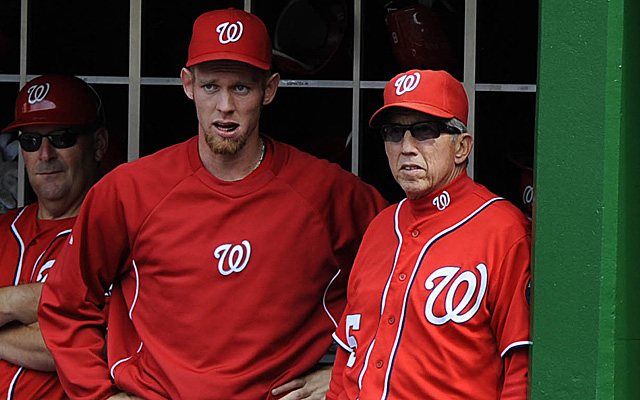
Stephen Strasburg (left) and Davey Johnson

October 12, 2012, 10 years ago: The biggest game in Washington baseball in 79 years is Game 5 of the National League Division Series at Nationals Park. The Washington Nationals lead the St. Louis Cardinals, 7-5 going into the 9th inning. But Nats reliever Drew Storen implodes, allowing a double to Carlos Beltrán, a walk to Yadier Molina, another walk to David Freese, a single to Daniel Descalso, a stolen base by Descalso, and a single to Pete Kozma.

The Nats go down 1-2-3 in the bottom of the 9th, and the Cards win, 9-7, and advance to the NL Championship Series. The Nats went from having, according to Baseball-Reference.com, a 93 percent chance of winning the game to losing it.

Concerned about putting too much stress on his arm after coming back from Tommy John surgery at the start of the season, the Nats had shut down ace pitcher Stephen Strasburg for the season after September 7, at which point he had pitched 159 innings. I wonder what Nats management would have given to have Strasburg pitch to just 1 batter: Descalso, when there were 2 outs and the score was still 7-5.

Keeping Strasburg off the postseason roster was a major blunder. It took the Nats another 7 years to get their 1st postseason series win since they were the 1981 Montreal Expos. Nats manager Davey Johnson, who previously managed the New York Mets to win the 1986 World Series, later said that, with Strasburg, the Nats would have gone all the way.

A major blunder. Right? That's why the Nats lost this series, right? Right? Or... Was it the right thing to do?

Top 5 Reasons You Can't Blame Team Management Shutting Stephen Strasburg Down for the Washington Nationals Losing the 2012 National League Division Series

5. No Guarantee. Even if Strasburg had started that game, and had been brilliant, and felt no pain, would the Nats' bullpen have held? In the history we know, they didn't. If, instead of starting, he had come in to pitch the 9th inning only, would he have held the lead? Maybe not. After all, at that point, he had made 45 career appearances, none in relief. Through the 2022 season, he's made 247, still none in relief. Some guys can make the adjustment. (Example: Mike Mussina, 2003 American League Championship Series, Game 7.) Many can't.

And if he had helped the Nats win that series? Would they have beaten the San Francisco Giants in the NLCS? Probably not: As the Cards showed, while experience isn't everything, it does matter, and the Giants had won the World Series only 2 years earlier. And did again, beating the Cards in 7 games, and then sweeping the Detroit Tigers. And then did it again, 2 years after that. The Nats, even with Strasburg pitching without pain, might not have beaten the Giants in the 2012 NLCS.

4. The Umpires. Home plate umpire Alfonso Marquez gave David Freese 2 gifts with 2 strikes on him in the top of the 9th inning: A generous check-swing for ball 3, backed up by 1st base umpire Ed Hickox; and a very close ball 3 on the next pitch, with the next pitch being a bases-loading ball 4, followed by Daniel Descalso's game-tying single and Pete Kozma's game-winning single. The Nats did a little bit of choking, but the umps did a little bit of screwing-over as well.

3. The Cardinals Were Better. Ordinarily, "The opposition were better" would be Reason Number 1. Not this time, but it must still be said.

The Cards were the defending World Champions. True, they no longer had Albert Pujols. But they still had Carlos Beltrán and Rafael Furcal, both of whom started the All-Star Game; Yadier Molina, David Freese, Matt Holiday and Lance Lynn, all of whom also made the National League All-Star Team; Lance Berkman, Matt Carpenter, Chris Carpenter (no relation), Lance Lynn and Adam Wainwright, who didn't make the All-Star Game that season, but have made 17 of them between them; and a Hall of Fame manager in Tony La Russa.

From 2011 to 2015, the Cardinals made the Playoffs every season, going 32-29 in postseason games. Over that same stretch, the Nationals made it twice, going 3-6. The Nats wouldn't win a postseason series until 2019 -- and that remains the only season in which they've won any, though they did go all the way that season.

2. It Was Better for Strasburg. He was able to pitch more innings in 2013, 183. In 2014, he pitched 215 innings, still a career high, led the NL with 34 starts and 242 strikeouts, and the Nats won the NL Eastern Division again. He went 15-4 in both 2016 and 2017. In 2019, he went 18-6, leading the NL in wins -- and in innings pitched, with 209. And the Nats won the World Series, the 1st Pennant for a D.C. team in 86 years, and the 1st World Championship for a D.C. baseball team in 95 years.

Evidence matters. The evidence of 2013 to 2019 backs up the decision to shut him down. So does the evidence since: The wear and tear he was able to put on his arm has meant that he only pitched 5 innings in 2020 (which had little to do with it being a COVID-shortened year), 21 2/3rds innings in 2021, and 4 2/3rds innings in 2022.

Shutting him down early at age 24 meant that he was able to pitch very well from 25 to 31. But pitching him that much in those years meant that he has barely pitched at 32, 33 and 34. His career record is 113-62. Even if he's fine from 2023 to 2028, the year he turns 40, and wins an average of 15 games a year, that will only get him to 203 wins, and probably won't get him into the Hall of Fame.

1. It Was Better for the Nationals. In essence, the Nats traded a shot at a title in 2012 for a title in 2019. And the Cardinals who beat them in that 2012 NLDS? They've won only 1 Pennant (2013) and no World Series since. So which team was really better off?

VERDICT: Not Guilty.

Thursday, November 3, 2016

World Series Walkoff Home Runs

New York's Mickey Mantle
We didn't get one in this World Series. That's okay, though -- unless you're a Cleveland fan.

1. October 5, 1949: Tommy Henrich, New York Yankees, Game 1, off Don Newcombe of the Brooklyn Dodgers, at the original Yankee Stadium in The Bronx.

Henrich's blast was not only the 1st walk-off home run in postseason history but remains one of just 2 that came with the score 0-0. Nicknamed "Old Reliable" for his clutch hitting, played alongside Joe DiMaggio and Charlie Keller in one of the greatest outfields ever assembled. The home run also seems to have put a hex over Newcombe, who had taken a 4-hit shutout into the 9th: He'd make 4 more World Series starts in his career, and allow 20 runs in 14 innings.

2. September 29, 1954: Dusty Rhodes, New York Giants, Game 1, off Bob Lemon of the Cleveland Indians, at the Polo Grounds in Manhattan.

To many, the 1954 Indians seemed unbeatable, winners of 111 games with a rotation that featured Lemon, Early Wynn, Mike Garcia and veteran Bob Feller. In the 8th inning of the opener, Willie Mays made his famous catch to keep the game tied. Lemon was in his 10th inning of work when Leo Durocher sent Rhodes -- who hit .341 in part-time duty that season -- in to hit for Monte Irvin with two runners on and one out.

Rhodes didn't hit it far, but the right-field wall at the Polo Grounds was only 258 feet down the line. His home run had just enough distance. Rhodes would later add game-tying pinch-single and home run in Game 2 and a two-run single in Game 3 as the Giants pulled off the sweep. "I couldn't buy a drink in New York after that '54 Series," Rhodes once said.

3. October 6, 1957: Eddie Mathews, Milwaukee Braves, Game 4, off Bob Grim of the Yankees, at Milwaukee County Stadium.

One of the forgotten great World Series games, the Yankees led the Series 2 games to 1 when Elston Howard's 2-out, 3-run homer off Warren Spahn tied the game in the 9th inning. The Yankees added another run in the 10th on Hank Bauer's RBI triple to take a 5-4 lead.

Bob Grim, the Yankee closer who had gone 12-8 with a league-leading 19 saves that year, came on. He hit Nippy Jones, hitting for Spahn, to lead off the inning. The pitch was originally called a ball, and then overturned when Jones showed umpire Augie Donatelli a shoe-polish mark on the ball. After an RBI double, Mathews launched his game-winning home run. The Braves went on to win in 7 games.

4. October 13, 1960: Bill Mazeroski, Pittsburgh Pirates, Game 7, off Ralph Terry of the Yankees, at Forbes Field in Pittsburgh.

The granddaddy of them all. His home run off the ivy-draped wall not only won the World Series but capped off maybe the greatest baseball game ever played.

5. October 10, 1964: Mickey Mantle, Yankees, Game 3, off Barney Schultz of the St. Louis Cardinals, at Yankee Stadium.

Mantle was a wreck by the time the 1964 World Series rolled out, playing on a bad knee and through a bum shoulder that required offseason surgery. His error earlier in the game allowed the Cardinals to score their only run in a 1-1 game. Schultz, a 37-year-old knuckleballer, warmed up and Mantle declared in the dugout, "I'm gonna hit one outta here."

Mantle swung at the 1st pitch, and crushed into the upper deck. It was his 16th career World Series home run, breaking Babe Ruth's record. The Cardinals would win in 7 games, however, although Mantle hit 2 more home runs.

6. October 21, 1975: Carlton Fisk, Boston Red Sox, Game 6, off Pat Darcy of the Cincinnati Reds, at Fenway Park in Boston.

Actually, since this one happened after midnight (12:34 AM), it was on October 22. Its a little overrated -- the Red Sox did lose Game 7, after all -- but Fisk's 12th-inning home run came in the midst of a brilliant game and hard-fought, exciting World Series with a lot on the line. Everybody knows about Boston's curse at the time, but Reds were also trying to win for the first time since 1940 after their superstar-laden lineup had failed to win in 1970, 1972 and 1973.

Add it up, throwing in the iconic image of Fisk willing the ball fair it crossed over the Green Monster, and you have a home run that will be remembered for a long time.

7. October 15, 1988: Kirk Gibson, Los Angeles Dodgers, Game 1, off Dennis Eckersley of the Oakland Athletics, at Dodger Stadium in Los Angeles.

Gibson's home run is so legendary, so awesome, that it almost makes us forget how Orel Hershiser carried that Dodgers that postseason: 3-0, one save, 1.05 ERA in 42.2 innings, .171 average allowed.

8. October 18, 1988: Mark McGwire, Oakland Athletics, Game 3, off Jay Howell of the Dodgers, at the Oakland-Alameda County Coliseum.

Two games after Kirk Gibson's home run, McGwire's game-ender gave A's fans hope. Alas, Tim Belcher won Game 4 and Orel Hershiser won Game 5 and the Bash Brothers had gone down. For both Gibson and McGwire, their home runs were their sole hit of the Series.

9. October 26, 1991: Kirby Puckett, Minnesota Twins, Game 6, off Charlie Leibrandt of the Atlanta Braves, at the Metrodome in Minneapolis.

The Twins trailed the Braves, 3 games to 2. Puckett told the story years later to Tim Kurkjian: "I went to the clubhouse, and I gathered (everyone) up. I said, 'Everybody together, we're going to have a short meeting.' Everybody comes in, and I said, 'Guys, I just have one announcement to make: You guys should jump on my back tonight. I'm going to carry us.'" He did.

10. October 23, 1993: Joe Carter, Toronto Blue Jays, Game 6, off Mitch Williams of the Philadelphia Phillies, at the SkyDome (now the Rogers Centre) in Toronto.

Williams was a big reason the Phillies got to the postseason in the first place, and nailed down the Pennant-clinching outs in the National League Championship Series against the Atlanta Braves. But he had already blown 3 saves that postseason when Jim Fregosi called upon him to protect a 6-5 lead in Game 6 of the World Series.

He walked Rickey Henderson on 4 pitches. Devon White flew out after a tough 9-pitch at-bat. Paul Molitor singled to center. And then Carter hooked the ball to left field and touched 'em all. Blue Jays 8, Phillies 6.

11. October 26, 1999: Chad Curtis, Yankees, Game 3, off Mike Remlinger of the Atlanta Braves, at Yankee Stadium.

This is how the Yankees won games in those days: It wasn't just Williams and Jeter coming up with the big hits. Curtis had homered in the 5th inning off Tom Glavine, and then won the game in the 10th. The Yanks completed the sweep the next day.

12. October 31, 2001: Derek Jeter, Yankees, Game 4, off Byung-Hyun Kim of the Arizona Diamondbacks, at Yankee Stadium.

Another one that happened after midnight: 12:03 AM on November 1, making Jeter baseball's 1st "Mr. November," after he'd been a "Mr. July" and a "Mr. October" the season before, the only man to be named MVP of both the All-Star Game and the World Series in the same season.

He hit Kim's 61st pitch of the night into the right-field bleachers, after Tino Martinez had already tied the game with a 2-run homer off him in the bottom of the 9th. You probably won't be surprised to discover this: Since then, 15 relievers have thrown more pitches in a postseason game, but all were long guys who entered before the fifth inning. And, yes, Bob Brenly brought him to pitch the next night, and Scott Brosius hit his own game-tying 2-run homer in the 9th.

13. October 22, 2003: Alex Gonzalez, Florida Marlins, Game 4, off Jeff Weaver of the Yankees, at Pro Player (now Hard Rock) Stadium, Miami Gardens.

Weaver had posted an unseemly 5.99 ERA during the season, but Joe Torre brought him in the 11th inning of a tie game. ''I mean, if he's not in the game there, he shouldn't be on our roster,'' Torre said after Gonzalez beat Weaver in the 12th inning to tie the Series. No kidding, he shouldn't be on the roster, Joe!

Where was Mariano Rivera, who went unused in the game, you ask? He had thrown 23 pitches in Game 3 (although he went unused in the 1st 2 games), and perhaps Torre was saving him for the save situation that never came.

As for Weaver, it was the last pitch he threw in pinstripes. By the way, the bigger story at the time: Many believed it was the final game of Roger Clemens' career. He even doffed his cap to the Marlins' crowd, tears welling up in his eyes, as he received a standing ovation after coming out of the game. "It was a very touching moment," Marlins manager Jack McKeon said. "He's a class act. We're gonna miss guys like him." (I'm thinking that maybe Roger should have actually retired.)

14. October 23, 2005: Scott Podsednik, Chicago White Sox, Game 2, off Brad Lidge of the Houston Astros, at U.S. Cellular Field in Chicago.

You could make a case that this was the least likely home run in World Series history, and certainly the least likely walk-off home run. Podsednik, after all, had batted 568 times all season, and hit exactly zero home runs.

The Astros had tied the game in the top of the inning on Jose Vizcaino's 2-out, 2-run single, setting up Podsednik's home run. In his previous appearance, in the NLCS, Lidge had served up a mammoth, game-losing home run to Albert Pujols of the Cardinals. He said that home run wasn't on his mind. "Unfortunately, because I happened to give up home runs in back-to-back games, it may look like I was. But the fact is, I threw a fastball to Podsednik that I wanted to throw. He may have hit it out. But that had nothing to do with Albert Pujols."

The count was 2-1. He didn't want to fall behind 3-1. Podsednik was sitting on the heater. "I was thinking that he was probably going to challenge me with a fastball," he said. "And I said, 'Hey, let's put a good swing on this fastball.'"

15. October 27, 2011: David Freese, St. Louis Cardinals, Game 6, off Mark Lowe of the Texas Rangers, at Busch Stadium in St. Louis.

In 1986, the Boston Red Sox led by 2 runs in the 10th inning, and were 1 out away from winning Game 6, and thus the Series for the 1st time in 68 years, but lost the game, before losing the Series in Game 7. In 2011, the Rangers topped that -- or bottomed it: They lwere 1 out away from winning Game 6, and thus the Series for the 1st time in their franchise's 51-season history (40 seasons in Texas), and blew 2-run leads in both the 9th and the 10th, before Freese won it for the Cardinals in the 11th, and the Cards won Game 7, too.

In World Series play, thus far, no Game 2 or Game 5 has been won by a walkoff home run. Only Mantle in '64, Fisk in '75, McGwire in '88 and Jeter in 2001 did it for teams that ended up losing the Series.

UPDATE:

16. October 26, 2018: Max Muncy, Los Angeles Dodgers, Game 3, off Nathan Eovaldi of the Boston Red Sox, at Dodger Stadium in Los Angeles.

This was in the bottom of the 18th inning, making it the longest game in World Series history by innings. At 5 hours and 41 minutes, it was also the longest game in World Series history by time. But it was the only game the Dodgers won in the Series.

Monday, October 31, 2011

Top 10 Scariest People in Baseball History

A Halloween Special: The Top 10 Scariest People in Baseball History.

10. David Freese. Especially if you live in Texas.

9. Marvin Miller. The one man who ever scared the baseball team owners.

8. Dual Entry: George Steinbrenner and Billy Martin. How could I not put them together?

7. Bob Gibson. "I didn't throw at a lot of batters, but when I did, I made sure I ht them." Gibson was the man Pedro Martinez only thought he was.

6. Carl Pavano. A zombie for the Yankees, a monster when he played for anyone else.

5. Bud Selig. He sucked the blood out of the 1994 postseason and the 2002 All-Star Game.

4. Walter O'Malley. He haunts Brooklyn to this day.

3. Ty Cobb. If you've ever heard of him, you know why.

2. Kevin Mitchell. Not because of the cat incident that Dwight Gooden apparently made up, but because of his curse on the Mets, now 25 years old.

1. Babe Ruth. He's been dead for 63 years, and he still scares the hell out of people, especially Red Sox fans.

*

October 31, 1887: Edouard Charles Lalonde is born. “Newsy” (from working in a newspaper plant) was one of early hockey’s greatest stars, winning 7 scoring titles and Captaining the Montreal Canadiens to their first Stanley Cup in 1916. On December 29, 1917, in the first-ever NHL game, he scored a goal on route to the Canadiens’ 7-4 victory over the Ottawa Senators. In 1922, the Canadiens angered him and a lot of their fans by trading him to the Pacific Coast Hockey Association’s Saskatoon Sheiks, but the Habs got future Hall-of-Famer Aurel Joliat in the deal.

From his retirement in 1927 until Maurice Richard surpassed him in 1954, his 455 goals in all leagues in which he played combined stood as a pro record. He was also the best lacrosse player of his era, and in 1950, he was named athlete of the half century in lacrosse. He was elected to the Hockey Hall of Fame in 1950, the Canadian Lacrosse Hall of Fame in 1965, and the Sports Hall of Fame of Canada. He had lit the torch when the Sports Hall of Fame opened in Toronto in August, 1955. In 1998 he was ranked number 32 on The Hockey News' list of the 100 Greatest Hockey Players, making him the highest-ranking player on the list who had played in a professional league before the founding of the NHL. He was the first Canadiens player to wear Number 4, and Joliat got it after the trade, but it was retired for later star Jean Beliveau.

October 31, 1933: Phil Goyette is born. The center won Stanley Cups with the Montreal Canadiens in 1957, ’58, ’59 and ’60. He was the first coach of the New York Islanders in 1972-73, but was fired due to a poor record midway through the season.

October 31, 1942: Dave McNally is born. He pitched a complete game to clinch the 1966 World Series for the Baltimore Orioles, and won another game and hit a grand slam in it to help them win it in 1970. His career won-lost record was a sterling 184-119. But he’s best known as one of the two pitchers, along with Andy Messersmith, who played the 1975 season without a contract to test the legality of the reserve clause. McNally, by then with the Montreal Expos, had been injured, had a successful ranch in his native Montana, and was ready to retire anyway, so he was an ideal player to make the test, since he didn’t need the money. The clause was overturned.

Also on this day, David Ogden Stiers is born. Best known as Major Charles Emerson Winchester III, the pompous but sometimes surprisingly human surgeon on M*A*S*H, he has spent much of the last few years doing voiceovers for PBS documentaries – in his real voice, not in Charles’ Boston Brahmin accent. I still can't believe "Chahles" wore a Brooklyn Dodger cap in one episode.

October 31, 1943: Brian Piccolo is born. The All-American running back from Wake Forest overcame his natural prejudice to help Chicago Bears teammate Gale Sayers come back from a devastating knee injury, then developed lung cancer at died at age 26.

Shortly before Piccolo’s death, Sayers was given the NFL’s most courageous man award for winning the 1969 rushing title on a knee with no cartilage in it. At the award ceremony, he said he didn’t deserve the award, because Piccolo was showing more courage. “I love Brian Piccolo,” he said, “and tonight, when you get down on your knees to pray, I want you to ask God to love him, too.” The Bears retired Piccolo’s Number 41. In the 1971 film Brian’s Song, Piccolo was played by James Caan, and Sayers by Billy Dee Williams, career-making roles for both men.

October 31, 1946: Stephen Rea is born. He starred in The Crying Game and was nominated for an Oscar for it. He’s best known in the U.S. as Inspector Eric Finch, a good guy who figures out that he’s really working for the bad guys, in V for Vendetta, it was because of that film that he was the only actor besides Colin Firth that I recognized from the original, British soccer, version of Fever Pitch.

October 31, 1947: Frank Shorter is born. He won the Olympic marathon in 1972, and finished second in 1976. Thanks to his ’72 win, the Boston Marathon was reborn as an event the whole country wanted to watch, and the New York City Marathon, which started the year before, took off. It will be run again tomorrow, and nearly 50,000 runners will participate. Along with Jim Fixx and his Book of Running, Shorter is probably more responsible than anyone for the rise of recreational running in America. I leave it to you to decide whether that’s a good thing.

October 31, 1950: John Candy is born. In the closing minutes of Super Bowl XXIII, when the Cincinnati Bengals had just scored to take the lead, the San Francisco 49ers were nervous, when quarterback Joe Montana, pointed out of the huddle to the stands and said, “Isn’t that John Candy?” The question relaxed the players, and Montana drove them for the winning touchdown.

Candy played the Cubs’ broadcaster in Rookie of the Year, and I give him a lot of credit for playing someone similar to, but not a total caricature of, Cubs broadcasting legend Harry Caray. On the other side of Chicago, he also shot a scene at the old Comiskey Park in its closing days for Only the Lonely. Considering his weight, I’m not surprised that he died young (53), but I’m still sorry about it. He gave us a lot, but he had a lot more to give.

Also on this day, Jane Pauley is born. The longtime co-host of The Today Show on NBC, she is married to Doonesbury cartoonist Garry Trudeau.

October 31, 1951, 60 years ago today: Nick Saban is born. The son of legendary coach Lou Saban, he hasn’t yet moved around to as many coaching jobs, but he has moved around with considerably less ethics than his father. He did, however, lead Louisiana State to the 2003 National Championship, and Alabama to the 2009 edition. He now has 'Bama ranked Number 1 again.

October 31, 1953: John Lucas is born. He played both basketball and tennis professionally, and was a member of the Houston Rockets’ 1986 NBA Western Conference Champions. His overcoming of drug addiction led him to become an NBA head coach and an addiction counselor. He is currently an assistant coach under Mike Dunleavy of the Los Angeles Clippers.

Like Dunleavy, he has a son who played in the NBA, John Lucas III, who, unlike his father whose 1974 Maryland team was prevented under the rules of the time from playing in the NCAA Tournament due to its loss in the ACC Final, went to the 2004 Final Four with Oklahoma State. John III played in the NBA with the Rockets, was recently waived by the Miami Heat and is currently a free agent. Another son, Jai Lucas, now plays at the University of Texas.

October 31, 1959: Mats Naslund is born. The left wing was known as Le Petit Viking (the Little Viking) when he played for the Montreal Canadiens, a tenure that included the 1986 Stanley Cup, in which he became the most recent Canadien to score 100 or more points in a season. He helped Sweden win the 1994 Olympic Gold Medal, and as general manager of the team he built their 2006 Gold Medal team.

October 31, 1960: Mike Gallego is born. He was the starting second baseman on the Oakland Athletics’ 3 straight Pennants of 1988-90. In 1993, he was voted the second baseman on their 25th Anniversary team (25 years since they’d moved to Oakland). He briefly played for the Yankees in the early 1990s, and is now back with the A’s as a coach.

Also on this day, Reza Pahlavi is born. He was 18 years old and the Crown Prince of Iran when his father, the Emperor, Mohammed Reza Shah, was overthrown in the Islamic Revolution of 1979. Luckily for him, he was already in the U.S., training as a fighter pilot (much as was his cousin and fellow heir to a throne, now King Abdullah II of Jordan).

He now lives in Potomac, Maryland, outside Washington. Unlike his father, who ran a brutally repressive, unofficially fascist regime, he has been an outspoken supporter of human rights, saying that in order to bring freedom to his homeland, “Idealism and realism, behavior change and regime change do not require different policies but the same: empowering the Iranian people.” His supporters have referred to him as “His Imperial Majesty Reza Shah II” since his father’s death on July 27, 1980, but he officially calls himself “the former Crown Prince,” and admits he has no realistic hope of the monarchy being restored, even when the Ayatollahs are finally and rightfully toppled.

October 31, 1961, 50 years ago today: A federal judge rules that Birmingham‚ Alabama laws against integrated playing fields are illegal‚ eliminating the last barrier against integration in the Class AA Southern Association.

October 31, 1963: Fred McGriff is born. In 1982, the Yankees traded first baseman McGriff, young pitcher Mike Morgan and outfielder Dave Collins to the Toronto Blue Jays for pitcher Dale Murray and third baseman Tom Dodd. Dodd did play one year in the majors, but for Baltimore, and is not the man for whom the ballpark belonging to the Norwich Navigators, a former Yankee farm team, is named. (That was Senator Thomas Dodd of Connecticut, father of current Senator Chris Dodd.) Murray got hurt and never contributed to the Yankees, either. Collins was pretty much finished, but in 2001, 19 years later, Morgan pitched against the Yankees in the World Series for the Arizona Diamondbacks, and McGriff was also still active. By trading him, the Yankees essentially traded 493 home runs for nothing.

Or did they? McGriff was 20 at the time, and did not reach the majors for another 4 years. Had he done so with the Yankees, he would have smacked right into Don Mattingly at his peak. The Yankees may not have had anyplace for him. Still, the trade looks bad. McGriff was involved in some other big trades: The Jays traded him to the San Diego Padres in 1990, a trade which brought them Joe Carter and Roberto Alomar, key figures in their 1992 and ’93 World Champions; and the Padres sent him to the Atlanta Braves as part of their 1993 “fire sale,” a pure “salary dump.”

McGriff hit the first home run at the SkyDome in 1989. With the Jays that season and the Padres in 1982, McGriff became the first player in the post-1920 Lively Ball Era to lead both leagues in home runs. He helped the Braves win the World Series in 1995, and later played for his hometown Tampa Bay Devil Rays. He now works in the Rays’ front office and as co-host for a show on Bright House Sports Network, a Tampa Bay-based outfit, and will be eligible for the Hall of Fame in its next election, this coming January. Despite falling 7 homers short of the magic 500 Club, he will probably make it, if not in his first year of eligibility then within the first couple of years thereafter. He was always popular – ESPN’s Chris Berman took the public-service-announcement character of “McGruff the Crime Dog” and nicknamed McGriff “Crime Dog” – and despite his home-run heroics, he has never been seriously suspected of steroid use. His son Erick McGriff plays football at the University of Kansas.

Also on this day, Carlos Caetano Bledorn Verri is born. The Brazilian soccer player was nicknamed “Dunga” by an uncle, Portuguese for “Dopey,” since he was short and expected to stay that way. But the midfielder starred for several Brazilian teams, with his longest tenure at Internacional (like the Milan club known as “Inter” for short) of Porto Alegre; for Fiorentina in Italy and Stuttgart in Germany. Dunga was a member of Brazil’s 1994 World Cup winners, but bombed as manager of the national team at the 2010 World Cup.

October 31, 1964: Marco van Basten is born. The striker starred for Ajax Amsterdam in his native Netherlands, winning League Championships in 1982, ’83 and ’85 and the Dutch Cup in ’83, ’86 and ’87 – meaning they won “The Double” in 1983. He moved on to AC Milan in Italy, winning Serie A in 1988, ’92 and ’93, and back-to-back European Cups (now the Champions League) in 1989 and ’90. He led the Netherlands to the European Championship in 1988. Three times he was named European Player of the Year, and the magazine France Football placed him 8th in a poll of the Football Players of the Century. He has managed both Ajax and the Netherlands national team.

October 31, 1966: Mike O’Malley is born. The comedian and actor, formerly star of Yes, Dear, is a tremendous Boston Red Sox fan. But he’s funny, so I forgive him.

October 31, 1968: Antonio Davis is born. After going undrafted out of the University of Texas at El Paso (UTEP), he played pro basketball in Athens and Milan before signing with the Indiana Pacers. He was an All-Star for the perennial Playoff contenders and Knick nemeses, although they didn’t reach the NBA Finals until after he left.

October 31, 1970: Steve Trachsel is born. In 1996, the Chicago Cubs pitcher was named to the All-Star Team. In 1998,gave up Mark McGwire’s steroid-aided 62nd home run, but he also won the Playoff for the NL Wild. Since the Cubs only made the Playoffs 4 times in the 62 seasons between 1945 and 2007, this makes him a Wrigleyville hero for all time. He also pitched for the Mets, winning the NL East with them in 2006. He last pitched for the Baltimore Orioles in 2008, but has not officially retired.

October 31, 1972: The Philadelphia Phillies trade third baseman Don Money and 2 others to the Milwaukee Brewers for 4 pitchers‚ including Jim Lonborg and Ken Brett. This was a rare good trade for both teams: Lonborg was a key cog in the Phillies developing a pitching staff that would reach the Playoffs 6 times in 8 years from 1976 to 1983 (though Lonborg retired after ’78), Money helped stabilize the Brewers and make them a contender by 1978 and a Pennant winner in 1982, and trading him allowed the Phillies to make room for the best player in the history of Philadelphia baseball, Mike Schmidt.

October 31, 1973: David Dellucci is born. The outfielder was a member of the Arizona Diamondbacks team that beat the Yankees in the 2001 World Series, and of the Yankee team that won the 2003 American League Pennant. He was released by the Toronto Blue Jays in 2009 and retired.

October 31, 1976: José María Gutiérrez Hernández is born. “Guti Hernandez” is a midfielder who starred for Real Madrid as they won Spain’s La Liga in 1997, 2001, 03, ’07 and ’08; and the Champions League in 1998, 2000 and ’02. He now plays for Besiktas in Turkey.

October 31, 1983: George Halas dies at age 88. He was the founder of the Chicago Bears, for all intents and purposes the founder of the NFL, formerly the winningest coach in NFL history (324), and no coach in the history of professional football has won as many league championships, 8: 1921, 1932, 1933, 1940, 1941, 1943, 1946, 1963. One of his last acts as owner was to hire former Bears star Mike Ditka as head coach, and Ditka would lead them to a 9th World Championship in 1985. When asked by Bob Costas in the locker room afterwards if he thought of “Papa Bear,” he said, “I always think of Coach Halas.”

This, despite a reputation for being cheap, which led Ditka to say, “George Halas throws nickels around like manhole covers.” It was also Halas’ cheapness that kept the Bears in Wrigley Field, with a football capacity of just 47,000, in spite of Soldier Field having over 65,000 seats and lights, because he didn’t want to pay the rent the City of Chicago was demanding; the Bears didn’t move there until 1971, when the money available to teams on Monday Night Football, which couldn’t be played at then-lightless Wrigley, more than offset the cost of the rent. In spite of this, when the aforementioned Brian Piccolo got sick, Halas paid all his medical expenses and for his funeral.

An NFL Films documentary from 1977 showed Halas walking through the Bears’ practice facility at Lake Forest, Illinois (the main building is now named Halas Hall), and announcer John Facenda said it was “like visiting Mount Vernon and seeing George Washington still surveying the grounds.” He had planned to hand the team over to his son George Jr., but “Mugs” predeceased him. His daughter Virginia handed control to her husband, Ed McCaskey. Unfortunately, Big Ed handed a lot of control over to his and Virginia’s son, George’s grandson, Mike McCaskey, who ran the franchise into the ground before Big Ed took it back and handed it over to someone else prior to his own death. Virginia is still alive and the nominal owner of Da Bears.

October 31, 1987: Nick Foligno is born. The center plays for the Ottawa Senators. His brother Marcus Foligno is in the minor-league system of the Buffalo Sabres, for whom their father, Mike Foligno, was an All-Star.

October 31, 1998: Elmer Vasko dies at age 62. “Moose” was an All-Star defenseman for the Chicago Blackhawks, winning the Stanley Cup with them in 1961.

October 31, 2001, 10 years ago today: Game 4 of the World Series. The Yankees trail the Arizona Diamondbacks 3-1 in the bottom of the 9th, and are about to fall behind in the World Series by the same margin of games. This is due in large part to the fine pitching of Curt Schilling, who was asked about the “mystique” of Yankee Stadium. He said, “Mystique, aura, those are dancers in a nightclub.” (Three years later, pitching for Boston, he would prove he was still not intimidated by Yankee Stadium, saying, “There’s nothing like making 55,000 Yankee fans shut up.”)

Byung-Hyun Kim, a “submarine” style pitcher from Korea, tries to close the Yankees out in the bottom of the 9th. But he lets a man on, and Tino Martinez comes to the plate. Tino electrifies the crowd but slamming a drive toward the upper deck. On the video, a fan in the front row of the upper deck tries to catch the ball, but it bounces off your hand. Now, imagine you’re that fan: Are you excited that the Yankees have come back in this World Series game, or are you mad that you were unable to catch this historic homer (and probably hurt your hand in the process)?

As the clock strikes midnight, for the first time ever – due to the week’s delay from the 9/11 attacks – a Major League Baseball game is played in the month of November. It is the bottom of the 10th, and Derek Jeter steps to the plate against Kim. A fan holds up a sign saying, “Mr. November.” (It’s often been asked, “How did he know to hold up that sign for Jeter?” The answer is easy: He didn’t hold it up specifically for Jeter. Jeter was just the batter when the clock struck 12, making him the first batter for whom it could be held up.)

At 12:03 came a typical Jeter hit, an inside-out swing to right-center, and it just... barely... got over the fence for a game-winning home run. Yankees 4, Diamondbacks 3. The Series was tied. The old ballyard was shaking. The “Yankee Mystique” had struck again. It is hits like this that have gotten Jeter the nickname “Captain Clutch.”

The next night, the first game to officially be played in the month of November, a fan made up a sign that said, “BASEBALL HISTORY MADE HERE” on what looked like an ancient scroll. Another fan made up a sign that said, “MYSTIQUE AND AURA APPEARING NIGHTLY.” (Two years later, in the Aaron Boone game, that same fan made up one that said, “MYSTIQUE DON’T FAIL ME NOW.” It didn’t.)

October 31, 2002: The Massachusetts Interscholastic Athletic Association votes 9-6 to prohibit the use of metal bats in the state high school tournament in 2003. Twenty five of 40 leagues will switch to wood for the regular season. The State is the first to outlaw metal bats. In this particular case, Massachusetts is ahead of the curve in baseball.

October 31, 2009: Alex Rodriguez's Game 3 fly ball in the right-field corner Citzens Bank Park becomes the subject of the first instant replay call in World Series history. The Yankees' third baseman hit, originally ruled a double, is changed by the umpires to a home run after the replay clearly shows the ball going over the fence before striking a television camera and bouncing back to the field.

Figures that A-Rod's first World Series home run would be controversial. But it does help make the difference, as the Yankees win, 8-5.
Friday, October 28, 2011

Can Game 7 Top Game 6? Sure -- For Whichever Team Wins It

World Series Game Sixes have been legendary before.

1947: Al Gionfriddo robs Joe DiMaggio.

1951: DiMaggio's last game.

1953: Yanks beat Dodgers in bottom of 9th on Billy Martin's single, to clinch a 5th straight World Championship.

1965: Jim "Mudcat" Grant pitches a shutout and hits 2 home runs.

1975: Carlton Fisk does the Fenway Twist, capping what was already one of the greatest games ever.

1977: Reggie! Reggie! Reggie!

1978: Catfish and the Goose finish off the Bums.

1980: Carlton and McGraw give the Phillies their first title.

1985: Don Denkinger makes a mistake.

1986: John McNamara makes many mistakes -- even if you don't count leaving Bill Buckner in.

1991: Kirby Puckett saves the game with his glove, and wins it with his home run -- same inning as last night, 20 years later, and with Jack Buck's call from that homer being copied by his son Joe Buck last night: "And we'll see you tomorrow night!"

1992: Dave Winfield finally gets his ring.

1993: Joe Carter touches 'em all.

1995: David Justice's homer is all Tom Glavine needs.

1996: Joe Girardi's triple ends a drought -- well, it's a drought by Yankee standards.

2002: Giants blow a 5-0 lead and lose Game 7, too.

2003: Josh Beckett takes advantage of cold Yankee bats to win the last World Series game at the old Yankee Stadium.

2009: Hideki Matsui drives in 6 runs, including a homer off Pedro Martinez.

2011: The Rangers needed 1 more out in the 9th, and blew it. Then they took a 2-run lead in the 10th and needed just 1 more out, and blew it -- just like the Red Sox in '86. The difference is that, unlike the Mets, the Cardinals couldn't finish it off in the 10th, but they sure did in the 11th.

Imagine being born and raised in a great baseball city, growing up rooting for a storied team, and hitting a game-winning extra-inning home run for them in the World Series. David Freese now knows. As long as he's within a decent bus ride of St. Louis, he'll never have to buy another drink.

Can Game 7 top Game 6? Sure -- for whichever team wins it.

One thing's for sure: Ron Washington, the Rangers' manager is on the spot.

* In 1978, Tommy Lasorda flipped out over Reggie Jackson's "Sacrifice Thigh" in Game 4, and instead of calming his team down, telling them, "Okay, we got screwed, but it's just one loss, we can still win this thing," he stewed in his own juices, and the Dodgers followed his lead. From the "interference" play onward, the Yankees outscored the Dodgers 21 to 4.

* In 1980, the Royals were about to tie up the Series, when Dickie Noles brushed back George Brett. Royal manager Jim Frey flipped out, and didn't calm himself or his team down, and although they hung on to win, the Phillies won the next 2.

* In 1985, Whitey Herzog moaned about the Denkinger goof, and the Cardinals lost Game 7 11-0.

* In 1986, McNamara didn't remind the Red Sox that they still had to win only 1 more -- and the Sox were winning that Game 7 in the 5th and were only 1 run down in the 7th. It was still possible.

* In 1991... Well, the Braves did take it to the limit, and beyond. I can't fault Bobby Cox on that one.

* In 1993, Jim Fregosi didn't calm the Phillies down after blowing a 14-9 8th inning lead at home. Although the Phils did win Game 5, they lost Game 6 on the Carter homer.

* In 1996, Cox could be faulted. The Braves blew a 6-0 lead in Game 4, and were outscored 10-2 the rest of the way. He should have reminded them that the Series was still only tied.

* In 2001, Bob Brenly did calm the Diamondbacks down after their shocking walkoff losses in Games 4 and 5, and they pounded the Yanks in Game 6, and came from behind to win Game 7. So it can be done.

* In 2002, Dusty Baker proved he was capable of getting a team close, but couldn't be trusted to get his team to finish the opposition off. (Cincinnati Reds, are you listening? You've got a good team, but do you have the right manager?)

That Game 6 last night had 1986 Game 6 written all over it -- although the Rangers' drought of 40 seasons isn't even close to the 68 years the Red Sox had at the time. And if Greg Prince of Faith and Fear in Flushing is reading this, he'll bristle at his beloved '86 Mets being compared to any Cardinal team.

But that game, coupled with the rainout the night before, means the Cards can start Chris Carpenter, their ace, for Game 7.

This may be beyond Ron Washington. I'm not sure any manager can bring a team back from being soclose to winning the whole thing and blowing it.

The Cards have the momentum, their ace on the hill, Albert Pujols, and the home crowd. I think they're going to win it.

*

There's a column in today's Daily News that says the Mets should do what the Yankees did last year with their shortstop, Derek Jeter: Play hardball with Jose Reyes, lowball him, and let him take his chances with the other 29 teams.

There's a problem with that theory.

Reyes didn't grow up as a Met fan. He's much more likely to say, "To hell with you" (or it's Spanish equivalent) than to say, "Okay, okay, I give in."

He's also much more likely to get a good deal from someone else. After all, he's not going to be as expensive as Jeter, for the simple reason that he's not as good as Jeter.

Never was. Isn't now, even as a batting champion. Never will be.