Showing posts with label chase field. Show all posts

Saturday, December 27, 2025

December 27, 2005: Rutgers Plays Its 1st Real Bowl Game

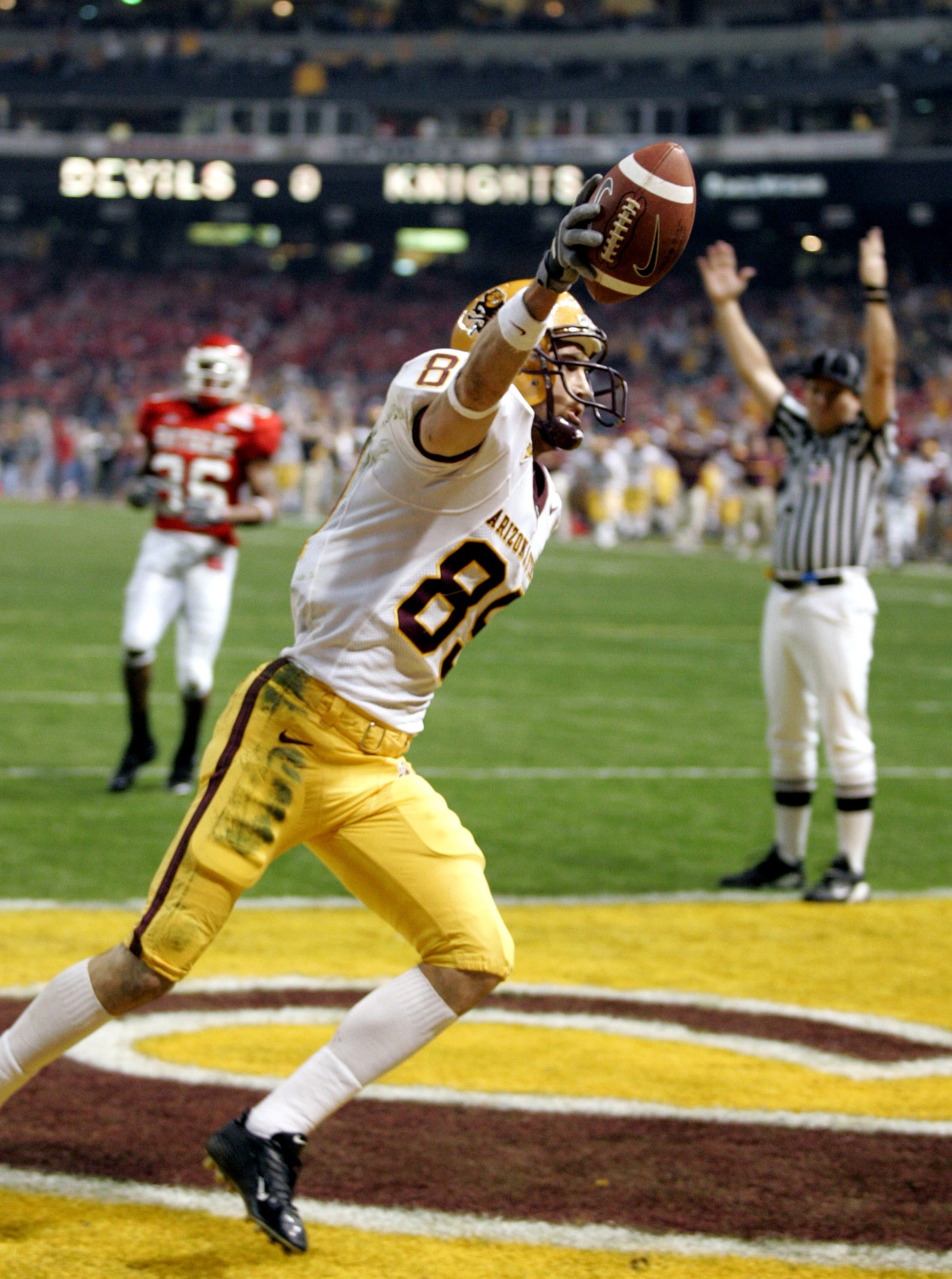
December 27, 2005, 20 years ago: For the 1st time, the football team at Rutgers, The State University of New Jersey, plays in a real postseason "bowl game."

It wasn't actually the first one. In 1978, frustrated over not having been selected for bowl games despite some fine seasons -- 8-1 in 1958, 8-1 in 1960, 9-0 in 1961, 8-2 in 1968, 7-4 in 1972, 7-3 in 1974, 9-2 in 1975, 11-0 in 1976, 8-3 in 1977 and finally 9-3 -- mainly due to a weak schedule, Rutgers started its own bowl, the Garden State Bowl.

It would be held at their secondary home field, the 77,000-seat Giants Stadium, in the Meadowlands Sports Complex in East Rutherford, Bergen County, New Jersey, 36 miles from their 23,000-seat Rutgers Stadium in Piscataway, and 35 miles from their Student Center in New Brunswick, both in Middlesex County.

The Scarlet Knights invited Arizona State, which had faced a similar level of disrespect, because they had dominated the weak Western Athletic Conference, and had just joined the Pacific-8, making it the Pac-10. Maybe they should've invited a weaker team than Frank Kush's Sun Devils, who beat them, 34-18.

That was a badge of dishonor: The Scarlet Knights couldn't even win a bowl on their secondary home field. So, again, they weren't invited to bowls, despite going 8-3 in 1979, 7-4 in 1980, 7-3 in 1984, 6-4 in 1986, and 7-4 in 1992. In '92, a loss to Boston College really stung, not just because BC's quarterback, future New York Jet Glenn Foley, had been a Jersey Boy, from Cherry Hill, but because he told the postgame media, "The only bowl Rutgers is going to is the one I just got off of." Meaning the toilet.

The new Rutgers Stadium (now SHI Stadium) opened in 1994, but, having joined the Big East Conference, RU was not putting up bowl-worthy seasons. Greg Schiano was hired in 2001, and it took him until 2005 to put up a winning season, 7-4.

Finally, a bowl came calling. It wasn't a major bowl. It was the Insight Bowl, named for an Internet company. It had gone through several names: The Copper Bowl from its 1989 establishment until 1996, the Insight.com Bowl starting in 1997, just the Insight Bowl starting in 2002, the Buffalo Wild Wings Bowl in 2012, the Cactus Bowl starting in 2015, the Cheez-It Bowl in 2018 and 2019, the Guaranteed Rate Bowl starting in 2020, and simply the Rate Bowl in 2024.

It was held at the University of Arizona's Arizona Stadium in Tucson from 1989 to 1999; then the Arizona Diamondbacks' Bank One Ballpark/Chase Field in Phoenix from 2000 to 2005; Arizona State University's Sun Devil Stadium (now Mountain America Stadium), in the Phoenix suburb of Tempe, from 2006 to 2015; and Chase Field again ever since.

It is the Phoenix area's secondary bowl game, behind the Fiesta Bowl, which was played at Sun Devil Stadium from 1971 to 2006, and has been played at the Arizona Cardinals' home, now named State Farm Stadium, in the Phoenix suburb of Glendale, since 2007.

So being invited to the Insight Bowl was not much respect. But it was more than Rutgers were used to, and it was a chance to spend Christmas week someplace considerably warmer than New Jersey, so they accepted the bid. As fate would have it, the opponent was the same as in the 1978 Garden State Bowl: Arizona State. The Sun Devils would be traveling 11 miles, so this would be more or less a home game for them. The Scarlet Knights would be traveling 2,386 miles.

At first, the long roadtrip didn't seem to faze Rutgers: Ryan Hart threw a touchdown pass to Clark Harris to give them a 7-0 lead. Arizona State answered with their own touchdown pass, but Hart threw another to Brian Leonard. Just before the 1st quarter ran out, Jeremy Ito kicked a 25-yard field goal. RU were up 17-7. Things were looking good.

The Sun Devils kicked a field goal to make it 17-10. Leonard ran for a touchdown to make it 24-10 Rutgers. But the Sun Devils scored to close to within 24-17 at the half.

In the 3rd quarter, Arizona State scored a tying touchdown, but Ito kicked another field goal to put RU back up, 27-24. Arizona State scored a touchdown to take their 1st lead, 31-27. Just before the end of the quarter, Ito kicked another field goal to make it 31-30 Sun Devils. Early in the 4th quarter, he kicked another to make it 33-31 Scarlet Knights.

Rutgers had a 4th quarter lead in a bowl game, in what was essentially a home game for the other team. This wasn't quite living the dream, but it sure looked like a building block toward reaching the dream.

But you can almost set your watch by the Rutgers defense collapsing. The Sun Devils scored a touchdown and a 2-point conversion, then another touchdown and a failed 2-point conversion. It was 45-33 Arizona State.

With 2 minutes left, Hart threw a 29-yard touchdown pass to Tres Moses, closing RU to within 45-40. But they failed to recover the onside kick, and Arizona State ran out the clock to seal the win.

It was yet another failure for Rutgers, one of the most underachieving programs in college football. On the other hand, they had been invited to a bowl, and scored 40 points against a hometown team. That was something to take with them into the next year.

In 2006, Rutgers went 10-2, finishing 2nd in the Big East. They were invited to the Texas Bowl. It wasn't the biggest bowl in Texas -- that remains the Cotton Bowl in Dallas -- but at least, unlike the Insight Bowl, it was the biggest bowl in its own metropolitan area, Houston. Rutgers won this game rather easily, 37-10, for their 1st-ever bowl win.

It began a streak of 4 straight seasons with bowl wins, and 5 in 6 years. Rutgers has since won (these dates are for the season, not necessarily the calendar year) the International Bowl in Toronto in 2007, The PapaJohns.com Bowl in Birmingham in 2008, the St. Petersburg Bowl in 2009, the Pinstripe Bowl at Yankee Stadium in 2011 and 2023, and the Quick Lane Bowl in Detroit in 2014. But the biggest bowl game they've ever been to, and it's still only a secondary bowl, is the Gator Bowl in Jacksonville, in the 2021 season, losing to Wake Forest, 38-10.

Monday, April 8, 2024

Yankees Off to Fantastic Start

So I'm not trying to blog, either print or video, after every Yankee game this season. And they've started out 8-2.

As a character in one of my favorite movies of all time said, "When you've been at this as long as I have, you learn to stop believing in coincidences."

After sweeping the cheating Astros...

Yes, "cheating." Present tense. I have no evidence that they are still cheating in 2024. I don't need evidence. We have proof that they cheated in 2017. José Altuve gave us, for all intents and purposes, a confession on his home run that won the 2019 Pennant. So it wasn't a one-time thing. So they have forfeited the presumption of innocence.

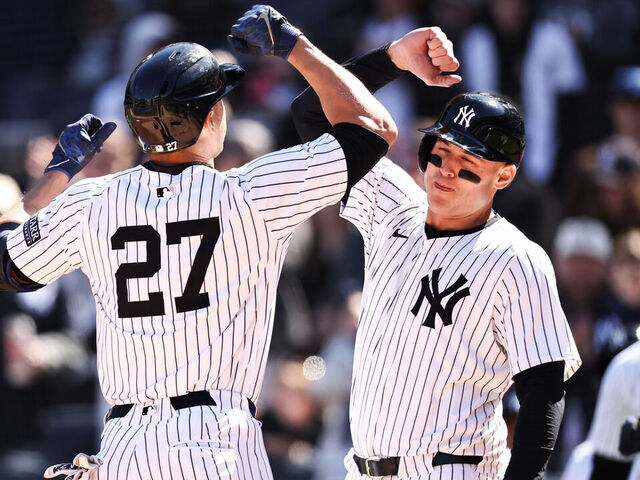
Anyway... After sweeping the cheating Astros, the Yankees went to Phoenix to play the Arizona Diamondbacks, who won last year's National League Pennant before losing the World Series to the Texas Rangers. They made it 5-0 on April 1, winning, 5-2. Anthony Volpe went 4-for-4 with an RBI. Luis Gil had a good start, but had already thrown 84 pitches, and, on Brian Cashman's orders, Aaron Boone took him out 1 out short of the threshold for getting credit for the win.

So the next pitcher got the win. It was Luke Weaver, signed as a free agent this past January. Seeing the name "Weaver" as the Yankees' pitcher on the scorebox on TV, I nearly had a stroke, remembering Jeff Weaver. Luke is not related to Jeff, and his brother Jered, also a major league pitcher.

The 1st loss of the season came the next night. Nestor Cortés had nothing, and allowed 3 runs in the 1st inning. The bullpen wasn't much better, the Yankees only got 3 singles (by Volpe, Juan Soto and Oswaldo Cabrera), and the D-backs won, 7-0.

Carlos Rodón had a good start in the rubber game, and Aaron Judge finally hit his 1st home run of the season. Other than that, though, the Yankees only got 5 hits and a walk in regulation. The game went to extra innings, and each team scored 2 runs in the 10th inning. I know: It still sounds strange. But there is that stupid "ghost runner" rule.

In the top of the 11th, the Yankees were aided by a balk, and Judge doubled home a 2nd run. Clay Holmes ran into trouble in the bottom of the 11th, and Caleb Ferguson made it worse, allowing a run, before getting a strikeout to end it, 6-5 to the Yankees. That's 6 out of 7, on the road, to 2 Playoff teams, to start the season.

*

The Yankees came home to face those pesky Toronto Blue Jays. The home opener was a bust: Marcus Stroman pitched 6 shutout innings, but the bullpen blew it. Volpe got 2 hits, but the rest of the team only got 4. The Blue Jays -- with hitting instructor Don Mattingly starting to look like actor Jeff Bridges with that big white beard -- won, 3-0.

The next game started out great, but nearly ended in disaster. Clarke Schmidt was okay as the starter, and the Yankees chased Kevin Gausman in the 2nd inning. Gausman led the American League in strikeouts last season, and usually pitches well against the Yanks. Judge, Giancarlo Stanton and Anthony Rizzo hit home runs, and it was 9-2 after 6 innings.

But there is no closer to speak of: Holmes is really an 8th-inning guy, and Jonathan Loáisiga is out due to injury, probably for the season. In this game, Weaver and Ian Hamilton were both bad. The Jays closed to within 9-8, and the Jays had the tying run on 1st before Holmes finally shut things down. Weaver ended up as the winning pitcher, anyway.

So it would have been nice if the Yankees could have given their home fans a laugher yesterday. They nearly did. The Jays got on the board in the top of the 3rd, but the Yankees scored 5 in the bottom of the 3rd, including a grand slam by Stanton that nearly beat the Moon to eclipsing the Sun today.

Gil again pitched well into the 5th, but was not allowed to finish it. Jake Cousins ended up as the winning pitcher. Yankees 8, Blue Jays 3.

*

So, one full week and one partial week into the season, the Yankees are 8-2, having already played a series away to the Astros, a series away to a World Series participant, and a series with the Jays. And we're doing this without Gerrit Cole, DJ LeMahieu and Loáisiga; and with Jose Trevino and Austin Wells as our only catchers. Before Opening Day, would I have taken that? You better believe it.

We are tied with the surprising Pittsburgh Pirates, who also started out 5-0, for the best record in baseball. And yet, in the AL Eastern Division, we only lead the Boston Red Sox by 1 game.

The Yankees start a new series tonight, home to the Miami Marlins, who lost their 1st 9 games of the season before winning yesterday. Oh, swell: We get them just as they're getting hot. Tonight, Cortés starts against Jesús Luzardo.

Sunday, April 17, 2022

How to Be a Met Fan In Arizona -- 2022 Edition

This coming Friday, April 22, the Mets begin a series in Phoenix against the Arizona Diamondbacks. 

Before You Go. Late April in Arizona can be hot. Actually, mid-January in Arizona can be hot. When it's 90 degrees and up, you don't want to hear any of that "But it's a dry heat" crap. According to a January 30, 2019 article in Thrillist

Occasionally, retired Kroger business executives from Ohio and their Pilates-instructor second wives will accidentally move to Flagstaff and get very sad and angry when they realize the average winter temperature is somewhere in the 20s. But most of Arizona offers up that dry desert day heat that is good for arthritis and any lingering guilt about leaving their first wives to deal with their delinquent teenage kids back in Indian Hill.    

AZcentral.com, the website for Phoenix's largest newspaper, the Arizona Republic, is predicting the low 80s for Friday and Saturday afternoons, with the nights will be in the high 50s. But on Sunday, they're talking a game-time temperature of 92. The roof will be closed, but you will have to spend some time outdoors. So stay hydrated. That means watch your alcohol consumption. It's the worst thing for you if you're dehydrated. I'm not kidding.

Arizona's infamous Daylight Savings Time issue has been settled: The State is on Mountain Time when New York is on Daylight Savings Time, and on Pacific Time when we're on Standard Time. This is the DST time of year. So you'll be on Pacific Time, 3 hours behind New Jersey and New York City. Adjust your timepieces accordingly.

If you're thinking of making a side trip into Mexico, you should know that Phoenix to the border is a 4-hour drive at the least. No public transportation. You'll need a passport, and you'll also need Mexican driving insurance, which you might be able to get at the Mexican consulate in Phoenix. In other words, it's not really worth the trip.

Tickets. The Diamondbacks averaged 26,124 fans per home game in 2019, the last pre-COVID season, in a stadium whose listed capacity is 48,633. So you can probably show up on the day of the game and get any ticket you can afford. Still, as always, it's better to have them printed up from your computer before you leave the house.

In the lower level, Infield Boxes will cost $150, Baseline Boxes $85, Baseline Reserves $70, and Bleachers $41. In the upper level, MVP Boxes are $33, Infield Reserves $29, and Outfield Reserves $25.

Getting There. It's 2,458 miles from Times Square to Chase Field in downtown Phoenix. In other words, if you're going, you're flying.

You think I'm kidding? Even if you get someone to go with you, and you take turns, one drives while the other one sleeps, and you pack 2 days' worth of food, and you use the side of the Interstate as a toilet, and you don't get pulled over for speeding, you'll still need nearly 2 full days to get there. One way.

But, if you really, really want to... You'll need to get on the New Jersey Turnpike. Take it to Exit 14, to Interstate 78. Follow I-78 west all the way through New Jersey, to Phillipsburg, and across the Delaware River into Easton, Pennsylvania. Continue west on I-78 until reaching Harrisburg. There, you will merge onto I-81. Take Exit 52 to U.S. Route 11, which will soon take you onto I-76. This is the Pennsylvania Turnpike, the nation's 1st superhighway, opening in 1940.

The Turnpike will eventually be a joint run between I-76 and Interstate 70. Once that happens, you'll stay on I-70, all the way past Pittsburgh, across the little northern panhandle of West Virginia, and then across Ohio, Indiana and Illinois, into Missouri.

At St. Louis, take Exit 40C onto Interstate 44 West, which will take you southwest across Missouri into Oklahoma. Upon reaching Oklahoma City, take Interstate 40 West, through the rest of the State, across the Texas Panhandle and New Mexico, into Arizona. At Flagstaff, take Interstate 17 South, which will take you into Phoenix. Take Interstate 10 East to Exit 145, which will lead you to North 7th Street. Chase Field is at 7th and East Jefferson Street.

If you do it right, you should spend about an hour and 15 minutes in New Jersey, 5 hours and 30 minutes in Pennsylvania, 15 minutes in West Virginia, 3 hours and 45 minutes in Ohio, 2 hours and 45 minutes in Indiana, another 2 hours and 45 minutes in Illinois, 5 hours in Missouri, 6 hours in Oklahoma, 3 hours in Texas, 6 hours and 15 minutes in New Mexico, and 5 hours and 15 minutes in Arizona. That's about 41 hours and 45 minutes. Counting rest stops, you're porbably talking about 55 hours.

That's still faster than Greyhound, averaging around 68 hours, including a 1:45 bus-change in Richmond, a 1:15 stopover in Charlotte, an hour's bus-change in Atlanta, an hour's stopover in Birmingham, a 45-minute stopover in Jackson, Mississippi, an hour's stopover in Shreveport, a 1:30 bus-change in Dallas (that's right, changing buses 3 times each way), and a 1:15 stopover in El Paso.

It's $748 round-trip, maybe as low as $503 if you order on advanced purchase. To get to Phoenix by Thursday afternoon, you'll have to leave on Monday night. The station is at 2115 East Buckeye Road, adjacent to Sky Harbor International Airport. Number 13 bus to downtown.

Forget Amtrak: It doesn't go to Phoenix. You'd have to take it to Maricopa Stadium, 35 miles to the south, and it's so convoluted that it's not worth posting.

Flights to Phoenix' Sky Harbor International Airport, usually changing in Chicago or Dallas, are usually among the cheapest to any big-league city. This time, though, they're going to cost over $1,000.

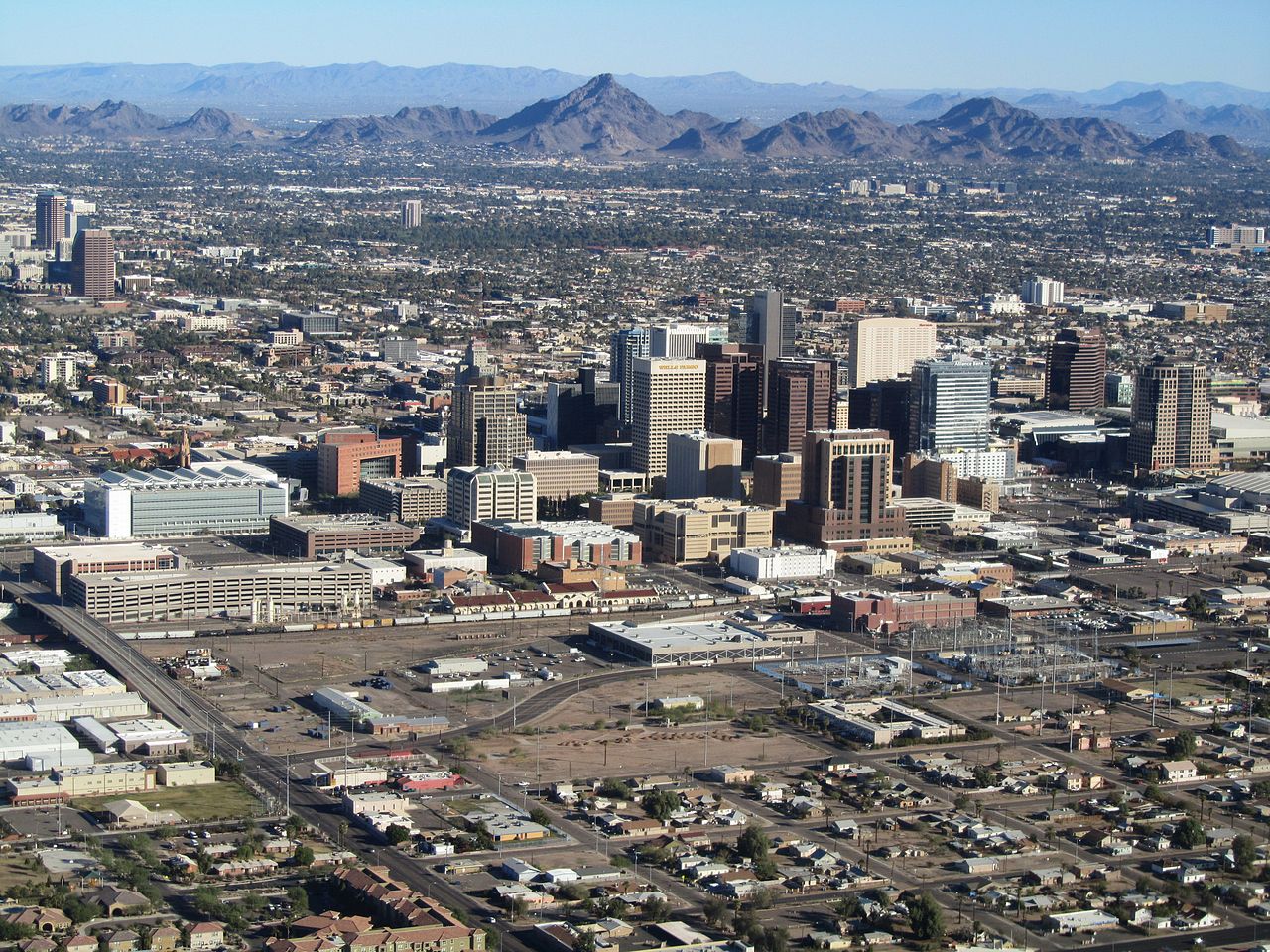
Once In the City. While the Diamondbacks have the State name as their geographic identifier -- apparently from a Native American word meaning "small spring" -- they play in Arizona's State capital, Phoenix. Jack Swilling, a Confederate veteran who founded the place in 1867, accepted the suggestion of a fellow settler, an Englishman named Lord Duppa: Since it was on the site of a previous Indian civilization, it should be named Phoenix, for the mythical bird that rose from its own ashes. The city was incorporated in 1881, making it the youngest city in American major league sports.
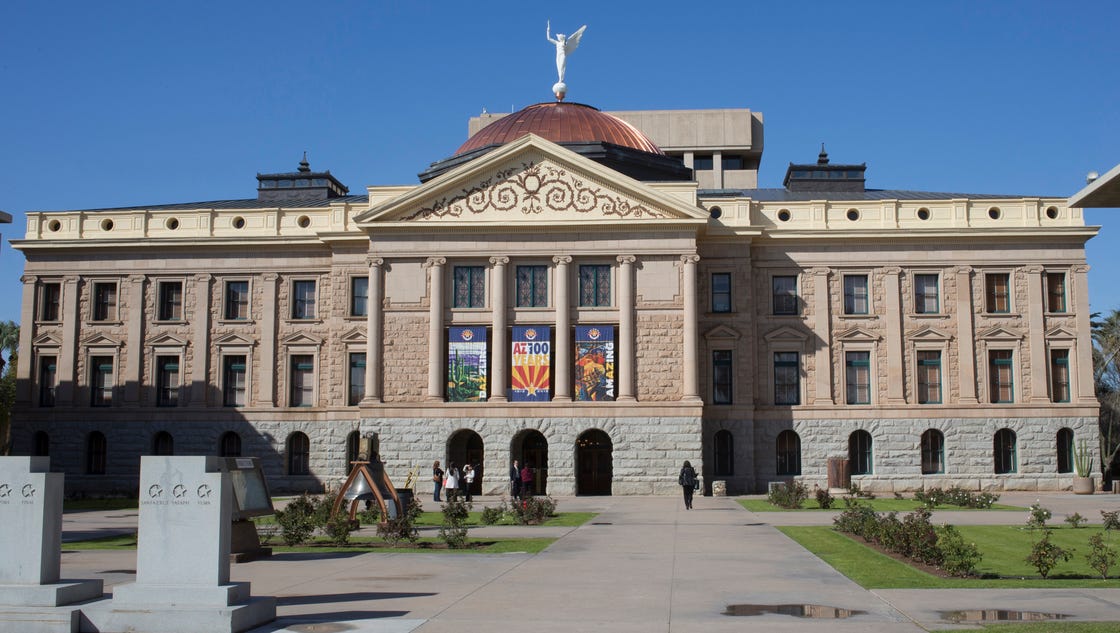
The State House in Phoenix,
apparently in 2012, the 100th Anniversary of Statehood

Home to just 100,000 people in 1950, Phoenix saw huge growth in the 2nd half of the 20th Century: 440,000 by 1960, 580,000 by 1970, 800,000 by 1980, and it surpassed the 1 million mark in the early 1990s. It's 1.6 million now, with about 4.8 million people in the metropolitan area.

All this made it an expansion target. The NBA's expansion Suns arrived in 1968. The NFL's St. Louis Cardinals in 1988, changing their name from the Phoenix Cardinals to the Arizona Cardinals in 1993. The USFL's Arizona Wranglers played there in 1984, and became the Arizona Outlaws the following year. This was around the time that the Philadelphia Eagles nearly moved there due to owner Leonard Tose's fractured finances.

The MLB team that became the Diamondbacks was awarded in 1995, to begin play in 1998. And the NHL's 1st Winnipeg Jets became the Phoenix Coyotes in 1997, changing their name to the Arizona Coyotes in 2013. This was after the World Hockey Association had the Phoenix Roadrunners in the 1970s -- and, yes, I'm well aware of the cartoon connection: Roadrunners replaced by Coyotes. The WNBA's Phoenix Mercury also began play in 1997. Today, the basketball teams are the only Phoenix-area team to keep the city's name as their identifier, rather than the State's name.

The sales tax in Arizona is 5.6 percent, but it's 8.3 percent within the City of Phoenix. ZIP Codes for Arizona start with the digits 85 and 86, and the Area Codes are 602 (for Phoenix), 480 and 623 (for the suburbs).

Arizona Public Service provides electricity and water. The Phoenix metropolitan area has a population that is about 58 percent white, 31 percent Hispanic, 5 percent black, 3 percent Asian, and 3 percent Native American.

Although Phoenix has had a gang problem, its bigger problem has been the racism of the white people to the Mexican-American community, symbolized by Joe Arpaio, Sheriff of Maricopa County from 1993 to 2017, who had people arrested without cause and tortured in his jails. After losing his last bid for re-election, he was convicted for contempt of court. He then became the 1st criminal pardoned by Donald Trump, and ran for his old office again in 2020, and lost.

Although Phoenix has had a gang problem, its bigger problem has been the racism of the white people to the Mexican-American community, symbolized by Joe Arpaio, Sheriff of Maricopa County from 1993 to 2017, who had people arrested without cause and tortured in his jails. After losing his last bid for re-election, he was convicted for contempt of court. He then became the 1st criminal pardoned by Donald Trump, and ran for his old office again in 2020, and lost.

Central Avenue is the source street for east-west house numbers; oddly, the north-south streets are numbered Streets to the east, and numbered Avenues to the west. Washington Street divides addresses into north and south. State Route 101 forms a partial "outer beltway," while Interstates 10 (north and east) and 17 (south and west) form an "inner beltway."
A single ride on Phoenix buses and Valley Metro Rail is $2.00, with an All-Day Pass a bargain at $4.00. With the ballpark being downtown and thus probably near your hotel, you probably won't need the light-rail system to get there. But in the heat, you may still want to take a cab. If you do take Metro Rail, it's Washington at 3rd Street station going westbound, and Jefferson at 3rd Street station going eastbound.
Light rail train stopped at the stadium

Going In. The official address of Chase Field is 401 East Jefferson Street, the street bounding center field. Home plate faces a railroad and East Buchanan Street, South 4th Street is the 3rd base side, and the 1st base side is South 7th Street. With the railroad on the south/home plate side, most of the gates are on Jefferson and 4th. Parking ranges from $10 to $16.
Roof open

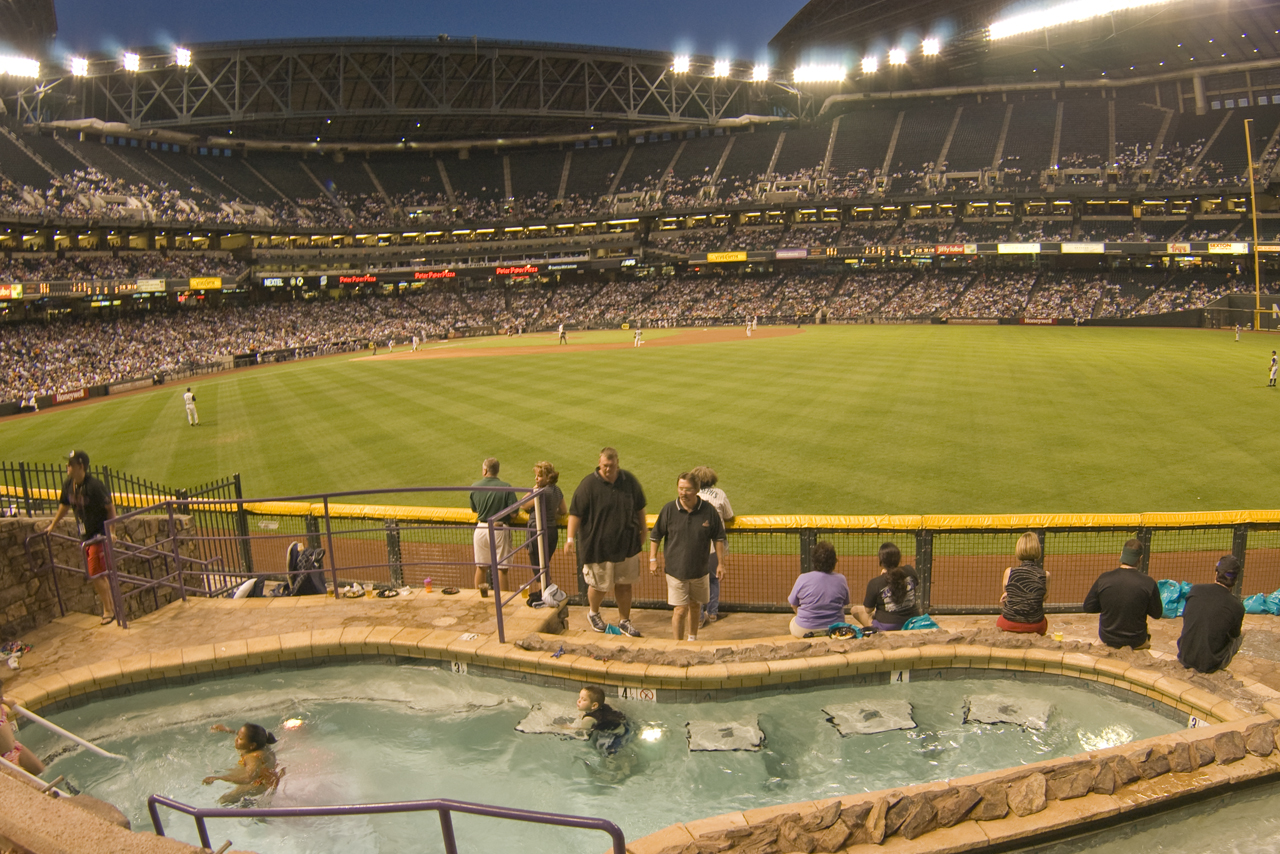
As a retractable-roof stadium, Chase Field -- opening in 1998 as Bank One Ballpark, and having that name during what remains the Diamondbacks' only World Series thus far, 2001 -- somewhat resembles Miller Park in Milwaukee, which opened 3 years later. In other words, it looks like a big airplane hangar, without much atmosphere.
Roof closed

True, there is that pool in the right-center-field corner... but what's a pool doing at a ballpark? At any rate, you won't get much of a view of downtown Phoenix from inside the place, which points due north.
The natural grass field that the stadium had since its opening was replaced in 2019, with artificial turf. The National League had been without it since the Montreal Expos moved in 2004, but it's back, because the heat meant that they couldn't keep the roof open enough to keep the grass alive.

The field points due north, and is functionally, but not quite, symmetrical: 330 to left field, 334 to right, 374 to both power alleys, 407 to center, and 413 to corners on each side of center. The longest home run hit at Chase is 504 feet, by Adam Dunn in 2008.
In addition to the Diamondbacks, Chase Field has also hosted concerts, rodeos, and the Cactus Bowl, formerly known as the Insight.com Bowl.

Major League Baseball became concerned enough about problems at Chase Field that it was considering forcing the team to move. But the Arizona legislature passed a bond issue to fix those problems, and it looks like the team is staying.

Food. As a Southwestern city, you might expect Phoenix to have a Mexican/Spanish/Southwest food theme. Which is the case: Their "A-Zona Grill" includes burritos, churros, and all kinds of tacos ranging from steak to chicken to shrimp.  They also have popcorn named "Catcus Corn."

But they also have Philadelphia-style cheesesteaks, San Francisco's trademark garlic fries, and an outlet of Los Angeles' famed Fatburger. They have chain outlets Subway, Panda Express, Mrs. Fields, TCBY and Cold Stone Creamery. And, knowing they have lots of ex-New Yorkers in their Sun Belt city and its surrounding metro area, they have stands called "Streets of New York" at Sections 104, 113, 125, 138, 306, 326 and 328.

They have 3 bars overlooking the outfield: The Arizona Baseball Club is above right field, the Sedona Club in center field, and Friday's Front Row (part of the T.G.I. Friday's chain) overlooks left field.

According to a recent Thrillist article on the best food at each MLB ballpark, the best snack at Chase Field is the Churro dog, available at 114 and 123. What's a churro dog? It's a chocolate long john, churro, ice cream, whip cream and chocolate and carmel drizzle. In other words, it's what happens 9 months after the Taco Bell Chihuahua and a Dairy Queen get drunk together. In other words, it's disgusting, a disgrace to both ice cream and Mexican food. So, unlike the churro dog itself, maybe you should take that Thrillist article with a grain of salt.

Team History Displays. The Diamondbacks have now celebrated their 20th Anniversary. As 1 of the 2 newest teams (unless you count the Washington Nationals separately from the Montreal Expos, and I usually do), the Diamondbacks don't have a lot of history, but they have some. They've won one Pennant, in 2001, and beat the Yankees in the World Series. They've won the National League Western Division 5 times: 1999, 2001, 2002, 2007 and 2011. They put these notations outside the stadium. They have not done so for their 2017 NL Wild Card berth.
They've retired the Number 20 of Luis Gonzalez, outfielder, 1999-2006; and the Number 51 of Randy Johnson, 1999-2004 and 2007-08. The retired numbers, along with Jackie Robinson's universally-retired Number 42, are above the right field stands. The D-backs have handed out Curt Schilling's Number 38, although it is not currently being worn.
The retired number display, before Johnson's 51 was added

In 2018, they polled their fans for a 20th Anniversary Team:

* From the 1999 Division Champions: 2nd baseman Jay Bell, shortstop Tony Womack, 3rd baseman Matt Williams; outfielders Gonzalez and Steve Finley; and pitcher Randy Johnson.

* From the 2001 World Champions and the 2002 Division Champions: Bell, Womack, Williams, Gonzalez, Finley, pitcher Schilling, and manager Bob Brenly.

* From the 2007 Division Champions: Catcher Miguel Montero, pitchers Brandon Webb and José Valverde.

* From the 2011 Division Champions: Montero, 1st baseman Paul Goldschmidt, pitcher Brad Ziegler.

* From the 2017 Wild Card team: Goldschmidt, outfielder A.J. Pollock, and pitchers Zack Greinke and Patrick Corbin.

There is no mention of the 1959 and 1977 Pacific Coast League Pennants won by the Phoenix Giants, or of the Division titles won by their replacements, the Phoenix Firebirds, including in 1996 and 1997, the last 2 seasons before the majors finally arrived in Phoenix.

Obviously, no Diamondbacks were chosen by The Sporting News for their 100 Greatest Baseball Players in 1999. If they were to do it again, Johnson would be selected. He was chosen by Diamondback fans for the DHL Hometown Heroes contest in 2006. In 2022, ESPN named its 100 Greatest Baseball Players. Among players who played significant time for the Diamondbacks, only Randy Johnson was chosen, ranked 26th.

There is an Arizona Sports Hall of Fame, with Gonzalez, Schilling, Johnson, Mark Grace, original owner Jerry Colangelo, former executive Roland Hemond, and current team CEO Derrick Hall as members. Among the other members are Arizona native baseball players Art Nehf of the 1920s New York Giants, James "Shanty" Hogan of the 1920s and '30s Boston Braves, Thornton Lee of the 1940s Chicago White Sox, and Tim Salmon of the 1990s and 2000s Angels of Varying Geographical Identifiers. The Hall does not have a permanent exhibit anywhere.

The Diamondbacks don't really have a rivalry. The next-closest teams are their NL West opponents: The Los Angeles Dodgers, the San Diego Padres, the San Francisco Giants and the Colorado Rockies; and, while they're in the AL, the Los Angeles Angels and the Oakland Athletics. But none really stands out above the others. I suppose, due to the history they carry, D-backs fans would rather beat the Dodgers than anyone else.

Stuff. The Diamondbacks have Team Stores all over Chase Field, oddly having more in the upper level than in the lower level. I don't know if they tie into the city's Western heritage by selling cowboy hats with team logos on them.

The 2001 World Series highlight film and a DVD package of that Series are available, although there is, as yet, no Essential Games of the Arizona Diamondbacks DVD collection.

As one of the newest teams, the D-backs don't have many books written about them, but there are 2 you should know about: Len Sherman wrote Big League, Big Time: The Birth of the Arizona Diamondbacks; and Sara Gilbert (not the actress of that name) wrote The Story of the Arizona Diamondbacks, published last year. Buster Olney's The Last Night of the Yankee Dynasty, as you would expect, mentions the Yanks' loss in the 2001 World Series, but is about them, not the Diamondbacks.

During the Game. A recent Thrillist article on "Baseball's Most Intolerable Fans" put Diamondback fans at 17th, right in the middle of the pack, although they did invoke the joke, "D-Backs, more like D-Bags, amirite?"

The average Arizona baseball fan is not especially douchey. On the other hand, this is still the home State of racist Sheriff Joe Arpaio. As the Thrillist article says, "You definitely have your segment of the fanbase that sees no cognitive dissonance whatsoever between saying horribly racist things about Latinos and cheering for Yasmany Tomas."

Nevertheless, wearing Met gear in Phoenix will not endanger your safety. As a franchise only in their 25th season, the Diamondbacks don't really have a rivalry yet; and if they did, it probably wouldn't be with the Mets, although the Mets did beat them in the 1999 NL Division Series.

For the most part, Arizona fans are okay, not making trouble for fans of teams playing the NFL Cardinals, NBA Suns or NHL Coyotes, either. In fact, their biggest rivalry is intrastate: The University of Arizona vs. Arizona State University. It's a heated rivalry... but it's a dry heat.

The Friday night game will be Jackie Robinson Night, since the Diamondbacks were on the road on April 15 -- at Citi Field to play the Mets. Rally Towels will be given away, but with Robinson's picture on them, which is weird, because he never played for the Diamondbacks. The Saturday and Sunday games will each have a hooded T-shirt giveaway.

The Diamondbacks hold auditions for National Anthem singers, instead of having a regular. They don't have a lot to hold your attention during a game, unless you want to count that pool. There's no special "Get Loud" device, and no famous fans known for getting people going. No special song during the 7th Inning Stretch or after a win.

There is a song titled "Arizona," a 1970 hit for Mark Lindsay, who was the lead singer for the rock band Paul Revere & the Raiders, but it's clear that the title refers to the name of the narrator's girlfriend, and has nothing to do with the State or the ballclub, which, of course, would not exist even on paper for another quarter of a century.

The team has 2 mascots. The first was D. Baxter the Bobcat, named for the team's abbreviation, "D-backs," and for the facts that bobcats are common in Arizona and the stadium was originally known as Bank One Ballpark or "The Bob."
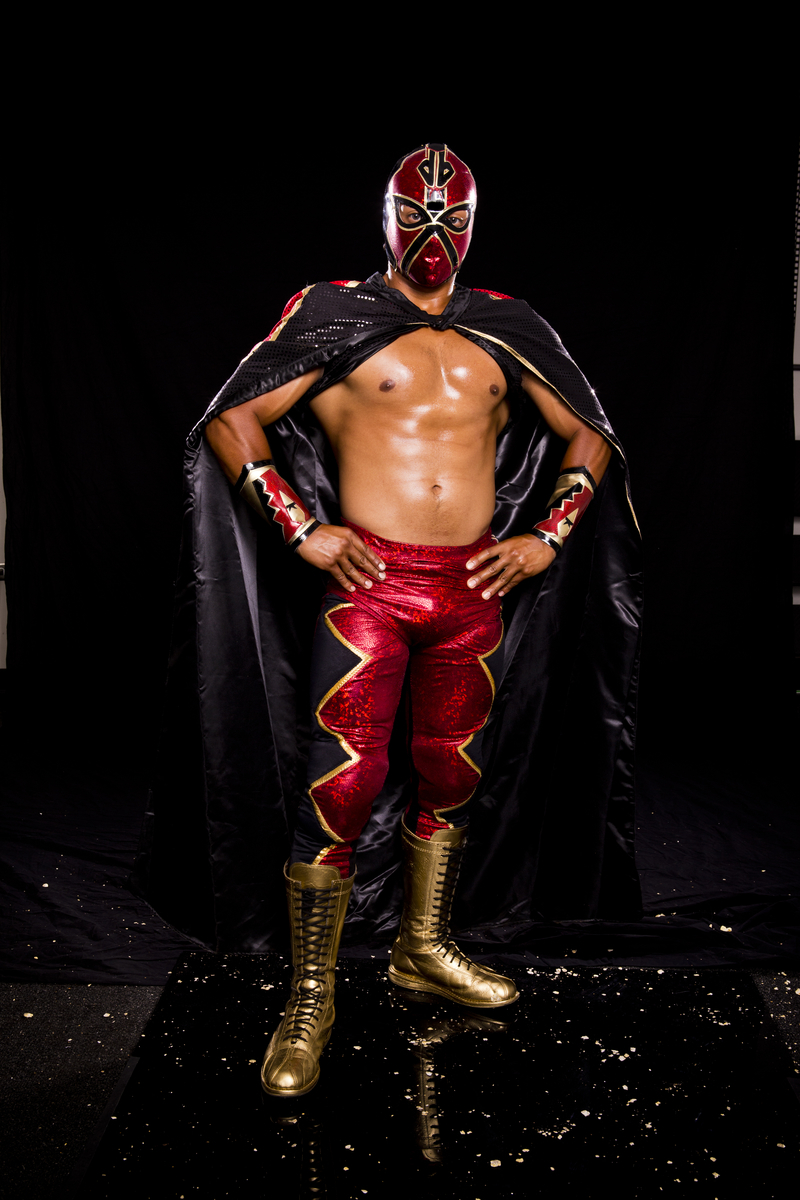
The newer one is "The D-Backs Luchador," a character based on Mexican "professional wrestling," introduced in 2015 to appeal to Hispanic fans. He wears a black cape, red pants, and a mask patterned after the team's logo. Clearly, making the mascot a snake, which is what a diamondback actually is, was out of the question.
Don't tell Sheriff Joe about this guy. For at least 2 reasons.

They have a variation on a mascot race, with kids chosen to wear hot dogs suits, with different condiments (ketchup, mustard, relish).

If the home team wins, they will play a song written for them, "D-backs Swing," by Rogers Clyne & the Peacemakers. Clyne is from Tucson, and wrote the theme song for the Fox cartoon King of the Hill.

After the Game. Phoenix does have crime issues, but you should be safe as long as you stay downtown. It's incredibly unlikely that Diamondback fans will try to provoke you. As I said, the newness of the team, the lack of nearby rivalries, and the fact that the Mets (or the Yankees) wouldn't be such a rivalry anyway all help.

There are, as yet, no bars around Chase Field that have become famous as postgame hangouts. As for anything New York-friendly, As for anything New York-friendly, the closest I can come at this time is a place called Tim Finnegan's, the local Jets fan hangout, but that's at 17045 North 59th Avenue, 21 miles northwest of downtown Phoenix and 13 miles northeast of the arena. It appears that the local football Giants fan club meets at Social Tap Scottsdale, at 4312 N. Brown Avenue, 12 miles east of downtown.

If you visit Phoenix during the European soccer season, as we are now in, the best "football pub" in Arizona is the George & Dragon Pub, which opens at 7:00 AM on matchdays. 4240 N. Central Avenue, about 3 miles north of downtown. Bus 13 to Buckeye Road & Central Avenue, then transfer to Bus ZERO to Farrington Lane. Unless you're a Liverpool fan, or you'd prefer to stay downtown, in which case you can go to the Rose and Crown, at 628 E. Adams Street, 2 blocks north of the ballpark.

Sidelights. On November 30, 2018, Thrillist published a list of "America's 25 Most Fun Cities," and Phoenix came in 21st. 

The Footprint Center, previously known as the AmericaWest Arena, the US Airways Center and the Talking Stick Resort Arena, is 2 blocks west of Chase Field, at 2nd & Jefferson. The Suns have played here since 1992, and the WNBA's Phoenix Mercury since 1997. The Coyotes played here from 1996 to 2003. (Footprint is an Arizona-based "material science" company.)

* Arizona Veterans Memorial Coliseum. The Grand Canyon State's 1st home to big-league sports, opening in 1965, was home to the Suns from their 1968 arrival until 1992, and to the World Hockey Association's Phoenix Roadrunners from 1974 to 1977.

Elvis Presley sang at the Coliseum on September 9, 1970, and again on April 22, 1973. Early in his career, on June 9, 1956, he sang at a grandstand at the adjoining Arizona State Fairgrounds. The next day, he sang at the Rodeo Grounds in Tucson. He also sang at the Tucson Community Center on November 9, 1972 and June 1, 1976. (While individual ex-Beatles have performed in Arizona, the band as a whole did not do so on any of their 3 North American tours.)

The Coliseum still stands, and is part of the State Fairgrounds. 1826 W. McDowell Road. Northwest of downtown. Number 15 bus to 15th & McDowell, then 3 blocks west.

* Phoenix Municipal Stadium. This ballpark was home to the Phoenix Giants/Firebirds from its opening in 1964 until 1991, and is the current spring training home of the Oakland Athletics, the Diamondbacks' Rookie League team, and Arizona's State high school baseball championship. 5999 E. Van Buren Street. East of downtown, take the Light Rail to Priest Drive/Washington station, then a short walk up Priest.
* Scottsdale Stadium. This stadium was home to the Firebirds in their last years, 1992 to 1997. Its seating capacity of 12,000, 4,000 more than Phoenix Municipal, was meant to showcase the Phoenix area as a potential major league market. It's the San Francisco Giants' spring training site, and replaced a previous stadium on the site that dated to 1956, used as a spring training home for the Giants, A's, Red Sox, Orioles and Cubs -- sometimes all at the same time.
Because it was the Cubs' spring training home, thus leading to Phoenix becoming "Chicago's Miami," where retirees from the city tend to go (paging Michael Wilbon of the Washington Post & ESPN's Pardon the Interruption & NBA coverage), it was where former Cub catcher Randy Hundley hosted the very first baseball fantasy camp. As Met fans, you might remember Randy's furious reaction to Tommie Agee scoring on a controversial umpiring call at home plate at Shea in September 1969. You might also remember Randy's son, former Met catcher Todd Hundley.

7408 E. Osborn Road, at Drinkwater Boulevard. Northeast of downtown. Light Rail to Veterans Way/College station, then transfer to Number 72 bus to Osborn, then walk 2 blocks east.

* State Farm Stadium and Gila River Arena. The Glendale Sports & Entertainment District, in the Phoenix suburb of Glendale, consists of State Farm Stadium (until this year known as The University of Phoenix Stadium), home to the Arizona Cardinals since 2006; and the Gila River Arena, home to the Coyotes since 2003.

The complex is about 17 miles northwest of downtown Phoenix. The official address of the stadium is 1 Cardinals Drive, and that of the arena is 9400 W. Maryland Avenue. Number 8 bus from downtown to 7th & Glendale Avenues, then transfer to Number 70 bus, to Glendale and 95th Avenue, then walk down 95th. If you drive in, parking starts at $10.

New York Tri-State Area sports fans know the stadium as the site of Super Bowl XLII, where the Giants derailed the New England Patriots' bid for the NFL's first 19-0 season. The Cardinals defeated the Philadelphia Eagles there in January 2009 to advance to Super Bowl XLIII. The Baltimore Ravens beat the San Francisco 49ers there in Super Bowl XLIX. It is set to host Super Bowl LVII on February 5, 2023.

The stadium is also home to the Fiesta Bowl, and thus what has amounted to 3 National Championship Games: 2006-07, Florida over Ohio State; 2010-11, Auburn over Oregon; and 2015-16, Alabama over Clemson.

In 2017, it became the 1st building in Arizona to host a Final Four, with North Carolina defeating Gonzaga in the Final. It will host the Final Four again in 2024. It's hosted 4 matches of the U.S. soccer team, most recently a 3-0 win over Panama in a friendly in 2019. It hosted 2 games of the 2017 CONCACAF Gold Cup, and 2 Quarterfinals of the 2021 CONCACAF Gold Cup. It will host the Final Four again in 2024.

The neighboring Gila River Arena has been home to the Coyotes since 2003. In 2012, for the first time since the Jets/Coyotes franchise entered the NHL in 1979, they reached the League's last 4 (now the Western Conference Finals). Nevertheless, the team is still having financial troubles, which could yet lead to it being moved. A deal to build a new arena for the Coyotes and Arizona State basketball on the ASU campus in Tempe means that they will stay in the area through at least the 2024-25 season.

The official address of the stadium is 1 Cardinals Drive, and that of the arena is 9400 W. Maryland Avenue. Number 8 bus from downtown to 7th & Glendale Avenues, then transfer to Number 70 bus, to Glendale and 95th Avenue, then walk down 95th.

UPDATE: In 2022, the Gila River Arena was renamed the Desert Diamond Arena, and the Coyotes moved to the new Mullett Arena, as tenants of Arizona State. It seats just 5,000 people. The Coyotes still have difficulty selling it out.

* Arizona State University. The University of Arizona is 114 miles away in Tuscon, but ASU is just a 24-minute Light Rail ride from downtown. The station is at 5th Street & Veterans Way, and is 2 blocks away from Sun Devil Stadium and the Wells Fargo Arena, home to their football and basketball teams, respectively.

Sun Devil Stadium was built in 1958, and ASU still plays there rather than move to the larger, more modern (but well off-campus) University of Phoenix Stadium. The Cardinals played there from 1988 to 2005, and the Fiesta Bowl was held there from 1971 to 2006. This meant what amounted to 5 National Championship Games: 1986-87, Penn State over Miami; 1988-89, Notre Dame over West Virginia; 1995-96, Nebraska over Florida; 1998-99, Tennessee over Florida State; and 2002-03, Ohio State over Miami.

The Dallas Cowboys treated it as a second home field when they played the Cardinals (mainly because there always seemed to be more Cowboy fans there), and won Super Bowl XXX there, when the world learned A) it was possible for the Pittsburgh Steelers to lose a Super Bowl, and B) Terry Bradshaw was a smart quarterback compared to Neil O'Donnell. It also hosted 2 U.S. soccer team matches in the 1990s.

The Wells Fargo Arena was previously known as the ASU Activity Center. Elvis sang there on March 23, 1977.

ASU's Gammage Auditorium, at the other end of the campus, hosted one of the 2004 Presidential Debates between George W. Bush and John Kerry. 1200 S. Forest Avenue.

The ASU Multi-Purpose Arena is scheduled to open this Autumn, as the home of the Coyotes (at least through the 2024-25 season) and ASU's hockey team. It is being built on the site of Packard Stadium, from 1974 to 2013 the home of the ASU baseball program, one of the most successful college baseball teams, east of the stadium and arena, at Rural Road and Rio Salado Parkway.

Packard Stadium was east of Sun Devil Stadium and the arena, at Rural Road and Rio Salado Parkway. The Sun Devils have won 5 National Championships, most recently in 1981. Their legends include Reggie Jackson, Barry Bonds, and current stars Dustin Pedroia and Andre Ethier. Notable ASU and Met alumni include Gary Gentry, Duffy Dyer, Lenny Randle, Craig Swan, Hubie Brooks, Paul Lo Duca and Ike Davis.

UA has been in the Final Four in 1988, 1994, 1997 and 2001, winning it all in 1997; but ASU has never gotten any closer than the Sweet 16, in 1995.

The highest-ranking pro soccer team in Arizona is Phoenix Rising FC, in the United Soccer League, our 2nd division. They play at Wild Horse Pass, at 19593 South 48th Street in Chandler, about 17 miles south of downtown Phoenix. No public transportation is available, so if you don't have a car, forget it. 

Presuming Major League Soccer's current expansion wave passes Phoenix by, the closest MLS teams are the 2 in Los Angeles, 375 (LAFC) and 376 (LA Galaxy) miles to the west, respectively. The San Jose Earthquakes and Real Salt Lake are considerably further away.

There are no Baseball Hall-of-Famers buried in Arizona. Ted Williams is (sort of) preserved at Alcor Life Extension Foundation, a cryonics lab in Scottsdale. It's a private facility, and they do not offer tours. It would be creepy if they did. So if you want to pay tribute to the Splendid Splinter, better to do so at his statue at Fenway Park in Boston, or at the Ted Williams Hitters' Hall of Fame at Tropicana Field in St. Petersburg, home of the Tampa Bay Rays.

* Wrigley Mansion. The Chicago Cubs have trained in Arizona since 1952: First at Mesa, then Scottsdale in 1967, and Mesa again since 1979. This is because of Phil Wrigley's Winter residence in Phoenix. (One of them, anyway: From 1922 to 1951, they trained on Catalina Island off the coast of Los Angeles, which he owned.) Wrigley himself is the reason baseball developed a "Cactus League" to go with Florida's "Grapefruit League."

Wrigley also owned the Arizona Biltmore Hotel in Phoenix, and built the Italianate-style mansion across from it. (The Waldrof-Astoria company now owns and operates the Arizona Biltmore.) The Mansion is now considered a landmark and a "Phoenix Point of ride." 2501 E. Telewa Trail, about 8 miles northeast of downtown. From there, Bus 17 to 24th & McDowell, then Bus 70. It takes 2 hours, so it may not be worth it.

* Arizona Science Center. Phoenix is not a big museum center. And while there have been Native Americans living in Phoenix for thousands of years, and Spaniards/Mexicans for hundreds, its Anglo history is rather short. No Arizonan has ever become President, although Senators Barry Goldwater and John McCain got nominated, so there's no Presidential Library or Museum. And it doesn't help history buffs that the city only goes back to 1867, and Statehood was gained only in 1912. But the Science Center is at 4th & Washington, just a block from the ballpark. And Arizona State has a renowned Art Museum.

The tallest building in Phoenix, and in all of Arizona, is the Chase Tower, bounded by Central Avenue and Van Buren, 1st and Monroe Streets. That it's only 483 feet, and that no taller building has been built in the city since it opened in 1972, says something about this city, but I'm not sure what. But the city seems to be intent on growing outward, not upward.

Television shows set in Phoenix, or anywhere in Arizona, are few and far between. The High Chaparral, another Western created by Bonanza creator David Dortort, ran on NBC from 1967 to 1971, and is fondly remembered by some. Medium was set in the Maricopa County District Attorney's office in Phoenix.

The best-remembered show is Alice, starring Linda Lavin as one of several waitresses at fictional Mel's Diner, running on CBS from 1976 to 1985. The show was taped in Hollywood (Burbank, actually), and its address was given on the show as 2128 Bush Highway. There is a Bush Highway in the area, but it starts in Mesa, well to the northeast of downtown.

But that once-famous "14-ounce coffee cup" sign is still used outside a real working diner in Phoenix. It was Lester's, until the owner agreed to change the name to "Mel's Diner" for the publicity. Today, it's Pat's Family Diner, at 1747 NW Grand Avenue, 2 miles northwest of downtown. Number 15 bus to 15th Avenue & Pierce Street, and then walk one block east to Grand, Pierce, and 12th. There are also still-in-business diners in Ohio and Florida that use the same sign design. "Pickup!"

Movies set in modern-day Arizona usually show the Grand Canyon or the Hoover Dam. Notable on this list is Thelma & Louise, in which Geena Davis and Susan Sarandon drive a 1966 Ford Thunderbird into the Canyon rather than be captured by the FBI, enacting a distaff version Paul Newman and Robert Redford at of the ending of Butch Cassidy & the Sundance KidNational Lampoon's Vacation and Natural Born Killers also used Arizona as a backdrop. While not a Western, Revenge of the Nerds was filmed at the University of Arizona, in Tucson.

The vast majority of movies set in Arizona have been Westerns, including the 1957 and 2007 versions of 3:10 to Yuma, the 1950 film Broken Arrow (not the later John Travolta film of the same title), Fort Apache (not the later Newman film set in The Bronx), Newman's Hombre, Johnny Guitar, A Million Ways to Die In the West, No Name On the Bullet, and all the films based on the 1881 Earps vs. Clantons gunfight, including My Darling Clementine in 1946, Gunfight at the O.K. Corral in 1957, Tombstone in 1993 and Wyatt Earp in 1994.

If you're a Western buff, and you want to see the site of the legendary gunfight, the official address is 326 East Allen Street, Tombstone, AZ 85638. Re-enactments are held daily. Be advised, though, that it's 184 miles southeast of downtown Phoenix, a 3-hour drive, and ain't no Greyhound or Amtrak service, stranger: You'll have to drive. It's also just 50 miles from the Mexican border.

And the other 2 things in Arizona that everybody talks about? The Grand Canyon Skywalk is 262 miles northwest of downtown Phoenix, and Hoover Dam 269 miles. They're 96 road miles apart, but about half that as the crow flies. 

*

If you go to Phoenix to see the Mets play the Diamondbacks, be careful of the heat: Inside the ballpark, you should be fine; outside it, it will be as close to hell on Earth as you are ever likely to get. But you should still be able to have a good time in Phoenix.

And, if you're a Met fan, and worse comes to worst, you can always reminisce about the 2001 World Series -- even if your own club had nothing to do with it, and also lost to the Yankees the year before. 

Friday, May 3, 2019

Yankees Swept In Arizona

The Yankees' 2-game trip to Phoenix to play the Arizona Diamondbacks at Chase Field was a bust. They scored a total of 3 runs, and that wouldn't have been enough to win either game.

Masahiro Tanaka started on Wednesday afternoon, and was shaky, allowing 3 runs on 5 hits and a walk, and was not allowed to continue past the 4th inning. Frequently, when he doesn't do well, it's because he gives up home runs. He gave up 1, to Ketel Marte in the 4th inning, and it turned out to be decisive.

Between them, Luis Cessa, Tommy Kahnle and Adam Ottavino pitched very well for 4 innings, with only a walk by Cessa making it less than perfect. In each of the 3 cases, this was a good sign. They kept the Yankees in the game, and gave the offense a chance to win it.

They didn't take it. Brett Gardner led off the game with a single, but was erased when Luke Voit grounded into a double play. Gio Urshela got to 3rd base in the 2nd, on a double and an error, but there were 2 outs, and Tyler Wade grounded to short to end the threat.

The Yankees loaded the bases with 2 outs in the 5th, but a Gardner groundout put a stop to that. Voit continued his hot streak with a leadoff home run in the 6th, and Gleyber Torres doubled with 1 out. But neither Mike Tauchman nor Urshela could bring him around. Cameron Maybin drew a 1-out walk in the 7th, but got no closer to scoring.

The Yankees closed the gap in the 8th, as Voit drew a leadoff walk, followed by a Gary Sanchez single. But Torres grounded into a double play. That did manage to get Voit to 3rd, and Tauchman singled him home. But Urshela grounded out to stop that. Maybin drew a 1-out walk in the 9th, putting the tying run on. But Austin Romine hit a liner to right that was caught, and Gardner flew out to center to end the game.

Diamondbacks 3, Yankees 2. WP: Merrill Kelly (3-2). SV: Greg Holland (7). LP: Masahiro Tanaka (2-3).

*

So here's where we stand, going into this weekend: The Yankees are 17-13, 4 games over .500, 2 1/2 games behind the Tampa Bay Rays in the American League Eastern Division, 2 in the loss column. If the current AL standings end up being the final standings, the Division Champions would be the Rays, the Minnesota Twins and the Houston Astros; while the Yankees would visit the Seattle Mariners for the AL Wild Card Game.

The Yankees need to do better, and to get healthy, so they can do better still. They are playing at a 92-win pace, and, as I've shown, since the start of Divisional Play in 1969, 92 is the average number of wins by the 2nd place team in the AL East (both before and after the institution of the Wild Card in 1994), so it takes an average of 93 wins to win the Division.

And it's a lot easier to win the Pennant if you win the Division: Only 4 of a possible 24 teams Wild Card teams have won the AL Pennant, and the Yankees have never been one of them: The 2002 Anaheim Angels, the 2004 Boston Red Sox, the 2006 Detroit Tigers and the 2014 Kansas City Royals.

Winning the Division is crucial: Since 1995, when winning the Division, which they've done 13 times, the Yankees have won 9 Division Series, 7 Pennants and 5 World Series; when winning the Wild Card, they've won just 2 of a possible 7 Division Series, and no Pennants.

And tonight, the Yankees start a home weekend series with the AL Central Division-leading Twins. Here are the projected pitching matchups:

* Tonight, 7:05: James Paxton vs. Kyle Gibson.

* Tomorrow, 1:05: J.A. Happ vs. Jake Odorizzi.

* Sunday, 1:05: Domingo German vs. former Yankee Michael Pineda -- presuming he doesn't get hurt again between now and then.

Wednesday, May 1, 2019

CC3K Not Backed By Enough Hitting

Congratulations to CC Sabathia on joining the 3,000 Strikeout Club. He follows Steve Carlton and Randy Johnson as only the 3rd left-handed pitcher to reach this milestone. Too bad the Yankees didn't hit for him.

It came last night, in the opener of a 2-game series against the Arizona Diamondbacks at Chase Field in Phoenix. In the bottom of the 2nd inning, he struck out David Peralta and Christian Walker, to get to 2,999, but then allowed a home run to former Met Wilmer Flores to put the D-backs up 1-0.

He then allowed a single to Nick Ahmed, before facing former Yankee John Ryan Murphy. CC threw him 4 cut fastballs, the 1st missing inside, and the next 3 being fouled off. He then switched to a changeup, which went down and in. Murphy swung and completely missed. That was, as advertised, "CC3K" and "LegaCCy."

The Arizona fans gave CC a nice hand. But, the way things worked out in this Interleague game in a National League park, with no designated hitter, CC was the next Yankee up to bat. And the pitcher he faced, Zack Greinke, might also go to the Hall of Fame one day. (He's now 191-119 with 2,474 strikeouts for his career, and he's 35, so he could build it up more.) CC isn't a bad hitter by pitchers' standards, with a lifetime batting average of .212, but he struck out.

The Yankees tied the game in the top of the 4th, with back-to-back doubles by Gary Sanchez and Gleyber Torres. But Flores drove in another run in the 5th, and the the D-backs scored another in the 8th, after CC left. Greinke and 2 relievers limited the Yankees to 5 hits and a walk.

Diamondbacks 3, Yankees 1. WP: Greinke (5-1). SV: Greg Holland (6). LP: Sabathia, despite his milestone (1-1).

The brief series concludes this afternoon, at 3:40 PM New York time. Masahiro Tanaka starts against Merrill Kelly. Then, a travel day, and then a home weekend series against the Minnesota Twins.

Wednesday, April 24, 2019

How to Be a New York Baseball Fan In Arizona -- 2019 Edition

This coming Tuesday, the Yankees begin a 2-game Interleague series in Phoenix against the Arizona Diamondbacks. The Mets make their only visit of the season on May 31, June 1 and 2. The fact the Diamondbacks beat the Yankees in the 2001 World Series should not matter: To us, they're just another National League team.

Before You Go. Mid-June in Arizona can be hot. Actually, mid-January in Arizona can be hot. When it's 90 degrees and up, you don't want to hear any of that "But it's a dry heat" crap. According to a January 30, 2019 article in Thrillist

Occasionally, retired Kroger business executives from Ohio and their Pilates-instructor second wives will accidentally move to Flagstaff and get very sad and angry when they realize the average winter temperature is somewhere in the 20s. But most of Arizona offers up that dry desert day heat that is good for arthritis and any lingering guilt about leaving their first wives to deal with their delinquent teenage kids back in Indian Hill.    

AZcentral.com, the website for Phoenix's largest newspaper, the Arizona Republic, is predicting the high 90s for the afternoons. The nights will be in the high 60s. The roof will be closed, but you will have to spend some time outdoors. So stay hydrated. That means watch your alcohol consumption. It's the worst thing for you if you're dehydrated. I'm not kidding.

Arizona's infamous Daylight Savings Time issue has been settled: The State is on Mountain Time when New York is on Daylight Savings Time, and on Pacific Time when we're on Standard Time. This is the DST time of year. So you'll be on Pacific Time, 3 hours behind New Jersey and New York City. Adjust your timepieces accordingly.

If you're thinking of making a side trip into Mexico, you should know that Phoenix to the border is a 4-hour drive at the least. No public transportation. You'll need a passport, and you'll also need Mexican driving insurance, which you might be able to get at the Mexican consulate in Phoenix. In other words, it's not really worth the trip.

Tickets. The Diamondbacks averaged 27,687 fans per home game this season, in a stadium whose listed capacity is 48,633. So you can probably show up on the day of the game and get any ticket you can afford. Still, as always, it's better to have them printed up from your computer before you leave the house.

In the lower level, Infield Boxes will cost $140, Baseline Boxes $115, Baseline Reserves $09, and Bleachers $65. In the upper level, MVP Boxes are $69, Infield Reserves $49, and Outfield Reserves $39.

Getting There. It's 2,458 miles from Times Square to Chase Field in downtown Phoenix. In other words, if you're going, you're flying.

You think I'm kidding? Even if you get someone to go with you, and you take turns, one drives while the other one sleeps, and you pack 2 days' worth of food, and you use the side of the Interstate as a toilet, and you don't get pulled over for speeding, you'll still need nearly 2 full days to get there. One way.

But, if you really, really want to... You'll need to get on the New Jersey Turnpike. Take it to Exit 14, to Interstate 78. Follow I-78 west all the way through New Jersey, to Phillipsburg, and across the Delaware River into Easton, Pennsylvania. Continue west on I-78 until reaching Harrisburg. There, you will merge onto I-81. Take Exit 52 to U.S. Route 11, which will soon take you onto I-76. This is the Pennsylvania Turnpike, the nation's 1st superhighway, opening in 1940.

The Turnpike will eventually be a joint run between I-76 and Interstate 70. Once that happens, you'll stay on I-70, all the way past Pittsburgh, across the little northern panhandle of West Virginia, and then across Ohio, Indiana and Illinois, into Missouri.

At St. Louis, take Exit 40C onto Interstate 44 West, which will take you southwest across Missouri into Oklahoma. Upon reaching Oklahoma City, take Interstate 40 West, through the rest of the State, across the Texas Panhandle and New Mexico, into Arizona. At Flagstaff, take Interstate 17 South, which will take you into Phoenix. Take Interstate 10 East to Exit 145, which will lead you to North 7th Street. Chase Field is at 7th and East Jefferson Street.

If you do it right, you should spend about an hour and 15 minutes in New Jersey, 5 hours and 30 minutes in Pennsylvania, 15 minutes in West Virginia, 3 hours and 45 minutes in Ohio, 2 hours and 45 minutes in Indiana, another 2 hours and 45 minutes in Illinois, 5 hours in Missouri, 6 hours in Oklahoma, 3 hours in Texas, 6 hours and 15 minutes in New Mexico, and 5 hours and 15 minutes in Arizona. That's about 41 hours and 45 minutes. Counting rest stops, you're porbably talking about 55 hours.

That's still faster than Greyhound, averaging around 68 hours, including a 1:45 bus-change in Richmond, a 1:15 stopover in Charlotte, an hour's bus-change in Atlanta, an hour's stopover in Birmingham, a 45-minute stopover in Jackson, Mississippi, an hour's stopover in Shreveport, a 1:30 bus-change in Dallas (that's right, changing buses 3 times each way), and a 1:15 stopover in El Paso.

It's $687 round-trip, maybe as low as $455 if you order on advanced purchase. To get to Phoenix by Thursday afternoon, you'll have to leave on Monday night. The station is at 2115 East Buckeye Road, adjacent to Sky Harbor International Airport. Number 13 bus to downtown.

Forget Amtrak: It doesn't go to Phoenix. You'd have to take it to Maricopa Stadium, 35 miles to the south, and it's so convoluted that it's not worth posting.

Flights to Phoenix' Sky Harbor International Airport, usually changing in Chicago or Dallas, are actually among the cheapest to any big-league city, and, if ordered ahead of time, can be had for just under $700.

Once In the City. While the Diamondbacks have the State name as their geographic identifier -- apparently from a Native American word meaning "small spring" -- they play in Arizona's State capital, Phoenix. Jack Swilling, a Confederate veteran who founded the place in 1867, accepted the suggestion of a fellow settler, an Englishman named Lord Duppa: Since it was on the site of a previous Indian civilization, it should be named Phoenix, for the mythical bird that rose from its own ashes. The city was incorporated in 1881, making it the youngest city in American major league sports.
The State House in Phoenix,
apparently in 2012, the 100th Anniversary of Statehood

Home to just 100,000 people in 1950, Phoenix saw huge growth in the 2nd half of the 20th Century: 440,000 by 1960, 580,000 by 1970, 800,000 by 1980, and it surpassed the 1 million mark in the early 1990s. It's 1.6 million now, with about 4.6 million people in the metropolitan area.

All this made it an expansion target. The NBA's expansion Suns arrived in 1968. The NFL's St. Louis Cardinals in 1988, changing their name from the Phoenix Cardinals to the Arizona Cardinals in 1993. The USFL's Arizona Wranglers played there in 1984, and became the Arizona Outlaws the following year. This was around the time that the Philadelphia Eagles nearly moved there due to owner Leonard Tose's fractured finances.

The MLB team that became the Diamondbacks was awarded in 1995, to begin play in 1998. And the NHL's 1st Winnipeg Jets became the Phoenix Coyotes in 1997, changing their name to the Arizona Coyotes in 2013. This was after the World Hockey Association had the Phoenix Roadrunners in the 1970s -- and, yes, I'm well aware of the cartoon connection: Roadrunners replaced by Coyotes. The WNBA's Phoenix Mercury also began play in 1997. Today, the Suns are the only Phoenix-area team to keep the city's name as their identifier, rather than the State's name.

The sales tax in Arizona is 5.6 percent, but it's 8.3 percent within the City of Phoenix. ZIP Codes for Arizona start with the digits 85 and 86, and the Area Codes are 602 (for Phoenix), 480 and 623 (for the suburbs).

Arizona Public Service provides electricity and water. The Phoenix metropolitan area has a population that is about 58 percent white, 31 percent Hispanic, 5 percent black, 3 percent Asian, and 3 percent Native American.

Although Phoenix has had a gang problem, its bigger problem has been the racism of the white people to the Mexican-American community, symbolized by Joe Arpaio, Sheriff of Maricopa County from 1993 to 2017, who had people arrested without cause and tortured in his jails. After losing his last bid for re-election, he was convicted for contempt of court. He then became the 1st criminal pardoned by Donald Trump, and ran for his old office again in 2020, and lost.

Although Phoenix has had a gang problem, its bigger problem has been the racism of the white people to the Mexican-American community, symbolized by Joe Arpaio, Sheriff of Maricopa County from 1993 to 2017, who had people arrested without cause and tortured in his jails. After losing his last bid for re-election, he was convicted for contempt of court. He then became the 1st criminal pardoned by Donald Trump, and ran for his old office again in 2020, and lost.

Central Avenue is the source street for east-west house numbers; oddly, the north-south streets are numbered Streets to the east, and numbered Avenues to the west. Washington Street divides addresses into north and south. State Route 101 forms a partial "outer beltway," while Interstates 10 (north and east) and 17 (south and west) form an "inner beltway."
A single ride on Phoenix buses and Valley Metro Rail is $2.00, with an All-Day Pass a bargain at $4.00. With the ballpark being downtown and thus probably near your hotel, you probably won't need the light-rail system to get there. But in the heat, you may still want to take a cab. If you do take Metro Rail, it's Washington at 3rd Street station going westbound, and Jefferson at 3rd Street station going eastbound.
Light rail train stopped at the stadium

Going In. The official address of Chase Field is 401 East Jefferson Street, the street bounding center field. Home plate faces a railroad and East Buchanan Street, South 4th Street is the 3rd base side, and the 1st base side is South 7th Street. With the railroad on the south/home plate side, most of the gates are on Jefferson and 4th. Parking ranges from $10 to $16.
Roof open

As a retractable-roof stadium, Chase Field -- opening in 1998 as Bank One Ballpark, and having that name during what remains the Diamondbacks' only World Series thus far, 2001 -- somewhat resembles Miller Park in Milwaukee, which opened 3 years later. In other words, it looks like a big airplane hangar, without much atmosphere.
Roof closed

True, there is that pool in the right-center-field corner... but what's a pool doing at a ballpark? At any rate, you won't get much of a view of downtown Phoenix from inside the place, which points due north.
The natural grass field that the stadium had since its opening was replaced this year, with artificial turf. The National League had been without it since the Montreal Expos moved in 2004, but it's back, because the heat meant that they couldn't keep the roof open enough to keep the grass alive.

The field points due north, and is functionally, but not quite, symmetrical: 330 to left field, 334 to right, 374 to both power alleys, 407 to center, and 413 to corners on each side of center. The longest home run hit at Chase is 504 feet, by Adam Dunn in 2008.
In addition to the Diamondbacks, Chase Field has also hosted concerts, rodeos, and the Cactus Bowl, formerly known as the Insight.com Bowl.

Major League Baseball is now concerned enough about developments at Chase Field that it might force the Diamondbacks to move.

Food. As a Southwestern city, you might expect Phoenix to have a Mexican/Spanish/Southwest food theme. Which is the case: Their "A-Zona Grill" includes burritos, churros, and all kinds of tacos ranging from steak to chicken to shrimp.  They also have popcorn named "Catcus Corn."

But they also have Philadelphia-style cheesesteaks, San Francisco's trademark garlic fries, and an outlet of Los Angeles' famed Fatburger. They have chain outlets Subway, Panda Express, Mrs. Fields, TCBY and Cold Stone Creamery. And, knowing they have lots of ex-New Yorkers in their Sun Belt city and its surrounding metro area, they have stands called "Streets of New York" at Sections 104, 113, 125, 138, 306, 326 and 328.

They have 3 bars overlooking the outfield: The Arizona Baseball Club is above right field, the Sedona Club in center field, and Friday's Front Row (part of the T.G.I. Friday's chain) overlooks left field.

According to a recent Thrillist article on the best food at each MLB ballpark, the best snack at Chase Field is the Churro dog, available at 114 and 123. What's a churro dog? It's a chocolate long john, churro, ice cream, whip cream and chocolate and carmel drizzle. In other words, it's what happens 9 months after the Taco Bell Chihuahua and a Dairy Queen get drunk together. In other words, it's disgusting, a disgrace to both ice cream and Mexican food. So, unlike the churro dog itself, maybe you should take that Thrillist article with a grain of salt.

Team History Displays. The Diamondbacks have now celebrated their 20th Anniversary. As 1 of the 2 newest teams (unless you count the Washington Nationals separately from the Montreal Expos, and I usually do), the Diamondbacks don't have a lot of history, but they have some. They've won one Pennant, in 2001, and beat the Yankees in the World Series. They've won the National League Western Division 5 times: 1999, 2001, 2002, 2007 and 2011. They put these notations outside the stadium. They have not done so for their 2017 NL Wild Card berth.
They've retired the Number 20 of Luis Gonzalez, outfielder, 1999-2006; and the Number 51 of Randy Johnson, 1999-2004 and 2007-08. The retired numbers, along with Jackie Robinson's universally-retired Number 42, are above the right field stands. The D-backs have handed out Curt Schilling's Number 38, currently worn by pitcher Robbie Ray. They are currently polling their fans for a 20th Anniversary Team.
The retired number display, before Johnson's 51 was added

There is no mention of the 1959 and 1977 Pacific Coast League Pennants won by the Phoenix Giants, or of the Division titles won by their replacements, the Phoenix Firebirds, including in 1996 and 1997, the last 2 seasons before the majors finally arrived in Phoenix.

Obviously, no Diamondbacks were chosen by The Sporting News for their 100 Greatest Baseball Players in 1999. If they were to do it again, Johnson would be selected. He was chosen by Diamondback fans for the DHL Hometown Heroes contest in 2006.

In 2018, Diamondback fans chose a 20th Anniversary Team. The honorees were: Infielders, 1st baseman Paul Goldschmidt, 2nd baseman Jay Bell, shortstop Tony Womack and 3rd baseman Matt Williams; outfielders Luis Gonzalez, Steve Finley and A.J. Pollock; catcher Miguel Montero; starting pitchers Randy Johnson, Curt Schilling, Brandon Webb, Patrick Corbin and Zack Greinke; relief pitchers Jose Valverde and Brad Ziegler; and manager Bob Brenly.

There is an Arizona Sports Hall of Fame, with Gonzalez, Schilling, Johnson, Mark Grace, and original owner Jerry Colangelo as members. Also members are Arizona native baseball players Art Nehf of the 1920s New York Giants, James "Shanty" Hogan of the 1920s and '30s Boston Braves, Thornton Lee of the 1940s Chicago White Sox, and Tim Salmon of the 1990s and 2000s Angels of Varying Geographical Identifiers.

The Diamondbacks don't really have a rivalry. The next-closest teams are their NL West opponents: The Los Angeles Dodgers, the San Diego Padres, the San Francisco Giants and the Colorado Rockies; and, while they're in the AL, the Los Angeles Angels and the Oakland Athletics. But none really stands out above the others. I suppose, due to the history they carry, D-backs fans would rather beat the Dodgers than anyone else.

Stuff. The Diamondbacks have Team Stores all over Chase Field, oddly having more in the upper level than in the lower level. I don't know if they tie into the city's Western heritage by selling cowboy hats with team logos on them.

The 2001 World Series highlight film and a DVD package of that Series are available, although there is, as yet, no Essential Games of the Arizona Diamondbacks DVD collection.

As one of the newest teams, the D-backs don't have many books written about them, but there are 2 you should know about: Len Sherman wrote Big League, Big Time: The Birth of the Arizona Diamondbacks; and Sara Gilbert (not the actress of that name) wrote The Story of the Arizona Diamondbacks, published last year. Buster Olney's The Last Night of the Yankee Dynasty, as you would expect, mentions the Yanks' loss in the 2001 World Series, but is about them, not the Diamondbacks.

During the Game. A recent Thrillist article on "Baseball's Most Intolerable Fans" put Diamondback fans at 17th, right in the middle of the pack, although they did invoke the joke, "D-Backs, more like D-Bags, amirite?"

The average Arizona baseball fan is not especially douchey. On the other hand, this is still the home State of racist Sheriff Joe Arpaio. As the Thrillist article says, "You definitely have your segment of the fanbase that sees no cognitive dissonance whatsoever between saying horribly racist things about Latinos and cheering for Yasmany Tomas."

Neverthless, wearing Met (or Yankee) gear in Phoenix will not endanger your safety. As a franchise only in their 20th season, the Diamondbacks don't really have a rivalry yet; and if they did, it probably wouldn't be with the Mets, although the Mets did beat them in the 1999 NL Division Series.

For the most part, Arizona fans are okay, not making trouble for fans of teams playing the NFL Cardinals, NBA Suns or NHL Coyotes, either. In fact, their biggest rivalry is intrastate: The University of Arizona vs. Arizona State University. It's a heated rivalry... but it's a dry heat.

The Sunday game, being on Father's Day, will feature a promotion, a Father's Day Hawaiian shirt. The Diamondbacks hold auditions for National Anthem singers, instead of having a regular. They don't have a lot to hold your attention during a game, unless you want to count that pool. There's no special "Get Loud" device, and no famous fans known for getting people going. No special song during the 7th Inning Stretch or after a win.

There is a song titled "Arizona," a 1970 hit for Mark Lindsay, who was the lead singer for the rock band Paul Revere & the Raiders, but it's clear that the title refers to the name of the narrator's girlfriend, and has nothing to do with the State or the ballclub, which, of course, would not exist even on paper for another quarter of a century.

The team has 2 mascots. The first was D. Baxter the Bobcat, named for the team's abbreviation, "D-backs," and for the facts that bobcats are common in Arizona and the stadium was originally known as Bank One Ballpark or "The Bob."
The newer one is "The D-Backs Luchador," a character based on Mexican "professional wrestling," introduced in 2015 to appeal to Hispanic fans. He wears a black cape, red pants, and a mask patterned after the team's logo. Clearly, making the mascot a snake, which is what a diamondback actually is, was out of the question.
Don't tell Sheriff Joe about this guy. For at least 2 reasons.

They have a variation on a mascot race, with kids chosen to wear hot dogs suits, with different condiments (ketchup, mustard, relish).

If the home team wins, they will play a song written for them, "D-backs Swing," by Rogers Clyne & the Peacemakers. Clyne is from Tucson and wrote the theme song for the Fox cartoon King of the Hill.

After the Game. Phoenix does have crime issues, but you should be safe as long as you stay downtown. It's incredibly unlikely that Diamondback fans will try to provoke you. As I said, the newness of the team, the lack of nearby rivalries, and the fact that the Mets (or the Yankees) wouldn't be such a rivalry anyway all help.

There are, as yet, no bars around Chase Field that have become famous as postgame hangouts. As for anything New York-friendly, the closest I can come at this time is a place called Tim Finnegan's, the local Jets fan hangout, but that's 11 miles north of downtown, at 9201 North 29th Avenue. It appears that the local football Giants fan club meets at Blue Moose, at 7373 E. Scottsdale Mall, but that's 12 miles northeast.

I've read that a Yankee Fan hangout is at LagerFields Sports Grill, at 12601 N. Paradise Village Pkwy. W., 14 miles northeast. Alas, I can find nothing Mets-specific in the area.

If you visit Phoenix during the European soccer season, which is now approaching its climax, the best "football pub" in Arizona is the George & Dragon Pub, which opens at 7:00 AM on matchdays. 4240 N. Central Avenue, about 3 miles north of downtown. Bus 13 to Buckeye Road & Central Avenue, then transfer to Bus ZERO to Farrington Lane. Unless you're a Liverpool fan, or you'd prefer to stay downtown, in which case you can go to the Rose and Crown, at 628 E. Adams Street, 2 blocks north of the ballpark.

Sidelights.
 On November 30, 2018, Thrillist published a list of "America's 25 Most Fun Cities," and Phoenix came in 21st. 

The Talking Stick Resort Arena, previously known as the AmericaWest Arena and the US Airways Center, is 2 blocks west of Chase Field, at 2nd & Jefferson. The Suns have played here since 1992, and the WNBA's Phoenix Mercury since 1997. The Coyotes played here from 1996 to 2003. (UPDATE: In 2021, the Suns' arena was renamed the Footprint Center. Footprint is an Arizona-based "material science" company.)

* Arizona Veterans Memorial Coliseum. The Grand Canyon State's 1st home to big-league sports, opening in 1965, was home to the Suns from their 1968 arrival until 1992, and to the World Hockey Association's Phoenix Roadrunners from 1974 to 1977.

Elvis Presley sang at the Coliseum on September 9, 1970, and again on April 22, 1973. Early in his career, on June 9, 1956, he sang at a grandstand at the adjoining Arizona State Fairgrounds. The next day, he sang at the Rodeo Grounds in Tucson. He also sang at the Tucson Community Center on November 9, 1972 and June 1, 1976. (While individual ex-Beatles have performed in Arizona, the band as a whole did not do so on any of their 3 North American tours.)

The Coliseum still stands, and is part of the State Fairgrounds. 1826 W. McDowell Road. Northwest of downtown. Number 15 bus to 15th & McDowell, then 3 blocks west.

* Phoenix Municipal Stadium. This ballpark was home to the Phoenix Giants/Firebirds from its opening in 1964 until 1991, and is the current spring training home of the Oakland Athletics, the Diamondbacks' Rookie League team, and Arizona's State high school baseball championship. 5999 E. Van Buren Street. East of downtown, take the Light Rail to Priest Drive/Washington station, then a short walk up Priest.
* Scottsdale Stadium. This stadium was home to the Firebirds in their last years, 1992 to 1997. Its seating capacity of 12,000, 4,000 more than Phoenix Municipal, was meant to showcase the Phoenix area as a potential major league market. It's the San Francisco Giants' spring training site, and replaced a previous stadium on the site that dated to 1956, used as a spring training home for the Giants, A's, Red Sox, Orioles and Cubs -- sometimes all at the same time.
Because it was the Cubs' spring training home, thus leading to Phoenix becoming "Chicago's Miami," where retirees from the city tend to go (paging Michael Wilbon of the Washington Post & ESPN's Pardon the Interruption & NBA coverage), it was where former Cub catcher Randy Hundley hosted the very first baseball fantasy camp. As Met fans, you might remember Randy's furious reaction to Tommie Agee scoring on a controversial umpiring call at home plate at Shea in September 1969. You might also remember Randy's son, former Met catcher Todd Hundley.

7408 E. Osborn Road, at Drinkwater Boulevard. Northeast of downtown. Light Rail to Veterans Way/College station, then transfer to Number 72 bus to Osborn, then walk 2 blocks east.

* State Farm Stadium and Gila River Arena. The Glendale Sports & Entertainment District, in the Phoenix suburb of Glendale, consists of State Farm Stadium (until this year known as The University of Phoenix Stadium), home to the Arizona Cardinals since 2006; and the Gila River Arena, home to the Coyotes since 2003.

The complex is about 17 miles northwest of downtown Phoenix. The official address of the stadium is 1 Cardinals Drive, and that of the arena is 9400 W. Maryland Avenue. Number 8 bus from downtown to 7th & Glendale Avenues, then transfer to Number 70 bus, to Glendale and 95th Avenue, then walk down 95th. If you drive in, parking starts at $10.

New York Tri-State Area sports fans know the stadium as the site of Super Bowl XLII, where the Giants derailed the New England Patriots' bid for the NFL's first 19-0 season. The Cardinals defeated the Philadelphia Eagles there in January 2009 to advance to Super Bowl XLIII. The Baltimore Ravens beat the San Francisco 49ers there in Super Bowl XLIX. It is set to host Super Bowl LVII on February 5, 2023.

The stadium is also home to the Fiesta Bowl, and thus what has amounted to 3 National Championship Games: 2006-07, Florida over Ohio State; 2010-11, Auburn over Oregon; and 2015-16, Alabama over Clemson.

In 2017, it became the 1st building in Arizona to host a Final Four, with North Carolina defeating Gonzaga in the Final. It will host the Final Four again in 2024. It's hosted 4 matches of the U.S. soccer team, most recently a 3-0 win over Panama in a friendly this past January 27. (UPDATE: It hosted 2 games of the 2017 CONCACAF Gold Cup, and 2 Quarterfinals of the 2021 CONCACAF Gold Cup. It will host the Final Four again in 2024.)

The neighboring Gila River Arena has been home to the Coyotes since 2003. In 2012, for the first time since the Jets/Coyotes franchise entered the NHL in 1979, they reached the League's last 4 (now the Western Conference Finals). Nevertheless, the team is still having financial troubles, which could yet lead to it being moved. A deal to build a new arena for the Coyotes and Arizona State basketball on the ASU campus in Tempe fell apart in 2017.

The official address of the stadium is 1 Cardinals Drive, and that of the arena is 9400 W. Maryland Avenue. Number 8 bus from downtown to 7th & Glendale Avenues, then transfer to Number 70 bus, to Glendale and 95th Avenue, then walk down 95th.

* Arizona State University. The University of Arizona is 114 miles away in Tuscon, but ASU is just a 24-minute Light Rail ride from downtown. The station is at 5th Street & Veterans Way, and is 2 blocks away from Sun Devil Stadium and the Wells Fargo Arena, home to their football and basketball teams, respectively.

Sun Devil Stadium was built in 1958, and ASU still plays there rather than move to the larger, more modern (but well off-campus) University of Phoenix Stadium. The Cardinals played there from 1988 to 2005, and the Fiesta Bowl was held there from 1971 to 2006. This meant what amounted to 5 National Championship Games: 1986-87, Penn State over Miami; 1988-89, Notre Dame over West Virginia; 1995-96, Nebraska over Florida; 1998-99, Tennessee over Florida State; and 2002-03, Ohio State over Miami.

The Dallas Cowboys treated it as a second home field when they played the Cardinals (mainly because there always seemed to be more Cowboy fans there), and won Super Bowl XXX there, when the world learned A) it was possible for the Pittsburgh Steelers to lose a Super Bowl, and B) Terry Bradshaw was a smart quarterback compared to Neil O'Donnell. It also hosted 2 U.S. soccer team matches in the 1990s.


The Wells Fargo Arena was previously known as the ASU Activity Center. Elvis sang there on March 23, 1977.

Packard Stadium, opened in 1974, is home to the ASU baseball program, one of the most successful college baseball teams, east of the stadium and arena, at Rural Road and Rio Salado Parkway. The Sun Devils have won 5 National Championships, most recently in 1981. Their legends include Reggie Jackson, Barry Bonds, and current stars Dustin Pedroia and Andre Ethier. Notable ASU and Met alumni include Gary Gentry, Duffy Dyer, Lenny Randle, Craig Swan, Hubie Brooks, Paul Lo Duca and Ike Davis.


ASU's Gammage Auditorium, at the other end of the campus, hosted one of the 2004 Presidential Debates between George W. Bush and John Kerry. 1200 S. Forest Avenue.

The US Airways Center, Wells Fargo Arena, University of Phoenix Stadium, and the University of Arizona's McKale Center have all hosted NCAA basketball tournament games, but, as yet, the State of Arizona has never hosted a Final Four -- although the University of Phoenix Stadium certainly could. UA has been in the Final Four in 1988, 1994, 1997 and 2001, winning it all in 1997; but ASU has never gotten any closer than the Sweet 16, in 1995.

The highest-ranking pro soccer team in Arizona is Phoenix Rising FC, in the United Soccer League, our 2nd division. They play at the rather unimaginatively-named Phoenix Rising FC Soccer Complex, which seats 6,200. 751 N. McClintock Drive, in Scottsdale, 10 miles east of downtown Phoenix. It takes 4 buses over 2 hours to get there, so if you don't have a car, forget it. 

Presuming Major League Soccer's current expansion wave passes Phoenix by, the closest MLS teams are the 2 in Los Angeles, 375 (LAFC) and 376 (LA Galaxy) miles to the west, respectively. The San Jose Earthquakes and Real Salt Lake are considerably further away.

There are no Baseball Hall-of-Famers buried in Arizona. Ted Williams is (sort of) preserved at Alcor Life Extension Foundation, a cryonics lab in Scottsdale. It's a private facility, and they do not offer tours. It would be creepy if they did. So if you want to pay tribute to the Splendid Splinter, better to do so at his statue at Fenway Park in Boston, or at the Ted Williams Hitters' Hall of Fame at Tropicana Field in St. Petersburg, home of the Tampa Bay Rays.

* Wrigley Mansion. The Chicago Cubs have trained in Arizona since 1952: First at Mesa, then Scottsdale in 1967, and Mesa again since 1979. This is because of Phil Wrigley's Winter residence in Phoenix. (One of them, anyway: From 1922 to 1951, they trained on Catalina Island off the coast of Los Angeles, which he owned.) Wrigley himself is the reason baseball developed a "Cactus League" to go with Florida's "Grapefruit League."

Wrigley also owned the Arizona Biltmore Hotel in Phoenix, and built the Italianate-style mansion across from it. (The Waldrof-Astoria company now owns and operates the Arizona Biltmore.) The Mansion is now considered a landmark and a "Phoenix Point of ride." 2501 E. Telewa Trail, about 8 miles northeast of downtown. From there, Bus 17 to 24th & McDowell, then Bus 70. It takes 2 hours, so it may not be worth it.

* Arizona Science Center. Phoenix is not a big museum center. And while there have been Native Americans living in Phoenix for thousands of years, and Spaniards/Mexicans for hundreds, its Anglo history is rather short. No Arizonan has ever become President, although Senators Barry Goldwater and John McCain got nominated, so there's no Presidential Library or Museum. And it doesn't help history buffs that the city only goes back to 1867, and Statehood was gained only in 1912. But the Science Center is at 4th & Washington, just a block from the ballpark. And Arizona State has a renowned Art Museum.

The tallest building in Phoenix, and in all of Arizona, is the Chase Tower, bounded by Central Avenue and Van Buren, 1st and Monroe Streets. That it's only 483 feet, and that no taller building has been built in the city since it opened in 1972, says something about this city, but I'm not sure what. But the city seems to be intent on growing outward, not upward.

Television shows set in Phoenix, or anywhere in Arizona, are few and far between. The High Chaparral, another Western created by Bonanza creator David Dortort, ran on NBC from 1967 to 1971, and is fondly remembered by some. Medium was set in the Maricopa County District Attorney's office in Phoenix.

The best-remembered show is Alice, starring Linda Lavin as one of several waitresses at fictional Mel's Diner, running on CBS from 1976 to 1985. The show was taped in Hollywood (Burbank, actually), and its address was given on the show as 2128 Bush Highway. There is a Bush Highway in the area, but it starts in Mesa, well to the northeast of downtown.

But that once-famous "14-ounce coffee cup" sign is still used outside a real working diner in Phoenix. It was Lester's, until the owner agreed to change the name to "Mel's Diner" for the publicity. Today, it's Pat's Family Diner, at 1747 NW Grand Avenue, 2 miles northwest of downtown. Number 15 bus to 15th Avenue & Pierce Street, and then walk one block east to Grand, Pierce, and 12th. There are also still-in-business diners in Ohio and Florida that use the same sign design. "Pickup!"

Movies set in modern-day Arizona usually show the Grand Canyon or the Hoover Dam. Notable on this list is Thelma & Louise, in which Geena Davis and Susan Sarandon drive a 1966 Ford Thunderbird into the Canyon rather than be captured by the FBI, enacting a distaff version Paul Newman and Robert Redford at of the ending of Butch Cassidy & the Sundance KidNational Lampoon's Vacation and Natural Born Killers also used Arizona as a backdrop. While not a Western, Revenge of the Nerds was filmed at the University of Arizona, in Tucson.

The vast majority of movies set in Arizona have been Westerns, including the 1957 and 2007 versions of 3:10 to Yuma, the 1950 film Broken Arrow (not the later John Travolta film of the same title), Fort Apache (not the later Newman film set in The Bronx), Newman's Hombre, Johnny Guitar, A Million Ways to Die In the West, No Name On the Bullet, and all the films based on the 1881 Earps vs. Clantons gunfight, including My Darling Clementine in 1946, Gunfight at the O.K. Corral in 1957, Tombstone in 1993 and Wyatt Earp in 1994.

If you're a Western buff, and you want to see the site of the legendary gunfight, the official address is 326 East Allen Street, Tombstone, AZ 85638. Re-enactments are held daily. Be advised, though, that it's 184 miles southeast of downtown Phoenix, a 3-hour drive, and ain't no Greyhound or Amtrak service, stranger: You'll have to drive. It's also just 50 miles from the Mexican border.

And the other 2 things in Arizona that everybody talks about? The Grand Canyon Skywalk is 262 miles northwest of downtown Phoenix, and Hoover Dam 269 miles. They're 96 road miles apart, but about half that as the crow flies. 

*

If you go to Phoenix to see the Mets play the Diamondbacks, be careful of the heat: Inside the ballpark, you should be fine; outside it, it will be as close to hell on Earth as you are ever likely to get. But you should still be able to have a good time in Phoenix.

And, if you're a Met fan, and worse comes to worst, you can always reminisce about the 2001 World Series -- even if your own club had nothing to do with it, and also lost to the Yankees the year before.