This is mostly about sports, and then mostly about baseball. It will favor the New York Yankees, the New Jersey Devils, Rutgers University football, and the London soccer club Arsenal. You got a problem with that? Make your own blog.
May 16, 1966, 60 years ago: Was this the greatest day in the history of American music? Three epochal events happened. No one fully realized just how epochal until later.
The Beach Boys released their album Pet Sounds. Brian Wilson -- born on June 20, 1942, 2 days after Paul McCartney of The Beatles -- admitted that Pet Sounds was his response to the Beatle album Rubber Soul, released on December 3, 1965. Wilson viewed Pet Sounds as a solo album, and attributed its inspiration partly to his marijuana use, and an LSD-rooted spiritual awakening.
He said he aimed to create "the greatest rock album ever made," surpassing Rubber Soul, and extending the innovations of producer Phil Spector's "Wall of Sound." This explains the use of an orchestra, and some instruments that even Spector hadn't used before.
It included 2 of the group's most-loved singles, "Wouldn't It Be Nice," which led off Side A, and "God Only Knows," which led off Side B. It also included "Sloop John B," an adaptation of the folk song "The Wreck of the John B." Oddly, given how much it sounds like it's in the spirit of the album, it does not include "Good Vibrations," which became the group's 3rd and last Number 1 hit, and is often called their greatest song.
John Lennon, the other main creative voice in The Beatles, said Brian was "doing some very great things." With Revolver about to be released on August 5, McCartney later said that Sgt. Pepper's Lonely Hearts Club Band, released on June 1, 1967, was his -- if not his band's -- response to Pet Sounds. Brian tried to top it with Smile, but, battling his inner demons, was unable to finish it.
Along with The Basement Tapes by Bob Dylan and The Band, Lifehouse by The Who, The Black Album by Prince, and Chinese Democracy by Guns 'N Roses, Smile became one of the great talked-about-but-unreleased albums in rock and roll history. Of course, all of these were eventually released. In Smile's case, in 1993.
*
On the same day, the aforementioned Bob Dylan released his album Blonde On Blonde. He's never said it was a response to anything.
Neither the name of the performer
nor the title of the album was on the front cover.
Bob already had that much oomph.
One of the things I love about Bob is that he came up with such great song titles. One of the things that drives me crazy about him is that sometimes, those titles are not mentioned anywhere in the lyrics, making it hard for someone who hears the song, but not the title, to know it. Typical of this is the song that leads off the album, "Rainy Day Women #12 & 35," better known by its chorus: "Everybody Must Get Stoned."
"I Want You" and "Just Like a Woman" were hit singles. The 9-verse, 7-minute "Stuck Inside of Mobile with the Memphis Blues Again" is fantastic. I once discovered that it fit the rhythm of Ernest Thayer's poem "Casey at the Bat," and imagined Dylan singing it to the tune. The album also includes "Visions of Johanna" and "Absolutely Sweet Marie."
It's a double album, 4 sides, although the 4th and last side is just 1 song, the 11-minute-23-second "Sad Eyed Lady of the Lowlands." Based on the lyrics, and the word "lowlands," we can presume that this song, along with some of the other songs on the album, were written about Sara Lownds, to whom he was married from 1965 to 1977. Their breakup inspired Dylan's best post-crash album, Blood On the Tracks, in 1975.
I say "post-crash" because, on July 29, 1966, just 76 days after releasing the album, Dylan was badly hurt in a motorcycle crash near his home in Woodstock, in the Catskill Mountains of New York State. He didn't record again for nearly a year, and didn't tour again until 1974.
In 1987, celebrating its 20th Anniversary, Rolling Stone magazine named its 100 Greatest Albums, though not limiting it to just the last 20 years. Sgt. Pepper came in 1st, Born to Run by Bruce Springsteen 2nd, Blonde on Blonde 3rd, and Pet Sounds 8th.
The magazine dropped Blonde on Blonde to 9th in 2003, and all the way to 38th in 2020. Perhaps there were 6 better albums released between 1987 and 2003, but there's no way in hell that 29 better albums were released between 2003 and 2020.
Pet Sounds was ranked 8th in 1987, rose to 2nd in 2003, and kept that honor in 2020. Sgt. Pepper has remained 1st.
*
Those 2 albums being released on the same day would make the day epic enough. But, also on that day, Janet Damita Jo Jackson was born in Gary, Indiana, outside Chicago. The youngest of the 9 singing siblings, she not only became the 2nd-most successful among them, but, by 1986, was able to establish her own "brand," separate from her megastar brother Michael, although they did occasionally work together. Judged solely on her own merits, she also became one of the biggest music stars in the world.
And, while this has nothing to do with music, another celebrity was born on the day: Thurman Thomas, running back for the Buffalo Bills, a member of the Pro Football Hall of Fame.
*
Unfortunately, May 16, 1966 was also the day that Chinese dictator Mao Zedong began what he called the Cultural Revolution. In 1958, he launched a plan to transform China into a modern industrialized state, a plan he called "the Great Leap Forward." He thought that establishing "people's communes" in the countryside, focused mostly on producing steel, would be a good way to go about it.
Taking people who only knew farming and getting them to leave their fields to become steelworkers had worked in America, earlier in the 20th Century. But that was by those men's own choices, because they believed that packing everything up and leaving the South to go North, or West, and learn the necessary skills, however hard it might be, was a better life than living in segregation and rural poverty -- a poverty so bad, it made white men as well as black ones leave.
In contrast, Mao was forcing his decision on people who didn't ask for it, and were completely unprepared for it, and over 30 million people starved to death. Li Jingquan, the Party boss in Sichuan, told Mao that 10.6 million people had died in his province alone by 1961.
In terms of numbers, the Great Leap Forward may have been the greatest blunder in human history. But there's a big difference between a blunder and a crime.
Mao abandoned the program after getting the numbers. Thereafter, moderates in China reversed many of the Great Leap Forward policies, and even began cutting Mao out of economic decision-making. Having an ego as big as his country, Mao didn't like this. In 1964, he saw that the Soviet Union had removed Nikita Khrushchev from power, and figured the same thing could happen to him, and he needed to do something about it. So he determined who had questionable loyalty, and secured his position by removing them from powerful positions, replacing them with sycophants.
Then, on May 16, 1966, there was a "notification": Mao declared the beginning of what he called the "Cultural Revolution." He said the moderate approaches that followed the catastrophe of the Great Leap Forward were bad, and that the Communist Party of China had to re-impose Maoism.
He called on his cult followers to rise up in violent class struggle, proclaiming, "To rebel is justified." On January 5, 1964, he published Quotations from Chairman Mao Tse-Tung (that's how his name was usually written in English during his lifetime). By 1966, he had over 1 billion copies of this "Little Red Book" made up, so that it could fit in the pocket of every person in China. (The country didn't have a billion people yet, but it would become the 1st country to reach that figure.) Among the better-known of these quotations:
* "War is a continuation of politics."
* "Politics is war without bloodshed, while war is politics with bloodshed."
* "In waking a tiger, use a long stick."
* "Despise the enemy strategically, but take him seriously tactically."
* "Political power grows out of the barrel of a gun."
* "All reactionaries are paper tigers."
Countless people were persecuted, massacres were abundant, and millions more died. And, because intelligent people are more likely to question the leader, intellectuals were maligned, and schools were closed. In an intentionally cruel reversal of his Great Leap Forward, Mao forcefully transported 17 million young, urban intellectuals to the countryside to be made to work as farmers, as punishment for their less-than-fully-loyal thinking.
All of this proved every bit as ineffective, if not as fatal. By 1971, knowing that the Cultural Revolution was failing, and that his health was also beginning to fail, Mao was willing to meet with the President of the United States, Richard Nixon. Mao died in 1976, and the power struggle thereafter was won by Deng Xiaoping. Because he was willing to experiment with free-market reforms, he was able to do what Mao was not: Turn China into a modern industrial nation -- though still a brutal totalitarian regime.
July 25, 1965, 60 years ago: Bob Dylan crosses a rock and roll Rubicon. He performs with The Paul Butterfield Blues Band at the Newport Folk Festival in Newport, Rhode Island. They use electric instruments, something the festival had never allowed before, as folk music has traditionally been all-acoustic.
Dylan had been born Robert Allen Zimmerman on May 24, 1941 in Duluth, Minnesota. He grew up in Hibbing, Minnesota, but found life there dissatisfying on multiple levels. Early early rock and roll stars of the mid-1950s appealed to him, and so anyone who had studied his entire life from 1941 to 1965 should have seen this coming. But most people didn't know about that when they became fans of his in the early 1960s.
In 1961, having dropped out of the University of Minnesota, he came to New York, renamed himself for Welsh poet Dylan Thomas, and started singing folk music in the clubs of Manhattan's Greenwich Village, where Thomas had lived and performed for the last few years of his life, dying there in 1953. (I have an entry for his death.)
Bob had adopted a persona like that of earlier folk singer Woody Guthrie, with scraggly clothes and a nasal twang. He combined traditional folk songs with his own new compositions, and it didn't seem to matter that he couldn't sing in the traditional sense, or that he wasn't an especially good-looking guy. People were mesmerized by his performances. Soon, men wanted to be him, and women just wanted him.
On April 16, 1962, at Gerde's Folk City at 11 West 4th Street, he first performed "Blowin' in the Wind," and it was a sensation, with its 3 short verses citing the civil rights and antiwar movements. This was less than a year after the Freedom Rides, but a year before American TV viewers saw the firehoses and police dogs of Birmingham, and most hadn't yet heard of Vietnam, let alone realized that we already had troops fighting, killing and dying there. To them, "war" still meant World War II, a "just war," or maybe the Korean War, which didn't seem worth it.
Bob's self-titled debut album had been released on Columbia Records the preceding March 19. Shortly after the Gerde's premiere, he began recording The Freewheelin' Bob Dylan. Released on May 27, 1963, it included "Blowin' in the Wind," "Masters of War," "A Hard Rain's A-Gonna Fall," and "Don't Think Twice, It's All Right" -- the latter the first in a long line of great breakup songs he would write.
Any 1 of those 4 songs would have been a great triumph for any writer. Dylan had all 4 on 1 album. He was 3 days past his 22nd birthday, and he was already a musical legend.
That July, he appeared at Newport for the first time, along with the biggest active legend of folksinging, Pete Seeger. Guthrie, to whom Seeger had introduced Dylan, was still alive, but sidelined by the condition that would kill him 4 years later.
Also there were Peter, Paul and Mary (Peter Yarrow, Noel Paul Stookey and Mary Travers), the folksinging trio who recorded what remain the biggest hit versions of "Blowin' in the Wind" and "Don't Think Twice." So was Joan Baez, the leading female soloist of "the folk revolution," who helped make Bob famous, then became his girlfriend. Together, these and others closed the show by joining hands and singing a song Seeger, though he didn't write it, made the anthem of civil rights: "We Shall Overcome."
Dylan then began recording his next album, finishing it before President John F. Kennedy was assassinated, but not released until afterward, on January 13, 1964: The Times They Are A-Changin'. It included the title track, "Ballad of Hollis Brown," "With God On Our Side," "Only a Pawn In Their Game," "When the Ship Comes In," and "The Lonesome Death of Hattie Carroll." His previous burst of creativity was thus proven to be no fluke.
Just 25 days after that album's release, The Beatles arrived in America. They and Dylan each influenced the other tremendously, and it may have been The Beatles who influenced Dylan to switch to electric instruments.
Before he did though, he recorded Another Side of Bob Dylan. Released on August 8, 1964, he told Nat Hentoff, the music critic of The Village Voice, New York's underground weekly newspaper, "There ain't no finger-pointing songs." There was "All I Really Want to Do," "Chimes of Freedom," "It Ain't Me, Babe," and "My Back Pages," on which the 23-year old Dylan closed each of 6 verses by singing, "Ah, but I was so much older then. I'm younger than that now."
The Byrds, who would record several of Bob's songs, recorded "My Back Pages," but, to cut it to single length, dropped the 3rd and 4th verses. Both they and Cher would have a hit with "All I Really Want to Do"; while "It Ain't Me, Babe" would be a hit on the pop chart for The Turtles (their first hit), and on the country chart for Johnny Cash.
Fame and the expectation of his peers were getting to Dylan. Until now, except for a couple of songs on the latest album where he had played piano, it had been just him, his guitar, and the harmonica he wore in a neck harness; with no other musicians. (The harmonica in the neck harness would be copied by many performers, most notably Neil Young and Billy Joel.) For his next album, he went electric, and it was titled Bringing It All Back Home.
Released on March 22, 1965, this was a revelation. It was a reminder of his rock and roll roots, about which his "folkie" fans seemed to know nothing. It began with "Subterranean Homesick Blues," with its angry declaration that, "You don't need a weatherman to know which way the wind blows." (This would inspire a radical offshoot of Students for a Democratic Society to call themselves the Weathermen, and later the Weather Underground.)
It included "Maggie's Farm," whose lyrics certainly suggested folk roots, but the electricity behind it give it a bigger punch. It included "Mr. Tambourine Man," which he recorded in 3/4 time, but The Byrds would later switch it to 4/4 time, and give him his 1st Number 1 hit as a writer. (The song has 4 verses, but Byrds lead singer Roger McGuinn sang only the 2nd between the choruses.)
It included "It's Alright Ma (I'm Only Bleeding)," with its declaration, "He not busy being born is busy dying." If that wasn't a message to the people who wanted him to remain the 22-year-old golden boy of the Greenwich Village clubs forever -- just as there were others who got upset when The Beatles moved beyond being "The Lovable Mop Tops" -- then the last song on the album certainly was: "It's All Over Now, Baby Blue."
And on July 20, he released a standalone single, a 6-minute reminder of how their delusions of him, not himself, had let them down: "Like a Rolling Stone." (Rolling Stone magazine was named for this song, not the new British band of the same name.)
So when Dylan, backed by The Paul Butterfield Blues Band, took the stage at Newport on July 25, nobody knew what to expect. Here's what he gave them: "Maggie's Farm," "Like a Rolling Stone," and "It Takes a Lot to Laugh, It Takes a Train to Cry," each electric.
There was booing, but there's dispute over why. Some have said it wasn't because the electric instruments were blasphemy to the folkies, it was because the sound system was bad, and Bob and the band couldn't be heard properly. The surviving film suggests that this is true, because the songs don't sound much like they did on the records.
Another legend, that Pete Seeger yelled at show producer George Wein to turn the amps off, and that, having been refused, the "purist" Seeger tried to chop the cord with an ax, were denied by Seeger himself. He admitted that the problem was the sound system, not Dylan's audacity. If any folkies felt betrayed that night, Seeger was not one of them.
Dylan played 2 more songs, just him, his guitar, and his harmonica: "Mr. Tambourine Man" and, providing a definitive last word for them, "It's All Over Now, Baby Blue." He soon wrote one of the nastiest songs ever written in the English language: "Positively 4th Street," opening with, "You got a lot of nerve to say you are my friend," and going on to really let them have it.
By this point, he had further enraged the folk music community by breaking up with Joan Baez, and marrying someone else, Sara Lowndes, for whom he wrote some of his more interesting songs thereafter.
Dylan would go through many more changes to his career, and did not appear at the Newport Folk Festival again until 2002. As of July 25, 2022, he is 81 years old, and still performing. Few people now doubt that going electric was good for him, and good for music.
Also, not counting individuals implied as being part of a group, like the Beatles and the performers at Woodstock, Bob Dylan is 1 of 4 people mentioned in Billy Joel's 1989 song "We Didn't Start the Fire" who are still alive. The others are Brigitte Bardot, Chubby Checker, and 1984 New York "subway vigilante" Bernhard Goetz.
June 16, 1965: A planned anti-war protest at The Pentagon becomes a "teach-in," with demonstrators distributing 50,000 leaflets in and around the building.
On the same day, Bob Dylan records the familiar version of "Like a Rolling Stone," at Studio A at Columbia Records, at 799 7th Avenue at 52nd Street in New York. He does not one take like the legend says, but 15 takes, in addition to one done the day before. The 4th take is the one we all know.
He had already written and recorded these songs: "Blowin' in the Wind," "Masters of War," "A Hard Rain's a-Gonna Fall," "Don't Think Twice, It's All Right," "The Times They Are a-Changin'," "With God On Our Side," "When the Ship Comes In," "My Back Pages," "Subterranean Homesick Blues," "Maggie's Farm," "Mr. Tambourine Man," "It's Alright, Ma (I'm Only Bleeding)" and "It's All Over Now, Baby Blue." All of those were done before his 24th birthday, on May 24, 1965. Now, he had written and recorded "Like a Rolling Stone."
Like some of Bob's other songs from around the same time -- especially "Maggie's Farm" and "It's All Over Now, Baby Blue," and the subsequent "Ballad of a Thin Man" -- it was a message to the people who were upset with him for "going electric," seemingly "betraying folk music" and its "movement." They never understood that he was a rocker at heart, loving Elvis Presley and Little Richard as much as he did Woody Guthrie and Pete Seeger.
In spite of being a full 6 minutes long, the song reached Number 2 on Billboard magazine's Hot 100 chart. Keeping it out of the Number 1 slot: "I Got You Babe" by Sonny & Cher. Cher made it up to Bob by making his song "All I Really Want to Do" her 1st solo hit single.
In 1967, the magazine Rolling Stone was founded, named for this song. The band The Rolling Stones was named after the Muddy Waters song "Rollin' Stone," which Dylan may have named his song after. There was, of course, the previous proverb: "A rolling stone gathers no moss."
In 2004, Rolling Stone put "Like a Rolling Stone" at Number 1 on their list of the 500 Greatest Songs of All Time. They occasionally revive the list. In 2010, they kept it at Number 1. In 2021, they put it at Number 4, behind Aretha Franklin's version of Otis Redding's "Respect," Public Enemy's "Fight the Power," and Sam Cooke's "A Change Is Gonna Come."
Bass guitarist Joe Macho (who also recorded under the name Joe Mack) died in 1977, producer Tom Wilson in 1978, guitarist Mike Bloomfield in 1981, pianist Paul Griffin in 2000, drummer Bobby Gregg in 2014, guitarist and tambourine player Bruce Langhorne in 2017, and pianist Frank Owens in 2023.
The other musicians on this recording are still alive: Organist Al Kooper, guitarist Al Gorgoni, and, of course, guitarist, harmonica player and singer Bob Dylan. There were no backup singers.
A simulation. There were no photographers at the meeting.
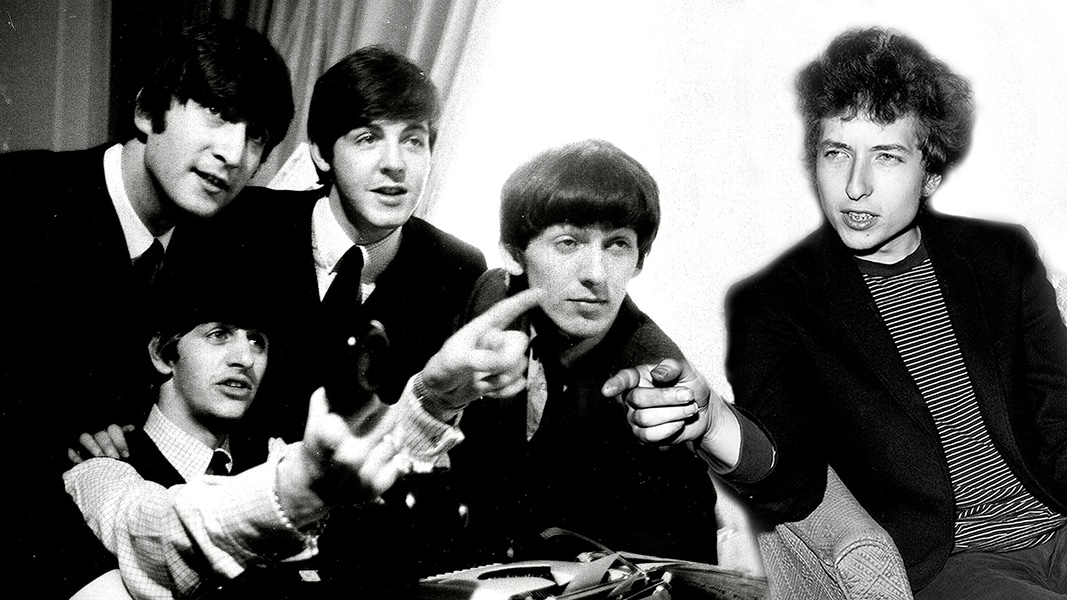
August 28, 1964, 60 years ago: The 1st of the 2 great summits of rock and roll occurs: Bob Dylan meets The Beatles.
Dylan released his 3rd album, The Times They Are a-Changin', on February 10, 1964, the day after The Beatles made their 1st American TV appearance, on The Ed Sullivan Show. Among the songs they played was "I Want to Hold Your Hand," then the Number 1 song in America. The bridge goes as follows:
And when I touch you
I feel happy inside.
It's such a feeling that
my love, I can't hide, I can't hide, I can't hide!
But between the music and their Liverpudlian accents, Dylan thought they were singing, "I get high, I get high, I get high!" Dylan, a marijuana smoker, assumed that The Beatles were potheads, too.
In fact, the Fab Four did get high, many times -- but on amphetamines, pep pills. They used them to stay up all night when they were cutting their teeth in the clubs of the Reeperbahn in Hamburg, Germany before they made it big in their homeland. They had never smoked weed yet. It wasn't popular in Britain yet.
When The Beatles returned to America for their Summer 1964 tour, a meeting was set up between them and the leader of American music's protest movement. The band was staying in a 6th floor suite at the Hotel Delmonico, at 502 Park Avenue at 59th Street. Al Aronowitz, covering the tour for The Saturday Evening Post, was friendly with both the band and Dylan, and brought Dylan in.
Dylan brought joints in with him. He first offered one to Ringo Starr. According to one account, the drummer, "ignorant of dope etiquette, chugged through that first joint like a stevedore attacking his first Woodbine of the morning and collapsed in a giggling mess." Next was their manager, Brian Epstein, who was affected very quickly, saying, "I'm so high, I'm up on the ceiling."
Paul McCartney believed he'd attained true mental clarity for the first time in his life, and instructed Beatles roadie and major-domo Mal Evans to write down everything he said henceforth. Whatever John Lennon and George Harrison said or felt, it appears not to have been recorded.
At one point, the phone rang, and Dylan answered, "This is Beatlemania here!" They drank some wine, and got along great.
The 2nd great summit happened exactly 365 days later, on August 27, 1965: Elvis Presley met The Beatles. It didn't go nearly as well.
The effect that marijuana had on the music of Dylan, and on that of The Beatles, is debatable. The effect that the meeting had on each is undeniable. Dylan "went electric," and, within 2 years, produced 3 albums that are regarded as absolute classics: Bringing It All Back Home, Highway 61 Revisited (including "Like a Rolling Stone"), and Blonde On Blonde.
As for The Beatles, most of the effects of the meeting with Dylan were, by his own admission, on John. Without Dylan, he almost certainly would not have written "I'm a Loser," "I Don't Want to Spoil the Party," "Help!", "You've Got to Hide Your Love Away," "Nowhere Man," "Norwegian Wood," "She Said She Said" and "Tomorrow Never Knows" -- to say nothing of what he did from Sgt. Pepper onward.
In 1988, each in their 1st year of eligibility, Dylan and The Beatles were elected to the Rock and Roll Hall of Fame. That same year, George invited Bob to be in his "supergroup," The Traveling Wilburys, along with Roy Orbison, Tom Petty, and Jeff Lynne of Electric Light Orchestra. In 1992, at the Dylan tribute concert at Madison Square Garden, George sang "If Not For You," not one of Bob's better songs; and "Absolutely Sweet Marie," a good one that he probably wouldn't have written without The Beatles' influence.
Al Aronowitz lived until 2005. Built in 1929, the Delmonico was converted into apartments in 1974. In 2018, it was bought by the Trump Organization, and renamed Trump Park Avenue. Disgusting.
October 16, 1992, 30 years ago: "Bob Dylan: The 30th Anniversary Concert Celebration" is held at Madison Square Garden in New York. Or, as one of the performers, Neil Young, put it, "This one's for you, Bob. Thanks for having Bobfest!" Actually, it was Columbia Records, Dylan's label the whole way, that put the show on.
And what a show it was. It may have been the greatest array of musical talent ever brought together for one show in one building. (Live Aid was 1 show, but in 2 stadiums on 2 continents, and I'm not sure it was a better show, anyway.) The house band consisted of Booker T. & the M.G.'s, with Jim Keltner and World's Most Dangerous Band member Anton Fig filling in for the late Al Jackson Jr. on drums, plus G.E. Smith of the Saturday Night Live Band. Kris Kristofferson, himself one of America's greatest songwriters, was master of ceremonies, and sang "I'll Be Your Baby Tonight."
John Mellencamp kicked it off with perhaps Dylan's greatest song, "Like a Rolling Stone." He also sang "Leopard-Skin Pillbox Hat."
One by one, some serious legends came, each playing a Dylan song or two:
* Stevie Wonder, singing the gospel-inflected version of "Blowin' in the Wind" that he hit with in 1966.
* Lou Reed, "Foot of Pride."
* June Carter and Johnny Cash, "It Ain't Me Babe."
* Willie Nelson, "What Was It You Wanted?"
* Johnny Winter, whose version of "Highway 61" was particularly blistering.
* Ron Wood of the Rolling Stones, "Seven Days."
* Richie Havens, whose acoustic version of "Just Like a Woman" was epic.
* The Clancy Brothers, Greenwich Village folkie contemporaries of Dylan's, singing "When the Ship Comes In" with an Irish brogue.
* Neil Young, who blitzed through "Just Like Tom Thumb's Blues," and made absolutely nobody miss Jimi Hendrix with "All Along the Watchtower."
* Chrissie Hynde of the Pretenders, "I Shall Be Released."
* Eric Clapton, who did "Love Minus Zero"/"No Limit," then totally tore the place up with a bluesy rendition of "Don't Think Twice, It's All Right."
* The O'Jays, "Emotionally Yours."
* The Band, "When I Paint My Masterpiece."
* George Harrison of the Beatles, "If Not For You" and "Absolutely Sweet Marie."
* Tom Petty & the Heartbreakers, "License to Kill" and "Rainy Day Women #12 and 35" (a.k.a. "Everybody Must Get Stoned").
* And Roger McGuinn of the Byrds, "Mr. Tambourine Man."
The younger generation got in on the act, too: Pearl Jam's Eddie Vedder and Mike McCready, with "Masters of War"; Tracy Chapman with "The Times, They Are A-Changin'," and a performance of "You Ain't Going Nowhere" by Mary Chapin Carpenter, Shawn Colvin, and Johnny's daughter (and June's stepdaughter) Roseanne Cash.
Said younger generation included a performer who became the focus of the show's one moment of controversy: Mere days after singing Bob Marley's "War" and tearing up a picture of Pope John Paul II on SNL, Sinead O'Connor tried to sing Dylan's "I Believe in You," but got booed off the stage.
Kristofferson, perhaps anticipating such a reaction, tried to introduce her by saying that, like Dylan, she stood for freedom, including freedom of speech. It was to no avail: Harder than Dylan was at Newport in 1965, she got booed. She walked off and cried on Kristofferson's shoulder, and a microphone picked up him saying to her, "Don't let the bastards get you down."
George Harrison introduced Bob, and the big question everybody had was, "What's Bob going to do?" Not because so many of his great songs had already been done, but because a Bob Dylan show is like a box of chocolates: You never know what you're going to get. Was he going to walk on, wave, and then just walk off? Was he going to say something controversial? Was he not going to be understandable as he sang?
There was no issue with him: He sang, "It's Alright, Ma (I'm Only Bleeding)," he was totally understandable, and he was on his game. In turn, the 6 verses of "My Back Pages" were sung by McGuinn, Petty, Young, Clapton, Dylan and Harrison. Bob closed with "Knockin' on Heaven's Door" and "Girl from the North Country."
I still have most of this concert from the WNEW-FM broadcast. To me, it sounds better than any other recording of it.
March 18, 1846: "Greenland Whale Fisheries," The Pogues.
April 4, 1968: "Pride In the Name of Love," U2 again.
May 1: "First of May," Jonathan Coulton. Also, "First of May," The Bee Gees.
May 5: "I Married Isis On the Fifth Day of May," Bob Dylan. Also, "Cinco de Mayo," Liz Phair. Dylan mentioned "Eastertime" in "Just Like Tom Thumb's Blues," but got no more specific than that, and Easter is on a different day every year.
May 10, 1865: "The Night They Drove Old Dixie Down," The Band.
May 12: "Pinball Song," Slobberbone.
May 19: "I've Known No War," The Who. It's guitarist/songwriter Pete Townshend's birthday.
June 3: "Ode to Billie Joe," Bobbie Gentry: "It was the 3rd of June, another sleepy, dusty Delta day."
June 6: "Convoy," C.W. McCall: "It was the dark of the Moon on the 6th of June... "
June 16: "Breathe," U2 again. June 16 is an important day in Irish culture, because it's the date in 1904 on which James Joyce's novel Ulysses is set, because that's the day Joyce met his wife, Nora Barnacle.
July 4: A bunch of songs. "Jack Straw," The Grateful Dead. "Saturday In the Park," Chicago. "4th of July, Asbury Park (Sandy)," Bruce Springsteen. "4th of July," X.
July 13: "Yell Help," Elton John.
July 15: "St. Swithin's Day," Billy Bragg.
August 1: "On the First Day in August," Carole King.
September 3: "Papa Was a Rollin' Stone," The Temptations: "It was the 3rd of September, that day I'll always remember, yes, I will. 'Cause that was the day that my daddy died."
September 21: "September," Earth, Wind & Fire: "Do you remember the 21st day of September?"
October 31: Lots of songs mention Halloween, including "Spooky" by The Classics IV, but Dusty Springfield's great cover doesn't. Also "Halloween" by Dream Syndicate; "Everyday Is Halloween" by Ministry"; and "The New Style," Beastie Boys.
November 5: "Remember," John Lennon, invoking the story of Guy Fawkes and the Gunpowder Plot of 1605.
November 22, 1963: "The Day John Kennedy Died" by Lou Reed, and "Life In a Northern Town" by The Dream Academy. Although his song "We Didn't Start the Fire" doesn't mention any specific dates, Billy Joel alludes to several events, including the JFK Assassination.
Thanksgiving falls on a different day every year, between November 22 and 28. Not many songs mention it. By far the best-known one is "Alice's Restaurant" by Arlo Guthrie.
December 8, 1980: Not quite, but Paul Simon cites the murder of John Lennon "On a cold December evening," in "The Late Great Johnny Ace," which also mentions the deaths of JFK and the R&B singer Johnny Ace, which happened on Christmas Day, December 25, 1954.
December 21: "How to Make Gravy," Paul Kelly, an Australian singer. I had never heard of him before soliciting ideas for this post. Great song. His fans call the date "Gravy Day."
December 25: Probably the best-known song not specifically a Christmas song to mention "Christmas Day" is "Levon" by Elton John.
December 26: "St. Stephen's Day Murders," The Chieftains, with guest lead vocal by Elvis Costello.
December 31: "What Are You Doing New Year's Eve?" Margaret Whiting.
Can you think of any others? Let me know in the comments.
May 24, 1941, 80 years ago: Robert Allen Zimmerman is born in Duluth, Minnesota, and grows up in Hibbing, Minnesota, also the birthplace of baseball legend Roger Maris, and the hometown of basketball legend Kevin McHale.
Bob Dylan, his character, was born in Minneapolis sometime in September 1959 in Minneapolis. Ah, but he was so much older then. He’s younger than that now.
He hasn't always been a good guy. He hasn't always been a great artist, either. Like anybody else -- Satchmo, Sinatra, Elvis, the Beatles, Jacko, etc. -- he's had some clunkers. In the end, it doesn't matter a damn.
Top 10 Bob Dylan Songs
These are in chronological order, by date of recording. What Bob recorded from July 9, 1962 to March 10, 1966 stands up with just about anybody's entire output, ever. It makes us forget that what he did after that, especially from late 1967 to 1975, would be enough to make most songwriters a legend.
Honorable Mention: "Don't Think Twice, It's All Right," November 14, 1962; "A Hard Rain's a-Gonna Fall," December 6, 1962; "Masters of War," April 24, 1963; "With God On Our Side," August 7, 1963; "It's Alright Ma (I'm Only Bleeding)," January 15, 1965; "Highway 61 Revisited," August 2, 1965; "Just Like Tom Thumb's Blues" (a.k.a. "When You're Lost In the Rain In Juarez"), August 2, 1965; 8. "Just Like a Woman," March 8, 1966; "Rainy Day Women No. 12 & 35" (a.k.a. "Everybody Must Get Stoned"), March 10, 1966; "All Along the Watchtower," November 9, 1967; "Lay Lady Lay," February 14, 1969; "Forever Young," November 1, 1973; "Jokerman," April 14, 1983.
1. "Blowin' in the Wind," July 9, 1962.
2. "When the Ship Comes In," October 23, 1963.
3. "The Times, They Are a-Changin'," October 24, 1963.
4. "My Back Pages," a.k.a. "I Was So Much Older Then," June 9, 1964.
5. "Subterranean Homesick Blues," a.k.a. "Johnny's In the Basement," January 14, 1965.
6. "Like a Rolling Stone," June 16, 1965.
7. "Stuck Inside of Mobile with the Memphis Blues Again," February 17, 1966.
8. "I Shall Be Released," September 24, 1971.
9. "Knockin' On Heaven's Door," February 1, 1973.
10. "Tangled Up In Blue," December 30, 1974.
I am aware that Bob wrote "Catfish," about Oakland Athletics and New York Yankees pitcher Jim Hunter. It's good. It's not one of his Top 10. It's not even one of his Top 50. That's how good he is.
Honorable Mention: "Don't Think Twice, It's All Right," November 14, 1962; "A Hard Rain's a-Gonna Fall," December 6, 1962; "Masters of War," April 24, 1963; "With God On Our Side," August 7, 1963; "It's Alright Ma (I'm Only Bleeding)," January 15, 1965; "Highway 61 Revisited," August 2, 1965; "Just Like Tom Thumb's Blues" (a.k.a. "When You're Lost In the Rain In Juarez"), August 2, 1965; 8. "Just Like a Woman," March 8, 1966; "Rainy Day Women No. 12 & 35" (a.k.a. "Everybody Must Get Stoned"), March 10, 1966; "All Along the Watchtower," November 9, 1967; "Lay Lady Lay," February 14, 1969; "Forever Young," November 1, 1973; "Jokerman," April 14, 1983.
And, of course, a lot of Bob's songs, especially his early ones, were covered, and done better, by other performers:
* "Blowin' in the Wind" was a hit in 1963 for Peter, Paul & Mary, and in 1966 for Stevie Wonder. Stevie sang it at the 30th Anniversary tribute concert that Columbia Records held for Bob at Madison Square Garden on October 16, 1992 -- or, as Neil Young called it, "Bobfest."
* "When the Ship Comes In" was a song he sang publicly even before recording it, at the March On Washington, August 28, 1963. The best version is by The Clancy Brothers, Irish accents and all, and they sang it at the Garden concert.
* "My Back Pages" was a hit for The Byrds in 1965, as was "Mr. Tambourine Man." On the former, The Byrds cut the 3rd and 4th of the 6 verses. At the Garden concert, after Byrds lead singer Roger McGuinn sang "Mr. Tambourine Man," "My Back Pages" was sung by, in order on the verses: McGuinn, Tom Petty, Neil Young, Eric Clapton, Dylan himself, and George Harrison.
* "I Shall Be Released" was recorded by The Band 4 years before Bob recorded it himself. They sang it together at The Band's farewell concert at the Winterland Ballroom in San Francisco, on Thanksgiving Night, November 25, 1976. It was filmed for Martin Scorcese's film The Last Waltz. Chrissie Hynde of The Pretenders sang it at the Garden concert.
Dylan is one of those performers where, if you get 25 people together and ask them what their favorite song of his is, you could get 25 different answers. That's how far he has reached -- even if every distance is not near.
The 2018 Major League Baseball season is underway. If you were hoping that the New York Yankees were going to use the long ball to win games this season, the first of your hopes have been realized. If you were hoping the Yankees were going to get good pitching, that hope also saw some realization.
The Yankees opened by starting a 4-game series against the Toronto Blue Jays, at the Rogers Centre (formerly named the SkyDome). Luis Severino got the start, and walked 2 batters in the 1st inning, but settled down, allowing just 1 hit until the 6th.
With 1 out, he walked Josh Donaldson, and then struck out Justin Smoak. It looked like the walk would be no big deal, and he could continue. He had thrown 91 pitches, but had done very well.
Unfortunately, Aaron Boone, in his 1st game as a major league manager, handled the situation exactly the way that Joe Girardi would have, and took the side of the pitch count, rather than that of the actual performance.
This was, potentially, a very stupid move. If you're concerned that he's thrown too many pitches, why wait until the batter after a walk to take him out? I don't care what the handedness of either the pitcher or the batter is: Unless the pitcher is injured, you never take him out after he's gotten an out!
With his 1st pitching change, Boone brought in Chad Green, and he struck former Yankee Curtis Granderson out to end the inning. Green faced 4 batters and got them all out.
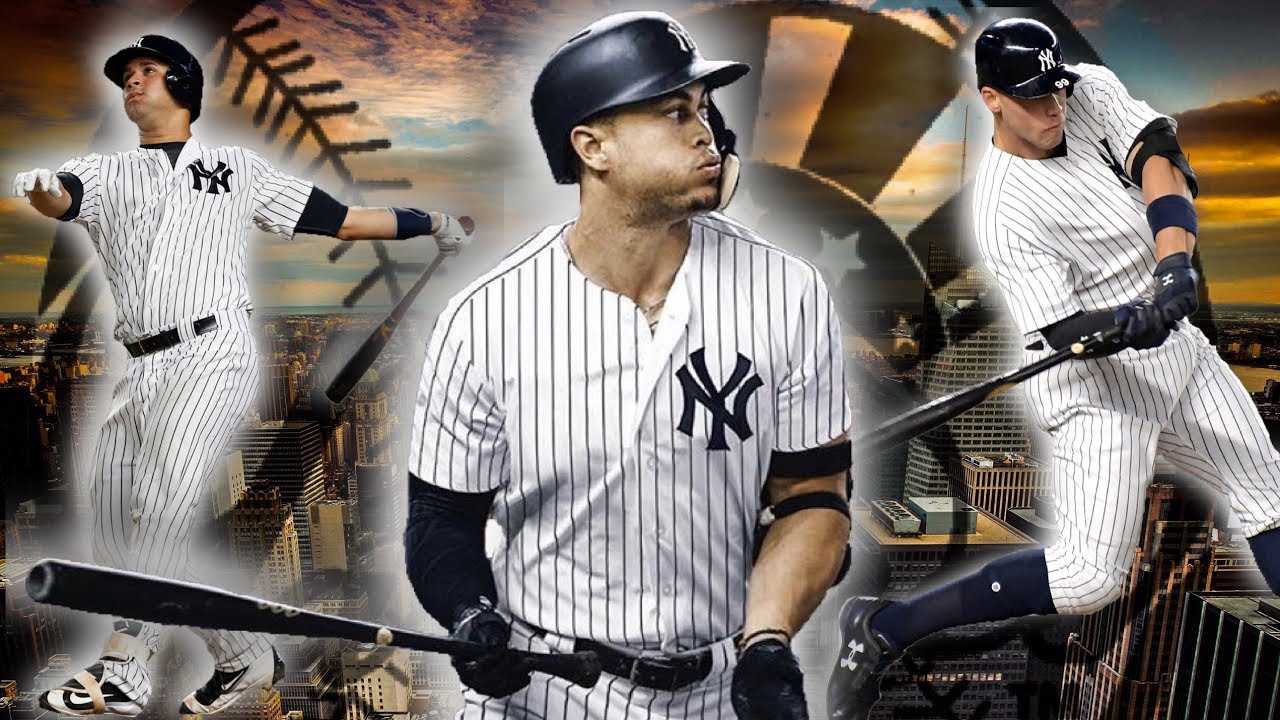
As for the Yankee bats: They did what we had been led to believe they would do. Brett Gardner led off the season by reaching 1st base on an error. Aaron Judge struck out, and up came the big new acquisition, Giancarlo Stanton. In his 1st at-bat as a Yankee -- his 1st at-bat in the American League -- he hit a long drive to right-center field, the opposite field. Home run. 2-0 Yankees.
That would be all the Yankees would need. But, to quote a Bob Dylan song, "Your debutante knows what you need, but I know what you want!" With 2 out in the top of the 5th, Judge drew a walk, and was followed by back-to-back doubles by Stanton and Gary Sanchez. Gardner led off the 7th with a home run. 5-0.
Boone brought Dellin Betances in to pitch the 8th. His 1st pitch was to Kevin Pillar, who hit it out. Until then, the Jays had a grand total of 1 hit. Fortunately, Betances got through the inning with no further damage.
Equally fortunately, Tyler Clippard came into the game -- for the Jays. He got Gardner and Judge out without looking sharp. Then he faced Stanton, who drove a missile to straightaway center field. 434 feet.
So far, the hype seems justified. As they would say in English soccer, Stanton was Man of the Match. The 1st home run was cake; the 2nd, icing -- delicious icing.
Aroldis Chapman needed all of 10 pitches to get through the 9th inning. Ballgame over, Yankees win -- Theeeeeeee Yankees win! First time in a game that counts since October 20, 2017.
Yankees 6, Blue Jays 1. WP: Severino (1-0). No save. LP: J.A. Happ (0-1). For Aaron Boone, his 1st game as a major league manager is a win.
The Baltimore Orioles and Tampa Bay Rays also started the season with wins. The Boston Red Sox, with a nasty loss against Tampa Bay, in which they blew a 4-0 lead. They didn't blow a lead of 2 or more runs all last season.
August 15, 1965, 50
years ago today: The Beatles open their 2nd full North American tour, at
Shea Stadium, home of Major League Baseball's New York Mets and the American Football League's New York Jets. On hand is a full house of 55,600 fans – probably the largest audience ever
assembled, to that point, for any concert, anywhere -- mostly screaming teenage girls. Ticket price: $5.75 -- about $43.36 in today's money.
The stage was set at 2nd base, far from any of the 55,000 fans. And the sound system wasn't good, as the singing and music mixed with the screaming to produce a dull sound that was far below the standards the Beatles had already set with the albums they'd recorded to that point: Please Please Me, With the Beatles, Beatles for Sale, and the soundtracks to the films A Hard Day's Night and the newly-released Help!
But you can't blame
the Mets, or the City of New York which owned the stadium, for that. At that
point, nobody knew how to stage a rock concert in an outdoor stadium. So John Lennon, Paul McCartney, George Harrison and Ringo Starr -- who, for all they had already achieved, were still rather young men, between the ages of 22 (George) and 25 (Ringo) -- did the best they could, as can be seen and heard on the concert's color film.
It is the 8th sellout that the Flushing Meadow amphitheater has had since the Mets
opened it on April 17, 1964. The Jets had only sold it out once in their inaugural season (a loss to the Buffalo Bills on November 8, 1964), the Mets 6 times -- and the stadium's opener wasn't one of them. All were against the former New York teams: 4 against the Los Angeles Dodgers, 2 against the San Francisco Giants. And 3 of those 6 were doubleheaders, not single games. (The Beatles didn't sell Shea out on their 1966
return, getting only about 40,000 fans.)
The last concert at Shea, in 2008, was hosted by Billy Joel, and he
invited Paul McCartney onstage with him. The 1st concert at its replacement,
Citi Field, was hosted by Paul, and he returned the favor and invited Billy.
*
In 1964, '65 and '66,
the Beatles gave a total of 66 performances in North America, at 45 separate
venues. For the moment, 50 years later, 23 of them still stand. They are, in alphabetical order by metropolitan area:
* Convention Hall in Atlantic City, now Boardwalk
Hall, which had hosted the Democratic National Convention the week before, and had nominated President Lyndon B. Johnson for a full term.
* The Baltimore Civic Center, home of the NBA's Baltimore Bullets. The Bullets moved to Washington in 1973, and the arena is now the Royal Farms Arena.
* Suffolk Downs Racetrack in Boston.
* Cincinnati Gardens, home of the NBA's Cincinnati Royals. They moved in 1972, and are now the Sacramento Kings.
* Public Auditorium in
Cleveland.
* The Dallas Memorial Auditorium, later home of the ABA's Dallas Chaparrals, the team that became the NBA's San Antonio Spurs.
* Red Rocks Amphitheatre in Morrison, Colorado, outside
Denver.
* The Indiana State Fairgrounds Coliseum in Indianapolis, later to be the 1st home of the ABA/NBA's Indiana Pacers.
* The Hollywood
Bowl and
* Dodger Stadium in Los Angeles.
* The ballroom of the Deauville Hotel in Miami, where they played for their 2nd Ed Sullivan Show appearance.
* The
Milwaukee Exposition and Convention Center Arena, a.k.a. the MECCA, formerly the home of the NBA's Milwaukee Hawks (by that point in St. Louis, and now in Atlanta), and later the home of the Milwaukee Bucks (who have since moved across the street). This area is now named the UW-Milwaukee Panther Arena.
* The
Montreal Forum, then the home of the NHL's Montreal Canadiens.
* City Park Stadium in New Orleans, a high school football stadium, now named Tad Gormley Stadium in New Orleans.
* The newly-opened Memorial Coliseum in Portland, Oregon.
* The Grand National Livestock Pavilion in Daly City, California, outside San Francisco, a.k.a. the Cow Palace, then home of the NBA's San Francisco Warriors, who've called themselves the Golden State Warriors since moving to Oakland. The 1975 and 2015 NBA Champions are moving back to San Francisco for the 2017-18 season, but appear to be keeping the Golden State name. The Cow Palace was also the 1st home of the NHL's San Jose Sharks.
* Maple Leaf
Gardens in Toronto, then the home of the NHL's Toronto Maple Leafs.
* The Washington Coliseum and
* District of Columbia Stadium in Washington, D.C. The former had previously hosted the NBA's Washington Capitols, was a mainstay of minor-league hockey, and would later host the NHL's Washington Caps. Now it is commuter parking for the nearby Union Station. The latter was renamed Robert F. Kennedy Stadium, and was then the home of MLB's Washington Senators and the NFL's Washington Redskins. It now hosts only MLS' D.C. United.
* And, in New York, CBS Studio 50 (now
the Ed Sullivan Theater)...
* Carnegie Hall and...
* The Paramount Theater in Midtown Manhattan, and...
* Forest Hills Stadium in Queens.
While the Paramount's and the Montreal Forum's structures still stand, both
have had their interiors drastically altered, so that they can no longer stage
sporting events or concerts.
Of these 23 buildings, the Baltimore arena and RFK Stadium are
the only ones that, barring a disaster, might not still be standing on the 60th Anniversary of the Beatles' tours in 2024-26. (UPDATE: The Cincinnati Gardens has since been demolished.) No longer standing
are:
* The newly-opened Atlanta Stadium, soon to be home to MLB's Atlanta Braves and the NFL's Atlanta Falcons, later renamed Atlanta-Fulton County Stadium.
* The Boston Garden, home of the NBA's Boston Celtics and the NHL's Boston Bruins.
* The International Amphitheatre and
* Comiskey Park in Chicago. The former hosted several teams briefly but is best known as the site of several political conventions, including the infamous Democratic Convention of 1968. The latter was the longtime home of MLB's Chicago White Sox and the NFL's Cardinals before they moved, now in Arizona.
* Crosley Field in
Cincinnati, home of MLB's Cincinnati Reds.
* Cleveland Municipal Stadium, home of MLB's Cleveland Indians and the NFL's Cleveland Browns.
* The Olympia Stadium in Detroit, home of the NHL's Detroit Red Wings and the 1st home in Detroit for the NBA's Pistons.
* The
Sam Houston Coliseum in Houston, home to several minor-league basketball and hockey teams, eventually the home of the World Hockey Association's Houston Aeros.
* The Gator Bowl in Jacksonville, home of the postseason college football game of the same name. The home of the NFL's Jacksonville Jaguars, currently named EverBank Field, was built on the site, incorporating some of the former stadium.
* Kansas City
Municipal Stadium, home of MLB's Kansas City Athletics and the AFL's Kansas City Chiefs.
* The arena that was part of the otherwise-remaining Las Vegas
Convention Center, which would soon host the Heavyweight Championship fight between champion Muhammad Ali and former champion Floyd Patterson.
* The Mid-South Coliseum in Memphis, later home to the ABA's Memphis Tams.
* Metropolitan Stadium in Bloomington, Minnesota, outside Minneapolis, home of MLB's Minnesota Twins and the NFL's Minnesota Vikings.
* Shea Stadium.
* The Convention Hall of the Philadelphia
Civic Center, home of the NBA's Philadelphia 76ers and formerly the Warriors before they moved to San Francisco.
* John F. Kennedy Stadium, formerly Sesquicentennial Stadium and Philadelphia Municipal Stadium, home of the Army-Navy Game and a few stray home games by the NFL's Philadelphia Eagles.
* The Civic Arena in
Pittsburgh, home of the minor-league hockey team the Pittsburgh Hornets and soon the NHL's Pittsburgh Penguins.
* The original Balboa Stadium in San Diego, home of the AFL's San Diego Chargers.
* The Seattle Center
Coliseum, soon to be home of the NBA's Seattle SuperSonics.
* The 1966 version of Busch Stadium in St. Louis, home of both the MLB and the NFL versions of the St. Louis Cardinals.
* The original Empire
Stadium in Vancouver, home of the Canadian Football League's British Columbia Lions.
* And, its demolition in progress at this writing, Candlestick Park
in San Francisco, site of their last concert on August 29, 1966, home of MLB's San Francisco Giants and later the NFL's San Francisco 49ers.
Of the 45 buildings in North America that hosted Beatles concerts, I've
been inside 9: Carnegie Hall, Forest Hills, Shea, the Philadelphia Civic
Center, Boardwalk Hall, the Montreal Forum, the Boston Garden, RFK Stadium and
Comiskey Park. Just 5 of those remain: Carnegie, Forest Hills, Boardwalk Hall,
the Montreal Forum and RFK.
There were 18
buildings that hosted both an Elvis Presley concert and a Beatles concert. Now
gone are: The Boston Garden, the International Amphitheatre in Chicago, the
Olympia Stadium in Detroit, the Sam Houston Coliseum, the Mid-South Coliseum in Elvis' hometown of Memphis, the
Pittsburgh Civic Arena, the Seattle Center Coliseum and the old Empire Stadium in Vancouver.
The 10 that remain
are: The Baltimore Civic Center/Royal Farms Arena, Cincinnati Gardens, the
Cleveland Public Auditorium, the Dallas Memorial Auditorium, the Indiana State
Fairgrounds, the Milwaukee Arena, the Portland Memorial Coliseum, the Cow
Palace, Maple Leaf Gardens, and, of course, the Ed Sullivan Theater.
The only 1 of the 18 that I have ever been inside was the now-demolished Boston Garden. Of the 10 that are left, I've been
outside 5 of them – Royal Farms Arena, Public Auditorium, Milwaukee Arena,
Maple Leaf Gardens and the Sullivan – but inside none.
*
New York's Top 10 Rock Concerts
These are in chronological order. Notice I am not counting TV show appearances, such as either Elvis or the Beatles on The Ed Sullivan Show.
Nor am I counting pre-rock shows, although the October 12, 1944 Frank Sinatra show at the Paramount, besieged by bobby-soxers, that became known as the Columbus Day Riot, could count. Certainly, it was a major New York event.
Nor am I counting jazz shows, such as Miles Davis' many appearances at Birdland in the 1950s, or John Coltrane at the Village Vanguard in 1961 when he debuted his improvised reworking of "My Favorite Things."
Nor am I counting Marilyn Monroe singing "Happy Birthday" to President John F. Kennedy at the old Garden in 1962.
0. August 15, 1965, Shea Stadium, Flushing Meadow, Queens: The Beatles. No, the sound wasn't great then, and the recording isn't great now, but it was a landmark. So I'm giving it the Number Zero. (It's my blog, and I can make whatever rules I want.)
Warmup acts included Brenda Holloway (a Motown singer whose hits included the original versions of "Every Little Bit Hurts" and "You've Made Me So Very Happy"), saxophone legend King Curtis, and a vocal group named Sounds Incorporated, all backed by The Discotheque Dancers.
Honorable Mention: Other big shows at Shea included The Clash and The Who on October 12 and 13, 1982 (that's how big The Who were: The Clash, already a major band, opened for them), The Police on August 18, 1983, a double bill of Elton John and Eric Clapton on August 20, 1992, and Billy Joel's "Last Play at Shea" on July 16 and 18, 2008.
1. August 1, 1971, Madison Square Garden, Midtown Manhattan: The Concert for Bangladesh. Ex-Beatle George Harrison and his close friend, Indian sitar icon Ravi Shankar (whom your generation might know as singer Norah Jones' father), organized it after hearing of the plight of refugees from the Bangladesh Liberation War and a devastating cyclone.
(The country, then as now one of the poorest in the world, had gained its independence from Pakistan, having previously been known as East Pakistan, separated from Pakistan proper by India.)
There were actually 2 shows that Sunday, both filmed for a documentary: At 2:30 in the afternoon and 8:00 at night. It was George's 1st full concert since the Beatles' last tour, 5 years earlier. His band included, among others, Ringo, Eric Clapton (who did the show despite being ill), Billy Preston, Klaus Voormann, Leon Russell and Jim Keltner.
Shankar played with his group. Also on the bill: Bob Dylan, in his 1st full show since his motorcycle wreck 5 years earlier, and the British band Badfinger.
Harrison, Dylan, Russell
This spectacle stamped The Garden as the most important concert venue in the New York Tri-State Area, in a way that the Nassau Coliseum, the Meadowlands Arena, and the baseball and football stadiums could never be.
While the 1925-68 "old Garden" never hosted a rock and roll show, the "new Garden" (which has now lasted longer than any of its predecessors) remains the place. An act that comes to New York and doesn't play The Garden either isn't big enough to do so, or is brash enough to think that only the Meadowlands stadium can hold him/her/them.
2. June 9, 1972, The Garden: Elvis Presley. In his book Only the Good Die Young, about dead rock stars and how they got that way, Robert Duncan recalled attending this concert at age 18 with his older brother. The brother was an Elvis fan. Robert was not. He wrote, "I was once in the same room with Elvis Presley. The year was 1972. The room, however, was Madison Square Garden... But I was once in the same room with Elvis, and that's what matters, isn't it?"
(He went on to savage Elvis, repeating in brief some of the seamier allegations about him. Duncan was clearly a Sixties Guy, a Beatles Person, not a Fifties Guy, an Elvis Person. He also said he met Janis Joplin: It was 1968, he was 14, and he saw her in a vintage clothing shop in Greenwich Village, and she smiled at him, which was more than Elvis did for him.)
Elvis did 4 shows that week, his only full concerts in New York City. He did a few TV appearances in Manhattan in 1956 and '57, and played the Nassau Coliseum after this, but never gave a concert in New Jersey, and never gave another within the 5 Boroughs.
The last one, on June 9, was filmed. It's not his best work, but his voice is strong, he was in good shape, and it was Elvis in New York. If it was anybody else, I wouldn't consider putting this one in the Top 10. But what Robert Duncan wrote with sarcasm, I write with conviction: It was Elvis in New York, and that's what matters, isn't it?
3. August 30, 1972: The Garden: The One-to-One Concert. Another ex-Beatle, this time John. (Paul doesn't appear on this list as a headliner, even though he's given more shows in New York after the breakup than the other 3 Beatles combined.)
This show was done at the request of TV journalist Geraldo Rivera, who'd befriended John and done an exposé on the treatment of children with mental disabilities at the state-run Willowbrook State School on Staten Island. John called Geraldo (not the other way around, as I previously thought), and recommended a benefit concert. John swallowed his differences with Paul and invited him, and Paul almost accepted, but, understandably, he didn't want Allen Klein involved. John did, and Paul backed out.
As with the Concert for Bangladesh, it was actually 2 shows in 1 day, both sold out. John was preceded onstage by doo-wop tribute group Sha Na Na, Roberta Flack and Stevie Wonder. John was backed by his wife Yoko Ono, Frank Zappa's Mothers of Invention (then including Mark Volman and Howard Kaylan from The Turtles), and Elephant's Memory, with whom he'd recorded the album Some Time in New York City over the previous Winter.
The concert was filmed, and became the live album Live in New York City. He played only his solo work, aside from 1 Beatle song: "Come Together." Film of these performances was combined, by one enterprising Beatle fan, with footage of George and Ringo in the Concert for Bangladesh and Paul's Wings Over America tour in 1976, to create a video for the song, which the Beatles never made together -- nearly creating an "alternate history" in which the Fab Four hadn't broken up in 1970.
Sadly, the history we know says that this was John's last full concert, anywhere.
Dishonorable Mention. July 27, 28 and 29, 1973, The Garden: The Song Remains the Same. I am not a big Led Zeppelin fan. The concert film of the same title, released on October 20, 1976, didn't change that.
In my opinion, that film was one of the most damaging things ever to happen to rock and roll. It made every hard rock singer and musician on the planet want to copy Led Zeppelin. Not just the music. Indeed, the music seemed to be the least important thing to them. They thought it was all about having big, long hair, open shirts, screeching like a maniac, prancing around onstage, playing your instrument as loud as possible (never mind playing it as well as possible), drinking like a fish, smoking like a chimney, screwing like a rabbit, acting like an ass, paying lip-service (and maybe more) to the occult, and, oh yeah, lots and lots of cocaine.
One member of Led Zeppelin, drummer John Bonham, died in 1980 from mixing booze and drugs. The other 3? Lead singer Robert Plant, guitarist Jimmy Page, and bassist John Paul Jones? They're still alive, but have you seen them lately? They look like they died 35 years ago, too!
4. November 28, 1974, The Garden: Thanksgiving with Elton. On Thanksgiving night, close to the height of his musical talent, fame and charisma, Elton John rocked The World's Most Famous Arena with considerable gusto. But that, by itself, wouldn't have put this concert on the list.
At the end of the show, Elton brought on a special guest. He had made a bet with John Lennon that if John's song "Whatever Gets You Through the Night," on which Elton had sung backup, hit Number 1 in the U.S., John would join him for this show. It did. John kept his word, and the audience, totally unaware, gave the building its greatest ovation ever, with the possible exception of when Willis Reed limped out for pregame warmups before Game 7 of the 1970 NBA Finals.
Together, the Walrus and the Rocket Man played 3 songs: "Whatever Gets You Through the Night," Elton's reworking of John's Beatle classic "Lucy in the Sky with Diamonds," and a song John introduced as being "by an old friend named Paul": "I Saw Her Standing There."
Those 3 songs -- possibly the inspiration for Lorne Michaels' never-accepted (except by George alone) invitation for the Beatles to reunite for 3 songs, getting paid $3,000, on Saturday Night Live in 1976 -- made this show a legend. That, and it was John's last concert appearance of any kind.
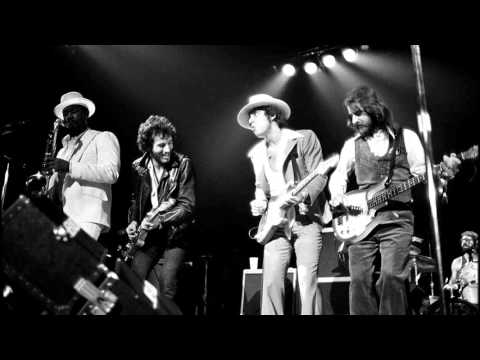
5. August 15, 1975, 40 years ago today, the Bottom Line, Greenwich Village, Manhattan: Bruce Springsteen & the E Street Band. Up until this night, Bruce was a cult act, as U2 and R.E.M. would be in the early 1980s: Those who knew his music couldn't get enough of it, but not enough people knew it.
From August 13 to 17, for 5 nights, 2 shows a night, the E Streeters would support the August 25 release of their album Born to Run by playing the 400-seat Village venue, which was then a year old and would close in 2004, and have the concerts broadcast live on WNEW-FM, New York's biggest rock station at the time.
The rest is history. In late October, Bruce would be on the covers of Time and Newsweek at the same time -- a rare feat for a non-politician. And, 40 years later, Born to Run is still one of the most beloved albums of all time, even though it only has 8 songs (but running over 42 minutes), including the title track, which is one of the top 10 rock and roll recordings ever made -- and Bruce isn't even a great singer!
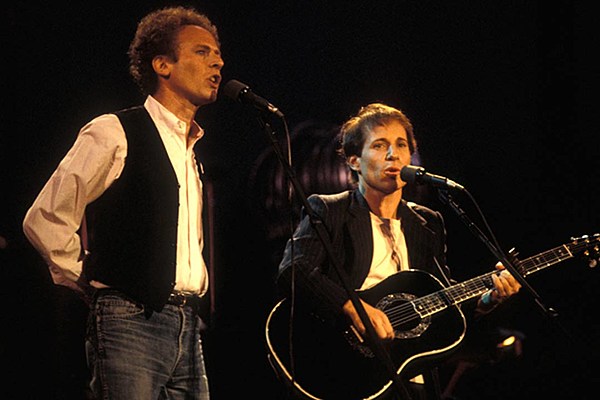
6. September 19, 1981, The Great Lawn, Manhattan: The Concert in Central Park. Half a million middle-aged Baby Boomers flocked to the Park, then in a rough period, to see Paul Simon and Art Garfunkel.
Paul & Artie hadn't toured together in 11 years, and hadn't sung together in public since an early Saturday Night Live in 1975. They opened with "Mrs. Robinson," and sang several of their other hits, plus Paul solo hits like "Me and Julio Down by the Schoolyard" and "Kodachrome." They also sang covers of songs from their youth: The Everly Brothers' "Wake Up Little Susie" and Chuck Berry's "Maybellene." And a good time was had by all -- even the performers.
They went on tour together in 1982, but broke up again during recording sessions for what became Paul's solo album Hearts and Bones. Paul, alone, would give another performance before 500,000 fans in the Park on August 15, 1991 -- again, today is the anniversary.
Diana Ross would also give a big concert in the Park, drenched by rain, on July 21, 1983. So would Luciano Pavarotti -- minus rain -- on June 26, 1993.
7. June 22, 1990, Yankee Stadium, The Bronx: Billy Joel. The big ballyard in The Bronx had the occasional music festival and postgame concert, but not until 1990 did a single performer headline there without a game. Billy, born in The Bronx and raised on Long Island, was the first. (The place was also sold out the day before, for a rally by Nelson Mandela.)
As it turned out, The Stadium was a pretty good concert venue, every bit as good as Shea, as would later be proven by U2, and by Pink Floyd for a reunion performance of The Wall (which was also done, more appropriately, at Fenway Park in Boston.) As usual, Billy opened with his keyboard-hammering "Prelude/Angry Young Man," and closed with "Piano Man."
Needless to say, he got big cheers during "We Didn't Start the Fire" when he mentioned Joe DiMaggio and Mickey Mantle, and even Brooklyn Dodger legend Roy Campanella -- and when he flipped the bird at the line, "California baseball," showing that there were still locals ticked off at the Dodgers moving to Los Angeles and the baseball Giants to San Francisco. The weird part was seeing Billy not sitting at the piano, but standing and playing guitar on that song and "A Matter of Trust."
8. October 16, 1992, The Garden: Bob Dylan: The 30th Anniversary Concert Celebration. Or, as one of the performers, Neil Young, put it, "This one's for you, Bob. Thanks for having Bobfest!" Actually, it was Columbia Records, Dylan's label the whole way, that put the show on.
And what a show it was. It may have been the greatest array of musical talent ever brought together for one show in one building. (Live Aid was 1 show, but in 2 stadiums on 2 continents, and I'm not sure it was a better show, anyway.) The house band consisted of Booker T. & the M.G.'s, with Jim Keltner and World's Most Dangerous Band member Anton Fig filling in for the late Al Jackson Jr. on drums, plus G.E. Smith of the Saturday Night Live Band. Kris Kristofferson, himself one of America's greatest songwriters, was master of ceremonies.
John Mellencamp kicked it off with perhaps Dylan's greatest song, "Like a Rolling Stone." One by one, some serious legends came, each playing a Dylan song or two: Stevie Wonder (singing the gospel-inflected version of "Blowin' in the Wind" that he hit with in 1966), Lou Reed, June Carter and Johnny Cash, Willie Nelson, Johnny Winter (whose version of "Highway 61" was particularly blistering), Ron Wood of the Rolling Stones, Richie Havens (whose acoustic version of "Just Like a Woman" was epic), the Clancy Brothers (Village folkie contemporaries of Dylan's, singing "When the Ship Comes In" with an Irish brogue), Neil Young (who blitzed through "Just Like Tom Thumb's Blues" and made absolutely nobody miss Jimi Hendrix with "All Along the Watchtower"), Chrissie Hynde of the Pretenders, Eric Clapton (who totally tore the place up with a bluesy rendition of "Don't Think Twice, It's All Right"), the O'Jays, The Band, George Harrison, Tom Petty & the Heartbreakers, and Roger McGuinn of the Byrds.
The younger generation got in on the act, too: Pearl Jam's Eddie Vedder and Mike McCready, Tracy Chapman, and a performance of "You Ain't Going Nowhere" by Mary Chapin Carpenter, Shawn Colvin, and Johnny's daughter (and June's stepdaughter) Roseanne Cash.
Said younger generation included a performer who became the focus of the show's one moment of controversy: Mere days after singing Bob Marley's "War" and tearing up a picture of Pope John Paul II on SNL, Sinead O'Connor tried to sing Dylan's "I Believe in You," but got booed off the stage. Kristofferson, perhaps anticipating such a reaction, tried to introduce her by saying that, like Dylan, she stood for freedom, including freedom of speech. It was to no avail: Harder than Dylan was at Newport in 1965, she got booed. She walked off and cried on Kristofferson's shoulder, and a microphone picked up him saying to her, "Don't let the bastards get you down."
George Harrison introduced Bob, and the big question everybody had was, "What's Bob going to do?" Not because so many of his great songs had already been done, but because a Bob Dylan show is like a box of chocolates: You never know what you're going to get. Was he going to say something controversial? Was he not going to be understandable as he sang?
There was no issue with him: He sang, "It's Alright, Ma (I'm Only Bleeding)," and he was totally understandable, and he was on his game. In turn, the 6 verses of "My Back Pages" were sung by McGuinn, Petty, Young, Clapton, Dylan and Harrison. Bob closed with "Knockin' on Heaven's Door" and "Girl from the North Country."
Wood, Harrison, Cash, McGuinn, Dylan
I still have most of this concert from the WNEW-FM broadcast. To me, it sounds better than any other recording of it.
9. October 20, 2001, The Garden: The Concert for New York City. Played just 6 weeks after the 9/11 attacks, emotions were still running deep. Most of the audience was cops, firemen, rescue workers, and people who had lost family members in the attacks, many of them holding up photos of the victims.
Every act was introduced by a non-singing celebrity: Billy Crystal (MC), Mark Wahlberg, Susan Sarandon, Harrison Ford, Christy Turlington, Edward Burns, Meg Ryan, David Spade, Jim Carrey, Mike Myers, Howard Stern, Julia Stiles, Jerry Seinfeld, Michael J. Fox, Hilary Swank. Leonardo DiCaprio and Robert DeNiro introduced a short film by Martin Scorcese, Halle Berry one by Spike Lee, John Cusack one by Woody Allen, Jon Bon Jovi doing one for New Jersey with one by Kevin Smith.
Comedy routines were done by Crystal, Adam Sandler as his SNL character Operaman, Jimmy Fallon, and Will Ferrell in character as George W. Bush. The real Bush didn't show up, but there were speeches by real politicians: Former President Bill Clinton, Senator Hillary Clinton, Governor George Pataki, Mayor Rudy Giuliani, and Senate Majority Leader Tom Daschle.
The big thing, of course, was the music. David Bowie, accompanied only by himself on bongos, opened the show with Simon & Garfunkel's "America," then did his own "Heroes" with a full band.
Bon Jovi, Jay-Z, Goo Goo Dolls, Destiny's Child (including Beyoncé), Eric Clapton & Buddy Guy, the Backstreet Boys, Macy Gray, James Taylor, John Mellencamp & Kid Rock, Five For Fighting, and Janet Jackson. (The last big musical event in The City before the attacks had also been at The Garden, a 30th Anniversary tribute to her brother Michael.)
Billy Joel was a little bit of a problem. He showed up drunk, and went into rehab not long thereafter. Of course, he played "New York State of Mind." But first, he played "Miami 2017." On September 10, 2001, it looked like the apocalypse he'd predicted for The City in 1976 had been prevented. But on the 11th, it came far too close to reality: "I watched the mighty skyline fall" -- although it was the World Trade Center, not the Empire State Building, that he saw "laid low." He later joined Elton John, who had played his New Yorker-themed "Mona Lisas and Mad Hatters," for a performance of Elton's "Your Song."
"A bottle of white, a bottle of red... "
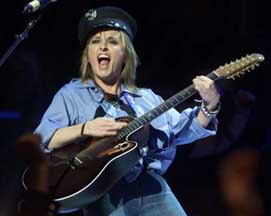
Melissa Etheridge's microphone went out during her acoustic performance of "Come to My Window," but everybody was singing along anyway, and none of those hard-edged, blue-collar cops and firemen gave a damn that she was openly gay. Her mike went out again as she did an acoustic version of Springsteen's "Born to Run" -- and nobody flinched as she sang lines of love and passion to a woman named Wendy.
"Just wrap your legs 'round these velvet rims
and strap your hands 'cross my engines!"
Mick Jagger and Keith Richards of the Rolling Stones sang "Salt of the Earth" and "Miss You" (with its reference to walking through Central Park in the '70s). When they were done, Mick said, "If there's one thing we've learned from all this, it's that you don't fuck with New York!" True.
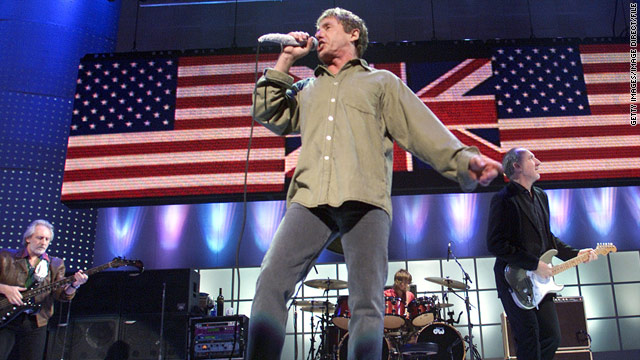
The Who came out, with Ringo Starr's son Zak Starkey filling in on drums for the late Keith Moon, and it turned out to be bass player John Entwistle's last performance. They did a nasty "Who Are You," an intense "Baba O'Riley," a melancholy "Behind Blue Eyes," and a roaring "Won't Get Fooled Again." Billy Crystal said, "I'd never seen The Who live before. It was great to see these middle-aged men get out on stage and kick ass."
With Elvis dead and unavailable, it was appropriate that the show closed with a surviving Beatle, Paul McCartney, who played, among others, "Yesterday," his new song "Freedom," and "Let It Be." (George had cancer, and died within weeks.)
Honorable Mention: September 20, 2005, The Garden: From the Big Apple to the Big Easy. This wasn't one of the better ones, but it was one of the most important. When New York was attacked by a force of man, virtually every major city in the world stepped up to help, including New Orleans. When New Orleans was attacked by a force of nature 4 years later, virtually every major city in the world stepped up to help, including New York.
About $9 million was raised, including for charities involving 4 different Presidents: The Bush Clinton Katrina Fund, and Jimmy Carter's much-needed down there house-building and house-restoring Habitat for Humanity.
The list of performers wasn't as big as for 9/11 and Hurricane Sandy, but there were some big ones. A star since 1957, Clarence "Frogman" Henry took his funny novelty song and made it massively relevant to the Crescent City's situation: "Ain't Got No Home."
He was one of several New Orleans-based (or, at least, Louisiana-based) performers that also included Dave Bartholomew (bandleader for Fats Domino, who for 2 days was missing and thought lost in the hurricane), Allen Toussaint, the Dixie Cups, Irma Thomas, the Neville Brothers, Buckwheat Zydeco, and the Meters. From outside New Orleans came Elton John, John Fogerty, Bette Midler, Elvis Costello and his wife Diana Krall, Jimmy Buffett, Ry Cooder, Lenny Kravitz, and a rare Simon & Garfunkel reunion.
10. December 12, 2012, The Garden: 12-12-12: The Concert for Sandy Relief. When Hurricane Katrina wrecked New Orleans on August 29, 2005, a fundraising concert was held at MSG. When Hurricane Sandy pounded New York and New Jersey on October 29, 2012, a fundraising concert at MSG was inevitable.
"I don't care what consequence it brings.
I have been a fool for lesser things."
As with the Concert for New York City, there were nonsinging celebrities on hand. Returning from that show were Crystal, Sarandon, Sandler, Shaffer and Fallon. Among the musical performers who had also been at the CFNYC were McCartney, Jagger and Richards (who brought the rest of the current Stones lineup with them), The Who's Roger Daltrey and Pete Townsend, Joel, Clapton, Bon Jovi and Vedder.
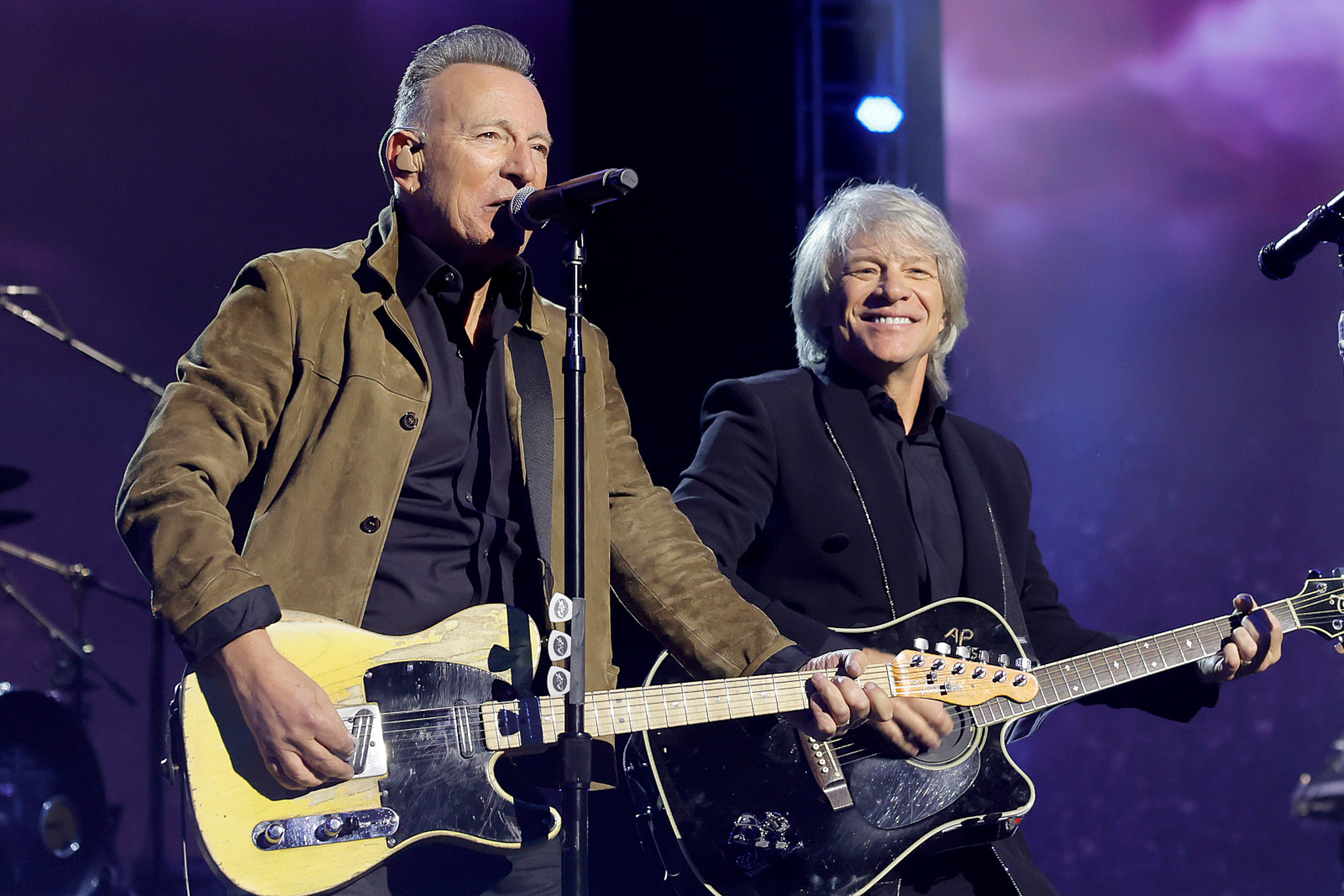
"Sprung from cages on Highway 9":
Freehold's Bruce and Sayreville's Jon
New to this show were Springsteen -- one of the few bills he's ever shared with Joel -- Roger Waters of Pink Floyd, Alicia Keys, Kanye West, Chris Martin of Coldplay; and nonmusical personalities Brian Williams, Ben Stiller, Whoopi Goldberg, Kristen Stewart, Jon Stewart (no relation), not Bill or Hillary but Chelsea Clinton, Stephen Colbert, Sean "Diddy" Combs, Olivia Wilde, Steve Buscemi, Joe Pantoliano, James Gandolfini, Chris Rock, Seth Meyers, Bobby Moynihan, Jake Gyllenhaal, Patricia Farrell, Blake Lively, Katie Holmes, Jason Sudeikis, and Quentin Tarantino and his Django Unchained stars Jamie Foxx and Christoph Waltz.
Central New Jersey, where men are men, and the women also root for the Yankees., United States
Born in North Jersey. Raised in Central Jersey. Yankee Fan and Rutgers fan since 1977. Devils fan since they arrived in 1982. Arsenal fan since 2008. Former Nets fan, now an NBA free agent. No NFL team. Single, interested in changing that status. No children, but uncle to two teenage girl athletes and one in the making. Liberal Democrat and damn proud of it. Hopefully, in sports as well as politics, I can live up to the words of the late John Spencer on "The West Wing": "We are going to raise the level of debate in this country, and let that be our legacy."




_(52246124397)_(cropped).jpg/960px-DylanYoungKilkenny140719v2_(50_of_52)_(52246124397)_(cropped).jpg)





:max_bytes(150000):strip_icc()/gettyimages-92810551-2000-312156db025e470d995ce55afdb4d71d.jpg)