Showing posts with label bernard malamud. Show all posts

Wednesday, May 11, 2016

Top 10 Things Wrong With "The Natural"

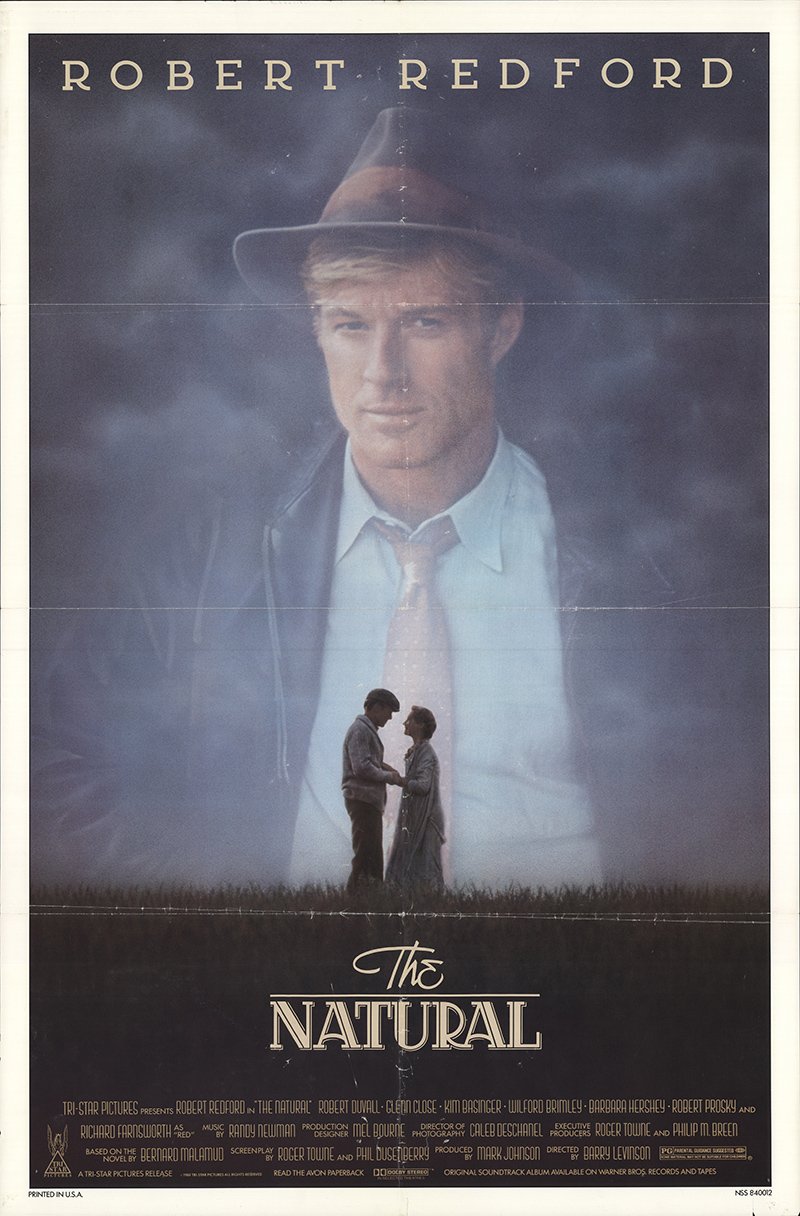
May 11, 1984: The film version of Bernard Malamud's baseball-themed 1952 novel The Natural premieres, starring Robert Redford, Glenn Close, Kim Basinger, Barbara Hershey, Robert Duvall, Joe Don Baker, Wilford Brimley, Red Farnsworth, Darrin McGavin and Robert Prosky.

Is it the best baseball movie ever? Maybe. Certainly, it's the one with the best photography (thanks to director Barry Levinson), and the one with the best music (thanks to Randy Newman).

It's not perfect, though. And I don't mean that it's corny or sappy.

Top 10 Things Wrong With The Natural

And, no, I'm not going to cite the changes in baseball history -- the New York Knights taking the place of the New York Giants, but having a history more like that of the Brooklyn Dodgers; and George "Babe" Ruth, lefty slugger, becoming George "the Whammer" Wambold, righty slugger. Whatever was true within the world of the movie that isn't true in ours doesn't matter. What matters is things that, even within the context of the movie, don't make sense.

1. Why does the story never explain what happened to Roy in the intervening 16 years? We only get a brief, mumbled, skipping-ahead explanation from Roy to Iris on the Chicago roadtrip, and we don't really hear the details. We never find out.

I checked the book: It doesn't explain what happened in the interim, either.

2. When we last saw Roy, in 1923, he was a pitching prospect. When we next see him, in 1939, he's a right fielder, and, as Pop Fisher later says, "the best goddamned hitter I ever saw." Okay, Roy can hit. But why did he stop pitching? Certainly, the '39 Knights could have used another good pitcher.

3. Pop isn't just the manager of the Knights, he's half-owner of the club. I'm presuming that he's also the general manager. Are you telling me that his chief scout didn't tell him about Roy? Are you telling me that the Judge, the other half-owner, didn't tell him that he was signing Roy? Don't both half-owners have to sign the contract to make it official? Roy did say, "I got a contract." And Pop did say, "I wanna see it." How has he not seen it yet?

4. Max Mercy is not stupid. He heard the name "Roy Hobbs" at that county fair in 1923, and saw Roy strike out "The Whammer," the Babe Ruth analogue, the greatest player in baseball at the time, on 3 pitches.

This would be a national story, as it was in real life when 17-year-old girl Jackie Mitchell, pitching in a 1931 exhibition game for the minor-league Chattanooga Lookouts, struck out the real Ruth and Lou Gehrig.

So when Max hears Roy's name again in 1939, does he really not remember? He knows the name and the face are familiar, that he knows Roy from somewhere. How hard would it be to go back into his personal records and check? He does do it some time later, so he could have done it earlier. But he didn't.

Indeed, a good reporter would wonder why Roy never showed up for his tryout with the Chicago Cubs -- the very reason he was on that train. A good reporter would find out what happened. If Bernard Malamud were paying attention to his characters, Max might well have made Roy his special project, trying to get him back to a chance at the majors, and he'd probably get back a lot sooner than 1939. Look at the stories surrounding the comebacks of Rick Ankiel -- a pitcher-turned-outfielder -- and Josh Hamilton.

5. Why does Bump Bailey die? He crashes into an outfield fence that is made of wood. Not concrete, wood. He might have a concussion, but he wouldn't be killed. Not unless there was a broken bottle that he fell on behind the fence, and he fell on it, and bled out. Or if he hit his head on something hard there. But hitting his head against a wooden fence shouldn't have been enough to do it.

6. Roy is not stupid. And, by age 35, he certainly is not naive. Does he really need Iris' note during the Playoff game to tell him that her son is his son? He couldn't figure it out based on their conversation back in her Chicago apartment?

7. The silver bullet is removed from Roy's stomach after the party at Memo's apartment in late September 1939. He was shot with it by Harriet in the Summer of 1923.

Removing a bullet from a human body is tricky now, and it was trickier then, before the common availability of antibiotics. Had there been a resulting infection, it could have proven more dangerous than the bullet, as Presidents James Garfield and William McKinley found out. But it was very possible. Why wasn't it removed when he was first shot?

8. Why would the playoff game be held at night? In real life, no postseason game, or playoff for a Pennant, was held at night until 1971.

I realize that Levinson wanted that great shot of the light standards shooting out and raining sparks down on the field. But he went so far out of his way to make the film look historically accurate, down to the red & black stitching on the baseballs, the advertising signs, and the 1839-1939 Baseball Centennial patches on the left sleeves of the uniforms. So why this one wrong detail? Why the playoff game at night?

9. A home run ball destroying a scoreboard clock? That did happen in a major league game once. A home run ball knocking out the power of a light standard? That's never happened, although Reggie Jackson hit the transformer on one at the 1971 All-Star Game in Detroit, so, theoretically, it's possible.

Both of these occurrences happening at some point (or rather, at a pair of points) in Major League Baseball history? I can buy that. But both of them happening to the same player, within a few weeks of each other? I can accept a little suspension of disbelief, but, in the immortal words of the great New York sportscaster Warner Wolf, "Come on, give me a break!"

10. Why do the lights go out one by one? Either only the one that Roy's drive broke should go out (if they're connected in parallel), or they all should (if they're connected in series), and then only in that one standard, not every light standard in the ballpark.

Even if you believe that a ball could be hit that high and that far (the right field pole was listed as 310 feet from home plate, so we may be talking 400 or so feet from the plate where the light standard was, so it's far-fetched, but not a crazy idea), the way the lights went out is scientifically ridiculous.

Saturday, April 26, 2014

Bernard Malamud at 100: Why He Had Roy Strike Out... and Why the Movie Didn't

April 26, 1914, 100 years ago: Bernard Malamud is born in Brooklyn. "All men are Jews, though few men know it."

Although it was his novel The Fixer (not about sports, but about anti-Semitism in Czarist Russia) that won him the Pulitzer Prize, it's The Natural for which he is best known.

He wanted to tell the story of King Arthur as a baseball player. The symbolism is hard to miss, from the team being called the Knights to Roy's bat Wonderboy standing in for Arthur's sword Excalibur.

And (SPOILER ALERT), just as Arthur lost in the end, so, too, did Roy Hobbs fall -- due, in large part, to his own failings.

But when the movie was made, they couldn't have Roy -- certainly couldn't have Robert Redford -- strike out in the end.

The Top 5 Reasons You Can't Blame Bernard Malamud For Having Roy Hobbs Strike Out

5. The Source Material. Although King Arthur is held up as an exemplar of kinghood, knighthood and chivalry, nearly every version of his story (the 2004 film King Arthur starring Clive Owen is a notable exception) has Arthur dying at the Battle of Camlann, and his kingdom of Camelot falling.

4. Ernest Thayer. Although there isn't much relationship to the Arthurian legend, Thayer was the first person to put the failure of an admired baseball player into popular culture, in his poem Casey at the Bat, in 1888:

Oh, somewhere in this favored land, the sun is shining bright.
And somewhere, bands are playing; and somewhere, hearts are light.
And somewhere, men are laughing; and somewhere, children shout.
But there is no joy in Mudville: Mighty Casey has struck out!

3. His Mother's Suicide. Bertha Malamud attempted suicide in 1927, when Bernard was just 13, and she never recovered from the effects, dying 2 years later. If she had lived, he would have been a very different person, with perhaps a different outlook on life.

2. The Brooklyn Dodgers. Malamud grew up in Brooklyn, and while the Dodgers won Pennants in 1916 and 1920, and finished 2nd in 1924 (when he was 2, 6 and 10 years old, respectively), for most of his youth, they were terrible. On the field, they were incompetent, often laughably so, nicknamed "the Daffiness Boys" before they were known as "Dem Bums" -- the true precursors of the original, early 1960s Mets.

Off the field, they were financially strapped, often on the edge of bankruptcy. That's how Walter O'Malley came to own a part of the Dodgers, before he became sole owner: He was the man the Brooklyn Trust Company, a bank that saved them from ruin, put in charge of their 1/4 share. It was between him and a younger lawyer named William Shea -- the same Bill Shea who later led the effort to replace the Dodgers and Giants with the Mets, and was honored with their stadium being named for him.

The Dodgers' money troubles were reflected in the fact that the New York Knights were owned by manager Pop Fisher, but he had to sell half a share to "The Judge" to keep the team afloat in the Great Depression. But it's also reflected in the fact that, while the Dodgers exist in the world of The Natural, the New York Giants don't: The Dodgers' already-old, storied rivals are replaced by the luckless Knights. A little bit of payback from Brooklyn to Manhattan, I suppose.

1. Failure Is More Remembered Than Success. We remember Fred Merkle for his "Boner," but do you remember the name of the player who made the play? You might have to think about it before you come up with the name of Johnny Evers. Ralph Branca is as famous as Bobby Thomson. True, many books have been written about the Yankees, but at least as many are written about the Red Sox, the Cubs, and the Brooklyn edition of the Dodgers.

As Roger Kahn wrote in the ultimate Brooklyn Dodger book, The Boys of Summer:

You may glory in a team triumphant, but you fall in love with a team in defeat. Losing after great striving is the story of man, who was born to sorrow, whose sweetest songs tell of saddest thought, and who, if he is a hero, does nothing in life as becomingly as leaving it.

Or, as his contemporary, but a Giants fan instead, Roger Angell, put it, "There's much more losing than winning in life."

"Life is a tragedy full of joy," Malamud has been quoted as saying.

*

Ah, but...

The Top 5 Reasons You Can't Blame the Film Version of The Natural For Having Roy Hobbs Hit a Home Run

5. Strikeouts Are Boring. In 1952, at the peak of his fame as an actor, Ronald Reagan played Hall of Fame pitcher Grover Cleveland Alexander in The Winning Team. In the 1926 World Series, pitching for the St. Louis Cardinals, Alexander struck out Tony Lazzeri of the Yankees, the most famous strikeout in baseball history. This event was the climax of the movie.

But while a game-ending strikeout (not that Alexander's was, there were 2 more innings to go) can be exciting in person, it's just not the same in a movie, and The Winning Team isn't as well-remembered as some other baseball films. Indeed, had Reagan not gone on to become President -- or had an actor who didn't go on to become President been cast instead -- the movie might be forgotten entirely by people who aren't Cardinal fans.

As Kevin Costner said to Tim Robbins in Bull Durham: "Don't try to strike everybody out. Strikeouts are boring! Besides that, they're fascist. Throw some ground balls. It's more democratic." Translation: Strikeouts are all about the pitcher throwing them, all about the overpowering executive; while ground balls require involving your teammates.

4. Chicks Dig the Long Ball. Since it was Redford, one of Hollywood's biggest heartthrobs, The Natural was one of the first baseball movies that seemed sure to bring in women as much as men. And women wanted Roy to win, because he was played by Redford. And he did win.

Speaking of whom...

3. Robert Redford. Yeah, he was too old to play 19-year-old Roy -- hell, at 47 at the time of filming, he was too old to play 35-year-old Roy. But he is one of Hollywood's biggest heroes. And, just as Elvis Presley had it written into his contract that he could never die in a movie again, after his fans were so upset to see him do so in his debut, Love Me Tender, Redford had already died at the end of Butch Cassidy & the Sundance Kid, and nobody wanted to see their beloved Bob Redford fail again.

2. The Magic of Hollywood. Everybody loves a happy ending. We go to the movies to see the good guys win and the bad guys lose.

Except for those Dark Hipsters who think the best Star Wars movie is The Empire Strikes Back (the film ends with the Empire unquestionably on top). These are people who root for the Witch in The Wizard of Oz, for Barzini in The Godfather, for the government in E.T. No, these people can, in the words of the old Giants shortstop Alvin Dark, "Take a hike, son."

1. America Loves a Winner. Simple as that, baby. Besides, the movie was not only released in the Reagan years, 1984, but took place during FDR's New Deal, 1939. In each case, it was a time for triumphs. Had it taken place in, say, 1975, when inflation was out of control, a President had recently resigned due to being a crook, our international prestige was waning, and our cities were burning pits of crime and being told by the new President to "Drop dead," it might have been, literally, a different story.


*
So what did Malamud think of the movie? He did live long enough to see it (he died in 1986), and his daughter, writer Janna Malamud Smith, said on one of the DVD extras for the film that her father had seen it, and his take on it was that it had "legitimized him as a writer."

He understood: "Without heroes, we would all be plain people, and wouldn't know how far we can go."