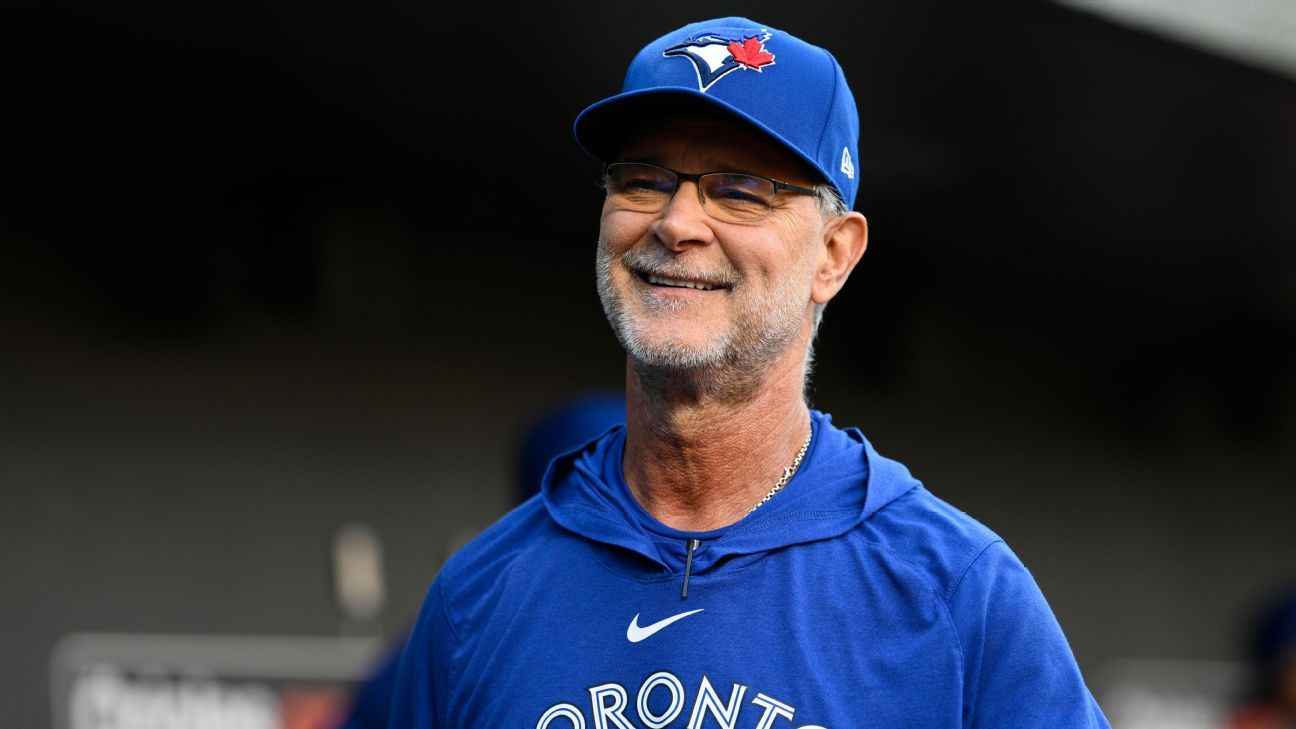
Don Mattingly first wore a uniform in Major League Baseball on September 8, 1982. On October 20, 2025 -- 43 years, 1 month and 12 days later -- a team that had him in uniform won a Pennant. This was the 1st time it had ever happened.
This is an adaptation of the last time I wrote about this phenomenon, on his 60th Birthday:
Donald Arthur Mattingly was born on April 20, 1961, in Evansville, Indiana. He is a reasonably intelligent man. He is, as far as I can tell, a man of sterling character. And, from 1984 to 1989, he might well have been the best baseball player on the planet.
By any measure, he is one of the most admired, and one of the most admirable, people associated with baseball in the last 50 years. He's also one of the least strange people involved in a frequently strange sport.
But he's had one of the strangest careers in baseball history. Here's a short list of some of the bizarre events for which he's been on the field, or at least in the dugout:
* July 4, 1983: Dave Righetti pitching a no-hitter on the 4th of July, ending it by striking out Wade Boggs, the most disciplined hitter of the 1980s and '90s.
* July 24, 1983: The Pine Tar Game. George Brett hits a home run to give the Kansas City Royals a 5-4 lead. The Yankees protest, saying Brett used pine tar on his bat, beyond the legal limit. The umpires agree, and Brett is called out, ending the game as a 4-3 Yankee win. But for perhaps the only time in baseball history, a League President -- Lee MacPhail, a former Yankee general manager and the son of a former Yankee part-owner -- overrules his own umpires, and rules that the game must continue.
* August 18, 1983: The game is resumed, and Yankee manager Billy Martin protests by putting Mattingly at 2nd base, making him by far the most recent lefthanded thrower to play the position. He also puts pitcher Ron Guidry in center field. The Royals hold on to win.
* September 12, 1985: "Baseball Thursday in New York," highlighted by both New York teams playing at home and beating the teams with whom they were fighting for their respective Division titles, and lowlighted by Yankee fans booing "O, Canada." (Notice that, this time, I do not capitalize the F. On this occasions, "Yankee Fans" did not deserve it.)
* October 6, 1985: Phil Niekro, who knuckleballed his way to 299 wins, winning his 300th without throwing the knuckler until the final batter, and getting a complete-game shutout at age 46.
* October 5, 1986: Possibly getting cheated out of a batting title when Wade Boggs sits out the final series.
* June 11, 1988: Martin bats Rick Rhoden, a pitcher, 7th as the designated hitter due to an injury crisis, and it works, as Rhoden drives in a run with a sacrifice fly, and the Yankees beat the Baltimore Orioles 8-6.
* July 21, 1988: The Yankees trade Jay Buhner for Ken Phelps.
* July 1, 1990: Andy Hawkins pitches a no-hitter, and loses.
* July 30, 1990: George Steinbrenner is banned from baseball for life. (He is reinstated for the 1993 season.)
* July 25, 1993: Yankees come from 8-0 down in the 2nd inning to walk off 9-8 winners.
* September 4, 1993: Jim Abbott pitches a no-hitter. With one hand.
* October 4, 1995: The Jim Leyritz Game.
* October 7, 1995: The Edgar Martinez Game.
* October 8, 1995: The day that saved baseball in the Northwest. Also Mattingly's last game as a player.
* July 1, 2004: The John Flaherty Game.
* July 24, 2004: Jason Varitek decides to have a bitch fight with Alex Rodriguez. (And remember, Mattingly wasn't there for the madness of the 2003 ALCS.)
* October 17-20, 2004: The big cheat-aided choke, including the A-Rod Slap Play.
* April 14, 2005: The Gary Sheffield incident at Fenway.
* October 7, 2006: Joe Torre bats Alex Rodriguez 8th in a win-or-go-home game. Because he'd earned it. It didn't work.
* October 5, 2007: The Bug Game.
* October 15, 2008 and October 21, 2009: On hand for 2 Pennant clinchers by a Philadelphia baseball team. There haven't been many people, outside of Phillies employees and fans, who've been able to truthfully claim that since 1931.
* October 12, 2013: Clayton Kershaw starts a postseason game, allows no earned runs and only 2 hits, and loses. That had never happened before.
* October 18, 2013: Kershaw, supposedly the best pitcher in baseball, gets rocked with 4 runs in the 3rd inning and 5 in the 5th.
* October 10, 2015: The Chase Utley incident with Ruben Tejada.
* October 15, 2015: The Daniel Murphy Game.
* September 25, 2016: Now the manager of the Miami Marlins, he has to manage them without their best pitcher, as José Fernández is killed in a drunken boating crash.
* August 11, 2017: Former Yankee Derek Jeter buys the Marlins, and forces one of that team's occasional "fire sales."
* December 11, 2017: Jeter trades Mattingly's best hitter, Giancarlo Stanton, to the Yankees for All-Star 2nd baseman Starlin Castro and 2 minor leaguers. At the time, it seemed like a joke, as if the Yankees had totally fleeced the Marlins. But within 3 years, the Marlins were back in the Playoffs, and the Yankees had failed to win a Pennant, in part because of Stanton's injuries and postseason struggles (at least, in 2018 and '19). It would take until 2024 for Stanton -- or for anyone else, for that matter -- to help the Yankees win a Pennant.
* October 8, 2020: Mattingly managed the Marlins to the COVID-expanded Playoffs, and they won the 1st round against the Chicago Cubs, before getting swept in the NLDS by the Atlanta Braves. They had never lost a postseason series before. They had only made the postseason as Wild Cards in 1997 and 2003, but won the World Series both times.
* October 3 and 4, 2023: Having been hired as bench coach by the Toronto Blue Jays, he was with them as they lost the American League Wild Card Series to the Minnesota Twins, two games to none, despite the Jays having home-field advantage for both games. The Twins hadn't won a postseason round in 21 years. They had been in 9 rounds since then, and lost them all. They hadn't even won a postseason game in 19 years. And yet, the Jays lost 2 home games to them.
From 1941 to 1988, counting all National League Pennants won by teams in whatever cities in which they've played, the Dodgers won 16 Pennants, the Cardinals 10, the Reds 5; 3 each were won by the Mets, the Phillies, the New York/San Francisco Giants, the Pittsburgh Pirates, and the Boston/Milwaukee Braves; and 1 each by the Chicago Cubs and the San Diego Padres; while the Milwaukee Brewers won a Pennant in the American League before being switched to the National, and the Montreal Expos, forerunners of the Washington Nationals, didn't win any.
From 1989 to 2016, including Mattingly's tenure as a coach 2008-10 and their manager 2011-15,
National League Pennants were won as follows: Giants 5, the Atlanta edition of the Braves 5, Cardinals 4, Phillies 3, 2 each by the Mets and the Florida (now Miami) Marlins; and 1 each by the Reds, Padres, Diamondbacks, Astros (now in the AL), Colorado Rockies and Cubs -- keeping in mind that, in 1988, the Marlins, Rockies and D-backs didn't even exist yet. Of all teams in the NL, the only ones that have failed to win a Pennant in that time were the Pirates, Brewers, Expos/Nationals... and Dodgers.
*
But it is as a Yankee player that Don Mattingly is best remembered. He gets called a "Yankee Legend." I put that in quotation marks because, to be a Yankee Legend, you have to have at least won a Pennant. This allows Bobby Murcer and Dave Winfield to qualify.
Don Mattingly is not a Yankee Legend. He is a curse.
I have often said that I don't believe in curses, jinxes and ghosts... except when it comes to sports. I did not invent the concept of the Curse of Donnie Baseball. I am merely the prophet who brings its dark word to the nonbelievers, whether they like it or not.
As far as I know, I am the first person ever to write about it publicly. I even created a Wikipedia entry for it. I put it up in 2005, but it's long since been taken down. I guess the Wikimedia guys didn't think there was enough evidence for it. But a few scraps of it survive, cited by others who think there might be such a Curse.
There is a Cult of St. Donald Arthur of Evansville. You can go to Yankee Stadium and spew forth the vilest of imprecations at Derek Jeter, Mariano Rivera, even at the imperfect saint that is Thurman Munson. But say that Don Mattingly is not all that Yankee Fans claim him to be, and you will be subjected to the kind of abuse that usually only occurs, in this country without the intensity of club soccer hatreds, between college football fans during Rivalry Week.
Yankee broadcaster Michael Kay is the high priest of this cult. On a number of occasions, he has said of Mattingly, "He might be the most beloved athlete in the history of New York sports."
Kay is usually smart, but this is the dumbest thing I've ever heard a sportscaster say. Has he never heard of Babe Ruth? Lou Gehrig? Joe DiMaggio? Mickey Mantle? Yogi Berra? Bobby Murcer (who, unlike Mattingly, at least won a Pennant in Pinstripes)? Thurman Munson? Reggie Jackson? Derek Jeter? Bernie Williams? Paul O'Neill? Mariano Rivera?
And that's just on the Yankees. What about Tom Seaver? Dwight Gooden? Jackie Robinson? Duke Snider? Gil Hodges? Willie Mays? John McGraw? Christy Mathewson? Mel Ott? Buck Ewing?
And that's just from baseball. What about Frank Gifford? Lawrence Taylor? Joe Namath? Walt Frazier? Patrick Ewing? Frank Boucher? Eddie Giacomin? Rod Gilbert? Mike Bossy? Denis Potvin? Mark Messier (though it pains me to admit it)? Brian Leetch? Martin Brodeur?
Most Yankee Fans, inside or outside of the Cult of St. Donald Arthur, don't know about the Curse. Those who do know about it tend to refuse to admit that it exists, for it means that Don Mattingly, their idol while growing up in the Eighties and Nineties, is a gigantic jinx.
*
Donald Arthur Mattingly, of Evansville, Indiana, now 64 years of age, was a very talented baseball player. From 1984 to 1989, he was arguably the best player in the game. Then a back injury struck. He decided to retire after the 1995 season – well, sort of: He announced he would take 1996 off, and then decide whether to resume playing; ultimately, he decided not to.
Between the ages of 23 and 28, he was wonderful; from 29 to 34, he was a hard-working, courageous player still capable of the occasional moment of greatness. He was, and remains, respected around the game. A contemporary, Kirby Puckett, observed him taking extra batting practice, and gave him the nickname "Donnie Baseball." It seemed to fit. He was Captain of the Yankees.
At 35, he was done. That's not a tragedy, but it is unfortunate.
At 43, he returned to baseball as a coach. From then until 48, he was a postseason fixture. At 52, 53, 54 and 59, he managed a team into the postseason.
But the record is clear: Don Mattingly is a loser, and any team that employs him is doomed to failure.
*
Facts can be interpreted any way you want, but their truths cannot be denied:
1979: The Yankees drafted Mattingly out of high school. He played for the Oneonta Yankees, in the New York-Penn League, "short season Class A." They won the Pennant.
1980: Mattingly was promoted to full season Class A, to the Greensboro Yankees of the South Atlantic League. They won the Pennant. Mattingly has never won another.
1981: The Yankees won the American League Pennant. This was their 4th Pennant, and their 5th postseason berth, in the last 6 seasons. Mattingly played the entire season for the Nashville Sounds, in the Class AA Southern League. They had won the Pennant in 1979, and would again in 1982. But not in 1981, with Mattingly.
1982: Mattingly played most of the season with the Yankees' top farm team, the Columbus Clippers, in Class AAA. They had won the last 3 International League Pennants: 1979, 1980 and 1981. But not in 1982.
The Yankees called Mattingly up on September 6. He played his 1st game on September 8, a 10-5 win over the Baltimore Orioles at Yankee Stadium. Mattingly was a defensive replacement in left field, and did not bat. The Yankees finished 6th, winning only 79 games. True, they were well out of the race well before this, so the fact of Mattingly's September callup, at age 21, near the end of a wasted season, is hardly enough on which to base an indictment. But the evidence continues.
1983: Again, Mattingly began the season with the Clippers. Again, they didn't win the Pennant. He was called up to the big club for good, and had his 1st season of being more than a look-see at the end. The Yankees finished 3rd. No shame in that, as the Baltimore Orioles ran away with the AL Eastern Division and won the World Series.
1984: Mattingly won the American League batting title with a .343 average, the highest for a Yankee in 27 years. Teammate Dave Winfield was right behind him at .340. Mattingly had also become a spectacularly-fielding 1st baseman.
Just as in the 1950s, when New York baseball fans debated who was the best center fielder (Mickey Mantle of the Yankees, Willie Mays of the Giants or Duke Snider of the Dodgers) or the best shortstop (Phil Rizzuto of the Yankees or Pee Wee Reese of the Dodgers), by this point, they were debating who was the best first baseman, Mattingly or Keith Hernandez of the Mets.
The Yankees finished 3rd, as the Detroit Tigers ran away with the Division and won the World Series. So far, no reason to suspect Mattingly of anything; after all, this was only his 1st full season with the team.
1985: Mattingly put together a season that earned him the AL Most Valuable Player award. The Yankees had their best season between 1981 and 1996, and their 97 wins was the most they would get between 1980 and 1998. But it wasn't enough, as the Toronto Blue Jays clinched against them on the next-to-last day of the regular season. Still no big deal: Plenty of players fall short in their 1st attempt at a real Pennant race.
1986: Mattingly set a Yankee record (which still has not been broken) with 238 hits in a season. But the Yankees finished 2nd again, 5½ games behind the hated Boston Red Sox. Finishing 2nd to the Red Sox is never a good thing. But the Yanks had a lot of pitching problems the last 2 seasons. One more good starter in either would have made a world of difference.
1987: Mattingly had a streak of hitting home runs in 8 consecutive games, tying a major league record. He also hit 6 grand slams in the season, setting a new record. (Each of those records has since been tied, but not broken.) But the Yankees finished 4th, 9 games behind the Tigers. Can't blame Mattingly for that: The Yankees had injuries, and particularly damaging were those to Willie Randolph and, to a lesser extent, Winfield.
1988: Another terrific year for Mattingly, but the Yankees finished 5th. Fifth! And it was the Red Sox winning the Division again! True, the Yankees were only 3½ games behind in a wild race that saw the first 4 teams (Boston, Detroit, Toronto and the Milwaukee Brewers) all within 2 games.
But this was the 4th straight season in which the Yanks were close late, and didn't win. That had never happened before: Usually, the Yankees would either win the Pennant (or, from 1976 onward, the Division), or finish well behind the leaders. Of the 31 seasons in which the Yankees did not win the Pennant between their 1st Pennant in 1921 and 1984, they were still in the race in mid-September in only 7 of them. Now they'd had 4 straight close calls, and nothing to show for them.
As Darth Vader would have said if he'd been a baseball fan, "I find your lack of postseason play disturbing."
But is that fair? I looked up the stats. Before September 11 became associated with the World Trade Center attacks, that date in 1985 was the date on which Pete Rose officially broke the all-time hits record, and it was also the date in that year when the Yankees went into a nosedive that cost them the AL East title.
So I decided to look at Mattingly's stats from that date onward in the 4 seasons in question:
* 1985: 30 hits in 100 at-bats, a batting average of exactly .300, 7 home runs, 22 runs batted in, 3 errors.
* 1986: 40-for-98, a whopping .408, 4 homers, 19 RBIs, no errors.
* 1987: 27-for-93, .290, 6 homers, 25 RBIs, 1 error.
* 1988: 27-for-87, .310, 4 homers, 11 RBIs, 2 errors.
Overall, in the 91 biggest games of his life to that point, Mattingly went 124-for-378, exactly .300, with 21 home runs, 77 RBIs and 6 errors. At a 162-game pace, 37 homers, 137 RBIs and 11 errors-- or, roughly, what he did throughout 1985.
It sounds like he did all he could during those stretches. Still, the Yankees should have at least won the Division in at least one of those seasons, right?
1989: Another very good year for Mattingly, but the Yankees collapsed. Hardly any pitching. Winfield missed the entire season with a back injury. Another injury forced Ron Guidry to retire without appearing once in the season.The most frustrating decade in team history is over. Can Mattingly be blamed? Surely not. All the evidence seen so far is merely circumstantial. Right? Right? Well, read on:
1990, 1991, 1992: The beginning of Mattingly's Captaincy, and all awful years for the Yankees, including what remains their only last-place finish in the last 55 years. They can't see contention with binoculars. And Mattingly's injuries rendered him pretty much useless. A great career appeared to have been going down in flames.
1993: As ESPN college football analyst Lee Corso would say, "Not so fast, my friend!" The rebuilt Yankees put together a fine season, and were tied for 1st with the Blue Jays on September 8. But it all fell apart again, and they finished 7 games back.
Mattingly's fault? Sure doesn't look like it: He had his best season in 5 years, in terms of both personal statistics and team finish. Yet again, it seemed like the Yankees were one starting pitcher away from a championship season. The bullpen needed some help, too. Mattingly was not the problem. Or, at least, he appeared not to be.
1994: This was the season it was all going to come together. At bat, Mattingly was partying like it's 1985. Paul O'Neill was on his way to becoming the 1st Yankee since Mattingly that year to win the batting title. Bernie Williams was coming into his own. Even the pitching had improved. On August 11, not only were they in first place by 6½ games over the Orioles, but they had the best record in the AL.
On August 12, the Major League Baseball Players Association went on strike. On September 15, with the strike still unresolved, Commissioner Bud Selig canceled the remainder of the regular season, and the postseason.The Yankees were not the only team hurt by this: The Chicago White Sox had probably their best team in 75 years, the Cleveland Indians were in their first Pennant race in 35 years, the Texas Rangers were in first place that late in the season for the first time in their 23-year history, the Montreal Expos had the best record in baseball and a shot at their first full-season postseason berth in their 36-year history, and the Colorado Rockies, in only their second season of play, were just a game and a half behind the Dodgers for the National League West and a game behind the Houston Astros for the Wild Card. A lot of teams got screwed.
But there was a growing sense among Yankee Fans that this was Mattingly's best chance, and that he might not get another one this good. Ever.
1995: A hard season for the Yankees. The Red Sox won the Division solidly. Cal Ripken broke Lou Gehrig's Iron Man streak record. Mickey Mantle's final illness and death hung over the team like a dark cloud. Being asked to broadcast a game rather than go to Mickey's funeral led Phil Rizzuto to retire – as it turned out, an agreement was reached, and he did one more season in '96. And the Yankees had more injuries, including Mattingly's bad back flaring up again.
But they managed to win the Wild Card, and, in the Division Series against the Seattle Mariners, Mattingly's 1st-ever postseason series in 14 years of trying, he batted .417 and hit 2 home runs, including one in Game 2 that sent the crowd at the original Yankee Stadium into an absolute frenzy. But when the Series went out to Seattle, the Mariners rode their own big crowds to come from 2 games to 0 back and win 3 straight and the series.
Mariner fans still like to brag about this series, partly because it inspired people to go to the polls next month and vote for the bond issue that funded the building of the hideous Kingdome's replacement, the much-more baseball-friendly Safeco Field; but partly because they beat the Yankees. They cling to 1995 the way rednecks cling to their guns and their religion (in that order). Mariner fans do not like to be reminded that the Yankees have since beaten them, not once, but twice, in 2000 and 2001, and in the League Championship Series, not just the Division Series.
"I have a hard time feeling bad about it," Mattingly said after the epic October 8, 1995 contest, the last in which he would ever play. A lot of Yankee Fans, however, still take this loss hard. It ensured that Don Mattingly would never play in a World Series.
And, in retrospect, it is hard to miss the parallel between Mattingly's "hard time feeling bad about it" and the resemblance to what Tom Glavine said after he bollixed up the Mets' chances in their 2007 regular season finale: "I'm disappointed, but I'm not devastated."
*1996: Playing their 1st season without Mattingly since 1981, which was then the last season in which they won the Pennant, the Yankees win the Pennant again, and the World Series. If it wasn't for the '95 ALDS, in which Mariner 1st baseman Tino Martinez hit well and reliever Jeff Nelson pitched well, the Yankees wouldn't have sent third baseman Russ Davis and pitcher Sterling Hitchcock to the Mariners for Tino and Nellie.
And if the Yankees had won that series, they probably still would have lost to the powerful Cleveland Indians in the ALCS. And it's likely that manager Buck Showalter, who has never won a Pennant anywhere he's managed (except in the minors), would have been kept. Joe Torre would never have managed the Yankees.
Put all that together, and do you think the Yankees would have won the World Series in 1996, '98, '99 and 2000? Isn't 4 World Series wins and 6 Pennants without Donnie Baseball better than 1 World Series appearance with him? There's no way to know for sure, but do the math.
As Brian Kenny used to say on the ESPN Classic show The Top 5 Reasons You Can't Blame... , Have I begun to change your mind yet? Are you now beginning to believe that larger forces are at work? Do you now see that Mattingly's presence did not help the Yankees win, and in fact hurt them?
No? You still ain't buyin' it? Okay, fine. Read on:
1997: On Opening Day, the Yankees invited Mattingly to raise the 1996 World Championship flag. On August 31, they retired his uniform Number 23, and dedicated a Plaque in his honor to rest in Yankee Stadium's Monument Park. After the dedication ceremony, the Yankees lost an Interleague game to the Montreal Expos, the team many of us suspected they would have played in the 1994 World Series if that Series had happened.
The Yanks went on to finish 2nd to the Orioles, and it remained the last season in which the Yankees did not win at least the Division title until 2007.
1998: The Yankees begin a run of 5 Pennants in 6 seasons, ending with the Aaron Boone homer in the 2003 ALCS and the subsequent World Series defeat to the Florida Marlins. Through all of this, Mattingly was back home at his farm outside his home town of Evansville, and had no active role with any baseball team, and appeared at Yankee Stadium just once a season, on Old-Timers' Day. Mattingly in uniform, no; October glory, yes.
2004: Mattingly decides to get back into baseball, and is hired as the Yankees' hitting instructor. The Yankees get within 3 outs of completing an ALCS sweep of the Red Sox for the Pennant. You know how this part of the story ends: The Sox "reverse the curse," the one involving Babe Ruth, and complete the greatest comeback in the history of baseball.
Can we blame Mattingly for this? Maybe, because the Yankee lineup seemed to lose a lot of steam after the 19-8 blowout in Game 3; after that, they barely hit at all. Five runs would have won Game 4, Game 5, or Game 6; instead, they got 4, 4 and 2, respectively. Game 7 was a blowout, more a pitching issue than a hitting one. But if Mattingly was such a good choice to be a hitting instructor, then he should have been able to give somebody the advice they needed to get that 5th run home in Game 4, 5 or 6.
Can we blame steroids? We know David Ortiz, Manny Ramirez and Bronson Arroyo were steroid users: The 1st 2 got caught (though it wasn't revealed until July 30, 2009), and the last confessed. Many of us also suspect Curt Schilling, Jason Varitek, Trot Nixon, Mark Bellhorn, Bill Mueller and Kevin Millar of using them. This would seem to invalidate my Curse of Donnie Baseball theory, since it suggests that the Yankees would have won the Pennant without it, even with Mattingly in uniform.
But the fact remains that the Yankees had Don Mattingly in uniform, and did not win the Pennant. So, even knowing what we know now, we have to accept the fact that the Yankees did not win.
2005: The Yankees win the Division, but lose the Division Series to the Anaheim Angels. And while the pitching wasn't very good, they also didn't hit much. Remember: Mattingly was the hitting instructor.
2006: The Yankees win the Division in a landslide, but lose the Division Series to the Detroit Tigers. And while the pitching wasn't very good, the hitting was practically nonexistent. Remember: Mattingly was the hitting instructor.
2007: The Yankees don't win the Division, the Red Sox do. The Yanks do manage to gain the Wild Card, but, again, their hitting in the Division Series against the Indians is pathetic. And, remember, their hitting instructor is Don Mattingly.
Afterward, the Yankees offered Joe Torre a new contract to manage, with a pay cut, and he resigned. He was hired to manage the Dodgers, and offered to take Mattingly with him, and Mattingly accepted.
I was afraid that Mattingly would get the Yankee job, and continue the Curse. And I was afraid that he would never, ever be fired, no matter how badly he did. After all, George Steinbrenner nearly went down in history as the man who fired Yogi Berra. Hank and Hal Steinbrenner would not have wanted to go down in history as the men who fired Don Mattingly. There are some popularity contests that you just can't win. Instead, Joe Girardi was hired; and, while he drove me crazy sometimes, he has done much better as a manager since then than has Mattingly.
There you have it. Between 1921 (their 1st Pennant) and 1981, and again from 1996 to 2003, a total of 69 seasons, the Yankees won 39 American League Pennants, or 56 percent of the available Pennants. In the 16 seasons in which Mattingly has been in a Yankee uniform (1982 to 1995 and 2004 to 2007), the Yankees have won exactly none.
Even after the '96 World Series, the pattern did not escape my notice. And when, in 2004, their 1st season with Mattingly in uniform since 1995, they blew the Pennant so spectacularly, I began to start telling people that Mattingly was a jinx, that there is a Curse of Donnie Baseball. In the ensuing 3 seasons, it only got worse.
*
That's what happened when Mattingly was in a Yankee uniform. What happened to the Dodgers with Mattingly in their uniform?
2008: The Dodgers won the National League Western Division, and swept the Chicago Cubs in 3 straight to win the NLDS, but got embarrassed by the Phillies in the NLCS. The Dodgers blew a 6th-inning lead in Game 1 and an 8th-inning lead in Game 4.
Rafael Furcal, with a 1.012 OPS in the regular season, dropped to .687 in the NLCS. Andre Ethier dropped from .885 to .534, future Yankee Russell Martin from .781 to .436, Blake DeWitt from .728 to .364 (a hopeless 1-for-13), and the veteran, near-Hall-of-Famer Jeff Kent from .745 to .000 – he went 0-for-8. Former Red Sox teammates Manny Ramirez and Nomar Garciaparra stepped their OPSs up, as did Matt Kemp and Juan Pierre. But the Dodgers had too many key guys stop hitting.
Should we credit the Phillies' pitching for stopping the Dodgers? Their WHIP for the series was 1.545, but with a WHIP that high, they should have had a much higher ERA than 3.89. The Dodgers had their chances, and they blew it. This was almost as bad as the 1977 and '78 NLCS were for the Phils, losing to the Dodgers in shocking, disgraceful moments. Now, just as they had done by benefiting from a September choke instead of perpetrating one, the Phils had turned the tables on the L.A. Bums.
So, Mattingly had now put a cloud over a 2nd franchise.
2009: The Dodgers won the NL West and the NLDS again, setting up another NLCS against the Phillies. The Phils trailed the Dodgers 4-3 in the bottom of the 9th in Game 4 at Citizens Bank Park. But a walk, a hit batsman, and Jimmy Rollins' double up the gap won the game for the Fightin' Phils, 5-4. The next night, the Phils won their 7th Pennant, and their 1st-ever back-to-back Pennants.
And, oh yeah, just 2 years after not lifting a finger to stop Mattingly from leaving, the Yankees won the World Series again.
How could the Dodgers have blown this? They were 1 win away from evening the series at 2 apiece and going back to L.A. for Game 5. How? How? How?!?
Silly Dodger fans, did they not know of the Curse of Donnie Baseball? Did they know anything that is not told to them by Vin Scully, Tommy Lasorda, or Bill Plaschke in his Los Angeles Times column?
2010: The Dodgers missed the postseason. To make matters worse, their arch-rivals, the San Francisco Giants, won the World Series, their 1st since moving to the West Coast. Torre retired as a manager. Mattingly was named to replace him.
2011: The Dodgers won only 82 games, barely a winning season. This can't all be put on Mattingly, as the team's ownership situation was a mess: Owner Frank McCourt was going through an exceedingly messy divorce, and stripped the Dodgers' assets to fund his legal defense.
And yet, the 1st season in which Mattingly managed the Dodgers was the 1st season, and remains the only season out of a possible 59 (2020 would have been the 60th without the COVID restrictions), in which the Dodgers had a lower attendance than the "crosstown" Angels.
But Earvin "Magic" Johnson, already an L.A. sports legend for what he did with the Lakers, and a man who has done more in business since leaving the court, bought the team, and did what every sports team owner should do, but most don't: He decided to spend whatever it takes to win.
2012: The Dodgers won 86 games, and were in the race for one of the NL's Wild Card spots the whole way. And the Giants won another World Series.
Should the Dodgers have done better? Yes. Would they have done better with a manager other than Mattingly? Maybe. But it was just the 1st full year of Magicball. Maybe they still needed time...
2013: By now, Magic's spending had given the Dodgers the highest payroll in baseball. They had also developed the highest per-game attendance in baseball. In both cases, they surpassed the Yankees.
And they didn't give up either of those distinctions in 2014 or 2015. So they should have been very serious contenders for the World Series.
In spite of missing their best player, Matt Kemp, for most of the season, the Dodgers rode the bat of Yasiel Puig and the arm of Clayton Kershaw to 92 wins and the NL West title. They beat the Braves in the NLCS, and faced the Cardinals in the NLCS.
The Dodgers took a 2-0 lead in the top of the 3rd in Game 1, but the Cards tied it in the bottom half, and won 3-2 it in the 13th inning. The Dodgers got only 5 hits in Game 2, and lost 1-0 despite Kershaw allowing just 2 hits. The Dodgers won Game 3, 3-0, but lost Game 4, 4-2. They buckled down and won Game 5, 6-4, to ensure that the Cards would not clinch at Dodger Stadium – although the Cards did score 2 in the top of the 9th. And then, in Game 6, the Cards just plain blew the Dodgers out, and the Cardinals, not the Dodgers, went to the 2013 World Series.
2014: The Dodgers won the NL West again, beating the Giants out. But the Cardinals bombed Kershaw out of the yard in Game 1 of the NLDS, and came from behind against him again in Game 4 to win the series. And the arch-rival Giants, having won the Wild Card, won the World Series again!
This is getting embarrassing for the Dodgers. Throw in the Giants' success -- they had now won as many World Series in the last 5 years as the Dodgers had in the last 51 -- and it's absolutely humiliating for Dodger fans.
2015: The Dodgers won the NL West again, making this the 1st time they'd ever reached the postseason in 3 consecutive years, in either Brooklyn or Los Angeles. But the Mets beat Kershaw in Game 1 of the Division Series and Zack Greinke in Game 5, both in Los Angeles, and hung 13 runs on the Dodgers in Game 3 in New York. A truly humiliating defeat, given how much hype the Dodgers, especially the pitching of Kershaw and Greinke, had gotten.
In the bottom of the 3rd inning of Game 5 last night, Ethier popped up, threw his bat -- a worse offense than Jose Bautista's bat-flip after a home run the day before -- walked back to the dugout, and started yelling at Mattingly. Mattingly said after the game that he was just trying to calm Ethier down, so he wouldn't get thrown out of the game for popping off, and Ethier wasn't having it.
ESPN posted an interesting stat, courtesy of the venerable Elias Sports Bureau: Among managers with at least a .550 career winning percentage in regular season play, the worst postseason winning percentage belongs to Grady Little with .400. Mattingly is next-worst, at .421.
Pedro Moura of the Orange County Register asked him after the game, "Where does this loss leave you, in terms of next year, coming back?" Mattingly said, "Seriously? You're asking me that now?"
Yes, he's seriously asking you that now. It's a valid question, Donnie.
Was his job in jeopardy? At first, it seemed safe: Magic tweeted, "Thank you to Manager Don Mattingly, our coaching staff as well as all of our Dodgers players for a good season!"
But Magic fired Don anyway.
*
2016: He was then hired as the manager of the Miami Marlins, a team that seemed to be going nowhere for reasons beyond his control. They went 79-82 in 2016.
2017: The Marlins went 77-85. Not good, but hardly terrible. That finish put them 20 games behind the Washington Nationals, but it was also good enough for 2nd place. Meanwhile, in their 2nd season after firing him, the Dodgers won their 1st Pennant in 29 years.
2018: The sale of the Marlins from Jeffrey Loria to the group led by Derek Jeter led to one of the Marlins' occasional fire sales and rebuilds. They lost 98 games. Now, that can't be blamed on Mattingly. It was a rotten situation, and no manager could have improved it. Meanwhile, the Dodgers won the Pennant again in 2018.
2019: The Marlins lost 105 games, 2nd-most in team history, after the 108 they lost in 1998, in their post-World Series fire sale.
2020: The rebuild began to pay off, in spite of the difficulties baseball had with the COVID shutdown. The Marlins went 31-29. That's a winning percentage of .517. Over 162 games, that works out to 84-78. Usually, that would not be good enough to make the Playoffs.
But because of the expanded setup that season, they made it. And they beat the Cubs in the Wild Card round. That meant that, in their history, the Marlins had been in 7 postseason rounds (3 in 1997, 3 in 2003, and this 1), and had won all 7. Their fans began to think it was their turn again. Yankee Fans got excited, hoping that Donnie Regular Season Baseball might finally have his Pennant.
No such luck: In the NLDS, they got swept in 3 straight by the Braves. There was nothing bizarre about it, but it was a tremendous letdown. Thus did Don Mattingly become the 1st manager in Marlin history to lose a postseason history. Meanwhile, the Dodgers won their 1st World Series in 32 years.
2021: The Marlins lost 95 games.
2022: The Marlins lost 93 games. Mattingly was fired.
2023: Mattingly was hired by the Blue Jays as bench coach, under manager John Schneider. They lost a Playoff round to the Twins. Nobody loses a Playoff round to the Twins. (Well, the Detroit Tigers did in 1987, and the Jays themselves did in 1991, and the A's did in 2002.)
2024: Mattingly became the 1st baseball coach to have the official title "offensive coordinator," so familiar in football. The Jays dropped from 89 wins to 74. For 2025, he was relegated back to bench coach under manager John Schneider.
*
Ladies and Gentlemen, Children of All Ages, read ye now the indictment:
There is a Curse of Donnie Baseball. No Major League Baseball team that has had Don Mattingly in uniform, in any capacity, has ever won a Pennant, and none ever will.
One season can be written off as, "Hey, that's baseball, these things happen." Maybe even several seasons, as factors like injuries, bad trades, and problems between players and management cause teams that could win to not do so.
We now have 35 seasons of evidence for this Curse. Thirty-five years. Over a third of a century. With 4 different teams, in 4 different home ballparks, in 4 different cities, on 2 different coasts, in 2 different Leagues, in 5 different decades, under 7 different ownerships (counting George Steinbrenner as no longer being functionally in charge by 2007), under 11 different managers (13 if you count the rehirings of Billy Martin and Lou Piniella), including Mattingly himself.
*
Am I wrong? Am I exaggerating? Do you need further testimony? Okay, here goes:
On October 26, 2007, while Mattingly was being considered for the managerial vacancy after Torre left, Robert A. George wrote this in the New York Post: Don Mattingly would be the absolute worst choice to be Yankees manager. I'm glad that Brian Cashman appears to be wavering on this. Do I base my views on any sort of great baseball knowledge? Not really -- though the fact that he has NO experience as a manager should be a factor.
No, my objection goes to a point I made once before: Mattingly IS the "curse" of the Yankees. He is the best player the Yankees have ever had WHO NEVER WON ANYTHING. I made this point in one of my earliest RT posts. Time has proven my point even more: The Yankees haven't gotten out of the first round of the playoffs since Mattingly returned to the team as a coach.
And, circumstantial evidence suggests that this is not just a coincidence. Aside from starting pitching problems, what differentiates the Yankees of the last four seasons ('04-'07) from their dynastic brethren of '96-'03? The answer is patient clutch pitching. Failure to get that clutch two-strike, two-out hit has doomed the Yankees in recent years. Who was the hitting coach in three of those four years. Yep, Mr. Donnie Baseball -- the man who came up to the major leagues just when the Yankees concluded a four World Series/two championships-in-six-year-run. The team wouldn't make it back to the Fall Classic until the year after Mattingly's last year.
He returned in '04. The rest is history.
In a game where superstition accounts for quite a lot, Don Mattingly is the black cat, the broken mirror and the crack in the sidewalk all rolled into one.
Okay, it's the Post. Not exactly a beacon of truth and good journalism. But it is one of the New York Tri-State Area's major papers, behind the Times and the Daily News, but with a readership well ahead of Newsday, the Star-Ledger and the other Jersey papers, the Journal News and any other Hudson Valley paper, and the New Haven Register and any other Connecticut paper.So someone from a major paper also takes it seriously.Chris Suellentrop of The New York Times noticed it in the Autumn of 2007, before the Dodgers entered into it.
The Gowanus Rotisserie Baseball Gazette also noticed it at that time. Baseball blogger Len Vlahos picked up on it as early as the start of the 2004 season, 6 months before the most powerful argument in favor of this curse happened. Gerlinda Grimes of How Stuff Works noticed it in 2012.
Even a Met fan blogger noticed it in 2009. And the intelligence of Met fans has been known to have a rather large range, from a few that are quite observant and express themselves well, to the flat-out dumb-as-a-post.
*You've heard my case. The prosecution rests. The defense may call whichever witnesses it chooses. I reserve the right to cross-examine these fools.Do you now believe? If not, how much more proof do you need?Call it a Curse. Call him "Donnie Regular Season Baseball." But Don Mattingly will never win a Pennant. Ever.Not in the American League, not in the National League. Not for the Yankees, not for any other team.Don Mattingly will never win a Pennant. Ever. As the late, great Phillies center fielder and broadcaster Richie Ashburn would say (to his broadcast partner, Harry Kalas), "Bet your house on it, Harry."
*
Last night, in Game 7 of the American League Championship Series at the Rogers Centre in Toronto, after trailing the Seattle Mariners 3 games to 2 and tying the series in Game 6, the Toronto Blue Jays, with Don Mattingly as bench coach, went into the bottom of the 7th inning losing, 3-1, and won, 4-3. This was their 1st Pennant since 1993, 32 years.
And it was the 1st Pennant won by any team with Don Mattingly in uniform, in any capacity.
With World Series having been won by the Atlanta Braves in 1995, the team now named the Los Angeles Angels in 2002, the Boston Red Sox in 2004, the Chicago White Sox in 2005, the San Francisco Giants in 2010, the Chicago Cubs in 2016, the Houston Astros in 2017, the Washington Nationals in 2019, and the Texas Rangers in 2023; Super Bowls being won by the Denver Broncos in 1998, the New England Patriots in 2002, the Tampa Bay Buccaneers in 2003, and the Philadelphia Eagles in 2018; NBA Championships being won by the Milwaukee Bucks in 2021, and the Denver Nuggets in 2023; Stanley Cups being won by the New York Rangers in 1994, the Chicago Blackhawks in 2010, the Boston Bruins in 2011, and the St. Louis Blues in 2019; and with the overall curse on Philadelphia teams being broken by the Phillies in 2008, I had come to think that Mattingly never winning a Pennant was the one unbreakable curse in sports.
Now, The Curse of Donnie Baseball is dead. 1982-2025.
Of course, if the Los Angeles Dodgers should beat the Blue Jays in the World Series, I could redefine the Curse as "No team with Don Mattingly in uniform has ever won the World Series." For the moment, that is still true.