And my beloved, if frequently irritating, New Jersey Devils, open the season away to the Florida Panthers on Thursday, October 13, and their home schedule on Tuesday, October 18, against the Anaheim Ducks.
Despite the ongoing rebuilding project, a Devils game can still be a good time. Be warned, though: I am convinced that it's the Mulberry Street Marauders (adaptation of Meadowlands Marauders, both nicknames that I bestowed upon the team), rather than the Yankees, Rutgers football, or any other team that will give me the heart attack or stroke that puts me in the ground.
*
Before You Go. Newark's weather is practically identical to New York's. However, I should warn you that the Prudential Center is just 5 blocks from the Passaic River, which is very wide, and when the winter wind comes blasting in off it, it can make the walk into and out of the arena very cold. That shouldn't be a problem in October, but, later in the season, it will be. So check your local weather before you go, and dress accordingly.
Of course, crossing the Hudson, Hackensack and Passaic Rivers does not mean you cross a time zone. You can leave your watch, your phone, whatever else you have that tells time, alone.
Tickets. The Prudential Center is nicknamed "The Rock," after the symbol of Prudential Financial, Inc., the Rock of Gibraltar. It is often shortened to "The Prudential" -- never "The Pru," although that is the nickname of the Boston skyscraper and shopping mall complex also named the Prudential Center.
The hockey capacity of the arena is 17,625 seats, 1,415 fewer than the Meadowlands arena was. Nevertheless, and despite The Rock having several advantages over the Brendan Byrne Arena/Continental Airlines Arena/IZOD Center, the Devils have, sometimes comically, had trouble filling the place. The average attendance in the 2015-16 season was 14,969, 720 per game less than the previous season, 26th out of the NHL's 30 teams. Only Columbus, Arizona, Carolina and the Islanders did worse. It was 84.9 percent of capacity, ranking 27th, ahead of just Arizona, Columbus and Carolina.
Still, getting nearly 15,000 a game, when they haven't made the Playoffs in 4 straight seasons, and so failing while there's 3 relatively close teams that did make the Playoffs -- the New York Rangers, the New York Islanders and the Philadelphia Flyers -- is nothing to sneeze at.
Forget the lower bowl, the single-digit and double-digit sections. These seats are ridiculously expensive, going for $129 to $335. And people wonder why the Devils can't get sellouts. Actually, these seats usually get sold, but to corporations, who then have trouble giving them away to clients. Why watch a New Jersey team, even with 3 Stanley Cups in the last 20 years (3 more than the Rangers and Islanders combined), when you can watch a New York team, however spectacularly failed over the last generation, at Madison Square Garden, The World's Most Famous Arena? (As if Mark Messier, Willis Reed or Elvis Presley could help them now.) Lower bowl seats behind the goal can run between $96 and $178.
The second deck, the 100 sections, provide a better view anyway. Along the east and west sides, tickets can run $160, but closer to the goal are $103. The main end sections, north and south, run from $78 to $84. The third deck, the 200 sections above the east and west sides, are $46.
Getting There. The Prudential Center is 13.5 road miles from Times Square. Obviously, you're not going to be flying. You could take a train or a bus, but you won't need to spend the big bucks on Amtrak or Greyhound.
Taking New Jersey Transit by rail between the Penn Stations, New York's and Newark's, should take less than 20 minutes, and will cost $10.50 round-trip. Taking a bus in from Port Authority is also possible, but don't do it: The train is cleaner, faster, more frequent, has shorter lines, and you can bring a snack or a drink on the train, which you can't do on the bus.
The PATH (Port Authority Trans-Hudson) train is cheaper, $5.50 round-trip, but it takes longer, 24 from World Trade Center to Newark Penn, and 33 minutes from 33rd Street (Herald Square) to Newark, and on that line you'd have to change trains at Journal Square in Jersey City. So NJT Rail, despite the fare, is the way to go if you're not driving (and you shouldn't, unless you come from a part of New Jersey that doesn't have bus or rail service to Newark Penn).


Newark's version of Pennsylvania Station.
When you come out of Newark's Penn Station, turn left, and walk a block to Market Street. Turn right on Market, and walk 2 blocks to Mulberry Street. The arena is a block away on your left.
If you're going to drive, there are plenty of parking lots available around the arena, and despite Newark's reputation for crime, especially car-related crime, these lots are well-policed. Most lots will charge around $15.
If you're coming from Midtown Manhattan, take the Lincoln Tunnel to the New Jersey Turnpike South. Take Exit 15E, and get on Interstate 280 West. From I-280, take Exit 15B (don't get the 2 exits confused), and turn left onto Broad Street. The Rock will be about a mile away, on your right.
If you're coming from Lower Manhattan, take the Holland Tunnel to "Truck Route 1 & 9" (at least until the Pulaski Skyway, regular U.S. Routes 1 & 9, gets its repairs finished, already past its presumed date of April 2016). When you get into Newark, follow the sign for Raymond Blvd. West. Cross under Penn Station and past the McCarter Highway (N.J. Route 21), and turn left on Broad Street. The Rock will be 4 blocks away, on your right. If you're coming from Brooklyn or Queens, or you're an Islander fan coming in from Long Island, get into Manhattan and follow the preceding directions.
UPDATE: The New Jersey Department of Transportation said in April 2017 that it would take until Spring 2018 to finally finish the work on the Skyway.
If you're coming from Staten Island, take Interstate 278 to the Goethals Bridge to the Turnpike North, to Exit 13A. Take N.J. Route 81 to U.S. 1 & 9, to the McCarter Highway, until you reach Lafayette Street. The Rock will be 2 blocks to your left.
If you're coming from Bergen or Passaic County, New Jersey, take Interstate 80 East to Exit 68 (the last one), onto Interstate 95 South, which becomes the Turnpike, then follow the directions from Midtown.
If you're coming from any other part of North Jersey, take any road that gets you to I-280 East, to Exit 14, and turn right on Broad Street.
If you're coming from the Lower Hudson Valley or Connecticut, take any road that will get you to the George Washington Bridge, and then follow the directions from Bergen County.
If you're coming from Central Jersey or further south, take the Turnpike North to Exit 13A, and then follow the directions from Staten Island.
The official address of the Prudential Center is 25 Lafayette Street, but that's new: It was previously 165 Mulberry Street, and putting either address into your GPS will get you there.
Once In the City. New Jersey is named for Jersey, one of the United Kingdom's Channel Islands, birthplace of Sir George Carteret, who in 1664 was granted the part of the former New Netherland across the Hudson River from what became New York. He gave the Colony of New Jersey freedom of religion. (The Borough of Carteret is named for him, the City of Elizabeth for his wife.) While the name was written as Caesarea in Latin, it is apparently not named for Julius Caesar: "Jers" comes from a word meaning "earl," and the -ey suffix denotes an Island, as with the other of the large Channel Islands, Guernsey.
Newark, founded in 1666 by Puritans unhappy with church conduct in Connecticut, was named after Newark-on-Trent, Nottinghamshire, England. Having a population of over 450,000 in 1960, white flight to the suburbs dropped it to about 260,000 by 1990, but estimates now have it back up to 280,000, still the largest city in New Jersey. The population for the entire State is just under 9 million, meaning that, for the first time, it has exceeded that of New York City.
Newark's skyline, including the Raymond-Commerce Building, center,
the National Newark & Essex Building,
and the Prudential Building, right, gives it an appearance
of being a much larger city than it really is.
New Jersey's State sales tax is 7 percent, but since Newark is in an Urban Enterprise Zone, it's halved to 3 1/2 percent. The major newspapers in North Jersey include The Star-Ledger (based in Newark), the Jersey Journal (Hudson County), The Record (Bergen County), the completely separate Daily Record (Morris County), and The Herald News (Passaic County). In addition, Central Jersey has the Home News Tribune (Middlesex County), the Asbury Park Press (Monmouth and Ocean Counties), the Courier-News (Somerset County), and The Times and The Trentonian (Mercer County).
ZIP Codes in North Jersey tend to begin with the digits 07, including 071 for Newark and environs, 072 for Elizabeth, 073 for Jersey City, and 075 for Paterson. Central and South Jersey got ZIP Codes starting with the digits 08, including 084 for Atlantic City, 086 and 086 for Trenton, and 089 for New Brunswick and environs.
New Jersey's original Area Code was 201. 609 was split off in 1958, 908 in 1991, 732 in 1997, and 856 in 1999. Now, they serve as follows: 201, with 551 overlaid in 2001, serves only Bergen and Hudson Counties (including the Meadowlands, and thus MetLife Stadium, and Harrison, and thus Red Bull Arena); 609 serves Mercer County (including the capital of Trenton and Princeton University) and the Southern Shore region (including Atlantic City); 732, with 848 overlaid, much of Central Jersey (including Rutgers University) and the Northern Shore region; 856, the Delaware River region that serves as suburbs of Philadelphia; 908, the Counties of Union, northern Somerset, Morris and Warren; and 973, with 862 overlaid, the Counties of Essex (including Newark, and thus the Prudential Center) and Passaic.
Newark doesn't have a "centerpoint," from which all addresses go up from zero, but the city's main intersection is Broad & Market Streets, a block east and north of the Prudential Center. New Jersey Transit buses have a fare of $1.60 for 1 zone, $2.55 for 2, and $3.15 for 3.
Going In. The Prudential Center, named for the Newark-based insurance company, opened on October 25, 2007 with a Bon Jovi concert. Two days later, the Devils played their opener, and lost to the Ottawa Senators.
There are 2 escalator towers on the east/Mulberry Street side of The Rock: The Verizon Tower and the PNC Bank Tower. I guess naming the building after one corporation wasn't enough.


The rink is aligned north-to-south. The Devils attack twice toward the north end, the end with the Stanley Cup and retired number banners. The press box is on the east side, so the Devils logo at center ice is seen right-side-up from the east stands. The south end is the stage end when the building hosts concerts.

Interior, before the 1st game, October 27, 2007.
The Devils lost to the Ottawa Senators.
Note that, at the time, there were fewer banners.
The arena is also the main home of the basketball team at Seton Hall University in nearby South Orange, and has hosted concerts and boxing. For a few years, it was home to the New Jersey Ironmen, an indoor soccer team run by Tony Meola, the longtime U.S. goalie from across the river in Kearny. Because "ultimate fighting" is illegal in the State of New York, UFC can't hold events at Madison Square Garden, the Barclays Center, or the Nassau Coliseum. So they've made The Rock their main venue for the New York Tri-State Area.
Food. It's all over the place. For those of you with pricey tickets, the Goal Bar is at the north end, the Fire Lounge (lit up in red) is on the east side, and the Ice Lounge (lit up in blue) is on the west side. The food is all-you-can-eat with your ticket, and the soda is all-you-can-drink. However, beer will still set you back some money.
For those of you with less pricey tickets, there are lots of stands, but the main one is the Taste of Newark series at the south end, featuring everything from Italian to Polish to Portuguese dishes. You can also get Nathan's hot dogs and crinkle-cut fries. I've never liked Nathan's hot dogs (which is why people shoot me dirty looks in Brooklyn), but Nathan's crinkle-cut fries are the best fries in the world. There are also a few Carvel Ice Cream and Dippin Dots stands.


Championship Plaza as it currently stands


The south end also has banners for the other team that calls The Rock home, the basketball edition of the Seton Hall Pirates. One is for their 1989 NCAA Final Four berth. Another is for the Pirates' 1953 NIT win. Others mark their 1991 Big East Tournament title, their 1992 Big East regular-season crown, and taking both in 1993. Another banner shows their 8 retired numbers: 3, Frank "Pep" Saul, guard, Class of 1949; 5, Walter Dukes, center, '53; 8, Bobby Wanzer, guard, '46; 11, Bob Davies, forward, '42; 12, Richie Regan, guard, '55; 24, Terry Dehere, guard, '93; 34, Glenn Mosley, forward, '77; and 44, Nick Werkman, forward, '64.
Saul, Wanzer and Davies were teammates on the 1951 NBA Champion Rochester Royals, the franchise now known as the Sacramento Kings, who also retired 11 for Davies. Regan played for the Royals later, and later still coached the Pirates. Saul also played on the Minneapolis Lakers titlists of 1952, '53 and '54. Dukes played for the Harlem Globetrotters, and in the 1955-56 season for the Knicks.
There are several murals around the building, all painted by local artists, including one on the upper level concourse featuring some Devils players, some Seton Hall players, stylized interpretations of other shows at The Rock, and other scenes from Newark, such as the gold-domed City Hall a couple of blocks away and the carousel at Branch Brook Park on the north side of town.
One in particular, on the east side of the lower level concourse, is the closest thing the Devils have to a team Hall of Fame. It includes all 3 of their Cup-winning head coaches, standing behind the team bench: Jacques Lemaire, Larry Robinson and the late Pat Burns. The players it shows, from left to right, roughly in order of their arrival in New Jersey, are: Goaltender turned broadcaster Glenn "Chico" Resch, defenseman Bruce Driver, defenseman Ken Daneyko, right wing John MacLean, center Peter Šťastný, right wing Claude Lemieux, defenseman Scott Stevens, defenseman Scott Niedermayer, left wing Patrik Elias, center Scott Gomez, and, out of the chronological order, so that the team is flanked by 2 goalies, Martin Brodeur.
There are 8 former Devils players in the Hockey Hall of Fame. Stevens, Niedermayer, Šťastný (4 seasons, elected mainly for what he did elsewhere), Viacheslav Fetisov (6 seasons, elected mainly for what he did elsewhere), Brendan Shanahan (4 seasons, elected mainly for what he did elsewhere), Doug Gilmour (2 seasons), Joe Nieuwendyk (2 seasons, including the Cup season of 2002-03) and Igor Larionov (1 season).
Former general manager Lou Lamoriello is also in the Hall. So are the 3 men who coached the Devils to Cups: Jacques Lemaire, Larry Robinson and Pat Burns, although all had contributions elsewhere, and only for Burns was the New Jersey contribution pivotal to election. Herb Brooks coached the team for the 1992-93 season, but is in the Hall for being the 1980 "Miracle On Ice" coach. Adam Oates was already in the Hall as a player before his brief tenure as a Devils assistant coach. Broadcaster Mike Emrick is a winner of the Foster Hewitt Memorial Award, tantamount to election to the Hall of Fame as a broadcaster.
In 1998, The Hockey News celebrated its 50th Anniversary by naming its selections for the 100 Greatest Hockey Players. Since Brodeur was still active, they didn't choose players whose best years were outside North America and thus excluded Russian legend Fetisov, and, for whatever reason, they didn't choose Stevens, either, the only former Devil they selected was Šťastný.
Mark Johnson, Neal Broten and Jack O'Callahan of the 1980 U.S. Olympic hockey team went on to play for the Devils. So did Bill Baker and Steve Janaszak when the team was still the Colorado Rockies. Broten and Ken Morrow were the only members of that team to go on to win a Stanley Cup: Morrow did so immediately, becoming a part of the Islander dynasty; Broten, whose brothers Aaron and Paul also played for the Devils (Aaron was the last original 1982-83 Devil still with the team, in 1989), took 15 years to do it, but scored 2 goals, including the game-winner, in Game 4 of the 1995 Finals to clinch the Devils' 1st Cup.
The Lester Patrick Trophy, for service to hockey in America, has been awarded to Brooks, Johnson, Broten, Lamoriello, Emrick, and former Devils assistants Max McNab and Lou Vairo, both of whom won it for their contributions elsewhere. Niedermayer, Johnson, Šťastný, Fetisov, and Alexei Kasatonov, a Russian who arrived with Fetisov but was a bust in the NHL, have been elected to the International Ice Hockey Federation (IIHF) Hall of Fame.
UPDATE: The Devils have now announced the foundation of a Ring of Honor. Founding owner John McMullen will be the 1st inductee. And Shanahan, Šťastný, Stevens, Brodeur and Niedermayer were named to the NHL's 100th Anniversary 100 Greatest Players in 2017. And it has been announced that Elias' Number 26 will be retired during the 2017-18 season.
Stuff. There are several souvenir stands, with a main team store, the Devils Den, on the ground floor behind the north end. It is open on non-game days, but on game days, you need a game ticket to get in.

They also sell a lot of merchandise geared toward women ("The Devil In Her"), and for kids and babies ("Little Devils"), knowing that, with the Rangers just 13 road miles away and still having a bit of a hold over the northern half of New Jersey (that's geographically, more like 2/3rds in terms of population), they need all the fans they can get, not just the stereotypical drunken 21-to-35-year-old guy trying a little too hard to be macho.
If you're looking for team videos, you're out of luck. The 3 Stanley Cup wins are available in highlight packages, but the titles aren't all that imaginative: Heaven: The New Jersey Devils' 1994-95 Champion Season; Second Heaven: New Jersey Devils 2000 Stanley Cup Champions; and New Jersey Devils Stanley Cup 2002-2003 Champions. There was no official team history video to commemorate their 10th, 20th, 25th or 30th Anniversary (1992, 2002, 2007 and 2012).
Despite having now played for a third of a century, the Devils don't have very many books written about them. Mike Kerwich and Chico Resch edited Tales from the New Jersey Devils Locker Room: A Collection of the Greatest Devils Stories Ever Told. And Martin Brodeur wrote the memoir Brodeur: Beyond the Crease.
But for a retrospective of the team's history, the best is probably 25: The History of Devils Hockey In New Jersey, by the Star-Ledger sportswriting staff, taking the team from the negotiations to bring the former Colorado Rockies (not to be confused with the current baseball team of that name) to New Jersey in 1982 through 2007, which marked both the team's 25th Anniversary and the opening of the Prudential Center. That book is available at the team stores.
During the Game. A November 19, 2014 article on The Hockey News' website ranked the NHL teams' fan bases, and listed the Devils' fans 21st -- in the bottom 1/3rd of the League, well below the Rangers and the Flyers, but 1 place ahead of the Islanders. The article cited the Devils' low attendance regardless of the team's record.
Devils fans hate the New York Rangers and their fans. (Can you blame them?) And the Philadelphia Flyers and their fans. (Ditto?) And since a lot more Devils fans are Yankee Fans than Met fans, they also tend to hate the Boston Bruins and their fans. But we are not Ranger, Flyer or Bruin fans. And while New Jersey has a rough reputation, not helped by Mob stories, both real and imagined, you do not need to fear for your safety, inside The Rock or out on the streets: We do not start fights, and the Newark Police are very thorough, knowing that their city has an image that they have to alleviate.
When the Devils are introduced, a natural song is played: "Hell's Bells" by AC/DC. (But no one has suggested renaming the McCarter Highway "the Highway to Hell.") The National Anthem is (or, if a Canadian team is the opponent, the National Anthems are) usually sung by Arlette Roxborgh, who uses only her first name professionally. She released her 1st album in 2014, after 20 years as a lounge singer, and about 15 years as the Devils' anthem singer. (In other words, she predates the 2nd and 3rd Cups, if not the 1st, and she did sing at the Meadowlands.) She's from the Caribbean island nation of Trinidad, but has lived in Brooklyn and Staten Island as an adult.
With the arena in Newark, and staffed by people living nearby, it's not so strange to see black people at a Devils game. She wears a Devils jersey when she sings, with the name ARLETTE and the Number 1, which has rarely worn by a Devils goalie since the arrival of Brodeur, although Keith Kinkaid wears it now.


Like most true New Jerseyans, N.J. is a commuter.
Indeed, the team name doesn't make sense: Aside from offending people of faith by making them think of Satan, the legend of the Jersey Devil comes from the Pine Barrens of South Jersey. That's Flyer territory. To make matters worse, there was a longtime hockey player from Slovakia named Miroslav Šatan (pronounced "Sha-TANN"), and the Devils never tried to acquire him. They should have, because he usually played well against them, and scored 363 goals in 15 NHL seasons.
For years, the Devils' goal song was "Rock and Roll Part II" (a.k.a. "The Hey Song") by Gary Glitter. Following a conviction on what would once have been quaintly called "a morals charge," they dropped it in favor of the soccer staple "The Ole Song." When Glitter was released from prison, the Hey Song returned, but after another conviction, the team dropped it again, in favor of "Seven Nation Army" by the White Stripes. This also means that the chant, while pointing at the goalie who let the goal in, of, "Hey -- you suck!" had been replaced by, "Oh, whoa oh ah oh, whoa... you suck!"
But "Seven Nation Army" didn't really catch on with the Jersey faithful, and so local musician Rich Andruska has written a new song, "Devils Rule," and given it to the team. It is catching on.
Like Islander fans before us, Devils fans will start a whistle, and punctuate it with the entire crowd (except for those rooting for the visiting team -- and, depending on the team, sometimes even them, as the Rangers are not admired around the NHL) yelling, "Rangers suck!" What we add to the old Islander chant is a reminder that "suck" used to mean not, "They are very bad," but, "They perform perverted sex acts," is, "Flyers swallow!" A lot of people bring children to the games, and I don't want to have to be the one to explain that chant.
This chant will usually start from the east side balcony, from Section 232, home of the 232 Crazies. They used to be the 228 Crazies at the Meadowlands, but, like the Bleacher Creatures having to move from Section 39 to Section 203 at the new Yankee Stadium, they had to change their number. They're rowdy, but they're not that crazy -- unless you're a Ranger or Flyer fan who wants to start something.

After the Game. Since the Prudential is so close to Newark Penn Station, a major transportation hub, they have a feature which, I think, is unique: Video screens posting New Jersey Transit train times out of the station. You would think that Madison Square Garden, built on top of New York's Penn Station, and the TD Garden, built (like its predecessor) on top of Boston's North Station, would also have this, but they don't.
As I said, the police have a significant presence outside. Your walk back to your car, or to Penn Station, will be completely safe. If anyone does try to hassle you, a cop to complain to will not be far away.
There are quite a few places to eat and drink nearby. Across Lafayette Street from The Rock is Edison Ale House. A block away, at 224 Market Street, is Dinosaur Bar-B-Que. If you've got a little extra to spend, the renowned Chateau of Spain is 2 blocks south of the arena, at 11 Franklin Street.
Across the railroad, ringed by rails and the Passaic River, is the Ironbound section of Newark, a famous Portuguese neighborhood. Several bars and restaurants, many along Market Street with a Spanish and/or Portuguese theme, cater to fans of the Devils and, across the River in Harrison, the New York Red Bulls.
These include MMMBello's at 376, Spain Restaurant at 419, Titanic at 486, and Catas at 538. (R.I.P. El Pastor, at 570: One of the best eateries in the neighborhood, and a major gathering place for Red Bulls fans, the place went out of business, and the building has been demolished. Now I'm sad.) Ferry Street includes Forno's of Spain at 47, and the castle-resembling Iberia at 80. There are others, including some Portuguese bakeries with tasty treats, but they may not be open late at night after a Devils home game.
Because New Jersey bars tend to not open until 11:00 or 11:30 AM, finding a place to watch your favorite European soccer team is difficult. The Ironbound bars will show games starting later than that, but for a typical starting time -- 10:00 AM Saturday in England (3:00 PM London time), 9:00 AM Sunday in Italy (3:00 PM Rome time), 9:30 AM Sunday in Germany (3:30 PM Berlin & Munich time), they won't. So your best bet is Mulligan's On First, at 159 1st Street in Hoboken. PATH train to Hoboken.
Sidelights. The North Jersey portion of the New York Tri-State Area's sports history isn't especially long, but it's had more success than the rest of the Area (minus The Bronx).
* Meadowlands Sports Complex. The complex, run by the New Jersey Sports & Exposition Authority, opened with the opening of the Meadowlands Racetrack, a.k.a. The Big M, on September 1, 1976, hosting only harness racing for a year, until it began hosting thoroughbred racing in the fall of 1977. Since 1981, it has been home to the Hambletonian Stakes, one of harness racing's biggest events and the 2nd leg of its Triple Crown. (It was previously held at several locations, including Yonkers Raceway, before its previous "permanent" home of the Du Quoin State Fairgrounds Racetrack in southern Illinois from 1957 to 1980.)
Giants Stadium opened on October 10, 1976, with the Giants losing to the Dallas Cowboys. Still, the stadium not only served as a new beginning for a football team that had been all but irrelevant for years, but as a coming-out party for New Jersey sports. In a year, the Rutgers Athletic Center would open, home to both the Rutgers basketball team and the former New York Nets.
It would "welcome" the USFL's New Jersey Generals from 1983 to 1985, the Jets starting in 1984, the New York/New Jersey Knights of the World League of American Football in 1991 and '92, and he New York/New Jersey Hitmen of the ill-advised, ill-mannered, ill-performing, ill-fated XFL in 2001. The 1985 USFL Championship Game, played at Giants Stadium and won by the Baltimore Stars over the Oakland Invaders, turned out to be the last-ever USFL game. Despite lasting only 34 seasons, due to hosting both Big Blue and Gang Green, no other stadium has hosted more NFL regular-season games: 466.
Rutgers played several home games there, due to the original Rutgers Stadium seating only 23,000, and played their entire 1993 schedule there while their stadium was rebuilt. Princeton also played a home game there in 1997, while their stadium was rebuilt. It hosted 4 Army-Navy Games.
Giants Stadium hosted the North American Soccer League's New York Cosmos from 1977 to 1984, including icons Pele and Franz Beckenbauer; and the New York-New Jersey MetroStars of Major League Soccer starting in 1996, changing their name to the New York Red Bulls in 2005. It hosted several international soccer matches, including 7 matches of the 1994 World Cup, among them a Group Stage match between Ireland and Italy (which certainly made sense, given the Tri-State Area's ethnic makeup), Bulgaria's Quarterfinal win over Germany, and Italy's Semifinal win over Bulgaria. (Italy would lose the Final to Brazil at the Rose Bowl.) It hosted the 1st 2 MLS All-Star Games in 1996 and '97, and 4 games of the 1999 Women's World Cup, including America's win over Denmark. The men's U.S. National Team played there 9 times.
Despite a rainstorm, Pope John Paul II delivered Mass there on October 5, 1995. The crowd of 82,948 was a stadium record, surpassed only by a U2 concert in 2009, 84,472. Other major musical events there included the Jacksons' Victory Tour in 1984, Freehold, New Jersey native Bruce Springsteen's Born In the U.S.A. Tour in 1985, the 1986 Amnesty International "Conspiracy of Hope" show, and a 1988 Guns 'N Roses show that was filmed as the video for their song "Paradise City."
The Giants, Jets and Red Bulls played their final seasons at Giants Stadium in 2009, with the Jets playing what turned out to be the final event, a Playoff-clinching win over the Cincinnati Bengals, on January 3, 2010. A limit on how many luxury boxes could be added was the reason for its replacement, rather than the awful artificial turf or the nasty wind, a.k.a. "The Hawk," that chilled spectators and made placekicking and punting difficult.
The 82,566-seat MetLife Stadium opened on April 10, 2010, with, of all things, a college lacrosse tournament. The Red Bulls had already moved into Red Bull Arena, and have never played at MetLife. The Giants and Jets moved into the place, then still called the New Meadowlands Stadium, in September. They own the stadium 50/50, and the exterior lighting can be changed to either Giant blue or Jet green, depending on who is at home. For the first time -- not at Shea Stadium, and certainly not at Giants Stadium -- the Jets can feel as though they are at home, while the Giants have gone on as before.
The U.S. National Team has played there twice: A loss to Brazil on August 10, 2010, and a draw with Argentina on March 26, 2011. (I was there for the Argentina match.) And Super Bowl XLVIII was held there in 2014, with the Seattle Seahawks crushing the Denver Broncos, 43-8. It probably earned the right to host another Super Bowl, and if the U.S. ever gets to host another World Cup, it will certainly be a host site and may even host the Final.
The arena, originally known as the Brendan Byrne Arena for the Governor who got it built (and successor of William T. Cahill, who got the rest of the Complex built), opened on July 2, 1981, with a Springsteen concert. The New Jersey Nets soon moved in, and stayed until 2010, when they spent 2 years in the Prudential Center before moving to Brooklyn in 2012. The Devils arrived in 1982, and stayed until 2007 when the Prudential Center opened. Capacity for basketball is 20,089; for hockey, 19,040.
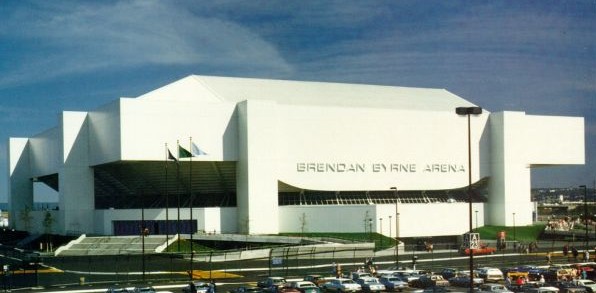
The Arena under its original name.
The arena saw the Devils clinch the Stanley Cup on home ice on June 24, 1995, and again -- by this point, renamed the Continental Airlines Arena (leading Byrne to say, "I was immortal for 15 years") -- on June 9, 2003. (They also clinched the Cup away to Dallas on June 10, 2000.) It hosted many NCAA Basketball Tournament games, including the 1996 NCAA Final Four, won by Kentucky over Syracuse.
With no pro teams still calling it home starting in 2010, the Izod Center (that name took hold in 2007 after the Devils left) mainly hosted concerts, circuses, and various family-friendly shows like Sesame Street Live, until this past January 15, when the NJSEA shut it down. The current plan is to demolish the Devils' 1st home in 2018.
The Complex is at the intersection of the Western Spur of the New Jersey Turnpike (Exit 16W), and New Jersey Routes 3 & 120. It can be reached by New Jersey Transit bus route 320 from Port Authority. On NFL game days only, it can also be reached by NJT rail when you transfer at Secaucus Junction.
According to a May 12, 2014 article in The New York Times, the Nets' failure in New Jersey has left them the 2nd favorite NBA team in most of the State, behind the Knicks, and sometimes 3rd behind the Los Angeles Lakers. In most Counties, the Knicks have about 25 percent of NBA fans, while the Nets average around 14 percent.
The Jets are only slightly luckier. According to a September 5, 2014 article in The Atlantic, they tend to have a better percentage of local fans than the Nets, or the Mets, but there is no place at all in the world where they have a majority. The last one where they did was their former headquarters of Nassau County. The Giants' 8-year head start at the Meadowlands made them "Jersey's Team" well before the Devils started marketing themselves with that slogan, even though the Giants have never used "New Jersey" in their name.
* Site of Ruppert Stadium. The original Newark Bears, of the International League, played here, built in 1926 as David's Stadium, before Jacob Ruppert bought it and the team and brought it into the Yankee organization. He also expanded the capacity from 12,000 to 19,000, making it larger than most minor-league stadiums (and larger than Philadelphia's Baker Bowl, and nearly as large as Cleveland's League Park). The Negro Leagues' Newark Eagles started playing there in 1936. In the original American Football League, of 1926, a football team called the Newark Bears played there.
With Yankee resources at their disposal, the Bears won 5 IL Pennants: 1932, 1937, 1938, 1940 and 1945. Future Yankee stars Joe Gordon, Tommy Henrich and Yogi Berra played for them. The Eagles, owned by Effa Manley, the first woman elected to the Baseball Hall of Fame, and led by future Hall-of-Famers Leon Day, East Orange native Monte Irvin, Paterson native Larry Doby, Willie Wells and Ray Dandridge, plus Don Newcombe, a Madison, New Jersey native who should be in the Hall, the Eagles won the 1946 Negro World Series. In 1948, Tony Zale regained the Middleweight Championship of the World there by knocking out Rocky Graziano.
However, the raids of black teams' rosters by the white majors began the decline of their leagues, and the Eagles left Newark after the 1948 season. The growth of television meant that fans could stay home and watch the Yankees, Giants or Dodgers for free, instead of going out to the Ironbound and paying to watch the Bears, and they left after 1950.
Ruppert Stadium was demolished in 1967, and a meat wholesaler's plant occupies the site now. 258 Wilson Avenue, southeast corner of Wilson and Avenue K. Number 25 bus. This is an industrial area, right underneath the elevated Routes 1 & 9, and I would advise avoiding it at night.
* Bears & Eagles Riverfront Stadium. Named for both of Newark's historical baseball teams, this new ballpark opened in 1999, for the new Bears of the independent Atlantic League. Newark native, Seton Hall graduate and former Yankee catcher Rick Cerone was the 1st owner. The team had legends Rickey Henderson and Jose Canseco trying to work their way back to the majors, and also Jose's twin brother Ozzie, and featured ex-Yankees Jim Leyritz and Ramiro Mendoza, and ex-Mets Edgardo Alfonzo and Armando Benitez. Managers included Bill Madlock, Tim Raines and Garry Templeton.
The Bears won a Division title in 2001, and Atlantic League Pennants in 2002 and 2007. The latter was particularly satisfying, defeating their arch-rivals, the Somerset Patriots, the team with the multicultural urban fan base beating the team of conservative suburbanites who foisted Republican Governors named Christie on the State (Christine Todd Whitman and Chris Christie).
But they were forever short of money, never promoted themselves well, always struggled for attendance, nearly went bankrupt in 2008, shifted to the Can-Am League where there was a built-in rivalry with the New Jersey Jackals, only made the CAL Playoffs once (in 2009), and folded after the 2013 season. The rights to the team, its records and its trademarks are currently for sale, and the ballpark is now targeted for demolition and replacement by housing, for commuters for NJ Transit's Broad Street Station, across the street.
450 Broad Street, at Division Street. Light Rail (formerly the Newark City Subway) from Penn Station to Riverfront Stadium Station. The ride takes 7 minutes.
* Harrison Park. Although the Indianapolis Hoosiers won the 1st Federal League Pennant in 1914, they lost money, so they moved east. Blocked by the major league teams from establishing a base in Manhattan, and unable to use Brooklyn because another FL team was already playing there, they built 21,000-seat Harrison Park across the River, in Harrison, Hudson County. Calling themselves the Newark Peppers, they are the only major league team ever to officially call New Jersey home.
They featured center fielder Edd Roush, later a Hall-of-Famer for the Cincinnati Reds; 3rd baseman Bill McKechnie, later a Hall of Fame manager; and former Chicago Cubs pitcher Ed Reulbach. But they went just 80-72, finishing 5th. The FL went out of business after the season, and only briefly has Major League Baseball returned to New Jersey. Indeed, the last Peppers game was on October 3, 1915 -- 100 years ago today.
Harrison Park continued to be used by minor-league and local teams, before being destroyed by a fire in 1923. Home plate was at the southeast corner of 2nd & Middlesex Streets (Middlesex is now Angelo Cifelli Drive), and the park was also bounded by 3rd & Burlingston Streets. Warehouses are on the site now. The Harrison PATH (Port Authority Trans-Hudson) station is adjacent, making it easily accessible from Newark's Penn Station. Red Bull Arena, the soccer stadium, is a 5-minute walk away.
* Red Bull Arena. Home to the New York Red Bulls since it opened in 2010, this 25,000-seat facility is probably the best soccer-specific stadium in America. The Red Bulls have made the MLS Playoffs every year since it opened (including 2016). Led by Arsenal legend Thierry Henry, former Everton star Tim Cahill, and short but wily midfielder Dax McCarty, "Metro" (the nickname a holdover from their MetroStars days) won the Supporters' Shield, the trophy given to the team with the best overall record in the League, in 2013. Led by McCarty and Bradley Wright-Phillips, son of Ian Wright (whom Henry replaced as Arsenal's all-time leading scorer), they won the Supporters' Shield again last season. However, they have never won an MLS Cup, it took them 18 seasons to get that 1st trophy of any kind, and some fans think the team is jinxed.
The Arena has hosted 2 U.S. national team matches: A win over Ecuador on October 11, 2011, and a draw with Turkey on June 1, 2014.
The U.S. national team has also played 3 matches within the confines of the City of Newark, in the early days, between 1885 and 1935; however, the locations have not been recorded. It may have been Dreamland Park, where the football Giants played their 1st game in 1925. The infamous Seth Boyden Houses project is on the site now, at Freylinghuysen Avenue (N.J. Route 27) & Seth Boyden Terrace, near Weequahic Park. Bus 59. It could also have been at the recently demolished and rebuilt Newark City Schools Stadium. More about that in a moment.
Red Bull Arena's official address is 600 Cape May Street, at Pete Higgins Blvd., in Harrison. PATH to Harrison is the most common way to get there if you're not driving. The most fun way is to go to Penn Station, walk out the east entrance, make a "pub crawl" down Market Street, and then join the various "ultra" groups as they walk across the Jackson Street Bridge, over the River, to the stadium.
Yes, ultras. Not hooligans: While incredibly enthusiastic, and will defend themselves if attacked, as they had to do recently with fans of expansion New York City F.C. (taking up temporary residence at the new Yankee Stadium) they will never instigate violence.
* Site of Roosevelt Stadium. Named for President Franklin D. Roosevelt, whose Works Project Administration (WPA) made it possible, this 24,000-seat stadium on Newark Bay, in the Droyer's Point section of Jersey City, hosted the International League's Jersey City Giants until 1950. It also briefly hosted the IL's Jersey City Jerseys (yes, that was the name) in 1960 and '61, and the Eastern League's Jersey City Indians in 1977 and Jersey City A's in 1978.
The "Little Giants" won Pennants in 1939 and 1947. On April 18, 1946, they hosted the Montreal Royals, in Jackie Robinson's debut in "organized ball."
In 1956 and 1957, the Brooklyn Dodgers took advantage of its big parking lot -- something the larger Ebbets Field did not have -- to play 7 games a season, 1 vs. each of the other National League teams, at Roosevelt. It was a ploy by Walter O'Malley, to show that he would move the Dodgers a lot further west than New Jersey if he didn't get a new ballpark. Robert Moses, the City's construction czar, either thought O'Malley was bluffing, or that it wasn't worth keeping the Dodgers, and they moved to Los Angeles.
The 1st Dodger game there was on April 19, 1956, and the Dodgers beat the Philadelphia Phillies, 5-4. The last was on September 3, 1957, also against the Phils, who won 3-2. Average attendance for the Jersey City games: 18,432, better than the Dodgers were doing at Ebbets Field. Despite this, since September 3, 1957, no MLB games have been played in the State of New Jersey.
In his first fight after regaining the Middleweight title at Ruppert Stadium in 1948, Tony Zale lost it at Roosevelt Stadium, beaten by Marcel Cerdan. In 1950, Sugar Ray Robinson defended the Welterweight Championship there. The Grateful Dead played 6 shows there in the 1970s. Today, Roosevelt Stadium is probably best remembered for its Thanksgiving Day high school football games, with the field laid out from 3rd base to right field (north to south).
It was demolished in 1985, and a gated community, named Droyer's Point for the old neighborhood, and a shopping center called Stadium Plaza have been built on the site. Danforth Avenue & N.J. Route 440. PATH to Journal Square, transfer to the Number 80 bus.
According to an April 24, 2014 article in The New York Times, the Yankees now have an absolute stranglehold on the baseball fandom of New Jersey. Percentage wise, the Yankees lead the Mets as follows, County by County: 66-14 in Bergen, 65-10 in Morris, 65-12 in Passaic, 65-14 in Sussex, 64-14 in Somerset, 63-10 in Essex (including Newark), 63-12 in Hunterdon, 63-16 in Middlesex, 60-13 in Ocean, 60-14 in Hudson, and 59-17 in Monmouth. In Warren County, bordering Pennsylvania, it's Yankees 42, Phillies 28, Mets 11. In Mercer, home of State capital Trenton, and accessible to Philadelphia by rail, it's Yankees 41, Phillies 27, Red Sox 10 -- the Mets are actually 4th in that County.
* Site of Boyle's Thirty Acres. This was a temporary stadium built by boxing promoter George "Tex" Rickard to host the July 2, 1921 Heavyweight Championship fight between titleholder Jack Dempsey and French fighter Georges Carpentier, the Light Heavyweight Champion. Why there? Because, at the time -- and for 2 more years -- boxing would be illegal in the State of New York.
On 34 acres owned by paper manufacturer John Boyle, and in a deal negotiated by Mayor Frank "I Am the Law" Hague (who later made the deal with the WPA to build Roosevelt Stadium), Rickard constructed a 90,000-"seat" facility, all wooden benches. (Had someone dropped a cigarette, and the stands caught fire, it could have made the 1989 Hillsborough Disaster in England look like a picnic.) The fight sold out, and Dempsey knocked the real-life World War I flying ace out in the 4th round.
Boxing was soon legalized in New York, and Rickard's promotion company staged fights at the 2nd Madison Square Garden, the Polo Grounds and Yankee Stadium. Rickard built the 3rd Garden, and turned it into "the Mecca of Boxing." (He also built the original Boston Garden.) All this made Boyle's Thirty Acres obsolete, and it was demolished in 1927. A housing project named Montgomery Gardens went up on the site in 1957, but the city demolish it this past August 29, and plans to replace it with new, better housing. Montgomery, Florence & Bright Streets & Corneilson Avenue. PATH to Journal Square, transfer to Number 6 bus.
* Hinchliffe Stadium. One of the few surviving stadiums to have hosted a Negro Leagues game, this 10,000-seat horseshoe, designed for football, was built by Paterson Mayor John Hinchliffe in 1932, above the city's Great Falls on the Passaic River. It hosted the 1933 Negro World Series, and hosted some (but not all) home games of the New York Black Yankees (yes, a team with that name did exist, though it wasn't nearly as successful as its white counterpart) and the New York Cubans (so named because so many natives of Cuba are the descendants of African slaves, so that, to many white people, "Cuban" came to be thought of as "black").
The stadium is home to both Eastside and John F. Kennedy (formerly Central) High Schools, and their Thanksgiving Day tussle is one of the biggest games in the State. Larry Doby, born in South Carolina but raised in Paterson, played there for both Eastside High and the Newark Eagles. It's in bad shape now, but efforts are underway to restore it. Maple & Liberty Streets. Number 72 bus from Newark Penn Station, then a 20-minute walk from Paterson's Broadway Terminal. Not to be visited at night.
* Newark Tornadoes. The 1st NFL team to play home games in New Jersey was the Orange Tornadoes, an offshoot of the Orange Athletic Club, founded in Orange, Essex County in 1887. They put a team called the Tornadoes in the NFL for the 1929 season, at Knights of Columbus Stadium at 54 Bell Street, site of the current Bell Stadium of Orange High School. Bus 21 from Newark Penn Station.
In 1930, the team was moved to Newark City Schools Stadium, and renamed the Newark Tornadoes. The timing couldn't have been much worse, as the stock market had crashed during their 1929 season in Orange, and the NFL lost several teams in the Herbert Hoover years. The team dropped out of the NFL, played semi-pro ball as the Orange Tornadoes back at K of C Stadium, were admitted to the American Association (a minor pro football league) in 1936, moved back to Schools Stadium and became the Newark Tornadoes in 1937 and the Newark Bears in 1939, and then folded after the U.S. got into World War II.
Newark Schools Stadium was a 25,000-seat horseshoe, open at the south end, built in 1925, hosting both baseball and football at the high school level, and the occasional NCAA Division III college football game. By the time I first saw it in 1988, a point at which the Newark school system was practically begging the State government for money, it was beginning to deteriorate. By 2006, it was outright condemned, and Central, Barringer and East Side High Schools began to share the smaller Untermann Field with West Side, while Malcom X Shabazz High School (the former South Side High had been renamed for Malcolm X in 1972 but is usually just called "Shabazz") and Weequahic High continued to share Shabazz Stadium.
In 2009, a new Newark City Schools Stadium opened, seating 15,000, with a considerably more decorated outer shell than the old one, and a FieldTurf playing surface. In the North Ward, at Bloomfield & Roseville Avenues. Bus 11, 28 or 29 from Newark Penn Station. Also a short walk from the Bloomfield Avenue station on Newark Light Rail (formerly known as the City Subway).
* Army-Navy Game. The battle between the service academies has been played in New Jersey: At Osborne Field in Princeton (that was 2 stadiums ago for the Princeton Tigers) in 1905; and at Giants Stadium in 1989, 1993, 1997 and 2002. It has not yet been played at MetLife Stadium, and, for the moment, there are no plans to host it there (it's scheduled through 2017).
* Yogi Berra Museum & Learning Center and Yogi Berra Stadium. Few people get a museum in their honor while they're still alive. A group of Yogi's friends thought he deserved one.
It's hard to argue against it: He not only won more World Series than any other player, 10, and 3 American League Most Valuable Player awards, but he was also the only major league ballplayer who also fought in the D-Day invasion. He was also the 1st Yankee on the cover of Sports Illustrated, and The Dreaded SI Cover Jinx didn't seem to affect him. That, alone, may justify a museum! But then, as the man himself might have said if he'd thought of it first, "I don't believe in bad jinxes."
Since he lived in Upper Montclair until he and his wife Carmen began to fail and moved to a nursing home -- both have since passed away -- the museum was built on the campus of Montclair State University, straddling the towns of Montclair (in Essex County) and Little Falls (the museum is actually in Passaic County).
The Museum has exhibits about Yogi's life and career, the Yankees in general, and tributes to the Negro Leagues and ballplayers in military service. It goes out of its way to be kid-friendly, hence the "Learning Center." Check it out: As the man himself would have said if he'd thought of it first, "If you don't go, you won't know what you're not missing."
Admission is $6.00, $4.00 for students under age 18. They're open Wednesday through Sunday, noon to 5:00 -- or, as the website itself says, "We're open 'til we close." 8 Yogi Berra Drive (to match his uniform number), Little Falls. Easy driving access from U.S. Route 46. Or, take the Newark Light Rail to Broad Street Station, one stop from Riverfront Stadium, and take the Montclair-Boonton Line to MSU station. Or, take the NJ Transit Number 28 bus from downtown Newark to the MSU campus.
Attached to the Museum is Yogi Berra Stadium, home of the New Jersey Jackals of the American Association, formerly of the Northeast League and the Can-Am League (both now defunct, as the AA is named for a pair of defunct pro leagues). They've won 4 Pennants: 1999, 2002, 2003 and 2004, all in the Northeast League. While they haven't won a Pennant in 11 years, they've made their league's Playoffs in each of the last 7 years. Alumni include Pete Rose Jr., former AL Rookie of the Year Angel Berroa, former Met Timo Perez, and a Yankee prospect who never panned out, D'Angelo Jimenez. A skybox attached to the museum was built so that Yogi and his guests could watch the games.
* Colleges. The aforementioned Montclair State is NCAA Division III. Division I schools in the northern half of New Jersey are: Rutgers University in New Brunswick, 27 miles away; Princeton University in Princeton, 41 miles; Monmouth University in West Long Branch, 45 miles; Seton Hall University in South Orange, 4 miles; St. Peter's University in Jersey City, 6 miles; and Fairleigh Dickinson University in Teaneck, 19 miles.
Rutgers is easily the most popular college football team in North Jersey, although there's plenty of Penn State and Notre Dame fans. For shame. Indeed, Saint Joe Paterno University dominates West Jersey and South Jersey. Yes, even after the scandal. Old habits die hard.
Yogi Berra is buried at Gate of Heaven Cemetery -- not the one in Westchester, where Babe Ruth and Billy Martin are laid to rest, but the one at 225 Ridgedale Avenue in East Hanover, Morris County. Not easily reachable by public transportation. Devils' founding owner John McMullen is buried at Mount Hebron Cemetery, 851 Valley Road in Montclair, a 20-minute walk south of Yogi's Museum and Stadium.
* Non-Sports Sites. The Newark Museum is worth a visit, at 49 Washington Street, off Washington Park. Use that stop on the Newark Light Rail. There are some other points of note in the city, and you can check out the city's website to decide which ones you want to see. Penn Station, built in 1935 in the Art Deco style so popular at the time, is a destination in and of itself. And don't forget all the nice places to eat in the Ironbound, the one section of Newark that actually smells good.
Branch Brook Park, on the north side of Newark, is home to the Basilica of the Sacred Heart, a carousel, a skating rink, and cherry blossom trees that light up the area in early April. Sacred Heart is at 6th Street & Clifton Avenue, across from Barringer High School (which happens to have been my father's alma mater). Park Avenue stop on the Light Rail. The rink is at 7th & Clifton; take the Orange Street stop.
The only President born in New Jersey was Grover Cleveland. His father was a minister, and the house where the future 22nd and 24th (non-consecutive terms) President of the United States was born was a church parsonage. 207 Bloomfield Avenue, Caldwell. Number 29 bus. (Not far away is the real-life house used as Tony's house on The Sopranos. However, it is privately owned, so leave them alone.)
Woodrow Wilson was the only New Jersey-based politician to become President, serving as Governor in 1911 and '12, and then elected President. At the time, New Jersey did not have an official Governor's Mansion. 72 Library Place, in Princeton. Not far away is Westland, the house where Grover Cleveland lived the last few years of his life. 15 Hodge Road. (Cleveland lived the beginning and end of his life in New Jersey, but lived most of his life in New York State.) Both residences, and Albert Einstein's house at 112 Mercer Street, are private residences, and not open to tours. NJ Transit rail to Princeton Junction, then take the Princeton Shuttle.
Elvis Presley never gave a concert in the State of New Jersey, not even at a smaller venue like Newark's Symphony Hall early in his career. By the time he started touring again in 1970, the only venue in the State that could have held him was Convention Hall, now known as Boardwalk Hall, in Atlantic City, but he was never booked there. The Beatles were, on August 30, 1964. This happened right after President Lyndon B. Johnson was nominated for a full term at the Democratic Convention. A bust of John F. Kennedy, who was supposed to be renominated at that Convention, is across the Boardwalk from the Hall. 2301 Boardwalk at Mississippi Avenue. NJ Transit runs buses from Port Authority.
The tallest building in Newark is the National Newark & Essex Building, another Art Deco masterpiece, going up in 1931 and rising 466 feet, with the flagpole increasing its height to 578 feet. 744 Broad Street at Clinton Street, 1 block west and 2 blocks north of the Prudential Center.
It remained the tallest building in New Jersey until 1989, a distinction held since 2004 by the Goldman Sachs Tower, on the Jersey City waterfront (a.k.a. the Gold Coast). It's 781 feet high, and, from traffic on the Turnpike, could easily be mistaken for one of the towers of the Financial District of Lower Manhattan, across the Hudson River. 30 Hudson Street at Essex Street. PATH to Exchange Place, then 5 blocks south on Hudson Street. Also accessible via the Essex Street station on the Hudson-Bergen Light Rail and the Paulus Hook Ferry.
*
With the Giants, the Jets, the Red Bulls, and, yes, the 3-time Stanley Cup Champion New Jersey Devils, North Jersey doesn't have to take a back seat to anybody. Indeed, from January 25, 1987 (Super Bowl XXI) onward, New Jersey has been home to 7 World Championships (Giants 4, Devils 3), New York City to 6 (Yankees 5, Rangers 1). New Jersey has also hosted a Super Bowl and World Cup matches since then, while New York City never has; and has hosted an NCAA Final Four, something New York City hasn't done since 1951.
Going to a Devils game is more fun than an Islander game because the Isles have become irrelevant. And it's more fun than a Ranger game because, well, the Rangers suck. Let's go, Devils!