Tuesday, October 4, 2022

Sevy's Smoke & Judge's Single Mess With Texas

I thought I had more time to do this one. I thought the early-season-locked-forced doubleheader was tomorrow, not today. Oh well.

Last night, the Yankees started their final series of the regular season, against the Texas Rangers at the new (3rd season) Globe Life Field in Arlington. They didn't get what they wanted, a 62nd home run from Aaron Judge, as he collected only a leadoff single in 4 at-bats. Kyle Higashioka singled home a run in the 5th inning, while Marwin González and Giancarlo Stanton hit home runs (not back-to-back) in the 8th.

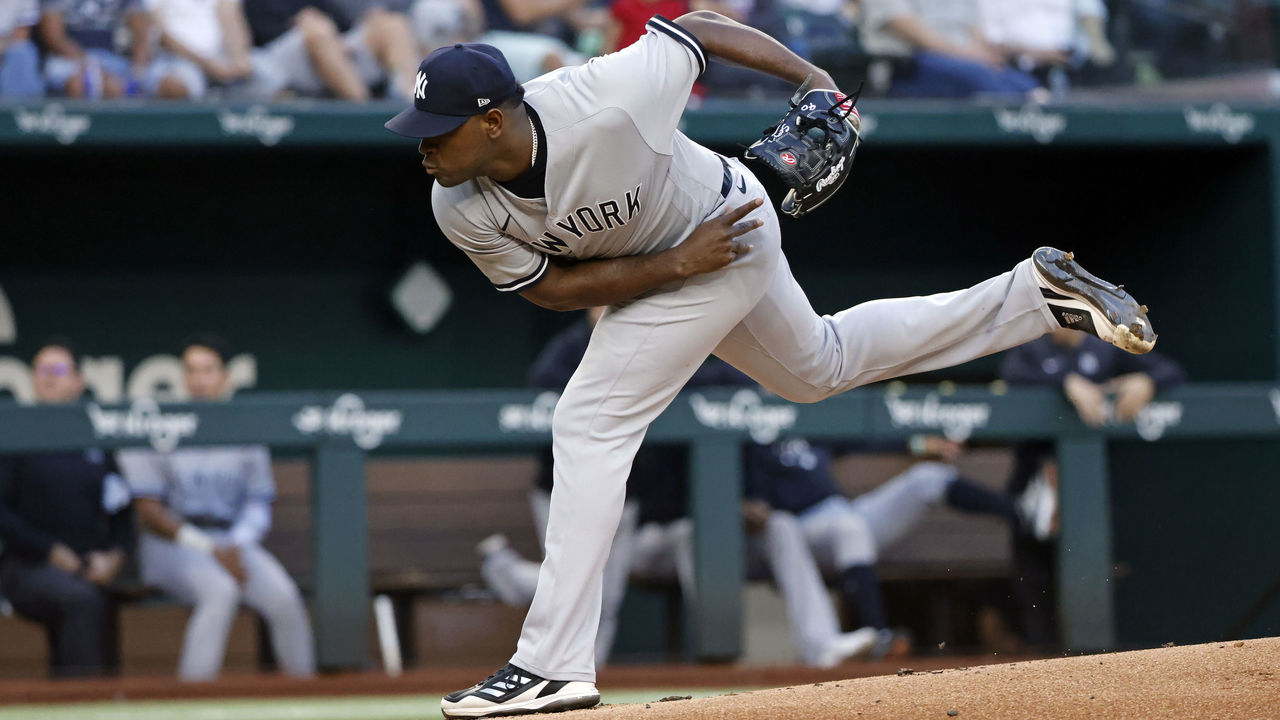
That was all Luis Severino needed in his start. He almost became a huge story himself, as he threw serious smoke, pitching a no-hitter for 7 innings. His only baserunner came when he walked Josh Smith in the 3rd, but he was erased on a double play. As Corey Kluber (now with the Tampa Bay Rays) did with a no-hitter in this same stadium last season, Sevy messed with Texas.

Aaron Boone took him out after 7 innings and 94 pitches, not wanting to risk renewed injury to his recently-returned arm. History or no, it was the right thing to do, especially since the Yankees will need every healthy pitcher they can get for the Playoffs. Who knows, with the injuries to the bullpen, Severino might be shifted into it. Miguel Castro was rusty in the 8th, and put the game back into doubt, but got out of it, and Scott Effross pitched a perfect 9th to end it.

Yankees 3, Rangers 1. WP: Severino (7-3). SV: Effross (4). LP: Martín Pérez (12-8).

Today, it's a doubleheader. There are 3 games left for Judge to get Number 62.

Monday, October 3, 2022

Judge Stuck On 61, Bullpen Frustrating

I don't know what's more frustrating:
Waiting on Judge homers these last few days,
or the annual Autumn "pumpkin spice" saturation.

If Aaron Judge is going to make it to 62 home runs in this regular season, it won't be at home at Yankee Stadium. It'll have to be in one of these last 4 games, away to the Texas Rangers.

The Yankees concluded their home schedule with a game against the Baltimore Orioles, with rain falling on and off during the contest. Judge struck out in the 1st, 2nd and 7th innings, drew a walk in the 5th, and was left on deck as the game ended. It's important to note that he worked a full count in all 4 plate appearances. So the O's weren't really "pitching around him."

The Yankees only got 4 hits, and their only run came on a wild pitch in the 5th inning. Chi Chi Gonzalez, making his Yankee debut and pitching for his 4th team in the last 12 months, started and allowed only 1 run in 4 2/3rds inning. But, Cliché Alert: Walks can kill you, and Aroldis Chapman let in 2 runs in the 7th, thanks to 3 walks.

To make matters worse, Ron Marinaccio got out of the 7th, but only got 1 out in the 8th before getting hurt. He now joins Clay Holmes and (again) Zack Britton on the Injured List. With all that, and Chapman again being unreliable, the Yankees are going to have to find somebody capable of relieving before the Playoffs start. Either that, or Brian Cashman is going to have to change his orders to Aaron Boone -- or Boone is going to have to defy orders -- and the Yankee starters are going to have to actually be allowed to pitch like men. Or the hitters will have to pound the ball every game, to give the bullpen unblowable leads.

Orioles 3, Yankees 1. WP: Logan Gillespie (1-0, and it's the 1st major league win for the rookie). SV: Dillon Tate (5). LP: Chapman (3-4).

These next 3 days, the Yankees will play 4 games against the Rangers, at Globe Life Field in Arlington, in its 3rd season as the Rangers' 3rd ballpark in 51 seasons -- of, if you count their previous tenure as the "new" Washington Senators, their 5th in 62 seasons.

October 3, 1962: The West Coast Giant-Dodger Playoff

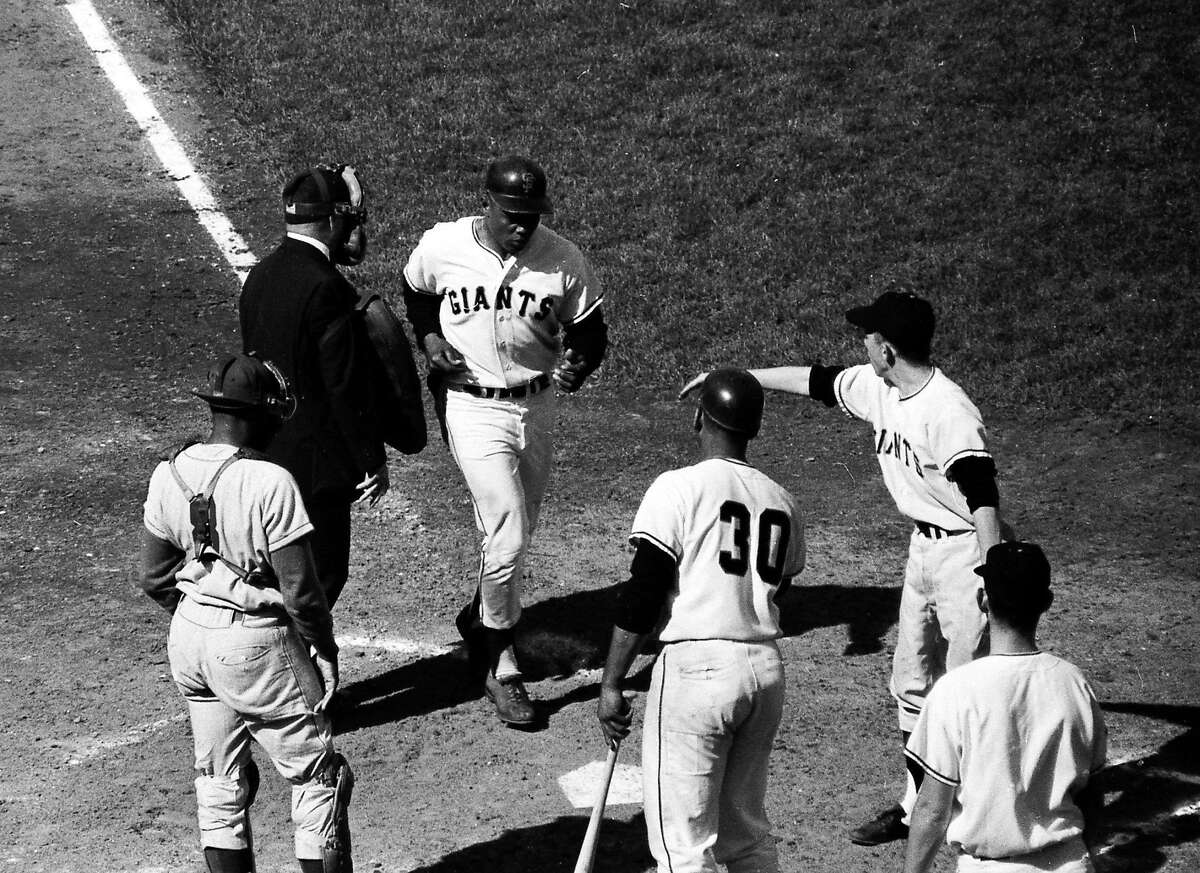
Felipe Alou walks home with the winning run

October 3, 1962, 60 years ago: The Giants beat the Dodgers in a Playoff for the National League Pennant again -- this time on the West Coast, and at the Dodgers' home. At Dodger Stadium, San Francisco wins the rubber game, beating Los Angeles, 6-4 as Don Larsen (yes, the hero of 1956 bedevils the Dodgers again) gets the win in relief of Juan Marichal.

The Giants took a 2-0 lead in the 3rd inning, but the Dodgers got a run back in the 4th, and took a 3-2 lead on a home run by Tommy Davis in the 6th. Maury Wills steals 3rd base in the 7th inning, and scores on a bad throw by Giant catcher Ed Bailey.

So, another parallel: The Giants needed to come back from a 4-2 deficit. Actually, in 1951, they had to come back from 4-1, but it was already 4-2 when Bobby Thomson hit that home run. And, this time, instead of at home, the Giants had to do it on the road.

They did. Matty Alou, pinch-hitting for Larsen, led off the top of the 9th with a single. Harvey Kuenn's groundout moved him over. Ed Roebuck, one of the Dodgers' holdovers from Brooklyn, walked Willie McCovey and Felipe Alou to load the bases. Willie Mays singled Kuenn home, and it was 4-3 L.A., with the bases still loaded, and still only 1 out.

Dodger manager Walter Alston pulled Roebuck, and brought in Stan Williams. Orlando Cepeda hit a sacrifice fly that made it 4-4. Following a wild pitch, Alston ordered Williams to intentionally walk Bailey to set up the double play, or at least a forceout at home plate. Instead, he walked Jim Davenport, forcing Felipe Alou home with what turned out to be the Pennant-winning run. And José Pagán reached on an error that made it 6-4. Billy Pierce, who had pitched for the American League Pennant-winning Chicago "Go-Go White Sox" of 1959, sent the Dodgers down 1-2-3 in the bottom of the 9th, to end it.

This was the 3rd and last time the Dodgers had lost a Playoff for the Pennant, all on an October 3. They did, however, win one in 1959, against the Milwaukee Braves, but that was on a September 29.

Thanks to the extended season, Wills sets a major league record for the most games played in a season, appearing in 165 games. This was the year he stole 104 bases, setting a new major league record. However, like Roger Maris' 61 home runs the season before, he didn't break the old record in 154 games, so his achievement and Ty Cobb's 96 steals in 1915 were listed as separate records. As with Babe Ruth's 60 homers in 1927 and Maris' 61 in '61, there was never actually an asterisk in the
record book.

The Giants played the Yankees in the World Series, losing in 7 games.

Sunday, October 2, 2022

Judge Not, But Orioles Judged by Nasty Nestor

There is a man I know on Facebook, I won't mention his name, but I will say that he's older than I am, and thus should know better. The other day, while waiting for Aaron Judge to go from 60 to 61 home runs on the season, he told me that "nobody cares" about the milestone anniversaries I sometimes post, including, these last few days, the anniversaries of Yankee Pennant clinchers. His own posts show that he doesn't even care about the Yankees winning. All he cares about is the home run record -- and remembrances of high school basketball in his hometown.

I had to tell him that it was my page, and I was going to post whatever I wanted, and that I didn't go on his page and tell him that "nobody cares" about what he posts about.

Nevertheless, now that the Yankees have clinched the American League Eastern Division title, and been locked into the 2nd seed in the AL Playoffs, there's nothing left to play for, except Judge's bid to go from 61 to 62.

Judge did not get Number 62 yesterday. The Baltimore Orioles continued to pitch around him, even hitting him on the elbow at one point. He had the elbow pad, so he wasn't hurt. Otherwise, he was walked twice, and struck out twice. And, yet again, a lot of fans left after Judge's last at-bat. It was fine yesterday, because the game was in the bag. But the night before? The result was still in doubt, and thousands left anyway.

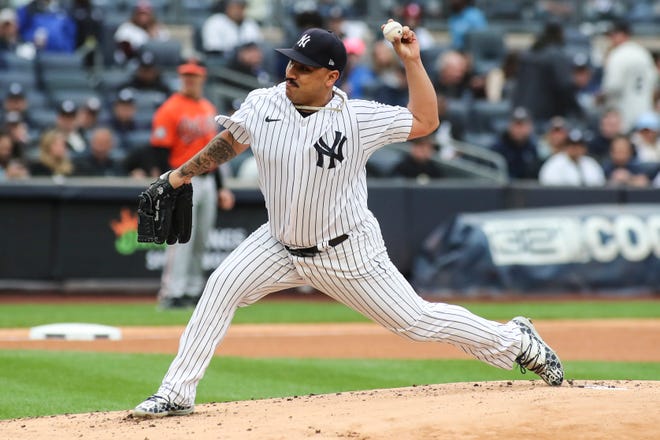
Judge was not the story yesterday. Nestor Cortés was: He pitched 7 2/3rds innings, longer than anyone expected to see him go, due to his earlier "load management." He allowed only 1 hit, a single to Jorge Mateo in the 5th, just 2 walks, and struck out 12. When he left, he got the ovation the fans had been ready to give Judge.

The Yankees gave "Nasty Nestor" the kind of run support that kind of pitching deserves. They scored 3 runs in the 1st inning, including a 447-foot home run from Giancarlo Stanton, who will need to be hitting well for the Yankees to do anything in the postseason. Kyle Higashioka made it 4-0 with a home run in the 2nd. And 4 more runs came in the 7th.

Yankees 8, Orioles 0. WP: Cortés (12-4). No save. LP: Austin Voth (5-4 -- another baseball name that sounds like the name of a law firm).

The series concludes this afternoon, weather permitting: As I type this, it is raining, and it is the last home game of the regular season. So Judge might not get this last chance to hit Number 62 at home. Alexander "Chi Chi" Gonzalez, a 30-year-old righthanded journeyman from Florida, makes his Yankee debut, starting against the Orioles' Kyle Bradish.

After this, the Yankees close the regular season with 4 games away to the Texas Rangers.

Saturday, October 1, 2022

Yanks Close September With Weak Effort vs. O's

October is my favorite month. Even late September can be hot in Central Jersey. But, in October, things cool off. This leads people to dress better. The leaves change, and the landscape bursts with color. And it's the only month when all 5 major North American sports are played at the same time. Major League Baseball and Major League Soccer move into their postseason; the National Football League, college football and high school football start to feel right, and ancient rivalries are replayed (although many more of them in November); the same is true of English and European soccer; while the National Hockey League and, later, the National Basketball Association get their new seasons underway.

However, once again, I won't be doing long anniversary lists for the period from September 28 (the earliest date on which a World Series game has been played, except for the shortened 1918 season) to November 8 (the latest date on which a Presidential election has been held in the modern era). I will, however, mention major milestones.

Last night, the Yankees closed September, and began their last home series of the regular season, losing to the Baltimore Orioles, 2-1. Aaron Judge went 1-for-2 with 2 walks, helping himself in his bid for the Triple Crown, but remaining at 61 home runs.

Domingo Germán started and lost (2-4), getting into the 6th inning, and looked worse than his numbers would suggest: 2 runs on 3 hits and 3 walks, with 6 strikeouts. He was also helped by some fine fielding, including to 2 great catches in center field by Harrison Bader.

But the Yankees couldn't do much with Oriole pitcher Jordan Lyles (WP, 12-11), or relievers Félix Bautista and DL Hall (SV: 1, and, yes, like CC Sabathia he spells his initials without periods). Oswaldo Cabrera led off the bottom of the 5th inning with a home run, and that was the only run the Yankees would get. They stranded a runner on 2nd base in the 3rd inning, wasted a leadoff walk by Judge in the 6th (that one didn't "kill" anybody), and blew a chance with men on 1st and 2nd with 1 out in the 8th.

In addition, reliever Clay Holmes was announced as out with an injury, although he could return in time for the Division Series. And reliever Zack Britton, for the 2nd time in as many appearances since coming off the Injured List, was shaky. He came back too soon. If the Yankees don't have a reliable bullpen for the Playoffs, forget it.

The series continues this afternoon, weather permitting: Shortly before I began typing this, we had a rainstorm, possibly the northern edge of Hurricane Ian, which is now pounding the Carolinas after shredding Florida, especially the Tampa Bay and Fort Myers area. Presuming the game goes ahead as planned, the starting pitchers have been announced as Nestor Cortés for us, and Austin Voth for them.

October 1, 1962: James Meredith Enrolls & Johnny Carson Debuts

October 1, 1962, 60 years ago: James Meredith registers as a full-time student at the University of Mississippi. This is a very big deal, since he is the 1st black student at "Ole Miss."

Governor Ross Barnett had ordered the Mississippi National Guard to prevent this, and pro-segregation demonstrators were ready to beat or even kill Meredith if he tried.

Two days earlier, Ole Miss played the University of Kentucky at Memorial Stadium in Jackson, and won 14-0. Confederate flags were everywhere in the stands. At halftime, a gigantic Confederate flag was unveiled on the field. Fans chanted, "We want Ross!" Barnett went down to the field, took a microphone, and said, "I love Mississippi! I love her people! Our customs! I love and respect our heritage!" And he got a standing ovation.

President John F. Kennedy, on the insistence of his brother, Attorney General Robert F. Kennedy, federalized the Guard, and ordered them instead to protect Meredith and allow him to enroll. The racists rioted, and threw things at the Guardsmen, who fired back. Two men were killed. But the law prohibiting racial discrimination in enrollment at State-sponsored schools was upheld.

Meredith, whose college credits from the all-black Jackson State University in Mississippi were carried over, received his degree from Ole Miss 10 months later.

The following Spring, the basketball team at Mississippi State University, who had won the Southeastern Conference Championship, was placed in the NCAA Tournament, to play Loyola University of Chicago, an integrated team. Barnett called the State Police, and told them to set up roadblocks to prevent the MSU Bulldogs from leaving the State to play that integrated team.

It didn't work: They snuck out. And lost the game. But won a moral victory. Loyola became the 1st team with more black than white starters to win the National Championship.

At the time, State law prohibited Mississippi's Governors from succeeding themselves, so Barnett had to sit out the 1963 election. He ran again in 1967, and finished a distant 4th in the Democratic Primary, the 1st gubernatorial election in the State following the Voting Rights Act of 1965. He never won another office, and died in 1987 -- absolutely unrepentant, unlike such other civil rights opponents as George Wallace of Alabama, Strom Thurmond of South Carolina, Robert Byrd of West Virginia and Albert Gore Sr. of Tennessee.

Today, Meredith is 89, and has spent most of the 60 years since as a Republican. Ole Miss has honored him with a statue, and, like its rival Mississippi State, goes out of its way to recognize its role in civil rights, first as an opponent, then as a supporter.
Ole Miss still calls its teams the Rebels, but Confederate paraphernalia is no longer allowed on campus, and the "Colonel Reb" mascot has been retired.

*

October 1, 1962  was also the day that Johnny Carson, not quite 37 years old, debuts as host of The Tonight Show on NBC, broadcasting live from NBC's studio at 30 Rockefeller Center in Midtown Manhattan. The guests on his 1st show: Comedy legend Groucho Marx, 1920s music star Rudy Vallée, acting legend Joan Crawford, comedian (not yet film director) Mel Brooks and singer Tony Bennett.
Carson kept Ed McMahon as his announcer and sidekick for the entire length of the show. In 1966, he replaced Lyle "Skitch" Henderson as leader of the band, The NBC Orchestra, with trumpeter Carl "Doc" Severinsen, famed for his wild suits.
Doc and Johnny

In 1972, Carson took 2 big steps. He formed his own production company, so that he could preserve every show taped after that. Previously, NBC had taped over most of his old shows, due to the high cost of videotape. As a result, his 1st show has only been preserved on audio, and the Ed Ames tomahawk throw of April 27, 1965 is only on a black & white kinescope. Fortunately, the February 19, 1968 "Copper Clapper Caper" with Jack Webb has been saved on color videotape.

The other step was moving the show from New York to Los Angeles -- or, more specifically, to NBC's studio in what Rowan & Martin's Laugh-In had dubbed "Beautiful Downtown Burbank." It was a reflection of the fact that most of the big entertainers had established residence in the L.A. area, and that Hollywood, not Broadway, was now the center of the entertainment world. CBS' cancellation of The Ed Sullivan Show, broadcast from a studio on Broadway itself, the year before was the writing on the wall.

McMahon would introduce him as follows: "From Hollywood: The Tonight Show Starring Johnny Carson. This is Ed McMahon along with Doc Severinsen and the NBC Orchestra, inviting to join Johnny and his guests... " And he would name the guests, and announce, "And now, ladies and gentlemen, heeeeeeeeeeeeeeeere's Johnny!" It was more drawn-out than later New York Yankees broadcaster John Sterling's "Theeee Yankees win!" And then the show's theme would play, composed by singer Paul Anka. Ed would usually yell, "Hi-yohhhhhhhh!" And the monologue would begin.
Ed and Johnny

The monologue usually ran about 7 minutes, and would begin with a few jokes about whatever was the top story of the day. Usually, the President of the United States, regardless of party or national popularity at the time, would come in for a couple of zingers, even if he hadn't done anything newsworthy that day. Occasionally, Johnny would start a joke by saying, "I've got good news and bad news," and Ed could be heard saying, "Uh-oh!"

If a string of jokes didn't work, Johnny might start tapdancing, and the Orchestra would play "Tea for Two," and the audience would cheer. Sometimes, it wasn't his fault. Thursday audiences, for some reason, weren't very responsive; but Friday audiences, anxious to start the weekend, were usually raucous. Johnny might say, "We've got a good crowd tonight. You should have seen last night's crowd," and then tell a joke about them.

I'm not sure, but Johnny -- or, rather, Ed -- may have invented "How (adjective) is/was (subject)?" jokes. My theory is that, once, Johnny mentioned the weather, saying, "It was so hot in L.A. today!" and Ed said, "How hot was it?" and the audience laughed. So Johnny had to make up a joke on the spot, without help from his writers and the cue cards placed at the bottom of the stage. Some time later, according to this theory, he did it again one night, and someone in the audience, remembering the previous time, yelled out, "How hot was it?"

Johnny was definitely doing it by early 1974. I've seen an episode of Match Game that aired on October 29, 1973, with host Gene Rayburn reading a clue, saying, "Bertha was so fat!" and before he could finish, panelist Bert Convy said, "How fat was she, Gene?" Before long, both shows were using it. But, barring further information, I can't be sure of who did it first.

Ed liked to do commercials, including for Budweiser beer (a product he enjoyed sampling offscreen) and Alpo dog food (which he, presumably, didn't). Johnny hated it, and eventually had his contract renegotiated so that he didn't have to. It was the final blow to sponsor power on TV: After Johnny, every talk-show host wanted that same exemption, and got it.

Often, before the first guest, Johnny would do a sketch, with such characters:

* Carnac the Magnificent: This was a ripoff of first Tonight Show host Steve Allen's Answer Man, with the added shtick of Carnac being a turbaned, caped "strange visitor from the East." Ed would hand him an envelope. He would put the envelope up to the turban. He would give the answer. He would tear the envelope open. And then he would read the question/punchline. Example: Answer: "Sis boom bah." Question: "Describe the sound made when a sheep explodes."
"The winners." Rip. "Who are the Dodgers playing tonight?"

* Art Fern: A ripoff of Jackie Gleason's character Reginald Van Gleason III, Fern who would announce today's "Tea Time Movie," then do a commercial for some whacked-out local business, then show a tangled mess of lines standing in for a map of Los Angeles, giving directions: "Take the L.A. Freeway to the San Diego Freeway to the Harbor Freeway, until you get to the Slauson Cutoff. Get out of your car, and cut off your Slauson!" The second time in the sketch, he would unfold the map to reveal a picture of a fork, and the audience would yell along with him: "Until you get to... the fork in the road!" Along with him would be his well-endowed, squeaky-voiced Matinee Lady, originally Carol Wayne. She died under mysterious circumstances in 1985, and was replaced by Teresa Ganzel.
Johnny and Teresa Ganzel

(Incidentally, in 1974, the musicians' union was on strike, and so Doc couldn't appear on the air. Nor could Tommy Newsom, the saxophonist who led the band when Ed was unavailable and Doc had to do the announcing. And Ed got sick during the strike. So Carol Wayne did the announcing for 2 days, making her the only woman ever to announce, "Heeeere's Johnny!")

* Aunt Blabby: Another ripoff, this time of Jonathan Winters' Maude Frickert, she was a cantankerous old woman dressed in Victorian clothing, the way women would have dressed when she was young.

(If you're thinking that these ripoffs were unfair, let the record show that Allen, Gleason and Winters were all favorite guests of Johnny's.)

* Floyd R. Turbo: An ignorant yokel wearing flannel hunting gear, responding to a local TV news editorial.

Sometimes, he would do unrelated sketches, with actors known as The Mighty Carson Art Players. Betty White would sometimes be involved. During the air-traffic controllers' strike of 1981, she played Jane to Johnny's Tarzan, telling him, "You're late!" and he said, "Not Tarzan's fault: Vine controllers strike!" And "Me Tarzan, King of Jungle!" was followed by Betty as Jane saying, "That wasn't exactly a royal performance you put on last night!" (I was 11. It took me years to get that joke.)

Johnny eventually cut back. On September 15, 1980, after the show had been an hour and a half, 11:30 PM to 1:00 AM, for most of its existence, going back to Steve Allen as host in 1954, it was cut to an hour, 11:30 to 12:30.

Although the show was faster-paced, it meant there would be fewer in-depth interviews. So there would be fewer newsmakers who weren't entertainers, fewer authors discussing their books, and fewer science figures, although astronomer Carl Sagan adapted well to the faster format. (Carson would sometimes impersonate Sagan, emphasizing the word "billions" the way he did.)

As the 1980s wore on, he was no longer taping on Mondays. Then, he wouldn't tape on Tuesdays, either. Twice a week, it was The Best of Carson airing at 11:30 PM. Well, what was NBC going to do, fire their biggest moneymaker? The show was making $60 million a year for NBC. (That's about $180 million in today's money.) It got to the point where, once, he introduced himself by saying, "My name is Johnny Carson. You all know me from The Best of Carson."

He liked to play tennis, and he liked to travel. This combined every Summer when he went to London for Wimbledon. In 1982, around the same time he did an impersonation of President Reagan in a re-working of Abbott & Costello's "Who's On First?" routine, he noted that Reagan had gone on vacation to his ranch outside Santa Barbara, and said, "Ronald Reagan spends more time in California than I do!"

(Reagan did once appear on the show, on January 3, 1975, just after his 2nd term as Governor of California. But while political candidates appeared on the show, no sitting President ever did while Carson was the host. Reagan had an inside man: Fred de Cordova, the show's director, had directed Reagan in the 1951 film Bedtime for Bonzo, about a man who adopts a chimpanzee.)

Whatever Johnny's personal tastes, he was willing to bring pretty much anybody on. Infamously, John Lennon and Paul McCartney of The Beatles (without George Harrison and Ringo Starr) appeared on May 14, 1968, but were very disappointed when baseball player-turned-NBC broadcaster Joe Garagiola, considerably squarer than Johnny, was the guest host. Eventually, all the individual Beatles except Lennon appeared as guests.

Musical guests ranged from classical to jazz to rock. Johnny was particularly fond of Bette Midler, and she became his last real guest, as his last show was basically a clip show.

Comedians knew that if Johnny liked you, you were going to make it. He helped make Joan Rivers a star, then his permanent guest-host and heir presumptive. But when Johnny wasn't ready to retire, Joan made a deal with Fox to do a competing show, and Johnny cut her off. From May 2, 1986, she did not appear on The Tonight Show again until February 17, 2014, shortly before her death, with Jimmy Fallon as host.

David Letterman and Jay Leno also had their 1st national TV appearances on Carson. Each guest-hosted for Johnny many times. Each thought he would succeed Johnny when he retired. Jay got the job. Dave was furious -- not with Johnny, but with Jay. Dave got a small measure of revenge: On the competing show he started on CBS in 1993, he got Johnny and Ed to appear, but Jay never got Johnny. (He did, however, get pre-Carson hosts Steve Allen and Jack Paar to come on.)

Also with their 1st national appearances on Carson: Steve Martin (a favorite of Johnny's, because they both started out as musicians), Jerry Seinfeld, Drew Carey and Robin Williams. Robin would be the last comedian on Johnny's version of the show, and they traded riffs on the 1992 Presidential election and the recent riot in Los Angeles.
Through immense change, from Kennedy to Clinton, from the Martin Luther King to Rodney King, from Sheriff Andy to Tim the Tool Man, from Lenny Bruce to Sam Kinison, from Elvis to Whitney, Carson was "The King of Late Night" for 30 years, winning 6 Emmy Awards and a Peabody Award, retiring on May 22, 1992.

Johnny Carson died in 2005. So did Skitch Henderson. Ed McMahon died in 2009. Groucho Marx and Joan Crawford both died in 1977. Rudy Vallée died in 1986. Fred de Cordova died in 2001. Tommy Newsom died in 2007. Joan Rivers and Robin Williams died in 2014. As of October 1, 2022, Doc Severinsen, Teresa Ganzel, Mel Brooks, Tony Bennett, Bette Midler, Jay Leno and David Letterman are still alive.

*

October 1, 1962 was a Monday. It was the day of Game 1 of the National League Playoff, 11 years after the Giants and Dodgers did it in New York. Now, they do it in California, and Billy Pierce pitches a 3-hit shutout. He hardly needs to, as 2 homers by Willie Mays, and 1 each by Orlando Cepeda and Jim Davenport, give the San Francisco Giants an 8-0 win over the Los Angeles Dodgers at Candlestick Park.
October 1, 1932: Babe Ruth's Called Shot

 
October 1, 1932, 90 years ago: Game 3 of the World Series is played at Wrigley Field in Chicago. There was bad blood between the New York Yankees and the Chicago Cubs, because the Cubs had acquired former Yankee shortstop Mark Koenig late in the season, he'd helped them win the Pennant, and had announced that, whatever their individual players' shares of the World Series money would be, he would get only half as much.

The Yankees, including Babe Ruth himself, publicly called the Cubs cheap, and there was some rough stuff in the 1st 2 games at Yankee Stadium. When Ruth and his wife Claire got off the train at Union Station in Chicago, Cub fans were waiting for them, throwing garbage at them, and spitting on them. Neither was naive: The Babe had been treated badly before, and Mrs. Ruth, under her maiden name of Claire Hodgson, was an actress, and used to rough customers. But this was over the line.

The Yankees took a 4-1 lead, including home runs by Ruth and Lou Gehrig. But the Cubs tied it up in the bottom of the 4th. Ruth led off the top of the 5th, and the Cub fans were abusing him like crazy. In the Cubs dugout, the "bench jockeying" was nasty as well.

Ruth was no stranger to this. Because of his large, wide nose and big lips, there had been suggestions that he was part black. Research into his family history showed him to be almost completely German -- in fact, because his grandparents were born in Pennsylvania, before moving to Baltimore, they were "Pennsylvania Dutch" -- ethnically Amish, if practicing Catholics.

But that didn't stop people from indulging in rumors, and one of the names he was sometimes called was "(N-word) Lips." On one memorable occasion, which may be apocryphal, he heard this particular insult, walked over to the opposing dugout, and said, "Listen, you guys, call me 'bastard' or 'cocksucker,' or whatever you want, but lay off the personal stuff, would ya?"

Charlie Root was pitching for the Cubs, and he threw a called strike. The Babe didn't like the pitch, and the Cubs' bench jockeying got worse. A home movie -- sadly, silent, and with all the crowd noise, we probably wouldn't be able to hear what the players were saying anyway -- shows Ruth waving he hand at the Cub dugout, a classic "Ah, go on, ya bum" gesture.

The way the story is usually told, including on a newsreel by Ruth himself, there were only 3 pitches in this at-bat. In fact, Root's next 2 pitches were out of the strike zone, and called balls. His 4th pitch was called a strike. The home movie shows Ruth pointing directly at Root -- twice. His arm is not extended. Contrary to legend, he is not pointing at a spot beyond the outfield fence, as if to say, "I'm going to hit the next pitch there."

But he is sending a message. Cubs catcher Gabby Hartnett claimed Ruth said, "It only takes one." Another source said Ruth said, "You got one more, kid!" (To the Babe, who was terrible with names, if you were a young guy, you were "Kid"; if you were older, you were "Doc"; and if he didn't like you, or sometimes even if he did, you were "You son of a bitch!") Gehrig, in the on-deck circle, told a reporter that what Ruth yelled at Root was, "I'm gonna hit the next pitch right down your goddamned throat!"

So, yes, Babe Ruth called his shot.

Root threw him one more pitch. The Babe crushed it to dead center field. Longtime Cub observers said it was the longest home run ever hit in Wrigley Field to that point. The now-familiar center field scoreboard wouldn't go up until 1937, and no player has ever hit it with a home run. Had it been there in 1932, the Babe's blast might have hit it.

The crowd knew that the Babe had made his point, and, like the Russian fans turning from Drago to Balboa in Rocky IV, switched sides, and cheered him.

The next batter was Gehrig, and he also hit his 2nd home run of the game. The Yankees hung on to win, 7-5, and completed the sweep the next day.

Ruth's Called Shot remains, along with Bobby Thomson's 1951 Pennant-winning "Shot Heard 'Round the World," one of the two most talked-about home runs in baseball history, more so even than the World Series Game 7-winning shot by Bill Mazeroski in 1960, or the home runs that broke Ruth's records: Single-season, 61 by Roger Maris in 1961, then 70 by Mark McGwire in 1998, then 73 by Barry Bonds in 2001; and career, 715 by Hank Aaron in 1974, then 756 by Bonds in 2007.