On Sunday, October 9, the Giants will be in Wisconsin to play the Green Bay Packers. This is a rarity in the NFL: These two teams have been trying to crush each other since 1925.
Before You Go. You've heard the legends of how cold it gets in Green Bay -- and, indeed, it is further north than Toronto, roughly as far north as Plattsburgh, New York and Burlington, Vermont, which are about 300 miles north of Midtown Manhattan. However, this is the middle of September, so the bitterly cold weather they sometimes get will not be a factor.
By the way, John Facenda, the longtime Voice of NFL Films, never said, on any highlight reel, the words "the frozen tundra of Lambeau Field." (They've checked.) It is now believed that ESPN's Chris Berman, doing an impression of Facenda, made it up. Though I did hear another announcer, talking about the 1967 NFL Championship Game, the legendary Ice Bowl, say it was "a day savage enough to make a Saint Bernard whimper," and add, "It is called Russian Winter: The kind of cold that made Napoleon and Hitler flee in terror from the doorstep of Moscow. But, in Green Bay, it is known as Packer Weather."
(In fact, Hitler's troops never quite got that far, and he didn't go with them. Napoleon, to his credit, did share his troops' hardships, and they did reach Moscow, but the locals had burned it, leaving it not worth keeping, and Napoleon and his Grand Army left.)
According to the
Green Bay Press Gazette, on Sunday afternoon, the temperatures should be in the high 50s. But the game will be played on Saturday night, at 7:30 PM local time, when it is projected to be in the low 40s, maybe the high 30s. So while you might not need a winter jacket in daylight, you will need one at night, during the game.
Green Bay is in the Central Time Zone, 1 hour behind New York. Adjust your timepieces accordingly.
Tickets. Unless you've already got them, or want to pay through the nose to a scalper, forget it. Last season, the Packers averaged 78,413 fans per home game -- a sellout. These people loved their football even before Vince Lombardi came along. Once he did, well... The Ice Bowl? Attendance that day was 50,861. That was the capacity of Lambeau Field at the time. So, for the coldest game in football history (or so it's been said), there was not one empty seat in the house.
Having sold out every seat since Lambeau opened nearly 60 years ago, and having a waiting list that makes the traffic backup at the Meadowlands seem small by comparison, tickets are simply not available at the stadium window or on the team website. I do see tickets available from
the NFL Ticket Exchange on Ticketmaster, but most seem to come in pairs (in other words, you'll have to buy both seats), and they're starting at around $100. Most of them are in the $150-250 range.
Getting There. Downtown Green Bay is an even 1,000 miles from Midtown Manhattan, and Lambeau Field is 990 miles from MetLife Stadium. If you don't want to take most of a day to get there, you'll want to fly.
Yeah, good luck with that. There is an airport in Green Bay, Austin Straubel International Airport, but it doesn't have nonstop flights from New York or Newark. In fact, getting a nonstop flight from home just to General Mitchell International Airport in Milwaukee is something you're probably not going to be able to do. Your best bet may be to fly to Chicago and rent a car for the last... 194 miles. That's right: Instead of flying
or driving, you'd have to do both.
(Billy Mitchell was an Army General from the Milwaukee suburbs, and an early advocate for air power. Austin Straubel was an Army Air Force Major from Green Bay who was killed in action in World War II.)
Forget the train: Amtrak goes to Milwaukee, but not to Green Bay, and there's no secondary service such as New Jersey Transit, Metro-North or the Long Island Rail Road to connect Wisconsin's major city with its football city.
Bus? Greyhound does go there, but you'd have to leave Port Authority, change buses in Chicago and again in Milwaukee. And, the way the schedules work out, you'll probably need 2 nights in a hotel. I don't know what your chance is of getting a hotel room within a 50-mile radius of Green Bay on an Autumn weekend is, but I'm not optimistic. Round-trip bus fare: $198. The Greyhound station is at 800 Cedar Street, at Main and Van Buren Streets.
So your best bet really is to drive. It's far enough that it will help to get someone to go with you and split the duties, and to trade off driving and sleeping. You'll need to get into New Jersey, and take Interstate 80 West. You'll be on I-80 for the vast majority of the trip, through New Jersey, Pennsylvania and Ohio. In Ohio, in the western suburbs of Cleveland, I-80 will merge with Interstate 90. From this point onward, you won’t need to think about I-80 until you head home; I-90 is the key, until it merges with Interstate 94, which will merge with Interstate 43.
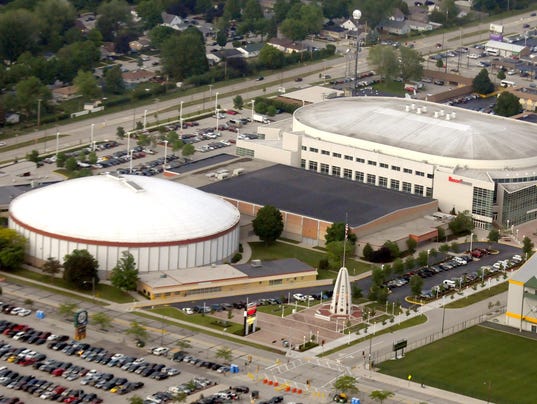
I-94 will split off from I-43 at downtown Milwaukee. Stay on I-43 North. Take Exit 180 to State Route 172 West. Exit onto State Route 32, and turn left on Pilgrim Way. You'll see a sign for Holmgren Way, named for the former Packer coach. On your right will be the Bay Park Square Mall. Turn right on Oneida Street. Before you reach Lombardi Avenue, you will see Lambeau Field on your left, and on your right, Green Bay's arenas: The old one, the Brown County Veterans Memorial Arena; and the new one, the Resch Center (named for a local businessman, not Devils goalie-turned-broadcaster Chico Resch). The official address for the stadium is 1265 Lombardi Avenue.
The Brown County Arena, Shopko Hall (a concert venue)
and the Resch Center
If you do it right, you should spend about an hour and a half in New Jersey, 5 hours and 15 minutes in Pennsylvania, 4 hours in Ohio, 2 hours and 30 minutes in Indiana, an hour and a half in Illinois, and about 3 hours in Wisconsin. That's about 17 hours and 45 minutes. Counting rest stops, and accounting for traffic in both New York and Chicago, it should be no more than 23 hours, which would save you time on Greyhound, if not on flying.
Once In the City. As you might guess, Green Bay -- named for the body of water it's on, and incorporated as a French fur-trading village in 1754, making it older than most of the big Midwestern cities -- is by far the smallest city in any of the 4 major North American sports: 104,057 people at the time of the 2010 Census, making it the 3rd-largest city in Wisconsin after Milwaukee and the State capital of Madison. The city is about 75 percent white, 13 percent Hispanic, 4 percent black, 4 percent Native American, and 4 percent Asian.
Its "metropolitan area" (if you don't count it as part of Milwaukee's) has about 300,000 people -- by comparison, Milwaukee has a little over 2 million in its area, making it the smallest in Major League Baseball. If you combine the 2 into one "market," in the NFL, they'd still be 26th out of 32, ahead of only Cincinnati, Indianapolis, Nashville, Jacksonville, Buffalo and New Orleans.
So why did Green Bay survive as an NFL city, when larger, but still not big, cities didn't get out of the NFL's founding era (1920-32)? Cities like Providence, Rhode Island; Rochester, New York; Pottsville, Pennsylvania; Canton, Ohio; Muncie, Indiana; Rock Island, Illinois; and Duluth, Minnesota? At one point, after a rocky beginning to their relationship, starting a rivalry between the teams that continues to this day, Chicago Bears boss and NFL co-founder George Halas stepped in and had his fellow team owners chip in to bail the team out of a serious debt. Between this, and the fact that the Packers are publicly owned through stock sales (the only such team in the big 4 North American sports), and the expansion of Lambeau Field, means the Packers will never have to move -- not to "nearby" Milwaukee, not anywhere else.
Walnut Street divides Green Bay addresses into North and South, but the only major road dividing into an East and West is Walnut, divided at the Fox River, which bisects the city. While the Fox flows into the body of water named Green Bay, a New Yorker might appreciate this: The city also has an East River, which flows into the Fox, downtown.
The sales tax in Wisconsin is 5 percent. As you might guess, a city as small as Green Bay doesn't have a subway. Public buses are $1.50. ZIP Codes in Wisconsin start with the digits 53 and 54, and for the Green Bay area, 541, 542 and 543. The Area Code is 920. Green Bay does not have a "beltway." Wisconsin Public Service Corporation runs the city's electricity.
Going In. Green Bay Metro buses offer free rides from downtown to the stadium, which is 3 miles southwest. Lambeau is an island in a sea of parking, which costs $18. Not surprising, considering that this is the Midwest, Big Ten County, tailgating is encouraged.
When it opened, 1957
All stadium gates open 2 hours prior to kickoff, and are accessible to fans with disabilities. Fans with seats in the South End (i.e. section numbers ending with the letter "S") must enter through the Shopko Gate on the south side of the stadium, which is for the exclusive use of South End ticket holders. Fans sitting elsewhere in the stadium are encouraged to use the gate suggested on their ticket for the most direct route to their seats.
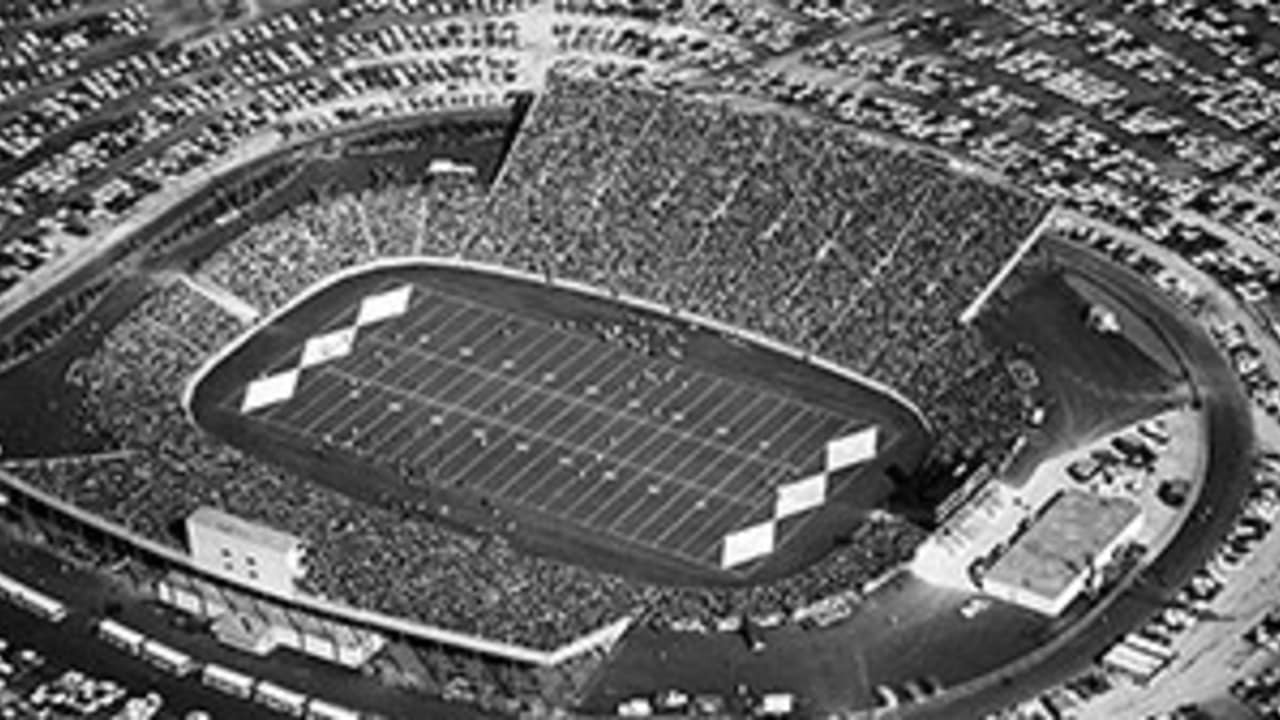
Expanded by 1965, it looked like this through
the Vince Lombardi era.
For most of its history, Lambeau Field was not an architectural marvel. It looked like a typical American sports stadium of the post-World War II era: Functional, but nothing special. It was the Packers who provided the glory, but how the stadium looked was not a factor.
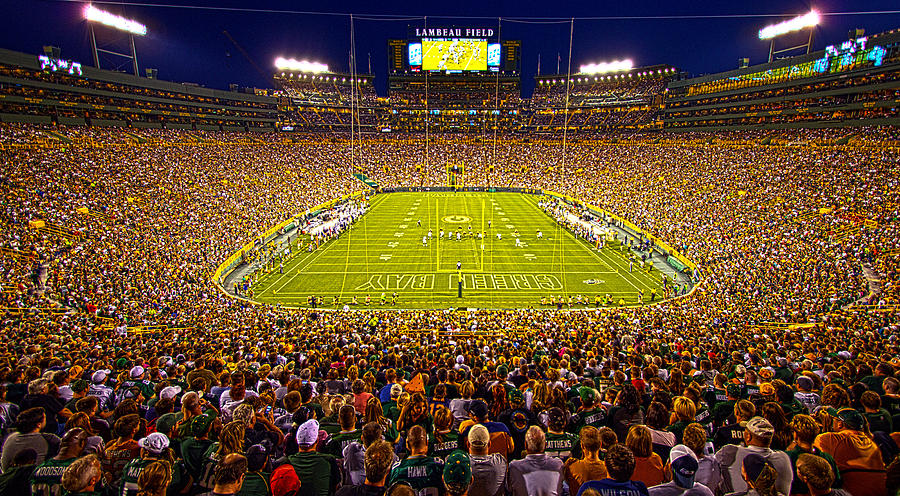
1996, the season the Packers won the Super Bowl
with Mike Holmgren, Brett Favre and Reggie White.
A recent renovation, which expanded capacity to 78,200 (officially, it's 80,735, however 78,200 is listed as the record attendance), also changed the exterior. Whereas it was built in 1957 as looking like an oversized high school football stadium -- with an appropriate name, City Stadium -- and by the 1980s had a green exterior on the sides that held up the luxury boxes, now it's surrounded by a red brick exterior, trying to copy the look of lots of "Memorial Stadiums" throughout the country, especially in the Midwest, built in the 1920s as memorials to World War I.
(These include those at the universities of Illinois, Nebraska, Kansas and Oklahoma, and the former stadium in Minnesota -- but not Indiana, as their Memorial Stadium was built after World War II and isn't nearly as classic-looking.)
This added exterior includes a new facility for the Packers Hall of Fame, and a bar called Curly's Pub, named for Earl "Curly" Lambeau, the Green Bay native and Notre Dame football star who founded the team, as a "company team" from co-workers at the Indian Packing Company, which was the team's initial sponsor.
(English soccer fans would call a company team a "works side." The arch-rival Chicago Bears were also originally a company team, based at the A.E. Staley Starch Company of Decatur, Illinois, and were known as the Decatur Staleys before moving upstate to Chicago.)
Lambeau played for the team from its 1919 founding until 1929, and coached it from 1919 to 1949. Like Bears founder George Halas, he was a good player, a very good coach, and, most importantly in the long run, a great administrator. The team wouldn't have gotten through the Depression, let alone to the post-merger era, without him, and without help from his rival Halas, who stood up for the NFL's last small-city team when that help was needed most. When Lambeau died in 1965, the new stadium was renamed for him.
(Halas stepped in again in 1955 to convince the other owners to chip in to build Lambeau Field. Perhaps this was his way of making up for almost killing the team in 1921, when he blew the whistle on them for using ineligible players.)
Stadium Tours are not available on game days. If you do stay overnight, you can take a tour on Saturday before the Sunday game. The Classic Tour includes the locker room, the field level, and a luxury box, lasts about an hour, and costs $11. The Champion's Tour includes the preceding, plus other amenities, lasts an hour and a half, and costs $19. The Legendary Tour offers more, takes 2 hours, and costs $28.
Don't scoff: The Packers are one of the few NFL teams that can legitimately do this, especially since they're 1 of only 2 teams that currently has a stadium that was in use, let alone hosting a championship team, prior to the start of the Super Bowl era in the 1966 season.
For the next 3 seasons, the only other NFL stadium that's played host to Sammy Baugh, Sid Luckman, Steve Van Buren, Otto Graham, Norm Van Brocklin, Doak Walker, Chuck Bednarik and even Giants legend Frank Gifford, and the only one older than Lambeau (built in 1923 but not hosting an NFL game until 1937) is the Los Angeles Coliseum, which the returned Rams will use until their new stadium opens in 2019. (The next-oldest active NFL stadium is the Oakland Coliseum, which opened in 1966.)
Like most football stadiums, Lambeau is aligned north-to-south. Despite the cold weather, the field is natural grass. Knowing that the field tended to freeze, in 1967, Lombardi had a system of heating coils installed underneath. It was nicknamed Lombardi's Electric Blanket.
But on New Year's Eve, the morning of the NFL Championship Game, it was
so cold (How cold
was it?) that the heating coils' control system broke, and the field froze anyway, resulting in the Ice Bowl, and one of the greatest and most iconic football games ever played, pro or college -- and, as it turned out, Lombardi's last game at Lambeau, as he retired after the Super Bowl.
In his 1981 book
Pro Football's Ten Greatest Games, John Thorn, who usually writes about baseball, called Bart Starr's winning quarterback sneak "the most famous touchdown in football history." He ranked it ahead of the 1972 Franco Harris "Immaculate Reception," although the Joe Montana to Dwight Clark "The Catch" happened a few months after that book's publication.
A better system was installed, and now, no matter how cold the air gets, the field is fine. Something for Canada to think about: Green Bay is further north than Toronto and Hamilton, and not much further south than Montreal and Ottawa, yet all 9 Canadian Football League stadiums have artificial turf, for the sole purpose of combating the cold.
Through updates over the years, the basic structure of the original bowl and field location have remained. It doesn’t feel quite like anyplace else, occupying that Wrigley/Fenway space in the collective imagination of football fans...
As much as the small town "we're not just fans, we're OWNERS" vibe of Packers fans can grate against outsiders, even the most hardened Bears or Vikings fan will (perhaps grudgingly) tell you that a visit to Lambeau is a must for any football -- hell, any sports -- fan. It starts with the town-consuming tailgating: generations of fans cooking up beer brats in the same spot they've staked out for years, who are nonetheless remarkably welcoming to outsiders (pregame, that is -- if the Packers lose, the postgame reception is a different story). It continues with your visit into a stadium that has managed to stay sufficiently updated with the times (including a shiny, glass-fronted atrium facing Lombardi Avenue) without sacrificing its time-earned gravitas.
And if you happen to visit on a snowy December day, staring out into the sea of fans keeping warm in orange hunting gear as you pound beers and eat cheese curds by the handful just to keep your jaw from chattering, and watch the place go absolutely bonkers for the Lambeau Leap and ensuing Todd Rundgren soundtrack, you'll find yourself a little less irritated next time Chris Berman grumbles about "the frozen tundra of Lambeau Field." A little less.
UPDATE: On June 24, 2019, Scott Nordlund wrote an article on NFL stadiums for Moneywise, and rated Lambeau Field Number 1: "Fans are guaranteed a good experience."
Food. Tailgating not enough for you? As I said, Curly's Pub is now open, on the 2nd floor of the Lambeau Field Atrium. On game days, it is accessible only via a game ticket, from the inside of the stadium. The Atrium also offers Goin' Deep Pizza and, in a nod to the team's beginnings, the Meat Packing Company, a restaurant concept developed exclusively for Lambeau Field, featuring overstuffed sandwiches, giant bratwursts and desserts.
There are other concession stands throughout the stadium, but they stop serving entirely -- not just beer -- at the end of the 3rd quarter.
Team History Displays. No team has won more NFL Championships than the Packers, with 13: 1929, 1930, 1931, 1936, 1939, 1944, 1961, 1962, 1965, 1966, 1967, 1996 and 2010. (The Chicago Bears are next with 9, the Giants next with 8.) This includes 2 of the only 3 threepeats in NFL history: 1929-31 and 1965-67. (The other is the 1922-24 Canton Bulldogs.) It also includes Super Bowls I, II, XXXI and XLV (1, 2, 31 and 45). These titles, which gave rise to Green Bay's nickname of Titletown, are shown in yellow lettering on the green background of the scoreboard.
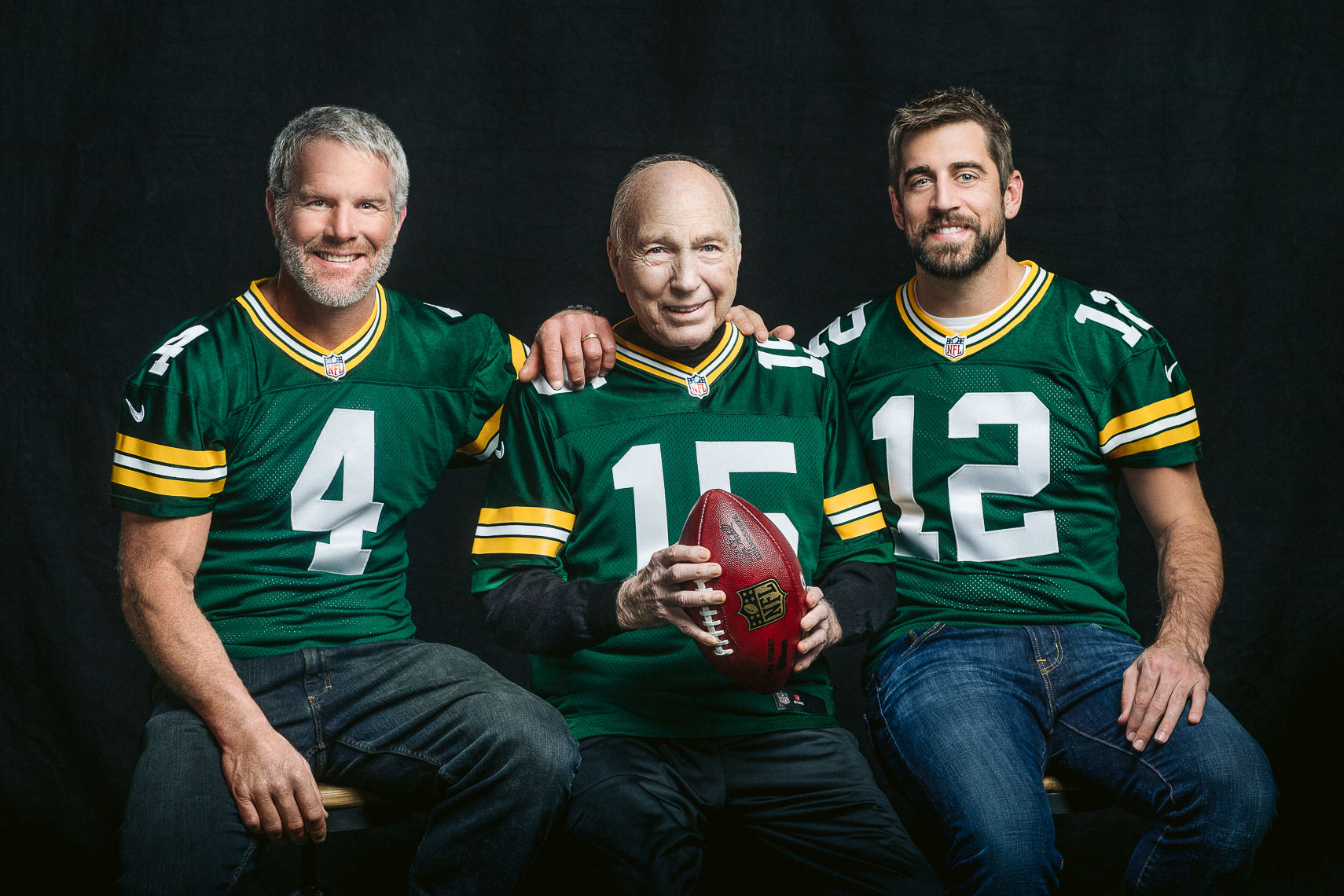
On the other sideline's skyboxes are the team's officially retired numbers: 3, Tony Canadeo, running back, 1941-52; 4, Brett Favre, quarterback, 1992-2007; 14, Don Hutson, receiver-defensive back, 1935-45; 15, Bart Starr, quarterback, 1956-71; 66, Ray Nitschke, linebacker, 1958-72; and 92, Reggie White, defensive end, 1993-98. The Number 5 of Paul Hornung, running back, 1957-66, has not been officially retired, but it is rarely given out.
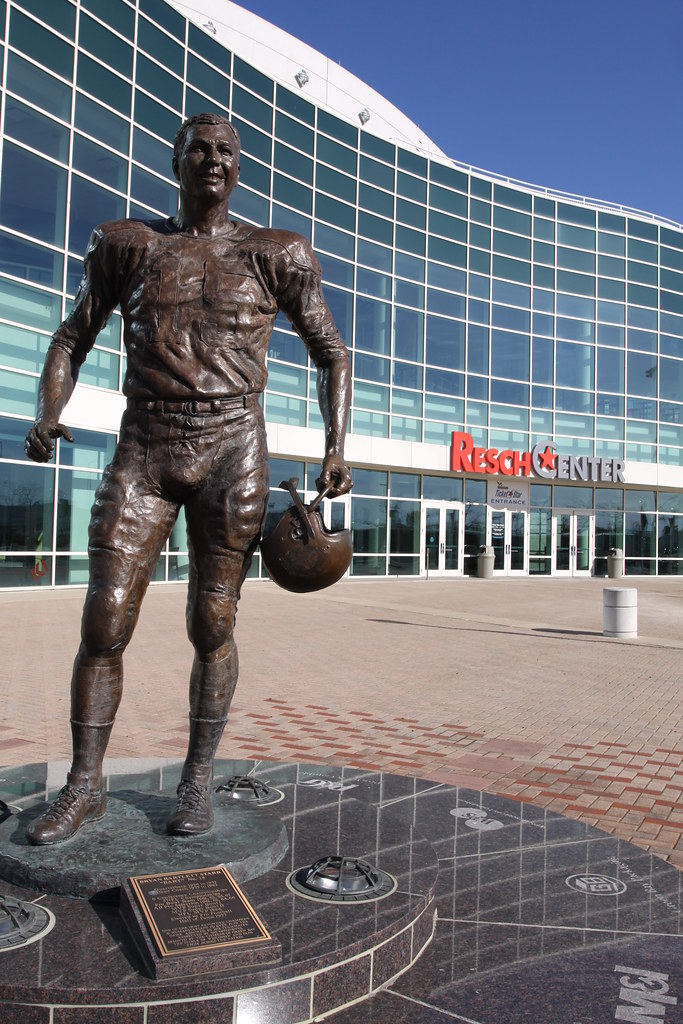
Outside the stadium are statues of the coaches (also general managers) who brought the 1st 11 titles, Lambeau (1929 through 1944) and Lombardi (1961 through 1967); and also of Starr, the only man to quarterback 5 NFL Championships. (And if Tom Brady becomes the 2nd, Starr will remain the only one to have done it honestly.)
Curly's hair wasn't all that curly. Then again,
he wasn't bald like Curly of the Three Stooges, either.
In addition to the preceding, the Packers have had the following players elected to the Pro Football Hall of Fame: Quarterback Arnie Herber; running backs Johnny "Blood" McNally, Clarke Hinkle and Jim Taylor; receiver James Lofton; center Jim Ringo, guard Mike Michalske, and offensive tackles Cal Hubbard and Forrest Gregg; defensive tackle Henry Jordan, defensive end Willie Davis, linebacker Dave Robinson, cornerback Herb Adderley, safety Willie Wood, and kicker Jan Stenerud. Other Hall-of-Famers have played for the Packers, but these are the players generally considered "Packer Hall-of-Famers."
Lombardi's statue, based on what was
clearly a rare photo of him with his mouth closed.
The Green Bay Packers Hall of Fame has, along with a recreation of Lombardi's office, more inductees than any other team hall of fame in North American sports, 157. It recently reopened after its part of the continuing renovation of Lambeau Field. Members include:
* From the 1929-36 titles: Lambeau; backs McNally, Herber, Hinkle, Charlie Mathys, Verne Lewellen, Red Dunn, Swede Johnston, Hank Bruder and Bob Monnett; linemen Hubbard, Michalske, Cub Buck, Whitey Woodin, Jug Earp, Boob Darling, Lavvie Dilweg, Nate Barragar, Milt Gantenbein and Lon Evans. (Swede? Cub? Jug? Boob? Lavvie? Johnny Blood?They knew how to give athletes nicknames back then.)
Lambeau, McNally, Herber, Hinkle, Lewellen, Dunn, Michalske, Buck and Dilweg have also been elected to the Wisconsin Athletic Hall of Fame, located at the UW-Panther Arena in Milwaukee, formerly known as the MECCA.
* From the 1939 and 1944 titles: Lambeau; backs Canadeo, Joe Laws, Ed Jankowski, Cecil Isbell, Andy Uram, Charley Brock, Lou Brock (related to Charley but not to the baseball star), Larry Craig (no relation to the scandalous Senator), Ted Fritsch and Irv Comp; receiver Hutson; linemen Charles "Buckets" Goldenberg, Tiny Engebretsen, brothers George and Earl "Bud" Svendsen, Russ Letlow, Pete Tinsley, Carl Mulleneaux and Harry Jacunski. Hutson, Canadeo and Goldenberg have also been elected to the Wisconsin Athletic Hall of Fame.
(A personal note: The Jacunskis are from Connecticut, and Harry's son Dick moved to New Jersey. He, his wife, and their daughters lived next door to my parents when I was born, and what remains of each family is still close. I got to meet Harry a couple of times: Although football left him physically debilitated, and I never saw the man stand up, he was still mentally sharp into his 80s.)
* Between the Lambeau and Lombardi eras: Quarterback Tobin Rote, running backs Bob Forte, Fred Cone, Al Carmichael and Howie Ferguson; ends Bob Mann, John Martinkovic and Billy Howton; offensive tackle Dick Wildung; linebacker Deral Teteak, and defensive back Bobby Dillon. Lisle Blackbourn, who coached the Packers in this era, has also been elected to the Wisconsin Athletic Hall of Fame.
* From the 1961-67 titles: Lombardi, assistant coaches Red Cochran and (Lombardi's much less successful successor as head coach) Phil Bengtson; quarterbacks Starr and Zeke Bratkowski; running backs Hornung, Taylor, Elijah Pitts, Donny Anderson and Travis Williams; receivers Gary Knafelc, Max McGee, Ron Kramer, Bowd Dowler, Marv Fleming and Carroll Dale; centers Ringo and Ken Bowman; guards Jerry Kramer, Fred "Fuzzy" Thurston and Gale Gillingham; offensive tackles Gregg and Bob Skoronski; defensive tackles Jordan, Dave Hanner and Ron Kostelnik; defensive ends Davis and Lionel Aldridge; linebackers Nitschke, Bill Forester, Dan Currie, Dave Robinson and Lee Roy Caffey; cornerbacks Adderley, Hank Gremminger and Bob Jeter; safeties Wood and Jesse Whittenton; and placekicker-punter Don Chandler.
Hornung and Anderson also did some kicking in this era. Thurston also played for the 1958, but not 1959, Baltimore Colts, while Gregg and Adderley also played for the 1971 Dallas Cowboys, making them the only 3 players ever to play on 6 NFL Championship teams. Lombardi called Gregg "the finest player I ever coached." It's not surprising, therefore, that he went on to become a successful coach, taking the Cincinnati Bengals to their 1st Super Bowl in 1982 (but losing), and then restoring the honor of his alma mater, Southern Methodist University, after their 1987 "death penalty.")
Lombardi, Starr, Hornung, Taylor, Kramer, Thurson, Davis and Nitschke have also been elected to the Wisconsin Athletic Hall of Fame.
* Between the Lombardi and Holmgren eras: Quarterbacks Lynn Dickey and Don Majkowski; running backs John Brockington and Gerry Ellis; receivers Lofton and Sterling Sharpe; tight end Paul Coffman; center Larry McCarren; offensive tackle Greg Koch; defensive end Ezra Johnson; linebackers Fred Carr, Mike Douglass, John Anderson and Johnny Holland; cornerbacks Ken Ellis and Willie Buchanon; safeties Johnnie Gray and Mark Murphy; and kickers Stenerud and Chester Marcol.
(UPDATE: In 2017, cornerback Mark Lee was elected.)
* From the 1996 title: Coach Holmgren, general manager Ron Wolf, and team president Bob Harlan; Favre; running backs Edgar Bennett, Dorsey Levens and William Henderson; receivers Robert Brooks and Antonio Freeman; tight end Mark Chmura; center Frank Winters; guard Marco Rivera; offensive tackle Ken Ruettgers; defensive end White; defensive tackle Gilbert Brown; safety Leroy Butler; and placekicker Chris Jacke. Harlan and White have also been elected to the Wisconsin Athletic Hall of Fame.
* Between the Holmgren and McCarthy eras: Running back Ahman Green and defensive end Kabeer Gbaja-Biamila. (UPDATE: In 2018, kicker Ryan Longwell was elected. He was a member of the 1997 NFC Champions, but not the 1996 World Champions.)
* From the 2010 title: Offensive tackle Chad Clifton and safety Nick Collins. Quarterback Aaron Rodgers and anyone else will have to wait a while; since Clifton and Collins both retired in 2011 and got elected this year, it looks like 5 years after retirement is the eligibility, as with most sports halls of fame. Receiver Donald Driver has been elected to the Wisconsin Athletic Hall of Fame. (UPDATE: In 2017, Driver was elected to the Packers Hall of Fame. So was offensive tackle Mark Tauscher.)
* Spanning the eras: Team executives George Calhoun, Frank Jonet, A.B. Turnbull, Fred Leicht, Emil Fischer, Lee Joannes, Lee Remmel (a sportswriter turned team executive who'd been involved with the club from 1944 until his death in 2015, linking the Lambeau, Lombardi, Holmgren and McCarthy eras), Jack Vainisi, F.N. Trowbridge, Jerry Atkinson, Dominic Olejniczak, Tom Miller and Robert Parins; team doctors Webber Kelly and E.S. Brusky, and trainer Carl Jorgensen; broadcasters Russ Winnie, Ray Scott and Jim Irwin; team attorney Gerald Clifford; team photographer Vernon Biever and video director Al Treml; journalist Art Daley; longtime band director Wilner Burke; team Hall of Fame founder William Brault; and one longtime fan, Al Schneider.
Hutson, Gregg, Nitschke and White were named to the NFL's 75th Anniversary Team in 1994. They, Starr, Adderley, Davis and Favre were named to
The Sporting News' 100 Greatest Football Players in 1999. All of those men were named to the NFL Network's 100 Greatest Players in 2010.
Starr's statue, with the city's new arena,
the Resch Center, in the background
The Packers have had 7 Heisman Trophy winners play for them: Bruce Smith (running back and defensive back, 1941 Minnesota, 1945-48 with the Packers, and not to be confused with the later Buffalo Bills defensive end), Paul Hornung (quarterback, running back and placekicker, 1956 Notre Dame, 1957-66), Ty Detmer (quarterback, 1990 Brigham Young, 1992-95), Desmond Howard (receiver, 1991 Michigan, 1996 and 1999), Rashaan Salaam (running back, 1994 Colorado, 1999), Danny Wuerffel (quarterback, 1996 Florida, 2000), and Charles Woodson (cornerback, 1997 Michigan, 2006-12).
The Packers' 2 biggest rivals, for geographical reasons, are the Chicago Bears and the Minnesota Vikings. If the Vikings had also been one of the NFL's oldest teams -- or if, say, the 1920s' Minneapolis Redjackets had survived -- they might be a bigger rival to the Packers than the Bears. After all, while Chicago and Milwaukee are rivals, Illinois and Wisconsin are not, at least not to the same extent as Wisconsin and Minnesota. After all, Cubs-Brewers (and, before that, White Sox-Brewers), Bulls-Bucks, Illini-Badgers and DePaul-Marquette are not major rivalries.
The Bears and Packers have played each other more than any other pair of teams. The Bears currently lead the rivalry, but it's close: 94-92-6. The Packers do, however, lead the Vikings, 59-51-2.
UPDATE: Through the 2017 season, the Packers have taken the lead over the Bears, 97-94-6; and lead the Vikings 60-53-2.
Stuff. Lambeau Field opened a new Pro Shop in 2015, and, along with smaller souvenir stands, it includes the usual items you'll find at a football game. What you won't find anywhere else is one of those big yellow triangular foam "cheeseheads." "Cheesehead" has been a nickname for a Wisconsan for many years, and when the Packers got good again in the 1990s, someone decided to capitalize on the nickname, and it stuck. It's been copied by the archrival Bears (a triangular foam wedge made to look like a slice of deep-dish pizza) and the Philadelphia Eagles (a cheesesteak head, naturally), among others. (Could lobsterheads be far away for New England, or crabheads for Baltimore?)
There are lots of books about the Packers, most of them focusing on the Lombardi era. For a general look at the team's history, Lew Freedman (author of a lot of sports history books, mainly baseball) published
The Packers Experience: A Year-by-Year Chronicle of the Green Bay Packers in 2014. Leroy Butler, inventor of the Lambeau Leap (more about that in a moment), wrote
Packers Pride: Green Bay Greats Share Their Favorite Moments.
The 2 biggest names in Packer history -- and, no, they're not Paul Hornung and Brett Favre -- have recent biographies about them:
Lambeau: The Man Behind the Mystique, by David Zimmerman; and
When Pride Still Mattered: A Life of Vince Lombardi, by David Maraniss (who has also written superb bios of President Bill Clinton and baseball legend Roberto Clemente).
On the lighter side -- and I doubt that the
very Catholic "Saint Vincent" Lombardi would have allowed this -- Judy DuCharme recently published
The Cheesehead Devotional: Daily Meditations for Green Bay Packers, Their Fans, and NFL Football Fanatics.
Available DVDs include
The Complete History of the Green Bay Packers (not so complete anymore, it came out in 2003, before the most recent title), the Packers' entry into the
NFL's Greatest Games series (6 games, including Super Bowl XXXI, but none prior to 1992), and the official Super Bowl XLV highlight film.
I expect that, as the year 2019 approaches, the team will begin preparations for their 100th Anniversary (the first NFL team to reach that milestone -- sort of, the Arizona Cardinals began as a Chicago social club in 1898), and more and better items connected with the Centennial will be released.
During the Game. A recent
Thrillist article on "
The Most Obnoxious Fans In the NFL" ranked Packer fans 9th, just outside the top quarter, saying:
Ah, Green Bay. The model franchise. Not owned
by some money-grubbing autocrat but by THE PEOPLE, and you’ll gladly remind
anybody and everybody of that as you break out your certificate that proves
you, too, own a piece of the team! Never mind that those certificates are about
as valuable as that “share of a gold mine” you got on a family trip to South
Dakota. Packers fans like to present a welcoming aura of friendliness (tailgating at Lambeau pre-game is actually a fantastic time), but make no mistake, they will turn (on you or anything around you) in a HEARTBEAT if things go south for the Pack. Just look what happened to Brett Favre when he dared play for the Vikings. Which Green Bay now collectively pretends never happened.
Hey, Jet fans would like to pretend Favre never played for them.
You do not have to worry about your safety at Lambeau Field. Maybe if you were a Bears fan, with the NFL's oldest rivalry taking hold; or possibly a Vikings fan, with the natural Wisconsin-Minnesota rivalry kicking in. While the Packers have been playing the Giants since 1925, and the Giants have laid 2 famous Playoff knockouts at Lambeau on the Packers (they almost never lose at home in the postseason), the Packer Backers don't consider the Giants to be an enemy, either. Feel free to wear whatever Big Blue team gear you want.
UPDATE:
From September 1
to 7, 2017, during the NFL National Anthem protest controversy,
FiveThirtyEight.com polled fans of the 32 NFL teams, to see
where they leaned politically. Wisconsin has a reputation for liberal Democrats and progressive Republicans, but Green Bay is in the more conservative part of the State, which produced right-wing Senator Joseph McCarthy. Nevertheless, Packer fans were found to be 8.7 percent more liberal than conservative, in the top 1/3rd of liberal fanbases.
The Packers hold auditions for National Anthem singers, instead of having a regular. When the Packers receive their pregame introductions, and after every Packer extra point, their traditional fight song is played: "Go! You Packers! Go!" It was written in 1931, but the current recording is from 1992. When the Packers score a touchdown, instead of the fight song, they play Todd Rundgren's 1983 classic "Bang the Drum All Day." The usual Packer Backer cheer is "Go, Pack, Go," rather than the old-timey "Go, You Packers, Go."
Speaking of drums: The Packers now have a Tundra Line, a percussion group (not an entire band) that plays throughout the game. But the Lumberjack Band, so named for their flannel jackets, which entertained at Packer games starting in 1921, was disbanded in 1997. At least they got to play for the Holmgren/Favre/White title.
The Packers are one of 5 NFL teams that does not currently have a mascot. The others are the Giants, the Jets, the Washington Redskins and the San Diego Chargers. The Packers are also
1 of 6 NFL teams that doesn't have cheerleaders. The others are the the Giants, the Buffalo Bills, the Pittsburgh Steelers, the Cleveland Browns and the Chicago Bears.
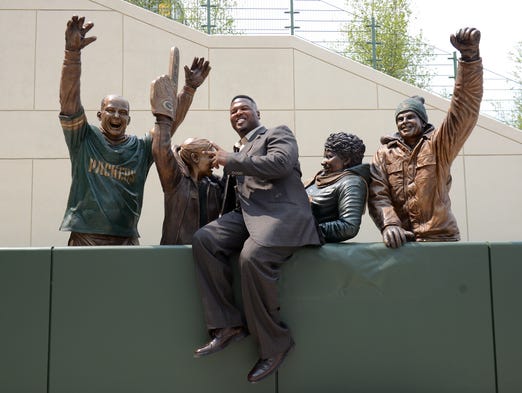
In 1993, Leroy Butler returned a fumble for a touchdown. Seeing a fan in the south stands who had his arms out and, as Butler put it, seemed to be saying, "Hug me," he jumped into the stands. Thus was born the Lambeau Leap. I don't know what Curly or Lombardi would have thought of it, but Holmgren and his boys loved it. It became a Packer tradition, and, last season, outside the Pro Shop (outside the stadium), with Butler invited back to recreate the moment, the Packers dedicated the Leap Wall, a padded green wall with statues of 4 fans behind it (one waving a big foam "We're Number 1" finger).
Butler at the dedication
After the Game. You should be safe going out. As I said, Lambeau Field is in the middle of a parking lot, not in a neighborhood, good or bad. You might have a traffic issue, but not a safety issue.
The Stadium View, calling itself "Not Just a Bar & Grill," is a block away from the stadium, at 1963 Holmgren Way at Tony Canadeo Run. Shenanigans Pub, long owned by the late 1960s Packer guard Fred "Fuzzy" Thurston, is probably the most famous eatery or bar in town. 1279 Main Street at Irwin Avenue, almost right across the river from the site of City Stadium. A bar named Hagemeister Park, festooned with Packer memorabilia, now stands at 325 N. Washington Street between Main and Pine.
It's unlikely a city as small as Green Bay will have many expatriate New Yorkers, and would thus be a good place for visitors to take in. I also haven't been able to find a reference to any Milwaukee bar or restaurant that caters to New Yorkers.
If you visit during the European soccer season, believe it or not, despite being a small city, Green Bay has a place that shows the games: Gipper's Sports Bar & Grill, 1860 University Avenue, about 2 1/2 miles east of downtown. Unfortunately, there's no bus service at that time of the morning on the weekend.
Sidelights. Green Bay is a big town, but a small city. Aside from Packer-connected stuff, there isn't a whole lot to see there.
UPDATE:
On February 3, 2017, Thrillist made a list ranking the 30 NFL cities (New York and Los Angeles each having 2 teams), and, due to its small size and comparative lack of options, Green Bay did indeed finish 30th and last:
This really isn't fair. Green Bay wouldn't even perform all that well on a ranking of cities IN WISCONSIN. Pitting it against the nation's great metropolises is like pitting opposing defenses against Aaron Rodgers. So yeah, it's a good thing the team is generally successful, because the town has all the personality of an AutoZone parking lot.
They're wrong about the personality. There are some things in town worth visiting:
* Site of Bellevue Park. The Packers played the 1923 and 1924 seasons at this minor-league baseball park. It seated just 5,000, and was east of downtown, across the East River. Although it probably saved the Packers in the short term -- any professional football team playing at a professional baseball park was considered to be of a higher class than one playing on a simple sandlot such as Hagemeister Park -- it was not a football stadium, and the Packers needed a real one. 1600 block of Main Street, by Franz Avenue.
The Brewers are the closest MLB team, 119 miles away; the Chicago Cubs, 204 miles; the Chicago White Sox, 209 miles; the Minnesota Twins, 278 miles. And the Brewers have a 75 percent stranglehold on Green Bay area baseball fans.
There are currently 2 minor-league baseball teams in Wisconsin, both in the Class A Midwest League, 3 steps below the majors. The Wisconsin Timber Rattlers play at Neuroscience Group Field at Fox Cities Stadium, in Appleton, 32 miles southwest of Green Bay, 106 miles north of Milwaukee, and 106 miles northeast of Madison. And the Beloit Snappers (their logo is a turtle) play at Harry C. Pohlman Field, 2301 Skyline Drive in Beloit, 50 miles southeast of Madison and 75 miles southwest of Milwaukee, and 168 miles southwest of Green Bay.
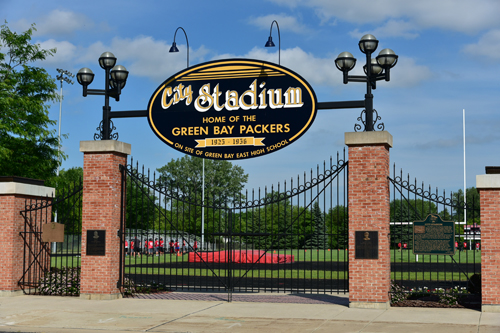
* Hagemeister Park and City Stadium. Owned by the long-gone Hagemeister brewery, Hagemeister Park was the Packers' first home, from 1919 to 1922. There wasn't much in the way of seating, and fans would often sit in their cars to watch games. George Calhoun, who founded the team with Lambeau, would get out and pass a hat for contributions at halftime, and that's the main reason the team lasted long enough to get a proper home stadium.
The park was cleared for the construction of a new building for East High School -- oddly enough, Curly Lambeau's alma mater. When the new East High School opened in 1923, on a triangle bordered by Walnut Street, Baird Street and the East River, City Stadium was built behind it. Originally seating 6,000, it was expanded into a 25,000-seat horseshoe, open at the south end.
Although the Packers won 6 titles there, it was seen as too small for the bigger game that pro football was becoming after World War II. Just as George Halas of the Bears saved them with the velvet glove 25 years earlier, in the mid-1950s he saved them with the iron fist, talking the other NFL owners into providing the funds to build a new stadium, or they would order the moving of the team, to Milwaukee or somewhere else. In 1956, the City Council voted to build new City Stadium, which opened the next year.
City Stadium, renamed East Stadium until the new one was renamed for Lambeau, remained the home field of East High School, and in 2008 was renovated, leaving no part of the original structure remaining. 1415 E. Walnut Street. It's within walking distance of downtown, unlike Lambeau Field.
* Brown County Veterans Memorial Arena. Across the street from Lambeau Field, this 5,248-seat arena opened in 1958, and from 1968 to 2002 was the home court of the University of Wisconsin at Green Bay basketball team. It's also hosted minor-league basketball and hockey (the Green Bay Bobcats played from 1958 to 1981, winning league titles in 1959, '60, '63 and '72), and pro wrestling. Elvis Presley gave one of his last concerts here, on April 28, 1977.
Other Wisconsin arenas to have been played by Elvis were the Mary E. Sawyer Auditorium in La Crosse on May 14, 1956; the Milwaukee Auditorium on June 14 and 15, 1972; the Milwaukee Arena (the MECCA) on June 28, 1974 and April 27, 1977; and the Dane County Coliseum in Madison on October 19, 1976 and June 24, 1977. (The Beatles played in Milwaukee, but not in Green Bay.)
The nearest NBA team is the Milwaukee Bucks, 115 miles away, easily beating the Chicago Bulls (206) and the Minnesota Timberwolves (278). The nearest NHL teams are the Chicago Blackhawks (206) and the Minnesota Wild (268). And the nearest MLS team is the Chicago Fire (216). However, due to (fairly) recent success for the Bulls, but not for the Bucks, the Bucks lead in popularity isn't as much as it is in nearby cities like Oshkosh and Sheboygan. Indeed, in Madison, the seat of the University of Wisconsin, the Bulls are more popular.
What else is there to do in Green Bay? Well, there's Bay Beach Amusement Park: 1313 Bay Beach Road at Irwin Avenue. There's a Botanical Garden: 2600 Larsen Road, off Packerland Drive. There's a zoo: 4378 Reforestation Road of Sunrise Road. And a National Railroad Museum, 2285 S. Broadway at Bosar Avenue -- ironic, considering that Amtrak doesn't go to Green Bay.
There have been plenty of TV shows and movies set in Wisconsin, but never in Green Bay. You would think that, by now, someone would have made a movie out of the Ice Bowl. In 1973, 3 years after Lombardi's death from cancer (like Babe Ruth, his funeral was at St. Patrick's Cathedral), ABC aired a TV-movie titled
Etched In Granite, with Ernest Borgnine playing Lombardi. Eric Simonson wrote
Lombardi, a play based on Maraniss' book, that ran on Broadway from October 2010 to May 2011, and while it got some good reviews, it failed to capitalize on the Pack's Super Bowl XLV win in February. Dan Lauria, best known as the father on
The Wonder Years, played the coach; Judith Light, best known as the mother on
Who's the Boss?, played his wife Marie.
And if you'd like to pay your respects at Lombardi's grave, surprise: You can do that almost anytime, because he's buried in New Jersey. He is so identified with Green Bay that a lot of people forget his New York Tri-State Area roots. He was from Brooklyn, went to Fordham, coached at the now-defunct St. Cecilia's High School in Englewood, at West Point and with the Giants, before becoming the Packers' head coach. Marie was from Red Bank, and they are buried across the Navesink River, at Mount Olivet Cemetery, on Chapel Hill Road off State Route 35 in Middletown. Lambeau, however,
is buried in Green Bay, at Allouez Catholic Cemetery, 2121 Riverside Drive at Allouez Avenue. (The late Jets and Madison Square Garden boss Sonny Werblin is buried at a Jewish cemetery, almost right across Route 35.)
For Milwaukee sites,
here's my 2016 guide for that city. The Packers played a game at Borchert Field (home of the old minor-league Milwaukee Brewers) in 1933, 2 games a year at State Fair Park in suburban West Allis from 1934 to 1951, 2 at Marquette Stadium in 1952, 2 at Milwaukee County Stadium from 1953 to 1977, and then 3 at County Stadium from 1978 to 1994. It was only in 1995 that they've played all their home games in Green Bay, save for 1 exhibition game at Camp Randall Stadium in Madison, home of the University of Wisconsin, 136 miles southwest of Green Bay.
Horlick Field opened in 1907, and hosted the Racine Legion from 1919 to 1924 (including 1922 to '24 in the NFL), the NFL's Racine Tornadoes in 1926, and the Racine Belles of the All-American Girls Professional Baseball League from 1943 to 1950. The current 8,500-seat stadium on the site hosts high school sports. 1648 N. Memorial Drive in Racine, Wisconsin, 29 miles south of downtown Milwaukee, and 70 miles north of Chicago's Loop. Amtrak from either to Sturtevant, then Bus 8.
The Kenosha Maroons played in the NFL in 1924, at Nash Field. The 5,000-seat stadium also hosts high school sports. 5909 56th Street in Kenosha, Wisconsin. Even though it's closer to Milwaukee (34 miles as opposed to 60), it can only be reached by public transportation from Chicago, riding the train from the Ogilvie Transportation Center (the former Northwestern Station) to Kenosha, then Bus 2.
The Sheboygan Red Skins played pro basketball from 1933 to 1952, winning the National Basketball League title in 1943 (making them, technically, if not officially recognized by the NBA, World Champions in the sport), and were merged into the NBA for the 1949-50 season.
Due to Sheboygan's small size (about 50,000 people, smaller even than since-abandoned NBA cities Syracuse, Rochester and Fort Wayne), the rest of the league wanted them out, and got their wish. They lasted only 2 years in their new league, and folded. But they are still winners of a World Championship. They played at the 3,974-seat Sheboygan Municipal Auditorium and Armory, 58 miles north of Milwaukee (Bus 916) and 67 miles south of Green Bay.
Wisconsin was the location of 3 famous nostalgia-based TV shows:
Happy Days, airing 1974 to 1984, but set from 1955 to 1965, in Milwaukee; that show's spinoff,
Laverne & Shirley, running from 1976 to 1983, and set in Milwaukee from 1957 to 1964, before moving to Los Angeles for 1965 to 1967; and
That '70s Show, airing 1998 to 2006, but set from 1976 to 1979, in fictional Point Place, a name that may have been based on the real town of Stevens Point, but said to be a suburb of Green Bay.
The Dairy State/Badger State was also the location of the 1990s CBS drama
Picket Fences, set in the small town of Rome, which is the name of a real town in Wisconsin; the 1990s ABC sitcom
Step By Step, set in a fictionalized version of a real Wisconsin town, Port Washington; and the longtime CBS soap opera
The Young and the Restless, set in Genoa City, which is the name of a small town on the Wisconsin-Illinois State Line, but, on the show, we are led to believe it is a much larger city.
*
Essentially, the reason to go to Green Bay is for the Green Bay Packers. They are the most storied franchise in the National Football League. The Giants have many stories, some of them great, but the Packers have the most stories, and some of the best.
But, seeing as how it won't be "Green Bay cold," you should be able to have fun watching the Giants play the Packers at Lambeau Field.