Showing posts with label orlando cepeda. Show all posts

Friday, June 28, 2024

Orlando Cepeda, 1937-2024

This has already been a difficult season for baseball in the San Francisco Bay Area. The Oakland Athletics have been terrible, and have announced their move to Las Vegas, with a stop at Sacramento in between. The San Francisco Giants have also struggled, and are below .500. And they just lost their greatest legend, Willie Mays.

Now, they have lost another: Orlando Cepeda.

Orlando Manuel Cepeda Pennes was born on September 17, 1937 in Ponce, Puerto Rico. His father, Pedro Cepeda, was a professional baseball player, known as "The Big Bull" and "Perucho." Orlando later became known as "The Baby Bull" and "Peruchin." Due to his love of Latin-flavored jazz and dancing, he also became known as "Cha Cha."

Baseball was, metaphorically speaking, in his blood, and he got off to a good start. But the seeds of his difficulties were also sown early, as he injured a knee playing basketball at age 13, and it never fully healed. Pedro was a heavy drinker, and caught malaria in 1955. This combination killed him, but not before his son was signed by the New York Giants. Orlando paid for the funeral with his signing bonus.

The Giants moved from New York to San Francisco in the 1957-58 off-season, which denied Orlando the chance to play in front of New York's huge Puerto Rican population. But it helped him in his new home: San Franciscans took to him, and to the other rising stars of the Giants, like Willie McCovey, Juan Marichal, and the 3 Alou brothers, who were Dominicans like Marichal. (Although founded by Spanish monks, San Francisco did not, then, have a large Hispanic community.)

This worked in the young players' favor, but worked against their established star, Willie Mays, who was seen as New York's star, an interloper. Frank Conniff of the New York Journal-American, perhaps the only man ever to interview both men, wrote, "This is the damnedest city. They cheer Khrushchev and boo Willie Mays."

Cepeda and the West Coast made their major league debuts together, on April 15, 1958, at Seals Stadium in San Francisco. The Giants played their also-transplanted arch-rivals, the Brooklyn, now Los Angeles, Dodgers. Batting 5th, playing 1st base, and wearing the Number 30 he would wear for most of his career, Cepeda went 1-for-5, the hit a solo home run off Don Bessent in the 5th inning, and the Giants cruised to an 8-0 win. Cepeda was named the National League's Rookie of the Year. In 1959, he was named to the 1st of 11 All-Star Games. 

In 1961, Cepeda batted .311, and led the NL with 46 home runs and 142 runs batted in, making him the 1st Hispanic player to lead either League in both categories. But the Cincinnati Reds won the Pennant, and so Cepeda finished 2nd to Frank Robinson in the voting for the NL's Most Valuable Player. In 1962, the Giants won their 1st Pennant in San Francisco, with Cepeda batting .306 with 35 homers and 114 RBIs. But they lost the World Series to the Yankees.

But he re-injured his knee playing in Puerto Rico's Winter league. After playing through the injury with strong seasons in 1963 and 1964, he only made 40 plate appearances in 1965, and that may have cost the Giants the Pennant, as they fell just 2 games short of the Los Angeles Dodgers. There was also the issue of the fact that both Cepeda and McCovey were natural 1st basemen. There was no designated hitter at the time, and both men hit too well to be kept out of the lineup.

And so, on May 8, 1966, not only did the St. Louis Cardinals lose to the Giants, 10-5, in their last game at Busch Stadium, formerly known as Sportsman's Park, which opened in 1909 as the last in a series of ballparks on the site starting in 1866, but they traded pitcher Ray Sadecki, even-up, to the Giants for Orlando Cepeda.

Interviewed 20 years later by former Cardinal teammate Tim McCarver, Cepeda said he knew that the trade was contingent upon him passing a physical exam. So when the Cardinal team doctor asked him to show the knee, Cepeda showed the other knee. It was fine, the doctor approved the trade, and Warren Giles, President of the National League, approved the trade. Cepeda rebounded, and was named NL Comeback Player of the Year.

In 1967, Cepeda put the Cardinals on his back, and carried them to the Pennant. Ace pitcher Bob Gibson missed a few weeks when Roberto Clemente of the Pittsburgh Pirates hit a line drive off his shin. Lou Brock had another strong season, but Cepeda batted. .325 with 25 homers and a League-leading 111 RBIs. It was a well-balanced team. Cepeda was a unanimous choice for NL MVP. Oddly, McCarver came in 2nd in the voting, while teammates Brock came in 7th, Julián Javier 9th, and Curt Flood 13th. 
Noting the team's Hispanic influence, fans called the team "El Birdos," and came to the new Busch Memorial Stadium wearing Mexican-style sombreros, unaware of the huge differences in Latin America or in the nature of the Spanish language: "The Cardinals" would be "Los Cardenales," "The Birds" would be "Los Aves," and a Puerto Rican would be more likely to wear what's known as a "Panama hat."

Still, as they had when winning the World Series in 1964, the Cardinals had a good combination of "white" and "black," and now had enough "brown" to be a nearly fully-integrated team. Managed by 1940s 2nd baseman Albert "Red" Schoendienst, and bolstered by a resurgent Gibson and the acquisition of Roger Maris from the Yankees, the Cards beat the Boston Red Sox in the World Series. Orlando Cepeda had his ring.

The 1968 season was the "Year of the Pitcher": Despite the Cardinals winning another Pennant, but losing the World Series to the Detroit Tigers, Cepeda had his worst statistical full season yet, with career lows in batting average, .248; home runs, 16; and RBIs, 73. He reported late to Spring Training in 1969, and the Cardinals traded him to the Atlanta Braves for Joe Torre.

Cepeda was concerned about Jim Crow laws, but found himself treated well in Atlanta. He bounced back, and, in that 1st season of Divisional Play, helped the Braves win the NL Western Division. (Why they weren't in the East until the 1994 season, I don't know.) He had an even better season, statistically, in 1970.

But early in the 1971 season, he re-injured his knee, and hardly played over the next year. In mid-1972, the Braves traded him to the Oakland Athletics. He played 3 games before the injury ended his season. The A's did not include him on their postseason roster, and released him. He was 35, and looked done.

Then came the designated hitter, only to the American League, in 1973. He signed with the Boston Red Sox, and became the 1st player to hit at least 20 home runs in a season with 4 different teams, including what would now be called a walkoff homer against the Yankees at Fenway Park on April 8.

But the knee remained a problem, and he was released in Spring Training 1974. The Kansas City Royals picked him up, but he only played in 33 games, and was released at the end of the regular season. He was finished, with a .297 lifetime batting average, 2,351 hits including 379 home runs, 1,365 RBIs, and a career OPS+ of 133. Impressive -- but worthy of the Baseball Hall of Fame?

Cepeda married 3 times, and had 3 sons and a daughter. His 2nd wedding came shortly after his retirement. Shortly after that, he was running a baseball clinic in the South American nation of Colombia, when he was asked to help them move some marijuana to Puerto Rico. Already a longtime smoker, he had no problem with this. But the shipment turned out to be a lot bigger than he expected, and someone tipped off the San Juan police, and he was arrested. It took until 1978 for the case to reach trial, and he was sentenced to 5 years in prison, though he only served 10 months.

Shortly after his release, he was hired as a scout by the Chicago White Sox. In 1987, he was brought back into the Giants' fold, first as a scout, and then as a goodwill ambassador to Latin American countries.

In 1999, with many believing the drug conviction had held him back, he was elected to the Baseball Hall of Fame, making him only the 2nd Puerto Rican, after Clemente, to be elected. The Giants subsequently retired his Number 30. In 2000, in reflection of Boog Powell's barbecue stand in Baltimore, Orlando's Caribbean BBQ opened at the Giants' new ballpark, now named Oracle Park. In 2008, the Giants dedicated a statue of him outside the park.
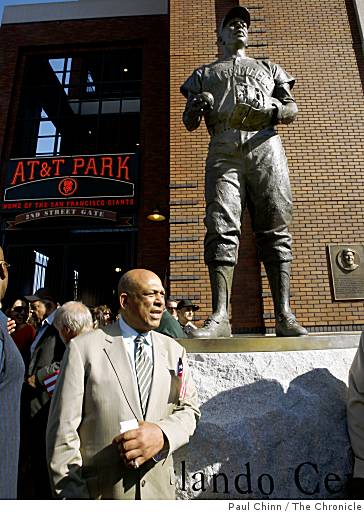
I don't know why his statue is wearing a road uniform.

The Cardinals have not retired his number, but they have elected him to their team Hall of Fame. He has also been elected to the Puerto Rico Sports Hall of Fame, the Bay Area Sports Hall of Fame, and the Missouri Sports Hall of Fame.

Orlando Cepeda died today, June 28, 2024, at the age of 86. His wife, Nydia, released a statement: "Our beloved Orlando passed away peacefully at home this evening, listening to his favorite music and surrounded by his loved ones. We take comfort that he is at peace."

* Bob Melvin, manager of the Giants, who grew up as a Giants fan in nearby Palo Alto, California: "Man, what another gut punch. Another just incredible personality and just beloved here. Statue out front. The numbers he put up, there are a lot of legends here and he's certainly right in the middle of that. To have it so close in proximity to Willie, it's kind of staggering."

* Dave Roberts, manager of the Dodgers, who were playing in San Francisco when the Giants announced Cepeda's death: "I don't think there's anyone in baseball that can say a bad word about Orlando. To lose two baseball greats, two great Giants... there was a somberness in the stadium tonight."

The Giants won this past Monday, in their 1st home game since Mays died; and again last night, after Cepeda died, both times on walkoff plays. Seems fitting. In the postgame spraying of water bottles, the letters "O.C." seemed to form, and had nothing to do with Orange County, home to the Los Angeles Angels.
With his death, there are now 4 surviving members of the 1962 National League Champion San Francisco Giants: Juan Marichal, Felipe Alou, Jim Duffalo and Manny Mota.

There are 8 surviving members of the 1967 World Champion St. Louis Cardinals: Steve Carlton, Julián Javier, Dal Maxvill, Ray Washburn, Bobby Tolan, Ed Spiezio, Dick Hughes and Larry Jaster.

There are 5 players left from the East-West All-Star Game played in Los Angeles, as a civil rights charity game in memory of Dr. Martin Luther King in Spring Training 1970: Pete Rose, Johnny Bench and Reggie Jackson from the West team; and Reggie Smith and Mike Andrews from the East team.

And there are 7 players left who were their teams' 1st-ever designated hitters in 1973: Ron Blomberg, Tony Oliva, Tommy McCraw, Rico Carty, Mike Andrews, Bill North and Terry Crowley.

It was in writing this post that I learned that, in Spanish-speaking places, the Hall of Fame is El Salón de la Fama. People who believe "Everything sounds better in Spanish" certainly have a case there.

Orlando Cepeda was great in any language.

Thursday, October 12, 2023

October 12, 1963: The Latin American All-Star Game

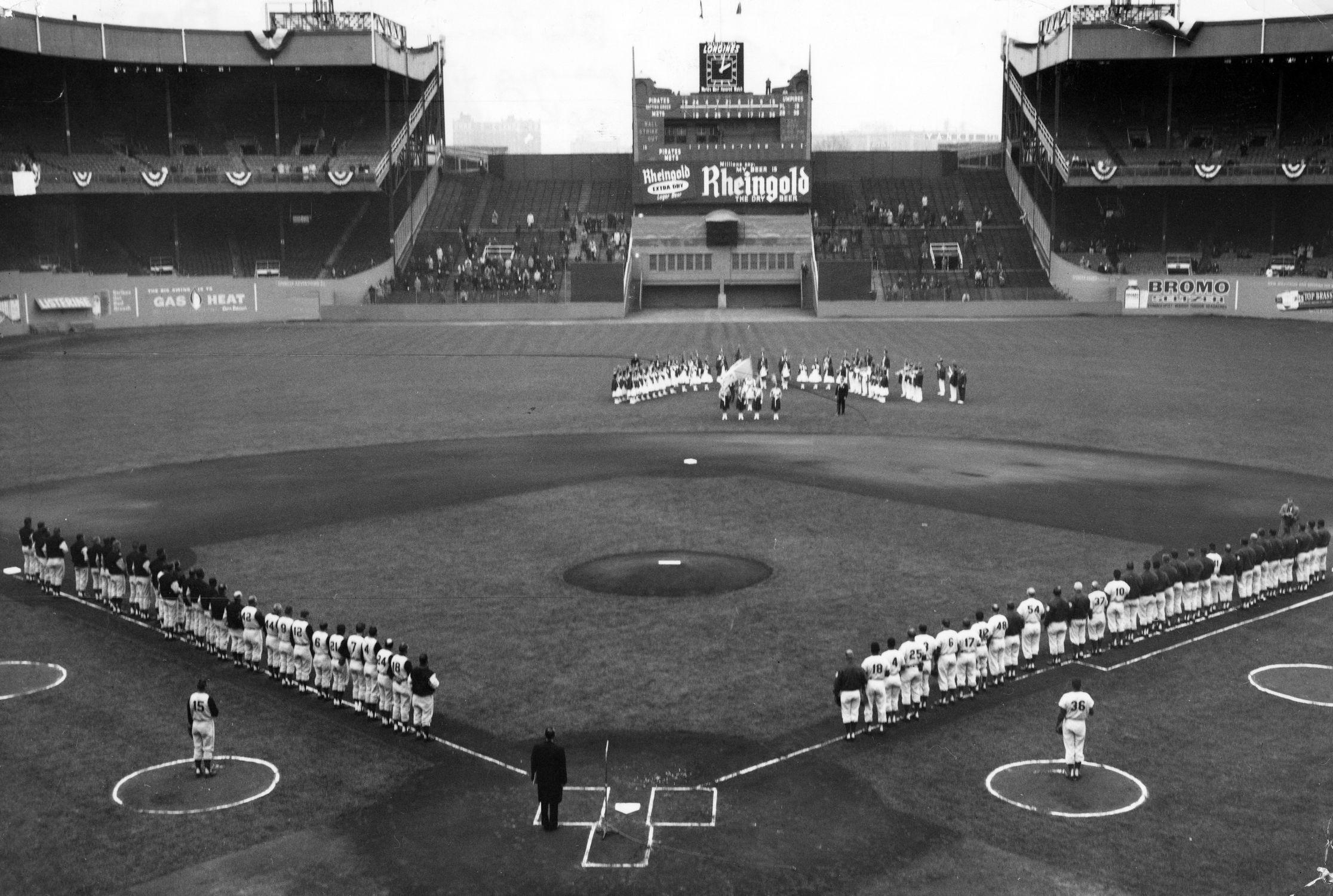
October 12, 1963, 60 years ago: Since 1883, baseball games had been played at locations named "The Polo Grounds." This would be the last one. It remains a game unlike any other in baseball history.

The old Harlem Horseshoe hosted the Latin American All-Star Game. A team of Latin stars from the National League beat their American League peers, 5-2. The postseason exhibition, in which Minnesota Twins 1st baseman Vic Power, a native of Puerto Rico, is honored as the top Latin American player during a pregame ceremony. That ceremony includes future Hall of Famers Luis Aparicio, Orlando Cepeda, Roberto Clemente, and Juan Marichal.
Marichal started the game for the National League, later saying, "It was historic. There was a lot of emotion among all the players, and you could tell the fans were excited about it, too."

Despite the rise of Hispanic players, the rosters weren't quite filled-out. The American League's 1st baseman was Julio Becquer, who didn't even have an official at-bat that season: He appeared in 1 game, as a pinch-runner for the Twins, though he did come around to score.

The National League team had trouble finding catchers. Their starter was Facundo "Cuno" Barragan, a Mexican-American from California, who struck out in his only at-bat that year for the Chicago Cubs. That was the last of his 190 major league plate appearance.

The other catcher on the NL roster wasn't even Hispanic: It was Joe Pignatano, formerly of the Brooklyn Dodgers, who had closed out his career the previous season, grounding into a triple play to end the Mets' season at the Polo Grounds. He went on to coach for the Mets, including in their 1969 World Championship season.

Only 14,235 fans attended this game, a terribly small crowd for the dual occasion of the coming-out party for Hispanic ballplayers and baseball's farewell to one of its most historic venues. 

Tuesday, July 25, 2017

Top 10 Athletes From Puerto Rico

July 25, 1952: Puerto Rico adopts its current Constitution, making it a Commonwealth of the United States, but not a State.

Top 10 Athletes From Puerto Rico

Remember: To qualify for this list, the person in question has to have been trained to play his or her sport in Puerto Rico. Where he or she was born, or went on to play, does not necessarily have any bearing on it. Therefore, Héctor "Macho" Camacho, born in Bayamón, and Héctor Camacho Jr., born in San Juan, do not qualify, because both were raised in New York.

As you might expect, baseball players and boxers dominate this list. 

Honorable Mention to José "King" Roman of Vega Baja. He came closer than any Puerto Rican to winning the Heavyweight Championship of the World, but George Foreman wrecked him in the 1st round in Tokyo on September 1, 1973.

Honorable Mention to Carlos Arroyo of Fajardo. Probably the best basketball player from Puerto Rico, he was a career backup in the NBA from 2001 to 2011, playing with the Toronto Raptors, Denver Nuggets, Utah Jazz, Detroit Pistons, Orlando Magic, Miami Heat and Boston Celtics.

He has had a considerably better career in European leagues, playing for such famous sports clubs as Maccabi Tel Aviv in Israel, and Besiktas and Galatasaray in Istanbul, Turkey. About to turn 38, the point guard now plays in his homeland, for his original professional team, Cariduros de Fajardo, of which he is now co-owner.

Dishonorable Mention to Iván Rodríguez. I don't care that he's now in the Hall of Fame, and considered the greatest catcher of his generation: He cheated, and does not make the Top 10. Nor, for the same reason, does Pudge's Texas Ranger teammate Juan Gonzalez. (For the same reason, another teammate, Rafael Palmeiro, wouldn't make the Florida team I will eventually do.)

10. Monica Puig of San Juan. At 23, an age by which many women's tennis players have already peaked, she has yet to even come close to winning a Grand Slam event. But she won the women's singles title at the 2016 Olympics in Rio de Janeiro, Brazil.

9. Wilfredo Gómez of San Juan. "Bazooka" (that's a great nickname for a boxer) was Super Bantamweight Champion of the World from 1977 to 1983, Featherweight Champion of the World for much of 1984, and Junior Lightweight Champion of the World in 1985 and 1986.

8. Sixto Escobar of Santurce. The 1st Puerto Rican to win a World Championship in any of boxing's weight classes, he knocked Mexican fighter Rodolfo "Baby" Casanova out in the 9th round at the Montreal Forum on June 26, 1934, to take the Bantamweight Championship. This was appropriate, since a bantam is a rooster, and his nickname was El Gallito, the Little Rooster. (Better than "the Little Chicken.")

He held the title until 1938. In 1939, he won a fight at a stadium named for him in San Juan. Upon his discharge from the U.S. Army after World War II, he found it too difficult to make weight, and opened a liquor store. Unfortunately, like so many men who ran liquor stores and bars, he sampled too much of his own product, and his drinking combined with diabetes killed him in 1979, only 64 years old. The stadium still stands, and a statue of him has been added.

7. Carlos Delgado of Aguadilla. A 2-time All-Star, the 1st baseman led the American League in RBIs in 2003, including those he drove in when he tied the major league record with 4 home runs in a game.

He was a bit unlucky, being called up as a rookie with the Toronto Blue Jays too late to make their 1993 World Series roster. He only made the postseason once more, with the 2006 Mets, and was part of their 2007 and '08 collapses. Nevertheless, he hit 473 career home runs, was named to the Blue Jays' Level of Excellence (their version of a team hall of fame), and should be seriously considered for the Baseball Hall of Fame in Cooperstown. He became eligible for it in 2015.

6. Carlos Beltrán of Manatí. A 9-time All-Star, the center fielder has won 3 Gold Gloves, was AL Rookie of the Year in 1999, and is a member of the 30-30 Club (30 home runs and 30 stolen bases in a season).

After starting with the Kansas City Royals, he has reached the postseason with the 2004 Houston Astros, the 2006 Mets, the 2012 and 2013 St. Louis Cardinals, the 2015 Yankees, and the 2016 Rangers, and will do so again with the 2017 Astros.

He recently turned 40, but shows no signs of slowing down. Going into tonight's games, he has a .280 lifetime batting average, 2,690 hits including 433 home runs, and 312 stolen bases. Of all players with more career stolen bases, the only players with more career home runs are Willie Mays, Andre Dawson (in each case, barely), and 2 guys with asterisks, Barry Bonds and Alex Rodriguez.

He should be headed for the Hall of Fame. In spite of his failure to swing on the final out of the 2006 National League Championship Series, Met fans voted him -- not Tommie Agee, Mookie Wilson or Lenny Dykstra -- the center fielder on their 50th Anniversary Team in 2012.

5. Roberto Alomar of Salinas. There are reasons to not like him, but his career is loaded. He was a 12-time All-Star and a 10-time Gold Glove. He had a .300 lifetime batting average, and 2,724 career hits, including 210 home runs, and 474 stolen bases.

He won back-to-back World Series with the 1992 and '93 Toronto Blue Jays, and also reached the postseason with the 1996 and '97 Baltimore Orioles, and the 1999 and 2001 Cleveland Indians. He was elected to the Baseball Hall of Fame, and his Number 12 is the 1st number retired by the Jays, who also elected him to their aforementioned Level of Excellence.

His brother Sandy Alomar Jr., and their father Sandy Alomar Sr., can be considered Honorable Mentions.

4. Félix Trinidad of Fajardo. He was Welterweight Champion of the World from 1993 to 2000, and Middleweight Champion of the World briefly in 2001.

3. Orlando Cepeda of Ponce. His father Pedro Cepeda was a great player, known as Perucho, The Bull, but was kept out of North American pro ball for being black. His son, known in Puerto Rico as Peruchin or the Baby Bull, was fortunate enough to debut after integration.

An 11-time All-Star, the man also nicknamed Cha-Cha for his dancing ability was the 1958 NL Rookie of the Year and the 1967 NL Most Valuable Player. He led the NL in home runs with 46 and RBIs with 142 in 1961, and led it in RBIs again with 111 in 1967.

He won Pennants with the 1962 San Francisco Giants and the 1967 and '68 St. Louis Cardinals, winning the World Series in '67. He also reached the NLCS with the 1969 Atlanta Braves and won another Series with the 1972 Oakland Athletics, although injuries kept him off the World Series roster. He batted .297 for his career, and hit 379 home runs. The Giants retired his Number 30, and he was elected to the Baseball Hall of Fame.

2. Miguel Cotto of Caguas. Born in Providence, Rhode Island, but raised in Caguas from age 2, he has held titles ranging from Light Welterweight to Middleweight from 2004 to 2015. An 11-year run as a top contender is impressive enough, but that's 11 years as a World Champion, regardless of how much boxing's titles have been fragmented the last half-century.

1. Roberto Clemente of Santurce. Was there ever going to be a doubt that The Great One -- a nickname he had after actor Jackie Gleason, but before hockey player Wayne Gretzky -- would be this list's numero uno? He was a 15-time All-Star, a 12-time Gold Glove, a 4-time NL batting champion, and the 1966 NL MVP.

He played in 14 World Series games, and got a hit in every one of them, helping the Pittsburgh Pirates win the 1960 World Series, and being named the MVP of the Pirates' win in the 1971 World Series, which raised him from Caribbean icon to American icon.
Although he played most of his home games at Forbes Field, whose dimensions were similar to the pre-renovation original Yankee Stadium, limiting him to 240 career home runs, his lifetime batting average was .317, his OPS+ 130, and he collected an even 3,000 hits.

We know how the story ends, on New Year's Eve 1972. It's worth noting that, in that season, at age 38, he batted .312, and had 10 home runs and 60 RBIs, despite missing most of July with an injury, and helped the Pirates reach their 3rd straight NLCS. He got hits in 21 of his last 31 games that season. He batted .341 the season before.

This was, at most, a first step toward age-related decline. He was selected for the All-Star Team in 1972, and it wasn't a gift to an aging player from a public unwilling to disappoint a proud man: He earned it. Hank Aaron and Willie Mays were both still legitimate All-Stars at age 40, and playing at 42. There's no reason to suspect that Clemente, had he been spared by tragedy, wouldn't have matched them.

The Pirates retired his Number 21, erected a statue of him outside Three Rivers Stadium, moved it to PNC Park, and made the right field wall at that park 21 feet high in his honor. The 6th Street Bridge, connecting downtown Pittsburgh with the ballpark and the Steelers' Heinz Field, is named for him.

He was the 1st Caribbean-born player elected to the Baseball Hall of Fame, and was the highest-ranking Hispanic player, Number 20, on The Sporting News' 1999 list of the 100 Greatest Baseball Players. In 2003, George W. Bush posthumously awarded him the Presidential Medal of Freedom.

Saturday, November 15, 2014

Alvin Dark, 1922-2014

When I was a kid, there was a book called Benchwarmer's Sports Trivia, by Bob Alexander. (He's still alive, and published a book about the Wild West this year.) One of the questions was, "Who is the only man to hit a home run off Sandy Koufax and catch a touchdown pass from Y.A. Tittle?"

Some men had done one or the other. Alvin Dark is the only one who did both. Until now, Dark, Koufax and Tittle were all still alive, although Tittle is in the throes of Alzheimer's disease.

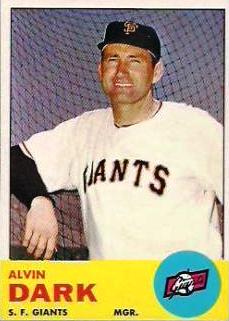
Alvin Ralph Dark was born on January 7, 1922, in Comanche, Oklahoma, about halfway between Oklahoma City and Dallas. He grew up in Lake Charles, Louisiana, about halfway between Baton Rouge and Houston. He attended Southwestern Louisiana University (now the University of Louisiana at Lafayette, later attended by another New York baseball star, Ron Guidry) before transferring to Louisiana State University in Baton Rouge, where he played football and caught the aforementioned touchdown pass from Tittle. In 1945, he was drafted by the Philadelphia Eagles.

But the NFL didn't pay much in those days, and Dark was better at baseball anyway. He signed with the Boston Braves, and made his major league debut on July 14, 1946, at Forbes Field in Pittsburgh. Wearing Number 23, he came in as a defensive replacement at shortstop in the 9th inning, and didn't come to bat. The Pirates won, 5-2.

After spending most of 1946 and 1947 in the minor leagues, he was called back up in 1948, was given Number 2, and was made the Braves' starting shortstop. It was their last great season in Boston. He batted .322 to win the National League Rookie of the Year award, and finished 3rd in the Most Valuable Player voting behind Stan Musial of the St. Louis Cardinals and his Braves teammate, pitcher Johnny Sain -- possibly splitting the Braves' vote to throw the award to Stan the Man. But the Braves won the Pennant, their 1st in 34 years. They lost the World Series to the Cleveland Indians, however.

*

The Braves couldn't sustain their success, and, needing to save money, they traded Dark and their starting 2nd baseman, former Brooklyn Dodger star Eddie Stanky, to, of all teams, the Dodgers' arch-rivals, the New York Giants, where Stanky's former manager Leo Durocher was running things. In return, the Braves got Sid Gordon, who'd finished 4th behind Dark in the '48 MVP race, and 3 guys you don't need to know about.

Wearing his now-familiar Number 19, Dark was able to thrive under Leo the Lip, playing in 3 All-Star Games in 4 seasons. In 1951, he batted .303, his 1st season over .300, and hit a League-leading 41 doubles. The Giants won the Pennant in a dubious stretch run and Playoff victory over the Dodgers, and Dark played in the game where Bobby Thomson hit the home run that meant, as broadcaster Russ Hodges said over and over again, "The Giants win the Pennant!" But they lost the World Series to the Yankees.

As the Durochermen's leadoff hitter, Dark led the NL in at-bats in 1953 and 1954, and in the latter year, the Jints won the Pennant again. This time, Dark was on the field in Game 1 of the World Series against the Indians, when Willie Mays made the most famous catch in baseball history; and in the dugout when Dusty Rhodes hit the pinch-hit home run that won the game in the 10th inning. The Giants swept the Indians, and Dark had his World Series ring on his 3rd try.

Yankee pitcher Jim Bouton likes to tell a story about a game he went to after his family moved from Rochelle Park, Bergen County, New Jersey, where they'd been Giants fans, to Chicago Heights, Illinois. They waited for the Giants to come to Wrigley Field to play the Chicago Cubs, and Jim and his brother Pete went to the game. They got seats behind the visitors' dugout, on the 1st base side, and, in a time-honored tradition, the older brother held the younger brother by his ankles, dangling him over the dugout roof, so he could see in, pen in one hand, program in the other, so he could get autographs.

The dangling Jim saw Dark, and said, "Hey, Al, my name's Jim, I'm not a Cub fan, I'm a Giant fan, I'm from New Jersey, can you sign my program, please?" After a minute, Pete pulled Jim back up, saw that he didn't get an autograph, and asked him what happened. Jim said Dark told him, "Take a hike, son."

Pete wasn't furious that a player had so coldly dismissed his brother. He was thrilled that a real live major league ballplayer had spoken to his brother: "No kidding? Alvin Dark told you to take a hike?" When they got home, their mother asked them what happened. Rather than tell her who won, or about anything that happened in the actual game, Pete said, "Alvin Dark told Jim to take a hike!" After that, whenever someone in the Bouton family wanted to get rid of somebody, even if it was one of the parents, it would be, "Take a hike, Jim," "Take a hike, Mom," or, "Take a hike, Dad."

Asked about the incident years later, Dark denied it, saying, "That's not true. I didn't even know Bouton when he was a kid."

As a veteran ballplayer in his early 30s, Dark had probably completely forgotten about it. He may have told dozens of kids, "Take a hike, son." But Jim has never forgotten it.

Think of it this way: How many of those 1950s Giants are remembered today? Willie Mays is, and so is Bobby Thomson, and so is Dusty Rhodes. Monte Irvin, maybe Sal Maglie. That's about it. But Dark is remembered, because Jim Bouton told the story in Ball Four. People generally don't know what kind of player Dark was, but they remember that he played for the Giants in New York, and that he told Jim Bouton as a boy, "Take a hike, son."

*

He should be remembered: While not as celebrated as the other New York shortstops of the time, Phil "the Scooter" Rizzuto of the Yankees and Harold "Pee Wee" Reese of the Giants, Alvin "Al," "Blackie" or "the Swamp Fox" Dark was a better hitter than either one.

He would hit .300 a total of 4 times, and, in a time when shortstops simply didn't hit much -- Ernie Banks was about to offer the first real change of that idea -- he was the 1st NL shortstop to hit 20 home runs more than once. (Playing in the Polo Grounds with its short foul lines helped.) At the time he retired, only Banks (already) and early Giant Travis Jackson had hit more home runs as an NL shortstop than Dark's 126. He was a good fielder, too, as he led the NL in putouts and double plays 3 times each.

He was traded to the Cardinals in 1956, and to the Cubs in 1958, remaining a starting shortstop until 1959. He was with the Milwaukee Braves in 1960 when, after the season, the Giants, now in San Francisco, reacquired him, and offered him their manager's job. At just 39 years of age, he would be a manager for the 1st time.

*

The 1961 Giants won 85 games to finish 3rd in the NL. The next year, there was a classic Giants vs. Dodgers Pennant race, and, although it was on the opposite coast and it began much later, there was yet another Dodger collapse and yet another Giant surge, and yet another best-2-out-of-3 playoff for the Pennant that wasn't decided until the 9th inning of the last game.

It was decided at the Dodgers' home field this time, the brand-new Dodger Stadium in Los Angeles, and it wasn't nearly as dramatic -- the key play was a bases-loaded walk -- but the Giants again won the Pennant, finishing with 103 wins in their 165 games.
And, again, they lost the World Series to the Yankees. They traded wins, the Yankees winning the odd-numbered games and the Giants the even-numbered ones, until the Yankees won Game 7, 1-0.

The Dodgers won 3 of the next 4 Pennants, with the Giants getting close but falling short of the Cardinals in 1964 and the Dodgers in 1965 and 1966. The 1964 season should have been the Giants' big chance, with Sandy Koufax's injury opening the door to 5 teams finishing within 5 games of 1st, and the Dodgers not being one of them.

But the Giants weren't in the right frame of mind that season. In an interview with the Long Island paper Newsday, Dark -- a Southerner, remember -- lamented the large number of black and Hispanic players on his team. He had Willie Mays, Willie McCovey, Orlando Cepeda, Juan Marichal, and the brothers Felipe, Mateo ("Matty") and Jesus Alou. It wasn't baseball that was ahead of the curve in signing Jackie Robinson in 1947, it was Branch Rickey. In so many ways, baseball was behind the times.

And, in this year of the Civil Rights Act, the Mississippi Freedom Summer, and Martin Luther King receiving the Nobel Peace Prize -- with civil rights for Hispanics hardly even on anyone's radar -- Dark said of black and Hispanic players, "They are just not able to perform up to the white player when it comes to mental alertness."

In a multicultural metropolitan area like San Francisco, this was like sticking your finger in a light bulb socket. The uproar was huge. Dark responded that he had been severely misquoted. Mays, who had been Dark's teammate and whom Dark had named team Captain, came to his defense, and helped calm things down. Jackie Robinson himself came to the defense of his former Giant opponent: "I have found Dark to be a gentleman and, above all, unbiased. Our relationship has not only been on the ballfield but off it."

Dark lasted through the season, but the Giants fell short, 3 games back but in 4th place, and owner Horace Stoneham fired him on the last day of the season, and, had he so chosen, could have fairly said that it had been for competitive reasons, that the Giants should have won the Pennant, and should have won a World Series by then, but hadn't.

Dark knew he'd blown it. One by one, he found the players he'd offended, and apologized to them. Cepeda and Marichal accepted his apology. The Alou brothers did not.

*

Charlie Finley, a native of Birmingham, Alabama, hired him as a coach for the Kansas City Athletics, and promoted him to manager in 1966. But in August 1967, with Finley preparing to move the team to Oakland and just beginning to build the 1970s A's dynasty -- Reggie Jackson made his debut that season, and Catfish Hunter, Bert Campaneris and Sal Bando were already up -- he and Dark had a disagreement over player discipline, and Dark was fired.

He was immediately picked up by Cleveland, and the Indians finished 3rd in 1968, their best finish between 1959 and 1994. But owner Vernon Stouffer made the mistake of giving Dark the general manager's job as well, and since World War II that has rarely worked, as the 2 jobs are too much for any 1 man, partly because of the contradictory needs of the field manager to have the best players available and of the GM to reduce costs. The Indians started losing again, and Dark was fired from both jobs in 1971.

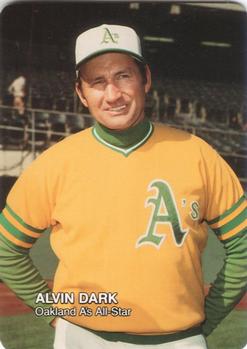
After Dick Williams had had enough of Finley after winning back-to-back World Series in Oakland, Finley hired Dark back for the 1974 season. It didn't start out well, as the players presumed (with some justification) that he would be a yes-man for the cheap owner, who was absentee when he was needed in Oakland and was in Oakland when it would have been better if he had stayed in his adopted hometown of Chicago.

He had recently rediscovered religion, and proselytized to his players, and they didn't like it. The black players saw a taste of his attitudes, and wondered if he even realized that he was being racist. And his bad decisions, particularly pulling starting pitchers too early -- shades of Joe Girardi and his pitch-count-reliant binder -- piled up. By June, with the A's trailing the Kansas City Royals in the American League Western Division, it got to the point where Bando, the A's captain, yelled for all the locker room to hear, "He couldn't manage a meat market!"

Dark heard this, and had enough. He didn't yell, but he calmly asserted his authority, and let them know that, while they didn't have to like the man, they were going to respect the manager. The players got the message: Things turned around, and the A's caught the Royals, and beat the Baltimore Orioles in the American League Championship Series for their 3rd straight Pennant. They'd won the Playoff in 4 games instead of the maximum 5, something they hadn't been able to do the previous 2 years under the much more discipline-minded Williams.

Dark became the 3rd manager, after Joe McCarthy (1929 Cubs and 1932 Yankees) and Yogi Berra (1964 Yankees and 1973 Mets) to win Pennants in both Leagues, and the 3rd after Yogi and Durocher
(1941 Dodgers and 1954 Giants), and still the last to this day, ever to do it with 2 teams in the same metro area. The A's faced his old rivals, the Dodgers, in the World Series, and won. He had now won a title as a player and as a manager.
One of Finley's tinkerings with mainstream baseball
was to have the A's manager and coaches wear white caps, 
while the players retained the green ones.

With Finley's stinginess having led to the team's best pitcher, Jim "Catfish" Hunter, being declared a free agent, Dark had his work cut out for him in 1975. But he did perhaps his best managing job, tinkering with a rotation that included Vida Blue, Ken Holtzman, and whoever else had been getting the job done. As they had in the 3 preceding years (they'd run away with it in 1971), the A's won a 5th straight AL West title in 1975. But with their rotation gutted, they lost the ALCS to the Boston Red Sox, and Finley fired Dark again.

His last managing job was with the San Diego Padres in 1977, managing the 2nd half of the season. He was fired in spring training in 1978, for insisting that a rookie be the team's starting shortstop, because of his fielding. The kid couldn't hit a lick, but Dark, who knew the shortstop position as well as any man alive, was sure the kid was ready for the majors. The Padres never did give the kid a fair chance, and ended up trading him to St. Louis for a more established shortstop, Garry Templeton.

Templeton helped the Padres win the Pennant in 1984, but the kid grew up, and became a Cardinal icon. He was Ozzie Smith. Dark was right to stand up for him, and lost his last job in baseball because of it. (The fact that he stood up for a flashy young black player should say something about how he'd changed.) He was 994-954 as a major league manager.

*

In 1980, Dark wrote a memoir with Sports Illustrated writer John Underwood, titled When in Doubt, Fire the Manager. He focused mostly on his career as manager, especially under Charlie Finley, and how his conversion to Christianity affected how he chose to manage his teams. He also remarked in it, "The Lord taught me to love everyone, but I learned to love the sportswriters last."
Dark gave an interview for Major League Baseball Productions in the late 1990s, and quotes from that interview were used in films like 100 Years of the World Series and various YES Network
Yankeeography installments. But he developed Alzheimer's disease, and died this Thursday, November 13, 2014, in Easley, South Carolina, at the age of 92.

With Dark's death, there are 4 men who played in the Bobby Thomson Game, 63 years ago, who are still alive: Giants Willie Mays and Monte Irvin, and the 2 men who pitched for Dodgers that day, Don Newcombe and Ralph Branca.

Still alive from the game where Mays made The Catch and Dusty Rhodes hit the pinch-hit walkoff home run, 60 years later, are 4 men: Mays, Irvin, and Indians Al Rosen and Rudy Regalado.

Dark is no longer among them. The Pearly Gates are that way. Take a hike, son.

Tuesday, June 29, 2010

Puerto Rico's All-Time Baseball Team

The Mets lost to the Florida Marlins last night, to start a 3-game series at Hiram Bithorn Stadium in San Juan, Puerto Rico.

Hiram Bithorn is believed to be the first native of Puerto Rico to play in the major leagues. He pitched for both Chicago teams, starting with the Cubs in 1942 and '43, then going off to World War II, returning to the Cubs in '46 (missing their appearance in the '45 World Series), and pitching with the White Sox in '47. Trying a comeback in the Mexican League, he was shot and killed by a police officer in 1951. The cop went to prison for it. Bithorn was only 34 years old.

Hiram Bithorn Stadium was built in 1962, seats 18,000, and is home to the Santurce Crabbers, hometown team of Roberto Clemente, and formerly the San Juan Senators. It hosted a special, one-off, Opening Day game in 2001, with the Toronto Blue Jays beating the Texas Rangers, 8-1. And in their last 2 seasons, 2003 and 2004, the Montreal Expos played a few "home" games at Bithorn, meaning that, at that point, they were being ignored in 3 languages: English, French and Spanish. It's also hosted World Baseball Classic games in 2006 and 2009.

An indoor arena, Roberto Clemente Coliseum, is next-door. Clemente's Number 21, Ruben Gomez's Number 22, and Orlando Cepeda's Number 30 are on Bithorn Stadium's outfield wall, not so much "retired" (as so many Hispanic players still want to wear Clemente's 21) as placed in a mini-Hall of Fame.
Puerto Rico's All-Time Baseball Team

1B Orlando Cepeda of Ponce. Hall of Fame, Number 30 retired by San Francisco Giants. Honorable Mention to Victor Pellot, a.k.a. Vic Power, of Arecibo, Willie Montanez of Catano and Carlos Delgado of Aguadilla.

2B Roberto Alomar of Salinas. He is now eligible for the Hall of Fame, but is not in. The Toronto Blue Jays have not retired his Number 12, but have placed him in their "Level of Excellence" at the Rogers Centre. Honorable Mention to Felix Mantilla of Isabela, Felix Millan, Carlos Baerga, Jose Vidro and Joey Cora.

SS Jose Oquendo. Honorable Mention to Sandy Alomar Sr., Jose Valentin, Rey Sanchez and Alex Cora.

3B Jose Hernandez. I was thinking Aurelio Rodriguez, but he was Mexican. Honorable Mention to Mike Lowell, Hispanic on his mother's side.

LF Jose Cruz Sr. Number 25 retired by the Houston Astros. Honorable Mention to Luis Olmo, who joined the Brooklyn Dodgers shortly after Bithorn's arrival in the majors, batted .313 and led the National League in triples in 1945, and in 1949 became the first Puerto Rican to play in the World Series.

CF Bernie Williams. Number 51 not yet retired by the Yankees, but not awarded to anyone else, either. You were expecting me to name Carlos Beltran? Honorable Mention to Juan Beniquez and Jose Cruz Jr.

RF Roberto Clemente. Hall of Fame, Number 21 retired by Pittsburgh Pirates, statue outside PNC Park (before that, it was outside Three Rivers Stadium). Steroid-user Juan Gonzalez is ineligible, and wasn't better than Roberto, anyway. And then there was Ruben Sierra, but I'm not sure I can label him "Honorable Mention," either. I can give that label to Danny Tartabull, although his father, Jose Tartabull, was born in Cuba and is thus ineligible for this team.

C Jorge Posada. Although, like his former Yankee teammate Danny Tartabull, his parents are Cuban exiles. Ozzie Virgil Jr. was born in Puerto Rico, but Ozzie Sr. is Dominican, and both spent their formative years in the U.S. Honorable Mention to Benito Santiago, Sandy Alomar Jr. of Salinas, and Javy Lopez, and to Benjie, Jose and Yadier Molina of Bayamon. Steroid-user Ivan Rodriguez is ineligible.

SP Juan Pizarro

SP Rogelio "Roger" Moret

SP Ed Figueroa

SP Jaime Novarro

SP Javier Vazquez.
Believe it or not, he has now passed Pizarro to become the winningest career pitcher born on the island. Honorable Mention to Jose Santiago, Ruben Gomez, Ricky Bones and Joel Piniero.

RP Luis Arroyo. Honorable Mention to Willie Hernandez and Roberto Hernandez.