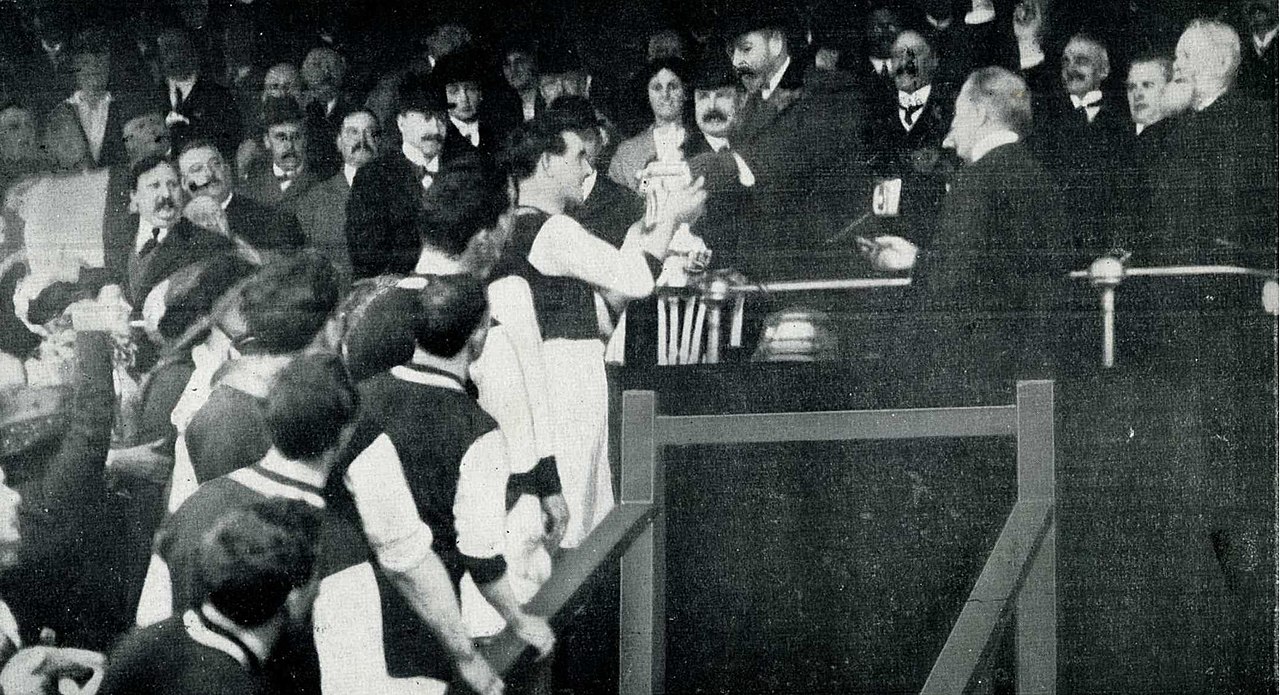
January 20, 1936, 90 years ago: King George V -- in full, George V, by the Grace of God, of Great Britain, Ireland and the British Dominions beyond the Seas, King, Defender of the Faith, Emperor of India -- dies at Sandringham House, the monarchy's country retreat in Norfolk, England. He was 70 years old.
Born George Frederick Ernest Albert of the House of Saxe-Coburg and Gotha on June 3, 1865, he was the 2nd son of Albert Edward, Prince of Wales, and thus grandson of Queen Victoria. At the time, he was 3rd in line for the throne, behind his father and his older brother.
The Prince's 1st son was Albert Victor, Duke of Clarence and Avondale. Nicknamed "Prince Eddy," he was engaged to Princess Mary, the daughter of Germany's Duke of Teck, but was a compulsive womanizer, and there were rumors of what would now be called a gay affair.
It has been rumored that Eddy's tendency toward London prostitutes made him Jack the Ripper, and a late 20th Century book about the case was titled Prince Jack. Records show that he was at Windsor Castle on the nights of all 5 "canonical Ripper murders," and, given modes of transportation in 1888, couldn't possibly have gotten out, gone to London, committed any of them, and gotten back without anyone noticing him.
Another rumor is that the royal physician, Dr. William Gull, killed those prostitutes to cover up Eddy's involvement, which (some said) involved an illegitimate child. But Gull was 71 years old at the time, and recovering from a stroke, making it unlikely that he could have overpowered even a woman.
On January 14, 1892, Eddy died, only 28 years old, officially of an influenza epidemic that was then raging through Britain. More salacious historians have suggested that his sex life caught up with him, and that he died of syphilis.
Regardless, it made his brother George 2nd in line to the throne. And, far be it for the British royal family to waste a good candidate for marriage: On July 6, 1893, George and Mary of Teck were married. They went on to have 5 children: Edward, known to the family as David, eventually named Prince of Wales; Albert, known to the family as Bertie, eventually named Duke of York; Mary, the Princess Royal, who married the Earl of Harewood; Henry, Duke of Gloucester; and John, who had epilepsy, and died of a severe seizure in 1919, only 13 years old.
Queen Victoria died on January 22, 1901, and George's father became King Edward VII. George became Prince of Wales. On May 6, 1910, Edward died, and, not quite 45 years old, his son became King George V.
George and Mary had 2 coronations: On June 22, 1911, as King and Queen of Great Britain and Ireland at Westminster Abbey in London; and on December 12, 1911, as Emperor and Empress of India at the Delhi Durbar. Victoria had been proclaimed Empress of India in 1877, and Edward VII proclaimed Emperor of India in 1903, but neither ever visited India, and were crowned in absentia. (Edward VIII and George VI held the title of Emperor of India, but never went there while on the throne.)
At first, George was popular. Then came World War I, and George found 2 of his 1st cousins on opposite sides: Czar Nicholas II of Russia on his, and Kaiser Wilhelm II of Germany on the other. (The words "Czar" and "Kaiser" both come from the Latin title for Emperor, "Caesar.")
As Lord Mountbatten, the King's nephew, said in a documentary over half a century later, the people of Britain came to despise all things German: "They insulted German governesses. They wouldn't listen to German music. They even kicked dachshunds in the streets. And the press played this up, and made things much worse."
To make matters worse than that, the Germans had planes named Gotha bombers. And another 1st cousin, Charles Edward, was the Duke of Saxe-Coburg and Gotha, and commanded German troops. And George V was of the House of Saxe-Coburg and Gotha, the family name of Queen Victoria's husband, Prince Albert. George V, Charles Edward, and Wilhelm II were all grandsons of Victoria and Albert, while Nicholas II married a granddaughter of Victoria and Albert.
H.G. Wells, one of the pioneers of science fiction, and a socialist opposed to all monarchies, wrote that George was "presiding over an alien and uninspiring court." Reading this, George blew his stack: "I may be uninspiring, but I'm damned if I'm an alien!"
So the decision was made to change the family name, taking it from the Castle in Berkshire that had been a country home to the family since William the Conqueror in 1070: The House of Windsor. This decision proved popular. (The Mountbatten name was also new: They formerly had the German name Battenberg.)
After the war, the monarchies of Germany, Austria, Russia and Turkey were abolished, and those of Italy and Belgium seriously diminished. The monarchy of Spain would also fall during George's reign, although that had nothing to do with World War I, in which Spain was neutral. Ireland was partitioned, and only the 6 Counties that made up Northern Ireland remained under George's reign.
George remained popular, but not healthy, smoking too much. He nearly died in 1928, while Edward, Prince of Wales, was on vacation (or "on holiday," as the British would say). He was guilted into coming home, just in case, but by the time he arrived, his father had taken a turn for the better.
In 1935, the 25th Anniversary of his reign, a Silver Jubilee was held for the King. By this point, he had become the 1st British monarch to make speeches over radio, including the institution of the annual monarch's Christmas Message, and publicly thanked the people for their devotion and their love.
But the end was near. His royal physician was Bertrand Dawson, 1st Viscount of Penn, and he was considered a poor doctor. Someone even wrote a short poem:
Lord Dawson of Penn
killed many men.
That's why we sing
"God save the King."
On the night of January 20, 1936, George seemed to be close to death, and Dawson sent a bulletin to the BBC: "The King's life is moving peacefully towards its close." But it wasn't moving fast enough for Dawson's tastes. As Kenneth Rose, columnist for the Daily Telegraph, and winner of an award for his 1983 biography of George, said of the text of the bulletin, for the 1994 documentary The Windsors: A Royal Family:
We now know that that wasn't true. Lord Dawson thought that the King ought to die at midnight, so that the death could be announced in the morning edition of The Times, rather than, as he put it, "less appropriate evening journals."
Dawson wrote in his diary:
At about 11 o'clock it was evident that the last stage might endure for many hours, unknown to the Patient but little comporting with that dignity and serenity which he so richly merited and which demanded a brief final scene. Hours of waiting just for the mechanical end when all that is really life has departed only exhausts the onlookers & keeps them so strained that they cannot avail themselves of the solace of thought, communion or prayer. I therefore decided to determine the end.
In one syringe, he prepared a dose of cocaine, enough to be lethal all by itself. In another, he prepared a similarly fatal dose of morphine. He told his nurse, Catherine Black, to inject the morphine into the King's neck, and he would do the same with the cocaine. Miss Black refused to murder her King. Dawson did both of them himself. Seeing what was being done, King George V, head of state for of one-quarter of the planet, with his mental faculties intact until the end, spoke his last words, to his doctor: "God damn you!"
At 11:55 PM, he was pronounced dead. The next morning, The Times of London, having their deadline met, got their scoop, so that the trashy tabloids would not announce it first. Not until 1986 -- 50 years after the King's death, 41 years after Lord Dawson's, and 3 years after the publication of Rose's biography -- was the royal euthanasia/assassination revealed to the public.
George V remains the only monarch of England and/or Great Britain to have been murdered since the execution of King Charles I in 1649.
He was succeeded by his son, who became King Edward VIII. His private life was already so tawdry that George said Edward would ruin himself in 12 months. George gave his son 1 month's too much credit. On December 10, 1936, Edward abdicated, in favor of George's 2nd son, Albert, who became King George VI. He died in 1952, and his daughter, the granddaughter of George V, took the throne as Queen Elizabeth II. Queen Mary died on March 24, 1953, a few weeks before Elizabeth was crowned. Edward, Duke of Windsor, lived in exile until 1972.
Of the other 3 children of King George V and Queen Mary: Mary, the Princess Royal, married the heir to the Earldom of Harewood, and became Countess of Harewood, living until 1965; Henry became Duke of Gloucester, served as Governor-General of Australia from 1945 to 1947, and lived until 1974; and George became Duke of Kent and a Commodore in the Royal Air Force, dying in a plane crash in 1942.
King George V has been played by Michael Osborne in Edward the Seventh in 1975, Marius Goring in Edward & Wallis in 1978, John Warner in The Treaty in 1991, David Troughton in All the King's Men in 1999, Tom Hollander in The Lost Prince in 2003, Michael Gambon in The King's Speech in 2010, Simon Jones in the film of Downton Abbey in 2019, and Tom Hollander again (also playing his cousins, Kaiser Wilhelm II and Czar Nicholas II) in The King's Man in 2021.