Showing posts with label calgary flames. Show all posts

Thursday, April 30, 2026

April 30, 1986: The Steve Smith Own Goal

April 30, 1986, 40 years ago: Steve Smith turns 23, and has the worst birthday in hockey history.

In 1985, he made his NHL debut with the Edmonton Oilers. He played 2 regular season games, and was not put on their Playoff roster, as they won their 2nd straight Stanley Cup. But in 1985-86, he was one of the League's top defensive rookies. He looked like he had a good career ahead of him. On April 30, he took the ice with the Oilers against their Provincial rivals, the Calgary Flames, in Game 7 of the NHL Smythe Division Final, at the Northlands Coliseum in Edmonton.

The Flames stunned their Alberta rivals by taking a 2-0 lead, early in the 2nd period. But before that period ended, the Oilers tied the game.

At the 5:14 mark of the 3rd period, Smith took the puck near the side of his own net, and tried to pass it up the ice. But he made a mistake, and the puck went off the leg of Oiler goaltender Grant Fuhr, and into the goal.

Perry Berezan was the last Flames player to touch the puck, so he got credit for the goal. In soccer, the rule is different: Smith would have been "credited" with an "own goal."

The Flames' 3-2 lead held, and they won, eliminating the Oilers from the Playoffs. The Flames had lost to the Oilers in the Playoffs in 1983 and 1984, and would again in 1988 and 1991. This remains the only "Battle of Alberta" Playoff series that the Flames have won.

It is the most famous own goal in hockey history, and it produced the most devastating loss in the history of Edmonton sports. Oiler fans were outraged. But, led by Captain and superstar Wayne Gretzky, Smith's teammates stood up for him. The next year, the Oilers rebounded to win the Cup. When taking it from NHL President John Ziegler, Gretzky let Smith be the 2nd Oiler player to lift it, and the crowd at the Coliseum gave him a standing ovation. All was forgiven.
Smith would help the Oilers win the Cup again in 1988 and 1990, remaining with them for 1 more season. He joined the Chicago Blackhawks for the 1991-92 season, and helped them reach the Stanley Cup Finals, where they were swept by the Pittsburgh Penguins. He stayed with the Hawks through 1997, then closed his career with, oddly enough, the Flames, playing for them until 2000.

In 804 regular-season NHL games, he had 72 goals and 303 assists. And he reached 4 Stanley Cup Finals, winning 3. A decent playing career, with one awful moment. He has since worked as an assistant coach with the Flames, the Oilers and the Buffalo Sabres, and a scout with the Blackhawks.

But that one awful moment tends to stand out. Is that fair? Did he really cost the Oilers the 1986 Stanley Cup, and prevent them from matching the 1956-60 Montreal Canadiens' run of 5 straight? Probably not. The Flames went on to reach the 1986 Stanley Cup Finals, where the Canadiens beat them in 5 games. They might have beaten the Oilers, too.

The Oilers had Grant Fuhr in goal; and on defense, Paul Coffey and Kevin Lowe. All 3 were elected to the Hockey Hall of Fame. And they had other good defensemen: Lee Fogolin, Charlie Huddy -- and Steve Smith. That defense allowed 25 goals, including 4 in Game 1, 5 in Game 2 (which the Oilers won anyway), 4 in Game 4 (which the Oilers won anyway), and 4 in Game 5 before allowing the calamitous own goal.

And what about the Oilers' offense? This was a team with Wayne Gretzky, Mark Messier, Jari Kurri and Glenn Anderson, all of whom are now in the Hockey Hall of Fame. And yet, they scored only 1 goal at home in Game 1, 2 in Game 3, 1 at home in Game 5, and 2 at home in Game 7. The most potent offense in NHL history, and they didn't get the job done.

And, in a situation like this, it's tempting to say that the side that won was actually better. Certainly, the Flames weren't as talent-laden as the Oilers. But they did sweep their previous Playoff series, against the Winnipeg Jets. They won Games 1 and 5 in Edmonton, before winning this shocking Game 7 in Edmonton. And they won the Conference Final over the St. Louis Blues.

They had Hall-of-Famers Lanny McDonald, Brett Hull, Al MacInnis and Joe Mullen; plus All-Stars Mike Vernon, Joel Otto and Gary Suter; Doug Risebrough, who had won 4 Cups with the Canadiens in the late 1970s; John Tonelli, who had won 4 Cups with the New York Islanders in the early 1980s; and Nick Fotiu, who had reached the Finals with the 1979 New York Rangers.

They did lose the Stanley Cup Finals to the Montreal Canadiens, although 2 of their losses were by 1 goal. And a slightly revamped Flames team beat the Canadiens in the Finals just 3 years later. So it's not like the Oilers lost to an undeserving team.

Friday, October 7, 2022

October 7, 1972: The New York Islanders Debut

October 7, 1972: The NHL's 2 new expansion teams, the New York Islanders and the Atlanta Flames, play their 1st regular-season games, against each other, at the Nassau County Veterans Memorial Coliseum, 30 miles east of Midtown Manhattan.

Original Captain Ed Westfall scores the Islanders' 1st goal, and Morris Stefaniw scores the 1st for the Flames, who win, 3-2. Stefaniw's goal is the 1st in the Coliseum's history, and it turns out to be the only one he scores in the NHL: Aside from 13 games with the Flames that season, he turns out to be a career minor leaguer.

The Isles' 1st season will be very rough, giving no indication as to the consistent excellence they will produce from 1975 to 1987, and the 4 straight Stanley Cups they will win from 1980 to 1983.

*

October 7, 1972 was a Saturday. There were 6 other games played in the NHL that day:

* The New York Rangers lost to the Detroit Red Wings, 5-3 at the Olympia Stadium in Detroit.

* The Montreal Canadiens beat the Minnesota North Stars, 3-0 at the Montreal Forum.

* The Chicago Black Hawks beat the Toronto Maple Leafs, 3-1 at Maple Leaf Gardens in Toronto.

* The Pittsburgh Penguins beat the Los Angeles Kings, 4-2 at the Civic Arena in Pittsburgh.

* The Philadelphia Flyers and the St. Louis Blues played to a tie, 4-4 at the St. Louis Arena.

* And the Vancouver Canucks beat the California Golden Seals, 3-2 at the Pacific Coliseum in Vancouver.

The World Hockey Association played its 1st games 4 days later. The NBA and the ABA were a few more days away from debuting. In baseball, both Leagues' Championship Series began:

* In the American League, the Oakland Athletics beat the Detroit Tigers, 2-1 at the Oakland Coliseum. Al Kaline and Norm Cash hit home runs off Catfish Hunter, and Mickey Lolich went the distance, but ran out of gas in the 11th inning, as Gonzalo Marquez got the winning hit for the A's. The A's would win the Pennant in 5 games.

* In the National League, the Pittsburgh Pirates beat the Cincinnati Reds, 5-1 at Three Rivers Stadium in Pittsburgh. Al Oliver homered for the Pirates, Joe Morgan for the Reds. In spite of this loss, the Reds would win the Pennant in 5 games. Game 5 would be the last game for Roberto Clemente of the Pirates, who was killed in a plane crash the following New Year's Eve.

The NFL played the next day, but there were big college football games played on this Saturday:

* The Number 1-ranked University of Southern California beat Stanford, 30-21 at Stanford Stadium in the San Francisco suburb of Palo Alto, California. This was the closest that USC came to losing a game that season.

* Number 4 Alabama beat Georgia, 25-7 at Sanford Stadium in Athens, Georgia.

* Number 7 Notre Dame beat Michigan State, 16-0 at Spartan Stadium in East Lansing, Michigan.

* Number 10 Penn State beat Illinois, 35-17 at Memorial Stadium in Champaign, Illinois.

* Princeton and New York's Columbia played to a 0-0 tie at Palmer Stadium in Princeton, New Jersey.

* And Rutgers lost to Cornell, 36-22 at Schoellkopf Field in Ithaca, New York.

Also, what would become my high school, East Brunswick in Middlesex County, New Jersey, beat Woodbridge, 19-13 at Woodbridge Stadium (now Nicholas A. Priscoe Stadium) in Woodbridge.

And Arsenal lost to Sheffield United, 1-0 at Bramall Lane in Sheffield, Yorkshire.

Thursday, March 10, 2022

How to Be a Devils Fan In Calgary -- 2022 Edition

This coming Wednesday, March 16, the Devils travel to play the Calgary Flames. With their "C of Red" fans, the Flames are never an easy team to beat at the Saddledome.

Before You Go. Aside from Edmonton's Rogers Place, no arena in the NHL is further north than the Saddledome -- indeed, aside from each Alberta city's CFL stadium, no venue in North American sports is further north except Rogers Place. 

But it won't be that cold: The Calgary Herald is predicting that temperatures will be in the mid-40s by day and the high 20s by night. You'll need a Winter jacket, but you won't have to bundle up. 

This is Canada, so you will need your passport. You will need to change your money. At this writing, C$1.00 = US 78 cents, and US$1.00 = C$1.28. And I advise you to call your bank and let them know that you will be in a foreign country, so they won't see credit or debit card purchases from a foreign country pop up and think your card has been stolen.

Also, remember that they use the metric system. A speed limit of 100 kilometers per hour means 62 miles an hour. And don't be fooled by the seemingly low gas prices: That's per liter, not per gallon, and, in spite of Canada being a major oil-producing nation, you'll actually be paying more for gas up there. So, in order to avoid both confusion and "sticker-shock," get your car filled up before you reach the border.

Calgary is in the Mountain Time Zone, so they are 2 hours behind New York and New Jersey. Adjust your timepieces accordingly.

Tickets. The Flames averaged 18,681 fans per home game in 2019-20, the last pre-COVID season, about 97 percent of capacity. A bit less than you might expect from a Canadian city. Tickets will probably still be hard to get.

Even with the exchange rate, these tickets, listed in U.S. dollars, are expensive. Seats in the lower level, the 100 sections, are $106 between the goals and $72 behind them. In the next level, the 200 sections, they're $53 between the goals and $46 behind them. The uppermost level, labeled PL (for "Press Level"), has seats for $14.

Getting There. It's 2,385 miles from Times Square to downtown Calgary (158 miles from the closest border crossing, at Babb, Montana), and 2,376 miles from the Prudential Center in Newark to the Saddledome. It would be natural if your first thought would be to fly.

If you're driving, you'll need to get into New Jersey, and take Interstate 80 West. You'll be on I-80 for the vast majority of the trip, through New Jersey, Pennsylvania and Ohio. In Ohio, in the western suburbs of Cleveland, I-80 will merge with Interstate 90. From this point onward, you won’t need to think about I-80 until you head home; I-90 is now the key, through the rest of Ohio and Indiana.

Just outside Chicago, I-80 will split off from I-90, which you will keep, until it merges with Interstate 94. For the moment, though, you will ignore I-94. Stay on I-90 through Illinois, until reaching Madison, Wisconsin, where you will once again merge with I-94. Now, I-94 is what you want, taking it into Minnesota and the Twin Cities.

However, unless you want to make a rest stop actually in Minneapolis or St. Paul, you're going to bypass them entirely. Take Exit 249 to get on Interstate 694, the Twin Cities' beltway, until you merge with Interstate 494 to reform I-94.

Crossing Minnesota and North Dakota, you'll take Exit 211 to Montana Route 200, and take that up to the town of Circle. There, you take Montana Route 13 until it splits and forms Montana Route 25. After just 6 miles, that takes a right turn in the town of Wolf Point, and then a quick left to U.S. Route 2 West. In Shelby, you'll leave US-2 for Interstate 15, and take that to the Canadian border.

Presuming you don't do anything stupid that makes Customs officials keep you out of Canada, I-15 will become Alberta Provincial Route 4. At Lethbridge, you'll turn onto Provincial Route 3 West. Take Provincial Route 23 to Provincial Route 519 to Provincial Route 2. From Route 2, take Exit 245 for Southland Drive, make a left on Southland, and then a quick right onto Blackfoot Trail. A left on 42nd Avenue and a right on MacLeod Trail, and you'll be at the edge of downtown Calgary, with the Saddledome on your right.

If you do it right, you should spend about an hour and a half in New Jersey, 5 hours and 15 minutes in Pennsylvania, 4 hours in Ohio, 2 and a half hours in Indiana, an hour and a half in Illinois, 2 and a half hours in Wisconsin, 4 and a half hours in Minnesota, 6 hours in North Dakota, 7 and a half hours in Montana, and 6 hours and 45 minutes in Alberta.  That's 42 hours. Throw in rest stops, and we're talking closer to 56 hours -- 2 and one-third days. You'd have to really love both driving and hockey, and not mind cold weather, to do that.

Forget the bus: For a reason I could not find, Greyhound is not currently offering service to Calgary. The Greyhound station is at 850 16th Street NW at Bow Trail.

Forget the train: You'll have to switch from Amtrak to VIA Rail Canada in Toronto, take a train to Edmonton, and then take a bus to Calgary -- which, for the moment, apparently, you can't do anyway. Round-trip, it would take 8 days. No, the train is no good.

So flying is easily the best way to get there. You can fly Air Canada from Newark to Calgary and back, changing planes in Toronto, for $1,071. Calgary International Airport was originally named McCall Field, after Frederick McCall, a Canadian flying ace of World War I.

On October 14, 2016, President Obama finally ended the ban on bringing Cuban cigars into America. This also applies to rum, for which Cuba is also renowned. It is still considerably easier to buy these items in Canada than in America, but, now, you can bring them back over the border.

Once In the City. At 1.2 million people, Calgary is the 3rd-largest city in Canada, behind Toronto and Montreal, and ahead of Vancouver and Edmonton. However, like most of Canada's larger cities, the huge amount of land area contained within its city limits means it has almost no suburbs, and its metropolitan area gives it only 1.4 million, 4th behind Toronto, Montreal and Vancouver -- but still ahead of national capital Ottawa and Provincial capital Edmonton.

Founded in 1882 at the confluence of the Bow and Elbow Rivers, there is some dispute as to the origin of the name, although both accepted versions are Scottish in origin. Some say it's from the Gaelic meaning "beach of the meadow," or "pasture." Others say it comes from the words the Vikings brought to northern Scotland's Hebrides, meaning "cold garden."

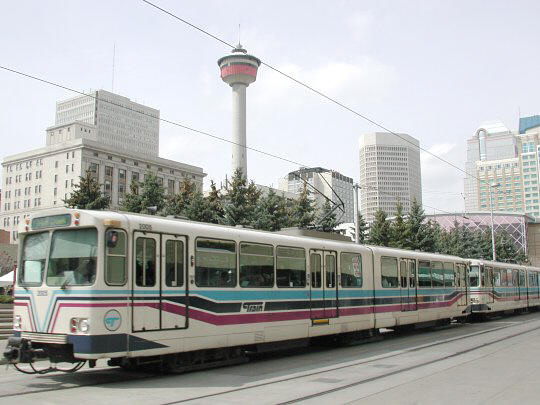
The Bow River and, east of its bend, Memorial Drive separate Calgary addresses into North and South, while Centre Street separates them into East and West. The sales tax in the Province of Alberta is 5 percent, and it doesn't go up in the City of Calgary. The city has buses and a light rail system nicknamed CTrain, and a single fare is $3.00 (which works out to about $2.35, so it's less expensive than New York's).
CTrain downtown, with Calgary Tower in the background

The drinking age in Alberta is 18. Postal Codes in the Province start with the letter T. The Area Code is 403, with 587 and 825 as overlays for the entire Province. The city has no highway "beltway." ENMAX Power Corporation runs the city's electricity. Calgary's ethnic makeup is 61 percent white, 16 percent East Asian, 9 percent South Asian, 4 percent black, 3 percent Aboriginal/Native North American/First Nations, 3 percent Middle Eastern, 2 percent Hispanic.

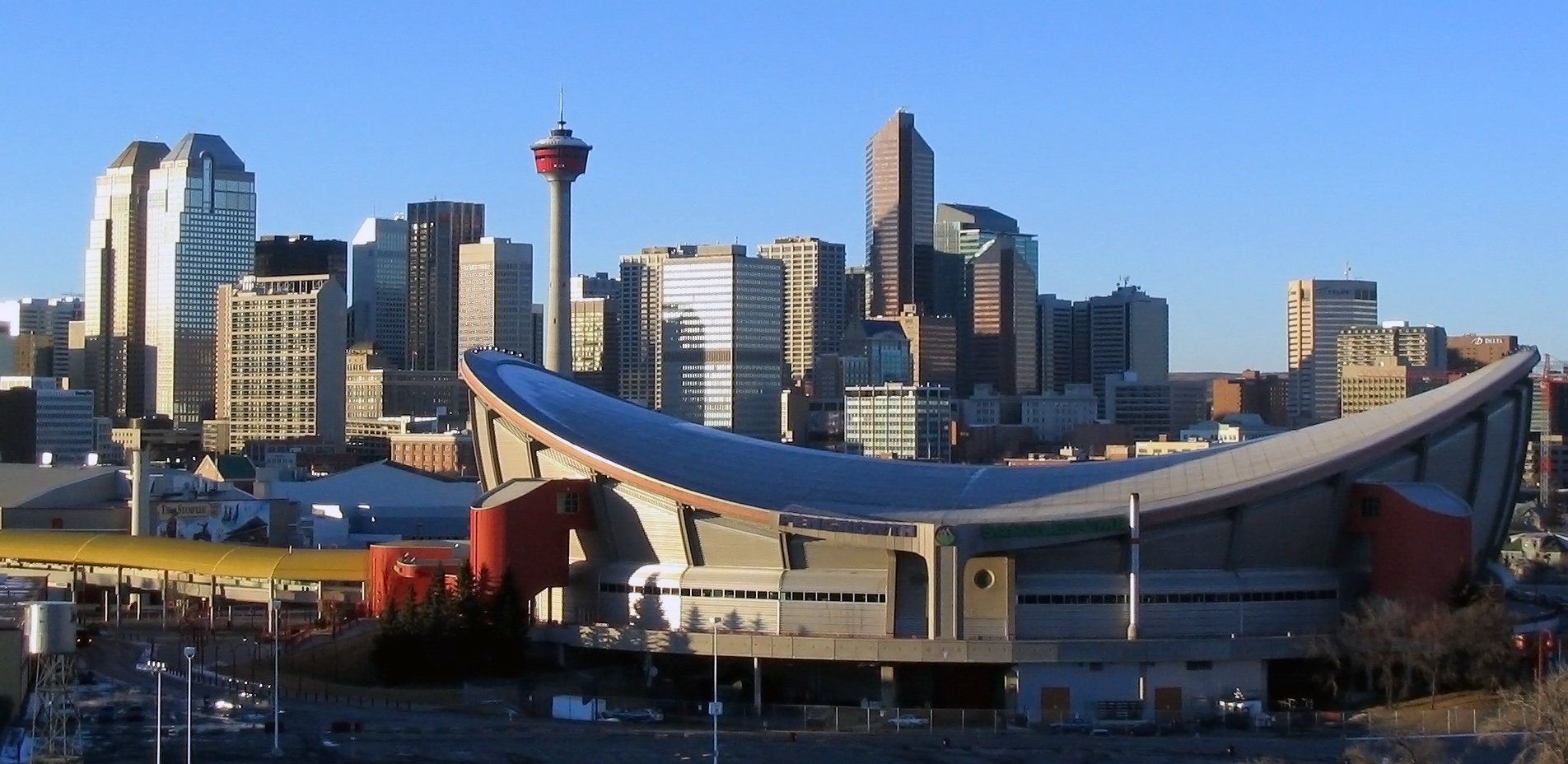
Going In. The Scotiabank Saddledome -- originally the Olympic Saddledome, built in 1983 for the Flames and as the centerpiece of the 1988 Winter Olympics, and now named for the Halifax-based bank -- is at 555 Saddledome Rise SE, across Olympic Way from the Stampede Corral, site of the world's largest rodeo, the Calgary Stampede. It's about a mile and a quarter southeast of the downtown shopping district. If you're driving, parking is $10. (US$7.82.) If you're coming in by light rail, it's about a 12-minute ride to Victoria Park-Stampede station, and then you'll have to walk across a big parking lot to get to the arena, entering from the west.

Like the Capital Centre, the suburban Washington arena that was once home to the Bullets (now Wizards) and Capitals, and the Arizona Veterans Memorial Coliseum, the still-standing former home of the Phoenix Suns, it has a saddle-shaped roof; hence, the name "Saddledome." (Why a bank based in Nova Scotia, in Canada's eastern Maritime Provinces, bought the naming rights to a western arena, I have no idea.)

The rink is laid out north-to-south, and the Flames attack twice to the north end. The arena is also home to the minor-league Calgary Hitmen, and their rivalry with the Edmonton Oil Kings is nearly as intense as the "Battle of Alberta" between the Flames and the Oilers.
The Saddledome is the 2nd-oldest arena in the league, behind Madison Square Garden. A plan to build a new arena, called the Calgary Event Centre, in the parking lot to the north of the Saddledome and the Corral, fell through in 2021. For the time being, the Flames are staying put.

Food. There's not much information available online about Saddledome concession stands, but the arena's website mentions several onsite restaurants, including Dutton's Lounge, the Alumni Lounge and the King Club. The Saddleroom Restaurant is on the arena's east side (another thing I had wrong last year), and the Platinum Club on the west side (ditto), but these are open only to season-ticket holders, much like the Prudential Center's Fire Lounge and Ice Lounge.

According to the arena website, concessions include: 

Time Out (Hot Dogs, Popcorn, Snacks)
Centre Ice (Hot Dogs, Popcorn, Snacks)
Pizza 73
Skyline Deli
Spolumbos Italian Eatery
Mac Shack (Mac 'n Cheese)
Flame Broiled Burgers
The Dog House (Specialty Hot Dogs)
The Zone
The Rotisserie

Cash or credit cards are accepted at all concession stands.


Team History Displays. All in a row, over the center red line, the Flames hang banners for their various championships and their retired numbers. The title banners including: The 1989 Stanley Cup; the 1986, 1989 and 2004 Conference Championships; the 1986, 1989, 1994, 1995, 2006 and 2019 Division titles; and the 1988 and 1989 President's Trophy for best overall record in the NHL regular season.
The Flames have 3 retired numbers. From the 1986 Cup Finalists and the 1989 Cup winners, they have retired: 9, for right wing Lanny McDonald; and 30, for goaltender Mike Vernon. From the 2004 Cup Finalists, 12, for right wing Jarome Iginla.

Right wing Theoren Fleury, a rookie on the 1989 Cup winners, has not had his Number 14 retired, but it has not been given out since he was traded in 1999. A banner for Brad Moran, whose Number 20 was retired by the Calgary Hitmen, is also hung at the Saddledome. (Although he holds several Hitmen club records, he played all of 8 games in the NHL, between 2002 and 2007.)

In 2012, the Flames organization introduced "Forever A Flame," to honor team legends while still allowing future Flames the opportunity to wear the numbers of some of the team's all-time greats -- essentially, a team hall of fame. Defenseman Al MacInnis was the 1st to earn this distinction, with a banner with his picture and the Number 2 raised to the rafters. Center Joe Nieuwendyk (who also won the 2003 Cup with the Devils) followed him, with a banner with his Number 25 on it. So that's 4 honorees, all from the 1989 Cup win.
McDonald, Iginla, MacInnis and Nieuwendyk are in the Hockey Hall of Fame. Vernon, as yet, is not. Also in the Hall are Joe Mullen (from 1989), Doug Gilmour (ditto), Phil Housley (starred for them after the '89 Cup), Sergei Makarov (ditto), general manager Cliff Fletcher (1989), longtime owner Harley Hotchkiss, and broadcaster Peter Maher.

There were no Flames named to The Hockey News' 100 Greatest Players in 1998, not even McDonald, Vernon or Gilmour. MacInnis was the only player usually identified with the Flames who was named to the NHL's 100th Anniversary 100 Greatest Players in 2017.

There is no reference to the Flames' time in Atlanta (the name references the burning of Atlanta during the American Civil War), unless you count the "A" for Alternate Captain being the Flames' old A logo. (The "C" for Captain is the current C logo.) The Flames didn't win anything in Atlanta, so there are no banners to raise, although they did make the Playoffs there. The only Atlanta Flames player in the Hockey Hall of Fame is Pat Quinn, and he's in the Hall for what he did elsewhere as an executive.

At the north end of the arena are Canadian and U.S. flags. At the south end are Canadian and British flags (Canada remains in the British Commonwealth), an Olympic flag, and a banner representing the 1988 Winter Olympics, for which the Saddledome and McMahon Stadium, home of the CFL's Stampeders, were the leading venues.

No members of the Team Canada that beat the Soviet Union in the 1972 "Summit Series" played for the Flames, in either Atlanta or Calgary. From the 1980 U.S. Olympic team that beat the Soviets and then Finland for the Gold Medal, Jim Craig played some of their final Atlanta games, while Steve Christoff played for them in Calgary.

Craig, Quinn, Makarov, and Swedes Kent Nilsson and Hakan Loob are members of the International Ice Hockey Federation (IIHF) Hall of Fame. Mullen and former coach Bob Johnson, who got them to the 1986 Stanley Cup Finals, received the Lester Patrick Trophy for contributions to hockey in America.

In addition to the Flames' achievements, the Memorial Cup, the championship of Canadian junior hockey, has been won by the following Calgary-area teams: The 1926 Calgary Canadians, the 1987 and 1988 Medicine Hat Tigers, the 2001 Red Deer Rebels and the 2002 Kootenay Ice.

The Battle of Alberta with the Edmonton Oilers is as intense as any in the NHL. It's close, but the Flames lead it, 138-129-18. They've faced each other in 5 Playoff series, all during the Wayne Gretzky era in Edmonton, and the Oilers won 4 of them: In 1983, 1984, 1988 and 1991.

The only Flames win came in the 1986 Smythe Division Final, when an own goal by Oiler defenseman Steve Smith led to the Flames winning in Game 7. Either the Oilers or the Flames won the NHL Clarence Campbell Conference (analogous to the current NHL Western Conference) every season from 1983 to 1990.

Stuff. There is a Flames Fan Attic (as in "fanatic") team store at the Saddledome, although I can't find a reference as to where in the arena. There are also Flames Fan Attics at the North Hill Centre mall and Calgary International Airport. I suspect that, due to the city's Western heritage, you can buy cowboy hats with the Flames' logo on them.

In spite of having won a Stanley Cup, and nearly winning 2 others, there aren't many books about the Flames. The Calgary Herald staff put together a coffee-table book titled Calgary Flames: The Fire Inside, but that's a big book at a big price. Last month, Mark Spector published The Battle of Alberta: The Historic Rivalry Between the Edmonton Oilers and the Calgary Flames.

The NHL has released a DVD set, Calgary Flames: 10 Great Playoff Games. They include a Game 7 win over the Philadelphia Flyers in 1981, their 1st season in Calgary; the shocking Game 7 win over the arch-rival Oilers in 1986, won by Steve Smith's own goal; another Game 7 win in 1986, over the St. Louis Blues; a Game 7 win over the Vancouver Canucks in 1989; the Cup-clincher of 1989, the only time a team ever clinched over the Montreal Canadiens at the Montreal Forum; the 1991 Game 6 win over the Oilers won by Theoren Fleury's goal that produced a memorable celebration; the Game 7 win over Vancouver in 2004; the Game 5 win over the Tampa Bay Lightning in 2004; and the Game 3 win over the San Jose Sharks in 2008.

During the Game. A November 19, 2014 article on The Hockey News' website ranked the NHL teams' fan bases, and listed the Flames' fans 8th: "Consistent turnout at games despite rebuild. Lackluster social media presence."

You are not Edmonton Oilers fans. You will not be wearing Oilers gear. Therefore, you will almost certainly be safe. This game will not feature a promotion.

The seats are blue, but they become "the C of Red." (Never "the Red C.") The Flames' home jerseys are red, like the Devils'. I don't know if it would be better to wear a red Devils jersey to fit in, or a white one to stand out. But the C of Red is as pervasive as the one in the St. Louis Cardinals' Busch Stadium.
The C of Red

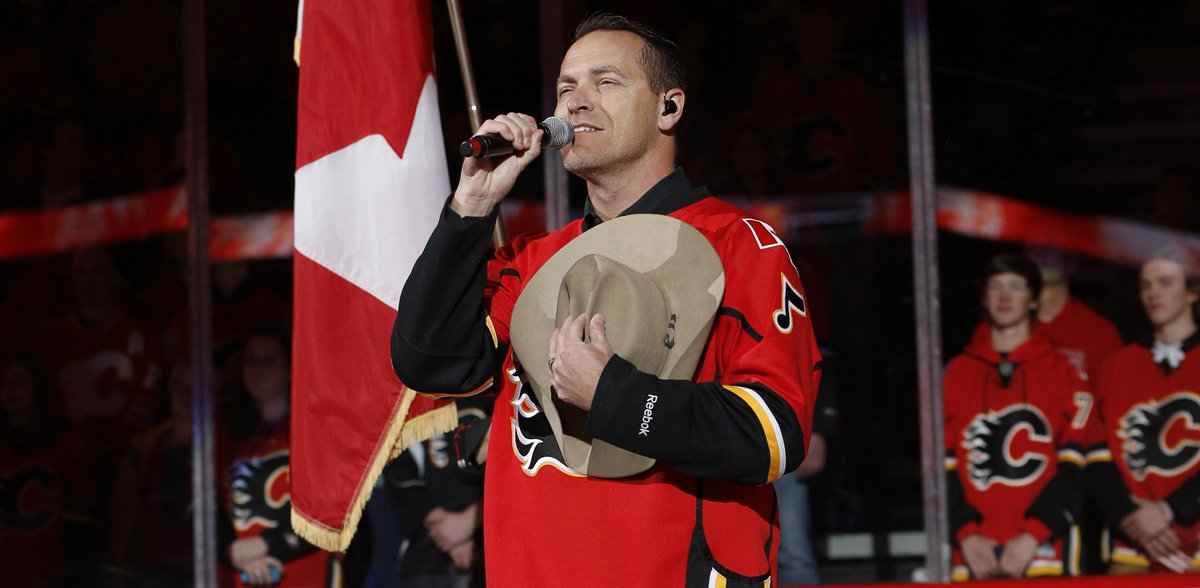
George Canyon, a country singer from Nova Scotia who now lives in Calgary, and has been appointed the Colonel Commandant of the Royal Canadian Air Cadets, is the Flames' regular singer of the National Anthem(s). There isn't much in the way of fan chants or songs, just "Go, Flames, Go!" Their goal song is "Righteous Smoke" by Monster Truck.
George Canyon

Although they sometimes wear a 3rd jersey with a fire-breathing dragon on it, their mascot is Harvey the Hound, a big white silly-looking dog with its tongue hanging way out -- which has driven some frustrated fans, and even one opposing coach (Craig MacTavish of the arch-rival Oilers), to grab it and try to rip it out. He was introduced in 1983, and was the 1st mascot in NHL history. (His name has confused me: I thought it was not Harvey, but Harley, named for longtime owner Harley Hotchkiss.)

After the Game. Canada does not have much of a problem with crime, and while hockey fans like to drink, Flames fans will probably leave you alone. Just don't praise the Oilers, and you should be safe.

Mavericks Dining Room & Lounge is on 2nd Street, at the southwest edge of the parking lot. Effectively, it marks the beginning (or the end) of the Red Mile, a strip of bars and restaurants along 17th Avenue that gained fame for its party atmosphere during the 2004 Playoffs.

If your visit to Calgary is during the European soccer season (which we are now in), the best soccer pub in town is The Pig & Duke, 1312 12th Avenue SW, about 2 miles west of downtown. Bus 7.

Sidelights. As with the other major cities of Canada, Calgary isn't just about hockey.

* Stampede Corral. Home to the Calgary Stampede, the world's largest rodeo, since 1950, the Flames played here from their 1980 move from Atlanta until the Saddledome opened across the street in 1983. At just 6,475 seats, it was too small to be their long-term home, but with the Saddledome already planned, they could afford to wait. Several minor-league hockey teams had used it before the Flames arrived. 10 Corral Trail SE at Olympic Way.
The Corral's long-term future depends on that of the Saddledome. One idea is that, when the Saddledome is torn down, an arena about the same physical size, but with a few thousand more seats than the Corral, be built on the site, so that the Corral's operations can be moved in, and the Corral would then be demolished.

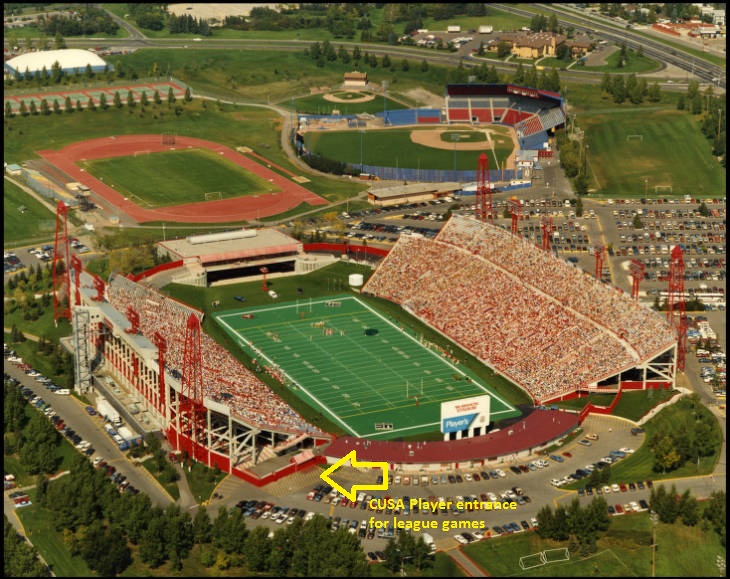
* McMahon Stadium. Home to the Calgary Stampeders of the Canadian Football League (who are owned by the Flames), and the University of Calgary football team, since 1960, it was named for a pair of brothers who funded its construction. Its current capacity is 37,317. Temporary seating raised it to 60,000 so that it could host the Opening and Closing Ceremonies of the 1988 Winter Olympics.

The Stampeders, a.k.a. the Stamps, won the Grey Cup, Canada's Super Bowl, while playing here in 1971, 1992, 1998, 2001, 2008, 2014 and 2018. Previously, they played at Mewata Stadium, and won the 1948 Grey Cup while playing there. That facility was built in 1906 and demolished in 1999.

The stadium hosted the Grey Cup in 1975, 1993, 2000 and 2009. The University of Calgary Dinos (yes, named for dinosaurs) have won Canada's national college football title, the Vanier Cup, in 1983, 1985, 1988, 1995 and 2019. (They haven't won any hockey titles.) The stadium hosted an NHL Heritage Classic between the Flames and the Canadiens in 2011, which the Flames won, 4-0. 1817 Crowchild Trail NW at 23rd Avenue.

* Foothills Stadium. Adjacent to McMahon Stadium, this 6,000-seat ballpark went up in 1966, and is the home of the University of Calgary baseball team. It was home to several minor league teams, including the Calgary Expos, who won Pioneer League Pennants there in 1979 and 1981. The Pacific Coast League's Calgary Cannons won Division titles in 1985, 1987, 1989 and 1991, but never won a Pennant. 2255 Crowchild Trail NW. Both stadiums can be reached via the Banff station on light rail.
The University of Calgary sports complex,
including Foothills Stadium (top) and McMahon Stadium (bottom)

* Spruce Meadows. The Canadian Premier League has debuted, and Calgary-based Cavalry FC has now won its 1st title. They have opened 6,000-seat ATCO Field at Spruce Meadows, famed as a venue for equestrian competitions. 18011 Spruce Meadows Way SW, about 12 miles south of downtown. Free shuttles will bring fans to the stadium from the Somerset-Bridlewood C-Train station.
While the University of Calgary is, of course, in Calgary, the University of Alberta is in Edmonton. The University of Lethbridge, 130 miles to the southeast, won the University Cup, Canada's national college hockey title, in 1994.

The closest Major League Baseball team to Calgary is the Seattle Mariners, and they're not close: 673 miles away. The closest NBA team, the Portland Trail Blazers, is even further away: 775 miles. Don't count on Calgary ever getting a team in either sport: Population-wise, its metro area would rank dead last in each, 31st. The closest Major League Soccer team is the Vancouver Whitecaps, 604 miles.

* Museums. Calgary's best-known museum is the Glenbow, which is both their Museum of Natural History and their Metropolitan Museum of Art. 130 9th Avenue SE at 1st Street downtown, across from the iconic Calgary Tower.

Gasoline Alley Museum at Heritage Park Historical Village sounds like a copy of the Henry Ford Museum outside Detroit, as it documents the dawn of the automobile age, with first- and second-generation automobiles and a recreated turn-of-the-20th-Century street scene -- significant because Alberta didn't turn from Territory to full Province until 1905. visitcalgary.com says of it, "It's probably the only time you'll ever find yourself in the thick of a traffic jam without a hint of road rage." 1900 Heritage Drive SW at 14th Street, on Glenmore Reservoir. Light rail to Heritage station, then switch to 502 bus.

Calgary has produced 2 Prime Ministers. The recently-defeated PM, Stephen Harper, represents a Calgary district (or "riding" as they'd say in Canada). The other is Richard B. Bennett, who served from 1930 and 1935, rising to power after the 1929 stock market crash but was seen as doing nothing to ease the Depression, and became the most hated man in the country's history, so much so that he left Canada for the mother country, Britain. He's the only head of government in either America or Canada who died on foreign soil, or is buried in it. As you might guess, there's no historic site in his memory, either in Calgary or in his hometown in the Province of New Brunswick.

The tallest building in Calgary, and in Canada between Toronto and Vancouver, is Brookfield Place East, a newly-completed 810-foot tower that just succeeded the 774-foot "The Bow" as the tallest. 225 6th Avenue NW.

TV shows set in Calgary are generally not shown in America, but the science fiction/Western
Wynonna Earp films at Heritage Park Historical Village, kind of a "Western Williamsburg." Probably the best-known movie to use Calgary and/or its environs as a filming location was Brokeback
Mountain.

*

Calgary is Canada's Denver, its great Western city of toughness, and its Dallas, its great Western city of excess, rolled into one. And it's a great hockey town, a good roadtrip for Devils fans. 

Friday, April 30, 2021

Top 5 Reasons You Can't Blame Steve Smith for the Edmonton Oilers Losing the 1986 Stanley Cup

April 30, 1963: James Stephen Smith is born in Glasgow, Scotland, and grows up in Cobourg, Ontario, about halfway between Toronto and Oshawa. By the Autumn of 1980, he was in London -- Ontario, playing minor-league hockey.

In 1985, he made his NHL debut with the Edmonton Oilers. He played 2 regular season games, and was not put on their Playoff roster, as they won their 2nd straight Stanley Cup. But in 1985-86, he was one of the League's top defensive rookies. He was about to turn 23, and it looked like he had a good career ahead of him.

April 30, 1986: Steve Smith has the worst birthday in hockey history. He took the ice with the Oilers against their Provincial rivals, the Calgary Flames, in Game 7 of the NHL Smythe Division Final, at the Northlands Coliseum in Edmonton.

The Flames stunned their Alberta rivals by taking a 2-0 lead, early in the 2nd period. But before that period ended, the Oilers tied the game.

At the 5:14 mark of the 3rd period, Smith took the puck near the side of his own net, and tried to pass it up the ice. But he made a mistake, and the puck went off the leg of Oiler goaltender Grant Fuhr, and into the goal.

Perry Berezan was the last Flames player to touch the puck, so he got credit for the goal. In soccer, the rule is different: Smith would have been "credited" with an "own goal."

The Flames' 3-2 lead held, and they won, eliminating the Oilers from the Playoffs. The Flames had lost to the Oilers in the Playoffs in 1983 and 1984, and would again in 1988 and 1991. This remains the only "Battle of Alberta" Playoff series that the Flames have won.

It is the most famous own goal in hockey history, and it produced the most devastating loss in the history of Edmonton sports. Oiler fans were outraged. But, led by Captain and superstar Wayne Gretzky, Smith's teammates stood up for him. The next year, the Oilers rebounded to win the Cup. When taking it from NHL President John Ziegler, Gretzky let Smith be the 2nd Oiler player to lift it, and the crowd at the Coliseum gave him a standing ovation. All was forgiven.
Smith would help the Oilers win the Cup again in 1988 and 1990, remaining with them for 1 more season. He joined the Chicago Blackhawks for the 1991-92 season, and helped them reach the Stanley Cup Finals, where they were swept by the Pittsburgh Penguins. He stayed with the Hawks through 1997, then closed his career with, oddly enough, the Flames, playing for them until 2000.

In 804 regular-season NHL games, he had 72 goals and 303 assists. And he reached 4 Stanley Cup Finals, winning 3. A decent playing career, with one awful moment. He has since worked as an assistant coach with the Flames, the Oilers and the Buffalo Sabres, and a scout with the Blackhawks.

But that one awful moment tends to stand out. Is that fair? Did he really cost the Oilers the 1986 Stanley Cup, and prevent them from matching the 1956-60 Montreal Canadiens' run of 5 straight?

Top 5 Reasons You Can't Blame Steve Smith for the Edmonton Oilers Losing the 1986 Stanley Cup

5. The Montreal Canadiens. No, I don't mean the shadow of their late 1950s dynasty, or any of their other dynasties. The Flames went on to reach the 1986 Stanley Cup Finals, where the Canadiens beat them in 5 games. They might have beaten the Oilers, too.

4. Grant Fuhr. Although he was an easy choice for the Hockey Hall of Fame (he was the 1st black player so honored), this time, he had a rotten series. He allowed 4 goals in Game 1, 5 goals in Game 2 (which the Oilers won anyway), 4 goals in Game 4 (which the Oilers won anyway), and 4 goals in Game 5, before allowing the calamitous own goal.
He allowed 25 goals in the series, compared to the 24 allowed by the Flames' Mike Vernon, who's not in the Hall of Fame, but should be.

3. The Oilers' Defense. This was a team with Hall-of-Famer Paul Coffey, and also Kevin Lowe, Lee Fogolin, Charlie Huddy -- and Steve Smith, who was a good player. But it wasn't just Fuhr: The Edmonton defense allowed those 25 goals, too.

2. The Oilers' Offense. This was a team with Wayne Gretzky, Mark Messier, Jari Kurri and Glenn Anderson, all of whom are now in the Hockey Hall of Fame. And yet, they scored only 1 goal at home in Game 1, 2 in Game 3, 1 at home in Game 5, and 2 at home in Game 7.

The most potent offense in NHL history, and they didn't get the job done.

1. The Calgary Flames. In a situation like this, it's tempting to say that the side that won was actually better. Certainly, the Flames weren't as talent-laden as the Oilers. But they did sweep their previous Playoff series, against the Winnipeg Jets. They won Games 1 and 5 in Edmonton, before winning this shocking Game 7 in Edmonton. And they won the Conference Final over the St. Louis Blues.

They had Hall-of-Famers Lanny McDonald, Brett Hull, Al MacInnis and Joe Mullen; plus All-Stars Mike Vernon, Joel Otto and Gary Suter; Doug Risebrough, who had won 4 Cups with the Canadiens in the late 1970s; John Tonelli, who had won 4 Cups with the New York Islanders in the early 1980s; and Nick Fotiu, who had reached the Finals with the 1979 New York Rangers.

They did lose the Stanley Cup Finals to the Montreal Canadiens, although 2 of their losses were by 1 goal. And a slightly revamped Flames team beat the Canadiens in the Finals just 3 years later. So it's not like the Oilers lost to an undeserving team.

VERDICT: Not Guilty.

Saturday, November 2, 2019

How to Be a Devils Fan In Calgary -- 2019-20 Edition

This coming Thursday, the Devils travel to play the Calgary Flames. With their "C of Red" fans, the Flames are never an easy team to beat at the Saddledome.

Before You Go. Aside from Edmonton's Rogers Place, no arena in the NHL is further north than the Saddledome -- indeed, aside from each Alberta city's CFL stadium, no venue in North American sports is further north except Rogers Place. And this is early November. It will be cold.

The Calgary Herald is predicting that temperatures will be in the low 20s by day and the single digits by night. That is very cold by our standards. Bundle up. And they are predicting snow for Monday and Tuesday, so it should still be on the ground on Thursday, so mind your step.

This is Canada, so you will need your passport. You will need to change your money. At this writing, C$1.00 = US 76 cents, and US$1.00 = C$1.32. And I advise you to call your bank and let them know that you will be in a foreign country, so they won't see credit or debit card purchases from a foreign country pop up and think your card has been stolen.

Also, remember that they use the metric system. A speed limit of 100 kilometers per hour means 62 miles an hour. And don't be fooled by the seemingly low gas prices: That's per liter, not per gallon, and, in spite of Canada being a major oil-producing nation, you'll actually be paying more for gas up there. So, in order to avoid both confusion and "sticker-shock," get your car filled up before you reach the border.

Calgary is in the Mountain Time Zone, so they are 2 hours behind New York and New Jersey. Adjust your timepieces accordingly.

Tickets. The Flames averaged 18,501 fans per home game last season, about 96 percent of capacity. A bit less than you might expect from a Canadian city. Tickets will probably still be hard to get.

Even with the exchange rate, these tickets, listed in Canadian dollars, are expensive. Seats in the lower level, the 100 sections, are $198 throughout the level. In the next level, the 200 sections, they're $131 between the goals and $79 behind them. The uppermost level, labeled PL (for "Press Level"), has seats for $47.

Getting There. It's 2,385 miles from Times Square to downtown Calgary (158 miles from the closest border crossing, at Babb, Montana), and 2,376 miles from the Prudential Center in Newark to the Saddledome. It would be natural if your first thought would be to fly.

If you're driving, you'll need to get into New Jersey, and take Interstate 80 West. You'll be on I-80 for the vast majority of the trip, through New Jersey, Pennsylvania and Ohio. In Ohio, in the western suburbs of Cleveland, I-80 will merge with Interstate 90. From this point onward, you won’t need to think about I-80 until you head home; I-90 is now the key, through the rest of Ohio and Indiana.

Just outside Chicago, I-80 will split off from I-90, which you will keep, until it merges with Interstate 94. For the moment, though, you will ignore I-94. Stay on I-90 through Illinois, until reaching Madison, Wisconsin, where you will once again merge with I-94. Now, I-94 is what you want, taking it into Minnesota and the Twin Cities.

However, unless you want to make a rest stop actually in Minneapolis or St. Paul, you're going to bypass them entirely. Take Exit 249 to get on Interstate 694, the Twin Cities' beltway, until you merge with Interstate 494 to reform I-94.

Crossing Minnesota and North Dakota, you'll take Exit 211 to Montana Route 200, and take that up to the town of Circle. There, you take Montana Route 13 until it splits and forms Montana Route 25. After just 6 miles, that takes a right turn in the town of Wolf Point, and then a quick left to U.S. Route 2 West. In Shelby, you'll leave US-2 for Interstate 15, and take that to the Canadian border.

Presuming you don't do anything stupid that makes Customs officials keep you out of Canada, I-15 will become Alberta Provincial Route 4. At Lethbridge, you'll turn onto Provincial Route 3 West. Take Provincial Route 23 to Provincial Route 519 to Provincial Route 2. From Route 2, take Exit 245 for Southland Drive, make a left on Southland, and then a quick right onto Blackfoot Trail. A left on 42nd Avenue and a right on MacLeod Trail, and you'll be at the edge of downtown Calgary, with the Saddledome on your right.

If you do it right, you should spend about an hour and a half in New Jersey, 5 hours and 15 minutes in Pennsylvania, 4 hours in Ohio, 2 and a half hours in Indiana, an hour and a half in Illinois, 2 and a half hours in Wisconsin, 4 and a half hours in Minnesota, 6 hours in North Dakota, 7 and a half hours in Montana, and 6 hours and 45 minutes in Alberta.  That's 42 hours. Throw in rest stops, and we're talking closer to 56 hours -- 2 and one-third days. You'd have to really love both driving and hockey, and not mind cold weather, to do that.

Forget the bus: For a reason I could not find, Greyhound is not currently offering service to Calgary. The Greyhound station is at 850 16th Street NW at Bow Trail.

Forget the train: You'll have to switch from Amtrak to VIA Rail Canada in Toronto, take a train to Edmonton, and then take a bus to Calgary -- which, for the moment, apparently, you can't do anyway. Round-trip, it would take 8 days. No, the train is no good.

So flying is easily the best way to get there. You can fly Air Canada from Newark to Calgary and back, changing planes in Toronto, for $971. Calgary International Airport was originally named McCall Field, after Frederick McCall, a Canadian flying ace of World War I.

On October 14, 2016, President Obama finally ended the ban on bringing Cuban cigars into America. This also applies to rum, for which Cuba is also renowned. It is still considerably easier to buy these items in Canada than in America, but, now, you can bring them back over the border.

Once In the City. At 1.2 million people, Calgary is the 3rd-largest city in Canada, behind Toronto and Montreal, and ahead of Vancouver and Edmonton. However, like most of Canada's larger cities, the huge amount of land area contained within its city limits means it has almost no suburbs, and its metropolitan area gives it only 1.4 million, 4th behind Toronto, Montreal and Vancouver -- but still ahead of national capital Ottawa and Provincial capital Edmonton.

Founded in 1882 at the confluence of the Bow and Elbow Rivers, there is some dispute as to the origin of the name, although both accepted versions are Scottish in origin. Some say it's from the Gaelic meaning "beach of the meadow," or "pasture." Others say it comes from the words the Vikings brought to northern Scotland's Hebrides, meaning "cold garden."

The Bow River and, east of its bend, Memorial Drive separate Calgary addresses into North and South, while Centre Street separates them into East and West. The sales tax in the Province of Alberta is 5 percent, and it doesn't go up in the City of Calgary. The city has buses and a light rail system nicknamed CTrain, and a single fare is $3.00 (which works out to about $2.25, so it's less expensive than New York's).
CTrain downtown, with Calgary Tower in the background

The drinking age in Alberta is 18. Postal Codes in the Province start with the letter T. The Area Code is 403, with 587 and 825 as overlays for the entire Province. The city has no highway "beltway." ENMAX Power Corporation runs the city's electricity. Calgary's ethnic makeup is 61 percent white, 16 percent East Asian, 9 percent South Asian, 4 percent black, 3 percent Aboriginal/Native North American/First Nations, 3 percent Middle Eastern, 2 percent Hispanic.

Going In. The Scotiabank Saddledome -- originally the Olympic Saddledome, built in 1983 for the Flames and as the centerpiece of the 1988 Winter Olympics, and now named for the Halifax-based bank -- is at 555 Saddledome Rise SE, across Olympic Way from the Stampede Corral, site of the world's largest rodeo, the Calgary Stampede. It's about a mile and a quarter southeast of the downtown shopping district. If you're driving, parking is $10. (US$7.60.) If you're coming in by light rail, it's about a 12-minute ride to Victoria Park-Stampede station, and then you'll have to walk across a big parking lot to get to the arena, entering from the west.

Like the Capital Centre, the suburban Washington arena that was once home to the Bullets (now Wizards) and Capitals, and the Arizona Veterans Memorial Coliseum, the still-standing former home of the Phoenix Suns, it has a saddle-shaped roof; hence, the name "Saddledome." (Why a bank based in Nova Scotia, in Canada's eastern Maritime Provinces, bought the naming rights to a western arena, I have no idea.)

The rink is laid out north-to-south, and the Flames attack twice to the north end. The arena is also home to the minor-league Calgary Hitmen, and their rivalry with the Edmonton Oil Kings is nearly as intense as the "Battle of Alberta" between the Flames and the Oilers.
The Saddledome is the 2nd-oldest arena in the league, behind Madison Square Garden. For the moment, the Flames organization says it has a plan to replace the Dome, called the Calgary Event Centre. The proposed location is in the parking lot to the north of the Saddledome and the Corral, ona plot bounded by 13th and 14th Avenues SE, 5th Street and Olympic Way. Groundbreaking is planned for 2021, the arena should open for the 2023-24 season, and the Saddledome would then be demolished.

Food. There's not much information available online about Saddledome concession stands, but the arena's website mentions several onsite restaurants, including Dutton's Lounge, the Alumni Lounge and the King Club. The Saddleroom Restaurant is on the arena's east side (another thing I had wrong last year), and the Platinum Club on the west side (ditto), but these are open only to season-ticket holders, much like the Prudential Center's Fire Lounge and Ice Lounge.

According to the arena website, concessions include: 

Time Out (Hot Dogs, Popcorn, Snacks)
Centre Ice (Hot Dogs, Popcorn, Snacks)
Pizza 73
Skyline Deli
Spolumbos Italian Eatery
Mac Shack (Mac 'n Cheese)
Flame Broiled Burgers
The Dog House (Specialty Hot Dogs)
The Zone
The Rotisserie

Cash or credit cards are accepted at all concession stands.


Team History Displays. All in a row, over the center red line, the Flames hang banners for their various championships and their retired numbers. The title banners including: The 1989 Stanley Cup; the 1986, 1989 and 2004 Conference Championships; the 1986, 1989, 1994, 1995, 2006 and 2019 Division titles; and the 1988 and 1989 President's Trophy for best overall record in the NHL regular season.
The Flames have 3 retired numbers. From the 1986 Cup Finalists and the 1989 Cup winners, they have retired: 9, for right wing Lanny McDonald; and 30, for goaltender Mike Vernon. From the 2004 Cup Finalists, 12, for right wing Jarome Iginla.

Right wing Theoren Fleury, a rookie on the 1989 Cup winners, has not had his Number 14 retired, but it has not been given out since he was traded in 1999. A banner for Brad Moran, whose Number 20 was retired by the Calgary Hitmen, is also hung at the Saddledome. (Although he holds several Hitmen club records, he played all of 8 games in the NHL. between 2002 and 2007.)

In 2012, the Flames organization introduced "Forever A Flame," to honor team legends while still allowing future Flames the opportunity to wear the numbers of some of the team's all-time greats -- essentially, a team hall of fame. Defenseman Al MacInnis was the 1st to earn this distinction, with a banner with his picture and the Number 2 raised to the rafters. Center Joe Nieuwendyk (who also won the 2003 Cup with the Devils) followed him, with a banner with his Number 25 on it. So that's 4 honorees, all from the 1989 Cup win.
Other possible future honorees could be Hockey Hall-of-Famers Joe Mullen (from 1989), Doug Gilmour (ditto), Phil Housley (starred for them after the '89 Cup), Sergei Makarov (ditto), general manager Cliff Fletcher (1989), longtime owner Harley Hotchkiss, and broadcaster Peter Maher.

There were no Flames named to The Hockey News' 100 Greatest Players in 1998, not even McDonald, Vernon or Gilmour. MacInnis was the only player usually identified with the Flames who was named to the NHL's 100th Anniversary 100 Greatest Players in 2017.

There is no reference to the Flames' time in Atlanta (the name references the burning of Atlanta during the American Civil War), unless you count the "A" for Alternate Captain being the Flames' old A logo. (The "C" for Captain is the current C logo.) The Flames didn't win anything in Atlanta, so there are no banners to raise, although they did make the Playoffs there. The only Atlanta Flames player in the Hockey Hall of Fame is Pat Quinn, and he's in the Hall for what he did elsewhere as an executive.

At the north end of the arena are Canadian and U.S. flags. At the south end are Canadian and British flags (Canada remains in the British Commonwealth), an Olympic flag, and a banner representing the 1988 Winter Olympics, for which the Saddledome and McMahon Stadium, home of the CFL's Stampeders, were the leading venues.

No members of the Team Canada that beat the Soviet Union in the 1972 "Summit Series" played for the Flames, in either Atlanta or Calgary. From the 1980 U.S. Olympic team that beat the Soviets and then Finland for the Gold Medal, Jim Craig played some of their final Atlanta games, while Steve Christoff played for them in Calgary.

Craig, Quinn, Makarov, and Swedes Kent Nilsson and Hakan Loob are members of the International Ice Hockey Federation (IIHF) Hall of Fame. Mullen and former coach Bob Johnson, who got them to the 1986 Stanley Cup Finals, received the Lester Patrick Trophy for contributions to hockey in America.

In addition to the Flames' achievements, the Memorial Cup, the championship of Canadian junior hockey, has been won by the following Calgary-area teams: The 1926 Calgary Canadians, the 1987 and 1988 Medicine Hat Tigers, the 2001 Red Deer Rebels and the 2002 Kootenay Ice.

The Battle of Alberta with the Edmonton Oilers is as intense as any in the NHL. It's close, but the Flames lead it, 131-119-18. They've faced each other in 5 Playoff series, all during the Wayne Gretzky era in Edmonton, and the Oilers won 4 of them: In 1983, 1984, 1988 and 1991.

The only Flames win came in the 1986 Smythe Division Final, when an own goal by Oiler defenseman Steve Smith led to the Flames winning in Game 7. Either the Oilers or the Flames won the NHL Clarence Campbell Conference (analogous to the current NHL Western Conference) every season from 1983 to 1990.

Stuff. There is a Flames Fan Attic (as in "fanatic") team store at the Saddledome, although I can't find a reference as to where in the arena. There are also Flames Fan Attics at the North Hill Centre mall and Calgary International Airport. I suspect that, due to the city's Western heritage, you can buy cowboy hats with the Flames' logo on them.

In spite of having won a Stanley Cup, and nearly winning 2 others, there aren't many books about the Flames. The Calgary Herald staff put together a coffee-table book titled Calgary Flames: The Fire Inside, but that's a big book at a big price. Last month, Mark Spector published The Battle of Alberta: The Historic Rivalry Between the Edmonton Oilers and the Calgary Flames.

The NHL has released a DVD set, Calgary Flames: 10 Great Playoff Games. They include a Game 7 win over the Philadelphia Flyers in 1981, their 1st season in Calgary; the shocking Game 7 win over the arch-rival Oilers in 1986, won by Steve Smith's own goal; another Game 7 win in 1986, over the St. Louis Blues; a Game 7 win over the Vancouver Canucks in 1989; the Cup-clincher of 1989, the only time a team ever clinched over the Montreal Canadiens at the Montreal Forum; the 1991 Game 6 win over the Oilers won by Theoren Fleury's goal that produced a memorable celebration; the Game 7 win over Vancouver in 2004; the Game 5 win over the Tampa Bay Lightning in 2004; and the Game 3 win over the San Jose Sharks in 2008.

During the Game. A November 19, 2014 article on The Hockey News' website ranked the NHL teams' fan bases, and listed the Flames' fans 8th: "Consistent turnout at games despite rebuild. Lackluster social media presence."

You are not Edmonton Oilers fans. You will not be wearing Oilers gear. Therefore, you will almost certainly be safe. This game will not feature a promotion.

The seats are blue, but they become "the C of Red." (Never "the Red C.") The Flames' home jerseys are red, like the Devils'. I don't know if it would be better to wear a red Devils jersey to fit in, or a white one to stand out. But the C of Red is as pervasive as the one in the St. Louis Cardinals' Busch Stadium.
The C of Red

George Canyon, a country singer from Nova Scotia who now lives in Calgary, and has been appointed the Colonel Commandant of the Royal Canadian Air Cadets, is the Flames' regular singer of the National Anthem(s). There isn't much in the way of fan chants or songs, just "Go, Flames, Go!" Their goal song is "Righteous Smoke" by Monster Truck.
George Canyon

Although they sometimes wear a 3rd jersey with a fire-breathing dragon on it, their mascot is Harvey the Hound, a big white silly-looking dog with its tongue hanging way out -- which has driven some frustrated fans, and even one opposing coach (Craig MacTavish of the arch-rival Oilers), to grab it and try to rip it out. He was introduced in 1983, and was the 1st mascot in NHL history. (His name has confused me: I thought it was not Harvey, but Harley, named for longtime owner Harley Hotchkiss.)

After the Game. Canada does not have much of a problem with crime, and while hockey fans like to drink, Flames fans will probably leave you alone. Just don't praise the Oilers, and you should be safe.

Mavericks Dining Room & Lounge is on 2nd Street, at the southwest edge of the parking lot. Effectively, it marks the beginning (or the end) of the Red Mile, a strip of bars and restaurants along 17th Avenue that gained fame for its party atmosphere during the 2004 Playoffs.

If your visit to Calgary is during the European soccer season (which we are now in), the best soccer pub in town is The Pig & Duke, 1312 12th Avenue SW, about 2 miles west of downtown. Bus 7.

Sidelights. As with the other major cities of Canada, Calgary isn't just about hockey.

* Stampede Corral. Home to the Calgary Stampede, the world's largest rodeo, since 1950, the Flames played here from their 1980 move from Atlanta until the Saddledome opened across the street in 1983. At just 6,475 seats, it was too small to be their long-term home, but with the Saddledome already planned, they could afford to wait. Several minor-league hockey teams had used it before the Flames arrived. 10 Corral Trail SE at Olympic Way.
The Corral's long-term future depends on that of the Saddledome. One idea is that, when the Saddledome is torn down, an arena about the same physical size, but with a few thousand more seats than the Corral, be built on the site, so that the Corral's operations can be moved in, and the Corral would then be demolished.

* McMahon Stadium. Home to the Calgary Stampeders of the Canadian Football League (who are owned by the Flames), and the University of Calgary football team, since 1960, it was named for a pair of brothers who funded its construction. Its current capacity is 37,317. Temporary seating raised it to 60,000 so that it could host the Opening and Closing Ceremonies of the 1988 Winter Olympics.

The Stampeders, a.k.a. the Stamps, won the Grey Cup, Canada's Super Bowl, while playing here in 1971, 1992, 1998, 2001 and 2008. Previously, they played at Mewata Stadium, and won the 1946 Grey Cup while playing there. That facility was built in 1906 and demolished in 1999.

The stadium hosted the Grey Cup in 1975, 1993, 2000 and 2009. The University of Calgary Dinos (yes, named for dinosaurs) have won Canada's national college football title, the Vanier Cup, in 1983, 1985, 1988 and 1995. (They haven't won any hockey titles.) The stadium hosted an NHL Heritage Classic between the Flames and the Canadiens in 2011, which the Flames won, 4-0. 1817 Crowchild Trail NW at 23rd Avenue.

* Foothills Stadium. Adjacent to McMahon Stadium, this 6,000-seat ballpark went up in 1966, and is the home of the University of Calgary baseball team. It was home to several minor league teams, including the Calgary Expos, who won Pioneer League Pennants there in 1979 and 1981. The Pacific Coast League's Calgary Cannons won Division titles in 1985, 1987, 1989 and 1991, but never won a Pennant. 2255 Crowchild Trail NW. Both stadiums can be reached via the Banff station on light rail.
The University of Calgary sports complex,
including Foothills Stadium (L) and McMahon Stadium (R)

* Spruce Meadows. The Canadian Premier League has debuted, and Calgary-based Cavalry FC has now won its 1st title. They have opened 6,000-seat ATCO Field at Spruce Meadows, famed as a venue for equestrian competitions. 18011 Spruce Meadows Way SW, about 12 miles south of downtown. Free shuttles will bring fans to the stadium from the Somerset-Bridlewood C-Train station.
While the University of Calgary is, of course, in Calgary, the University of Alberta is in Edmonton. The University of Lethbridge, 130 miles to the southeast, won the University Cup, Canada's national college hockey title, in 1994.

The closest Major League Baseball team to Calgary is the Seattle Mariners, and they're not close: 673 miles away. The closest NBA team, the Portland Trail Blazers, is even further away: 775 miles. Don't count on Calgary ever getting a team in either sport: Population-wise, its metro area would rank dead last in each, 31st. The closest Major League Soccer team is the Vancouver Whitecaps, 604 miles.

* Museums. Calgary's best-known museum is the Glenbow, which is both their Museum of Natural History and their Metropolitan Museum of Art. 130 9th Avenue SE at 1st Street downtown, across from the iconic Calgary Tower.

Gasoline Alley Museum at Heritage Park Historical Village sounds like a copy of the Henry Ford Museum outside Detroit, as it documents the dawn of the automobile age, with first- and second-generation automobiles and a recreated turn-of-the-20th-Century street scene -- significant because Alberta didn't turn from Territory to full Province until 1905. visitcalgary.com says of it, "It's probably the only time you'll ever find yourself in the thick of a traffic jam without a hint of road rage." 1900 Heritage Drive SW at 14th Street, on Glenmore Reservoir. Light rail to Heritage station, then switch to 502 bus.

Calgary has produced 2 Prime Ministers. The recently-defeated PM, Stephen Harper, represents a Calgary district (or "riding" as they'd say in Canada). The other is Richard B. Bennett, who served from 1930 and 1935, rising to power after the 1929 stock market crash but was seen as doing nothing to ease the Depression, and became the most hated man in the country's history, so much so that he left Canada for the mother country, Britain. He's the only head of government in either America or Canada who died on foreign soil, or is buried in it. As you might guess, there's no historic site in his memory, either in Calgary or in his hometown in the Province of New Brunswick.

The tallest building in Calgary, and in Canada between Toronto and Vancouver, is Brookfield Place East, a newly-completed 810-foot tower that just succeeded the 774-foot "The Bow" as the tallest. 225 6th Avenue NW.

TV shows set in Calgary are generally not shown in America, but the science fiction/Western
Wynonna Earp films at Heritage Park Historical Village, kind of a "Western Williamsburg." Probably the best-known movie to use Calgary and/or its environs as a filming location was Brokeback
Mountain.

*

Calgary is Canada's Denver, its great Western city of toughness, and its Dallas, its great Western city of excess, rolled into one. And it's a great hockey town, a good roadtrip for Devils fans.

Saturday, May 25, 2019

How Long It’s Been: The Calgary Flames Won the Stanley Cup

May 25, 1989, 30 years ago: The Calgary Flames beat the Montreal Canadiens 4-2, and win the Stanley Cup Finals by the same margin.

It is the 1st Cup for the team born as the Atlanta Flames in 1972, moved to Calgary in 1980, and lost the Finals to the same Canadiens in 1986. It is the only time the Canadiens ever saw another team clinch the Cup against them at the Montreal Forum. 

The Flames haven't won the Cup since: Their only Finals appearance has been in 2004, losing to the Tampa Bay Lightning in 7 games, and lots of people believe that Cup was stolen.

30 years. How long has that been?

*

Coached by Terry Crisp, who'd won the Cup as a player with the 1974 and '75 Philadelphia Flyers, the Flames included 5 future members of the Hockey Hall of Fame: Captain Lanny McDonald (closing a 16-year, 500-goal career with Toronto, Colorado and Calgary), Joe Nieuwendyk, Doug Gilmour, Joe Mullen and Al MacInnis; plus All-Stars Brad McCrimmon, Gary Roberts, Theoren Fleury, Gary Suter, Joe Otto and Mike Vernon.

The NHL's Sun Belt experiment seemed to be over, and failed. But that's because the League was governed by a President, John Ziegler, and not a Commissioner, Gary Bettman, who loves the Sun Belt and hates Canada, and hates Canadian teams like the Flames. Especially the Flames, who were a Sun Belt team, but failed in Atlanta and then succeeded in Calgary.

The Pittsburgh Penguins, the New Jersey Devils, the team then known as the Quebec Nordiques, the team then known as the Minnesota North Stars, the team then known as the Hartford Whalers, the Los Angeles Kings and the Washington Capitals had not yet won their 1st Stanley Cup. The New York Rangers had not won the Stanley Cup since 1940, the Detroit Red Wings since 1955, the Chicago Blackhawks since 1961, the Boston Bruins since 1972.

The Penguins, the Kings, the Devils, the Nordiques, the Capitals and the Whalers, had not yet reached their 1st Stanley Cup Finals. The San Jose Sharks, the Ottawa Senators, the Tampa Bay Lightning, the Florida Panthers, the Anaheim Ducks, the Nashville Predators, the Atlanta Thrashers, the Columbus Blue Jackets, the Minnesota Wild and the Vegas Golden Knights did not yet exist.

The North Stars had not yet become the Dallas Stars. The Nordiques had not yet become the Colorado Avalanche. The Whalers had not yet become the Carolina Hurricanes. The old Winnipeg Jets had not yet become the Phoenix (later Arizona) Cardinals. The Thrashers had not yet become the 2nd team to fail in Atlanta, after the Flames, and had not yet become the new Winnipeg Jets.

All of those facts have since changed.

The defining players of my childhood were all retired, except for Guy Lafleur (who came out of retirement), Larry Robinson and Bryan Trottier. Martin Brodeur was in high school. Patrick Elias was 13 years old. Zdeno Chara was 12. Henrik Zetterberg was 8. Henrik Lundqvist was 6. Andy Greene was 5. Rich Nash and Marc-Andre Fleury were 4. Alexander Ovechkin, Jonathan Quick and Cory Schneider were 3. Evgeni Malkin and T.J. Oshie were 2. Sidney Crosby and Carey Price were a year and a half. Claude Giroux, Jnathan Towes and Brad Marchand were 1. Patrick Kane was 6 months old. P.K. Subban was 12 days old. Braden Holtby, Steven Stamkos, John Tavares and Taylor Hall weren't born yet.

The Flames were coached by Terry Crisp, who became one of the few men to have won the Cup as a player and as a head coach. He had won with the Philadelphia Flyers in 1974 and '75. He is about to turn 76, and is retired from an active role in the sport. In 1989, current Flames coach Bill Peters was at Red Deer College in Alberta.

Pat Shurmur of the Giants was an assistant coach at Michigan State University. Barry Trotz of the Islanders was a scout for the Washington Capitals. Domenec Torrent of New York City FC was playing at Guixols in Spain. David Quinn of the Rangers was out of hockey due to a long-term illness. Kenny Atkinson of the Nets was at the University of Richmond. Aaron Boone of the Yankees, David Fizdale of the Knicks, Katie Smith of the Liberty and Chris Armas of the Red Bulls were in high school. Mickey Callaway of the Mets and John Hynes of the Devils were in junior high. Adam Gase of the Jets was 11 years old.

The same day, a few hours earlier, AC Milan of Italy had won the European Cup Final, demolishing Steaua Bucuresti of Romania 4-0. Argentina had won the most recent World Cup, and the Netherlands the previous year's European Championship. The next day, Arsenal of North London would win the Football League title in the most dramatic fashion imaginable, beating Liverpool away with a goal in the last minute of the last game of the season, defeating the defending Champions, who had just won the FA Cup following the tragedy of the Hillsborough Stadium Disaster the month before.

In North American major league sports, the defending World Champions in baseball were the Los Angeles Dodgers, the San Francisco 49ers had won the last Super Bowl, the defending NBA Champion Los Angeles Lakers were about to be dethroned by the Detroit Pistons, and, the night before, the Calgary Flames had beaten the Montreal Canadiens, interrupting the Edmonton Oilers' Stanley Cup dynasty.

Of the 21 teams then in the National Hockey League, only the Flames and the New York Rangers are still playing in the same buildings in which they played the 1988-89 season. The Flames are looking to get out of the Olympic (now Scotiabank) Saddledome and into a new arena, and the Rangers' hand may be forced by the lease on Madison Square Garden.

The Olympic Games have since been held in America twice, Canada, France, Norway, Japan, Greece, Italy, China, Britain, Russia, Brazil and Korea. The World Cup has since been held in America, Italy, France, Japan, Korea, Germany, South Africa, Brazil and Russia.

The idea that the Iron Curtain would fall was no longer a ridiculous one. Ideas still considered ridiculous included the idea that a President of the United States would collaborate with the Russians, a black man could be President, that people of the same gender could marry each other, and that corporations were "people" and entitled to the rights thereof.

The President of the United States was George H.W. Bush. Ronald Reagan, Jimmy Carter. Gerald Ford, Richard Nixon, their wives, and the widows of Lyndon Johnson and John F. Kennedy were still alive.

Bill Clinton was the Governor of Arkansas. George W. Bush had just bought baseball's Texas Rangers. Barack Obama was working at a law firm in Chicago, and was about to meet Michelle Robinson, who would become his wife. Donald Trump was a racist slumlord, cheating on his 1st wife with his 2nd. Outside New York City, he was mainly known as the guy who killed the United States Football League.

The Governor of the State of New York was Mario Cuomo, whose son, Andrew, the current Governor, was running a foundation designed to help poor people obtain low-cost housing. The Mayor of the City of New York was Ed Koch. Manhattan Borough President David Dinkins was running to defeat him, and the current Mayor, Bill de Blasio, was one of his aides. (Dinkins won.) The Governor of the State of New Jersey was Tom Kean. The current Governor, Phil Murphy, was working at Goldman Sachs.

The Prime Minister of Canada was Brian Mulroney, and of Britain Margaret Thatcher. The head of state of both nations was Queen Elizabeth II -- that hasn't changed. The United Nations Peace-Keeping Forces had just been awarded the Nobel Peace Prize. The Pope was John Paul II. The current Pope, Francis, was in graduate school at Sankt Georgen Graduate School of Philosophy and Theology in Frankfurt, Germany. There have since been 6 Presidents of the United States, 6 Prime Ministers of Britain, and 3 Popes.

There were still living veterans of the Spanish-American, Boer and Russo-Japanese Wars. There were still living survivors of the Johnstown Flood, the Galveston Hurricane, the Iroquois Theatre Fire, the General Slocum fire, the Triangle Shirtwaist Company fire, and the sinking of the Titanic.

Major novels of 1989 included Total Recall by Piers Anthony, Clear and Present Danger by Tom Clancy, Billy Bathgate by E.L. Doctorow, Like Water for Chocolate by Laura Esquivel, A Time to Kill by John Grisham, The Remains of the Day by Kazuo Ishiguro, The Joy Luck Club by Amy Tan, A River Runs Through It by Norman Maclean, While My Pretty One Sleeps by Mary Higgins Clark and Daddy by Danielle Steel.

All were made into major motion pictures, except the last two: Clark's and Steele's novels tend to get adapted for television instead, and these were, as well. Daddy starred Patrick Duffy and Lynda Carter. The site of Bobby Ewing and Wonder Woman making out was shocking, even when I remembered that, when Lynda was playing Wonder Woman, Patrick was playing another superhuman, starring in the Aquaman ripoff The Man From Atlantis.

Also published that year was Foucault's Pendulum by Umberto Eco. As yet, it has not been filmed. Ken Follett's The Pillars of the Earth became a TV miniseries. John Irving's 1989 novel A Prayer for Owen Meany, itself an American rewrite of Gunter Grass' The Tin Drum, was seriously reworked for the film Simon Birch.

Stephen King published The Dark Half. George R.R. Martin published The Skin Trade. J.K. Rowling was working as a researcher for Amnesty International.

Gene Roddenberry was putting Star Trek V: The Final Frontier together. George Lucas and Steve Spielberg had just released Indiana Jones and the Last Crusade -- which, of course, turned out not to be Indy's last "crusade." Christopher Reeve was the most recent live-action Superman. Michael Keaton was about to begin playing Batman. The original run Doctor Who was about to be canceled, with Sylvester McCoy as The Doctor. Timothy Dalton was playing James Bond for the 2nd and last time, in Licence to Kill. Major films released in the Spring of 1989 included the baseball-themed Major League and Field of Dreams, Say Anything... , Scandal, Earth Girls Are Easy, Road House and Dead Poets Society.

The Arsenio Hall Show, Coach and Quantum Leap had recently premiered. The 1st episode of Seinfeld was 40 days away. The British children's show Thomas the Tank Engine and Friends had just premiered on American TV, under the title Shining Time Station.

No one had yet heard of Deadpool, the Seinfeld Four, Buffy Summers, Alex Cross, Fox Mulder & Dana Scully, Andy Sipowicz, Jay & Silent Bob, Ross Geller & Rachel Greene, Doug Ross, Alan Partridge, Bridget Jones, Xena, Ash Ketchum, Austin Powers, Carrie Bradshaw, Tony Soprano, Jed Bartlet, Robert Langdon, Master Chief, Jack Bauer, Omar Little, Rick Grimes, Wynonna Earp, Leroy Jethro Gibbs, Michael Bluth, Lisbeth Salander, Bella Swan, Michael Scott, Don Draper, Katniss Everdeen, Walter White, Jax Teller, Richard Castle, Leslie Knope, Sarah Manning, Jane "Eleven" Hopper or Maggie Bell.

Kris Jenner was still married to Robert Kardashian Sr. I don't know if she had yet met the person then known as Bruce Jenner.

The Number 1 song in America was "Forever Your Girl" by Paula Abdul. Paul McCartney released his album Flowers in the Dirt, Bob Dylan Oh Mercy, Tom Petty Full Moon Fever, Stevie Ray Vaughan In Step, Richard Marx Repeat Offender, Clint Black Killin' Time, Soul II Soul Club Classics Vol. One, 10,000 Maniacs Blind Man's Zoo, Queen their last album The Miracle, Nirvana their debut album Bleach, and both Garth Brooks and the Stone Roses released self-titled debut albums.

Inflation has been such that what $1.00 would buy then, $2.06 would buy now. A postage stamp cost 25 cents. A single ride on the New York Subway cost $1.00, and on the London Underground £1.30. The average price of a gallon of gas was $1.06, a cup of coffee $1.41, a McDonald's meal (Big Mac, fries, shake) $5.28, a movie ticket $3.96, a new car $14,372, and a new house $144,300. The Dow Jones Industrial Average closed that day at 2,493.77.


The tallest building in the world was the Sears Tower in Chicago. The Atari 5200 SuperSystem was the leading home video game system. Mobile telephones were still big and bulky, too much so to fit in your pocket. Personal computers were now in a majority of homes, but the Internet as we know it had not yet been developed. There was no World Wide Web, no Netscape, no Facebook, no Twitter, no Instagram, no Pinterest, no Skype. There were birth control pills, but no Viagra.

In the Spring of 1989, Prime Minster Thatcher introduced a local government tax, which resulted in angry demonstrations throughout Britain. Border wars were fought between South Africa and Namibia, and between Senegal and Mauritania. There were food riots in Argentina. Prime Minister Noboru Takeshita of Japan resigned in a stock-trading scandal.

The first cracks in the Iron Curtain came, as Hungary dismantled barbed wire fencing along its border with Austria. Poland had its first free elections since before World War II. But Red Army soldiers killed 20 people in the Georgian capital of Tbilisi. Fighting broke out in Uzbekistan between Uzbeks and their Turkish minority. A natural gas explosion killed 645 people on trains near the Russian city of Ufa. And over 2,000 pro-democracy demonstrators were killed in the Chinese capital of Beijing.

In America, the Savings & Loan Scandal broke. A gun turret exploded on the battleship USS Iowa, killing 47 crewmembers. And a controversy erupted over a museum exhibit of explicit photographs taken by the late Robert Mapplethorpe.

Lucille Ball, and Abbie Hoffman, and Gilda Radner died. So did the Ayatollah Ruhollah Khomeini, religious dictator of Iran, whose funeral led to chaos. So did Christine Jorgensen, the 1st person to undergo what was then called a "sex change," but would now be called "gender reassignment surgery." So did boxing legend Sugar Ray Robinson. Chris Brown, and Cam Newton, and Rob Gronkowski were born.

May 25, 1989. The Calgary Flames won the Stanley Cup. It has not happened since.

Will it happen again anytime soon? They did win their Division this season, but lost in the 1st round of the Playoffs. And, as we have seen, NHL Commissioner Gary Bettman is very hostile to Canadian teams, having already cheated the Flames out of the 2004 Stanley Cup. Stay tuned.