Showing posts with label big 5. Show all posts

Wednesday, September 15, 2021

How to Go to a Temple Football Game

This Saturday at noon, Temple University of Philadelphia, having split their 1st 2 football games of the 2021 season by losing to Rutgers 61-14, and beating the University of Akron 45-24, play their 1st home game of the season, against Boston College.

Most of you know Temple as a school with a good basketball program. Some of you might not know they even have a football team.

Before You Go. Philadelphia is just down the road, so it's in the Eastern Time Zone, and you don't have to worry about fiddling with various timepieces. And the weather will be almost identical to what you'd have on the same day in New York. Still, check the combined website for the Philadelphia newspapers, the Inquirer and the Daily News, before you head out.

For the moment, it looks like, for tomorrow, temperatures in Philly will be in the mid-80s in the afternoon, and in the high 60s, with no rain being predicted.

Tickets. Temple are not going to sell this game out. You can sit pretty much in whatever seat you're willing to pay for. Their biggest crowd of 2019, the last pre-COVID season, was 34,253. The only time they've ever sold The Linc out, 69,280 strong, was on Halloween 2015, and that's because they were hosting Notre Dame, and since Philly is a city with a huge Catholic community, most of the fans were rooting for Notre Dame. (The Fighting Irish won, but only 24-20.)

In fact, the University is only opening the lower level, and not even all of that. Midfield tickets are $60, and they're only opening one end zone, at $35.

Getting There. It's 99 miles from Times Square in Manhattan to City Hall in Center City Philadelphia. (In fact, there's a cheesesteak place on 3rd Avenue in the East Village named "99 Miles to Philly.") This is close enough that you could spend an entire day in Philadelphia, and, hopefully, you've already done this. Having done so many times myself, I can tell you that it's well worth it.

If you are driving, you'll need to get on the New Jersey Turnpike. If you're not "doing the city," but just going to the game, take the Turnpike's Exit 4 to NJ Route 73 West, to NJ Route 90, over the Betsy Ross Bridge. Then take Interstate 95 South to Center City.

From anywhere in New York City, allow 2½ hours for the actual drive, though from North Jersey you might need only 2, and from Central Jersey an hour and a half might suffice. But you'll need at least another half-hour to negotiate the last mile or so, including the parking lot itself.

If you don't want to drive, there are other options, but the best one is the train. Philadelphia is too close to fly, just as flying from New York (from JFK, LaGuardia or Newark) to Boston, Baltimore and Washington, once you factor in fooling around with everything you gotta do at each airport, doesn't really save you much time compared to driving, the bus or the train.

And I strongly recommend not taking the bus. If you do, once you see Philadelphia's Greyhound terminal, at 10th & Filbert Streets in Center City, the nation's 2nd-busiest behind New York's Port Authority Bus Terminal, you'll say to yourself, "I never thought I'd say this, but thank God for Port Authority!"
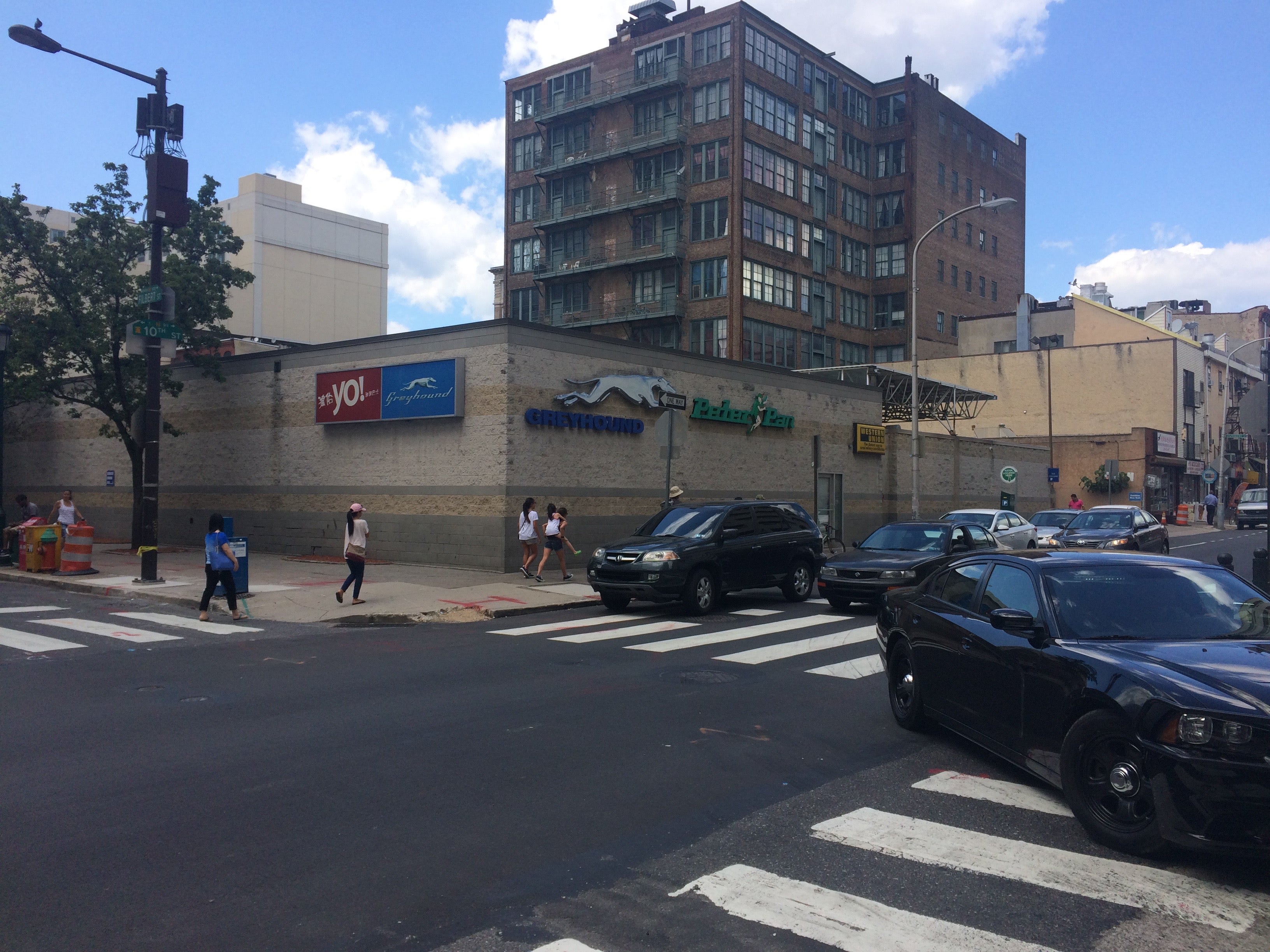
The Philly terminal is a disgrace. I don't know how many people are in Atlantic City on an average summer day, when both the beaches and the casinos are full (I'm guessing about half a million, or one-third the size of Philly), but it has a permanent population of 40,000 people, compared to the 1.6 million of Philadelphia, and it has a bus station of roughly equal size and far greater cleanliness than Philly's. Besides, Greyhound service out of Newark's Penn Station is very limited, and do you really want to go out of New Jersey into Manhattan just to get across New Jersey into Philadelphia? At any rate, it's $82 round-trip, but it can drop to as little as $44 with advanced purchase.

If you can afford Amtrak, and that will be $132 round-trip between New York and Philly, it takes about 2 hours to get from Penn Station to the 30th Street Station at 30th & Market Streets, just across the Schuylkill River from Center City.

Unlike the dull post-1963 Penn Station, this building is an Art Deco masterpiece from 1933, and is the former corporate headquarters of the Pennsylvania Railroad. Ironically, it never had the official name "Pennsylvania Station" or the nickname "Penn Station." You might recognize its interior from the Eddie Murphy film Trading Places. (If you can't afford Amtrak, or if you can but you'd rather save money, I'll get to what to do in a minute.) 
West front of 30th Street Station

In 2020, it was renamed the William H. Gray III 30th Street Station, in honor of the Rev. Bill Gray, a Congressman from 1979 to 1991, and then the president of the United Negro College Fund until 2004. There had been a movement to rename it Ben Franklin Station, but this was discarded, because it was presumed people would call it "Ben Station," and this would sound too much like "Penn Station," of which there were already several on the Northeast Corridor.
Interior of 30th Street Station

Like Philly's commuter-rail and bus systems, their subway system is run by SEPTA, the SouthEastern Pennsylvania Transportation Authority. You might recognize their "S" logo from Trading Places, and the bus that hits Tommy Morrison at the end of Rocky V. You'll have to exit 30th Street Station and cross 30th Street itself to get into the 30th St. station on the Market-Frankford Line.

Philadelphia was the last city in the U.S. that still used tokens rather than farecards or tickets for their subways, switching in 2018. One ride on a SEPTA subway train is $2.50, and a one-day KeyCard, good for 8 rides, is $9.00.

If you don't want to take Amtrak, your other rail option is local. At Newark Penn, you can buy a combined New Jersey Transit/SEPTA ticket to get to Center City Philadelphia. Take NJT's Northeast Corridor Line out of Penn Station to the Trenton Transit Center. This station recently completed a renovation that has already turned it from an absolute hole (it was so bad, it made Philly's bus station look like Grand Central) into a modern multimodal transport facility.

At Trenton, transfer to the SEPTA commuter rail train that will terminate at Chestnut Hill East, and get off at Suburban Station, at 17th Street & John F. Kennedy Blvd. (which is what Filbert Street is called west of Broad Street). Getting off there, a pedestrian concourse will lead you to the City Hall station on the Broad Street Line, and then just take that to Pattison.
A SEPTA train at 30th Street Station

Because there will be a lot more stops than there are on Amtrak (especially the SEPTA part), it will take 2 hours and 10 minutes, but you'll spend $50 round-trip, about what you'd spend on a same-day purchase on Greyhound, and less than half of what you'd be likely to spend on Amtrak. However, again, time will be an issue: The last SEPTA Trenton Line train of the night that will connect to an NJT train leaves Suburban Station at 11:57 PM (and the NJT train it will connect to won't get to Penn Station until 2:46 AM), so this might not be an option for you this time, either.

The subway's cars are fairly recent, and don't rattle much, although they can be unpleasant on the way back from the game, especially if it's a football game and they're rammed with about 100 Eagles fans who've spent the game sweating and boozing and are still loaded for bear for anyone from outside the Delaware Valley.
Once In the City. Philadelphia is a Greek word meaning "brotherly love," a name given to it by its founder, William Penn, in 1683. So the city is nicknamed "The City of Brotherly Love." The actions and words of its sports fans suggest that this is ridiculous. Giants coach Bill Parcells was once caught on an NFL Films production, during a game with the Eagles at the Vet, saying to Lawrence Taylor, "You know, Lawrence, they call this 'the City of Brotherly Love,' but it's really a banana republic." And Emmitt Smith, who played for that other team Eagles fans love to hate, the Dallas Cowboys, also questioned the name: "They don't got no love for no brothers."

On a map, it might look like Penn Square, surrounding City Hall, is the city's centerpoint, but this is just geographic, and only half-refers to addresses. Market Street is the difference between the north-south numbering on the numbered Streets. But the Delaware River is the start for the east-west streets, with Front Street taking the place of 1st Street. Broad Street, which intersects with Market at City Hall/Penn Square, takes the place of 14th Street.
The William Penn statue atop City Hall

In the Colonial and Revolutionary periods, Philadelphia was the largest city in America, before being overtaken by New York. As recently as 1970, it had about 2 million people. But "white flight" after the 1964 North Philadelphia riot led to the population dropping to just over 1.5 million in 2000. It has inched back upward since then, to about 1.6 million. The metro area as a whole -- southeastern Pennsylvania, South Jersey and most of Delaware -- is about 7.2 million, making it the 7th-largest in the country, behind New York, Los Angeles, Chicago, San Francisco, Boston and Dallas.

Philadelphia's racial and ethnic issues are long-standing. There was a pro-slavery riot in 1834, a nativist riot in 1844, race riots in both Philadelphia and nearby Chester in 1917, the aforementioned race riot in North Philadelphia in 1964, a race riot across the river in Camden in 1971, and the 1977 and 1985 police actions against the black separatist group MOVE. Elsewhere in Eastern Pennsylvania, there was the Scranton Coal Riot in 1871, and the York Race Riot in 1969.

And black Philadelphians were upset that a statue of 1972-80 Mayor Frank Rizzo, a notorious bigot, was placed in front of the Municipal Services Building, across the street from the north side of City Hall, in 1998.

A statue of professional baseball player and civil rights activist Octavius Catto, murdered on South Street in 1871, was placed on the south side of City Hall later in 2017. I had hoped that it would be placed on the north side, so he could stare Rizzo down. That became academic in 2020, when Rizzo's statue was removed.

Philadelphia is about 42 percent black, 36 percent white, 13 percent Hispanic, and 7 percent Asian. North, Northwest and West Philadelphia are now almost entirely black, although University City (home to the University of Pennsylvania and Drexel University) and some of Southwest Philly remains white. South Philadelphia (Italian) and Northeast Philadelphia (Irish) remain mostly white.

The sales tax is 6 percent in the Commonwealth of Pennsylvania (Massachusetts, Virginia and Kentucky are also "commonwealths" in their official State names), 8 percent within the City of Philadelphia.

ZIP Codes in Philadelphia start with the digits 191. In the suburbs, it's 189, 190, 193 and 194. The Area Code for the city is 215, and the suburbs 610, with 267 overlaying both, and 445 being added in 2018. Philadelphia's "beltway" consists of Interstate 276 (the easternmost part of the Pennsylvania Turnpike) in the north, Interstate 476 (the Mid-County Expressway) in the west, and Interstate 95 (the Delaware Expressway) in the south and east.

The Philadelphia electric company is named just that: Philadelphia Electric Company, or PECO. And while it's not quite as close as it is to New York, much of the Jersey Shore is easily reachable from Philadelphia, thanks to Interstate 195, New Jersey Route 70, U.S. Routes 30 and 40, the Atlantic City Expressway, and New Jersey Transit's buses and its Atlantic City Rail Line. Point Pleasant Beach is 76 miles away, Seaside Heights 64 miles, Long Beach Island 62, Atlantic City 61, Ocean City 65, Wildwood 90, and Cape May 92.

Once On Campus. When I was a kid, I associated the word "temple" with Judaism, so I figured that Temple University was a Jewish school. Then, a friend got in, and since he was Catholic, I figured that Temple was a Catholic school. Both perceptions were boosted by Philly schools La Salle, St. Joseph's and Villanova all being Catholic.

As it turned out, it was founded in 1884 by Russell Conwell, a Baptist minister, and a lawyer from -- if you're actually from Philly, brace yourself -- Boston. He opened The Temple College of Philadelphia in the basement of his church, the Baptist Temple, and taught students at night, to accommodate their work schedules. The students became known as "night owls," and Temple students have been "Owls" ever since.

The school added Samaritan Hospital and a Medical School. In 1907, it acquired the Philadelphia Dental College, and reorganized as Temple University. In 1965, it became a State-related university: It receives funds from the Commonwealth of Pennsylvania, subject to State appropriations, but is independently operated: Neither the Commonwealth, nor the City of Philadelphia, nor any religious institution has a hand in its actual operation.

Temple is roughly the buffer between Center City and the North Philadelphia ghetto. As a result, it's had a major role in the local side of the civil rights movement. The former Columbia Avenue, which goes right through the campus, was renamed Cecil B. Moore Avenue, after the president of the local chapter of the NAACP. Martin Luther King gave a noted speech on campus in 1965. And longtime basketball coach John Chaney was heavily involved in the African-American educational experience, and not just on the Temple campus.

Until recently, the most honored graduate of Temple, living or otherwise, was comedian and TV giant Bill Cosby. His fall into disgrace was a terrible blow to the University's image, as he was probably the biggest fundraiser they ever had. But the school still has many distinguished alumni: 

* Journalism (non-sports) MSNBC host Tamron Hall, HuffPost Live host Marc Lamont Hill, conservative radio talk show host Mark Levin.

* Literature: Science fiction author Ben Bova, minister and theologian Tony Campolo.

* Entertainment: Actors Norman Fell, Robert Prosky, Veronica Hamel, Patricia Wettig, Tom Sizemore, Danny Woodburn and Kunal Nayyar; comedians David Brenner, Bob Saget and Paul F. Tompkins; directors Irvin Kershner, Dan Trachtenberg and Adam McKay; both Daryl Hall and John Oates (they met at Temple), soul singer Billy Paul, R&B singer Jill Scott, songwriter Julie Gold, and music producer Thomas Pentz, a.k.a. Diplo.

* Politics: Mayor John Street of Philadelphia, and Charles Sandman, Congressman from South Jersey was the Republican nominee for Governor in 1973, and then made a fool of himself standing up for President Richard Nixon during the Watergate hearings.

While not a political office, this is, in a way, a governmental role: Captain Frederick C. Branch, was the 1st African-American to become an officer in the U.S. Marine Corps. His attendance at Temple was interrupted by World War II, but he got his degree there in 1947.

Serial killer Ted Bundy attended Temple for one semester, in 1969. Salvatore Testa, son of local Mob boss Philip Testa, attended Temple for a year in 1981, before joining the family business. Like his father, "the Chicken Man," he was rubbed out by his fellow wiseguys. And Edith Windsor, whose lawsuit overturned the federal "Defense of Marriage Act," a key moment in the gay rights movement, was a Temple graduate.

Temple was renowned for its basketball program long before John Chaney got there, and it's still renowned for it after his retirement and death. Its stars include Mike Bloom in the 1930s; Bill Mlkvy (a.k.a. The Owl Without a Vowel); Hal Lear and Guy Rodgers in the 1950s; Terrence Stansbury, Nate Blackwell and Mark Macon in the 1980s; Aaron McKie in the 1990s; and Pepe Sanchez at the turn of the 21st Century.

The school's sports department and its journalism program have produced NFL writer and historian Ray Didinger, ESPN's Howard Bryant and Kevin Negandhi, and Los Angeles Angels broadcaster Terry Smith.

Going In. If you were going to the campus, this is how you would go: Temple: Take Broad Street north from Center City, to Oxford Street. Turn left, go 3 blocks, then right on Sydenham Street. The parking garage for the Liacouras Center is 2 blocks north. The Center's address is 1776 Broad Street, across Montgomery Avenue from their 3,900-seat 1969-97 arena, McGonigle Hall. 2 miles north of Center City. Temple also has campuses in Center City and in the State capital of Harrisburg. They the only 1 of the Big 5 that has a campus outside its main area.

If you were going in by public transportation, you would take the Broad Street Line uptown to Cecil B. Moore station.

But the stadium is not on campus. It's Lincoln Financial Field, home of the NFL's Eagles, in the opposite direction. The Philadelphia sports complex is at Broad Street and Pattison Avenue, 36 blocks -- 7 miles -- south of City Hall.

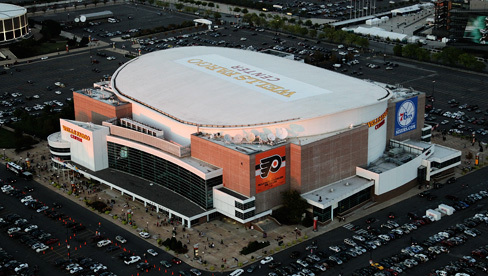
It once included Sesquicentennial/Municipal/John F. Kennedy Stadium (1926-1992), The Spectrum (1967-2009), and Veterans Stadium (1971-2004). The arena now known as the Wells Fargo Center was built on the site of JFK Stadium. Citizens Bank Park, the new home of the Phillies, was built to the east of The Vet. And Lincoln Financial Field was built south of the new ballpark, and east of the Spectrum. Once known as Pattison station, the end of the line is now "AT&T Station." 

It's highly unlikely anyone will give you anything more than a little bit of verbal on the subway ride into the Sports Complex, while they might give a little more gusto to the verbal on the ride back. But despite Philly sports fans' reputation, this will not be the equivalent of the London Underground on a Saturday afternoon in the 1980s: They might tell you that your team sucks (even if your team is ahead of theirs in the standings), but that's about the worst you'll get.

There is plenty of parking in the complex, including a lot on the site of  The Vet. Parking is $22. But you'll be a lot better off if you take the subway. Not really because of the price of parking, but because traffic is going to be awful.

Coming out of the AT&T subway station, you'll walk down Pattison Avenue, with a parking lot on the former site of Veterans Stadium to your left, and the site of the Spectrum to your right. Further to your right is the successor to the Spectrum, the Wells Fargo Center, named for the banking and insurance company. Further to your right is Lincoln Financial Field. You'll be likely to enter either at the north end zone or the west sideline.

The new home of the Eagles has seen them make the Playoffs more often than not, and reach the Super Bowl in the 2004 and 2017 seasons, finally winning it in 2017-18. And fan behavior, while still rowdy, is not as criminal as it was at The Vet: No more municipal court under the stands is necessary. Still, this is not an Eagles game, it's a Temple game.
"The Linc" has hosted the Army-Navy Game every year since it opened, except for 2007, 2011 and 2014, 2016 and 2020. It's hosted 4 games of the U.S. National Soccer Team, most recently a 3-0 win over Bolivia in a friendly on May 28, 2018; games of the 2003 Women's World Cup, an MLS All-Star Game, and several games by touring European teams such as Manchester United, Glasgow Celtic and A.C. Milan. It will probably host games of the 2026 World Cup. (UPDATE: It has been chosen as a World Cup site.)
It looks a lot taller from the inside,
because the field is well below street level.

Inside the stadium, concourses are wide and well-lit, a big departure from The Vet. Escalators are safe and nearly always work, as opposed to the Vet, which did not have escalators, only seemingly-endless ramps. Getting to your seat should be easy. The field is natural grass (clearly, the organization listened to all those complaints about the Vet's turf), and runs (more or less) north-to-south.

On February 23, 2019, The Linc hosted an NHL Stadium Series game, with the Flyers beating the cross-State Pittsburgh Penguins 4-3.

In 2017, Thrillist had an article ranking all 31 NFL stadiums. The Linc didn't come off so well, 25th place:

The outside of Lincoln Financial Field is a land of wonder and joy (and fisticuffs). It's the best part of every game, because out there, the Eagles haven't yet disappointed their fans in spectacularly new and innovative ways.

You can take the Broad Street Line to avoid traffic AND start drinking early. Tailgates are unequivocally the best part of an Eagles game because you can't lose the tailgate like you can the home opener, season finale, every rivalry, and the NFC Championship Game. For the cheap fans (most of us), you can still tailgate the game and watch every disappointing minute next door at XFINITY Live!, where you chase sorrows with mechanical bull rides and light-up shots of Rumchata (just me?). The inside of the Linc is a hellscape where dreams and civility go after their undignified death. But say this for the joint: Eagles fans will never, ever let you forget where you are. You're guaranteed to leave with new memories, kind of a feat for a weekend afternoon in Pennsylvania.
Food. From the famed Old Original Bookbinder's (125 Walnut Street at 2nd, now closed) and Le Bec Fin (1523 Walnut at 16th) to the Reading Terminal Market (Philly's version of  the South Street Seaport, at 51 N. 12th St at Filbert) to the South Philly cheesesteak giants Pat's, Geno's and Tony Luke's, Philly is a great food city and don't you ever forget it.

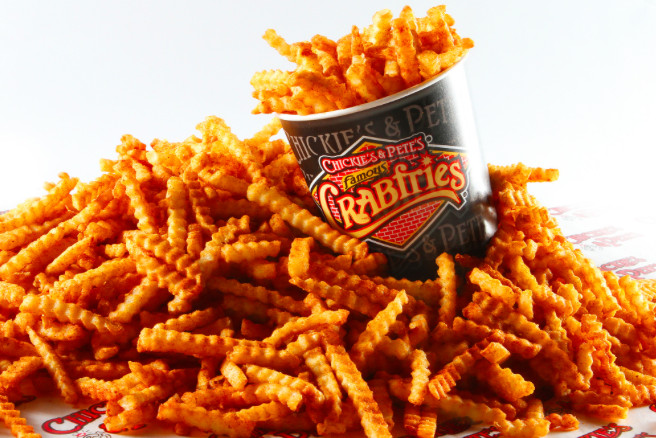
The variety of food available at The Linc. Little of it is healthy (no surprise there), but all of it is good. Tony Luke's has a stand (as it also does at the ballpark and the arena). So does Chickie's & Pete's, to sell their fish and their "crab fries" -- French fries with Old Bay seasoning mix, not fries with crabmeat. Also at The Linc are outlets of Bassett's Original Burgers & Fresh Cut Fries, Seasons Pizza, and Melt Down grilled cheese stands.

When The Linc opened, the Eagles instituted a policy that the City had previously allowed at The Vet, which it, not the team, owned: No longer would fans be allowed to bring hoagies (hero/sub sandwiches) into the stadium. The fans revolted, and the old policy was restored, making The Linc one of the few sports venues in North America where you can bring in your own food -- but only hoagies. 

Team History Displays. They will all be for the Eagles, not for Temple. Their football history is pretty spotty, anyway: Their historical record is 474 wins against 586 losses, with 52 ties, for a winning percentage of .450.

They began playing in 1894, suspended the program from 1918 to 1921, and have been bad much more often than good. Under coach Heinie Miller, they were 7-1 in 1927, 7-1-2 in 1928, 8-1-1 in 1931, and 5-1-2 in 1932. Under Pop Warner, they were 7-1-2 in 1934. Under Ray Morrison, they were 7-2 in 1941 and 7-1 in 1945. Under George Makris, they were 7-2 in 1964 and 1967. Under Wayne Hardin, they were 7-3 in 1970, 6-2-1 in 1971, 9-1 in 1973, 8-2 in 1974, 7-3-1 in 1978, and 10-2 in 1979. Under Al Golden, they were 9-4 in 2009, 8-4 in 2010 and 9-4 in 2011. Under Matt Rhule, they were 10-4 in 2015 and 2016.

But much more common seasons are like the winless seasons of 1955 (0-8), 1958 (0-8), 1959 (0-9) and 2005 (0-11); the 1-10 seasons of 1989, 1992, 1993, 1995 and 1996; the 1-11 seasons of 2003 and 2006; and the 2-10 season of 2013.

Their chances of winning any kind of championship have been hindered by the fact that they've been an Independent for much of their history. They belonged to the Middle Atlantic Conference from 1960 to 1969, the Big East Conference from 1991 to 2004, the Mid-American Conference from 2007 to 2011, the Big East Conference only in 2012, and have been in the American Athletic Conference since 2013. They won the Middle Atlantic title in 1967, the MAC East Division in 2009, the AAC East Division in 2015, and the AAC overall in 2016.

In 1934, under the already legendary coach Glenn "Pop" Warner, Temple went 7-0-2, earning them an invitation to the 1st Sugar Bowl game, hosted by Tulane University at their stadium on January 1, 1935. Tulane won it, 20-14.

Temple weren't invited to another bowl until the 1979 season, and it was the Garden State Bowl in the nearby Meadowlands, hardly prestigious. They beat the University of California 28-17. They lost the 2009 EagleBank Bowl to UCLA, 30-21; and won the 2011 New Mexico Bowl over Wyoming, 37-15.

They made a bowl game 5 years in a row, before COVID caused them to cancel their entire last season. 2015: Lost to Toledo in the Boca Raton Bowl, 32-17. 2016: Lost to Wake Forest in the Military Bowl, 34-26. 2017: Beat Florida International in the Gasparilla Bowl, 28-3. 2018: Lost to Duke in the Independence Bowl, 56-27. 2019: Lost to North Carolina in the Military Bowl, 55-13. So, 9 bowls, only 1 of them major, a 3-6 record.

The program has had 4 men elected to the College Football Hall of Fame. But 3 were elected as coaches, for what they did elsewhere before they ever got to Temple: Pop Warner (Carlisle, Pittsburgh and Stanford), Ray Morrison (Southern Methodist) and Wayne Hardin (Navy).

The 1 true Temple Hall-of-Famer was Paul Palmer, a running back who was the runner-up to Vinny Testaverde of Miami for the 1986 Heisman Trophy. He later played 27 games for the Kansas City Chiefs, 9 for the Dallas Cowboys and 5 for the Detroit Lions. He later coached high school ball in South Jersey, and is now a radio analyst for Temple football.

Other notable Temple football players include Jets legend Joe Klecko and his son Dan Klecko, who won 3 Super Bowls * with the New England Patriots; Ed Kolman, a 1930s tackle who made 3 Pro Bowls and won 3 NFL Championships with the 1940s Chicago Bears; Frank "Bucko" Kilroy, a 1940s guard who became known as the NFL's dirtiest player with the 1950s Eagles; Randy Grossman, a 1970s tight end who won 4 Super Bowls with the Pittsburgh Steelers; Steve Watson, a 1970s receiver who made a Pro Bowl and 2 Super Bowls for the Denver Broncos; and Todd Bowles, a 1980s cornerback who was head coach of the Jets from 2015 to 2018, and is now the defensive coordinator for the Tampa Bay Buccaneers.
Joe Klecko and coach Wayne Hardin

The basketball "Big 5" doesn't come into play much. St. Joseph's stopped their football program in 1939. La Salle followed in 1941, started again in 1997, and stopped again in 2007. Villanova stopped playing after the 1980 season, but started again in 1987. And the University of Pennsylvania, being an Ivy League school, stopped playing the big schools in the late 1970s.

But the Temple-Villanova rivalry does exist in football. They played every year from 1928 to 1943, again from 1970 to 1980, in 2003, every year from 2009 to 2012, and again in 2017 and 2018. Overall, the series is dead even, 16-16-2. Even though Villanova Stadium is outside Philadelphia, 11 miles west of City Hall, Temple and Villanova play for a trophy named the Mayor's Cup.
Stuff. Souvenir stands will sell Temple souvenirs, but the team store will be all Eagles stuff. If you want Temple stuff, you'll have to go to the Temple University Shop & Cafe, at 1755 N. 13th Street (Cecil B. Moore station); or the Temple University Center City Bookstore, at 1515 Market Street (City Hall station).

Don't bother looking for books about Temple football: If there are any, they may not be in those stores, and they definitely aren't on Amazon.com. There are books about Temple basketball.
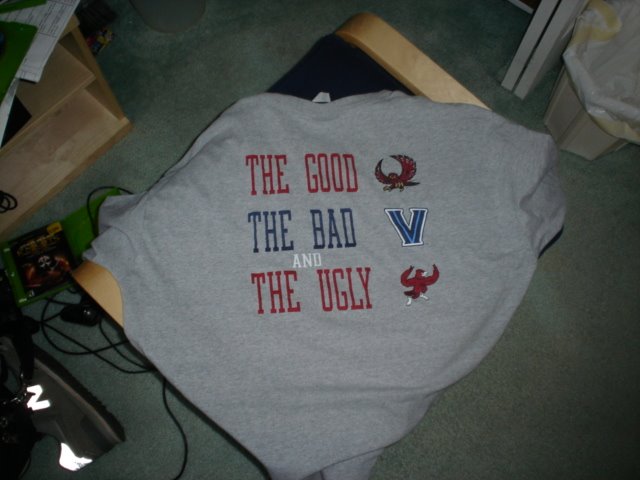
T-shirt sold in the Temple University Bookstore.
"The Bad" is 'Nova, "The Ugly" is St. Joe's.

During the Game. You may have heard about, or even experienced, trouble at an Eagles or Flyers game. At a Temple football game, just stay away from the interaction between the students, and you'll be fine.
Temple has a live female owl mascot, Stella, and a guy in a suit, Hooter the Owl. Both are brought to basketball games at the Liacouras Center and football games at the Eagles' Lincoln Financial Field. Temple may be the only major football-playing college that calls its shade of red "cherry."
If the guy playing Hooter is smart, he won't do a
Marlon Brando impression from A Streetcar Named Desire
and yell, "Stellaaaaaaaa!"

After the Game. Philadelphia is a big city, with all the difficulties of big cities as well as many of the perks of them. You should get back to your car/public transit stop as quickly as you can. 

The legendary Pat's and Geno's Steaks, arch-rivals as intense as any local sports opponents, are across 9th Street from each other at Passyunk Avenue in the Italian Market area. My preference is Pat's, but Geno's is also very good. Be advised, though, that the lines at both are of Shake Shack length, because people know they're that good.

You can also pick up a sandwich, a snack or a drink at any of several Wawa stores in and around the city. If you came in via Suburban Station, there's one at 1707 Arch, a 5-minute walk away; if the game lasts 3 hours or less, you have a shot at getting in, getting your order, getting out, and getting back to the station in time to catch your train.

If your visit to Philly is during the European soccer season (which is in progress), you can probably watch your favorite club at Fadó Irish Pub, at 1500 Locust Street in Center City. Be advised that this is home to supporters' groups for Manchester United, Liverpool, Tottenham Hotspur and Celtic FC; so if you're not particularly fond of any of those teams, you might want to stay away.

Sidelights. On November 30, 2018, Thrillist published a list of "America's 25 Most Fun Cities," and Philadelphia came in 17th. 

The 1st home of Temple football, from 1894 to 1927, was Vernon Park, at 5800 Germantown Avenue. The park is still there, but there's no evidence that there was ever a football stadium on the site. SEPTA Bus 23 from 11th & Market.

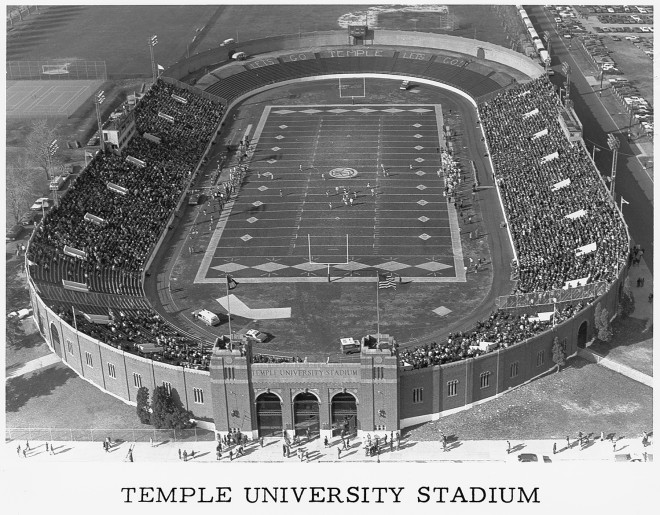
Temple Stadium opened in 1928, in the West Oak Lane neighborhood of North Philadelphia. It seated 40,000 at the time. They played there until 1977, and continued to play their soccer games there until 1995, after which it was demolished. The Philadelphia Spartans, the city's 1st entry into what became the original North American Soccer League, played there in 1967.
On November 6, 1934, the Eagles played at Temple Stadium, and beat the Cincinnati Reds 64-0. It remains the 2nd-most lopsided game in NFL history. Named for the city's baseball team, these Reds never played again, going out of business due to the Great Depression. Not until the birth of the Bengals in 1968 would Cincinnati have another major league football team.

In 1952, unhappy with their lease at Shibe Park (soon to be renamed Connie Mack Stadium), the Eagles offered to buy Temple Stadium and make it their home field. The University had it appraised for $1 million, and the Eagles refused to pay it. They moved to Franklin Field in 1958, Veterans Stadium in 1971, and Lincoln Financial Field in 2003.

The U.S. national soccer team played a friendly against Israel at Temple Stadium on September 25, 1968. Israel won 4-0. Jimi Hendrix played one of his last concerts there, on May 16, 1970, with the Grateful Dead and the Steve Miller Band also appearing.

As with Shibe Park/Connie Mack Stadium, a church was built on the site: Enon Tabernacle Baptist Church, which already had a link with Temple, as it was holding services at the Liacouras Center until this new building opened in 2006. 2800 W. Cheltenham Avenue, 9 miles north of City Hall, and 7 miles north of the Liacouras Center. Broad Street Line to Olney Transportation Center, then Bus 22 to Cheltenham & Vernon.

From 1978 to 2002, Temple played football at Veterans Stadium, and, with the Eagles, moved to The Linc in 2003. Since 2015, the University has been talking about building a 35,000-seat stadium on campus, but aside from a feasibility study, nothing has been done about it.

From 1938 to 1955, Temple played its home basketball games at the Convention Hall of the Philadelphia Civic Center. It stood from 1931 to 2005, and was home to the NBA's Philadelphia Warriors from 1946 to 1962, and the Philadelphia 76ers from 1963 to 1967. It hosted the 1936 Democratic Convention, the 1940 Republican Convention, and both parties' Conventions in 1948. The Beatles played there in 1964.

The University of Pennsylvania's Perelman Center for Advanced Medicine is now on the site. 3400 Civic Center Blvd. Market-Frankford Line to 33rd Street.

From 1955 to 1969, they played home games at The Palestra, as tenants of the University of Pennsylvania. "The Cathedral of College Basketball" has hosted Penn since 1927, and Big 5 doubleheaders have been great events. 223 S. 33rd Street, next to Franklin Field. Market-Frankford Line to 33rd Street.

Finally, in 1969, Temple opened an on-campus arena, McGonigle Hall, named for Arthur T. McGonigle, a major donor to the University. It was a fortress: They went 179-28 there. But it was a small fortress, topping out at 4,500 seats, and so they still played the occasional "home game" at The Palestra, which seats twice as many.
Given how big coach John Chaney had made Temple basketball, a bigger facility was needed. The Liacouras center opened in 1997, named for University President Peter Liacouras, and seating 10,206. Liacouras is at 1776 N. Broad Street, and McGonigle at 1800 N. Broad, separated by Montgomery Street. Broad Street Line to Cecil B. Moore.

*

So, if you want to see a football game in Philadelphia, but don't want to risk your life amongst a bunch of crazed and possibly drunken Eagle fans, a Temple game may be the way to go.

Friday, January 29, 2021

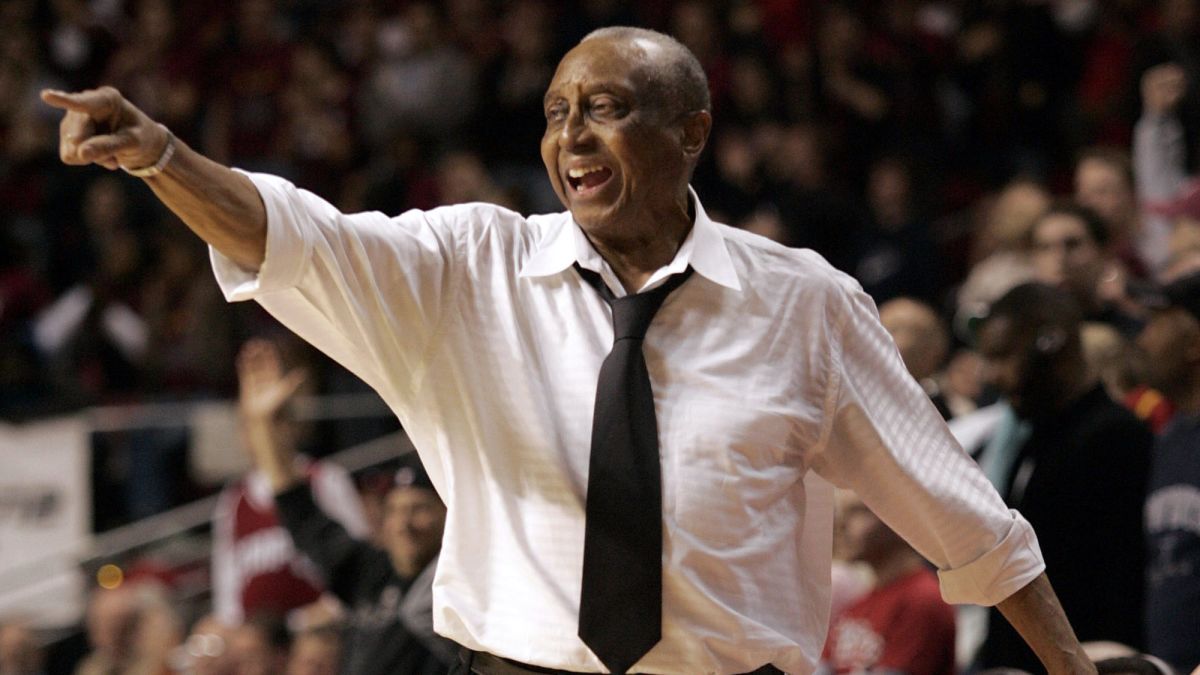
John Chaney, 1932-2021

If you only know Bob Knight as a raving lunatic who happened to be a great college basketball coach, then you need to know more.

The same was true for John Chaney, who may have changed even more lives for the better. Certainly, he changed lives more than Knight did.

John Chaney (no middle name) was born on January 21, 1932 in Jacksonville, Florida. Like pretty much any black man in the South who wanted to go to college, he had to go to one of the South's "historically black colleges and universities" (HBCUs). In his case, it would be Bethune-Cookman University in Daytona Beach, Florida, from which he graduated in 1955.

At this point, the NBA had black players, but not many. And Chaney was not drafted. So he played in the next-highest league, the Eastern Professional Basketball League, for the Sunbury Mercuries from 1955 to 1963, and the Williamsport Billies until 1966. Both of those teams were in Pennsylvania. That got the attention of basketball people in that State, particularly in its largest city, Philadelphia.

Philadelphia was already a great basketball city. Its "Big Five" (or "Big 5," if you prefer) schools are Temple University, which had won the 1st NIT in 1938, and had already been to what we now call the NCAA Final Four in 1956 and 1958; La Salle University, which won the National Championship in 1954 and got back to the Final in 1955; Villanova University, which made the 1st Final Four in 1939; St. Joseph's University, which had made the Final Four in 1961; and the University of Pennsylvania, one of the earliest great programs, and whose 1927-built arena, The Palestra, hosted many Big 5 games, many of them not even featuring Penn, and became known as "The Cathedral of Basketball."

In addition, the South Philadelphia Hebrew Association, a.k.a. the Philadelphia SPHAs, were one of the earliest great professional teams, and evolved into the Philadelphia Warriors, the 1st NBA Champions in 1947, won the title again in 1956, and moved in 1962, eventually becoming the Golden State Warriors. In 1963, they were replaced by the Philadelphia 76ers.

In 1963, while still playing for Williamsport, John Chaney got his 1st coaching job, at Sayre Junior High School in Sayre, Bradford County, in Northeast Pennsylvania. In 1966, he hung up his sneakers to take the job at Simon Gratz High School in North Philadelphia.

Simon Gratz was a longtime member of the Philadelphia Board of Education. By the time Chaney got there, the school had already produced Baseball Hall-of-Famer Roy Campanella, Pro Football Hall-of-Famer Leroy Kelly, longtime Warriors and 76ers statistician Harvey Pollack, singer Eddie Fisher, songwriter Artie Singer (who had co-written "At the Hop" and "Rock and Roll Is Here to Stay" for South Philly doo-wop group Danny & The Juniors), and future Congressman Bill Gray. It has since produced boxing champion Meldrick Taylor and 2 NBA stars: Rasheed Wallace and a player Chaney would coach, Aaron McKie.

When Chaney got to Gratz, they were coming off a season in which they won exactly one game. He took them to a 63-23 record in 6 seasons. He couldn't get Gratz to win the Public League Championship, but the school has since done so in 1973 under coach Lionel Hoye; 1990, 1991, 1993, 1994, 1997 and 2001 under Bill Ellerbee; and in 2004 and 2006 under Leonard Poole.

In 1972, Chaney reached the college ranks, Cheyney State College, now Cheyney University, an HBCU in Cheyney, Chester County, southwest of Philadelphia. In 10 seasons, offering chances to kids whose only way out of Philly's ghettos seemed to be basketball, he guided the school, now in NCAA Division I, to a 232-56 record, including the NCAA Division II Championship in 1978. Surely, some people thought the school was named for him, not noticing the difference in spelling.

In 1982, he was hired at Temple University. Sitting on the area where Center City begins to fade out, and the North Philly ghetto begins, it has always been an inclusive school, and a lifelong for poor youth in the city. This has included its basketball program, a haven first for Jewish kids, then for black ones.

(This confused me, as I heard the name "Temple" and thought it had started as a Jewish school. In fact, it was founded in 1884 by Russell Conwell, a Bostonian, a lawyer, and an ordained Baptist minister. Its 1st lecture hall was in the basement of Conwell's Grace Baptist Temple, and that's where the name comes from.)

Temple's motto is "Perseverantia Vincit," Latin for "Perseverance Conquers." Chaney already knew that, and he showed it at McGonigle Hall. He became known for early-morning practices, yelling in a raspy voice when he perceived insufficient effort, his tie getting looser and looser as games went on, a fine match-up zone defense, and scheduling the Temple Owls against the toughest teams in the country. He was a firm believer in the old line of, "If you want to be the best, you've got to beat the best."

In 1985, he guided them to the Atlantic 10 Conference regular-season title, and also to the A-10 Tournament title. He repeated this feat in 1987, and again in 1988, and again in 1990. In 1988, he got a team led by Tim Perry and Macon Macon to the pre-NCAA Tournament Number 1 ranking. In the Tournament, they beat Lehigh, Georgetown and the University of Richmond to reach the Elite Eight, with a record of 31-1. But they were beaten by Duke in the Regional Final. Chaney swept the various National Coach of the Year awards, one of which he had already won in 1987.

Chaney became an icon in Philadelphia, and beyond. But 1988 would be the closest he ever got to a Division I National Championship. And as time went on, he began to be seen as a quirky character, an irascible old man. I saw a newspaper cartoon comparing him to the Star Wars character Yoda. (A bit taller, he was, hm?)

In 1994, Temple went 23-8, finished 2nd in the A-10, and was ranked 12th in the last national poll. By Chaney's standards, it was about average. But on February 13, they went up to Amherst, Massachusetts to play the University of Massachusetts, then coached by John Calipari, and lost 56-55.

During Calipari's postgame press conference, Chaney, 62, barged in, and accused Coach Cal, 35 and already with the kind of reputation that would get him called a "preening schmo," of "manipulating the referees." Calipari tried to respond, but Chaney wouldn't let him, yelling, "Shut up, goddammit!" He then charged the podium, and security officers stopped him before he could get close. But not before he could yell, "I'll kill you!" and, "When I see you, I'm gonna kick your ass!" and, "I'll tell my players to knock your fucking kids in the mouth!"

Calipari, a native of a small town outside Pittsburgh, stood his ground, and said, "Nothing ceases to amaze me." He has gone on to great success in the game, but also to great controversy. Chaney was suspended for 1 game over the incident, apologized, and, years later, publicly defended Calipari during one of his scandals.

Chaney would lead Temple to the A-10 regular season title in 1998, sweep the regular-season and Tournament titles in 2000, win the Tournament again in 2001, and win the regular-season title again in 2002. In 2001, meeting the eligibility requirement -- active coaches can be elected with 25 years of service -- he was elected to the Basketball Hall of Fame.

But after getting Temple back to the Elite Eight in 2001, he never got them into the NCAA Tournament again. Despite 3 straight 2nd-place finishes in the league, overall, he went 18-16 in 2003, 15-14 in 2004, and 16-14 in 2005. The A-10 then went to a single division, due to changes in affiliations, and in 2006, he went 8-8, good enough for only 7th, and went 17-16 overall.

At the age of 73, he hung up his whistle. He was 741-312 for his career, including 516-253 at Temple. He had won 8 regular-season Conference Championships, and 6 Conference Tournaments. But despite making the Elite Eight in 1988, 1991, 1993, 1999 and 2001, he never made the Final Four.

He was succeeded by Fran Dunphy, who came over from fellow Big 5 school Penn. Despite a losing record in his 1st season -- something Chaney had also done at Temple, and it would be the only losing season he ever had as a coach -- he led Temple to A-10 titles in 2010 and 2012, and to the Championship of the American Athletic Conference in 2016.

In 2019, "Mr. Big 5" stepped aside, having surpassed Chaney as the all-time wins leader among Big 5 coaches, and handed the reigns to Aaron McKie, who had been his assistant, had won A-10 Player of the Year under Chaney in 1993, and had starred in Philly for the 76ers.

John Chaney died today, January 29, 2021, after a brief illness. He had just reached his 89th birthday, and leaves behind his wife Jeanne, their daughter Pamela, dozens of men whose lives received a boost thanks to his tutelage, the love of the people of Philadelphia, and the respect of basketball fans everywhere.

Friday, January 20, 2017

How to Go to a Philadelphia Big Five Basketball Game

Presuming you haven't been arrested by Trump's secret police, tomorrow, you can participate in a counter-demonstration in Washington.

You could also attend the Penn-St. Joe's game at the Palestra -- but only if you already have tickets, or want to deal with scalpers: It's sold out.

Before You Go. Philadelphia is just down the road, so it's in the Eastern Time Zone, and you don't have to worry about fiddling with various timepieces. And the weather will be almost identical to what you'd have on the same day in New York. Still, check the combined website for the Philadelphia newspapers, the Inquirer and the Daily News, before you head out.

For the moment, it looks like, for tomorrow, temperatures in Philly will be in the mid-50s in the afternoon, and in the mid-40s, with today's rain being past. Wear a winter jacket.

Tickets. Officially, the Palestra has a seating capacity of 8,725. That's not much for a big game, although it's usually more than enough for an Ivy League game. But, as I said, this game is sold out.

Price LevelPremium GameNon-Premium Game
Lower Sideline$38.50$33.00
Upper Sideline$22.00$17.00
Lower Baseline$22.00$17.00
Upper Baseline$17.00$11.50
In addition to tomorrow's hosting of St. Joe's, Penn plays away to La Salle this coming Wednesday. St. Joe's visits La Salle on Saturday, February 18. Lower seats are $25, upper seats $20.

Temple has no further home games against Big 5 teams this season. Their next home game is also this Wednesday, against the University of Memphis (formerly Memphis State). They are now in the same conference. Seats in the lower level, the 100 sections, are $35 between the baskets and $25 behind. Seats in the 200 level are $15 throughout.

A week from tomorrow, La Salle visits St. Joseph's. Due to demand, with St. Joe's' recent success, and needing to pay off the recent renovation of Hagan Arena, all seats are $50.

Villanova does things a bit differently, partly because they divide their home games between their on-campus facility, Nevin Field House, and the 76ers/Flyers arena, the Wells Fargo Center.

Getting There. It's 99 miles from Times Square in Manhattan to City Hall in Center City Philadelphia. (In fact, there's a cheesesteak place on 3rd Avenue in the East Village named "99 Miles to Philly.") This is close enough that you could spend an entire day in Philadelphia, and, hopefully, you've already done this. Having done so many times myself, I can tell you that it's well worth it.

If you are driving, you'll need to get on the New Jersey Turnpike. If you're not "doing the city," but just going to the game, take the Turnpike's Exit 4 to NJ Route 73 West, to NJ Route 90, over the Betsy Ross Bridge. Then take Interstate 95 South to Center City.

From anywhere in New York City, allow 2½ hours for the actual drive, though from North Jersey you might need only 2, and from Central Jersey an hour and a half might suffice. But you'll need at least another half-hour to negotiate the last mile or so, including the parking lot itself.

If you don't want to drive, there are other options, but the best one is the train. Philadelphia is too close to fly, just as flying from New York (from JFK, LaGuardia or Newark) to Boston, Baltimore and Washington, once you factor in fooling around with everything you gotta do at each airport, doesn't really save you much time compared to driving, the bus or the train.

And I strongly recommend not taking the bus. If you do, once you see Philadelphia's Greyhound terminal, at 10th & Filbert Streets in Center City, the nation's 2nd-busiest behind New York's Port Authority Bus Terminal, you'll say to yourself, "I never thought I'd say this, but thank God for Port Authority!"
The Philly terminal is a disgrace. I don't know how many people are in Atlantic City on an average summer day, when both the beaches and the casinos are full (I'm guessing about half a million, or one-third the size of Philly), but it has a permanent population of 40,000 people, compared to the 1.6 million of Philadelphia, and it has a bus station of roughly equal size and far greater cleanliness than Philly's. Besides, Greyhound service out of Newark's Penn Station is very limited, and do you really want to go out of New Jersey into Manhattan just to get across New Jersey into Philadelphia?

If you can afford Amtrak, and that will be $110 round-trip between New York and Philly, it takes about 2 hours to get from Penn Station to the 30th Street Station at 30th & Market Streets, just across the Schuylkill River from Center City. Unlike the dull post-1963 Penn Station, this building is an Art Deco masterpiece from 1933, and is the former corporate headquarters of the Pennsylvania Railroad. Ironically, it never had the official name "Pennsylvania Station" or the nickname "Penn Station." You might recognize its interior from the Eddie Murphy film Trading Places. (If you can't afford Amtrak, or if you can but you'd rather save money, I'll get to what to do in a minute.)
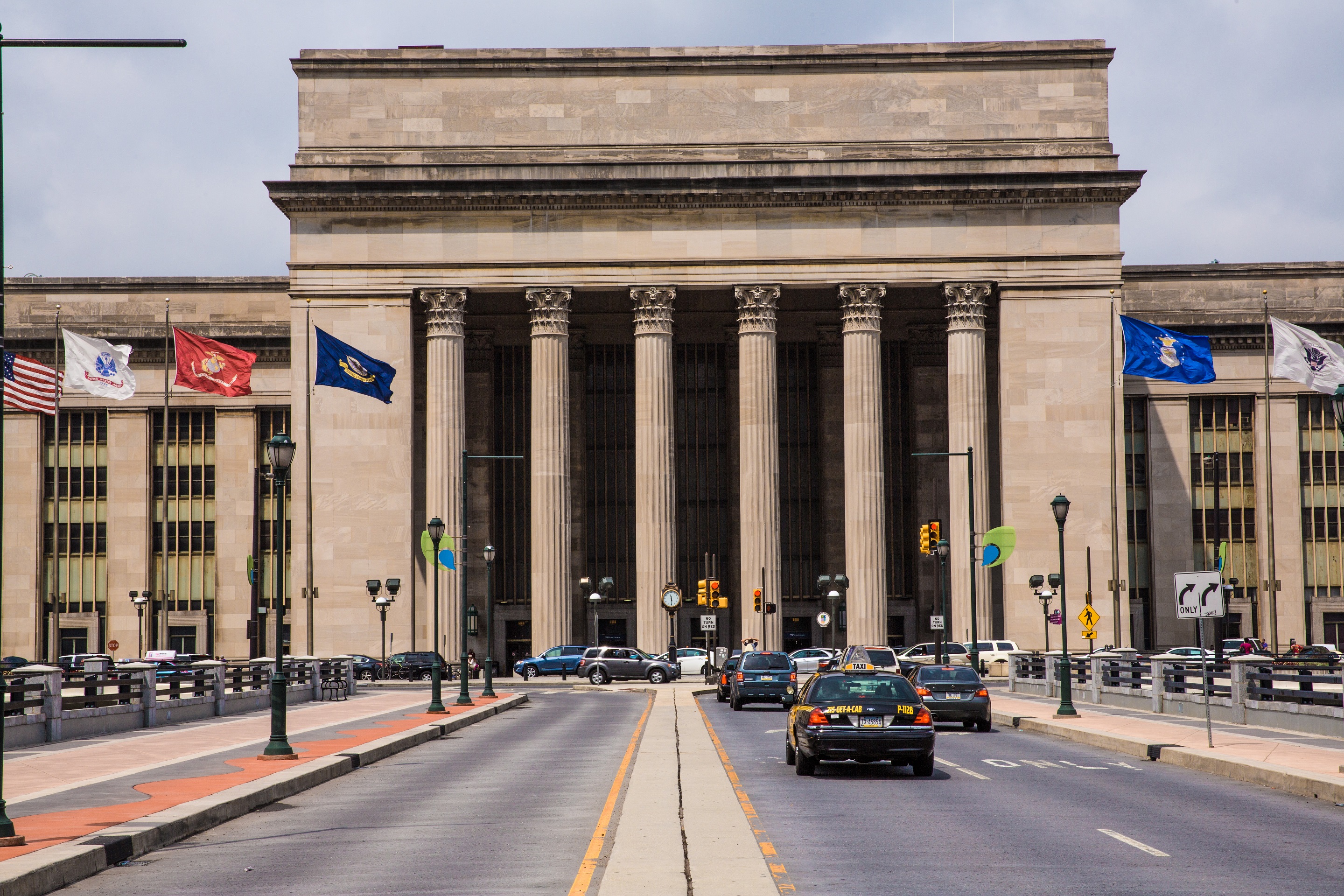
West front of 30th Street Station

Interior of 30th Street Station

Like Philly's commuter-rail and bus systems, their subway system is run by SEPTA, the SouthEastern Pennsylvania Transportation Authority. You might recognize their "S" logo from Trading Places, and the bus that hits Tommy Morrison at the end of Rocky V. You'll have to exit 30th Street Station and cross 30th Street itself to get into the 30th St. station on the Market-Frankford Line.

Philadelphia and Toronto are the only 2 cities left on the North American continent, as far as I know, that still use tokens rather than farecards (or "MetroCards" as New York's MTA calls them) or tickets for their subways. But this past February, they began an experiment with "KeyCards," and will probably phase the tokens out. (UPDATE: They did so in 2018.)

One ride on a SEPTA subway train is $2.25, cheaper than New York's, but they don't sell single tokens at booths. They come in packs of 2, 5 and 10, and these packs are damn hard to open. Two cost $3.60; five are $9.00, and a ten-pack costs $18.00. They are also available for bulk purchase.

If you don't want to take Amtrak, your other rail option is local. At Newark Penn, you can buy a combined New Jersey Transit/SEPTA ticket to get to Center City Philadelphia. Take NJT's Northeast Corridor Line out of Penn Station to the Trenton Transit Center. This station recently completed a renovation that has already turned it from an absolute hole (it was so bad, it made Philly's bus station look like Grand Central) into a modern multimodal transport facility. At Trenton, transfer to the SEPTA commuter rail train that will terminate at Chestnut Hill East, and get off at Suburban Station, at 17th Street & John F. Kennedy Blvd. (which is what Filbert Street is called west of Broad Street). Getting off there, a pedestrian concourse will lead you to the City Hall station on the Broad Street Line, and then just take that to Pattison.
A SEPTA train at 30th Street Station

Because there will be a lot more stops than there are on Amtrak (especially the SEPTA part), it will take 2 hours and 10 minutes, but you'll spend $52 round-trip, about what you'd spend on a same-day purchase on Greyhound, and less than half of what you'd be likely to spend on Amtrak. However, again, time will be an issue: The last SEPTA Trenton Line train of the night that will connect to an NJT train leaves Suburban Station at 11:57 PM (and the NJT train it will connect to won't get to Penn Station until 2:46 AM), so this might not be an option for you this time, either.

The subway's cars are fairly recent, and don't rattle much, although they can be unpleasant on the way back from the game, especially if it's a football game and they're rammed with about 100 Eagles fans who've spent the game sweating and boozing and are still loaded for bear for anyone from outside the Delaware Valley.

SEPTA is now becoming the last major transit authority in America to phase out tokens, although the switch to KeyCards (as they're calling them) is still in progress, so if you have any tokens left over from your last visit, you can (and should) use them.
Once In the City. Philadelphia is a Greek word meaning "brotherly love," a name given to it by its founder, William Penn, in 1683. So the city is nicknamed "The City of Brotherly Love." The actions and words of its sports fans suggest that this is ridiculous. Giants coach Bill Parcells was once caught on an NFL Films production, during a game with the Eagles at the Vet, saying to Lawrence Taylor, "You know, Lawrence, they call this 'the City of Brotherly Love,' but it's really a banana republic." And Emmitt Smith, who played for that other team Eagles fans love to hate, the Dallas Cowboys, also questioned the name: "They don't got no love for no brothers."
On a map, it might look like Penn Square, surrounding City Hall, is the city's centerpoint, but this is just geographic, and only half-refers to addresses. Market Street is the difference between the north-south numbering on the numbered Streets. But the Delaware River is the start for the east-west streets, with Front Street taking the place of 1st Street. Broad Street, which intersects with Market at City Hall/Penn Square, takes the place of 14th Street.
The William Penn statue atop City Hall

In the Colonial and Revolutionary periods, Philadelphia was the largest city in America, before being overtaken by New York. As recently as 1970, it had about 2 million people. But "white flight" after the 1964 North Philadelphia riot led to the population dropping to just over 1.5 million in 2000. It has inched back upward since then. The metro area as a whole -- southeastern Pennsylvania, South Jersey and most of Delaware -- is about 7.2 million, making it the 7th-largest in the country, behind New York, Los Angeles, Chicago, San Francisco, Boston and Dallas.

Philadelphia's racial and ethnic issues are long-standing. There was a pro-slavery riot in 1834, a nativist riot in 1844, race riots in both Philadelphia and nearby Chester in 1917, the aforementioned race riot in North Philadelphia in 1964, a race riot across the river in Camden in 1971, and the 1977 and 1985 police actions against the black separatist group MOVE. Elsewhere in Eastern Pennsylvania, there was the Scranton Coal Riot in 1871, and the York Race Riot in 1969.

And black Philadelphians were upset that a statue of 1972-80 Mayor Frank Rizzo, a notorious bigot, was placed in front of the Municipal Services Building, across the street from the north side of City Hall, in 1998.

UPDATE: A statue of professional baseball player and civil rights activist Octavius Catto, murdered on South Street in 1871, was placed on the south side of City Hall later in 2017. I had hoped that it would be placed on the north side, so he could stare Rizzo down. That became academic in 2020, when Rizzo's statue was removed.

The sales tax is 6 percent in the Commonwealth of Pennsylvania (Massachusetts, Virginia and Kentucky are also "commonwealths" in their official State names), 8 percent within the City of Philadelphia.

ZIP Codes in Philadelphia start with the digits 191. In the suburbs, it's 189, 190, 193 and 194. The Area Code for the city is 215, and the suburbs 610, with 267 overlaying both, and 445 being added in 2018. Philadelphia's "beltway" consists of Interstate 276 (the easternmost part of the Pennsylvania Turnpike) in the north, Interstate 476 (the Mid-County Expressway) in the west, and Interstate 95 (the Delaware Expressway) in the south and east.

Philadelphia is about 42 percent black, 36 percent white, 13 percent Hispanic, and 7 percent Asian. North, Northwest and West Philadelphia are now almost entirely black, although University City (home to the University of Pennsylvania and Drexel University) and some of Southwest Philly remains white. South Philadelphia (Italian) and Northeast Philadelphia (Irish) remain mostly white.

The Philadelphia electric company is named just that: Philadelphia Electric Company, or PECO. And while it's not quite as close as it is to New York, much of the Jersey Shore is easily reachable from Philadelphia, thanks to Interstate 195, New Jersey Route 70, U.S. Routes 30 and 40, the Atlantic City Expressway, and New Jersey Transit's buses and its Atlantic City Rail Line. Point Pleasant Beach is 76 miles away, Seaside Heights 64 miles, Long Beach Island 62, Atlantic City 61, Ocean City 65, Wildwood 90, and Cape May 92.

Since we're dealing with 5 different schools here, I'll skip the usual lists of prominent alumni. Unfortunately, it is worth noting that both Donald Trump and his daughter Ivanka are Penn graduates.

Going In, By Driving:

Penn: Take Walnut Street west from Center City, across the Schuylkill River, and follow the signs for Penn parking. The Palestra is at 223 S. 33rd Street. A mile and a half west of Center City.

Temple: Take Broad Street north from Center City, to Oxford Street. Turn left, go 3 blocks, then right on Sydenham Street. The parking garage for the Liacouras Center is 2 blocks north. The Center's address is 1776 Broad Street, across Montgomery Avenue from their 3,900-seat 1969-97 arena, McGonigle Hall. 2 miles north of Center City. Temple also has campuses in Center City and in the State capital of Harrisburg. They the only 1 of the Big 5 that has a campus outside its main area.

La Salle: Take Interstate 76 West to Exit 340B, US Route 1 North -- or, if you're in New Jersey, simply take Route 1 South all the way -- to Germantown Avenue. Right on Wister Street, right on Olney Avenue. Or take Broad Street north from Center City, to Belfield Avenue, right on Wister, right on Olney. Or take Broad straight to Olney, although the other 2 should be faster. 1900 W. Olney Avenue. 6 miles north of Center City.

St. Joe's: Take I-76 West to Exit 341, Montgomery Drive. Right on Belmont Avenue, left on Wynnefield Avenue, right on Old Lancaster Road. 5400 Overbrook Avenue. 5 miles northwest of Center City.

Villanova: A bit further out, not actually in the City of Philadelphia. Take I-76 West to Exit 331A, to Interstate 476 West, to Exit 13, US Route 30 East, about 2 miles. 11 miles northwest of Center City. If it's at the Wells Fargo Complex, take Broad Street south to Pattison Avenue. 3601 S. Broad Street. 4 miles south of Center City.

Going In, by Public Transportation:

Penn: You could walk west on Market Street, and make a left on 33rd Street. It would take only 15 minutes. If it were a nice afternoon, I would recommend it. But at night, you might e better off taking a taxi, as taking the "Subway-Surface Line" to 33rd Street won't really save you much walking.

Built in 1927, The Palestra is the arena aptly nicknamed the Cathedral of Basketball. It even has stained-glass windows. (I swear, I am not making that up.) The home gymnasium of the University of Pennsylvania (or just "Penn"), it also hosts some games of Philly's informal "Big 5" basketball programs when they play each other.
Penn, a member of the Ivy League, has one of the nicest college campuses anywhere, but do not be fooled by its Ivyness: In Philadelphia, even the Ivy Leaguers are tough.
Temple: Take the Broad Street Line uptown to Cecil B. Moore (formerly Susquehanna-Dauphin) Avenue.
La Salle: Take SEPTA's Regional Rail Trenton or Chestnut Hill East Line (the former R7 or R8) to Wister, then a 12-minute walk up Wister to Olney. Their on-campus Wister Hall became too small after their 1954 National Championship, so they played at various Philly arenas: The Civic Center, The Palestra, The Spectrum, the Wells Fargo Center, and, finally, building the arena named for their greatest player, from the 1954 title, and the coach who restored them after a terrible scandal in the late 1960s, Tom Gola.
St. Joe's: Take SEPTA's Regional Rail Cynwyd Line (the former R6) to Bala, then a 10-minute walk down City Avenue and 54th Street.
Villanova: Take SEPTA's Regional Rail Paoli Line (the former R5) to Villanova, then a 10-minute walk. If it's at the Wells Fargo Complex, take the Broad Street Line downtown to AT&T (formerly Pattison) station. Jake Nevin Field House was Villanova's home from 1932 to 1986, with The Pavilion built following the 1985 National Championship, due to the Field House's tiny capacity of 1,500, which is why they preferred to play big games at the Palestra, and later The Spectrum.
Villanova Stadium, with Jake Nevin Field House above it to the left,
and The Pavilion above it to the right (the triangle-dotted building)

Built: Penn's The Palestra (a Greek word for a rectangular enclosure for watching sports), 1927; St. Joseph's Michael J. Hagan Arena (named for a graduate and major donar, formerly Alumni Fieldhouse), 1949: Villanova's The Pavilion, 1986; Wells Fargo Center, 1996; Liacouras Center (named for Peter J. Liacouras, the University President who built it), 1997; Tom Gola Arena (named for the former star player and coach), 1998.

Seating Capacities: Tom Gola Arena, 3,200; Hagan Arena, 4,200; The Pavilion, 6,500; The Palestra, 8,725; Liacouras Center, 10,206; Wells Fargo Center, 21,600.
Wells Fargo Center

Food. From the famed Old Original Bookbinder's (125 Walnut Street at 2nd, now closed) and Le Bec Fin (1523 Walnut at 16th) to the Reading Terminal Market (Philly's "South Street Seaport" at 51 N. 12th St at Filbert) and the South Philly cheesesteak giants Pat's, Geno's and Tony Luke's, Philly is a great food city and don't you ever forget it.

All of these college arenas have small concession stands, so you might better be off stopping at Pat's on the way in and a Wawa on the way out. The variety of food available at the Wells Fargo Center is not merely better, but unbelievable. Little of it is healthy (no surprise there), but all of it is good.

On the lower Main Concourse Level, the South Jersey restaurant chain P.J. Whelihan's has stands behind both goals. Tim Hortons, the Canadian donut chain founded by the Toronto Maple Leafs legend, has stands at all 4 corners. Chickie's & Pete's, whose main outlet is nearby at 1526 Packer Avenue (near the also-famed Celebre's Pizza), has stands on the west side and in the northeast corner, to sell their fish and their "crab fries" -- French fries with Old Bay seasoning mix, not fries with crabmeat. The northeast corner also has that wonderful junk food staple of Pennsylvania Dutch country (and the Jersey Shore), funnel cake. The legendary South Street pizzeria Lorenzo & Sons has stands on both the east and west sides. Each of these brands can also be found on the upper, Mezzanine Concourse Level.
Team History Displays. The Wells Fargo Center has lots of banners for the 76ers and Flyers, but not Villanova, inside. It has statues outside, of Wilt Chamberlain, Julius Erving, Kate Smith (due to her singing of "God Bless America" as a "good luck charm" for the 1970s Flyers), and "Score!" depicting Gary Dornhoefer's overtime goal against the Minnesota North Stars in the 1973 Playoffs. It bears a striking resemblance to Bobby Orr's "Flying Goal" that wont the 1970 Stanley Cup for the Boston Bruins. The statue of Sylvester Stallone as Rocky Balboa has been moved back to the Museum of Art, adjacent to the steps that Sly/Rocky ran up.

Penn has banners down the east baseline of The Palestra, along with banners of the other Ivy League teams and the other Big 5 teams.

They were retroactively awarded pre-NCAA National Championships for 1920 and 1921. They reached the Final Four in 1979, under coach Chuck Daly. They and arch-rival Princeton have dominated the Ivy League. Penn has won 38 Conference Championships between 1906 and 2007, including 25 since the official formation of the Ivy League in 1954.

They have no retired numbers. Their legends include East Brunswick, New Jersey native Dave Wohl, Tony Price and Matt Maloney. The school is much better known for their football legends, including John Heisman, John Outland, Bert Bell and Chuck Bednarik, all of whom have had notable trophies named for them; and Jim Finn, who played for the Giants in Super Bowl XLII.

Temple's banners are at the open end of the horseshoe of the Liacouras Center's seats. They won the 1st NIT in 1938, which retroactively made them National Champions for that season. They reached the Final Four in 1956 and 1958, but not since, although they made the Elite Eight 5 times from 1988 to 2001. They've won 20 regular-season conference titles from 1937 to 2016, and 9 conference tournaments, the last in 2010.

Temple has not retired any numbers, but it's had some great players over the years, including Guy Rodgers, Eddie Jones, Aaron McKie and Mark Macon; plus legendary coaches Harry Litwack and John Chaney.

La Salle also has banners behind one of the baskets. They won the National Championship in 1954, Philly's 1st title under the NCAA brand, and reached the Final again in 1955; won regular season conference titles in 1984, 1988 and 1989; and conference tournaments in 1975, 1978, 1980, 1983, 1988, 1989, 1990 and 1992.

La Salle has retired 4 numbers: 15, guard Tom Gola '55; 33, forward Kenny Durrett '71; 32, forward Michael Brooks '80; and 22, forward Lionel Simmons '90.

St. Joseph's has a string of banners along each baseline. Along one is banners of their league's teams; along the other, banners with photos of team legends. They reached the Final Four in 1961, but the NCAA vacated it due to rule violations. They reached the Elite Eight in 1981 and 2004, in the latter year going undefeated until the game that could have gotten them into the Final Four. They've won 26 regular-season conference titles from 1959 to 2010, and 6 conference tournaments from 1981 to 2016.

They've retired 4 numbers. Number 4 has been retired for 4 separate players: 1920s guard Bill Oakes; 1940s brothers George and Paul Senesky from the 1940s (George was a guard), and 1960s guard and 1980s coach Jim Lynam. Number 30, Cliff Anderson, was a mid-1960s forward. Number 44, Mike Bantom, was an early 1970s forward. And Number 14, Jameer Nelson, was the star of the 2004 Elite Eight team that also included fellow guard Delonte West.

Villanova's banners are all in The Pavilion. They are the defending National Champions, having also won the title in 1985 under head coach Rollie Massimino, a.k.a. Daddy Mass, in the legendary Final upset of Georgetown. They also reached the Final in 1971, losing to UCLA, but, like the 1961 St. Joe's squad, had to vacate that year's achievements due to rule violations. They've also been to the Final Four the 1st time it was run, in 1939, and in 2009.

They've won 10 regular-season conference titles from 1978 to 2016, and 4 conference tournaments, in 1978, 1980, 1995 and 2015.

Only 1940s legend Paul Arizin has actually had his number retired, 11. They honor other notable figures with banners showing jerseys, including their numbers if they were players. Non-players honored include head coaches Massimino, Kraft and Al Severance.

Severance was head coach from 1936 to 1961. Ironically, he died the day of the National Championship win, April 1, 1985. Jake Nevin, trainer for 50 years, was also dying, from Lou Gehrig's disease, but was able to attend the Final. He was also honored with a banner, with the Number 1 on it. Kraft took over as coach from Severance, from 1961 to 1973. Massimino got the job then, and held it until 1992.

Other honorees: 1950s player Larry Hennessy (14); 1960s players Hubie White (14), Wally Jones (24, who later converted to Islam and changed his name slightly to Wali Jones) and Bill Melchionni (25); 1970s players Howard Porter (54), Chris Ford (42), Keith Herron (33) and Tom Ingelsby (24); 1980s players John Pinone (45) and Ed Pinckney (54); 1990s player Kerry Kittles (30) and 2000s player Randy Foye (2).

Arizin, Hennessy, La Salle's Tom Gola, and St. Joe's' George Senesky all played on the 1956 NBA Champion Philadelphia Warriors. Jones and Melchionni played with Wilt Chamberlain and Billy Cunningham on the 1967 NBA Champion Philadelphia 76ers. Melchionni played on the 1974 and 1976 ABA Champion New York Nets.

UPDATE: Going into the 2018-19 season, Villanova leads Penn 48-16, St. Joe's 38-24, La Salle 38-26 and Temple 34-29. Temple leads St. Joe's 73-55, La Salle 57-34 and Penn 48-18. St. Joe's leads La Salle 52-41 and Penn 44-22. Penn leads La Salle 35-29. La Salle is the only Big 5 school that doesn't have an edge over any of the others.

Stuff. The Flyers have a team store, run by Forty Seven Brand ('47), in the northwest corner of the lower concourse, which is also open on non-game days. The 76ers have a Fan Gear Store, at the opposite, southeast corner.

Books about the Big 5 include: 

* General: Philadelphia's Big Five: Celebrating the City of Brotherly Love's Basketball Tradition, by legendary Philadelphia broadcaster Skip Clayton and Phillies public address announcer Dan Baker.

* Penn: Jumping Through Hoops: Why Penn Wins, by Harold I. Gullan.

* Temple: Chaney: Playing for a Legend, by Donald Hunt and John Chaney.

* St. Joseph's: Tales from the St. Joseph's Hardwood: The Hawk Will Never Die, by Jack McKinney and Bob Gordon.

* Villanova: The Perfect Game: How Villanova's Shocking 1985 Upset of Mighty Georgetown Changed the Landscape of College Hoops Forever, by Frank Fitzpatrick; and Long Shots: Jay Wright, Villanova, and College Basketball's Most Unlikely Champion (about the 2016 title, although the 1985 team was certainly an unlikely titlist), by Dana O'Neil and Jay Bilas.

I couldn't find any books about La Salle basketball, not even a biography of Gola. 

During the Game. You may have heard about, or even experienced, trouble at an Eagles or Flyers game. At a Big 5 game, just stay away from the interaction between the students, and you'll be fine.
Temple's Liacouras Center

As a boy, I thought Temple was a Jewish school, but that was only because of the name. As a teenager, I thought, well, La Salle, St. Joe's and 'Nova are Catholic schools, maybe Temple is, too. While it was once private, and founded in 1884 by a Baptist minster, meeting is his Baptist Temple, as a night school -- hence, its students were nicknamed "night owls," and the Owl name stuck -- it has never been controlled by a church, and is now public, catering significantly (but not entirely) to Philly's black population.
La Salle's Gola Arena

La Salle, St. Joe's and 'Nova embrace their Catholic faith, to the point where the SJU-'Nova rivalry, like Boston College vs. Notre Dame and the Mormon rivalry between the University of Utah and Brigham Young University, is known as The Holy War.
St. Joe's' Hagan Arena

Legend has it that, one year, 'Nova went undefeated against the other 4 schools, with St. Joe's being the last. The Wildcat fans chanted, "We own Philly!" The Hawk fans, knowing full well that the 'Nova campus was 5 miles northwest of City Avenue (Route 1), chanted, "You ain't Philly!" Their mostly-white student body, with the notable exception of their basketball team, has gotten them tagged "Vanillanova."
Villanova's Pavilion

Penn's teams are known as the Quakers, but they don't have a Quaker mascot. La Salle is named for a late 17th Century priest, Jean-Baptiste de La Salle, the founder of modern Catholic schools, and not his contemporary and countryman, René-Robert Cavelier, Sieur de La Salle, who explored the Mississippi Valley and claimed it for France. Yet their teams are called the Explorers, although they don't have an Explorer mascot.

Temple has a live female owl mascot, Stella, and a guy in a suit, Hooter the Owl. Both are brought to basketball games at the Liacouras Center and football games at the Eagles' Lincoln Financial Field.
Villanova has a Wildcat mascot, Will D. Cat, who appears at football games at Villanova Stadium, and basketball games at The Pavilion and the Wells Fargo Center.
Since Penn doesn't have a Quaker mascot,
Will D. Cat eats Quaker oats.

And St. Joe's has a hawk named simply The Hawk. The Hawk mascot flaps his wings throughout the entire 40 minutes of basketball games. The reason he never stops flapping is because, in their reworking of "The Battle Hymn of the Republic," "Glory, glory, hallelujah, the Hawk will never die!" It's now a Twitter hashtag: #THWND

The 1st time I saw a Big 5 game live, ironically, wasn't in Philadelphia. It was 60 miles to the southeast, at Boardwalk Hall in Atlantic City, as Temple and St. Joe's played each other in the Final of the Atlantic 10 Conference Tournament. As St. Joe's built up a huge lead, the Hawk kept flapping. Several times, inside the stuffy old auditorium (it was March 15, 2008, but it was hot inside), the guy in the suit needed a drink. But as he drank from his water bottle with one hand, he kept flapping the other, because The Hawk Will Never Die.
Well, in the 2nd half, Temple came roaring back, and the guy playing Hooter did a lot of swooping around the court with their cheerleaders during timeouts. As the minutes ticked down, and Temple caught up, the Temple fans chanted, "The Hawk must die!" The final score was Temple 69, St. Joe's 64, and the St. Joe's cheerleaders and The Hawk ran off the court, real fast, completely humiliated. Too late: The Owl fans were already chanting: "The Hawk is dead! The Hawk is dead! The Hawk is dead!"

When I walked into Boardwalk Hall, it was daylight, and fans on the Boardwalk, with their hats and shirts and jackets, seemed to be about 7-1 in St. Joe's' favor. When I walked out, it was night, and the support was about 50-50. As I got back to the casino to take my bus back home, I realized: Of course, St. Joe's led in the 1st half, and Temple won it in the 2nd, because the Hawk is a day bird, and the Owl is a night bird!
T-shirt sold in the Temple University Bookstore

After the Game. Philadelphia is a big city, with all the difficulties of big cities as well as many of the perks of them. Temple is a little into North Philly; La Salle, even more so. You should get back to your car/public transit stop as quickly as you can. For Penn, St. Joe's or 'Nova, this is considerably less urgent. As with any of the 5 schools, it's not the home fans you need to worry about.

The legendary Pat's and Geno's Steaks, arch-rivals as intense as any local sports opponents, are across 9th Street from each other at Passyunk Avenue in the Italian Market area. My preference is Pat's, but Geno's is also very good. Be advised, though, that the lines at both are of Shake Shack length, because people know they're that good.
Also, Pat's was the original "Soup Nazi": You have to have your cash ready, and you have to quickly order your topping, your style of cheese, and either "wit" or "widdout" -- with or without onions. I haven't been there in a while, but I've been there often enough that I have a "usual": "Mushroom, whiz, wit."

Both Pat's and Geno's are open 24 hours, but, because of the length of the line, unless you drove down to the game, I would recommend not going there after the game, only before (if you can make time for it). Broad Street Line to Ellsworth-Federal, then 5 blocks east on Federal, and 1 block south on 9th.
Yes, Pat's and Geno's are both open 24 hours a day.

The Tavern on Broad, at 200 S. Broad Street at Walnut, seems to be the headquarters of the local Giants fan club. Another supposed Giant fan spot is the Fox & Hound, at 1501 Spruce in Center City. Revolution House, in Old City at 200 Market Street, is supposedly Jets country. A particular favorite Philly restaurant of mine is the New Deck Tavern, at 3408 Sansom Street in University City, on the Penn campus.

You can also pick up a sandwich, a snack or a drink at any of several Wawa stores in and around the city. If you came in via Suburban Station, there's one at 1707 Arch, a 5-minute walk away; if the game lasts 3 hours or less, you have a shot at getting in, getting your order, getting out, and getting back to the station in time to catch your train.

If your visit to Philly is during the European soccer season (which is in progress), you can probably watch your favorite club at Fadó Irish Pub, at 1500 Locust Street in Center City. Be advised that this is home to supporters' groups for Manchester United, Liverpool, Tottenham Hotspur and Celtic FC; so if you're not particularly fond of any of those teams, you might want to stay away.

Sidelights. UPDATE: On November 30, 2018, Thrillist published a list of "America's 25 Most Fun Cities," and Philadelphia came in 17th. 

The Philadelphia sports complex once included 3 buildings that have all been replaced and demolished: From north to south, the Vet, the Spectrum and JFK Stadium. The arena now known as the Wells Fargo Center was built on the site of JFK Stadium. Citizens Bank Park, the new home of the Phillies, was built to the east of The Vet. And Lincoln Financial Field was built south of the new ballpark, and east of the Spectrum.
The old version of the Philly sports complex, on a 1980s postcard.
Top to bottom: The Vet, The Spectrum, JFK Stadium.
The Philly sports complex, prior to The Spectrum's demolition in 2010.
The site of the Vet is now a parking lot, and JFK Stadium has been replaced
by the Wells Fargo Center. On the right, Citizens Bank Park and Lincoln Financial Field.

The A's played at 33,608-seat Shibe Park from 1909 to 1954, the Phils from 1938 to 1970, and the Eagles in 1940, and from 1944 to 1957. The name was changed to Connie Mack Stadium in 1952. A fire gutted the place in 1971, and it was demolished in 1976. It remained an empty lot until Deliverance Evangelistic Church was built on the site in 1991. Across the street is Dobbins Tech, a high school known for its great basketball program. (Remember the story of Hank Gathers and Bo Kimble? They went to Dobbins. So did Dawn Staley.)

Be advised, though, that this is North Philly, and the church is easily the nicest building for several blocks around. 21st Street & Lehigh Avenue. By subway, use the North Philadelphia station on the Broad Street Line, and walk 7 blocks west on Lehigh.

The Phils played at Baker Bowl from 1887 to 1938, and the Eagles from 1933 to 1943 (though sometimes moving to Municipal Stadium, the one renamed for JFK). The Phils won one Pennant there, in 1915. It was also the Eagles' 1st home, in the 1933, '34 and '35 seasons.

Southwest corner of Broad Street and Lehigh Avenue, 8 blocks east of the Connie Mack Stadium site. Same subway stop as Shibe/Connie Mack. The A's original home, Columbia Park, was at 29th Street & Columbia Avenue, but I wouldn't recommend going there. If you're going to any of these, do it in daylight.

Franklin Field is right next to the Palestra. The oldest continuously-used college football site, Penn has played here since 1895 (which is also when the Penn Relay Carnival, the nation's premier track-and-field event, began), and in the current stadium since 1922. That year, it supposedly hosted the first football game ever broadcast on radio (a claim the University of Pittsburgh disputes), and in 1939 it supposedly hosted the first football game ever televised (a claim New York's Columbia University disputes). The amazing building in the west end zone is the University administration building.
The Eagles played here from 1958 to 1970, including their last NFL Championship, December 26, 1960, beating the Green Bay Packers in a thriller, 17-13. Half a century. Penn's football team has been considerably more successful, having won 14 Ivy League titles since the league was formally founded in 1955.
The stadium is in surprisingly good shape (must be all those Penn/Wharton Business School grads donating for its upkeep), although the playing field has been artificial turf since 1969. Same trolley stop as the Palestra.

The Philadelphia Civic Center complex included the Convention Hall, Franklin D. Roosevelt, Wendell Willkie, Harry Truman and Thomas E. Dewey received Presidential nominations. The Beatles played here on September 2, 1964. Pope John Paul II said Mass here. The Philadelphia Warriors played here from 1952 to 1962, when they moved to San Francisco (and now the "Golden State Warriors" play in Oakland), and the 76ers from 1963 until the Spectrum opened in 1967. Titles were won here by the 1956 Warriors and the 1967 76ers.

So many Philly area greats played here, in high school, college and the pros, but you need know one name -- pardon the pun -- above all others: Wilt Chamberlain. I saw a concert here in 1989, and the acoustics were phenomenal, with a horseshoe of seats and a stage at one end, much like Boardwalk Hall in Atlantic City and the building once known as the Baltimore Civic Center.

Built in 1931, it was demolished in 2005 to make way for the Perelman Center for Advanced Medicine. an addition to the University of Pennsylvania Hospital. 34th Street & Civic Center Boulevard. Same stop as the Palestra and Franklin Field, which are a block away.

Built in 1920, the Philadelphia Arena was the first home of the NBA's Warriors from 1946 to 1952, and site of some 76ers home games as well. The Arena made its name hosting college hockey: Penn playing there was understandable, but, at the time, Princeton and even faraway Yale did not have their own rinks, and used the Arena as home ice.

The worst team in NHL history played there: The 1930-31 Philadelphia Quakers. After 5 seasons as the Pittsburgh Pirates, they clowned their way to a record of 4 wins, 40 losses and 4 ties, making them about as bad as the worst team in NBA history, the 1972-73 76ers (9-73). They were strapped during this 2nd indoor sports season of the Great Depression, and went out of business thereafter. Although several minor-league teams would play at the Arena -- the Arrows, the Comets, the Ramblers, the Falcons and the Rockets -- it would not be until 1967, with the opening of the Spectrum and the beginning of the Flyers, that Philly would have another NHL team.

Baseball pitcher-turned-evangelist Billy Sunday delivered sermons there in the 1920s, and Charles Lindbergh used it for an America First speech in 1940. Early in his career, Elvis sang at the Arena on back-to-back days, doing 2 shows each on April 5 and 6, 1957.

Philly's ABC affiliate, Channel 6, formerly WFIL and now WPVI, built its studio next-door. It still stands. The Arena does not: It caught fire on August 24, 1983, and had to be demolished. A housing project is on the site today. 4530 Market Street. Market Street Line to 46th Street.

Built in 2010 for the expansion Philadelphia Union of Major League Soccer, and named PPL Park until last year when PPL was bought by Talen Energy, Talen Energy Stadium it seats 18,500 people, on the bank of the Delaware River in Chester, under the Commodore Barry Bridge (U.S. Route 222), linking it with Gloucester County, New Jersey.

1 Stadium Drive, in Chester. SEPTA Wilmington/Newark Line train to the Chester Transportation Center, then shuttle buses will leave for the stadium every 20 minutes. If you're only going for a visit, not a game when there would be plenty of police protection, do not visit at night: Chester can be a dangerous city.

Philadelphia's 1st pro football team was the Frankford Yellow Jackets, who played at Frankford Stadium in Northeast Philly from 1924 to 1930, winning the 1926 NFL Championship, before a fire on the eve of the 1931 season forced them into Baker Bowl and then into folding.

The stadium was on a plot bounded by Frankford Avenue, Devereaux Avenue, Hawthorne Street and Benner Street. An AutoZone (at 6137 Frankford) and rowhouses are on the site now. Market-Frankford Line to Frankford Transportation Center, then transfer to SEPTA Bus 66 Frankford & Harbison Avenues.

In addition to the Yellow Jackets, another ill-fated team played in Eastern Pennsylvania in the NFL's early days. The Pottsville Maroons played at the 5,000-seat Minersville Park, at the intersection of Sunbury Road and Prison Road, 106 miles northwest of Philly, from 1920 to 1928. They claimed the 1925 NFL Championship, but may have been "robbed" of the title.

From 1924 to 1991, the Broadwood Hotel stood at the intersection of Broad and Wood Streets, just north of Center City. From 1924 to 1946, its ballroom was the home of the Philadelphia SPHAs -- a basketball team run by the South Philadelphia Hebrew Association, even though it wasn't in South Philly. This team would evolve into the Warriors. A parking deck for Hahnemann University Hospital is on the site now. Broad Street Line to Race-Vine.

Temple has have played football at the South Philly complex since 1978, first at The Vet and now at the Linc. From 1928 to 1977, they played at Temple Stadium, a 20,000-seat facility on the city's northern edge. It was demolished in 1996, and, like Shibe Park/Connie Mack Stadium, the site is now home to a church. 2800 Pickering Avenue at Vernon Road. Broad Street Line to Olney Transportation Center, then transfer to the Number 18 bus toward Cedarbook Mall.

Philadelphia is home to Independence National Historic Park, including Independence Hall and the Liberty Bell. The Visitor's Center is at 6th & Market Streets: At this complex, there will be people there to advise you on what to do. 5th Street on the Market Street Line.

Thomas Jefferson wrote the Declaration of Independence at what's now known as Declaration House, at 599 S. 7th Street, although the front of the building would be 700 Market Street (which would suggest 1 S. 7th Street).

The President's House -- that's as formal a name as it had -- was where George Washington (1790-97) and John Adams (1797-1800) lived while Philadelphia was the national capital before Washington, D.C.. It was demolished in 1832. When digging to build the new Liberty Bell Center, the house's foundation was found, and somebody must've asked, "Why didn't anybody think of this before?" So, an exhibit has been set up, at 530 Market Street at 6th. The new Liberty Bell Center is between it and Independence Hall (Chestnut Street between 5th and 6th). Be advised that since 9/11 -- and since the movie National Treasure -- they're understandably a bit finicky about security there.

The oldest surviving Presidential residence (chosen specifically for the President, not counting homes like Mount Vernon or Monticello) is the Germantown White House, which still stands at 5442 Germantown Avenue. George Washington and John Adams used it to escape the heat and, more importantly, the yellow fever epidemics of what's now Center City Philadelphia, making it less "the first Summer White House" and more "the first Camp David." SEPTA Chestnut Hill West Line to Germantown, then 3 blocks down Armat Street and a left on Germantown Avenue. Definitely not safe at night.

Speaking of George Washington, Valley Forge National Historical Park is just an hour's bus ride from Suburban Station. On JFK Blvd. at 17th Street, board the SEPTA 125 bus. Valley Forge Casino Resort and the King of Prussia Mall are a short drive (or a moderate walk) away. The fare is $4.75 each way ($9.50 total).

Philadelphia's answer to the Museum of Natural History is the University of Pennsylvania Museum, at 33rd & South Streets, across from Franklin Field. (Same trolley stop.) Their answer to the Hayden Planetarium -- and a better one -- is the Franklin Institute, which is also the national memorial to Big Ben, the man who, more than any man made any city in the Western Hemisphere, made Philadelphia. 20th Street & Benjamin Franklin Parkway. Number 76 bus. 76, get it? The bus is nicknamed "The Ben FrankLine."

At the other end of the Parkway, at 25th and Spring Garden Streets, is Philly's answer to the Metropolitan, the Philadelphia Museum of Art. The Rocky Balboa statue is here, and it doesn't cost anything except sweat to run up the steps.

Not surprisingly for a city of its size, Philadelphia has had a few TV shows set there, but not many actually filmed there. Boy Meets World was taped entirely at the Walt Disney Studios in Burbank. (Its sequel series, Girl Meets World, featuring Cory & Topanga Matthews and their kids, is set in New York.) Amen was also taped in L.A.

Neither does It's Always Sunny In Philadelphia film in Philly -- and it is not always sunny there. Nor did Angie film there, nor Thirtysomething, nor Cold Case, nor Strong Medicine, nor Body of Proof. Kim Delaney's legal drama Philly includes City Hall, which includes the Philadelphia County Courthouse, in its opening montage, but that was about it. Same with the legal drama Shannon's Deal and the current hit How to Get Away with MurderThe 1960s flashback series American Dreams did some filming under the Market Street Elevated Line, but most of it was filmed in L.A. And, being a cartoon, Fat Albert and the Cosby Kids didn't have to "film" anywhere.

The 1980s period piece The Goldbergs is set in the northern suburb of Jenkintown. The American version of The Office was set in Scranton. Fictional Philadelphia suburbs are sometimes used for daytime soap operas and their evening counterparts: Pine Valley on All My Children, Llanview on One Life to Live, Corinth on Loving, and Roseweood on Pretty Little Liars

On M*A*S*H, Father Francis Mulcahy, the Army chaplain played by William Christopher, was a Philadelphia native, and coached boxing at a Catholic Youth Organization (CYO), while "my sister the Sister" coached basketball at a convent.

The films PhiladelphiaThe Philadelphia Story and The Philadelphia Experiment had a few Philly locations put in, but all filming was done in Southern California. For chronological reasons, the film version of the musical 1776 couldn't be filmed on the streets of Philadelphia, or even inside Independence Hall -- although National Treasure used the Hall, and the Franklin Institute, and the Reading Terminal Market.

Probably the best-known film set in the city is Trading Places -- except a lot of it was filmed in and around New York! The New York Chamber of Commerce Building (65 Liberty Street) and the Seventh Regiment Armory (643 Park Avenue) stood in for the Heritage Club. Mill Neck Manor for the Deaf on Long Island stood in for the Duke Brothers' estate. And, of course, the climactic scene was set at the New York Mercantile Exchange, at 4 World Trade Center, which was at destroyed in the 9/11 attacks.

Locations in the film that were absolutely in Philly were: 30th Street Station; Duke & Duke, at Fidelity Bank at 135 S. Broad Street, 2 blocks south of City Hall; and Lewis Winthorpe's residence, with exterior shots at 2014 Delancey Place at 20th Street, near Rittenhouse Square, which is where Eddie Murphy pretended to be a blind, legless Vietnam veteran. (This is a private residence: Walk down there if you like, but leave the residents alone.)

*

So, to sum up, I would definitely recommend to New York Tri-State Area basketball fans to take the trip to Philadelphia to see a Big 5 game. It'll probably be considerably safer than an Eagles, a Flyers, a Phillies, or even a 76ers game.