
L to R: James Doohan as Scotty, Walter Koenig as Chekov,
DeForest Kelley as McCoy, Majel Barrett as Chapel,
William Shatner as Kirk, Nichelle Nichols as Uhura,
Leonard Nimoy as Spock, and George Takei as Sulu.
Here's the affiliates you could have watched it on, if you were in what would now be considered a "major league" city (note that not all of these are still NBC affiliates, or operating under the same call letters):
* Channel 2: WGRZ, Buffalo; WSB, Atlanta; KPRC, Houston; KUTV, Salt Lake City
* Channel 3: KYW, Philadelphia; WKYC, Cleveland; KSNV, Las Vegas; KCRA, Sacramento
* Channel 4: WNBC, New York; WRC, Washington; WBZ, Boston; WDIV, Detroit; WTMJ, Milwaukee; WSMV, Nashville; WDAF, Kansas City, KFOR, Oklahoma City; WOAI, San Antonio; KCNC, Denver; KNBC, Los Angeles; KRON, San Francisco
* Channel 5: WLTW, Cincinnati; WMC, Memphis; WMAQ, Chicago; KSDK, St. Louis; KXAS, Dallas; KING, Seattle
* Channel 6: WFBM, Indianapolis; WDSU, New Orleans
* Channel 7: WSVN, Miami
* Channel 8: WFLA, Tampa; KGW, Portland, Oregon
* Channel 9: WSOC, Charlotte
* Channel 10: KGTV, San Diego
* Channel 11: WBAL, Baltimore; WIIC, Pittsburgh, WTVD, Raleigh
* Channel 12: WTLV, Jacksonville; KPNX, Phoenix
The series depicted the USS Enterprise, a Starfleet starship with a crew of 430, representing the United Federation of Planets, a galactic version of the United Nations, headquartered on Earth, at some unspecified point in the future.

The ship's mission -- partly invoking the late President John F. Kennedy's "New Frontier" -- was written by series creator Gene Roddenberry (1921-1991), a former combat pilot in World War II and Los Angeles police officer, who pitched it to the network as "Wagon Train to the stars," in essence a Western in space. But with his ship's Captain, he was inspired by C.S. Forester's novels about Captain Horatio Hornblower, and he liked to call his adventures "Hornblower in space." Here is the mission, written by Roddenberry, and recited near the start of each episode by William Shatner:
Space: The final frontier. These are the voyages of the starship Enterprise. Its five-year mission: To explore strange new worlds, to seek out new life and new civilizations, to boldly go where no man has gone before!
When Star Trek: The Next Generation premiered in 1987, Patrick Stewart, playing the Captain of the 24th Century edition of the Enterprise, Jean-Luc Picard, adjusted it to say, "Its continuing mission" and the gender-non-specific "where no one has gone before!" Since Stewart is British, and Shatner is Canadian and thus has the British influence on language, they pronounced "civilizations" as "Siv-il-igh-zay-shuns," instead of "Siv-il-iz-ay-shuns," as Boston-born Leonard Nimoy, as Spock, said it in the movies.
The main cast:
* William Shatner (born 1931 and still alive at this writing), as Captain James Tiberius Kirk, Commanding Officer. (The 2nd pilot, "Where No Man Has Gone Before," shows his middle initial as R., but this was changed.) At the time, Kirk was said to be the youngest starship captain in Starfleet history, but a list of his commendations in the episode "Court-Martial" shows his heroism to already be long-established. His idealism and his devotion to duty occasionally come into conflict, but he always ends up doing the right thing.
He needs both Spock for his logic and McCoy for his humanity. His devotion to his crew leads to some unorthodox thinking, which always works. And women of all kinds, human and otherwise, find him irresistible -- and vice versa. (Despite Eddie Murphy's comedy routine, he did not actually go beyond kissing a green woman. At least, not onscreen.)
* Leonard Nimoy (1931-2015), as Commander Spock, First Officer and Science Officer. (He had a first name, but he said the human mouth "couldn't pronounce it.") A native of the planet Vulcan, the son of the planet's Ambassador to the Federation and his human wife, he (as we would say today) self-identified as Vulcan, and worked toward their philosophy of seeking logic and repressing emotion, but struggled with his human half: "I survive it, because my intellect wins out over both." In spite of his detachment from emotion, he and Kirk confirmed to an outsider that they viewed each other as "brothers."
* DeForest Kelley (1920-1999), as Lieutenant Commander Leonard H. McCoy (it is never said what the H. stands for), Chief Medical Officer. From Georgia (the American State, not the former Soviet "republic"), his devotion to science is every bit as strong as Spock's, but his emotional outlook is a counterweight to Spock's logic. While they admire each other, they often argue.
Kirk calls him "Bones," short for "Sawbones," an old term for a doctor. The censors of the 1960s would never have let him say, "Damn it, man," or, "Damn it, Jim," as later portrayals of the character have,but, on 7 separate occasions during the series, he does say, or say a variation on, "I'm a doctor, not a (fill in the blank)!"
The stereotypical Scotty line is, "I'm givin' it all she's got," but I don't think he ever said that during any of the show's 79 episodes. And the stereotypical line spoken to him, by Kirk, is, "Beam me up, Scotty," but that was never said, either. Usually, it was, "Energize," or, "(Number of personnel) to beam up."
* Nichelle Nichols (born 1932 and still alive), as Lieutenant Nyota Uhura, Chief of Communications. (Her first name was never mentioned on the show. Despite lots of speculation, it was never confirmed until the 2009 reboot.) Although her specific place of origin has never been mentioned, she said that Swahili was her native language, thus suggesting she was born and raised in Kenya, Tanzania or Uganda in East Africa.
While a horribly underused character, and unfairly relegated to the role of the ship's "telephone operator" (a stereotypical job for women up until the 1970s), the fact that she was both a woman and a black person among the ship's senior officers, and didn't take any crap from anyone, was revolutionary for the 1960s. Indeed, in the episode "The Gamesters of Triskelion," she successfully fought off a rape attempt by a much larger man.
As Nichols had a professional music background, she was allowed to sing in 3 episodes. Despite having to wear a skimpy outfit in the episode "Mirror, Mirror" -- almost certainly, the most black female skin exposed on U.S. TV to that point -- that episode also showed Kirk's confidence in her, his respect for her, and her ability to make that confidence and respect pay off. The episode "Plato's Stepchildren" showed her having to kiss Kirk, usually cited as the 1st interracial kiss on U.S. TV. (Some Southern stations refused to show that episode.)
She wanted to quit after the 1st season to go back to music, but no less than Martin Luther King told her she needed to stay on, as an example. Both comedian Whoopi Goldberg (who went on to play Guinan on Star Trek: The Next Generation) and Dr. Mae Jemison (America's 1st black woman in space, who played a transporter operator on ST:TNG, making her the 1st real-life astronaut to appear on a Star Trek series), have cited her as a tremendous influence.
* George Takei (born 1937 and still alive), as Lieutenant Hikaru Sulu, Chief Helmsman (His first name was never revealed until the film Star Trek VI: The Undiscovered Country.) Like Star Wars creator George Lucas, Roddenberry was long fascinated by Asian culture, and wanted an Asian character among the bridge crew. Sulu was assigned to the ship's "astroscience" department in the 2nd pilot, but was moved to the helm for the main series.
Like Uhura, the other nonwhite character in the main cast, Sulu was grossly underused. So much so that, based on the original series alone, we probably know less about him than anyone else on the show. (Indeed, it wasn't until Star Trek IV: The Voyage Home that we found out that he was from San Francisco, rather than Japan as was long presumed.)
At least he wasn't a stereotype: Although the episode "Shore Leave" showed him facing a simulation of a samurai warrior, it also showed his interests in more modern firearms and botany. And "The Naked Time" showed he preferred a fencing foil to a samurai sword.
* Walter Koenig (born 1936 and still alive), as Ensign Pavel Andreievich Chekov, a young navigator introduced at the start of the 2nd season, because Roddenberry wanted to include a Russian character. To appeal to teenage viewers, he was given a hairstyle similar to Davy Jones of The Monkees. As Koenig said, "When people thought I was 22, Russian and single, I got more fan mail than anybody but Spock. When they found out I was 30, American and married, it dried up."
Brilliant but raw, his immaturity occasionally undermined his great capability. He was proud of his heritage, but mistakenly believed that many historical advancements and cultural icons were "invented in Russia."
* Majel Barrett (1932-2008), as Ensign Christine Chapel, McCoy's nurse. She later completed her studies, and was a full-fledged doctor in the movies. She has a hopeless crush on Spock.
Barrett was Roddenberry's girlfriend at the time, later his wife. She had played the First Officer, named only "Number One," in the show's 1st pilot, "The Cage," but the network balked at having a female officer ranked so high. She also voiced the computers on every Star Trek TV show and movie until the 2009 reboot, and played Ambassador Lxwana Troi, Denna's mother, on ST:TNG.

In 1964, Shatner and Nimoy actually appeared onscreen together very briefly in "The Project Strigas Affair," an episode of The Man from U.N.C.L.E. Nimoy, Kelley and Doohan had appeared on the Western series Bonanza, where they caught the attention of Gene L. Coon, who wrote for that series, and wrote and produced for Star Trek -- he and Roddenberry often being called "The Two Genes."
Nimoy, Nichols, Koenig and Barrett had appeared on an earlier military-themed TV series created and written by Roddenberry, The Lieutenant, which starred Gary Lockwood, who was cast as the ill-fated First Officer, Lieutenant Gary Mitchell, in the 2nd Star Trek pilot, "Where No Man Has Gone Before." Lockwood's character, U.S. Marine Lieutenant William Rice, had the same middle name as Kirk: "Tiberius."
*
Today, it's easy to call Star Trek, especially the original series created by Roddenberry that ran from September 8, 1966 to June 6, 1969, a legend. Today, it's very difficult to see why such a groundbreaking, often wonderful (though also often campy and occasionally even ridiculous) show was nearly canceled after just 2 seasons, and was finally canceled after 3 seasons. Easy to see why it was brought back in movies and had later series based on it, yes; easy to see why NBC gave up on it originally, no.
Surely, there must be good reason why the Peacock Network dropped this ball...

5. The Sale of Desilu Productions. Lucille Ball and her then-husband and then-costar Desi Arnaz founded this company in 1950, combining their names. It was very rare then -- and even in the Sixties -- for a woman or a non-Anglo to be in charge of a Hollywood production company, but Desilu had both. In 1962, after their divorce, Lucy bought out Desi's shares in the company.


And Lucy loved Star Trek. And, being the boss,
she didn't have any 'splaining to do.
They did, and a second pilot was commissioned. With an entirely new cast except for Leonard Nimoy as Spock -- although, as I said, Majel Barrett would be cast in a new role -- "Where No Man Has Gone Before" was written and filmed. Jeffrey Hunter, who played Captain Christopher Pike in "The Cage," was not available, so William Shatner was cast as a new Captain, James T. Kirk. NBC liked the new version, and set it up for the 1966-67 season.
In February 1967, Lucy sold Desilu to Gulf & Western, which had just bought Paramount Pictures. G&W turned Desilu into Paramount Television. Paramount, on screens both small and large, has run Star Trek ever since.

Paramount Television's original logo
Without its biggest backer, Lucy, on hand to speak up for it, Star Trek lacked the star power it needed. It would be as if, today, Jerry Seinfeld, a star of the era of TV before the current era, were now running a TV studio, and had backed a groundbreaking new show, but split with his wife, and sold off his shares in order to pay her a settlement, and it died without him to watch over it.
4. 2001: A Space Odyssey. It changed the rules for special effects in science fiction. Before Stanley Kubrick's film 2001, Star Trek was considered a big leap forward over the sci-fi films of the 1950s, and also over the biggest sci-fi TV series before it, Captain Video and His Video Rangers (1949-55) and Lost In Space (1965-68).

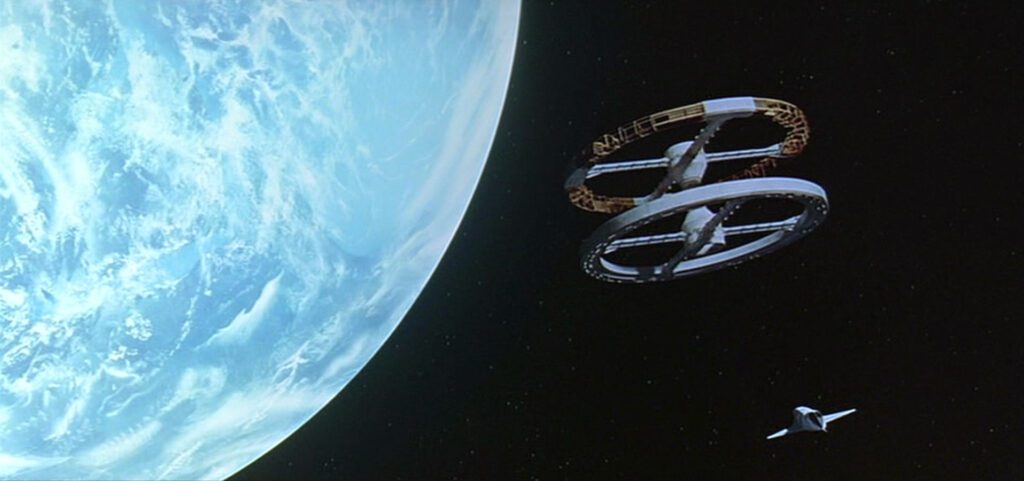
A still from 2001
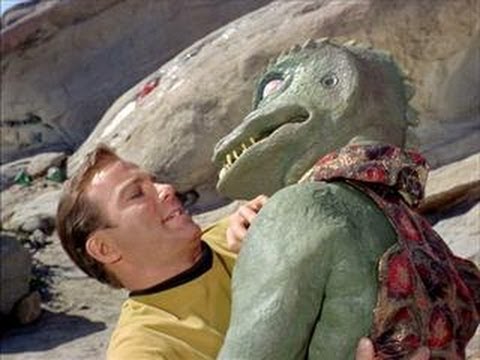
Kirk fighting a Gorn captain in "Arena"
3. Fred Freiberger. He had produced Ben Casey and The Wild Wild West with few problems. But when Roddenberry quit as, as we would say today, showrunner after the 2nd season, 1967-68, NBC hired Freiberger, and dealt him a rotten hand -- which he completely misplayed.

He looks more like a villain that Kirk had to take down
than an admiral (or a director) fit to give him orders.
He proved himself a well-meaning incompetent, particularly where science fiction was concerned. The 3rd season of Star Trek included few good episodes, and some laughable ones. The season premiere was "Spock's Brain." It was the only original series episode to have a character's name in the title, and when people talk about how ridiculous Star Trek was, this is the 1st episode they mention.
It actually got worse: "The Paradise Syndrome" ("Behold: A god who bleeds!"), "And the Children Shall Lead" (a ghostly Melvin Belli leads super-powered children to take over the ship), "Wink of an Eye" (a society moving at superspeed needs fertile men), "The Mark of Gideon" (a story about overpopulation that could have been a great one, but was totally blown), "The Lights of Zetar" (another interesting idea that bombed), "Requiem for Methuselah" (the crew encounter Methuselah, King Solomon, Alexander the Great, Lazarus, Merlin, Johannes Gutenberg, Leonardo da Vinci and Johannes Brahms, and they're all the same guy), "The Way to Eden" (space hippies, Chekov's girlfriend, "Herbert!"), "The Cloud Minders" (a story about the class gap between rich and poor, another good idea made ridiculous), "The Savage Curtain" (meeting Abraham Lincoln, Genghis Khan, and the founders of Vulcan and Klingon civilization, and, no, they're not all the same guy, and this was a great idea that was absolutely butchered), and, the last episode to air, "Turnabout Intruder" (a story rendered stupid by the rise of feminism in the next few years, and by later Trek shows and films that showed female starship captains).
In 1972, Freiberger became the producer of the cartoon Josie and the Pussycats -- already a dumb idea, since it was a teenage rock band that solved mysteries, essentially a combination of The Monkees and Scooby-Doo. He made it Josie and the Pussycats in Outer Space. No, I'm not making that up. He made it up.
In 1975, he was handed the reins of Space: 1999, to make the British series (albeit with American stars Martin Landau and Barbara Bain) more accessible to Americans. He changed the cast, and, as was the problem on Star Trek, it became less about the story and more about the action. That 2nd season was the last.
He was handed the reins of The Six Million Dollar Man for its 5th season, 1977-78. Let's just say that, unlike Colonel Steve Austin when he got his bionic body parts, it was not better than it was before. It was canceled. He had the Reverse Midas Touch: Everything he touched turned to crap.
In her memoir, Nichelle Nichols tried to absolve Freiberger for the demise of the show:
I know that some fans hold him responsible for the show's decline, but that is not fair. Star Trek was in a disintegrating orbit before Fred came aboard. That we were able to do even what we did is a miracle and a credit to him.
William Shatner has also gone out of his way to say Freiberger shouldn't be blamed. But, in an interview for a book about the show, James Doohan ripped him: "Fred Freiberger had no idea what he was doing. He was just a line producer, suddenly handed creative control over a show that was like nothing else on television."
And Martin Landau wasn't forgiving of what he did with Space: 1999, telling him:
I'm not going out on a limb for this show, because I'm not in accord with what you're doing as a result... I don't think I even want to do the promos. I don't want to push the show any more as I have in the past. It's not my idea of what the show should be.
Contrary to what I had previously thought, Freiberger had nothing to do with Mission: Impossible, which was also a Desilu/Paramount production, and premiered on CBS just 9 days after Star Trek, running until 1973. Like Space: 1999 later would, it featured Landau and his then-wife Barbara Bain. After Star Trek was canceled, Landau and Bain left M:I. Nimoy was hired, as "The Great Paris" (real name never revealed), a magician and master of disguise like Landau's character Rollin Hand.
2. Political Correctness -- 1960s Style. Since the term first gained wide usage in the early 1990s, "political correctness" has come to mean "liberalism." But the backlash that came at it during the Space Age was much more effective than what conservatives have been able to do it in the Bill Clinton, George W. Bush and Barack Obama years.
After 15 or so years of the Civil Rights Movement, 8 years of the New Frontier of JFK and the Great Society of Lyndon Johnson, 4 years of inner-city race riots, 3 years of protests against the U.S. military effort in Vietnam, and the previous year's "Summer of Love" with its hippies and its so-called free love and its drugs, tempered by the worst of the riots, by late 1968, people were tired of being preached to about peace and harmony and brotherhood.
With Robert Kennedy dead, Gene McCarthy's supporters demoralized, and people who would normally have supported Hubert Humphrey not convinced he was going to end the war, millions of Democrats either stayed home, or voted for Richard Nixon because he promised to end the war. Many others left the Democrats over race, and voted for Nixon or George Wallace because of their pledges to "restore law and order."
The 1968 election can be viewed as close, as Nixon won by only 520,000 popular votes, 43.4 percent to Humphrey's 42.7 percent. But that was good for 301 Electoral Votes to HHH's 191, and Wallace's 46. Throw in the people who voted for Wallace, and, of the people who actually showed up to vote, just under 58 percent of the popular vote, and 347 Electoral Votes, went to candidates who voted to crack down on blacks and student demonstrators, and thought the way to end the Vietnam War was to win it, and thought the way to win it was to escalate it.

Does this look like someone who would
willingly watch Star Trek? No, he looks like a "Herbert."
The cancellation of Star Trek was unfortunate. But it was not a tragedy. An actual tragedy is Reason Number 1 why you can't blame NBC for canceling it:
1. The Apollo 1 Fire. In the Star Trek episode "Tomorrow Is Yesterday" -- 1 of 10 episodes written by Dorothy Fontana, who had to use her initials, "D.C. Fontana," because studios either didn't want women writing TV shows, or didn't want it known that they were writing them -- the Enterprise is accidentally hurled back in time.
Uhura intercepts a TV broadcast saying that the first manned mission to the Moon will be launched on the following Wednesday. (It was, indeed, launched on a Wednesday: July 16, 1969. Granted, Fontana had a 1-in-7 chance, 14.3 percent, of getting that right, and those aren't especially long odds, but she did guess right!) Kirk heard this, and said, "But that was in the late 1960s!" Spock answered, "Evidently, so are we."
Fontana couldn't possibly have known in late 1966 exactly when the 1st successful mission would be launched. She only knew of what JFK said in his address to Congress on May 25, 1961: "I believe that this nation should commit itself to achieving the goal, before this decade is out, of landing a man on the Moon, and returning him safely to Earth." So she wrote, "in the late 1960s."

This looks like a man who would would watch Star Trek
-- if not a cosplaying "Trekkie."
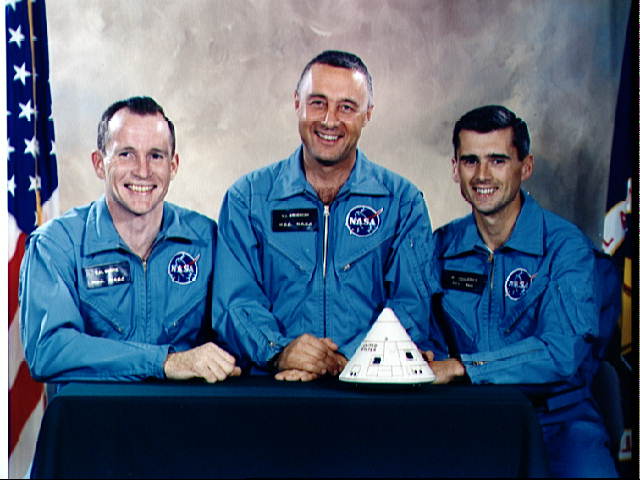
L to R: Ed White, Gus Grissom, Roger Chaffee
The tragedy set the U.S. space program back. The 1st manned Apollo flight, Apollo 7, wouldn't get off the ground until October 11, 1968 -- almost 2 years later, and putting JFK's end-of-decade (December 31, 1969) goal in serious jeopardy.
The last episode of Star Trek to get a first-run airing, "Turnabout Intruder," got it on June 6, 1969. Everyone figured that was the end. On July 20, 1969, just 44 days later, during Apollo 11, Neil Armstrong walked on the Moon. As Roddenberry put it, "Suddenly, people going into space and exploring strange new worlds didn't seem so far-fetched anymore."
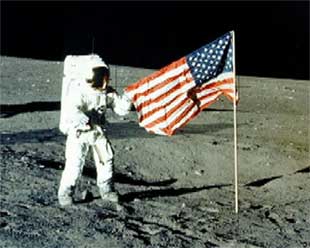
"That's one small step for a man,
one giant reason to believe in Gene Roddenberry's vision."
Star Trek caught on in syndication, airing on what were then "independent" TV stations, like New York's WPIX-Channel 11. NBC didn't want the show anymore, so it was cheap for these stations to air. Low risk, and any reward was nice. The reward turned out to be huge: As with 1950s shows The Honeymooners and The Adventures of Superman, the late 1960s Batman series, and, later, the original, early 1970s version of The Odd Couple, Star Trek brought those stations higher ratings than did the old movies they were airing. Star Trek got a new life, making possible not only its movies and its later series, but Star Wars and the other sci-fi film epics of the late 1970s and afterward.
But had the Apollo 1 fire not happened, the 1st Moonwalk might have happened months or even a year earlier, during Star Trek's 3rd season. It might have made people hungrier for a show about the exploration of space, boosted the ratings, and saved the show.
We'll never know what kind of episodes we would have seen had "its five-year mission" been completed. The show's legacy clearly didn't need it. But, as fan series such as Star Trek: New Voyages and Star Trek Continues have shown, it would have been nice to find out. And so, we can speculate.
Kirk: "Is that the logical thing to do?"
Spock: "No. But it is the human thing to do."

The main cast during filming of Star Trek VI: The Undiscovered Country,
1991, the last film with all of them together:
Koenig, Takei, Kelley, Nichols, Shatner, Doohan, Nimoy
And what we do have has served us well.


