Showing posts with label 1972 summit series. Show all posts

Sunday, September 7, 2025

Ken Dryden, 1947-2025

Kids these days, they look at some 26-year-old singer and call them "iconic." They keep using that word. It does not mean what they think it means.

Ken Dryden, the man, the mask, the pose, was iconic.

Kenneth Wayne Dryden was born on August 8, 1947 in Hamilton, Ontario, Canada, and grew up in Islington, Ontario, then a separate city, but now a part of Toronto. As such, he grew up as a fan of the Toronto Maple Leafs, which would come to seem odd. But then, when he was a young goaltender on the Canadiens, they had Frank Mahovlich, who had been perhaps the greatest player the Leafs have ever had.

He was a first cousin, twice removed, of Murray Murdoch, who played on the New York Rangers' 1928 and 1933 Stanley Cup winners, and was the longtime coach of Yale University's hockey team; and of Andy Blair (Andrew Dryden Blair), who played on the Leafs' 1932 Cup winners.

He had an older brother, Dave Dryden, who played a game for the Rangers in 1962, then 11 for the Chicago Black Hawks in the 1965-66 season, then regularly for the Hawks in the 1967-68 and 1968-69 seasons. He was an original member of the Buffalo Sabres in 1970, was an All-Star with them in 1974, then got lured by the not-so-reliable money of the World Hockey Association, mostly for the Edmonton Oilers, playing one last season in the NHL, 1979-80, after the WHA folded and the Oilers were 1 of the 4 surviving teams admitted. The brothers faced each other 8 times.

After starring in goal for the Etobicoke Indians of the Metro Junior B Hockey League and the Humber Valley Packers of the Metro Toronto Hockey League, Ken was drafted by the Boston Bruins in 1964, but his rights were quickly traded to the Montreal Canadiens. Instead of signing with the Canadiens, he went to Cornell University in Ithaca, New York, helping them win the 1967 National Championship.

He made his NHL debut on March 14, 1971, against the Pittsburgh Penguins at the Civic Arena in Pittsburgh. The Canadiens won the game 5–1, with Dryden stopping 35 of 36 shots. He played only six regular-season games, but rang up 1.65 goals-against average. This earned him the starting goaltending job for the playoffs ahead of veteran Rogatien "Rogie" Vachon.

The Canadiens advanced to the Stanley Cup Finals, against the Black Hawks. (The name was altered to one word, "Blackhawks," in 1986.) Their goalie Tony Esposito. The Canadiens had traded him, and also Vachon, who became a star with the Los Angeles Kings. They also traded the veteran Lorne "Gump" Worsley, who, despite being 41, had something left. They traded 3 future Hall of Fame goalies, 2 of them early in their careers, getting little in return. That's how much they believed in Dryden.

The Canadiens won Game 7, 3-2, and had their 17th Stanley Cup. Late in that game, Dryden made a spectacular toe-save on Jim Pappin, to prevent an equalizer. It was perhaps the most consequential (if not best) save in hockey history.

At this point, Dryden had played in 6 regular-season games, and 7 games in the Stanley Cup Finals. He was awarded the Conn Smythe Trophy as the Most Valuable Player of the Playoffs. The next season, he won the Calder Trophy as NHL Rookie of the Year. He remains the only player in the "big four" North American sports to be named Rookie of the Year after being named a postseason MVP. (Todd Worrell of the St. Louis Cardinals might have been so honored in 1985 and '86, if the Cardinals had hung on to win the World Series.)
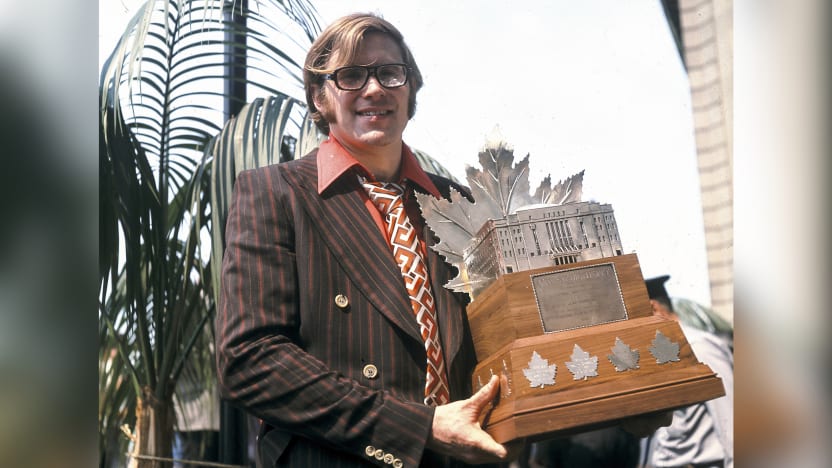
Dryden with the Conn Smythe Trophy.
Apparently, in the 1970s, Canadian men had no better taste
in clothing or hair than did American men.

He and Esposito were the 2 goalies selected for Team Canada in the "Summit Series" with the Soviet Union in 1972. Dryden played in Games 1, 4, 6 and 8; Esposito in Games 2, 3, 5 and 7. In a 50th Anniversary interview in 2022, he said, "I feel the history of that tournament, the legacy of that team just as strongly as all Canadian fans do. It never goes away. It's kind of like a good wine, I guess. Actually, the legacy of it grows."

The Canadiens did not win the Cup in 1972, but they did in 1973. Dryden missed the 1973-74 NHL season, so he could earn his law degree from McGill University in Montreal. The Canadiens did not win. He came back for 1974-75. They did not win. But they did for 1975-76, 1976-77, 1977-78 and 1978-79.

Serge Savard, a Hall of Fame defenseman for the Canadiens, said, "We looked at him and we thought he was coming from another planet. We didn’t see hockey players coming into the dressing room with books under their arms. After practice, he was going to McGill University."

As I was writing this, it occurred to me: Given his era, his talent, and his status as a thinking man and a thinking fan's man in his sport, Ken Dryden was the Tom Seaver of Hockey. Maybe he should have worn Number 41, as did a later Canadiens goalie, Jocelyn Thibault.

The "Flying Frenchmen" were so dominant that he could frequently stand in front of his goal, wearing what became the most famous goalie mask design ever, with its red, white and blue ovals, and in his familiar pose of resting his arms on top of his stick.

He then retired, having played 7 full seasons, and playing in the All-Star Game in 5 of them, and winning the Vezina Trophy as the League's top goalie in 5 of them. His Number 1 was retired by Cornell, and his Number 29 was retired by the Canadiens. He was elected to the Hockey Hall of Fame in 1983, named Number 26 on The Hockey News' list of the 100 Greatest Hockey Players in 1998 (5th among goalies, behind Terry Sawchuk, Jacques Plante, Glenn Hall and Patrick Roy), and named to the NHL's 100th Anniversary 100 Greatest Players in 2017.

Having abandoned his famed mask and pose at the age of 31 -- theoretically, he could have been only halfway through a career that would have surely earned him the title of the greatest goalie in hockey history -- he turned to more intellectual pursuits, including writing several books.

The Game, written about his final season and published in 1983, has been called one of the best books ever written about hockey. In 2019, he published Scotty: A Hockey Life Like No Other, a biography of his former coach, Scotty Bowman. No coach has led more Cup wins, 9, the 1st 5 with Dryden. In 2022, for the 50th Anniversary of the Summit Series, he published The Series: What I Remember, What It Felt Like, What It Feels Like Now.

He broadcast hockey for ABC for the 1980, 1984 and 1988 Winter Olympics, including the "Miracle On Ice" game in Lake Placid, New York in 1980. That meant that he was present for, arguably, the 2 most famous moments in the sport's history: The Soviet Union's losses to Canada in 1972 and America in 1980.

From 1997 to 2004, he served as President of the Leafs organization, and they got to within 1 game of the Stanley Cup Finals in 1999, getting back to the Conference Finals in 2002. But they got no closer. After leaving, he never worked in hockey again. With his law practice and his public service, he didn't need the money.
Honored at a 50th Anniversary celebration
of the 1971 Stanley Cup

After leaving the Leafs, he went into politics. He was elected as a member of the Liberal Party to the House of Commons for York Centre, a Toronto district, in 2004, and Prime Minister Paul Martin named him Minister of Social Development. He lost that post when the Conservative Party won the 2006 election, although Dryden was re-elected to his seat. He won again in 2008, but lost in 2011, and has not run for office again. In 2012, he was named an officer of the Order of Canada, the country's equivalent to a knighthood.

He went back to McGill as a lecturing professor. He became a television producer, having co-created and co-produced the six-part CBC-TV series We Are Canada, showcasing young, innovative Canadians to help celebrate the nation's 150th birthday in 2017. He participated in ceremonies honoring the Canadiens' 100th Anniversary in 2009, and the Boston Bruins' 100th Anniversary in 2024, since the Canadiens had been the opponents in the Bruins' 1st game in 1924.

Ken Dryden and his wife Lynda had two children, a son named Michael and a daughter named Sarah; and four grandchildren. Ken died of cancer in Toronto on Friday, September 5, 2025. He was 78 years old.

Canadian Prime Minister Mark Carney: "I am deeply saddened to learn of the passing of the Hon. Ken Dryden, a Canadian hockey legend and hall of famer, public servant and inspiration. Few Canadians have given more, or stood taller, for our country. Ken Dryden was Big Canada. And he was Best Canada. Rest in peace."

Larry Robinson, Hall of Fame defenseman for the Canadiens: "He was one of a kind back then. I was just very honored to play in front of him all those years. He sure as hell made me look a lot better." (Robinson also coached the New Jersey Devils to the 2000 Stanley Cup. Another Canadien teammate, Jacques Lemaire, coached the Devils to the 1995 Stanley Cup.)

Vladislav Tretiak, the opposing goalie in the 1972 Summit Series: "Ken Dryden will always be remembered by me first and foremost as a remarkable person -- intelligent, educated, kind, and open-minded. He represented that generation of Canadians who raised hockey to incredible heights worldwide, taking part in the 1972 Summit Series and shining in goal for the Montreal Canadiens."

See? Not just for Canada, or for North America, but Ken Dryden was an icon for hockey fans all over the world.

Wednesday, August 8, 2018

Stan Mikita, 1940-2018

Michael Wilbon of ESPN's Pardon the Interruption, formerly of The Washington Post, called Stan Mikita "Scottie Pippen" to Bobby Hull's "Michael Jordan." As a Chicago native, he should know.

Stanislav Guoth was born on May 20, 1940, in Sokolče, in what was then the Slovak Republic, a "client state" of Nazi Germany. The country no longer exists: After World War II, it was reintegrated into Czechoslovakia. That country also no longer exists: In 1993, it was split into the Czech Republic (sometimes "Czechia") and the Slovak Republic (usually written as "Slovakia"). The town no longer exists: It was evacuated in 1975, and inundated by a reservoir.

And the boy's name wouldn't exist for very long: In 1948, to escape the Communist takeover of Czechoslovakia, he was sent to live with an aunt and uncle in St. Catharines, Ontario Canada. They gave him their surname, and he became Stanislav Mikita. He was never "Stanley," although, like a lot of Eastern Europeans whose names start with "Stan," he would be nicknamed "Stosh."

Slovakia has gone on to produce several good hockey players. Before the 1993 "Velvet Divorce," Slovaks who starred for the Czechoslovakia team and then in the NHL included the Šťastný brothers, Peter, Anton and Marián; and Róbert Švehla and Žigmund Pálffy. Since 1993, there has been Peter Bondra, Miroslav Šatan, Jozef Stumpel, Zdeno CháraMichal HandzušMarián Gáborík, and the Hossa brothers, Marián and Marcel.

But it was in Canada that Stan Mikita learned how to play hockey. He starred for his hometown team, the St. Catharines Teepees of the Ontario Hockey League. In 1959, he was promoted to the Chicago Blackhawks. In 1961, he scored 6 goals in the Playoffs, helping the Hawks win the Stanley Cup.

It was a team laden with stars. Captain Eddie Litzenberger led Mikita, defenseman Pierre Pilote, goaltender Glenn Hall, and a young left wing who would become the most exciting player in the game, Bobby Hull, whose long blond hair -- eventually replaced with a combover and finally a toupee -- and speed gave him the nickname the Golden Jet.

Mikita was placed on what became known as the Scooter Line, centering right wing Ken Wharram and left wing Ab McDonald, with McDonald sometimes replaced by Doug Mohns. Like Hull, Mikita used a stick with a heavily curved blade. While Hull used his "banana blade" to fire the fastest shot in the game in that era, Mikita found success as the NHL's best faceoff man. In 1970, with both Hull and Mikita still roughly at their peak, the NHL passed a rule limiting the curve of a hockey stick's blade to half an inch. Violation meant a penalty, as Marty McSorley of the Los Angeles Kings found out to his dismay in the 1993 Stanley Cup Finals

Mikita was also one of the top defensive forwards in the game, although the Frank Selke Award for the season's best defensive forward had not yet been established. Among the awards that had been established: He was named to 9 All-Star Games; he won the Hart Memorial Trophy as NHL Most Valuable Player in 1967 and 1968; he won the Art Ross Trophy as leading scorer (goals plus assists) in 1964, 1965, 1967 and 1968; and the Lady Byng Trophy as "most gentlemanly player" in 1967 and 1968.

In those seasons, he became the 1st player to win the Hart, the Ross, and the Lady Byng in the same season, doing it twice. To this day, no other player has won it, even once.

Mikita winning the Lady Byng Trophy, donated in 1925 by Evelyn Byng, the hockey-loving wife of Julian Byng, the World War I hero who served as Canada's Governor-General at the time, would have seemed odd early in his career, as he racked up a lot of penalties.

One day, he came home from a roadtrip, and his wife Jill told him that daughter Meg (they also had daughter Jane, and sons Scott and Christopher) had been watching the 'Hawks on TV, and asked her mother, "Mommy, why does Daddy spend so much time sitting down?" The camera had just shown him sitting in the penalty box. So Stan cleaned his game up, and reaped the rewards.

But despite having plenty of stars on their roster, the Hawks couldn't win another Cup. They lost in the Finals to the Toronto Maple Leafs in 1962, and to the Montreal Canadiens in 1965, 1971 and 1973. It would be 2010 before they won another Cup.

In 1967, an errant shot hit Mikita in the ear, and actually tore a piece off. It was stitched back on. Afterward, he became one of the earliest players, and certainly the biggest star among those who did, to wear a helmet full-time. The NHL would later make helmets mandatory.

In 1972, Mikita, despite being born outside Canada -- and in a country still effectively controlled by the Soviet Union -- was named to Team Canada for the 1972 "Summit Series" against the Soviet national team. But injury limited him to just 2 of the 8 games.

It's worth noting that Hull and goaltenders Gerry Cheevers and Bernie Parent had been declared ineligible, because it was a team of NHL players, and those 3 had jumped to the new World Hockey Association. The goalies were Ken Dryden of the Canadiens and Hull and Mikita's Blackhawk teammate, Tony Esposito. It's also worth noting that Bobby Orr of the Bruins was injured. If either Hull or Orr was available, it would have been a very different series. Instead, Canada won it in the last 30 seconds of the last game, 4 games to 3 with a tie.

In 1976, Mikita was named Captain of the Blackhawks, and was awarded the Lester Patrick Trophy for contributions to hockey in America. Despite a back injury, he played 22 seasons, all with the Blackhawks, retiring after the 1980 season, playing into a 4th decade. At the time, only Gordie Howe and Phil Esposito had scored more NHL points, and only 6 players had appeared in more games.

The 'Hawks made his Number 21 the 1st they retired, as they were still feuding with Hull. They would make peace in 1983, and Hull's Number 9 went into the rafters. Also in 1983, Mikita and Hull were both elected to the Hockey Hall of Fame. Their retired number banners, although with the 1 of Hall and the 35 of Esposito, were taken down following the last regular-season game at Chicago Stadium in 1994, and presented to their honorees. New banners went up at the opening of the United Center. In 2011, statues of Mikita and Hull were dedicated outside the arena.

Mikita was inspired by the deaf son of a friend to establish, along with fellow Sloavk Irv Tiahnybik, a Chicago businessman, the American Hearing Impaired Hockey Association (AHIHA). And when he heard that the Special Olympics had been established in 1968 by Eunice Kennedy Shriver, sister of the late President John F. Kennedy, and were set for Chicago's Soldier Field, he jumped at the chance to be involved.

He became an avid golfer, and ran the company that make the little plastic containers for the sauces that McDonald's uses for its Chicken McNuggets. He also owned a restaurant in the suburb of Oak Brook, Illinois, named Stan Mikita's Village Inn.
A business he did not own was Stan Mikita's Donuts. That was an inside joke in the 1991 movie Wayne's World, based on the Saturday Night Live sketch set in the Chicago suburb of Aurora, and patterned after real-life donut chain Tim Hortons. (Horton was a defenseman for the Toronto Maple Leafs in the 1950s and '60s.)

In 1998, The Hockey News ranked him 17th on their list of the 100 Greatest Hockey Players. In 2017, he was named to the NHL's 100th Anniversary 100 Greatest Players, which were not ranked.

Although he survived cancer, in 2015 he was diagnosed with dementia. He died this past Tuesday, August 7, 2018, in Chicago, at the age of 78.

Blackhawks President William Rockwell "Rocky" Wirtz: "Stan made everyone he touched a better person. 'Stosh' will be deeply missed, but never, ever forgotten."

Former teammate Dale Tallon, now general manager of the Florida Panthers: "His preparation was impeccable. His style of play was unique. He had great skills and drive and passion. He was hardworking. He was unselfish. He was a superstar."

(Tallon was also the 1st player to wear Number 9 on the Blackhawks after Hull. He joked, "The only thing wrong with it is, they left off the decimal point.")

Hull: "Pound for pound, Stan had to be one of the greatest who ever played, and he was a player who always came to play."

If Hull was the Golden Jet, then Mikita was a Dark Glider, but there was plenty of lamp-lighting when he was on the ice. And he will always shine brightly in the minds of hockey fans.

UPDATE: Mikita's final resting place is not publicly known.

Monday, October 15, 2012

They're Trying

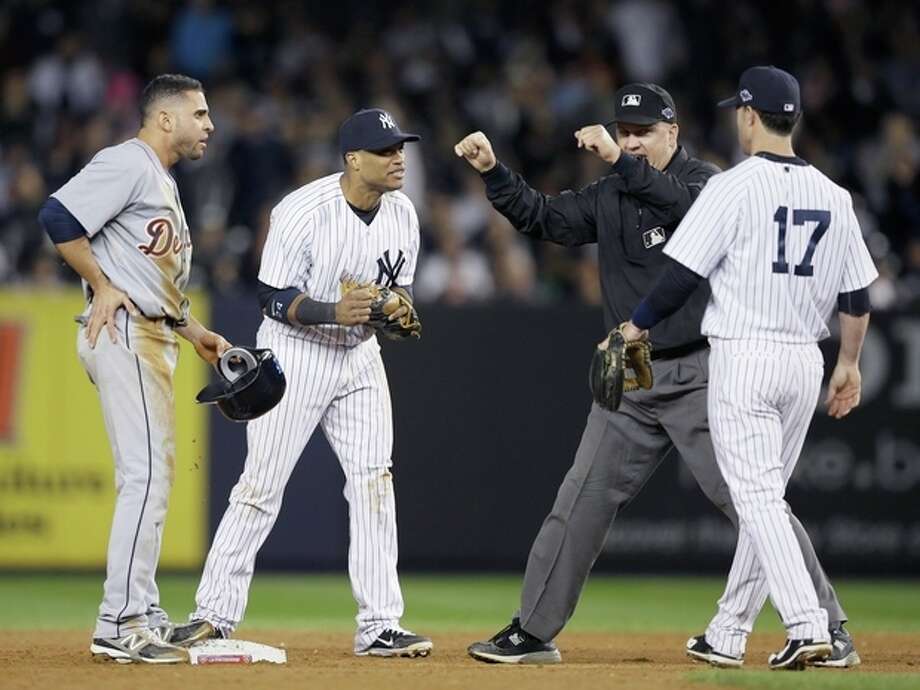
Yesterday, the Yankees lost Game 2 of the American League Championship Series to the Detroit Tigers, 4-0.  Hiroki Kuroda seemed to turn into Harvey Haddix: He took a perfect game into the 6th, but the Yankees couldn't score off Anibal Sanchez. The Yankees got just 7 baserunners, and none of them scored.

And the boos came out. Long and hard.

Let's get something straight: I don't think the Yankee Fans are booing individual players -- except for Alex Rodriguez, who, whether he or we like it or not, is the easiest target, because of how much money he makes, and how many times he's failed in postseason play for us.

I think they're booing the failure in general. Nick Swisher is simply the one who's reacted to it. He's got a point: It isn't completely fair. But the fans also have a point: It is partly fair.

It reminds me of Phil Esposito's interview after Game 4 of the 1972 "Summit Series," after the Soviets had embarrassed Team Canada on Canadian soil:

For the people across Canada, we tried. We gave it our best. For the people who booed us, jeez, all of us guys are really disheartened and we're disillusioned, and we're disappointed in some of the people. We cannot believe the bad press we've got, the booing we've gotten in our own buildings.

If the Russian fans boo their players like some of the Canadian fans - I'm not saying all of them - some of them booed us, then I'll come back and apologize to each and every Canadian. But I don't think they will.

I'm really, really, I'm really disappointed. I am completely disappointed. I cannot believe it. Some of our guys are really, really down in the dumps. We know - we're trying. What the hell, we're doing the best we can. They've got a good team, and let's face facts. But it doesn't mean that we're not give it our 150 per cent, because we certainly are.

Every one one of us guys, 35 guys who came out to play for Team Canada, we did it because we love our country, and not for any other reason. They can throw the money for the pension fund out the window, they can throw anything they want out the window. We came because we love Canada. And even though we play in the United States and we earn money in the United States, Canada is still our home, and that's the only reason we come. And I don't think its fair that we should be booed.

Granted, playing for your country is far different from playing for a club -- as Wayne Rooney finds out when he plays international soccer and doesn't have officials who are inclined to give his team the benefit of the doubt simply the team is Manchester United and officials who don't fix matches for Man U have seen their jobs suffer.

But Espo's analogy applies. The Yankees aren't trying to fail. They're just in an awful slump, at the worst possible time. These things happen.

And while Yankee Fans pay an inordinate price for their fandom -- high ticket prices, high food prices, high souvenir prices, and the MTA is about to announce a Subway fare hike -- and they have the right to express their displeasure when the highest-paid team in North American sports doesn't get the job done, certain things have to be realized:

1. Success is not guaranteed, no matter how much money is spent. Ask the Mets. Ask the Boston Red Sox these last 2 years. Ask the Philadelphia Phillies this year. Ask the Los Angeles teams, as both the Dodgers and the Angels have spent a lot of money over the last 10 seasons (2003 to 2012), and have no Pennants between them to show for it.

2. The Yankees aren't trying to fail. A-Rod, Swish, Robinson Cano, Curtis Granderson, yeah, these guys are highly paid professionals and should win -- but they are trying. You think their failures don't bother them? To borrow an analogy from another sport, they're not throwing in the towel. They keep fighting. They don't seem to know where to punch at the moment, but they're getting off the deck and continuing to fight.

3. There are no bad teams in the Playoffs. The Baltimore Orioles nearly won the AL East. The Tigers did win the AL Central, and beat the AL West Champion Oakland Athletics in a tough 5-game series.

These are good teams, and they deserve some credit for the way they've driven the Yankees nuts. The Tigers did eliminate the Yankees from the Playoffs last year, and some of the players they've got are holdovers from the 2006 Tigers who did the same.

If the Yankees do somehow come from behind and win this Pennant, they'll have to face either the defending World Champion St. Louis Cardinals, 5th seed though they were, or the NL West Champion and previous World Champion San Francisco Giants. Should we be shocked if either of them wins the World Series, completely shutting down the Yankees or Tigers? Certainly not.

4. As bad as things look for the Yankees right now, remember what Yogi Berra said: "It ain't over 'til it's over."

No Jeter. A-Rod not hitting. Robbie not hitting. Grandy not hitting. Swish not hitting. Good pitching performances by Andy Pettitte and Hiroki Kuroda getting wasted. (Not that kind of "getting wasted.") No Mariano Rivera to rely on, if we somehow get a lead and hold it into the 9th inning. Lost the 1st 2 games of this ALCS at home. And now we have to go to Detroit. And face Justin Verlander in Game 3.

But you know what? The Yankees have faced situations like this before, and won: 1996 World Series, 1998 ALCS, 2000 and 2001 ALDS. Even in the 2009 World Series, we lost Game 1 at home before taking 4 of the next 5.

Paul Sullivan, author of the blog Sully Baseball and a huge Red Sox fan, is really enjoying the Yankees' failure -- as if he wouldn't give a tooth to see the Sox failing in the Playoffs, because that would mean they made the Playoffs. Like Jim Mora Sr. would say, don't talk to him about playoffs, his team has to worry about just winning a game!

But Sully rightly points out that a comeback is incredibly unlikely, and cites the fact that the 2012 Yankees are not the 2004 Red Sox.

He's got a point. The Yankees can't count on their steroid cycles kicking in. The Yankees can't purposely throw at opponents and expect to get away with it every single time. And if this series does somehow get to a Game 6 at Yankee Stadium, Derek Jeter is not coming to bat with blood coming out of his ankle and through his sock.

To boo these Yankees in understandable. All that money, and, undeniably, they have spectacularly failed.

But maybe we need to accept the truth: These are not the 1927, 1936, 1941, 1949, 1961, 1977, 1996 or 2009 Yankees -- but remember, those teams all had something to prove, and until they did win the World Series, they hadn't proven it.

Every great Yankee has gotten booed. Babe Ruth. Lou Gehrig. Bill Dickey. Joe DiMaggio. Yogi Berra. Whitey Ford. Mickey Mantle. Roger Maris. Thurman Munson. Reggie Jackson. Dave Winfield. Yes, even Jeter. Even Mariano, mainly early in his career, but it happened. Especially A-Rod.

It seems that the only great Yankee who didn't get booed was Don Mattingly -- even though he pulled off the unique feat of playing 14 seasons in a Yankee uniform and never winning a postseason series.