Friday, September 29, 2017

September 29, 1957: Giants Leave Polo Grounds, Packers Open Lambeau Field

September 29, 1957, 60 years ago: The Giants play their last game at the Polo Grounds, their owner Horace Stoneham having already announced that they're moving to San Francisco. Unlike the Brooklyn Dodgers, who played their last home game at Ebbets Field 5 days earlier, they have a farewell ceremony, including Blanche McGraw, widow of longtime manager John, who said that the move would have broken his heart.

Since moving to the site in 1890, including replacing the original stadium that burned down in 1911, the Giants had won 15 National League Pennants, and won the World Series 5 times: In 1905, 1921, 1922, 1933 and 1954.

The Pittsburgh Pirates, unable to even score off the Dodgers on Tuesday night, beat the Giants on Sunday afternoon, 9-1. The crowd is a pathetically small 11,606, and storms the field after the game. At one point, they gather at the center field blockhouse that included both teams' locker rooms, chanting for Mays, "We want Willie!" And, to the tune of "Good Night, Ladies," they sing, "We want Stoneham! We want Stoneham! We want Stoneham, with a rope around his neck!"
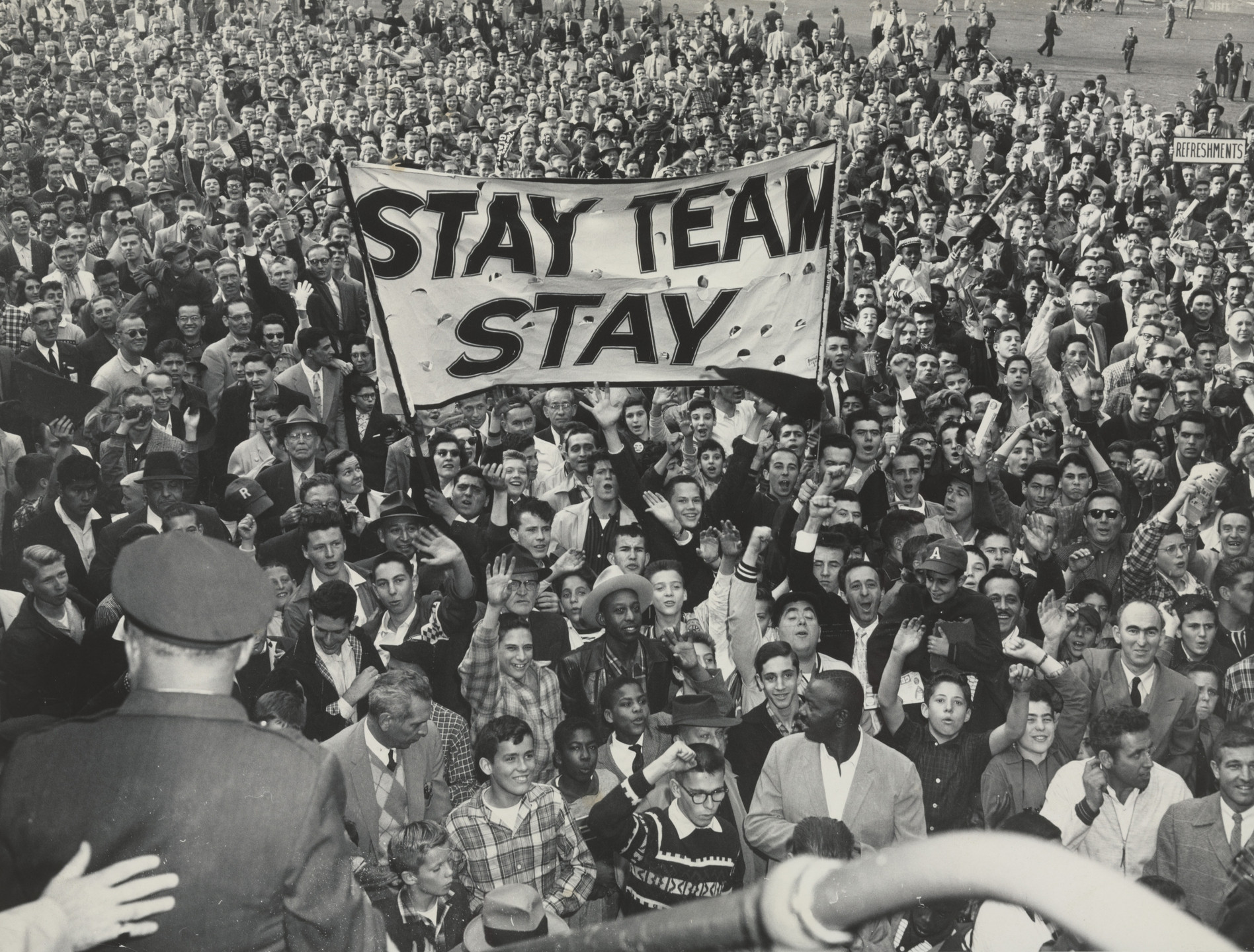
Stoneham had already said that the fans had no one to blame but themselves, as they hadn't shown up in sufficient numbers, borne out by the small crowd at the finale: "I feel bad for the kids, but I haven't seen too many of their fathers lately."

As for the Dodgers: Their last game as a Brooklyn team is also on this day, and it is a 2-1 loss to the Philadelphia Phillies at Connie Mack Stadium. Ed Bouchee homers for the Phils, and Seth Morehead outpitches Roger Craig.

The last pitch by a Brooklyn Dodger is thrown by an erratic (so far) reliever from Brooklyn, Sandy Koufax. The last Brooklyn play is left fielder Bob Kennedy flying to center fielder Richie Ashburn. It is also, though no one foresees the Winter's tragedy, the last game for Roy Campanella, and his last at-bat is also a fly to Ashburn. With both teams well out of the race, only 9,886 attend the Brooklyn Dodgers' semi-official funeral.

That is not the case at the 1st game at the new City Stadium in Green Bay, Wisconsin, as the Packers move out of the old one, which was too small, and 32,132 see them beat their arch-rivals, the Chicago Bears, 21-17.
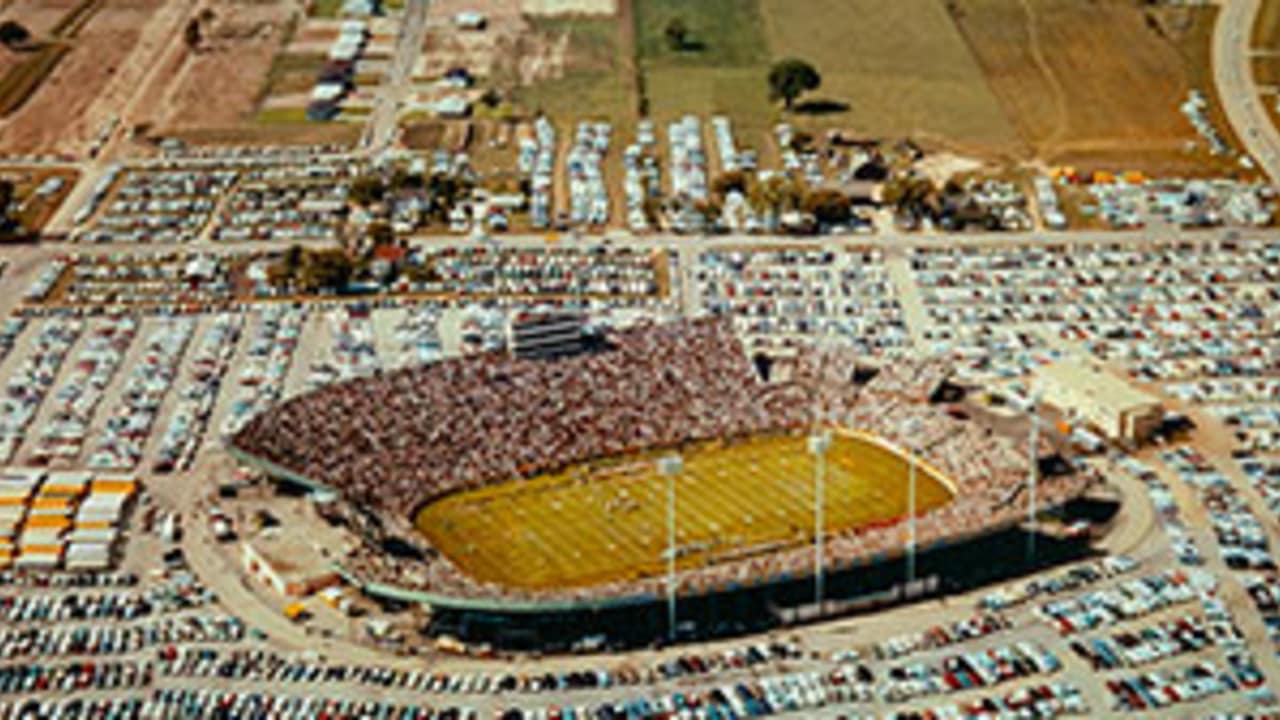
Actual color photo from the 1st game

The stadium was renamed Lambeau Field after team founder Earl "Curly" Lambeau died in 1965. By that point, capacity was be 50,861. That's how many people attended the 1967 NFL Championship Game on New Year's Eve, known as the Ice Bowl: Despite a gametime temperature of -15 degrees Fahrenheit, without the wind chill factor, there wasn't an empty seat in the house. The capacity became 55,000 by 1970, 58,000 by 1990, 60,000 by 1995, 70,000 by 2005, and is now 81,411.

Since moving to Lambeau Field in 1957, the Packers have made the Playoffs 27 times, won 14 Division titles, reached the NFL (1957-69) or NFC (1970-2016) Championship Game 13 times (including last season), won 8, reached 5 Super Bowls, and won 4 of them: I, II, XXXI and XLV -- meaning they have been World Champions for the seasons of 1961, 1962, 1965, 1966, 1967, 1996 and 2010.

When the Los Angeles Rams move from the Los Angeles Memorial Coliseum to their new stadium in Inglewood, currently scheduled for 2020, Lambeau Field will be, as it was from 2002 to 2015, the oldest active stadium in the NFL. (The Chicago Bears' Soldier Field went up in 2002, replacing the same of the same name on the same site that went up in 1924, although the Bears have only played on the site since 1970.)

Also on this day, Mark L. Attanasio is born in The Bronx, and grows up just across the Hudson River, in Tenafly, Bergen County, New Jersey. (I can find no record of what the L stands for.) Since 2005, he has been the owner of the Milwaukee Brewers. They have now made the Playoffs as many times in 12 seasons as they did under their previous owners, the Selig family, in 35 seasons: 2.

*

September 29, 1793: Samuel Powel dies in the yellow fever epidemic that hit Philadelphia that year. He was 55. He was Mayor of the city from 1775 until 1790, a period that included the adoption of the Declaration of Independence there in 1776, the occupation by the British in 1777-78, and the Constitutional Convention of 1787.

September 29, 1829: The Metropolitan Police Service is founded in London. They are often known as simply The Met.

Since they were established by a bill written by Sir Robert Peel, then Home Secretary, and later Prime Minister (1834-35 and 1841-46), his nickname "Bobby" becomes theirs. Eventually, all British policemen get nicknamed "Bobbies."

They also get nicknamed "The Old Bill," for a policeman who figured in a cartoon regularly printed in a late Victorian Era magazine. This is the nickname, sometimes shortened to just "The Bill," preferred by English soccer hooligans, who tend to verbally abuse them -- from a distance, of course. The antipathy is very much mutual.

However, "Scotland Yard" refers to not the policemen, or even the department, but their London headquarters. It would be like calling the New York Police Department "One Police Plaza" or "1PP."

September 29, 1891: A statue of Diana, the Roman goddess of the Moon and hunting, equivalent in Greek mythology to Artemis, is placed atop the 485-foot tower at Madison Square Garden, at 26th Street and Madison Avenue, overlooking Madison Square itself.

The building, the 2nd to bear the name after the 1879 version, was designed by renowned architect Stanford White, who put his penthouse apartment atop the tower, and commissioned the statue on top of that. The 18-foot-high statue, topping a complex that also includes an 8,000-seat arena, a 1,500-seat concert hall, and a 1,200-seat theater, was sculpted by Augustus Saint-Gaudens, and shows Diana pulling back her bowstring, ready to fire an arrow. It also acts as a weather vane.

White and Saint-Gaudens decide that it's too big, and Saint-Gaudens replaces it in 1893 with a 13-foot version. The original was given to the World's Columbia Exposition in Chicago, the World's Fair designed to celebrate the 400th Anniversary of Christopher Columbus' arrival in the New World (in 1492, so it was a year late). That statue was lost in a fire the next year.
The tower of the 2nd Garden, topped by the 2nd Diana statue

Both statues are nudes, and critics and self-appointed moral arbiters hated them. In particular, a critic from Philadelphia ripped the original in a newspaper. Ironically, when the 2nd Garden was torn down in 1925 to make way for the New York Life Building, the 2nd Diana was donated to... the Philadelphia Museum of Art. Yes, the building whose steps Sylvester Stallone ran up in the Rocky movies. It's still there.

Neither White nor Saint-Gaudens lived to see the demolition of their work. White was murdered in 1906, in the rooftop theater he'd built, by Harry Thaw, who found out that White had seduced his wife, actress Evelyn Nesbit -- before she and Thaw had ever even met. White was 52 years old, would probably have died soon anyway (an autopsy showed liver and kidney disease), and one of the worst-kept secrets in New York was that he was a molester, at least of teenage girls and possibly of boys as well. After 2 mistrials, Thaw was found not guilty by reason of insanity. And Saint-Gaudens died of cancer a year after Thaw, just 59.

Boxing promoter George "Tex" Rickard built the 3rd Madison Square Garden at 50th Street and 8th Avenue in 1925. It became what the Madison Square Garden Corporation now claims the current building is, "The World's Most Famous Arena," but, unlike its 1891-1925 predecessor, it was not an architectural marvel. The current Garden, at 32nd Street and 7th Avenue, opened on February 11, 1968, so it's about to celebrate its 50th Anniversary.

September 29, 1894: The National League season ends, and the Baltimore Orioles have won their 1st Pennant, finishing 3 games ahead of the New York Giants, and 8 games over the 3-time defending Champions, the Boston Beaneaters (forerunners of the Atlanta Braves).

But Boston center fielder Hugh Duffy has one of the best seasons in baseball history, batting .440 (122 years later, still a single-season major league record), hitting 18 home runs, and 145 RBIs, leading the NL in all 3 categories, thus giving him the Triple Crown.

September 29, 1901: Verne Clark Lewellen is born in Lincoln, Nebraska. The 2-way back won 3 straight NFL Championships for the Green Bay Packers, in 1929, 1930 and 1931.

Green Bay is in Brown County, Wisconsin. He and teammate LaVern Dilweg were both practicing attorneys. In 1928, they ran against each other for Brown County District Attorney, and Lewellen won. He was re-elected in 1930, but defeated in 1932. Dilweg would later be elected to Congress in 1942, but was defeated in 1944. After their defeats, neither ever ran for public office again.

Dilweg died in 1968, Lewellen in 1980. Both are in the Green Bay Packers Hall of Fame, but neither is in the Pro Football Hall of Fame. Both should be, but the Hall voters have given short shrift to the League's pioneer players.

September 29, 1907: Orvon Grover Autry is born in Tioga, Texas, and grows up in Ravia, Oklahoma. He got his 1st job working at a telegraph at a radio station, and the station manager heard him singing, and gave him a show. Encouraged by no less an Oklahoma entertainer than Will Rogers, by 1929 he was "Gene Autry," and a national radio and records star. His film career as "The Singing Cowboy" began in 1934, and in 1950 he became one of the earliest television stars.

By that point, he had become owner of the Golden West Network, including radio stations KSFO in San Francisco, KMPC in Los Angeles, and KOGO in San Diego. It also included Los Angeles' Channel 5, KTLA.

He had also became a part-owner of the Pacific Coast League's Hollywood Stars, who were forced out of town by the move of the Brooklyn Dodgers to Los Angeles in 1957-58. But the arrival of the New York Giants in San Francisco at the same time led him to buy the broadcast rights to their games, and they were on KSFO through the 1978 season. (They have been on KNBR since then.)

In 1960, the American League established an expansion team in L.A. Gene, going back to his roots, wanted to buy the radio broadcast rights. But MLB officials were so impressed with his approach, they offered to sell him the team. He owned it for the rest of his life, even though this created a conflict of interest in owning the station that broadcast the Giants' games.

The team was named after the former PCL team that had been the Stars' rivals, the Los Angeles Angels. They played at the L.A. version of Wrigley Field in 1961, then began sharing the new Dodger Stadium in 1962. Tired of Walter O'Malley treating him like crap (It wasn't personal: O'Malley treated everyone like crap), Gene made a deal with the suburban City of Anaheim, and built Anaheim Stadium for the 1966. He renamed the team the California Angels.

He wasn't afraid to spend money, if he thought it would bring results. When free agency arrived after the 1976 season, and the team had not yet made the Playoffs in 16 seasons, he opened the vault and signed Joe Rudi and Bobby Grich. He later signed future Hall-of-Famers Reggie Jackson, Rod Carew, Don Sutton and Bert Blyleven.

But while they won AL Western Division titles in 1979, 1982 and 1986, they couldn't win a Pennant. Indeed, their losses -- not just on the field, but 6 active Angels died of various causes between 1965 and 1989 -- led to talk of "The Curse of the Cowboy," though it's hard to imagine what Gene could have done to bring it on.

In 1995, battling lymphoma, he sold a quarter share of the team to Anaheim's biggest employer, the Walt Disney Company, with a provision that the rest would go to them after his death. That came on October 2, 1998, just after his 91st birthday -- and on his wife Jackie's 57th birthday.

In 2002, by then known as the Anaheim Angels, in their 42nd season, they broke the curses: They won their 1st postseason series, their 1st Pennant, and their 1st World Series. They became known as the Los Angeles Angeles of Anaheim in 2005, after Disney sold the team to Arte Moreno.

The Angels have retired Number 26 for him, as the "26th Man" with a 25-man roster, and dedicated a statue of him outside what's now named Angel Stadium of Anaheim. He is not in the Baseball Hall of Fame, but he should be. His widow, Jackie Autry, served as President of the American League from 2000 to 2015.

September 29, 1913: The New York Giants defeat the Boston Braves 5-3 at the Polo Grounds, and clinch the National League Pennant.

Also on this day, Silvio Piola is born in Robbio, Lombardy, Italy. A striker, he starred for Italian soccer teams Pro Vercelli and Novara of Piedmont, Lazio of Rome, and both major Turin clubs, Torino and Juventus,

He was not selected for the Italy team that won the World Cup on home soil in 1934, but he was selected for the 1938 World Cup in France, and scored 2 goals in the Final against Hungary to help the Azzurri repeat. To this day, only Giuseppe Meazza and Gigi Riva have scored more goals for the Italian national team. He died in 1996, at the age of 83. Stadiums in the cities of Novara and Vercelli are named after him.

September 29, 1915: Frederick Page -- no middle name -- is born in Port Arthur, now part of Thunder Bay, Ontario. As president of the Canadian Amateur Hockey Association, the tours he led stoked the love of the sport in Europe. He was elected to the Hockey Hall of Fame in 1993, and died in 1997.

September 29, 1917, 100 years ago: Jesse Bernard Renick is born in Hickory, Oklahoma, and grows up in nearby Marietta. A guard, he starred on the basketball team at Oklahoma A&M University (now Oklahoma State), alongside 7-foot center Bob Kurland.

Together, they played on the Phillips 66ers, the top amateur team of the era (since pro basketball was not yet big business), sponsored by Phillips Petroleum, which gave amateur hoop stars nominal jobs; and the U.S. team that won the Gold Medal at the 1948 Olympics in London. "Cab" Renick was the 2nd Native American to win an Olympic Gold Medal -- and the 1st to get to keep it, after Jim Thorpe was stripped of the 2 he won in 1912. Renick lived until 1999.

*

September 29, 1932: Game 2 of the World Series. The Chicago Cubs take a 1-0 in the 1st inning, but the Yankees score 2 in the bottom half, and Lefty Gomez handles the Cubs the rest of the way. The Yankees win, 5-2, and take a 2 games to 0 lead as the Series heads out to Chicago.

September 29, 1937, 80 years ago: Ray Ewry dies on Long Island at age 63. He was America's 1st great Olympic medalwinner, albeit in standing jumps, events that are no longer contested. He won 8 Gold Medals: The standing long, high and triple jumps at Paris in 1900; all 3 again at St. Louis in 1904; and the long and high jumps at London in 1908.

September 29, 1939: Lawrence Lavon Linville is born in Ojai, California, and grows up in Sacramento. After several TV cameos, including a recurring role as a Los Angeles Police Lieutenant on Mannix, from 1972 to 1977, he played Major Frank Burns on M*A*S*H. Unlike the moralizing but immoral, hyper-patriotic and paranoid, incompetent surgeon he played, Larry was said by all of his castmates to be a nice guy.

On a 1976 episode, Frank used the fact that Armed Forces Radio broadcast baseball games live in the middle of the night, Korea time, and then rebroadcast them later in the day, to place sure-thing bets. Hawkeye (Alan Alda) discovers this, and outfoxes him.

He left the show after 5 seasons because he, correctly, felt that Frank was the only character that wasn't showing any growth: In his words, Frank was "a cartoon." He returned to his former status as a cameo actor -- I remember him playing a genie on Fantasy Island -- and died of cancer in 2000.

*

September 29, 1942, 75 years ago: David Wilcox (no middle name) is born in Ontario, Oregon, and grows up in nearby Vale. A linebacker, Dave Wilcox was a 7-time Pro Bowler for the San Francisco 49ers, and is in the Pro Football Hall of Fame.

He is still alive. He, his brother Johnny, and his sons Justin and Josh all played at the University of Oregon. Justin Wilcox is now the head coach at the University of California.

September 29, 1943: Wolfgang Overath is born in Siegburg, North Rhine-Westphalia, Germany. A midfielder for FC Köln, he helped them win the 1st Bundesliga title in 1964, and the DFB-Pokal (Germany's version of the FA Cup) in 1968 and 1977.

He competed for Germany in 3 World Cups, losing to England in the 1966 Final, finishing 3rd in 1970, and winning it on home soil in 1974. He is still alive.

Also on this day, Lech Wałęsa is born in Popowo, Poland. In 1980, the electrician, working at the Lenin Shipyard in Gdansk, formed the 1st independent trade union in the Soviet bloc, Solidarność (Solidarity). He was imprisoned. In 1981, Time magazine named him its Man of the Year. He was freed soon afterward. In 1989, Poland had its 1st free election in over 50 years, and he was elected President.

So conservatives, who say Ronald Reagan "won the Cold War," have to live with the fact that the Cold War was won not by what Reagan became, a conservative politician; but by what Reagan used to be, the head of a labor union.

He served as President from 1990 to 1995, and turned out to be too conservative for Poles' taste, as he was defeated for re-election.

September 29, 1946: The Rams, who played in Cleveland from 1936 to 1945, play their 1st home game in Los Angeles, making them the city's 1st real major league sports team. (Previous pro football teams had "Los Angeles" as their name, but their leagues could hardly be called "major.") The defending NFL Champions lose to the Philadelphia Eagles, 25-14.

This game is even more significant than L.A.'s debut on the major league stage, because it is the NFL debut for halfback Kenny Washington and end Woody Strode, both of whom had played for UCLA at the Rams' new home, the Los Angeles Memorial Coliseum. They became the 1st black players in the NFL in 13 years, ending the color bar.

Marion Motley and Bill Willis of the Cleveland Browns were doing the same in the All-America Football Conference that Autumn, so pro football had "four Jackie Robinsons," a few months before baseball had one. (Robinson had also played football at UCLA, and ran in the same backfield as Washington in 1939 and '40.)

September 29, 1951: Duke University defeats the University of Pittsburgh, 19-14 at Pitt Stadium. NBC broadcasts the game. It is the 1st nationwide television broadcast of a live sporting event. Four days later, they will do the same of the deciding game of the Dodger-Giant playoff.

*

September 29, 1954: Willie Mays makes the most famous defensive play in the history of sports, remembered as simply The Catch -- Capital T, Capital C.

It was Game 1 of the World Series. The New York Giants had won the National League Pennant, beating out their crosstown rivals, the Brooklyn Dodgers. The Cleveland Indians had won the American League Pennant, winning League record 111 games to beat out the Yankees, who had won the last 5 World Series. Indeed, the last 8 AL Pennants had been won by the Indians (1948 & '54) and the Yankees (1947, '49, '50, '51, '52 & '53).

Game 1 was played at the Polo Grounds in New York. The game was tied 2-2 in the top of the 8th, but the Indians got Larry Doby on 2nd base and Al Rosen on 1st with nobody out.

Giant manager Leo Durocher pulled starting pitcher Sal Maglie, and brought in Don Liddle, a lefthander, to face the lefty slugger Vic Wertz, and only Wertz. Somehow, this got into Joe Torre's head (despite being a native of Brooklyn, Torre says he grew up as a Giants fan) and into Joe Girardi's binder (Girardi wasn't even born for another 10 years).

Liddle pitched, and Wertz swung, and drove the ball out to center field. The Polo Grounds was shaped more like a football stadium, so its foul poles were incredibly close: 279 feet to left field and 257 to right. In addition, the upper deck overhung the field a little, so the distances were actually even closer. But if you didn't pull the ball, it was going to stay in play. Most of the center field fence was 425 feet from home plate. A recess in center field, leading to a blockhouse that served as both teams' clubhouses -- why they were in center field, instead of under the stands, connected to the dugouts, is a mystery a long-dead architect will have to answer -- was 483 feet away.

Mays, at this point in his career, was already a big star. Just 23 years old, he had won that season's NL batting title. He had been NL Rookie of the Year in 1951, but had missed most of the 1952 season and all of 1953 serving in the U.S. Army, having been drafted into service in the Korean War. He had become known for playing stickball in the streets of Harlem with local boys in the morning, and then going off to the Polo Grounds to play real baseball in the afternoon. This raised his profile, and made him an accessible figure to City kids. His cap flying off as he ran around the bases, his defensive wizardry, and his yelling of, "Say hey!" endeared him to Giant fans.

While he made the "basket catch" nationally popular, he didn't invent it. In fact, he wasn't even the 1st Giant to use it, as 3rd baseman Bill Rigney, who would succeed Durocher as manager in 1956, was using it in the 1940s.

Even so, the days when the Giants were the team in New York sports were long gone, this week's events notwithstanding. At this moment, Mays was, in the public consciousness, where Babe Ruth was in May 1920, where Joe DiMaggio and Ted Williams were in May 1941, where Mickey Mantle was in May 1956, where Reggie Jackson was in September 1977, where Roger Clemens was in April 1986, where Derek Jeter was in September 1996, where David Ortiz was in September 2004: A star, well-known and popular, but not yet a legend.

Mays ran back to try to catch the ball. In mid-stride, he thumped his fist into his mitt. His teammates, who had seen this gesture before, knew that this meant that he thought he would catch it. But most fans, who didn't watch him every day, didn't know this. Watching on television (NBC, Channel 4 in New York), they figured the ball would go over his head, scoring Doby and Rosen, and that Wertz, not exactly fleet of foot, had a chance at a triple, or even an inside-the-park home run.

Willie has said many times that he was already thinking of the throw back to the infield, hoping to hold Doby to only 3rd base.

With his back to the ball all the way, he caught the ball over his head, stopped, pivoted, and threw the ball back to the infield. Doby did get only to 3rd.

The announcers were Jack Brickhouse, who normally did the home games for both of Chicago's teams, the Cubs and the White Sox, but was the lead announcer for NBC in this Series; and Russ Hodges, the usual Giants announcer, made nationally famous 3 years earlier when Bobby Thomson's home run made him yell, "The Giants win the Pennant!" over and over again.

Brickhouse: "There's a long drive, way back in center field, way back, back, it is... Oh, what a catch by Mays! The runner on second, Doby, is able to tag and go to third. Willie Mays just brought this crowd to its feet with a catch which must have been an optical illusion to a lot of people. Boy! See where that 483-foot mark is in center field? The ball itself... Russ, you know this ballpark better than anyone else I know. Had to go about 460, didn't it?"

Hodges: "It certainly did, and I don't know how Willie did it, but he's been doing it all year."

It has been argued by many, including Bob Feller, the pitching legend sitting on the Indians' bench that day, that the reason so much is made of this catch is that it was in New York, it was in the World Series, and it was on television. "It was far from the best catch I've ever seen," Feller said. Mays himself would say he'd made better catches. But none more consequential.

Durocher yanked Liddle, and brought in Marv Grissom. Upon reaching the Giant dugout, Liddle told his teammates, "Well, I got my man."

Yeah, Don. You got him. As Jim Bouton, then a 15-year-old Giant fan who'd recently moved from Rochelle Park, Bergen County, New Jersey to the Chicago suburb of Chicago Heights, Illinois, would later say, "Yeah, surrrre!"

Grissom walked Dale Mitchell to load the bases with only 1 out. But he struck out Dave Pope, and got Jim Hegan to fly out, to end the threat.

When the Giants got back to the dugout, they told Willie what a hard catch it was. He said, "You kiddin'? I had that one all the way."

The game went to extra innings. Future Hall-of-Famer Bob Lemon went the distance for the Tribe, but in the bottom of the 10th, he walked Mays, who stole 2nd. Then he intentionally walked Hank Thompson to set up an inning-ending double play. It didn't happen: Durocher sent Dusty Rhodes up to pinch-hit for left fielder Monte Irvin, and Rhodes hit the ball down the right-field line. It just sort of squeaked into the stands.

On the film, it looks a little like a fan reached out, and it bounced off his hand. A proto-Jeffrey Maier? To this day, no one has seriously argued that the call should be overturned.

The game was over: Giants 5, Indians 2. The Indians, heavily favored to win the Series, never recovered, and the Giants swept. The Series ended on October 2, tied with 1932 for the 2nd-earliest end to a World Series. (In 1918, the season was shortened due to World War I, and ended on September 11.)

Victor Woodrow Wertz, a native of Reading, Pennsylvania, was a right fielder and 1st baseman. He made his name with the Detroit Tigers, hit 266 home runs in his career, had 5 100-plus RBI seasons, and made 4 All-Star Teams. He went 4-for-5 with 2 RBIs in this game. He should be remembered as more than a man who hit a 460-foot (or so) drive that was caught, while another guy in the same game hit a 260-foot drive that won the game as a home run. He died in 1983, aged only 58.

Willie Howard Mays Jr., a native of Fairfield, Alabama, outside Birmingham, became one of baseball's greatest legends. He hit 660 home runs, collected 3,283 hits, made 24 All-Star Games (there were 2 every season from 1959 to 1962), won a Gold Glove the 1st 12 seasons it was given out (1957 to 1968), won the 1954 and 1965 NL Most Valuable Player awards, and played on 4 Pennant winners -- but 1954 would be his only title.

The Giants, with whom he moved to San Francisco in 1958, retired his Number 24, dedicated a statue to him outside AT&T Park, and made its official address 24 Willie Mays Plaza. He played with the Giants until 1972, when he was traded to the Mets, going back to New York at age 41. He retired in 1973, and the Mets have rarely given out Number 24 since.

He was elected to the Hall of Fame in his 1st year of eligibility, 1979. In 1999, he was named to the Major League Baseball All-Century Team, and The Sporting News put him at Number 2 on its list of the 100 Greatest Baseball Players -- 2nd only to the long-dead Babe Ruth, so Willie was tops among living players. No player has since come along to suggest otherwise -- not later Giant Barry Bonds, not Derek Jeter.

Willie is 86 years old. He and Rudy Regalado, a pinch-runner for the Indians, are the only players from this game who are still alive, 63 years later.

*

September 29, 1955: Game 2 of the World Series. Tommy Byrne goes the distance and singles in a run, as the Yankees beat the Brooklyn Dodgers, 4-2. The Yankees have a 2-games-to-0 lead as the Series goes to Brooklyn. Dem Bums is in deep trouble.

September 29, 1956: Carol Ann Blazejowski is born in Elizabeth, Union County, New Jersey, and grows up in neighboring Cranford. "The Blaze" is on the short list for the title of greatest female basketball player ever. In 1978, playing for Montclair State College, she set a Madison Square Garden (old or new) record for points in a college game, by a person of either gender, with 52 against Queens College. That season, she was awarded the 1st Wade Trophy for women's player of the year.

(The pro record for points at the old Garden was 73 by Wilt Chamberlain, breaking the famous record of 71 by Elgin Baylor; at the new one, 61 by Kobe Bryant; by any Knick, 60 by Bernard King. Remember: For Wilt, Elgin and Blaze, there was no 3-point field goal.)

She was too young to play on the 1976 U.S. Olympic team, and the boycott kept her out of the 1980 Olympics. When the Women's Pro Basketball League was formed in 1980, she was signed by the New Jersey Gems, and was, at $50,000, the league's highest-paid player. It lasted just the 1 season, and she never played again.

She then worked in the NBA's front office, was elected to the Basketball Hall of Fame in 1994, and when the NBA created the WNBA in 1997, she was named general manager of the New York Liberty. She now works for her alma mater, since renamed Montclair State University.

Also on this day, Sebastian Newbold Coe is born in Hammersmith, West London. He won the Gold Medal in the 1500 meters at the 1980 Olympics in Moscow and the 1984 Olympics in Los Angeles. He later served in Britain's House of Commons, now serves in the House of Lords (as Baron Coe), and organized Britain's bid to host, and then its hosting, of the 2012 Olympics. He is now the president of the IAAF, the world governing body for track & field.

September 29, 1959: Game 2 of the National League Playoff, at the Los Angeles Memorial Coliseum. Like in 1946, but not 1951, the Dodgers make sure the Playoff series doesn't go to a Game 3. They score 3 runs in the bottom of the 9th to send the game to extra innings. With 2 outs in the 12th, Gil Hodges draws a walk, Joe Pignatano singles, and Carl Furillo singles home Hodges with the Pennant-winning run, 6-5.

The Dodgers had won the 1st Pennant by any team west of St. Louis. The City of Milwaukee has had just 1 Pennant winner in the 56 years since, the 1982 Brewers; and the Braves wouldn't win another Pennant for 32 years, and by that point they were in their 26th season in Atlanta.

September 29, 1961: Julia Eileen Gillard is born in Barry, Wales. As a childn, she suffered from bronchial pneumonia, making the United Kingdom not an ideal climate for her. Her parents were advised to take her someplace drier. In 1966, they settled in Adelaide, in the State of South Australia.

In 1998, she was elected to Australia's Parliament. From June 24, 2010 to June 27, 2013, she was her country's Prime Minister -- its 1st woman to hold the post. For reasons beyond her control, she had to lead a minority government, and couldn't hold it together, and retired from politics before the 2013 election, which her party lost.

She is now a visiting professor at the University of Adelaide, and a nonresident senior fellow at America's Brookings Institution. She is a supporters of the Australian rules football team, the Western Bulldogs; and the rugby league team, the Melbourne Storm.

September 29, 1963: The St. Louis Cardinals beat the Cincinnati Reds 3-2 at Sportsman's Park, in the regular season finale. Dal Maxvill doubles home the winning run in the bottom of the 14th inning.

It is the last game for retiring Cardinal legend Stan Musial, and his Number 6 is retired. In the bottom of the 6th, the 42-year-old Stan the Man singles Curt Flood home. It is the 3,630th hit of his career, a National League record. In one of the neatest coincidences in sports history, he got exactly 1,815 hits in home games, and 1,815 hits in away games.

The single goes between 1st and 2nd base, past the Reds' diving 2nd baseman, soon to be named NL Rookie of the Year, and just 5 months old when Stan made his major league debut on September 17, 1941, 22 years and 12 days earlier. His name is Pete Rose. In 1981, Pete will surpass Stan as the NL's all-time hit leader. In 1985, he will surpass Ty Cobb as the major leagues' all-time hit leader. In 1989... um, let's move on.

Also on this day, David John Andreychuk is born in Hamilton, Ontario. A left wing, he starred for the Buffalo Sabres and the Toronto Maple Leafs, before 3 disappointing seasons (1996-99) with the Devils. In 2004, at age 40, he finally reached his 1st Stanley Cup Finals, and captained the Tampa Bay Lightning to their 1st Cup win.

He retired with 640 goals, including 274 on power plays, a record that not even Wayne Gretky can match. He now works in the Lightning's front office, and is a member of the Sabres' team hall of fame. This year, he was elected to the Hockey Hall of Fame.

September 29, 1964: The Cardinals beat the Philadelphia Phillies 4-2 at Sportsman's Park. It is the 9th of the 10 straight games the Phils will lose in their epic late-season collapse.

It is also the last game for Philadelphia-area native Bobby Shantz, the former Philadelphia Athletics pitcher who won the 1952 American League Most Valuable Player, and helped the Yankees win the 1958 World Series. He gets 2 outs in the bottom of the 7th, but has to be relieved. "The Little Lefty" (5-foot-6, 140 pounds) had just turned 39, does not pitch in the last 3 games of the season, and finishes 119-99 for his career.

September 29, 1966: Star Trek, in only its 5th week, airs the episode "The Naked Time." It has a reference to sports, if you count Lieutenant Hikaru Sulu (George Takei) waving a fencing foil.

Also on this day, Kenneth Howard Norton Jr. is born in Jacksonville, Illinois, and grows up in Los Angeles. The son of a boxer who would go on to beat Muhammad Ali and later reign as WBC Heavyweight Champion, he was an All-American linebacker at the University of Southern California, and a 3-time Pro Bowler.

He was with the Dallas Cowboys in the 1992 and 1993 seasons, and the San Francisco 49ers in the 1994 season -- making him the only human being who has ever lived to win the Super Bowl in 3 consecutive seasons: XXVII, XXVIII and XXIX.

He returned to USC to begin his coaching career, rising to assistant head coach in 2009. Before the head coaching job could open up, he was offered the job of linebackers coach for the Seattle Seahawks. As such, he won a 4th Super Bowl ring, after Super Bowl XLVIII. He is now defensive coordinator for the Oakland Raiders. He is married with 3 children, including a son named Ken Norton III.

*

September 29, 1975: Casey Stengel dies of cancer in his adopted hometown of Glendale, California, in the Los Angeles suburbs. "The Ol' Perfesser" was 85.

He first wore a major league uniform in 1912, and last in 1965. In between, in those 54 seasons, as a player and a manager, he had been a part of 14 Pennant winners and 9 World Championships. He had last appeared in a major league ballpark on June 28, for the Mets' Old-Timers Day.

Jim Murray of the Los Angeles Times wrote, "Well, God is certainly getting an earful tonight."

September 29, 1976: Andriy Mykolayovych Shevchenko is born in Dvirkivschyna, Ukraine, then a part of the Soviet Union. The striker led Dynamo Kyiv to the Ukrainian Premier League title in 1995, 1996, 1997, 1998 and 1999; and to the Ukrainian Cup in 1996, 1998 and 1999 (all 3 of them League and Cup "Doubles").

He moved on to AC Milan, winning the Coppa Italia and the Champions League in 2003, and Serie A (Italy's national league) in 2004, also winning the Ballon d'Or as world player of the year. At West London club Chelsea, he won the FA Cup and the League Cup in 2007, known as the "Cup Double."

In 2016, he was appointed the manager of the Ukraine national team, and is regarded as the country's greatest player ever. On October 6, they will play Kosovo in a qualification match for next year's World Cup. They should win it. But on October 9, they host Croatia, the current group leader, and may have to win it to qualify.

He is married to Polish-American model Kristen Pazik. They met at a party held by the Giorgio Armani company, and speak Italian to each other. They have 4 sons.

Also on this day, the CBS sitcom Good Times airs the episode "The Big Move." Newark native John Amos, who played James Evans was angry that the writers were making Jimmie Walker's character, James Jr. or "J.J.," not merely the focus of the show, but dumber than he should be. Amos was fired, and this episode revealed that he had died.

His wife, Florida, played by Esther Rolle, holds up well until the end, finally yelling, "Damn, damn, damn!" This was about as far as language could go on American TV in the Seventies.

September 29, 1977, 40 years ago: Billy Joel releases his album The Stranger, including the title track, "Just the Way You Are," "Only the Good Die Young," "She's Always a Woman," and perhaps his best (if not his most-played) song, "Scenes from an Italian Restaurant," a.k.a. "The Ballad of Brenda and Eddie." Or "Brender 'n' Eddie." It is one of the greatest albums in history.

This album wouldn't seem to have anything to do with sports, but the cover does show a pair of boxing gloves hanging from a nail on the wall. Billy was an amateur boxer, but discovered that music did less damage to his face.

On the same day, at Madison Square Garden, a building Billy owns as much as Willis Reed or Mark Messier ever would, Muhammad Ali barely hangs onto the Heavyweight Championship of the World, needing to win the 15th and final round to win by a close decision.

*

September 29, 1981: Bill Shankly dies of a heart attack in Liverpool at age 68. As a player, the Scotsman was a good defender, helping Lancashire club Preston North End win the 1938 FA Cup. But, like contemporaries Matt Busby and Stan Cullis, also good players at the time, he truly made his mark as a manager.

He became manager of Liverpool Football Club in 1959, and got them promoted to the Football League Division One in 1962, and they have never left. He led them to League titles in 1964, 1966 and 1973; the 1965 and 1974 FA Cups; and the 1973 UEFA Cup. His last match before retiring was the 1974 Charity Shield, England's annual season-opening match between the previous season's winners of the League and the Cup. Liverpool beat Leeds United, but the match was marred by a fight between Liverpool's Kevin Keegan and Leeds' Billy Bremner.

Although his assistant-turned-successor Bob Paisley led Liverpool to more glories, "Shanks" is still the most beloved figure in the club's history. A statue of him now stands outside the stadium, Anfield, which also has an entrance known as the Shankly Gates. The biggest LFC supporters' group is known as Spirit of Shankly.

September 29, 1983: The San Francisco Giants beat the Cincinnati Reds, 11-7 at Riverfront Stadium in Cincinnati. In the bottom of the 5th inning, Johnny Bench comes off, well, the bench, pinch-hits for pitcher Ted Power, and singles to left off Mark Calvert, driving in 2 runs. Gary Redus is sent in to pinch-run for him, and that's the end of Bench's playing career.

September 29, 1984: Per Mertesacker (no middle name) is born in Hannover, Lower Saxony, Germany. The 6-foot-6 centreback starred for hometown club Hannover 96, then won the 2009 DFB-Pokal at Werder Bremen, before moving to North London's Arsenal in 2011.

Arsenal fans -- fans of "The Gunners" are known as "Gooners" -- immediately embraced the man they called, in a nod to Roald Dahl's novel, the BFG. In the novel, it stands for "Big Friendly Giant"; to Gooners, it stands for "Big Fucking German." He helped lead the club to the 2014 and 2015 FA Cups, and Captained it to the 2017 FA Cup. He also won the World Cup with Germany in 2014. He has announced that this will be his last season, and the club has announced that, next Summer, he will begin managing their academy.

September 29, 1988: Kevin Wayne Durant is born in Washington, D.C. A 6-time All-Star, he's already played in an NBA Finals for the Oklahoma City Thunder (2012) and won an NBA MVP award (2014). He now plays for the Golden State Warriors, and helped them win this year's NBA Championship.

September 29, 1989: August Anheuser Busch Jr. dies of pneumonia in his native St. Louis. "Gussie" was 90. The chairman of Anheuser-Busch brewing had owned the St. Louis Cardinals since 1953, overseeing 6 National League Pennants and 3 World Series wins, and building the 1966 version of Busch Stadium.

Although he let personal feelings get in the way sometimes, as with Curt Flood and Harry Caray in 1969, and Steve Carlton in 1971, his word was good. When Roger Maris told him after the 1967 World Series win that he wanted to retire, Gussie asked him to play 1 more season, in exchange for an Anheuser-Busch beer distributorship. Roger helped the Cards win another Pennant, and Gussie gave the Maris family a distributorship in Gainesville, Florida, which they held on to well after Roger's death.

Gussie is not in the Baseball Hall of Fame, but, for all his flaws, he was that rare team owner who was beloved by both is players and the local fans. The Cards' board of directors retired Number 85 for him on his 85th birthday (reasoning that the number would never be chosen by a player anyway).

*

September 29, 1990: Saturday Night Live premieres its 16th season. This was the debut of castmembers Chris Farley and Chris Rock, launching both to stardom. Sadly, Farley would follow John Belushi's path, going from SNL to drug abuse to movie stardom to death at age 33. Rock is still alive, but being a Mets fan may have made him wish for the mercy of death on a few occasions.

September 29, 1994: Seinfeld airs the episode "The Big Salad." It parodies the O.J. Simpson case, then ongoing. The writers substituted a baseball star (Steve Gendason, played by Dean Hello) for the football legend, a caddy for the ex-wife, a golf tee for the bloody glove, Kramer (Michael Richards) for Al Cowlings, and the Palisades Interstate Parkway for the San Diego Freeway.

September 29, 1998: Tom Bradley dies in Los Angeles from the effects of a stroke. He was 80. A hero cop in the city, he was elected to the City Council in 1961, ran to become the city's 1st black Mayor in 1969, but lost to incumbent Sam Yorty, who won with a racist campaign, and then tried again in 1973, and won, because Yorty's racist outreach no longer worked, and people were tired of him anyway.

Bradley grew the city tremendously, including landing the 1984 Olympics. During his tenure, the Dodgers won 5 Pennants and 2 World Series, the Raiders moved in and won a Super Bowl, the Rams reached a Super Bowl, the Lakers won 5 NBA Championships, and the Clippers moved in. But the conditions for the Rams and Raiders moving out were in place, and the 1992 South Central riot doomed his hopes of winning a 6th term in 1993.

September 29, 2000: The Xcel Energy Center opens in St. Paul, Minnesota, on the site of the old St. Paul Civic Center. It is home to the NHL's Minnesota Wild, and the WNBA's Minnesota Lynx will use it as their home court while the Target Center undergoes Summer renovations in 2017, much as the New York Liberty had to play at the Prudential Center while Madison Square Garden did the same.

September 29, 2001: Saturday Night Live premieres its 27th season, on time, despite the 9/11 attacks having taken place just 18 days before. The show begins with Mayor Rudy Giuliani introducing Paul Simon, a longtime friend of SNL executive producer Lorne Michaels, singing his 1969 hit "The Boxer" with New York policemen and firemen on the stage.

Then Giuliani tells Michaels it's okay to begin the show. Michaels, not wanting to seem insensitive, asks, "Can we be funny?" The audience laughs lightly. Giuliani: "Why start now?" The audience cracks up, followed by Rudy yelling the tagline, "Live, from New York, it's Saturday Night!" (In the 1st season, 1975-76, the title was just Saturday Night, now Saturday Night Live, and they never changed the line.)

The host is Reese Witherspoon, and the musical guest is Alicia Keys, who sings "Fallin'" -- the Number 1 song in the country when the World Trade Center fell. If anyone connected with the show made the connection between the title and the attack, they didn't think it worth dropping the song.

September 29, 2003: The new Soldier Field opens in Chicago, on the site of the old one. Only the south gate and the columns on each side remain from the original 1924 structure. The Chicago Bears lose to their arch-rivals, the Green Bay Packers, 38-23.

September 29, 2004: Although the announcement that the Montreal Expos were moving to Washington, D.C. to become the Washington Nationals next season was not a surprise, the timing of it was: On the morning of the Expos' last home game ever, during the season finale into a French-Canadian wake.

The Expos go down quietly, losing 9-1 to, of all teams, the Florida Marlins, the team that Expos owner Jeffrey Loria was allowed to buy, and giving the Expos back to Major League Baseball, having stripped the franchise of pretty much its entire front office, and even its broadcast team, including Hall-of-Famer Dave Van Horne.

To make matters worse still, the winning pitcher for the Marlins was an Ex-Expo, Carl Pavano. The last Expos play was Terrmel Sledge, batting against Rudy Seanez, popping up to 3rd baseman Mike Mordecai. A crowd of 31,395 came to say Au revoir.

Although the Olympic Stadium has since held preseason games, involving Canada's remaining MLB team, the Toronto Blue Jays, and both the Tampa Bay Rays and the Oakland Athletics have struggled in their bids to keep their fans and build new ballparks to replace inadequate stadiums, it is unlikely that a new team -- expansion or moved -- will be placed in Montreal until the City, or the Province of Quebec, is will to spend the money to build a new ballpark there. And that's not going to happen anytime soon.

September 29, 2007, 10 years ago: Basketball star LeBron James hosts the Season 33 premiere of Saturday Night Live. Kanye West is the musical guest.

September 29, 2008: The Dow Jones Industrial Average drops 777 points, in the wake of the Lehman Brothers bankruptcy 2 weeks earlier. It is the biggest drop, in terms of points (though not as a percentage of value) in the Dow's history.

The Crash of 2008 had so spooked the nation that Senator John McCain of Arizona, the Republican nominee for President, had announced after the Lehman Brothers collapse that he was suspending his campaign and dropping out of the September 26 debate with the Democratic nominee, Senator Barack Obama of Illinois, at the University of Mississippi to return to Washington and help broker a bailout deal for the American economy with Congress and the term-limited President George W. Bush.

In hindsight, this was a noble thing to suggest. But there were problems with it. For one thing, McCain's expertise was in foreign policy and defense matters, not the economy: As a Navy brat who joined the Navy himself, and essentially went straight from the Navy into politics, he'd been living on the government's dime his entire life, except for the 5 years he was a prisoner of war in North Vietnam. He'd also married Cindy Hensley, whose family got rich in the brewery industry, so he didn't have a clue what it was like to be poor in America.

It also didn't help that he was an old white Republican running for President against a young black Democrat, and that the debate was at "Ole Miss," which in 1962 became a flashpoint of the Civil Rights Movement. McCain was talked into going to the debate anyway.

When the September 29 crash happened, McCain again made a brief trip to Washington to lobby for a bailout bill, and one was crafted on October 1. Whatever else one can say about McCain, his dedication to his country cannot be questioned. How he has carried it out can be, and that's what politics is all about. But his patriotism is not at issue -- unlike with Donald Trump, as McCain himself has suggested.

September 29, 2014: The Kansas City Chiefs clobber the New England Patriots 41-14 at Arrowhead Stadium. The Monday Night Football broadcast registered the crowd noise at 142.2 decibels, the loudest in NFL history -- without the benefit of a dome to hold in the noise. To put that in perspective, the "threshold of pain" is usually considered to be 120 decibels.

September 29, 2015: The Los Angeles Dodgers win their 3rd straight National League Western Division title, and away to their arch-rivals, no less. Clayton Kershaw pitches a 1-hit, 13-strikeout, 1-walk shutout, and the Giants beat the San Francisco Giants, 8-0 at AT&T Park. However, the Dodgers still have Don Mattingly as manager. The Curse of Donnie Baseball will strike again.

On this same day, across the Bay, the Oakland Athletics announce the hiring of Dr. Justine Siegal, to pitch batting practice for their off-season Instructional League team, in the Phoenix suburb of Mesa, Arizona. This makes her the 1st female coach to be hired by a Major League Baseball team. This is the closest any woman has ever gotten to a major league roster.

Thursday, September 28, 2017

Last Gasp for Yanks' AL East Hopes

So: With 4 games left in the regular season, the Yankees are 3 games behind the Boston Red Sox in the American League Eastern Division.

The Yankees have wrapped up home-field advantage in the American League Wild Card Game, which will be played at Yankee Stadium, next Tuesday, October 3, against the Minnesota Twins.

That is not good enough. I cannot trust Joe Girardi to win a win-or-go-home game. He does not know how to manage a pitching staff.

The same would be true if the Yankees and the Red Sox finished tied for 1st place in the Division, because the result would be the same: A 1-game playoff at Yankee Stadium. The Yankees need to finish ahead of the Red Sox to give themselves any margin for error in the postseason.

The Red Sox' last 4 games are against the Houston Astros. Along with the Cleveland Indians and the Los Angeles Dodgers. The Astros have been 1 of the 3 best teams in baseball all season long. Lately, they have been playing well, and the Red Sox have been a bit shaky.

I am hoping the Astros can do the business for the Yankees, but even that is not enough. The Yankees have to do their own business, and that means winning all 4 of their remaining games.

* Tonight, the Yankees close out a series with the Tampa Bay Rays. Sonny Gray starts against Jacob Faria. And the Red Sox begin their series with the Astros, with Eduardo Rodriguez starting against Brad Peacock.

* Tomorrow afternoon -- why it's a 1:05 start, I don't know -- the Yankees start their final series, at home to, of course, those pesky Toronto Blue Jays. Masahiro Tanaka starts against Joe Biagini. That night, Doug Fister goes for Boston, Charlie Morton for Houston.

* On Saturday at 1:05, Jaime Garcia starts for the Yanks, against Marcus Stroman. At the same time, Drew Pomerantz starts for the Sox, against Lance McCullers Jr.

* And on Sunday, all MLB games start at 3:05 PM. Jordan Montgomery is scheduled to make -- if the Division is still possible at that point -- the biggest start of his career, against Brett Anderson. For Boston, their ace, Chris Sale, goes against Collin McHugh. In other words, the Astros' ace. Dallas Kuechel, who shut the Yankees out in the 2015 Wild Card Game, will not appear.

* If there is a 1-game playoff with the Sox, CC Sabathia will start it, on Monday, his regular day. The Red Sox starter would likely be Rick Porcello.

* Presuming, as now seems likely, the Yankees are in the Wild Card Game, Luis Severino would start, as he'd be on full rest. The Twins' starter would be Ervin Santana. That would be a little awkward for me, as he was the first MLB player to follow me on Twitter. I would have to root against him.

The only way the Yankees avoid a 1-game playoff, either with the Red Sox or the Twins -- or, God save our nerves, both -- is by winning 4 straight, while the Sox lose 4 straight. Granted, given the histories of these teams, we can't rule it out completely. But the odds are really long.

If either of those things happens, but not both -- if the Red Sox get swept but the Yankees only win 3 out of 4, or the Yanks sweep while the Sox only lose 3 out of 4 -- then it's a Yanks-Sox Playoff on Monday. Any other series of events, and it's a Yanks-Twins playoff on Tuesday.

To think, if we just had Andrew Miller for 4 games that Tyler Clippard blew, the Yankees would now be in the driver's seat. But Brian Cashman traded Miller for Clint Frazier. I don't give a damn what Clint Frazier in the future: Cashman threw away 2016, and the odds are better than 50-50 that he's thrown away 2017 as well.

When you have a chance to win the World Series, even if it's a 10-1 chance that you even win the Division (as was the case in 2016), you don't surrender, like Cashman did. You go for it.

"Prospects"? The Yankees have the money to get the job done every season, and to worry about the future when it comes.

Unless, of course, Donald Trump ends the world.

That's not the only reason I want the Yankees to win the World Series this year.

And they can. Right now, they're playing as well as Boston, as Cleveland, as Houston, as L.A., as the Washington Nationals, as anybody.

But if they don't win that 1-game Playoff, then the season, if not a waste (the coming seasons will determine if it was that), is a failure.

Enough is enough. If the Yankees don't at least make the AL Division Series, Girardi and Cashman need to go.

*

Days until the Red Bulls play again: 2, this Saturday night at 7:00, away to Toronto FC. They lost the MLS Cup Final away to Sporting Kansas City, and, this past Saturday night, despite coming from 2-1 down, blew a 3-2 lead in stoppage time and escaped with a 3-3 draw against their most hated rivals, D.C. United.


Days until Rutgers University plays football again: 2, this Saturday night at 7:30 PM, home to Ohio State. The Scarlet Knights blew a very good chance at an attention-getting win, away to Nebraska, last week, and are now 1-3. And now, they have to play the Buckeyes, ranked Number 11 in the country by the Associated Press (the AP is the sportswriters' poll), and Number 9 by United Press International (UPI is the coaches' poll, which is better-informed). Ohio State won last year's game 58-0. The year before, they won 49-7. Help...

Days until The Arsenal play again: 3, on Sunday, 7:00 AM our time, home to Sussex club Brighton & Hove Albion. This afternoon, in UEFA Europa League play, they traveled to the Eastern Bloc, and beat BATE Borisov of the Ukraine 4-2. "BATE" is an acronym of "Borisov Automobile and Tractor Electronics, as, like all former Soviet teams, they began as an industry team, what the English called a works side and America called a company team.

Days until East Brunswick High School plays football again: 8, a week from tomorrow night, at 7:00 PM, in a Greater Middlesex Conference/Shore Conference crossover game, home to Marlboro. Da Bears lost to Monroe last Saturday, falling to 0-3 against a team that had also started 0-2. An 0-10 season is a distinct possibility for Bob Molarz' Green-White Army.

Days until the U.S. national soccer team plays again: 8, a week from tomorrow night, at 7:35 PM, against Panama, at Orlando City Stadium. This game will probably decide which of these teams qualifies for next year's World Cup, and which has to go to a tiebreaker to get in. There's 1 more qualifying match after this, away to Trinidad & Tobago, which is the last-place team in the group. If the U.S. wins both matches, they're in. If they lose to Panama, then they're in trouble. A draw, and it likely depends on what Panama does at home to Costa Rica, which has already qualified.

Days until the New Jersey Devils play again: 9, a week from this Saturday night, home to the Colorado Avalanche.

Days until the New Jersey Devils next play a local rival: 16, on Saturday night, October 14, against the New York Rangers at Madison Square Garden in Midtown Manhattan. Their 1st game against the New York Islanders will be on Sunday, January 7, 2018, at the Barclays Center in Brooklyn -- and they'll have played the Rangers 3 times by then. Their 1st game against the Philadelphia Flyers will be on Saturday, January 13, 2018, at the Prudential Center in Newark -- and they'll have played the Rangers 3 times and the Islanders once by then. This is a weird schedule.

Days until the Red Bulls next play a "derby": 24, on Sunday, October 22, against the D.C. Scum, at Robert F. Kennedy Stadium in Washington. Depending on when the new Audi Field opens next year (right now, they're talking about a June 2018 opening), this could be Metro's last trip to RFK. This is the last derby of the regular season. They could play New York City FC in the Playoffs, but the New England Revolution and the Philadelphia Union won't be faced again until next season.

Days until the Alex Rodriguez Contract From Hell officially runs out, and the Yankees can spend his salary on new players: 33, on October 31. A little over a month.

Days until the next election for Governor of New Jersey: 40, on Tuesday, November 7. A little under 6 weeks until we elect Phil Murphy, defeat Kim Guadagno, end Christieism forever, and send the Republicans and their illegitimate leader Donald Trump a message that their time has come and gone. But only if you vote!

Days until the next Rutgers-Penn State football game: 44, on Saturday, November 11, at Beaver Stadium in State College, Pennsylvania.

Days until the next North London Derby: 51, on Saturday, November 18, at the Emirates Stadium. A little over 9 weeks. This game was moved back to 5:30 PM London Time, 12:30 PM New York time, for TV purposes, but was not, as I thought it might be, moved to Sunday afternoon (morning, our time) or Monday night (afternoon).

Days until the next East Brunswick-Old Bridge Thanksgiving high school football game: 56, on Thursday, November 23, at 10:00 AM. Exactly 8 weeks, and thank God it's at home, at Jay Doyle's Green Grove, rather than at that purple shit pit on Route 9.

Days until the next Winter Olympics begins in Pyeongchang, Korea: 134, on February 9, 2018. Under 5 months.

Days until Opening Day of the 2018 Major League Baseball season: 182, on Thursday night, March 29, as the Yankees open away to the Toronto Blue Jays. Just 6 months. Yes, the 2018 MLB schedule has been released.

Days until the Yankees' 2018 home opener: 186, on Monday afternoon, April 2, against the Tampa Bay Rays.

Days until the next Yankees-Red Sox series begins: 194, on Tuesday, April 10, 2018, at Fenway Park. Theoretically, they could play each other in the American League Championship Series (as happened in 1999, 2003 and 2004), which would begin on October 13 -- a Friday the 13th, so, take note, you superstitious Sox fans. That would be 15 days.

Days until the next World Cup kicks off in Russia: 259, on June 14, 2018. A little under 9 months. Has Bruce Arena turned our chances around? Maybe. Or maybe, with the tournament on his soil, Vladimir Putin will tell his bitch Donald Trump to tell Bruce Arena to tank the games. Maybe not. Or maybe only if we end up playing Russia. I don't think Arena will listen. If he doesn't, I hope his life insurance is paid up, because Putin has had people killed for defying him.

Days until September 2018 roster call-ups, when we can finally start to expect seeing most of these wonderful "prospects" for whom Yankee general manager Brian Cashman threw away a chance at the 2016 Playoffs, and possibly the 2017 AL East title as well: 338. Now under 1 year, or a little over 11 months. Of course, Clint Frazier is already up, but the bubble has already burst on him, and we've hardly benefited enough to offset the cost of Andrew Miller. We could end up seeing another of them sooner than that, but since most of them are at Double-A Trenton now, if that, who's kidding who?

Days until the next Congressional election, when we can elect a Democratic Congress that can impeach and remove Donald Trump from the Presidency: 404, on November 6, 2018. A little over a year, or a little over 13 months.

Days until the Baseball Hall of Fame vote is announced, electing Mariano Rivera: 468, on January 9, 2019. A little under a year and a half, or a little over 15 months.

Days until the Baseball Hall of Fame vote is announced, electing Derek Jeter: 833, on January 8, 2020. A little under 2 1/2 years, or a little over 27 months.

Days until the next Summer Olympics begins in Tokyo, Japan: 1,031, on July 24, 2020. Under 3 years, or a little under 34 months.

Days until the next Presidential election, when we can dump the Trump-Pence regime and elect a real Administration: 1,133on November 3, 2020. Under 3 1/2 years, or a little over 37 months.

Days until Liberation Day: 1,111, at noon on January 20, 2021. A little under 3 1/2 years, or a little under 40 months. Note that this is liberation from the Republican Party, not just from Donald Trump. Having Mike Pence as President wouldn't be better, just differently bad, mixing theocracy with plutocracy, rather than mixing kleptocracy with plutocracy.

Happy Ted Williams Day

It's October milestones time again -- including the end of September, though baseball doesn't play postseason games in September anymore.

And September 28 turned out to be a very significant day in the life of Ted Williams.

September 28, 1941: Ted Williams, the 23-year-old left fielder for the Boston Red Sox, enters the last day of the 1941 regular season with a batting average of .39955, which would have been rounded up to .400. Manager Joe Cronin offers to let him sit and protect his ".400 batting average." But the Splendid Splinter, all of 23 years old, understands what his place in baseball history would have really been, and insists on playing the doubleheader, against Connie Mack's Philadelphia Athletics at Shibe Park.

The 1st time he comes to bat in the opener, the A's catcher, Frankie Hayes, tells him, "Ted, Mr. Mack told us to pitch to you." As in, we will try to get you out, but we won't try to stop you from getting .400 by walking you, intentionally or "not."

Ted singles to right in the 2nd inning, hits a home run leading off the 5th, singles to right in the 6th, hits an RBI single to right in the 7th, and reaches on an error in the 9th, by the A's 2nd baseman -- Lawrence Columbus "Crash" Davis of Durham, North Carolina, for whom the Kevin Costner character in the movie Bull Durham would be named. So the one time he doesn't get a hit, he gets on base anyway. Despite a 9-run A's outburst in the 5th inning, the Sox win 12-11.

Ted's batting average is now .404. Even if he goes 0-for-4 in the nightcap, he will still finish at .4004. (Going 0-for-5 would have made him .39956.) He plays anyway. He singles to right in the 2nd, doubles to center in the 4th, and flies to left in the 7th.

Because Pennsylvania had only legalized professional sporting events on Sunday in 1934, and had a 7:00 PM curfew for them on Sundays, the A's were already up 7-1, and Ted's .400 was secure, it was agreed between the umpires and the managers, Cronin and Mack, that the 1st game would end after 8 innings, thus denying Ted a 4th at-bat in the game. He finishes the season with 185 hits in 456 at-bats, for a batting average of .405701754, rounded off to .406.

Ironically, the Sox pitcher in the 2nd game was former A's star Lefty Grove. It was the last appearance of a Hall of Fame career in which he went 300-141.

Joe DiMaggio of the Yankees was awarded the American League MVP. Red Sox fans, now 3 generations removed, remain angry about this. They say Ted's .406 average was a greater achievement than DiMaggio's 56-game hitting streak the same season. They forget that the award is Most Valuable Player, not Most Outstanding Player. Ted's great season did not get the Red Sox above 6th place. Joe's great season put the Yankees on a run that led to them winning the World Series.

In 1957, Ted came close to .400 again, at age 39, batting .388. In 1977, Rod Carew was over .400 for much of the season, and finished at .388. In 1980, George Brett was over .400 in September, and finished at .390. In 1994, Tony Gwynn was at .394 when the strike hit on August 12. Ted died in 2002, and since then, there have been no living human beings who have hit .400 in a season. (Bill Terry of the 1930 New York Giants, at .401, remains the last to do it in the National League.)

September 28, 1947, 70 years ago: The regular season ends, and Ted Williams has won the Triple Crown for the 2nd time: He batted .343, hit 32 home runs, and had 114 RBIs. Again, Joe DiMaggio leads the Yankees to the World Championship. Again, DiMaggio, not Williams, is named the AL MVP.

September 28, 1960: Having announced his retirement, Ted Williams plays his last game. The Red Sox and Baltimore Orioles are both way out of the American League race, which the Yankees wrapped up a few days ago. It's a Wednesday afternoon. The weather? As Ted later recalled, "Lousy day, damp." Only 10,454 fans came out to say goodbye to "the greatest hitter who ever lived."

In the bottom of the 8th, the Orioles led 4-2. with 1 out, Ted came to back against Jack Fisher, and cranked a home run to straightaway center field. He is easily the greatest player ever to hit a home run in his last career at-bat.

It was his 521st career home run -- at the time, good for 3rd all-time behind Babe Ruth and Jimmie Foxx -- and his 2,654th hit. It's hard to believe, until you see it in print, but, because he lost 5 years to military service, Ted Williams not only didn't get 3,000 hits, he didn't even get all that close. His lifetime batting average was .344, which remains the highest of any player whose career began after 1917. (Rogers Hornsby began that year, and batted .358.)

He rounds the bases with his head down, shakes hands with on-deck batter Jim Pagliaroni (later to become semi-famous as a 1969 Seattle Pilot as a result of Jim Bouton's book Ball Four), and walks back into the dugout. Fans were hoping that he would come out and tip his cap, something he swore he would never do after being abused by Boston fans early in his career. He did not. As John Updike wrote in his acclaimed New Yorker magazine piece about the game, Hub Fans Bid Kid Adieu, "Gods do not answer letters."

Ted's career is over, but the game is not. Carroll Hardy replaces him in left field for the 9th inning. In the bottom of the 9th, with the O's leading 4-3, Marlan Coughtry singles, Vic Wertz (yes, the man robbed by Willie Mays 6 years minus 1 day earlier) doubles him to 3rd, Pumpsie Green (the 1st black Red Sock) walks to load the bases, and Willie Tasby grounds to 2nd, where Marv Breeding mishandles the ball, allowing Coughtry and Wertz to score, giving the Red Sox a 5-4 walkoff win.

*

September 28, 48 BC: Gnaeus Pompeius, a Roman general known as Pompey the Great, is assassinated in Pelusium, Egypt, to which he had fled after losing to Julius Caesar -- his rival for Roman supremacy, and his former father-in-law -- after losing the Battle of Pharsalus in central Greece a few weeks earlier. He was a day short of his 58th birthday.

His name lives on, in Portsmouth, England -- ironically, not an army but a navy town. The nautical location is known as Portsmouth Point, which was been shortened in ships' logbooks to "Po'm. P." or "Pompey." The local soccer team, Portsmouth Football Club, is also nicknamed Pompey, and "The Westminster Chimes" -- you know, "the chimes of Big Ben" -- have been rewritten as "The Pompey Chimes": The club's supporters sing, "PLAY up, POM-pey... Pom-PEY play UP!"

September 28, 1821: The Declaration of Independence of the Mexican Empire is drafted in the National Palace in Mexico City. Mexico becomes independent from the Spanish Empire after a long war.

Nowhere in that declaration is it written that their national soccer team won't be full of players who dive, or have fans who will avoid bigoted chants.

September 28, 1872: Franz Adolf Louis John is born in Pritzwalk, Brandenburg, Germany. A photographer and a soccer player for athletic club MTV 1879 Munich, he was among 11 players upset in 1900 that the club's steering committee wouldn't let the team join the SFV, the group that ran soccer in southern Germany at the time. So he led them to walk out, and form a new club.

They named it Munich Football Club Bayern (meaning "Of Bavaria"), and he served as its 1st president, from 1900 to 1933. Today, known as Fußball-Club Bayern München, it is the most popular (but also the most-hated) sports team in Germany, having won 26 league titles and 5 European Cup/Champions League titles.

Franz John did not see most of this. He left Munich in 1904, moved back to his hometown of Pankow near Berlin, and died in 1952. Bayern won its 1st title in 1932, then didn't win another until 1969, after the 1963 founding of the national league (the Bundesliga). 

September 28, 1878: Blackburn Rovers Football Club are founded in Blackburn, Lancashire -- the city later famously said to have had "four thousand holes" by John Lennon in the Beatles' song "A Day in the Life."

The soccer team famous for its two-tone shirts, blue on the right, white on the left, won the FA Cup in 1884, 1885, 1886, 1890 (and 1891 -- a dynasty. They won the Football League in 1912 and 1914. They won the Cup again in 1928. Then they went into a long decline, occasionally reviving, reaching the FA Cup Final in 1960, losing to Wolverhampton Wanderers.

In 1994, under the big spending of new owner Jack Walker, a steel magnate and a longtime fan, they modernized Ewood Park, their home since 1890, and finished 2nd to Manchester United in the new Premier League. They then went to the last day of the 1995 season with a chance to win it. They lost on the last day, but when word arrived a minute later that Man U had lost as well, they were League Champions for the 1st time in 81 years.

They've struggled since. They won the League Cup in 2002, but Walker had died 2 years earlier, and his family sold the team to an Indian company in 2010. They were relegated to the 2nd division, the Championship, in 2012, and have not been able to get back to the Premier League since.

September 28, 1889: The General Conference on Weights and Measures, meeting in the Paris suburb of Sèvres, defines the length of a meter (or "metre") as the distance between two lines on a standard bar of an alloy of platinum with 10 percent iridium, measured at the melting point of ice. In other words, 39.37 inches, or about 1.0936 yards.

This will have consequences in sports: The modern Olympic Games will start in 1896, and, deviating from what was then the English system, which had used yards, will use meters for the various races -- foot, bicycle, and boat, and eventually skiing with the introduction of the Winter Olympics in 1924.

In the 1970s, some Major League Baseball stadiums will have their home run distances marked not just in feet, but in meters. Fenway Park in Boston, despite its age, will have the foul pole on the left field wall, the Green Monster, marked as 315 feet, and 96 meters, from home plate. Eventually, it will be redesignated as 310 feet, and 94.5 meters. The Rogers Centre in Toronto, as Canada uses the metric system, marks its poles as 328 feet, or 100 meters.

September 28, 1892, 125 years ago: For the 1st time, an organized football game is played at night under artificial light. It is between 2 colleges in Northeastern Pennsylvania: Wyoming Seminary, in Kingston, about 130 miles west of Midtown Manhattan, hosted Mansfield State Normal School (now Mansfield University) in Mansfield. At halftime, with the game still scoreless, the lights gave out.

This game would be depicted in a General Electric TV commercial in 1992, 100 years later.

September 28, 1893: Foot-Ball Club do Porto is founded in Porto, the 2nd-largest city in Portugal. Eventually known by the more Portuguese-sounding name of Futebol Club do Porto, or FC Porto, they are, along with Lisbon's Benfica and Sporting, one of the country's "Big Three" soccer teams. Their rivalry with Benfica is called O Clássico (The Classic).

They have won Portugal's Primeira Liga 27 times since 1935, including 21 times in 29 seasons from 1985 to 2013. But 2013 remains their most recent title. They have won the Campeonato de Portugal and its successor the Taça de Portugal (Portuguese Cup) 20 times, most recently in 2011. They have won the Portuguese version of "The Double," the League and the Cup, 7 times: In 1956, 1988, 1998, 2003, 2006, 2009 and 2011. They won the European Cup in 1987, and its successor tournament, the UEFA Champions League, in 2004. And they won the UEFA Cup in 2003 and its successor the UEFA Europa League in 2011.

They have played in the 50,000-seat Estádio do Dragão (the club has long been known as the Dragons, nothing to do with Game of Thronessince 2003.

*

September 28, 1901: The American League's 1st season ends. The Chicago White Stockings (later renamed the White Sox) win the Pennant by 4 games over the Boston Americans (Red Sox), 8 1/2 over the Detroit Tigers, 9 over the Philadelphia Athletics, 13 1/2 over the Baltimore Orioles (the team that would fold the next year, making the franchise that became the Yankees possible), 20 1/2 over the Washington Senators, 29 over the Cleveland Bluebirds (later the Indians), and 35 1/2 over the Milwaukee Brewers (no relation to the current team of that name, this one became the St. Louis Browns the next season and the new Baltimore Orioles in 1954).

Napoleon "Nap" Lajoie, 2nd baseman of the Athletics, leads the League in just about every offensive category, including batting average (.426, an AL record that still stands), home runs (14), and runs batted in (125), giving him the AL's 1st Triple Crown.

Also on this day, William Samuel Paley is born in Chicago. With his father, his brother-in-law, and some other partners, he bought a small chain of radio stations, and in 1928 he turned them into the Columbia Broadcasting System (CBS), the 2nd major radio network in America after NBC. In 1947, again following NBC, he made it the 2nd major TV network in America. CBS Sports became a major shaper of how we view sports in America, particularly with its football broadcasts, both college and the NFL.

On the exact same day, another key CBS figure arrived: Edward Vincent Sullivan is born in the Harlem section of Upper Manhattan -- at the time, not yet America's foremost black neighborhood. In 1947, with CBS having televised the New York Daily News' Harvest Moon Ball, Paley noticed the host, then the paper's Broadway columnist, and hired him to do a Sunday night variety show, Toast of the Town. In 1955, it was renamed what everybody was calling it anyway: The Ed Sullivan Show. From then until it was canceled in 1971, it was the biggest show on television.

Ed loved vaudeville, and put vaudeville-style acts on his show, including bringing in such acts from all over the world. But he stayed current: After first insisting that he would never have Elvis Presley on his show, in 1956 he relented, and hosted Elvis 3 times. In 1963, he visited England, saw the fuss over the Beatles, signed them, and on February 9, 1964, got 73 million viewers to see them -- at the time, a record for a single network's telecast. He also signed black performers and edgier rock performers when few other variety show hosts would.

What did he have to do with sports? He was a tremendous sports fan, especially of boxing. As with great entertainers, when a great athlete was in the audience, he would interrupt the show and introduce them, and ask them to stand and wave to the audience.

On March 2, 1969, a day after Mickey Mantle announced his retirement from baseball, he invited Mickey to come onto the show, and allowed him to explain why: "Well, it got to where I couldn't hit anymore," he half-joked. On October 19 of that year, 3 days after the Mets won their "Miracle" World Series, he brought the whole team onstage to sing a song from a baseball-themed musical, ironically titled Damn Yankees: "You Gotta Have Heart." Each was identified with graphics, but by their full name, resulting in 3 of their pitches being listed as "G. Thomas Seaver," "Frank L. McGraw" and "L. Nolan Ryan."

September 28, 1907: Albert Glen Edwards is born in the inartfully-named town of Mold, Washington. A 2-way tackle, I don't know how he got the nickname "Turk," but he and Mel Hein, later the star center of the Giants, helped Washington State University reach their 1st Rose Bowl in 1931.

He then became an original member of the NFL's Boston Braves in 1932, the team that became the Boston Redskins in 1933 and the Washington Redskins, and NFL Champions, in 1937. Unfortunately for him, his last game as a player was the 1940 NFL Championship Game, in which the Redskins lost to the Chicago Bears 73-0, the biggest blowout in NFL history.

He later coached the Redskins, and ran a sporting goods store in Seattle. He was elected to the Pro Football Hall of Fame in 1969, and was introduced at the induction ceremony by Hein, a charter inductee in 1963, who said, "The thing I'll remember most about Turk Edwards is that he was a true sportsman, a true gentleman, and still is."

He lived until 1971. He was named to the NFL's 1930s All-Decade Team and, on the Redskins' 70th Anniversary in 2002, to the 70 Greatest Redskins.

September 28, 1911: Howard Cunningham is born, probably in Chicago. The 1975 Happy Days episode "Howard's 45th Fiasco" establishes that he shares his birthday with the ancient Chinese philosopher Confucius. And the show was established as having taken place 19 years in the past, making the date in the episode September 28, 1956.

In a later episode, Howard said he was living in Chicago at age 15 when he ran away from home, went to New York, and saw Babe Ruth play for the Yankees. If this date is correct, then it was in the 1926 season. The show never made it clear why he ended up in Milwaukee, where he married Marion (played by Marion Ross), and had children Richie (Ron Howard) and Joanie (Erin Moran).

Howard was written as a stereotypical late 1950s father, not always understanding the changes in the world around him, but still wanting figure out what was best for his family, his community, his country, and the world, and then trying to do it. Clearly, Arthur Fonzarelli (Henry Winkler) thought "Mr. C" was cool enough for him. If he was cool enough for The Fonz, then he was cool enough for anybody.

Tom Bosley, Howard's portrayer, was born in 1927 and lived until 2010, at the age of 83. If we presume the character lived just as long, then Howard Cunningham would have died in 1994.

September 28, 1920: Eight Chicago White Sox players are suspended indefinitely for their roles in "throwing" the previous season's World Series to the Cincinnati Reds: Left fielder Joe Jackson, 1st baseman Arnold "Chick" Gandil, shortstop Charles "Swede" Risberg, 3rd baseman George "Buck" Weaver, center fielder Oscar "Happy" Felsch, utility infielder Fred McMullin, and pitchers Eddie Cicotte and Claude "Lefty" Williams.

In Gandil's case, it didn't matter: He had already announced his retirement after the previous season. For the other 7, it did matter. Weaver did not take part in the fix, but he was suspended because he knew about it and didn't tell anyone. And "Shoeless" Joe Jackson was on his way to a Hall of Fame career.

At the time of the suspension, the White Sox were just half a game behind the Cleveland Indians in the American League, and the Yankees 3 back, with the Sox having 11 games left to play. When the season ended on October 3, the White Sox were actually closer, 2 games behind, and the Yankees 3. So did losing those players really hurt? Actually, yes: Not until 1957 would the White Sox get into another Pennant race, and not until 1959 would they win one.

None of the "Eight Men Out" ever played in "organized baseball" again, just in "outlaw leagues." Despite being found not guilty of fraud at their trial on August 2, 1921, the next day, Commissioner Kenesaw Mountain Landis banned them all permanently anyway.

Jackson was the 1st to tie, in 1951. McMullin -- who was a marginal player, and only included in the fix because he'd overheard the ringleaders, Gandil and Felsch, talking about it and demanded in on it in exchange for his silence -- followed in 1952, Weaver in 1956, Williams in 1959, Felsch in 1964, Cicotte in 1969, Gandil in 1970, and Risberg was the last survivor, living until 1975.

Also on this day, Joseph Andre Maca is born in Brussels, Belgium. A defender, he played professional soccer in his homeland before World War II, and fought in their Resistance against the Nazis.

After The War, he moved to New York, played for local club sides, and -- under the rules of the time, this was allowed -- played for his adopted country. He was the left back on the U.S. team that shocked England at the 1950 World Cup in Brazil. Later in the tournament, he took a penalty and scored against Chile. But the U.S. team did not advance to the knockout round. He lived until 1982.

September 28, 1923: Alexander Gus Spanos is born in Stockton, California. He won track and diving letters at the University of the Pacific in Stockton, then turned a food truck into a real estate empire. By 1977, he was the largest apartment builder in America.

In 1984, he bought the San Diego Chargers from Gene Klein, who was so sick of the NFL and his fellow owners, he wrote the words, "Thank you, Alex" several times in his memoir First Down and a Billion.

Since 1993, his son Dean Spanos has run the Chargers -- by necessity since 2008, as Alex has been said to have fallen into dementia. It was Dean who extorted the City of San Diego, telling them to build him a new stadium or else he'd move the team. Knowing that the Spanoses had, through their personal fortune and real estate contacts, both the money and the means to build a stadium without one penny of the people's tax dollars, the City has called their bluff, and told him to forget it.

It now appears that Dean will move the Chargers back to their original hometown of Los Angeles, leaving San Diego without an NFL team. But the Rams, having moved back from St. Louis, got a 1-year head start, and while they have been invited to share the new stadium the Rams are building in Inglewood, the Los Angeles Coliseum commission and the City of Pasadena (owners of the Rose Bowl stadium) won't let them use their stadiums as stopgap facilities.

Dean has a decision to make. But, sooner or later, he'll have to go, either by moving the team somewhere, or selling it, because, right now, he is the most hated man in San Diego County. And, if the rumors about his father's health are true, Alex has no idea about this.

September 28, 1926: Camille Oscar Van Brabant is born outside Detroit in Kingsville, Ontario, Canada. He pitched in 11 major league games, all for the Athletics, 9 in Philadelphia in 1954, and 2 in Kansas City in 1955.

He made only 2 starts, both in 1954, both against the Boston Red Sox, and lost both. At age 91, he is 1 of 16 surviving Philadelphia Athletics.

September 28, 1929: The football teams at the University of Southern California and the University of California at Los Angeles play each other for the 1st time, at both teams' home field, the Los Angeles Memorial Coliseum. It is no contest, as USC beats UCLA 76-0.

The teams play for a Victory Bell, which is painted in the winning team's colors after the game. USC leads, 48-31-7.

September 28, 1930: Albert Douglas Holden is born in Manchester, England. A right wing, Doug Holden appeared in 3 FA Cup Finals, losing with Bolton Wanderers in 1953, winning with them in 1958, and losing (though scoring a goal) with Preston North End in 1964. He later coached in both England and Australia, and is 1 of 3 surviving members of Bolton's '58 Cup winners.

September 28, 1932: Game 1 of the World Series. The Chicago Cubs score 2 runs in the 1st inning, but the Yankees outscore them 37-17 over the rest of the Series. Lou Gehrig hits a home run, and the Yankees win, 12-6.

*

September 28, 1941: On the same day that Ted Williams completes his .406 season, Charles Robert Taylor is born outside Dallas in Grand Prairie, Texas. One of the earliest great football players at Arizona State University, Charley Taylor played 14 seasons with the Washington Redskins, including their 1972 NFC Championship and their appearance in Super Bowl VII.

He was NFL Rookie of the Year in 1964, and an 8-time Pro Bowler. When he retired in 1977, he was the NFL's all-time leader with 649 receptions and 9,110 receiving yards. He was named to the Pro Football Hall of Fame, the NFL's 1960s All-Decade Team, and the Washington Redskins Ring of Fame. The Redskins do not officially retire uniform numbers (except for Sammy Baugh's 33), but Taylor's 42 remains out of circulation. He has spent most of the years since his retirement in the Redskins organization, as a coach and a scout.

September 28, 1942, 75 years ago: Grant Dwight Jackson is born in Fostoria, Ohio, outside Toledo. The lefthanded pitcher was an All-Star for the Philadelphia Phillies in 1969, and won a Pennant with the Baltimore Orioles in 1971. The Yankees traded for him in 1976, and he was instrumental in winning the Pennant that year.

They traded him to the Pittsburgh Pirates, and he won the 1979 World Series with them. He nearly won another Pennant with the Montreal Expos in 1981. He retired with a career record of 86-75, plus 79 saves. He later coached with the Pirates and the Cincinnati Reds, and is still alive.

September 28, 1943: Robert Hope (no middle name) is born in Bridge of Allan, Stirlingshire, Scotland. No relation to the English-born American entertainment legend Bob Hope, this Bobby Hope was a forward for several professional soccer teams, mostly Birmingham-area side West Bromwich Albion, whom he helped to win the 1966 League Cup and the 1968 FA Cup.

He later played in America for the Philadelphia Atoms and the Dallas Tornado. He now West Brom's chief scout.

September 28, 1947, 70 years ago: While the Yankees officially count Lou Gehrig Day, July 4, 1939, as the 1st Old-Timers' Day, the first of the annual event at Yankee Stadium is held on this day.

Among the guests are Babe Ruth, then age 52, wearing a suit and his camel-hair coat, and appearing in spite of the cancer that will take him within a year; Ty Cobb, 61, wearing a Detroit Tigers uniform, Number 25; Tris Speaker, 59 and a coach for the Cleveland Indians, wearing his uniform, Number 43; and Cy Young, 80, who pitched for both the Indians and the old National League team, the Cleveland Spiders, wearing an Indians uniform, Number 29. Cobb, Speaker and Young all retired before numbers were regularly worn.
Left to right: The Georgia Peach, the Sultan of Swat, 
and the Grey Eagle. Between them, 10,579 hits.

Also on hand were Duffy Lewis and Harry Hooper, who, with Speaker, formed the great Red Sox outfield that won the 1912 and 1915 World Series, before Speaker was traded to the Indians. With Ruth as a young pitcher, Lewis and Hooper won the Series again in 1916 and 1918. Had Walter Johnson, who died of cancer the year before, still been alive, he likely would have been invited as well, as he had pitched to Ruth in a war bond drive game in 1942.
Left to right: Cy Young, Duffy Lewis, Tris Speaker,
Harry Hooper and Ty Cobb.

There's also a regular game, the last of the regular season. The Yankees beat the Philadelphia Athletics, 5-3. Johnny Lindell hits a home run off Lou Brissie, the war hero who has to wear a metal plate on his shin to protect his surgically-repaired leg. The winning pitcher is Bill Wight -- not to be confused with Bill White, later a fine 1st baseman, a longtime Yankee broadcaster, and a President of the National League.

In 2 days, the Yanks will face the Brooklyn Dodgers in Game 1 of the World Series.

*

September 28, 1952: The Boston Braves and the Brooklyn Dodgers are tied 5-5 after 12 innings at Ebbets Field, when the managers and umpires agree to stop playing. No one knows it yet, but this is the last game the Braves will play as a Boston team. The next year, during Spring Training, they will move to Milwaukee.

Their last home game had been a week earlier, on September 21, at Braves Field, an 8-2 loss to the Dodgers.

Also on this day, The Allen County War Memorial Coliseum opens in Fort Wayne, Indiana. The 10,240-seat arena was built for the NBA's Fort Wayne Pistons and minor-league hockey's Fort Wayne Komets. But Fort Wayne proved to be too small a city for a major league team, and they moved to Detroit in 1957. Now seating 13,000, it still stands, and the Komets still call it home.

September 28, 1954: Stephen Michael Largent is born in Tulsa, Oklahoma. The greatest player in the history of both the University of Tulsa and the Seattle Seahawks, he broke Charley Taylor's records with 819 receptions and 13,089 receiving yards, although was surpassed in receptions by Art Monk, and in both categories by Jerry Rice.

He was a 7-time Pro Bowler, but the closest he got to a Super Bowl was getting the Seahawks to the 1983 AFC Championship Game. (They switched to the NFC in 2002.) His Number 80 was the 1st they retired. He was named to the Pro Football Hall of Fame, the NFL's 1980s All-Decade Team, and the Seahawks Ring of Honor. In 1999, he was named the only Seahawk on The Sporting News' 100 Greatest Football Players, coming in 46th.

In 1994, he was elected to Congress from a Tulsa district, as a very conservative Republican. He won 3 more terms, but resigned in 2002 to run for Governor of Oklahoma. He lost the general election by 7,000 votes. He is now a lobbyist for the telecommunications industry.

September 28, 1955: Game 1 of the World Series, at the original Yankee Stadium. Yes, a World Series game was played on a September 28. This was also the 1st World Series game broadcast in color, on NBC (as were all World Series from the 1st telecast of one in 1947 until 1975), although hardly anyone has a color TV set at this point, and no TV recording of it, in color or otherwise, is known to survive.

There is film footage, though. That footage shows Jackie Robinson of the Brooklyn Dodgers stealing home plate against the New York Yankees. Home plate umpire Bill Summers rules him safe. Yankee catcher Yogi Berra says Jackie was out, and has a fit.

To the end of his life, Yogi insisted that he wouldn't have argued that strenuously if he wasn't sure, or if Jackie was definitely safe, as Monte Irvin of the New York Giants was when he stole home on Yogi in the 1951 World Series.

Whitey Ford was pitching, and he insists to this day that Jackie was out. But Phil Rizzuto claimed that Jackie was safe, and he knew, because he was playing shortstop, and had the best view of the play.

Whitey didn't like that, so he looked it up. The steal was in the top of the 8th inning -- and in the bottom of the 6th, manager Casey Stengel had pinch-hit Eddie Robinson for the Scooter! In the top of the 7th, a new shortstop took the field: Jerry Coleman (normally a 2nd baseman). Coleman was playing short when Jackie stole home. Oops on the Scooter.

So who was right? Judge for yourself. Here's the film. It's hard to tell from there. But this photo makes it obvious: He was out! See: Yogi's mitt was between Jackie's foot and the plate.
And if the Yankees had lost the game, and the World Series, because of this, there would have been an uproar -- or, as the Dodgers' legendary broadcaster, ironically now with the Yankees, Red Barber, would have put it, a rhubarb.

But the Yankees did not lose the Series, or even the game, because of the steal. Indeed, the Yankees won the game, 6-5. Left fielder (and backup catcher) Elston Howard, a "rookie" at age 30, hit a home run off Don Newcombe in the 2nd inning, while 1st baseman Joe Collins hit 2 homers off Big Newk. Carl Furillo and Duke Snider hit home runs off Ford.

Like Carlton Fisk's home run in Game 6, 20 years later, Robinson's steal of home was a spectacular moment, but, ultimately, it had no effect on the result of the Series.

Still, stealing home plate has become Jackie Robinson's signature, along with his grace under more pressure than any American athlete has ever faced. He stole home plate 19 times in the regular season, plus this 1 time in the World Series -- still the last steal of home in a World Series game. (One of the many records that Ty Cobb set, and one that he still holds, is the most steals of home in a career: 54.) It even became a point of reference in Buddy Johnson's 1949 song about Jackie, with the Count Basie Orchestra having made the best-known recording:

Did you see Jackie Robinson hit that ball?
Did he hit it?
Yeah!
And that ain't all:
He stole home!
Yes, yes, Jackie's real gone.

"Gone" meaning "cool." Not as in "has left the vicinity" or "gone in the head." No player ever kept his head -- or had to -- as much as Jack Roosevelt Robinson of Pasadena, California (and Stamford, Connecticut).

Newcombe, Ford, Eddie Robinson, and Yankee left fielder Irv Noren are the only players from this game who are still alive, 61 years later.

This Series was a classic, and it went to 7 games. In the end, as would be said in the Brooklynese accent, the Dodgers finally dooed it. After World Series losses in 1916, 1920, 1941, 1947, 1949, 1952 and 1953 (the last 5 of those 7 against the Yankees), losses in Playoffs for the National League Pennant in 1946 and 1951 (the latter against the hated New York Giants), losing the Pennant on the final day of the regular season in 1942 and 1950, and finishing 2nd to the Giants in 1954 -- 10 close calls in a span of 14 years -- 1955 turned out to be the "Next Year" that Dodger fans from Williamsburg to Coney Island, from Morristown to Montauk, from Poughkeepsie to Point Pleasant, had waited for.

September 28, 1958: The Philadelphia Eagles, after 25 years of bouncing around the city, play their 1st game at Franklin Field on the campus of the University of Pennsylvania. They lose 24-14 to the Washington Redskins. But in 1960, they will reach, host, and win the NFL Championship Game at Franklin Field, beating the Green Bay Packers. They remain there until Veterans Stadium opens in 1971.

September 28, 1959: Game 1 of the National League Playoff. It was the Braves' move to Milwaukee, with is (then) modern stadium and its huge parking lot, that made Walter O'Malley want a better ballpark for the Brooklyn Dodgers, and ultimately made him move the team to Los Angeles. Now, after the Braves have won the last 2 Pennants, there is a tie for the flag, and these 2 teams, representing cities that didn't even have teams 7 seasons ago face off at Milwaukee County Stadium.

Dodger manager Walter Alston starts Danny McDevitt, who pitched a shutout in the last game at Ebbets Field, 2 years and 4 days earlier. But he doesn't get out of the 2nd inning this time, as he falls behind, 2-1. Alston brings Larry Sherry in to relieve, and he goes the rest of the way. John Roseboro hits a home run off Carlton Willey, and the Dodgers win, 3-2, to take a 1-0 lead back to L.A.

*

September 28, 1962: Irving Dale Fryar is born in Mount Holly, Burlington County, New Jersey. Like Pittsburgh Steelers Hall-of-Famer Franco Harris, he is a graduate of Mount Holly's Rancocas Valley Regional High School. He played on the Nebraska team that fell 2 points short of putting together the greatest season in college football history in 1983.

A 5-time Pro Bowl receiver, he won the 1985 AFC Championship with the New England Patriots, and also played for the Miami Dolphins, Philadelphia Eagles and Washington Redskins. He caught 851 passed for 12,785 yards and 84 touchdowns. In 2009, he was named to the Patriots' 50th Anniversary Team.

He is not in the Pro Football Hall of Fame, and probably never will be, partly because of a couple of domestic abuse incidents, and partly because of a 2015 conviction for mortgage fraud -- and his mother was convicted along with him. He served 8 months in prison.

Also on this day, Grant Scott Fuhr is born in the Edmonton suburb of Spruce Grove, Alberta. A 6-time All-Star, he won the Stanley Cup with his hometown Edmonton Oilers in 1984, 1985, 1987, 1988 and 1990, although by 1990 he had been replaced as the starter by Bill Ranford.

In 1984, he had 14 assists, still an NHL record for a goaltender. In 1988, he was the winning goaltender for all 16 of the Oilers' postseason wins, the 1st time this had been done. In 1995-96, playing for the St. Louis Blues, he set NHL single-season records for goalies with 79 games and 76 consecutive games.

In 1998, he was ranked Number 70 on The Hockey News' list of the 100 Greatest Hockey Players. In 2003, he was the 1st black player elected to the Hockey Hall of Fame, and the Oilers retired his Number 31. Wayne Gretzky, his Oiler teammate, is convinced that Grant Fuhr is the greatest goalie in hockey history.

September 28, 1965: Brian Boyer Bliss is born in the Rochester suburb of Webster, New York. Like Joe Maca, born 45 years to the day earlier, he was a defender, and played for the U.S. national team in its 1st World Cup since 1950, in 1990.

He later played for 3 German clubs, and when Major League Soccer was founded in 1996, he became an original member of the Columbus Crew. In 1997, he played for the New York/New Jersey MetroStars, the team that became the New York Red Bulls. In 1999, he was a player-manager for the New Britain-based Connecticut Wolves. He has since been an interim manager for the team now known as Sporting Kansas City, for the Columbus Crew, and for the Chicago Fire, and is back with SKC as director of player personnel.

September 28, 1968: Coming to bat against Jim Lonborg of the Boston Red Sox in the top of the 1st inning at Fenway Park, Mickey Mantle receives a nice hand from the Boston fans, who, though nothing has been made official, suspect that this is it. He hits a pop-up into short left field, where it is caught by Red Sox shortstop Rico Petrocelli.

Mickey was announced as the 1st baseman in this game, but he never takes the field for the bottom of the 1st. Andy Kosco goes out to the position. This is the next-to-last game of the season, and Mickey is not put into the lineup the next day. Thus ends Mickey's career, 3 weeks short of his 37th birthday, although he doesn't make it official until the following March 1.

He finishes with a .298 lifetime batting average, 2,415 hits including 536 home runs, 12 Pennants and 7 World Series. For perspective, in their entire history, 1901 to 2016, the Red Sox have won 13 Pennants and 8 World Series.

Also on this day, Purdue University, with the Number 1-ranked football team in the country, makes the short trip across northern Indiana from West Lafayette to South Bend to play Number 2-ranked Notre Dame. Number 1 vs. Number 2 matchups this early in the season were always rare, and, with the Bowl Championship Series and now the College Football Playoff system in effect, rankings are now no longer done until mid-October, so it can never happen this early again.

Led by head coach Jack Moellenkopf and star running back Leroy Keyes, Purdue wins, 37-22. But 2 weeks later, they will travel to Number 4 Ohio State, and lose 13-0, swinging the Number 1 ranking, the Big Ten Championship, the league's Rose Bowl bid, and a shot at the National Championship, all of them, to the Buckeyes, who would go on to win it all.

Purdue, which had tied for the Big Ten title the season before, and, with the Big Ten's no-repeat rule for their Rose Bowl berth blocking titlists Michigan State, won the Rose Bowl the season before, would also go on to lose to Minnesota, finishing 8-2. Notre Dame would finish 7-2-1, also losing to Michigan State, and being tied by Southern California, and their star running back, who would win the Heisman Trophy: O.J. Simpson.

Keyes would finish 2nd to O.J. in the Heisman voting, and go on to a brief NFL career with the Philadelphia Eagles, and an administrative career in Purdue's Athletic Department. O.J. would have a Hall of Fame pro career. At this point, though, he would probably prefer to switch lives with Keyes.

September 28, 1969: The Minnesota Vikings defeat the Baltimore Colts 52-14 at Metropolitan Stadium in the Minneapolis suburb of Bloomington. Johnny Unitas is the Colts' quarterback, but the passing star of the day is the Vikes' Joe Kapp, who ties the NFL record by throwing 7 touchdown passes.

*

September 28, 1971: The St. Louis Cardinals beat the Mets 5-2 at Shea Stadium. Steve Carlton and Nolan Ryan are the starting pitchers, and will one day be the top 2 pitchers in career strikeouts. Carlton lives up to his billing, and pitches a complete game, for his 20th win of the season.

Ryan does not: He walks the 1st 4 batters of the game: Lou Brock Ted Sizemore, Matty Alou and Joe Torre. He then gives up a 2-run single to Ted Simmons, and is relieved. Brooklyn native Bob Aspromonte grounds out to 2nd against Carlton in the 8th. Just 3,338 fans come out to Shea on a Tuesday afternoon for this game, which appears to be meaningless.

But it is far from meaningless. It is the last game that Carlton pitches for the Cardinals, as he is stupidly traded to the Philadelphia Phillies in the off-season, for Rick Wise, a good but hardly great pitcher, all because Cards owner Gussie Busch, a billionaire from his beer company, wouldn't give him an extra $10,000 for the 1972 season. (About $60,000 in today's money.)

It is also the last game that Ryan pitches for the Mets, as they make possibly an even dumber trade, sending him and his control problems to the California Angels for Jim Fregosi. And Aspromonte never plays again -- making this the last game ever played by a man who had played for the Brooklyn Dodgers, 14 years after their move. Willie Mays, the last active New York Giant, is still with the Giants, although the Mets will acquire him the next season.

September 28, 1973: Brian Christopher Rafalski is born outside Detroit in Dearborn, Michigan. A 2-time NHL All-Star, he won the Stanley Cup with the New Jersey Devils in 2000 and 2003, and with his hometown Detroit Red Wings in 2008. Not trying to re-sign him is a mistake by then-general manager Lou Lamoriello for which the Devils are still paying.

Now retired, Raffy is a member of the United States Hockey Hall of Fame, and should be considered for the main Hockey Hall of Fame in Toronto. He is eligible.

September 28, 1975: The New Orleans Saints play their 1st game at the Louisiana Superdome. They lose 21-0 to the Cincinnati Bengals.

It is said that the building, now named the Mercedes-Benz Superdome, was built on a burial ground, and that this has cursed the Saints. New Orleans native, jazz saxophonist and Saints fan Branford Marsalis points out that the Saints had played 7 seasons at Tulane Stadium, which wasn't built on a burial ground. "The Saints were losing before they played on a burial ground. How do you explain that?" At any rate, the Saints have since won postseason games, including Super Bowl XLIV, so if there was a curse, it's gone now.

Also on this day, the Yankees beat the Baltimore Orioles 3-2. Both teams had battled the Boston Red Sox for the American League Eastern Division title, but the Sox had won it. It is the last home game the Yankees played at Shea Stadium while the original Yankee Stadium was being renovated -- and remains the last home game they've played at a ballpark not named Yankee Stadium, except for 1 in 1998 that was, in an emergency, moved to Shea.

The game has a bizarre ending. With the O's leading 2-0 going to the bottom of the 9th, Roy White leads off with a single off Mike Flanagan. Thurman Munson singles him to 3rd. Rick Dempsey, later the greatest catcher in Oriole history, draws a walk to load the bases. Oriole manager Earl Weaver removes Flanagan for Dyar Miller, who strikes out Chris Chambliss. Terry Whitfield singles home White and Munson to tie it, sending Dempsey to 3rd.

Then, with Rich Coggins the batter, Weaver orders a pickoff play to 3rd. For Dempsey. A backup catcher. Who was never fast, even at his peak. And certainly wasn't going to steal home in a meaningless game, not even for running-crazy (and just plain crazy) Yankee manager Billy Martin. Miller throws the ball away, and Dempsey calmly trots home with the winning run.

Weaver liked to say, "The Oriole Way is pitching, defense, and three-run homers." In other words, not just home runs, but homers with men on base. This time, he only got 1 homer, and it was a solo drive by Don Baylor. And, at the end, his pitching and his defense failed him, in the form of the same person at the same time.

September 28, 1978: Pope John Paul I dies of a heart attack at the Papal residence, the Apostolic Palace in Vatican City, after only 33 days on the Papal throne. The former Albino Luciani, a native of Veneto in northeast Italy (the province where Venice is located), was 65 years old.

There are conspiracy theories around his death, including that the Vatican Bank (then embroiled in scandal), the Mafia, Fascists and Communists were involved. (Obviously, not all, if any, were.)

That night, as the American League Eastern Division race was down to its last 4 days, Charles Laquidara of Boston radio station WBCN began his broadcast, "Pope diesSox still alive." Of course, earlier in the year, when his predecessor, Pope Paul VI, died, good Catholic Phil Rizzuto said, on the air, "Well, that puts a damper on even a Yankee win."

September 28, 1987, 30 years ago: "Encounter at Farpoint," the 2-hour premiere episode of Star Trek: The Next Generation, airs in syndication. This was a Star Trek that I could watch develop from the beginning, unlike what's become known as "The Original Series," which I watched in reruns with my father, an original Trekkie from 1966. (No, he never went to a convention or cosplayed, but he did put up Starlog magazine posters of both series' versions of the starship USS Enterprise in his home office.)

The opening shot showed a sweeping front view of the Enterprise-D, and Dad said, "I want that ship!" He would say this many times over the show's 7-year run.

Sports was rarely mentioned on the original series or TNG. Deep Space Nine would mention sports, particularly baseball, a lot, but, sadly, said that, in the Star Trek universe, baseball died out, with the clinching game of the last World Series attended by only 300 people. The lingering effects of World War III, which lasted from 2026 (just 7 years from now!) until 2053, I suppose. DS9's Captain Benjamin Sisko would be responsible for reviving baseball in the United Federation of Planets.

The 1995 DS9 episode Past Tense, which sent the characters back to 2024, said that the 1999 Yankees would be considered one of the greatest teams ever. They got that right! What they didn't get right (along with, hopefully, the "Sanctuary Districts") was an MLB team in London that, by 2015, would be another contender for the title. And, on Voyager, it would be revealed that the Yankees would win the 2032 World Series in 6 games, although their opponent was not mentioned.

September 28, 1991: Saturday Night Live premieres its 17th season. It is the debut of castmembers Ellen Cleghorne, Siobhan Fallon, and Robert Smigel, who writes the "Bob Swerski's SuperfFans" sketch. It features a TV talk show focused on Chicago sports fans and the things they like to eat and drink.

George Wendt of Cheers, not a regular cast member but a Chicago native in real life, plays the host of the show, Swerski, conducting the show from Bears coach Mike Ditka's Chicago restaurant. Smigel played Carl Wollarski, Chris Farley played Todd O'Connor, and Mike Myers played Pat Arnold.

All of them tried to resemble Ditka by wearing Bears caps (or Bulls caps, depending on the time of year), sunglasses and mustaches. They extolled "Da Bears" and "Da Bulls," spoke with exaggerated Chicago accents, and joked about heart attacks -- which got a lot less funny in retrospect after Farley's drug-induced heart attack death in 1997.

I first visited Chicago on September 13, 1990, 4 months before the sketch's debut on January 12, 1991. When I got back, I was asked if I noted any distinctive accent. I thought about it, and realized that I didn't. Once I saw the sketch, I realized why: The Chicago accent, with its "dis, dat, dese, dose" and stretched-out vowels is so similar to the accents of New York City and North Jersey that I didn't notice it. Between that, and the neighborhood around Wrigley Field resembling the North Jersey neighborhoods of my parents, I felt right at home! I love Chicago.

September 28, 1994: Ken Burns' PBS miniseries Baseball concludes with its segment "Ninth Inning: Home," covering the years 1970 to 1992. Its coverage of the struggles of black baseball players and battles between players and management was the most in-depth that baseball fans had ever seen. And its film footage, going as far back as a 1906 clip of Christy Mathewson pitching for the New York Giants, was stunning. It was a great medicine for those of us sickened by the cancellation of that year's postseason.

Four years earlier, from September 23 to 27, 1990, PBS had aired Burns' miniseries The Civil War. That war began with the Confederate attack on Fort Sumter, in Charleston, South Carolina, on April 12, 1861. The order for the Union Army to return fire was given by the fort's second-in-command, Major Abner Doubleday. So Doubleday was present at the start of an important American phenomenon that would later be covered by Ken Burns -- but it wasn't baseball.

September 28, 1995: Albert Johanneson dies of meningitis in Leeds, England. He was only 55. One of the 1st black South Africans to make it big in soccer, the left winger took to English pitches at a time when there weren't many black players in the country at all, and faced terrible discrimination, although not as much as did Jackie Robinson, in his sport and in his own country, a generation earlier.

Nevertheless, he helped Yorkshire club Leeds United gain promotion to the Football League Division One in 1964, finish runners-up in both the League and the FA Cup in 1965, and win the League in 1969.

September 28, 1996: At their home ground of Highbury in North London, Arsenal defeat North-East club Sunderland 2-0. They leave it late, with John Hartson scoring the winner in the 73rd minute, and Ray Parlour adding an insurance goal in the 88th.

This is the last game for Pat Rice, the Captain of Arsenal's 1979 FA Cup-winners, as "caretaker" manager. After the firing of Bruce Rioch in the Summer, Arsenal were waiting until the former winner of the French league at AS Monaco could see out his contract with Japanese team Nagoya Grampus. Two days later, they were able to introduce him. His name was Arsène Wenger.

Also on this day, Saturday Night Live premieres the "Saturday TV Funhouse" animated sketch "The Ambiguously Gay Duo," designed to look like a 1970s-style Saturday morning cartoon, and playing with the idea that Batman and Robin are a gay couple.

Ace, voiced by Stephen Colbert, is the "Batman," the alpha male. Gary -- A and G, as in "Ambiguously Gay" -- voiced by Steve Carell, is the "Robin," the less experienced, younger, shorter, not quite as power-arrayed, but equally-muscled sidekick. While they can both fly, they tend to get around in a suspiciously-shaped "Duocar." Their main adversary is a villain named Bighead, voiced by the series' creator, Robert Smigel, a.k.a. Carl from the Chicago Superfans (Da Bears) sketch.

The sketch appeared 4 times in the 1996-97 season, and occasionally thereafter. Both allies and enemies spend much of the episodes wondering if the Duo are gay. The evidence that they are is plentiful, but not definitive. As far as I know, gay activist groups have never protested the sketch.

September 28, 1998: The Chicago Cubs and San Francisco Giants, having finished in a tie for the NL's Wild Card berth, face each other in a Playoff game at a raucous Wrigley Field. Former Minnesota Twins World Series winner Gary Gaetti hits a home run, and Rod Beck holds off his former team to save a fine performance by Steve Traschel, and the Cubs win, 5-3.

Sammy Sosa goes 2-for-4 for the Cubbies, and scores 2 runs. Barry Bonds goes 0-for-4 for the Jints. I guess Sammy's steroids were working that night, and Barry's weren't.

*

September 28, 2000: The last game is played at Milwaukee County Stadium. The Milwaukee Brewers lose 8-1 to the Cincinnati Reds. Juan Castro and Sean Casey hit home runs for the visitors. A postgame ceremony is held, with many greats of the Braves (1953-65) and Brewers (1970-2000).

September 28, 2002: Hartland Molson dies in Montreal at age 95. A member of the Molson brewing family, he attended the Royal Military College at Kingston, Ontario, Canada's "West Point," where he was on the hockey, football, track and boxing teams. He flew 62 missions with the Royal Canadian Air Force in the Battle of Britain.

He was on the board of directors of Molson Breweries, Sun Life Assurance and the Bank of Montreal, was a major donor to medical schools and institutes, and served in Canada's Senate from 1955 to 1993. In 1957, he and his brother Thomas bought a controlling interest in the Montreal Canadiens, and he sold his interest in 1968, following 6 Stanley Cup wins. He was elected to the Hockey Hall of Fame in 1973.

September 28, 2003: Two of the stadiums of the expansion era, necessary to keep their teams in town, but also past their useful life, close. The Philadelphia Phillies play the last game at Veterans Stadium, and lose 8-3 to the Atlanta Braves. The Eagles had already moved across the street to the south, to Lincoln Financial Field, and the Phillies were preparing to move across the street to the east, to Citizens Bank Park.

The closing ceremony features several former Phillies, including most of the 1980 World Champions. After the introductions, Steve Carlton walks out to the mound and pretends to throw one last pitch. Then Mike Schmidt swings a bat and takes one more trip around the bases. And Tug McGraw, dying of cancer (he didn't live long enough to see the new ballpark's opening) and his catcher Bob Boone reenact the stadium's greatest moment, the strikeout that ended the 1980 World Series. It ends with Phillies broadcaster Harry Kalas saying The Vet "is... outta here!" It was demolished the following March.

The San Diego Padres ended up no better at the finale for San Diego/Jack Murphy/Qualcomm Stadium, losing 10-8 to the Colorado Rockies. Tony Gwynn, not yet eligible for the Hall of Fame but "Mr. Padre," involved in both their 1984 and their 1998 Pennant, throws out a ceremonial last pitch to Bruce Bochy, a former big-league catcher who managed their 1998 Pennant winners.

September 28, 2008: An emotional day for both New York teams. The Yankees, having closed the old Yankee Stadium a week earlier with a 7-3 win over the Baltimore Orioles, and a star-laden pregame ceremony and a postgame lap of honor, but eliminated from postseason eligibility for the 1st time in 15 years in their next game, beat the American League Eastern Division Champion Boston Red Sox 6-2 at Fenway Park.

Xavier Nady hits a home run off Daisuke Matsuzaka, who came into the game 18-2. But the big story is Mike Mussina, who has announced his retirement, and this is his last game. He wins his 20th game of the season, the only time he ever did that. No Yankee has won 20 in a season since. It is the 270th win of Moose's career.

But at Shea Stadium, the Mets endure "Groundhog Day." Having blown a September Division lead and lost to the Florida Marlins at home on the last day of the season to miss the Playoffs completely last season, it happens again. They lose the last scheduled game at Shea, 6-2 to the Marlins.

The Phillies didn't wait until the last day to clinch the National League East this time, although they do beat the Washington Nationals 8-3. And when the Milwaukee Brewers beat the Chicago Cubs 3-1, they clinch the NL Wild Card, and eliminate the Mets. There will be no more games at Shea, with Citi Field nearing completion beyond center field.

A postgame ceremony is held, with Mets going back to the first team in 1962, prior to Shea's opening in 1964, coming onto the field, including most of the 1969 and 1986 World Champions. Despite his Yankee connections, 1973 Pennant-winner manager Yogi Berra gets a nice hand. So does Dave Kingman, a slugger known for his long home runs, but also for his strikeouts, bad fielding and moodiness. So does Willie Mays, even though he wasn't a Met for very long.

The close has the greatest of all Mets, Tom Seaver, take the mound, and throw a last pitch to Mike Piazza. But it's a bad pitch, bouncing in front of the plate. (Seaver threw a strike to Piazza for the ceremonial first pitch at Citi Field the following April.) Then, to the tune of "In My Life," not one of the songs the Beatles playing in their 1965 and 1966 concerts at Shea, Seaver and Piazza walk across the field, give one last wave to the fans at the center field gate, and walk out.

Why Seaver and Piazza? Why not representatives of both World Series teams, who were both already in the Hall of Fame? Why not Seaver and Gary Carter, who was still alive and well? If they wanted representatives of all the Mets' Pennant-winners, why not Seaver (1969 and 1973), Piazza (2000) and Carter (1986)? If they wanted representatives of all the Mets' Playoff teams, why not Seaver (1969 and 1973), Piazza (1999 and 2000), David Wright (2006) and Carter (1986 and 1988) -- making a "Met Mount Rushmore"? The organization had little control over the game, but they had absolute control over the closing ceremonies. Yet another error on the Mets.

*

September 28, 2010: On the 16th anniversary of the conclusion of Baseball, PBS airs the 1st part of Ken Burns' sequel: Baseball: The Tenth Inning. It covers the years 1993 to 2009, and includes the steroid controversy and the Boston Red Sox' 2004 World Series victory -- but, being a Red Sox fan himself (though born in Brooklyn, he's lived his adult life in New Hampshire), Burns does not point out that the two phenomena are linked.

He did cover the Yankees' return to glory with proper respect. He also covered the Strike of '94, Cal Ripken breaking Lou Gehrig's "Iron Man" record, baseball's response to the 9/11 attacks, and the dominant role that Hispanic players have taken in baseball.

September 28, 2011: One of the most remarkable days in the history of regular season baseball. The Yankees have won the American League East, with help from the Red Sox, who went 7-20 in September, a month they began by leading the Division by 1 game and the Wild Card by 9.

But the Baltimore Orioles come from 3-2 down in the bottom of the 9th at Camden Yards, as Robert Andino singles off Jonathan Papelbon to give the O's a 4-3 win. This gives the Yankees the Division title. The Sox can still win the Wild Card, but the Rays complete a sweep of the Yankees, coming from 7-0 down to win 8-7 in the 12th inning on Evan Longoria's 2nd home run of the game.

Yankee Fans have a good laugh, though: The Sox become the 1st team ever to miss the Playoffs completely after having a 9-game lead for any berth in September. The Sox may have won the World Series twice in the last 8 years, but this night adds to their long list of chokes.

The Atlanta Braves also choke, having led the St. Louis Cardinals by 10 1/2 games for the NL Wild Card on August 25, but going 11-20 since, while the Cards went 23-9. On the final day, the Cards beat the Houston Astros 8-0 as Chris Carpenter pitches a 2-hit shutout, while the Braves lose to the Phillies, 4-3 in 13 innings. The Braves are out.

Also on this day, the Florida Marlins play their last game under that name, and their last game at the Miami Dolphins' stadium. They lose 3-1 to the Washington Nationals, ending 19 years of play in the suburb of Miami Gardens. The next season, they will be named the Miami Marlins, and move to the new, garish, retractable-roof Marlins Park, built on the Little Havana site of the Orange Bowl.

It is also the last game for Ivan Rodriguez, playing out the string for the Marlins, whom he and his steroids helped win the 2003 World Series.

September 28, 2012: The Barclays Center opens in Brooklyn, across from the Long Island Rail Road's Flatbush Avenue Terminal, on the site that Walter O'Malley originally wanted for his new Dodger Stadium. Designed by Frank Gehry, it is the strangest-looking sports venue in North America.

The 1st event is a concert by Brooklyn native rapper Jay-Z. The NBA's Nets, finally getting to rebrand themselves as "Brooklyn" after playing their last 8 seasons in New Jersey as a lame duck franchise, have to delay their entry even further, as Hurricane Katrina postpones their opener. The New York Islanders move in for the 2015-16 season.

September 28, 2013: The Yankees beat the Houston Astros 2-1. It is Andy Pettitte's last major league game, and the Yankee pitcher, who had a 3-year (2004-06) sabbatical with the Astros, the team he grew up rooting for in the Houston suburbs, pitches a complete-game victory in his hometown. It is the 256th win of his career, his 219th for the Yankees. Only Whitey Ford (236) and Red Ruffing (231) have won more for the Yankees.

Right, Joe Girardi let his starter pitch a complete game, after the Yankees were eliminated from the Playoffs, and the game no longer means anything to anybody but Pettitte.

September 28, 2014: The Yankees beat the Red Sox 9-5 at Fenway Park. Michael Pineda outpitches Clay Buchholz. With the game scoreless in the top of the 3rd, Francisco Cervelli leads off with a walk. Chris Young strikes out, but Jose Pirela singles, and Buchholz moves the runners over with a wild pitch. Ichiro Suzuki triples the runners home.

Derek Jeter, the designated hitter on this day -- Stephen Drew is the shortstop -- hits a ground ball to 3rd base. Garin Cecchini fields it, but Jeter beats the throw, and Ichiro scores, to make it 3-0 Yankees.

It is Jeter's 3,465th career hit. Only Pete Rose, Ty Cobb, Hank Aaron, Stan Musial and Tris Speaker have more -- meaning Jeter has more hits than all but 2 living people, and more hits than anyone born after April 14, 1941.

Girardi sends Brian McCann -- perhaps the slowest runner on the team, but whose bat will fill the DH slot -- in to pinch-run, and the Fenway crowd, which despises the Yankees and has long maintained that Jeter and his teammates "suck," gives him a standing ovation as he leaves a major league field for the last time.

September 28, 2016: Shimon Peres dies from the effects of a stroke. He was 93 years old, the last surviving founding father of Israel from 1948. He was a member of their Parliament, the Knesset, from 1959 to 2007; and was Prime Minister 3 times: Briefly in 1977, from 1984 to 1986, and again in 1995-96, following the assassination of Yitzhak Rabin.

He once said, "Sometimes people ask me, 'What is the greatest achievement you have reached in your lifetime?' So I reply that there was a great painter named Mordecai Ardon, who was asked which picture was the most beautiful he had ever painted. Ardon replied, 'The picture I will paint tomorrow.' That is also my answer."