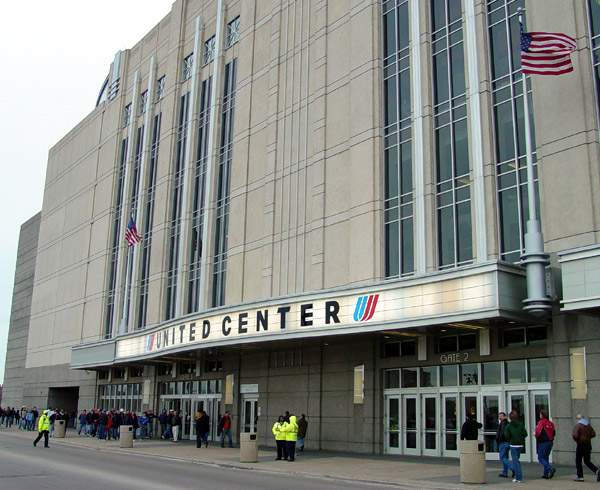
This coming Thursday, the New Jersey Devils face the Chicago Blackhawks, at the United Center in Chicago.
Hog Butcher for the World,
Tool Maker, Stacker of Wheat,
Player with Railroads and the Nation’s Freight Handler,
Stormy, husky, brawling,
City of the Big Shoulders:
They tell me you are wicked and I believe them, for I have seen your painted women under the gas lamps luring the farm boys.
And they tell me you are crooked and I answer: Yes, it is true I have seen the gunman kill and go free to kill again.
And they tell me you are brutal and my reply is: On the faces of women and children I have seen the marks of wanton hunger.
And having answered so I turn once more to those who sneer at this my city, and I give them back the sneer and say to them:
Come and show me another city with lifted head singing so proud to be alive and coarse and strong and cunning.
Flinging magnetic curses amid the toil of piling job on job, here is a tall bold slugger set vivid against the little soft cities;
Fierce as a dog with tongue lapping for action, cunning as a savage pitted against the wilderness,
Bareheaded, shoveling, wrecking, planning, building, breaking, rebuilding,
Under the smoke, dust all over his mouth, laughing with white teeth,
Under the terrible burden of destiny laughing as a young man laughs,
Laughing even as an ignorant fighter laughs who has never lost a battle,
Bragging and laughing that under his wrist is the pulse.
And under his ribs the heart of the people, laughing!
Laughing the stormy, husky, brawling laughter of Youth, half-naked, sweating, proud to be Hog Butcher, Tool Maker, Stacker of Wheat, Player with Railroads and Freight Handler to the Nation.
-- Carl Sandburg, 1916.
Sandburg knew. He was right then. He is still right now. And this legendary poem "Chicago" fits the Blackhawks, one of the National Hockey League's traditional "roughhouse" teams.
Before You Go. Chicago weather can be unpredictable. This game being played in mid-November, cold weather can be expected. However, the arena is 3 miles inland from Lake Michigan, so the local wind, a.k.a. The Hawk (not named for the hockey team), which tends to produce "Bear Weather," won't be that much of a problem while you're right outside.
The
Chicago Tribune is predicting temperatures to be in the low 40s during daylight, and the low 30s at night. They are not, however, predicting rain or snow. The
Chicago Sun-Times backs up its rivals' temperature predictions.
Wait until you cross into Illinois to change your clocks. Indiana used to be 1 of 2 States, Arizona being the other, where Daylight Savings Time was an issue; however, since 2006 -- 4 years after a
West Wing episode lampooned this -- the State has used it throughout. Once you cross into Illinois, you'll be moving from Eastern to Central Daylight Time.
Tickets. Like their co-tenants at the United Center, the Bulls, the Blackhawks led their league in per-game attendance last season: 21,826. Even now that the Cubs have finally won a World Series, the Hawks are the toughest ticket in town. Which, as you might guess, makes them expensive, more expensive than Bulls tickets. (Think of how silly that would have sounded in 1998, or even in 2009.)
Seats in the lower level, the 100 sections, are $215 between the goals and $155 behind them. In the club level, the 200 sections, they're $150 and $130. In the upper level, the 300 sections, they're $77 and $55. Standing-room tickets are $45.
I would, however, recommend avoiding Sections 321 to 330 in the upper deck, behind the west goal, because that's the Blackhawk equivalent of the 400 level, the old "Blue Seats," at Madison Square Garden.
Getting There. Chicago is 789 land miles from New York. Knowing this, your first reaction is going to be to fly out there.
Unlike some other Midwestern cities, this is a good idea if you can afford it. If you buy tickets online, and you're willing to fly out of LaGuardia, you can get them for under $200 -- nonstop and round-trip. If you'd prefer to use Newark, they'll cost twice as much, but $400 or so is still a huge bargain.
O'Hare International Airport (named for Lt. Cmdr. Edward "Butch" O'Hare, the U.S. Navy's 1st flying ace, who was nevertheless shot down over the Pacific in World War II), at the northwestern edge of the city, is United Airlines' headquarters, so nearly every flight they have from the New York area’s airports to there is nonstop, so it’ll be 3 hours, tarmac to tarmac, and about 2 hours going back.
The Chicago Transit Authority (CTA) Blue Line train will take you from O'Hare to the downtown elevated (or "L") tracks that run in "The Loop" (the borders of which are Randolph, Wells, Van Buren and Wabash Streets) in 45 minutes. From Midway Airport, the Orange Line train can get you to the Loop. Both should take about 45 minutes.
Bus? Greyhound's run between the 2 cities, launched 5 times per day, is relatively easy, but long, averaging about 18 hours, and is $114 round-trip -- but can drop to as low as $94 on Advanced Purchase. Only 1 of the 5 runs goes straight there without requiring you to change buses: The one leaving Port Authority Bus Terminal at 10:15 PM (Eastern) and arriving at Chicago at 2:30 PM (Central). This includes half-hour rest stops at Milesburg, Pennsylvania and Elkhart, Indiana, and an hour-and-a-half stopover in Cleveland.
The station is at 630 W. Harrison Street at Des Plaines Street. (If you’ve seen one of my favorite movies,
Midnight Run, this is a new station, not the one seen in that 1988 film.) The closest CTA stop is Clinton on the Blue Line, around the corner, underneath the elevated Dwight D. Eisenhower Expressway.
Train? Amtrak's
Lake Shore Limited (formerly known as the
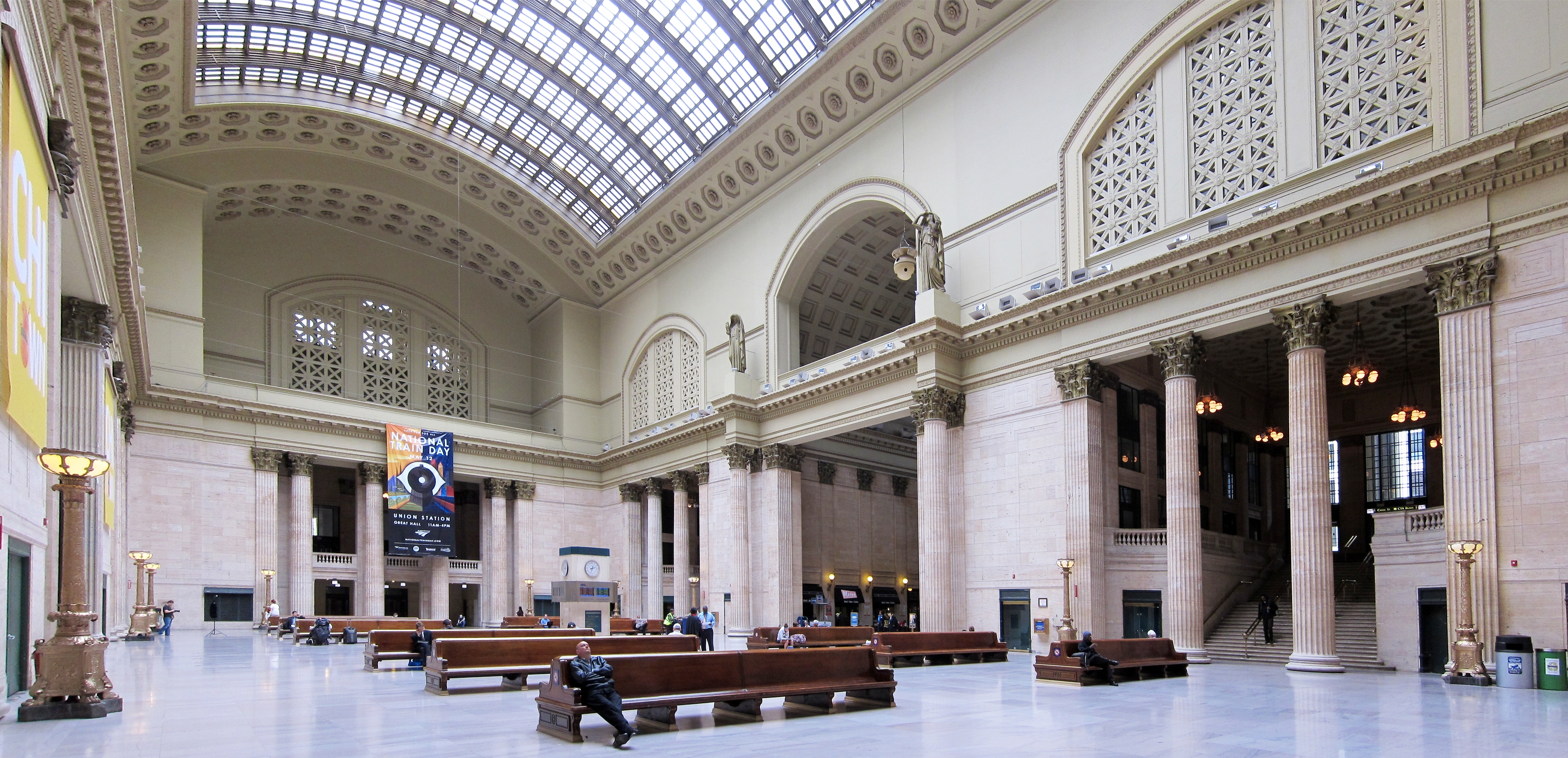
Twentieth Century Limited when the old New York Central Railroad ran it from Grand Central Terminal to Chicago's LaSalle Street Station) leaves New York's Penn Station at 3:40 every afternoon, and arrives at Union Station at 225 South Canal Street at Adams Street in Chicago at 9:45 every morning. It leaves Chicago at 9:30 every evening, and returns to New York at 6:23 the following night.
It's $170 round-trip, very cheap per mile by Amtrak standards. The closest CTA stop is Quincy/Wells, in the Loop, but that’s 6 blocks away – counting the Chicago River as a block; Union Station is, literally, out of the Loop.
If you do decide to walk from Union Station to the Loop, don't look up at the big black thing you pass. That's the Willis Tower, formerly known as the Sears Tower, which, until the new World Trade Center was topped off, was the tallest building in North America, which it had officially been since it opened in 1974, surpassing the old WTC. If there's one thing being in New York should have taught you, it’s this: "Don't look up at the tall buildings, or you'll look like a tourist."
But since you've come all this way, it makes sense to get a hotel, so take a cab from Union Station or Greyhound to the hotel – unless you’re flying in, in which case you can take the CTA train to within a block of a good hotel. There are also hotels near the airports.
If you decide to drive, it’s far enough that it will help to get someone to go with you and split the duties, and to trade off driving and sleeping. The directions are rather simple, down to (quite literally) the last mile. You'll need to get into New Jersey, and take Interstate 80 West. You'll be on I-80 for the vast majority of the trip, through New Jersey, Pennsylvania and Ohio. In Ohio, in the western suburbs of Cleveland, I-80 will merge with Interstate 90. From this point onward, you won’t need to think about I-80 until you head home; I-90 is now the key, and will take you right past Union Station the Loop.
If you do it right, you should spend about an hour and a half in New Jersey, 5 hours and 15 minutes in Pennsylvania, 4 hours in Ohio, 2 hours and 30 minutes in Indiana, and half an hour in Illinois before you reach the exit for your hotel. That’s 13 hours and 45 minutes. Counting rest stops, preferably halfway through Pennsylvania and just after you enter both Ohio and Indiana, and accounting for traffic in both New York and Chicago, it should be no more than 18 hours, which would save you time on both Greyhound and Amtrak, if not on flying.
Once In the City. A derivation of a Native American name, "Chikagu" was translated as "Place of the onion," as there were onion fields there before there was a white settlement. Some have suggested that the translation is a little off, that it should be "Place of the skunk." Others have said, either way, it means "Place of the big stink."
Founded in 1831, so by Northeastern standards it's a young city, Chicago's long-ago nickname of "the Second City" is no longer true, as its population has dropped, and Los Angeles' has risen, to the point where L.A. has passed it, and Chicago is now the 3rd-largest city in America. But at 2.7 million within the city limits, and 9.5 million in the metropolitan area, it's still a huge city -- and if you divide the Los Angeles market equally between the Kings and the Ducks, that makes Chicago the largest market in the NHL. If you count Anaheim separately, boosting the Kings' share, then Chicago falls to 2nd lace.
The "Loop" is the connected part of the Chicago Transit Authority (CTA)'s elevated railway (sometimes written as "El" or "L") downtown: Over Wells Street on the west, Van Buren Street on the south, Wabash Street on the east and State Street on the north. Inside the Loop, the east-west streets are Lake, Randolph, Washington, Madison, Monroe, Adams, Jackson and Van Buren; the north-south streets are Wells, LaSalle (Chicago's "Wall Street"), Clark, Dearborn, State and Wabash.
The city's street-address centerpoint is in the Loop, at State & Madison Streets. Madison separates North from South, while State separates East from West. The street grid is laid out so that every 800 on the house numbers is roughly 1 mile. As the United Center is at 1901 West Madison Street, and on the 3600 block of North Sheffield Avenue, now you know it's on the main east-west axis, and a little more than 2 miles west of State Street and the center of the Loop.
The CTA's rapid-rail system is both underground (subway) and above-ground (elevated), although the El is better-known, standing as a Chicago icon alongside the Sears Tower, Wrigley Field, Michael Jordan, deep-dish pizza, and less savory things like municipal corruption, Mrs. O'Leary's cow and Al Capone. The single-ride fare is $2.25, a 1-day pass is $10, a 3-day pass is $20, and a 7-day pass is $28.
(By the way, the Great Chicago Fire of 1871 was more likely the result of Mr. O'Leary hosting a poker game in his barn, in which he, or one of his friends, dropped cigar ash, rather than Mrs. O'Leary's cow, knocking a lantern, onto some hay.)
I was actually in Chicago on the day they switched from tokens to farecards: June 1, 1999. It took me by surprised, as I had saved 10 tokens from my previous visit. I was able to use them all, because I'd gotten there 2 days before.
Illinois' State sales tax is 6.25 percent, but in the City of Chicago it's 9.25 percent -- higher than New York's. So don't be shocked when you see prices: Like New York, Boston and Washington, Chicago is an expensive city.
ZIP Codes in the Chicago area start with the digits 60. The Area Code is 312, with 708 and 847 in the suburbs.
Chicago's legendary crime problem has evolved: It's no longer Al Capone-style gangs running things, it's poor kids with guns. So whatever precautions you take when you're in New York, take them in Chicago as well.
Going In. From 1929 to 1994, the NHL's Chicago Blackhawks played at Chicago Stadium, "the Madhouse on Madison," at 1800 W. Madison Street at Wood Street. The NBA's Bulls played there from 1967 to 1994.
The United Center opened across the street at 1901 W. Madison at Honore Street. Naming rights were bought by the O'Hare-based airline. The public transportation situation is a little tricky. You can take the CTA Blue Line to Illinois Medical District Station, and then walk 2 blocks up Ogden Avenue and 5 blocks up Wood Street. Or you can take the Green Line or the Pink Line (no joke: The CTA acutally does have a Pink Line) to Ashland, walk 4 blocks down Ashland Avenue, and then walk 3 blocks down Madison Street. The best way is to take the Number 20 bus, which goes right down Madison.
If you drive in, parking can be had for as little as $5.00. What you don't want to do is park outside of official lots. In a 1992 article, in advance of Chicago Stadium hosting the NBA and Stanley Cup Finals at the same time, a writer for
Sports Illustrated suggested that, due to their success having been more recent, Bulls fans were much more likely than Blackhawks fans to say, "I got a great parking space, over in those condos!" Those aren't condos: Those are West Side housing projects.
However you go in, you're least likely to enter from the west side (Damen Avenue). More likely, you'll go in from the north (Madison Street), east (Wood Street) or south (Monroe Street) side.
The United Center has hosted both the Blackhawks and the Bulls since the 1994-95 season, although, due to the 1994 NHL strike, it was January 1995 before the Hawks actually took their new ice for the 1st time. It is 1 of 10 arenas currently home to both an NBA team and an NHL team.
Each team has now won 6 World Championships, and each has won 3 since it moved in. The Bulls clinched at home in 1996 and 1997, the Blackhakws in 2015. At Chicago Stadium, the Blackhawks clinched at home in 1934 and 1938, the Bulls in 1992. The city's 1st NBA team, the Chicago Stags, played there from 1946 to 1950, and reached the 1st NBA Finals there in 1947.
The United Center has become Chicago's top venue for concerts and professional wrestling, and it hosted the 1996 Democratic Convention, at which President Bill Clinton was nominated for a 2nd term. It will host the NCAA Frozen Four this season, and hosts the annual Champions Classic, a college basketball season-opening tournament.
The rink is laid out east-to-west. The Blackhawks attack twice toward the west end.
The Democrats had their Convention at Chicago Stadium in 1932, '40 and '44, nominating Franklin D. Roosevelt each time; the Republicans also had their Convention there in '32 (renominating Hebert Hoover) and '44 (nominating Thomas E. Dewey).
Elvis Presley gave concerts at Chicago Stadium on June 16 and 17, 1972;
October 14 and 15, 1976; and May 1 and 2, 1977 -- meaning he was singing while
burglars were breaking into the Watergate complex in Washington, and while Chris Chambliss as hitting a Pennant-winning home run for the Yankees.
Food. As one of America’s greatest food cities, in Big Ten Country where tailgate parties are practically a sacrament, you would expect the Chicago sports venues to have lots of good options. The United Center lives up to this obligation.
The north side of the arena has DiGiorno pizza, a Captain Morgan/Don Julio cocktail bar, Madison Street Eats and a Ketel One cocktail bar. The east side has Chicago Dish pizza, Chicago Burger, and a Goose Island cocktail bar. The south side has Monroe Street Eats and a Smirnoff/Crown Royal cocktail bar. The west side has Leghorn Chicken, a Crown Royal Whiskey Bar and a Sweet Baby Rays barbecue stand. That's just on the 100 Level. The 300 Level has fewer theme stands, but quite a few of them, including Breakaway (in keeping with the hockey theme) and Fast Break (the basketball theme).
Team History Displays. The Blackhawks' banners are at the east, Wood Street, side of the building. The Blackhawks' banners are at the west, Damen Avenue, side.
Chicago Stadium in its Blackhawks setup
The Blackhawks have banners for their 6 Stanley Cups: 1934, 1938, 1961, 2010, 2013 and 2015. (Their 49-year drought seemed impossible to break, but for today's kids, it seems impossible to imagine.) They have 15 banners for Division titles (from 1970 to 2013 -- they won the Cup without winning their Division last season), 2 banners for President's Trophies (1991 and 2013), and 4 banners for Conference Championships (1992, 2010, 2013 and 2015). They do no have banners for pre-1992 seasons in which they reached the Stanley Cup Finals (1931, 1944, 1962, 1965, 1971 and 1973), unless they also won the Division in those years.
Obviously, this was taken before they won the 2015 Cup.
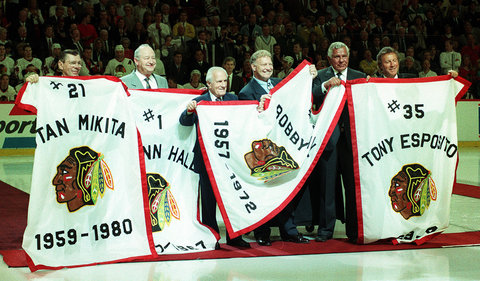
The Blackhawks have retired 6 numbers for 7 players. On October 19, 1980, the Hawks retired Number 21 for the recently retired center Stan Mikita, a member of their 1961 Cup winners. Due to a feud between left wing Bobby Hull and the team-owning Wirtz family, stemming from Hull's defection to the World Hockey Association in 1972, they hadn't retired Number 9 for "the Golden Jet." Dale Tallon, an All-Star defenseman, was acquired in 1973, and was given 9, and joked, "They forgot the decimal point." (Tallon is now the general manager of the Florida Panthers.) Hull and the Wirtzes patched things up, and his 9 was retired on December 18, 1983.
On November 20, 1988, the Hawks honored their 2 greatest goaltenders, retiring 1 for Glenn Hall (1961 Cup winners) and 35 for Tony Esposito (1971 and 1973 Cup Finalists). When the last regular-season game was played at Chicago Stadium in 1994, each man was given the banner for his number that had hung in the rafters, and was invited back the next season when new banners were raised to the roof at the United Center.
On March 19, 1998, the Hawks retired 18 for center Denis Savard (1992 Cup Finalists). On November 12, 2008, they retired 3 for a pair of defensemen: Keith Magnuson (1971 and 1973 Cup Finalists, killed in a car crash in 2003) and Pierre Pilote (1961 Cup winners, on hand for the ceremony).
The Hawks dedicated statues to Hull and Mikita on the east side of the United Center in 2012. A plaque with the words "Chicago Stadium - 1929–1994 - Remember The Roar" is located behind a statue of the Blackhawks greatest players on the north side of the United Center.
In 2001, a 75th Anniversary Team was named:
* From the 1934 and 1938 Cup winners: Only right wing Harold "Mush" March. Goaltender Charlie Gardiner, and defensemen Lionel Conacher, Art Coulter and Earl Seibert (there in '38 but not in '34), Hall-of-Famers all, were not selected. Neither were should-be-Hall-of-Famers defenseman Taffy Abel and left wings Paul Thompson and Johnny Gottselig. Owner Frederic McLaughlin is also in the Hall.
* From the 1944 Cup Finalists: No one. McLaughlin and Seibert were holdovers. The Bentley brothers, left wing Doug and center Max, played on this team, and were elected to the Hall of Fame. So was right wing Bill Mosienko, famous for his record achievement of scoring 3 goals in 21 seconds in a 1952 game. Defenseman John Mariucci is in the Hall of Fame, but for coaching at the University of Minnesota. Left wing Roy Conacher (Lionel's brother, and also brother of Toronto Hall-of-Famer Charlie) and defenseman Bill Gadsby played for the Hawks in the late 1940s and early '50s, and made the Hall of Fame.
* From the 1961 Cup winners: Hull, Hall, Pilote and Mikita. They, owner Art Wirtz, head coach Rudy Pilous, head coach Tommy Ivan, and defenseman Al Arbour were elected to the Hall. It should be noted that, while Arbour was an All-Star, he was elected for what he did as Islanders coach.
* From the 1971 and 1973 Finalists, but not the '61 Cup winners: Esposito, Magnuson, and left wing Dennis Hull, Bobby's brother, a.k.a. the Silver Jet. Esposito is in the Hall of Fame.
* From between the 1973 and 1992 Finalists: Savard; Defensemen Doug Wilson, Pat Stapleton and Bill White; and left wing Al Secord. Savard and 1980s head coach Bob Pulford are in the Hall of Fame.
* From the 1992 Finalists: Goaltender Ed Belfour, defenseman Chris Chelios, center Jeremy Roenick, and right wing Steve Larmer. Chelios, Belfour, Dominik Hasek (then Belfour's backup, so not elected for what he did in Chicago), left wing Michel Goulet, and owner Bill Wirtz are in the Hall of Fame.
* Right wing Tony Amonte was with the Hawks at the time of the 2001 vote. Obviously, no one from the 3 recent Cups was selected.
Gardiner, Hull, Hall, Mikita, Esposito, Chelios, 1938 Cup hero Earl Seibert, 1940s star brothers Max and Doug Bentley, and 1950s star Bill Gadsby were named to
The Hockey News' 100 Greatest Players in 1998. Stapleton, who also played for the Chicago Cougars of the World Hockey Association, was named to the WHA's All-Time Team.
Gardiner and Conacher were named to the NHL All-Star Team that opposed the host Toronto Maple Leafs in the Ace Bailey Benefit Game in 1934. Gottselig and Marsh were named to the team that opposed a combined Canadiens and Maroons team in the Howie Morenz Memorial Game at the Montreal Forum in 1937. Gottselig and Seibert -- note the difference in the spelling, they were not related -- played for the team that faced the Canadiens in the Babe Siebert Memorial Game at the Forum in 1939.
The Bentley brothers and Bill Mosienko -- best known for his 1952 feat of scoring 3 goals in a span of 21 seconds against the Rangers -- were on the team that faced the defending Champion Leafs in the 1st official NHL All-Star Game in 1947. Dave Christian and Jack O'Callahan of the 1980 U.S. Olympic team went on to play for the Blackhawks. Esposito, Mikita, Stapleton, White and Dennis Hull were named to the Team Canada that faced the Soviets in the 1972 Summit Series. Bobby was not: It was only open to NHL players, and he had just jumped to the WHA. As a result of not being selected for that Team Canada, Canada's Walk of Fame is an honor that Dennis -- as well as Mikita, Stapleton, White, Esposito and his brother Phil Esposito, a Blackhawk at the beginning of his career -- has received, but Bobby hasn't.
Hull, Mikita, Pulford, Ivan, Mariucci, and former owners James D. Norris, and Art and Bill Wirtz all received the Lester Patrick Trophy, for contributions to hockey in America. Lloyd Pettit and Pat Foley have received the Foster Hewitt Memorial Award, considered election to the Hockey Hall of Fame for broadcasters.
UPDATE: Max Bentley, Hall, Hull, Mikita, Esposito, Savard, Chelios, and current Blackhawks Jonathan Toews, Patrick Kane and Duncan Keith were named to the NHL's 100th Anniversary 100 Greatest Players in 2017.
Stuff. The Blackhawks Store and the Bull Market -- 2 sides of a large store -- are on the lower level of the arena's west end. They may sell Indian headdresses and foam tomahawks, in keeping with the "Blackhawk" image.
Chicago is a great literary city, and while the Cubs have been seen as the city's most romantic sports, there have been some good books about the Blackhawks. George Vass wrote
The Chicago Black Hawks Story in 1970. (Until 1986, when the team's original charter was found, and the name of it was found to be written as one word, "Blackhawks," it was usually written as two words, "Black Hawks." This made sense, as the team was named after Chief Black Hawk, the early 19th Century leader of Native American tribes in the Midwest.)
Chicago Tribune columnist Bob Verdi and former head coach Billy Reay collaborated on
Chicago Blackhawks: Seventy-Five Years in 2000 (a little early).
Lew Freedman recently published Chicago's Big Teams: Great Moments of the Cubs, Bears, White Sox, Blackhawks and Bulls.
DVD packages should be available for the 2010, 2013 and 2015 Cup wins.
During the Game. A November 19,2014 article on The Hockey News' website ranked the NHL teams' fan bases, and listed the Blackhawks' fans as 2nd: "Hawks fans are boisterous and publicly supportive. Spoiled with wins, though."
Nevertheless, they still came out 20,000 strong during that long stretch from their Conference Finals berth of 1995 until 2007, when longtime cheapskate owner William Wadsworth "Bill" Wirtz died and his son William Rockwell "Rocky" Wirtz took over and rebuilt the team. This was a time when the Hawks were barely even relevant: Only the low level of support for soccer and thus for the Chicago Fire, and for women's basketball and thus for the Chicago Sky, kept them from being the 5th team in a 5-team town; instead, they were 5th out of 7, behind the Bears, Cubs, Bulls and White Sox.
The United Center is on the West Side, but the well-policed parking lots should buffer you from neighborhood crime. Chicago fans can get a bit rough, and they do like to drink. However, if you don't antagonize them, they will probably give you no worse than a bit of verbal.
This Thursday night's game against the Devils is Blackhawks Goal Light Ornament Night. They'll be giving away a Christmas tree ornament in the form of a goal whose red light with blink, as if a goal has been scored.
Wayne Messmer, former Cubs public address announcer, used to sing the National Anthem for both the Cubs and the Blackhawks. But when he became part-owner of the minor-league Chicago Wolves, the Hawks dropped him. Jim Corneilson has sung the Anthem for both the Blackhawks and the Bulls since 2008.
The Blackhawks' mascot is Tommy Hawk (as opposed to "tomahawk"), a black hawk wearing the 4 feathers shown on the team's logo, in colors red, green, yellow and orange.
The main chant for Blackhawks fans is "Let's go, Hawks!" -- definitely not, "Let's go, Blackhawks! (Clap, clap, clap-clap-clap)," because, to a Chicagoan, it sounds too much like, "Let's go, Red Wings!" Wings vs. Colorado Avalanche was never a real rivalry: Wings vs. Hawks has been going on since 1926. However, unlike us, and Islanders fans, with our "Rangers suck!" chant (and our addition of "Flyers swallow!"), they only use "Dee-troit sucks!" when they're playing the Wings. Otherwise, they put that chant away.
The goal song is "Chelsea Dagger" by The Fratellis: "Dip-diddle-ip-diddle-ip... " And their victory song is the Notorious B.I.G.'s "Old Thing Back." A little touch of our Tri-State Area on Chicago's West Side.
After the Game. The neighborhood should be safe after a day game, but after a night game, with all that extra time to drink, it can get a little dodgy. As I said, leave them alone, and they'll probably leave you alone.
As I said, the parking lots are a buffer zone against the dodgy neighborhood, but also put distance between the arena and any bars or restaurants worth going to: None are in the vicinity.
If you want to be around other New Yorkers and New Jerseyans, I found listings of 4 Chicago bars where New York Giants fans gather: Red Ivy, just south of Wrigley Field at 3519 N. Clark Street at Eddy Street; The Bad Dog Tavern, 4535 N. Lincoln Avenue at Wilson Avenue (Brown Line to Western); Racine Plumbing Bar and Grill, 2642 N. Lincoln Avenue at Kenmore; and Trinity, at 2721 N. Halsted Street at Diversey Parkway (Brown or Purple Line to Diversey for either Racine or Trinity). Racine Plumbing is also listed as the local bar for Mets and Notre Dame fans.
And I found these 3 which show Jets games: Rebel Bar & Grill, also just south of Wrigley, at 3462 N. Clark at Cornelia Avenue; Wabash Tap, 1233 S. Wabash Avenue (Red Line to Roosevelt); and Butch McGuire's, 20 W. Division Street at Dearborn Street (Red Line to Clark/Division).
Note that, with the exception of Wabash Tap, all of these are a lot closer to Wrigley than to the United Center. But there are plenty of good places in the city to get a postgame meal, or just a pint.
If your visit to Chicago is during the European soccer season (which were are now in), the best place to watch your favorite club is at The Globe Pub, 1934 W. Irving Park Rd., about 6 miles northwest of The Loop. Brown Line to Irving Park.
Sidelights. Chicago is one of the best sports cities, not just in America, but on the planet. Check out the following – but do it in daylight, as the city’s reputation for crime, while significantly reduced from its 1980s peak, is still there. For my thoughts on Wrigley Field, check out my post on the subject.
* Wrigley Field. Built in 1914 for the Chicago Whales of the Federal League, and home of the Cubs since 1916, it is by far the oldest ballpark in the National League, and only Fenway Park in Boston is older among North American major league sports venues.
The Cubs have never won the World Series here, but won 6 Pennants between 1918 and 1945 -- and none since. They've made the Playoffs 7 times in the last 32 seasons (including this year), which is better than some teams have done over that stretch -- but no Pennants. The Bears played here from 1921 to 1970, and won 8 NFL Championships between 1921 and 1963. It hosted the NHL Winter Classic in 2009, with the Hawks losing to the Wings. Wrigley (still known as Cubs Park) was also home of the Chicago Tigers, who played in the NFL only in its 1st season, 1920.
If you go, don't watch a game from one of the rooftops on Waveland (left field) or Sheffield (right field) Avenues. What's the point of watching a game
at Wrigley Field if you're not
in Wrigley Field? 1060 W. Addison Street at Clark Street. Red Line to Addison.
* Guaranteed Rate Field. Home of the White Sox since 1991, and originally named the new Comiskey Park and later U.S. Cellular Field, they've made the Playoffs 4 times since, including winning the 2005 World Series. 333 W. 35th Street at Shields Avenue (a.k.a. Bill Veeck Drive), off the Dan Ryan Expressway. Red Line to Sox-35th.
* Site of old Comiskey Park. The longtime home of the White Sox, 1910 to 1990, was across the street from the new one, at 324 W. 35th Street, is now a parking lot, with its infield painted in. This was the home field of Big Ed Walsh (the pitcher supposedly helped design it to be a pitchers' park), Eddie Collins, Shoeless Joe Jackson and the rest of the "Black Sox," Luke Appling, the great double-play combination of Luis Aparicio and Nellie Fox of the '59 "Go-Go White Sox," Dick Allen, the 1977 "South Side Hit Men" of Richie Zisk and Oscar Gamble, and the 1983 Division Champions of Carlton Fisk, Ron Kittle, LaMarr Hoyt and Harold Baines.
The old Comiskey was also where future Yankee stars Russell "Bucky" Dent and Rich "Goose" Gossage began their careers, and where, in the last game the Yankees ever played there, Andy Hawkins pitched a no-hitter – and lost, thanks to his own walks and 3 errors in the 8th inning.
The NFL's Chicago Cardinals played there from 1922 to 1959, and the franchise, now the Arizona Cardinals, won what remains their only NFL Championship Game (they didn't call 'em Super Bowls back then) there in 1947. And in 1979, during what was supposed to be intermission between games of a White Sox vs. Tigers doubleheader, was Disco Demolition Night. Today, it's called a fiasco, but the sentiment was right: Disco really did suck. But the biggest music event there was the Beatles' concert on August 20, 1965.
* Previous Chicago ballparks. The Cubs previously played at these parks:
State Street Grounds, also called 23rd Street Grounds, 1874-77, winning the NL’s first Pennant in 1876, 23rd, State, and Federal Streets & Cermak Road (formerly 22nd Street), Red Line to Cermak-Chinatown.
Lakefront Park, also called Union Base-Ball Grounds and White-Stocking Park (the Cubs used the name “Chicago White Stockings” until 1900, and the AL entry then took the name), 1878-84, winning the 1880, ’81 and ’82 Pennants, Michigan Avenue & Randolph Street in the northwest corner of what’s now Millennium Park, with (appropriately) Wrigley Square built on the precise site. Randolph/Wabash or Madison/Wabash stops on the Loop.
West Side Park I, 1885-91, winning the 1885 and ’86 Pennants, at Congress, Loomis, Harrison & Throop Streets, now part of the campus of the University of Illinois at Chicago (UIC), Blue Line to Racine.
South Side Park, 1891-93, just east of where the Comiskey Parks were built.
West Side Park II, 1893-1915, winning the 1906 and 1910 Pennants and the 1907 and 1908 World Series, the only World Series the Cubs have ever won, at Taylor, Wood and Polk Streets and Wolcott Avenue, now the site of a medical campus that includes the Cook County Hospital, the basis for the TV show ER, Pink Line to Polk. (Yes, the CTA has a Pink Line.)
Prior to the original Comiskey Park, the White Sox played at a different building called South Side Park, at 39th Street (now Pershing Road), 38th Street, & Wentworth and Princeton Avenues, a few blocks south of the Comiskey Parks.
* Soldier Field. The original version of this legendary stadium opened in 1924, and for years was best known as the site of the Chicago College All-Star Game (a team of graduating seniors playing the defending NFL Champions) from 1934 to 1976.
It was the site of the 1927 heavyweight title fight between Jack Dempsey and Gene Tunney, the famed "Long Count" fight, which may have had what remains the greatest attendance ever for a U.S. sporting event, with figures ranging from 104,000 to 130,000, depending on who you believe. It definitely was the site of the largest football crowd ever, 123,000 to see Notre Dame play USC a few weeks after the Long Count. In spite of various expansions, the universities of Michigan and Tennessee and Penn State still can't top this. The 1926 Army-Navy Game was played there, in front of over 100,000.
The Chicago Rockets of the All-America Football Conference played at Soldier Field in 1946, '47 and '48, changing their name to the Chicago Hornets in '49. They were not admitted into the NFL with their AAFC brethren in Cleveland, San Francisco and Baltimore.
Games of the 1994 World Cup and the 1999 Women's World Cup, were also held at the old Soldier Field. MLS' Chicago Fire made it their 1st home ground, winning the MLS Cup in 1998; and 14 matches of the U.S. soccer team have been played on the site, most recently a 2016 win over Costa Rica. The U.S. has won 7 of these games, lost 4 and tied 3. An NHL Stadium Series game was played there earlier this year, with the Blackhawks beating the Pittsburgh Penguins 5-1.
Amazingly, the Bears played at Wrigley from 1921 to 1970, with the occasional single-game exception. The story I heard is that Bears founder-owner-coach George Halas was a good friend of both the Wrigley and Veeck families, and felt loyalty to them, and that’s why he stayed at Wrigley even though it had just 47,000 seats for football. But I heard another story that Halas was a Republican and didn’t like Chicago’s Democratic Mayor, Richard J. Daley (whose son Richard M. recently left office having broken his father’s record for longest-serving Mayor), and didn’t want to pay the city Parks Department a lot of rent. (This is believable, because Halas was known to be cheap: Mike Ditka, who nonetheless loved his old boss, said, “Halas throws nickels around like manhole covers.”) The real reason the Bears moved to Soldier Field in 1971 was
Monday Night Football: Halas wanted the revenue, and Wrigley didn’t have lights until 1988.
A 2002-03 renovation demolished all but the iconic (but not Ionic, they're in the Doric style) Greek-style columns that used to hang over the stadium, and are now visible only from the outside. It doesn’t look like “Soldier Field” anymore: One critic called it The Eyesore on the Lake Shore.
Capacity is now roughly what it was in the last few years prior to the renovation, 61,500. And while the Bears won 8 Championships while playing at Wrigley, they’ve only won one more at Soldier Field, the 1985 title capped by Super Bowl XX. The Monsters of the Midway have been tremendous underachievers since leaving Wrigley, having been to only 1 of the last 28 Super Bowls (and losing it).
1410 S. Museum Campus Drive, at McFetridge and Lake Shore Drives, a bit of a walk from the closest station, Roosevelt station on the Green, Orange and Red Lines.
* Site of Chicago Coliseum. There were 2 buildings with this name that you should know about. One hosted the 1896 Democratic National Convention, where William Jennings Bryan began the process of turning the Democratic Party from the conservative party it had been since before the Civil War into the modern liberal party it became, a struggle that went through the Woodrow Wilson and Franklin Roosevelt years before it finally lived up to its promise under John F. Kennedy and Lyndon Johnson.
It was here that Bryan gave the speech for which he is most remembered, calling for the free coinage of silver rather than sticking solely to the gold standard: "You shall not press down upon the brow of labor this crown of thorns. You shall not crucify mankind upon a cross of gold."
Now a part of Jackson Park, at 63rd Street & Stony Island Avenue. 63rd Street Metra (commuter rail) station.
The other was home to every Republican Convention from 1904 to 1920. Here, they nominated Theodore Roosevelt in 1904, William Howard Taft in 1908 and 1912, Charles Evans Hughes in 1916 and Warren Harding in 1920. When TR was maneuvered out of the nomination to return to office at the 1912 Convention, he held his subsequent Progressive Party Convention was also held there.
It was also the original home of the Blackhawks, from 1926 to 1929 and briefly again in 1932. In 1935, roller derby was invented there. In 1961, an NBA expansion team, the Chicago Packers, played there, becoming the Zephyrs in 1962 and moving to become the Baltimore Bullets in 1963 (and the Washington Bullets in 1973, and the Washington Wizards in 1997).
The Coliseum hosted a few rock concerts before the Fire Department shut it down in 1971, and it was demolished in 1982. The Soka Gakkai USA Culture Center, a Buddhist institute, now occupies the site. East side of Wabash Avenue at 15th Street, with today’s Coliseum Park across the street. Appropriately enough, the nearest CTA stop is at Roosevelt Avenue, on the Red, Yellow and Green Lines.
* Site of International Amphitheatre. Home to the Bulls in their first season, 1966-67, and to the World Hockey Association’s Chicago Cougars from 1972 to 1975, this arena, built by the stockyards in 1934, was home to a lot of big pro wrestling cards. Elvis sang here on March 28, 1957. The Beatles played here on September 5, 1964 and August 12, 1966.
But it was best known as a site for political conventions. Both parties met there in 1952 (the Republicans nominating Dwight D. Eisenhower, the Democrats nominating their host, Governor Adlai Stevenson of Illinois), the Democrats in 1956 (Stevenson again), the Republicans in 1960 (Richard Nixon), and, most infamously, the Democrats in 1968 (Hubert Humphrey), with all the protests. The main protests for that convention were in Grant Park and a few blocks away on Michigan Avenue in front of the Conrad Hilton Hotel, one of the convention headquarters (now the Chicago Hilton & Towers. 720 S. Michigan).
The Amphitheatre, torn down in 1999, was at 4220 S. Halsted Street, where an Aramark plant now stands. Red Line to 47th Street. This location is definitely not to be visited after dark; indeed, unless you’re really interested in political history, I’d say, if you have to drop one item from this list, this is the one.
Elvis also sang in Illinois at Assembly Hall at the
University of Illinois in Champaign on October 22, 1976, and at Southern Illinois
University Arena in Carbondale on October 27.
* Northwestern University. Chicago's Big Ten school is just north of the city, 16 miles from the Loop, in Evanston. Dyche Stadium/Ryan Field, and McGaw Hall/Welsh-Ryan Arena, are at 2705 Ashland Avenue between Central Street and Isabella Street. (Purple Line to Central.)
While Northwestern's athletic teams have traditionally been terrible, the school has a very important place in sports history: The 1st NCAA basketball tournament championship game was held there in 1939, at Patten Gymnasium, at 2145 Sheridan Road: Oregon defeated Ohio State. The original Patten Gym was torn down a year later -- don't be too hard on them, no one had any idea how important this historical distinction would become -- and the school's Technological Institute was built on the site. Sheridan Road, Noyes Street and Campus Drive. Purple Line to Noyes.
Welsh-Ryan, under the McGaw name, hosted the Final Four in 1956: Bill Russell and K.C. Jones, soon to be Boston Celtics stars, led the University of San Francisco past Iowa. These are the only 2 Final Fours ever to be held in the Chicago area.
The University of Illinois is in Champaign, 137 miles south on Interstate 57.
* Toyota Park. MLS' Chicago Fire have played here since 2006. The U.S. soccer team has played here once, a 2008 win over Trinidad & Tobago. 7000 S. Harlem Avenue, Bridgeview, in the southwestern suburbs. Orange Line to Midway Airport, then transfer to the 379 or 390 bus.
* Allstate Arena. Known from its 1980 opening until 1999 as the Rosemont Horizon, this 17,500-seat area was built as a modern (for the time) suburban alternative to the ghetto-ridden Chicago Stadium. It became Chicagoland's premier site for NCAA Tournament basketball, rock concerts, "professional wrestling" and the Ringling Brothers Barnum & Bailey Circus.
Mostly, it's known as the home court for DePaul University basketball, and the playing surface is named the Ray and Marge Meyer Court for the coaching legend and his wife. It's also been home to the WNBA's Chicago Sky, minor-league hockey's Chicago Wolves, and Arena Football's Chicago Rush, winners of the 2006 ArenaBowl and hosts of the game in 1988. (The Rush, named for the city's Rush Street nightclub district, suspended operations in 2013, and are currently listed as dormant rather than folded.)
6920 N. Mannheim Road at Lunt Avenue, 18 miles northwest of the Loop, across I-90 from O'Hare Airport. Possible to reach by public transportation, but not really worth it: If you're pressed for time, and need to cross some items off your list, this should be one of them.
* DePaul University. Led by legendary coach Ray Meyer, and then his son Joey Meyer, the basketball team at this "mid-major" Catholic school has featured eventual pro stars George Mikan, Bill Robinzine, Mark Aguirre, Terry Cummings, Dallas Comegys, Quentin Richardson and Rod Strickland.
The Blue Demons' longtime home court was Alumni Hall, until 1979. It was demolished in 2000, and DePaul's new student center was built on the site. 1011 W. Belden Avenue. Red Line to Fullerton. Starting in 1980, they moved out to the aforementioned Allstate Arena. In the Autumn of 2017, they'll move into the new Wintrust Arena, at the McCormick Place Convention Center. 2201 S. Indiana Avenue, at Cermak Road. Green Line to Cermak-McCormick Place.
* National Italian-American Sports Hall of Fame. Appropriately in Chicago's Little Italy, west of downtown, it includes a state uf Yankee legend Joe DiMaggio. Other New York native or playing baseball players honored include Joe Torre, Yogi Berra, Phil Rizzuto, Billy Martin, Vic Raschi, Tony Lazzeri, Dave Righetti, Frank Crosetti, Roy Campanella, Sal Maglie, Mike Piazza, Bobby Valentine, John Franco, Carl Furillo, Frank Viola, Jim Fregosi, Ralph Branca, Rocky Colavito, broadcaster Joe Garagiola, and the last active player to have been a Brooklyn Dodger, Bob Aspromonte, and his brother Ken Aspromonte. 1431 W. Taylor Street at Loomis Street. Pink Line to Polk.
* Museums. Chicago's got a bunch of good ones, as you would expect in a city of 3 million people. Their version of New York’s Museum of Natural History is the Field Museum, just north of Soldier Field. Adjacent is the Shedd Aquarium. On the other side of the Aquarium is their answer to the Hayden Planetarium, the Adler Planetarium.
They have a fantastic museum for which there is no real analogue in New York, though the Franklin Institute in Philadelphia is similar: The Museum of Science & Industry, at 57th Street & Cornell Drive, near the University of Chicago campus; 56th Street Metra station. The Art Institute of Chicago is their version of the Metropolitan Museum of Art, at 111 S. Michigan Avenue, just off the Loop.
*
Ferris Bueller's Day Off. If you're a fan of that movie, as I am (see
my 25th Anniversary retrospective, from June 2011), not only will you have taken in Wrigley Field, but you’ll recognize the Art Institute as where Alan Ruck focused on Georges Seurat’s painting
A Sunday Afternoon on the Island of La Grande Jatte.
Other sites visited by Ferris, Cameron and Sloane were the Sears Tower, then the tallest building in the world, 1,454 feet, 233 S. Wacker Drive (yes, the name is Wacker), Quincy/Wells station in the Loop; and the Chicago Mercantile Exchange, 335 S. La Salle Street, LaSalle/Van Buren station in the Loop. (That station is also where Steve Martin & John Candy finally reached Chicago in another John Hughes film,
Planes, Trains and Automobiles). The von Steuben Day Parade goes down Lincoln Avenue every September, on or close to the anniversary of Baron von Steuben's birth, not in the spring as in the film.
While the Bueller house was in Long Beach, California, the Frye house is in Highland Park, north of the city. Remember, it’s a private residence, and not open to the public, so I won’t provide the address. And the restaurant, Chez Quis, did not and does not exist.
Nor did, nor does, Adam's Ribs, a barbecue joint made famous in a 1974
M*A*S*H episode of the same title. Today, there are 18 restaurants in America named Adam's Ribs, including two on Long Island, on Park Boulevard in Massapequa Park and on the Montauk Highway in Babylon; and another on Cookstown-Wrightstown Road outside South Jersey's Fort Dix and McGuire Air Force Base. But only one is anywhere near Chicago, in Buffalo Grove in the northwestern suburbs.
Not far from that, in the western suburbs, is Wheaton, home town of football legend Red Grange and the comedic Belushi Brothers, John and Jim. John and Dan Aykroyd used Wrigley Field in
The Blues Brothers, and Jim played an obsessive Cubs fan in
Taking Care of Business. Their father, an Albanian immigrant, ran a restaurant called The Olympia Cafe, which became half the basis for John's
Saturday Night Live sketch of the same name, better known as the Cheeseburger Sketch: "No hamburger! Cheeseburger, cheeseburger, cheeseburger, cheeseburger, cheeseburger... No fries, chips!... No Coke, Pepsi!"
Don Novello, an
SNL writer who played Father Guido Sarducci, said the other half of the inspiration was the Billy Goat Tavern, originally operated by Greek immigrant William "Billy Goat" Sianis, originator of the supposed Billy Goat Curse on the Cubs, across Madison Street from Chicago Stadium, from 1937 until 1963. At that point, Sianis moved to the lower deck of the double-decked Michigan Avenue, since it was near the headquarters of the city's three daily newspapers, the
Tribune, the
Sun-Times, and the now-defunct
Daily News. Mike Royko, who wrote columns for each of these papers, made it his haunt and frequently mentioned it in his columns.
Novello and Bill Murray, Chicagoans, were regulars at the Billy Goat, but John Belushi later said he'd never set foot in the place, so while the others may have drawn inspiration from it, his came from his father's restaurant.
Sam Sianis, nephew of the original Billy, still serves up a fantastic cheeseburger (he was there when I visited in 1999), he deviates from the sketch: No Pepsi, Coke. It's open for breakfast, and serves regular breakfast food. It looks foreboding, being underneath the elevated part of Michigan Avenue, and a sign out front (and on their website) says, "Enter at your own risk." But another sign says, "Butt in anytime." 430 N. Michigan Avenue, lower deck, across from the Tribune Tower. Red Line to Grand. The original location near Chicago Stadium has effectively been replaced, at 1535 W. Madison Street.
The Tribune Tower is a work of art in itself. Its building,
Tribune publisher "Colonel" Robert R. McCormick, had stones taken from various famous structures all over the world: The Palace of Westminster in London, the Western Wall in Jerusalem, the Taj Mahal, the Great Wall of China, the Grand Canyon. (He must've paid a lot of people off.) These can be seen at near ground level, but the building itself is so grand that it doesn't need it.
The building is also the headquarters of the TV and radio station that McCormick named for his paper: WGN, "The World's Greatest Newspaper," a line that has long since disappeared from the paper's masthead. 435 N. Michigan Avenue. Red Line to Grand.
The Wrigley Building is right across from it, at 400 N. Michigan. The block of North Michigan they're on is renamed Jack Brickhouse Way, and Brickhouse's statue is on the grounds of the Tribune Tower.
You may notice some other film landmarks. The Chicago Board of Trade Building was used as the Wayne Tower in Christopher Nolan's Batman films. And Chicago stood in for Metropolis in the Superman-themed TV series
Lois & Clark, with the Wrigley Building and the Tribune Tower as standout landmarks.
TV shows set in Chicago include
The Untouchables, about Eliot Ness and his Depression-era crimebusters;
Good Times, set in the infamous, now-demolished Cabrini-Green housing project; the related sitcoms
Perfect Strangers and
Family Matters (Great shows? Well, of course, they were, don't be ridiculous!);
Married... with Children, Fox's longest-running non-cartoon (though the Bundy family was pretty darn cartoonish); the 1990s hospital dramas
ER and
Chicago Hope;
Boss, the current show with Kelsey Grammer as a corrupt Mayor; and
The Bob Newhart Show, with Bob as psychiatrist Dr. Bob Hartley.
Nearly every one of these shows was actually filmed in Los Angeles, and the exterior shots were also mostly L.A. sites, so don't bother going to look for them. However, a statue of Newhart is at the Navy Pier, near its amusement rides, between Grand Avenue & Illinois Street at the lake.
* Quad Cities. Rock Island and Moline, Illinois, and Davenport and Bettendorf, Iowa, are, together, known as the Quad Cities. Together, these cities and adjoining smaller towns have a population of about 475,000. (Davenport about 100,000, Moline 44,000, Rock Island 39,000 and Bettendorf 35,000). Not big enough to be major league -- but some people tried.
The 5,000-seat Douglas Park was the home of the Rock Island Independents from 1907 to 1925, including 1920 to 1925 in the NFL. In fact, it was the site of the 1st NFL game, on October 3, 1920, a 45-0 Indys win over the Indiana-based Muncie Flyers. It was also home to a minor-league baseball team, the Rock Island Islanders, from 1907 to 1937, winning Class D Pennants in 1907, 1909 and 1932. West side of 10th Street between 15th and 18th Avenues in Rock Island, 180 miles west of Chicago.
One of the oldest surviving pro basketball teams is the Atlanta Hawks. They began as the Tri-Cities Blackhawks (they dropped Bettendorf from the "Quad Cities" description) in 1946. They weren't very good, and moved to Milwaukee in 1951, St. Louis in 1955, and Atlanta in 1968. They played at the 6,000-seat Wharton Field House, which opened in 1928 and still stands. 1800 20th Avenue.
There is a minor-league baseball team in the Quad Cities, but it's been known by various names since its inception in 1879 as the Davenport Brown Stockings. They've won 10 Pennants, previously in Class B, and in what's now Class A: In 1914, 1933 and 1936 as the Davenport Blue Sox; in 1949 as the Davenport Pirates; in 1968 and 1971 as the Quad City Angels; In 1979 as the Quad City Cubs; in 1990 again as the Quad City Angels; and in 2011 and 2013 under their current name, the Quad Cities River Bandits.
Since 1931, they have played at a stadium right on the Mississippi River, which proved a problem during the 1993 flood. The 4,024-seat ballpark was known as Municipal Stadium until 1971, then as John O'Donnell Stadium until 2008, when it became Modern Woodmen Park, as the fraternal organization bought naming rights. 209 S. Gaines Street in Davenport.
No President has ever come from Chicago, and none has a Presidential Library anywhere near it --Abraham Lincoln's is 200 miles away, in the State capital of Springfield -- although many have Presidential connections. Most notably, the 1st true Presidential Debate, between John F. Kennedy and Richard Nixon, was held on September 26, 1960, at the old CBS Studio, home to WBBM, 780 on your AM dial and Channel 2 on your TV. 630 N. McClurg Street. The building is no longer there. Red Line to Grand, then an 8-minute walk.
In the early days of American politics, any temporary meeting structure was called a "Wigwam," which is a Native American word for a temporary dwelling. Chicago's 1st Wigwam was at what is now 191 N. Upper Wacker Drive, right where the Chicago River splits into north and south branches. Abraham Lincoln was nominated there at their 1860 Convention. A modern office building is on the site today. Clark/Lake station in the Loop.
Another Wigwam stood at 205 East Randolph Street, in what was then called Lake Park, now Grant Park. The Democrats held their Convention there in 1892, nominating Grover Cleveland for the 3rd time. The Harris Theater is on the site today. Randolph/Wabash station in the Loop.
In 1864, the Democrats nominated General George B. McClellan at The Amphitheatre, 1100 South Michigan Avenue. A Best Western Hotel is on the site today. Red Line to Roosevelt. In 1868, the Republicans nominated Ulysses S. Grant at Crosby’s Opera House, 1 West Washington Street. A modern office building is on the site today. Blue Line to Washington.
The Interstate Industrial Exposition Building, a.k.a. the Glass Palace, was where the Republicans met and nominated James Garfield in 1880, and both parties met in 1884, the Republicans nominating James G. Blaine and the Democrats nominating Cleveland for the 1st time. 111 South Michigan Avenue. The aforementioned Art Institute of Chicago is on the site today. Adams/Wabash station in the Loop. And in 1888, the Republicans met at the Auditorium Building, 430 South Michigan Avenue. It still stands. Harold Washington Library station, a.k.a. State-Van Buren station, in the Loop.
*
Every American should visit Chicago. And with the Blackhawks having won 3 of the last 6 Stanley Cups, a visit to the United Center can be an epic experience. Have fun -- but remember, be smart, and don't go out of your way to antagonize anyone.




.jpg)