Sunday, July 2, 2017

How to be a Met Fan In St. Louis -- 2017 Edition

This coming Friday, the Mets will visit St. Louis for a 3-game series with the Cardinals.

The Mets and the Cards had fights for the National League Eastern Division title in 1973, 1985 and 1987, and faced each other in the NLCS in 2000 (Mets won) and 2006 (Cards won). As the great college football broadcaster Keith Jackson would say, "These two teams just don't like each other." Or, more accurately, their sets of fans don't.

Before You Go. The website of the St. Louis Post-Dispatch is predicting heat. Afternoons will reach the low 90s, and the nights will be in the low 70s. St. Louis is known for its heat. The new Busch Stadium is open, unlike the previous one, which, as Casey Stengel put it, really held the heat well. But it could still be hot.

St. Louis is in the Central Time Zone, an hour behind New York. Adjust your timepieces accordingly.

Tickets. The Cardinals always sell well, even in off years. They averaged 43,467 fans per home game last season. This year, they're averaging 43,130, nearly a sellout every time, 2nd in the majors only to the Dodgers. So tickets may be hard to come by.

At least they'll be cheap, compared to the New York teams' tickets: Infield Boxes will be $75, and 1st & 3rd Base Field Boxes $67, Infield Pavilion $35, Infield Terrace $20, Bleachers $20.

Getting There. Busch Stadium is 961 miles from Citi Field, and the same distance from Yankee Stadium. Knowing this, your first reaction is going to be to fly out there.

If you order tickets on American Airlines now, you could conceivably get a round-trip fare from Newark Liberty to Lambert-St. Louis International Airport for a little over $400. You will, however, have to change planes, most likely in Chicago. If you order on United, you could get a nonstop flight for under $700. (Albert Bond Lambert was a St. Louis golfer and an early aviator.)

MetroLink, St. Louis' light rail system, will get you directly from Lambert to the ballpark. Of course, if you're going for the whole series, you should get a hotel. And whatever you do, if you take a taxi instead, do not call the dispatcher "a slab of meat with mittens" like Steve Martin did at that same airport in Planes, Trains and Automobiles.

Bus? Not a good idea. Greyhound runs 8 buses a day between Port Authority and St. Louis, and only 4 of them are without changes. The average time of these trips is around 24 hours, and costs $282 round-trip, although it can drop to $232 with advanced-purchase. The Greyhound terminal is at Union Station, downtown at 430 S. 15th Street.
Union Station is also their train hub. You could board the Lake Shore Limited at Penn Station at 3:40 Eastern on Sunday afternoon, arriving at Union Station in Chicago at 9:45 Central on Monday morning, transfer to the Texas Eagle at 1:45 in the afternoon, and be at St. Louis' Union Station at 7:21 that night. Which would get you there a little under 24 hours before the Friday game. That's 26 hours and 36 minutes. Longer than the bus, but cheaper, and you get to be in Chicago for 4 hours, which is cool. It will be $323 round-trip.
If you decide to drive, it's far enough that it will help to get someone to go with you and split the duties, and to trade off driving and sleeping. You'll need to get on the New Jersey Turnpike, and take Interstate 78 West across New Jersey, and at Harrisburg get on the Pennsylvania Turnpike, which at this point will be both I-70 and I-76. When the two Interstates split outside Pittsburgh, stay on I-70 west.

You'll cross the northern tip of West Virginia, and go all the way across Ohio (through Columbus), Indiana (through Indianapolis) and Illinois. When you cross into Missouri, it will be over the new Stan Musial Veterans Memorial Bridge. Exit 9 will be for the Sports Complex.
The Stan Musial Veterans Memorial Bridge,
a.k.a. the Stan Span.

If you do it right, you should spend about an hour and 15 minutes in New Jersey, 5 hours in Pennsylvania, 15 minutes in West Virginia, 3 hours and 45 minutes in Ohio, 2 hours and 30 minutes in Indiana, 2 hours and 30 minutes in Illinois, and 15 minutes in Missouri before you reach the exit for your hotel. That's going to be nearly 17 and a half hours. Counting rest stops, preferably 6 of them, and accounting for traffic in both New York and St. Louis, it should be about 24 hours.

Once In the City. St. Louis, settled by the French in 1764 and named for Louis IX, the Crusader King, the only monarch of France to have been canonized as a Saint, has a history out of proportion to its size. There's a mere 320,000 within the city limits, about half of what it was in 1950. But, like a lot of cities, especially in the Midwest, the "white flight" went to the suburbs, keeping the population of the metropolitan area roughly the same, in this case 2.9 million. Or, roughly, the population of Brooklyn alone.
Market Street divides the city's north and south street addresses, and on the east-west streets, the numbers increase westward from the Mississippi River. The sales tax in the State of Missouri is 4.225 percent, but it's over double that in St. Louis City: 8.49 percent. And St. Louis City is independent of St. Louis County, a confusion we usually don't have, because nobody outside County courthouses and Manhattan Borough Hall refers to Manhattan Island as "New York County."
Metrolink light rail has a $2.25 base fare, and the Metro buses are $2.00.  A Day Pass for the entire system is $7.50. If you're staying for the entire series, a Weekly Pass is $25. Do yourself a favor: Do not, even on Metrolink, go across the river into East St. Louis, Illinois. The joke is that the crime rate has dropped because there's nothing left to steal.
The State Capitol is in Jefferson City, 126 miles west of downtown St. Louis, 147 miles east of downtown Kansas City, and 30 miles south of the University of Missouri campus in Columbia.
The Missouri State House,
on the Missouri River in Jefferson City

ZIP Codes for the St. Louis area start with the digits 630, 631 and 632. The Area Codes are 314 for the city and 636 for the suburbs.

Going In. The old Busch Stadium was bounded by Broadway (left field), Walnut Street (3rd base), 7th Street (1st base) and Spruce Street (right field). The new stadium was built next-door, and is bounded by Poplar Street and Interstate 64 (1st base), 8th Street (3rd base), Clark Street (left field, extended through the site of the old stadium) and Broadway (right field). The Metrolink station for the stadium is on 8th, between Clark and Spruce, putting you outside the left field gate.

The official address of Busch Stadium is 700 Clark Street. Parking is $27.50.

Busch Stadium has real grass. Its predecessor started out that way in 1966, but had artificial turf from 1970 to 1995, and switched back in 1996. The turf was designed to help the traditional Cardinal game of pitching, defense and speed, as exemplified in the Sportsman's Park era by the likes of Pepper Martin and Enos Slaughter, and in the turf era by Lou Brock, Ozzie Smith and Vince Coleman.

August Anheuser Busch Jr., a.k.a. Gussie Busch, was the grandson of the founders of the Anheuser-Busch breweries: Adolphus Busch and August Anheuser. When he bought the Cardinals in 1953, he wanted to rename Sportsman's Park "Budweiser Stadium," so he could advertise his flagship beer. Commissioner Ford Frick told him no, it would be too commercial. Imagine that: A Commissioner of a professional sports league prohibiting a team owner from giving his venue's name to a corporation!

Gussie protested: Chewing-gum magnate Philip K. Wrigley let the Cards' ostensible arch-rivals, the Chicago Cubs, play at Wrigley Field. Frick responded that Wrigley was the man's name, and that he didn't rename the ballpark Doublemint Stadium for the specific purpose of trying to sell gum. So instead of a dismissal of his complaint, Gussie accepted that as a hint to take, renamed the old yard Busch Stadium, and introduced the Busch brand of beer.

Regardless, Gussie Busch -- and especially the man then the voice of the Cardinals, Harry Caray -- did use the team to sell Budweiser. It worked like a charm, as by the time the Cards won their next Pennant in 1964, Budweiser had become America's biggest-selling brand of beer, and pushed a lot of once-big brewing companies out of business or to the local margins. Given where Bud was in 1953 when Gussie bought the team, and where it was in 1969 when Gussie fired Harry, it can be legitimately said that Harry was the greatest salesman any brand name has ever known in the history of American capitalism -- unless you count the way Coca-Cola used Santa Claus, also white-haired and sometimes wearing glasses, but a bit thinner than Harry.

All 3 Busch Stadiums have been heavy on Bud advertising. Gussie had the Sportsman's Park/original Busch Stadium scoreboard replaced with one topped by the Anheuser-Bush logo, the giant A with the eagle flying through it. When a Cardinal hit a home run, the scoreboard operator would push a button, and the eagle's mechanical wings would flap. This was in 1953, 7 years before Bill Veeck ordered the fireworks-shooting "exploding scoreboard" for Comiskey Park in Chicago. When Busch Memorial Stadium opened in 1966, the mechanical eagle was replaced by an electronic one.

On special occasions, such as Opening Day or World Series home games, the Bud jingle "Here Comes the King" (as in "Budweiser: King of Beers") would play over the speakers, while Gussie himself, waving a big hat with a big peacock feather in it, would ride in the cab of a Budweiser carriage pulled by the company's iconic Clydesdales. You think horse manure looks bad on real grass? Imagine that on the pale green of artificial turf.

Gussie died in 1989, leaving the brewery and the team to his son, August Anheuser Busch III, a.k.a. Augie Busch. Augie sold controlling interest in the team in 1996, and the family sold controlling interest in the brewery in 2006, but the Busch family and the brewery still own pieces of the ballclub. The new Busch Stadium, opening in 2006, still has signs featuring A-B brands (Budweiser, Bud Light, Bud Dry, Michelob, et al.) all over the place.

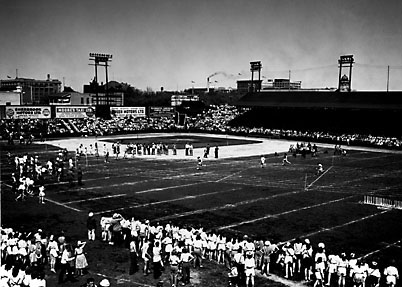
Busch Stadium I (Sportsman's Park) was well north of downtown. Busch Stadium II (Busch Memorial Stadium) was right downtown, and St. Louis' greatest icon, the Gateway Arch, built right before the stadium was, could be seen over its left-field fence, and the idea was incorporated into the park's design, with an arched roof that gave the stadium a very distinctive look that separated it from the other multipurpose concrete circle/oval stadiums of the 1960s and '70s.

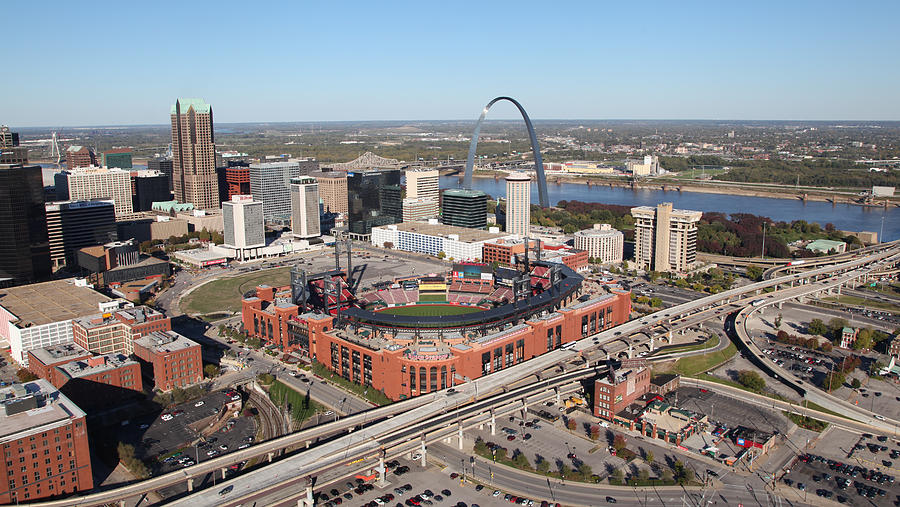
Busch Stadium III has a brick look on the outside that suggests an old factory -- or perhaps a brewery. And the Arch is visible beyond straightaway center field, much more so than it was in the preceding stadium, due to the new one's open outfield.
Other than that, though, the view isn't especially impressive: St. Louis has never exactly been known as a city of impressive skyscrapers, unlike such other Midwestern cities as Chicago, Detroit, Cleveland, and, if you want to count Western Pennsylvania as being "Midwestern" instead of "Northeastern," Pittsburgh. Besides which, the stadium is 5 blocks from the River, so there's not a lot of room to build anything especially impressive -- aside from the Arch, which is one block from the River.

But there is one other notable structure that can be seen from the park: The Old Courthouse can be seen beyond the left field fence. This was where 2 of the most infamous court cases in American history began, both later settled unfairly by the U.S. Supreme Court in decisions that were overturned by Constitutional Amendments: Dred Scott v. Sanford, in which a slave sued in 1846 to be declared free after his master took him into a State where slavery had already been abolished; and Minor v. Happersett, in which a woman sued in 1872 to be allowed to vote.
The seating capacity of the new Busch Stadium is officially listed as 43,975, but it can be boosted with standing room. For this season's Opening Day, they shoehorned 47,492 into the place; for a 2013 soccer game between Chelsea and Manchester City, 48,263. The park's outfield distances are 336 feet to the left field pole, 375 to left-center, 400 to straightaway center, 375 to right-center, and 335 to the right field pole. Like its predecessor, the new Busch Stadium is usually regarded as a pitcher's park.

You might guess that Albert Pujols hit the longest home run in the current Busch Stadium, and he did hit one 465 feet in 2011. But in 2012, Matt Holliday topped that with a 469-footer. At the 2nd Busch, Mark McGwire, understandably, hit the longest, in his 1998 asterisk season, hitting one measured at 545 feet. One of the earliest homers hit there, in 1966, is believed to be the longest hit there without cheating, a 515-foot shot by Willie McCovey of the San Francisco Giants.

Figuring out who hit the longest at Sportsman's Park/Busch Stadium I is problematic, as both left field (known as the "bleachers") and right field (covered by a roof and known as the "pavilion") had narrow seating sections over which quite a few balls were hit, including by Mickey Mantle in 1953 (to left, supposedly 530 feet) and Babe Ruth several times (to right, who knows for sure).

The U.S. soccer team played a 2018 World Cup Qualifier against the Caribbean nation of St. Vincent & the Grenadines at Busch Stadium last November 13. English power Liverpool FC and Italian giant AS Roma played each other there on last August 1.
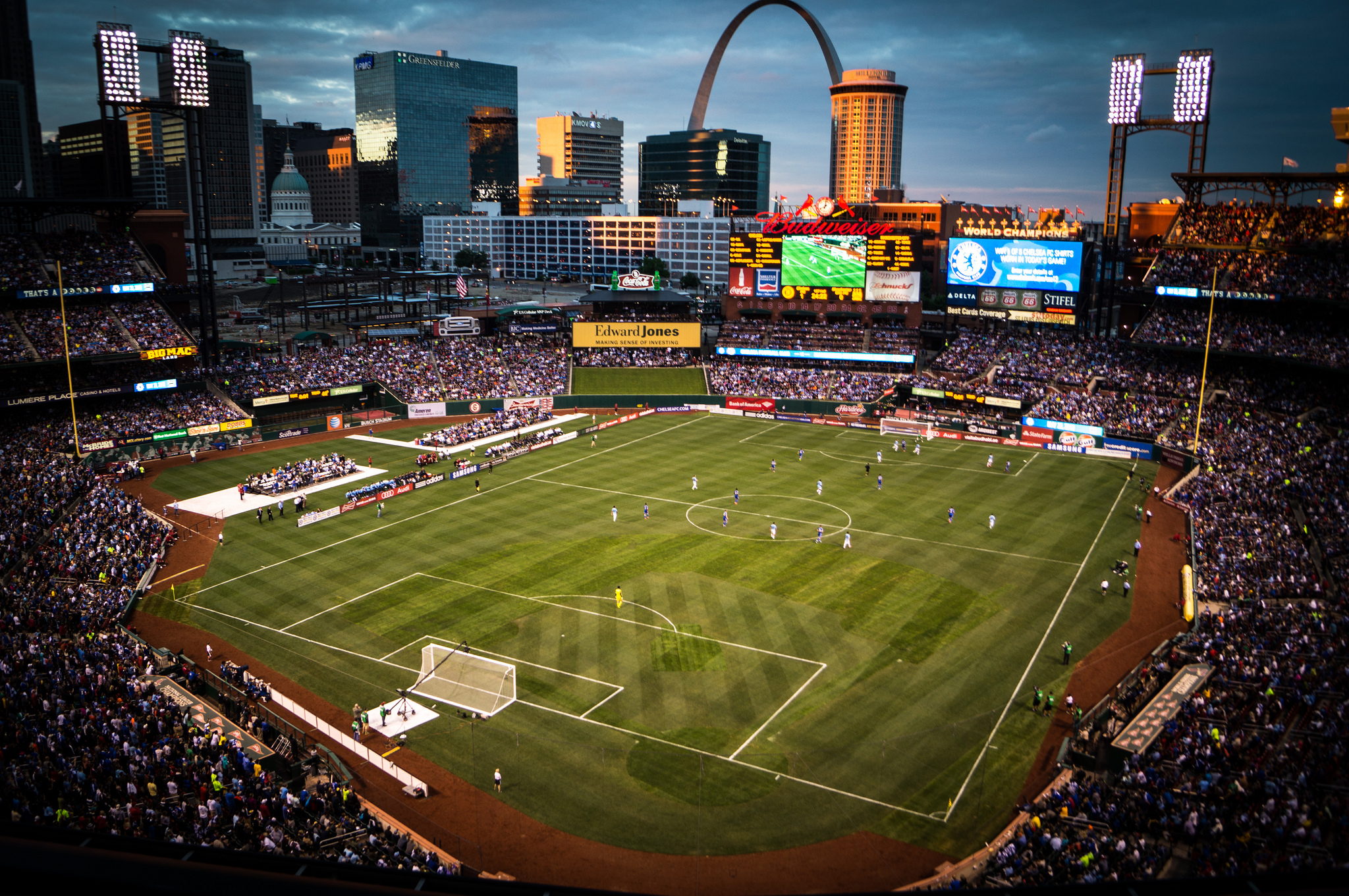
Soccer setup

Food. St. Louis has a reputation for great barbecue, and Busch Stadium has a stand called Broadway BBQ in Section 509, near the Bleachers.

They also have stands named for Cardinal legends: Dizzy's Diner, for Dizzy Dean, Sections 139, 161 and 446; Gashouse Grill, for the 1934 World Champions known as the Gashouse Gang, Sections 132, 146, 150, 154, 233 and 450; and El Birdos Cantina, for the Latino-influenced 1967 World Champions (if you'll excuse the fact that it should have been "Los Pájaros" or "Los Cardinales"), Sections 141 and 148. They also have Hardee's stands at 135 and 358.

Keeping with the Midwest's rural image -- St. Louis may be a big city, but even the Royals and the Braves may not have as countrified fan base as the Cards -- they have a Farmer's Market at 136, across from Hardee's; and the Prairie Farms Family Pavilion at 507.

Section 144 is home to the Food Network Hot Dog Bar. According to a recent Thrillist article on the best food at each big-league ballpark, the best thing to eat at Busch Stadium is this bar's St. Louis-style hot dog: Potato chips, barbecue sauce and shredded cheese atop a frankfurter..

Team History Displays. The Cardinals fly flags representing their World Championships atop the scoreboard in right field: 1926, 1931, 1934, 1942, 1944, 1946, 1964, 1967, 1982, 2006 and 2011. Those 11 titles are the most of any National League team, and are 2nd in all of MLB, only to the Yankees.
They do not fly flags for their National League Pennants when they went on to lose the World Series: 1928, 1930, 1943, 1968, 1985, 1987, 2004 and 2013. Nor do they fly flags for their 1996, 2000, 2002, 2005, 2009, 2014 and 2015 NL Central Division titles, or for their 2001 and 2012 Wild Card berths. Nor for their 1885, 1886, 1887 and 1888 Pennants in the old American Association, when they had the name that would later be used by the American League team now known as the Baltimore Orioles: The St. Louis Browns. (They became the Cardinals in 1900 with a change of uniform color.)

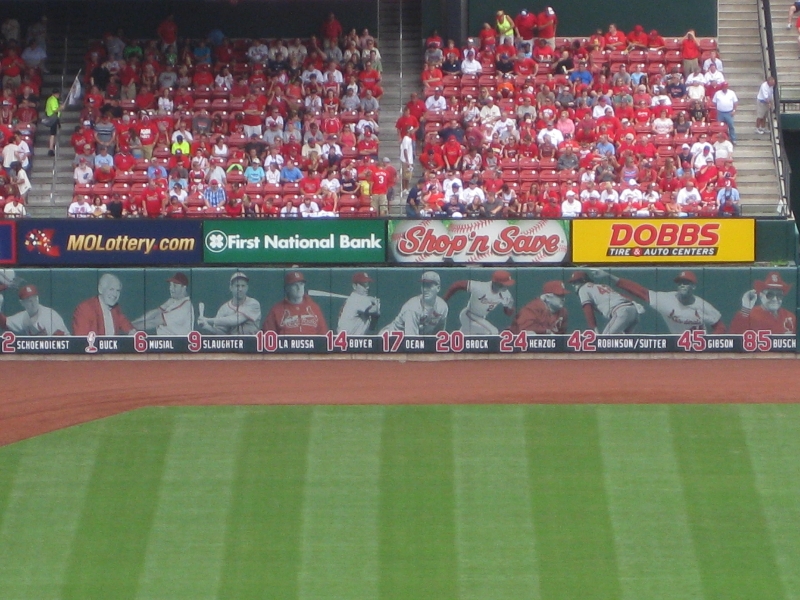
The Cardinals have their retired numbers on the left field fence: 1, Ozzie Smith, shortstop, 1982-96; 2, Albert "Red" Schoendienst, 2nd base, 1945-56, and at least a coach almost continuously since 1961, including stints as manager 1966-76 and briefly in 1980 and 1990, now 93 years old and a "special assistant coach," essentially the Cards' Yogi Berra or Johnny Pesky; 6, Stan Musial, 1st base and left field, 1941-63; 9, Enos Slaughter, right field, 1938-53; 10, Tony LaRussa, manager, 1996-2011; 14, Ken Boyer, 3rd base, 1955-65, manager, 1978-80; 17, Jay "Dizzy" Dean, pitcher, 1930-37; 20, Lou Brock, left field, 1964-79; 24, Dorrel "Whitey" Herzog, manager and general manager, 1980-90; 42, universally retired for Jackie Robinson but also retired here for Bruce Sutter, pitcher, 1981-84; 45, Bob Gibson, pitcher, 1959-75; and 85, Gussie Busch, owner, 1953-89. The Cards' board of directors decided to honor Gussie on his 85th birthday, hence the number; he did not order it retired for himself.

Also honored with the retired numbers are Jack Buck, who broadcast for the Cardinals from 1954 until his death in 2002, represented with a picture of a microphone; and Rogers Hornsby, a 2nd baseman who played in St. Louis with the Cardinals from 1915 to 1926, and again in 1933, and with the Browns from 1933 to 1937.

Hornsby also managed the Cardinals in 1925 and '26, winning the World Series in the latter year; and managed the Browns from 1933 to 1937, and again briefly in 1952. When he had Hall-of-Famer Rogers Hornsby playing for him at or near his peak, Rogers Hornsby the manager won; when he was past his prime as a player, and then retired, he was a lousy manager. He wore a few numbers during a career that predated them, most commonly 4, and so no number is retired for him, an "STL" logo standing in for his number.
Not yet officially retired, but pulled from circulation, are: 5, Albert Pujols, 1st base 2001-11; 51, Willie McGee, center field 1982-90 and 1996-99; and 57, Darryl Kile, pitcher, 2000-02. Kile died of a heart attack in the Cardinals' hotel during a 2002 roadtrip to Chicago; his other teams, the Colorado Rockies and the Houston Astros, have also refused to reissue Number 57. Pujols' 5 will likely be officially retired when he retires as a layer.

In addition, while their numbers have been returned to circulation, the 32 of Josh Hancock (pitcher, killed in a 2007 car crash) and the 18 of Oscar Taveras (right field, killed in a 2014 car crash) are honored with small circular logos bearing their initials and numbers on the wall of the Cardinal bullpen. (This is even though Taveras was not a pitcher, and both he and Hancock died because they were driving drunk.)

Outside the Gate 3 entrance stands a bronze statue of Musial. It was first unveiled outside the old Busch Stadium in 1968, and was moved to the new stadium. It shows him in his famed "corkscrew" batting stance, and the base includes a quote delivered by Commissioner Ford Frick at Musial's retirement ceremony at Sportsman's Park on September 29, 1963: "Here stands baseball's perfect warrior. Here stands baseball's perfect knight."
Other statues that previously surrounded Busch Memorial Stadium are now displayed at the corner of 8th & Clark, outside the team store: Cardinal Hall-of-Famers Hornsby, Smith, Schoendienst, Slaughter, Dean, Brock, Gibson and Buck; Browns star George Sisler, 1st base, 1915-27; and James "Cool Papa" Bell, a Negro League star whose teams included the St. Louis Stars. (Sisler remained in the major leagues until 1930, just before uniform numbers were adopted, so no number was ever retired for him; and besides, since the Browns no longer exist, they couldn't do it for him anyway.)

There's another statue of Stan at Lester's Restaurant, at 9906 Clayton Road in Ladue, not far from Stan's longtime home; one of Brock at Lindenwood University in nearby St. Charles (which is where the Mississippi and Missouri Rivers come togethre); and one of Albert Pujols (who now plays for the Los Angeles Angels of Anaheim) at Westport Plaza, at the intersection of Interstate 270 (St. Louis' beltway) and State Route 364. And a new bridge carrying Interstate 70 across the Mississippi, opened in 2014, was named the Stan Musial Veterans Memorial Bridge, a.k.a. the Stan Span.

There are now 37 inductees in the St. Louis Cardinals Hall of Fame, which is located at Ballpark Village, across Clark Street to the north of the ballpark:

* From their 1880s American Association Pennant winners: None as yet, but players from this team that are in the main Hall of Fame in Cooperstown are 1st baseman and manager Charles Comiskey (later the Chicago White Sox owner) and pitcher James "Pud" Galvin.

* Between their 1888 and 1926 Pennants: Again, none. In Cooperstown are 1st baseman Jake Beckley and left fielder Jesse Burkett. Also during this era, Taylor Spink inherited his family's publication, The Sporting News, then known as "the Bible of Baseball." He ran it for the rest of his life, 1914 to 1962, and the Hall of Fame named its award for sportswriters for him, giving him the first one.

* From their 1926 World Championship: Hornsby, pitcher Jesse Haines, 1st baseman "Sunny Jim" Bottomley, left fielder Charles "Chick" Hafey, owner Sam Breadon and general manager Branch Rickey. Future Pennant-winning manager Billy Southworth was on this team as well. In Cooperstown but not in this Hall: Pitchers Grover Cleveland Alexander and Burleigh Grimes.

* From their 1928 and 1930 Pennants and their 1931 world Championship: Haines, Bottomley, Hafey, Breadon, Rickey, 2nd baseman Frankie Frisch, and 3rd baseman John "Pepper" Martin.

* From their 1934 "Gashouse Gang" World Champions: Haines, Breadon, Rickey, Frisch (now also the manager), Martin, pitcher Jay "Dizzy" Dean and left fielder Joe "Ducky" Medwick (of Carteret, New Jersey). Shortstop Leo Durocher is in Cooperstown, mainly for what he did as a manager for other teams.

* Between their 1934 and 1942 Pennants: 1st baseman Johnny Mize.

* From their 1942, '43, '44 and '46 Pennant winners: Breadon, Dean (as broadcaster), Southworth, Musial, Slaughter, shortstop Marty Marion, center fielder Terry Moore and scout George Kissell. In 1946, Schoendienst and, as a broadcaster, Caray arrived, although Caray is not yet in the team Hall.

Also playing in this era, and elected to the Hall of Fame in Cooperstown as a broadcaster, was Joe Garagiola. Also elected, to the sportswriters' wing in Cooperstown, is Bob Broeg, who began writing for the Post-Dispatch in this era, and is said to have given Musial his nickname, having heard Brooklyn Dodger fans, knowing that he liked to hit at Ebbets Field, say, "Uh-oh, dat man is back in town! Here comes dat man again!" So it was apparently Broeg who dubbed him "Stan the Man." He also pushed for better pensions for ballplayers, and advocated for the Hall elections of Hafey, Slaughter and Schoendienst.

* From their 1964, '67 and '68 Pennant winners: Busch, Schoendienst (coach 1964, manager 1967 and '68), Kissell, Buck, Boyer, Gibson, Brock, center fielder Curt Flood, left fielder Mike Shannon, and catcher Tim McCarver. Elected to Cooperstown, but not yet the Cards' Hall of Fame, are Caray, 1st baseman Orlando Cepeda (better known for what he did with the San Francisco Giants) and pitcher Steve Carlton (better known for what he did with the Philadelphia Phillies).

* From between their 1968 and 1982 Pennants: 1st baseman-3rd baseman, later manager, Joe Torre; and catcher Ted Simmons.

* From their 1982, '85 and '87 Pennant winners: Busch, Buck, Schoendinest, Kissell, Shannon (now a broadcaster), Herzog, Sutter, Smith, McGee and pitcher Bob Forsch. Note that 1st baseman Keith Hernandez, 1979 NL batting champion and co-MVP, and 1982 World Series-winning 1st baseman, has not been elected.

* From their 1996 Division title: Schoendienst, Kissell, Buck, Shannon, Smith, McGee and LaRussa.

* From their 2000 Division title: Schoendienst, Kissell, Buck, Shannon, LaRussa, 1st baseman Mark McGwire, and center fielder Jim Edmonds.

* From their 2004 Pennant and their 2006 World Championship: Schoendienst, Kissell, Shannon, LaRussa, Edmonds and pitcher Chris Carpenter. Presumably, Pujols will be elected when he retires as a player.

* From their 2011 World Championship: Schoendienst, Shannon, LaRussa, Pujols and Carpenter.

* From their 2013 Pennant: Schoendienst and Shannon.

It is strange for fans of my generation and later to think of Caray, whose broadcasts and outsized personality symbolized the Chicago Cubs, as being the voice of the Cubs' arch-rivals, the Cardinals. After all, his statue is outside Wrigley Field, not Busch Stadium. Yet he broadcast for the Cards from 1945 to 1969, along with Schoendienst bridging the gap between the Musial Pennants and the Brock-Gibson Pennants. He was fired after allegedly having an affair with Augie Busch's wife -- which he never denied. The Chicago White Sox picked him up, and, when his contract with them ran out, he had offers from both Chicago teams, but saw the Cubs signed up with WGN's "Superstation" project, and the White Sox hadn't. He later said that if he'd stayed with the White Sox, he'd soon be "Harry Who?" The rest is history.

There is a St. Louis Sports Hall of Fame, but it was moved from the old Busch Stadium to the new Blues arena, now known as the ScotTrade Center. Cardinals elected to it are, in chronological order: Hornsby, Frisch, Dean, Medwick, Musial, Marion, Schoendienst, Boyer, Gibson, Brock, Torre, Simmons, 1970s-80s 1st baseman Keith Hernandez, Herzog, Smith, Sutter, Edmonds, 1990s-2000s coach Dave Duncan, Busch, and broadcasters Buck, Garagiola and Bob Costas.

Also elected are Browns Sisler, Ned Garver and Roy Sievers, St. Louis natives Yogi Berra and Earl Weaver, and Erma Bergman, who played for a St. Louis team in the women's league that played during World War II. There is a Missouri Sports Hall of Fame, but it's all the way across the State in Springfield.

When the 1st All-Star Game was played in 1933, the Cardinals had 4 representatives named to it: Frankie Frisch, Pepper Martin, Bill Hallahan and Jimmie Wilson. To its 100 Greatest Baseball Players in 1999, The Sporting News (which was long based in St. Louis, but has since moved its headquarters to Charlotte) named Cardinals Hornsby, Alexander, Frisch, Dean, Medwick, Musial, Gibson, Brock, Carlton, Smith and McGwire; Browns Sisler and pitcher Satchel Paige; and Bell of the Negro Leagues' St. Louis Stars. In 2006, Cardinal fans, fully over their McGwire bender and hangover, voted Musial in as St. Louis' representative in the DHL Hometown Heroes contest.

Stuff. Team Stores are located on Level 1, behind the left field and right field corners. The usual items that can be found at a souvenir store can be found there.

Books about the Cardinals are not exactly well-known outside the St. Louis area. Peter Golenbock did his oral-history thing, which he'd previously done for the Yankees, Cubs and Brooklyn Dodgers, with The Spirit of St. Louis, which also included the Browns.

The legendary 1930s club was nicknamed for the Gashouse District, an area of gas tanks and slums which was torn down in the 1940s to make way for Stuyvesant Town. John Heidenry has the best account of that club: The Gashouse Gang: How Dizzy Dean, Leo Durocher, Branch Rickey, Pepper Martin, and Their Colorful, Come-from-Behind Ball Club Won the World Series -- and America's Heart -- During the Great Depression.

Many baseball observers have suggested that, due to his playing away from the media centers of New York, Chicago and Los Angeles, he is one of the most under-appreciated great players ever. But once he approached the age of 90, and more so now that he has died, there have been a few books to boost his historical reputation. The latest is Stan Musial: An American Life, by the legendary New York Times sportswriter George Vescey. It should be as good a guide as any into the 1942-46 Cardinal champions.

David Halberstam's October 1964 does a good job of showing how the Cardinal champions of the 1960s came together, and also how the Yankee dynasty of the 1950s and early '60s began to fall apart, with civil rights and the Cold War as backdrops. Doug Feldmann continues the story with (again, grammatically incorrect, but that's the nickname that was used at the time) El Birdos: The 1967 and 1968 St. Louis Cardinals, which was really the first team to succeed using a well-balanced mixture of white, black and Hispanic players. (The early San Francisco Giants, Cepeda among them, had the mix, but not quite the success, winning just 1 Pennant.)

Whitey Herzog got together with Rob Rains and Alvin Reid to write Whitey's Boys: A Celebration of the '82 Cards World Championship. James Rygelski and Robert Tiemann wrote 10 Rings: Stories of the St. Louis Cardinals World Championship, which became out of date at the end of the season. Rains tells how that happened in Wild Cards: The St. Louis Cardinals' Stunning 2011 Championship Season.

There are 3 World Series highlight films collections for the Cardinals. Since the official highlight films only started with the Yanks-Cards matchup of 1943, the previous year's Cards win over the Yanks is not included. But the 1943, '44 and '46 Series are packaged together, as are the Series of 1964, '67 and '68, and the Series of 1982, '85 and '87 -- even though the Cards lost 4 of those 9. The 1982, 2006 and 2011 Series are packaged separately as well.

There is, as yet, no Essential Games of the St. Louis Cardinals DVD collection, but there is The St. Louis Cardinals - Greatest Games of Busch Stadium. The games are: 1968 World Series Game 1 (Gibson strikes out 17 Tigers to set a Series record), 1982 World Series Game 7, 1985 NLCS Game 5 (Ozzie Smith, of all people, hits a walkoff homer), 1987 World Series Game 3, September 8, 1998 (Mark McGwire's record-breaking 62nd homer), and 2004 NLCS Game 7.

During the Game. A recent Thrillist article on "Baseball's Most Intolerable Fans" listed the Cardinals' fans 2nd -- behind only L.A.'s, and ahead of Boston's, the Yankees', Philly's, San Francisco's, the Cubs' and the Mets' in that order:

Every last Cardinals fan believes right down to the marrow of their custard-fortified bones that, by golly, the Cards are just a special franchise blessed by whatever deity you believe in (oh, who are we kidding, it's the Christian one) with the capacity to just do things the right way.


They fancy themselves the best fans in baseball to such a degree that it's become a punchline within baseball circles and a dynamic blessed with its own must-read, hypocrisy-exposing Twitter account where you can read all the horribly racist things they continue to say about Jason Heyward for daring to, you know, choose his employer. Oh, and their front office broke federal laws hacking into the Houston Astros computer system, which has somehow received about 1% the attention that Tom Brady's taste for slightly more grippable balls did.
Okay, they can be annoying. And, because they've got a lot of Eastern Missouri, Southern Illinois, Western Kentucky, Northern Arkansas and Western Tennessee people, there may be some Tea Party, neo-Confederate bigotry going on. And I wouldn't go onto the streets of St. Louis or into Busch Stadium wearing Chicago Cubs gear.

But most Cardinal fans are fine. Because of their Great Plains/Heartland image, they like a "family atmosphere." They don't much like New York, but they won't bother Met fans just for being Met fans. They will not directly antagonize you. At least, they won't initiate it. But don't call them rednecks, hicks, hillbillies or (to borrow a term from British soccer) sheep-shaggers.

Cardinal fans wear red. Bright red. Cardinal red. Nearly all of them. This seems to be a requirement. The entire stadium seems to be covered in it, and not just because the seats at Busch are red (as they were at its predecessor).

All of the games in this series will be promotions. Friday night is Adult Performance T-Shirt Night. It will also be Military Appreciation Night, with a portion of the gate proceeds going to the USO. Saturday will be Tim McCarver Bobblehead Day, honoring the former Cardinals catcher and Mets broadcaster. The Sunday game will be Snapback Hat Day. For each of these giveaways, the items will go to the 1st 30,000 fans age 16 and older. Sunday will also be Prairie Farms Ice Cream Sunday and Prairie Farms Kids Run the Bases Day -- in that case, the opposite of the other promotions, ages 15 and under.

The Cards have a mascot, with perhaps the dumbest name of any mascot in the big four major league sports: Fredbird the Redbird. He's no Phillie Phanatic, or even a Mr. Met. He does, however, have a bevy of young lady assistants.
The Cardinals hold auditions for National Anthem singers, instead of having a regular. (Sometimes, the Blues' regular Anthem singer, Charles Glenn, will do it.) They don't play a song after "Take Me Out to the Ballgame" during the 7th stretch. But, as I said earlier, in the middle of the 8th inning they play the old Budweiser TV commercial jingle "Here Comes the King," as in "Budweiser, King of Beers." "When you say Budweiser... you've said it all!" After the game, win or lose, they play "Meet Me in St. Louis," the theme from the 1944 Judy Garland film about the 1904 St. Louis World's Fair. (So, even that long ago, it was already a nostalgia piece.)

After the Game. St. Louis has a bit of a crime problem, but since the stadium is right downtown, this will probably not affect you. As I said, leave the home fans alone, and they'll probably leave you alone.

"Ballpark Village" has been built, across Clark Avenue to the north of the stadium, with bars and restaurants. A similar project, with the same name, has been planned for the area around Yankee Stadium since the renovation project for the old Stadium 40 years ago, but has never happened. Hopefully, the Cardinals will have more luck.

Mike Shannon's Steaks and Seafood, owned by the 1960s Cardinal right fielder and longtime broadcaster, is at 620 Market Street at 7th Street, 2 blocks north of Busch Stadium.

If you want to be around other New Yorkers, Bar Louie is the home of the local Giant fans. 14 Maryland Plaza at Euclid Avenue, on the West Side. MetroLink to Central West End, then a short walk. The local Jet fans’ hangout is BoBecks, but it's 20 miles south of downtown St. Louis, across the River in Waterloo, Illinois. 1234 Jamie Lane. MetroLink to 5th & Missouri, then switch to 2X bus, then walk a mile south.

If your visit to St. Louis is during the European soccer season, which gets back underway in mid-August, the best place to watch your club is at the Amsterdam Tavern, 3175 Morganford Road, in the Tower Grove South area, about 6 miles southwest of downtown. Bus 30 to Arsenal Street and Morganford Road. (However, don't be fooled by that street name: Fans of London club Arsenal meet at Barrister's, 7923 Forsyth Blvd., about 9 miles west of downtown. MetroLink to Clayton.

Sidelights. Busch Memorial Stadium, home of the Cardinals from 1966 to 2005, the NFL Cardinals from 1966 until 1987 when they moved to Arizona, and the Rams for 3 games in 1995 because the new dome wasn't ready, was across Clark Avenue from the new stadium.
While it was never a major venue for football -- unless you count those "Bud Bowl" commercials during Super Bowls, where the arched roof of old Busch was easily recognizable -- there were 6 World Series played there, with the Cardinals winning in 1967 and 1982. But only in 1982 did they clinch there; the Detroit Tigers clinched there in 1968, and the Boston Red Sox did so in 2004, with Drew Barrymore and Jimmy Fallon filmed by the Farrelly Brothers in their improvised rewritten ending to the U.S. version of Fever Pitch, with Major League Baseball giving them permission to film on the field after the game.
The 1980s, the era of the White Rat,
the Wizard of Ozz, 3 Pennants and artificial turf.

Busch Memorial Stadium hosted 7 games by the U.S. national soccer team, and the Stars & Stripes were undefeated in them, winning 5 and tying 2.
* Edward Jones Dome. Home to the NFL's Rams from 1995 until last year, it has a St. Louis Football Ring of Fame, but most of the honorees are ex-football Cardinals. The only St. Louis Rams honored on it are Marshall Faulk, coach Dick Vermeil, and team owner Georgia Frontiere, who moved the team out of Los Angeles because she hated the black neighborhood around the L.A. Coliseum, Anaheim was a lousy stadium for football, and St. Louis was her hometown.

Now, with Frontiere dead, and former minority owner Stan Kroenke in full control, the Rams have gone back to Los Angeles, meaning that St. Louis has now lost 2 NFL teams in less than 30 years, meaning that, regardless of how hard they try to get a replacement for the Dome built, the NFL won't try to put another team there.

St. Louis area fans seem to have fallen back into the pattern they had in the 1988-94 interregnum: Fans on the Missouri side of the Mississippi River favor the Missouri team, the Kansas City Chiefs; while those on the Illinois side favor the Illinois team, the Chicago Bears.

The Dome has hosted the Big 12 Conference Championship Game, and the 2005 NCAA Final Four, with North Carolina beating Illinois in the Final. The Dome is at 6th Street & Broadway, 9 blocks north of Busch Stadium. Metrolink to Convention Center.

* Site of Sportsman's Park. From 1866 onward, several ballparks stood on this site, including the one used by the Cardinals, then known as the St. Louis Browns, when they won 4 straight Pennants in the old American Association from 1885 to 1888.
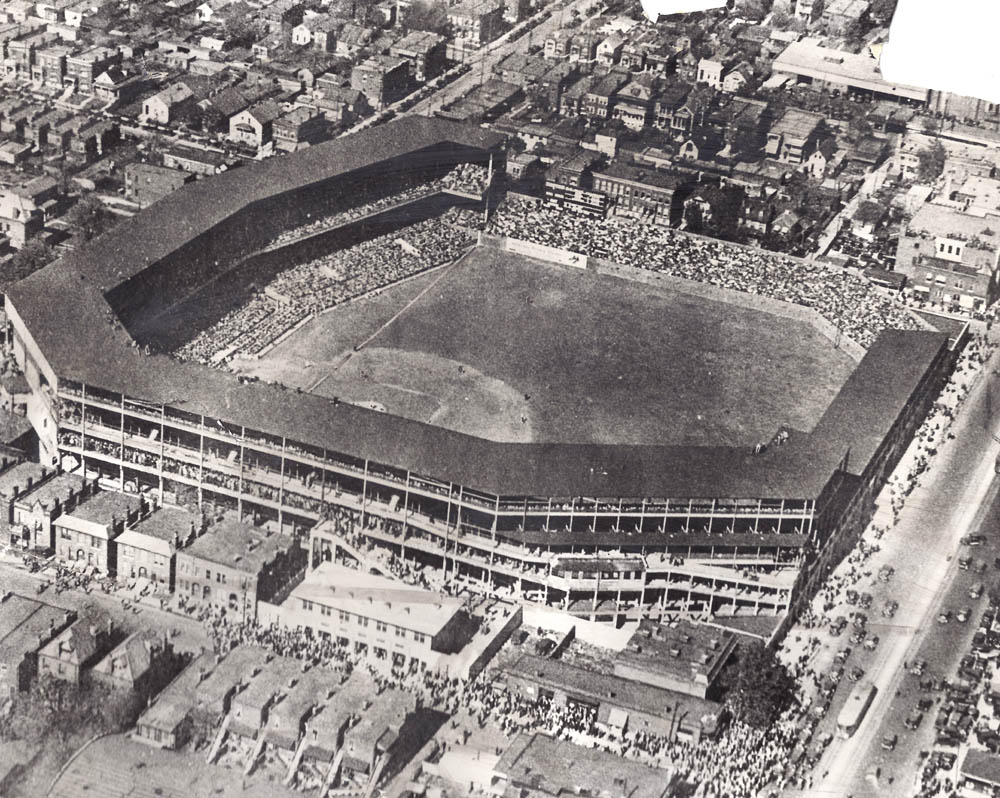
Those Browns were owned by Chris von der Ahe, a German immigrant (as were thousands of people in St. Louis at the time), and he was an outsized personality owning a baseball team decades before George Steinbrenner or Gussie Busch were born.

"Der boss president of der Browns," as he called himself in his accent, built one of the first amusement parks, adjacent to the ground, and a beer garden which could be called the first sports bar -- though this is disputed by Bostonians stumping for Michael "Nuf Ced" McGreevy's Third Base Saloon, which also opened in the 1880s. But the ballpark burned down in 1898, and von der Ahe was ruined. The new owners moved the team to Robison Field.

The team's name became the Cardinals with a change in uniform color in 1900, and the American League's Browns arrived in 1902, after spending the AL's first season in Milwaukee. The AL Browns set up shop at the existing Sportsman's Park, and built a new one on the site, the last one, in 1909.

The ballpark was home to St. Louis' 1st 2 NFL teams, the All-Stars, who played only the 1923 season; and the Gunners, who played from 1931 to 1940.

Those Browns remained until 1953, when Bill Veeck realized that Gussie Busch's purchase of the Cards meant the Browns simply couldn't compete. The Cards had moved back to the site in 1920 and by 1926 had set the tone: The Browns were the landlords but legendary losers, while the Cardinals were the tenants but wildly successful. Ten World Series were played in that ballpark, from 1926 to 1964, including the all-St. Louis "Trolley Series" of 1944, when the Browns led the Cards 2 games to 1 but the Cards won the next 3 straight to take it, ruining the Browns' best (and perhaps last) chance to take the city away.
Gussie knew that his Cards -- and the NFL's Cardinals, who played there after moving from Chicago in 1960 -- couldn't stay in a 30,804-seat bandbox tucked away on the North Side with no parking and no freeway access, so he got the city to build him the downtown stadium. Sportsman's Park, the first Busch Stadium, the home of George Sisler, the Gashouse Gang and Stan the Man, was demolished shortly after the Cards left in 1966. The Herbert Hoover Boys Club is now on the site, and, unlike most long-gone ballpark sites, there is a baseball field there.

Oddly, the two teams had different addresses for their offices: The Cards at 3623 Dodier Street, the Browns at 2911 North Grand Blvd. Metrolink to Grand station, transfer to Number 70 bus. Definitely to be visited only in daylight.

* Site of Robison Field. Home of the Cardinals from 1898 to 1920, it was the last mostly-wooden ballpark in the major leagues. Moving out was the best thing the Cards could have done, as -- hard to believe, considering what happened to them over the next quarter-century -- they were the town's joke club, while the Browns were the more-regarded team. It was torn down in 1926 to make way for Beaumont High School, which still stands on the site.
3836 Natural Bridge Avenue, at Vandeventer Avenue. Six blocks north and two blocks west of the site of Sportsman's Park. Again: Do not visit at night.

* Site of Handlan's Park. The St. Louis Terriers played in the Federal League, finishing last in 1914, but nearly winning the Pennant in 1915. They had Hall of Fame pitchers Eddie Plank and Mordecai "Three-Finger" Brown and Eddie Plank. When the FL folded after the 1915 season, the team's owner, Phil Ball, was invited to buy the Browns, and he owned them until his death in 1933, with his estate continuing to do so until selling in 1936.

They played at Handlan's Park. The spot is now occupied by Marchetti Towers, housing for Saint Louis University, whose Hermann Stadium and Chaifetz Arena are within a 5-minute walk. 3520 Laclede Avenue at Grand Blvd., about 2 1/2 miles west of downtown. MetroLink to Grand.

* Scottrade Center, site of Kiel Auditorium, and St. Louis Sports Hall of Fame. The NHL's Blues moved into this new arena in 1994, after 27 years at the old Arena. Originally, it was known as the Kiel Center in honor of the previous building on the site, and then the Savvis Center, after a company that would go bust in the tech bubble. They've only reached the Conference Finals once since moving in, but at least they're stable and not in danger of being moved.

The building also hosts the Missouri Valley Conference tournament, known as "Arch Madness" instead of "March Madness." It hosted the NCAA Frozen Four in 2007.

The previous building was built in 1934, as the Municipal Auditorium, and in 1943 was renamed for the late Mayor Henry Kiel, who got it built. Saint Louis University played its home basketball games there for its entire existence, 1934 to 1991, before moving temporarily to the Arena and then to the Scottrade Center, before opening its new on-campus Chaifetz Arena in 2008.

The NBA's Hawks played there from their 1955 move from Milwaukee until their 1968 move to Atlanta, winning the Western Conference title in 1957, '58, '60 and '61 and the NBA Title in 1958. Elvis Presley sang there on January 1, 1956; March 29, 1957; September 10, 1970; June 28, 1973; and March 22, 1976.

1401 Clark Avenue (known on that block as Brett Hull Way in honor of the Blues legend) at 14th Street, 5 blocks west of Busch Stadium.  Metrolink to Civic Center.

On May 12, 2014, the New York Times printed a story that shows NBA fandom by ZIP Code, according to Facebook likes. Being between several NBA cities but not especially close to any of them (242 miles to Indianapolis, 284 to Memphis, 295 to Chicago, 498 to Oklahoma City), the St. Louis area divides up its fandom among the "cool" teams: The Bulls, the Los Angeles Lakers and the Miami Heat. However, not far into St. Louis' Illinois suburbs, you begin to get into solid Bulls territory. If St. Louis had an NBA team, its metropolitan area would rank 20th in population among NBA markets.

* Chaifetz Arena. The aforementioned home of Saint Louis University basketball (they always spell "Saint" out, never abbreviate it as "St.") is at 1 S. Compton Avenue, at the southwest corner of Laclede Avenue. Across from it, at the southeast corner, was Stars Park, home of the Negro Leagues' St. Louis Stars, Pennant winners in 1928, 1930 and 1931 -- just like their white counterparts.

SLU's teams are called the Billikens. Along with another Catholic school known for basketball but not football, Washington, D.C.'s, Georgetown Hoyas, this is one of the odder nicknames in college sports. In 1911, a local sportswriter said that the school's football coach at the time, John R. Bender, resembled a "Billiken," a charm doll popular at the time, resembling a Buddha with pointed ears. His team became known as Bender's Billikens, and the name stuck. Bender's predecessor as SLU football coach, Eddie Cochems, was the 1st coach to legally utilize the forward pass, in 1906. MetroLink to Grand.

* Site of 1904 World's Fair and St. Louis Arena. The Louisiana Purchase Exposition was held at Forest Park in honor of the centennial of the start of Meriwether Lewis and William Clark heading out from St. Louis to explore the Louisiana Purchase.

The Exposition is remembered as the birthplace of the hamburger, the hot dog, iced tea, peanut butter, cotton candy and Cracker Jacks. While they may have all been nationally popularized at that place and at that time, all of these claims of origin are dubious at best, except for Cracker Jacks, which are definitely a St. Louis creation. Equally dubious was the 1904 Olympics, which were essentially a sideshow of the World's Fair; it wasn't until London in 1908 that they became an institution in and of themselves.

Very little of the Fair remains. The Administration Building is now Brookings Hall, a major building of Washington University. The Palace of Fine Art is now the St. Louis Art Museum.

The Arena opened in 1929 across Oakland Avenue from Forest Park. At 14,200 seats, it was then one of the largest arenas outside the Northeast Corridor, and in terms of floor space only the recently-built "old" Madison Square Garden was larger.

It was the home of several minor league hockey teams until the NHL expansion of 1967 brought in the Blues. At first, the NHL purposely put all the new teams in the same division, thus giving them an equal chance of reaching the Stanley Cup Finals. The Blues reached the Finals in their first 3 seasons, 1968, '69 and '70, due to having signed some legends at the end of their careers, such as Jacques Plante, Doug Harvey, Dickie Moore and Glenn Hall. They haven't reached the Finals since, and only reached the NHL's round of 4, under whatever name, twice in the last 44 years.

In 1977, the Arena had been expanded to 17,188 seats, and with Ralston Purina then being majority owners of the Blues, their "Checkerboard Square" logo was plastered everywhere, and the building was renamed the Checkerdome until 1983.

It hosted the NCAA Final Four in 1973 (Bill Walton hitting 21 of 22 shots for UCLA over Memphis State) and 1978 (Jack Givens' Kentucky defeating Mike Gminski's Duke); and the hockey version, the "Frozen Four," in 1975.

It was the home of the Spirits of St. Louis in the American Basketball Association's last 2 seasons, 1974-75 and 1975-76, before folding with the league, and were not absorbed into the NBA. That team featured Marvin Barnes and future Basketball Hall-of-Famers Maurice Lucas and Moses Malone, all 3 of whom were later named to the ABA All-Time Team. The Spirits were also the 1st major league sports team for whom Bob Costas broadcast.

The Arena was seen as being inadequate for a modern sports team, and the Blues moved out in 1994. It was demolished in 1999, and apartments and a Hampton Inn are on the site today. 5700 Oakland Avenue at Parkview Place. Metrolink to Central West End, then Number 59 bus.

Elvis also sang at the Missouri Theater on October 21, 22 and 23, 1955, at the intersection of N. Grand Blvd. and Lucas Avenue, a block away from he Fox Theatre. Parking is on the site now.


In addition to the preceding, Elvis sang in Eastern Missouri in 1955 at the National Guard Armory in Sikeston on January 21 and September 7; at the Armory in Poplar Bluff on March 9; at the B&B Club in Gobler on April 8 and September 28; and at the Arena Building in Cape Girardeau on July 20. 

* St. Louis Walk of Fame. Honoring famous people from the St. Louis area, including from across the river in southern Illinois, these plaques run from 6150 to 6699 Delmar Blvd. Metrolink to Delmar station.

Of the 146 current honorees, 29 are connected to sports: Cardinals figures Branch Rickey, Rogers Hornsby, Dizzy Dean, Stan Musial, Red Schoendienst, Bob Gibson, Tim McCarver, Curt Flood, Lou Brock, Whitey Herzog, Ozzie Smith, Haray Caray, Joe Garagiola, Jack Buck and Bob Costas; the Browns' George Sisler; the Negro Leagues' James "Cool Papa" Bell; St. Louis native and New York baseball legend Yogi Berra; football Cardinals Dan Dierdorf and Jackie Smith (as yet, no Rams); Hawks Bob Pettit and Ed Macauley (as yet, no Blues); boxers Henry Armstrong and Archie Moore; tennis stars Dwight Davis and Jimmy Connors; track legend Jackie Joyner-Kersee; bowler Dick Weber; and golfer Hale Irwin.

At 6504 Delmar is Blueberry Hill, the rock-and-roll-themed restaurant associated with -- but not, as I once believed, owned by -- the late St. Louis native Chuck Berry, who, of course, has a plaque on the Walk of Fame, as does his pianist Johnnie Johnson. They are 2 of the 15 musical personalities on the Walk, including both Ike and Tina Turner, ragtime inventor Scott Joplin, jazz superstars Josephine Baker and Miles Davis, and opera singer Robert McFerrin, father of "Don't Worry Be Happy" singer Bobby McFerrin.

* Gateway Arch.  Built on the traditional founding site of the city, on the Mississippi River, on February 14, 1764, the Arch, 630 feet high with its legs 630 feet apart at ground level, represents an old city. But it is, surprisingly, not an especially old landmark, opening to the public in 1967.

An underground visitors' center leads to a tram that takes you to the top, which is higher than any actual building in town, and serves as St. Louis' "observation deck." Like the Empire State Building, it has lights cast on it at night in honor of various occasions. Admission is $10. 200 Washington Avenue at Market Street, access via Walnut Street.

The Arch is treated as the tallest "building" in the State of Missouri, but the tallest real building in town is One Metropolitan Square, built at Broadway & Olive Street in 1989: 593 feet tall. Ordinary, by New York's standards.

* Brewery. The world's 2nd-largest brewery is the Anheuser-Busch plant on U.S. Routes 1 & 9, across from Newark Liberty International Airport. The largest is A-B's corporate headquarters, south of downtown. Public tours of the brewery are available. 1 Busch Place, Broadway and Arsenal Street. Number 30 or 73 bus.

* Museum of Transportation. A rail spur of the old Missouri Pacific Railroad (or "Mopac," later absorbed by the Union Pacific) enabled this museum to open in 1944. It houses trains, cars, boats, and even planes. From a New York Tri-State Area perspective it has one of the last 2 surviving New York Central steam locomotives, one of the last 2 surviving Delaware, Lackawanna & Western steam locomotives, an Erie Lackawanna diesel locomotive, and the 1960 DiDia 150, a.k.a. the "Dream Car" made famous by New York singing legend Bobby Darin.

3015 Barrett Station Road in Keyes Summit (though St. Louis is still the mailing address), west of downtown. Bus 58X to Big Bend & Barrett Station Roads, then a 15-minute walk north on Barrett Station.

* Hall of Fame Place. Yogi, Garagiola, Bobby Hofman and Jack Maguire. Jack Buck. 5400 Elizabeth Avenue.

* Ulysses S. Grant National Historic Site. The closest the St. Louis area comes to having a Presidential Library, this park was built on land owned by the family of Julia Dent, the wife of the Union General and 18th President who is on the $50 bill.

7400 Grant Road, Grantwood Village, St. Louis County, southwest of downtown. It's tough to reach by public transportation: You'd have to take Metrolink to Shrewsbury station, transfer to the Number 21 bus, ride it to Walton and Grant Roads, and walk a little over a mile down Grant Road.

The Democratic Party had its 1876 Convention at the Merchants Exchange Building, at 3rd Street between Chestnut and Pine Streets, nominating Governor Samuel J. Tilden of New York for President. The building stood there from 1875 to 1958.

The St. Louis Exposition and Music Hall stood from 1883 to 1907, and was the site of the Conventions for the Democrats in 1888 (renominating Grover Cleveland) and 1904 (nominating Alton Parker), and the Republicans in 1896 (nominating William McKinley). It stood at the southeast corner of 13th and Olive Streets.

The St. Louis Coliseum stood from 1908 and 1953, at the southwest corner of Washington Blvd. and Jefferson Avenue. The Democrats held their 1916 Convention there, renominating Woodrow Wilson. It also staged boxing.

The Washington University Field House has hosted Presidential Debates in 1992 (George H.W. Bush, Bill Clinton and Ross Perot), 2000 (George W. Bush and Al Gore) and 2004 (George W. and John Kerry). 330 N. Big Bend Blvd. Metrolink to University City-Big Bend.

Stan Musial is buried at Forever Bellerive Cemetery, 740 N. Mason Road. Light rail to Delmar Loop, then Bus 91 to Olive & Kram, then walk a mile south on Mason. George Sisler is buried at the Faith des Peres Presbyterian Church Cemetery, 11155 Clayton Road. Light rail to Clayton, then Bus 58 to Clayton & Geyer.

According to the best source I can find, there have been 7 TV shows set in St. Louis. The only recent one is Defiance, a postapocalyptic show now entering its 2nd season, for which a damaged Arch is a landmark. So if you're looking for locations in the city that have been on TV, guess what, the Arch itself and Busch Stadium are your best bets.

*

St. Louis has a history out of proportion to its size, and Cardinal fans like to think of their town as the best baseball town in America. You are under no obligation to agree, but it is one of the best baseball cities, and every fan who can get out there should.

Why, Joe, Why?

The Yankees should have made it 2 straight over the Houston Astros at Minute Maid Park last night. But they didn't, because Joe Girardi was in full Girardi mode.

Never go full Girardi.

Didi Gregorius hit a grand slam in the 6th inning, his 10th home run of the season. In the 7th, Clint Frazier, one of the "prospects" for whom Brian Cashman threw last season away, making his major league debut and already having gotten his 1st major league hit, hit his 1st major league home run.

Years from now, they may say, "Ol' Number 30 could really hit. We knew it back in '17."

Or they could say, "He fooled us, like Hensley Meulens, and Steve Balboni, and Dan Pasqua, and Kevin Maas, and Gerald Williams, and Jesus Montero."

(I didn't include Shane Spencer, because he actually helped us win a World Series. Three, in fact.)

So the Yankees led 5-2 going to the bottom of the 6th, and 6-3 going to the bottom of the 8th. That means they won the ballgame, right? Wrong. Because Joe Girardi is an idiot who does not know how to manage a pitching staff.

Jordan Montgomery pitched into the 6th inning, and was doing well. He got the 1st out. Then he allowed a home run and a double. Unlike Douglas Adams' Hitchhiker's Guide to the Galaxy science-fiction book series, Girardi must be the only guy with a book that says, "Yes, panic!" He looked in his damn binder, and it said, "Replace starting pitcher."

And it wasn't due to the damn pitch count: Montgomery had only thrown 87 pitches, 54 of them for strikes. He should have been good for at least 7 innings.

So Girardi brought on Chad Green. Green pitched well, finishing the 6th and getting through the 7th, with just 1 baserunner. Gee, if he was that effective, maybe Girardi should have left him in.

But because Joe Girardi is an idiot who does not know how to manage a pitching staff, he didn't leave Green in. He brought Dellin Betances in to pitch the 8th, when Green -- hell, maybe even Montgomery -- should still have been in.

Even if you buy the narrative from last season, Betances is supposed to be the 7th inning pitcher, Andrew Miller the 8th, and Aroldis Chapman the 9th. But because Cashman traded Miller for "prospects," including Frazier, Miller wasn't there for the 8th, and Betances illustrates "The Peter Principle": He rises to the level of his incompetence.

Betances got the 1st out in the 8th. Here's what happened thereafter: Walk, stolen base, stolen base, groundout getting that runner home (6-4 Yankees), home run (6-5 Yankees), walk, error, stolen base, walk.

Cliche Alert: Walks can kill you.

This time, we could have used Girardi panicking and pulling a pitcher after 2 mistakes. But he didn't. He waited until it was too late to bring Chapman in for the 8th inning. And Chapman allowed a double that brought home the tying and, as it turned out, winning runs.

Naturally, the Yankees didn't score in the top of the 9th. Aaron Judge popped up to 1st base. He was pinch-hitting for Chris Carter. Begging the question, What the hell was Carter doing in the game, and Judge not, at the start? The much-hyped Frazier -- you'd think he'd already done as much as Judge, with all the hype he's gotten -- also popped to 1st. And Brett Gardner singled to left -- and was thrown out trying to stretch it to a double. I admire his enthusiasm, if not his judgment.

Final score: Astros 7, Yankees 6. WP: Dayan Diaz (1-1). SV: Ken Giles (19). LP: Betances (3-3). But, again, the loss should be charged to Girardi -- this time, for his lineup and his pitching screwups.

In the immortal words of Nancy Kerrigan, "Why? Why? Why?"

The series concludes this afternoon. Luis Severino starts against Mike Fiers. Chris Carter is in the lineup again. And Girardi is still the manager. And it's away to the Astros.

I'm assuming this game is lost, unless and until it's won.

Probably a safe default position for every game Girardi manages for the rest of his life.

July 2, 1937, Amelia Earhart Disappears

July 2, 1937, 80 years ago: Amelia Earhart disappears, along with her navigator, Fred Noonan, in her attempt to become the 1st woman to make an around-the-world flight.

Her plane was a Lockheed Electra 10E, with 2 propeller-driven engines, 1 on each side of the cockpit. And this around-the-world flight was not going to be a single nonstop flight. The technology simply wasn't available at the time. Her intended route was as follows:

* May 20, the 10th Anniversary of Charles Lindbergh's takeoff from Long Island, successfully becoming the 1st person to fly across the Atlantic Ocean, solo or otherwise: Oakland, California to the Los Angeles suburb of Burbank.

* May 21: Burbank to Tuscon, Arizona.

* May 22: Tucson to New Orleans.

* May 23: New Orleans to Miami. Then, a break, until...

* June 1: Miami to San Juan, Puerto Rico.

* June 2: San Juan, across the Caribbean Sea, to the South American continent, to Caripito, Venezuela.

* June 3: Caripito to Paramribo, Surinam.

* June 4: Paramaribo to Fortaleza, Braail.

* June 5: Fortaleza to Natal, Brazil. Then a day off. Then...

* June 7: Natal, across the Atlantic, to the African continent, to Saint-Louis, Senegal.

* June 8: Saint-Louis to Dakar Senegal. Then a day off. Then...

* June 10: Dakar to Gao, French Sudan (now Mali).

* June 11: Gao to Fort-Lamy, French Equatorial Africa (now N'Djamena, the capital of the independent nation of Chad).

* June 12: Fort-Lamy to El Fasher, Anglo-Egyptian Sudan (now just "Sudan").

* June 13: Two flights. First, El Fasher to Khartoum, Sudan. Then, Khartoum to Massawa, Italian East Africa (now Eritrea).

* June 14: Massawa to Assab, Italian East Africa (Eritrea).

* June 15: Assab, across the Red Sea and the Middle East into Asia, to Karachi, British India (now in Pakistan). Then a day off. Then... 

* June 17: Karachi to Calcutta, British India (now Kolkata, India).

* June 18: Kolkata to Akyab, Burma (now Sittwe, Myanmar).

* June 19: Sittwe to Rangoon, Burma (now Yangon, Myanmar).

* June 20: Two flights. First, Yangon to Bangkok, Siam (now Thailand). Then, Bangkok to Singapore, Straits Settlements (now the City of Singapore, the Republic of Singapore).

* June 21: Singapore to Bandoeng, Dutch East Indies (now Bandung, Indonesia). Then 3 days' rest. Then...

* June 25: She intended to fly from Bandung to Soerabaia, Dutch East Indies (now Surabaya, Indonesia), but had to return due to dysentery, and needed repairs on her plane.

* June 26: She tried again, this time making it from Bandung to Surabaya.

* June 27: Surabaya to Koepang, Dutch East Indies (now Kupang, Indonesia).

* June 28: Kupang to Darwin, on the north coast of Australia, where more repairs were made.

* June 29: Darwin to Lae, New Guinea (now Papua New Guinea).

There were 3 more legs of the trip, across the Pacific Ocean, to begin on July 2: Lae to Howland Island, then as now belonging to America, and at 2,223 miles the 2nd-longest leg; Howland to Honolulu; and the longest leg, 2,400 miles, but one Earhart had done before, Honolulu to Oakland, with the aim of arriving on the 4th of July to a big patriotic celebration.

The U.S. Coast Guard cruiser Itasca was at Howland, to provide assistance: Radio messages on where to turn to find the island, and when and how to land.

Shortly after 10:00 AM, local time on July 2, Earhart and Noonan took off from Lae. Earhart radioed reports in at 3:00 and 5:00 PM. The Electra crossed the International Date Line. But communication problems arose, partly due to the fact that Earhart and Noonan were using Greenwich Mean Time throughout their journey, and the Itasca was using a Naval time zone designation system, a predecessor of what's now called Zulu Time.

According to the Itasca's log, at 6:14 AM on July 2, Howland time, Earhart called in, saying she was about 200 miles from Howland. At 6:45, she said she was within 100 miles. But at 7:30, she said the Electra was running out of gas. At 7:42, Earhart told them, "We must be on you, but cannot see you. But gas is running low." At 7:58, she said she could not hear them. The ship sent her a Morse code signal. She said she received it, but could not determine its direction.

At 8:43, she said, "We are on the line 157 337. We will repeat this message. We will repeat this on 6210 kilocycles. Wait... We are running on line north and south." Itasca crewmembers said this suggested that Earhart and Noonan thought they were at Howland's charted position, but they were off by 5 miles. The ship used its boilers to generate smoke for them to see.

The Electra was never heard from again. The Itasca searched, and was soon joined by the battleship USS Colorado. More ships joined the search. On July 19, the search was abandoned.

Theories abound. The most common is that the plane simply crashed into the Ocean and sank to the bottom. Another suggests that, with the Empire of Japan already at war with the Republic of China, and flexing its aerial muscles, a Japanese plane or ship may have seen the Electra, thought it was a Chinese plane coming in to attack, and shot it down. Another theory is that the flight was actually a ruse for Earhart and Noonan to spy on Japanese airpower, and that the Japanese made no mistake at all when they shot the plane down.

Another theory is that the plane did reach an island, and Earhart and Noonan survived for as long as their could before their food and water ran out. Another theory is that Earhart and Noonan flew off together, to be a couple, away from prying eyes. Earhart was just short of her 40th birthday, and although she had been married since 1931 to publishing executive George Putnam, it was an open marriage. (Putnam lived on until 1950.) Noonan was 43 and had recently gotten married following an earlier divorce. Neither Earhart nor Noonan had any children.

Two modern TV shows, Star Trek: Voyager in 1995 (which embraced the spying-on-Japan theory) and DC's Legends of Tomorrow just a few weeks ago, have suggested that Earhart and Noonan were captured in midflight by aliens visiting Earth, and taken away.

Robert Ballard, the oceanographer who found the wrecks of the RMS Titanic, the Nazi battleship Bismarck, and John F. Kennedy's World War II command PT-109, now says he wants to launch an expedition to find the Electra. He is 79 years old, and is probably looking for "one last score."

Earhart had many distinctions to her aviation career: In 1928, the 1st woman to fly across the Atlantic Ocean; in 1931, the 1st woman to fly an autogyro, an early helicopter, and the 1st woman to cross the U.S. in one; in 1932, the 1st woman to fly across the Atlantic solo, thus becoming the 1st person to fly across the Atlantic twice, also the 1st woman to fly nonstop, coast-to-coast, across the U.S., all earning her the Distinguished Flying Cross; and in 1933, the 1st person of either gender to fly solo between Hawaii and the San Francisco Bay Area.

But she will forever be remembered not for the flights she completed, but the one she didn't.

The airstrip built for Earhart on Howland Island was never used. Eventually, vegetation overgrew it, so it, too, disappeared. Since the Island has no permanent residents, there was no one there to take care of the airstrip.

The actual first around-the-world flight was made by an 8-man crew of Americans, from March 17 to September 28, 1924, beginning and ending in Seattle, staying as close as possible to land (crossing the Atlantic by making stops in Greenland and Iceland, for example).

Saturday, July 1, 2017

Yankees Mess With Texas, Clobber Astros

The Houston Astros have the best record in baseball, mainly due to their terrific pitching, The Yankees went into last night's opener of a 3-game series with them at Minute Maid Park having lost 12 out of their last 16, and reeling with injuries.

Cliche Alert, and cue John Sterling talking to Suzyn Waldman: "You know, Suzyn, you just can't predict baseball."

The Astros took a 1-0 lead in the 1st inning, but the Yankees tied it in the 3rd. The Astros took the lead back in the 4th, 3-1. But that would be it for them.

Then came the top of the 6th, and the Yankees unloaded the lumber. Didi Gregorius led off with an infield single. Chase Headley struck out, but Lance McCullers Jr. walked Austin Romine.

Astro manager Chad Hinch brought Michael Feliz in to relieve. This was a Girardi binder-style panic move, and I wouldn't have expected it from Hinch, who's a pretty smart guy. After all, he's 1 of only 5 managers ever to take the Astros to the postseason. The others are Bill Virdon (1980 and '81), Hal Lanier (1986), Larry Dierker (1997, '98, '99 and 2001) and Phil Garner (2004 and '05).

Ronald Torreyes greeted Feliz with a looping single that scored Gregorius. 3-2 Astros. Tyler wade struck out, but Chris Carter...

Yes, the Yankees' injury situation has led them to bring back Carter, who had been designated for assignment. And you thought we were free at last.

Carter brought the inning's 2nd infield single, scoring Romine and tying the game. Then Brett Gardner gave the Yankees the lead, singling home Torreyes. Then Jacoby Ellsbury singled, scoring Carter, and the runners took an extra base on an error. Then a ball four to Aaron Judge turned into a wild pitch, scoring Gardner. 6-3 Yankees.

There was more to come in the 7th. Hedy led off with a single. (That's "Headley!") Romine singled. Torreyes drew a walk to load the bases. Wade grounded into a fielder's choice, with the play going home to eliminate Headley. Carter struck out -- as he does. But the bases were still loaded, and Brett Gardner welcomed us to the deli, with a grand salami, his 15th home run of the season. 10-3 Yankees.

That's 2 big innings. Thank you, sirs, may I have another? Apparently, I may: Torreyes and Wade both walked to start the 9th. Carter, Mr. Consistently Inconsistent, went back to being good, nearly hitting one out, settling for a double that scored Torreyes. Gardner hit a sacrifice fly, scoring Wade, Gardy's 6th RBI of the game. An Ellsbury groundout brought Carter home to round out the Bronx Bomber scoring.

This was a rare game in which Joe Girardi used only 2 pitchers. He started Michael Pineda, and let him pitch 6 innings, allowing 3 runs, only 1 of them earned, on 7 hits, and (I love seeing this stat by a Yankee pitcher) no walks, with 3 strikeouts.

Having thrown only 91 pitches, Pineda could have pitched the 7th inning. And, at that point, the Yankees were only leading by 3 runs, hardly an insurmountable lead -- especially given that Minute Maid Park is nicknamed "The Juice Box," because of its corporate name and the fact that it's a bandbox. It was originally named Enron Field, and nicknamed Ten Run Field.

Girardi let Bryan Mitchell pitch the rest of the way. This was clearly a move designed to give Mitchell some confidence. He did not pitch badly: He went 3 innings, throwing 30 pitches, 24 of them for strikes. He allowed 1 run on 2 hits and no walks. Were those same proportions spread over 6 innings -- 2 runs on 4 hits and no walks, although it's hard to imagine a pitcher throwing only 60 pitches in 6 innings -- we'd call it a "quality start," and we'd be right.

Mitchell's performance, although good, demonstrates the oddity of the save rule. According to the rule, a pitcher is credited with a save if his team wins the game, he is their last pitcher, he cannot be credited as the winning pitcher, and 1 of these 3 guidelines is met:

1. He comes in with a lead of no more than 3 runs, and pitches at least 1 inning. Or...
2. He comes in with the tying run either on base, at bat, or on deck. Or...
3. "He pitches effectively for at least three innings."

That's the exact language: He "pitches effectively," and does so for at least 3 innings, which Mitchell did by pretty much any standard.

In other words, If the Yankees led 20-0 after 6 innings, and Girardi brought Tyler Clippard in to pitch the 7th, and let him also pitch the 8th and the 9th, and the final score turned out to be Yankees 25, Astros 24 -- an incredibly unlikely occurrence, but with Girardi, and with Clippard, we can't say it's impossible -- then, despite having allowed 24 runs in 3 innings, given the facts that the Yankees won the game, Clippard was the last Yankee pitcher, wasn't the winning pitcher, and the Yankees never lost the lead, meant that he could be credited with a save.

Granted, that's not what happened here. Still, the save is a bit of a weird category.

At any rate, it's a win, and a very impressive one, given the opponent and the fact that it was on the road. Yankees 13, Astros 4. WP: Pineda (8-4). SV: Mitchell (1). LP: Feliz (4-2). I love it when somebody messes with Texas.

The Boston Red Sox also won last night, and they won this afternoon as well. Currently, the Yankees are a game and a half behind the Sox in the American League East, but, with 3 games in hand, begin July still even with them in the all-important loss column.

The series continues tonight. Jordan Montgomery starts for us, Francis Martes for them.

How to Go to a Winnipeg Blue Bombers Game

It's appropriate that I do a CFL Trip Guide on July 1, 2017, Canada Day -- not just the national holiday, but the 150th Anniversary of Confederation.

The Winnipeg Blue Bombers are currently playing their season opener, away to their arch-rivals, the Saskatchewan Roughriders. Next Friday night, they play their home opener, against the Calgary Stampeders.

UPDATE: The Bombers won, 43-40 in overtime.

Before You Go. Winnipeg is in Manitoba. Manitoba is in Canada. But it's July, so the legendary Canadian cold will not be an issue. The website for the Winnipeg Free Press is predicting low 80s for Friday afternoon, and low 60s for night.

Winnipeg is in Canada, so you're going to need to have, and bring, a valid passport. It's also in the Central Time Zone, 1 hour behind New York and New Jersey. Adjust your timepieces accordingly.

Do yourself another big favor: Change your money before you go. There are plenty of currency exchanges in New York City, including one on 42nd Street between 7th and 8th Avenue.

Leave yourself $50 in U.S. cash, especially if you’re going other than by plane, so you’ll have usable cash when you get back to your side of the border. At this writing, the exchange rate is US$1.00 = C$1.30, while C$1.00 = US 77 cents, so, for the moment, it really favors us.

Tickets. The Bombers averaged 25,936 fans per home game last season, about 77 percent of capacity. Getting tickets shouldn't be very hard.

The prices I'm citing are in Canadian dollars. In the lower bowl, midfield seats are $140, sideline seats are $114, and end zone seats are $51. In the upper deck, midfield seats are $64, and corner seats are $28. (No end zone seats up there.)

Getting There. It's 1,653 miles from Times Square to the Manitoba Legislative Building, the Province's capitol building; 1,648 miles from the Prudential Center in Newark to the MTS Centre in Winnipeg; and 66 miles from the closest border crossing, at Pembina, North Dakota, to downtown Winnipeg. (I won't be doing these for the CFL teams, but Regina, Saskatchewan, which only has a team in that League, is 1,940 miles from Times Square, and 101 miles from the closest border crossing, at Raymond, Montana.)

Knowing this, your first instinct will be to fly. Air Canada offers round-trip flights from Newark Liberty to Winnipeg's James Armstrong Richardson International Airport for as little as $837. (Richardson was a Member of Parliament, and Minister of Defence under Prime Minister Pierre Trudeau in the 1970s.) Unfortunately, there are no nonstop flights: You'd have to change planes in either Ottawa or Toronto.

You can't get from New York to Winnipeg directly by train, either. You have to change trains in Toronto. Amtrak, however, runs just one train, the Maple Leaf, in each direction each day between New York and Toronto, in cooperation with Canada’s equivalent, VIA Rail. This train leaves Pennsylvania Station at 7:15 AM and arrives at Union Station at 7:42 PM, a trip of 12 hours and 22 minutes – 9:10 of it in America, 32 minutes of it at Customs (4:25 to 4:57 PM) and 2:45 of it in Canada. The return trip leaves Toronto at 8:20 AM, reaches the border at 10:22, and gets back to Penn Station at 9:45 PM.

Likewise, VIA Rail has just 1 train running every other day from Toronto to Winnipeg, leaving Toronto at 10:00 PM (giving you 2 hours and 18 minutes to make the change) and taking 35 hours to get to Winnipeg, arriving at 8:00 AM. It then leaves Winnipeg at 10:30 PM and arrives in Toronto at 9:30 AM 2 days later.

And the itinerary doesn't matter, because, on the available day, the train is already sold out. So let's move on.

How about the bus? Greyhound does serve Canada. But you'd have to start out from Port Authority at 12:15 AM Wednesday, and arrive at Winnipeg at 7:45 PM Thursday, in order to attend the game on Friday night. That's 43 1/2 hours: Not only is Ontario huge, but you'll be going around 3 of the 5 Great Lakes: Ontario, Huron and Superior. And you'd have to change buses in Toronto. It'll cost you $466.

Or maybe driving would be better. Keep in mind, it's better to do this with 2 people, so 1 can drive while the other sleeps. And you'll both need passports. And make sure your companion isn't someone who would say or do some wiseass thing at Customs, like answer the question, "Do you have anything to declare?" with, "I declare that I'm proud to be an American."

The most direct route bypasses Buffalo, Hamilton and Toronto -- in fact, it doesn't go through Ontario at all.

You'll need to get into New Jersey, and take Interstate 80 West. You'll be on I-80 for the vast majority of the trip, through New Jersey, Pennsylvania and Ohio. In Ohio, in the western suburbs of Cleveland, I-80 will merge with Interstate 90. From this point onward, you won’t need to think about I-80 until you head home; I-90 is now the key, through the rest of Ohio and Indiana.

Just outside Chicago, I-80 will split off from I-90, which you will keep, until it merges with Interstate 94. For the moment, though, you will ignore I-94. Stay on I-90 through Illinois, until reaching Madison, Wisconsin, where you will once again merge with I-94. Now, I-94 is what you want, taking it into Minnesota and the Twin Cities.

However, unless you want to make a rest stop actually in Minneapolis or St. Paul, you're going to bypass them entirely. Take Exit 249 to get on Interstate 694, the Twin Cities' beltway, until you merge with Interstate 494 to reform I-94. Crossing Minnesota into North Dakota, you'll take Exit 349B to get on Interstate 29 North. At Pembina, North Dakota, you'll reach Customs.

Assuming you have everything in order and don't do anything stupid, you'll be allowed to cross over into Emerson, Manitoba, and your highway will continue as Manitoba Route 29. This will soon flow into Manitoba Route 75, the Lord Selkirk Highway. Upon crossing Route 300, it will become Manitoba Route 42. Take that to Manitoba Route 62, and that will take you into downtown Winnipeg.

If you do it right, you should spend about an hour and a half in New Jersey, 5 hours and 15 minutes in Pennsylvania, 4 hours in Ohio, 2 and a half hours in Indiana, an hour and a half in Illinois, 2 and a half hours in Wisconsin, 4 and a half hours in Minnesota, 2 hours and 45 minutes in North Dakota, and a shade over an hour in Manitoba. That’s 24 hours and 30 minutes.

Counting rest stops, preferably halfway through Pennsylvania and just after you enter both Ohio and Indiana, outside Chicago, halfway across Wisconsin, outside the Twin Cities, outside Grand Forks, and counting Customs, which should have a bathroom and vending machines, it should be no more than 33 hours, which would save you time on both Greyhound and Amtrak, if not on flying.

And, on October 14, 2016, President Obama finally ended the ban on bringing Cuban cigars into America. This also applies to rum, for which Cuba is also renowned. It is still considerably easier to buy these items in Canada than in America, but, now, you can bring them back over the border.

Once In the City. The name Winnipeg comes from the Western Cree words for "muddy waters." The region was a trading center for aboriginal peoples (usually called "First Nations" in Canada, rather than "Indians" or "Native Canadians") before the arrival of Europeans. French traders built the first fort on the site in 1738. A settlement was later founded by the Selkirk settlers in 1812, the nucleus of which was incorporated as the City of Winnipeg in 1873.
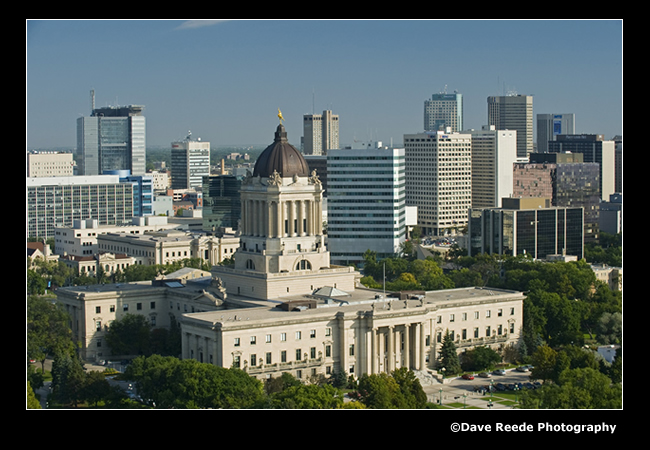
The Manitoba Legislative Building,
equivalent to a State Capitol or State House

According to the figures I have, Winnipeg has a population of 705,000, more than fellow NHL cities Detroit, Denver, Boston, Washington, Nashville, Vancouver, Raleigh, Miami, Minneapolis, Tampa, Anaheim, St. Louis, Pittsburgh, Newark and Buffalo -- but only 812,000 in its metropolitan area, meaning their "suburbs" add up to only 107,000 people. They are last in metro-area population in the NHL, although they are ahead of Hamilton and Regina in the CFL. The people are about 68 percent white, 13 percent East Asian, 11 percent Aboriginal, 4 percent South Asian, 3 percent black, 1 percent Hispanic and 1 percent Middle Eastern.
Since Canada is in the British Commonwealth, there are some subtle differences. Every measurement will be in the metric system. Dates are written not as Month/Day/Year, as we do it, but as Day/Month/Year as in Britain and in Europe. So the game is played for us on "July 7, 2017," but for them on "7 July 2017." The day before would be written by us as 7/6/17, but by them as 6/7/17.

They also follow British custom in writing time: This game is scheduled to start at 6:00 PM, and will be listed as 1800. (Those of you who have served in the military, you will recognize this as, in the words of M*A*S*H's Lt. Col. Henry Blake, "all that hundred-hours stuff.") And every word we would end with -or, they will end with -our; and some (but not all) words that we would end with -er, they end with -re, as in "MTS Centre."
Another thing to keep in mind: Don't ask anyone where the "bathroom" is -- ask for the "washroom." This difference was a particular pet peeve of mine the first time I visited Toronto, although it wasn't a problem in Montreal as I knew the signs would be in French.


Every measurement will be in the metric system: Temperatures will be in Celsius, not Fahrenheit; distances will be in "kilometres," not miles (including speed limits, so don't drive 100 thinking it's miles); and gas prices will be per "litre," not per gallon (so don't think you're getting cheap gas, because a liter is a little more than a quart, so multiply the price by 4, and you'll get roughly the price per gallon, and it will be more expensive than at home, not less). Better to get gas at one of your rest stops before going into Canada.

Manitoba's sales tax is 13 percent -- in 2010, this replaced the former Provincial sales tax of 5 percent and the federal GST (Goods & Services Tax) of 8 percent. In other words, the Conservative Party government of Prime Minister Stephen Harper wanted Canadians to think he'd killed the hated GST, when, in fact, Manitobans are paying pretty much the same taxes that they did before. See how stupid it is to vote for conservative candidates? It doesn't work in any country, as Canada recently admitted by dumping Harper and his Tories for Justin Trudeau and his Liberals.

The Red River divides street addresses into east and west, and the Assiniboine River divides the city into north and south. Winnipeg doesn't have a subway, and its buses are $2.50 cash and $2.15 for a prepaid ticket. Again, that's in Canadian dollars, making it cheaper than New York's MTA or New Jersey Transit. The city has no freeway "beltway."

The drinking age in Manitoba is 18. Postal Codes in Manitoba begin with the letter R. The Area Codes are 204 and 431. Utilities are run by Manitoba Hydro.

Going In. Today, the Blue Bombers play at Investors Group Field. Opening in 2013 on the campus of the University of Manitoba, it is a 33,500-seat facility that can be expanded to 40,000. The address is 315 Chancellor Matheson Road, at University Crescent, about 6 miles south of downtown. Take the Number 60 bus from downtown to the aforementioned intersection, across from IGF's southeast corner. If you drive in, parking is C$20.

The funky roof protects nearly the fans, but not the players, from precipitation, much like the old Texas Stadium outside Dallas. The playing surface is FieldTurf, and runs north-to-south. Remember, it's Canadian football, so the field is 110 yards long, not 100; 65 yards wide, not 53 1/3rd; with end zones 25 yards deep, not 10, so the passing game has more primacy; 12 men on a side, not 11; and 3 downs to get a new 1st down, not 4.
IGF hosted the 2015 Grey Cup (Edmonton beat Ottawa), and 7 games of the 2015 Women's World Cup, including the U.S.' win over Australia and draw with Sweden en route to winning the Cup. Last October 23, it hosted the NHL Heritage Classic, with the Winnipeg Jets beating the Edmonton Oilers 3-0.
Taylor Swift played its 1st concert, but its 1st sold-out concert was by then 71-year-old Paul McCartney. (For comparison's sake: When Taylor Swift was born in 1989, Paul was 47, on one of his biggest tours, and was still making the U.S. Top 40. Taylor should be so lucky in 2036.) The King and Queen of recent pop music, Jay-Z and Beyonce, played it in 2014, 1 of only 2 Canadian venues on their tour (the other being the Rogers Centre in Toronto).

In 2018, the Canadian Premier League, Canada's attempt at a "top flight" soccer league, will begin play, and Winnipeg will have a team, as yet unnamed, playing at IGF.

UPDATE: The League will start instead in Spring 2019, and will include Valour FC, owned by, and groundsharing with, the Blue Bombers.

Food. Lots of good stuff is available:

Section 101    Shawarma Khan Mobile Cart (Propriety Items plus Beverages)
Section 102    Danny’s Whole Hog Mobile Cart (Pulled Pork Sandwiches, Beer, Beverages, Snacks)
Section 103    PIZZA HOTLINE (Pizza Products, Beer, Snacks & Beverages)
Section 104    Bottoms Up Mobile Cart (Draught Beer)
Section 105    Filipino Mobile Cart (Filipino food, Beverages)
Section 106    SALISBURY HOUSE (Salisbury House propriety Items, Beer, Popcorn, Beverages, Snacks)
Section 109    Chicken Tenders & Wings (Fried Chicken, FF, Beverages, Hot Dogs, Beer, Snacks)
Section 111    Pretzel Place Mobile Cart (Pretzel items, Beverages, Beer, Snacks)
Section 112    GOAL LINE (Speciality Drinks, Beer, Liquor, Coolers, Wine)
Section 113    Mighty Mini Donuts Mobile Cart (Donuts & Beverages)
Section 115    MVP Mobile Cart (Individual Ice Creams, Snacks, Beverages, Beer)
Gate 2            Back Field Bar (Liquor)
Section 117    Bottom’s Up Mobile Cart (Draught Beer)
Section 117    PIZZA HOTLINE (Pizza Products, Gilati, Snacks, Beverages, Beer)
Section 118    Buzz & Boomer Burgers & Dogs Mobile Cart (Burgers, Hot Dogs, Snacks, Beverages, Beer)
Section 119    MVP Hot Dog Cart Mobile Cart (Individual Ice Creams, Snacks, Beverages, Beer)
Section 121    Clay Oven (East Indian Cousine, Beverages)
Section 121    MVP Mobile Cart (Individual Ice Creams, Snacks, Beverages, Beer)
Section 122    Backfield Bar Mobile Cart (Draught Beer)
Section 123    Bottom’s Up Mobile Cart (Draught Beer)
Section 124    Shawarma Khan Mobile Cart (Propriety Items plus Beverages)
Section 125    FIRST DOWN (Speciality Hot Dogs, Beverages, Beer, Snacks, Candy)
Section 126    Mighty Mini Donuts (Donuts & Beverages)
Section 127    POUR HOUSE (Speciality Drinks, Beer, Liquor, Wine)
Section 128    Chicken Tenders & Wings (Fried chicken, Beverages, Beer, Snacks)
Section 130    Bottom’s Up Mobile Cart (Draught Beer)
Section 131    Salisbury House ( Burgers, Hot Dogs, FF, Snacks, Beer, Beverages)
Section 133    Pretzel Place Mobile Cart (Pretzel items, Beverages, Beer, Snacks)
Section 134    Captain Blue Poutinerie (Poutine, Beer, Snacks)
Section 135    Danny’s Whole Hog Mobile Cart (Pulled Pork Sandwiches, Beer, Beverages, Snacks)
Section 137    Caesars & Beer Mobile Cart (Canned Beer Products)
Section 138    Bottoms Up Mobile Cart (Draught Beer)
Section 138    RUM HUT (Speciality Drinks, Beer, Liquor, Coolers, Wine)
Section 138    Bottom’s Up Mobile Cart (Draught Beer)
Section 141    Burger/Filipino Cart Mobile Cart (Filipino food, Burgers, Beverages)
Section 142    Shock Top Specialty Beers Mobile Cart (Premium draught beer, canned beer)
Section 142    New Amsterdam Vodka Bar (Speciality Drinks, Beer, Liquor, Coolers, Wine)
Section 142    Backfield Bar Mobile Cart (Draught Beer)
Section 144    Bottoms Up Mobile Cart (Draught Beer)
Section 144    Mighty Mini Donuts Mobile Cart (Donuts & Beverages)
200 Level Concourse Concessions Listing
200 Level East Side Concessions Listing
Section 201    Backfield Bar Mobile Cart (Canned Beer Products)
Section 203    HOME GROWN  (Local Product, Hot Dog’s, Beverages, Beer, Snacks, Popcorn)
Section 206    GRID IRON GRILL (Burgers, Hot Dogs, FF, Snacks, Beer, Beverages)
Section 208    Chicken Tenders & Wings Mobile Cart (Fried Chicken, Snacks, Beverages)
Section 208    Shawarma Khan Mobile Cart (Propriety Items plus Beverages)
Section 210    Pretzel Place (Pretzel items, Beverages, Beer, Snacks)
Section 210    Upper Deck Bar Mobile Cart (Draught Beer)
Section 212    Mini Donuts Mobile Cart
Section 212    The Greats (Hot Dogs, Popcorn, Wraps, Beverages, Beer)
Section 214    Touch Down Bar (Speciality Drinks, Beer, Liquor, Wine)
Section 215    New Amsterdam Vodka Bar Mobile Cart (Speciality Drinks, Beer, Liquor, Coolers, Wine)
200 Level West Side Concessions Listing
Section 223    Backfield Bar (Speciality Drinks, Beer, Liquor, Coolers, Wine)
Section 224    Pretzel Place (Pretzel items, Beverages, Beer, Snacks)
Section 225    HOME GROWN (Local Product, Beverages, Hot Dogs, Popcorn, Beer, Snacks)
Section 228    Shawarma Khan Mobile Cart (Propriety Items plus Beverages)
Section 229    GRIDIRON GRILL (Burgers, Hot Dogs, FF, Snacks, Beer, Beverages)
Section 230    Bottoms Up Mobile Cart (Draught Beer)
Section 231    The Greats (Hot Dogs, Popcorn, Wraps, Beverages, Beer, Snacks)
Section 232    Upper Deck Bar Mobile Cart (Canned Beer Products)
Section 234    Mini Donuts Mobile Cart
Section 234    Chicken Tenders & Wings (Hot Dogs, Popcorn, Wraps, Beverages, Beer, Snacks)
Section 236    Touch Down Bar (Speciality Drinks, Beer, Liquor, Wine)
Section 237    Appletons Bar Mobile Cart (Speciality Drinks, Beer, Liquor, Coolers, Wine)
Team History Displays. The Bombers were founded in 1930 as the Winnipeg Football Club, which remains their official name today. They wore blue, and merged with another club, wearing gold, to forge the colors known today.

They became known as the Winnipeg 'Pegs, and it was under this name that they won their 1st Grey Cup, in 1935. This made them the 1st team west of Ontario to win it. Winnipeg Tribune sportswriter Vince Leah, as a takeoff on Joe Louis' nickname the Brown Bomber, called the team the Blue Bombers, and so they have been ever since.

The good news is that the Bombers have won 10 Grey Cups, more than any team except the Toronto Argonauts and the Edmonton Eskimos. The bad news is that they've gone longer without winning it than any CFL team, last taking the Cup on November 25, 1990, 50-11 over the Eskimos at BC Place in Vancouver. That was their 3rd Cup in 7 years, and they won 4 in 5 years from 1958 to 1962, under Bud Grant, who would later coach the Minnesota Vikings. Grant now has a statue outside the stadium.
Bud Grant. And he was only in his early 30s then.
He's 90 now, and still beloved in Manitoba and Minnesota.

And they have made the Grey Cup Final 5 times since 1990, most recently in 2011 with their "Swaggerville" defense. But they still haven't won it in 17 years.

In 2005, the Bombers named a 75th Anniversary team. The players are, in alphabetical order: Greg Battle, Dieter Brock, Tom Clements, Herb Gray, Bob Cameron, Tom Casey, Fritz Hanson, Rick House, Jack Jacobs, Gerry James, Trevor Kennerd, Leo Lewis, James Murphy, Ken Ploen, Frank Rigney, Charles Roberts, Joe Poplawski, Willard Reaves, Milt Stegall and Chris Walby.

There are 32 men connected with the Blue Bombers in the Canadian Football Hall of Fame. They are:

* From the 1935, 1939 and 1941 Grey Cup Champions: Club founder and 1st CFL Commissioner Sydney Halter, team president Frank Hannibal, team executive Joe Ryan, team executive Karl Slocomb, running back and defensive back Melvin "Fritz" Hanson, running back and defensive back Eddie James, running back and defensive back Greg Kabat, running back and defensive back Russ Rebholz, running back and defensive back Art Stevenson, receiver and defensive back Chester "Ches" McCance, offensive and defensive tackle Les Lear. Bert Warwick was a quarterback on this team, later coached the Bombers into the 1945 Grey Cup Final (which they lost), and was later elected to the Hall of Fame as a "Builder" for his service at the League level. Halfback Joe Nicklin was also on this team, and he's noteworthy for a reason I'll get to shortly.

* From the 1950 and 1953 Western Interprovincial Football Union Champions (winning the WIFU but losing the Grey Cup Final): Quarterback Jack Jacobs, running back and defensive back Tom "Citation" Casey, running back and defensive back Gerry James, offensive and defensive tackle Dick Huffman. Gerry James was the son of the aforementioned Eddie James, and also played for the Toronto Maple Leafs. In 1959-60, he became the only man ever to play in the Grey Cup Final and the Stanley Cup Final in the same season, winning the former and losing the latter. Guard Tommy Lumsden also played for this team.

* From the 1958, 1959, 1961 and 1962 Grey Cup Champions: Coach Grant, James, quarterback Ken Ploen, running back Leo "the Lincoln Locomotive" Lewis, offensive tackle Frank Rigney, offensive and defensive tackle Robert "Buddy" Tinsley, and defensive end (and sometimes also guard) Herb Gray.
Leo Lewis

* From the 1965 to 1984 interregnum: Quarterback Dieter Brock, offensive tackle Bill Frank, defensive tackle John Helton.

* From the 1984 Grey Cup Champions: Head coach and general manager Cal Murphy, quarterback Tom Clements (now the offensive coordinator of the Green Bay Packers), receiver James Murphy (no relation to Cal), receiver Joe Poplawski, center John Bonk, offensive tackle Chris Walby. From the 75th Anniversary Team, running back Willard Reaves, slotback Rick House, kicker Trevor Kennerd, punter Bob Cameron.

* From the 1988 Grey Cup Champions: Cal Murphy (now just GM), James Murphy, Walby. From the 75th Anniversary Team, Kennerd, Cameron, linebacker Greg Battle (not to be confused with his contemporary, Jets linebacker Greg Buttle).

* From the 1990 Grey Cup Champions: Cal Murphy, James Murphy, Walby, defensive back Less Browne. From the 75th Anniversary Team, House (who had left before the '88 title but had been reacquired by '90), Kennerd, Cameron, Battle.
Chris Walby, a.k.a. "Big Bluto"

* From the 2001 and 2007 CFL Eastern Division Champions: Slotback Milt Steagall. From the 75th Anniversary Team, running back Charles Roberts. No players from the 2011 CFL Eastern Division Champions have yet been elected.
Hall of Fame display outside IGF

The Bombers have no officially retired numbers. They have 6 that are unofficially retired: 6, Cameron; 11, Ploen; 28, Nicklin; 63, Walby; 75, Lumsden; and 85, Stegall.

In 2006, TSN (The Sports Network, Canada's version of ESPN) named the CFL's Top 50 Players. From the Bombers, Helton came in at 12, Stegall at 15, Walby at 22, Browne at 23, Lewis at 29, Clements at 47 and Bill Frank at 49.

Although many American football stars have gone north to play in the CFL, no Heisman Trophy winner has ever played for the Bombers.

The Bombers' biggest rivals are the Saskatchewan Roughriders, against whom they play the annual Labour Day Classic. The Bombers lead this rivalry 34-18. (UPDATE: Through the 2018 season, the Bombers lead it 36-18.)

Stuff. The Bomber Store is under the south end stands. It may be that, due to the city's Western heritage, there are cowboy hats with the team logo on them. But bomber pilot helmets, in honor of the team's name? That might be a bit of a stretch.

Amazon.com doesn't seem to have any books about the Blue Bombers, but the CFL Traditions DVD series has a video on them.

During the Game. The fans can get rowdy. "Swaggerville" was a nickname that began in 2011, applied first to the Bombers' linebacking corps, then to their entire defense, and now to their entire fan base -- even though the lack of a Grey Cup in over a quarter-century means they haven't had much to swagger about. That said, you won't be rooting for any of the teams Bomber fans tend to dislike: Saskatchewan, Toronto or Ottawa. Your safety will almost certainly not be an issue.
Unlike their fellow 'Peggers, the Winnipeg Jets, who have Stacey Nattrass, the Blue Bombers don't have a regular National Anthem singer, instead holding auditions. Their fight song is "The Winnipeg Football March." The mascots are a pair of birds, wearing old-time football helmets without facemasks: Boomer, who wears Number 00 and does more fan interaction; Buzz, who wears Number 01 and bomber-pilot glasses, and does more stunts.
Boomer and Buzz.

The Bombers tend to play their arch-rivals, the Saskatchewan Roughriders, in back-to-back weeks: On the 1st weekend in September, in Regina in one of the CFL's Labour Day Classic games, and in a game called the Banjo Bowl a week later in Winnipeg. The game got its name in 2003, when placekicker Troy Westwood, the Bombers' all-time leading points scorer, said that Riders fans were "a bunch of banjo-pickin' inbreds." As if there isn't a lot of rural area in Manitoba. He then "apologized" by saying, "The vast majority of the people in Saskatchewan have no idea how to play the banjo."

After the Game. Winnipeg is a city, but it's a Canadian city. You're going to be safer than in most American cities. And while Canadians like to drink, if you behave yourself and don't antagonize anyone, the home fans will do the same.

Investors Group Field is on the campus of the University of Manitoba, but there are a few places to eat along the adjacent Pembina Highway to the west. That's if you drove in. If you took the bus, you'd be better off going back downtown. And there is unlikely to be a bar in Winnipeg that caters to expatriate or visiting New Yorkers and New Jerseyans.

If your visit to Winnipeg is during the European soccer season, which starts up again in mid-August, your best bet to watch your club is at The Pint, at 274 Garry Street, downtown.

Sidelights. Despite the struggles of Winnipeg's football and hockey teams, the city has actually got a decent sports history.

There was a 3-building complex at 1430 Maroons Road, at the corner of Empress Street. This included the Winnipeg Arena, Winnipeg Stadium and the Polo Park horse racing track.

Winnipeg Stadium stood at 1465 Maroons Road, and was home to the Blue Bombers from 1953 to 2012. While there, they won 7 Grey Cups: 1958, 1959, 1961, 1962, 1984, 1988 and 1990. It was also home to baseball's Winnipeg Whips in 1970 and '71. Another baseball team, the Winnipeg Goldeyes, played there from 1954 to 1964, as a farm team of the St. Louis Cardinals, winning Northern League Pennants in 1957, 1959 and 1960. The new version of the Goldeyes played there from 1994 to 1998.

The Stadium seated about 33,000 at its peak, although temporary seating for the 1991 Grey Cup raised it to 51,985. It was switched from natural grass to artificial turf in 1988. In 2000, a hotel chain bought the naming rights, and it became Canad Inns Stadium for the rest of its existence.
The Arena was home to the Winnipeg Warriors of the Western Hockey League from its opening in 1955 until 1961, the Winnipeg Jets of the Western Canada Hockey League from 1967 to 1972, the orginal WHA/NHL Jets from 1972 to 1996, and the Manitoba Moose of the International Hockey League and the American Hockey League from 1996 to 2004, when the MTS Centre Opened.
It also hosted Game 3 of the 1972 Canadian-Soviet "Summit Series," even though Winnipeg was, at the time, not an NHL city, and was, in fact, pandering to the WHA. This was awkward because Team Canada only included players from the NHL, barring defectors to the WHA like Bobby Hull (Chicago to Winnipeg), Bernie Parent (Toronto to Philadelphia, before Philly again in the NHL) and Gerry Cheevers (Boston to Cleveland).

That, plus Bobby Orr's injury, made the series a down-to-the-last-minute-of-the-last-game affair. Had Hull been allowed and Orr able to play, the legend of the great Red Army team might have been strangled in the crib.
Note the steep upper deck and the portrait of
Canada's head of state, Queen Elizabeth II.

Like the Colisee de Quebec, 10,000 seats was enough for the WHA, but not for the NHL. So, like their WHA bretheren the Nordiques, they expanded their Louis St. Laurent-era arena to 15,000 seats. Unfortunately, also like the Nords, the Jets found the NHL rough going from 1979 onward, losing the core of their WHA dynasty in a dispersal draft, and setting a league record in 1980-81 for longest winless streak: 30 games (23 losses, 7 ties), and earning the nickname "Loseipeg."

Also like the Nords, they got better in the 1980s, and made the Playoffs again in the 1990s. But, again, like the Nords, it was too late, as the combination of a bad exchange rate and an outdated arena led to them moving. Like Winnipeg, Quebec City now has a new arena, too, so, like the Jets, the Nords could come back, too.

The Arena and the Stadium did not share space with Polo Park for long. Polo Park hosted thoroughbred racing from 1925 to 1956, and was demolished shortly thereafter. The Polo Park Mall opened in 1959. Today, an industrial site sits across Maroons Road from the mall, where the Arena and the Stadium once stood. Bus 11 from downtown.

Bell MTS Place is downtown, at 300 Portage Avenue. It opened as the MTS Centre in 2004, having been built in the hopes of attracting a moved or expansion team to the former city of the team now known as the Arizona Coyotes. The Manitoba Moose played there from 2004 to 2011. The name was just changed, as Bell Canada acquired MTS this past May.
One of the first events held there was the 2005 Juno Awards, Canada's equivalent of the Grammys. After a few preseason exhibition games, including one by the ex-Jets (then named the Phoenix Coyotes), the Atlanta Thrashers made the move, and played their 1st regular-season home game as the new Winnipeg Jets on October 9, 2011.

UPDATE: The arena was renamed the Canada Life Centre in 2021.

The University of Manitoba Bisons won the Memorial Cup, the championship of Canadian junior hockey, in 1935, 1937 and 1946. Other Manitoba-based teams to do so were the 1921 Winnipeg Junior Falcons, the 1923 Winnipeg Monarchs, the 1938 St. Boniface Seals, the 1941 and 1943 Winnipeg Rangers, the 1942 Portage la Prairie Terriers, the 1957 Flin Flon Bombers, and the 1959 Winnipeg Braves.

Prior to the construction of Winnipeg/CanadInns Stadium, the Blue Bombers played at Osborne Stadium from 1935 to 1952, winning the Grey Cup in 1935, 1939 and 1941. The Blue Bombers played exhibition games against the Columbus Bullies, champions of the 1940s version of the American Football League, at Osborne over the course of 3 weeks in 1941: Losing 19-12 on August 26, 6-0 on September 1, and 31-1 (a blocked extra point returned for a touchdown) on September 10. A baseball team called the Winnipeg Reo Rods also called it home.

Opened in 1932, with just 7,800 seats, it was too small for CFL play. It was demolished in 1956, and the Great-West Life Assurance Building now stands on the site. 60 Osborne Street at Granite Way, across from the Manitoba Legislative Building.
The current version of the Winnipeg Goldeyes has played at Shaw Park since it opened in 1999. Formerly named CanWest Global Park, it seats 7,461, making it ideal for independent leagues like the current version of the American Association (not to be confused with the longtime Triple-A league or the 1880s major league of the same name).
These Goldeyes have won 9 division titles, and Pennants in 1994 and 2012, making for 5 Pennants for Winnipeg baseball teams. "The Fishbowl" stands at 1 Portage Avenue East, at Waterfront Drive along the Red River. Number 1 or 10 bus from downtown.

From 1909 to 1955, Winnipeg's hockey center (or, should I say, "centre") was Shea's Auditorium. For many years, it held Canada's only artificial ice surface between Toronto and Vancouver. The University of Winnipeg Library now stands on the site, although their hockey rink, the Duckworth Centre, is adjacent. 515 Portage Avenue, 6 blocks west of the MTS Centre. In other words, when the new arena opened in 2004, Winnipeg hockey was coming home, even if it took the Jets a little longer.

Winnipeg has won the Stanley Cup 3 times. Did you know that? But it was a really long time ago. In fact, they've gone longer without winning the Cup than any city that has actually won it: 114 years. The Winnipeg Victorias won it in 1896, 1901 and 1902. The Victorias played at the Winnipeg Auditorium, at Garry Street and York Avenue, downtown. The Auditorium was destroyed by a fire in 1926. A bank and a parking deck now stand on the site of the greatest achievement in the history of Manitoba sports.

The Manitoba Sports Hall of Fame is at 145 Pacific Avenue at Lily Street. Number 20 bus.

Minneapolis is both the closest MLB city and the closest NBA city to Winnipeg: 456 miles away. Don't count on Winnipeg ever getting a team in either league: It would rank dead last in metropolitan area population. It already ranks last in the NHL, and still would if Quebec City returns, although not if Hamilton, Ontario gets a team as it has tried to do for the last 30 years. Even in the CFL, the Blue Bombers, at least in terms of metro population, have a "Borg ranking": 7 of 9, ahead of only the Hamilton Tiger-Cats and the Regina-based Saskatchewan Roughriders.

According to an article in the May 12, 2014 New York Times, the most popular NBA team in the city of Winnipeg is the Miami Heat, but in the suburbs, it's the Los Angeles Lakers. I don't know why there's a difference.

Like most major (or major-wannabe) cities, Winnipeg has museums. The Canadian Museum for Human Rights is at 85 Israel Asper Way, at York Avenue, across Pioneer Avenue from Shaw Park. Number 1 or 10 bus. Across Asper Way and the railroad tracks is the Winnipeg Railroad Museum. The Manitoba Planetarium and Science Gallery is at 190 Rupert Avenue at Main Street. Number 20 bus.

Adjacent to the Museum for Human Rights is The Forks, named for the splitting of the Red and Assiniboine Rivers. Because of this confluence, it was a meeting place for early Aboriginal peoples (Indians/Native Canadians/First Nations), European fur traders, hunters, riverboat and railway workers, and Manitoba's immigrants.

The complex now includes the Forks Market, in effect Winnipeg's South Street Seaport, Reading Terminal Market, Harborplace or Faneuil Hall/Quincy Market. 1 Forks Market Road, at Israel Asper Way. The Manitoba Children's Museum is also part of the complex, at 45 Forks Market Road. Number 1 or 2 bus.

Arthur Meighen, who served briefly twice (1920-21 and for a few weeks in 1926), is the only Prime Minister of Canada to have represented a riding (district) in Manitoba, in his case the nearby town of Portage La Prairie. There is no historical site in his honor, though.

The tallest building in Winnipeg is 201 Portage, standing a mere 420 feet at the intersection of Portage Avenue and Main Street, 3 blocks from Bell MTS Place. It looks nice, but it's no skyscraper.

Any TV shows set in Winnipeg would only be shown on Canadian television, and wouldn't be familiar to Americans. There have, however, been major films that you would recognize shot in and around Winnipeg. Many of these have been westerns or more recent period pieces that take advantage of the surrounding prairies, such as The Assassination of Jesse James by the Coward Robert Ford (set in 1882 Missouri) and Capote (set in 1959 Kansas while Truman Capote was researching the murders that became the basis of his book In Cold Blood). Other movies with scenes filmed in Winnipeg include K-19: The Widowmaker, Shall We Dance, The Constant Gardener and The Haunting in Connecticut (despite the title).

*

Winnipeg is not very big city, and it's far away, with little to attract the local hockey fan besides hockey. But once you're there, it turns out to be a much more interesting place. Give it a go, whether you're a football fan or not.