Saturday, March 4, 2017

How to Be a Devils Fan In Arizona -- 2017 Edition

Why would you want to go to Arizona? Well, if you're a New Jersey Devils fan, they're playing the Arizona Coyotes (formerly the Phoenix Coyotes, and before that the original Winnipeg Jets) this coming Saturday afternoon.

You may not have many more chances to see the Coyotes in their current form, at their current home. With the Islanders now ensconced in Brooklyn, and the Atlanta Thrashers having become the new Winnipeg Jets, the 'Yotes are now the NHL most likely to move. How likely? They've been in danger of it since at least 2009, and their current arena lease runs only through 2018-19.

The current Phoenix hockey team is called the Coyotes, and the old one, playing there in the World Hockey Association from 1974 to 1977, was called the Roadrunners. Coyote and Roadrunner. "Meep meep!"

Before You Go. AZcentral.com, the website for Phoenix's largest newspaper, the Arizona Republic, is predicting mid-60s for Saturday afternoon, and mid-40s for the evening. So the legendary Arizona "dry heat" won't be an issue. Still, once you get on the plane, you'll want to ditch your winter coat.

Arizona's infamous Daylight Savings Time issue has been settled: The State is on Mountain Time when New York is on Daylight Savings Time, and on Pacific Time when we're on Standard Time. This isn't the DST time of year. So you'll be on Mountain Time, 2 hours behind New Jersey and New York City. Adjust your timepieces accordingly.

If you're thinking of making a side trip into Mexico, you should know that it's a 4-hour drive at the least. No public transportation. You'll need a passport, and you'll also need Mexican driving insurance, which you might be able to get at the Mexican consulate in Phoenix. In other words, it's not really worth the trip.

Tickets. The Coyotes are averaging 12,949 fans per home game this season, a drop of over 300 over the season before. Only the Islanders and the Carolina Hurricanes are averaging less. And, at 75 percent of their arena's seating capacity, only the 'Canes are averaging less. For comparison's sake, the Devils, much maligned for their attendance issues, are averaging 14,688, 89 percent. Now who's "a Mickey Mouse operation on the ice," former Coyotes owner Wayne Gretzky?

Getting tickets will not be hard: You could probably show up at the arena box office 5 minutes before puck-drop, and get any ticket you can afford.

With the law of supply and demand, Coyotes tickets are among the cheapest in the NHL. Seats in the lower level, the 100 sections, are $120 between the goals and $80 behind them. In the upper level, the 200 sections, seats are 50 between the goals and $20 behind them.

Getting There. It's 2,458 miles from Times Square downtown Phoenix, and 2,444 miles from the Prudential Center in Newark to the Gila River Arena in Glendale. In other words, if you're going, you're flying.

You think I'm kidding? Even if you get someone to go with you, and you take turns, one drives while the other one sleeps, and you pack 2 days' worth of food, and you use the side of the Interstate as a toilet, and you don't get pulled over for speeding, you'll still need nearly 2 full days to get there. One way.

But, if you really, really want to... You'll need to get on the New Jersey Turnpike. Take it to Exit 14, to Interstate 78. Follow I-78 west all the way through New Jersey, to Phillipsburg, and across the Delaware River into Easton, Pennsylvania. Continue west on I-78 until reaching Harrisburg. There, you will merge onto I-81. Take Exit 52 to U.S. Route 11, which will soon take you onto I-76. This is the Pennsylvania Turnpike, the nation's first superhighway, opening in 1940.

The Turnpike will eventually be a joint run between I-76 and Interstate 70. Once that happens, you'll stay on I-70, all the way past Pittsburgh, across the little northern panhandle of West Virginia, and then across Ohio, Indiana and Illinois, into Missouri.

At St. Louis, take Exit 40C onto Interstate 44 West, which will take you southwest across Missouri into Oklahoma. Upon reaching Oklahoma City, take Interstate 40 West, through the rest of the State, across the Texas Panhandle and New Mexico, into Arizona.  At Flagstaff, take Interstate 17 South, which will take you into Phoenix. Take Interstate 10 West to Exit 133B, which will lead you to State Route 101. Take Exit 6 to the arena/stadium complex

If you do it right, you should spend about an hour and 15 minutes in New Jersey, 5 hours and 30 minutes in Pennsylvania, 15 minutes in West Virginia, 3 hours and 45 minutes in Ohio, 2 hours and 45 minutes in Indiana, another 2 hours and 45 minutes in Illinois, 5 hours in Missouri, 6 hours in Oklahoma, 3 hours in Texas, 6 hours and 15 minutes in New Mexico, and 5 hours and 30 minutes in Arizona. That's about 42 hours. Counting rest stops, you're probably talking about 55 hours.

That's still faster than Greyhound, averaging around 68 hours, including a 1:45 bus-change in Richmond, a 1:15 stopover in Charlotte, an hour's bus-change in Atlanta, an hour's stopover in Birmingham, a 45-minute stopover in Jackson, Mississippi, an hour's stopover in Shreveport, a 1:30 bus-change in Dallas (that's right, changing buses 3 times each way), and a 1:15 stopover in El Paso.

It's $478 round-trip ($398 with advanced purchase), and to get to Phoenix by Saturday morning, you'll have to leave today, by 5:15 PM. The station is at 2115 East Buckeye Road, adjacent to Sky Harbor International Airport. Number 13 bus to downtown.

The way Amtrak has it set up now, it's so convoluted that I can't even recommend looking it up. Their downtown Union Station has been permanently closed, making the nearest station the one in Maricopa, 34 miles south of downtown.

United Airlines can get you round-trip from Newark to Sky Harbor for a little over $700. 

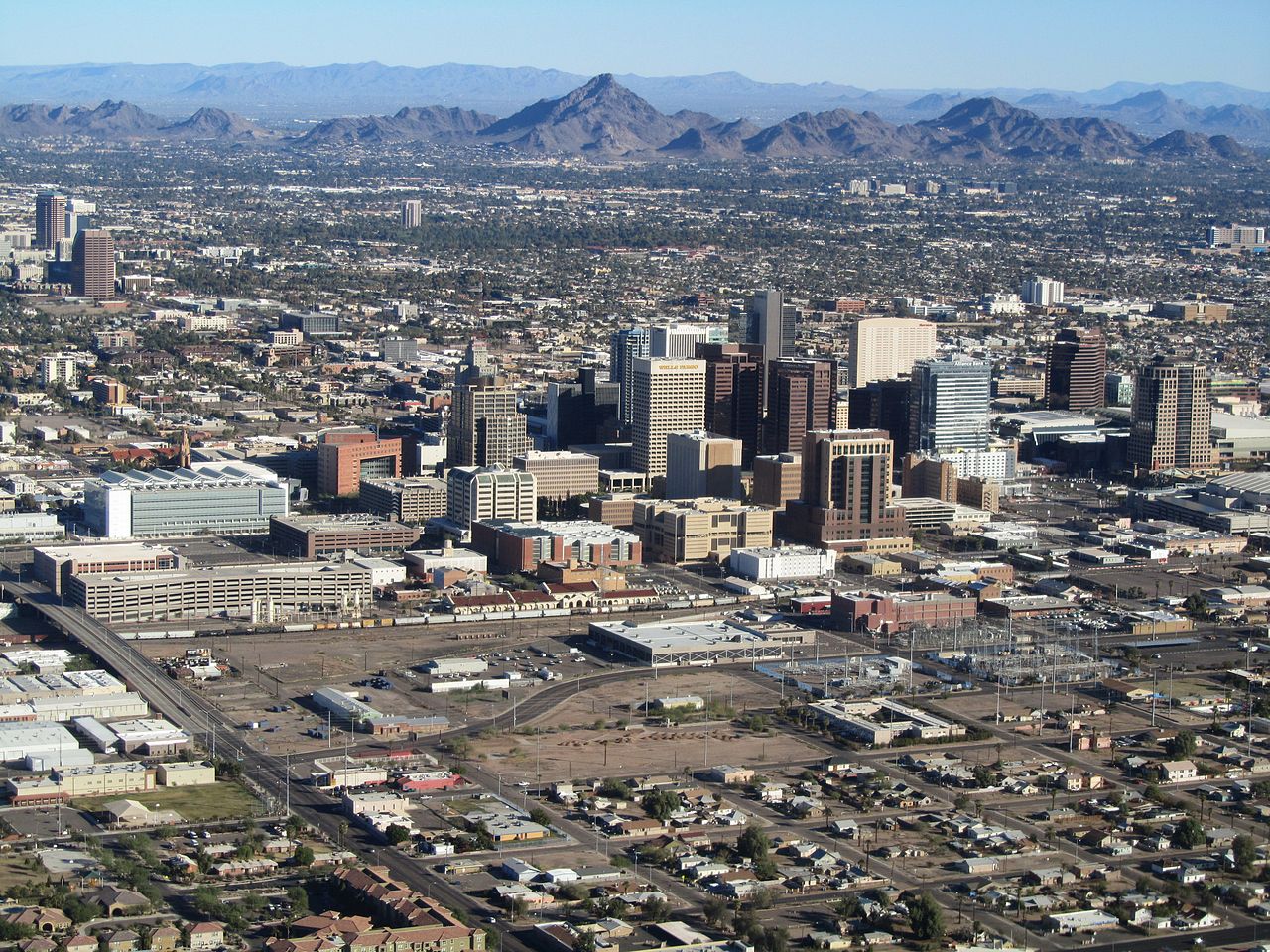
Once In the City. While the Coyotes (as do MLB's Diamondbacks and the NFL's Cardinals, but not the NBA's Suns) have the State name as their geographic identifier -- apparently from a Native American word meaning "small spring" -- they play in Arizona's State capital, Phoenix.

Jack Swilling, a Confederate veteran who founded the place in 1867, accepted the suggestion of a fellow settler, an Englishman named Lord Duppa: Since it was on the site of a previous Indian civilization, it should be named Phoenix, for the mythical bird that rose from its own ashes. The city was incorporated in 1881, making it the youngest city in American major league sports.
The State House in Phoenix

Home to just 100,000 people in 1950, Phoenix saw huge growth in the 2nd half of the 20th Century, thanks in large part to the growth of the air-conditioning industry: 440,000 by 1960, 580,000 by 1970, 800,000 by 1980, and it surpassed the 1 million mark in the early 1990s. It's 1.6 million now, with about 4.6 million people in the metropolitan area.

All this made it an expansion target: The Suns arrived in 1968, the NFL's St. Louis Cardinals in 1988 (after the Philadelphia Eagles had to quash a moving-there rumor earlier in the decade), and the first Winnipeg Jets in 1997 (after the WHA had the Phoenix Roadrunners in the 1970s). Today, Phoenix is home to 1.5 million people, with 4.4 million in its metropolitan area.

The sales tax in Arizona is 5.6 percent, but it's 8.3 percent within the City of Phoenix. ZIP Codes for Arizona start with the digits 85 and 86, and the Area Codes are 602 (for Phoenix), 480 and 623 (for the suburbs).

Central Avenue is the source street for east-west house numbers; oddly, the north-south streets are numbered Streets to the east, and numbered Avenues to the west. Washington Street divides addresses into north and south. A single ride on Phoenix buses and Valley Metro Rail is $2.00, with an All-Day Pass a bargain at $4.00. 
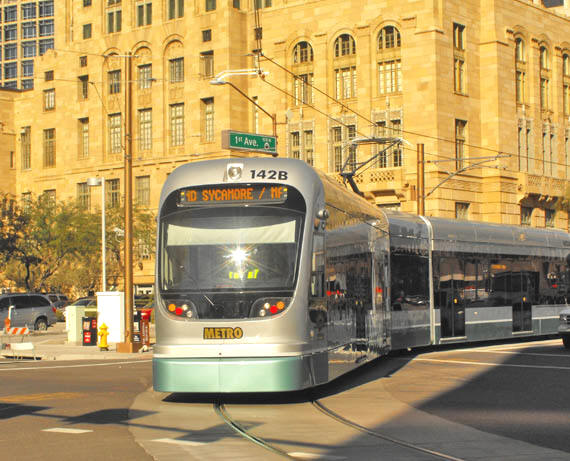
A Valley Metro Rail train

Going In. The Glendale Sports & Entertainment District, in the Phoenix suburb of Glendale, consists of The University of Phoenix Stadium, home to the Arizona Cardinals since 2006; and the Gila River Arena, home to the Coyotes since 2003.

The complex is about 17 miles northwest of downtown Phoenix. The official address of the stadium is 1 Cardinals Drive, and that of the arena is 9400 W. Maryland Avenue. Number 8 bus from downtown to 7th & Glendale Avenues, then transfer to Number 70 bus, to Glendale and 95th Avenue, then walk down 95th. If you drive in, parking starts at $10.

New York Tri-State Area sports fans know the stadium as the place where the Giants derailed the New England Patriots' bid for the NFL's first 19-0 season. The Cardinals defeated the Philadelphia Eagles there in January 2009 to advance to Super Bowl XLIII. The stadium is also home to the Fiesta Bowl. (There is an actual University of Phoenix, on the ground, not just on the Internet. But that's not here.) It's hosted 3 matches of the U.S. soccer team, most recently a 1-0 loss to Colombia in the Copa America this past June 25.
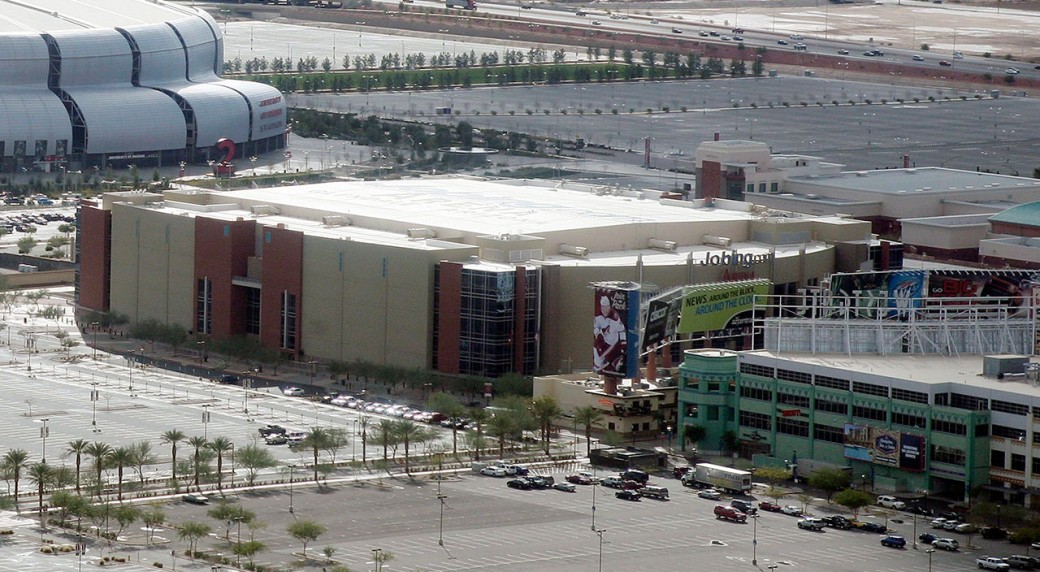
Gila River Arena, under its former name Jobing.com Arena,
between University of Phoenix Stadium and the Westgate Mall

Formerly the Jobing.com Arena, named for an employment-service website, Gila River Casinos, run by local Native American tribes, now holds naming rights to the arena. The rink is laid out north-to-south. The Coyotes attack twice toward the south end.
Since the Suns' arena is downtown, the Coyotes' arena doesn't get many concert tours. It averages 14 non-hockey events a year -- so, not counting any Playoff games the Coyotes host, that's 55 dates a year, out of 365 days (366 in leap years such as 2016). Not good. The stadium is a moneymaker, but the arena is not.

The reason the Coyotes left the downtown arena in the first place is because its retrofit meant losing about 2,000 seats for hockey, resulting in poor revenue, but they don't control this arena, either, and aren't making much money off it. Hence, they may still have to move. If they do, the Glendale Entertainment District might as well just move the arena's concert operations to the stadium and tear the arena down.

Last month, Arizona State University killed a deal for a new arena on ASU's Tempe campus, which would be home to the Coyotes and ASU's basketball team. The Coyotes would've picked up half the cost, and the taxpayers of the State of Arizona the other half.

As I write this, the Coyotes' long-term future in Arizona is once again in doubt. The Suns currently have no plans to leave their 1992-built home, now named the Talking Stick Resort Arena, so they won't be going halfsies with the Coyotes on a new arena.

Food. As a Southwestern city, you might expect Phoenix to have Mexican, Spanish, Western and Southwestern food themes. Which is the case. Tortilla Flats stands are on the Plaza Concourse outside of sections 102 and 230. Chuckwagon Grill, specializing in burgers, has locations on the Plaza Concourse outside of sections 109 and 212. Koko Pollo (chicken) is on the Plaza Concourse outside of section 204.

They also have Papa John's Pizza outside sections 115 and 219; the Yotes Head Pub at 103; Big City Reds Center Ice (hot dogs and chili) at 111, 122, 202 and 2014; Boars Head Deli at 110 and 120; Vienna Beef (hot dogs) at 114 and 217; AZ Cheesesteaks and Sausages at 119 and 227; Taste of Belgium (drinks including Stella Artois beer) at 122; End Cap Bars at 102, 110, 114 and 120; Dreyers Ice Cream (not Breyers) at 111 and 122; and Dippin Dots at 102, 110, 204 and 219.

Team History Displays. As one of the newer teams (due to their move), the Coyotes don't have a lot of history, and they don't hang banners for what they won as the original Winnipeg Jets. Their only championship banner is for their 2012 Pacific Division Championship, when they were still known as the Phoenix Coyotes, the name they used from 1996 to 2014. 
Yup, that's all they got.

This is the only division title the Jets/Coyotes franchise has won in the NHL. Their last one before that was in 1979, when they won the last World Hockey Association Championship. The 2011-12 season is also the only time they've reached the last 4 of the Stanley Cup Playoffs. (The Jets won 3 WHA titles in 4 trips to the Finals.)

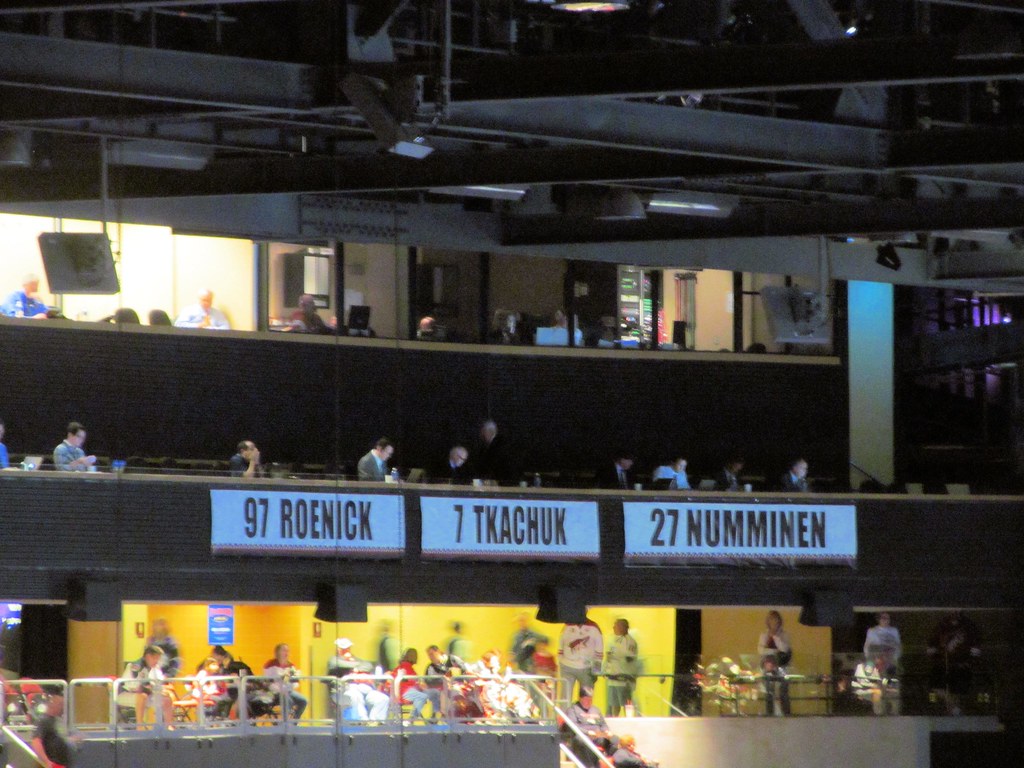
The Coyotes don't have retired numbers, except for the Number 99 retired through the entire NHL for Wayne Gretzky, who was the team's main owner . Instead, they have Honored Numbers, which they display on the Coyotes Ring of Honor.

Center Keith Tkacuk, Number 7, and defenseman Tepp Numminen, Number 27, spanned both Winnipeg and Phoenix. Center Jeremy Roenick, Number 97, is the only one featured who played for the franchise only in Phoenix, never in Winnipeg. Left wing Bobby Hull, Number 9; center Dale Hawerchuk, Number 10; and right wing Thomas Steen, Number 25, all played for them only in Winnipeg, never in Phoenix.

Hull and Steen had their numbers retired in Winnipeg, but they were unretired in Phoenix. Still, those numbers have remained unworn, with 1 brief exception: Bobby's son, Brett Hull, briefly played for the Coyotes and wore 9.
Only 2 members of the Hockey Hall of Fame have ever played for the Coyotes since their move to Arizona: Mike Gartner, for 2 seasons, 1996-98; and Brett Hull, briefly, in 2005. (No, Roenick has not yet been elected.) Numminen has been elected to the International Ice Hockey Federation (IIHF) Hall of Fame.

Bobby Hull received the Lester Patrick Trophy for contributions to hockey in America, and was named to The Hockey News' 100 Greatest Players in 1998. He was one of several of the old Winnipeg Jets to be named to the WHA All-Time Team: The others were Ulf and Kent Nilsson, Anders Hedberg, Joe Daley, Lars-Erik Sjoberg, Ernie Wakely, Ted Green and Terry Ruskowski. Robbie Ftorek, who played for the Phoenix Roadrunners, was also named to the WHA All-Time Team. Dave Silk and Dave Christian from the 1980 U.S. Olympic team played for the old Jets.

There is an Arizona Sports Hall of Fame, but the only person connected with the Coyotes who is in it is Jerry Colangelo, and he's in for what he did with the Suns and, secondarily, the Diamondbacks.

Stuff. The Coyotes' Den is located in the northwest corner of the arena, by Gate 3. You can find the usual team-themed stuff there. Perhaps, due to Arizona's Western heritage, you can find cowboy hats with the team's logo on them.

With hardly any history, there's no team highlight DVDs, and the only book I could find about the team was Laura Winters' entry for them in the NHL's Inside the NHL series, published last year.

During the Game. A November 19, 2014 article on The Hockey News' website ranked the NHL teams' fan bases, and listed the Coyotes' fans 30th in the League -- dead last: "In seats and on Twitter, Dogs' fan base is microscopic despite respectable play."

In other words, they're not nasty fans, or stupid fans; they simply don't have enough fans. Gee, maybe that could be explained by having an arena far from the center of the metropolitan area. Or by the metro area being, you know, in Arizona, a hot-weather city which never should have had an NHL team in the first place!

Wearing Devils gear in Ariona will not endanger your safety. As a franchise only in their 20th season, the Coyotes don't really have a rivalry yet; and if they did, it wouldn't be with the Devils. For the most part, Arizona fans are okay, not making trouble for fans of teams playing the NFL Cardinals, NBA Suns or MLB's Diamondbacks, either. In fact, their biggest rivalry is intrastate: The University of Arizona vs. Arizona State University. It's a heated rivalry... but it's a dry heat.

Patrick Lauder has sung the National Anthem for the Coyotes since the return from the lockout in 2005, after having done so several times since the team's arrival in 1996. The goal song is "Howlin' for You" by the Black Keys.

The mascot is Howler the Coyote. He wears uniform Number 96, in honor of the team's 1996 arrival. He seems to think the Coyotes do have a rivalry, with the Anaheim Ducks. And he does kind of look like Wile E. Coyote, albeit not nearly as thin and with shorter ears.
Arizona fans have their own Southwestern spin on the Detroit tradition of throwing an octopus onto the ice: They throw rubber snakes. At least, I hope they're rubber, and not real.

After the Game. Be advised that outgoing traffic from this game may run into incoming traffic for the NFL Playoff game in which the Cardinals will host the Green Bay Packers.

Phoenix does have crime issues, but you should be safe as long as you stay downtown. What's more, the arena is in the suburbs. It's incredibly unlikely that Coyote fans will bother you, and the fact that the Devils aren't rivals to them helps.

This is a matinee, so the Westgate Mall, to the north across Coyotes Blvd., will be open after the game if you want to do some postgame dining or shopping. A McFadden's is outside the arena at the northwest corner, and a Saddle Ranch Chophouse at the northeast corner.

As for anything New York-friendly, the closest I can come at this time is a place called Tim Finnegan's, the local Jets fan hangout, but that's 11 miles north of downtown, at 9201 North 29th Avenue. It appears that the local football Giants fan club meets at the Blue Moose, at 7373 East Scottsdale Mall, 13 miles northeast of downtown. I've also heard that Loco Patron, at 1327 E. Chandler Blvd., is a Giants fan hangout, but that's 21 miles south. I've read that a Yankee Fan hangout is at LagerFields Sports Grill, at 12601 N. Paradise Village Pkwy. W., 14 miles northeast of downtown. Alas, I can find nothing Mets-specific in the area.

If you visit Phoenix during the European soccer season, as we are now in, the best "football pub" in Arizona is the George & Dragon Pub, which opens at 7:00 AM on matchdays. 4240 N. Central Avenue, about 3 miles north of downtown. Bus 13 to Buckeye Road & Central Avenue, then transfer to Bus ZERO to Farrington Lane. Unless you're a Liverpool fan, or you'd prefer to stay downtown, in which case you can go to the Rose and Crown, at 628 E. Adams Street, 2 blocks north of the ballpark.

Sidelights. Phoenix's sports history is relatively brief, and not very successful. But there are some notable locations.

* Chase Field and Talking Stick Resort Arena. The capital of Arizona sports is 2 buildings separated by 2 blocks and the Jefferson Street Garage, which provides parking for both.

The Arizona Diamondbacks have played since their 1998 inception at Chase Field, a retractable-roof stadium, originally named Bank One Ballpark, and having that name during what remains the Diamondbacks' only World Series thus far, 2001. It looks like a big airplane hangar, without much atmosphere. True, there is that pool in the right-center-field corner... but what's a pool doing at a ballpark?

UPDATE: Major League Baseball is now concerned enough about developments at Chase Field that it might force the Diamondbacks to move.

The Talking Stick Resort Arena, previously known as the US Airways Center and the AmericaWest Arena for a previous airline, it is 2 blocks west of Chase Field, at 2nd & Jefferson. The Suns have played here since 1992, and the WNBA's Phoenix Mercury since 1997. The Coyotes played here from 1996 to 2003.

The arena's address is 201 E. Jefferson Street, and the ballpark's is 401 E. Jefferson Street. Both buildings can be reached on Metro Light Rail via the Jefferson Street & 3rd Street station.

* Arizona Veterans Memorial Coliseum. The Grand Canyon State's 1st home to big-league sports, opening in 1965, was home to the Suns from their 1968 arrival until 1992, and to the World Hockey Association's Phoenix Roadrunners from 1974 to 1977.

Elvis Presley sang at the Coliseum on September 9, 1970, and again on April 22, 1973. Early in his career, on June 9, 1956, he sang at a grandstand at the adjoining Arizona State Fairgrounds. The next day, he sang at the Rodeo Grounds in Tucson. He also sang at the Tucson Community Center on November 9, 1972 and June 1, 1976. (While individual ex-Beatles have performed in Arizona, the band as a whole did not do so on any of their 3 North American tours.)

The Coliseum still stands, and is part of the State Fairgrounds. 1826 W. McDowell Road. Northwest of downtown. Number 15 bus to 15th & McDowell, then 3 blocks west.

* Phoenix Municipal Stadium. This ballpark was home to the Phoenix Giants/Firebirds from its opening in 1964 until 1991, and is the current spring training home of the Oakland Athletics, the Diamondbacks' Rookie League team, and Arizona's State high school baseball championship. 5999 E. Van Buren Street. East of downtown, take the Light Rail to Priest Drive/Washington station, then a short walk up Priest.

* Scottsdale Stadium. This stadium was home to the Firebirds in their last years, 1992 to 1997. Its seating capacity of 12,000, 4,000 more than Phoenix Municipal, was meant to showcase the Phoenix area as a potential major league market. It's the San Francisco Giants' spring training site, and replaced a previous stadium on the site that dated to 1956, used as a spring training home for the Giants, A's, Red Sox, Orioles and Cubs -- sometimes all at the same time.

Because it was the Cubs' spring training home, thus leading to Phoenix becoming "Chicago's Miami," where retirees from the city tend to go (paging Michael Wilbon of the Washington Post & ESPN's Pardon the Interruption & NBA coverage), it was where former Cub catcher Randy Hundley hosted the very first baseball fantasy camp. As Met fans, you might remember Randy's furious reaction to Tommie Agee scoring on a controversial umpiring call at home plate at Shea in September 1969. You might also remember Randy's son, former Met catcher Todd Hundley.

7408 E. Osborn Road, at Drinkwater Boulevard. Northeast of downtown. Light Rail to Veterans Way/College station, then transfer to Number 72 bus to Osborn, then walk 2 blocks east.

* Arizona State University. The University of Arizona is 114 miles away in Tuscon, but ASU is just a 24-minute Light Rail ride from downtown. The station is at 5th Street & Veterans Way, and is 2 blocks away from Sun Devil Stadium and the Wells Fargo Arena, home to their football and basketball teams, respectively.

Sun Devil Stadium was built in 1958, and ASU still plays there rather than move to the larger, more modern (but well off-campus) University of Phoenix Stadium. The Cardinals played there from 1988 to 2005, and the Fiesta Bowl was held there from 1971 to 2006. The Dallas Cowboys treated it as a second home field when they played the Cardinals (mainly because there always seemed to be more Cowboy fans there), and won Super Bowl XXX there, when the world learned A) it was possible for the Pittsburgh Steelers to lose a Super Bowl, and B) Terry Bradshaw was smart compared to Neil O'Donnell. It also hosted 2 U.S. soccer team matches in the 1990s.


The Wells Fargo Arena was previously known as the ASU Activity Center. Elvis sang there on March 23, 1977.

Packard Stadium, opened in 1974, is home to the ASU baseball program, one of the most successful college baseball teams, east of the stadium and arena, at Rural Road and Rio Salado Parkway. The Sun Devils have won 5 National Championships, most recently in 1981. Their legends include Reggie Jackson, Barry Bonds, and current stars Dustin Pedroia and Andre Ethier. Notable ASU and Met alumni include Gary Gentry, Duffy Dyer, Lenny Randle, Craig Swan, Hubie Brooks, Paul Lo Duca and Ike Davis.

ASU’s Gammage Auditorium, at the other end of the campus, hosted one of the 2004 Presidential Debates between George W. Bush and John Kerry. 1200 S. Forest Avenue.

The US Airways Center, Wells Fargo Arena, University of Phoenix Stadium, and the University of Arizona's McKale Center have all hosted NCAA basketball tournament games, but, as yet, the State of Arizona has never hosted a Final Four -- although the University of Phoenix Stadium certainly could. UA has been in the Final Four in 1988, 1994, 1997 and 2001, winning it all in 1997; but ASU has never gotten any closer than the Sweet 16, in 1995.

* Arizona Science Center. Phoenix is not a big museum center. And while there have been Native Americans living in Phoenix for thousands of years, and Spaniards/Mexicans for hundreds, its Anglo history is rather short. No Arizonan has ever become President (although Senators Barry Goldwater and John McCain got nominated), so there's no Presidential Library or Museum. And it doesn't help history buffs that the city only goes back to 1867, and Statehood was gained only in 1912. But the Science Center is at 4th & Washington, just a block from the ballpark. And Arizona State has a renowned Art Museum.

The tallest building in Phoenix, and in all of Arizona, is the Chase Tower, bounded by Central Avenue and Van Buren, 1st and Monroe Streets. That it's only 483 feet, and that no taller building has been built in the city since it opened in 1972, says something about this city, but I'm not sure what. But the city seems to be intent on growing outward, not upward.

Television shows set in Phoenix, or anywhere in Arizona, are few and far between. The High Chaparral, another Western created by Bonanza creator David Dortort, ran on NBC from 1967 to 1971, and is fondly remembered by some.

But the best-remembered show is Alice, starring Linda Lavin as one of several waitresses at fictional Mel's Diner, running on CBS from 1976 to 1985. Although the show was taped in Hollywood (Burbank, actually), that once-famous "14-ounce coffee cup" sign is still used outside a real working diner in Phoenix. It was Lester's, until the owner agreed to change the name to "Mel's Diner" for the publicity. Today, it's Pat's Family Diner, at 1747 NW Grand Avenue, 2 miles northwest of downtown. Number 15 bus to 15th Avenue & Pierce Street, and then walk one block east to Grand, Pierce, and 12th. There are also still-in-business diners in Ohio and Florida that use the same sign design. "Pickup!"

Movies set in modern-day Arizona usually show the Grand Canyon or the Hoover Dam. Notable on this list is Thelma & Louise, in which Geena Davis and Susan Sarandon drive a 1966 Ford Thunderbird into the Canyon rather than be captured by the FBI, enacting a distaff version of Butch Cassidy & the Sundance KidNational Lampoon's Vacation and Natural Born Killers also used Arizona as a backdrop.

The vast majority of movies set in Arizona have been Westerns, including the 1957 and 2007 versions of 3:10 to Yuma, the 1950 film Broken Arrow (not the later John Travolta film of the same title), Fort Apache (not the later Paul Newman film set in The Bronx), Paul Newman's HombreJohnny Guitar, A Million Ways to Die In the West, No Name On the Bullet, and all the films based on the 1881 Earps vs. Clantons gunfight, including My Darling Clementine in 1946, Gunfight at the O.K. Corral in 1957, Tombstone in 1993 and Wyatt Earp in 1994.

If you're a Western buff, and you want to see the site of the legendary gunfight, the official address is 326 East Allen Street, Tombstone, AZ 85638. Reenactments are held daily. Be advised, though, that it's 184 miles southeast of downtown Phoenix, a 3-hour drive, and ain't no Greyhound or Amtrak service, stranger. It's also just 50 miles from the Mexican border.

*

If you go to Phoenix to see the Devils play the Coyotes, you won't be subjected to Arizona's usual intense heat, and you can probably see a hockey game relatively cheap. Have fun!

Friday, March 3, 2017

How to Go to a Hockey Game in New Brunswick, Canada

Next Friday, the most popular team in the Canadian Province of New Brunswick, the Saint John Sea Dogs of the Quebec Major Junior Hockey League, will host the Charlottetown Islanders.

Yes, the QMJHL may, and does, also include teams from Atlantic Canada, a.k.a. the Maritime Provinces: New Brunswick, Nova Scotia, Prince Edward Island, and Newfoundland and Labrador.

Yes, it's called New Brunswick. No, aside from the name, it has no connection with the New Jersey city that's home to Rutgers University.

I originally had this set for February 28, for their March 7 home game against their Provincial rivals, the Acadie-Bathurst Titan. But the weather on that day was forecast to be nasty: "Snow of varying intensity" through the day and low 20s by night. So I moved it back.

Before You Go. New Brunswick is in Canada, so you will need a passport. And you will need to change your money. At last check, US$1.00 = C$1.32, and C$1.00 = US 76 cents. And I advise you to call your bank and let them know that you will be in a foreign country, so they won't see credit or debit card purchases from a foreign country pop up and think your card has been stolen.

The Maritime Provinces, a.k.a. Atlantic Canada, are 1 hour ahead of the Eastern Time Zone. So a game starting at 7:00 PM their time would by 6:00 our time. Adjust your timepieces accordingly.

Saint John -- usually spelled out, unlike the Newfoundland capital, which usually gets shortened to "St. John's" and has the apostrophe-S on the end -- is in Canada, and this is winter. It's also a seafront city, where wind can be an issue. On Friday, the temperatures are expected to be in the mid-30s by day, and the mid-teens by night, but it's also expected to be the 3rd of 7 straight days with no new snow, so it's a big improvement over my original plan, for the Tuesday night game. Still, bundle up.

Also, remember that they use the metric system. A speed limit of 100 kilometers per hour means 62 miles an hour. And don't be fooled by the seemingly low gas prices: That's per liter, not per gallon, and, in spite of Canada being a major oil-producing nation, you'll actually be paying more for gas up there. So, in order to avoid both confusion and "sticker-shock," get your car filled up before you reach the border.

Tickets. Their arena seats 6,308 people. This is a minor-league game, and not against a Provincial rival, so they probably won't sell out. You should be able to get a ticket. Seats are C$29 between the goals and C$19 behind them.

Getting There. St. John, New Brunswick is 607 miles from Times Square, and 71 miles from the nearest border crossing, at Calais, Maine. Air Canada can fly you from New York to Montreal and then to Saint John International Airport, but it would cost over $1,000 round-trip, and your flight back would have to be at 5:15 AM. No good. VIA Rail goes there, but not on the day you'd need. On Greyhound, you'd first have to get to Montreal. There's 1 bus each day, each way, between Montreal and Saint John: Outbound, leaving 9:30 PM and arriving 2:40 PM; inbound, leaving 3:40 PM and arriving 12:05 AM; cost, C$273. That's nuts.

So it looks like you'll have to drive. Start out as if you're going to Boston: Take Interstate 95 North to New Haven. Take Exit 48, Interstate 91 North to Hartford. Take Exit 30, Interstate 84 East into Massachusetts. You'll merge with Interstate 90 East, the Massachusetts Turnpike, and take that until you reach Interstate 495, Boston's outer beltway.

But instead of continuing on the Mass Pike to Boston, take Exit 11A onto I-495 North, into Boston's northern suburbs, until you reunite with I-95 North at Salisbury, just before reaching the New Hampshire State Line. You'll cross New Hampshire and go into Maine. Take Exit 182A onto U.S. Route 1A, turn left on State Route 46, right on State Route 9, then follow this rural route all the way to Baring, where you'll meet up with U.S. Route 1. Turn left at International Avenue, and you'll reach the Border.

Don't get cute. Show your passport. If they ask for any other ID, show them that. If you have anything that could be considered a weapon, even a pair of nail clippers, it's probably best to mention that. Don't make any wiseass remarks about Canada. When they ask you your purpose for visiting Canada, tell them you' re visiting Halifax as a tourist. (That is the truth.) Presuming you don't do or say anything stupid, you should get across with no trouble.

International Avenue becomes New Brunswick Provincial Route 1. Take this to Exit 122, which will put you on Main Street. Almost immediately, turn right on Union Street, then right on Smythe Street, then right on Long Wharf, which becomes Station Street. The arena will be on your left.

If all goes well, you should be in New York State (not counting Manhattan) for half an hour, in Connecticut for 2 hours, in Massachusetts for an hour and 15 minutes, New Hampshire for 15 minutes, Maine for 4 hours and 45 minutes, Customs for 15 minutes or less, and New Brunswick for an hour and 15 minutes. Given rest stops in Connecticut and just after arriving in Maine, it should take about 12 hours.

Once In the City. Like the New Jersey city of the same name, which is home to Rutgers University, the Canadian Province of New Brunswick is named for the German city of Braunschweig. This was the hometown of Britain's King George I, who reigned from 1714 to 1727, and his House of Hanover, which continued under all 4 King Georges, King William IV, and Queen Victoria until her death in 1901.
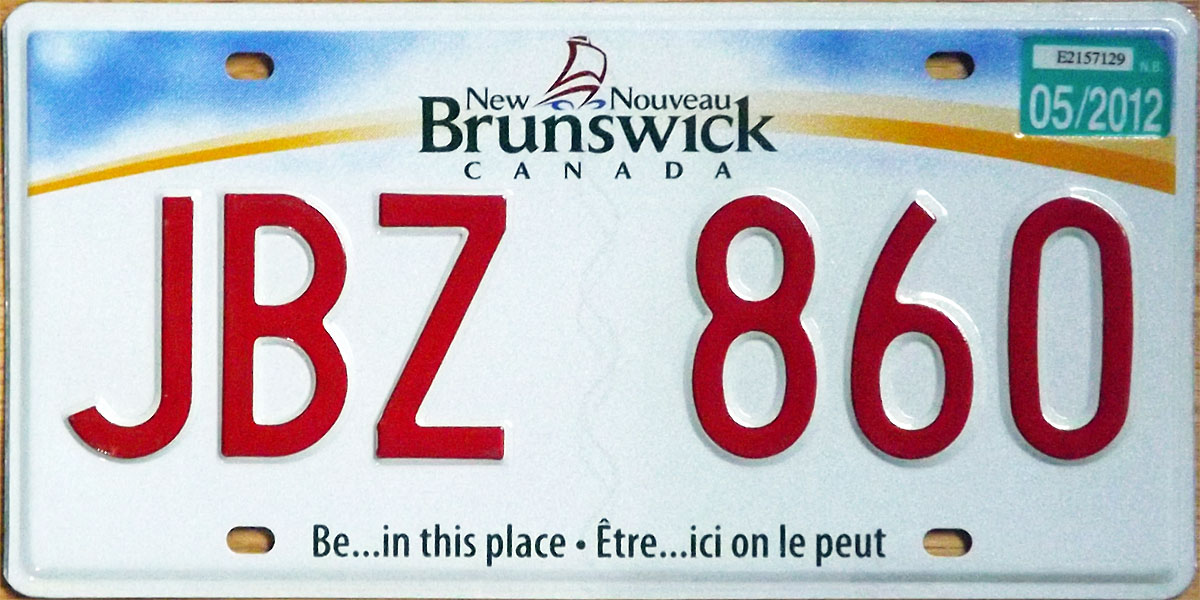
Home to around 750,000 people, New Brunswick is about 22 percent Francophone, but only about 5,000 French-first people live in and around Saint John. The Province's license plates do say both "New Brunswick" and "Nouveau Brunswick." The Province is about 96 percent white, with scattered black, Asian and Aboriginal/Native/First Nations people. There are less than 800 Hispanic people in the Province. The Harmonized Sales Tax (HST) is 15 percent. All New Brunswick mailing addresses have a Postal Code that begins with E. The Area Code is 506.

The French explorer Samuel de Champlain founded Saint John in 1604, naming it for John the Baptist. It is home to about 67,000. Just last year, Moncton surpassed Saint John to become the Province's largest city, with 71,000 people. (Like New Brunswick, New Jersey, Moncton is known as the "Hub City.")

Saint John is "Canada's Irish City," as a result of taking so many immigrants during the Irish Potato Famine of the late 1840s. But Protestants (including Irish) still out number Catholics. 47 percent to 40.

The capital of New Brunswick is Fredericton, 68 miles northwest of Saint John, and home to 56,000 people. The drinking age in New Brunswick is 19. Its leading newspaper is the Saint John-based Telegraph-Journal.
Saint John Transit runs the bus service in town (no rail, either above or below ground, local or commuter), and fares, depeinding on distance, range from C$2.50 to C$3.50. Bay Ferries runs a ferry service across the Bay of Fundy from Saint John to Digby, Nova Scotia. The Province has no beltway.

There is no "centerpoint" (or "centrepoint") for street addresses, but address numbers go up heading north and east. Like many Canadian cities, Saint John has a climate-controlled walkway, in their case above-ground, known as the Inside Connection. The arena is connected to it.
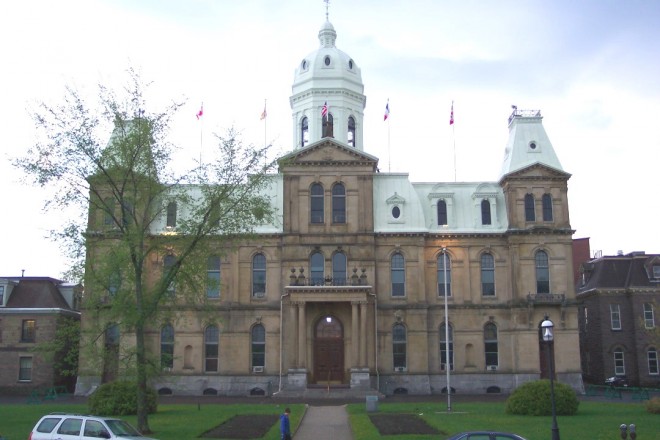
Legislative Assembly of New Brunswick, in Fredericton

Going In. Harbour Station bills itself as "Atlantic Canada's Enetertainment Centre!" With 6,308 seats for hockey, 7,305 for basketball, and 7,586 for concerts, it opened in 1993, at 99 Station Street, at the intersection of Sewell Street. Parking is only C$3.00. The Saint John Sea Dogs, of the Quebec Major Junior Hockey League, were founded in 2005, as the successors to the American Hockey League's Saint John Flames (1993-2003).
You're most likely going to enter from the west or south, since the north is bordered by Route 1 and a railroad. The rink is aligned southwest-to-northeast.
The Saint John Mill Rats were a founding franchise of the National Basketball League of Canada, in 2011, and they also set up shop at the Harbour Station, changing their name to the Saint John Riptide this season, renaming themselves for the nearby Bay of Fundy, famous for having the world's highest tides. The arena survived a small fire shortly before a Mill Rats game in 2014.

Food. The arena's website says only that, "Food services are available at 7 locations on the concourse, including TIM HORTON'S." (Emphasis theirs, not mine.) In other words, you may be better off eating before and after the game, rather than during.

Team History Displays. The Sea Dogs won the President's Cup, the QMJHL championship, and the Memorial Cup, the championship of Canadian junior hockey, in 2011. They won the President's Cup again in 2012. They have also won Division Championships in 2010, 2011, 2012 and 2016. They have banners for all of these achievements.
They have no retired numbers. The former Sea Dog that Devils fans would most easily recognize is former New Jersey defenseman Eric Gelinas, now in the Colorado Avalanche's minor-league system.

Harbour Station also honors (or "honours") the Saint John Flames, for their 2001 AHL title, the Calder Cup; and its 1998 Division and Conference titles.
UPDATE: In 2018, the Acadie-Bathurst Titan, playing out of Bathurst in the QMHJL, became the 2nd team from New Brunswick to win the Memorial Cup.

Stuff. Being a minor-league team, the Sea Dogs don't have a large team store, only a few souvenir stands. There are no books or videos about them.

During the Game. Your safety will not be an issue. The people of Saint John won't be bothered by a New Yorker showing up, especially if he's going to, as they say in another sport, root, root, root for the home team.

The Sea Dogs hold auditions for National Anthem singers, as opposed to having a regular. A "sea dog" is a seal, and the team's original mascot was a black seal named Splash.
Splash

However, in 2009, Fleaburn, the dog mascot of the departed Flames (his name a play on the fire theme), was brought back. Though why his hat resembles a basketball more than a hockey puck is a mystery.
Fleaburn, you dog.

After the Game. As with your entry, your exit is most likely to be by the west or south entrances. But there aren't many places nearby to get a postgame meal, or even a pint. Vito's, at 2 Peel Plaza (Union Street and Chipman Hill), was the only place that even showed up on Google Maps. You may have to go further east on Union Street to find a place.

Rocky's Sports Bar, at 7 Market Square (corner of St. Patrick and King Streets), is 5 blocks from the arena, and is said to be the best sports bar in the Province.

Sidelights. There is one other pro hockey team in New Brunswick. The Moncton Wildcats play at the Moncton Coliseum, built in 1973, about 90 miles to the northeast. They won the QMJHL title in 2006 and 2010. The Coliseum is also the home of the Moncton Miracles, of the National Basketball League of Canada, arch-rivals of the Saint John Riptide.
Moncton Coliseum

Professional baseball and soccer are not particularly big in New Brunswick. Indeed, a website titled Canadian Soccer Blog couldn't find a single bar in the Province to add to its The Ultimate Guide to Canadian Soccer Pubs, although the aforementioned Rocky's was cited on another page.

However, Moncton Stadium, opened in 2010 on the campus of the Universite de Moncton, hosted 7 matches of the 2015 Women's World Cup, including a Round of 16 match in which Australia eliminated Brazil. With 10,000 permanent seats, but expandable to up to 20,725, it's hosted 3 regular-season games in the Canadian Football League's "Touchdown Atlantic" series.
Moncton Stadium, with temporary end-zone bleachers
and the CFL's notorious 25-yards-deep end zones
taking out the curves of the running track

UPDATE: The Canadian Premier League, an attempt at a top-flight soccer league for the country, was founded in mid-2017, with the hopes of beginning play in Spring 2019. A team could be established to play at Moncton Stadium.

Other colleges in the Province include the University of New Brunswick, with campuses (campii?) in Saint John and Fredericton; and Mount Allison University, 120 miles to the northeast in Sackville,

Neither Elvis Presley nor The Beatles ever performed in the Province of New Brunswick. Harbour Station remains the Province's most significant concert venue.

The New Brunswick Museum, at 1 Market Square across from Rocky's, is the oldest continuously-open museum in Canada. Fort Howe was a site briefly taken over by the Continental Army during the War of the American Revolution in June 1777, until the British drove them out. Magazine Street at Webster Street. The Carleton Martello Tower is a historic site, dating to the War of 1812. 454 Whipple Street, across the Saint John River on the city's West Side, 3 miles south of downtown. Neither of these historic sites is reachable by public transit, but Fort Howe is a mile's walk, including over the Main Street overpass over Route 1. And New Brunswick's historic sites do not include any birthplaces or residences for Prime Ministers, as none has ever come from there.

Like East Brunswick, New Jersey, Saint John has an indoor shopping mall named Brunswick Square. It has a tower that is the tallest building in the city, 265 feet high. 39 King Street, corner of Germain Street. It is tied for the title of the tallest building in the Province, with Assumption Place in Moncton.

Any TV shows set in the Province would only be familiar to Canadians, not to Americans. The movie filmed there most likely to be familiar to Americans is Children of a Lesser God, for which deaf actress Marlee Matlin won an Oscar.

*

Saint John is not much like St. John's University in Queens; and New Brunswick, Canada is not much like New Brunswick, New Jersey. But it is worth a visit, especially for a hockey fan.

Raymond Kopa, 1931-2017

The 1st great French soccer player -- and the greatest Polish Frenchman since Frederic Chopin -- is no longer with us. It is another reminder of the passage of time, as the heroes of the 1950s, in all walks of life, are reaching the ends of their stories.

Raymond Kopaszewski was born on October 13, 1931 (a week before Mickey Mantle) in Nœux-les-Mines, Pas-de-Calais, France. His parents were born in Germany, his grandparents in Krakow, the great city of ancient Poland. They left Germany during World War I and went to France, and the family name was shortened to Kopa when he was a boy. Like his father and grandfather before him, he became a coal miner -- at age 14. He lost a finger in a work accident.

In 1949, just 17, the midfielder was signed by SCO Angers, then in Ligue 2 (French soccer's 2nd division). By 1951, despite having grown to only 5 feet, 6 1/2 inches, he had attracted the attention of Stade de Reims, who had won the Ligue 1 title in 1949 and the Coupe de France in 1950. Kopa would help them win the league again in 1953 and 1955. Reims wore red shirts with white sleeves, reminiscent of North London club Arsenal.

In 1953, led by Kopa, Reims won the Latin Cup, a tournament for teams from France, Spain, Portugal and Italy, beating AC Milan in the Final. Reims were the only French team ever to win it. (Barcelona won it in 1949 and 1952, Benfica of Lisbon in 1950, Milan in 1951 and 1956, and Real Madrid in 1955 and 1957. It wasn't held in 1954, and by 1957 it was redundant.)

The Latin Cup, the Mitropa Cup (Central Europe except for Germany) and the European Railways Cup (Eastern Europe) were precursors to the European Champion Clubs' Cup, shortened to the European Cup and, since 1992, known as the UEFA Champions League. The 1st one was held in the 1955-56 season, and Reims got all the way to the Final, losing to Real Madrid 4-3 at the Parc des Princes in Paris.

That Madrid team already had the great Argentine forward Alfredo Di Stéfano. Through purchasing him, their president, Santiago Bernabeu had shown that he would spend whatever it took to bring the club additional glories. They had already seen him play for the France national team against Spain in Madrid in 1955, with Marca, Spain's leading sports-themed newspaper, calling him "The Little Napoleon." By 1959, they had, arguably, the 3 best players in the world: Di Stéfano, Kopa, and the great Hungarian star Ferenc Puskás -- the Napoleon of Football, the Blond Arrow and the Galloping Major.

Real Madrid won the 1st 5 European Cups, the middle 3 of these with Kopa: Defeating Florence, Italy's Fiorentina in 1957 in front of 124,000 people at their home stadium, the Estadio Santiago Bernabeu; beating Milan in 1958 at the Heysel Stadium in Brussels, Belgium; beating Reims again, with the great Just Fontaine having replaced Kopa, in 1959 at the Neckarstadion in Stuttgart, Germany; and capping it in 1960, in front of 127,621 at Hampden Park in Glasgow, Scotland, coming from an early 1-0 deficit to defeat Eintracht Frankfurt 7-3.
Kopa and Di Stéfano, with the 1957 European Cup

Kopa was selected for the France team for the 1954 World Cup in Switzerland, but they did not advance out of their group. In the 1958 edition in Sweden, he scored in France's Group Stage matches with Paraguay and Scotland. He did not score in their Group Stage match with Yugoslavia. Guess which one they lost. They won their Group, and defeated Northern Ireland in the Quarterfinal before falling to Brazil in the Semifinal. This would be France's best performance in a World Cup until winning it on home soil in 1998.
Kopa and Fontaine at the 1958 World Cup

Having won the European Cup and been the best European player at the World Cup, France Football magazine awarded Kopa the Ballon d'Or (Golden Ball) as world footballer of the year. He was the 1st French player to receive it.

He returned to Reims for the 1959-60 season, and helped them win the Ligue that year and in 1962. He remained with them through 1967. It shows the difference between Real Madrid and other European clubs of the 1950s: At Reims, Kopa is the greatest player ever; at the Bernabeu, he's simply one of many legends.

He married Christiane, the sister of an Angers teammate. He never returned to an official role in soccer after retiring as a player, moved to the French Mediterranean island of Corsica -- Napoleon Bonaparte's birthplace, somewhat appropriately -- and finally returned to Angers. He launched a successful sportswear line and wrote a memoir. In 1970, he became the 1st footballer to receive France's highest civilian honor, Le Ordre national de la Légion d'honneur.
Raymond Kopa died on the morning (overnight, our time) of March 3, 2017, in Angers, at the age of 85.

Noël Le Graët, the president of the French Football Federation, said in a statement: “The passing of Raymond Kopa plunges the federation into immense sadness. It’s a terrible loss for French football. Raymond Kopa is among the legends. He was a symbolic player and a forerunner. His career with his clubs, as with the France team, was exceptional."

Francisco Gento, still the only man to win 6 European Cups, was already the last surviving player from Los Blancos' triumph in the 1st European Cup in 1956. He is now the last survivor from their 1957 win as well.

UPDATE: Kopa's final resting place is not publicly known.

Thursday, March 2, 2017

How to Be a Devils Fan in Colorado -- 2017 Edition

Next Thursday, the New Jersey Devils visit Denver to play the Colorado Avalanche.

Before You Go. The Denver Post is predicting high 60s for Thursday afternoon, and high 30s for the evening. Although the mountain air leads to a lot of snow, no precipitation of any kind is forecast for this week. Still, keep the thin air in mind, and don't exert yourself too much.

Denver is in the Mountain Time Zone, so you'll be 2 hours behind New York time. And there's a reason it's called the Mile High City: The elevation means the air will be thinner. Although the Rocky Mountain region is renowned for outdoor recreation, if you're not used to it, try not to exert yourself too much. Cheering at a sporting event shouldn't bother you too much, but even if the weather is good, don't go rock-climbing or any other such activity unless you've done it before and know what you're doing.

Tickets. When the Avs arrived in 1995, and immediately won the Stanley Cup, the Rocky Mountain region went nuts, having never before won a World Championship in any sport. They stayed good for 10 years, and attendance remained great. Then they fell apart, and people saw how well Colorado fans supported a non-winner. They've made the Playoffs just once in the last 5 seasons, and average home attendance this season is down to 15,019 per game -- not terrible, but only 83 percent of capacity. So tickets will almost certainly be available.

Tickets in the lower level are $230 between the goals and $109 behind them. In the upper level, they're cheap: $35 between and just $21 behind.

Getting There. It's 1,779 miles from Times Square in New York to the Denver plaza that contains the State House and the City-County complex, and 1,767 miles from Prudential Center to the Pepsi Center. You're probably thinking that you should be flying.

The good news: As was its predecessor, Stapleton International Airport (named for 1923-47 Mayor Benjamin F. Stapleton), the new Denver International Airport is a major change-planes-here spot for going to the West Coast and Las Vegas, meaning lots of nonstop flights from New York to Denver are possible.

The bad news: Flying to Denver nonstop, on this occasion, will be expensive, over $1,100 round-trip on United Airlines. It could be about half that on American Airlines, but you'd have to change planes in Chicago each way.

Amtrak's Lake Shore Limited leaves Penn Station at 3:40 PM Tuesday, arrives at Union Station in Chicago at 9:45 AM Wednesday (that's Central Time). The California Zephyr leaves Chicago at 2:00 PM Wednesday and arrives at Denver's Union Station at 7:15 AM (Mountain Time) Thursday. The return trip would leave Denver at 7:10 PM Friday, arrive in Chicago at 2:50 PM Saturday, leave Chicago at 9:30 PM Saturday, and get back to New York at 6:23 PM Sunday. The round-trip fare is $519.

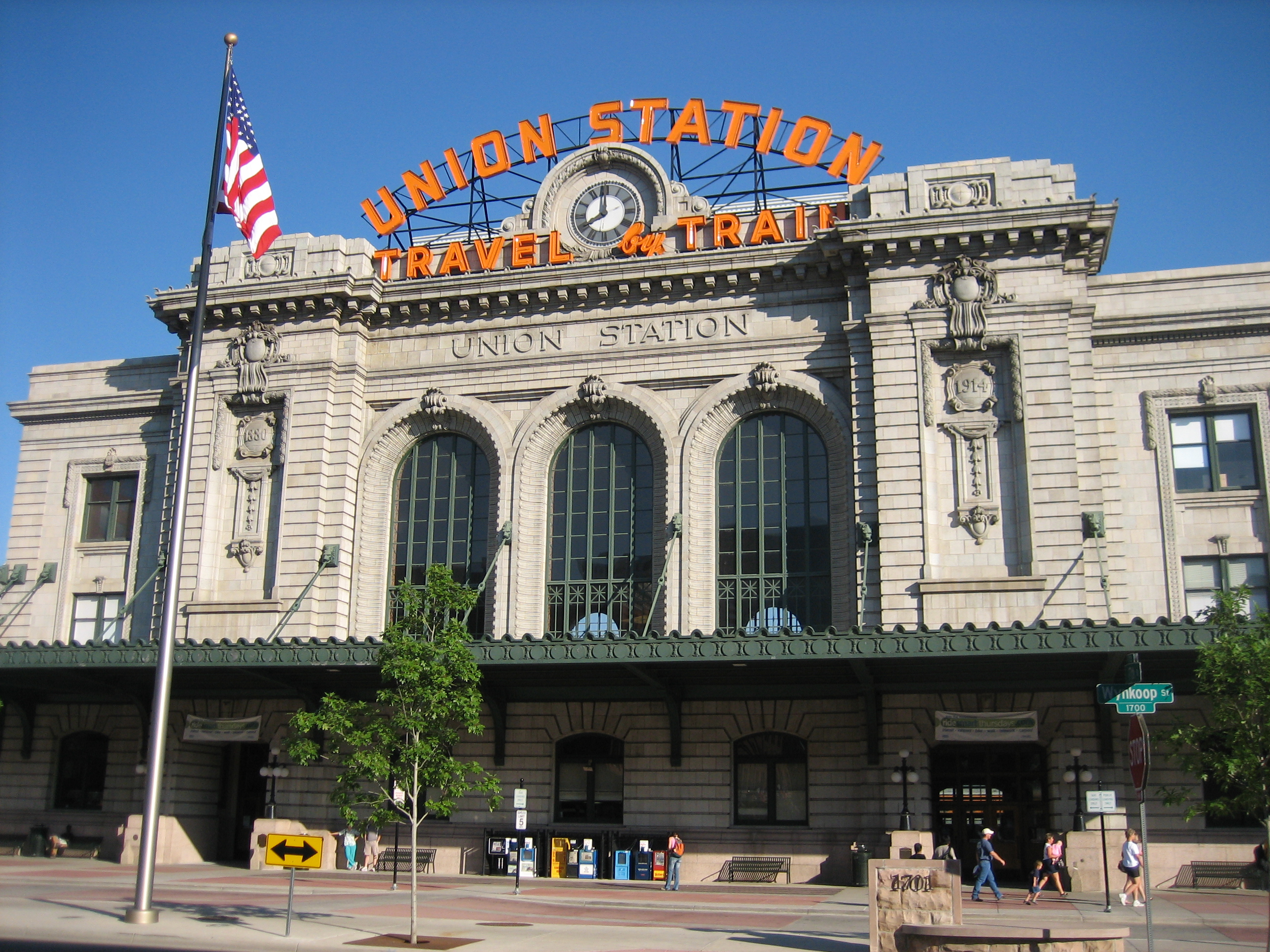
Conveniently, Union Station is at 1700 Wynkoop Street at 17th Street, just 3 blocks from Coors Field. The front of the building is topped by a clock, framed by an old sign saying UNION STATION on top and TRAVEL by TRAIN on the bottom.
Greyhound allows you to leave Port Authority Bus Terminal at 4:00 PM Tuesday, and arrive at Denver at 10:50 AM on Thursday, a trip of just under 45 hours, without having to change buses. That 44:50 does, however, include layovers of 40 minutes in Philadelphia, an hour and a half in Pittsburgh, an hour in Columbus, an hour in Indianapolis, 2 hours in St. Louis, and half an hour in Salina, Kansas; plus half-hour meal stops in Pennsylvania, Illinois and Kansas. Round-trip fare is $406, but you can get it for $336 on advanced-purchase. You can get a bus back at 7:20 PM Friday and be back in New York at 3:00 PM Sunsday. The Denver Bus Center is at 1055 19th Street.

If you actually think it's worth it to drive, get someone to go with you, so you'll have someone to talk to, and one of you can drive while the other sleeps. You'll be taking Interstate 80 most of the way, through New Jersey, Pennsylvania, Ohio, Indiana, Illinois, Iowa and Nebraska, before taking Interstate 76 from Nebraska to Colorado, and then Interstate 25 into Denver. (An alternate route: Take the New Jersey and Pennsylvania Turnpikes to Interstate 70 and then I-70 through Pennsylvania, Ohio, Indiana, Illinois, Missouri, Kansas and Colorado into downtown Denver. It won't save you an appreciable amount of time over the I-80 route, though.)

If you do it right, you should spend about an hour and a half in New Jersey, 5 hours and 15 minutes in Pennsylvania, 4 hours in Ohio, 2 hours and 30 minutes in Indiana, 2 hours and 45 minutes in Illinois, 5 hours and 15 minutes in Iowa, 6 hours in Nebraska, and 3 hours and 15 minutes in Colorado. Including rest stops, and accounting for traffic (you'll be bypassing Cleveland and Chicago, unless that's where you want to make rest stops), we're talking about a 40-hour trip.

Even if you're only going for one game, no matter how you got there, get a hotel and spend a night. You'll be exhausted otherwise. Trust me, I know: Trains and buses are not good ways to get sleep.

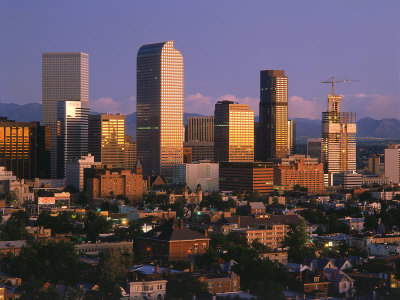
Once In the City. Founded in 1858 as a gold rush city, and named for James W. Denver, then Governor of the Kansas Territory, from which Colorado was separated, Denver is a State capital and city of 700,000 people, in a metro area of 3.4 million -- roughly the population of Brooklyn and Staten Island combined. It's easily the biggest city in, and thus the unofficial cultural capital of, the Rocky Mountain region.
The State House

Broadway is the main north-south drag, separating East addresses from West. But the northwestern quadrant of the street grid is at roughly a 45-degree angle from the rest of the city, and this area includes the central business district, Union Station and the ballpark.

The sales tax in the State of Colorado is 2.9 percent, however, the City of Denver adds a 3.62 percent sales tax, for a total of 6.52 percent. ZIP Codes in Colorado start with the digits 80 and 81, with the Denver area running from 800 to 810. The Area Code for Denver is 303, with 720 overlaid.

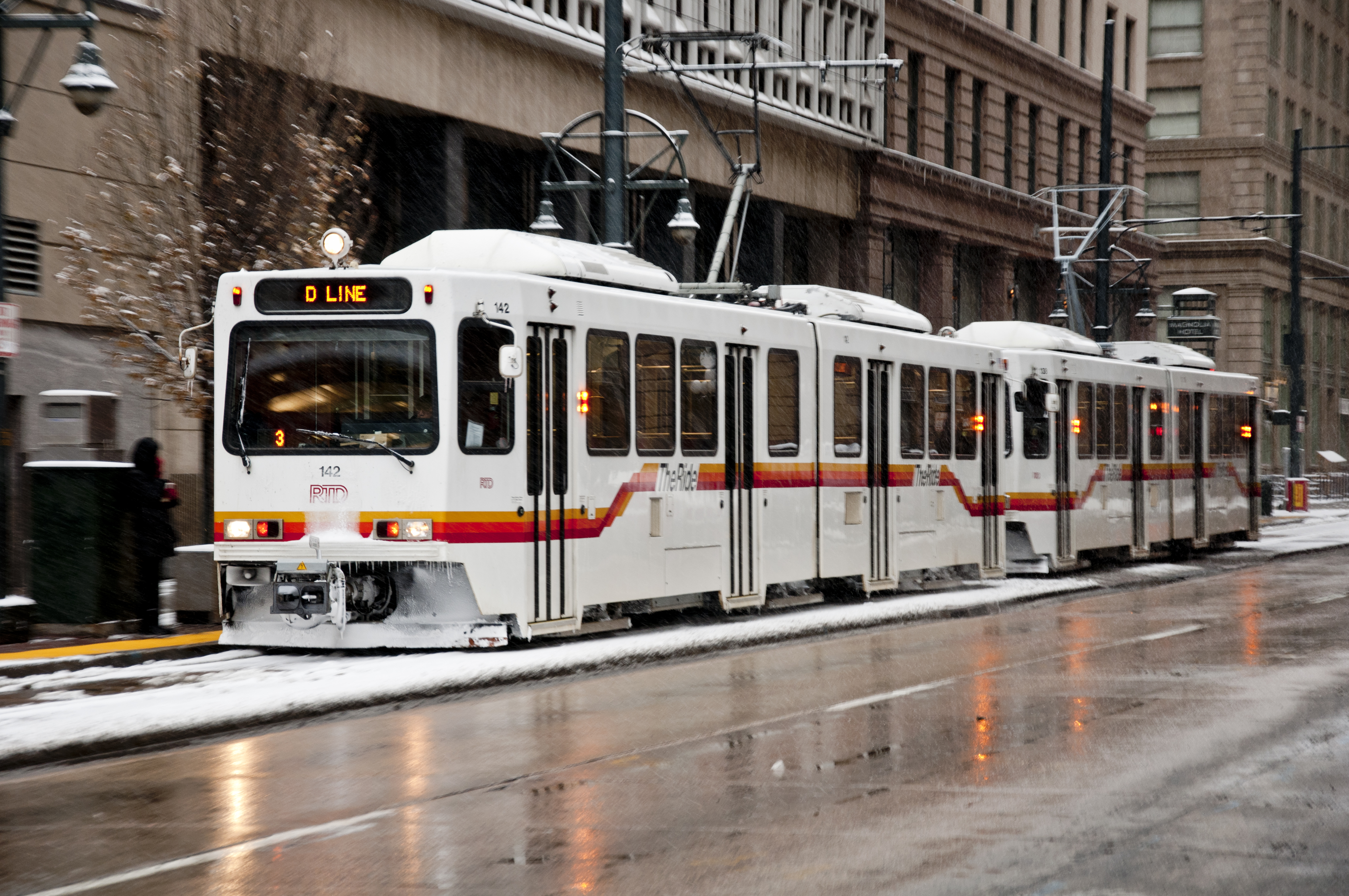
The Denver Post is a good paper, but don't bother looking for the Rocky Mountain News: It went out of business in 2009. Bus and light rail service in Denver is run by the Regional Transportation District (RTD), and goes for $2.25 for a single ride, and $6.75 for a DayPass. Denver switched from tokens to farecards in 2013.
Don't worry, the weather isn't forecast to look like this during your visit.

Going In. The Pepsi Center -- the soda company has always had naming rights on the arena since it opened -- is across Cherry Creek from downtown, about 2 miles northwest of City Hall. The intersection is 11th Street & Auraria Parkway, but the mailing address is 1000 Chopper Circle, in honor of Robert "Chopper" Travaglini, the beloved former trainer (and amateur sports psychologist) of the NBA's Nuggets, who share the arena. It is 1 of 10 current arenas that is home to both an NBA team and an NHL team.

Chopper was actually a Jersey Boy, albeit from Woodbury on the Philly side. He died in 1999, age 77, right before the new arena opened. Chopper Circle is an extension of Wewatta Street.
Pepsi Center/Elitch Gardens station on the RTD light rail. If you're coming in that way, you'll probably enter from the west gate, the Grand Atrium. If you're driving, parking starts at just $5.00. The rink is laid out east-to-west, and the Avs attack twice toward the east end.
In addition to hosting the Avs and the Nugs, the Pepsi Center has also hosted NCAA Tournament basketball games, the 2008 edition of NCAA's hockey "Frozen Four," and the 2008 Democratic National Convention.

Food. Being a "Wild West" city, you might expect Denver to have Western-themed stands with "real American food" at its arena. Being in a State with a Spanish name, in a land that used to belong to Mexico, you might also expect to have Mexican food. And you would be right on both counts.

Unfortunately, the team and arena websites don't include charts showing where the concession stands are. The arena website does mention specialty restaurants:

The Shock Top Lodge is a restaurant that seats 325 guests, 250 in the restaurant and 75 at the bar, and is open to all ticketholders.


The Land Rover Denver Club has seating for 125 and can accommodate over 300 in a lounge-like environment. Guests can enjoy a Colorado craft beer or specialty drink coupled with a chef-inspired dish without missing any of the action in the arena while watching on one of the 20 HD TVs positioned throughout the space. 
The Peak Pub House seats 236 patrons, and is available to suite holders, KeyBank Club Level ticket holders, the first row of rinkside, all courtside seat holders, and all patrons with 5 minutes remaining in the game.
Team History Displays. The Nuggets' banners are at the east end of the arena, and the Avalanche's banners at the west end. There are also banners for the Arena Football League's Colorado Mammoths -- which, like the Avs, the Nugs, MLS' Colorado Rapids, the NFL's St. Louis (for the moment) Rams, and English soccer's Arsenal Football Club, is owned by Walton of Walmart infamy in-law Stan Kroenke.

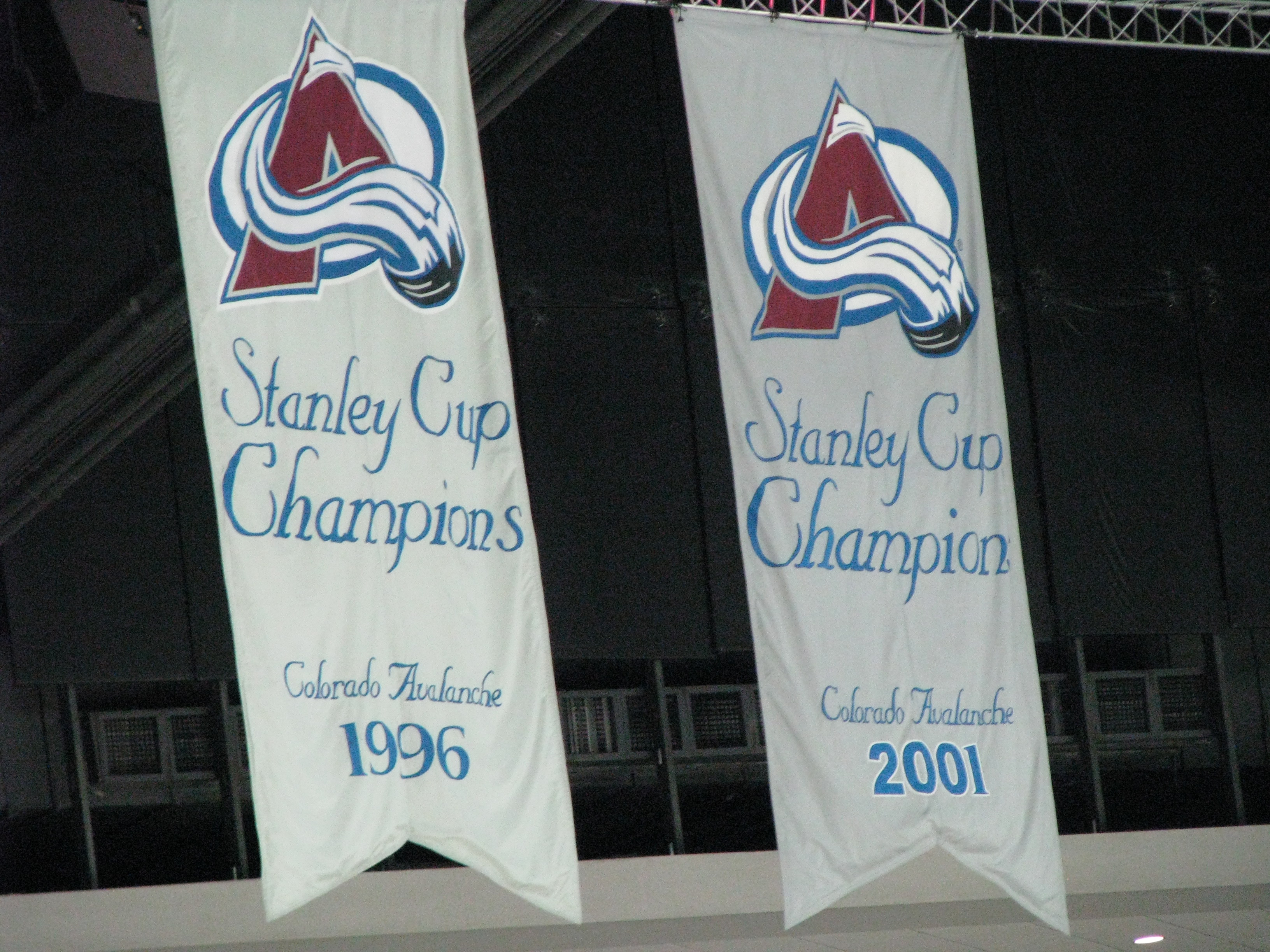
Despite the Avs' brief history, they have plenty of banners: 9 for Division titles in 1996, 1997, 1998, 1999, 2000, 2001, 2002, 2003 and 2014; 2 for President's Trophies in 1997 and 2001; 2 for Western Conference Championships in 1996 and 2001; and 2 for Stanley Cups in 1996 and 2001.
There is no notation for what the franchise won as the Quebec Nordiques, and, since the original, hockey version of the Colorado Rockies made the Playoffs just once in 6 seasons before moving to become the Devils, there is nothing to hang for them anyway.
They've also retired 5 uniform numbers. From the 1996 Stanley Cup winners, they've retired 19 for center Joe Sakic, 21 for center Peter Forsberg, 33 for goaltender Patrick Roy (now the team's head coach) and 52 for defenseman Adam Foote.

All of these players were still there for the 2001 Stanley Cup win (although Forsberg was injured for the Playoffs). And, in case the 2,001 times that Gary Thorne and ABC Sports mentioned it wasn't enough to jam it into your memory for all time, the Avs had added Number 77, defenseman Ray Bourque. (Interestingly enough, both times the Avs won the Cup, the Devils won it the season before. But this pattern did not hold in 2003-04.)
Prior to the team's move to become the Avalanche, the Quebec Nordiques had retired 3 for defenseman Jean-Claude Tremblay, 8 for left wing Marc Tardif, 16 for left wing Michel Goulet, and 26 for center Peter Stastny (who, of course, also played for the Devils). Each of these numbers was returned to circulation, and Peter's son Paul Stastny, now with the St. Louis Blues, wore his father's Number 26 with the Avs.

Last season, the Avs named a 20th Anniversary Team. From the 1996 Cup team, they chose Roy, Sakic, Forsberg, Foote, defenseman Sandis Ozolinsh, left wing Valeri Kamensky, right wings Adam Deadmarsh and our old friend Claude Lemieux, and center Stephane Yelle.

From the 2001 Cup team, they chose Roy, Sakic, Forsberg, Foote, Bourque, Yelle, defenseman Rob Blake, left wing Alex Tanguay, right wing Milan Hejduk, and centers Stephen Reinprecht and Chris Drury.

From after, but not including, 2001, they've chosen goalie Semyon Varlamov, defensemen John-Michael Liles and Erik Johnson, left wing Gabriel Landeskog, and centers Paul Stastny and Matt Duchene.
Yay, Claudie!

Foote, Forsberg, Roy, Sakic, Hejduk and former team president and general manager Pierre Lacroix have been elected to the Colorado Sports Hall of Fame, which is located at the new Broncos' stadium. Bourque and Claudie have not. Stastny and Sundin from the Quebec years, and Forsberg and Kamensky from both cities, have been elected to the International Ice Hockey Federation (IIHF) Hall of Fame. Bourque has received the Lester Patrick Trophy for contributions to hockey in America.

Sakic, Roy and Bourque -- the latter, still with the Boston Bruins at the time -- were named to The Hockey News' 100 Greatest Players in 1998. From the Nordiques, Tremblay, Tardif, Goulet, Christian Bordeleau, Rich LeDuc, Serge Bernie, and Richard Brodeur (no relation to Marty) were named to the WHA All-Time Team. Bill Baker and Steve Janaszak of the 1980 U.S. Olympic team played for the Rockies before they became the Devils. A few weeks ago, Sakic, Roy, Forsberg and Bourque were named to the NHL's 100th Anniversary 100 Greatest Players.

Stuff. Altitude Athletics is located in the Grand Atrium at the arena's west end. It sells Avs, Nugs, Rapids and Mammoths merchandise -- but not the Rams or The Arsenal, as these teams are located nowhere near Denver. They may sell cowboy hats with team logos on them, to tie in with the State's Western heritage.

There are books available about the team, but, being Devils fans, you won't want to be reminded of how they plowed into the Meadowlands, off Exit 16W (as in 16 wins to get through the Playoffs), and took the Cup away from us. That story is told in the Denver Post's official retrospective, Mission 16W: Colorado Avalanche: 2000-'01 Stanley Cup Champions. Of course, Bourque is in the center of the cover, holding up the Cup, flanked by photos of Sakic and Roy.

From Claude Lemieux's unacceptable hit on Kris Draper in Game 6 of the 1996 Western Conference Finals, Detroit Red Wings fans have hated the Avs in general and Claudie in particular. They met in 5 Playoff series in 7 seasons from 1996 to 2002, and mixed in there was a regular-season nasty brawl in Detroit on March 26, 1997, in which Claudie was targeted by the Wings. Denver Post hockey writer Adrian Dater and then-Wings coach Scotty Bowman have collaborated on Blood Feud: Detroit Red Wings v. Colorado Avalanche: The Inside Story of Pro Sports' Nastiest and Best Rivalry

Of course, the Wings' real arch-rivals are the Chicago Blackhawks, as the Hawks' 2010s renaissance has reminded everyone. Wings-Avs was like Mets-Braves, Knicks-Heat and 49ers-Cowboys, in that it was only a rivalry for a brief time, and no longer really matters, especially now that the Wings have been moved to the Eastern Conference. It's also worth noting that Claudie had a nasty reputation even before 1996. Indeed, when he was introduced before Game 1 of the 1995 Stanley Cup Finals in Detroit, no Devils player was booed harder.

The Avs haven't yet released a 20th Anniversary DVD, but highlight packages for the 1996 and 2001 Cup wins are be available. The '96 version is titled The Colorado Avalanche Landslide; the '01, Mission Accomplished (again, playing on the theme of Bourque's 22-year quest for the Cup, failing 20 times with the Boston Bruins and once for the Avs before finally doing it).

During the Game. A November 19, 2014 article on The Hockey News' website ranked the NHL teams' fan bases, and listed the Avalanche's fans 27th, ahead of only Columbus, Dallas and Arizona: "Long way from 1990s heyday. Avs 3rd in standings, 23rd in attendance last year." Meaning the 2013-14 season. But in 2015-16, they were 19th, with their arena averaging 97 percent full. Maybe they should rethink their "metrics" for deciding these things.

Coloradans love their sports, but they're not known as antagonistic. Although the Jets came within a half of derailing a Bronco Super Bowl in 1999 (1998 season), and the Devils came within a game of short-circuiting their Stanley Cup run in 2001, the people of the Centennial State don't have an ingrained hatred of New Yorkers. As long as you don't wear Kansas City Chiefs or Oakland Raiders gear, you'll probably be completely safe. (But, as always, watch out for obnoxious drunks, who know no State Lines.)

Jake Schroeder is the Avs' regular National Anthem singer. The Avs take the ice to "Scalped," an old surf-rock instrumental by Dick Dale. (Shouldn't the L.A. Kings use a surf-rock song? I guess nobody ever thought to invent "ski-rock.") Their goal song is "Born to Rage" by the Swedish DJ duo Dada Life. (From ABBA to Ace of Base to Dada Life, Sweden has never learned how to make good music.) If the Avs win, they'll play "Takin' Care of Business" by Bachman-Turner Overdrive.

Sometimes, the Avs will wear jerseys with "COLORADO" in descending diagonal block letters, much like the hated Rangers. This is an attempt to show how they might have dressed had they existed in the old days, not a "throwback" uniform, but a "fauxback."

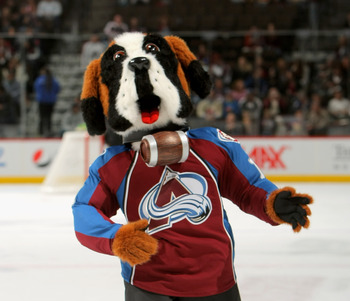
Despite sometimes featuring a shoulder patch of a Sasquatch/Bigfoot footprint, the Avs' mascot is Bernie the St. Bernard, emblematic of rescuing people trapped in alpine avalanches. He even has a keg around his neck, although from a distance, Avs fans, trained on Broncomania, could easily mistake it for a football. His theme song is "Atomic Dog," by Plainfield, New Jersey native George Clinton and his "P-Funk Empire." His uniform number is a bone, although it could, from a distance, appear to be a Number 1.
After the Game. Denver has had crime issues, and just 3 blocks from Coors Field is Larimer Street, immortalized as a dingy, bohemian-tinged, hobo-strewn street in Jack Kerouac's novel On the Road. But that scene was written in 1947. The Pepsi Center is, essentially, an island in a sea of parking. LoDo (Lower Downtown) has become, with the building of Coors Field and the revitalization of Union Station, a sort of mountain Wrigleyville, and thus the go-to area for Denver nightlife. So you'll probably be safe.

Across Chopper Circle from the arena is Brooklyn's at the Pepsi Center, a typical sports bar. If you want something a little more substantial, a Panda Express is on the other side of the arena, across Elitch Circle.

LoDo is loaded with bars that will be open after the game, including Scruffy Murphy's at Larimer & 20th, and an outlet of the Fado Irish Pub chain at Wynkoop & 19th. But the only baseball-named place I can find anywhere near Coors is Sandlot Brewery, at 22nd & Blake, outside the park's right-field corner. Behind home plate, at 1930 Blake Street, is The Sports Column, hailed by a recent Thrillist article as the best sports bar in the State of Colorado.

Perhaps the most famous sports-themed restaurant near Denver is Elway's Cherry Creek, a steakhouse at 2500 E. 1st Avenue in the southern suburb of Cherry Creek. Bus 83L. It's owned by the same guy who owns John Elway Chevrolet in another southern suburb, Englewood.

About a mile southeast of Coors Field, at 538 E. 17th Avenue in the Uptown neighborhood (not sure why a southern, rather than northern, neighborhood is called "Uptown"), is The Tavern, home of the local New York Giants fan club. Jet fans gather at Chopper's Sports Grill, possibly named for Chopper Travaglini, at 80 S. Madison Street at Bayaud Avenue, 3 miles southeast of downtown, in the Pulaski Park neighborhood. Bus 83, then a mile's walk.

If your visit to Denver is during the European soccer season (which is now winding down), your best bet for watching your favorite club is at The Three Lions (named for the crest on the jerseys of the England national team), 2239 E. Colfax Avenue, about 2 miles east of downtown. Number 15 bus.

Sidelights. Sports Authority Field at Mile High, formerly Invesco Field at Mile High, has been the home of the NFL's Denver Broncos since 2001. Everyone just gives it the same name as the old facility: "Mile High Stadium." It includes the Colorado Sports Hall of Fame, and the Broncos' Ring of Fame.

It was built on the site of the McNichols Sports Arena, home to the NBA's Denver Nuggets from 1975 to 1999, the NHL's Colorado Avalanche from 1995 to 1999, and the first major league team called the Colorado Rockies, the NHL team that became the Devils, from 1976 to 1982. It hosted the NCAA Final Four in 1990, with UNLV (the University of Nevada at Las Vegas) clobbering Duke. (The University of Colorado, in Boulder, made the Final Four in 1942 and 1955, although it wasn't yet called the Final Four.  No other Colorado-based school has made it, and none has won a National Championship -- not in basketball, anyway.)
The Rockies they're wishing good luck are the baseball team,
not the hockey team that used to play there and became the Devils.

When the time came to play the final concert at McNichols, the act that played the first concert there was brought back: ZZ Top. This fact was mentioned on an ABC Monday Night Football broadcast, leading Dan Dierdorf to note the alphabetic distinction of the long red-bearded men, and say, "The first one should have been ABBA." Which would have been possible, as they were nearly big in the U.S. at the time. However, the fact that the arena only lasted 24 years, making it not that hard for the act that played the first concert there to also play the last, says something about America's disposable culture.

The old stadium was just to the north of the new stadium/old arena. The current address is Mile High Stadium Circle, but the old intersection was W. 20th Avenue & Bryant St. (2755 W. 17th Avenue was the mailing address.) It was built in 1948 as Bears Stadium, an 18,000-seat ballpark.

When the American Football League was founded in 1960, it was expanded to 34,000 seats with the addition of outfield seating. The name was changed to Mile High Stadium in 1966, and by 1968 much of the stadium was triple-decked and seated 51,706. In 1977 – just in time for the Broncos to make their first Super Bowl run and start "Broncomania" – the former baseball park was transformed into a 76,273-seat horseshoe, whose east stands could be moved in to conform to the shape of a football field, or out to allow enough room for a regulation baseball field. The old-time ballpark had become, by the standards of the time, a modern football stadium.

The biggest complaint when the Rockies arrived in 1993 wasn't the thin air, or the condition of the stadium (despite its age, it was not falling apart), but the positioning of the lights: Great for football fans, but terrible for outfielders tracking fly balls. But it was only meant to be a temporary ballpark for the Rockies, as a condition for Denver getting a team was a baseball-only stadium. What really led to the replacement of Mile High Stadium, and its demolition in 2002, was greed: The Broncos' desire for luxury-box revenue.

At Bears/Mile High Stadium, the Broncos won AFC Championships in 1977, 1986, 1987, 1989, 1997 and 1998, winning the Super Bowl in the last 2 years after losing the first 4 in blowouts.  (They've now won an AFC title at the new stadium, but not a Super Bowl.) The Denver Bears won Pennants while playing there in 1957 (as a Yankee farm team), 1971, 1976, 1977, 1981, 1983 and 1991 (winning the last one under the Denver Zephyrs name).

The U.S. national soccer team played a pair of games at Mile High Stadium in the 1990s, and beat Mexico at the new stadium in 2002 (the only game they've played there so far). While the 2008 Democratic Convention was held at the Pepsi Center, Senator Barack Obama gave his nomination acceptance speech outdoors in front of 80,000 people at New Mile High Stadium.

The Red Lion Hotel Denver and the Skybox Grill & Sports Bar are now on the site of the old stadium. At McNichols, the Nuggets reached the ABA Finals in 1976, and the Avalanche won the 1996 Stanley Cup (albeit clinching in Miami). The Denver Dynamite won the 1st ArenaBowl in 1987. and again in 1989, 1990 and 1991, before finances forced them to fold anyway. 

The new stadium, and the site of the old stadium and arena, are at Mile High Station on the light rail C-Line and E-Line.

Coors Field has been home to the Rockies since it opened in 1995. This past February, it hosted 2 hockey games. The University of Denver beat arch-rival Colorado College 4-1 in a game billed as the Battle On Blake. And as part of the NHL Stadium Series, the Colorado Avalanche hosted the Detroit Red Wings, perhaps perversely celebrating the 20th Anniversary of the birth of their brief but nasty rivalry. The Wings won 5-3.

2001 Blake Street (hence the team's nickname, the Blake Street Bombers) at 20th Street, 3 blocks from Union Station, accessible by light rail.

The Nuggets, known as the Denver Rockets until 1974, played at the Denver Auditorium Arena, at 13th & Champa Streets, from their 1967 inception until McNichols opened in 1975. It was also the home of the original Nuggets, who played in various leagues from 1935 to 1948, and then in the NBA until 1950.

It opened in 1908, and its seating capacity of 12,500 made it the 2nd-largest in the country at the time, behind the version of Madison Square Garden then standing. It almost immediately hosted the Democratic National Convention that nominated William Jennings Bryan for President for the 3rd time – although it's probably just a coincidence that the Democrats waited exactly 100 years (give or take a few weeks) to go back (it's not like Obama didn't want to get it right the 1st time, as opposed the 0-for-3 Bryan).

The Auditorium Arena hosted Led Zeppelin's 1st American concert on December 26, 1968. It was demolished in 1990 to make way for the Denver Performing Arts Complex, a.k.a. the Denver Center. Theatre District/Convention Center Station on the light rail's D-Line, F-Line and H-Line.

The Denver area's Major League Soccer team, the Colorado Rapids, plays at Dick's Sporting Goods Park in Commerce City, about 8 miles northeast of downtown. They'e won the MLS Cup since moving there, in 2010.

The U.S. national team has played there 3 times: A 2-0 win over Guatemala in a World Cup Qualifier on November 19, 2008; a 1-0 win over Costa Rica in a World Cup Qualifier on March 22, 2013 (the famous Snow Classico); and a 2-0 win over Trinidad & Tobago in a World Cup Qualifier this past June 8. The women's team has played there twice: A 2008 win over Brazil, and a 2012 win over Australia. It's also hosted football, rugby, lacrosse and concerts.

6000 Victory Way. If you're going in by public transportation from downtown Denver, Number 48 bus to 60th Avenue & Dahlia Street, then Number 88 bus to 60th & Monaco. Then they make you walk 10 blocks on 60th to get to the stadium.

The Beatles played Red Rocks Amphitheatre in suburban Morrison on August 26, 1964. It is still in business, and a Colorado Music Hall of Fame is a short walk away. 18300 W. Alameda Parkway, 10 miles west of downtown. Sorry, no public transportation.

Elvis played 2 shows at the Denver Coliseum on April 8, 1956, and 1 each on November 17, 1970 and April 30, 1973. Built in 1951, it still stands, seating 10,500, and is best known for concerts and the National Western Stock Rodeo. 4600 Humbolt Street at E. 46th Avenue, off Interstate 70, 3 miles northeast of downtown. Apparently, no public transportation to there, either.

Denver has some renowned museums, including the Denver Museum of Nature & Science (their version of the Museum of Natural History) at 2001 Colorado Blvd. at Montview Blvd. (in City Park, Number 20 bus), and the Denver Art Museum (their version of the Metropolitan Museum of Natural History), at 100 W. 14th Avenue Parkway at Colfax Avenue (across I-25 from Mile High Stadium, Auraria West station on the C-Line and E-Line).

Denver's history only goes back to a gold rush in 1859 – not to be confused with the 1849 one that turned San Francisco from a Spanish Catholic mission into the first modern city in the American West. The city isn't exactly loaded with history.

There's no Presidential Library – although Mamie Doud, the eventual Mrs. Dwight D. Eisenhower, grew up there, and her house is now a historic site. Mamie and "Ike" were married there, their son John (a future General, Ambassador and military historian) was born there, and the Eisenhowers were staying there when Ike had his heart attack in 1955. The house is still in private ownership, and is not open to the public. However, if you're a history buff, or if you just like Ike, and want to see it, it's at 750 Lafayette Street, at 8th Avenue. The Number 6 bus will get you to 6th & Lafayette.

After his heart attack, Ike was treated at Fitzsimmons Army Medical Center in nearby Aurora, 12 years after Senator John Kerry, nearly elected President in 2004 and now Secretary of State, was born there. It's not a Presidential Birthplace, because Kerry narrowly lost. It is now the University of Colorado Hospital. The Fitzsimmons Golf Course is across Montview Boulevard – it figures that Ike would be hospitalized next to a golf course! 16th Avenue & Quentin Street. Number 20 bus from downtown.

The University of Denver's Newman Center for the Performing Arts hosted a 2012 Presidential Debate between Barack Obama and Mitt Romney. 2344 East Iliff Avenue, about 5 miles south of downtown. The University's Magness Arena hosted the Frozen Four in 1961, 1964 and 1976. 2250 E. Jewell Avenue. Both can be reached via H Line light rail to University of Denver Station.

Byron "Whizzer" White was a star football and basketball player at the University of Colorado in the late 1930s, a Rhodes scholar, a running back for the Pittsburgh Steelers and the Detroit Lions, a Bronze Star-winning Navy officer in World War II, one of Colorado's finest lawyers, the chairman of John F. Kennedy's Presidential campaign in the State, and one of the longest-serving Justices on the U.S. Supreme Court. He is buried at the Cathedral of St. John in the Wilderness, 1350 N. Washington Street at 14th Avenue. Bus 6.

Denver doesn't have as many tall buildings as the nation's bigger cities, nor are they as interesting, architecturally. The tallest building in the State of Colorado is Republic Plaza, 714 feet high, at 17th Street & Tremont Place downtown. A 1,000-foot, 90-story residential/hotel tower, currently named Six Fifty 17 for its address (650 17th Street), has been proposed by Uruguay-born, New York-based architect Carlos Ott and local real estate firm Greenwich Realty Capital. They hope to break ground on it in Summer of 2018.

The University of Colorado is in Boulder, 30 miles to the northwest. At Market Street Station, 16th & Market, take the BV Bus to the Boulder Transit Center, which is on campus. The ride should take about an hour and 20 minutes. Colorado State University is in Fort Collins, 65 miles up Interstate 25 north, and forget about reaching it by public transportation.

The U.S. Air Force Academy is outside Colorado Springs, 60 miles down I-25. As with Fort Collins, you'd need Greyhound. Unlike CSU, you might not be able to just go there: Some of the area is restricted.  It is, after all, a military base.

Colorado Springs was also home to the Broadmoor Ice Palace, which hosted what's now called the Frozen Four every year from its inception in 1948 until 1957, and again in 1969. The 3,000-seat arena at The Broadmoor Resort & Spa was home ice to Colorado College from 1938 to 1994. 1 Lake Avenue, across Cheyenne Lake from the main hotel. Its 7,750-seat 1998 replacement, the Broadmoor World Arena, is 4 miles to the east, at 3185 Venetucci Blvd.

Colorado College has won hockey's National Championship in 1950 and 1957. The University of Denver has won it in 1958, 1960, 1961, 1968, 1969, 2004 and 2005. None of the other Colorado schools has yet won it.

A few TV shows have been set in Denver, but you won't find their filming locations there. The old-time Western Whispering Smith and the more recent one Dr. Quinn, Medicine Woman were set in old Colorado, but filmed in Southern California.

Probably the most famous show set in Colorado is South Park, and that's a cartoon, so forget seeing anything from that. Not quite as cartoonish was Mork & Mindy, set in Boulder. The McConnell house actually is in Boulder, at 1619 Pine Street. But don't try to copy the opening-sequence scene with Robin Williams and Pam Dawber on the goalposts at the University of Colorado's Folsom Field. You could fall, and end up saying, "Shazbot!"

The most famous show ever set in Colorado was Dynasty, ABC's Excessive Eighties counterpart to CBS' Dallas, starring John Forsythe as Blake Carrington, an oilman and a thinly-veiled version of Marvin Davis, who nearly bought the Oakland Athletics from Charlie Finley in 1978 with the idea of moving them to Mile High Stadium, but the deal fell through. Right, you don't care about Blake, all you care about is the catfights between the 2nd and 1st Mrs. Carrington's: Krystle (Linda Evans) and Alexis (Joan Collins). The Carrington mansion seen in the opening credits is in Beverly Hills, but the building that stood in for the headquarters of Denver Carrington is at 621 17th Street, while the one that stood in for Colbyco is at 1801 California Street.

Movies set in Denver or its suburbs include The Unsinkable Molly Brown, the original Red Dawn, and, of course, Things to Do In Denver When You're Dead. Films involving skiing often take place in Colorado towns such as Aspen or Vail. City Slickers, a film with loads of baseball references, has a cattle drive that ends in Colorado, but there's no indication of how close it is to Denver. Flashback
takes place on the Pacific Coast, but Denver's Union Station stands in for a train station in San Francisco.

*

The Colorado Avalanche arrived in Denver 20 seasons ago, ready to challenge for the Stanley Cup, and, with a couple of roster tweaks, won it. They stayed strong, won another Cup, fell, and have risen again. Their history isn't long, but it's already deep. Not unlike the Devils.

Wednesday, March 1, 2017

How to Go to a Hockey Game on Prince Edward Island

Next Wednesday, the Charlottetown Islanders will play the Moncton Wildcats, probably the closest thing the biggest sports team on Prince Edward Island has to a rivalry.

Before You Go. Prince Edward Island is in Canada, so you will need a passport. And you will need to change your money. At last check, US$1.00 = C$1.32, and C$1.00 = US 76 cents. And I advise you to call your bank and let them know that you will be in a foreign country, so they won't see credit or debit card purchases from a foreign country pop up and think your card has been stolen.

The Maritime Provinces, a.k.a. Atlantic Canada, are 1 hour ahead of the Eastern Time Zone. So a game starting at 7:00 PM their time would by 6:00 our time. Adjust your timepieces accordingly.

Despite being in Canada, and an oceanfront city where wind can be an issue, and with this being winter, the weather is not expected to be all that bad. Temperatures are expected to be in the high 30s in daylight, and the high 20s at night, with some snow. Be advised that it could be slippery as well as cold.

Also, remember that they use the metric system. A speed limit of 100 kilometers per hour means 62 miles an hour. And don't be fooled by the seemingly low gas prices: That's per liter, not per gallon, and, in spite of Canada being a major oil-producing nation, you'll actually be paying more for gas up there. So, in order to avoid both confusion and "sticker-shock," get your car filled up before you reach the border.

Tickets. The arena seats only 3,690 people, so, even for a minor-league game, tickets may be difficult to get. At least they're cheap: All adult tickets (age 13 to 64, unless with a valid student ID) are C$16.50.

Getting There. Charlottetown, Prince Edward Island is 803 miles from Midtown Manhattan, and 271 miles from the closest border crossing, at Calais, Maine.

Flying is the fastest way to get there, but not a good way. You'd have to change planes, more likely in Toronto (500 miles west) than Montreal, and a round-trip fare on Air Canada could be over US$1,000. VIA Rail doesn't to to PEI. Greyhound does, but the schedule doesn't work out.

So it looks like you'll have to drive. Start out as if you're going to Boston: Take Interstate 95 North to New Haven. Take Exit 48, Interstate 91 North to Hartford. Take Exit 30, Interstate 84 East into Massachusetts. You'll merge with Interstate 90 East, the Massachusetts Turnpike, and take that until you reach Interstate 495, Boston's outer beltway.

But instead of continuing on the Mass Pike to Boston, take Exit 11A onto I-495 North, into Boston's northern suburbs, until you reunite with I-95 North at Salisbury, just before reaching the New Hampshire State Line. You'll cross New Hampshire and go into Maine. Take Exit 182A onto U.S. Route 1A, turn left on State Route 46, right on State Route 9, then follow this rural route all the way to Baring, where you'll meet up with U.S. Route 1. Turn left at International Avenue, and you'll reach the Border.

Don't get cute. Show your passport. If they ask for any other ID, show them that. If you have anything that could be considered a weapon, even a pair of nail clippers, it's probably best to mention that. Don't make any wiseass remarks about Canada. When they ask you your purpose for visiting Canada, tell them you' re visiting Halifax as a tourist. (That is the truth.) Presuming you don't do or say anything stupid, you should get across with no trouble.

International Avenue becomes New Brunswick Provincial Route 1. Take this to River Glade, where you'll get on the Trans-Canada Highway -- which serves as Charlottetown's "beltway." You'll take that through Moncton and to the Confederation Bridge, over the Northumberland Strait and onto Prince Edward Island. Then continue on the TCH until the exit for Kensington Road, on which the arena sits.

If all goes well, you should be in New York State (not counting Manhattan) for half an hour, in Connecticut for 2 hours, in Massachusetts for an hour and 15 minutes, New Hampshire for 15 minutes, Maine for 4 hours and 45 minutes, Customs for 15 minutes or less, New Brunswick for 3 and a half hours, and an hour and 15 minutes on Prince Edward Island (including the Bridge). Given rest stops in Connecticut, at each end of Maine, and in New Brunswick, it should take about 17 hours.

Once In the City. The Island is named for Prince Edward, Duke of Kent and Strathearn, son of King George III of England, brother of King George IV and King William IV, and father of Queen Victoria, who was only 8 months old when he died. He lived for a time in Quebec, was the 1st member of the British royal family to visit America after its independence, and was the 1st person to publicly refer to British subjects in "British North America," British and French alike, as "Canadians."

It was his plan for a "confederation" of Canada that would be discussed long after his death. On the island named for him, the Charlottetown Conference was held in 1864, and this is why the city, named for his mother, Queen Charlotte (wife of George III), is considered "The Birthplace of Confederation," and Edward is called "Father of the Canadian Crown." Ironically, PEI did not become one of the original Provinces after Confederation on July 1, 1867, waiting until 1873, as the 7th of what is now 10 Provinces.
PEI is home to about 147,000 people, nearly half of whom, 64,000, live in the capital of Charlottetown. The people are about 98 percent white, with a few scattered black, Hispanic, Asian and Aboriginal/Native/First Nations people. It's about 93 percent Anglophone and 4 percent Francophone. The tiny Evangline, in Prince County, with about 1,200 people, is the only place on the Island to have a French-speaking majority.

Charlottetown was a fashionable resort in the Victorian era, and is, sort of, "Canada's Cape Cod," particularly its town of Summerside (38 miles west of downtown Charlottetown, population 16,000), even though it is nearly 700 miles from Montreal and over 1,000 miles from Toronto. (The island has a town named Toronto, a small village.)
Province House in Charlottetown, the Provincial capitol building,
site of the 1864 Charlottetown Conference, and thus "the Birthplace of Canada"

The drinking age in PEI is 19. Their Harmonized Sales Tax is 15 percent. The largest newspaper is named The Guardian. Postal Codes on the Island start with the letter C. Like Nova Scotia, PEI uses Area Codes 902 and 782. Maritime Electric runs the Province's electricity.
The 8-mile-long Confederation Bridge, linking the Island with mainland Canada, is soon to celebrate its 20th Anniversary, as it replaced an old ferry on May 31, 1997. Charlottetown doesn't really have a "centerpoint" (or a "centrepoint"), but street addresses increase as you go north and east, and the main intersection appears to be Queen Street and Kent Street -- effectively, named for the namesakes of the City and the Province, mother and son. T3 Transit runs buses (no trains, subway or above-ground), and a single fare is C$2.25.
Confederation Bridge

Going In. The Eastlink Centre is at 46 Kensington Road, at Park Street, adjacent to the Red Shores Racetrack & Casino, just northeast of downtown. It opened in 1990 as the Charlottetown Civic Centre, and naming rights were bought by Canadian communications company EastLink in 2013. Parking is C$12. Seating capacity is 3,690.
The rink is aligned north-to-south. It was home to the University of Prince Edward Island hockey team from 1990 to 2003, and the Prince Edward Island Senators (an Ottawa Senators farm team) from 1993 to 1996.

Since 2003, the arena has been home to a Quebec Major Junior Hockey League team, originally called the PEI Rocket -- formerly the Montreal Rocket, named for Maurice Richard, and playing in the arena named for him at the Olympic Park -- and known since 2013 as the Charlottetown Islanders. They are no longer a Montreal Canadiens farm team, and have no connection to the New York Islanders beyond sharing a name.
Hockey setup

The arena is also home to the Island Storm of the National Basketball League of Canada, and has hosted concerts, including by Canadian performers The Guess Who, Bryan Adams and the Tragically Hip. It also seems to have a thing for old country music singers, as both George Jones and Willie Nelson sang there. David Copperfield performed his magic act there in 2009.
Basketball setup

Food. There are small concession stands (it's only a 3,700-seat arena, after all), including a Tim Hortons, and the Moose Light Lounge (named for a brand of Canadian-produced Moosehead beer) is behind Section 5.

Team History Displays. In their 1st 13 seasons, the Rocket/Islanders made the QMJHL Playoffs 11 times, but only 3 times made the 2nd Round, and never the Semifinals. Thus, they have no championship banners. They have 2 retired numbers, keeping the 9 of Maurice Richard packed away even though they no longer have even their former tenuous connection to him (PEI isn't even majority-Francophone), and the 22 of Pierre-André Bureau, who played for the Rocket from 2000 to 2005, but never reached the NHL.

The PEI Senators won Division titles in 1995 and '96, but there is no notation for this at the Eastlink Centre. That team is now the Binghamton Senators, but is about to move to Bobby Hull's hometown of Belleville, Ontario, while the Albany Devils will be moving to become the Binghamton Devils.

Stuff. There are small souvenir stands, but no team store, no books about the team, no videos.

During the Game. Your safety will not be an issue. Indeed, the people of PEI might be thrilled that someone from New York came to check them out. They hold auditions for National Anthem singers, and have no mascot.

After the Game. Surprisingly, there aren't any restaurants or bars within a 5-minute walk of the arena. You may have to head back downtown for a postgame meal.

The Olde Dublin Pub, 131 Sydney Street between Queen and Great George Streets, is well-regarded. So is the Churchill Arms, around the corner from the Olde Dublin, at 75 Queen Street between Sydney and Dorchester Streets. Both show English soccer games on the weekend, and will likely show whatever European game you ask for if your visit to PEI is during the season (as we now are).

Sidelights. Prince Edward Island is too small to generate any kind of mass culture, including sports. After all, it has just 147,000 people, about the same population as Paterson, New Jersey. Although hockey, rugby, and that classic cold-weather Canadian sport, curling, are common there, there are no professional teams in baseball or football -- either the American version or that common to Canada, with its 12 men on a side, 3 downs a series, and the 110-yard field with the 25-yard-deep end zones.

The former arena was named the Charlottetown Forum. It stood from 1930, at 229 Fitzroy Street, between Weymouth and Cumberland Streets, about halfway between the center of town and the Eastlink Centre. It was demolished in 2001, and the site is now occupied by a parking lot next to the Perfection Foods plant.
The Charlottetown Forum and the 1932 Charlottetown Abbies

The University of Prince Edward Island (UPEI) has since moved into the MacLauchlan Arena, about a mile west of the center of town. The Panthers have won 6 Conference Championships, and count Joel Ward of the San Jose Sharks among their alumni. 170 N. River Road. They've also had some success in basketball and soccer.

UPDATE: The Canadian Premier League, an attempt at a top-flight soccer league for the country, was founded in mid-2017, with the hopes of beginning play in Spring 2018. There is no plan for a stadium or team on Prince Edward Island.

Neither Elvis Presley nor The Beatles ever gave a concert on Prince Edward Island. No Island native has ever come close to being named Prime Minister.

PEI has a few museums. Province House itself is a museum, a building as historic as any in the entire country. 165 Richmond Street. The Confederation Centre of the Arts is a few doors down, at 145 Richmond Street. The Prince Edward Island Regimental Museum is on the Northumberland Strait, at Water and Haviland Streets. Outside of Charlottetown, the best-known museum on the Island is the Acadian Museum, at 23 Main Drive East in Miscouche, just outside Summerside, about 70 miles west of the capital.

The tallest building in the Province isn't very tall, just 127 feet. It's a hotel at Confederation Court Mall, 134 Kent Street, downtown. The Charlottetown Thermal Generating Station, a natural diesel oil power station, is the Island's tallest structure, at 226 feet.

The most famous structure on the Island is Green Gables, the setting of the 1908 novel Anne of Green Gables by Island native Lucy Maud Montgomery, whose family lived at the house and surrounding farm. 8619 Cavendish Road in Cavendish, about 25 miles northwest of downtown Charlottesville, on the Gulf of St. Lawrence. You'd have to drive.

Anne of Green Gables has been filmed only twice: A silent film in 1919, now considered lost; and a 1934 version starring Dawn O'Day, who also filmed another in Montgomery's series, Anne of Windy Poplars, in 1940. A musical film version is currently in development. The other notable film taking place on the Island is Johnny Belinda, starring Jane Wyman and Lew Ayres in 1948.

*

Prince Edward Island is probably best visited in the Summer, when it becomes a resort. But it does have a professional hockey team, and is worth a visit.