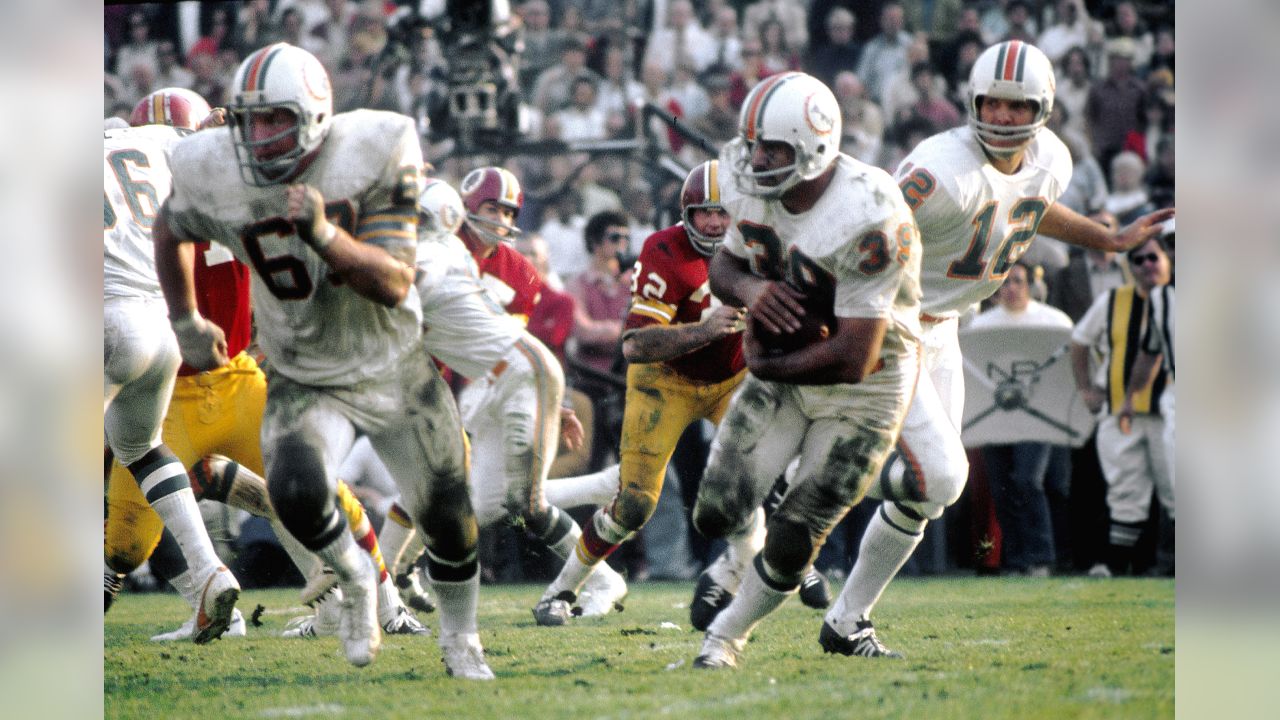
January 14, 1973, 50 years ago: Super Bowl VII is played at the Los Angeles Memorial Coliseum. At stake for both teams was the Championship of the National Football League. At stake for one was the first such title in 30 years. At stake for the other was their first ever, and more: The NFL's 1st undefeated, untied season.
The Miami Dolphins had been founded in 1966. By 1970, they were a Playoff team. For the 1971 season, they reached Super Bowl VI, but lost it to the Dallas Cowboys, 24-3. Now, they were AFC Champions for the 1972 season, and looking for redemption.
Their head coach was also looking for it. Don Shula had been a defensive back for the Cleveland Browns between their NFL Championships of the 1950s, and for the Baltimore Colts before theirs. He became the defensive coordinator for the Detroit Lions, building the 1st defensive line to be known as "The Fearsome Foursome." (The Los Angeles Rams and the San Diego Chargers would also use the name.)
In 1963, he was named head coach of the Colts. He got them into the 1964 NFL Championship Game, but lost to the Browns. In 1968, he won the NFL Championship Game, but lost Super Bowl III to the New York Jets. He was fired after the 1969 season -- and then Don McCafferty took them all the way the next season, winning Super Bowl V.
He was hired by the Dolphins, and built what became known as "the No-Name Defense." This nickname was unfair: While only linebacker Nick Buoniconti has been elected to the Pro Football Hall of Fame, end Bill Stanfill and safeties Dick Anderson and Jake Scott were named to that season's Pro Bowl; and tackle Manny Fernandez would also be an All-Pro.
The offense was led by quarterback Bob Griese, and had 3 good running backs: Larry Csonka, Jim Kiick and Eugene "Mercury" Morris. Griese had receivers Paul Warfield and Howard Twilley, plus Marlin Briscoe, who had previously been one of pro football's earliest black quarterbacks; and tight ends Marv Fleming (who had played for the Green Bay Packers' winners of Super Bowls I and II) and Jim Mandich.
Griese was protected by an offensive line that included center Jim Langer, guards Larry Little and Bob Kuechenberg, and tackles Norm Evans and Doug Crusan. And Garo Yepremian, a bald left-footer from the Mediterranean island nation of Cyprus, was already known as one of the top placekickers in the game.
Shula, Griese, Csonka, Langer, Little, Warfield and Buoniconti have all been elected to the Hall of Fame.
And the regular season couldn't have gone any better. They opened the season by playing the 1st regular season game at Arrowhead Stadium, beating the Kansas City Chiefs, 34-13. They beat the Houston Oilers at home at the Orange Bowl, They struggled to beat the Minnesota Vikings away, 16-14, then beat the New York Jets away and the San Diego Chargers at home.
Their toughest test came at home to the Buffalo Bills, as they had trouble containing O.J. Simpson, and only won 24-23. They rebounded by shutting out the Colts away, beating the Bills 30-16 in Buffalo, and obliterating the New England Patriots 52-0.
Joe Namath and the Jets came to the Orange Bowl, where they had beaten Shula's Colts in Super Bowl III, and held the Dolphins to a 28-24 win. The 'Phins closed by beating the St. Louis Cardinals at home, the Patriots in Foxboro, the New York Giants at Yankee Stadium, and the Colts at home.
The Playoffs were a little more difficult. On Christmas Eve, they beat the Browns at home, 20-14. And on New Year's Eve, they went to Three Rivers Stadium (at the time, home field advantage for the Conference Championships was rotated, rather than given automatically based on best record), and beat the Pittsburgh Steelers 21-7.
That set up a Super Bowl meeting with the Washington Redskins. They had won the NFL Championship in 1937 and 1942, and had lost the NFL Championship Game in 1945. But their reluctance to racially integrate -- they did not do so until 1962, after every other NFL team, every MLB and NBA team, and even 1 NHL team, the Boston Bruins, had done so -- led to a generation of struggle. They integrated, and began to improve, but still didn't make the Playoffs again until 1971.
That was the 1st season as head coach there for George Allen. Unlike Shula, he wasn't much of a player. But, like Shula, he became one of the NFL's top defensive coordinators. In 1963, the Chicago Bears won the NFL Championship and, just as Buddy Ryan as well as head coach Mike Ditka was carried off the field, it was Allen -- not the 68-year-old head coach and owner George Halas -- who was carried off the field. (Ditka was a key player on those '63 Bears.)
Allen got his 1st head coaching job with the Rams, and made them a perennial Playoff team. In 1971, looking for a permanent head coach after the death of Vince Lombardi (who had come out of his Packer retirement to take the Washington reins, and was making progress before he got sick), the Redskins hired Allen.
His idea was "The future is now." He trusted veterans more than rookies. His team became known as "The Over-the-Hill Gang." But the 1972 season proved that they weren't over the hill. Quarterback Billy Kilmer led the NFL in passer rating. The receivers he had to pass to included Charley Taylor (who would become the NFL's all-time leader in receptions), former Packer star Boyd Dowler, and star tight end Jerry Smith. Running back Larry Brown overcame a severe hearing impairment, and was named the League's Most Valuable Player.
As usual, Allen's pride was his defense. He had Verlon Biggs and Ron McDole as ends; Bill Brundige and Diron Talbert as tackles; Jack Pardee, Chris Hanburger and Harold McLinton as linebackers; Pat Fischer and Mike Bass as cornerbacks; and Richie Petitbon (one of his '63 Bears) and Brig Owens as safeties.
The Redskins went 11-3, their losses being 24-23 away to New England, and then, after they were already 11-1 and had clinched the NFC Eastern Division, 34-24 away to the Dallas Cowboys and 24-17 at home to O.J. and the Bills.
As Dick Vermeil later would as head coach of the Philadelphia Eagles, Allen focused like a laser beam on the Cowboys, who in 1966 became the dominant team in the Division that would evolve into the NFC East. As Cowboy defensive end Harvey Martin later put it in an interview, "He had them so high, they were ready to pop. So if you're going to go in there, you better have your guns on." Pretty bold statement to make about Washington, the city where the President of the United States lives, from a man playing in Dallas, a city where a President had recently been shot and killed.
But the Redskins did hate the Cowboys. And so did their fans. The fans were hopped-up about everybody: The current President, Richard Nixon, made the point that, "All anybody cares about in Washington is the Redskins. Nobody cares about the Kennedy Center or the National Gallery of Art." It was true: The city had just lost baseball's Senators, and basketball's Bullets and hockey's Capitals hadn't arrived yet. Sports-wise, the Redskins were it.
And on New Year's Eve, December 31, 1972, 3 hours after the Dolphins had finished off the Steelers, and a few hours before the plane crash that would kill baseball star Roberto Clemente, the NFL Films cameras caught a fan at Robert F. Kennedy Memorial Stadium wearing a Redskin helmet with a single-bar facemask, yelling at the Cowboys, "Die, you dogs, die! Die, you yellow dogs!"
Well, the Cowboys didn't die, but they were completely shut down and humiliated by the game that stood as the masterstroke in the careers of both George Allen and Billy Kilmer: Redskins 26, Cowboys 3. The Cowboys' reign as World Champions, and their 1st glory period, was over, and they went into a transition that allowed them to emerge as Super Bowl winners 5 years later.
So the Redskins were ready to derail the Dolphins' bid for an undefeated season. There was precedent: In 1942, the Bears were undefeated going into the NFL Championship Game, and the Redskins beat them. The Bears were also undefeated going into the Championship Game in 1934, and lost to the Giants.
There had been undefeated seasons in the NFL. In the 1st season, 1920, the Akron Pros went 8-0-3. In 1922, the Canton Bulldogs went 10-0-2. In 1923, the Bulldogs went 11-0-1. In 1929, the Packers went 12-0-1. But that was all before the institution of the NFL Championship Game for the 1933 season, let alone the Super Bowl for the 1966 season. So it had never been done in a full season.
Shula was outwardly calm. But he knew that he was 0-2 in Super Bowls, and had missed his chances as a player with the Browns and the Colts. And he had the flu, a fact he hid from his players, who did notice, as they said in later interviews, that he seemed "neurotic" and "absolutely crazy." Allen was similarly uptight, and accused the media of ruining his team's preparation. The players began to tell each other that they should have left him in Washington.
The year before, when the Dolphins lost Super Bowl VI to the Cowboys, it was the coldest Super Bowl to date, with a kickoff temperature of 39 degrees. (There have been Super Bowls played in domed stadiums, where it was colder than that outside, but not inside.) This time, it was 84 degrees at kickoff. Despite every Super Bowl ever played having been played either in a warm-weather city or under a dome, this remains the highest temperature in the game's history.
The Dolphins scored at the end of each of the 1st 2 quarters. At the end of the 1st, Griese threw a 28-yard touchdown pass to Twilley. At the end of the 2nd, Kiick ran the ball in from 1 yard, to make it 14-0 Miami. The No-Name Defense had limited the Redskins to 72 total yards and only 4 1st downs.
In the 3rd quarter, the Redskins got to the Dolphins' 17-yard line, but Taylor stumbled, and a Kilmer pass bounced off his fingers. Fernandez then sacked Kilmer, and Curt Knight attempted a 32-yard field goal, which went wide right. A successful kick would only have made it 14-3, but it would have given the Redskins a little momentum, with plenty of time to play.
They almost scored a touchdown early in the 4th quarter. Jerry Smith was wide open in the end zone, but Kilmer's pass went awry, and hit the goalpost. (After 1 more season, the NFL moved the goalposts back 10 yards, from the goal line to the end line.) Kilmer tried again, but Scott intercepted him, and returned it 55 yards.
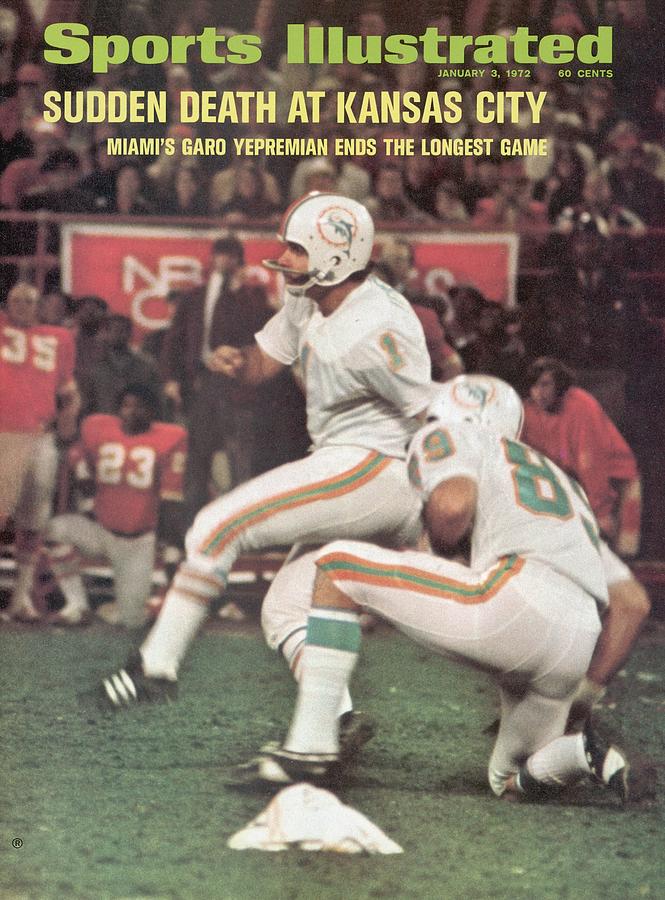
The Dolphins got the ball to the Redskin 34, and on 4th down, Shula thought, "What a hell of a way to remember this game." He sent Yepremian in for a 42-yard field goal. So now, the team that stood to finish 17-0 stood to win 17-0. It was all so... perfect.
But Yepremian's kick was too low, and it was blocked by Brundige, and bounced back to him. Yepremian recovered it. There was still, according to the rules, a chance to gain a 1st down on the play. Brundige bore down on Yepremian, who tried to throw the ball -- with his right hand, despite kicking with his left foot.
What would have happened if he'd thrown with his left hand? We'll never know, but, throwing with his right, the ball went almost straight up, and came down, and bounced off his hands as he tried to catch it himself. Bass caught it for an interception, and he ran down the sideline, and couldn't be caught. Touchdown, Washington. Knight's extra point was good, and, with 2 minutes and 7 seconds left on the clock, it was Miami 14, Washington 7.
Now, suddenly, the game, the title, and the perfect season were all in serious jeopardy, thanks to what became known as "Garo's Gaffe." If the Dolphins didn't hang on and win this game, Yepremian would have become the biggest goat in the history of South Florida sports.
But Allen was a conservative coach, not given to gambling, and he made a historic blunder: He had Knight kick the ball deep. Unlike Jim Haslett to begin the 2nd half for the New Orleans Saints, 37 Super Bowls later, Allen was not willing to try an onside kick, and while there's no guarantee that the 'Skins would have recovered it, it cost him the best chance at a title he would ever have.
But Allen trusted his defense, and, while he was forced to use all his timeouts, plus the 2-minute warning, it almost worked. He forded the Dolphins to punt from their own 36 with 1:14 left. But Kilmer threw 2 incompletions, lost 4 yards on a pass play, and was sacked by Vern Den Herder on the game's final play.
The game was over, and the Dolphins had their perfect season. Scott was named the game's MVP, unusual for a defensive back. The Redskins had nearly as many total yards from scrimmage as the Dolphins, and had more 1st downs and 5 minutes' more time of possession. But the Dolphins' defense had completely shut the Redskins' offense down, as Washington's only score came on special teams.
The Dolphins won their 1973 season opener, extending their winning streak to 18 straight games, and their regular-season winning streak to 16. They won Super Bowl VIII, beating the Minnesota Vikings at Rice Stadium in Houston.
Over the next 11 seasons, Shula would lead them to 2 more Super Bowls, XVII and XIX, but they would lose them both. Shula got them into the 1992 AFC Championship Game, at home, but they lost to the Bills. Through the 2022 season, the Dolphins have never been back to the AFC Championship Game, much less the Super Bowl. Shula retired with 347 wins, more than any coach in NFL history, but with only 2 Super Bowl wins in 6 attempts.
The Redskins remained a contender through the 1970s, but, finally, the Over-the-Hill Gang truly got old. In the early 1980s, new coach Joe Gibbs and general manager Bobby Beathard rebuilt the team, and in 1983, they beat the Dolphins in Super Bowl XVII, winning the franchise's 1st World Championship in 40 years. They lost Super Bowl XVIII, but won Super Bowls XXII and XXVI, making it 4 appearances and 3 wins in 9 years. But they haven't been back since.
Super Bowl VII was the 2nd time the Los Angeles Coliseum had hosted the Super Bowl, after hosting the 1st in 1967. The next 5 Super Bowls to be held in the Los Angeles metropolitan area -- in calendar years 1977, 1980, 1983, 1987 and 1993 -- were held at the Rose Bowl in suburban Pasadena. The NFL instituted a policy that only metro areas with an NFL team could host a Super Bowl (albeit chosen years in advance, in the hopes of assuring a neutral site), so L.A. didn't host one for a long time. But with the restoration to the area of the Rams and the Chargers, in 2022, Super Bowl LVI was played at the new SoFi Stadium in Inglewood.
*
NBC had the rights to cover Super Bowl VII. They also had the rights to air Elvis: Aloha from Hawaii via Satellite. This concert was broadcast all over the world from the Honolulu International Center, now named the Neal S. Blaisdell Center, after the Mayor who got it built. The one major country on Earth that did not broadcast it live was America, because NBC thought it would be too much to ask of their viewers to watch 2 epic events in one day. So they held it back, and broadcast it on April 4, 1973.
Elvis Presley had just turned 38, and had also just finalized his divorce from his wife Priscilla. He came onstage wearing a white jumpsuit with an eagle on the front, an eagle on the back, and a big belt with a double-eagle buckle.

He sang hits from all phases of his career: The early "Memphis Flash" days, his Hollywood exile, and his Las Vegas comeback. As usual, he closed with "Can't Help Falling In Love," which was certainly appropriate on this occasion, because it was used in his 1962 film Blue Hawaii.
It was not one of his better performances. Certainly, he wasn't as into it was he was for his "Comeback Special" in 1968 (also on NBC) or for the Vegas show he did that was included in the 1970 documentary Elvis: That's the Way It Is. He was tired, and the emotional stress of the divorce was weighing on him. He looked like he was still in good shape, but the prescription drugs he was taking had already begun to take their toll. Within 5 years, the King of Rock and Roll was dead.