Showing posts with label super bowl vii. Show all posts

Saturday, January 14, 2023

January 14, 1973: The Dolphins Finish Undefeated & Elvis Says Aloha

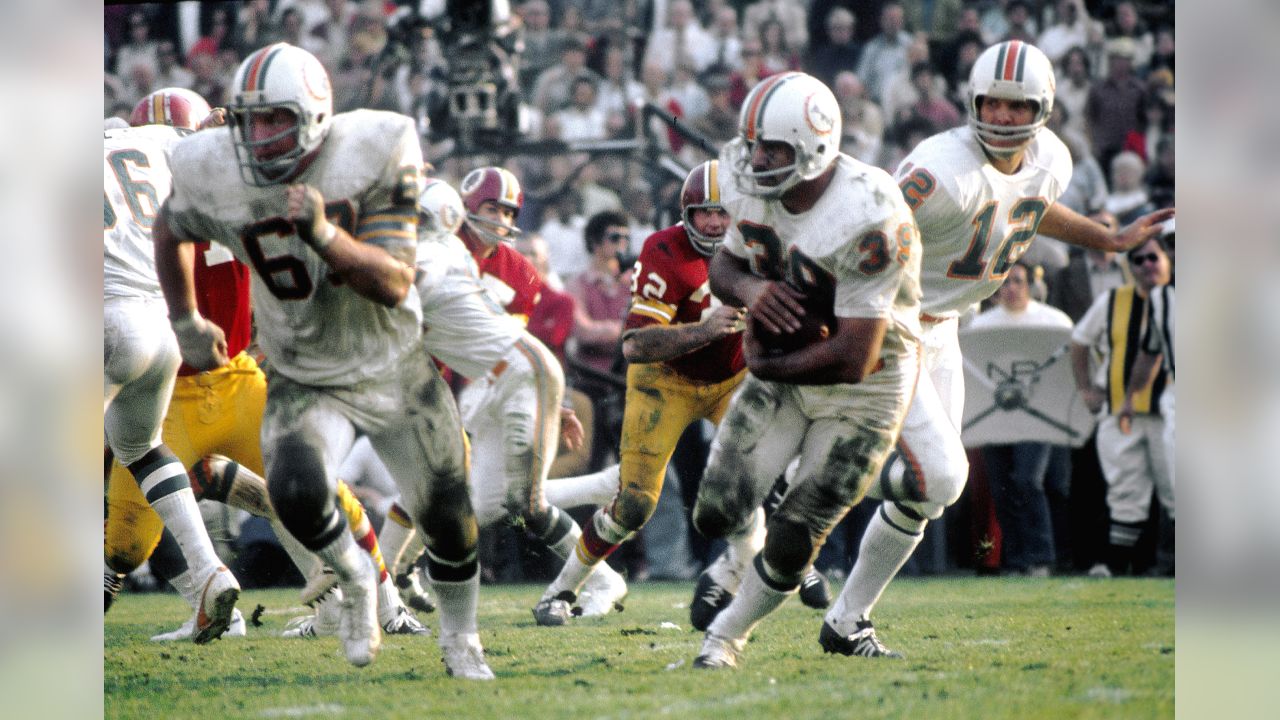
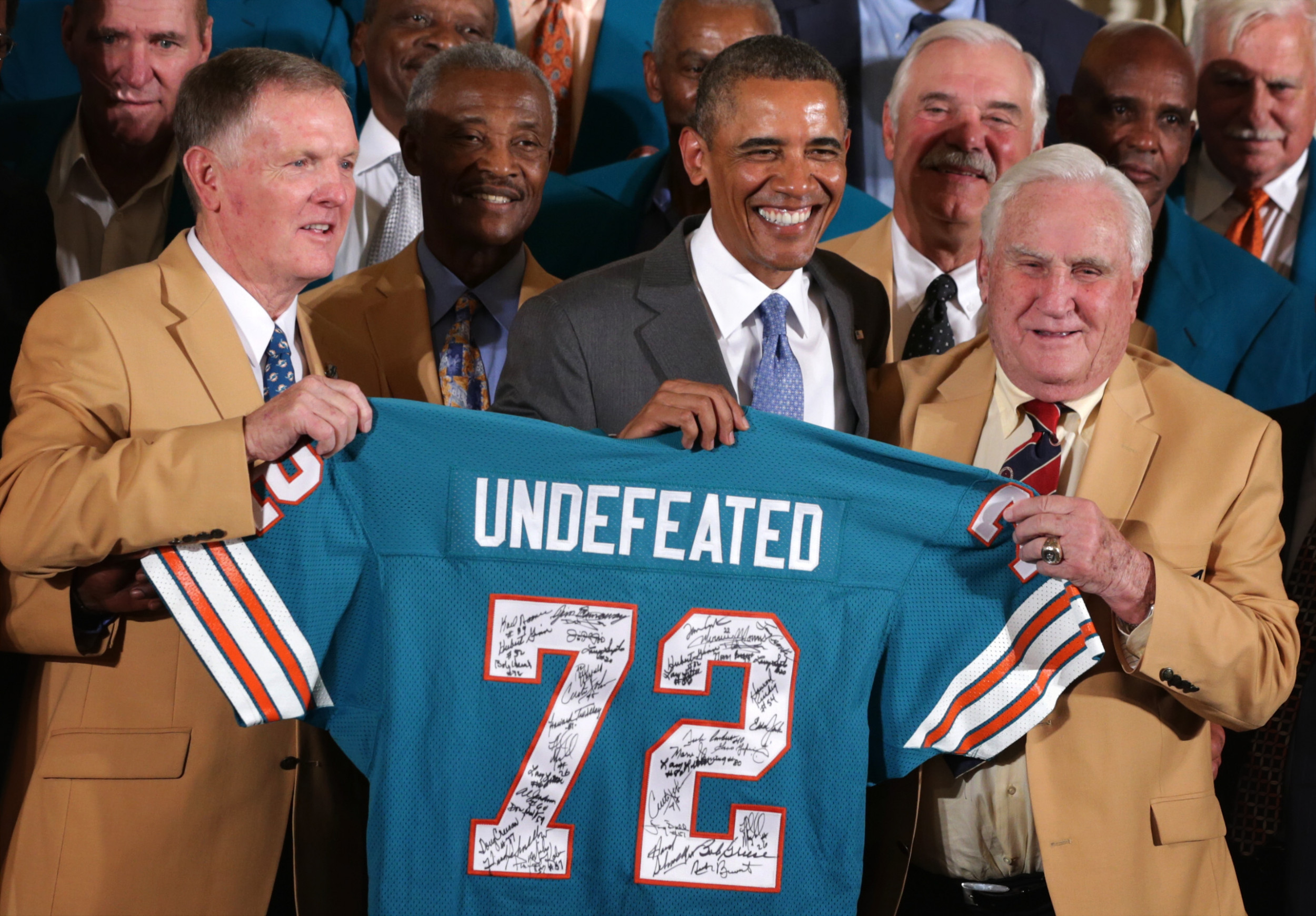
January 14, 1973, 50 years ago: Super Bowl VII is played at the Los Angeles Memorial Coliseum. At stake for both teams was the Championship of the National Football League. At stake for one was the first such title in 30 years. At stake for the other was their first ever, and more: The NFL's 1st undefeated, untied season.

The Miami Dolphins had been founded in 1966. By 1970, they were a Playoff team. For the 1971 season, they reached Super Bowl VI, but lost it to the Dallas Cowboys, 24-3. Now, they were AFC Champions for the 1972 season, and looking for redemption.

Their head coach was also looking for it. Don Shula had been a defensive back for the Cleveland Browns between their NFL Championships of the 1950s, and for the Baltimore Colts before theirs. He became the defensive coordinator for the Detroit Lions, building the 1st defensive line to be known as "The Fearsome Foursome." (The Los Angeles Rams and the San Diego Chargers would also use the name.)

In 1963, he was named head coach of the Colts. He got them into the 1964 NFL Championship Game, but lost to the Browns. In 1968, he won the NFL Championship Game, but lost Super Bowl III to the New York Jets. He was fired after the 1969 season -- and then Don McCafferty took them all the way the next season, winning Super Bowl V.

He was hired by the Dolphins, and built what became known as "the No-Name Defense." This nickname was unfair: While only linebacker Nick Buoniconti has been elected to the Pro Football Hall of Fame, end Bill Stanfill and safeties Dick Anderson and Jake Scott were named to that season's Pro Bowl; and tackle Manny Fernandez would also be an All-Pro.

The offense was led by quarterback Bob Griese, and had 3 good running backs: Larry Csonka, Jim Kiick and Eugene "Mercury" Morris. Griese had receivers Paul Warfield and Howard Twilley, plus Marlin Briscoe, who had previously been one of pro football's earliest black quarterbacks; and tight ends Marv Fleming (who had played for the Green Bay Packers' winners of Super Bowls I and II) and Jim Mandich.

Griese was protected by an offensive line that included center Jim Langer, guards Larry Little and Bob Kuechenberg, and tackles Norm Evans and Doug Crusan. And Garo Yepremian, a bald left-footer from the Mediterranean island nation of Cyprus, was already known as one of the top placekickers in the game.

Shula, Griese, Csonka, Langer, Little, Warfield and Buoniconti have all been elected to the Hall of Fame.

And the regular season couldn't have gone any better. They opened the season by playing the 1st regular season game at Arrowhead Stadium, beating the Kansas City Chiefs, 34-13. They beat the Houston Oilers at home at the Orange Bowl, They struggled to beat the Minnesota Vikings away, 16-14, then beat the New York Jets away and the San Diego Chargers at home.

Their toughest test came at home to the Buffalo Bills, as they had trouble containing O.J. Simpson, and only won 24-23. They rebounded by shutting out the Colts away, beating the Bills 30-16 in Buffalo, and obliterating the New England Patriots 52-0.

Joe Namath and the Jets came to the Orange Bowl, where they had beaten Shula's Colts in Super Bowl III, and held the Dolphins to a 28-24 win. The 'Phins closed by beating the St. Louis Cardinals at home, the Patriots in Foxboro, the New York Giants at Yankee Stadium, and the Colts at home.

The Playoffs were a little more difficult. On Christmas Eve, they beat the Browns at home, 20-14. And on New Year's Eve, they went to Three Rivers Stadium (at the time, home field advantage for the Conference Championships was rotated, rather than given automatically based on best record), and beat the Pittsburgh Steelers 21-7.

That set up a Super Bowl meeting with the Washington Redskins. They had won the NFL Championship in 1937 and 1942, and had lost the NFL Championship Game in 1945. But their reluctance to racially integrate -- they did not do so until 1962, after every other NFL team, every MLB and NBA team, and even 1 NHL team, the Boston Bruins, had done so -- led to a generation of struggle. They integrated, and began to improve, but still didn't make the Playoffs again until 1971.

That was the 1st season as head coach there for George Allen. Unlike Shula, he wasn't much of a player. But, like Shula, he became one of the NFL's top defensive coordinators. In 1963, the Chicago Bears won the NFL Championship and, just as Buddy Ryan as well as head coach Mike Ditka was carried off the field, it was Allen -- not the 68-year-old head coach and owner George Halas -- who was carried off the field. (Ditka was a key player on those '63 Bears.)

Allen got his 1st head coaching job with the Rams, and made them a perennial Playoff team. In 1971, looking for a permanent head coach after the death of Vince Lombardi (who had come out of his Packer retirement to take the Washington reins, and was making progress before he got sick), the Redskins hired Allen.

His idea was "The future is now." He trusted veterans more than rookies. His team became known as "The Over-the-Hill Gang." But the 1972 season proved that they weren't over the hill. Quarterback Billy Kilmer led the NFL in passer rating. The receivers he had to pass to included Charley Taylor (who would become the NFL's all-time leader in receptions), former Packer star Boyd Dowler, and star tight end Jerry Smith. Running back Larry Brown overcame a severe hearing impairment, and was named the League's Most Valuable Player.

As usual, Allen's pride was his defense. He had Verlon Biggs and Ron McDole as ends; Bill Brundige and Diron Talbert as tackles; Jack Pardee, Chris Hanburger and Harold McLinton as linebackers; Pat Fischer and Mike Bass as cornerbacks; and Richie Petitbon (one of his '63 Bears) and Brig Owens as safeties.

The Redskins went 11-3, their losses being 24-23 away to New England, and then, after they were already 11-1 and had clinched the NFC Eastern Division, 34-24 away to the Dallas Cowboys and 24-17 at home to O.J. and the Bills.

As Dick Vermeil later would as head coach of the Philadelphia Eagles, Allen focused like a laser beam on the Cowboys, who in 1966 became the dominant team in the Division that would evolve into the NFC East. As Cowboy defensive end Harvey Martin later put it in an interview, "He had them so high, they were ready to pop. So if you're going to go in there, you better have your guns on." Pretty bold statement to make about Washington, the city where the President of the United States lives, from a man playing in Dallas, a city where a President had recently been shot and killed.

But the Redskins did hate the Cowboys. And so did their fans. The fans were hopped-up about everybody: The current President, Richard Nixon, made the point that, "All anybody cares about in Washington is the Redskins. Nobody cares about the Kennedy Center or the National Gallery of Art." It was true: The city had just lost baseball's Senators, and basketball's Bullets and hockey's Capitals hadn't arrived yet. Sports-wise, the Redskins were it.

And on New Year's Eve, December 31, 1972, 3 hours after the Dolphins had finished off the Steelers, and a few hours before the plane crash that would kill baseball star Roberto Clemente, the NFL Films cameras caught a fan at Robert F. Kennedy Memorial Stadium wearing a Redskin helmet with a single-bar facemask, yelling at the Cowboys, "Die, you dogs, die! Die, you yellow dogs!"

Well, the Cowboys didn't die, but they were completely shut down and humiliated by the game that stood as the masterstroke in the careers of both George Allen and Billy Kilmer: Redskins 26, Cowboys 3. The Cowboys' reign as World Champions, and their 1st glory period, was over, and they went into a transition that allowed them to emerge as Super Bowl winners 5 years later.

So the Redskins were ready to derail the Dolphins' bid for an undefeated season. There was precedent: In 1942, the Bears were undefeated going into the NFL Championship Game, and the Redskins beat them. The Bears were also undefeated going into the Championship Game in 1934, and lost to the Giants.

There had been undefeated seasons in the NFL. In the 1st season, 1920, the Akron Pros went 8-0-3. In 1922, the Canton Bulldogs went 10-0-2. In 1923, the Bulldogs went 11-0-1. In 1929, the Packers went 12-0-1. But that was all before the institution of the NFL Championship Game for the 1933 season, let alone the Super Bowl for the 1966 season. So it had never been done in a full season.

Shula was outwardly calm. But he knew that he was 0-2 in Super Bowls, and had missed his chances as a player with the Browns and the Colts. And he had the flu, a fact he hid from his players, who did notice, as they said in later interviews, that he seemed "neurotic" and "absolutely crazy." Allen was similarly uptight, and accused the media of ruining his team's preparation. The players began to tell each other that they should have left him in Washington.

The year before, when the Dolphins lost Super Bowl VI to the Cowboys, it was the coldest Super Bowl to date, with a kickoff temperature of 39 degrees. (There have been Super Bowls played in domed stadiums, where it was colder than that outside, but not inside.) This time, it was 84 degrees at kickoff. Despite every Super Bowl ever played having been played either in a warm-weather city or under a dome, this remains the highest temperature in the game's history.

The Dolphins scored at the end of each of the 1st 2 quarters. At the end of the 1st, Griese threw a 28-yard touchdown pass to Twilley. At the end of the 2nd, Kiick ran the ball in from 1 yard, to make it 14-0 Miami. The No-Name Defense had limited the Redskins to 72 total yards and only 4 1st downs.

In the 3rd quarter, the Redskins got to the Dolphins' 17-yard line, but Taylor stumbled, and a Kilmer pass bounced off his fingers. Fernandez then sacked Kilmer, and Curt Knight attempted a 32-yard field goal, which went wide right. A successful kick would only have made it 14-3, but it would have given the Redskins a little momentum, with plenty of time to play.

They almost scored a touchdown early in the 4th quarter. Jerry Smith was wide open in the end zone, but Kilmer's pass went awry, and hit the goalpost. (After 1 more season, the NFL moved the goalposts back 10 yards, from the goal line to the end line.) Kilmer tried again, but Scott intercepted him, and returned it 55 yards.

The Dolphins got the ball to the Redskin 34, and on 4th down, Shula thought, "What a hell of a way to remember this game." He sent Yepremian in for a 42-yard field goal. So now, the team that stood to finish 17-0 stood to win 17-0. It was all so... perfect.

But Yepremian's kick was too low, and it was blocked by Brundige, and bounced back to him. Yepremian recovered it. There was still, according to the rules, a chance to gain a 1st down on the play. Brundige bore down on Yepremian, who tried to throw the ball -- with his right hand, despite kicking with his left foot.

What would have happened if he'd thrown with his left hand? We'll never know, but, throwing with his right, the ball went almost straight up, and came down, and bounced off his hands as he tried to catch it himself. Bass caught it for an interception, and he ran down the sideline, and couldn't be caught. Touchdown, Washington. Knight's extra point was good, and, with 2 minutes and 7 seconds left on the clock, it was Miami 14, Washington 7.

Now, suddenly, the game, the title, and the perfect season were all in serious jeopardy, thanks to what became known as "Garo's Gaffe." If the Dolphins didn't hang on and win this game, Yepremian would have become the biggest goat in the history of South Florida sports.

But Allen was a conservative coach, not given to gambling, and he made a historic blunder: He had Knight kick the ball deep. Unlike Jim Haslett to begin the 2nd half for the New Orleans Saints, 37 Super Bowls later, Allen was not willing to try an onside kick, and while there's no guarantee that the 'Skins would have recovered it, it cost him the best chance at a title he would ever have.

But Allen trusted his defense, and, while he was forced to use all his timeouts, plus the 2-minute warning, it almost worked. He forded the Dolphins to punt from their own 36 with 1:14 left. But Kilmer threw 2 incompletions, lost 4 yards on a pass play, and was sacked by Vern Den Herder on the game's final play.

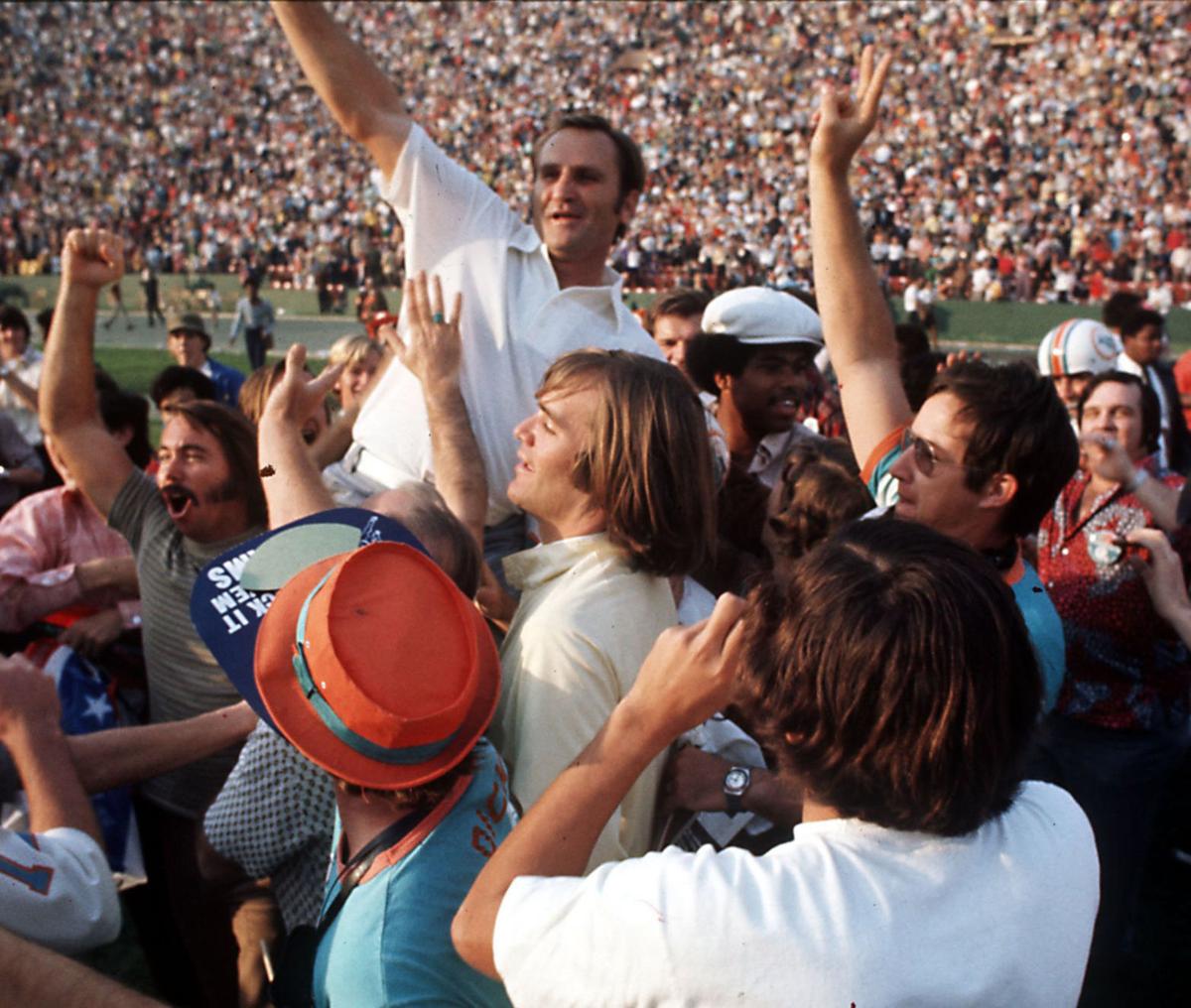
The game was over, and the Dolphins had their perfect season. Scott was named the game's MVP, unusual for a defensive back. The Redskins had nearly as many total yards from scrimmage as the Dolphins, and had more 1st downs and 5 minutes' more time of possession. But the Dolphins' defense had completely shut the Redskins' offense down, as Washington's only score came on special teams.

The Dolphins won their 1973 season opener, extending their winning streak to 18 straight games, and their regular-season winning streak to 16. They won Super Bowl VIII, beating the Minnesota Vikings at Rice Stadium in Houston.

Over the next 11 seasons, Shula would lead them to 2 more Super Bowls, XVII and XIX, but they would lose them both. Shula got them into the 1992 AFC Championship Game, at home, but they lost to the Bills. Through the 2022 season, the Dolphins have never been back to the AFC Championship Game, much less the Super Bowl. Shula retired with 347 wins, more than any coach in NFL history, but with only 2 Super Bowl wins in 6 attempts.

The Redskins remained a contender through the 1970s, but, finally, the Over-the-Hill Gang truly got old. In the early 1980s, new coach Joe Gibbs and general manager Bobby Beathard rebuilt the team, and in 1983, they beat the Dolphins in Super Bowl XVII, winning the franchise's 1st World Championship in 40 years. They lost Super Bowl XVIII, but won Super Bowls XXII and XXVI, making it 4 appearances and 3 wins in 9 years. But they haven't been back since.

Super Bowl VII was the 2nd time the Los Angeles Coliseum had hosted the Super Bowl, after hosting the 1st in 1967. The next 5 Super Bowls to be held in the Los Angeles metropolitan area -- in calendar years 1977, 1980, 1983, 1987 and 1993 -- were held at the Rose Bowl in suburban Pasadena. The NFL instituted a policy that only metro areas with an NFL team could host a Super Bowl (albeit chosen years in advance, in the hopes of assuring a neutral site), so L.A. didn't host one for a long time. But with the restoration to the area of the Rams and the Chargers, in 2022, Super Bowl LVI was played at the new SoFi Stadium in Inglewood.

*

NBC had the rights to cover Super Bowl VII. They also had the rights to air Elvis: Aloha from Hawaii via Satellite. This concert was broadcast all over the world from the Honolulu International Center, now named the Neal S. Blaisdell Center, after the Mayor who got it built. The one major country on Earth that did not broadcast it live was America, because NBC thought it would be too much to ask of their viewers to watch 2 epic events in one day. So they held it back, and broadcast it on April 4, 1973.

Elvis Presley had just turned 38, and had also just finalized his divorce from his wife Priscilla. He came onstage wearing a white jumpsuit with an eagle on the front, an eagle on the back, and a big belt with a double-eagle buckle.
He sang hits from all phases of his career: The early "Memphis Flash" days, his Hollywood exile, and his Las Vegas comeback. As usual, he closed with "Can't Help Falling In Love," which was certainly appropriate on this occasion, because it was used in his 1962 film Blue Hawaii.

It was not one of his better performances. Certainly, he wasn't as into it was he was for his "Comeback Special" in 1968 (also on NBC) or for the Vegas show he did that was included in the 1970 documentary Elvis: That's the Way It Is. He was tired, and the emotional stress of the divorce was weighing on him. He looked like he was still in good shape, but the prescription drugs he was taking had already begun to take their toll. Within 5 years, the King of Rock and Roll was dead.

Monday, December 13, 2021

How to Be a Jet Fan In Miami -- 2021 Edition

On Sunday, December 5, the New York Giants played the Dolphins in the Miami suburbs. The Dolphins won, 20-9.

This Sunday, December 19, the New York Jets play the Dolphins in the Miami suburbs. This AFC Eastern Division rivalry has had some big moments. But since the New England Patriots started dominating the AFC East and winning Super Bowls in the 2001-02 season, Jets-Dolphins hasn't meant as much.

Funny, but that meaning wasn't lost when it was the Buffalo Bills winning AFC East titles from 1988 to 1995.

Before You Go. Miami is in Florida. If you're still nervous about COVID, don't go. If you do go, wear a mask.

Miami is in Florida. It's frequently hot, even during the Christmas season. And it's frequently rainy. At least now, the stadium has a roof to provide protection from the rain, if not from the heat, at your seat. So dress lightly, wear a hat, keep hydrated, and you should probably bring an umbrella to the city, although it won't be allowed inside the stadium.

The Miami Herald website is predicting that Sunday afternoon will be in the low 80s, while the nighttime temperature will be in the low 70s. They are predicting rain for Sunday, during the game. But the roof that was part of the stadium's renovations should protect you during the game.

Florida is a former Confederate State, and parts of Miami sure seem like a foreign country. But you won't need to bring your passport or change your money. And it's in the Eastern Time Zone, so you won't have to fool with your timepieces.

Tickets. The Dolphins averaged 63,067 fans per home game in 2019, the last pre-COVID season. With 10,000 seats having been sacrificed in a recent renovation, this was close to a sellout. So getting tickets may be hard.

In the Lower Level, the 100 sections, seats go for $245 on the sidelines and $135 in the end zone. In the Upper Level, the 300 sections, they're $95 on the sidelines and $80 in the end zone. The 200 sections are Club Level, and are truly prohibitively expensive, so don't even consider them.

Before you order online, or (if you are so foolhardy as to not have your tickets before you take off from Newark/JFK/LaGuardia) pay at the ticket window, be advised that the northeast sideline, the sections on each level ending in the 20s, gets the full brunt of the sun during day games, although that won't be a problem this time, as it's going to rain.

Getting There. It's 1,283 miles from Times Square in New York to downtown Miami, and 1,267 miles from MetLife Stadium in East Rutherford, New Jersey to Hard Rock Stadium in Miami Gardens, Florida.

Knowing this distance, your first reaction is going to be to fly down there. This is not a horrible idea, but you'll still have to get from the airport to wherever your hotel is. If you're trying to get from the airport to downtown, you'll need to change buses – or change from a bus to Miami's Tri-Rail rapid transit service. And it is possible, if you order quickly, to find nonstop flights, lasting 3 hours, for under $400 round-trip.

The train is not a very good idea, because you'll have to leave Penn Station on Amtrak's Silver Meteor at 3:15 PM and arrive in Miami at 6:39 the next day's evening, a 27-hour ride. The return trip will leave at 8:10 AM and return to New York at 11:00 AM, also 27 hours. No, there's no time-zone change involved. Round-trip, it'll cost $424. And the station isn't all that close, at 8303 NW 37th Avenue. Fortunately, there's a Tri-Rail station there that will take you downtown. But you'll have to spend the nights of the 18th and the 19th in a hotel.

How about Greyhound? There are 5 buses leaving Port Authority every day with connections to Miami. The ride, including any changeovers that might have to be made (most likely in Richmond), takes about 33 hours. Round-trip fare is $588, but it can be cut to $383 with advanced purchase. The station is at 4111 NW 27th Street and, ironically, is right across 42nd Avenue from the airport. It's worth the fact that it'll cost twice as much to simply fly down. Plus, going from New York to Miami on Greyhound, you might be reminded of the end of the movie Midnight Cowboy, and nobody wants to be reminded of that.

If you want to drive, it'll help to get someone to go down with you, and take turns driving. You'll be going down Interstate 95 (or its New Jersey equivalent, the Turnpike) almost the whole way. It'll be about 2 hours from the Lincoln Tunnel to the Delaware Memorial Bridge, 20 minutes in Delaware, and an hour and a half in Maryland, before crossing the Woodrow Wilson Bridge, at the southern tip of the District of Columbia, into Virginia. Then it will be 3 hours or so in Virginia, another 3 hours in North Carolina, about 3 hours and 15 minutes in South Carolina, a little under 2 hours in Georgia, and about 6 hours and 15 minutes in Florida before you reach downtown Miami – maybe a little under 6 hours if you get a hotel near the stadium.

Given rest stops, preferably in one in each State from Maryland to Georgia and 2 in Florida, you're talking about a 28-hour trip.

Once In the City. A lot of people don't realize it, because Miami is Florida's most famous city, but the most populous city in the State is Jacksonville.  However, while Miami has about 453,000 people within the city limits, there are 6.4 million living in the metro area, making it far and away the largest in the South, not counting Texas.

Because Florida is so hot, and air-conditioning didn't become common until the mid-20th Century, Miami was founded rather late by the standards of the East coast, in 1825, and wasn't incorporated as a city until 1896. The name is derived from the Mayaimi tribe of Native Americans. Miami Avenue is the east-west divider, Flagler Street the north-south.

The Herald is the only major newspaper left in the city, but the Sun-Sentinel of Fort Lauderdale should also be available. And, considering how many ex-New Yorkers are around, you might also be able to get the Times, the Daily News, or, if you're really desperate (or really conservative), the Post.

The sales tax in Florida is 6 percent, but it's 7 percent within Miami-Dade County. ZIP Codes in Miami start with the digits 330, 331 and 332; in the Fort Lauderdale area, 333; and in the Palm Beach area, 334 and 349. Florida Power & Light runs the Miami area's electricity.

No longer thought of as a haven for retired Jewish New Yorkers, Miami is the most Hispanic city east of Texas: 70 percent, with half of that, 34 percent of the total, being of Cuban origin, many of them refugees from the 1959 Castro Revolution and their descendants.

It should be noted, though, that, after 2 generations, there are Cubans in South Florida who don't remember living under the Castros, and find out that things weren't so great under the Batista regime, either, and thus don't automatically vote Republican because of the single issue.

The city is 19 percent black, 10 percent white, and only about 1 percent Asian. Miami-Dade County as a whole is about 65 percent Hispanic, 17 percent black, 15 percent white, 2 percent Asian, and 1 percent Middle Eastern. North of the river is mostly black, and a few miles north of that mostly white; while south of the river is mostly Hispanic.

Miami had a race riot in downtown in 1980, after the acquittal of policemen who had beaten a black man to death late the previous year; a riot in the Overtown section in early 1989, after a white policeman ran over a black bicyclist; and a riot in the Wynwood section in late 1990, after the acquittal of officers who had beaten a drug dealer to death.

Since 1984, Miami has had a rapid-transit rail service, Metrorail, and a downtown-only smaller service, Metromover. Both above-ground, sort of like Chicago's El and the Detroit People Mover, if they were in the same city. The fare for the Metrorail and the Metrobus is $2.25.
Metrorail above, and the smaller Metromover below

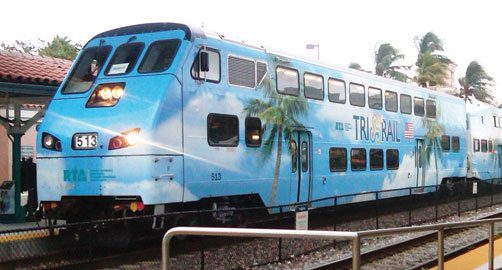
Tri-Rail has run commuter rail service since 1989, linking 3 Counties: Dade (Miami), Broward (Fort Lauderdale) and Palm Beach. Brightline service now connects Miami with Fort Lauderdale and West Palm Beach (its only stops), hoping to open an extension to Orlando in 2022.
A Tri-Rail train

Going In. When the Dolphins' stadium opened on August 16, 1987, it was named Joe Robbie Stadium, for the Dolphins' founder and still their owner, who had it built for them and for a hypothetical MLB team that became the Marlins.

Since then, it's been named Pro Player Park (briefly in 1996), Pro Player Stadium (1996 to 2005, including both of the then-Florida Marlins' World Series wins), Dolphins Stadium (2005 to 2006), Dolphin Stadium (no more S on the end, 2006 to 2009), Land Shark Stadium (2009 to 2010), Sun Life Stadium (2010 to 2016), New Miami Stadium (briefly in 2016), and now Hard Rock Stadium (with the Hard Rock Cafe franchise buying the naming rights). If you're keeping track, that's 9 names in the stadium's 1st 29 years, averaging a new name every 3 years and 12 weeks.

"The Dolphin Tank" is 15 miles north of downtown Miami, in a location that's been called, at various times, Miami, Miami Lakes, Miami Gardens, Carol City and Opa-Locka. Sounds like a bad variety show sketch. And another series of name changes. It made me wonder if the Dolphins had signed Chad Johnson, a.k.a. Chad Ochocinco. They did, in the 2012 preseason, but released him after he got arrested for domestic violence. And Prince, known for changing his name, played the halftime show at Super Bowl XLI in Miami.

The best way to get there from downtown is to take I-95 North to the Florida Turnpike (renamed the Ronald Reagan Turnpike, and, contrary to "conservative principles," the Gipper did believe in good roads), to Exit 2X for Northwest 199th Street. NW 199th is also known as Dan Marino Boulevard, named after some guy who never won a championship, college or pro.

The Stadium is between 199th and 203rd, and between the Turnpike and 27th Avenue, across 203rd and Snake Creek from Calder Race Course. The exact address is 347 Don Shula Drive, for the coach who won the Dolphins' 2 titles and the record number of NFL coaching wins he has. Like tickets, parking is expensive: $40. Tailgating is permitted.
Before the renovation, with the seats in Dolphin aqua & orange

Public transportation there is a bit trickier. You'd have to take Metrorail from downtown to M.L. King Rail Station, then transfer to the Number 27 bus, riding that to NW 199th Street & NW 27th Court. And then you'd have to walk down 199th for about 15 minutes and turn into the parking lot. Not exactly ideal. (Somehow, I don't think a situation like this, especially with a transit station with his name on it, was part of Martin Luther King's dream. But he certainly would have approved of a racially mixed crowd watching racially mixed teams playing each other.)

In spite of South Florida's climate – the stadium probably gets more rain than any other in the NFL, including Seattle – umbrellas are not permitted inside. "Safety concerns," No, I'm not making that up, it's on the Dolphins' website. The field runs northwest-to-southeast, and is natural grass.

In 2015 and 2016, no longer needed to host baseball, the stadium underwent a major renovation to make it football-specific, including a roof to protect the fans from the elements (but not the players -- shades of the Dallas Cowboys' old Texas Stadium), new video boards, and wider seats. This renovation reduced seating capacity from 75,540 to 65,326.
Post-renovation

It has been home to the Dolphins since 1987; the Orange Bowl game in 1996, 1997, 1998 and since 2000; the University of Miami football team since 2008 (their games were the last thing the Orange Bowl stadium hosted before its demolition to make way for Marlins Park); the Marlins from 1993 to 2011; and the Champs Sports Bowl from 1990 to 2000.
The building now known as Hard Rock Stadium has hosted 5 Super Bowls: XXIII (1989, San Francisco over Cincinnati), XXIX (1995, San Francisco over San Diego), XXXIII (1999, Denver over Atlanta), XLI (2007, Indianapolis over Chicago, and the only Super Bowl that's yet been rained on), XLIV (2011, Green Bay over Pittsburgh) and LIV (2020, Kansas City over San Francisco). 

It's also hosted 2 World Series: 1997, Marlins over Cleveland; and 2003, Marlins over, uh, let's move on. It hosted 4 BCS National Championship Games: 2001 (Oklahoma over Florida State), 2005 (USC over Oklahoma), 2009 (Florida over Oklahoma) and 2013 (Alabama over Notre Dame).

The stadium is also a premier U.S. soccer venue. On August 4, 1989, London's Arsenal played Argentine club Independiente, each team coming off winning its national league title. Arsenal won, 2-1, but only 10,042 fans came out to see it in the oppressive August Florida heat. (Perhaps this is why Arsenal did not play in North America again for 25 years, coming to Red Bull Arena in 2014.)

Other major club teams to play there include Mexico's Chivas of Guadalajara; England's Chelsea of London, Liverpool, Manchester City and Manchester United; Spain's Real Madrid and Barcelona; France's Paris Saint-Germain; Germany's Bayern Munich; and Italy's AC Milan, Internazionale and Juventus.

The U.S. national team has played there 4 times: A 1-0 loss to Colombia on April 22, 1990; a 1-1 draw with Bolivia on February 18, 1994; a 3-1 loss to Sweden on February 20, 1994; and a 1-0 win over Honduras on October 8, 2011. Other national teams to play there have been England, Croatia, Mexico, Brazil, Educador, Peru, Venezuela, Chile, Ghana and South Korea. It hosted 2 games of the 2013 CONCACAF Gold Cup, and has been selected by the U.S. Soccer Federation as a finalist to be one of the host venues for the 2026 World Cup. (UPDATE: It was chosen.)

It's also hosted some concerts. Former Beatle Paul McCartney has played there 3 times, the 1st in 1990. Billy Joel and Elton John did their Face to Face Tour there on April 13 and 14, 1995. The Three Tenors -- Luciano Pavarotti, Placido Domingo and José Carreras -- sang there on March 8, 1997. The Rolling Stones played there on November 25, 1994, and again on August 30, 2019, closing their No Filter Tour. It turned out to be drummer Charlie Watts' last concert.

A November 4, 2020 article on MoneyWise named Hard Rock Stadium the 6th-worst stadium in the NFL -- in other words, 25th out of 30:

It’s not terribly convenient for fans driving from either Miami or Fort Lauderdale, and traffic in and out is brutal. There’s also very little around the stadium, so fans are all but forced back into their cars after a game.

Says a reviewer on TripAdvisor: "The stadium experience is a mess. The traffic is so fouled up... that we didn't get to our seats until the end of the first quarter. Thousands of others came streaming in afterwards, because they were also delayed."

Longstanding inconsistency on the field has erased a lot of the passion in the stadium, earning Hard Rock Stadium poor grades for its fan atmosphere.

Food. With a great Hispanic, and especially Cuban, heritage, and also being in Southeastern Conference country (hello, tailgating), you would expect the football team in Miami to have great food at their stadium. Centerplate runs their concessions, and the stadium renovations include better options. From the Miami Herald:

* Sloppy Joe's (based on the famous Key West bar) at Sections 106, 144 and 317.
* Kosher Central (Hey, a lot of ex-New Yorker Jews in South Florida) at 111.
* BurgerFi at 114, 124 and 350.
* Craft Beer Tap Room at 117 and 147.
* Versailles (A French theme?) at 119 and 317.
* Sushi Maki at 126.
* Bodega Taqueria at 142, 329 and 345.
* Paradise Cups at 155.

Team History Displays. Founded in the AFL in 1966, with actor-producer Danny Thomas as one of Joe Robbie's minority partners (which may explain why his son, TV producer Tony Thomas, set his show The Golden Girls in Miami), the Dolphins quickly got good, and became one of the AFC's dominant teams. From 1970 to 2001, they made the Playoffs 21 times in 32 seasons. However, they have made it only twice since, in 2008 and 2016.

They've won 13 AFC Eastern Division titles: 1971 1972, 1973, 1974, 1979, 1981, 1983, 1984, 1985, 1992, 1994, 2000 and 2008. You'll notice that only twice have they won it in the last 24 years, and only once in the 20 years since Tom Brady became the starting quarterback of the New England Patriots. They've won the AFC Championship for the seasons of 1971, 1972, 1973, 1982 and 1984, winning Super Bowls VII and VIII, and losing Super Bowls VI, XVII and XIX.

Since then, the closest they've gotten to the Super Bowl is losing the 1992 AFC Championship Game, at home, to the Buffalo Bills. And they haven't won a Playoff game since December 30, 2000. For an iconic franchise like the Dolphins, that is inexcusable.

The Dolphins Honor Roll currently honors the undefeated 1972 team, the 1973 team that made it back-to-back Super Bowl wins, and 26 individuals:

* From the 1972 team that went undefeated and won Super Bowl VII, and the 1973 team that won Super Bowl VIII: Founding owner Joe Robbie, head coach Don Shula, defensive coordinator Bill Arnsparger, quarterback Bob Griese, running back Larry Csonka, receiver Paul Warfield, tight end Jim Mandich, center Jim Langer, guards Larry Little and Bob Kuechenberg, defensive end Bill Stanfill, defensive tackle Manny Fernandez, linebacker Nick Buoniconti, and safeties Jake Scott and Dick Anderson.

* From the 1982 team that reached Super Bowl XVII: Robbie, Shula, Arnsparger, center Dwight Stephenson, receivers Nat Moore and Mark Duper, defensive end Doug Betters and defensive tackle Bob Baumhower.

* From the 1984 team that reached Super Bowl XIX, the team's most recent appearance: Robbie, Shula, Moore, Duper, Betters, Baumhower, quarterback Dan Marino and receiver Mark Clayton.

* From the 1992 team that reached and hosted the AFC Championship Game, the team's most recent appearance: Shula, Marino, Duper, Clayton, offensive tackle Richmond Webb and linebacker John Offerdahl.

* From the 2000 team that won the AFC Eastern Division, a year after Marino retired: Webb, defensive end Jason Taylor and linebacker Zach Thomas.

As yet, no players have been inducted from the 2008 AFC East title, although Taylor had left before that season, and would return. And no inductions have been made since 2014.
Jim "Mad Dog" Mandich's notation
on the Dolphins Honor Roll revealed in 2012

Little, Warfield, Marino and Stephenson were named to The Sporting News' 100 Greatest Football Players in 1999. Warfield and Marino were named to the NFL Network's 100 Greatest Players in 2010. Warfield, Marino and Stephenson were named to the NFL's 100th Anniversary All-Time Team in 2019, and Shula was named to that team's coaching staff.

The Dolphins have retired 3 numbers: Griese's 12, Marino's 13 and Csonka's 39. Prior to the renovation, those numbers were flown on flags on the stadium's rim.
There's also a statue of Marino. Contrary to popular belief, he is not shown shaking a closed fist to show you how many Super Bowl rings he has won.
The Florida Sports Hall of Fame is located at Lake Myrtle Sports Park in Auburndale, 232 miles northwest of downtown Miami, and 220 miles northwest of Hard Rock Stadium. Aside from the colleges (Florida, Florida State and Miami), the Dolphins have more honorees than any other team: Robbie, Shula, Griese, Csonka, Warfield, Little, Buoniconti, Anderson, Marino, Moore, Stephenson, Zach Thomas (but not Danny Thomas), 1970s placekicker Garo Yepremian, Griese's 1972-73 backup Earl Morrall (who was the losing Colts quarterback under Shula in the Jets' Super Bowl III win), coach Jimmy Johnson (who's probably in there mainly for his coaching at the University of Miami) and owner Wayne Huizenga.

The Dolphins have had just 2 Heisman Trophy winners, both of them controversial running backs. Ricky Williams won it at Texas in 1998, and was with the Dolphins from 2002 to 2010, except for 2006, when he was in trouble with the NFL for his marijuana use. And Reggie Bush won it at USC in 2005, and is the only player the Heisman Trophy Committee ever considered asking for it back. He avoided it by giving it up by choice. He played for the Dolphins in 2011 and 2012.

The Jets' biggest rivals now are the Patriots, but until the Pats' fans started getting cocky around 2005 or so, it was the Dolphins. In spite of all the Jets' difficulties, the Dolphins' fall from relevance in the 21st Century has allowed the Jets to close within 56-55-1 in the series.

Notable games include 1982 AFC Championship Game, a 14-0 Dolphins win known as the Mud Bowl, at the Orange Bowl; the overtime shootout between Marino and Ken O'Brien at the Meadowlands in 1986, a 51-45 Jets win; the 1994 Fake Spike Game at the Meadowlands, with Marino faking a spike to stop the clock, and instead throwing for a last-minute touchdown pass to win 28-24; and the 2000 "Monday Night Miracle," a 30-7 Dolphin lead becoming a 40-37 Jet win that was later voted by NFL fans as the greatest game in Monday Night Football history.

Stuff. The Dolphins' Team Store is located on the ground level, in the Grand Plaza, south entrance. For non-event days, it's open Monday to Friday, 8:30 AM to 5:30 PM, and on Saturday from 10 to 2. I'm trying to imagine what it might sell to put on your head, like Green Bay does with cheese wedges, Chicago with a deep dish pizza slice, or Philadelphia with a cheesesteak. A Cuban sandwich? Or maybe a Dolphin dorsal fin?

As Florida's oldest major league sports team, there are a few books written about the Dolphins. In 2002, on the 30th Anniversary of the undefeated season, Shula collaborated with Dave Hyde on Still Perfect! The Untold Story of the 1972 Miami Dolphins. Interestingly enough, Hyde, a columnist for the Sun-Sentinel, is a graduate of Miami University... of Ohio, and published a book about Miami graduate Woody Hayes and his Ohio State National Champions of 1968. (Shula is also from Ohio, but went to John Carroll University, not The... Ohio State University, or Miami, a.k.a. "the Cradle of Coaches.")

In August 2012, on the 40th Anniversary of the achievement, Griese came out with Perfection: The Inside Story of the 1972 Miami Dolphins' Perfect Season, followed that same month by Undefeated: Inside the 1972 Miami Dolphins' Perfect Season, by Mike Freeman of Bleacher Report, who also wrote biographies of Jim Brown and Bobby Bowden, and a book that was critical of ESPN. Newly published is Douglas Todt's story of the Miami teams that couldn't go all the way: Deflated Dreams: The Miami Dolphins in the Dan Marino Era.

DVDs about the Dolphins available on Amazon.com include an official team history produced in 2010, a 40th Anniversary tribute to the undefeated 1972 team including a disc of the entire broadcast of Super Bowl VII, and another such tribute to the 1973 team including a disc of the entire broadcast of Super Bowl VIII.

During the Game. South Florida is loaded with people who came from elsewhere, including ex-New Yorkers. The stereotype is that, when a New Yorker gets old, if he has enough money to do so, he moves to Miami. Especially if he's Jewish. Or Italian. As a result, you may see a lot of Jet fans, few of whom switched to the Dolphins.

However, despite Dolphin fans' hatred of the Jets (and, to a lesser extent, the New England Patriots, the Oakland Raiders and the Pittsburgh Steelers), your safety should not be an issue. Hard Rock Stadium is an island in a sea of parking, nowhere near any high crime area.

A recent Thrillist article on the NFL's most obnoxious fans ranked Dolphin fans 15th, almost right in the middle:
·          

Listen, there, Al Bundy of NFL fanbases, at some point you have to stop responding to trash talk from fans from NY/NJ (who take up half your stadium) with “17-0!” That was 47 YEARS AGO. And, yes, you’re the only fanbase in South Florida that’s not one losing season away from complete apathy, but most of your old-school fans are middle-aged guys who moved up to Lighthouse Point and Jupiter sometime in the 1990s -- and they're not so obnoxious. But you know who is? Your "new" fans who can’t name two players on the defense and come to Sun Life to take selfies at LIV. So basically, in half a generation, you'll be the same as Heat fans, and move up a solid eight spots on this list, regardless of whether you ever win another playoff game.


After years of having a live dolphin mascot, named Flipper after the TV dolphin, in 1997 the Dolphins debuted a man in a costume, T.D. (standing for either "The Dolphin" or "Touchdown").
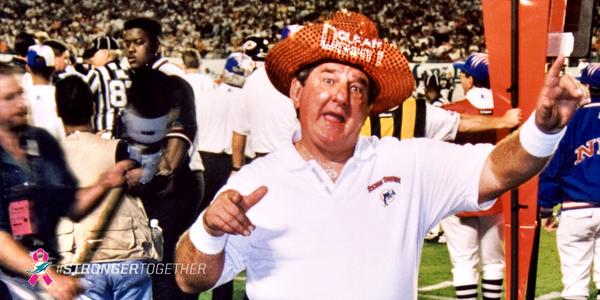
Denny Sym, a.k.a. Dolfan Denny, cheered the team on for its 1st 33 years as a one-man sideline show, often leading the crowd in cheers and chants from each corner of the field. He usually wore glittering orange and aqua hats. In 1976, the Dolphins began paying him $50 per game (about $219 in today's money) to cheer from the sideline, after being impressed by his spirit and passion. He got sick in 2000, and retired his act, dying in 2007 at age 72.
He looked a bit like Buddy Hackett.

The Dolphins hold auditions for National Anthem singers, instead of having a regular singer. "The Dolphins Fight Song" goes back to the Super Bowl years (and was ripped off by the Houston Oilers), but recently got an update by rapper T-Pain. And there's not much in the way of fan chants, aside from "Let's go, Dolphins!"

After the Game. Miami has some rough areas, but you're starting out in the suburbs, so you should be safe. As for where to go after the game, I can't be sure. I checked for area bars where New Yorkers gather, and found one for each of the city's NFL teams.

The South Florida Jets Fan Club meets at Hammerjack's, at 5325 S. University Drive in Davie, 9 miles north of the stadium, and a whopping 23 miles north of downtown. Possible to reach by public transportation, but it would take too long. American Social is supposedly the home of the South Florida fan club of the Giants. 690 SW 1st Court, downtown, in the Neo Vertika Building. 

Don't bother looking for Dan Marino's restaurants: They've all closed. He's had financial setbacks, partly due to paying his extramarital baby mama millions of dollars in hush money.

If you visit Miami during the European soccer season, American Social is probably your best bet, since the Fado Irish Pub chain has permanently closed its outlet downtown, and Churchill's Pub is temporarily closed. That's at 5501 NE 2nd Avenue, 4 miles north of downtown, in Little Haiti. Bus 9.

Sidelights. On February 3, 2017, Thrillist made a list ranking the 30 NFL cities (New York and Los Angeles each having 2 teams), and Miami came in 17th, in the bottom half. They called it, "That one guy in your freshman dorm that wears excessive hair product, owns myriad button-down shirts in primary colors purchased online from European clothiers, and is weirdly good at Jet Skiing, but a city." On November 30, 2018, Thrillist published a list of "America's 25 Most Fun Cities," and Miami came in a surprisingly low 12th.

Miami's sports history is long, but aside from football, it's not all that involved:

* Marlins Park and site of Orange Bowl. The home of the team that became known as the Miami Marlins when they moved in for the 2012 season was built at the site of the stadium known as the Miami Orange Bowl. It will be a long time before it builds up anything of  history, but it will never match the history of the classic horseshoe with the palm trees at the open east end.

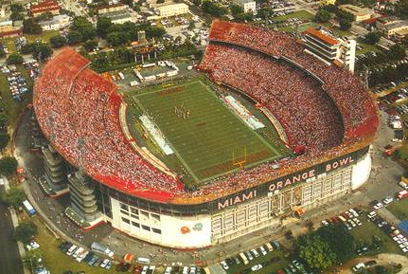
Opening in 1937, and known as Burdine Stadium until 1959, it hosted the Orange Bowl game on (or close to) every New Year's Day from 1938 to 1995, and once more in 1999 when the Dolphins made the Playoffs to make their new stadium unavailable; the University of Miami football team from 1937 to 2007 (famed for its fake-smoke entrances out of the tunnel); the Miami Seahawks of the All-America Football Conference in 1946 (they moved to become the Baltimore Colts after just 1 season, but this was arguably the 1st "major league" team in any of the former Confederate States); the Bert Bell Benefit Bowl (a game involving the 2nd-place teams in each of the NFL's divisions from 1960 to 1969, also known as the Playoff Bowl, a game so lame that Vince Lombardi once called it "the only game I never want to win" – and he didn't); the Dolphins from 1966 to 1986; the Miami Toros of the North American Soccer League from 1972 to 1976; and 5 Super Bowls, most notably (from a New York perspective) Super Bowl III, when the Jets beat the Colts in one of the greatest upsets in sports history, on January 12, 1969. Super Bowl XIII, in 1979, was the last Super Bowl to be held here.
The Orange Bowl was where the Dolphins put together what remains the NFL's only true undefeated season, in 1972. The Canton Bulldogs had gone undefeated and untied in 1922, but there was no NFL Championship Game in those days. The Chicago Bears lost NFL Championship Games after going undefeated and untied in the regular seasons of 1932 and 1942. And the Cleveland Browns went undefeated and untied in the 1948 AAFC season, but that's not the NFL.

The Dolphins capped their perfect season by winning Super Bowl VII, and then Super Bowl VIII. And yet, despite having reached the Super Bowl 5 times, and Miami having hosted 10 of them, the Dolphins have never played in a Super Bowl in their home region. (They've done so in Los Angeles twice, and once each in New Orleans, Houston and San Francisco.) They also haven't been to one in 37 seasons, or all of their history in their new stadium. "The Curse of Joe Robbie," anyone?
The Orange Bowl also hosted Arsenal's 1st game in North America. Due to the length of the English soccer season, it was again the wrong time of year to host a soccer game in Miami. Only 4,725 fans saw the Gunners beat the Miami Gatos 3-2.

1501 NW 3rd Street, between 7th Street, 14th and 16th Avenues. Number 11 Bus west on Flagler Street from downtown, then 3 blocks north on 15th Avenue. Be careful, this is in Little Havana.

* Comfort Inn. This hotel, across 36th Street from the airport, was the site of the Playhouse, once considered one of South Florida's finest banquet halls. It was here, on January 9, 3 days before the Super Bowl, at a dinner organized by the Miami Touchdown Club, that Joe Namath of the Jets was speaking, and some drunken Colts fan yelled out, "Hey, Namath! We're gonna kick your ass on Sunday!" And Joe said, "Let me tell you something: We got a good team. And we're gonna win. I guarantee it!" He was right.

NW 36th Street between Curtiss Parkway and Deer Run. MetroRail toward Palmetto, to Allapattah Station, then transfer to the 36 Bus.

* Site of Miami Stadium. Also known as Bobby Maduro Stadium, this was the home of the original Miami Marlins, of the Florida State League. Seating 13,000, it was known for its Art Deco entrance and a roof that shielded nearly the entire seating area, to protect fans from the intense Miami weather.  The FSL team that played here was known as the Sun Sox from 1949 to 1954, the Marlins from 1956 to 1960, the Marlins again 1962 to 1970, the Miami Orioles 1971 to 1981, and the Marlins again from 1982 to 1988. These teams won FSL Pennants in 1969, 1970, 1971, 1972 and 1978 -- giving Miami 7 Pennants, counting those won by the NL Marlins.

Miami Stadium was the spring training home of the Brooklyn Dodgers from 1950 to 1957, the Dodgers in their first season in Los Angeles in 1958 (it can be said that "the Los Angeles Dodgers" played their 1st game here, not in California), and the Baltimore Orioles from 1959 to 1990.

It was demolished in 2001, and The Miami Stadium Apartments were built on the site. 2301 NW 10th Avenue, off 23rd Street. It's just off I-95, and 8 blocks north and east from the Santa Clara MetroRail station.

* FTX Arena. Known until 2020 as the American Airlines Arena, or the "Triple-A," this has been the home of the NBA's Miami Heat since 2000, including their 2006, 2012 and 2013 NBA Championship seasons. The Miami Sol of the WNBA also played here, from 2000 to 2002. 601 Biscayne Blvd. (U.S. Routes 1 & 41), between NE 6th and 8th Streets, across Port Blvd. from the Bayside Marketplace shopping center (not exactly their version of the South Street Seaport) and the Miami outlets of Hooters, the Hard Rock Café and Bubba Gump Shrimp. Freedom Tower station on Metromover.

* Site of Miami Arena. This was the home of the Heat from 1988 to 1999, the NHL's Florida Panthers from 1993 to 1998, and the University of Miami basketball team from 1988 to 2003. When the Overtown race riot happened in January 16 to 18, 1989, in the week before Super Bowl XXIII, area residents took great pains to protect this arena from damage, and succeeded.

This building was demolished in 2008. Only 20 years? Apparently, like the multipurpose stadiums of the 1960s and '70s, and the Meadowlands Arena and the Nassau Coliseum, it served its purpose – getting teams to come in – and then quickly became inadequate. Grand Central Park, a public park, was built on the site. 701 Arena Blvd., between Miami Avenue, NW 1st Avenue, and 6th and 8th Streets. Overtown/Arena rail station.

* FLA Live Arena. This arena, which like Hard Rock Stadium has had a bunch of names in a short period of time, has been the home of the NHL's Florida Panthers since 1998, and there's a reason the team is called "Florida" instead of "Miami": The arena is 34 miles northwest of downtown Miami, and 14 miles west of downtown Fort Lauderdale, in a town called Sunrise. 1 Panther Parkway, at NW 136th . If you don't have a car, you'd have to take the 195 Bus to Fort Lauderdale, and then the 22 Bus out to the arena.

* Fort Lauderdale Stadium and Lockhart Stadium. Built in 1962, the Yankees moved their spring training headquarters to the 8,340-seat Fort Lauderdale Stadium after being assured that, unlike their spring home of St. Petersburg at the time, their black players could stay in the same hotel as their white players. The Yankees remained there until 1995, by which point Tampa was not only long since integrated, but was willing to pretty much anything city resident George Steinbrenner wanted, including build him a new spring home for the Yankees.
The Yankees' Class A team in the Florida State League also used it as a home field. After the Yankees left, the Orioles used it from 1996 to 2009. Although it no longer has a permanent tenant, or even a spring training tenant, it still stands, and the Fort Lauderdale Strikers use it as a practice facility. 1401 NW 55th Street.

Built in 1959, Lockhart is a 17,417-seat high school football stadium, across 55th Street from Fort Lauderdale Stadium. It's been home to 4 different teams called the Fort Lauderdale Strikers, including the original NASL's version from 1977 to 1983, and the new NASL's version from 2011 until 2016, and MLS' Miami Fusion from 1998 to 2001.
It's hosted 3 games of the U.S. national soccer team, including the November 23, 1980 2-1 victory that was the 1st time the U.S. ever defeated Mexico on home soil, the 1st time anywhere since the countries' 1st meeting, in the 1934 World Cup. It also hosted Florida Atlantic University's football team from 2003 to 2010, after which their on-campus stadium opened. 1350 NW 55th Street, at 12th Avenue.

Lockhart Stadium was demolished on May 8, 2019, to be replaced by a new stadium, of about the same capacity, on the same site, to serve as a training ground and reserve team home for Inter Miami. It's been named DRV PNK Stadium, pronounced "Drive Pink."

For both stadiums, take MetroRail to Tri-Rail, then Tri-Rail to northbound to Cypress Creek. From there, it's about a 10-minute walk.

* Inter Miami CF. The current plan for the Major League Soccer team that retired English soccer star David Beckham wants to bring to Miami is for a 25,000-seat stadium at the International Links Melreese Country Club. 1802 NW 37th Avenue, adjacent to the airport and the Greyhound and Tri-Rail stations.

They still have to clear land-purchase and rezoning hurdles, but it looks like they have the proper ownership lined up. The new stadium will be named Miami Freedom Park.

* Miami Beach Convention Center. Opened in 1957, it seats 15,000 people. The American Basketball Association's Miami Floridians played here from 1968 to 1972. The 1968 Republican Convention, and both major parties' Conventions in 1972, were held here. (Both Republican Conventions nominated Richard Nixon, the Democrats' nominated George McGovern.) Why? Simple, they wanted to be away from any city's downtown, putting water between themselves and wherever the hippies and another antiwar demonstrators were staying.

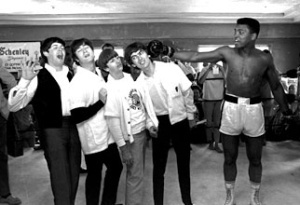
This building hosted the heavyweight title fights of 1961 (Floyd Patterson-Ingemar Johansson III, Floyd won) and 1964 (Cassius Clay-Sonny Liston I, Clay winning and then changing his name to Muhammad Ali). Just 9 days before Ali forced his "total eclipse of the Sonny," on February 16, 1964, the Beatles played their 2nd full-length U.S. concert here. They visited Ali at his Miami training center, and a famous photo was taken. Elvis Presley gave a pair of concerts here on September 12, 1970.
Convention Center Drive between 17th Street and Dade Blvd. The Jackie Gleason Theater, where "The Great One" taped his 1960s version of The Jackie Gleason Show (including a now rarely-seen revival of The Honeymooners) is next-door. This, and any other Miami Beach location, can be reached via the 103, 113 or 119 Bus, or a car, over the MacArthur Causeway.

* Site of the Coconut Grove Convention Center. This former Pan Am hangar, attached to the Dinner Key Marina in 1930, was used as a Naval Air Station, a convention center, a concert hall, a 6,900-seat sports arena (the Floridians played a few home games here), and as the indoor-scenes studio for the USA Network show Burn Notice.

It's also been known as the Dinner Key Auditorium. Under that name, on March 1, 1969, The Doors gave a concert here, and lead singer Jim Morrison supposedly committed an indecent act there. (Yeah, he told the crowd, "I'm from Florida! I went to Florida State! Then I got smart and moved to California!")

It was demolished in 2013, and a park is being built on the site. 2700 S. Bayshore Drive, at Pan American Drive & 27th Avenue, in the Coconut Grove section of town. Number 102 Bus to Number 48.

* Gusman Center for the Performing Arts. Formerly the Olympic Theater, Elvis sang here on August 3 and 4, 1956. 174 E. Flagler Street, downtown.

On March 26, 1960, Elvis taped a segment for The Frank Sinatra Timex Show, subtitled Welcome Home Elvis, in the ballroom of the Fontainebleau Hotel. It was his 1st TV appearance since his discharge from the Army 3 weeks earlier.

Frank was not initially a fan of Elvis, but his 2-year peacetime-but-Cold-War hitch for Uncle Sam -- further emphasized by the fact that an ear condition left Frank himself 4-F, meaning he didn't serve in World War II -- convinced a lot of grownups that he was all right after all, and Frank and his fellow Rat Packers were now happy to go along -- down to Frank's daughter, 15-year-old Nancy (6 years from becoming a star in her own right), being the first "name" he saw when he got off the plane.

Elvis sang both sides of his 1st post-service single, "Fame and Fortune" and the soon-to-be-Number 1 hit "Stuck On You." Then he sang Frank's "Witchcraft," and Frank sang his "Love Me Tender," and they closed the latter song together. They remained friends for the rest of Elvis' life.

The Fontainebleau, then as now, was the most famous hotel in Miami, in Florida, indeed in the entire Southern U.S. 4441 Collins Avenue in Miami Beach.

In addition to the preceding, Elvis sang in South Florida in Fort Myers at the City Auditorium on May 9 and July 25, 1955; in West Palm Beach at the Palms Theater on February 20, 1956 and the West Palm Beach Auditorium on February 13, 1977; and in Hollywood at the Sportatorium on February 12, 1977.

* Movies & TV. Several TV shows have been set in Miami. A restaurant called Jimbo's Place was used to film scenes from Flipper and Miami Vice, and more recently CSI: Miami and Burn Notice. It's at 4201 Rickenbacker Causeway in Key Biscayne, accessible by the Causeway (by car) and the 102 Bus (by public transportation).

If you're a fan of The Golden Girls, you won't find the house used for the exterior shots. It's actually in Los Angeles. The address mentioned on the show was 6151 Richmond Street, but that address doesn't exist in Miami. The exterior shot used for the hospital in its spinoff Empty Nest was also in Southern California.

If you're a fan of those not-quite-golden girls, the Kardashian sisters, the penthouse they use to tape the Miami edition of their "reality show" is on Ocean Drive between 1st and 2nd Streets in Miami Beach. But I don't think they use it anymore, especially since Kourtney and Kim have since "taken New York."

Greenwich Studios has been used to film Miami Vice, True Lies, There's Something About Mary
and The Birdcage. It's at 16th Avenue between 121st and 123rd Streets, in North Miami, and often stands in for Miami Beach for the TV shows and movies for which it's used. 93 Bus.

Other shows set in Miami include Surfside 6, Dave's World (based on the Miami Herald columns of Dave Barry), Nip/Tuck, Dexter, and Jane The Virgin.

The largest college in the area is, as you might have guessed, the University of Miami. Its new Donna E. Shalala Student Center, named for the former University President and U.S. Secretary of Health and Human Services under President Bill Clinton, is at 1330 Miller Drive, about 7 miles southwest of downtown. University Station on Metrorail.

Florida International University is at 11200 SW 8th Street, 16 miles west of downtown. Its Riccardo Silva Stadium, formerly FIU Stadium, opened in 1995 and seating 23,500, is at 11310 SW 17th Street. Bus 8. Silva Stadium is also home to Miami FC, the largest pro soccer team in South Florida, which it will remain until David Beckham's MLS club takes the field -- if it ever does.
FIU should not be confused with Florida Atlantic University in Boca Raton. Its 29,419-seat FAU Stadium, which opened in 2011, is at 777 Glades Road, or FAU Blvd. & N. University Drive. Tri-Rail to Boca Raton station. On October 14, 2014, the U.S. soccer team had a 1-1 draw with Honduras at FAU Stadium.
No President has ever been born in Florida, or grew up there, or even had his permanent residence there. Two men who served as Governor ran for the Democratic Party's nomination for the office, but neither came particularly close to the nomination: Reubin Askew dropped out after the 1984 New Hampshire Primary, and Bob Graham didn't even make it to calendar year 2004, much less the Iowa Caucuses.

Nevertheless, Miami has a key role in Presidential history. On February 15, 1933, President-elect Franklin Roosevelt and Chicago Mayor Anton Cermak were at a rally in Bayfront Park, when Giuseppe Zangara started shooting. FDR was not hit, but Cermak was, and he died on March 6, just 2 days after FDR was inaugurated. Bayfront Park station on Metromover.

More recently, the building where the votes for Dade County were supposed to be counted in the 2000 election was besieged by protesters, hired by House Majority Leader Tom DeLay, so Miami was ground zero for the theft of the election by the George W. Bush campaign. Because of the suits the protesters wore, it's become known as the Brooks Brothers Riot. The Stephen P. Clark Government Center, 111 NW 1st Street, downtown. Government Center station.

The Watsco Center, formerly the University of Miami Convocation Center, hosted a Presidential Debate between Bush and John Kerry in 2004. 1245 Dauer Drive, in Coral Gables. Tri-Rail to University. And Lynn University in Boca Raton hosted a Presidential Debate between Barack Obama and Mitt Romney in 2012. 3601 N. Military Trail. Tri-Rail to Boca Raton, then Bus 2.

The Kennedy family had a compound in Palm Beach, but sold it in 1995. It's still in private hands, and not open to the public. Also in Palm Beach is the Mar-a-Lago Club, a hotel and members-only club built in 1927 by cereal company heiress and socialite Marjorie Merriweather Post. In 1985, it was bought by Donald Trump, and he's turned it into his "Southern White House," disgracing the nation there every other weekend. 1100 S. Ocean Blvd. Bus 1 from downtown West Palm Beach will get you to Dixie Highway & Southern Blvd. (U.S. Routes 1 & 98), but you'd have to walk almost 2 miles over Southern Blvd., across Lake Worth Lagoon and Bingham Island, to get to the sandbar on which Palm Beach sits.

There was a "Little White House" in Key West (111 Front Street), used by Harry Truman (and, to a lesser extent, his immediate successors Dwight D. Eisenhower and Kennedy), and it's open to tours. But that's a long way from Miami: 160 miles, with no public transportation between the 2 cities, and Greyhound charges $110 round-trip for a 4 1/2-hour ride.

Miami's top 2 museums are the Perez Art Museum Miami (PAMM), at 1103 Biscayne Blvd., Museum Park station on Metromover; and the Patricia and Philip Frost Museum of Science, at 3280 S. Miami Avenue, Vizcaya station on Metrorail.

For the moment, the tallest building in Miami, and in the entire State of Florida, is the 868-foot Panorama Tower, at 1101 Brickell Avenue. Tenth Street Promenade station on Metromover. And that won't last long as the tallest, since it will be surpassed in 2020 by the 1,005-foot One Bayfront Plaza, at 100 S. Biscayne Blvd. Bayfront Park station on Metromover. The building boom in downtown Miami includes the bayfront skyscrapers that have become known as the "Biscayne Wall."

The tallest of Miami's older buildings is the Freedom Tower, built in 1925 as the home of the now-defunct Miami News. It now houses Miami-Dade College and a Museum. 600 Biscayne Blvd., downtown, across from the American Airlines Arena. Freedom Tower station on Metromover.

*

You don't have to be old to be a New Yorker in Miami -- but it helps to be a sports fan. Since this is Giants vs. Dolphins, not Jets vs. Dolphins, the intensity of the rivalry won't be there. You should be able to enjoy yourself, even if neither team is all that good at the moment.

Monday, May 4, 2020

Don Shula, 1930-2020

Nobody's perfect. We've all heard that. Even a "perfect season" isn't perfect. But one man built a perfect season in the National Football League.

Donald Francis Shula was born on January 4, 1930 in Grand River, Ohio, outside Cleveland. A son of Hungarian immigrants, he grew up in nearby Painesville. When he was 11, his mother noticed that he'd cut his face from playing tackle football, and forbade him to play it, ever again.

In 1945, at Harvey High School in Painesville, a gym teacher noticed that he looked strong enough to play football, and suggested he go out for the football team. But his mother had forbidden it. No one had any idea at the time, but the very history of the sport hung in the balance. On the signup sheet, he forged his parents' signatures. In his senior year, 1947, he led Harvey to a 7-3 record, its best in 18 years.

But college football scholarships were hard to come by, since the boys who had gone off to World War II were now grown men, and older than college football players would normally be. A former Harvey coach recommended John Carroll University, a private Catholic school in the Cleveland suburbs, coached by Herb Eisele.

While there, Shula considered training for the priesthood. Again, the history of football hung in the balance. But big wins over Youngstown State and Syracuse convinced him to stick with football. Today, the football facility at Carroll is named Don Shula Stadium. That would not have been the case had he become Father, Monsignor, Bishop, or even Cardinal Shula. (Maybe the school would have been renamed for him, or a school somewhere, but not a stadium.)

*

He graduated in 1951, with a sociology degree. Again, the history of football was up for grabs, because he was offered a teaching and coaching job at Lincoln High School in nearby Canton -- the city where the National Football League was founded in 1920, but not yet home to the as-yet-nonexistent Pro Football Hall of Fame.

But Paul Brown, head coach and general manager of his hometown team, the Cleveland Browns, defending NFL Champions, had selected him in the 9th round of the NFL Draft. In the 22nd round -- today, the Draft has only 7 rounds -- Brown had selected Shula's roommate at Carroll, Carl Taseff. Brown liked looking at Carroll players because Eisele had attended Brown's clinics and used similar tactics, thus making Eisele's players adaptable to Brown's system. The teaching job offered him $3,750 a year. Brown offered him $5,000. Shula signed with the Browns.

This was the time when single-platoon football, where players played on both offense and defense, was giving way to two-platoon football, where they went only one way and not the other. Two of the defining coaches of my youth were among the first players to be only defensive backs and really good at it: Tom Landry of the New York Giants, and Don Shula.

Shula played in all 12 Browns games in 1951, becoming a starter midway through the season, and intercepted 4 passes. The Browns had beaten the Los Angeles Rams in an epic NFL Championship Game the season before, but, in 1951, the Rams won a rematch. This began an unfortunate trend for him: So often close to glory, but not quite getting it.

He had enlisted in the Ohio National Guard, and, with the Korean War on, was soon called up to serve. He remained stationed Stateside, and was deactivated in time to play half of the 1952 season. Again, the Browns reached the NFL Championship Game, but lost again, this time to the Detroit Lions.

Before the 1953 season, Shula and Taseff -- apparently, Brown had become less enamored with them, or maybe he got a trade deal he decided he couldn't pass up -- were traded to the Baltimore Colts. They went 3-9 despite leading the NFL in defensive takeaways, including 3 interceptions by Shula. Wilbur "Weeb" Ewbank, a former Brown assistant, became their head coach in 1954, and the team got better. In spite of a broken jaw, Shula finished the 1955 season with 5 interceptions.
Yes, he played. Yes, the Colts once wore blue helmets.
No, facemasks were not yet common, but soon would be.

Ewbank waived Shula at the end of training camp in 1957, and so he missed their 1958 and 1959 NFL Championships. He played a season with the Washington Redskins, and retired as a player, with 21 career interceptions and 4 fumble recoveries.

*

In 2012, I did a sport-by-sport series on whether "mediocre players" make the best coaches. It would be unfair to say that Don Shula was a "mediocre player," but he wasn't an especially successful one. But, like a lot of athletes who weren't great players, he took his love for, and knowledge of, his sport, and made himself a good coach.

Shula went right into coaching after retiring, first as an assistant at the University of Virginia under head coach Blanton Collier, then at Iowa State, then the University of Kentucky. While at Virginia, he married Dorothy Bartish. They had 5 children: Sons Dave and Mike, both of whom also became NFL players and coaches; and daughters Donna, Sharon and Anne.

In 1960, he got his 1st NFL job, coaching the defensive backfield for the Detroit Lions. He convinced head coach George Wilson to take Taseff with him. By 1962, he was the defensive coordinator, and 5 members of his defense have made the Hall of Fame: Joe Schmidt, Alex Karras, Yale Lary, Dick LeBeau and Dick "Night Train" Lane. It also featured such luminaries as Roger Brown, Darris McCord, Sam Williams, Carl Brettschneider and Wayne Walker. The front four of Karras, Brown, McCord and Williams was one of several pro football defensive lines to be known as "The Fearsome Foursome."

In a game known as the Thanksgiving Day Massacre, they handed the Green Bay Packers what turned out to be their only defeat of the season, sacking Hall of Fame quarterback Bart Starr 11 times. But with only the 1st place team in each Division making the Playoffs at the time, the Lions' 11-3 record was still behind the Packers' 13-1, and so they didn't make the NFL Championship Game.

Still, it got Shula noticed, and in 1963, with Ewbank having left for the AFL's New York Jets, the Colts welcomed him back, as head coach. His 1st game was a 37-28 loss to the Giants at Memorial Stadium in Baltimore, but he got them to rebound to finish 8-6.

He got them to the 1964 NFL Championship Game, and lost to the Browns. Paul Brown had been fired by new owner Art Modell, and their new head coach was Collier. Collier remains the last head coach to lead the Browns to an NFL Championship, and, until the 2016 Cavaliers, the last man to lead a Cleveland team to a World Championship in any sport.

In 1965, Shula led the Colts to a tie with the Packers for the Western Division title. (What Baltimore, a Northeastern city, was doing in the Western Division, I don't know.) But they lost a Playoff to the Packers in controversial fashion.

In 1967, they were undefeated going into the last game of the season, their only blemishes being ties against the Los Angeles Rams and the Minnesota Vikings. But they went out to L.A., and the Rams clobbered them, 34-10. Thus, the Colts and Rams both finished 11-1-2, and since head-to-head play was then the tiebreaker, the Rams made the Playoffs, while the Colts didn't.
Don Shula and Johnny Unitas

In 1968, Johnny Unitas, perhaps the greatest quarterback football had yet seen, was injured during the preseason. Earl Morrall stepped in as quarterback, and the Colts went 13-1, and avenged their only regular-season loss by going to Cleveland and beating the Browns in the NFL Championship Game. (Under the rules of the time, hosting the title game was rotated, not decided by record. This also explains why the Dolphins played the 1972 AFC Championship Game on the road.)

But this NFL Championship did not make the Colts "World Champions." They had to play the AFL Champions in Super Bowl III, and it was Ewbank's Jets. The Colts were favored by 18 points, but Jet quarterback Joe Namath said, "We're gonna win, I guarantee it."

The Colts played as poorly as any team has ever played in a major league sports final, blowing several chances. It was only 7-0 Jets at the half. Unitas had missed the whole season, but he said he was ready to go back in. Shula later said if he'd put Unitas in to start the 2nd half, the Colts would have won. Instead, he waited until the Colts were 16-0 down, and the Jets won 16-7.

Super Bowl III was played on neutral ground, at the Orange Bowl in Miami. If Shula only knew how much he would come to "own" that stadium, and that city and its metropolitan area...

Shula was on the wrong side of the biggest upset in pro football history. In 2 years, he had guided his team to a regular-season record of 24-2-2, but did not have a World Championship to show for it. He was fired after the 1969 season, and his record as Colts coach was 71-23-4, including 3 Playoff berths in 7 seasons, and an NFL Championship -- but not a World Championship. To make matters worse, just 2 years later, his successor, Don McCafferty, led the Colts to win Super Bowl V -- with Unitas getting hurt in midgame, and Morrall stepping in and leading them to victory.

*

The Miami Dolphins had entered the AFL in 1966, and, like most expansion teams, had struggled. Original coach George Wilson, who had coached the Lions to the 1957 NFL Championship and had hired Wilson for his staff in 1960, was fired, and Shula was named to replace him in 1970. He hired Taseff as an assistant, and they would remain together through the 1993 season.

Over the next 6 seasons, he would take the Dolphins to a 67-16-1 regular-season record. In a 16-season stretch from 1970 to 1985, the Dolphins would utterly dominate the newly-created American Football Conference Eastern Division, going 168-63-2, winning the Division 10 times.

In 1970, he got the Dolphins to the AFC Wild Card (only 1 Wild Card per Conference at the time), and lost a Divisional Playoff to the Oakland Raiders. In 1971, he won the AFC East, and on Christmas Day, beat the Kansas City Chiefs in what remains the longest game in NFL history, a double-overtime 24-21 away win.

Shula got some measure of revenge by beating the Colts, who had won the AFC East the year before, in the AFC Championship Game. But they lost Super Bowl VI to the Dallas Cowboys, 24-3. Until 2019, they were the only team ever to play in a Super Bowl and fail to score a touchdown.

In 1920, the 1st NFL season, the Akron Pros won the title, going 8-0-3. In 1922, the Canton Bulldogs went 10-0-2. In 1923, the Bulldogs went 11-0-1. In 1948, the Browns went 14-0 and won the league title, but that league was the All-America Football Conference, not the NFL. None of those teams, from Shula's native Northern Ohio, had to play an NFL Championship Game.

In 1934, and again in 1942, under head coach and NFL founder George Halas, the Chicago Bears went through the regular season undefeated, but lost the NFL Championship Game. Going into the 1972 season, no NFL team had gone undefeated and untied and then won the NFL Championship Game, under that name or under that of the Super Bowl.

The Dolphins began the season by beating the Chiefs. (Just as their Playoff game the preceding season was the last football game at Kansas City Municipal Stadium, this was the 1st regular-season game at Arrowhead Stadium.) They won at home to the Houston Oilers, away to the Minnesota Vikings, away to the Jets, home to the San Diego Chargers, home to the Buffalo Bills, away to the Colts, away to the Bills, home to the Patriots, home to the Jets, home to the St. Louis Cardinals, away to the Patriots, home to the Giants, and home to the Colts.

How close were these games? Their win home to the Bills was 24-23. Their win away to the Vikings was 16-14. Their win home to the Jets was 28-24. Every other win was by at least 10 points, including home to the Patriots, 52-0.

Like the '68 Colts, Shula had to do without his starting quarterback for a while, although for not nearly as long. He had been satisfied with Morrall as a substitute for Unitas, and had acquired him as a backup for Bob Griese, and he played from the 5th game onward, until Griese returned for the AFC Championship Game.

In addition to Shula himself, 6 members of the '72 Dolphins are in the Pro Football Hall of Fame: Griese, running back Larry Csonka, receiver Paul Warfield, center Jim Langer, guard Larry Little, and linebacker Nick Buoniconti. Good cases can also be made for tight end Jim Mandich, guard Bob Kuechenberg, defensive tackle Manny Fernandez, defensive end Bill Stanfill, and safety Jake Scott.

Between Buoniconti, Fernandez, Stanfill, Scott, and All-Pros defensive end Vern Den Herder, cornerback Tim Foley and safety Dick Anderson (not to be confused with the later Rutgers head coach of the same name), it was hardly what the media called it, a "No-Name Defense.")

Running backs Jim Kiick and Csonka (in that order) were nicknamed "Butch Cassidy and the Sundance Kid," after the 1969 Western movie starring Paul Newman and Robert Redford. The backfield also featured Eugene "Mercury" Morris, who, as his nickname (for the Roman messenger of the gods, known as Hermes in ancient Greece), was pretty fast.

Also noteworthy is Marlin Briscoe: In 1968, with the Denver Broncos, he had become the 1st black man to start at quarterback under the NFL banner. (It was still the AFL, but the merger process was already underway.) But, like so many black quarterbacks at that time, he was moved to receiver, and it was at that position that he had his greatest success on a team level.

On Christmas Eve, they hosted the Wild Card winners, the Browns, at the Orange Bowl, and won 20-14. On New Year's Eve, they went to Three Rivers Stadium. Just 8 days earlier, the Pittsburgh Steelers had played their 1st official Playoff game (their 1947 Eastern Division Playoff is usually not counted), and won on the Terry Bradshaw to Franco Harris "Immaculate Reception." But the "Steel Curtain" was not quite ready, and the Dolphins won 21-17.

So the Dolphins qualified for Super Bowl VII, at the Los Angeles Memorial Coliseum, the stadium where Shula's hopes for the 1967 Colts died. They would be playing the Washington Redskins, whose coach, George Allen, had also been a great defensive coordinator -- and had coached that Rams team that knocked Shula's '67 Colts out. His veteran squad, nicknamed "The Over-the-Hill Gang," was 11-3, 13-3 counting the Playoffs. These 'Skins were good, mean, and ready for battle. And the oddsmakers actually made the undefeated Dolphins 3-point underdogs. And Namath thought his Jets were being shown disrespect?

It was January 14, 1973. Richard Nixon was 6 days away from being sworn in for a 2nd term as President. The Vietnam War was coming to an end. The Cold War had thawed a little. Hardly anybody was talking about Watergate just yet. Music was dominated by hard rock and soul. "Muscle cars" were the popular automobiles. Arcades were still full of pinball machines and games of chance, with video games on the horizon.

It was 84 degrees at kickoff, and that remains the warmest temperature in Super Bowl history. That would seem to have favored a team from Miami a lot more than a team from Washington, although the Redskins had plenty of Southerners on their roster.

The Dolphins broke an early deadlock by scoring a touchdown late in the 1st quarter. They scored another touchdown in the 2nd quarter, and were up 14-0 at the half, having limited to the Redskins to 4 1st downs and just 72 yards from scrimmage. But there was a warning sign, noticeable mostly in retrospect: Both times, when Garo Yepremian, the Dolphins' Cyprus-born left-footed placekicker, attempted the extra point, it was good, but a low kick.

In the 3rd quarter, the Redskins nearly scored a touchdown, but Charley Taylor, eventually to become the NFL's all-time leader in receptions, just missed catching a Billy Kilmer pass and taking it in for a touchdown. Curtis Knight ended that drive with a 32-yard field goal attempt that went wide right, and it looked like Washington's best chance was gone.

They got close again early in the 4th quarter, when Kilmer threw to Jerry Smith, wide open in the end zone. But the pass hit the crossbar of the goalpost, and Scott intercepted a Kilmer pass on the next play. (Before the 1974 season, the NFL changed the rule, and goalposts were moved from the goal line to the end line.)

With a little over 2 minutes left, it was still 14-0 Miami, and the Dolphins had 4th and 4 on the Redskin 34. Shula ordered a field goal, which would have made it 17-0, forging a 17-0 record. He would later say he thought, "What a hell of a way to remember this game."

As I said, the goalposts were on the goal line, so, with the 7-yard backup, this was a 41-yard attempt. It was on natural grass, but there was no wind. A good kicker like Yepremian should have been able to make it. But, again, he kicked it low, and it was blocked by the Redskins' Bill Brundige.

That was bad enough. But the ball was still live, and it rebounded, and Yepremian, rather than kick-holder Morrall, got to it. Yepremian should have just fallen on it: It would have kept the gap at 2 scores, and the Redskins wouldn't have had time.

Instead, he saw Brundige coming to tackle him, and he decided to get rid of it. For whatever reason, this left-footed kicker threw it with his right hand, and it went almost straight up. He reached for it again, and it glanced off his fingers and into the hands of Mike Bass, who took it 49 yards for a touchdown -- the 1st fumble recovery touchdown in Super Bowl history.

With 2:07 to go, it was Miami 14, Washington 7. The Redskins had life: If they could hold the Dolphins on the next possession, they could tie the game and send it to overtime. (The NFL did not yet have the 2-point conversion.)

The Redskins held the Dolphins to a 3-and-out, and almost blocked Larry Seiple's punt. They had 1:14, although they'd used up all their timeouts. The "No-Name Defense" held, with Den Herder sacking Kilmer on 4th down to end the game.

The Dolphins had their undefeated season. Miami had its 1st World Championship in any sport. Scott was named the game's Most Valuable Player, the 1st defensive back, and only the 2nd defensive player, so honored. Shula had his redemption.
The Dolphins did, indeed, go 17-0. The NFL expanded to a 16-game regular-season schedule in 1978. In the 1984 season, the San Francisco 49ers went 18-1, losing only at home to Pittsburgh. In 1985, the Bears went 18-1, losing only, with great pride for Dolphin fans, away to Miami. In 2007, the Patriots went 18-0 before losing the Super Bowl to the Giants.

The 1972-73 Miami Dolphins remain the only undefeated and untied NFL Champions. For that season, as he had previously been in 1964, 1967 and 1968, the Associated Press named Shula their NFL Coach of the Year.

Is there a reason the '72 Dolphins can't be called the greatest single-season team in NFL history? Their regular-season opponents had an aggregate winning percentage of .397. The Giants and Chiefs both went 8-6, and that was the best of their opponents.

However, due to the aforementioned scheduling rotation, they did have to go on the road to face the rising Steelers for the AFC title, and they won; and, of course, the Super Bowl was at a neutral site. (Miami has hosted 11 Super Bowls, a record that New Orleans is set to tie in 2024, but the Dolphins haven't played in any of those.)

Legend has it that, in every NFL season, when the last undefeated team loses for the 1st time, the surviving members of the '72 Dolphins get together for a champagne toast. In reality, this is an exaggeration, as only a few of them do it. Shula himself has never participated in it.

The Dolphins would win their opener in 1973, before losing their 2nd game, away to Oakland, ending a 16-game regular-season winning streak. They went 12-2, their only other loss coming away to Baltimore. They hosted the Cincinnati Bengals, coached by Shula's old mentor Paul Brown, in the Playoffs, and beat them. Then they avenged their defeat to the Raiders, beating them for the AFC title. And they won Super Bowl VIII, beating the Minnesota Vikings 24-7 at Rice Stadium in Houston.

It looked like the dynasty would continue in 1974, as they went 11-3. They went to Oakland for the Divisional Playoff, and it looked like they had the game wrapped up on a late touchdown, Griese passing to Benny Malone. But Ken Stabler threw to a well-covered Clarence Davis for the winning touchdown, in what became known as the "Sea of Hands" play and game.

*

The Dolphins missed the Playoffs the next 3 seasons, despite going 10-4 in 2 of them. Shula rebuilt, but these Dolphin teams wouldn't quite be good enough. They lost to the Houston Oilers in the 1978 AFC Wild Card Game, lost to the Steelers in a 1979 Divisional Playoff, missed the Playoffs in 1980, and lost to the San Diego Chargers in a 1981 Divisional Playoff that became known as "The Epic in Miami" and "The Kellen Winslow Game."

The 1982 would be shortened to 9 games by a players' strike, but the Dolphins won the AFC Championship again. The Redskins got some revenge, beating them in Super Bowl XVII at the Rose Bowl in Pasadena, 27-17.

The Dolphins drafted quarterback Dan Marino, and lost to the Seattle Seahawks in a 1983 Divisional Playoff. But Marino put together perhaps the best passing season anybody had yet seen in 1984, and the Dolphins cruised to another AFC Championship, their 5th, and Shula was in his 8th NFL championship game. But Joe Montana showed Marino, Shula, and everyone else the difference between a passer and a quarterback, and the 49ers beat the Dolphins, 38-16.

To the surprise of most football fans, neither Shula nor Marino never got into another Super Bowl. The Dolphins lost the 1985 AFC Championship Game, at home, to the Patriots. They missed the Playoffs the next 4 seasons, and it began to look like Shula, now 60 years old, should retire. They then got stuck behind the Buffalo Bills in the AFC East, losing to the Bills in the 1990 Divisional round and the 1992 AFC Championship Game, at the Dolphins' new home of Joe Robbie Stadium in the Miami suburbs.

In 1991, after 32 years of marriage, Dorothy Shula died. Don soon founded the Don Shula Foundation for Breast Cancer Research. In 1993, he married Mary Anne Stephens, and he lived the rest of his life at her home in the Miami suburb of Indian Creek, Florida. In 2007, they joined his former quarterback, Dan Marino, in doing TV commercials for NutriSystem weight loss products.

In spite of his struggles, on the field and off, Shula wasn't done as a coach. He got off to a 9-2 start in 1993, in spite of Marino suffering a season-ending injury, and Scott Mitchell having to play quarterback. But Mitchell got hurt, too, and he was down to a 3rd-string quarterback.

On November 14, the Dolphins beat the Philadelphia Eagles 19-14 at Veterans Stadium. This was the 325th win of Shula's head coaching career, surpassing Halas as the NFL's all-time leader. To this day, Shula and Halas have been joined only by Bill Belichick * as head coaches who are winners of 300 or more NFL games.

That 3rd string quarterback who beat the Eagles that day? It was Doug Pederson, who would coach the Eagles to win Super Bowl LII, over Belichick's Patriots.

At the end of the year, Sports Illustrated named him their Sportsman of the Year, although that was pretty much a lifetime achievement award, rather than a reflection of his doing anything particularly noteworthy that year. (In 1972, they split the award between UCLA basketball coach John Wooden and tennis star Billie Jean King. In 1973, they gave it to Jackie Stewart. Stewart had a great year, but auto racing is not a sport.)
But a true "last stand" wouldn't come that year. Under Pederson and veteran Steve DeBerg, the Dolphins collapsed, losing their last 5 games. They remain the only NFL team to start a season 9-2 or better and miss the Playoffs. They won the AFC East in 1994, Shula's 15th 1st place finish as an NFL head coach, but lost a Divisional Playoff to the Chargers. They made the Playoffs in 1995, but lost a Wild Card Game to the Bills, 37-22. Shula then retired.

He coached his 1st NFL game on September 15, 1963. He coached his last on December 30, 1995. In between, he coached a record 526 games, went 328-156-6 in regular-season play, and 19-17 in the Playoffs, for a total of 347-173-6, for an overall winning percentage of .665.

In 33 seasons, he reached the Playoffs 19 times, won 15 Division titles, on 10 occasions reached the AFC Championship Game or its previous equivalent, won 6 of those, won 3 NFL Championships, and won 2 Super Bowls. It's also worth pointing out that Shula's teams were consistently among the least penalized teams in the NFL: They were not only efficient, but played cleanly.

*

Don Shula was elected to the Pro Football Hall of Fame in 1997, in his 1st year of eligibility. (Coaches need to sit out only 1 season before they're eligible. They can then coach again without losing their Hall-of-Famer status.) He was named the head coach on the NFL's 1970s All-Decade Team, and to the staff of the NFL's 100th Anniversary All-Time Team.

He was the 1st inductee to the Miami Dolphins Honor Roll, and the address of Hard Rock Stadium (formerly Joe Robbie Stadium, among other names) is 347 Don Shula Drive, in honor of the man and the number of games he won as a head coach. In 2010, a statue of him was unveiled outside that stadium. In 1983, while he was still coaching, the Florida legislature renamed the South Dade Expressway, near which the stadium was built, the Don Shula Expressway.
John Carroll University named its new football ground Don Shula Stadium. The annual game between Florida International University in Miami and Florida Atlantic University in Boca Raton is named the Shula Bowl, and the winner receives a trophy named the Don Shula Award.
Don Shula Stadium, John Carroll University,
University Heights, Ohio

In 1999, the Vince Lombardi Cancer Foundation gave him the Lombardi Award of Excellence, which they define as going to "an individual who exemplifies the spirit of the coach" (Lombardi). In 2003, 30 years after completing his perfect season, Shula was invited to toss the coin before Super Bowl XXXVII at Jack Murphy Stadium in San Diego. (The Tampa Bay Buccaneers beat the Raiders.)

Shula co-wrote 3 books: The Winning Edge in 1973, with Lou Sahadi; Everyone's a Coach in 1995, with Ken Blanchard; and The Little Black Book of Coaching: Motivating People to Be Winners in 2001, also with Blanchard.

He also lent his name to Don Shula's Steakhouse. The original opened in Miami Lakes, at a hotel that he also owned. One was in New York, near Port Authority Bus Terminal. I considered going there once, but the menu was posted in the front window, and the prices were ridiculously high, so I didn't go in. That one is now closed, but they are still open in Florida in Miami Lakes, Tampa, Gainesville and Walt Disney World; and in Chicago, Houston, and the Phoenix suburb of Chandler, Arizona.

In 2013, noting that they'd never been invited to the White House for a ceremony honoring them, President Barack Obama invited the '72 Dolphins to celebrate the 40th Anniversary of their win in Super Bowl VII. Shula gave him a period-specific Dolphins jersey, with the Number 72 on it, and "UNDEFEATED" as the "name," signed by all the surviving players.
Griese, Obama and Shula hold up the jersey.
Warfield and Csonka behind them.

Langer, Kuechenberg and Fernandez were still alive, but refused to attend, because of their opposition to Obama. Yepremian, however, was a Republican, and known to be a friend of former Florida Governor Jeb Bush, who lives near Miami on the very exclusive Fisher Island, but attended anyway.

Dave Shula became a lefthanded quarterback. played at Ivy League school Dartmouth, and, like his father, played for the Baltimore Colts, in 1981. He coached under Don with the Dolphins from 1982 to 1988, then under Jimmy Johnson with the Cowboys until 1990.

In 1991, in one of his last hires before he died, Paul Brown hired Dave as the receivers coach for the Bengals. Paul's son and successor as Bengals owner, Mike Brown, hired Dave as head coach in 1992, but his 5 seasons at the helm were unsuccessful. Dave left coaching to run the steakhouse franchise, and in 2018 went back at Dartmouth, where he remains receivers coach. He is married with 3 sons.
Dave and Don, after a Dolphins-Bengals game
at Riverfront Stadium in Cincinnati

Mike Shula was a better player and a better coach than his older brother Dave. He quarterbacked the University of Alabama to 9-2-1 and a win in the Aloha Bowl in the 1985 season, and 10-3 and a win in the Sun Bowl in the 1986 season. He was drafted by the Buccaneers, but only played the 1987 season. He remained with them as an assistant coach for the next 3 years.

In 1991, he joined his father's Dolphins staff. In 1993, he was lured away by the Chicago Bears, became the Bucs' offensive coordinator in 1996, and the Dolphins' quarterbacks coach in 2000. In 2003, he was named head coach at Alabama. He got them to the 2004 Music City Bowl (but lost), and a 10-2 record and a win in the Cotton Bowl in the 2005 season, before a scandal forced his firing in midseason in 2006. What responsibility Mike bore for the scandal is debatable.

He has never been a head coach again, but he was immediately hired as the quarterbacks coach for the Jacksonville Jaguars, and has since served on the staffs of the Carolina Panthers, the Giants, and now the Denver Broncos. He is married with 4 daughters.
Don and Mike, after a Dolphins-Buccaneers game
at the new Dolphins stadium

It was announced this morning, May 4, 2020, that Don Shula had died in Miami Lakes at the age of 90. No cause has been publicly released, and there is no indication that he had a long-term illness. I suspect that if the Coronavirus had been the cause, that would have been mentioned. He was survived by his 2nd wife, his 5 children, 16 grandchildren, and 5 great-grandchildren.

I note that Shula had served in the Ohio National Guard, and he died 50 years to the day after Ohio National Guardsmen had been deployed to Kent State University outside Cleveland, and shot at antiwar demonstrators, killing 4 of them and wounding many others. Somehow, I doubt that, if Shula had stayed with the ONG, and had been their commanding officer at Kent, they would have fired.

The NFL office, the NFL Network, NFL Films and the Pro Football Hall of Fame have tweeted condolences. So have the other major league teams in South Florida: MLB's Marlins, the NBA's Heat, the NHL's Florida Panthers, and MLS' Inter Miami. So have the University of Miami, Florida International and Florida Atlantic.

NFL Commissioner Roger Goodell: "Don Shula will always be remembered as one of the greatest coaches and contributors in the history of our game. He made an extraordinarily positive impact on so many lives. The winningest coach in NFL history and the only one to lead a team to a perfect season, Coach Shula lived an unparalleled football life. As a player, Hall of Fame coach, and long-time member and co-chair of the NFL Competition Committee, he was a remarkable teacher and mentor who for decades inspired excellence and exemplified integrity."

Brian Flores, current Dolphins head coach: "Don Shula is a legend who had an incredible impact on the game of football."

Larry Csonka: "Hard to believe he’s gone. He was such a dominant force. I fully expected he'd live to see 100. Winning was critical to him but winning WITHIN THE RULES was more important. There was only 1 perfect team in the first 100 yrs of the NFL and Coach Shula is the reason! #FinsUp"

Bill Belichick, Patriots head coach, who has actually admitted to going beyond the rules to win: "Don Shula is one of the all-time great coaching figures and the standard for consistency and leadership in the NFL, I was fortunate to grow up in Maryland as a fan of the Baltimore Colts who, under Coach Shula, were one of the outstanding teams of that era. My first connection to Coach Shula was through my father, whose friendship with Coach Shula went back to their days in northeast Ohio. I extend my deepest condolences to the Shula family and the Dolphins organization."

Jimmy Johnson of Fox, who coached the Cowboys to win Super Bowls XXVII and XXVIII, and succeeded Shula as head coach of the Dolphins: "He set the standard."

Bill Cowher of CBS, who coached the Steelers to win Super Bowl XL: "His leadership and wisdom helped to guide me and many others who have made a life in coaching football. Thank you Coach Shula. May your spirit and legacy live on forever."

Phil Simms of CBS, who quarterbacked the Giants to win Super Bowl XXI: "He was gracious, humorous & gave real game insight. Office was impressive as he was; museum to football, a sport which is forever grateful to him."

Bruce Arians, head coach of the Buccaneers: "We lost the greatest coach of all time."

Frank Martin, Miami native, now head men's basketball coach at the University of South Carolina: "Thank u for showing us Miamians how 2 b fans & 4 the class u always showed. Your leadership made us all young bucks from the Orange Bowl Neighborhood want 2 b educators." (The head women's basketball coach at South Carolina is Dawn Staley, legendary player from Philadelphia, who turns 50 today, born the day of the Kent State shooting.)

Jim Palmer, Baseball Hall-of-Famer: "First met Don in the 60’s in Baltimore , then the O’s minor leagues shared St Thomas U with the Dolphins. Always cordial but had an aura that demanded respect. What a man, what a coach!"

Chris Mortensen of ESPN: "Don Shula was as fierce a competitor as I have met and covered in the
@NFL. He also exuded a fierce love for his family and players. There was so much I learned from him and I imagine there are countless people who can share the same or even more."
Peter King, longtime football writer at Sports Illustrated: "As honorable and principled a coach as the NFL has had. Thought a big strength of his was empowering coaches to do+think for themselves."
Ron DeSantis, current Governor of Florida, now mired in controversy over reopening the State despite the Coronavirus still raging, but he gets it about Shula: "Coach Don Shula leaves behind an incomparable legacy as the NFL's winningest coach and as the one who put Miami sports on the map."
Perhaps the best reaction, and the one most telling of the man's character, comes from Jeff Darlington of ESPN: "My most treasured day as a sports reporter: On the day before Don Shula's 80th birthday, he invited me to his house. We spent hours on his veranda, overlooking Biscayne Bay, as he told story after story, treating me not like a reporter but like a grandson. I will never forget it."
Don Shula was once asked what he wanted his obituary to say. He said, "I want them to say he won within the rules."

He did. A lot. He not only won, but he set an example in so doing. He didn't win as much as he could have, but he won more than most, and in the right way.