Showing posts with label honolulu. Show all posts

Saturday, January 14, 2023

January 14, 1973: The Dolphins Finish Undefeated & Elvis Says Aloha

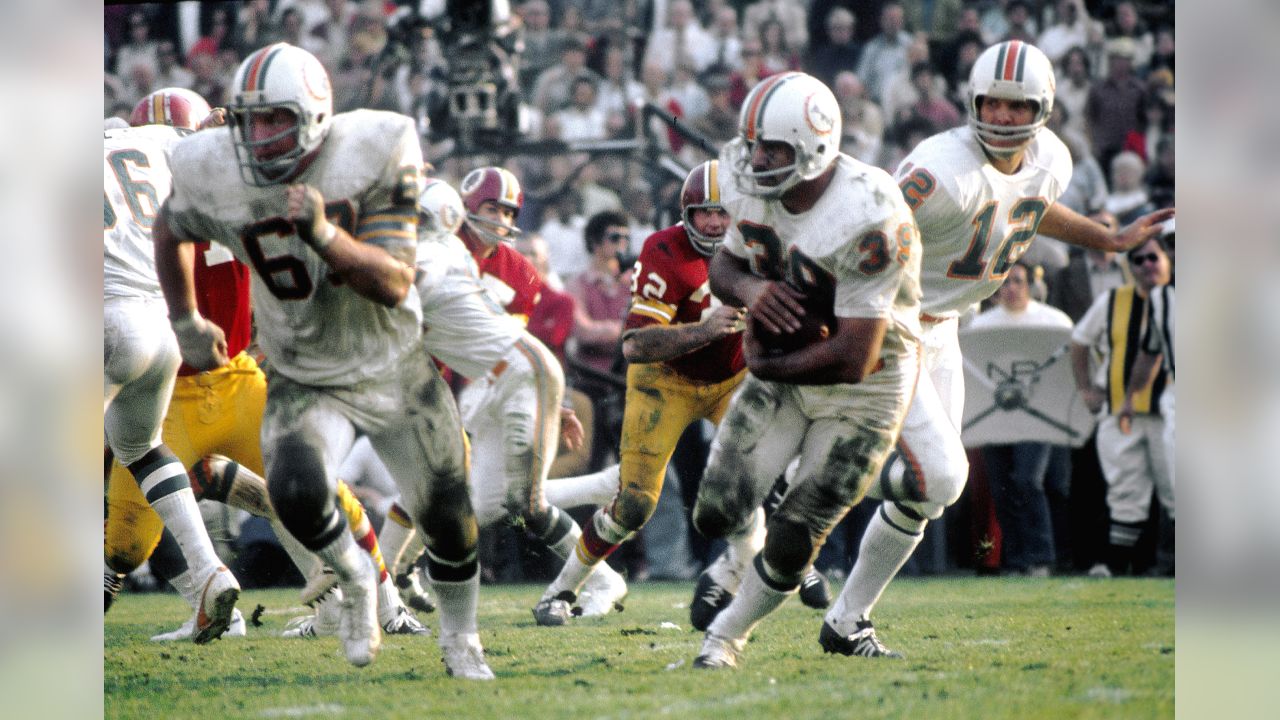
January 14, 1973, 50 years ago: Super Bowl VII is played at the Los Angeles Memorial Coliseum. At stake for both teams was the Championship of the National Football League. At stake for one was the first such title in 30 years. At stake for the other was their first ever, and more: The NFL's 1st undefeated, untied season.

The Miami Dolphins had been founded in 1966. By 1970, they were a Playoff team. For the 1971 season, they reached Super Bowl VI, but lost it to the Dallas Cowboys, 24-3. Now, they were AFC Champions for the 1972 season, and looking for redemption.

Their head coach was also looking for it. Don Shula had been a defensive back for the Cleveland Browns between their NFL Championships of the 1950s, and for the Baltimore Colts before theirs. He became the defensive coordinator for the Detroit Lions, building the 1st defensive line to be known as "The Fearsome Foursome." (The Los Angeles Rams and the San Diego Chargers would also use the name.)

In 1963, he was named head coach of the Colts. He got them into the 1964 NFL Championship Game, but lost to the Browns. In 1968, he won the NFL Championship Game, but lost Super Bowl III to the New York Jets. He was fired after the 1969 season -- and then Don McCafferty took them all the way the next season, winning Super Bowl V.

He was hired by the Dolphins, and built what became known as "the No-Name Defense." This nickname was unfair: While only linebacker Nick Buoniconti has been elected to the Pro Football Hall of Fame, end Bill Stanfill and safeties Dick Anderson and Jake Scott were named to that season's Pro Bowl; and tackle Manny Fernandez would also be an All-Pro.

The offense was led by quarterback Bob Griese, and had 3 good running backs: Larry Csonka, Jim Kiick and Eugene "Mercury" Morris. Griese had receivers Paul Warfield and Howard Twilley, plus Marlin Briscoe, who had previously been one of pro football's earliest black quarterbacks; and tight ends Marv Fleming (who had played for the Green Bay Packers' winners of Super Bowls I and II) and Jim Mandich.

Griese was protected by an offensive line that included center Jim Langer, guards Larry Little and Bob Kuechenberg, and tackles Norm Evans and Doug Crusan. And Garo Yepremian, a bald left-footer from the Mediterranean island nation of Cyprus, was already known as one of the top placekickers in the game.

Shula, Griese, Csonka, Langer, Little, Warfield and Buoniconti have all been elected to the Hall of Fame.

And the regular season couldn't have gone any better. They opened the season by playing the 1st regular season game at Arrowhead Stadium, beating the Kansas City Chiefs, 34-13. They beat the Houston Oilers at home at the Orange Bowl, They struggled to beat the Minnesota Vikings away, 16-14, then beat the New York Jets away and the San Diego Chargers at home.

Their toughest test came at home to the Buffalo Bills, as they had trouble containing O.J. Simpson, and only won 24-23. They rebounded by shutting out the Colts away, beating the Bills 30-16 in Buffalo, and obliterating the New England Patriots 52-0.

Joe Namath and the Jets came to the Orange Bowl, where they had beaten Shula's Colts in Super Bowl III, and held the Dolphins to a 28-24 win. The 'Phins closed by beating the St. Louis Cardinals at home, the Patriots in Foxboro, the New York Giants at Yankee Stadium, and the Colts at home.

The Playoffs were a little more difficult. On Christmas Eve, they beat the Browns at home, 20-14. And on New Year's Eve, they went to Three Rivers Stadium (at the time, home field advantage for the Conference Championships was rotated, rather than given automatically based on best record), and beat the Pittsburgh Steelers 21-7.

That set up a Super Bowl meeting with the Washington Redskins. They had won the NFL Championship in 1937 and 1942, and had lost the NFL Championship Game in 1945. But their reluctance to racially integrate -- they did not do so until 1962, after every other NFL team, every MLB and NBA team, and even 1 NHL team, the Boston Bruins, had done so -- led to a generation of struggle. They integrated, and began to improve, but still didn't make the Playoffs again until 1971.

That was the 1st season as head coach there for George Allen. Unlike Shula, he wasn't much of a player. But, like Shula, he became one of the NFL's top defensive coordinators. In 1963, the Chicago Bears won the NFL Championship and, just as Buddy Ryan as well as head coach Mike Ditka was carried off the field, it was Allen -- not the 68-year-old head coach and owner George Halas -- who was carried off the field. (Ditka was a key player on those '63 Bears.)

Allen got his 1st head coaching job with the Rams, and made them a perennial Playoff team. In 1971, looking for a permanent head coach after the death of Vince Lombardi (who had come out of his Packer retirement to take the Washington reins, and was making progress before he got sick), the Redskins hired Allen.

His idea was "The future is now." He trusted veterans more than rookies. His team became known as "The Over-the-Hill Gang." But the 1972 season proved that they weren't over the hill. Quarterback Billy Kilmer led the NFL in passer rating. The receivers he had to pass to included Charley Taylor (who would become the NFL's all-time leader in receptions), former Packer star Boyd Dowler, and star tight end Jerry Smith. Running back Larry Brown overcame a severe hearing impairment, and was named the League's Most Valuable Player.

As usual, Allen's pride was his defense. He had Verlon Biggs and Ron McDole as ends; Bill Brundige and Diron Talbert as tackles; Jack Pardee, Chris Hanburger and Harold McLinton as linebackers; Pat Fischer and Mike Bass as cornerbacks; and Richie Petitbon (one of his '63 Bears) and Brig Owens as safeties.

The Redskins went 11-3, their losses being 24-23 away to New England, and then, after they were already 11-1 and had clinched the NFC Eastern Division, 34-24 away to the Dallas Cowboys and 24-17 at home to O.J. and the Bills.

As Dick Vermeil later would as head coach of the Philadelphia Eagles, Allen focused like a laser beam on the Cowboys, who in 1966 became the dominant team in the Division that would evolve into the NFC East. As Cowboy defensive end Harvey Martin later put it in an interview, "He had them so high, they were ready to pop. So if you're going to go in there, you better have your guns on." Pretty bold statement to make about Washington, the city where the President of the United States lives, from a man playing in Dallas, a city where a President had recently been shot and killed.

But the Redskins did hate the Cowboys. And so did their fans. The fans were hopped-up about everybody: The current President, Richard Nixon, made the point that, "All anybody cares about in Washington is the Redskins. Nobody cares about the Kennedy Center or the National Gallery of Art." It was true: The city had just lost baseball's Senators, and basketball's Bullets and hockey's Capitals hadn't arrived yet. Sports-wise, the Redskins were it.

And on New Year's Eve, December 31, 1972, 3 hours after the Dolphins had finished off the Steelers, and a few hours before the plane crash that would kill baseball star Roberto Clemente, the NFL Films cameras caught a fan at Robert F. Kennedy Memorial Stadium wearing a Redskin helmet with a single-bar facemask, yelling at the Cowboys, "Die, you dogs, die! Die, you yellow dogs!"

Well, the Cowboys didn't die, but they were completely shut down and humiliated by the game that stood as the masterstroke in the careers of both George Allen and Billy Kilmer: Redskins 26, Cowboys 3. The Cowboys' reign as World Champions, and their 1st glory period, was over, and they went into a transition that allowed them to emerge as Super Bowl winners 5 years later.

So the Redskins were ready to derail the Dolphins' bid for an undefeated season. There was precedent: In 1942, the Bears were undefeated going into the NFL Championship Game, and the Redskins beat them. The Bears were also undefeated going into the Championship Game in 1934, and lost to the Giants.

There had been undefeated seasons in the NFL. In the 1st season, 1920, the Akron Pros went 8-0-3. In 1922, the Canton Bulldogs went 10-0-2. In 1923, the Bulldogs went 11-0-1. In 1929, the Packers went 12-0-1. But that was all before the institution of the NFL Championship Game for the 1933 season, let alone the Super Bowl for the 1966 season. So it had never been done in a full season.

Shula was outwardly calm. But he knew that he was 0-2 in Super Bowls, and had missed his chances as a player with the Browns and the Colts. And he had the flu, a fact he hid from his players, who did notice, as they said in later interviews, that he seemed "neurotic" and "absolutely crazy." Allen was similarly uptight, and accused the media of ruining his team's preparation. The players began to tell each other that they should have left him in Washington.

The year before, when the Dolphins lost Super Bowl VI to the Cowboys, it was the coldest Super Bowl to date, with a kickoff temperature of 39 degrees. (There have been Super Bowls played in domed stadiums, where it was colder than that outside, but not inside.) This time, it was 84 degrees at kickoff. Despite every Super Bowl ever played having been played either in a warm-weather city or under a dome, this remains the highest temperature in the game's history.

The Dolphins scored at the end of each of the 1st 2 quarters. At the end of the 1st, Griese threw a 28-yard touchdown pass to Twilley. At the end of the 2nd, Kiick ran the ball in from 1 yard, to make it 14-0 Miami. The No-Name Defense had limited the Redskins to 72 total yards and only 4 1st downs.

In the 3rd quarter, the Redskins got to the Dolphins' 17-yard line, but Taylor stumbled, and a Kilmer pass bounced off his fingers. Fernandez then sacked Kilmer, and Curt Knight attempted a 32-yard field goal, which went wide right. A successful kick would only have made it 14-3, but it would have given the Redskins a little momentum, with plenty of time to play.

They almost scored a touchdown early in the 4th quarter. Jerry Smith was wide open in the end zone, but Kilmer's pass went awry, and hit the goalpost. (After 1 more season, the NFL moved the goalposts back 10 yards, from the goal line to the end line.) Kilmer tried again, but Scott intercepted him, and returned it 55 yards.

The Dolphins got the ball to the Redskin 34, and on 4th down, Shula thought, "What a hell of a way to remember this game." He sent Yepremian in for a 42-yard field goal. So now, the team that stood to finish 17-0 stood to win 17-0. It was all so... perfect.

But Yepremian's kick was too low, and it was blocked by Brundige, and bounced back to him. Yepremian recovered it. There was still, according to the rules, a chance to gain a 1st down on the play. Brundige bore down on Yepremian, who tried to throw the ball -- with his right hand, despite kicking with his left foot.

What would have happened if he'd thrown with his left hand? We'll never know, but, throwing with his right, the ball went almost straight up, and came down, and bounced off his hands as he tried to catch it himself. Bass caught it for an interception, and he ran down the sideline, and couldn't be caught. Touchdown, Washington. Knight's extra point was good, and, with 2 minutes and 7 seconds left on the clock, it was Miami 14, Washington 7.

Now, suddenly, the game, the title, and the perfect season were all in serious jeopardy, thanks to what became known as "Garo's Gaffe." If the Dolphins didn't hang on and win this game, Yepremian would have become the biggest goat in the history of South Florida sports.

But Allen was a conservative coach, not given to gambling, and he made a historic blunder: He had Knight kick the ball deep. Unlike Jim Haslett to begin the 2nd half for the New Orleans Saints, 37 Super Bowls later, Allen was not willing to try an onside kick, and while there's no guarantee that the 'Skins would have recovered it, it cost him the best chance at a title he would ever have.

But Allen trusted his defense, and, while he was forced to use all his timeouts, plus the 2-minute warning, it almost worked. He forded the Dolphins to punt from their own 36 with 1:14 left. But Kilmer threw 2 incompletions, lost 4 yards on a pass play, and was sacked by Vern Den Herder on the game's final play.

The game was over, and the Dolphins had their perfect season. Scott was named the game's MVP, unusual for a defensive back. The Redskins had nearly as many total yards from scrimmage as the Dolphins, and had more 1st downs and 5 minutes' more time of possession. But the Dolphins' defense had completely shut the Redskins' offense down, as Washington's only score came on special teams.

The Dolphins won their 1973 season opener, extending their winning streak to 18 straight games, and their regular-season winning streak to 16. They won Super Bowl VIII, beating the Minnesota Vikings at Rice Stadium in Houston.

Over the next 11 seasons, Shula would lead them to 2 more Super Bowls, XVII and XIX, but they would lose them both. Shula got them into the 1992 AFC Championship Game, at home, but they lost to the Bills. Through the 2022 season, the Dolphins have never been back to the AFC Championship Game, much less the Super Bowl. Shula retired with 347 wins, more than any coach in NFL history, but with only 2 Super Bowl wins in 6 attempts.

The Redskins remained a contender through the 1970s, but, finally, the Over-the-Hill Gang truly got old. In the early 1980s, new coach Joe Gibbs and general manager Bobby Beathard rebuilt the team, and in 1983, they beat the Dolphins in Super Bowl XVII, winning the franchise's 1st World Championship in 40 years. They lost Super Bowl XVIII, but won Super Bowls XXII and XXVI, making it 4 appearances and 3 wins in 9 years. But they haven't been back since.

Super Bowl VII was the 2nd time the Los Angeles Coliseum had hosted the Super Bowl, after hosting the 1st in 1967. The next 5 Super Bowls to be held in the Los Angeles metropolitan area -- in calendar years 1977, 1980, 1983, 1987 and 1993 -- were held at the Rose Bowl in suburban Pasadena. The NFL instituted a policy that only metro areas with an NFL team could host a Super Bowl (albeit chosen years in advance, in the hopes of assuring a neutral site), so L.A. didn't host one for a long time. But with the restoration to the area of the Rams and the Chargers, in 2022, Super Bowl LVI was played at the new SoFi Stadium in Inglewood.

*

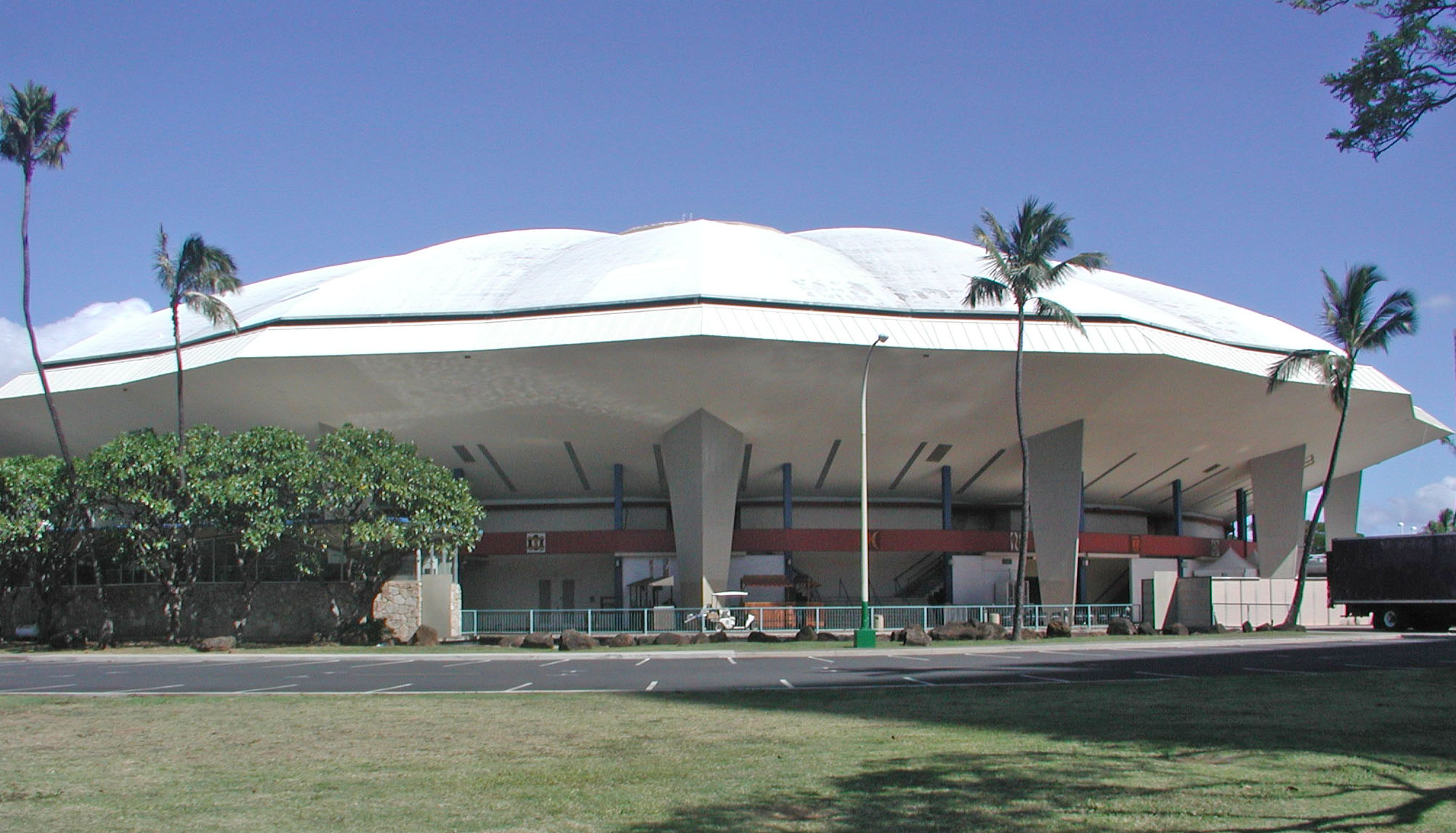
NBC had the rights to cover Super Bowl VII. They also had the rights to air Elvis: Aloha from Hawaii via Satellite. This concert was broadcast all over the world from the Honolulu International Center, now named the Neal S. Blaisdell Center, after the Mayor who got it built. The one major country on Earth that did not broadcast it live was America, because NBC thought it would be too much to ask of their viewers to watch 2 epic events in one day. So they held it back, and broadcast it on April 4, 1973.

Elvis Presley had just turned 38, and had also just finalized his divorce from his wife Priscilla. He came onstage wearing a white jumpsuit with an eagle on the front, an eagle on the back, and a big belt with a double-eagle buckle.
He sang hits from all phases of his career: The early "Memphis Flash" days, his Hollywood exile, and his Las Vegas comeback. As usual, he closed with "Can't Help Falling In Love," which was certainly appropriate on this occasion, because it was used in his 1962 film Blue Hawaii.

It was not one of his better performances. Certainly, he wasn't as into it was he was for his "Comeback Special" in 1968 (also on NBC) or for the Vegas show he did that was included in the 1970 documentary Elvis: That's the Way It Is. He was tired, and the emotional stress of the divorce was weighing on him. He looked like he was still in good shape, but the prescription drugs he was taking had already begun to take their toll. Within 5 years, the King of Rock and Roll was dead.

Tuesday, December 7, 2021

December 7, 1941: The Japanese Bomb Pearl Harbor

December 7, 1941, 80 years ago: As President Franklin D. Roosevelt said the next day, asking Congress for a Declaration of War against the Empire of Japan, and getting it, it is "a date which will live in infamy." Japanese planes attack the U.S. Naval base at Pearl Harbor in Honolulu, Hawaii.

American casualties and losses: 2 battleships totally lost, 2 battleships sunk and recovered, 3 battleships damaged, 1 battleship grounded, 2 other ships sunk, 3 cruisers damaged, 3 destroyers damaged, 3 other ships damaged, 188 aircraft destroyed, 159 aircraft damaged, 2,403 people killed, 1,178 wounded.

To put that in perspective: In 1941, the U.S. had about 130 million people, and we lost 2,400 in Honolulu that day. In 2001, we had about 300 million, and lost 3,000 on 9/11. Proportionately, we lost about twice as many people at Pearl Harbor as we did at the World Trade Center and the Pentagon combined 60 years later.

About 18,000 people were stationed at Pearl Harbor at the time. In 2013, 2,000 to 2,500 survivors were thought to be still alive, according to Eileen Martinez, chief of interpretation for the USS Arizona Memorial. But I can find no definitive number of how many people who were there who are still alive, only that there are believed to be 3 still alive who served on the Arizona.

Of the 16,112,566 people who served in the armed forces of the United States of America from December 7, 1941 to August 14, 1945, the U.S. Department of Veterans Affairs says that 325,574 are still alive, 76 to 80 years later -- a shade over 2 percent.

This was during Major League Baseball's offseason, so none of their games were played. This was 5 years before the founding of the NBA, so none of their games were played.

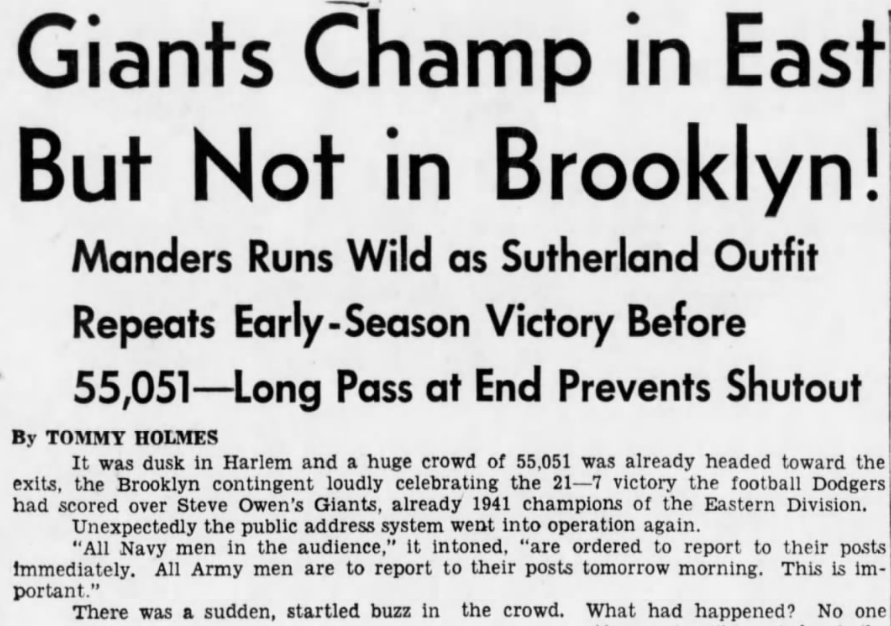
It was a Sunday, and 3 games were played in the National Football League. The most notable was at the Polo Grounds in New York, between 2 teams that were named for established baseball teams: The New York Giants and the Brooklyn Dodgers.

The Giants had won the NFL's Eastern Division title, as they had previously done in 1933, 1934, 1935, 1938 and 1939, winning the NFL Championship Game in 1934 and 1938 -- Super Bowl -XXXIII and Super Bowl -XXIX, if you prefer. But before they could face the Chicago Bears in the 1941 edition (having beaten them in 1934 and lost to them in 1933), they had to face the football Dodgers, who, like their baseball namesakes, played home games at Ebbets Field.

It was Tuffy Leemans Day at the Polo Grounds. Alphonse Emil Leemans (1912-1979) was a native of Superior, Wisconsin, and had been an All-American back (offensive and defensive) at George Washington University in Washington, D.C. The Giants would later retire his Number 4, and he was elected to the Pro Football Hall of Fame.
The Dodgers didn't care. They were going for a season sweep of the Giants, and they got it, winning 21-7. The Giants may have been the official Division Champions, but the Dodgers were the unofficial City Champions.
The Brooklyn Eagle, December 8, 1941

The attack started at 7:48 AM Hawaii time, which was 1:48 PM East Coast time. During the 2nd half, word got to the press box, and announcements began to come over the public address system. In those days, it was rare for someone to get paged at a sporting event. Usually, it was a doctor, who had to go and attend to a medical emergency.

This time, with the draft already in place, and enlistments already well underway as well, military officers attending the game were paged, and told to report to their various bases in and around New York City.

At Comiskey Park in Chicago, home to the Great Lakes Naval Training Center on Lake Michigan, another crosstown battle was held. The Bears beat the host Cardinals 34-24. And at Griffith Stadium in Washington, in the capital so the number of government officials and military officers present was considerably larger than in New York and Chicago, the host Redskins beat the Philadelphia Eagles 20-14.

When the game in New York ended, Dodger fans could not openly celebrate, and Giant fans didn't care, either, because it was then announced to the crowd that Pearl Harbor had been attacked.

The NFL Championship Game was played as scheduled, at Wrigley Field in Chicago on December 21, and, despite a 9-9 deadlock in the 3rd quarter, the Bears went on to beat the Giants 37-9.

Not until October 24, 1945 would an NHL game be played with all wartime conditions removed. For MLB, April 16, 1946. For the NFL, not until September 29, 1946.

Tuesday, July 9, 2019

List of All-Star Game Sites, 1933-2019

Tonight, the Major League Baseball All-Star Game will be played at Progressive Field, home of the Cleveland Indians. It was known as Jacobs Field from its opening in 1994 until 2008.

This list includes All-Star Games played in the major leagues in baseball, pro football, pro basketball, hockey and soccer. Ties are broken by most recent hosting.

1. Los Angeles, including Anaheim, Inglewood and Carson, 40: MLB, Los Angeles Memorial Coliseum in 1959; Anaheim/Angel Stadium in 1967, 1989 and 2010; Dodger Stadium in 1980, and it will host again in 2020. NFL, Wrigley Field in 1939; Gilmore Stadium in 1940; Los Angeles Coliseum every year from 1951 to 1972, and 1979. NBA, Los Angeles Sports Arena in 1963; The Forum in 1972 and 1983; Staples Center in 2004, 2011 and 2018. NHL: The Forum in 1981; Staples Center in 2002 and 2017. MLS, Home Depot Center/StubHub Center/Dignity Health Sports Park in 2013.

2. Honolulu, 35: NFL, Aloha Stadium every year from 1980 to 2009, plus 2011 through 2014, and 2016.

3. New York, including New Jersey and Long Island, 27: MLB, Polo Grounds in 1934 and 1942; old Yankee Stadium in 1939, 1960, 1977 and 2008; Ebbets Field in 1949; Shea Stadium in 1964; Citi Field in 2013; the new Yankee Stadium has not yet hosted. NFL, Polo Grounds in 1942. NBA: Madison Square Garden III in 1954, 1955 and 1968; Brendan Byrne Arena in 1982; Madison Square Garden IV in 1998; Barclays Center in 2015. WNBA: Madison Square Garden IV in 1999, 2003 and 2006; Radio City Music Hall in 2004. NHL: Madison Square Garden IV in 1973 and 1994; Nassau Coliseum in 1983; Brendan Byrne Arena in 1984. MLS: Giants Stadium in 1996 and 1997; Red Bull Arena in 2011.

4. New England, including Connecticut, 17: MLB, Braves Field in 1936; Fenway Park in 1946, 1961 and 1999. NBA, Boston Garden 1951, 1952, 1957 and 1964; the TD Garden has not yet hosted. WNBA, Mohegan Sun Arena in 2005, 2009, 2010, 2013 and 2015. NHL, Boston Garden in 1971; Hartford Civic Center/XL Center in 1986; FleetCenter/TD Garden in 1996. WHA, Hartford Civic Center/XL Center in 1977.

5. Montreal, 17: MLB, Olympic Stadium in 1982. CFL, Molson Stadium in 1957; the Autostade in 1971. NHL, Montreal Forum in 1937, 1939, 1953, 1956, 1957, 1958, 1959, 1960, 1965, 1967, 1969, 1975 and 1993; Bell Centre in 2009.

6. Chicago, including Bridgeview, 15: MLB, Comiskey Park in 1933, 1950 and 1983; Wrigley Field in 1947, 1962 and 1990; and Guaranteed Rate Field in 2003. NBA, Chicago Stadium in 1973 and 1988; the United Center will host in 2020. NHL: Chicago Stadium in 1948, 1961, 1974 and 1991; the United Center has yet to host. MLS: Toyota Park/SeatGeek Stadium in 2006; Soldier Field in 2017.

7. Toronto, 14: MLB, SkyDome/Rogers Centre in 1991. CFL, Varsity Stadium in 1955; Exhibition Stadium in 1977. NBA, Air Canada Centre/Scotiabank Arena in 2016. NHL, Maple Leaf Gardens in 1934, 1947, 1949, 1951, 1962, 1963, 1964 and 1968; Air Canada Centre/Scotiabank Arena in 2000. MLS, BMO Field in 2008.

8. Washington, including Landover, 12: MLB, Griffith Stadium in 1937 and 1956; District of Columbia/Robert F. Kennedy Stadium in 1962 and 1969; Nationals Park in 2018. NBA, Capital Centre in 1980, MCI Center/Capital One Arena in 2001. WNBA, MCI Center/Capital One Arena in 2002 and 2007. NHL, Capital Centre in 1982. MLS, Robert F. Kennedy Stadium in 2002 and 2004.

9. Philadelphia, 12: MLB, Shibe Park in 1943 and 1952; Veterans Stadium in 1976 and 1996; Citizens Bank Park is scheduled to host in 2026, for the 250th Anniversary of the nation's independence, as the city got several major events for the 200th in 1976. NFL, Shibe Park in 1943. NBA: Philadelphia Civic Center Convention Hall in 1960; The Spectrum in 1970 and 1976; First Union/Wells Fargo Center in 2002. NHL: The Spectrum in 1976 and 1992; the Wells Fargo Center has not yet hosted. MLS: Lincoln Financial Field in 2012.

10. San Francisco, including Oakland, San Jose, Daly City and Santa Clara, 11: MLB, Candlestick Park in 1961 and 1984; Oakland Coliseum in 1987; AT&T Park in 2007. AFL, Oakland Coliseum in 1967. NBA, Cow Palace in 1967; Oakland Coliseum Arena/Oracle Arena in 2000. NHL, San Jose Arena/SAP Center in 1997 and 2019. MLS, Spartan Stadium in 2001; Avaya Stadium in 2016.

11. Houston, 11: MLB, the Astrodome in 1968 and 1986; Minute Maid Park in 2004. AAFC, Rice Field in 1949. AFL, Jeppesen Stadium in 1965, Rice Stadium in 1966, the Astrodome in 1970. NBA: The Summit in 1989; Toyota Center in 2006 and 2013. MLS: BBVA Compass Stadium in 2010.

12. Detroit, including Pontiac and Auburn Hills, 11: MLB, Briggs/Tiger Stadium in 1941, 1951 and 1971; Comerica Park in 2005. NBA: Olympia Stadium in 1959, Silverdome in 1979. NHL: Olympia Stadium in 1950, 1952, 1954 and 1955; Joe Louis Arena in 1980.

13. St. Louis, 10: MLB, Sportsman's Park in 1940, 1948 and 1957; Busch Memorial Stadium in 1966; Busch Stadium in 2009. NBA: St. Louis Arena in 1958, 1962 and 1965. NHL, St. Louis Arena in 1970 and 1988; the Enterprise Center will host in 2020.

14. Cleveland, including Richfield, 9: MLB, Cleveland Municipal Stadium in 1935, 1954, 1963 and 1981; Jacobs/Progressive Field in 1997 and 2019. NBA: Richfield Coliseum in 1981; RocketMortgage Field House in 1997, and will host again in 2022. WHA: Richfield Coliseum in 1976.

15. Minnesota, including Minneapolis, St. Paul and Bloomington, 8: MLB, Metropolitan Stadium in 1965; Metrodome in 1985; Target Field in 2014. NBA: Target Center in 1994. WNBA: Target Center in 2018. NHL, Metropolitan Sports Center in 1972; Xcel Energy Center in 2004. WHA, St. Paul Civic Center in 1974.

16. San Diego, 8: MLB, Jack Murphy/SDCCU Stadium in 1978 and 1992; Petco Park in 2016. AFL, Balboa Stadium in 1962, 1963 and 1964. NBA, San Diego Sports Arena/Valley View Casino Center in 1971. MLS: Qualcomm/SDCCU Stadium in 1999.

17. Orlando, 7: NFL, Citrus Bowl/Camping World Stadium from 2017 to 2019. NBA: Orlando Arena/TD Waterhouse Center in 1992; in Amway Center in 2012. WNBA: TD Waterhouse Center in 2001. MLS: Citrus Bowl/Camping World Stadium in 1998.

18. Colorado, including Denver, and Commerce City, 7: MLB, Coors Field in 1998. NBA, McNichols Arena in 1984, Pepsi Center in 2005. ABA, McNichols Arena in 1976. NHL, Pepsi Center in 2001. MLS: Dick's Sports Goods Park in 2007 and 2015.

19. Arizona, including Phoenix, Glendale and Tempe, 7: MLB, Chase Field in 2011. NFL, State Farm Stadium in 2015. NBA: Arizona Veterans Memorial Coliseum in 1975; America West Arena/USAirways Center/Talking Stick Resort Arena in 1995 and 2009. WNBA, America West Arena/USAirways Center/Talking Stick Resort Arena in 2000 and 2014.

20. Atlanta, including Cumberland, 6: MLB, Atlanta-Fulton County Stadium in 1972; Turner Field in 2000; SunTrust Park has not yet hosted, but is scheduled to do so in 2021. NBA: The Omni in 1978, State Farm Arena in 2003. NHL: Philips/State Farm Arena in 2008. MLS: Mercedes-Benz Arena in 2018.

21. Seattle, 6: MLB, Kingdome in 1979; Safeco/T-Mobile Field in 2001. NFL, Kingdome in 1977. NBA: Seattle Center Coliseum in 1974; Kingdome in 1987. WNBA, KeyArena in 2017.

22. Cincinnati, 6: MLB, Crosley Field in 1938 and 1953; Riverfront Stadium in 1970 and 1988; Great American Ball Park in 2015. NBA: Cincinnati Gardens in 1966.

23. Pittsburgh, 6: MLB, Forbes Field in 1944 and 1959; Three Rivers Stadium in 1974 and 1994; PNC Park in 2006. NHL: Civic Arena in 1990.

24. Kansas City, including Kansas City, Kansas, 5: MLB, Kansas City Municipal Stadium in 1960 Royals/Kauffman Stadium in 1973 and 2012. NFL, Arrowhead Stadium in 1974. MLS, Children's Mercy Park in 2013.

25. Dallas, including Arlington and Irving, 5: MLB, Globe Life Park in 1995. NFL, Texas Stadium in 1973. NBA, Reunion Arena in 1986; AT&T Stadium in 2010. NHL, American Airlines Center in 2007.

26. Edmonton, 5: CFL, Clarke Stadium in 1976, Commonwealth Stadium in 1988. NHL, Northlands Coliseum in 1989. WHA, Northlands Coliseum in 1975 and 1979.

27. Carolina, including Charlotte, Raleigh and Greensboro, 4: NBA, Charlotte Coliseum in 1991, Spectrum Center in 2019. ABA: Greensboro Coliseum in 1971. NHL, PNC Arena in 2011.

28. New Orleans, 4: NFL, Superdome in 1976. NBA, New Orleans Arena/Smoothie King Center in 2008, 2014 and 2017.

29. Miami, including Miami Gardens, Fort Lauderdale and Sunrise, 4: MLB, Marlins Park in 2017. NFL, Orange Bowl in 1975; Sun Life/Hard Rock Stadium in 2010. NBA, Miami Arena in 1990; American Airlines Arena has not yet hosted.

30. Wisconsin, including Milwaukee and Green Bay, 4: MLB, Milwaukee County Stadium in 1955 and 1975; Miller Park in 2002. NBA, Milwaukee Arena (MECCA) in 1977; Bradley Center never hosted, Fiserv Center has not yet hosted.

31. Vancouver, 4: CFL, Empire Stadium in 1956; BC Place in 1983. NHL: Pacific Coliseum in 1977, General Motors Place/Rogers Arena in 1998.

32. Indiana, including Indianapolis and Fort Wayne, 4: NBA, Allen County War Memorial Coliseum in 1953; Hooser Dome in 1985; Bankers Life Fieldhouse has not yet hosted, but is scheduled to do so in 2021. ABA, Hinkle Fieldhouse in 1968; Fairgrounds/Indiana Farmers Coliseum in 1971.

33. Tampa Bay, including Tampa and St. Petersburg, 3: NFL, Tampa Stadium in 1978. NHL, Ice Palace/Amalie Arena in 1999 and 2018. MLB, Tropicana Field has not yet hosted.

34. Columbus, 3: NHL, Nationwide Arena in 2015. MLS, Columbus Crew/Mapfre Stadium in 2000 and 2005.

35. Ottawa, including Kanata, 3: CFL, Lansdowne Park in 1970 and 1974. NHL, Scotiabank Place/Canadian Tire Centre in 2012.

36. San Antonio, 3: NBA, Alamodome in 1996. ABA, HemisFair Arena in 1975. WNBA, AT&T Center in 2011.

37. Utah, including Salt Lake City and Sandy, 3: NBA, Delta Center/Energy Solutions Arena in 1993. ABA, Salt Palace in 1973. MLS, Rio Tinto Stadium in 2009.

38. Baltimore, 3: MLB, Memorial Stadium in 1958; Oriole Park at Camden Yards in 1993. NBA, Baltimore Civic Center/Royal Farms Arena in 1969.

39. Quebec City, 3: NHL, Colisee de Quebec in 1987. WHA, Colisee de Quebec in 1973 and 1978.

40. Calgary, 3: CFL, McMahon Stadium in 1972 and 1978. NHL, Saddledome in 1985.

41. Western New York, including Buffalo, Orchard Park, Rochester and Syracuse, 3: NBA, Rochester War Memorial Coliseum/Blue Cross Arena in 1956; Onandaga County War Memorial Coliseum/OnCenter in 1961. NHL, Buffalo Memorial Auditorium in 1978; the KeyBank Center has not yet hosted.

42. Las Vegas, 2: NBA, Thomas & Mack Center in 2007. WNBA, Mandalay Bay Events Center in 2019.

43. Hamilton, 2: CFL, Civic/Ivor Wynne Stadium in 1958 and 1973.

44. Louisville, 2: ABA, Freedom Hall in 1969 and 1972.

45. Jacksonville, 2: AFL, Gator Bowl in 1968 and 1969.

46. Tennessee, including Nashville and Memphis, 1: NHL, Bridgestone Arena in 2016. The NBA's Memphis Grizzlies have not yet hosted.

47. Portland, 1: MLS, Providence Park in 2014. Despite the Trail Blazers being one of the NBA's more stable franchises, soon to celebrate their 50th Anniversary, and having had a modern, 19,000-seat arena in the Moda Center since 1995, they have never hosted an NBA All-Star Game.

48. Norfolk, 1: ABA, Norfolk Scope in 1974.

Saturday, August 26, 2017

How to Go to a Hawaii Football Game

35 States down, 15 to go.

Tomorrow, the University of Hawaii football team opens its season, away to the University of Massachusetts. That's about as long a roadtrip as you can have in college football, and still be in the United States.

A week from tomorrow, they play their 1st home game, against Western Carolina.

Before You Go. Despite having to fly 1/3rd of a way across an ocean, you do not need a passport to visit Hawaii. However, it has its own time zone, and you will be a whopping six hours behind New York time. Adjust your timepieces accordingly, and get a wakeup call from your hotel.

Being tropical, and further south than anywhere in the U.S. mainland, Hawaii is naturally warmer, and rainier. And this is the tail end of Summer. Nevertheless, according to the Honolulu Star- Advertiser website, for the next couple of weeks, daytime temperatures should be in the mid-80s, and nighttime temperatures in the mid-70s, with only a small chance of rain. So you should be dry -- from rain, if not from sweat.

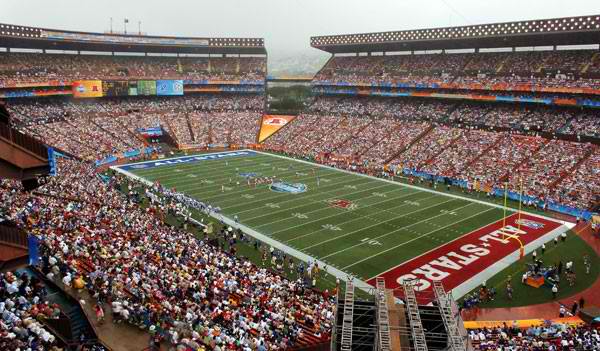
Tickets. Aloha Stadium officially seats 50,000 people, but UH only averaged about 23,000 fans per game last season. And it wasn't because they were bad. They weren't: They finished 7-7. And it can't be because the stadium is in bad shape. It can't be that bad, since the NFL still (usually) holds the annual Pro Bowl there, and the NCAA still allows the annual Hawaii Bowl there, which they wouldn't do if they didn't think the stadium was safe. Every Pro Bowl held there has had been 47,000 and 50,000 in attendance.

But from 2011 onward, UH home attendances have rarely topped 30,000. This may due to parts of the stadium simply being closed off, because they don't think they can sell tickets there. At any rate, getting a ticket shouldn't be a problem.

Seats on the west side of the stadium have sections labels with single letters, and on the east side with double letters. Midfield seats, in sections J, JJ, K, KK, L, LL, M and MM, are $75. Sideline seats further down, in sections F, FF, G, GG, H, HH, J, JJ (there is no I or II), N, NN, P, PP (there is no O or OO, but there is a PP), Q and QQ, are $50. Seats in the south end zone, sections A and AA through E and EE, are $40. Seats in the north end zone, sections R and RR through V and VV, are $25. I'm guessing there's more sun, and thus more heat, on the north end zone.

Getting There. Well, one thing's for sure: You are not driving. It's 4,960 air miles from from Newark Liberty International Airport to Daniel K. Inouye International Airport (named for the longtime U.S. Senator) in Honolulu. And 2,570 of that is just from Los Angeles to Honolulu.

Put it this way: You can take Amtrak or Greyhound, or drive, all the way from New York to L.A., taking 3 days, and then take a cruise line from L.A. to Honolulu, with your car on board, and that will take another 3 days, and the whole thing could run you close to $2,000 -- each way. And that's not counting food, lodging, game costs, or anything else. Whereas a roundtrip, nonstop flight (without even stopping to refuel in California) could cost about $1,400.

Once In the City. When Hawaii was granted Statehood on August 21, 1959, the 50th and (so far) last State, having been a U.S. Territory since 1893 and an independent Kingdom before that, its name was registered as "Hawaii" and pronounced "Hah-WIGH-ee." But in 1978, an Amendment to the Constitution of the State of Hawaii added Hawaiian as an official State language. In Hawaiian, it's written "Hawai'i" and pronounced "Hah-WAH-ee."
Since it's not easy to get a car from Hawaii to the mainland,
you may now be seeing a Hawaii license plate for the 1st time.

The source of the name is disputed. Some say the islands are named for the legendary figure who discovered them, Hawai'iloa. Others point out similarities to the native name for "home land" in other Polynesian languages: "Hawaiki" by the Maori of New Zealand, and "Savai'i" by the Samoans.

There are dozens of Hawaiian Islands, formerly the Sandwich Islands, but 8 main ones. From west to east, they are: Ni'ihau (which is private), Kauai, O'ahu, Moloka'i, Lana'i, Kaho'olawe, Maui, and Hawai'i. The last of these, a.k.a. The Big Island, has more land area than the other 7 combined.

But of the 1.4 million people in the State, 950,000, about 2/3rds, live on O'ahu, about 350,000 of them in the State capital, Honolulu. For all intents and purposes, the entire island of O'ahu is Honolulu's "metropolitan area." About 55 percent of the people in Honolulu are Asian (20 percent Japanese, 13 percent Filipino, 10 percent Chinese, 4 percent Korean, 2 percent Vietnamese, 2 percent Samoan, and the rest scattered), 18 percent white, 8 percent "Native Hawaiian," 5 percent Hispanic, 2 percent black, and the rest claiming a mix.

Officially, Hawaii does not have a State sales tax, but it has a general excise tax (GET) "at every level of transaction on goods and services," which serves the same function. It's 4.5 percent on O'ahu, 4 percent on the other islands. ZIP Codes in Hawaii start with the digits 967 and 968, and the Area Code is 808.
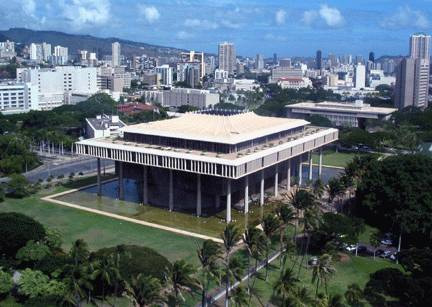
It's easy to conclude, from having watched Hawaii Five-0 (either version) that either the Aloha Tower, or the building that Steve McGarrett stands on in the opening, or the 'Iolani Palace, where he works, is the State House; after all, Steve works for, essentially, the State Police.

Well, the 'Iolani Palace was the seat of the Hawaiian government until 1969. But the current State Capitol is a much smaller building at 415. S. Beretania Street. It opened after the original version of the show premiered -- and, sad to say, looks it. The 1960s were a great decade for many things, but architecture most certainly was not one of them. How can a State that is so beautiful have a State Capitol that is so... not?
The State House in Honolulu

Honolulu's land area occupies the southeastern corner of O'ahu, but most of the population resides along the coast, much like Australia. Address numbers increase eastward from the harbor, and northward and southward from Nuuanu Avenue.

Honolulu has a serious traffic problem, so the city is building Honolulu Rail Transit, or HART. (Yes, I know, and they know, there's no Capital A in that.) The first phase is scheduled to open in late 2020, and will include a station at Aloha Stadium. The bus system is named simply TheBus, and a single ride is $2.50. Neither the city nor the island has a freeway "beltway." Hawaiian Electric Industries provides the electricity.

The University of Hawaii was founded in 1907, after annexation but well before Statehood. In addition to its main campus, known as University of Hawaiʻi at Mānoa, it has a campus across the island of Oahu, the University of Hawaiʻi–West Oʻahu, in Kapolei; one on "The Big Island," University of Hawaiʻi at Hilo; and one on the island of Maui, the University of Hawai'i Maui College, in Kahului.

Aside from football players, its notable athletes include baseball players Glenn Braggs, Chuck Crim and Steven Wright. Graduates in other fields include:

* Science: oceanographer Bob Ballard '66, former U.S. Surgeon General Kenneth Moritsugu '67.

* Journalism: Time Warner CEO Richard Parsons '68.

* Entertainment: Actress Georgia Engel '70, best known for playing Georgette Baxter (Mrs. Ted) on The Mary Tyler Moore Show, and Shirley Burleigh (Mrs. Howard) on Coach; and Star Trek design master Michael Okuda '78.

* Politics, representing Hawaii unless otherwise stated: Senator Hiram Fong '30, Senator Spark Matsunaga '41 (yes, "Spark" was his real name), Congresswoman Patsy Takemoto Mink '48 (co-author with Senator Birch Bayh of Indiana of Title IX), Senator Daniel Inouye '50, Senator Daniel Akaka '52, former President Kuniwo Nakamura '65 of the Pacific island nation of Palau, Senator Mazie Hirono '70, Governor David Ige '79, and Senator Tammy Duckworth '89 of Illinois.

Also, President Obama's father, Barack Obama, B.A. '62; his mother, Dr. Ann Dunham, B.A. '67, M.A. '83, Ph.D. '92; and his half-sister, Dr. Maya Soetoro-Ng, Ph.D. 2006. (Neil Abercrombie befriended Barack Sr. and Ann, got his master's degree at UH, and was later elected Congressman and Governor. However, his undergraduate degree was at Union College in Schenectady, New York.)

Going In. Aloha Stadium is 8 miles northwest of downtown, in the Halawa district, almost next-door to Pearl Harbor. Take Bus 11 or Bus 54 from downtown. It should take a little over half an hour. The official address is 99-500 Salt Lake Blvd. If you rented a car, parking is $7.00.
The Stadium opened in 1975, and, not surprising given how different from mainland America Hawaii is, is perhaps the most unusual stadium under the American flag, and not just because of its tree-lined parking lot. The North Stand and the South Stand are fixed in place, but the East Stand and the West Stand are movable, to allow it to host both baseball and football.
Baseball configuration

The field, now named Hawaiian Tel FCU Field, is artificial and always has been, and runs (more or less) north-to-south. It has been home to the University of Hawaii Rainbow Warriors since it opened, The Hawaiians of the World Football League in 1975, the Hawaii Islanders of the Class AAA Pacific Coast League from 1976 to 1985, and Team Hawaii of the original North American Soccer League in 1977. The Islanders won PCL Pennants there in 1975 and 1976, and additional Division titles in 1977, 1979, 1980 and 1984.

It has also hosted several postseason college football bowl games: The Aloha Bowl from 1982 to 2000, the Oahu Bowl from 1998 to 2000, the Hawai'i Bowl (the game uses the native spelling) since 2002, and the Hula Bowl, an east-west all-star game, from 1975 to 1997 and again from 2006 to 2008. NFL played its Pro Bowl there from 1980 to 2009, again from 2011 to 2014, and again in 2016. After 2 years in Orlando, Aloha Stadium will host the Pro Bowl again starting in 2019.
In 1997, a regular-season Major League Baseball series was played there, in a doubleheader on April 19 and a single game on April 20, between the San Diego Padres, who had been the Hawaii Islanders' parent club, and the St. Louis Cardinals. The Cardinals swept the doubleheader, 1-0 and 2-1 (attendance: 37,882), while the Padres took the finale 8-2 (40,050).
The National Anthem before the 1997 series

The stadium is also known for its swap meet, held every Wednesday, Saturday (aside from UH gamedays) and Sunday.

In 2007, to save money, the stadium was permanently locked into its football configuration, so even if Hawaii were to get another pro baseball team, they'd have to play somewhere else. This also prevents pro soccer from being played there, as the width of a soccer field required the stands to be moved into the baseball configuration.

In addition, Hawaii's humid climate and salt air leads to the rusting of the weathering steel used to build the stadium. Maintenance is expensive, and a 2016 renovation didn't seem to help much. There's a very good chance that, by the dawn of the 2020s, either a plan will be approved to build a new stadium, or Hawaii will lose major sports permanently.

This would leave the University of Hawaii to start building a smaller stadium for their football team or else drop their program entirely. Either way, don't expect Aloha Stadium to last much beyond its 50th Anniversary in 2025, if that long; and don't expect it to host the 2030 Pro Bowl.

UPDATE: On November 19, 2018, Moneywise compiled a list of their Worst College Football Stadiums, the bottom 19 percent of college football, 25 out of 129. Aloha Stadium came in 2nd, ahead of only Vanderbilt Stadium (which I don't get, it's not a terrible place to watch a game). The article cited the 2016 renovation, saying it didn't mean much improvement.

Food. Centerplate runs the concessions, but I can find no reference to specific stands. Presumably, there will be specialty items, possibly with a Hawaiian theme.

Team History Displays. The University of Hawaii at Manoa (the school's full name, but usually just shortened to "Hawaii") has been playing football since 1909, except for 1942 through 1945, when World War II and concerns over another Japanese attack made it inadvisable. Originally, they were the Fighting Deans, but a rainbow appeared over their Moiliili Field in 1923, and they became the Rainbows. At some point, they became the Rainbow Warriors, just the Warriors in 2001, and the Rainbow Warriors again in 2013.

Their modern era began in 1956, when they went to Lincoln and avenged the previous year's 50-0 loss to Nebraska at Honolulu Stadium, and won 6-0. In 1968, defensive lineman Larry Cole became the 1st Hawaii player drafted by an NFL team, the Dallas Cowboys, and won 2 Super Bowls.

The school was put in NCAA Division II upon its postwar restoration in 1946 and in Division I-A upon the NCAA's I-A/I-AA split in 1974. Hawaii joined the Western Athletic Conference in 1979, played in its 1st real bowl game in the 1989 Aloha Bowl, and in 2012 joined the Mountain West Conference for football and the Big West Conference for all other sports.

It won the WAC in 1992, 1999, 2007 and 2010, although only the 2007 title was solo. In that season, the Warriors became the 3rd team from a non-automatic qualifier conference to play in a Bowl Championship Series game, losing the 2008 Sugar Bowl to Georgia, 48-14. There is no display for these titles in the fan-viewable areas of the stadium.

Hawaii has retired no uniform numbers. Its stars have included Dallas Cowboys Super Bowl winners Larry Cole (1967), Golden Richards (1972) and Mark Tuinei (1982); San Francisco 49ers Super Bowl winners Dana McLemore (1981) and Jesse Sapolu (1982); Denver Broncos Super Bowl winners Jason Elam (1991) and Maa Tanuvasa (1992); 3-time New England Patriots Super Bowl winner Adrian Klemm (1999); and Washington Redskins quarterback Colt Brennan (leader of their 2007 WAC Champions and 3rd in the Heisman Trophy balloting, though his pro career was a bust).

Since Brigham Young University left the WAC in 1993, Hawaii's biggest rivalry has been with Fresno State, who moved with them from the WAC into the Mountain West in 2012. The rivalry is a nasty one, featuring both teams have run up the score on the other (Fresno State won 70-14 in 2004, and Hawaii won 68-37 in 2006), and their fans have been European-soccer level abusive to each other. Fresno State leads the rivalry 26-22-1. (UPDATE: Through the 2019 season, it's now 29-22-1 in Fresno's favor.)

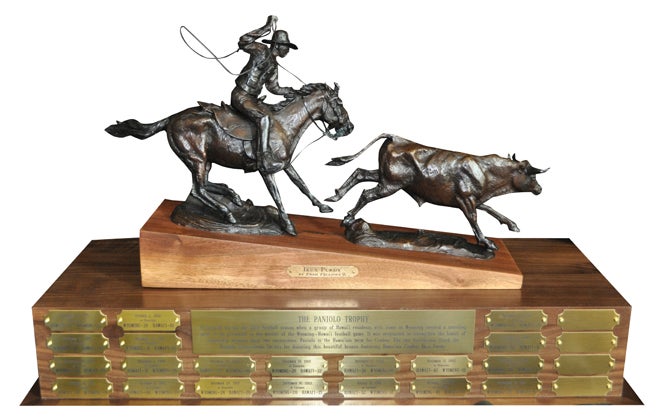
When Hawaii joined the MWC in 2012, they renewed an old rivalry with Wyoming, with whom they once played for the Paniolo Trophy. Wyoming's teams are called the Cowboys, and "Paniolo" is a Hawaiian term for a ranch hand (there are ranches on the islands) that, effectively, means "cowboy." The original trophy was lost, so a new one was created. Wyoming leads the series 13-9. (UPDATE: Wyoming now leads 14-10.)
The Paniolo Trophy.

Stuff. There is no major team store at Aloha Stadium, since it is owned by the State, not by the University. There are souvenir stands, but to get the better stuff, you'd have to go to the University Bookstore, at 2465 Campus Road.

As far as I can tell, there are no team videos, and the only book that Amazon.com seems to have on the team is Once A Warrior: Hawai'i Football, On the Field and Off the Record, by J. Ian Sample, Colt Brennan's most frequent receiver, and the son of ex-baseball player Billy Sample.

During the Game. As a visitor, and not one openly rooting for the opposing team, your safety is not likely to be an issue. Just remember that Hawaii is, to use Canada's term for Quebec, a distinct society, with its own native culture, of which they are proud. Treat the people as you would like them to treat you, and you will be accepted; if not, you're in trouble.

The UH marching band will play the National Anthem -- and they may play familiar Hawaiian songs as well. UH used to have a mascot, but he was no Rainbow Warrior. Warrior, certainly; "rainbow," definitely not. He was Vili Fehoko, using the name Vili the Warrior -- Vili is a common Polynesian name. He used to lead the players in a pregame haka dance, much like the Polynesian-dominated All Blacks, the New Zealand rugby team. Also like the All Blacks, UH sometimes wears all-black uniforms.
Vili retired just before the 2012 season began, saying he wanted to spend more time with his family. This led to rumors that he was forced into retirement, but it wasn't true. Unlike when a politician says it, this wasn't a euphemism for "I didn't something stupid, and my wife found out about it, and now I have to make it up to her." He has 4 sons, all of whom were then involved in local sports, and he wanted to see their games: "I'm going to be a road warrior now."

The fight song sounds more like an "Alma Mater":

Here’s to our dear Hawai‘i 
Here’s to our Green and White 
Here’s to our Alma Mater 
Here’s to the team with fight 
Rah! Rah! Rah! 

Here’s to old warriors calling 
Here’s to old battles won 
Here’s to Hawai‘i’s victory 
Here’s to each valiant one. 


After the Game. Since you're a visiting fan, but not an opposing fan, you've got no reason to antagonize anyone. Therefore, you'll be welcome back anytime.

That's the good news. The bad news is that Aloha Stadium isn't really in a neighborhood, set off from neighborhoods by Interstates H1, H3 and H201 (for some reason, they use the State's name for a letter prefix, something no other State does), the Kamehameha Highway (State Route 99), and Salt Lake Blvd. So your postgame meal options are very limited. Restaurant 604 is a 5-minute drive away, at 57 Arizona Memorial Drive, just outside of Pearl Harbor. And there's a McDonald's and a Starbucks just down Salt Lake Blvd., south of the stadium.

If you're a fan of a European soccer team, there are 2 places that are cited as possibilities to watch. Legends Sports Pub is at 411 Nahua Street in the Waikiki area, about 3 miles southeast of downtown. Rivals Sports Lounge is nearby, at 2211 Kahio Avenue, but while it's a well-known place, it's not well-known for showing soccer. Bus 2 or Bus 13 from downtown will get you to either. The other, known for being the home of the Hawaii branch of the U.S. national team supporters' group, the American Outlaws, is Square Barrels, at 1001 Bishop Street, downtown.

Sidelights. Few places in the other, and no other place in America, are more frequently compared to "paradise" than Hawaii. Consistent good weather, beautiful topography, beautiful people, great food, and even good sports. Paradise? I suppose, if you don't mind mosquitoes and volcanoes.

UPDATE: On November 30, 2018, Thrillist published a list of "America's 25 Most Fun Cities," and Honolulu came in 25th. 

Before there was Aloha Stadium, there was Honolulu Stadium. It was built in 1926, with a baseball grandstand, but adapting it for football gave it a weird look, along with a capacity of 25,000 fans. UH played there off and on from 1926 to 1974, and it hosted the Pineapple Bowl postseason college football game. (The name would be used for a 1991 episode of Coach, but it was a real game from 1939 to 1941, called off due to The War, and then played again from 1947 to 1952.)
Its main focus was baseball, and both Babe Ruth and Joe DiMaggio (while he was serving in the Army Air Forces during World War II). In 1957 and 1958, within a matter of weeks, it hosted both a pair of Elvis Presley concerts and a Billy Graham crusade.

In 1961, the Pacific Coast League's Sacramento Solons moved in, becoming the Hawaii Islanders. They won a Division title in 1970, and gave broadcaster Harry Kalas his big break from 1961 to 1964. (He even met his 1st wife, mother of broadcaster Todd Kalas, in Hawaii.) And the WFL's The Hawaiians played there in 1974 and part of the 1975 season.

But it was becoming clear that Honolulu Stadium was outdated, having earned the nickname "The Termite Palace." Aloha Stadium was built, taking in the Islanders and (briefly, before the WFL folded) The Hawaiians, and Honolulu Stadium was demolished in 1976. A plaque honoring the stadium now stands in Old Stadium Park. 2237 S. King Street, not far from the UH campus. Bus 1.

In 1984, UH built the 4,312-seat Rainbow Stadium, renaming it Les Murakami Stadium for their longtime baseball coach upon his 2002 retirement. The Hawaii Islanders played their 1986 and 1987 seasons there, before travel costs became prohibitive, and the team moved to Colorado Springs, leaving the State without professional sports. 1337 Lower Campus Road. Bus 1, and then walk down Varsity Circle, over Interstate H1, to the campus.
Adjacent, at 1355 Lower Campus Road, is their basketball arena, the Stan Sheriff Center. Built in 1994, the former Special Events Center was named for their longtime athletic director in 1998, but is usually called the Aloha Dome.
Believe it or not, there is a baseball legend buried in Hawaii. Not just any legend, but the man often called the inventor of the game. Alexander Cartwright, the member of the Knickerbocker Base Ball Club who is said to have invented some of the earliest rules of the game in 1845, went west with the 1849 California Gold Rush, and instead continued on west when he learned of the opportunity to continue his careers as both a surveyor and a fireman in Hawaii. He served as Fire Chief of Honolulu from 1850 to 1863, and died there in 1892. He is buried at Oahu Cemetery, 2162 Nuuana Avenue. Bus 4.

In spite of the Padres having been the Hawaii Islanders' parent club 30 year ago, a 2014 New York Times article shows their support not even registering now. The Yankees and the San Francisco Giants both have about 15 percent of the fandom, with the Boston Red Sox and the Los Angeles teams, the Dodgers and Angels, both having token support. The most popular NFL team is the San Francisco 49ers. The most popular NFL team is the Los Angeles Lakers. The most popular NHL team is the Anaheim Ducks.

The Beatles did not perform in Hawaii, but Elvis Presley famously did. He made 3 films there: Blue Hawaii (1961), Girls! Girls! Girls! (1962, supposedly the Elvis film most often shown on TV), and Paradise, Hawaiian Style (1966). On November 10, 1957, he did 2 shows at Honolulu Stadium. The next night, he did a private show at the Conroy Boxing Bowl at Wheeler Army Air Field. Conroy Bowl still stands, but since it's on a military base, access may be restricted. 627-699 Trimble Road. Bus 52 to Bus 72.

On March 25, 1961, he did a show at Pearl Harbor's Bloch Arena, to raise money for the Pearl Harbor Memorial Charity. This would be his last live performance for 7 years, and 1 of only 6 shows he would do from Autumn 1957 to Summer 1969. Also on a military base, so access may be restricted. 224 A Avenue. Bus 9.

He did a show on November 17, 1972, and 2 on November 18, at the Honolulu International Center. On January 12, 1973, he did a show there for Elvis: Aloha From Hawaii Via Satellite, his worldwide TV special. Officially, it was a rehearsal, with the cameras going as if it was real; unofficially, it was a failsafe, so there would be something to broadcast if something went wrong with the actual show. On January 14, he did the actual show, which was broadcast live around the world -- except in the U.S., because NBC didn't want to air it on the same day as Super Bowl VII (promotional costs, I suspect), and so they delayed it until April 4, 1973.

The HIC, which opened in 1964, is now named the Neal S. Blaisdell Center, after the Mayor who got it built, and a statue of Elvis stands outside. I'd say Elvis must have felt right at home, since the building has the same design as the Mid-South Coliseum in Memphis, but he never played that venue until 1974, after the Hawaii shows. 777 Ward Avenue, downtown.
The 'Iolani Palace, Hawaii's seat of government from 1882 to 1969, and the only royal palace on what is now U.S. soil, is now a museum. 364 S. King Street. The Hawaii State Art Museum is at 250 S. Hotel Street. The Honolulu Museum of Art is at 900 S. Beretania Street, across a park from the Blaisdell Center. All of these are downtown, and within walking distance, no bus needed.

The Bishop Museum, dedicated to Polynesian Culture, is at 1525 Bernice Street. Bus 2. Waikiki Aquarium is at 2777 Kalakaua Avenue. Bus 2 to 22 to reach anything in the Waikiki area.

The Pearl Harbor Visitor Center and its memorials have an address of 1 Arizona Memorial Road, off the Kamehameha Highway. Bus 40 or 42. If you drive in, do not simply type in "Pearl Harbor," or it will take you to the still-active U.S. Navy base. You will need to get a ticket at the Visitor Center to see everything, including to get on the boat to the USS Arizona Memorial, but there is no entrance fee.

Hawaii has produced a President. And, as we now know with 100 percent certainty, Barack Obama was born on August 4, 1961 at the Kapi'olani Medical Center for Women and Children, at 1319 Punahou Street. It is still a working hospital, and it's unlikely you'll be allowed into the specific delivery room where he was born. Bus 4. The places where Obama lived in Hawaii remain private residences, not official historic sites, and are not open to the public; while it probably wouldn't be that hard to find the addresses, I won't post them here.

If you're wondering, Obama has chosen to put his Presidential Library & Museum in his adopted hometown of Chicago, not in his birth city of Honolulu. This is for the best, due to Chicago's central location and Hawaii's significantly lesser accessibility.

Despite a lot of high-rise hotels, the tallest buildings in Hawaii are in a "twin towers" complex, known only by their address, 801 South Street, downtown, just 450 feet tall. A building is going up at 690 Pouhaina Street that will succeed it at 650 feet, but is not scheduled to open until 2019.

Not as tall as these, but Hawaii's most iconic building, is the Aloha Tower, a 184-foot-high former lighthouse built in 1926, which has been converted into student housing for Hawaii Pacific University. 155 Ala Moana Blvd., downtown. A mall is next-door.

The 26-story Ilikai Hotel & Luxury Suites opened on Leap Year Day, February 29, 1964, as the 1st luxury high-rise hotel in the State, overlooking Waikiki at 1777 Ala Moana Blvd. This is the building on whose balcony both versions of Steve McGarrett stand on in the openings of their respective versions of Hawaii Five-O, both Jack Lord in 1968 and Alex O'Loughlin in 2010. The hotel's developer was Chinn Ho, and the H50 character of Chin Ho Kelly (played by Kam Fong Chun, a real-life Pearl Harbor survivor and later a real-life Honolulu policeman, in the original and Daniel Dae Kim in the reboot) was named for him.

Because of its good weather and beautiful locations, Hawaii has been a filming location for many TV shows and movies. Some of the better-known TV series, in chronological order: Hawaiian Eye, Fantasy Island, Magnum, P.I, Jake and the Fatman, Baywatch, and One West Waikiki. Movies: The aforementioned trio of Elvis movies, Ride the Wild Surf, Blue Crush, Forgetting Sarah Marshall, Lilo & Stitch, 50 First Dates, Battleship, and, of course, any movie about the attack on Pearl Harbor, including From Here to Eternity, Tora! Tora! Tora!, The Final Countdown and Michael Bay's Pearl Harbor.

*

It's not easy to get to Hawaii. Once you've been there, you may find that it's not easy to get back -- beyond the reasons associated with logistics. But it remains a target destination, and a good time can be had at a college football game there.

As Jack Lord used to say, "Be there. Aloha!"

Monday, August 21, 2017

Top 10 Athletes From Hawaii

August 21, 1959: Hawaii is granted Statehood, the 50th State, and, so far, the last.

Top 10 Athletes From Hawaii

Barack Obama doesn't count: The 44th President was definitely born in Honolulu, and he may have been a decent high school basketball player, but he didn't play in college, much less the pros. And his ceremonial first pitches needed work. Let's just say that, by going to law school, he made the right career choice.

As opposed to alleged great high school athlete Donald Trump, who may be the last "president" born before Hawaiian Statehood, and apparently doesn't recognize that it happened.

Steve McGarrett doesn't count, either: Although the lead character of CBS' Hawaii Five-O reboot was a great high school quarterback, he did not continue his football playing while at the Naval Academy -- and, besides, like the original version played by Jack Lord, the new one played by Australian actor Alex O'Loughlin is fictional.

Anyway, unless otherwise stated, all of these athletes grew up in the State capital of Honolulu. Remember: The deciding factor as to what State to list an athlete with is not where they were born, but where they were raised and trained to play their sport.

Honorable Mention to Herman Wedemeyer of Hilo, Hawaii's 2nd-largest city, and the biggest on the "Big Island." A running back, he starred for St. Mary's College in the Bay Area, before playing in the All-America Football Conference in the late 1940s, earning the nicknames "The Flyin' Hawaiian" and "Squirmin' Herman." He later became an actor, playing Detective Sergeant Duke Lukela on the original version of Hawaii Five-O. He was elected to the college Football Hall of Fame.

Honorable Mention to Adrian Murrell of Wahiawa. He had the misfortune to play for the Jets and the Arizona Cardinals before they went from awful to good, the Washington Redskins and the Dallas Cowboys after they went from great to bad, and the Carolina Panthers between good stretches. But he still ran for 5,199 yards in an NFL career spanning 11 seasons.

Honorable Mention to Benny Agbayani. "The Hawaiian Hammer" actually played longer in Japan (2004-09) than he did in the North American major leagues (1998-2002), but the left fielder did help the Mets win the National League Pennant in 2000. Like earlier Met hero Sid Fernandez (more about whom later), he wore Number 50 in tribute to his home, the 50th State.

Honorable Mention to Deitre Collins. The University of Hawaii volleyball player won the Honda-Broderick Cup as the nation's top female collegiate athlete in 1982-83.

10. Marcus Mariota. The 1st Hawaiian to win the Heisman Trophy, he won it as a quarterback at the University of Oregon in 2014. Since 2015, he has been the starting quarterback for the Tennessee Titans. Barring injury, he should move up this list a bit.

9. Mosiula "Mosi" Tatupu. Born in Samoa, he starred as a running back at the University of Southern California (like Arizona and Arizona State, USC tapped into Samoa's base of large, strong young men to make them good college football players), and became a Pro Bowler for the New England Patriots. He was named to their 50th Anniversary Team.

He stayed in the Boston suburbs, and became a high school coach. Unfortunately, he was one of those players who suffered football-related brain damage, and died in 2010.

8. Mark Tuinei of Nanakuli. Born in Oceanside, California, he went to the Punahou School, a preppy private high school in Honolulu which has produced a lot of famous graduates, including President Obama. He starred as an offensive tackle at the University of Hawaii, and won Super Bowls XXVII, XXVIII and XXX with the Dallas Cowboys, making 2 Pro Bowls.

Unfortunately, he died in 1999 -- not from football-related trauma, but from something really stupid. The coroner said it was probably his first experience with heroin, and he'd mixed it with ecstasy. I'm not blaming this on his being a Dallas Cowboy, since he hadn't played a down with them in 2 years, but the Cowboys do have a bad drug legacy.

7. Jesse Sapolu. Born in Samoa, he starred as a center at the University of Hawaii, and won Super Bowls XIX, XXIII, XXIV and XXIX with the San Francisco 49ers. He was a 2-time All-Pro, and was good enough to last 15 seasons in the NFL, so he wasn't just along for the ride.

6. Sid Fernandez. He went 114-96 in a 15-year major league career, highlighted by being a part of the Mets' rotation during their 1984-90 revival. A fat lefthander -- a "portly portsider," or a "hefty lefty" -- with a nasty screwball, "El Sid" was a 2-time All-Star, making him the 1st Hawaii native to appear in a Major League Baseball All-Star game.

"El Sid" -- nicknamed after medieval Spanish hero El Cid, and the letters SSSSID replacing the K's in the "K Korner" in left field at Shea Stadium -- was the winning pitcher in Game 7 of the 1986 World Series, in relief of Ron Darling, holding the Boston Red Sox off long enough for the Met bats to bail them out. The Mets have won exactly 2 World Series games since.

He retired after the 1997 season. Recent reunions, such as on the anniversaries in 2006 and 2016 and the 2008 closing of Shea Stadium, show that he's one of the few 1986 Mets who's lost weight. He looks terrific. Although of Portuguese descent, and not having long hair or a mustache, he could once have been mistaken for a Samoan football player. Now, he looks like a Hawaiian native who used to surf, and could still do it.

5. Russ Francis. Born in Seattle, he became a 3-time Pro Bowl tight end with the New England Patriots, and won Super Bowl XIX with the San Francisco 49ers.

4. Clarence "Buster" Crabbe. Born in Oakland, California, he went to the Punahou School. He won the 400-meter freestyle swim at the 1932 Olympics in Los Angeles.

Like Johnny Weissmuller before him, he starred as Tarzan, and took other jungle-man roles. In 1940, he replaced Weissmuller as the leading swimming attraction at Billy Rose's Aquacade at the New York World's Fair. In between, he starred as science fiction characters Buck Rogers and Flash Gordon in film serials.

In 1979, 4 years before his death, he was cast in the campy NBC series Buck Rogers in the 25th Century, as a retired fighter pilot named Brigadier Gordon, in a nod to his other spacely character. When that series' Buck, Gil Gerard, praised his flying, Crabbe said, "I've been doing this sort of thing since before you were born." The Buck character, in both versions, had been asleep for 500 years, so this was improbable. And Girard said, "You think so, old-timer?" And Crabbe said, "Young man, I know so." Crabbe first played Buck Rogers in 1939, and Gerard was born in 1943.

3. Warren Kealoha of Honolulu. Not the greatest competitive swimmer from Hawaii, or even of his own generation, but an Olympic Gold Medalist in the backstroke in 1920 at Antwerp, Belgium, and again in 1924 in Paris. He is a member of the International Swimming Hall of Fame.

2. Carl "Bobo" Olson of Honolulu. On October 21, 1953, he knocked out Randy Turpin at the old Madison Square Garden to become the Middleweight Champion of the World. Turpin held the title because he was a former Champion and the last man to have beaten Sugar Ray Robinson, who had forfeited the title. But Robinson got it back on December 9, 1955, knocking Olson out at Chicago Stadium.

They fought 4 times, and Robinson won them all. But Olson beat some great fighters: Turpin, Anton Raadik, Dave Sands, Kid Gavilan and Joey Maxim. The Ring magazine named him Fighter of the Year for 1953.

1. Duke Paoa Kahinu Mokoe Hulikhola Kahanamoku. Yes, "Duke" was his real name, not a nickname, like is was for pretty much anyone else called "Duke," including Edwin Donald Snider.
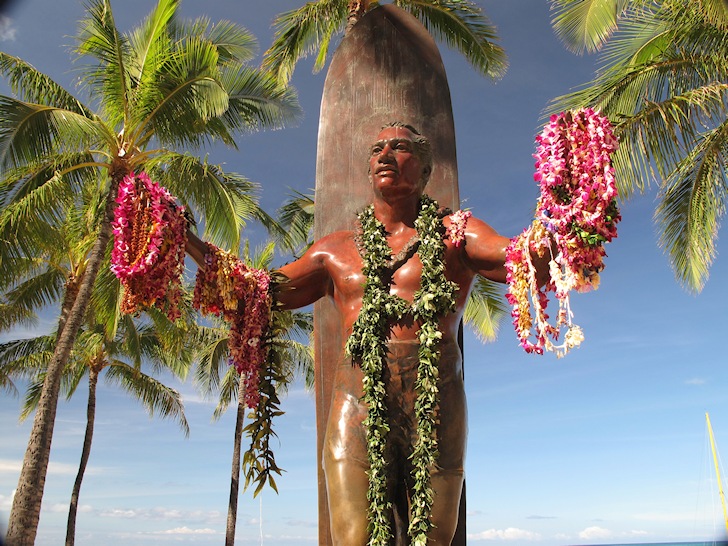
Duke's statue on Waikiki Beach

Duke Kahanamoku (1890-1968) is the Father of Modern Surfing. Surfing is a competition, and it's certainly athletic, but it's not a traditional sport. But swimming is. In the 1912 Olympics in Stockholm, Sweden, he won a Gold Medal and a Silver Medal.

There was no 1916 Olympics because of World War I. At the 1920 Olympics in Antwerp, Belgium, he won 2 more Gold Medals. At the 1924 Olympics in Paris, he won a Silver Medal and his brother Samuel Kahanamoku won a Bronze Medal, both in the same race in which Duke won Gold in the previous Olympics, the 100-meter freestyle, the "sprint" of Olympic swimming, but both were beaten by Johnny Weissmuller. He was a charter inductee into the International Swimming Hall of Fame.

Duke's greatest legacy has nothing to do with sports, or even with surfing in a competitive or artistic sense. While living in Newport Beach, California on June 14, 1925, he rescued 8 men from a fishing vessel that capsized in heavy surf while attempting to enter the city's harbor. There were 29 fishermen who went into the water, and 17 died. Using his surfboard, Duke was able to make quick trips back and forth to shore to increase the number of sailors rescued. Two other surfers saved 4 more fishermen. Newport's police chief at the time called Duke's efforts "the most superhuman surfboard rescue act the world has ever seen." It also caused U.S. lifeguards to begin using surfboards in their water rescues. Duke later served as Sheriff of Honolulu from 1932 until 1961.