Showing posts with label kansas city municipal stadium. Show all posts

Thursday, September 25, 2025

September 25, 1965: Satchel Paige, MLB's Oldest Player

September 25, 1965, 60 years ago: The Boston Red Sox beat the Kansas City Athletics, 5-2 at Kansas City Municipal Stadium. Lee Thomas and Tony Conigliaro hit home runs for the Red Sox, while Carl Yastrzemski went 2-for-4.

Satchel Paige started the game for the A's. He went 3 innings, allowed no runs, 1 hit, no walks, striking out 1. It was the K.C. bullpen -- Diego Seguí, Don Mossi and John Wyatt -- who lost the game.

So why take Satch out so early? Well, he was 59 years old. He was the oldest player ever to appear in a Major League Baseball game.

His birth name, Leroy Robert Paige, was known. Less known was how he got his nickname: Either his feet were as big as suitcases, or "satchels," and "Satchelfoot" became "Satchel," or "Satch" for short; or his constant traveling, as the loose structure of the Negro Leagues meant that he was always in demand, led to him always carrying a satchel.

Not known for sure, for a long time, was his birthdate. His contemporary, Dizzy Dean, would tell differing stories about his date of birth, place of birth, and real name, most of them lies. But as to his date of birth, Paige simply kept them guessing. He would say things like, "How old would you be if you didn't know how old you was?" And, "A goat ate the Bible that had my birth certificate. That goat lived to be 29 years old."

When Paige was finally brought to the major leagues in 1948, by Bill Veeck, owner of the Cleveland Indians, Veeck decided to find out for himself. He had heard Paige say he was born in Mobile, Alabama, a city which would later produce 2 other Hall-of-Famers, Hank Aaron and Willie McCovey. So Veeck went to Mobile, accepted the possibility that there might not be a birth record for a black child born in the early part of the 20th Century, and found one anyway: With the permission and accompaniment of members of the Paige family, he went to the Mobile County Board of Health, and found that Satch was born on July 7, 1906. That made him 42, the oldest rookie in major league history.

That didn't stop the speculation. One of his former Negro League teammates, Ted Radcliffe, known as "Double Duty" because he could catch and pitch, said he grew up with Paige in Mobile, and Paige was exactly 2 years older. Since Radcliffe's birthdate was established as July 7, 1902, that meant Paige was born on July 7, 1900, making him 48 when he reached the major leagues. (Radcliffe lived to be 103, stuck by his story to the end, and should be in the Hall of Fame.)

A few years after his debut, someone interviewed Paige's mother, and she said he was born in 1904, and she should know, right? Paige said, "She was in her nineties when she told the reporter that, and sometimes she tended to forget things." 

So people still wondered. Veeck said he'd seen the birth certificate, but he said a lot of things over the years, some of which were proven to be untrue.

Similarly, Archie Moore, Light Heavyweight Champion of the World from 1952 to 1962, was the subject of questions about his age. He said he was born on December 16, 1916, but his mother said it was 1913. Sonny Liston, Heavyweight Champion from 1962 to 1964, also faced questions about his age: He was officially 32 when Muhammad Ali dethroned him, but, as part of his poetic trash-talking, Ali, then still using his birth name, said, "You're 40 years old, if a day, and you don't belong in the ring with Cassius Clay!" Hispanic players, due to poor record-keeping, have also faced questions about their ages, including the Cuban pitchers Luis Tiant and Orlando "El Duque" Hernández.

Paige got around in the Negro Leagues and the Caribbean leagues. He debuted with the Chattanooga Black Lookouts in 1926, presumably as a teenager for a few weeks. Among his tenures: He played 4 seasons with the Birmingham Black Barons, 4 with the Pittsburgh Crawfords, and 8 with the Kansas City Monarchs. Negro League records are incomplete, but he is known for sure to have at least 118 wins against 80 losses. How many games he won in all those "barnstorming" appearances, God only knows.

As a "rookie" in 1948, Paige helped the Indians win the World Series. He pitched for them in 1949 as well. He returned to the Negro Leagues in 1950, because Veeck sold the Indians, and the new owner didn't want him. Veeck bought the St. Louis Browns in 1951, and brought Paige in. In 1953, with the Browns, at age 47, Paige became the oldest player to appear in the All-Star Game. But Veeck sold the Browns after that season, and they became the Baltimore Orioles. Paige did not go with them, and went back to barnstorming.

In 1955, Veeck bought the Miami Marlins of the Class AAA International League, whose name would later be taken by a major league team. He signed Paige, who stayed through the 1958 season, at 52. He kept barnstorming -- apparently, he needed the money -- until 1961, when he signed with the Portland Beavers of the Class AAA Pacific Coast League.

In 1965, desperate for attendance, Kansas City Athletics owner Charlie Finley, remembering that Paige had played longer in Kansas City than anywhere else, signed him to play one last major league game. Finley invited several Negro League veterans to be introduced before the game. If Finley wanted a big crowd, it didn't work: Only 9,289 fans came out.

Ironically, this last appearance may have delayed Satch's entrance into the Baseball Hall of Fame. At the Hall's 1966 induction ceremony, Ted Williams told the crowd that Paige, catcher Josh Gibson, and other Negro League stars should be eligible for the Hall. The Hall's rules state that a player must be retired for 5 full seasons. Paige was the 1st Negro Leaguer elected, in 1971 -- 5 full seasons after his last appearance. (Gibson had died in 1947, of a brain tumor while still an active player, 3 months before Jackie Robinson made his debut. He was elected in 1972.)

In 1968, Paige reached out to all 20 teams then in MLB, to try and join one of them on the active roster, in order to reach the 158 days he still needed to qualify for the five-year minimum for the Players' Association pension. On August 12, Atlanta Braves owner Bill Bartholomay signed him as an adviser and an assistant trainer, and Paige qualified. With his struggle in mind, the following season, MLB and the Players' Association reduced the requirement from 5 to 4 years, and "grandfathered in" all players who had played up to 1959.

Paige died on June 8, 1982, a month before his presumed 76th birthday, of a heart attack at his home in Kansas City. He was married 3 times, and had 7 children, all with his 3rd wife. In 1999, The Sporting News ranked him 19th on their list of the 100 Greatest Baseball Players. In 2022, ESPN ranked him 41st on their updated 100. In each case, he was the highest-ranking  among Negro League players. Statues of him stand in Cooperstown, New York, a block from the Hall of Fame; and in the Negro Leagues Baseball Museum in Kansas City.

Satch broke the record of Charley O'Leary, who was just short of turning 59 on September 30, 1934. He appeared as a pinch-hitter, singled and scored, making him the oldest player to get a hit and the oldest player to score a run. He was not then placed in the field. He had last played in the majors in 1913, his 21-year gap between appearances still an MLB record. But he had been a player-manager in the minors for a while, and had coached for the St. Louis Browns that season, activated for the season finale.

For a while, it was thought that Minnie Miñoso, brought out of retirement at 53 for the 1976 Chicago White Sox, as a publicity stunt by, you guessed it, team owner Bill Veeck, was the oldest player to get a hit. But later research found that O'Leary was older than previously thought. Miñoso made 1 more appearance, at 56 in 1980, making him a 5-decade player, but did not get a hit.

Jack Quinn, a pitcher, was the oldest player to appear regularly, last doing so at 50 with the 1933 Cincinnati Reds. He finished with a career record of 247-218. Julio Franco was the oldest position player to appear regularly, last doing so with the 2007 Atlanta Braves, at 49. In 2006, at 48, with the New York Mets, Franco became the oldest player to hit a home run.

In 2012, at 48, Jamie Moyer became the oldest pitcher to win a game, with the Colorado Rockies. Since the National League still didn't have the designated hitter, Moyer had to bat for himself, and also became the oldest player with an RBI.

The oldest players to appear at each position:

Pitcher: 59, Satchel Paige, 1965 Kansas City Athletics
Catcher: 54, Jim "Orator" O'Rourke, 1904 New York Giants
Third Base: 49, Jimmy Austin, 1929 St. Louis Browns
First Base: 48, Hughie Jennings, 1918 Detroit Tigers
Second Base: 48, Johnny Evers, 1929 Boston Braves
Right Field: 46, Sam Thompson, 1906 Detroit Tigers
Shortstop: 44, Omar Vizquel, 2012 Toronto Blue Jays
Left Field: 44, Ichiro Suzuki, 2018 Seattle Mariners
Center Field: 43, Ichiro Suzuki, 2017 Miami Marlins

Monday, September 8, 2025

September 8, 1965: The 1st Man to Play All 9 Positions In an MLB Game

Bert Campaneris, after the A's moved to Oakland

September 8, 1965, 60 years ago: Against the California Angels at Kansas City Municipal Stadium, Dagoberto "Bert" Campaneris of the Kansas City Athletics becomes the first player to play all 9 positions in the same game, as part of a special promotion featuring the popular 23-year-old Cuban, whose main position is shortstop.

He began the game at shortstop and played, in order for the next 8 innings: 2nd base, 3rd base, left field, center field, right field, 1st base, pitcher (giving up a run on a hit and 2 walks) and catcher. With the game tied at 3-3 after 9 innings, manager Haywood Sullivan (later better known as the general manager of the Boston Red Sox) sent Rene Lachemann in to replace Campaneris, who was injured in a collision at the plate with Ed Kirkpatrick to end the top of the 9th.

The Angels scored 2 runs in the 13th inning, and defeated the A's 5-3. Attendance: 21,576, meaning there were about 13,000 empty seats, so the promotion didn't exactly work.

There appears to be no surviving footage of this game, but Campaneris survived the last 3 seasons in Kansas City, and the 1967-68 move to Oakland, to help the A's become a dynasty in the 1970s. He only batted .259 lifetime, but had 2,249 hits stole 649 bases, led the American League in stolen bases 6 times, made 6 All-Star Games, and reached the postseason 6 times: 5 straight AL Western Division titles with the A's, including 3 straight World Series in 1972, '73 and '74; and the 1979 AL West title with the California Angels. As of September 8, 2025, he is still alive.

Through the 2024 season, there have been 5 players to play all 9 positions in a major league game. No player has also managed to be a designated hitter in the same game, to make it 10.

Saturday, April 12, 2025

April 12, 1955: The Salk Polio Vaccine & the Kansas City Athletics

April 12, 1955, 70 years ago: Dr. Jonas Salk announces that the vaccine he had been testing against polio is effective and safe.

The announcement was made at the University of Pittsburgh Medical Center, on the 10th Anniversary of the death of Franklin Delano Roosevelt, who had been stricken with polio as a seemingly rising politician, recovered, and got himself elected President, and led the fight against polio, among the other fights he led. I can't prove that the announcement was made on that day for that reason, but it worked out poetically.

People have asked, "Could Franklin Roosevelt be elected President today? After all, he was in a wheelchair." The answer is, "Today, he wouldn't have been in a wheelchair, because, as a child born after 1955, he would have been vaccinated against polio."

As late as 1952, at which point Salk had begun testing his vaccine, polio outbreaks terrified people. Over 58,000 people were stricken with it, and 3,145 people died from it, with thousands of others paralyzed. My mother remembered growing up a block away from a public pool in Tompkins Square Park, on Manhattan's Lower East Side, and her mother wouldn't let her swim in it, because polio was often absorbed from water. Even jumping in puddles was forbidden by many mothers.

Salk pressed on, until he was sure his vaccine was effective and safe. He was told that if he patented it, it would make him $1 billion. He made it free to the world. "Could you patent the Sun?" he asked.

The vaccine got, for want of a better choice of words, a booster shot on October 28, 1956. Elvis Presley, the biggest music star in America, is photographed getting the polio vaccine. That led millions of teenagers to get it.

*

On the same day, the Kansas City Athletics beat the Detroit Tigers, 6-2 at Kansas City Municipal Stadium. It was the 1st home game for the A's after moving from Philadelphia. Their new hometown was back in the major leagues after 40 years.
Former President Harry S Truman, from nearby Independence, Missouri, threw out the ceremonial first ball. For the Tigers, Al Kaline went 2-for-4, and Red Wilson hit the ballpark's 1st major league home run. For the A's, Bill Wilson hit a home run, and Alex Kellner was the winning pitcher.

Previously, Kansas City had these major league teams in baseball: The Kansas City Cowboys of the Union Association, a league which only played the 1884 season; the Kansas City Cowboys of the National League, a team which only played the 1886 season, with none of these teams have any official connection with the other; the Kansas City Cowboys of the American Association, a team which only played the 1888 and 1889 seasons; and the Kansas City Packers of the Federal League, a league which only played the 1914 and 1915 seasons. And, in football, the Kansas City Blues entered the NFL in 1924, became the Kansas City Cowboys in 1925, and folded after the 1926 season.

The Kansas City Blues won 10 American Association Pennants: 1888, 1890, 1898, 1901, 1918, 1923, 1929, 1938, 1952 and 1953. The Kansas City Monarchs won 11 Negro League Pennants: 1923, 12 1924, 1925, 1929, 1937, 1939, 1940, 1941, 1942, 1946 and 1953.

Both teams played at Muehlebach Field, built in 1923 by, and named for, George E. Muehlebach, who owned the Blues and a number of other Kansas City businesses, including Muehlebach Beer and the Muehlebach Hotel. The previous Kansas City ballpark, Association Park, was owned by a railroad, which decided to build a new line through it, creating the need for a new ballpark.

In 1937, the New York Yankees bought the Blues, made them their top farm team, and renamed the ballpark Ruppert Stadium, in honor of team owner Jacob Ruppert. Ruppert died in 1939, and the ballpark was renamed Blues Stadium in 1943.

Knowing that the Philadelphia Athletics had been purchased by Arnold Johnson, and were being moved to Kansas City for the 1955 season, the city added an upper deck to Blues Stadium, and renamed it Kansas City Municipal Stadium. It now seated 35,020 people. When the American Football's League's Dallas Texans became the Kansas City Chiefs in 1963, the addition of football bleachers raised seating capacity to 51,000.

When Johnson died in 1960, the A's were bought by Charles O. Finley. He wanted a bigger ballpark, and when the city wouldn't build him one, he flirted with moving the A's to Dallas and Louisville, before finally moving to Oakland, California for the 1968 season. Kansas City then got an expansion team, and the Royals played there from 1969 to 1972.

Unusual for that era, instead of building one stadium for both baseball and football, Kansas City built a stadium for each. Arrowhead Stadium opened in 1972, Royals Stadium opened in 1973, and the complex was named the Harry S Truman Sports Complex. Missouri's favorite son had died the day after Christmas, 1972.

When the Royals' original owner, pharmaceutical magnate Ewing Kauffman, died in 1993, the stadium was renamed Kauffman Stadium for him. In 2024, the Royals released plans for a new stadium, tentatively set to open in 2028. The Chiefs renovated Arrowhead Stadium at the same time, and have no plans to replace it.

The Chiefs won the AFL Championship in 1966 and 1969, losing Super Bowl I but winning Super Bowl IV. The Royals won the World Series in 1985 and 2015, having lost it in 1980 and 2014. The Chiefs have since won Super Bowls LIV, LVII and LVIII; while losing Super Bowls LV and LIX.

In soccer, the Kansas City Spurs won the 1969 North American Soccer League title, playing home games at Municipal Stadium. But they only lasted 1 more season. The Kansas City Wizards won the 2000 MLS Cup. In 2010, they rebranded as Sporting Kansas City, and moved from Arrowhead to a new stadium in nearby Kansas City, Kansas. They won the MLS Cup again in 2013.

A women's team, FC Kansas City, only lasted from 2013 to 2017, but won the National Women's Soccer League title in 2014 and 2015. In 2021, they were replaced by the Kansas City Current.

The area has been less successful in the indoor sports. In 1972, the NBA's Cincinnati Royals moved in, but, since the baseball team was already called the Royals, they became the Kansas City Kings. In 1974, they moved from the Municipal Auditorium to the new Kemper Arena. That same year, the NHL placed an expansion team there, the Kansas City Scouts.

The Scouts were lousy, and moved after 2 seasons. The Kings won a Division title in 1979 and reached the Western Conference Finals in 1981, but never drew well, and moved to Sacramento in 1985. In 2018, the Kemper Arena was downsized and rebranded as the Hy-Vee Arena. In 2007, the Sprint Center opened downtown, but it has failed to attract and NBA, WNBA or NHL team.

No matter: Kansas City still has MLB and the NFL, the 2 sports that mark a city and its metropolitan area as "major league." And while the A's left, the Royals and the Chiefs aren't going anywhere.

But the A's moved to Oakland in 1968, and to Sacramento in 2025, with a plan to move to Las Vegas for 2028.

Saturday, December 25, 2021

December 25, 1971: The NFL's Longest Game

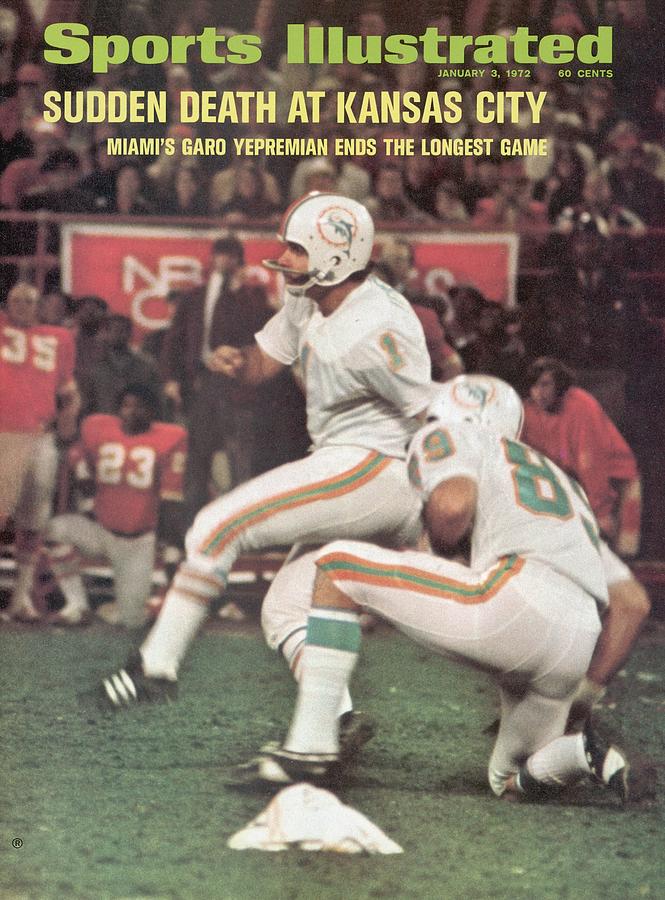
December 25, 1971, 50 years ago: For the 1st time, the NFL plays a game on Christmas Day. It turned out to be the longest game in the league's history.

The Kansas City Chiefs played the Miami Dolphins at Kansas City Municipal Stadium. The Chiefs had been the defining team of the American Football League, winning the title in 1962, 1966 and 1969. From the AFL's founding in 1960 until the 1962 Championship Game, they were the Dallas Texans. That '62 title game, which they beat the Houston Oilers, went to 2 overtimes, becoming the longest game in pro football history.

The Dolphins had only been founded in 1966, and made the Playoffs for the 1st time in 1970. They were a team on the rise, and this would be their biggest challenge yet. Despite the game being in Kansas City in December, the weather was just fine by Miami standards: 62 degrees and partly cloudy at the 3:00 kickoff (4:00 Eastern Time).

The scoring began with Jan Stenerud kicking a field goal for the Chiefs. They went ahead 10-0 following an interception by Willie Lanier and a touchdown pass from Len Dawson to Ed Podolak. The Dolphins came back, with Larry Csonka running for a touchdown and Garo Yepremian kicking a field goal, making the score 10-10 at the half.

Dawson launched a 75-yard, 10-minute drive that ended with a Jim Otis touchdown, but the Dolphins came back with a Jim Kiick touchdown to make it 17-17. In the 4th quarter, Nick Buoniconti picked up a fumble, but Jim Lynch intercepted Griese to end that threat. Dawson then drove the Chiefs 91 yards, capped by a 3-yard run by Podolak, making it 24-17 Kansas City.

The Dolphins struck back, going 71 yards until Griese threw a 5-yard touchdown pass to Marv Fleming, tying it 24-24 with 1:25 left in regulation. Podolak took the kickoff back 78 yards, but Stenerud missed a 32-yard field goal, and the game went to overtime.

At this point, overtime was still rare. There would not be a provision for it in the regular season until 1974. It had happened in the 1958 NFL Championship Game, with the Baltimore Colts beating the New York Giants. It had happened, as I said, in the 1962 AFL Championship Game. And it had happened in a Playoff for the NFL Western Division Championship in 1965, with the Green Bay Packers beating the Colts. This would be only the 4th time in pro football history that a game went beyond the standard 60 minutes.

Podolak returned the overtime kickoff to the 46-yard line, setting up a 42-yard field goal attempt by Stenerud. But the Dolphins blocked it. Later in the 5th quarter, Yepremian tried a field goal from 52 yards, but this was short. At the end of this 1st overtime period, Jake Scott intercepted a Dawson punt, but this came to nothing, and the teams traded punts.

Finally, Csonka -- on his 25th birthday -- broke off a 29-yard run, setting up a 37-yard field goal attempt by Yepremian, with 7:40 left in the 6th quarter -- 82 minutes and 40 seconds of play. The left-footed Armenian from Cyprus made the kick, it was good, and the Dolphins had won, 24-21.

Chiefs coach Hank Stram said, "I don't think any one player in a big game, a monumental game like that, had a day like Eddie Podolak had." Stram had a point: 17 rushes for 85 yards, 8 catches for 110 yards, 3 kickoff returns for a 154 yards, and 2 punt returns for 2 yards. That's 350 all-purpose yards, still a postseason record, and the 4th-highest total in NFL history. But for all he, and Hall-of-Famers like Len Dawson, Willie Lanier, Buck Buchanan, Bobby Bell, Curley Culp, Johnny Robinson and Jan Stenerud did, it wasn't enough.

This defeat meant that this was the last game the Chiefs would play at Municipal Stadium. They would not host the AFC Championship Game, and the next season, Arrowhead Stadium opened, and it remains the Chiefs' home to this day.

More than this, it was the end of one era, and the beginning of another. The Chiefs had played 8 postseason games in 9 years, winning 3 AFL Championships and Super Bowl IV. They would not play another Playoff game for 15 years, only that 1 for 19 years, and wouldn't win a Playoff game for 20 years.

The Dolphins hosted the Colts, another great team getting old, in the AFC Championship Game, and won, 21-0. They lost Super Bowl VI to the Dallas Cowboys, 24-3. But the following season, they went undefeated, 14-0, and won Super Bowl VII over the Washington Redskins, 14-7. They would win Super Bowl VIII as well.

*

December 25, 1971 was a Saturday. Earlier in the day, the Dallas Cowboys had beaten the Minnesota Vikings, 20-12 at Metropolitan Stadium in the Minneapolis suburb of Bloomington, Minnesota.

The following day, December 26, the Baltimore Colts beat the Cleveland Browns, 20-3 at Cleveland Municipal Stadium; and the San Francisco 49ers beat the Washington Redskins, 24-20 at Candlestick Park in San Francisco.

There were 6 games played in the NHL. Since this day, the League has never played on Christmas Day again. In fact, traditionally, it has not played on December 24, or 25, and usually not on 26, either.

The New York Rangers beat the Minnesota North Stars, 2-1 at the Metropolitan Sports Center in Bloomington. The Boston Bruins beat the Philadelphia Flyers, 5-1 at the Boston Garden. The Toronto Maple Leafs beat the Detroit Red Wings, 5-3 at Maple Leaf Gardens in Toronto. The Pittsburgh Penguins beat the Montreal Canadiens, 4-2 at the Civic Arena in Pittsburgh. 

The St. Louis Blues and the Buffalo Sabres played to a tie, 4-4 at the St. Louis Arena. And the Oakland-based California Golden Seals beat the Los Angeles Kings, 3-1 at The Forum outside Los Angeles, in Inglewood, California.

There were 7 games played in the NBA. The New York Knicks beat the Golden State Warriors, 114-89 at Madison Square Garden. Walt Frazier scored 36 points.

The Boston Celtics beat the Cincinnati Royals, 99-94 at the Cincinnati Gardens. This was the end of a tradition: The last Christmas game in Cincinnati. The following season, the Royals moved, becoming the Kansas City-Omaha Kings.

Also, the Baltimore Bullets beat the Philadelphia 76ers, 117-114 at The Spectrum in Philadelphia. The Atlanta Hawks beat the Buffalo Braves, 140-117 at the Alexander Coliseum in Atlanta. Walt Bellamy scored 40 points. The Detroit Pistons beat the Milwaukee Bucks, 120-118 in overtime at Cobo Hall in Detroit. Kareem Abdul-Jabbar scored 38 points, but it wasn't enough to beat the Pistons.

The Phoenix Suns beat the Seattle SuperSonics, 116-86 at the Arizona Veterans Memorial Coliseum in Phoenix. Connie Hawkins scored 31 for the Suns. And the Chicago Bulls beat the Portland Trail Blazers, 109-88 at the Portland Memorial Coliseum.

There were 3 games played in the ABA. The Virginia Squires beat the Pittsburgh Condors, 133-126 at the Hampton Coliseum. The Memphis Pros beat the Carolina Cougars, 110-102 at the Mid-South Coliseum. And the Utah Stars beat the Indiana Pacers, 150-129 at the Salt Palace in Salt Lake City.

Sunday, April 17, 2016

Top 5 Reasons You Can't Blame the Kansas City Athletics for Moving to Oakland

September 27, 1967: The Kansas City Athletics play their last home game. Their last 2, actually: They sweep a doubleheader from the Chicago White Sox, 5-2 and 4-0.

April 17, 1968: The A's play their 1st home game in Oakland. They lose to the Baltimore Orioles, 4-1.

The A's had been bought from the Mack family by Arnold Johnson in the Autumn of 1954, and he moved them to Kansas City. He died in 1960, and Charlie Finley had bought them from his heirs. He wanted a new ballpark, and Kansas City wasn't willing to build him one. He threatened to move to other cities before settling on Oakland, California, across San Francisco Bay from, well, San Francisco.

Kansas City was glad to be rid of Finley. A few weeks after the A's played their 1st game in Oakland, Major League Baseball expanded, and put a team in Kansas City, the Royals, and the city approved a new ballpark for them.

In the short term, Oakland was a great sports city. In the long run, it has failed. The Golden State Warriors, at the peak of their influence, are building a new arena and moving back across the Bay to San Francisco, hoping to open it for the 2019-20 season. The Raiders have already moved to Los Angeles once, moved back, and may yet move again, possibly back to L.A. And the A's may yet move again, because the Oakland Coliseum, once such a fun place to watch a baseball game or a football game, is now old and dreary with a rotten atmosphere.

Indeed, Finley tried to get the A's out of Oakland. He was inches away from moving them to Denver for the 1978 season. He thought he could move them to New Orleans for 1979. He tried again to move them to Denver for 1980, before finally selling them to Walter Haas that year.

Did Finley screw up by moving the A's? No: The relationship with Kansas City was poisoned. He had to go somewhere.

Did he screw up by choosing Oakland? It sure looks that way.

But, as Brian Kenny tended to say on the ESPN series The Top 5 Reasons You Can't Blame... , things aren't always what they seem.

Top 5 Reasons You Can't Blame the Kansas City Athletics for Moving to Oakland

First, let me discuss a couple of reasons that didn't make the final cut, The Best of the Rest.

The St. Louis Cardinals. Thanks to their radio network, and the accompanying promotion by the team's owners, Gussie Busch and his Anheuser-Busch brewing corporation, Kansas City and the surrounding area was still Cardinal territory. Not until the Royals came along and started making the Playoffs in 1976 did a Kansas City team effectively take the region away from the Cards.

The Kansas City Market. I once saw a photograph taken at Super Bowl I. The photo showed Pennants of each team. The Packers pennant showed a 1940s-style football player, complete with a facemaskless helmet, his arm back to throw a pass, a ball against an outline of the State of Wisconsin. The Chiefs pennant showed an Indian carrying a football, against an outline of several States: Missouri, Kansas, Iowa, Nebraska, Oklahoma and Arkansas.
There's a lot of people in that territory. But it's a lot of area. Check out these mileages to downtown Kansas City:

Lawrence, home of the University of Kansas: 43
Topeka, capital of the State of Kansas: 64
Manhattan, home of Kansas State University: 122
Columbia, home of the University of Missouri: 126
Jefferson City, capital of the State of Missouri: 157
Omaha, largest city in Nebraska: 188
Lincoln, home of the University of Nebraska and the State capital: 194
Des Moines, capital and largest city of Iowa: 195
Wichita, largest city in Kansas: 199
Fayetteville, home of the University of Arkansas: 237
Tulsa, Oklahoma: 272
Oklahoma City, capital and largest city of Oklahoma: 354
Little Rock, capital and largest city of Arkansas: 426
  
Today, the Kansas City Metropolitan Area has about 2.4 million people, ranking it 28th among MLB markets, ahead of only Milwaukee and Cincinnati. It had even fewer people half a century ago. So even if Finley and the Kansas City market had straightened out their differences, he still would have had to struggle in a market where football is king. (More about that in a moment.)

In contrast, the San Francisco market is huge, having 8.6 million, and it wasn't substantially smaller then. Before you tell me, "Oakland is a small market," no, it isn't: About half of the San Francisco market is in the East Bay. Throw in Sacramento, where the State Capitol is just 113 miles from the Oakland Coliseum (a 2-hour drive), and the market gets bigger. Even if you think only 1/3rd of the Bay Area market is A's territory instead of Giants territory, that's still nearly 3 million people, which is noticeably more than Kansas City.

Oakland. The Oakland-Alameda County Coliseum complex, a stadium and an arena, opened in 1966. The Oakland Raiders arrived in the Autumn of that year. The San Francisco Warriors played a few home games at the Oakland Coliseum Arena from 1966 to 1971, before moving there full-time in 1971 and changing their names to the Golden State Warriors.

The Oakland Clippers of the National Professional Soccer League (which merged with the United Soccer Association to form the original North American Soccer League) began in the Spring of 1967, and won the title. The hockey team known at various times as the California Seals, the Oakland Seals and (under Finley's ownership and switch from blue & green to A's green & gold) the California Golden Seals arrived in the Autumn of 1967.
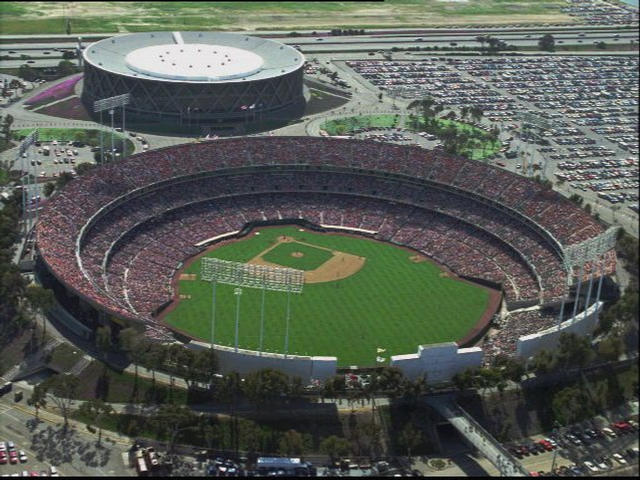
The Coliseum complex, prior to the construction
of the "Mount Davis" bleachers in the mid-1990s.

Oakland, every bit as much as the bigger, more glamorous city across the Bay, had become a place to be, including for sports. It would become more so in the 1970s, as, between them, the A's, the Raiders and the Warriors won 5 World Championships in a little more than 4 years, between October 1972 and January 1977.

By January 1981, the Seals were gone, the Clippers were forgotten, the A's had crashed and burned, but had gotten back up, and the Raiders had added another Super Bowl win. Although the Raiders left, the A's would have semi-glory days again: 1988 to 1992, and again 2000 to 2006.

No one yet knew that the Raiders would leave after the 1981 NFL season, or that they would come back but reach only 1 more Super Bowl as an Oakland team through February 2016; that the A's would win only 1 more World Series through October 2015; or the Warriors wouldn't win another NBA Championship until June 2015, and start building a new arena back on the San Francisco side of the Bay, hoping to open in October 2017; and that, as the 2010s dawned, both the A's and the Raiders would want out of the Coliseum.

The idea that Oakland would be a hip, happening place seems ridiculous now. It was not in 2003 (A's a Playoff team, Raiders in Super Bowl), or 1989 (A's World Champs, Warriors with "Run-TMC"), or 1975 (Oakland seemed to be the sports capital of the world). Or 1967, when the A's moved in.

Now for the Top 5:

5. Football. When Finley was preparing to move, the Kansas City Chiefs were defending American Football League Champions. Since their arrival from Dallas in 1963, they were filling Municipal Stadium, 47,000 strong, 7 times a year. Finley had a baseball capacity of 35,000, and didn't even fill that 7 times out of 81.

The Chiefs were the most popular sports team in Kansas City. Even in times of glory for the Royals -- the last couple of years, and in the George Brett era of 1976 to 1985, times when the Chiefs have not been particularly successful -- the Chiefs were more popular.

It wasn't (and isn't) just the Chiefs. The University of Missouri, the University of Kansas, the University of Nebraska, the University of Oklahoma... all are huge in their States. At Kansas, the basketball team is bigger than the football team, but the football team was then riding high on the recent success of Gale Sayers. Even on top of the world in 2016, the Royals have trouble competing for fans' attention and dollars with the Chiefs, Missouri football, Kansas basketball, Nebraska football, Oklahoma football and the Oklahoma City Thunder. But, mostly, with the Chiefs.

The Great Plains likes baseball, but it loves football. Theoretically, under a different owner, who cared more about winning than money, the A's could have ruled the East Bay, maybe even the entire Bay Area. They were never going to stand astride the Plains like a colossus.

4. Ballparks. Municipal Stadium, which had previously been home to the American Association's Kansas City Blues (a Yankee farm team) and the Negro Leagues' Kansas City Monarchs, was not really major league-worthy. The lower level was built in 1923, and the upper deck was added in 1955.

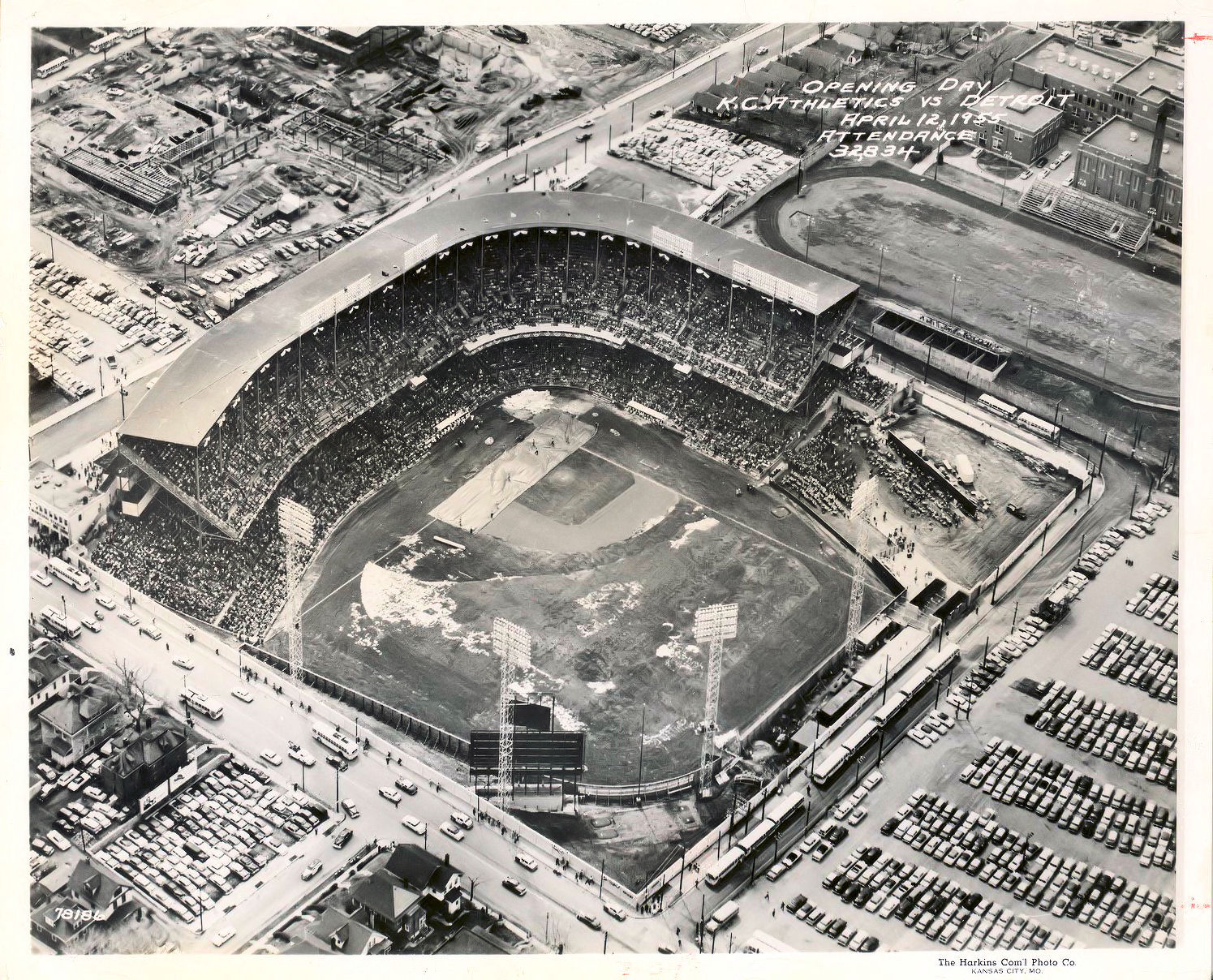
It seated only 35,020 for baseball, and even adding bleachers only brought its football capacity to a little over 47,000. It had support poles providing lots of obstructed views, technically reducing capacity even further. And with no room to add outfield seating, except maybe down the left-field line, it wasn't expandable. Parking was also an issue, which, as with the expandability issue, you can see in this photo.
The Oakland Coliseum, at the time Finley decided to move there, was new, exciting, had 50,000 seats for baseball, had lots of parking, and construction on public transportation access was underway. (However, the BART system, including the Coliseum stop, wouldn't open until 1972.)

3. The Kansas City Government. Finley had feuded with them over getting a new ballpark for so long, and in such a nasty way, that they weren't willing to deal with him anymore. You'll notice that, once Finley was gone, and MLB was willing to put a new team in Kansas City, they got moving on getting a new ballpark going.

In the Autumn of 1972, Arrowhead Stadium opened for the Chiefs. The following Spring, Royals Stadium opened, and the area was named the Harry S Truman Sports Complex, in memory of the native son former President who had just died. Royals Stadium was renamed Kauffman Stadium in 1993, in honor of the Royals' founding owner, Ewing Kauffman. In spite of both stadiums now being over 40 years old, recent renovations have ensured that neither will have to be replaced anytime soon.

But Royals/Kauffman Stadium was not going to happen for Finley. Which leads to...

2. The Alternatives. Finley threatened to move to several other cities. Would any of them have been a better option than Oakland? Or even a better option than Kansas City?

* Dallas-Fort Worth. Finley thought he had an agreement to move there for the 1962 season. It fell through. But where would they have played? Burnett Field, home of the Texas League's Dallas Eagles, seated less than 11,000 people. LaGrave Field, home of their arch-rivals, the Fort Worth Cats, was even smaller.

The plan was to play in the Cotton Bowl -- a 75,000-seat football stadium that would, like the Polo Grounds in New York and the Los Angeles Coliseum, not really have enough space for a baseball field fit into it. At least one fence, either left or right field, would have to be really short. Clearly, a new stadium would have to be built.

Turnpike Stadium was built in Arlington in 1965, with 10,000 seats. By 1972, it had 35,000 seats, and was ready to take on the new Washington Senators, who became the Texas Rangers. By 1978, it had 43,000 seats. But it never looked like anything more than what the Cotton Bowl would have been: A stopgap facility. When the stadium now known as Globe Life Park opened in 1994, they looked like a permanent team for the first time.

Had they moved to Dallas, they would have had a substandard stadium, and Finley probably would have wanted to move them soon again anyway.

* Louisville. Finley thought he had an agreement to move them and become the Kentucky Athletics in 1964, but the 9 other American League owners all said no

It's just as well: Not only was Louisville a smaller market than any in MLB (and it still is), but they would have had to play in Fairgrounds Stadium, which seated just under 20,000 for baseball, and was eventually expanded to just 36,000 (under its current name of Cardinal Stadium, as former home of University of Louisville football and local Triple-A baseball). Finley would almost have had to move again, whether he liked it or not.

* Atlanta. As we've seen, it's a lousy market for baseball, even when the Braves are winning.

* Seattle. Sick's Stadium seated only 11,000, and even when expanded for the Seattle Pilots in 1969, it only seated 25,420. The Kingdome, as atrocious as it was, had to be built, but do you really think Finley would have waited until 1976? It wasn't until the Playoff season of 1995, and the voters approving the bond issue that made Safeco Field possible, that Seattle was saved as an MLB market.

In 1975, Finley proposed an idea: He would swap franchises with the owners of the Chicago White Sox, who would move the A's to Seattle, and Finley would run the team in his own area. (He had a mansion in Indiana near the Illinois State Line.) The AL owners put the kibosh on that, too.

* San Diego. Another small market, with what's now known as Qualcomm Stadium not opening until 1967, and there's a reason first the Padres, and now the Chargers, have wanted out. It's unsuitable for baseball, and far from downtown. The Padres wouldn't ensure their long-term survival until the 1998 Pennant led to the voters approving the bond issue that made Petco Park possible.

* New Orleans. Finley was from Birmingham, Alabama, and he thought another Southern team after the Houston Astros (the Braves hadn't yet moved to Atlanta) could work. Indeed, in between attempts in 1978 and 1980 to move the A's from Oakland to Denver (the 1st very nearly happened), in 1979, he thought he had a deal to move the A's to New Orleans, a city he had also looked into while still in Kansas City.

The Superdome had a baseball layout (the post-Katrina renovation makes that impossible at present), but it wouldn't open until 1975. This is another case where he would have had to use a stopgap stadium, as Pelican Stadium seated just 9,500, and playing at a football facility like the massive, already-obsolete Tulane Stadium, would have been a bad idea.

* Milwaukee. After the Braves left, Milwaukee County Stadium was available, and seated 44,000 at the time. And it was only 90 miles from Chicago, making it fairly close to his home.

Even so, Milwaukee is also a small market, and the idea of Finley staying there long-term was not serious. The Pilots, so badly flailing financially after their inaugural season in 1969, were moved right before the 1970 season began (you could do that in those days), and became the Milwaukee Brewers.

So unless you count Milwaukee -- which, rather than having failed as a Major League Baseball market, was more sabotaged by Braves management in the early 1960s -- Finley didn't have a great option before Oakland opened up as a potential home in 1966.

Compared to those options (except maybe for Milwaukee), working out his differences with the government and fans of Kansas City could well have been a better choice for Finley than moving anywhere, including Oakland.

But instead of looking at Oakland and the Bay Area through the prism of now, look at it from the perspective of half a century ago:

1. The Bay Area. In 1967, it was hip, it was happening, it was groovy, it was far out. It was now, baby.

It wasn't just sports. It was Haight-Ashbury. It was Berkeley. It was psychedelia. It was the Free Speech Movement. It was antiwar activists blocking the doors to the Oakland induction center and burning draft cards outside. It was the Hell's Angels. It was the Black Panthers. It was Rolling Stone magazine and The Berkeley Barb. It was The People stickin' it to The Man, man.

Sometimes, that hipness took a grotesque form (the People's Park protest in Berkeley and the Altamont killings, both in the East Bay in 1969), but it was there, man.

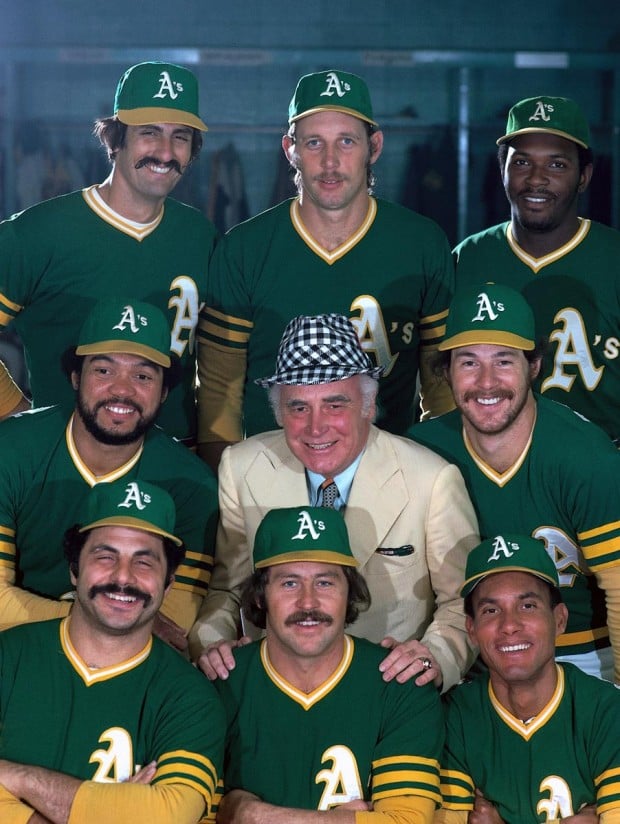
And the A's, with their bright green & gold uniforms, and an owner who was equally as loud and flamboyant, fit right in. And this was before they started with the Afros and the mustaches in 1972.
Top: Rollie Fingers, Joe Rudi, Vida Blue.
Middle: Reggie Jackson, Charlie Finley, Gene Tenace.
Bottom: Sal Bando, Jim "Catfish" Hunter, Bert Campaneris.
Finley must've gotten that hat from his Alabama pal,
Coach Paul W. "Bear" Bryant.

Contrast that with Kansas City. You can't get much more Middle America, and not just in a geographic sense. The geographic center of the continental U.S. is in Lebanon, Kansas, about 260 miles northwest of Kansas City. The population center of the U.S. is near Plato, Missouri, about 210 miles southeast.

K.C. was not in 1960, and is not in 2016, a Charles Oscar Finley type of place. Whatever virtues K.C. has, it has not been hip since Count Basie and the other jazz acts of the 1930s. In 1967, the Summer of Love, Middle America looked like the past. At the time, California -- the Bay Area, L.A, even San Diego -- looked like the future.

VERDICT: Not Guilty.

The Bay Area looks like the future now. The successes of the Giants and the Warriors. Those teams, the San Jose Sharks and Major League Soccer's San Jose Earthquakes all have (or, as with the Dubs, soon will have) new buildings. The 2 big colleges, Cal and Stanford, recently rebuilt their football stadiums. And the huge amounts of money in San Francisco, Marin County, Silicon Valley and the hill communities of the East Bay will keep those franchises in the pink.

Oakland? The Warriors aren't going far, but they are going. The Raiders would like to go, again. The A's, under current management, would prefer to stay, in a new ballpark. Will they get it? They're not currently close to getting it. But then, most cities that have been considered as new ones for the A's don't have major league-ready stadiums. (Montreal is an exception, and, even then, the Olympic Stadium would be only a stopgap facility.)

It looks likely that the A's will host their 2018 season finale in the Oakland Coliseum, whatever corporate name it will have at the time. Beyond that? It's hard to say.

But if Oakland baseball can survive Finley's mismanagement of his 1970s champions, maybe, just maybe, "Green Collar Baseball" can ensure its continued existence well into the 21st Century.