Showing posts with label kansas city athletics. Show all posts

Sunday, June 7, 2026

June 7, 1966: The Mets Draft Steve Chilcott -- Instead of Reggie Jackson

June 7, 1966, 60 years ago: Major League Baseball holds its 2nd annual Amateur Draft. The top pick goes to the team that had the worst record the season before: The New York Mets.

They chose Steve Chilcott, a 17-year-old catcher from Antelope Valley High School in the Los Angeles suburb of Lancaster, California.

What happened to Steve Chilcott? A baserunning blunder wrecked his throwing shoulder. He never reached the major leagues, and he played his last professional game in 1972, only 24 years old. He moved to Santa Barbara, and became a firefighter and a contractor. In a 2005 interview, he said, "I've had a good life, although, at first, it was hard for me to find things to do, because I had such a desire to be a professional athlete. I had to find my place in the world."

With the 2nd pick, the Kansas City Athletics chose Reggie Jackson, an outfielder from Arizona State University.
There were other good picks in that draft. The Houston Astros chose pitcher Wayne Twitchell. The Boston Red Sox chose pitcher Ken Brett. The Washington Senators chose outfielder Tom Grieve. The Cleveland Indians chose pitcher John Curtis. The Cincinnati Reds chose pitcher Gary Nolan. The Pittsburgh Pirates chose shortstop (later 3rd baseman) Richie Hebner. The Chicago White Sox chose outfielder Carlos May.

That was just in the 1st Round. In the 2nd Round, the White Sox chose catcher Johnny Oates. In the 3rd Round, the St. Louis Cardinals chose pitcher Clay Kirby, and the Minnesota Twins chose 3rd baseman Steve Garvey. (He didn't sign with them. Two years later, the Los Angeles Dodgers drafted him as a 1st baseman, and he signed with them.)

In the 5th Round, the Astros chose catcher Cliff Johnson, and the Pirates chose shortstop (later 2nd baseman) Dave Cash. In the 6th Round, the Pirates chose 2nd baseman Gene Clines. In the 8th Round, the Dodgers chose pitcher Charlie Hough. In the 9th Round, the California Angels chose pitcher Ken Forsch, and the Dodgers chose outfielder (later shortstop) Bill Russell.

With perhaps the most interesting pick in the draft, in the 10th Round, the New York Yankees chose a lefthanded pitcher from the University of Alabama: Ken Stabler. Instead of baseball, he chose football, and became a Hall of Fame quarterback with the Oakland Raiders. (John Elway, who later actually did play one season in the Yankee system, followed the same path.)

In the 15th Round, the Dodgers chose catcher (later 2nd baseman) Ted Sizemore. In the 19th Round, the Dodgers chose 3rd baseman Ron Cey. In the 20th Round, the Angels chose pitcher Dave LaRoche. In the 31st Round, the Chicago Cubs chose pitcher Bill Stoneman, and the Angels chose pitcher Bill Bonham. And in the 32nd Round, the Mets chose 2nd baseman Kurt Bevacqua.

So while Reggie turned out to be the best player in that Draft, he was far from the only good player who the Mets overlooked. But why did they overlook him? Arizona State head coach Bobby Winkles, who later managed the A's after Reggie left them, told him that the Mets were concerned that he was a black man with a white girlfriend. This was in 1966, a year before the U.S. Supreme Court ruled that all laws against interracial marriage were unconstitutional.

In fact, Reggie's girlfriend, Jennie Campos, was a Mexican-American, who faced prejudice as well. Reggie and Jennie married, but it didn't last, as Reggie's wandering eye was as active as his batting eye. But he has managed to keep his private life mostly private. There have been no public stories about him mistreating women.

We can say that, as usual, the dumb Mets were so dumb in not taking Reggie. But the catcher they ended up with was Jerry Grote. How do we know a healthy Chilcott would have done better than Grote? We don't. So this is more about who they didn't take than about who they did.

With Reggie, the A's moved to Oakland in 1968, won 5 straight American League Western Division titles from 1971 to 1975, and won 3 straight World Series from 1972 to 1974. He signed with the Yankees for the 1977 season, and led them to back-to-back World Series wins, also winning an AL Eastern Division title in 1980 and an AL Pennant in 1981. After his relationship with team owner George Steinbrenner went from great to terrible, he signed with the Angels, and helped them to AL West titles in 1982 and 1986.

He retired with 563 career home runs, reached the postseason 11 times in 21 seasons, won 6 Pennants and 5 World Series, including the Series Most Valuable Player award twice, and was a 1st-year-of-eligibility electee to the Baseball Hall of Fame.

Having Reggie wouldn't have helped the Mets much. Maybe it would have been better for Cub fans in 1969, since they probably wouldn't have had a big lead to blow, so it's less painful for them. And it would have reversed the result of the 1973 World Series, when Reggie homered in Game 7, and the A's beat the Mets.

But just as the A's players took their earliest possible chances to bolt from team owner Charlie Finley, his cheapness, and his micromanaging, the opposite happened with the similarly cheap president of the Mets, M. Donald Grant: He got rid of his good players before they demanded "too much." Can you imagine George Steinbrenner seeing Reggie Jackson playing the 1976 season for a National League team, and then going after a Mets legend, and making him a bigger star with the Yankees? So, having Reggie on their team might have ended up actually being more painful for Met fans. 

Thursday, September 25, 2025

September 25, 1965: Satchel Paige, MLB's Oldest Player

September 25, 1965, 60 years ago: The Boston Red Sox beat the Kansas City Athletics, 5-2 at Kansas City Municipal Stadium. Lee Thomas and Tony Conigliaro hit home runs for the Red Sox, while Carl Yastrzemski went 2-for-4.

Satchel Paige started the game for the A's. He went 3 innings, allowed no runs, 1 hit, no walks, striking out 1. It was the K.C. bullpen -- Diego Seguí, Don Mossi and John Wyatt -- who lost the game.

So why take Satch out so early? Well, he was 59 years old. He was the oldest player ever to appear in a Major League Baseball game.

His birth name, Leroy Robert Paige, was known. Less known was how he got his nickname: Either his feet were as big as suitcases, or "satchels," and "Satchelfoot" became "Satchel," or "Satch" for short; or his constant traveling, as the loose structure of the Negro Leagues meant that he was always in demand, led to him always carrying a satchel.

Not known for sure, for a long time, was his birthdate. His contemporary, Dizzy Dean, would tell differing stories about his date of birth, place of birth, and real name, most of them lies. But as to his date of birth, Paige simply kept them guessing. He would say things like, "How old would you be if you didn't know how old you was?" And, "A goat ate the Bible that had my birth certificate. That goat lived to be 29 years old."

When Paige was finally brought to the major leagues in 1948, by Bill Veeck, owner of the Cleveland Indians, Veeck decided to find out for himself. He had heard Paige say he was born in Mobile, Alabama, a city which would later produce 2 other Hall-of-Famers, Hank Aaron and Willie McCovey. So Veeck went to Mobile, accepted the possibility that there might not be a birth record for a black child born in the early part of the 20th Century, and found one anyway: With the permission and accompaniment of members of the Paige family, he went to the Mobile County Board of Health, and found that Satch was born on July 7, 1906. That made him 42, the oldest rookie in major league history.

That didn't stop the speculation. One of his former Negro League teammates, Ted Radcliffe, known as "Double Duty" because he could catch and pitch, said he grew up with Paige in Mobile, and Paige was exactly 2 years older. Since Radcliffe's birthdate was established as July 7, 1902, that meant Paige was born on July 7, 1900, making him 48 when he reached the major leagues. (Radcliffe lived to be 103, stuck by his story to the end, and should be in the Hall of Fame.)

A few years after his debut, someone interviewed Paige's mother, and she said he was born in 1904, and she should know, right? Paige said, "She was in her nineties when she told the reporter that, and sometimes she tended to forget things." 

So people still wondered. Veeck said he'd seen the birth certificate, but he said a lot of things over the years, some of which were proven to be untrue.

Similarly, Archie Moore, Light Heavyweight Champion of the World from 1952 to 1962, was the subject of questions about his age. He said he was born on December 16, 1916, but his mother said it was 1913. Sonny Liston, Heavyweight Champion from 1962 to 1964, also faced questions about his age: He was officially 32 when Muhammad Ali dethroned him, but, as part of his poetic trash-talking, Ali, then still using his birth name, said, "You're 40 years old, if a day, and you don't belong in the ring with Cassius Clay!" Hispanic players, due to poor record-keeping, have also faced questions about their ages, including the Cuban pitchers Luis Tiant and Orlando "El Duque" Hernández.

Paige got around in the Negro Leagues and the Caribbean leagues. He debuted with the Chattanooga Black Lookouts in 1926, presumably as a teenager for a few weeks. Among his tenures: He played 4 seasons with the Birmingham Black Barons, 4 with the Pittsburgh Crawfords, and 8 with the Kansas City Monarchs. Negro League records are incomplete, but he is known for sure to have at least 118 wins against 80 losses. How many games he won in all those "barnstorming" appearances, God only knows.

As a "rookie" in 1948, Paige helped the Indians win the World Series. He pitched for them in 1949 as well. He returned to the Negro Leagues in 1950, because Veeck sold the Indians, and the new owner didn't want him. Veeck bought the St. Louis Browns in 1951, and brought Paige in. In 1953, with the Browns, at age 47, Paige became the oldest player to appear in the All-Star Game. But Veeck sold the Browns after that season, and they became the Baltimore Orioles. Paige did not go with them, and went back to barnstorming.

In 1955, Veeck bought the Miami Marlins of the Class AAA International League, whose name would later be taken by a major league team. He signed Paige, who stayed through the 1958 season, at 52. He kept barnstorming -- apparently, he needed the money -- until 1961, when he signed with the Portland Beavers of the Class AAA Pacific Coast League.

In 1965, desperate for attendance, Kansas City Athletics owner Charlie Finley, remembering that Paige had played longer in Kansas City than anywhere else, signed him to play one last major league game. Finley invited several Negro League veterans to be introduced before the game. If Finley wanted a big crowd, it didn't work: Only 9,289 fans came out.

Ironically, this last appearance may have delayed Satch's entrance into the Baseball Hall of Fame. At the Hall's 1966 induction ceremony, Ted Williams told the crowd that Paige, catcher Josh Gibson, and other Negro League stars should be eligible for the Hall. The Hall's rules state that a player must be retired for 5 full seasons. Paige was the 1st Negro Leaguer elected, in 1971 -- 5 full seasons after his last appearance. (Gibson had died in 1947, of a brain tumor while still an active player, 3 months before Jackie Robinson made his debut. He was elected in 1972.)

In 1968, Paige reached out to all 20 teams then in MLB, to try and join one of them on the active roster, in order to reach the 158 days he still needed to qualify for the five-year minimum for the Players' Association pension. On August 12, Atlanta Braves owner Bill Bartholomay signed him as an adviser and an assistant trainer, and Paige qualified. With his struggle in mind, the following season, MLB and the Players' Association reduced the requirement from 5 to 4 years, and "grandfathered in" all players who had played up to 1959.

Paige died on June 8, 1982, a month before his presumed 76th birthday, of a heart attack at his home in Kansas City. He was married 3 times, and had 7 children, all with his 3rd wife. In 1999, The Sporting News ranked him 19th on their list of the 100 Greatest Baseball Players. In 2022, ESPN ranked him 41st on their updated 100. In each case, he was the highest-ranking  among Negro League players. Statues of him stand in Cooperstown, New York, a block from the Hall of Fame; and in the Negro Leagues Baseball Museum in Kansas City.

Satch broke the record of Charley O'Leary, who was just short of turning 59 on September 30, 1934. He appeared as a pinch-hitter, singled and scored, making him the oldest player to get a hit and the oldest player to score a run. He was not then placed in the field. He had last played in the majors in 1913, his 21-year gap between appearances still an MLB record. But he had been a player-manager in the minors for a while, and had coached for the St. Louis Browns that season, activated for the season finale.

For a while, it was thought that Minnie Miñoso, brought out of retirement at 53 for the 1976 Chicago White Sox, as a publicity stunt by, you guessed it, team owner Bill Veeck, was the oldest player to get a hit. But later research found that O'Leary was older than previously thought. Miñoso made 1 more appearance, at 56 in 1980, making him a 5-decade player, but did not get a hit.

Jack Quinn, a pitcher, was the oldest player to appear regularly, last doing so at 50 with the 1933 Cincinnati Reds. He finished with a career record of 247-218. Julio Franco was the oldest position player to appear regularly, last doing so with the 2007 Atlanta Braves, at 49. In 2006, at 48, with the New York Mets, Franco became the oldest player to hit a home run.

In 2012, at 48, Jamie Moyer became the oldest pitcher to win a game, with the Colorado Rockies. Since the National League still didn't have the designated hitter, Moyer had to bat for himself, and also became the oldest player with an RBI.

The oldest players to appear at each position:

Pitcher: 59, Satchel Paige, 1965 Kansas City Athletics
Catcher: 54, Jim "Orator" O'Rourke, 1904 New York Giants
Third Base: 49, Jimmy Austin, 1929 St. Louis Browns
First Base: 48, Hughie Jennings, 1918 Detroit Tigers
Second Base: 48, Johnny Evers, 1929 Boston Braves
Right Field: 46, Sam Thompson, 1906 Detroit Tigers
Shortstop: 44, Omar Vizquel, 2012 Toronto Blue Jays
Left Field: 44, Ichiro Suzuki, 2018 Seattle Mariners
Center Field: 43, Ichiro Suzuki, 2017 Miami Marlins

Monday, September 8, 2025

September 8, 1965: The 1st Man to Play All 9 Positions In an MLB Game

Bert Campaneris, after the A's moved to Oakland

September 8, 1965, 60 years ago: Against the California Angels at Kansas City Municipal Stadium, Dagoberto "Bert" Campaneris of the Kansas City Athletics becomes the first player to play all 9 positions in the same game, as part of a special promotion featuring the popular 23-year-old Cuban, whose main position is shortstop.

He began the game at shortstop and played, in order for the next 8 innings: 2nd base, 3rd base, left field, center field, right field, 1st base, pitcher (giving up a run on a hit and 2 walks) and catcher. With the game tied at 3-3 after 9 innings, manager Haywood Sullivan (later better known as the general manager of the Boston Red Sox) sent Rene Lachemann in to replace Campaneris, who was injured in a collision at the plate with Ed Kirkpatrick to end the top of the 9th.

The Angels scored 2 runs in the 13th inning, and defeated the A's 5-3. Attendance: 21,576, meaning there were about 13,000 empty seats, so the promotion didn't exactly work.

There appears to be no surviving footage of this game, but Campaneris survived the last 3 seasons in Kansas City, and the 1967-68 move to Oakland, to help the A's become a dynasty in the 1970s. He only batted .259 lifetime, but had 2,249 hits stole 649 bases, led the American League in stolen bases 6 times, made 6 All-Star Games, and reached the postseason 6 times: 5 straight AL Western Division titles with the A's, including 3 straight World Series in 1972, '73 and '74; and the 1979 AL West title with the California Angels. As of September 8, 2025, he is still alive.

Through the 2024 season, there have been 5 players to play all 9 positions in a major league game. No player has also managed to be a designated hitter in the same game, to make it 10.

Saturday, April 12, 2025

April 12, 1955: The Salk Polio Vaccine & the Kansas City Athletics

April 12, 1955, 70 years ago: Dr. Jonas Salk announces that the vaccine he had been testing against polio is effective and safe.

The announcement was made at the University of Pittsburgh Medical Center, on the 10th Anniversary of the death of Franklin Delano Roosevelt, who had been stricken with polio as a seemingly rising politician, recovered, and got himself elected President, and led the fight against polio, among the other fights he led. I can't prove that the announcement was made on that day for that reason, but it worked out poetically.

People have asked, "Could Franklin Roosevelt be elected President today? After all, he was in a wheelchair." The answer is, "Today, he wouldn't have been in a wheelchair, because, as a child born after 1955, he would have been vaccinated against polio."

As late as 1952, at which point Salk had begun testing his vaccine, polio outbreaks terrified people. Over 58,000 people were stricken with it, and 3,145 people died from it, with thousands of others paralyzed. My mother remembered growing up a block away from a public pool in Tompkins Square Park, on Manhattan's Lower East Side, and her mother wouldn't let her swim in it, because polio was often absorbed from water. Even jumping in puddles was forbidden by many mothers.

Salk pressed on, until he was sure his vaccine was effective and safe. He was told that if he patented it, it would make him $1 billion. He made it free to the world. "Could you patent the Sun?" he asked.

The vaccine got, for want of a better choice of words, a booster shot on October 28, 1956. Elvis Presley, the biggest music star in America, is photographed getting the polio vaccine. That led millions of teenagers to get it.

*

On the same day, the Kansas City Athletics beat the Detroit Tigers, 6-2 at Kansas City Municipal Stadium. It was the 1st home game for the A's after moving from Philadelphia. Their new hometown was back in the major leagues after 40 years.
Former President Harry S Truman, from nearby Independence, Missouri, threw out the ceremonial first ball. For the Tigers, Al Kaline went 2-for-4, and Red Wilson hit the ballpark's 1st major league home run. For the A's, Bill Wilson hit a home run, and Alex Kellner was the winning pitcher.

Previously, Kansas City had these major league teams in baseball: The Kansas City Cowboys of the Union Association, a league which only played the 1884 season; the Kansas City Cowboys of the National League, a team which only played the 1886 season, with none of these teams have any official connection with the other; the Kansas City Cowboys of the American Association, a team which only played the 1888 and 1889 seasons; and the Kansas City Packers of the Federal League, a league which only played the 1914 and 1915 seasons. And, in football, the Kansas City Blues entered the NFL in 1924, became the Kansas City Cowboys in 1925, and folded after the 1926 season.

The Kansas City Blues won 10 American Association Pennants: 1888, 1890, 1898, 1901, 1918, 1923, 1929, 1938, 1952 and 1953. The Kansas City Monarchs won 11 Negro League Pennants: 1923, 12 1924, 1925, 1929, 1937, 1939, 1940, 1941, 1942, 1946 and 1953.

Both teams played at Muehlebach Field, built in 1923 by, and named for, George E. Muehlebach, who owned the Blues and a number of other Kansas City businesses, including Muehlebach Beer and the Muehlebach Hotel. The previous Kansas City ballpark, Association Park, was owned by a railroad, which decided to build a new line through it, creating the need for a new ballpark.

In 1937, the New York Yankees bought the Blues, made them their top farm team, and renamed the ballpark Ruppert Stadium, in honor of team owner Jacob Ruppert. Ruppert died in 1939, and the ballpark was renamed Blues Stadium in 1943.

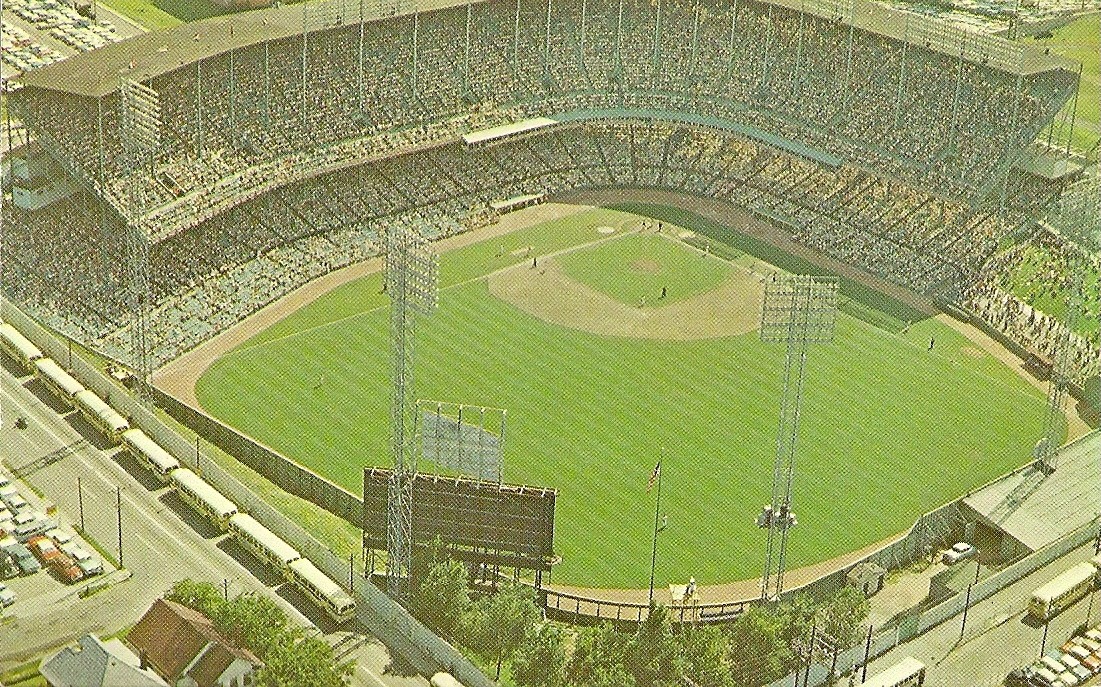
Knowing that the Philadelphia Athletics had been purchased by Arnold Johnson, and were being moved to Kansas City for the 1955 season, the city added an upper deck to Blues Stadium, and renamed it Kansas City Municipal Stadium. It now seated 35,020 people. When the American Football's League's Dallas Texans became the Kansas City Chiefs in 1963, the addition of football bleachers raised seating capacity to 51,000.

When Johnson died in 1960, the A's were bought by Charles O. Finley. He wanted a bigger ballpark, and when the city wouldn't build him one, he flirted with moving the A's to Dallas and Louisville, before finally moving to Oakland, California for the 1968 season. Kansas City then got an expansion team, and the Royals played there from 1969 to 1972.

Unusual for that era, instead of building one stadium for both baseball and football, Kansas City built a stadium for each. Arrowhead Stadium opened in 1972, Royals Stadium opened in 1973, and the complex was named the Harry S Truman Sports Complex. Missouri's favorite son had died the day after Christmas, 1972.

When the Royals' original owner, pharmaceutical magnate Ewing Kauffman, died in 1993, the stadium was renamed Kauffman Stadium for him. In 2024, the Royals released plans for a new stadium, tentatively set to open in 2028. The Chiefs renovated Arrowhead Stadium at the same time, and have no plans to replace it.

The Chiefs won the AFL Championship in 1966 and 1969, losing Super Bowl I but winning Super Bowl IV. The Royals won the World Series in 1985 and 2015, having lost it in 1980 and 2014. The Chiefs have since won Super Bowls LIV, LVII and LVIII; while losing Super Bowls LV and LIX.

In soccer, the Kansas City Spurs won the 1969 North American Soccer League title, playing home games at Municipal Stadium. But they only lasted 1 more season. The Kansas City Wizards won the 2000 MLS Cup. In 2010, they rebranded as Sporting Kansas City, and moved from Arrowhead to a new stadium in nearby Kansas City, Kansas. They won the MLS Cup again in 2013.

A women's team, FC Kansas City, only lasted from 2013 to 2017, but won the National Women's Soccer League title in 2014 and 2015. In 2021, they were replaced by the Kansas City Current.

The area has been less successful in the indoor sports. In 1972, the NBA's Cincinnati Royals moved in, but, since the baseball team was already called the Royals, they became the Kansas City Kings. In 1974, they moved from the Municipal Auditorium to the new Kemper Arena. That same year, the NHL placed an expansion team there, the Kansas City Scouts.

The Scouts were lousy, and moved after 2 seasons. The Kings won a Division title in 1979 and reached the Western Conference Finals in 1981, but never drew well, and moved to Sacramento in 1985. In 2018, the Kemper Arena was downsized and rebranded as the Hy-Vee Arena. In 2007, the Sprint Center opened downtown, but it has failed to attract and NBA, WNBA or NHL team.

No matter: Kansas City still has MLB and the NFL, the 2 sports that mark a city and its metropolitan area as "major league." And while the A's left, the Royals and the Chiefs aren't going anywhere.

But the A's moved to Oakland in 1968, and to Sacramento in 2025, with a plan to move to Las Vegas for 2028.

Saturday, July 28, 2018

Kansas City's 10 Greatest Teams

This weekend, the Yankees are hosting the Kansas City Royals

Kansas City's 10 Greatest Teams

Very Honorable Mention to the Kansas City Monarchs, Negro League Pennant winners in 1923, 1924, 1925, 1929, 1937, 1939, 1940, 1941, 1942, 1946, 1953 and 1957.

The Kansas City Athletics never had a winning season in their 13-year run in the city, 1955 to 1967. Nor did the Kansas City Scouts make the Stanley Cup Playoffs in their 2 seasons, 1974-75 and 1975-76.

10. 1926 Kansas City Cowboys. The KC's 1st NFL team won only 2 games in 1924, and only another 2 in 1925. But in 1926, they went 8-3. Had there been Playoffs at the time, they would have made it.

But pro football was saturating the market at the time. The NFL had 22 teams, while the 1st league to use the name "American Football League" had 9. That total of 31 teams would not be matched until 1999. That 1st AFL folded after just 1 season, and the NFL cut back to 12 teams for 1927, and the Cowboys were not among them. The only 1926 NFL teams that will also be 2018 NFL teams -- or were even 1933 NFL teams -- were the New York Giants, the Chicago Bears, the Chicago Cardinals (now in Arizona), and the Green Bay Packers.

9. 2013-17 Kansas City Chiefs. Rebounding from a 2-14 season, the Chiefs hired Andy Reid as head coach, and have finished 1st or 2nd in the AFC Western Division ever since, taking the Division in 2016 and 2017. But only in 2015 have they won a Playoff game, albeit that one on the road, against the Houston Texans, and they gave the New England Patriots all they could handle in Foxboro before losing. Their other 3 Playoff losses in this stretch have been by a grand total of 4 points.

8. 1978-81 Kansas City Kings. They made the NBA Playoffs 3 straight seasons, getting to the Western Conference Semifinals in 1979 and the Conference Finals in 1981. They missed the Playoffs in 1982 and 1983, made it in 1984, but fell apart in 1985, and were moved to Sacramento.

7. 1990-97 Kansas City Chiefs. Marty Schottenheimer's team made the Playoffs 8 straight seasons, winning the AFC Western Division in 1993, 1995 and 1997. But only in the 1993 season did they get to the AFC Championship Game, losing away to the 3-time defending Champion Buffalo Bills.

6. 1975-82 Kansas City Royals. In 8 seasons, they won an American League Pennant, 4 other AL Western Division titles (1 in the split-season format in strike-torn 1981), and had 2 other seasons where they won at least 90 games. By the time they won the 1985 World Series, most of this team was gone or getting old.

5. 2000-04 Kansas City Wizards. The team now known as Sporting Kansas City finished 1st overall in the 2000 MLS season, and went through the Playoffs, winning the MLS Cup. They reached the Eastern Conference Finals in 2003, and in 2004 reached both Cup Finals, losing the MLS Cup but winning the U.S. Open Cup.

4. 2012-present Sporting Kansas City. They opened the 2012 season with 7 straight wins, including an MLS record 335 minutes without allowing so much as a shot on goal. They finished 1st in the Eastern Conference, but lost in the 1st Round of the Playoffs. They did win the U.S. Open Cup.

In 2013, they went all the way, defeating Real Salt Lake on penalties to win the MLS Cup Final. They have made the Playoffs every year since, being switched to the Western Conference in 2015, and winning the 2017 U.S. Open Cup. They remain one of MLS' top teams.

3. 1984-90 Kansas City Royals. Finally won the World Series in 1985, had another Division title in 1984, finished only 2 games out of one in 1987, and won 92 games in 1989.

2. 2014-15 Kansas City Royals. Fell a run short in Game 7 in 2014 of having back-to-back World Series wins. That might not make them better than the 1976-80 or 1985 teams, but it makes them more accomplished.

1. 1966-71 Kansas City Chiefs. Their earlier achievement of the 1962 American Football League Championship cannot be included here, since they were the Dallas Texans at the time. But they won additional AFL titles in 1966 and 1969, losing Super Bowl I but winning Super Bowl IV, KC's 1st World Championship in any sport. They also made the Playoffs in 1968 and 1971, and missed in 1967 despite going 9-5.

Monday, April 10, 2017

Bob Cerv, 1925-2017

The number of living Yankees who won World Series at the original, pre-renovation Yankee Stadium is getting smaller and smaller.

Robert Henry Cerv was born on May 5, 1925, just 1 week before Yogi Berra, in Weston, Nebraska, 44 miles west of Omaha. He served in the U.S. Navy during World War II, and played baseball and basketball at the University of Nebraska -- a school much better known for its football program.

He was scouted by the Yankees, and he signed with them in 1950. He made his major league debut on August 1, 1951, wearing Number 7. As the Yankees tried to rally in the bottom of the 9th inning at The Stadium, manager Casey Stengel sent the power-hitting left fielder up to bat for Jerry Coleman, who was filling in at shortstop for Phil Rizzuto that day. It didn't work out, as Dizzy Trout struck Cerv out for the final out. The Yankees lost 9-8 to the Detroit Tigers, despite home runs by Berra and Gene Woodling.

Woodling was not about to give up his spot as the Yankees' starting left fielder. And that Number 7 was given to outfielder Cliff Mapes, and then to a rookie outfielder just called back up from the Kansas City Blues, who had been wearing 6 earlier in the season: Mickey Mantle.

Cerv was briefly back up in 1952, wearing 34; and 1953, wearing 41. He managed to stick around, in Number 41, through the 1956 season, and was on the World Series rosters in 1955 and '56, winning a World Series ring in 1956.

Legend has it that Stengel sat down next to him in the dugout one day, and said, "There's not many people that know this, but one of us has been traded to Kansas City." By that time, the Philadelphia Athletics had moved to Kansas City, taking the place of the former Yankee farm team. Except the story isn't true: The Yankees sold Cerv to the A's, and only got cash in return.

*

The next 4 seasons would be the only 4 full seasons of Cerv's career. In 1958, he suffered a broken jaw, sustained himself on  liquid diet, and still made the American League All-Star Team, beating out Ted Williams for the starting spot in left field. He batted .305, hit 38 home runs, and had 104 RBIs, despite Kansas City Municipal Stadium not being particularly friendly to hitters. He finished 4th in the voting for the AL Most Valuable Player award, behind Jackie Jensen of the Boston Red Sox, Yankee pitcher Bob Turley (who won the Cy Young Award) and Rocky Colavito of the Cleveland Indians. Mantle finished 5th, so Cerv was ahead of him.

Just before Spring Training began in 1960, Cerv was invited to appear on the syndicated TV program Home Run Derby. He showed up at Wrigley Field -- the former home of the Pacific Coast League's Los Angeles Angels, a farm team of the Chicago Cubs, thus the stadium had the same name and basic design as the Cubs' home -- wearing his A's uniform, Number 33, he was the challenger in the 17th of the series' 26 episodes, and beat Frank Robinson 8-7, before losing to Bob Allison in the next episode. He won $3,000, at a time when the minimum salary in baseball was only twice that. That $3,000 in 1960 would be worth about $25,000 in today's money.
Cerv with the host of Home Run Derby,
Cincinnati Reds broadcaster Mark Scott,
watching either Frank Robinson or Bob Allison bat

Early in the 1960 season, the Yankees reacquired Cerv, sending the A's 3rd baseman Andy Carey in exchange. He played in the World Series, which the Yankees lost to the Pittsburgh Pirates, and then was left unprotected in the expansion draft. The new major league version of the Angels, also playing that 1st season at L.A.'s Wrigley Field, too him, but in May 1961 they sold him back to the Yankees, where he was given Number 17.

Billy Crystal's film 61*, in which Cerv is played by Chris Bauer, got a lot of things right. One thing it got wrong was that it had Cerv with the Yankees at the start of the 1961 season. One thing it got right is that Cerv was rooming with Roger Maris in Forest Hills, Queens, and that Maris invited Mantle to stay with them.
Chris Bauer as Bob Cerv, with Barry Pepper as Roger Maris,
at Tiger Stadium in Detroit, which stood in
for the pre-renovation Yankee Stadium

Another thing it got wrong is that Cerv and Mantle watched Maris hit his 61st home run of the season -- not in the Yankee dugout, but together on a hospital room's TV. While they were both injured, they weren't in the same room. The injury cost Cerv a place on the World Series roster, but he did get another World Series ring (and, more importantly, another World Series share). By the time the movie was filmed in 2000, Cerv was the only 1 of the 3 still alive.

In June 1962, the Yankees sold Cerv to another expansion team, the Houston Colt .45's, who became the Astros in 1965. They released him in August, and that was the end of his playing career. He finished with a .276 batting average and 105 home runs -- the fewest of any of the players who appeared on Home Run Derby.

*

He became a college baseball coach, at Southeast Missouri State College, now Southeast Missouri State University, in Cape Girardeau. He later coached baseball and basketball at John F. Kennedy College in Wahoo, Nebraska, hometown of a Baseball Hall-of-Famer, early 20th Century Detroit Tiger right fielder Sam Crawford, a.k.a. "Wahoo Sam."
Bob Cerv died this past Thursday, April 6, 2017, in Blair, Nebraska. He was 91 years old.

With his death, there are now 3 surviving members of the Yankees' 1956 World Championship team: Whitey Ford, Don Larsen and Charlie Silvera. And there are 10 living players from their 1961 World Championship team: Ford, Bobby Ricahrdson, Tony Kubek, Hector Lopez, Ralph Terry, Rollie Sheldon, Bud Daley, Jim Coates, Billy Gardner and Jack Reed.

And of the 19 men who appeared on Home Run Derby, only 5 are still alive: Hank Aaron, Rocky Colavito, Al Kaline, Willie Mays and Frank Robinson. The others were Bob Allison, Ernie Banks, Ken Boyer, Bob Cerv, Gil Hodges, Jackie Jensen, Harmon Killebrew, Jim Lemon, Mickey Mantle, Eddie Mathews, Wally Post, Duke Snider, Dick Stuart and Gus Triandos.

UPDATE: Bob Cerv was buried at Saint John Nepomucene Cemetery in Weston, Nebraska.

Monday, February 8, 2016

Top 5 Reasons You Can't Blame the Philadelphia Athletics for Moving to Kansas City

February 8, 1956, 60 years ago: Connie Mack dies in Philadelphia, of "old age and complications from hip surgery." He was 93 years old.

A former major league catcher, occasionally good but never great, he managed the Philadelphia Athletics from their founding in 1901 until 1950 -- 50 seasons. He won American League Pennants in 1902, 1905, 1910, 1911, 1913, 1914, 1929, 1930 and 1931. He won the World Series in 1910, 1911, 1913, 1929 and 1930.

But increase in salaries caused by the arrival of the Federal League in 1914 caused him to break up his 1st dynasty, and the stock market Crash of 1929 wiped out his savings, causing him to break up his 2nd dynasty, as he had no more income outside of the team.

He was never able to rebuild the A's as he had in the 1920s. And, also being the owner, he was not going to be fired as manager, even as he entered his 80s, and began making inexplicable moves, including calling out names of pinch-hitters, players who hadn't been on the A's in years.

Finally, after the 1950 season, his sons ganged up on him. Earle and Roy Mack, his sons from his 1st marriage, did not get along with Connie Mack Jr., his son from his 2nd marriage. The one thing they agreed on was that Connie Sr., at age 87, had to go, as field manager, as general manager, and as owner in all but name.

Their financial management was no better than his, and in 1954, they sold the A's to Arnold Johnson, who ran a Chicago-based trucking business, and he moved them to Kansas City.  Mack was dead in a year and a half, a few months after that scourge of the elderly, a hip-breaking fall.

*

Mitchell Nathanson, author of The Fall of the 1977 Phillies, makes the case that, unlike with the St. Louis Browns and Cardinals, and the Boston Braves and Red Sox, in the case of Philadelphia, the wrong team moved and the wrong team stayed.
He's got a point. The AL's A's not only were more successful than the National League's Philadelphia Phillies -- from 1901 to 1949, winning 9 Pennants to the Phils' 1, in 1915 -- but were the landlords at Shibe Park, while the Phils, who'd the inadequate Baker Bowl a few blocks away, were the tenants. The Phils' stirring 1950 "Whiz Kids" Pennant changed the recent history, but not the overall history.

Here's what the teams did after the A's moved in 1954:

* The Phillies have made the Playoffs 12 times, won the NL Eastern Division 11 times, won 5 Pennants, and won the World Series in 1980 and 2008. Not a bad record, but this includes the near-misses for the postseason in 1964, 1982, 2004, 2005 and 2006; and the terrible postseason chokes of 1977 and 1978, plus losing World Series they had very good chances to win in 1983, 1993 and 2009.

* The A's did nothing in Kansas City, but since moving again, to Oakland, in 1968, they've made the Playoffs 18 times, won the AL Western Division 16 times, the Pennant 6 times (although not since 1990) and the World Series 4 times (1972, 1973, 1974 and  1989). Indeed, the A's won more World Series in 3 seasons (1972 to 1974) than the Phils have won in the competition's entire history (1903 to 2015).

* Just since the A's moved to Oakland, 1968 to 2015, they've won nearly as many Pennants, 6, as the Phils have in their entire history (1883 to 2015), 7.

So, in hindsight, Philadelphia and its fans might have been better off keeping the A's and losing the Phils.

And in the 25 years between the Crash of '29 and the A's move, not only the Phils' on-field fortunes as futzed-up as those of the A's, but so were their finances. Gerry Nugent had to get a loan from the other NL owners in 1943, just so he could send the team to spring training. He sold them to William D. Cox, who had plenty of money and was willing to spend it, but was caught betting on the Phils, and so was banned from baseball. A new owner stepped in.

So if the Phils were in that bad a shape, why did they stay, and not the A's? Did the 1950 Pennant really matter all that much?

Not really. It would be a "Best of the Rest" in a list of...

The Top 5 Reasons You Can't Blame the Philadelphia Athletics for Moving to Kansas City

5. Demographics. In the 1950 Census, Philadelphia was cited as having just under 2.1 million people. This was the most it would ever have. Indeed, the population was already going down. It would be a shade over 2 million in 1960, a little under that in 1970, under 1.7 million in 1980, under 1.6 million in 1990, and bottom out at just over 1.5 million in 2000. It's now believed to be about 1,553,000.
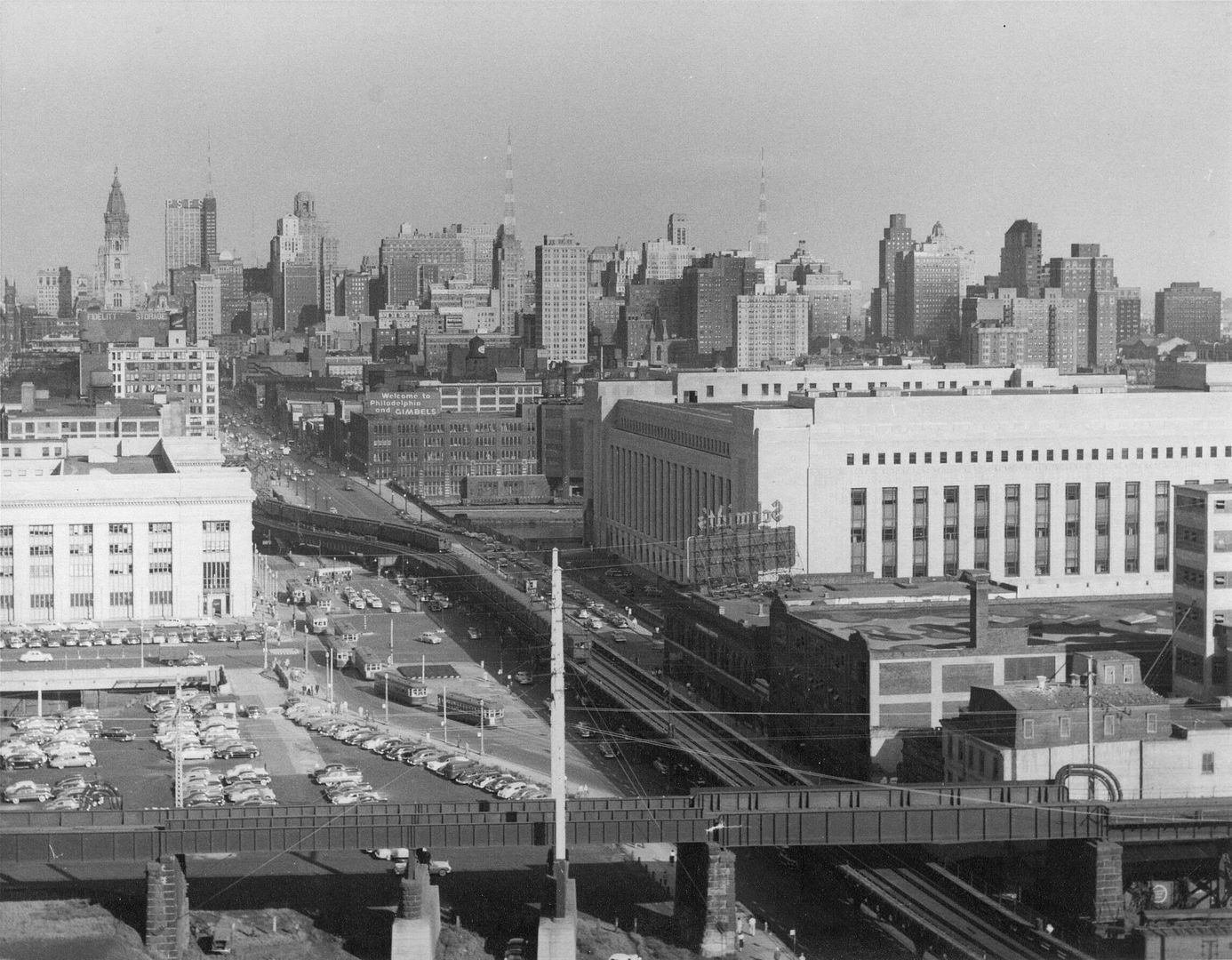
Philadelphia, 1950. Prior to the 1980s,
they really didn't have skyscrapers.
In the foreground, that's 30th Street Station on the left,
and the main post office on the right.

Meanwhile, the suburbs boomed, so that the Philly region, a.k.a. the Delaware Valley -- Eastern Pennsylvania, South Jersey and Northern Delaware -- has about 7.1 million people, making it the nation's 7th-largest market. This suburban boom will be revisited in Reason Number 3.
A more recent photo, taken from a similar angle.
As you can see, the city has grown up. Way up.

Ahead of Philly in metropolitan population are New York (23 million), Los Angeles (18 million), Chicago (almost 10 million) and San Francisco (8.6 million), all with 2 MLB teams, although San Fran may lose the Oakland Athletics in the next few years.

Also ahead of Philly are Boston (just over 8 million) and Dallas (7.2 million). And nobody is credibly suggesting that Boston, whose Red Sox are no longer selling out every game, or Dallas, a football-first city which barely supports the Texas Rangers as it is, should get a 2nd Major League Baseball team.

When the Phillies were winning 5 straight NL East titles from 2007 to 2011, and Citizens Bank Park was full 81 times a year -- even after the economic Crash of 2008, the worst since the Crash of 1929 that wiped Connie Mack out -- there was talk that Philly might get a 2nd team, either through expansion by the AL or a moved team, playing at CBP until they could get their own ballpark built. There was even talk that, after over half a century away, the A's might "come home." But the Phils' 2012 collapse, and their subsequent nosedive in attendance, put an end to that talk, before it could reach an even remotely serious stage.

Philadelphia could support 2 major league baseball (capitalized or otherwise) teams before World War II. But not afterward. As with Boston and St. Louis, 1 of the 2 teams was going to have to go.

4. The Deaths of the Shibe Brothers. When Ben Shibe, Connie Mack's co-owner and the man for whom their ballpark was named, died in 1922, his shares of the team went to his sons. Thomas F. Shibe became team president, and John F. Shibe became vice president.
Tom Shibe, left, with Ty Cobb,
who closed his career with the A's in 1927 and '28.

Tom and Jack Shibe were "sportsmen" in the old sense, also interested in hunting and speedboat racing, respectively. Tom essentially ran the ballpark, while Mack ran the team, filling the roles of manager and what we would now call "general manager."

Tom died in 1936. Jack replaced his brother Tom as president, and Connie installed his son Roy Mack as vice president. All seemed fairly stable. But Jack got sick shortly after becoming president, dying the next year. Connie, club treasurer from day one, installed himself as president, and bought out the brothers' widows, making himself the majority owner for the first time.

Why not promote one of the next generation of Shibes? Because neither Tom nor Jack had children, while Ben's daughters (Tom's and Jack's sisters), being women, were not seriously considered for team leadership roles, even though they had stock in the club.

One of Ben's sons-in-law, Ben MacFarland, was named traveling secretary. His brother, Frank MacFarland, was named assistant treasurer. But the MacFarlands were frozen out of management decisions regarding the team or the stadium, neither of which got proper maintenance. In essence, they had titles, but no power.

Connie set Roy, Earle and Connie Jr. up to run the team after him, frequently citing "The House of Mack." (Even that wasn't correct: His full name was Cornelius Alexander McGillicuddy. He only shortened his name to "Mack" as a young player so that it would fit in a box score without being abbreviated into something like "M'Cuddy.")
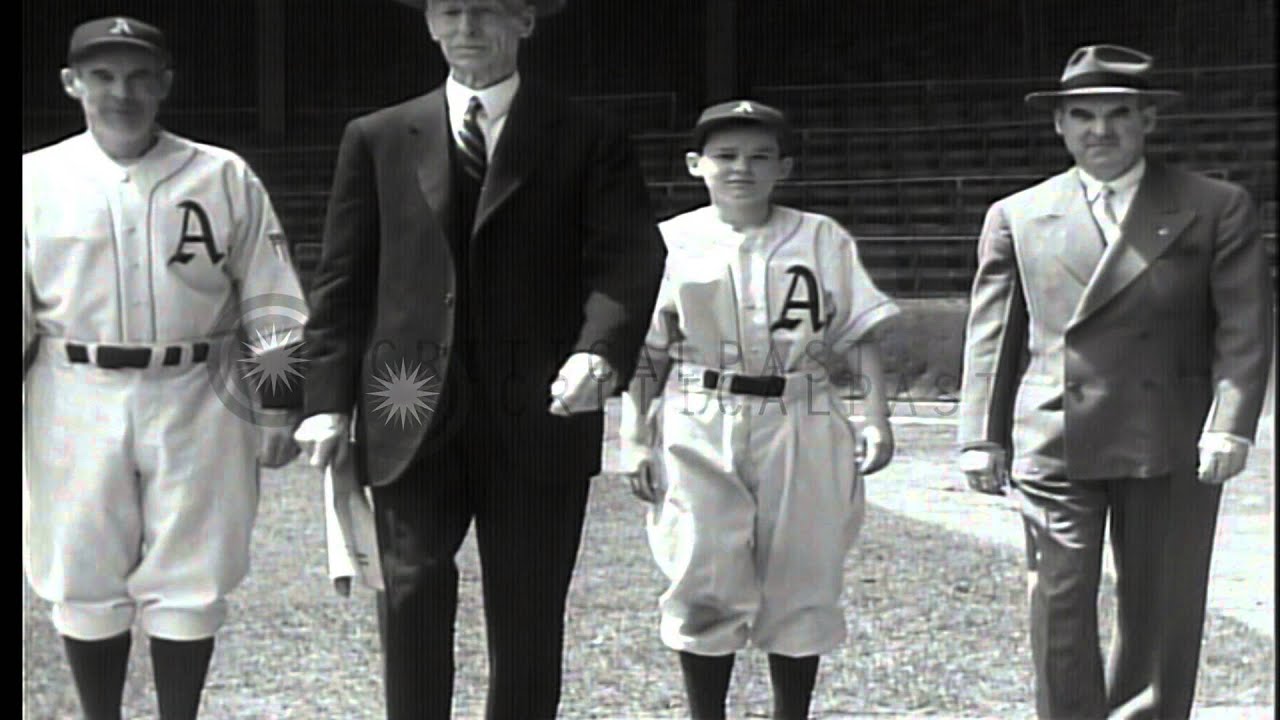
L to R: Earle Mack, Connie Mack, Connie Mack Jr., Roy Mack

In 1937, and again in 1939, at ages 74 and 76, Connie Sr. got sick, and Earle, who had played a little for the A's from 1910 to 1914, filled in as manager. If either of the Shibe brothers had still been around at the time -- Tom was 70 when he died, and Jack was 65, both of them thus younger than Connie Sr. -- they might have talked some sense into "The Grand Old Man of Baseball,"

(Roy Mack died in 1960, only outliving his father by 4 years. Earle lived on until 1967, and Connie Jr. until 1996. His son Connie III became a U.S. Senator from Florida, and Senator Mack's son Connie IV was elected to the House like his father, but has failed in his only Senate bid thus far.)

3. Ballparks. Part of the problem was Shibe Park itself. Opening on April 12, 1909, it was the 1st concrete and steel stadium in Major League Baseball. The Shibe brothers expanded it in 1925, and eventually seating capacity would reach... 33,608. This made it smaller than any ballpark in use in MLB today. When it finally closed on October 1, 1970, 3 months after the end for Crosley Field in Cincinnati and Forbes Field in Pittsburgh, only Fenway Park in Boston was similarly small.
And losing his money in the Crash of '29 and buying out the Shibe widows had tapped Connie Mack out. He tried adding more seats, but he couldn't afford the maintenance on Shibe Park. When his sons pushed him out, they took out a tremendous mortgage on the ballpark, and couldn't make the payments on it, so they couldn't keep the place up either.

Access was a big problem, too. Although North Philadelphia hadn't yet descended into urban blight, there was no major highway nearby. Public transportation? The trolleys had been cut back, so to get to Shibe Park, you either had to take the Broad Street Line subway to North Philadelphia, or the Pennsylvania Railroad to Germantown Junction (now SEPTA's North Philadelphia commuter rail station), or the Reading Railroad to North Broad Street Station; and then take a bus 7 blocks down Lehigh Avenue. Even if you weren't afraid of the neighborhood (and by the time the Phillies made their 1964 Pennant run, lots of people were), that was a hassle.

In contrast, the Kansas City Municipal Stadium, built in 1923, was being double-decked in the 1954-55 off-season, doubling its seating capacity to 35,020, and while its neighborhood soon deteriorated as well, it had better access roads and more parking.
When the A's were sold, the Macks sold Shibe Park to the Phillies, even though their owner Bob Carpenter said, "I need Shibe Park like I need a hole in the head."

He renamed it Connie Mack Stadium in honor of the Grand Old Man, and spent the rest of the 1950s and nearly all of the 1960s trying to get it replaced, finally convincing the city to build what became Veterans Stadium for the Phillies and the NFL's Eagles, who left Connie Mack Stadium for the University of Pennsylvania's Franklin Field in 1958, before groundsharing with the Phils again from 1970 to 2003, when each had a new stadium built adjacent to the Vet at the South Philadelphia sports complex.

2. Kansas City. It had been a very good baseball town, with the minor-league Blues (a Yankee farm team from 1936 to 1954) and the Negro Leagues' Monarchs each winning multiple Pennants. If the A's didn't move there for 1955, another major league team would have done so. If that hadn't happened by 1960, surely, they would have gotten an expansion franchise.
It worked, sort of: Although their attendance in Kansas City was never great, in each of the A's 1st 7 seasons there, they got more fans than in each of their last 5 seasons, and in 24 of their last 25 seasons, in Philadelphia. Even their worst seasonal attendance in K.C. was better than 4 of their last 5 years in Philly.

Once the A's moved to Oakland, and were replaced by the Royals, fans who had never warmed to Charlie Finley, who'd bought the A's after the death of Arnold Johnson in 1960, came out in better numbers than the A's franchise would ever see until the 1980s.

The Royals' recent success, including last year's World Series and the last 2 AL Pennants, shows that Kansas City was a sleeping giant as far as baseball markets was concerned. All they needed was to show that ownership cared. It took ownership a while to show it, but they have, and the fans are coming out.

But the A's might never have moved to Kansas City -- and the Phillies might have, or might have moved somewhere else -- if the right man hadn't stepped in to buy the Phillies.

1. The Carpenters. No, not the singing siblings of the 1970s. In November 1943, Robert Ruliph Morgan Carpenter bought the Phillies from the banned William D. Cox.

Known as Ruly, he could afford it: The Carpenters were one of the oldest and wealthiest families in Philadelphia and in neighboring Wilmington, Delaware. Ruly married into the family in Delaware, the du Ponts, giving him control of more money. He became an executive at E.I. du Pont de Nemours and Company (a.k.a. simply "DuPont," although the family has never capitalized the D in their names), and made even more money.

He was a strong supporter of the University of Delaware, including its athletic department. But he didn't really want to run the Phillies. So he left that to his son, Robert Ruliph Morgan Carpenter Jr. Known as Bob Carpenter, he totally reorganized the team, giving it a real front office, a real farm system, and a real scouting department, all for the first time. The result was the 1950 Pennant, featuring Hall-of-Famers Robin Roberts and Richie Ashburn, Most Valuable Player Jim Konstanty, and Dick Sisler, whose home run on the final day of the season clinched the flag.
Bob Carpenter

Eventually, Bob's moves stopped working, especially since he was so focused on getting the ballpark replaced. In 1972, that task done, he turned control of the team over to his son, Robert Ruliph Morgan Carpenter III, known as Ruly like his grandfather. Ruly, at 32 then the youngest controlling owner in MLB, made Paul Owens the general manager, and they built the Phillies team that dominated the NL East from 1976 to 1983, including the 1980 World Championship.
Ruly Carpenter, now 75, with his copy of the Commissioner's Trophy
for winning the 1980 World Series

The Carpenter family sold the Phillies soon thereafter, and is no longer involved with the team, but retains a small ownership, and still supports University of Delaware athletics. But once they bought the Phillies, and put to work money that the Mack and Shibe/MacFarland families simply didn't have, the A's, despite the huge advantages in ownership and history with the Phillies, were doomed as far as Philadelphia was concerned.

VERDICT: Not Guilty. As many mistakes as the Macks made, there were circumstances beyond their control that put an end to the Athletics' tenure in Philadelphia.

The A's had to go. And it worked out. For a while. Why did they leave Kansas City after only 13 seasons? That's a blog post for another time.

Saturday, November 28, 2015

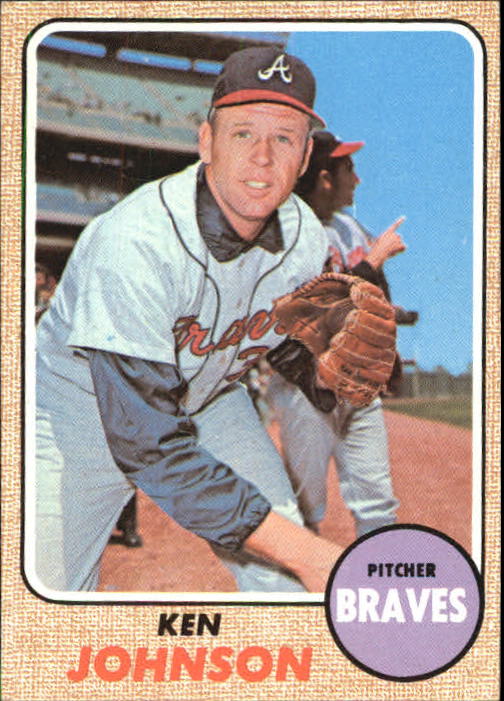
Ken Johnson, 1933-2015

According to Wikipedia, there are 13 men named Kenneth Johnson who are notable athletes. But one is an auto racer, and another is a professional wrestler, so it's really only 11 athletes.

I'm focusing on the most famous one, although what he's famous for is a little dubious.

Kenneth Travis Johnson was born on June 16, 1933 in West Palm Beach, Florida. A righthanded pitcher who stood 6-foot-4, weighed 230 pounds (making him huge for that era), and with an effective knuckleball, he was signed by the Philadelphia Athletics out of high school in 1952. But he was soon drafted into the U.S. Army to fight in the Korean War. When the war ended, he spent a year at the University of South Carolina, where he met Lynn Ergle, whom he married.

By the time he made his major league debut on September 13, 1958, they had moved to Kansas City. On that day, A's starter Jack Urban got rocked, so Johnson was brought out of the bullpen in the 1st inning. Wearing Number 27, he was no improvement, allowing 4 runs in 2 1/3rd innings, including a home run by light-hitting catcher (and ex-Yankee) Clint Courtney, and the A's lost to the Washington Senators, 8-5 at Kansas City Municipal Stadium.

The A's were going nowhere. (Actually, when Charlie Finley bought them in 1960, they were going a lot of places: Louisville, Dallas, Seattle. Finally, he settled on Oakland.) So, in 1961, they traded Johnson to the Cincinnati Reds, and, lo and behold, he was on a Pennant winner.

Wearing the Number 40 which he would wear for the majority of his remaining career, he went 6-2 with a 3.25 ERA for the Reds down the stretch, after going 0-4 with a 10.61 ERA for the A's to that point. He even got to pitch in the clinching game of the World Series. Okay, it was Game 5, and the Yankees won it 13-5, but, unlike his big-league debut, the defeat wasn't his fault: In the top of the 2nd, relieving Jim Maloney, who had already relieved Joey Jay, he got Elston Howard to line out to 3rd base, and got Moose Skowron to fly out to center.

And his reward for pitching 2/3rds of perfect baseball in the World Series, against one of the best teams ever, the '61 Yankees? He got pinch-hit for and relieved. He never threw another postseason pitch.

*

In a span of just 5 months from May to October 1961, Ken Johnson went from one of the worst teams in baseball (the Kansas City A's) to a minor-league team (the Toronto Maple Leafs, for whom the hockey team was named) to a Pennant winner (the Cincinnati Reds) to another bad team. He was taken in the expansion draft, by one of the National League's new teams, the Houston Colt .45's. Hey, it could have been worse: He could have been taken by the Mets.

He went 7-16 for the expansion Colts in '62, and 11-17 in '63. On April 23, 1964, he was 2-0, and took the mound against his former team, the Reds, at Colt Stadium, which the Colt .45's used as a stopgap facility until their permanent stadium, the Astrodome, could be built next-door. The next year, it opened, and the name of the team was changed to the Houston Astros.

The Colts/Astros weren't very good in 1964, mainly because they were very young. They had a couple of solid veterans in future Hall-of-Famer Nellie Fox and 2-time batting champion Pete Runnels. But most of their players who turned out to be good ended up doing so later, and some for other teams: Joe Morgan, Jimmy Wynn, Jim Beauchamp, and future Met All-Stars Rusty Staub and Jerry Grote.

In contrast, the Reds had a very good team in 1964. The had Frank Robinson, future Hall-of-Famer; Vada Pinson, a multiple All-Star; Pete Rose, who would have made the Hall if he hadn't ignored baseball's warnings about gambling; Deron Johnson, an All-Star; Leo Cardenas, an All-Star; and Joe Nuxhall, once the youngest player in the game's history, now "The Old Lefthander," wrapping up what turned out to be a nicer career (1952-1965) than anyone could have imagined when he got smacked in his debut, not yet 16 years old (1944).

Nuxhall was the opposing pitcher that day, and he and Johnson traded goose eggs for 8 innings. Johnson walked a batter in the 1st inning, and walked another in the 5th, but those were the only 2 baserunners he'd allowed.

Nuxhall was effectively his equal, if less spectacularly. He allowed a single to Fox in the 1st, but he was caught stealing. He then walked Runnels, but stranded him. He allowed a single to Bob Aspromonte in the 2nd, but induced a double play to erase him. He allowed a single to Runnels in the 4th, but got another double play. In the 7th, he allowed a single to Fox, and there was no double play this time, as Cardenas made an error, allowing Runnels to reach. The Colts had men on 1st and 2nd with nobody out. Now, Nuxy got a double play, and a flyout to end it. He allowed a leadoff double to Wynn in the 8th, but retired the next 3 batters to keep it 0-0.

His wife Lynn, and sons Kenneth Johnson Jr. and Russell "Rusty" Johnson were at the game. "I knew it was close," Lynn said. "Every inning he would get them out. I was getting pretty nervous. Our youngest son, Rusty, wanted to go to the bathroom, and I wouldn't let him leave."

Nuxhall himself led off the top of the 9th with a groundout to 3rd. But Johnson hurt his own cause by throwing away a grounder that Rose had hit to him. Rose got to 2nd base. Johnson got Chico Ruiz to ground back to him, and he threw to 3rd to get Rose, but he was safe. Aspromonte, the Colts' 3rd baseman, then threw Ruiz out at 1st. Pinson then hit a grounder to 2nd, which should have been the 3rd and final out, completing the (word you can't say while one is in progress, for fear of jinxing the pitcher). But, of all players to make an error at this time, it was Fox, the team's earliest (though not 1st) Hall-of-Famer. Rose scored, and it was 1-0 Reds.

Johnson got Robinson to fly to left to end the inning, but the damage was done. The Colts weren't done, though: With 2 out in the bottom of the 9th, Runnels reached on an error by 1st baseman Johnson. (A born DH before there was a DH, Johnson would soon be replaced by Tony Perez, and the rest is history.) The tying run was on 1st, the winning run was at the plate, and maybe Johnson could win the game anyway. But the batter was the Houston right fielder, John Weekly, a man who lived up to his name with a .133 batting average at the time. Nuxhall struck him out looking to end it.

The totals on the ballgame: For the Reds, 1 run on no hits and 2 errors; for the Colt .45's, no runs on 5 hits and 2 errors. WP: Nuxhall (1-1). No save. LP: Johnson (2-1). Attendance on this Thursday night: 5,426. The time of the game, a brisk 1 hour and 56 minutes.

Ken Johnson had pitched a no-hitter, for a full 9 innings. And lost the game. This had never happened before, and has never happened since.

Fox, through tears, apologized to Johnson after the game. Runnels told him, "How many no-hitters were thrown last year? Who threw them? They'll remember yours."

For the record, 3 no-hitters were thrown in 1963, 1 by Johnson's own roommate, Don Nottebart, the 1st no-hitter in the history of the Houston franchise. So Runnels should have remembered. You might have heard of the guys who threw the other 2: Sandy Koufax of the Los Angeles Dodgers, and Juan Marichal of the San Francisco Giants. Also throwing no-hitters in 1964 were Koufax, and Jim Bunning of the Philadelphia Phillies, who threw a perfect game against the Mets.

On July 1, 1990, Andy Hawkins of the Yankees pitched 7 no-hit innings against the Chicago Whit Sox at Comiskey Park. But the Yankees hadn't scored, either. In the 8th, he walked 3 batters, and his fielders made 3 errors. The Yankees lost the game 4-0, but, at first, Hawkins was credited with a no-hitter. After all, he had pitched a complete game without allowing a hit.

A year later, Major League Baseball made a ruling that a pitcher could only be credited with a no-hitter if he pitched all of a team's game, went at least 9 innings, and didn't allow a hit. In other words, if he pitched 9 no-hit innings, and was relieved in the 10th, no no-hitter. If he pitched 9 no-hit innings, and kept pitching, and his team eventually won, but if he allowed a hit in the 10th, the 11th, or whichever inning, he didn't get credit for the no-hitter -- not even if he kept going into the 19th inning, having effectively pitched 2 no-hitters in 1 day.

Even if he pitched 9 perfect innings, he wouldn't get credit for the no-hitter or the perfect game unless his team won, he was the only pitcher they used, and he stayed hitless (or perfect).

Not only did Hawkins lose credit for his no-hitter (he had pitched 8 innings), but Harvey Haddix, who pitched 12 perfect innings in a 1959 game but lost it all in the 13th, lost credit for his perfect game.

During the commercial break between the 8th and 9th innings of the Andy Hawkins Game, I switched from WPIX-Channel 11 to WWOR-Channel 9, to see if the Mets' announcers were talking about what was happening at Comiskey. They were, and Ralph Kiner mentioned that only 1 pitcher had ever pitched a complete-game no-hitter and lost: "I think it's Ken Johnson." Tim McCarver confirmed: "It is Ken." I'd never heard of Johnson at that point, but you can be sure that the name has stuck with me in the 25 years since the Andy Hawkins Game, which I still have on videotape somewhere.

I don't know if Ken Johnson and Andy Hawkins ever met. If they didn't, it's too late now.

*

Colts owner Roy Hofheinz, a federal Judge and a former Mayor of Houston, gave Johnson a $1,000-a-year raise, equivalent to $7,672 now. He was invited to come to New York to appear on the TV game show I've Got a Secret.

He went 11-16 in that 1964 season, and on May 23, 1965, the Astros traded him, along with Beauchamp, to the Milwaukee Braves for Lee Maye. He ended up having his best season, going 16-10 with a 3.42 ERA. He moved with them to Atlanta in 1966, and went 14-8 that year and 13-9 the next.
But he only won another 7 games in the major leagues. He had particularly bad luck in 1969. Still with the Braves, they sold him to the Yankees on June 10. He wore Number 54 for them, later made famous by Hall-of-Famer Goose Gossage. Not only did Johnson not get to pitch for the Braves in the 1st-ever NL Championship Series that October, but he missed being in attendance at Mickey Mantle Day by 2 days.

These were not Mickey's Yankees: These were the Yankees of Joe Pepitone, Bobby Murcer, Mel Stottlemyre, Fritz Peterson, a young Roy White, and 20 guys named Jerry Kenney. Then, on August 11, the Yankees gave up on Johnson, selling him to the Chicago Cubs, allowing him to be a part of their infamous September Swoon.

The Cubs released him just before the 1970 season began, but he was picked up mere hours later by the Montreal Expos. They released him 20 days and 3 games later, and his career was over: 91-106, ERA 3.46, ERA+ 102, WHIP 1.199. He was a good pitcher with bad luck, never more so than on that humid Thursday night in Houston, early in the '64 season.

*

After leaving baseball, he worked for Palm Beach Atlantic University in his hometown, and later coached at Louisiana College in Pineville, where he spent the rest of his days. After his coaching, he ran a nursing service for his local Baptist church.

Ken and Lynn had 3 children: Sons Kenneth and Rusty, and daughter Janet Johnson. He would live to see 6 grandchildren and 5 great-grandchildren.

Kenneth Johnson Jr. is a doctor, and this past Wednesday, confirmed that his father had died in Pineville the preceding Saturday, November 21, 2015, of a kidney infection. He had also battled Alzheimer's and Parkinson's diseases. He was 82 years old.

Unfortunately, I can't find a picture of him later than that Braves photo. Even more unfortunately, he was too ill to be honored by the Astros last year on the 50th Anniversary of his no-hitter. Nor could he be honored in Milwaukee this year on the 50th anniversary of the last Braves team in that city, or in Atlanta next year on the 50th anniversary of the first Braves team there. As far as I know, he was never invited back to any ballpark for any ceremony.

He deserved better than that. But at least his strange moment in baseball history is remembered. There have been 18,662 players to have played in at least 1 Major League Baseball game, and most of them end up being not particularly noteworthy.

"I pitched the best game of my life," Ken Johnson said at the time, "and still lost. A hell of a way to get into the record books."

Agreed. But he's in them. After all, if someone other than the man who had been the youngest player ever to appear in a big-league game (and later a beloved Reds broadcaster) had been the opposing starter, how well would we remember him?

But, in 2004, on the 40th Anniversary of his achievement, Johnson admitted to a local newspaper in Louisiana, "Instead of the notoriety, I’d rather have won the game."

Thursday, November 12, 2015

Norm Siebern, 1933-2015

The Yankees of the 1950s were already retired and legendary by the time I was old enough to start paying attention to baseball in the late 1970s. Now that my nieces are old enough, those Fifties Yankees are getting to be fewer and fewer in number.

Norm Siebern was not one of the more celebrated of those Fifties Yankees. But the few we have left should be celebrated.

Norman Leroy Siebern was born on July 26, 1933 in St. Louis. He was signed by the Yankees out of high school in 1951, went into their minor-league system, and attended Southwest Missouri State University, which is now named Missouri State University, in Springfield. He played basketball there (then as now, it was legal to be a professional in one sport and a college athlete in another), and among his classmates and teammates there was a future Yankee teammate, Jerry Lumpe.

He made his debut for the Yankees on June 15, 1956. Batting 2nd, playing left field, and wearing Number 36, he singled off Mike Garcia in his 1st at-bat, and immediately scored on a Mickey Mantle home run. He went 2-for-4, and the Yankees beat the Cleveland Indians, 6-2.

A lefthanded hitter whose stroke seemed to be designed for Yankee Stadium, he split the 1956 season between the Yankees and their top farm club of the time, the Denver Bears of the American Association. He had one at-bat in the 1956 World Series. He spent the entire 1957 season with the Bears, helping them win the Pennant with one of the best seasons any minor-league team has ever had. The Sporting News named him its Minor League Player of the Year.

That got him called back up to the Yankees in 1958, wearing Number 25, and was in the majors to stay, batting .300 with 14 home runs and 55 runs batted in. He played in 3 games of that year's World Series, and was awarded one of the 1st American League Gold Gloves that year.

He had a decent season in 1959, but the Yankees had an uncharacteristically weak season, finishing 3rd, just 79-75. Some changes had to be made, and this made Siebern, among others, expendable. On December 11, he was traded, along with Hank Bauer, Don Larsen and Marv Throneberry -- each of those 3 a legend, although in Throneberry's case it was for his later ineptitude with the Mets, but he was considered a great prospect in the late 1950s -- to the Kansas City Athletics for Roger Maris, Joe DeMaestri and Kent Hadley. If you know anything about Yankee history, you know that Maris was the key.

*

Siebern benefited from the move to Kansas City, as he wasn't going to crack the Yankees' starting lineup without an injury. He was an AL All-Star in 1962, '63 and '64. His best season was in 1962, when he batted .308, hit 25 homers, and had 117 RBIs, all career highs. In 1964, he was traded to the Baltimore Orioles, then managed by Bauer, one of the men with whom he was traded. He led the AL in walks, and the O's only finished 2 games behind the Yankees.

After the 1965 season, the O's traded him to the California Angels for Dick Simpson, and won the 1966 World Series without him. But in 1967, he was acquired by the Boston Red Sox, and while he was clearly at the end of the line, he did help them win their "Impossible Dream" Pennant, and appeared in 3 games of the World Series. He retired after the 1968 season, with career totals of a .272 batting average, 132 homers and 636 RBIs.

After retiring as a player, he appears never to have worked in baseball again. He was married with 3 daughters, owned an insurance agency in Naples, Florida, and died there on October 30, 2015 in Naples, Florida. He was 82.
This is the only photo I could find of him as a retired player.
Unfortunately, I couldn't find one showing him
wearing a uniform, a jersey, or even a cap.


With his death, there are now just 4 surviving players from the 1956 World Champion Yankees: Whitey Ford, Don Larsen, Charlie Silvera and Bob Cerv. And there are now just 7 surviving players from the 1958 World Champion Yankees: Ford, Larsen, Bobby Shantz, Bobby Richardson, Tony Kubek, Art Ditmar and Zach Monroe.

Wednesday, September 10, 2014

Roger Maris: An 80th Birthday Appreciation

September 10, 1934, 80 years ago: Roger Eugene Maras is born in Hibbing, Minnesota.

There was a split in the family that led to various spellings of the name. Roger's wing of the family became "Maris."

He wasn't the most famous person to come from Hibbing. That would be Robert Allen Zimmerman, who also changed his name, to Bob Dylan. But he became a baseball legend.

*

Roger, his older brother Rudy, and his parents moved from Hibbing to Fargo, North Dakota in 1946, and that's what he always considered his hometown. Rudy was supposed to be the great athlete in the family, but developed polio before the widespread distribution of the Salk and Sabin vaccines. Although he recovered most of his movement, his chances of athletic stardom were over.

Roger went to Bishop Shanley High School in Fargo, which had one of the best football programs in North Dakota, winning several State Championships, including while the Maris brothers were there. After them, from 1965 to 1970, they won 53 straight games, and had an unbeaten streak of 59 straight, at the time a national record. Their enrollment has seriously decreased, though, and as a result, they haven't won a State title since 1983. Roger is one of 2 Major League Baseball players produced by the school, joined in the 1990s by Texas Rangers pitcher Rick Helling.

Roger was actually recruited to play football at the University of Oklahoma by coach Bud Wilkinson. This was a tremendous honor, since Wilkinson was building what became the dominant college football program of the 1950s, eventually winning a record 47 straight games from 1953 to 1957. Wilkinson had previously contacted Oklahoma native Mickey Mantle about playing there was well, and would later try to lure Oklahoma native Bobby Murcer. He didn't get any of them, but he did just fine without them.

Since there was no Major League Baseball Amateur Draft at that point, MLB teams that didn't have the resources of the Yankees or the Dodgers usually went after local guys, or guys who were local to one of their farm teams. The Cleveland Indians had the Fargo-Moorhead Hawks, who represented Fargo and, across the Red River, Moorhead, Minnesota, in their farm system, and they signed Roger.

In 1956, he helped the Indianapolis Indians win the American Association Pennant. The '56 Indians also featured future Yankee pitcher Bud Daley, future All-Star Detroit Tigers pitcher Hank Aguirre, and future Yankee coach Joe Altobelli, who would manage the Baltimore Orioles to the 1983 World Championship. (The team is still called the Indians even though they're no longer a part of the Cleveland system.)

His Triple-A performance convinced the parent club that he was ready, and on April 16, 1957, Roger made his major league debut at Cleveland Municipal Stadium. Batting 5th, playing left field, and wearing Number 32, he had an exceptional debut, particularly when you consider that the opposing Chicago White Sox started Billy Pierce, not just a lefthander like Roger but an All-Star pitcher: He struck out in the 2nd inning, but in the 4th, he led off with a single and scored; he led off the 6th with another single, flew out in the 8th, and led off the 11th with another single, going 3-for-5. But the White Sox won in 11 innings.

Although he only batted .234 that 1st season, he hit 14 home runs and had 51 RBIs, not bad at all for a 23-year-old kid playing as, essentially, his team's 4th outfielder, and hitting in the vast confines of what was often called "Cavernous Cleveland Stadium." The next year, given Number 5, he still wasn't hitting for a high average, but the Kansas City Athletics wanted him, and they sent Vic Power and Woodie Held, 2 pretty good players, to the Indians for Roger and 2 guys you don't need to know about.

Kansas City's ballpark was also called Municipal Stadium, and was also kinder to pitchers than to hitters, but Roger blossomed there. Wearing Number 35 for the A's, he finished the '58 season with 28 homers and 80 RBIs. In 1959, given the Number 3 (in a retroactive irony, Babe Ruth's number with the Yankees), he was named to the All-Star team, and batted .273 with 16 homers and 72 RBIs.

*

That got the Yankees' attention. On December 11, 1959, in the last of the many lopsided trades between the Yankees and the A's under the regime of Arnold Johnson, the A's owner who was a good friend of Yankee co-owner Del Webb (to the point that the trades between the two of them were sometimes called "incestuous"), the Yankees sent All-Star right fielder Hank Bauer, former World Series hero pitcher Don Larsen, quality outfielder Norm Siebern and perhaps their top prospect, 1st baseman Marv Throneberry -- the same Marvelous Marv who would become a symbol of the early Mets' ineptitude, but he did contribute a little to the Yankees' 1958 title -- to the A's for Roger, reserve infielder Joe DeMaestri, and a nondescript 1st baseman named Kent Hadley.

(Johnson died before the 1960 season could begin, and insurance executive Charlie Finley bought the team, and slammed the door on any more deals with the Yankees. He also began the process of rebuilding the team, and the process of moving them, finally choosing Oakland after failing to convince Kansas City, Dallas, Louisville, Miami and Seattle to build him a new ballpark.)

This was a great trade. Bauer and Siebern were pretty much done. Except for helping the San Francisco Giants win the 1962 National League Pennant, so was Larsen. Throneberry had some power but the stories about his atrocious fielding and boneheaded baserunning with the Mets are only a slight exaggeration.

Hadley played 55 games for the Yankees in 1960 and never played in the majors again. DeMaestri was a spare part, probably best known as the guy who took over at shortstop in Game 7 of the 1960 World Series, after a bad-hop ground struck Tony Kubek in the throat. Essentially, the Yankees traded 3 good players who were done, and 1 who wasn't going to pan out, for Roger Maris.

Roger was an ideal new right fielder for the Yankees. He was 12 years younger than Bauer, but was a better fielder, and unlike the righthanded Bauer, who had the vast left and center field "Death Valley" to hit into at the pre-renovation original Yankee Stadium, Roger was lefthanded, and could aim at the "short porch" in right field: 296 feet to the pole, 344 to straightaway right. With 3 retired for Ruth, he was given Bauer's Number 9.

Roger's new teammates liked him, because he was a decent man who came to play every day. But, while he liked the Midwestern sensibilities of Kansas City -- he thought it reminded him of a larger, warmer version of Fargo -- New York was not his kind of town. So many people, so many reporters. He didn't like answering personal questions. It didn't help that his parents were divorcing when he arrived, and the family had other secrets as well. (The name changes weren't just about the children and grandchildren of Croatian immigrants trying to sound "more American.")

Typical of the way the New York media reacted to him was by asking the kind of question that the Cleveland and Kansas City media wouldn't have thought to ask: "Who's your favorite singer?" He thought it was a ridiculous question to ask of a ballplayer. It wasn't as if he was a young singer coming up, getting asked, "What singer do you most want to be like?" Who was his favorite singer? "I don't have one." The sportswriter asked, "How about if I just put down Frank Sinatra?" Roger said not to do that, because it wouldn't be true. (As if the truth ever stopped a sportswriter, especially in New York.)

Roger did not move his family east to New York, keeping them in the house they'd bought in suburban Kansas City. He had married Patricia, his high school sweetheart, and eventually had 6 children. He didn't want them growing up in the hustle and bustle of New York, although he missed Pat terribly.

In 1960, his 1st season with the Yankees, Roger batted a career-high .283, hit 39 homers, falling just short of the American League lead by Mickey Mantle, and led the AL with 112 RBIs and a .581 slugging percentage. He also won a Gold Glove, the only one he would win. (The Gold Gloves started in 1957, and Mantle also won only 1.) The Yankees won the Pennant, and Roger was named the AL Most Valuable Player.

So far, so good. And while the New York media didn't love him the way it loved quote machines Mantle, Yogi Berra and Whitey Ford, neither did they suggest he was unworthy of the MVP, the All-Star berth, or the Gold Glove.

*

Then came 1961. Roger got off to a slow start, and late in April, manager Ralph Houk tinkered with the batting order, putting Roger 3rd and Mickey 4th. That did the trick: Mickey kept hitting well, and Roger, who couldn't be walked (intentionally or "unintentionally") for fear of bringing Mickey up with a man on base, saw better pitches to hit, and did he ever hit them. By the All-Star break, both men had over 30 home runs, and Ruth's record of 60 home runs in a season was in doubt.

This was the 1st season of a 162-game schedule, due to the expansion of the AL from 8 to 10 teams, after over 50 years of a 154-game schedule. Thus, Commissioner Ford Frick, who had been a good friend of the Babe's, said that the record books would have 2 separate entries for single-season records, in the event that such a record needed more than 154 games to be broken.

(This also became an issue the next season, though with much less fuss: Ty Cobb stole 96 bases with the 1915 Detroit Tigers, but Maury Wills of the Los Angeles Dodgers stole 104 -- but didn't get his 97th until after the 154th game.)

All the while, the New York media wouldn't let up, bothering Roger from the moment he walked out of his car as he arrived at the Stadium until the moment he got back into his car after the game. He was being bothered at home. Fans who didn't want to see Ruth's record broken booed him.

They would have preferred Mickey as the record-breaker, since Mickey was a career Yankee. (They must have forgotten that the Babe was not. This may have been the first-ever "True Yankee" debate, symbolized later by Thurman Munson & Reggie Jackson, and more recently by Derek Jeter & Alex Rodriguez.) The point was made that Roger was a .270 hitter, whereas the Babe hit .342 lifetime. They brought up the extra games, and the addition of pitchers due to expansion.

Had the Babe lived, he would have been 66 years old, not a terribly old man. I've got to believe that he would have said, "Anything that's good for baseball, and anything that's good for the Yankees, is good for me. If this kid can break my record, it'll help the Yankees win, and it's getting people talking about baseball, so I'm fine with it." Alas, he had died in 1948, and the writers never figured out that attacking Roger did nothing to protect the Babe's legacy.

It got so bad that Roger was getting death threats in the mail, and at least one telephoned threat to kidnap his children. It got so bad that his hair started falling out. (This sounds like a legend, to exaggerate what really happened, but it has been well-documented.) Still, the media kept treating him like dirt, partly because he was threatening the sacred record of the beloved Babe, partly because, unlike the Babe and the Mick, he wasn't the kind of man who liked a lot of attention.

(When Hank Aaron approached Ruth's career record of 714 home runs in 1973, Roger was the only man who had an understanding of what Hank was going through, although in Roger's 1961 case there wasn't a racial aspect to it. By then living in Florida, where the closest MLB team was Hank's Atlanta Braves, Roger took his kids up there to see Hank play, and praised him for his great career and his courage in standing up to the abuse. Hank, of course, got to 715 early in the 1974 season, and finished with 755, which stood until 2007 when it was broken, with "help," by Barry Bonds, who raised it to the current record of 762.)

In the 154th game, Roger hit his 59th home run, but that was it. He got to 60, and then, on October 1, 1961, in the last game of the season, against the Boston Red Sox, Roger provided the only run of the game, hitting a home run off Tracy Stallard in the 4th inning, into the right-field stands near the Yankee bullpen, about 375 feet. Phil Rizzuto had the call, on WPIX-Channel 11:

Here's the windup. Fastball, hit deep to right, this could be it! Way back there! Holy cow, he did it! Sixty-one for Maris! And look at the fight for that ball out there! Holy cow, what a shot! Another standing ovation for Roger Maris! Sixty-one home runs, and they're still fighting for that ball out there, people are climbing over each other's back. One of the greatest sights I've ever seen here at Yankee Stadium.

One of my favorite trivia questions is, "Who played right field for the Yankees the day Roger Maris hit his 61st home run in 1961?" The easy answer is, "Roger Maris," but that's wrong. Mickey Mantle was sick, and Roger was playing center field that day. The right fielder? Backup catcher Johnny Blanchard.

Still alive from this game, 53 years later: For the Yankees, Yogi Berra, Bobby Richardson, Tony Kubek, Hector Lopez, Jack Reed and Luis Arroyo. Whitey Ford and Ralph Terry are still alive, but did not play in this game. For the Red Sox: Stallard (who, as far as I know, has never given an interview about the home run), Chuck Schilling (a Brooklyn native, and no relation to Curt), Frank Malzone (a Bronx native), Don Gile, Russ Nixon, and rookie left fielder Carl Yastrzemski.

Roger batted .269 that season, but his 61 home runs, 141 RBIs and 366 total bases all led the AL. In spite of his relationship with the New York writers, the Baseball Writers Association of America voted him MVP again. The Yankees won the World Series, beating the Cincinnati Reds in 5 games, and Roger hit another homer in the series.

*

The rest of his career was an anticlimax. How could it not be? He and Mickey both appeared in the kid-friendly movie Safe at Home. (If you've never seen it, don't bother: It stinks.) Along with Yogi, they appeared in the Yankee dugout with Cary Grant and Doris Day for the film That Touch of Mink. (That one's a bit better, but the scene lasts less than one minute, so if you're a baseball fan, and not necessarily a Cary Grant or Doris Day fan, you might not be interested.)

Roger hit 33 home runs in 1962. Had he hit the same 39 homers in '61 that he'd hit in '60, dropping to 33 wouldn't have raised too many eyebrows. But coming down from 61 to 33 made a lot of people say words to the effect of, "See? We told you he wasn't worthy of breaking Babe Ruth's record!"

Oh no? In his 1st 5 seasons as a Yankee, Roger played in 5 World Series. In the Babe's 1st 5 seasons as a Yankee, he played in 3.

Roger broke his hand early in the 1965 season, one of several injuries that caused the Yankees to fall apart that year and tumble from the top to the middle of the League, and the next year to the bottom. But Yankee management told him the injury was something less severe, and publicly suggested that he was faking the extent of the injury. This caused a breach between Roger and the Yankee management of the time that never healed, even after the hand did.

After the 1966 season, he was traded to the St. Louis Cardinals for 3rd baseman Charley Smith. Even-up. How good was Charley Smith? He batted .239 lifetime, and hit 69 home runs in 10 seasons. To put that another way: He hit as many home runs between September 8, 1960 and April 22, 1969 (his first and last days in a major league game) as Roger Maris hit between August 6, 1960 and October 7, 1961.

Roger helped the Cardinals win the World Series in 1967. He wanted to retire after that. Cards owner Gussie Busch, who owned Anheuser-Busch, offered Roger a deal: Play one more year for me, and then I'll give you the next Anheuser-Busch beer distributorship that comes up.
Roger agreed, knowing that, at the time, those distributorships could make a man a lot more money than playing baseball could. The Cardinals won the Pennant again, but lost the World Series to the Detroit Tigers. On October 10, 1968, Game 7 was played at Busch Memorial Stadium in St. Louis, and Mickey Lolich pitched the Tigers to a 4-1 win over Bob Gibson and the Cardinals. In his last game, Roger played right field, batted 7th, and, as he had with the Yankees, wore Number 9. He grounded to short in the 2nd, struck out in the 5th, and popped up to short in the 7th.

He finished his career with a .260 batting average, 275 home runs and 851 RBIs. Decent totals, but not those of an all-time great.

*

Gussie Busch kept his word: Not only did he offer Roger the next distributorship that came up, but it was in Gainesville, in warm-weather Florida. Knowing that his beloved Kansas City could get nearly as cold in the winter as his hometown of Fargo, Roger took it, and the family, led by brother Rudy Maris and son Roger Maris Jr., ran it until 1997, at which point Gussie's son Augie Busch restructured the company, and screwed the Maris family out of millions, only a fraction of which they later regained in court.

Roger sent his sons to Oak Hill Academy, a Catholic prep school in Gainesville. After George Steinbrenner bought the Yankees, he tried to convince Roger to come back to Yankee Stadium. He refused. He must have heard that, on Mickey Mantle Day in 1969, when his name was mentioned, the crowd booed.

Finally, George asked what it would take to get Roger to come back. Roger told him that Oak Hill's baseball field could use resodding and some lights. George said, "Done!" and wrote a check for $25,000.

On April 13, 1978, the Yankees played their home opener against the Chicago White Sox. Before the game, Mickey and Roger were introduced together. This time, the chant of Roger's name went up, not Mickey's. The idea was to bring them out together, so that the cheers for Mickey would drown out the boos for Roger. There were no boos: All cheers, and as much for Roger as for Mickey. Together, they went out to Monument Park, and raised the 1977 World Championship flag.
Roger returned for Old-Timers' Day every season from 1978 to 1984. On July 21, 1984, the Yankees retired his Number 9 and Elston Howard's Number 32, and dedicated Plaques for them for Monument Park. (Ellie had died in 1980, and his wife Arlene accepted on his behalf.) Roger, in uniform, gave a short speech, telling of how nice the new Yankee regime and the new Yankee fans had been to him.
A Roger Maris Museum had also been dedicated in his hometown of Fargo, at the West Acres Regional Shopping Center. Roger said he would allow it as long as admission was free. It still is.

He was already battling cancer. He appeared again the next Opening Day, but never came to another ballgame. He died on December 14, 1985, at the age of just 51, at the M.D. Anderson Cancer Center, a hospital run by the University of Texas, in Houston. (In 2008, Bobby Murcer would also die there.) Roger was survived by both of his parents, his brother, his wife, and all 6 children. Two of his sons, Randy and Kevin, now coach the baseball team at St. Francis High School in Gainesville.

*

When Roger was building his 61 in '61, it seemed that the vast majority of the baseball media, and the baseball fans they influenced, didn't want him to break the record.

So, in the spirit of the great 2005-07 ESPN series The Top 5 Reasons You Can't Blame... , I've decided to look at both sides of the story.

The Top 5 Reasons You Can't Blame the Media for Being Hard On Roger Maris

5. Maris Didn't Help. True, it wasn't exactly in his nature to open up, but he certainly could have done better than to answer questions with things like, "How the fuck do I know?" and, "None of your fucking business," and, "Don't ask me about that fucking record."

4. Maris' Teammates. They didn't try to deflect the media's attention from him. If Mantle, or Berra, or Ford had stood up and told the media, "Hey! Back off! He's answered your questions a thousand times, leave him alone!" they might have listened. None of them did.

3. The Only Game In Town. The Dodgers and Giants had moved. The Mets, at this point, existed only on paper. From 1958 to 1961, the Yankees were the only MLB team in New York.

This was complicated further by the teams in the other sports. The football Giants didn't start up until September, and, while they were very good (they would reach the NFL Championship Game), their biggest star, Frank Gifford, was taking a year off to recuperate from an injury. Even so, at the time, the NFL was not nearly as big as baseball. The Jets? They were still the New York Titans, they were playing in the AFL, and nobody was much interested in paying attention to them. And college football had long since ceased to be a major factor in the Tri-State Area, and wouldn't start until September anyway. (Rutgers did go 9-0 that year, but New Brunswick, New Jersey is not The Bronx, as Fordham is.)

The Knicks? Their season was over in the spring, it wouldn't start again until the fall, and, at the time, they were terrible. The Rangers? Same deal as with the Knicks. The Nets, the Islanders, the Devils? They didn't exist yet. Major prizefights? None were held in New York that summer. Horse racing? The Belmont Stakes was held in June, but the Triple Crown was not on the line, and summer racing Upstate at Saratoga was hardly the same kind of draw as a Yankee Pennant race and the record chase.

Essentially, for New York City's 7 daily newspapers, the various suburban papers, and the 6 TV channels (WCBS-2, WNBC-4, WNEW-5, WABC-7, WOR-9 and WPIX-11 -- WNET-13 hadn't started up yet), the Yankees, to paraphrase Vince Lombardi, weren't everything, they were the only thing.

Speaking of those papers...

2. Seven Newspapers. The Times, the Daily News and the Post are still around. But, back then, there was also the Herald Tribune, the Journal-American, the World-Telegram & Sun, and the Mirror. Of those latter 4, the 1962-63 newspaper strike killed the Mirror outright, and badly wounded the other 3, indirectly leading to their folding, all in 1966.

Then there were the suburban papers. The Staten Island Advance may have been in The City, but it's usually treated as a "suburban" paper. In Westchester, the Journal News. On Long Island, Newsday and the now-defunct Press.

In New Jersey, the Newark-based Star-Ledger, the Hackensack-based The Record, and the Jersey City-based Jersey Journal are still around; the Newark Evening News and the Hudson Dispatch are not. In Fairfield County, there was (and still is) the Connecticut Post.

And that's not counting papers further out, like the Home News and News Tribune (now merged into the Home News Tribune) in Middlesex County, New Jersey, or the Somerset County-based Courier-News, or the Jersey Shore's Asbury Park Press, or the capital city's Times and Trentonian, or the New Haven Register. They all had guys covering the Yankees, and they all needed a story.

1. The Story. Hitting more home runs in a single season than any player ever had? Including the great Babe Ruth? Hell, yeah, that's a big story. Maybe the press could have been more cooperative with Roger, but, at the same time, he could have been more cooperative with him.

*

But to suggest that he wasn't worthy of breaking the record, well, that's just plain stupid. Especially when you consider that, after 53 years, he's still the single-season record-holder in the American League; while, in the National League, the 3 guys who've surpassed him -- Mark McGwire with 70 in 1998 (and 65 in 1999), Sammy Sosa with 66 in 1998 (and 63 in 1999), and Barry Bonds with 73 in 2001 -- all had "help."

The Top 5 Reasons You Can't Blame Roger Maris for Breaking Babe Ruth's Record

5. Records Are Not Sacred. For all the talk about how baseball is "a religion," how ballparks are "cathedrals," and how there are "baseball gods" who want certain things to happen, no record is sacred. It wasn't sacred for Ruth when he surpassed Ned Williamson's 27 home runs of 1884 or Roger Connor's 138 in a career (he played from 1880 to 1897). Nor were those records sacred when Roger hit Number 61 or when Hank Aaron hit Number 715. Or when McGwire hit Number 70 or Bonds hit Number 73 and Number 756.

It's a number. It's a very impressive number. But it wasn't special just because Babe Ruth was the one who did it. The Babe did a lot of things. It hurt his reputation not one bit when Maris and Aaron broke his records.

4. He Had a Pennant to Win. The Yankees won 109 games that season, but the Detroit Tigers won 101, and the Pennant wasn't clinched until that 154th game in Baltimore, on September 20. The Tigers were still close to the Yankees about a week before. And, clearly, what Roger was doing on the field helped.

3. Mickey Mantle. By hitting behind Roger, and ensuring he got Roger better pitches to hit, Mickey made it possible. And he always went out of his way to say what a great player and a great guy Roger was. From the moment Roger hit Number 61, Mickey spent the last 34 years of his life saying, "That was the greatest feat I ever saw in baseball."

He also went out of his way to say that Roger was a better person than he was, a better husband, a better father. He said he had hoped his 4 sons would grow up like Roger. (They didn't, for reasons that I won't get into at this time.)

2. Maris Had It Tougher Than Ruth. Yes, Roger had the 8 extra games. But, in 1961, Roger had 698 plate appearances. The Babe had 691. Those 8 extra games didn't even amount to an average of 1 extra plate appearance per game over their course!

They said that the pitching had been diluted by expansion. This gets canceled out by the fact that Roger, unlike the Babe, had to face black and Hispanic pitchers. The talent pool was not diluted -- if anything, it was deeper than before.

And while the Babe had to face legal spitballs, he didn't have to face the knuckleball or the slider, except on a few occasions. Roger faced them, and he also had to face screwballs, forkballs (the precursor to the split-fingered fastball), and the early 1960s could have been called the golden age of the slider. Maybe Roger saw some bad pitchers, but the average pitcher was probably better in his time.

What about the ballparks? In some cases, the teams they faced in the AL were playing in the same stadiums: New York, Boston, Chicago, Detroit, Washington. But the Indians were playing in League Park in 1927, with a 290-foot right-field foul pole; in 1961, they were playing in Municipal Stadium, where a 320-foot pole but a 390-foot straightaway right field. The Athletics were playing in Shibe Park in Philadelphia in 1927 (322), and in Kansas City Municipal Stadium in 1961 (353). The St. Louis Browns played in Sportsman's Park in 1927 (310), and by 1961 were the Baltimore Orioles, playing in Memorial Stadium (309 down the line, but 380 to straightaway right). No question about it, the ballparks favored Ruth.

The media loved the Babe, and he loved them back. And he loved living in New York, with all that it had to offer him. This was not the case with Roger: He was mistreated by the media, and Kansas City was far closer to being his kind of place.

Don't even talk about the travel. Yes, the Babe had those 18-hour train rides from New York to Chicago, 24-hour train rides to St. Louis. But those trains stayed on the ground. No flying for him. And he never had to turn his watch back more than an hour, while Roger, flying to Los Angeles for the first season of play for the Angels, had to turn his back 3 hours. Jet lag affects athletes, too, and that's something the Babe never had to worry about.

1. He Was Good Enough. Don't forget, Roger didn't exactly come out of nowhere. He was already an All-Star when the Yankees got him -- otherwise, they wouldn't have gotten him. He had already won the 1960 AL MVP before he started out on the record-breaking season. The 1961 season was his 3rd as an AL All-Star. And he was only 27 years old: He should have had a great career ahead of him.

Instead, he said, years after the fact, "It would have been better if I had never hit those 61 home runs. It gave me nothing but headaches."

*

But in the last few years of his life, as he got his due, Roger began to enjoy the attention. He saw that he had earned their respect, not just for doing what he did, but how he got through it.

Roger is never going to be elected to the Baseball Hall of Fame. Baseball-Reference.com, on their Hall of Fame Monitor, where 100 is a "Likely HOFer," Roger comes in at 89, a bit short. On their Hall of Fame Standards, where 50 represents the "Average HOFer," Roger comes in at 22, well short. Of their 10 Most Similar Batters to him, none has ever been seriously considered for the Hall.

But that doesn't matter. The Yankees, at least under George Steinbrenner's rule, considered him worthy of a place in their holy Monument Park.

In 2001, 40 years after the season involved, the film 61*, directed by lifelong Yankee Fan Billy Crystal, premiered. Roger was played by Barry Pepper. Billy's daughter, Jennifer Crystal Foley, played Pat Maris. Tom Jane played Mickey Mantle. Like the McGwire-Sosa record chase of 1998, it helped spur new interest in Roger.

Roger deserved to still be alive today, 80 years after he was born. He should be remembered for who he was, not just for a number in a record book, or a plaque in a park. Roger Maris was an All-Star baseball player, and he was a Hall of Fame person.