Showing posts with label kansas city chiefs. Show all posts

Sunday, August 3, 2025

Happy 100th Birthday, Marv Levy

August 3, 1925, 100 years ago: Marvin Daniel Levy is born in Chicago. In World War II, he was a meteorologist for what was then called the U.S. Army Air Forces. Given that he ended up coaching in Canada, Kansas City, Chicago and Buffalo, that may have helped.

He was the head coach at the University of California and the College of William & Mary, leading W&M to the 1966 Southern Conference (not Southeastern Conference) title, before getting his 1st pro coaching job, in 1969, as an assistant with the Philadelphia Eagles. With George Allen’s Washington Redskins, he reached Super Bowl VII in 1973. He led the Montreal Alouettes to the Championship of Canadian football, the Grey Cup, in 1974 and 1977. In 1978, he became head coach of the Kansas City Chiefs. In 1984, he succeeded Allen as head coach of the USFL’s Chicago Blitz.

In 1986, he became head coach of the Buffalo Bills. He led them to 4 straight AFC Championships – but lost all 4 Super Bowls. He went 45-60-5 as a college head coach, 43-31-4 as a pro head coach in Canada, and 143-112 in America.

He grew up a fan of the Chicago Cardinals, the team now known as the Arizona Cardinals, and hates the Chicago Bears, including their theme song, "Bear Down, Chicago Bears." In 1994, after losing to the Bears and hearing that song, he promised his players that if they won their next game, he would write them a fight song. They beat the Miami Dolphins, and he kept his word.

Marv Levy was named to the Pro Football Hall of Fame, the Canadian Football Hall of Fame, and the Bills Wall of Fame. He turns 100 today.

Saturday, February 8, 2025

What Is a "Dynasty," In Sports?

The official 1990-91 record book for the NHL, published at the start of the season, had a special section on "dynasties." They defined "dynasty" as follows: 3 straight Stanley Cups, or 4 out of 5, or, to cover the one then just completed, that of the Edmonton Oilers, 5 out of 7.

That definition was good enough for me then. I'll extend it a little now, and say that 4 out of 6 qualifes.

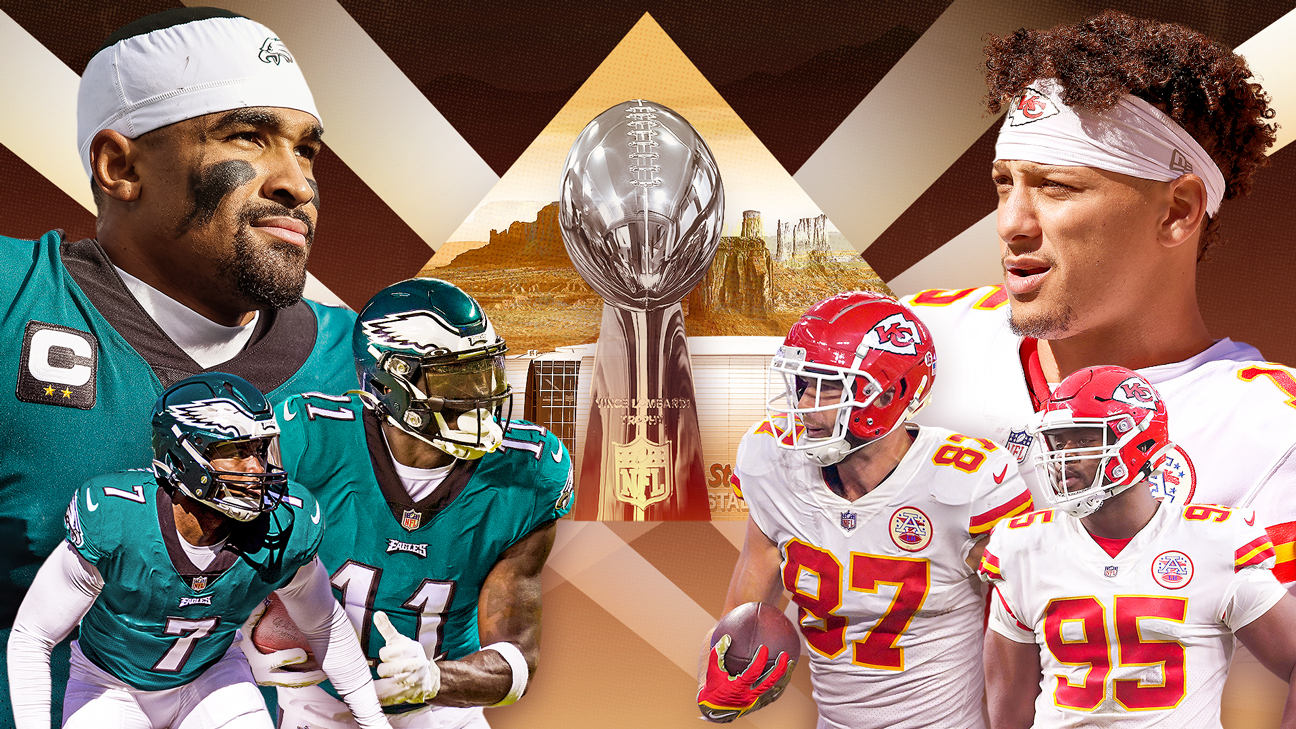
Tomorrow, the Kansas City Chiefs will attempt to become only the 4th team to win 3 straight NFL Championships, the 2nd to win 3 straight NFL Championship Games under any name, and the 1st to do so since the name "Super Bowl" began to be used. The Philadelphia Eagles stand in their way.

Here goes:

Baseball

1. 1872-78 Boston Red Stockings: 6 out of 8 World Championships, as that was then defined. That's 4 straight Pennants in the National Association, 1872-75; missing 1876; then 2 straight in the National League, 1877-78. This is the franchise now known as the Atlanta Braves.

2. 1880-82 Chicago White Stockings, 3 straight World Championships. This is the franchise now known as the Chicago Cubs.

Just missed: 1885-88 St. Louis Browns: 4 straight Pennants in the American Association, but won the World Championship only in the 1st 2, losing in the last 2. This is the franchise now known as the St. Louis Cardinals.

3. 1891-93 Boston Beaneaters: 3 straight World Championships. Same team as 1, now the Braves.

4. 1894-96 Baltimore Orioles: 3 straight World Championships. Despise this success, they went out of business after the 1899 season, and have no connection to the current team of the same name.

Just missed: 1901-03 Pittsburgh Pirates. Losing the 1st World Series, in 1903, cost them.

Just missed: 1906-08, and 1906-10, Chicago Cubs. 3 straight Pennants, and 4 out of 5, but 2-2 in World Series play.

Just missed: 1910-14 Philadelphia Athletics. 4 Pennants in 5 years, but 3-1 in World Series play.

Just missed: 1912-18 Boston Red Sox: 4 out of 7 is close, but not quite there.

Just missed: 1921-23 New York Yankees: 3 straight Pennants, but 1-2 in World Series play.

Just missed: 1921-24 New York Giants: 4 straight Pennants, but 2-2 in World Series play.

Just missed: 1926-28 New York Yankees: 3 straight Pennants, but 2-1 in World Series play. It could be extended to 1921-28: 6 Pennants in 8 years, but 3-3 in World Series play.

Just missed: 1929-31 Philadelphia Athletics: 3 straight Pennants, but losing Game 7 of the 1931 World Series cost them.

5. 1936-39 New York Yankees: 4 straight World Series. If you want to extend it to 1936-43, that's 8 seasons, 7 Pennants, and 6 World Series.

Just missed: 1942-46 St. Louis Cardinals: 4 Pennants and 3 World Series wins in 5 seasons.

6. 1949-53 New York Yankees: 5 straight World Series. Never done before, never done since. If you want to extend it, 1947-64: 16 seasons, 13 Pennants, 10 World Series wins.

Just missed: 1959-66 Los Angeles Dodgers: 4 Pennants and 3 World Series wins in 8 seasons.

Just missed: 1966-71 Baltimore Orioles: 4 Pennants and 2 World Series wins in 6 seasons.

Just missed: 1970-76 Cincinnati Reds: 4 Pennants and 2 World Series wins in 7 seasons. This team often gets talked about as the greatest of all time, especially the back-to-back titles of 1975 and '76. But it wasn't as good as the Baltimore team that beat them in the 1970 World Series, must less the Oakland team that beat them in the 1972 edition.

7. 1972-74 Oakland Athletics: 3 straight World Series. They are the only franchise other than the Yankees ever to do it. If you want to extend it to 1971-75, that's 5 straight Division titles, but no other Pennants. Sadly, the franchise's owner has now abandoned Oakland.

Just missed: 1976-81 New York Yankees: 5 Division titles, 4 Pennants and 2 World Series wins in 6 seasons.

Not even close: 1984-90 New York Mets: 7 seasons, just 2 Division titles, 1 Pennant, 1 World Series win. As Michael Wilbon would say on ESPN's Pardon the Interruption, "Dynasty of One."

Just missed: 1988-92 Oakland Athletics: 4 Division titles, including 3 straight Pennants, in 5 seasons, but only 1 World Series win.

Just missed: 1991-93 Toronto Blue Jays: 3 straight Division titles, and 2 World Series wins. But they had already been broken up in 1994, before the strike hit.

Just missed: 1991-99 Atlanta Braves: 9 seasons, 8 Division titles, and 5 Pennants, but just 1 World Series win, in 1995.

8. 1998-2000 New York Yankees: 3 straight World Series. If you extend it to 1996-2003, that's 8 seasons, 7 Division Titles, 6 Pennants and 4 World Series.

Just missed: 2010-14 San Francisco Giants: 3 World Series wins in 5 years.

Just missed: 2017-22 Houston Astros: 6 seasons, 4 Pennants, 2 World Series wins.

Just missed: 2017-24 Los Angeles Dodgers: 8 seasons, 4 Pennants, 2 World Series wins. They could add to this total.

Football

1. 1922-24 Canton/Cleveland Bulldogs: 3 straight NFL Championships. This was the original, single-division version of the NFL that ran from 1920 to 1932. This team moved from the smaller city of Canton to the nearby larger city of Cleveland for the 1924 season, then moved back to Canton for 1925, then were moved to become the Detroit Wolverines in 1929, and then went out of business.

2. 1929-31 Green Bay Packers: 3 straight NFL Championships. Unofficially, the 1st NFL Championship Game was played the next season; officially, the season after that.

Just missed: 1940-46 Chicago Bears: 4 NFL Championships in 7 years. I'm tempted to say this one counts, because the 1944 and '45 seasons were depleted due to the manpower drain of World War II, which would make it 4 out of 5, and nearly 5 straight as they were undefeated in 1942 before losing the NFL Championship Game to the Washington Redskins, having beaten the Redskins in the title game in 1940 (73-0!) and 1943. But, strictly speaking, the Monsters of the Midway just miss.

Just missed: 1947-49 Philadelphia Eagles: 3 straight NFL Championship Games, but lost the 1st of them.

Just missed: 1950-55 Cleveland Browns: 3 NFL Championships in 5 years. They won the title in all 4 seasons of the All-America Football Conference, 1946-49; and made 10 straight league championship games, 1946-55, winning 7. But the AAFC was not a major league. The Browns would make their point in the NFL, but fall a little short of dynasty status.

Just missed: 1952-57 Detroit Lions: 3 NFL Championships in 6 years, plus one other Championship Game appearance.

3. 1965-67 Green Bay Packers: 3 straight NFL Championships, including the 1st 2 Super Bowls. If you extend it to 1961-67, that's 5 World Championships in 7 seasons.

Just missed: 1971-73 Miami Dolphins: 3 Super Bowls, but won only 2.

4. 1974-79 Pittsburgh Steelers: 4 Super Bowl wins in 6 seasons.

Just missed: 1981-89 San Francisco 49ers: 4 Super Bowls in 9 seasons, including, 1984-89, 3 in 6.

A bit short of a "just missed," but I want to mention them, anyway: 1982-91 Washington Redskins, 3 Super Bowl wins and 1 other appearance in 10 seasons.

Not even close: 1984-90 Chicago Bears: 7 seasons, 6 Division titles, 3 NFC Championship Games, 1 trip to the Super Bowl, winning it. Wilbon, a Chicago native who loved that team, has to concede that, like the 1980s Mets, Da Bears of the 1980s were a "Dynasty of One."

Just missed: 1992-95 Dallas Cowboys: 3 Super Bowls in 4 seasons.

Just missed: 2001-04 New England Patriots: 3 Super Bowls in 4 seasons. Had they completed the 19-0 season for 2007, that would have been 4 out of 7, and still wouldn't have qualified under these parameters.

Just missed: 2015-19 New England Patriots: 3 Super Bowls in 5 seasons. Had they beaten the Philadelphia Eagles for the 2017 title, that would have been 3 straight, and 4 out of 5, and qualified. But they didn't.

Would qualify if they win tomorrow: 2022-24 Kansas City Chiefs: 3 straight Super Bowls. Extending it to 2019, and it would be 4 out of 6, plus 1 other Super Bowl that was lost.

If the Eagles win, that's 8 seasons, 3 appearances, 2 wins. Most teams would love to have it, but it wouldn't qualify as a dynasty.

Basketball

1. 1949-54 Minneapolis Lakers: 5 out of 6 NBA Championships. They won the National Basketball League title in 1948, but did not play the NBA Champion Baltimore Bullets for a "world championship." Then they joined the NBA, and won the title in 1949, 1950, 1952, 1953 and 1954.

2. 1957-69 Boston Celtics: 11 out of 13 NBA Championships. The dynasty of all dynasties in North American major league sports, and the only way to question that is to say that the reason the Celtics were so far ahead of the rest of the league is that the league wasn't getting the best possible athletes at the time. (For example: Sandy Koufax and Bob Gibson both played college basketball, but are remembered as baseball pitchers.) The Boston run included 8 straight titled, 1959-66. Never done before, never done since.

Just missed: 1981-86 Boston Celtics: 3 out of 6 NBA Championships. If you extend it 1 more year, that's 3 titles and 5 Finals appearances in 7 seasons, but that doesn't get them over the top.

3. 1982-88 Los Angeles Lakers: 5 out of 7 NBA Championships. If you extend it to 1980-88, that's 6 out of 9. If you extend it to 1980-91, that's 6 titles and 9 Finals appearances in 12 seasons.

Just missed: 1988-90 Detroit Pistons: 3 straight Finals appearances, but 2-1 in Finals.

4. 1991-93 Chicago Bulls: 3 straight NBA Championships.

5. 1996-98 Chicago Bulls: 3 straight NBA Championships. If you combine this into a single "dynasty," that's 6 out of 8.

Just missed: 1999-2007 San Antonio Spurs: 4 titles in 9 seasons. If you truncate it to 2002-07, that's 3 out of 5, but that doesn't quite make it, either.

6. 2000-02 Los Angeles Lakers: 3 straight NBA Championships. They also had a "just missed" from 2008 to 2010: 3 straight Finals appearances, going 2-1. If you extend it to 2000-10, that's 11 seasons with 7 Finals appearances, winning 5 titles.

Just missed: 2011-14 Miami Heat: 4 straight Finals appearances, but went 2-2.

Just missed: 2015-18 Cleveland Cavaliers: 4 straight finals appearances, but went 1-3.

Just missed: 2015-22 Golden State Warriors: 4 NBA Championships, and 1 other trip to the Finals, in 8 seasons.

Hockey

Being a "challenge trophy" up until 1914, the list of winners of the Stanley Cup is a bit complicated. Teams could win it, then have it taken from them literally within days, and win in multiple times within, say, 3 years. So I'm only going to count who had it at the end of each season.

Just missed: 1895-98 Montreal Victorias: 3 out of 4. Won it for 1894-95, lost it for 1895-96, won it for 1896-97, won it for 1897-98, then lost it for 1898-99.

1. Ottawa Hockey Club: 3 straight Stanley Cups. Won it for 1902-03, won it for 1903-04, won it for 1904-05, then dethroned. This team was nicknamed the Ottawa Silver Seven, and would become the 1st team named the Ottawa Senators, but moved to St. Louis in 1934, and went out of business after just 1 season there.

Just missed: 1906-10 Montreal Wanderers: 4 out of 6 Stanley Cups. Won it for 1905-06, lost it but quickly regained it for 1906-07, won it for 1907-08, lost it for 1908-09, won it for 1909-10.

Just missed: 1920-27 Ottawa Senators: 4 out of 8 Stanley Cups. Won it in 1920, 1921, 1923 and 1927.

2. 1947-49 Toronto Maple Leafs: 3 straight Stanley Cups. This can be extended to 1945-51, and 5 Cups in 7 seasons; or even 1942-51, and 6 Cups in 10 seasons.

Just missed: 1950-55 Detroit Red Wings: 4 Stanley Cups in 6 seasons. If extended to 1948-56, they appeared in 3 more Finals, but lost them all.

3. 1956-60 Montreal Canadiens: 5 straight Stanley Cups. Never done before, never done since. It could be extended back to 1953, making it 6 out of 9.

4. 1962-64 Toronto Maple Leafs: 3 straight Stanley Cups. If extended to 1967, that's 4 out of 7.

5. 1965-69 Montreal Canadiens: 4 Stanley Cups in 5 seasons. It could be extended to 1973, and then it's 6 out of 9.

6. 1976-79 Montreal Canadiens: 4 straight Stanley Cups. If you want to combine the last 2, into 1965-79, that's 10 Cups in 15 seasons.

7. 1980-83 New York Islanders: 4 straight Stanley Cups. They made it 5 straight Finals, but the next great team ended "The Drive for Five.

8. 1984-90 Edmonton Oilers: 5 Stanley Cups in 7 seasons. And for the last one, Wayne Gretzky was already gone. So was Jari Kurri. So was Paul Coffey. And Andy Moog, not Grant Fuhr, was now the starting goalie.

A bit short of a "just missed," but I want to mention them, anyway: 1995-2003 New Jersey Devils: 3 Cups and a 4th Finals in 9 seasons.

Just missed: 1997-2002 Detroit Red Wings: 3 Cups in 6 seasons.

Just missed: 2010-15 Chicago Blackhawks: 3 Cups in 6 seasons.

TOTAL: MLB 8, NFL 6, NBA 6. NHL 8. All told, 28.

New York 4, Boston 3, Chicago 3, Montreal 3, Green Bay 2, Los Angeles 2, Toronto 2, Baltimore 1, San Francisco Bay Area 1, Cleveland 1, Pittsburgh 1, Minneapolis 1, Ottawa 1, Edmonton 1.

Thursday, February 6, 2025

Why the Eagles?

I'm from East Brunswick, New Jersey. The house where I grew up is 48 miles from Yankee Stadium, across the street from the site of the old Yankee Stadium, home of the NFL's New York Giants from 1956 to 1973; and also 48 miles from the site of the Polo Grounds, home of the Giants from 1925 to 1955, and the New York Jets (originally the New York Titans) from 1960 to 1963.

The house is 36 miles from MetLife Stadium, home of the Giants and the Jets, built next-door to the site of Giants Stadium, home of the Giants from 1976 to 2009, and of the Jets from 1984 to 2009.

The house is 51 miles from Citi Field, built next-door to the site of Shea Stadium, home of the Jets from 1964 to 1983, and of the Giants in 1975.

And it's 65 miles from Lincoln Financial Field, home of the Philadelphia Eagles, adjacent to the site of Veterans Stadium, home of the Eagles from 1971 to 2003.

Based on distance alone, it would make more sense for me to be a fan of the Giants, or the Jets, than the Eagles.

But the things that would seem to make the most sense don't always. Because of their 1970s success, when they were frequently on television, the Pittsburgh Steelers, the Dallas Cowboys, the Miami Dolphins and then then-Oakland Raiders gained lots of fans in big cities, and their suburbs, whose teams weren't doing well at the time. Keeping in mind that only the 2 Division Champions made it from 1933 to 1966, the 4 Division Champions from 1967 to 1969, and the 3 Division Champions plus 1 Wild Card in each of 2 Conferences from 1970 to 1977:

* The Giants did not make the Playoffs between 1963 and 1981.
* The Jets did not make the Playoffs between 1969 and 1981.
* The Eagles did not make the Playoffs between 1960 and 1978.
* The Boston/New England Patriots did not make the Playoffs between 1963 and 1976.
* And the Chicago Bears did not make the Playoffs between 1963 and 1977.

This would also be true for the 1980s, despite the Giants and the Jets recovering enough to make the Playoffs on a regular basis. The Bears, the San Francisco 49ers, and the team then known as the Washington Redskins gained nationwide followings.

As a result, in New York, in Philadelphia, and in their suburbs, which, between them, includes the entire State of New Jersey (including the hardscrabble cities and the rural areas), there's a lot of people who root for an NFL team other than the G-Men, Gang Green, or the Birds.

So, given my age, it would be understandable if my favorite team wasn't either of the New York teams or the Philadelphia team.

But television has nothing to do with my not being a Giants fan, or a Jets fan.

The reason I am not a fan of the New York Jets is that most Jet fans tend to also be fans of baseball's New York Mets, due to their sharing of Shea Stadium, and also due to their both having won their league's titles in 1969. I'm a Yankee Fan, and Met fans struck me as having all the arrogance and obnoxiousness of Yankee Fans, without having earned it. Treating one title (2 for the Mets from 1986 onward) as if they meant more than the 22 titles the Yankees then had, and treating the 4 NFL Championships won by the Giants as not counting, because they came in the pre-Super Bowl era.

Plus, I was sick of hearing about Joe Namath, who, by the time I was old enough to watch him, was a broken-down wreck.

So, the Giants, right? After all, I'm from New Jersey, and the Giants were the pioneers in playing in New Jersey. For those of us growing up there at the time, Giants Stadium was huge. Not just big in physical size, but in terms of how it raised our profile. We were "major league," and could stand alongside New York City and Philadelphia with pride.

Except... the Giants kept the New York name. They took the "ny" logo off their helmets, replacing it with "GIANTS" -- until the year 2000, anyway -- but they remained, officially, "the New York Giants." Or, in the traditional, plus accent, "the Noo Yawk Footbawl Ji-unts."

In New Jersey public schools, we were taught to be proud of our home State. As a result, it really offended me -- indeed, it offended the entire family, including those of us who also made the voyage across the Hudson River from New York City to New Jersey -- that the Giants wouldn't change their name to "the New Jersey Giants."

So, the Jets, right? After all, they're the other alternative, unless you want to be one of those bandwagon fans who roots for the Cowboys or the Steelers.

But, no. I didn't want to hang around Jet fans. It meant hanging around Met fans.

So, that's it, right? I just don't have a favorite football team.

Then came November 19, 1978. The Miracle of the Meadowlands. A last-minute screwup by Giant quarterback Joe Pisarcik gave the Eagles a stunning win, pushing them on to their 1st Playoff berth in 18 years, while the Giants crashed and burned.

And I noticed something else. Not only were the Eagles good, they were interesting, led by head coach Dick Vermeil. And their quarterback was Ron Jaworski. In his second act, as an NFL analyst on ESPN, his nickname is "Jaws." But, as an Eagle quarterback, his nickname was "The Polish Rifle." He was Polish -- and so was I. This -- not Pisarcik, who was also Polish but seemed to stand in for all the stupidity people joked about Polish people having; not Namath, who was Hungarian but by now retired; and not Richard Todd, Namath's replacement as Jet signal-caller -- was a quarterback I could get behind.
My Quarterback -- Then

And not that far to the south of me, in towns like Spotswood, Monroe and South Brunswick, was, more or less, the unofficial border between the New York and Philadelphia metropolitan areas, where Yankee and Met fans gave way to Phillies fans, and the Giants' and Jets' fanbases faded out and the Eagles' faded in. Same with the Knicks and Nets to the 76ers, and the Rangers -- not yet any Islander fans in New Jersey, and the Devils didn't exist yet -- to the Flyers. So, to be an Eagles fan in East Brunswick was unusual, but hardly outrageous.

And I was getting in on the ground floor of something good, or so it seemed: The Eagles reached Super Bowl XV in 1981. But that was the peak: They lost that game to the Raiders, and fell apart after that. They got good again in the late 1980s, and remained so until the mid-1990s. They got good again in 2001, and went to 4 straight NFC Championship Games, but won only one, and lost Super Bowl XXXIX, to the New England Patriots.

I was in Philadelphia on the day of the 2008 NFC Championship Game, which the Eagles were favored to win over the Arizona Cardinals, but they lost. I walked into a Wawa, and there was a uniformed policeman there. I told him, "Officer, I want to report a crime: The Eagles are killing me." He said nothing, just nodded. He knew.

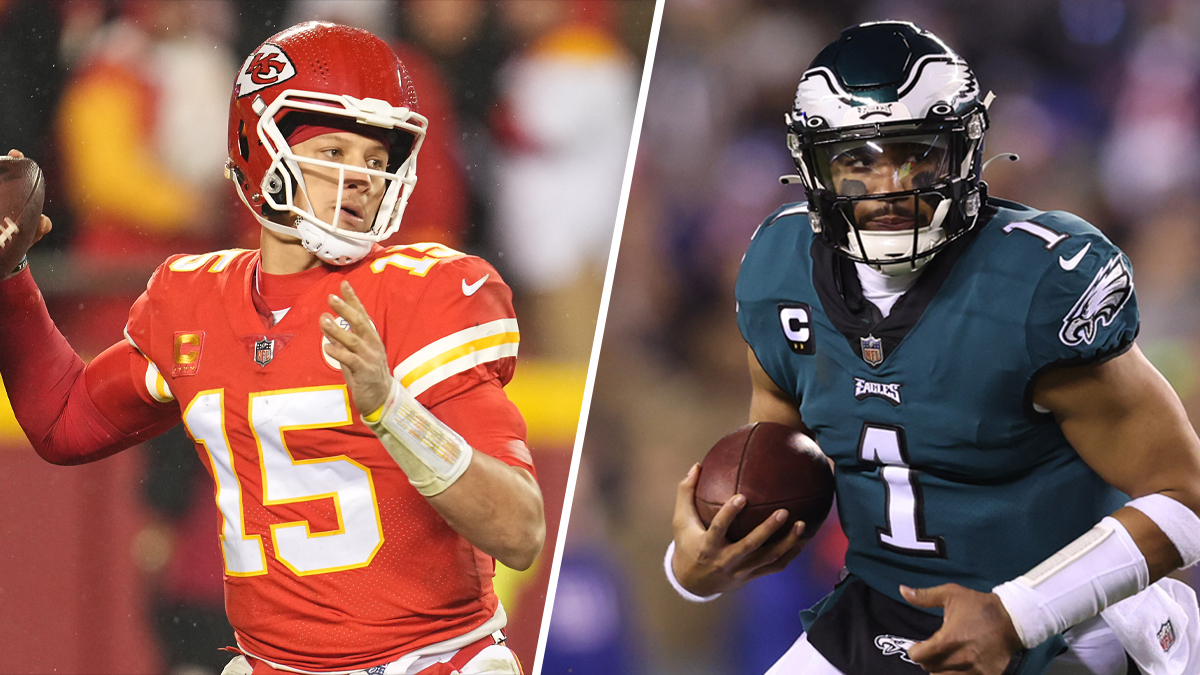
The Eagles finally won Super Bowl LII in 2018, beating the Patriots. They lost Super Bowl LVII to the Kansas City Chiefs in 2022, and are playing the Chiefs again this Sunday, in Super Bowl LIX. I'll be behind Jalen Hurts and the Broad Street Birds all the way.
My Quarterback -- Now

What's more, for reasons I won't get into here, I can't drive. And, even with the addition of the Meadowlands Rail Spur to New Jersey Transit in 2009, in time for the transition to MetLife Stadium, it's still easier to use public transportation to get to the South Philadelphia sports complex than to the Meadowlands Sports Complex.

Yes, I know, the Eagles have the most-hated fan base in the League. Yes, I know, they once "booed Santa Claus." Who's kidding who? They're smarter than Cowboy fans, and saner than Raider fans.

Did I make the right choice? Right now, certainly: Both the Giants and the Jets have stunk for years. Overall? Compared to the Jets, absolutely: They've played 65 seasons, and gotten to the Super Bowl exactly once, even though they won it, and it was one of the most epic moments in pro football history. Compared to the Giants, no: The Giants have won 8 NFL Championships, including 4 Super Bowls. The Eagles have won 4 NFL Championships, only 1 in the Super Bowl era.

Taking everything into account, I'm still glad I chose the Eagles over the Giants and the Jets. Fly, Eagles, fly, on the road to victory!

Saturday, January 25, 2025

Most NFL Conference Championship Games, 1932-2024

Notes: Years mentioned are for the calendar year in which the season began, not in which it ended. In other words, tomorrow, we will see the 2024 NFC and AFC Championship Games, not the 2025 editions.

Also, this includes the 1932 to 1969 NFL Championship Games, and the 1960 to 1969 AFL Championship Games, but not the 1946 to 1949 AAFC Championship Games.

For once, I am counting all cities for a team.

Ties broken by wins, then by most recent.

1. New York Giants, 19: 1933, 1934, 1935, 1938, 1939, 1941, 1944, 1946, 1956, 1958, 1959, 1961, 1962, 1963, 1986, 1990, 2000, 2007, 2011.

2. San Francisco 49ers, 19: 1970, 1971, 1981, 1983, 1984, 1988, 1989, 1990, 1992, 1993, 1994, 1997, 2011, 2012, 2013, 2019, 2021, 2022, 2023.

3. Green Bay Packers, 18: 1936, 1938, 1939, 1944, 1961, 1962, 1965, 1966, 1967, 1995, 1996, 1997, 2007, 2010, 2014, 2016, 2019, 2020.

4. Chicago Bears, 16: 1932, 1933, 1934, 1937, 1940, 1941, 1942, 1943, 1946, 1956, 1963, 1984, 1985, 1988 2006, 2010.

5. Boston/New England Patriots, 16: 1963, 1985, 1996, 2001, 2003, 2004, 2006, 2007, 2011, 2012, 2013, 2014, 2015, 2016, 2017, 2018.

6. Pittsburgh Steelers, 16: 1972, 1974, 1975, 1976, 1978, 1979, 1984, 1994, 1995, 1997, 2001, 2004, 2005, 2008, 2010, 2016.

7. Dallas Cowboys, 16: 1966, 1967, 1970, 1971, 1972, 1973, 1975, 1977, 1978, 1980, 1981, 1982, 1992, 1993, 1994, 1995.

8. Cleveland/St. Louis/Los Angeles Rams, 16: 1945, 1949, 1950, 1951, 1955, 1974, 1975, 1976, 1978, 1979, 1985, 1989, 1999, 2001, 2018, 2021.

9. Cleveland Browns, 14: 1950, 1951, 1952, 1953, 1954, 1955, 1957, 1964, 1965, 1968, 1969, 1986, 1987, 1989.

10. Philadelphia Eagles, 13: 1947, 1948, 1949, 1960, 1980, 2001, 2002, 2003, 2004, 2008, 2017, 2022, 2024.

11. Boston/Washington Redskins/Commanders, 13: 1936, 1937, 1940, 1942, 1943, 1945, 1972, 1982, 1983, 1986, 1987, 1991, 2024.

12. Oakland/Los Angeles/Las Vegas Raiders, 13: 1967, 1968, 1970, 1973, 1974, 1975, 1976, 1977, 1980, 1983, 1990, 2000, 2002.

13. Dallas Texans/Kansas City Chiefs, 11: 1962, 1966, 1969, 1993, 2018, 2019, 2020, 2021, 2022, 2023, 2024.

14. Baltimore/Indianapolis Colts, 11: 1958, 1959, 1964, 1968, 1970, 1971, 1995, 2003, 2006, 2009, 2014.

15. Minnesota Vikings, 11: 1968, 1969, 1973, 1974, 1976, 1977, 1987, 1998, 2000, 2009, 2017.

16. Buffalo Bills, 10: 1964, 1965, 1966, 1988, 1990, 1991, 1992, 1993, 2020, 2024.

17. Denver Broncos, 10: 1977, 1986, 1987, 1989, 1991, 1997, 1998, 2005, 2013, 2015.

18. San Diego/Los Angeles Chargers, 9: 1960, 1961, 1963, 1964, 1965, 1980, 1981, 1994, 2007.

19. Houston Oilers/Tennessee Titans, 9: 1960, 1961, 1962, 1967, 1978, 1979, 1999, 2002, 2019.

20. Portsmouth Spartans/Detroit Lions, 8: 1932, 1935, 1952, 1953, 1954, 1957, 1991, 2023.

21. Miami Dolphins, 7: 1971, 1972, 1973, 1982, 1984, 1985, 1992.

22. Baltimore Ravens, 5: 2000, 2008, 2011, 2012, 2023.

23. New York Jets, 5: 1968, 1982, 1998, 2009, 2010.

24. Seattle Seahawks, 4: 1983, 2005, 2013, 2014.

25. Tampa Bay Buccaneers, 4: 1979, 1999, 2002, 2020.

26. Atlanta Falcons, 4: 1998, 2004, 2012, 2016.

27. Carolina Panthers, 4: 1996, 2003, 2005, 2015.

28. Chicago/St. Louis/Arizona Cardinals, 4: 1947, 1948, 2008, 2015. Think about that: The Cardinals have been around 75 years longer than the Panthers, yet they've appeared in the same number of NFL or NFC Championship Games.

29. Cincinnati Bengals, 4: 1981, 1988, 2021, 2022.

30. New Orleans Saints, 3: 2006, 2009, 2018.

31. Jacksonville Jaguars, 3: 1996, 1999, 2017.

32. Houston Texans, none.

Monday, February 12, 2024

The Chiefs' "Eras Tour"

For all the fuss over Taylor Swift, it's worth mentioning: Oh yes, there was a game last night. For the 1st 2 quarters, and most of the 3rd, it was kind of dull. Then it got really good.

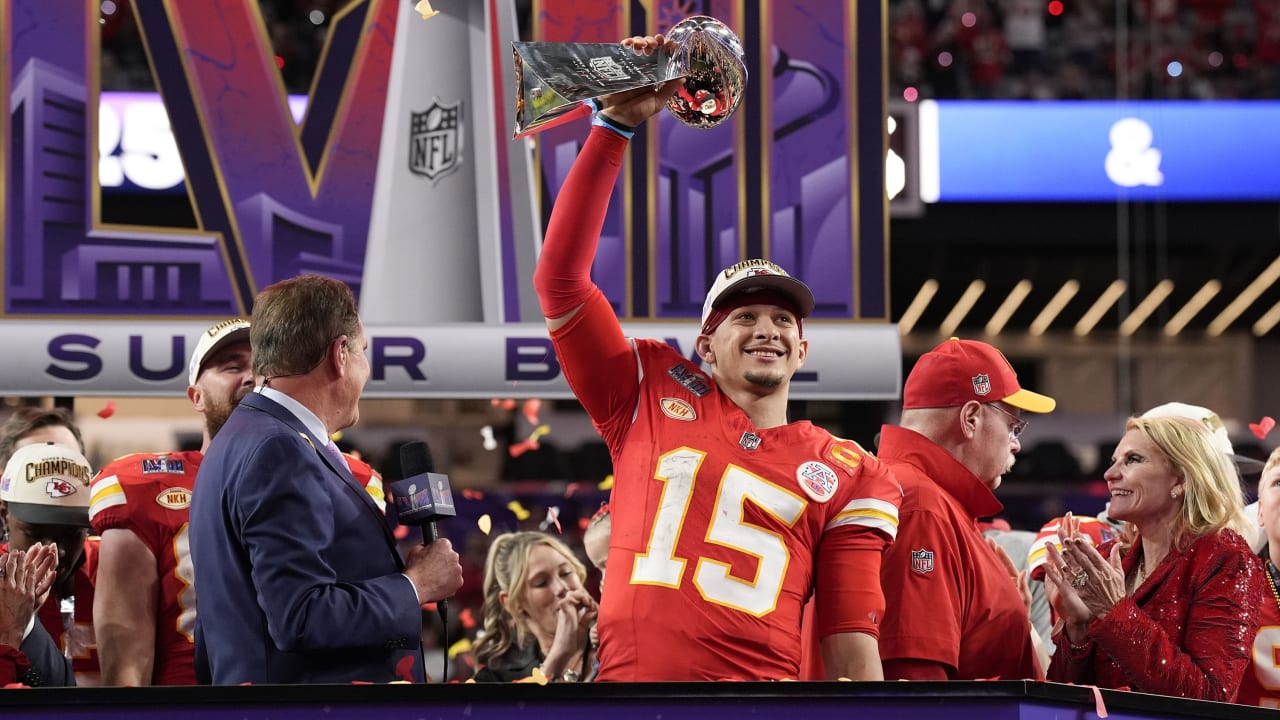
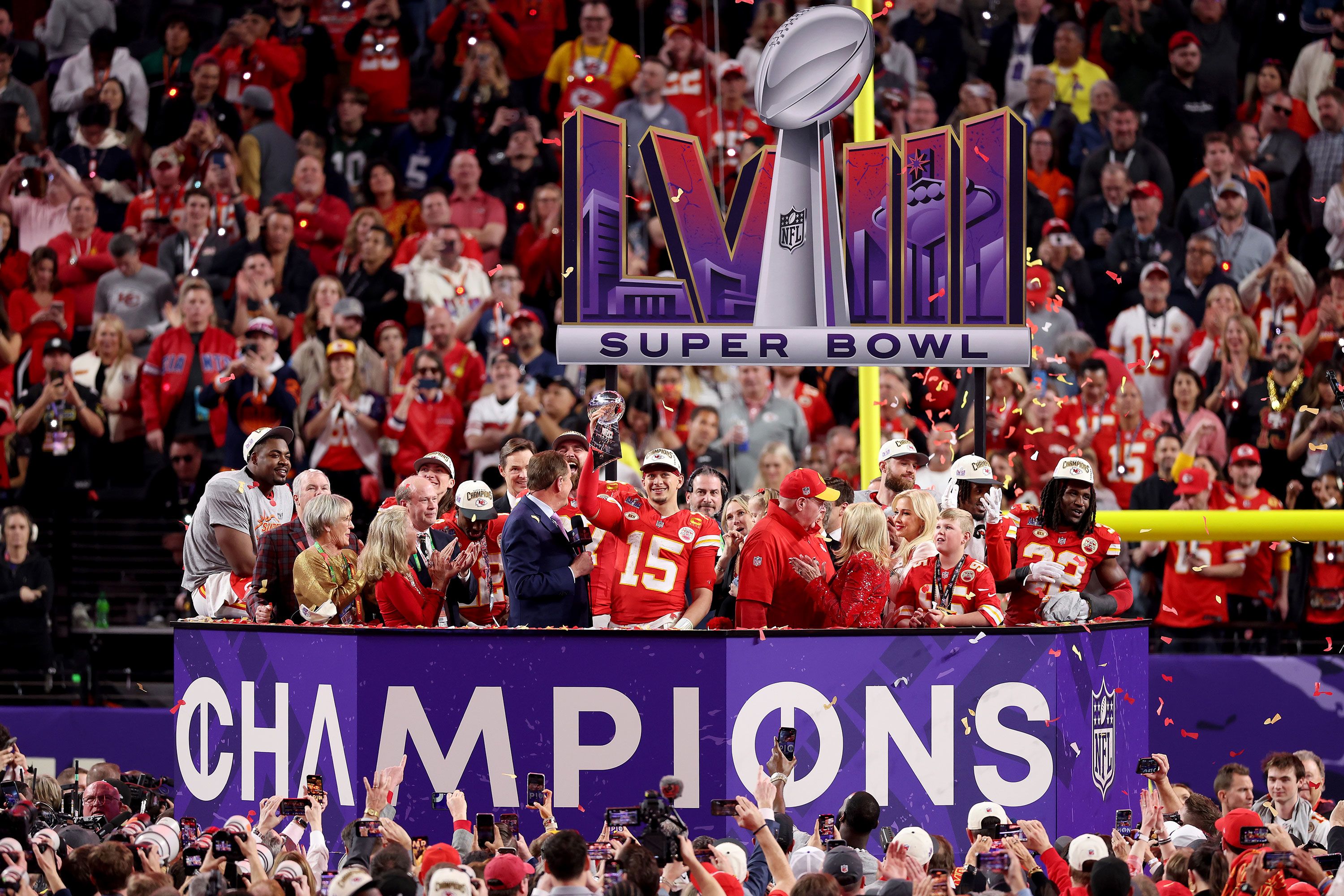
It turned out to be the longest Super Bowl ever, only the 2nd to go to overtime, and the 7th-longest in NFL history. Under current overtime rules, the San Francisco 49ers kicked a field goal, but it would not be enough, as the Kansas City Chiefs would get a chance to at least tie the game, and scored a touchdown, a 3-yard pass from Patrick Mahomes, who won his 3rd Super Bowl Most Valuable Player award, to Mecole Hardman. Final: Kansas City 25, San Francisco 22.

The Chiefs have now won 3 titles in 4 appearances in 5 years. It's not quite a "dynasty," but, as Taylor might say, it's quite an "era." So, like Taylor, the Chiefs have their own "Eras Tour."

Andy Reid joins Chuck Noll, Bill Walsh and Joe Gibbs as coaches who have won 3 Super Bowls. Mahomes joins Terry Bradshaw, Joe Montana, Troy Aikman and Peyton Manning as quarterbacks who've done it. And the Chiefs became the 1st back-to-back Super Bowl winners since the 1998-99 Denver Broncos.

(Note: Proven cheaters not included, so don't tell me about the Bill Belichick and Tom Brady New England Patriots.)

The winning touchdown was caught by Mecole Hardman -- who, like Aaron Rodgers, began the season with the New York Jets. For some people around here, Ouch.

Travis Kelce got a big hug from Taylor at the end, but, other than that, he was the one Chief who ended up not looking better. His antics on the victory stand didn't help. And getting caught yelling at Reid on the sideline was bad. He's already a meme.
Yeah. He's going to the Pro Football Hall of Fame, as are Reid and Mahomes, but this is not a good look.

One more thing, for all the Trump fans: We might not be in the mess we've been in for the last 50 years if Frank Sinatra hadn't switched parties, and endorsed first Richard Nixon, then Ronald Reagan.

At least Frank hated Trump, as do his kids, who've spoken well of Taylor.

It's also worth noting that Elvis Presley didn't endorse Adlai Stevenson over Dwight D. Eisenhower. But he did get the polio vaccine, on live TV, right before the 1956 election! (Of course, both Ike and Adlai supported the vaccine.)

Wednesday, January 31, 2024

Taylor the WAG

Conservative media is now claiming that the National Football League is rigging the Super Bowl, so that the Kansas City Chiefs, and therefore Travis Kelce, and therefore Taylor Swift, will win; so that Taylor can then ride that to help President Joe Biden get re-elected.

It's not the craziest conspiracy they've ever come up with. But it's one of the dumber ones. Why the hell would the NFL rig the Super Bowl for the Chiefs? There's 3 big reasons why they wouldn't do that:

1. They wouldn't rig it at all. They want people to bet on the game. Therefore, they would want the game to appear to be on the level.

2. What's the point? The Chiefs are the defending Champions. They don't need the rigging.

3. Of the NFL's 32 teams, 28 are owned by contributors to Donald Trump's Presidential campaign. Clearly, they don't want Biden to win.

Of course, the right-wingers are ready, either way. If the San Francisco 49ers win, they'll say it was rigged to help liberal San Francisco against conservative Missouri and Kansas. So, either way, they look like idiots.

*

Anyway... Today, on The View on ABC, Sara Haines made the point that American football has places for women: As cheerleaders, and in the stands. Their place is not by the side of their boyfriend or husband, the player.

And they see Taylor Swift cozying up to Travis Kelce, star tight end of the Kansas City Chiefs, and his family. And they don't like it.

They also don't like that she's registering voters to vote the way she would want them to: For Democrats, for women's rights, and other liberal causes.

Yes, Haines used the phrase "American football." That's important. Because, whether she meant to or not, it draws a contrast to soccer, the sport the rest of the world calls "football."

In England, they have "WAG Culture." WAG: Wives And Girlfriends. If an English soccer star, or a foreign soccer star in England's Premier League, still the highest-grossing sports league in the world -- ahead of the mighty NFL, mind you -- has a girlfriend or a wife (hopefully, not both) who is also famous, it provides the same kind of effect as when Joe DiMaggio and Marilyn Monroe got married (and, just as quickly, divorced): Each builds on the other's fame, until, on top of what they were already famous for, they become "famous for being famous."

America isn't used to that. Reggie Jackson was very good at keeping his private life private: He married once, was divorced while still in Oakland, and if he ever dated a famous woman while in the markets of New York (with the Yankees) or Los Angeles (with the team then named the California Angels), the media never found out.

Also in Reggie's time, nobody seemed to care who Pete Rose, Johnny Bench, Carl Yastrzemski, George Brett, Ozzie Smith, Rickey Henderson, Don Mattingly or Ryne Sandberg was married to. Derek Jeter and Alex Rodriguez both dated famous women, but that was in New York, which isn't like the rest of the country.

In other sports, Joe Montana's wife was Jennifer Wallace, and Wayne Gretzky's wife was Jennifer Jones, and neither was ever anything more than a minor actress. Michael Jordan and Dan Marino had embarrassing divorces, but they were quickly forgotten. We hear lots of talk about LeBron James' son Bronny, but how many of us recognize the name of Savannah Brinson, LeBron's wife and Bronny's mother?

Tom Brady was married to Gisele Bündchen, but that was treated as an afterthought. Patrick Mahomes, Chiefs quarterback and Kelce's teammate, having led them into a 4th Super Bowl and looking for a 3rd win, is the most famous player in the NFL, but how many of us would recognize his wife on sight? Or recognize her maiden name, Brittany Matthews? And she was a pro athlete, too, a soccer player. She's one of the co-owners of the K.C. area's team in the National Women's Soccer League, the Kansas City Current. And yet, she can walk through Port Authority Bus Terminal in Midtown Manhattan without one single autograph request. Her husband can't do that.

There's something else to consider about the Taylor & Travis phenomenon. Taylor Swift is the 1st female performer to be, unquestionably, the biggest music star in America. Every predecessor in that regard was male: Bing Crosby, Frank Sinatra, Elvis Presley, The Beatles (British rather than American, but embraced by America), Michael Jackson.

Not Madonna. When she first hit it big in 1984, Jackson, Bruce Springsteen and Prince were bigger. When she was at her most hyped and controversial, in 1989 and '90, Jackson was still bigger. So were imports U2. Janet Jackson was never the biggest. Nor was Jennifer Lopez. The Beehive won't like reading this, but Beyoncé has been with Jay-Z since 2002, and he's been either the biggest or 2nd-biggest hip-hop figure longer than that, so Bey has never even been the biggest performer in her own relationship.

Yes, there is an element of race involved. If Beyoncé had merely collaborated with Jay-Z, and never gotten into a relationship with him, she would still be very big. But being black would have prevented her from being the biggest star among white fans. Taylor doesn't have that issue. She does have issues, but not that one.

But Taylor got to where she is by writing and singing songs about a troublesome love-life. And while she did sing, "I'm the problem, it's me" in "Anti-Hero," a lot of her songs are about breakups with inadequate boyfriends.

Guys see this, and think, "If only she'd come to me, I could show her a real man." Then she starts dating a Super Bowl-winning football star, and they feel betrayed. And so they hate her.

And, like Mariah Carey a few years earlier, she can sing a song titled "Shake It Off." (Neil Sedaka also had a Number 1 hit titled "Bad Blood" decades before Taylor did.) And that just ticks them off more.

Let them be ticked off.

By the way, you should have seen the look on my face when I remembered that there were meat-packing companies named Taylor and Swift.

The Taylor Provisions Company, of course, invented pork roll, and still sell more of it than anybody else. They sell it under the name "Pork Roll." Not "Taylor Ham."

Monday, January 29, 2024

Finals Appearances, 1871-2024

Updated to include the set of Super Bowl LVIII, between the Kansas City Chiefs and the San Francisco 49ers.

Includes the following:

* Baseball: The World Series, 1903-2023; pre-1903 championship finals, including the Temple Cup (1894-97); and single-division leagues that did not have postseason series.

* Football: All professional league championship games, including the pre-Super Bowl NFL Championship Game, 1932-1965; and Canada's Grey Cup.

* Basketball: The NBA Finals, 1947-2023, and the WNBA Finals, 1997-2023.

* Hockey: The Stanley Cup Finals, 1894-2023, including before the founding of the NHL.

* Soccer: The NASL Finals, 1967-1984; the MLS Cup, 1996-2023; and the finals of the various women's leagues.

In the case of an intra-city finals, the city will be counted twice. Ties will be broken by most wins, then by most recent.

Still to be done: NASL, MLS, WUA/WPS/NWSL

New York, 136: World's Championship Series, 1888, both teams in 1889, 1890; Temple Cup, 1894; National League Champions, 1899, 1900; World Series, 1904, 1905, 1911, 1912, 1913, 1916, 1917, 1920, 1921 (both), 1922 (both), 1923 (both), 1924, 1926, 1927, 1928, 1932, 1933, 1936 (both), 1937 (both), 1938, 1939, 1941 (both), 1942, 1943, 1947 (both), 1949 (both), 1950, 1951 (both), 1952 (both), 1953 (both), 1954, 1955 (both), 1956 (both), 1957, 1958, 1960, 1961, 1962, 1963, 1964, 1969, 1973, 1976, 1977, 1978, 1981, 1996, 1998, 1999, 2000 (both), 2001, 2003, 2009, 2015; NFL Champions, 1927; NFL Championship Game, 1933, 1934, 1935, 1938, 1939, 1941, 1944, 1946, 1956, 1958, 1959, 1961, 1962, 1963; Super Bowl, 1987, 1991, 2001, 2008, 2012; AAFC Championship Game, 1946 and 1947; NBA Finals, 1951, 1952, 1953, 1970, 1972, 1973, 1994, 1999, 2002, 2003; ABA Finals, 1972, 1974, 1976; WNBA Finals: 1997, 1999, 2000, 2002, 2023; Stanley Cup Finals, 1928, 1929, 1932, 1933, 1937, 1940, 1950, 1972, 1979, 1980, 1981, 1982, 1983, 1984, 1994, 1995, 2000, 2001, 2003, 2012, 2014

New England, 90: National Association Champions, 1872, 1873, 1874, 1875; National League Champions, 1877, 1878, 1879, 1892, 1893, 1898; World's Championship Series, both teams in 1884 and 1891; Temple Cup, 1897; World Series, 1903, 1904, 1912, 1914, 1915, 1916, 1918, 1946, 1948, 1967, 1975, 1986, 2004, 2007, 2013, 2018; NFL Champions, 1928; NFL Championship Game, 1936; AFL Championship Game, 1963; Super Bowl, 1986, 1997, 2002, 2004, 2005, 2008, 2012, 2015, 2017, 2019; NBA Finals: 1957, 1958, 1959, 1960, 1961, 1962, 1963, 1964, 1965, 1966, 1968, 1969, 1974, 1976, 1981, 1984, 1985, 1986, 1987, 2008, 2010, 2022; WNBA Finals: 2004, 2005, 2019, 2022; Stanley Cup Finals, 1927, 1929, 1930, 1939, 1941, 1943, 1946, 1953, 1957, 1958, 1970, 1972, 1974, 1977, 1978, 1988, 1990; WHA Finals, 1973, 1978

Montreal, 74: Grey Cup, 1931, 1944, 1949, 1954, 1955, 1956, 1970, 1974, 1975, 1977, 1978, 1979, 2000, 2002, 2003, 2005, 2006, 2008, 2009, 2010, 2023; Stanley Cup Finals, 1893, 1894, 1895, 1896, 1897, 1899, 1900, 1901, 1903, 1904, 1906, 1907, 1908, 1910, 1914, 1916, 1917, 1919, 1924, 1925, 1926, 1928, 1930, 1931, 1935, 1944, 1946, 1947, 1951, 1952, 1953, 1954, 1955, 1956, 1957, 1958, 1959, 1960, 1965, 1966, 1967, 1968, 1969, 1971, 1973, 1976, 1977, 1978, 1979, 1986, 1989, 1993, 2021

Toronto, 67: World Series, 1992, 1993; Grey Cup, 1909 (both), 1910, 1911 (both), 1912, 1913, 1914 (both), 1915, 1920 (both), 1921, 1924, 1926, 1927, 1930, 1933, 1937, 1938, 1940, 1942, 1945, 1946, 1947, 1950, 1952, 1971, 1982, 1983, 1987, 1991, 1996, 1997, 2004, 2012, 2017, 2022; NBA Finals, 2019; Stanley Cup Finals, 1902, 1904, 1908, 1914, 1918, 1922, 1932, 1933, 1935, 1936, 1938, 1939, 1940, 1942, 1945, 1947, 1948, 1949, 1951, 1959, 1960, 1962, 1963, 1964, 1965, 1967

Los Angeles, 59: World Series, 1959, 1963, 1965, 1966, 1974, 1977, 1978, 1981, 1988, 2002, 2017, 2018, 2020; NFL Championship Game, 1949, 1950, 1951, 1955; AFL Championship Game, 1960; Super Bowl, 1980, 1984, 2019, 2022; NBA Finals, 1962, 1963, 1965, 1966, 1968, 1969, 1970, 1972, 1973, 1980, 1982, 1983, 1984, 1985, 1987, 1988, 1989, 1991, 2000, 2001, 2002, 2004, 2008, 2009, 2010, 2020; ABA Finals, 1970; WNBA Finals: 2001, 2002, 2003, 2016, 2017; Stanley Cup Finals, 1993, 2003, 2007, 2012, 2014

Chicago, 58: National League Champions, 1876, 1880, 1881, 1882; World's Championship Series, 1885, 1886; American League Champions, 1901; World Series, both teams in 1906; 1907, 1908, 1910, 1917, 1918, 1919, 1959, 2005, 2016; NFL Champions, 1921, 1925; NFL Championship Game, 1932, 1933, 1934, 1937, 1940, 1941, 1942, 1943, 1946, 1947, 1948, 1956, 1963; Super Bowl, 1986, 2007; NBA Finals, 1947, 1991, 1992, 1993, 1996, 1997, 1998; WNBA Finals, 2014, 2021; Stanley Cup Finals, 1931, 1934, 1938, 1944, 1961, 1962, 1965, 1971, 1973, 1992, 2010, 2013, 2015; WHA Finals, 1974

Detroit, 50: World's Championship Series, 1887; World Series, 1907, 1908, 1909, 1934, 1935, 1940, 1945, 1968, 1984, 2006, 2012; NFL Championship Game, 1935, 1952, 1953, 1954, 1957; USFL Championship Game, 1983; NBA Finals, 1988, 1989, 1990, 2004, 2005; WNBA Finals, 2003, 2006, 2007, 2008; Stanley Cup Finals, 1934, 1936, 1937, 1941, 1943, 1945, 1948, 1949, 1950, 1952, 1954, 1955, 1956, 1961, 1963, 1964, 1966, 1995, 1997, 1998, 2002, 2008, 2009

Philadelphia, 47: National Association Champions, 1871; American Association Champions, 1883; American League Champions, 1902; World Series, 1905, 1910, 1911, 1913, 1914, 1915, 1929, 1930, 1931, 1950, 1980, 1983, 1993, 2008, 2009, 2022; NFL Champions, 1926; NFL Championship Game, 1947, 1948, 1949, 1960; Super Bowl, 1981, 2005, 2018, 2023; USFL Championship Game, 1983 and 1984; NBA Finals: 1947, 1948, 1956, 1967, 1977, 1980, 1982, 1983, 2001; Stanley Cup Finals, 1974, 1975, 1976, 1980, 1985, 1987, 1997, 2010

Winnipeg, 42: Grey Cup, 1925, 1935, 1937, 1938, 1939, 1941, 1942, 1943, 1945, 1946, 1947, 1950, 1953, 1957, 1958, 1959, 1961, 1962, 1965, 1984, 1988, 1990, 1992, 1993, 2001, 2007, 2011, 2019, 2021, 2022, 2023; Stanley Cup Finals, 1896, 1900, 1901, 1902, 1904, 1908; WHA Finals, 1973, 1976, 1977, 1978, 1979

San Francisco Bay Area, 36: World Series, 1962, 1972, 1973, 1974, 1988, 1989 (both), 1990, 2002, 2010, 2012, 2014; AAFC Championship Game, 1949; Super Bowl, 1968, 1977, 1981, 1982, 1985, 1989, 1990, 1995, 2003, 2013, 2020, 2024; USFL Championship Game, 1985; NBA Finals, 1964, 1967, 1975, 2015, 2016, 2017, 2018, 2022; 1969 ABA Finals; Stanley Cup Finals, 2017

Hamilton, 34: Grey Cup, 1910, 1912, 1913, 1915, 1927, 1928, 1929, 1932, 1935, 1943, 1944, 1953, 1957, 1958, 1959, 1961, 1962, 1963, 1964, 1965, 1967, 1972, 1980, 1984, 1986, 1989, 1998, 1999, 2013, 2014, 2019, 2021; Stanley Cup Finals, 1910, 1911

St. Louis, 34: World's Championship Series, 1885, 1886, 1887, 1888; World Series, 1926, 1928, 1930, 1931, 1934, 1942, 1943, 1944 (both), 1946, 1964, 1967, 1968, 1982, 1985, 1987, 2004, 2006, 2011, 2013; Super Bowl, 2000, 2002; NBA Finals, 1957, 1958, 1960, 1961; Stanley Cup Finals, 1968, 1969, 1970, 2019

Edmonton, 34: Grey Cup, 1921, 1922, 1952, 1954, 1955, 1956, 1960, 1973, 1974, 1975, 1977, 1978, 1979, 1980, 1981, 1982, 1990, 1993, 1996, 2002, 2003, 2005, 2015; Stanley Cup Finals, 1908, 1910, 1923, 1983, 1984, 1985, 1987, 1988, 1990, 2006; WHA Finals, 1979

Ottawa, 33: Grey Cup, 1925, 1926, 1936, 1939, 1940, 1948, 1951, 1960, 1966, 1968, 1969, 1973, 1976, 1981, 2015, 2016, 2018; Stanley Cup Finals, 1894, 1897, 1903, 1904, 1905, 1906, 1908, 1909, 1910, 1911, 1915, 1920, 1921, 1923, 1927, 2007

Cleveland, 31: Temple Cup, 1895, 1896; World Series, 1920, 1948, 1954, 1995, 1997, 2016; NFL Champions, 1920, 1922, 1923, 1924; AAFC Championship Game, 1946, 1947, 1948, 1949; NFL Championship Game, 1945, 1950, 1951, 1952, 1953, 1954, 1955, 1957, 1964, 1965; NBA Finals, 2007, 2015, 2016, 2017, 2018

Pittsburgh, 24: National League Champions, 1901, 1902; World Series, 1903, 1909, 1925, 1927, 1960, 1971, 1979; Super Bowl, 1975, 1976, 1979, 1980, 1996, 2006, 2009, 2011; ABA Finals, 1968; Stanley Cup Finals, 1991, 1992, 2008, 2009, 2016, 2017

Baltimore, 22: Temple Cup, 1894, 1895, 1896, 1897; World Series, 1966, 1969, 1970, 1971, 1979, 1983; NFL Championship Game, 1958, 1959, 1964; Super Bowl, 1969, 1971, 2001, 2013; USFL Championship Game, 1985; Grey Cup, 1994, 1995; NBA Finals, 1948, 1971

Wisconsin, 21: World Series, 1957, 1958, 1982; NFL Champions, 1929, 1930, 1931; NFL Championship Game, 1936, 1938, 1939, 1960, 1961, 1962, 1965; Super Bowl, 1967, 1968, 1997, 1998, 2011; NBA Finals, 1971, 1974, 2021

Washington, 21: World Series, 1924, 1925, 1933; NFL Championship Game, 1937, 1940, 1942, 1943, 1945; Super Bowl, 1973, 1983, 1984, 1988, 1992; NBA Finals, 1949, 1975, 1978, 1979; WNBA Finals, 2018, 2019; Stanley Cup Finals, 1998, 2018

Minnesota, 21: World Series, 1965, 1987, 1991; Super Bowl, 1970, 1974, 1975, 1977; NBA Finals, 1949, 1950, 1952, 1953, 1954, 1959; WNBA Finals: 2011, 2012, 2013, 2015, 2016, 2017; Stanley Cup Finals, 1981, 1991

Calgary, 21: Grey Cup, 1948, 1949, 1968, 1969, 1971, 1991, 1992, 1995, 1998, 1999, 2001, 2008, 2012, 2014, 2016, 2017, 2018; Stanley Cup Finals, 1924, 1986, 1989, 2004

Regina, 19: Grey Cup, 1923, 1928, 1929, 1930, 1931, 1932, 1934, 1951, 1966, 1967, 1969, 1972, 1976, 1989, 1997, 2007, 2009, 2010, 2013

Vancouver, 18: Grey Cup, 1963, 1964, 1983, 1985, 1988, 1994, 2000, 2004, 2006, 2011; Stanley Cup Finals, 1915, 1918, 1921, 1922, 1982, 1994, 2011

Houston, 17: World Series, 2005, 2017, 2019, 2022; AFL Championship Game, 1960 and 1961; NBA Finals, 1981, 1986, 1994, 1995; WNBA Finals, 1997, 1998, 1999, 2000; WHA Finals, 1974, 1975, 1976

Miami, 16: World Series, 1997, 2003; Super Bowl, 1972, 1973, 1974, 1983, 1985; NBA Finals, 2006, 2011, 2012, 2013, 2014, 2020, 2023; Stanley Cup Finals, 1996, 2023

Dallas, 14: World Series, 2010, 2011, 2023; AFL Championship Game, 1962; Super Bowl, 1971, 1972, 1976, 1978, 1979, 1993, 1994, 1996; NBA Finals, 2006, 2011; Stanley Cup Finals, 1999, 2000, 2020

Colorado, 14: World Series, 2007, Super Bowl, 1978, 1987, 1988, 1990, 1998, 1999, 2014, 2016; ABA Finals, 1976; NBA Finals, 2023; Stanley Cup Finals, 1996, 2001, 2022

Indiana, 13: Super Bowl, 2007, 2010; NBA Finals, 1955, 1956, 2000; ABA Finals, 1969, 1970, 1972, 1973, 1975; WNBA Finals, 2009, 2012, 2015

Western New York, 13: AAFC Championship Game, 1948; AFL Championship Game, 1964 and 1965; Super Bowl, 1991, 1992, 1993, 1994; NBA Finals, 1950, 1951, 1955, 1956; Stanley Cup Finals, 1975, 1999

Cincinnati, 12: World Series, 1919, 1939, 1940, 1961, 1970, 1972, 1975, 1976, 1990; Super Bowl, 1982, 1989, 2022

Arizona, 12: World Series, 2001, 2003; Super Bowl, 2009; USFL Championship Game, 1984; NBA Finals, 1976, 1993, 2021; WNBA Finals: 1998, 2007, 2009, 2014, 2021

Kansas City, 10: World Series, 1980, 1985, 2014, 2015; Super Bowl, 1967, 1970, 2020, 2021, 2023, 2024

Tampa Bay, 9: World Series, 2008, 2020; Super Bowl, 2003, 2021; Stanley Cup Finals, 2004, 2015, 2020, 2021, 2022

Seattle, 13: Super Bowl, 2006, 2014, 2015; NBA Finals, 1978, 1979, 1996; WNBA Finals: 2004, 2010, 2018, 2020; Stanley Cup Finals, 1917, 1919, 1920

Atlanta, 11: World Series, 1991, 1992, 1995, 1996, 1999, 2021; Super Bowl, 1999, 2017; WNBA Finals, 2010, 2011, 2013

San Antonio, 7: NBA Finals, 1999, 2003, 2005, 2007, 2012, 2013; WNBA Finals, 2008

San Diego, 7: World Series, 1984, 1998; AFL Championship Game, 1961, 1963, 1964, 1965; Super Bowl, 1995

Kingston, 6: Grey Cup, 1922, 1923, 1924; Stanley Cup Finals, 1895, 1899, 1906

Las Vegas, 5: WNBA Finals, 2020, 2022, 2023; Stanley Cup Finals, 2018, 2023

Carolina, 5: Super Bowl, 2004, 2016; WNBA Finals, 2001; Stanley Cup Finals, 2002, 2006

Utah, 4: ABA Finals, 1971 and 1974; NBA Finals, 1997, 1998

Portland, 4: NBA Finals, 1977, 1990, 1992; Stanley Cup Finals, 1916

Quebec City, 4: Stanley Cup Finals, 1912, 1913; WHA Finals, 1975 and 1977

Louisville, 4: World's Championship Series, 1890; ABA Finals, 1971, 1973, 1975

Orlando, 3: World Bowl, 1974; NBA Finals, 1995, 2009

Sarnia, 3: Grey Cup, 1933, 1934, 1936

Victoria 3: Stanley Cup Finals, 1914, 1925, 1926

Halifax, 3: Stanley Cup Finals, 1900, 1906, 1913

Kenora, 3: Stanley Cup Finals, 1903, 1905, 1907

Tennessee, 2: Super Bowl, 2000; Stanley Cup Finals, 2017

New Orleans, 2: Super Bowl, 2010; ABA Finals, 1968

Sacramento, 2: WNBA Finals, 2005, 2006

Brandon, 2: Stanley Cup Finals, 1904, 1907

Oklahoma City, 1: NBA Finals, 2012

Birmingham, 1: 1974 World Bowl

Portsmouth, 1: NFL Championship Game, 1932

Moncton, 1: Stanley Cup Finals, 1912

Thunder Bay, 1: Stanley Cup Finals, 1911

Dawson City, 1: Stanley Cup Finals, 1905

Austin, none

Jacksonville, none

Monday, February 13, 2023

Top 5 Reasons You Can't Blame the Referees for the Philadelphia Eagles Losing Super Bowl LVII

Last night, the Kansas City Chiefs came from behind to defeat the Philadelphia Eagles, 38-35 at State Farm Stadium in the Phoenix suburb of Glendale, Arizona.

It was the most points ever scored by a team in a Super Bowl that still lost. It broke the record of 33, set by the New England Patriots, 5 years ago, when they lost 41-33... to the Eagles. That game remains the highest-scoring Super Bowl, topping last night's game, 74 to 73.

Chiefs quarterback Patrick Mahomes fought off an ankle injury at the Eagles' defense, the best in the NFL all season long, to lead the comeback, and win his 2nd Super Bowl in 3 tries, and also his 2nd Pete Rozelle Award as the Most Valuable Player of the Super Bowl.

Harrison Butker kicked a 27-yard field goal with 8 seconds left in regulation, following a drive aided by a penalty on James Bradberry for holding Chiefs receiver JuJu Smith-Schuster, giving the Chiefs an automatic 1st down. Eagle fans were furious over the call, which, if called an incomplete pass, would have meant 4th down and 8 yards to go on the 17.

Did Eagle fans have a point? It was a borderline call, and the tendency in the late moment of a postseason game, in any sport, is for the officials to "Let them play." This time, the call was made.

Top 5 Reasons You Can't Blame the Referees for the Philadelphia Eagles Losing Super Bowl LVII

5. The Hurts Fumble Hurt. Jalen Hurts didn't play like a 2nd-year quarterback. He played as if pressure was a friend, not an enemy. But early in the 2nd quarter, with the Eagles leading 14-7, he fumbled the ball, and it was recovered by Nick Bolton, who returned it 36 yards for a game-tying touchdown.

If that fumble hadn't happened, even if the Eagles had stalled, and then held the Chiefs off on their next drive, they would have won the game.

4. Experience. In an exercise such as this, the easiest thing is to say, "The opposition was better," and make that Reason Number 1. Were the Chiefs better? Eagles head coach Nick Sirriani said so after the game: "Today, they were better than we were."

At the very least, they were more experienced. They won the Super Bowl 3 years ago, and lost another 2 years ago. Many of their players from those games were in this one as well, enabling them to overcome the "Dynasty of One" tag. In contrast, the Eagles only had 4 players remaining, and almost an entirely different coaching staff, from their Super Bowl win of 5 years ago. Aside from that, they didn't have Super Bowl experience.

Speaking of experience:

3. Andy Reid. In Super Bowl XXXIX, 18 years earlier, Reid coached the Eagles against the New England Patriots, and his poor clock management was one of the things that cost the Eagles the game. It wasn't the first time that happened while he was their coach, nor the last.

It was why I was sure the Chiefs would lose Super Bowl LIV to the San Francisco 49ers: I didn't trust him in the game's closing minutes. But he managed the clock well that time. And he did again last night, outcoaching Sirriani despite having a 24-to-36-minute time of possession deficit.

2. It Probably Didn't Matter. If the penalty hadn't been called, or had been overruled by the referee, or invalidated by instant replay -- instead of the referee calling for the replay, and the replay confirming that the right call was made -- it would have given the Chiefs 4th & 8 at the Eagles' 17. A field goal from there would have been 34 yards.

Granted, Butker had missed a field goal earlier, but that was from 42 yards. Even with the field being in bad shape, he should have been able to make it from 34, under a dome and thus in perfect weather.

It would have given the Eagles the ball back with about 1 minute to go, instead of 8 seconds. Depending on the lengths of the kickoff and its return, they would have needed 50 yards, maybe as little as 40, for a game-tying field goal. But as good as Hurts had been during the game, there's no guarantee that he would have been able to do it, especially win only 1 time-out remaining.

1. The Eagles Admitted It. Bradberry himself said, after the game, "I pulled on his jersey. They called it. I was hoping they would let it ride." And Sirriani said, "That's not what it is. There's so many plays that contribute to the end result of a game. And, today, they were better than we were."

VERDICT: Not Guilty. This game was fairly won, and it was fairly lost.

Tuesday, January 31, 2023

Finals Appearances by Cities, 1903-2023

Note: Includes only the big four: The World Series, 1903-2022; the NFL Championship Game, 1932-1965, and the Super Bowl, 1967-2023, but not the Championship Games of the AFL or any other football league, including the CFL: the NBA Finals, 1947-2022; and the Stanley Cup Finals since the founding of the NHL, 1918-2022. In the case of an intra-city finals, the city will be counted twice. Ties will be broken by most wins, then by most recent.

1. New York, 120: 69 MLB, 21 NHL, 20 NFL, 10 NBA
2. Boston, 70: 22 NBA, 20 NHL, 16 MLB, 12 NFL
3. Chicago, 51: 16 MLB, 15 NFL, 13 NHL, 7 NBA
4. Los Angeles, 52: 26 NBA, 13 MLB, 8 NFL, 5 NHL
5. Detroit, 46: 24 NHL, 11 MLB, 6 NFL, 5 NBA
6. Philadelphia, 41: 16 MLB, 9 NBA, 8 NFL, 8 NHL
7. Montreal, 37: 37 NHL
8. San Francisco, 32: 12 MLB, 11 NFL, 8 NBA, 1 NHL
9. St. Louis, 30: 20 MLB, 4 NBA, 4 NHL, 2 NFL
10. Toronto, 24: 21 NHL, 2 MLB, 1 NBA
11. Pittsburgh, 21: 8 NFL, 7 MLB, 6 NHL
12. Cleveland, 21: 10 NFL, 6 MLB, 5 NBA
13. Milwaukee (includes Green Bay), 19: 13 NFL, 3 MLB, 3 NBA
14. Washington, 19: 10 NFL, MLB 4, NBA 4, NHL 1
15. Baltimore, 15: 7 NFL, 6 MLB, 2 NBA
16. Dallas, 15: 8 NFL, 3 NHL, 2 MLB, 2 NBA
17. Minneapolis, 14: 5 NBA, 4 NFL, 3 MLB, 2 NHL
18. Denver, 12: 8 NFL, 3 NHL, 1 MLB
19. Miami, 12: 5 NFL, 4 NBA, 2 MLB, 1 NHL
20. Cincinnati, 12: 9 MLB, 3 NFL
21. Buffalo (includes Rochester & Syracuse), 11: 5 NBA, 4 NFL, 2 NHL
22. Kansas City, 9: 5 NFL, 4 MLB
23. Tampa Bay, 9: 5 NHL, 2 MLB, 2 NFL
24. Vancouver (includes Victoria), 9: 9 NHL
25. Seattle, 9: 3 NFL, 3 NBA, 3 NHL
26. Houston, 8: 4 MLB, 4 NBA
27. Atlanta, 8: 6 MLB, 2 NFL
28. San Antonio, 7: 7 NBA
29. Edmonton, 7: 7 NHL
30. Indianapolis (includes Fort Wayne), 5: 3 NBA, 2 NFL
31. Phoenix, 5: 3 NBA, 1 MLB, 1 NFL
32. Ottawa, 5: 5 NHL
33. Calgary, 4: 4 NHL
34. Charlotte (includes Raleigh), 4: 2 NFL, 2 NHL
35. Portland, 3: 3 NBA
36. San Diego, 3: 2 MLB, 1 NFL
37. Nashville (include Memphis), 2: 1 NFL, 1 NHL
38. Orlando, 2: 2 NBA
39. Salt Lake City, 2: 2 NBA
40. New Orleans, 1: 1 NFL
41. Oklahoma City, 1: 1 NBA
42. Jacksonville, none
43. Sacramento, none

Sunday, January 29, 2023

NFL Championship Game Appearances, 1932-2023

NFL Championship Game appearances, counting this season's, between the Philadelphia Eagles and the Kansas City Chiefs -- including from before the Super Bowl era, with all teams listed under their current names, and ties broken by most wins, and then by most recent:


1. New York Giants 19

2. Green Bay Packers 13

3. Chicago Bears 13

4. New England Patriots 11

5. Los Angeles Rams 10

6. Washington Commanders 10

7. Cleveland Browns 9

8. Pittsburgh Steelers 8

9. Dallas Cowboys 8

10. Philadelphia Eagles 8

11. Denver Broncos 8

12. San Francisco 49ers 7

13. Indianapolis Colts 7

14. Detroit Lions 6

15. Las Vegas Raiders 5

16. Kansas City Chiefs 5

17. Miami Dolphins 5

18. Buffalo Bills 4

19. Minnesota Vikings 4

20. Seattle Seahawks 3

21. Arizona Cardinals 3

22. Cincinnati Bengals 3

23. Tampa Bay Buccaneers 2

24. Baltimore Ravens 2

25. Atlanta Falcons 2

26. Carolina Panthers 2

27. New Orleans Saints 1

28. New York Jets 1

29. Tennessee Titans 1

30. Los Angeles Chargers 1
31. Jacksonville Jaguars none, but reached 3 AFC Championship Games
32. Houston Texans none, hasn't yet reached an AFC Championship Game

The Rams reached 1 as the Cleveland Rams, and 2 as the St. Louis Rams. The Commanders reached 1 as the Boston Redskins, the rest as the Washington Redskins. The Colts reached 5 as the Baltimore Colts. The Lions reached 1 as the Portsmouth Spartans. The Raiders reached 4 as the Oakland Raiders, and 1 as the Los Angeles Raiders. The Cardinals reached 2 as the Chicago Cardinals. The Chargers reached their 1 as the San Diego Chargers.

NFL and AFL Championships, including pre-title game wins, 1920-31:

1. Green Bay 13

2. Chicago 11 (Bears 9, Cardinals 2)

3. New York 9 (Giants 8, Jets 1)

4. Cleveland 9 (Browns 4, Canton Bulldogs 3, Rams 1, Akron Pros 1)

5. Pittsburgh 8

6. San Francisco Bay Area 8 (49ers 5, Oakland Raiders 1 in AFL & 2 SB)

7. New England 7 (Patriots 6, Providence Steam Roller 1)

8. Dallas 6 (Cowboys 5 NFL, Texans 1 AFL)

9. Washington 5

10. Philadelphia 5 (Eagles 4, Frankford Yellow Jackets 1)

11. Baltimore 5 (Colts 3, Ravens 2)

12. Detroit 4

13. Kansas City 4 (Chiefs 2 in AFL, 2 Super Bowls)

14. Los Angeles 3 (Rams 2, Raiders 1)

15. Tampa Bay 2

16. Denver 2

17. Miami 2

18. Buffalo 2 (Bills 1964 and 1965 in AFL)

19. Houston 2 (Oilers 1960 and 1961 in AFL)

20. Seattle 1

21. New Orleans 1

22. Indianapolis 1

23. St. Louis 1

24. San Diego 1 (Chargers 1963 in AFL)

25. Minnesota 1 (Vikings 1969 NFL, lost Super Bowl)

26. Arizona 0-1 in title games

27. Tennessee 0-1

28. Atlanta 0-2

29. Carolina 0-2

30. Cincinnati 0-3

31. Las Vegas none

32. Jacksonville none

Wednesday, August 24, 2022

Len Dawson, 1935-2022

Everyone considers the performance of Joe Namath in Super Bowl III, leading the New York Jets to victory after predicting it, to be one of the biggest moments in the history of professional football.

The performance of Len Dawson in Super Bowl IV the following season should not be overlooked.

Leonard Ray Dawson was born on June 20, 1935 in Alliance, Ohio, as the seventh son of a seventh son, a distinction that folklore says means one has special abilities. In spite of this, Len never wore Number 7 during his playing career, always Number 16.

Alliance is about 50 miles southeast of Cleveland, and 16 miles northeast of Canton, where the Pro Football Hall of Fame would be built. After starring at quarterback for Alliance High School, he was recruited by 2 Big Ten Conference schools, Ohio State and Purdue.

He knew that Ohio State head coach Woody Hayes didn't like to throw the ball. With some irony, Purdue's head coach, Stu Holcomb, had played at Ohio State, albeit 20 years before Hayes got there. He sent one of his assistants to talk to Dawson about the school, in West Lafayette, Indiana, about halfway between Chicago and Indianapolis, and its program. That assistant coach was Hank Stram, and thus began a friendship that lasted for the rest of Stram's life.

In 1954, as a sophomore, Dawson became Purdue's starting quarterback. While he wasn't the first Boilermaker signal-caller to be nicknamed "The Golden Boy" -- Bob DeMoss, later the school's longtime athletic director, had that honor -- he set the standard by which so many Purdue quarterbacks would be measured, including Bob Griese, who joined Dawson in the Pro Football Hall of Fame; and Drew Brees, who almost certainly will.

In that 1954 season, Dawson led the NCAA in passing efficiency, and also played defensive back and placekicker. In his 1st 2 games, he threw 4 touchdowns passes in a win over Missouri, then made the cross-State journey to South Bend, Indiana, and beat Notre Dame, 27-14. The Fighting Irish had come in as defending National Champions, ranked Number 1 in the country, and had a 13-game winning streak. They had a pretty good sophomore quarterback of their own, also known as the Golden Boy: Paul Hornung. (Both Purdue and Notre Dame have traditionally worn gold helmets.)

Also in 1954, Dawson was married to his high school sweetheart, Jackie, and they remained married until her death in 1978. They had a daughter, Lisa Ann; and a son, Len Jr.

In 1956, his senior year, Dawson would again lead Purdue into South Bend and upset Notre Dame, 28-14. The team as a whole wasn't that good, though, although the defensive line did feature future Los Angeles Rams star Lamar Lundy. Overall, though, the team's record in his 3 seasons was 13-10-4; they finished 6th, 4th and 7th in the Big Ten; and, as a result of the league's rule that only its Champion (or, if the Champion had gone the previous season, the 2nd-place finisher) could go to a bowl game, specifically the Rose Bowl, the Boilermakers didn't play in one.

*

The Pittsburgh Steelers drafted Dawson in the 1st Round of the 1957 NFL Draft. But after just 1 season, they acquired Bobby Layne, who had led the Detroit Lions to 3 NFL Championships and 1 other NFL Championship Game in the preceding 5 seasons.

Everyone who knew Steelers founding owner Art Rooney seemed to love him, but the man was a better administrator and a better fan than he was a football talent evaluator. In the 1950s, the Steelers had these quarterbacks in their camp: Len Dawson, Bobby Layne, Jack Kemp and Johnny Unitas. And they didn't make the Playoffs until 1972, with Terry Bradshaw.

Rooney traded Dawson to the Cleveland Browns. With Paul Brown as head coached, he should have thrived. (Should that be "thrived" or "throve"?) But Brown preferred starting quarterback Milt Plum. Fortunately, he had options: The American Football League had gotten started, and he signed with the Dallas Texans, whose head coach was his friend from Purdue, Hank Stram.

The Texans won the AFL Championship in 1962, and Dawson was named the AFL's Most Valuable Player. But attendance was an issue: The NFL's Cowboys, though lousy, got more fans than the Champion Texans. So team owner and AFL founder Lamar Hunt moved the team, and they became the Kansas City Chiefs.

Playing in Municipal Stadium, groundsharing with baseball's Kansas City Athletics, the Chiefs proved more successful than the A's, and more popular. And Dawson -- not Joe Namath of the New York Jets, not George Blanda of the Houston Oilers, not Daryle Lamonica of the Oakland Raiders, and not Jack Kemp, who had also found new life in the league, with the Buffalo Bills -- was the AFL's best quarterback, making 6 All-Star Games, leading the league in completion percentage 7 times, in passer rating 6 times, and in touchdown passes 4 times.

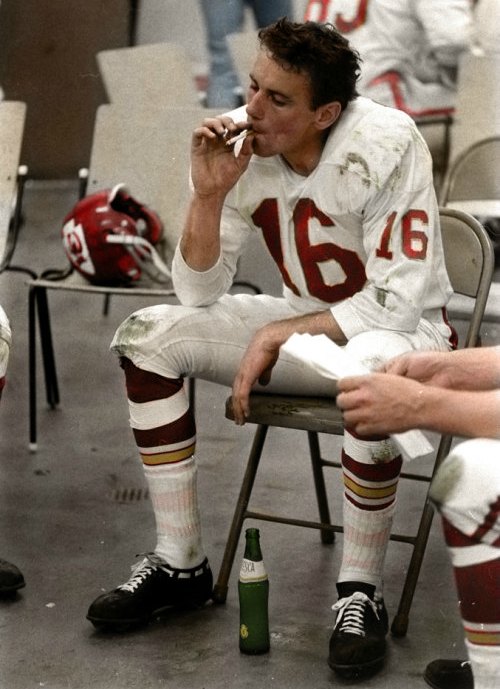
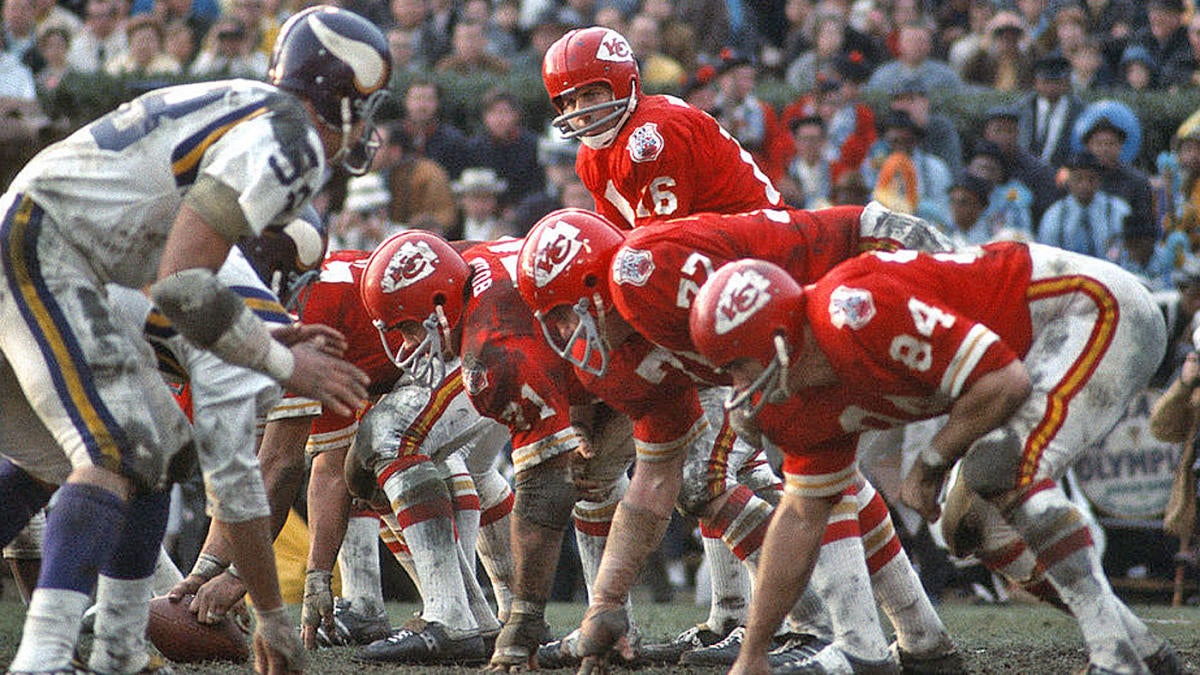
In 1966, with Dawson again being named the game's MVP, the Chiefs won a 2nd AFL Championship, making them the league's representative in the 1st AFL-NFL World Championship Game, later retroactively renamed Super Bowl I. At halftime, the Chiefs were very much in the game, trailing the NFL Champion Green Bay Packers, 14-10. In the locker room, Dawson smoked a cigarette, and a famous photo was taken. Final score: Packers 35, Chiefs 10. Let that be a lesson to you, kids: Don't smoke.
I'd seen this photo a dozen times,
and only now did I notice he was also drinking a beer.
Another lesson: Don't drink and drive an offense.

Dawson hurt his knee in the 2nd game of the 1969 season, but came back in midseason, and led the Chiefs to wins, in the Playoffs, on the road, over both participants in the previous season's AFL Championship Game, the Jets and the Raiders.

That 3rd AFL Championship got them into Super Bowl IV, but, in spite of Namath having proved the year before that it wasn't that the NFL was superior to the AFL, it was that the Packers were superior to everybody, the Vikings were big favorites.

But Dawson proved that the previous year's AFL win was no fluke, that the teams that would be forming the American Football Conference the next season, the 1st season of the merged NFL, were every bit as good as the established NFL teams that were forming the National Football Conference.
He completed 12 of 17 passes for 142 yards. Although he threw an interception, he also passed for a touchdown -- something that, for all his talk, all his charisma, and all his talent, Namath did not do a year earlier. And with the AFL's best defense, the Chiefs beat the Vikings, 23-7 at Tulane Stadium in New Orleans. The founding franchise of the AFL had won the last game any AFL team would ever play, and had made Lamar Hunt's point.

The Chiefs made the Playoffs again in 1971, and moved into Arrowhead Stadium in 1972. Dawson was named NFL Man of the Year (now known as the Walter Payton Man of the Year Award), in 1973, and retired after the 1975 season. He was named to the AFL All-Time Team, the Chiefs' team Hall of Fame with his Number 16 retired, and, in 1987, the Pro Football Hall of Fame.

Dawson became the sports director for KMBC-Channel 9, the ABC affiliate in Kansas City, and broadcast for the Chiefs from 1976 to 2017. From 1977 to 2001, he hosted HBO's Inside the NFL. From 1977 to 1982, he analyzed AFC games for NBC.

In 2012, the Hall of Fame gave him its Pete Rozelle Award, making him only the 2nd person in any of North American's "Big Four" sports to be honored by its Hall of Fame as both a player and a broadcaster, following Frank Gifford. (Walt Frazier just became the 1st basketball player so honored, but no baseball or hockey player has.) In 2017, Clark Hunt, who became Chiefs owner following his father Lamar's death in 2006, named the Arrowhead Stadium broadcast booth for Dawson.
The reason this was done in 2017 is that he had announced that he was retiring at the end of the season, as his health had begun to fail. He had remarried, and his 2nd wife, Linda remained by his side until he died this morning, August 24, 2022, at the University of Kansas Medical Center in Kansas City, Kansas. He was 87 years old.

"My family and I are heartbroken," Clark Hunt said in a statement Wednesday. "Len Dawson is synonymous with the Kansas City Chiefs. Len embraced and came to embody Kansas City and the people that call it home. You would be hard-pressed to find a player who had a bigger impact in shaping the organization as we know it today than Len Dawson did."

Dawson still held most of the Chiefs' career passing records, but he lived long enough to see Patrick Mahomes lead them to victory in Super Bowl LIV, ending a 50-year drought.
Mahomes said today, "RIP to the legend Len Dawson. The legacy and impact you made on Kansas City will live on forever. Prayers to his family."

With his death, there are now 21 living players from the Chiefs' Super Bowl IV winners: Willie Lanier, Bobby Bell, Jan Stenerud, Ed Podolak, Emmitt Thomas, Mike Garrett, Johnny Robinson, Ed Budde, Otis Taylor, Tom Flores, Paul Lowe, Warren McVea, Mike Livingston, Willie Mitchell, Frank Pitts, Curtis McLinton, Jim Marsalis, Jim Kearney, Bob Stein, Mo Moorman and Ed Lothamer.

And there are 10 surviving players from the AFL All-Time Team: Chiefs Lowe, Robinson, Bell and Budde; Jets Namath and Gerry Philbin; the Bills' Billy Shaw; the Raiders' Jim Otto; and the San Diego Chargers' Lance Alworth and Ron Mix.