Showing posts with label y.a. tittle. Show all posts

Friday, October 28, 2022

October 28, 1962: The Cuban Missile Crisis Is Resolved

Herbert Block (Herblock) cartoon in The Washington Post,
November 1, 1962: JFK says, "Let's get a lock for this thing."

October 28, 1962: The Cuban Missile Crisis is resolved, as Soviet Premier Nikita Khrushchev
announces that he has ordered the removal of Soviet missile bases in Cuba, as demanded by President John F. Kennedy.

In a secret deal between them, JFK agrees to the withdrawal of U.S. missiles from Turkey. The fact that the Turkey part of the deal is not made public makes it look like the Soviets have backed down, rather than that the deal was a true compromise.

Much of the world thought that this was it, that World War III was assured, that the NFL and AFL games of this day might be the last sporting events that they'd ever see, or even that they would be prevented. They weren't, and the world moved on.

One event the world moved on to was the Nuclear Test Ban Treaty, signed on July 26, 1963 by JFK, Khrushchev, and British Prime Minister Harold Macmillan, banning nuclear testing in the atmosphere -- including above the Arctic Circle.

*

October 28, 1962 was a Sunday. The baseball season ended on October 16, as the New York Yankees beat the San Francisco Giants 1-0 in Game 7 of the World Series, the 1st Series to be between a team on the Atlantic Coast and a team on the Pacific Coast. (The Dodgers had already been in a World Series since their move from Brooklyn to Los Angeles, in 1959, but their opponent was the Chicago White Sox, not a coastal team. The Dodgers won it.)

There was 1 NBA game played that day. The Cincinnati Royals beat the San Francisco Warriors, 131-130 at the Cincinnati Gardens. The Warriors were in their 1st season on the Coast, after playing in Philadelphia. They changed their name to the Golden State Warriors in 1971.

Wilt Chamberlain scored 53 points and grabbed 27 rebounds. Just another day at the office for the greatest basketball player who ever lived. But Oscar Robertson, himself a serious contender for that title, scored 36 to lead the team now named the Sacramento Kings to victory.

For the NHL, this was the "Original Six" era, and 4 of the 6 played. The New York Rangers lost to the Chicago Black Hawks, 5-3 at the old Madison Square Garden. And the Detroit Red Wings beat the Toronto Maple Leafs, 2-0 at the Olympia Stadium in Detroit. The Montreal Canadiens and the Boston Bruins did not play.

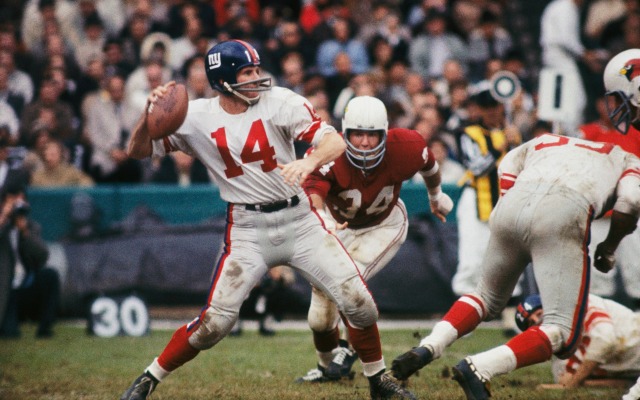
And there was football. In the NFL, at the original Yankee Stadium. Y.A. Tittle tied an NFL record with 7 touchdown passes, and the New York Giants beat the Washington Redskins 49-34.

Tittle is 1 of 8 NFL quarterbacks to have thrown 7 touchdown passes in a single game. Sid Luckman of the Chicago Bears did it against the Giants in 1943. Adrian Burk of the Philadelphia Eagles did it against the Redskins in 1954. Although it was in the AFL, the NFL counts George Blanda of the Houston Oilers doing it against the New York Titans (the Jets) in 1961. Joe Kapp of the Minnesota Vikings did it against the Baltimore Colts in 1969.

It was done twice in 2013, by Peyton Manning of the Denver Broncos against the Baltimore Ravens, and by Nick Foles of the Philadelphia Eagles against the Oakland Raiders. In 2015, the Giants were victimized again, by Drew Brees of the New Orleans Saints.

Also on October 28, 1962:

* The Green Bay Packers beat the Baltimore Colts, 17-6 at Memorial Stadium in Baltimore. Johnny Unitas was the greatest quarterback of the era, but Vince Lombardi was the best coach and the best general manager, and had built the best team. From September 24, 1961 to September 13, 1964, the Packers went 38-5-1, including winning the 1961 and 1962 NFL Championship Games.

* The Cleveland Browns beat their arch-rivals, the Pittsburgh Steelers, 41-14 at Forbes Field in Pittsburgh.

* The St. Louis Cardinals beat the Dallas Cowboys, 28-24 at the Cotton Bowl in Dallas.

* The Detroit Lions beat the Chicago Bears, 11-3 at Tiger Stadium in Detroit.

* The Philadelphia Eagles beat the Minnesota Vikings, 31-21 at Metropolitan Stadium in the Minneapolis suburb of Bloomington, Minnesota.

* And the Los Angeles Rams beat their arch-rivals, the San Francisco 49ers, 28-14 at Kezar Stadium in San Francisco.

In the upstart American Football League:

* The New York Titans beat the San Diego Chargers, 23-3 at the Polo Grounds in New York. The Titans changed their name to the New York Jets the next year.

* The Boston Patriots beat the Oakland Raiders, 26-16 at Boston University Field. The stadium would be renamed Nickerson Field in 1964, and the team would be renamed the New England Patriots upon their move to suburban Foxborough, Massachusetts in 1971.

* The Dallas Texans beat the Houston Oilers, 31-7 at Jeppesen Stadium in Houston. The teams would meet again in the AFL Championship Game, and the Texans won. The next year, though, tired of trying to compete for attention with the NFL's Cowboys, they moved, becoming the Kansas City Chiefs.

* The Buffalo Bills beat the Denver Broncos, 45-38 at Bears Field in Denver. Bears Field would be expanded and turned into the original Mile High Stadium.

Tuesday, October 10, 2017

Y.A. Tittle, 1926-2017

Before there was Peyton Manning, before Brett Favre, before Vinny Testaverde, before Steve DeBerg, even before George Blanda became the old quarterback giving it one more spectacular shot, there was Y.A. Tittle.

And he may have been better than any of them.

Yelberton Abraham Tittle Jr. was born on October 24, 1926 in Marshall, Texas, in the northeastern corner of the Lone Star State. Learning that the greatest of all Texas-born football players, Sammy Baugh, had practiced throwing footballs through a tire swing, he did the same thing. In 1943, he quarterbacked Marshall High School to an undefeated season.

He was recruited by Louisiana State University, and since World War II caused a manpower drain, the NCAA temporarily rescinded its prohibition on freshmen playing varsity sports (which it would strike down for good in 1972). LSU won only 2 games in 1944, but 1 was over arch-rival Tulane, in which Tittle through for 238 yards, then a school record.

In 1946, LSU beat Tulane again, and was awarded a berth in the Cotton Bowl in Dallas -- not quite Tittle's hometown, but the closest big city to it. More than 20 years before a game in Green Bay got the nickname, this game was called the Ice Bowl, as the field at the Cotton Bowl was covered with ice in frigid weather. Tittle was able to move the ball a little, but nobody moved it much, and the game with Arkansas ended in a 0-0 tie.

When I was a kid, I saw a little sports trivia book, and it had this question: "Who was the only man to hit a home run off Sandy Koufax and catch a touchdown pass from Y.A. Tittle?" It was Tittle's predecessor as LSU's starting quarterback, future New York Giants shortstop Alvin Dark.

*

Tittle was chosen by the Detroit Lions in the 1st round of the 1948 NFL Draft, but he signed with the Baltimore Colts of the All-America Football Conference instead. The Lions went after another quarterback from Texas, Bobby Layne, and did all right. With the Colts, Tittle was 1948 AAFC Rookie of the Year. They joined the NFL for 1950, but were bankrupt, and folded. A new Colts would start in 1953.

The San Francisco 49ers took Tittle in the dispersal draft. In 1951 and 1952, he split quarterbacking duties with Frankie Albert, one of the earliest lefthanded quarterbacks. He became the starter in 1953, and led the Niners to a 9-3 record, the 1st of several near-misses for him.

In 1954, the 49ers had the only backfield ever to be fully comprised of future members of the Pro Football Hall of Fame. Behind Tittle were halfback Hugh McElhenny and fullbacks John Henry Johnson and Joe "the Jet" Perry. They were called the Million Dollar Backfield ($1 million then would be about $9.2 million today, or about $2.3 million per year per man), and the hype was such that, on their issue dated November 22, 1954, Tittle became the 1st pro football player to appear on the cover of Sports Illustrated.

Tittle reminisced, "It made quarterbacking so easy, because I just get in the huddle, and call anything, and you have 3 Hall of Fame running backs ready to carry the ball." But he also said, "They should have called us the Hundred Dollar Backfield, because that's about what we were paid."

The Million Dollar Backfield lasted all of 6 games. The 49ers beat the Lions, the Washington Redskins, the Green Bay Packers and the Chicago Bears, and tied the Los Angeles Rams. But on Halloween, October 31, McElhenny got his shoulder separated, and the 49ers lost 31-27 to the Chicago Bears, and their championship aspirations were ruined. This was a run of losing 4 out of 5, and they finished 7-4-1. (Don't blame The Dreaded SI Cover Jinx: This was before Tittle was on the cover.)

The backfield was kept together for 2 more seasons, but won nothing. Johnson was traded before the 1957 season, and a new player, receiver R.C. Owens, made his mark when he jumped high in the air to catch Tittle passes, a play that became known as "the alley-oop." The Niners tied the Lions for the Western Division title, losing a Playoff. This would be as close as they would get to an NFL Championship for 13 years. They wouldn't get closer for another 24 years.

In 1960, a new coach came in, Red Hickey, and he became the 1st NFL coach to use the shotgun formation. This enabled him to use 2 young quarterbacks at once, John Brodie and Billy Kilmer. Tittle had become marginalized. He was 34, and it seemed his days as a starting NFL quarterback were over.

*

But after the 1st preseason game in 1961, Tittle was traded to the New York Giants, rejuvenating his career. He was actually younger than the quarterback the Giants had: Charlie Conerly, who had led them to the 1956 NFL Championship and back to the Championship Game in 1958 and '59, was 40. Tittle led the Giants to the Eastern division Championship, and was voted by the NFL players as League Most Valuable Player. But the Giants got clobbered by the Packers in the Championship Game, 37-0.

On October 28, 1962, the day the Cuban Missle Crisis was resolved, Tittle tied an NFL record with 7 touchdown passes in a 49-34 win over the Redskins. In the season finale, he threw 6 in a 41-31 win over the Dallas Cowboys, setting a new NFL record with 33 touchdown passes on the season. Again, the Giants won the Division. Again, they advanced to the Championship Game. This time, it was at home at Yankee Stadium. But again, the Packers won, 16-7.

Tittle had to be talked out of retirement in 1963. At 37, he set a new record with 36 touchdown passes, and he was named MVP by the Associated Press. He was a bigger star than ever, even appearing as the "mystery guest" on CBS' What's My Line?

Again, he got the Giants into the Championship Game. This time, it was against the Bears at a chilly Wrigley Field. In the 2nd quarter, he was tackled by Larry Morris and wrecked his knee. But he kept playing, gamely trying to finally win that elusive title. But he threw 5 interceptions, 4 after the injury, and the Bears won, 14-10.

The Giants seemed to get old all at once. On September 20, 1964, the Giants played the Pittsburgh Steelers at Pitt Stadium. John Baker hit Tittle hard enough to give him a concussion, crack his sternum, and injure the cartilage in his ribs. Chuck Hinton, who later played for the Jets, intercepted the pass that Tittle threw, and returned it for a touchdown. The Steelers won, 27-24.

There were no hard feelings: Baker later ran for Sheriff in Wake County, North Carolina, and Tittle went there to campaign for him during one of his re-election bids. He served 24 years.

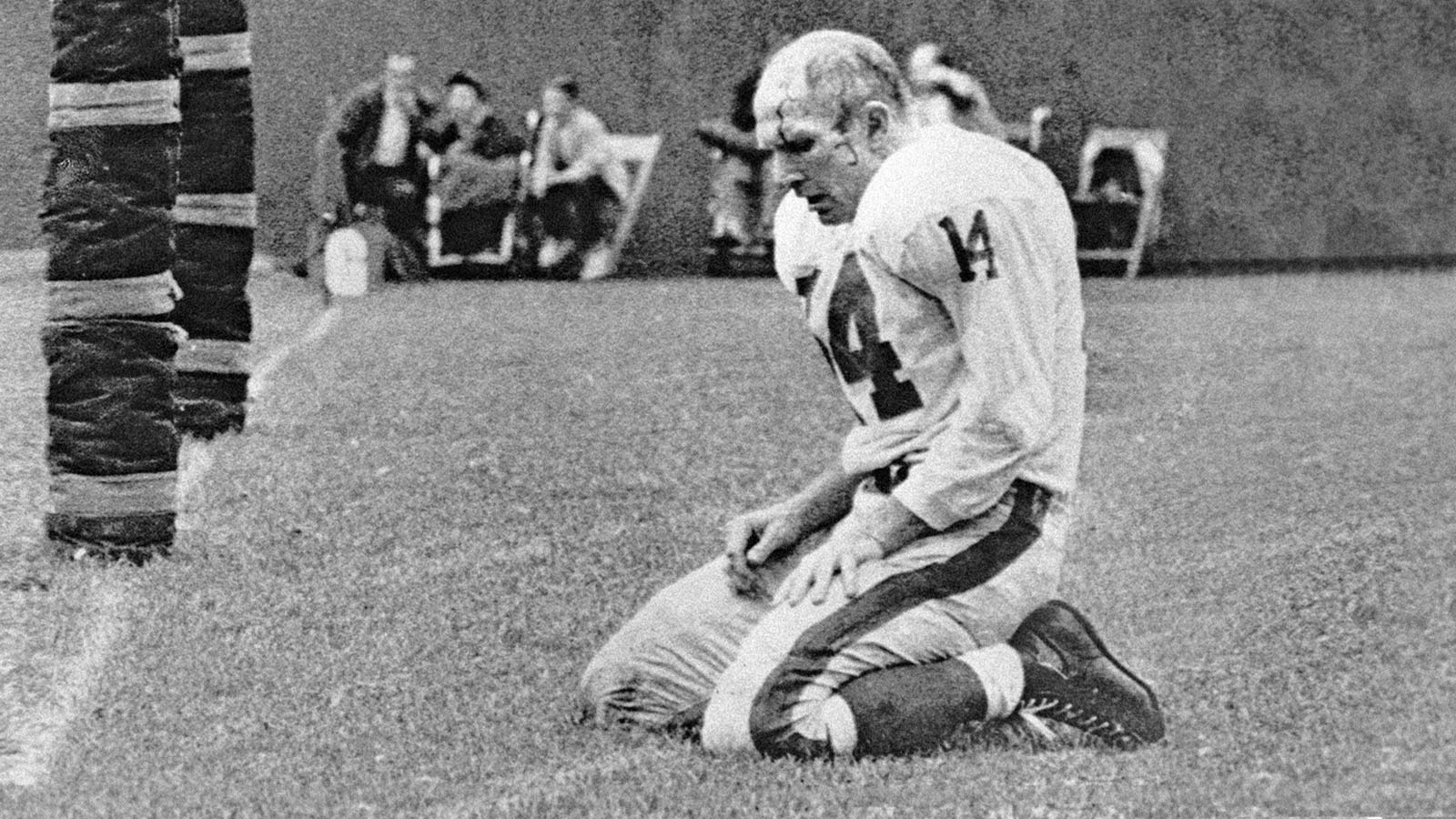
Morris Berman of the Pittsburgh Post-Gazette took a picture of Tittle kneeling on the grass after the hit, blood dripping from his famously bald scalp. While the P-G refused to publish it, preferring what it called "action shots," Berman took it to Life magazine, which published it in its October 2, 1964 issue. The photo became iconic, with Charlton Heston re-enacting it while playing an aging quarterback in the 1969 film Number One.
It was the beginning of the end, for Tittle and that generation of Giants. They finished 2-10-2 that season. "That was the end of the road," Tittle later said. "It was the end of my dream. It was over." But, at the time, he held most of the major career passing records that would later be broken by Johnny Unitas, then Fran Tarkenton, then Brett Favre, then Peyton Manning, then Tom Brady: 4,395 passes, 2,427 completions, 33,070 yards, 242 touchdowns, and 39 rushing touchdowns for a quarterback.

*

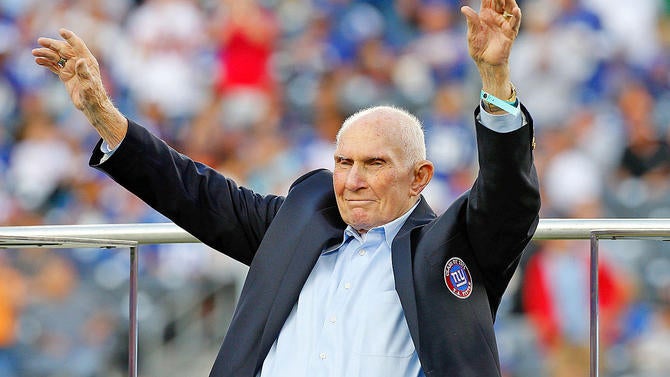
He was elected to the Pro Football Hall of Fame, the Texas Sports Hall of Fame, the Louisiana Sports Hall of Fame, the Bay Area Sports Hall of Fame, the San Francisco 49ers Hall of Fame, and the New York Giants Ring of Honor. The Giants retired his Number 14. He later served as an assistant coach for the 49ers and the Giants, and returned to the Bay Area, launching an insurance and financial services company.

On October 31, 1994, 40 years to the day after the Million Dollar Backfield got derailed, he appeared with another New York quarterbacking legend, Joe Namath of the Jets, and Packer linebacker icon Ray Nitschke, in a Halloween-themed cold open for ABC's broadcast of a Monday Night Football game between the Packers and the Bears. (I have it on videotape somewhere. It doesn't seem to be on YouTube, nor does a photo seem to be on Google Images.)

He lived out his life in Atherton, the same town on "The Peninsula," San Mateo County south of San Francisco, where Willie Mays lived (and still does at this writing). He married a fellow LSU student named Minnette, and they had sons Michael, Patrick and John, and a daughter, Dianne Tittle de Laet, who wrote a biography, Giants & Heroes: A Daughter's Memories of Y.A. Tittle.
Minnette died in 2012. By this point, dementia had begun to take over, making Tittle yet another of the old-time NFL players affected by the many head shots that players take. In 2014, ESPN.com published a story by Seth Wickersham, about Dianne taking him back to Marshall and Baton Rouge, to trigger his memories one more time, and to get him talking about his experiences.

Y.A. Tittle died on October 8, 2017, at a hospital in Stanford, California, just short of his 91st birthday. A long life of defying many foes ended, as there is one foe that eventually stops caring about every person's defiance.

That foe erased Y.A. Tittle's memories. It cannot erase his place in the collective memory. For as long as people talk about football, they will talk about him. He earned that.

UPDATE: He was buried near the Stanford campus, at Alta Mesa Memorial Park in Palo Alto.

Tuesday, January 6, 2015

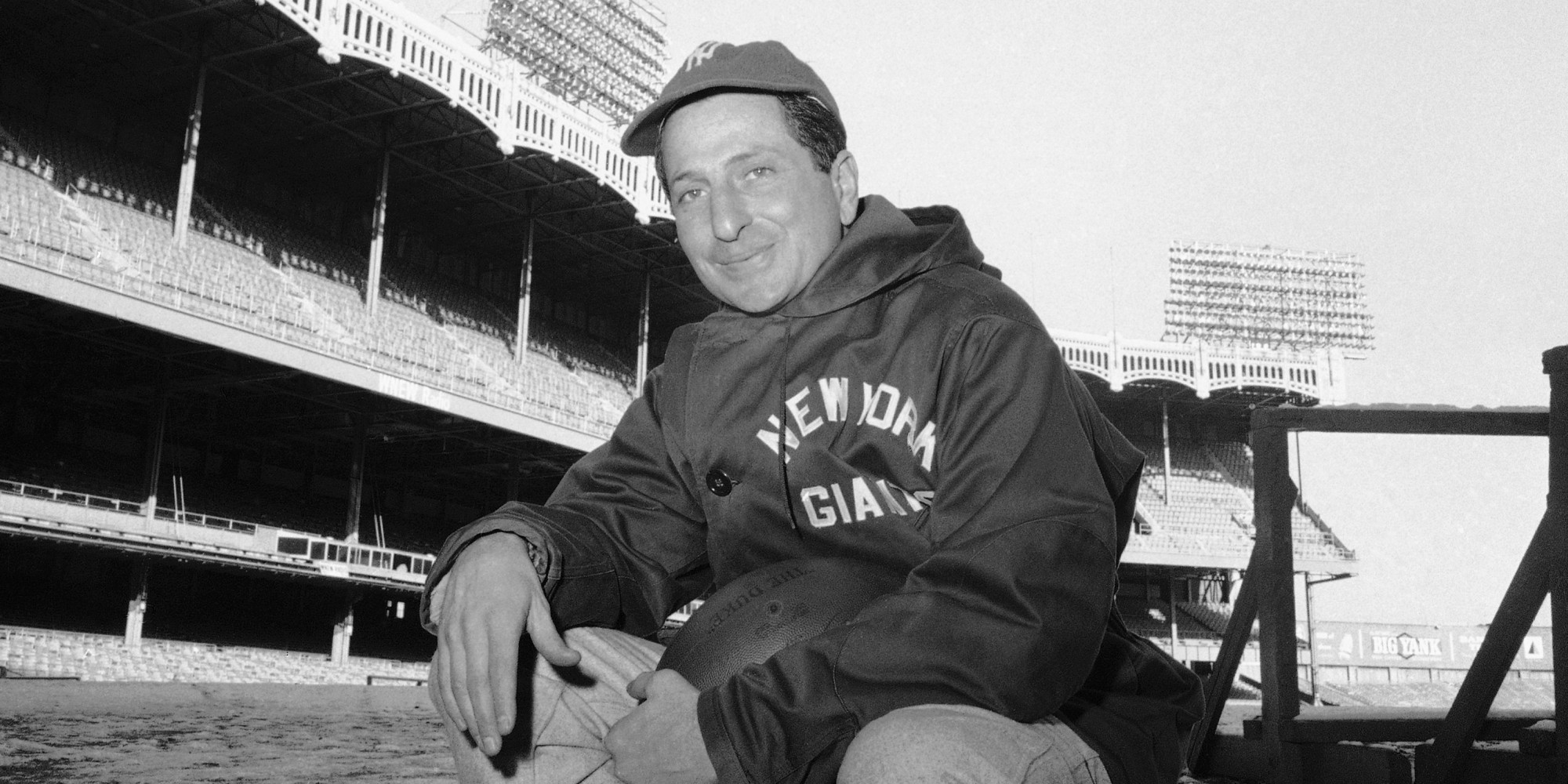
Allie Sherman, 1923-2015

In the wake of the Jets' decision to fire head coach Rex Ryan, and the Giants taking a chance by keeping Tom Coughlin, let us pause to remember Allie Sherman, who guided the Giants through highs and lows long ago.

Alexander Sherman -- who became "Allie" instead of "Alex," or even "Sander," as Michigan Congressman Sander Levin did -- was born on February 10, 1923 in Brooklyn, the son of Russian-Jewish immigrants. He attended Boys High School, in the Bedford-Stuyvesant section, before its merger to become Boys & Girls High School.

Other alumni of Boys High include: 2-time National League batting champion Tommy Davis; basketball stars Lenny Wilkens, Connie Hawkins, Si Green, Mel Davis; and sportswriter/sportscaster Howard Cosell. And that's just from the world of sports. It also produced novelist Norman Mailer, science fiction titan Isaac Asmiov, longtime Congressman Emanuel Celler, housing developer William Levitt, civil rights lawyer Will Maslow, his brother psychologist Abraham Maslow, painter Man Ray, music legends Aaron Copland and Max Roach, comedian Alan King, film producer Irving Thalberg, and actor Norman Lloyd, now 100 years old. Since the merger, its most notable graduate has been basketball star Dwayne "the Pearl" Washington.

When Sherman was 13, he was already a locally renowned athlete, and he tried out for the football team at Boys High. The head coach rejected him, for being too small. This was in 1936; Phil Rizzuto, even smaller, had already been the quarterback at Richmond Hill High School in Queens, before being rejected by Brooklyn Dodger manager Casey Stengel for being too small, and then signing with the Yankees where the rest was history -- although he would be reunited with Stengel, who admitted he was wrong, but Rizzuto never forgave him.

At 16, Sherman graduated, and got into Brooklyn College, paying his tuition with money he made from hustling older kids in handball. He tried out for their football team. This time, the coach wasn't the one who told him not to: His mother was. Allie and the coach talked her into letting him play, and in 1940 he became the starting quarterback. In 1942, he led BC to a shocking upset win over crosstown rival City College of New York (CCNY). He graduated at age 19.

There weren't many lefthanded quarterbacks in Sherman's day. But, knowing that Sherman had quarterbacked the T-formation, and that George Halas' Chicago Bears had shown that the T was the formation of the future and the single wing that of the past, Philadelphia Eagles coach Earl "Greasy" Neale took a chance on him. "Never have I seen a player with a greater understanding of the game," Neale said. "He was so dedicated, he insisted on rooming with a lineman. He wanted to absorb the way a lineman thought."
Eagles quarterback "Al" Sherman

Due to the World War II-induced manpower shortage, for the 1943 season, the NFL convinced the 2 Pennsylvania teams, the Eagles and the Pittsburgh Steelers, to merge for the season. The team, called the "Steagles," finished 3rd in the NFL Eastern Division with a record of 5–4–1. Both teams had started play in 1933, and this was the best finish that either of them had yet had.

The Eagles finished 2nd in 1944, '45 and '46, and tied the Steelers for 1st in '47. They beat the Steelers in a Playoff, the 1st postseason game in either team's history (and the only one the Steelers would play until the "Immaculate Reception" game in 1972). But they lost the NFL Championship Game to the Chicago Cardinals.

The next year, Neale put his faith in a new quarterback, Tommy Thompson. Sherman was gone -- but it worked, as the Eagles won the NFL Championship in 1948 (getting revenge on the Cardinals in a blizzard at Shibe Park) and 1949 (beating the Rams despite a rare Southern California rainstorm turning the Los Angeles Coliseum field into soup).

*

Sherman went into coaching. He won a title with a minor-league team in Paterson, New Jersey. Then Neale made it up to Sherman by recommending him to Steve Owen, longtime coach of the Giants. Owen had been losing due to his loyalty to the single wing, and finally gave up the ghost, and had Sherman teach the T to the Giants, turning Charlie Conerly into a championship and Hall of Fame quarterback.

When Owen retired after the 1953 season, Sherman didn't get the job -- former Giants player Jim Lee Howell did. It is worth nothing that Sherman was only 30 years old. There's no way any NFL team would name a 30-year-old man as head coach today. He did not, however, blame his rejection on his youth, or on his religion.

(UPDATE: The Los Angeles Rams hired Sean McVay as head coach in 2017, when he was only 31.)

He went to Canada, coached the Winnipeg Blue Bombers, and got them to the Playoffs. Canadian football's system, with 12 men on the field, 3 downs instead of 4, a wider field and deeper end zones, led Sherman to adapt with offensive schemes that would later help him in the NFL (even though he had to adapt back to the system he previously knew, as some of his Winnipeg plays, even with 11 men, wouldn't have been legal).

When the Giants took Sherman back as an assistant coach, the new Bombers head man was one of his receivers, Bud Grant, and he led them to 4 Grey Cup wins in 5 seasons, before moving on to the Minnesota Vikings, and leading them to 4 Super Bowls (though they lost them all).

In 1959, Giants offensive coordinator Vince Lombardi got the head job with the Green Bay Packers. He wanted Sherman to come with him as offensive coordinator. He refused, thinking Howell would soon move on, and that he would get the Giants job. This became more likely in 1960, as Giants defensive coordinator Tom Landry was named the 1st head coach of the expansion Dallas Cowboys. (Yes, kids: Lombardi and Landry were on the same coaching staff, in New York.)

In 1961, Howell left, and Sherman got his wish, at age 38, 8 years after he first hoped to. He wasn't the 1st Jewish head coach in the NFL, or even the Giants' 1st: Quarterback Benny Friedman was briefly a player-coach. But Sherman became the most successful Jewish head coach in NFL history.

With an aging but still effective Y.A. Tittle replacing Conerly, Sherman led the Giants to 3 straight Division titles. He earned NFL Coach of the Year awards in 1961 and 1962, the 1st time that a coach won that honor in back-to-back seasons.

But the Giants didn't win the title. In 1961, they got wiped out in the NFL Championship Game, losing 37-0 to the Green Bay Packers on a snowy New Year's Eve at what would later be renamed Lambeau Field.

In 1962, with Frank Gifford ending his 1-year retirement, they faced the Packers again, this time at Yankee Stadium. (In those days, the site rotated between the Division Champions, rather than getting assigned to whoever had the best record. Good thing for the Giants, as the Packers were 13-1 that year.) The cold, freezing the field, helped the Packers, but it shouldn't have fazed a team playing in New York, or a coach who had coached in Canada. But the renowned Giants defense, led by Sam Huff, couldn't stop Jim Taylor, and their offense couldn't get a footing, and the Packers won, 16-7.

The 1963 title game still stands as perhaps the most frustrating in Giants history. They played the Bears at a frigid Wrigley Field, and Tittle sustained a knee injury. Courageously, Tittle convinced Sherman to keep him in the game, and, despite repeatedly getting hit and driven into the frozen Wrigley grass, he led a final drive with the Bears up 14-10. But an interception ended the Giants' chances, and Tittle would never win a title.

In 1964, just as the Yankees would a year later, the Giants faced a situation where everyone seemed to get old, or hurt, or both, at once. The team collapsed from 11-3 to 2-10, its worst season ever, in just that 1 year, and Sherman no longer looked like a genius.

To make matters worse, Giants owner Wellington Mara orchestrated the trades of some of the better players: Huff went to the Washington Redskins, where he became a big part of that franchise's revival after a long down period; while defensive end Rosie Grier went to the Rams, where he became part of their imposing defensive line known as the Fearsome Foursome.

Sherman told Mara he should draft Joe Namath. He refused. Namath proved Sherman right, as he did become a great pro quarterback who led a New York team to a World Championship -- but it was the Jets. Instead of drafting the man who would become Broadway Joe, Mara traded for Vikings quarterback Fran Tarkenton, who never really meshed with New York or its fans, and was sent back to Minnesota, where he led them to 3 of their 4 NFC Championships.

The Giants got back to 7-7 in 1965, but in 1966, they crashed to their worst season ever, 1-12-1. In just 3 seasons, Sherman had coached the 2 worst seasons in Giant history. (They're still 2 of the 4 worst, for this franchise that has now played 90 seasons.) To the tune of "Good Night, Ladies," Giant fans began singing, "Goodbye, Allie."

This was long before the Jet fans' chant of "Joe Must Go" for Joe Walton, the Giant fans' chant of "Ray Must Go" for Ray Handley, or the Jet fans' chant of "FI-re KO-tite!" for Rich Kotite. Fans began bringing "GOODBYE ALLIE" banners. They did this at a time when Yankee management had banners confiscated at Yankee Stadium, thinking it was a bush-league thing that Met fans did. Sherman was unfazed, saying, "They paid their money, and can do what they want."

He may have won a few fans back by being savvy with the media, as he was among the earliest NFL head coaches to take press questions daily. Understanding NFL Commissioner Pete Rozelle's desire to make the NFL more accessible to fans via television, every Monday morning after a game, Sherman presented game film clips and evaluations -- standard procedure now, but revolutionary at the time.

Rethinking his 1963 rejection of writer (and Giant fan) George Plimpton's idea to allow Plimpton to pose in training camp as a rookie quarterback (resulting in him going to the Detroit Lions and producing the bestseller Paper Lion, made into a movie with a young Alan Alda), in 1966 Sherman and Mara accepted the proposal of author Eliot Asinof (author of the Black Sox book Eight Men Out) to spend 2 years with the team having total freedom and unlimited access to players, coaches, and executives, even closed coaches meetings.

This resulted in a never-before seen behind-the-scenes look of the inner world of the professionals, Seven Days To Sunday, published in 1968. This was right before the publication of Packer guard Jerry Kramer's diary of the 1967 season, Instant Replay, and before Roy Blount Jr.'s insider's look at the 1972 Steelers, About Three Bricks Shy of a Load.

While college football coaches had previously had radio shows, Sherman produced and owned the 1st pro football coach's weekly television program, on then-independent station WPIX-Channel 11, reviewing film of the Giants' prior game and discussing football with invited players, coaches, and guests, giving many fans their 1st peek inside professional football and "up close and personal" moments with the players.

He co-produced and hosted a Monday night radio program, Ask Allie, airing on the Giants' station, WNEW (1130 on your AM dial, now Bloomberg Radio), where it was just him sitting in a booth, smoking a cigar, and directly taking fans call-in questions and comments.

The press respected Sherman for facing fans weekly, especially just 24 hours after a tough loss, and always treating them graciously. He also hosted the first nationally syndicated TV panel-discussion sports show called Pro Football Special, where, in reviewing touchdown plays, he would say that the runner, once in the clear, "goes in for the touch."

He annually held a big Christmas party for the press, inviting everyone who regularly covered the Giants, even his critics. All this won some of them over, but he was still sometimes called "very Madison Avenue-ish," suggesting that he should concentrate less on public relations and more on winning; less on "sizzle" and more on "steak."

In 1965 an 1966, he added former Giants Emlen Tunnell and Roosevelt Brown, both future Hall-of-Famers, to his coaching staff. They were the 1st 2 African-American assistant coaches in the NFL. This may have helped, strategically as well as with public relations: In 1967 and 1968, the Giants went 7-7, missing the newly-expanded Playoffs by 1 game in '68. It was a brief reprieve, and the crosstown Jets ended up beating the Baltimore Colts in Super Bowl III for the World Championship, the 1st for a New York football team since the 1956 Giants.

Then came the nail in Allie's coaching coffin: The following preseason, as part of the process of the AFL's absorption into the NFL, the 2 New York teams played each other for the 1st time -- not at Yankee Stadium or Shea, but at the Yale Bowl in New Haven. Three Jet players chose to come out of retirement, just for this 1 game, because they wanted to make a point about being not just the best team in the world, but the best team in New York. The Jets won, 34-17, and at the end of the season, Mara fired Sherman.

In his 1st 3 seasons as an NFL head coach, Sherman went 33-8-1. In his last 6 seasons, he went 30-51-3. Overall, he was 63-59-4. At age 46, he had coached his last game.

*

But he was neither away from the game nor unproductive with the 2nd half of his life. The main reason he didn't coach again in the NFL is that he thought it would be better to go into management, and so he turned down some offers. He tried to put together a group that would buy an NFL team. One of these attempts was with Steve Ross, head of Warner Communications, Inc. (WCI). They tried and failed to buy the Jets from Leon Hess.

Ross agreed with Sherman that sports content also had great potential value, with cable television as a delivery system. Ross asked Sherman to join WCI and use his coaching and media expertise to build good teams and develop these potential assets. While helping WCI win cable franchises in additional cities, Sherman was part of WCI's experimental QUBE system in Columbus, Ohio.

It was the nation's 1st interactive cable system, enabling QUBE customers to individually order film and other content direct from home on a pay-per-view basis. Sherman recognized its marketing and revenue potential for sports programming. He created cable's first sports subscription package with Ohio State University Chancellor Gordon Gee.

In each WCI cable system, in big cities like Dallas and Chicago, Sherman continued to acquire college and professional sports rights, and then built regional sports networks to exhibit the games and specially created related programming. Eventually they were all purchased, and are known today as the Fox Sports Networks. Sherman positioned WCI's growing cable systems as an integral part of the sales and marketing of national pay-per-view events, especially high-priced championship fights. He negotiated special rights deals with impresarios and friends Don King and Bob Arum.

Ross had been a founding co-owner of the North American Soccer League's New York Cosmos, and used WCI to boost the team and the league. When Pelé announced his retirement in 1977, he requested that the man he called "Allie Boss" produce his farewell game, a testimonial at Giants Stadium, between the Cosmos and Pelé's former club team in Brazil, Santos. Pelé would play a half for each team.

Sherman put together a package of an ABC special game presentation, a worldwide syndicate of TV networks in 117 countries, including the Soviet Union, global sponsors to market it, had Frank Gifford as host with myriad celebrities and officials, ending with a special award presented by Muhammad Ali, then still Heavyweight Champion of the World. (Supposedly, the man who liked to call himself "The Greatest" said of Pelé, "Now I understand: He is greater than I am.")

Between Pelé, Ali, the Cosmos, the power of New York, the love of the game, Ross' media reach, and Sherman's promotional genius, this broadcast remains, outside of World Cup matches, the most-watched soccer event ever broadcast.

Sherman was a frequent guest on Warner Wolf's late-Sunday-night sports wrap-up show on WCBS-Channel 2, and this led to him going up to Bristol, Connecticut to appear live on the early ESPN, making him famous beyond the New York Tri-State Area. Having worked with the father-son team of Ed and Steve Sabol to help establish NFL Films in the 1960s, giving their film crews full access to the Giants behind the scenes, Allie worked with Steve to produce ESPN's pregame show for Monday Night Football (now on ESPN but then still on ABC), Monday Night Matchup.

He and his co-hosts would break down the teams into key matchups, and use stop-action film and graphics to analyze the upcoming game. This format later became a standard feature in ESPN's and the networks' sports programming. One of his panelists was a fellow former Eagle quarterback, Ron Jaworski, giving the Polish Rifle (that was his nickname before every ESPN viewer knew him as "Jaws") the springboard to a media career that, as with Sherman, has now outshone his playing days.

In 1994, using his usual lack of tact (which pissed off many, but endeared him to many more, much like predecessor Ed Koch), new Mayor Rudy Giuliani wanted to reform New York's Off-Track Betting system for taking horse racing bets outside the racetracks. He said, "OTB is the only bookie in the world that loses money every year," and asked Sherman to run it.

As Giuliani did with the streets of New York, Sherman cleaned OTB up both figuratively and literally: He closed down run-down stores, fixed up the rest, and leaned on his Warner Cable connections to create a racing station and to allow Warner customers to phone in bets. In just 2 years, OTB was making a profit for the first time. (After he left, it fell into losses again, and The City shut it down in 2010.)

Throughout the years, Sherman was involved with many charities, including charities for children with special needs, the Boys and Girls Clubs of America, and the Veteran's Bedside Network, where he regularly visited veterans’ hospitals, to talk football and sports with disabled veterans.

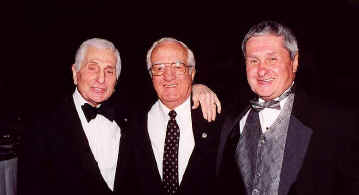
This is the most usable (relatively) recent photo I could find of Allie, from the NFL's "Helping Hands Award" charity dinner in 2002. He's on the left. In the middle is Tony Veteri, an official in the AFL and NFL for 23 years. On the right is George Beim, Events Coordinator for the charity.
Allie Sherman died this past Saturday, a few weeks short of his 92nd birthday. He is survived by his wife Joan, son Randy, daughters Lori Sherman and Robin Klausner, and 2 grandchildren. He is a member of the National Jewish Sport Hall of Fame in Long Island, and the Brooklyn College Hall of Fame as well.

He wasn't a great player or a great coach, but he was good at both. His true brilliance was in bringing football to the people, making him as important a football-in-media figure as Rozelle, the Sabols, and ABC Sports boss and Monday Night Football founder Roone Arledge. The Pro Football Hall of Fame's media award is named for Rozelle. Allie Sherman should have gotten it years ago. Hopefully, with a new Hall of Fame election coming up this month, he will be recognized.

Note: Some of this text is taken from Wikipedia's entry on Sherman.

UPDATE: He was buried at Mount Pleasant Cemetery in Hawthorne, Westchester County, New York, the same cemetery as another New York sports media legend, Bill Mazer. It is near Gate of Heaven Cemetery in Hawthorne, where Babe Ruth is buried; and that is next-door, albeit in an adjacent town, to Kensico Cemetery in Valhalla, where Lou Gehrig is buried.

Wednesday, February 8, 2012

Top 10 New York Quarterbacks

The Giants' Super Bowl win, their 2nd with Eli Manning as their quarterback, leads to the question of who are New York's best quarterbacks.

Honorable Mention: Ed Danowski, Giants, 1934-41. The position of quarterback was not yet what it would become during the course of his career, largely thanks to Sammy Baugh of the Washington Redskins and Sid Luckman of the Chicago Bears. But with Danowski (1911-1997) as quarterback, the Giants reached 5 NFL Championship Games, winning 2, in 1934 and 1938.

He was the 1st New York quarterback to start in, and the 1st New York quarterback to win, 2 NFL Championship Games. Phil Simms could have been the second, had he not gotten hurt; Eli Manning now is.

Ed's son John Danowski was a successful lacrosse coach at Hofstra University, and has been even more successful at Duke. John's son Matt Danowski is the all time Division I career leader in total points in NCAA lacrosse history.

Honorable Mention: Clarence "Ace" Parker, of the football version of the Brooklyn Dodgers, 1937-41. A great all-around athlete out of Duke University before anyone ever heard of Dick Groat, never mind Mike Gminski or Christian Laettner, he was another pre-Baugh quarterback who nonetheless became an offensive and defensive star.

He also played for the Philadelphia Athletics in 1936 and 1937. This coming May 17, if he makes it, will be his 100th birthday, making him both the oldest living pro football player, the 2nd-oldest living Major League Baseball player, and the oldest living member of any of the 4 major league sports' halls of fame.

10. Jeff Hostetler, Giants, 1984-92. A star at West Virginia University, he married the daughter of his coach, Don Nehlen. He was mainly Simms' backup at the Meadowlands, and only made 25 regular-season starts, nearly all of them in his last 2 seasons with the club. But when Simms was hurt late in the 1990 regular season, it was Hoss who got the Giants all the way through to victory in Super Bowl XXV. In 1993, he went to the Los Angeles Raiders, and got them into the Playoffs.

He is now 50 years old, and has returned to Morgantown, where he runs a construction company.

9. Richard Todd, Jets, 1976-84. Somebody had to succeed Broadway Joe as the Jets' starting quarterback, and, like Joe, he had the University of Alabama pedigree. And while he was mercilessly ripped in the media for not being Broadway Joe, he did get the Jets into the Playoffs twice (same number of times as Joe) and into the 1982 AFC Championship Game.

He is now 58, and works in the finance industry in his native Alabama.

8. Ken O'Brien, Jets, 1983-92. That great "Quarterback Class of '83" included Hall-of-Famers John Elway, Dan Marino and Jim Kelly, All-Pro Todd Blackledge, and Tony Eason whose career wasn't great but he did get the New England Patriots to their first AFL or AFC Championship.

O'Brien wasn't as good as Elway, Marino or Kelly, but he did make a Pro Bowl like Blackledge, passed for over 25,000 yards, and led the NFL with the lowest rate of interceptions in 1985, 1987, and 1988. In 1986 he battled Marino in one of the best-remembered Jet games ever, the 51-46 win over the Dolphins at the Meadowlands.

On a Monday Night Football broadcast, Frank Gifford, who's seen every quarterback since the early Fifties, said of O'Brien, "When he gets the time to throw the football, no one throws it any better than he does."

O'Brien is now 51, and has been a college assistant coach, having coached a Heisman Trophy winner, USC's Carson Palmer, and runs quarterbacking clinics.

7. Vinny Testaverde, Jets, 1998-2003 & 2005. Speaking of Heisman Trophy-winning quarterbacks, Vinny was one at the University of Miami, after being born in Brooklyn and raised just outside New York City in Elmont, Long Island, location of the Belmont Park horse racing track.

His pro career, like that of too many other Heisman winners, looked like it was going to be a bust, until he reached the Jets at age 34. The 1998 season was, and remains, the Jets' best season since the 1968-69 Super Bowl season, as Vinny led Bill Parcells' J-E-T-S-Jets-Jets-Jets to within half an hour of a Super Bowl appearance.

A severed Achilles tendon in the 1st game of the next season ruined things for that group of Jets, but he bounced back, remaining the Jets' starter until 2002, when he was replaced by Chad Pennington (who does not make this list -- nor does current Jets starter Mark Sanchez). Still, he remained in the NFL until 2007, age 44. Think about that: When Barack Obama was beginning his 1st campaign for President, there was a man taking snaps in the NFL who had been born when John F. Kennedy was in the White House.

Vinny is now 48, and will be eligible for the Pro Football Hall of Fame next year. Will he make it? Maybe: He passed for over 46,000 yards, threw 275 touchdown passes (but also 267 interceptions), and holds records for most seasons with at least one touchdown pass (21) and touchdown passes to the most different players (70).

6. Fran Tarkenton, Giants, 1967-71. He's best remembered as the 1st, and then the best, quarterback for the Minnesota Vikings, whom he led to 3 NFC Championships -- but lost the Super Bowl all 3 times. Still, he became the 1st NFL quarterback known for running to avoid a sack and keep a play alive, which became known as "scrambling." This allowed him to set all kinds of NFL records (most since broken), including most completions, passing yards and touchdowns, and reach the Pro Football Hall of Fame.

During his tenure at Yankee Stadium, the Giants weren't a very good team, but it was hardly his fault: A faulty defense meant that the best record the team would have in those years was 9-5 in 1970 -- not unlike the Yankees, whose best finish between 1964 and 1976 was their 93-win season in 1970, but 15 games behind the Pennant-winning Baltimore Orioles. At a time when Broadway Joe was leading the Jets to glory and glamour, Fran the Scrambler was keeping the Giants relevant.

Fran just turned 72, and became a gazillionaire by getting in on the ground floor of the computer industry. He's hosted and co-hosted TV shows, including ABC's That's Incredible!, been a commentator on Monday Night Football, written a self-help book: What Losing Taught Me About Winning, and co-authored a mystery novel, Murder at the Super Bowl.

5. Y.A. Tittle, Giants, 1961-64. Formerly the signal-caller for the Baltimore Colts and the San Francisco 49ers, Yelberton Abraham became, sort of, the Vinny Testaverde of his day. He debuted for the Giants just before turning 35, and got them into the next 3 NFL Championship Games, and it was hardly his fault that they lost them all.

Unfortunately, he is probably best remembered for one of his last games, in 1964, in which he got clobbered by the Pittsburgh Steelers as the great Giants teams of 1956 to 1963 suddenly seemed to get old all at once, a prelude to what would happen to the Yankees the following spring. The photo by Morris Berman of the Pittsburgh Post-Gazette has become a symbol of the price that football players pay for putting their bodies on the line for money.

Tittle is now 85, and retired from the insurance industry. In the film Any Given Sunday, he played the head coach of the Chicago team. He was the 1st quarterback to be elected to the Pro Football Hall of Fame without having led his team to an NFL Championship -- and that's including Ace Parker, who was elected a year after Tittle.

4. Charlie Conerly, Giants, 1948-61. Since Danowski was a pre-Baugh, pre-Luckman quarterback, Charlie (1921-1996) was the 1st "real quarterback" to lead the Giants to a title, in 1956. He was also the first great quarterback out of the University of Mississippi, predating Jake Gibbs, and Archie and Eli Manning.

After the arrival of Tittle led him to retire, he owned a string of shoe stores and appeared as the Marlboro Man in cigarette commercials -- before cigarette advertising was rightly banned from television. Although a member of the College Football Hall of Fame, he has never been elected to the Pro Hall.

3. Joe Namath, Jets, 1965-76. True, he only reached the Playoffs twice. Statistically speaking, Joe's credentials for the Hall of Fame are actually kind of skimpy -- he had far more interceptions (220) than touchdown passes (173), and his career completion percentage was barely over half (50.1). And due to injuries, he had his last good season at age 29, and was done at 34.

But how many New York quarterbacks have won Super Bowls? Four. And how many quarterbacks, for all teams, have won iconic championships? Very few. Joe's Super Bowl III win was one – along with Johnny Unitas and the 1958 NFL Championship Game, one of the top 2 of all time.

Joe is now 68 years old. Since retiring, and being elected to the Hall, he's been an actor and a sportscaster, and has had his personal difficulties. But he's still beloved by fans for his achievement and his personality, and respected by football people for his talent and his determination to succeed despite injuries. And, while he may have been drunk at the time of the interview, I don't blame him for wanting to kiss Suzy Kolber.

2. Phil Simms, Giants, 1979-93. Okay, Phil wasn't the Giants' starting quarterback in Super Bowl XXV, due to injury, but they wouldn't have gotten there without him. And he did complete 22 out of 25 passes in Super Bowl XXI, giving the G-Men their first World Championship of the modern era. Considering how many injuries -- and how many boos -- he got at the beginning of his career, it's amazing how loved he now is.

Now 57, Phil has been CBS' top NFL color commentator for the last few years, although CBS having the AFC package has led him to call a lot more Jet games than Giant games. His son Chris Simms has also been an NFL quarterback, although the less said about Chris' off-field activities, the better.

1. Eli Manning, Giants, 2004–present. Phil Simms led the Giants to 2 Super Bowl seasons and was Super Bowl MVP in 1 of them. Eli has now been named MVP of 2 Super Bowls, and both were better games than the ones Simms and Namath played in. And let's not forget: Much like the Jets were in Super Bowl III, the Giants were underdogs in both of their Supes with the Patriots.

Indeed, being the younger brother of Peyton Manning, having played his college ball at the University of Mississippi rather than a more storied football school, having been greeted with skepticism by Giant fans upon their acquisition of him following the 2004 NFL Draft, and playing in the NFC East with the Philadelphia Eagles' Donovan McNabb and Michael Vick and the Dallas Cowboys' Tony Romo, it can be argued that Eli was an underdog for the first 31 years of his life.

No more. At the beginning of this season, he was asked if he was "an elite quarterback." He said he was. He has now proven it. It will take a mistake of O.J. Simpson or Pete Rose proportions to keep him out of Canton now -- and he and Peyton will probably become the 1st brother combination to both be in the Hall, unless Clay Matthews (father of the Packer linebacker of the same name) joins his brother Bruce (and he should).

Eli at his best still isn't as good as Peyton was at his best, but he's won 2 NFL Championships. Here's a list of the NFL quarterbacks who've done that since Baugh and Luckman rewrote the rules for the passing game:

1. Sid Luckman, 1940, '41, '43 and '46 Chicago Bears
2. Sammy Baugh, 1937 & '42 Washington Redskins
3. Tommy Thompson, 1948 & '49 Philadelphia Eagles
4. Bob Waterfield, 1945 Cleveland & '51 Los Angeles Rams
5. Bobby Layne, 1952 & '53 Detroit Lions (hurt for '57 Championship Game)
6. Otto Graham, 1950, '54 & '55 Cleveland Browns
7. Johnny Unitas, 1958, '59 & '70 Baltimore Colts
8. Bart Starr, 1961, '62, '65, '66 & '67 Green Bay Packers
9. Bob Griese, 1972 & '73 Miami Dolphins
10. Terry Bradshaw, 1974, '75, '78 & '79 Pittsburgh Steelers
11. Roger Staubach, 1971 & '77 Dallas Cowboys
12. Jim Plunkett, 1980 Oakland & '83 Los Angeles Raiders
13. Joe Montana, 1981, '84, '88 & '89 San Francisco 49ers
(Not quite - Phil Simms, 1986 & '90 New York Giants)
14. Troy Aikman, 1992, '93 & '95 Dallas Cowboys
15. John Elway, 1997 & '98 Denver Broncos
16. Tom Brady, 2001, '03 & '04 New England Patriots *
17. Eli Manning, 2007 & '11 New York Giants

And of those, how many have been Super Bowl MVP twice? Just 5: Starr, Bradshaw, Montana, Brady (*) and Elway.

Pretty good company, Eli. He didn't walk off the field either time holding up the "We're Number 1" finger like Namath. But he could have. On the list of the greatest quarterbacks in the history of New York Tri-State Area football, Eli Manning is Number 1. And, hopefully, he's got a few more years to go.